Author Archive
 Author:
  November 7th, 2014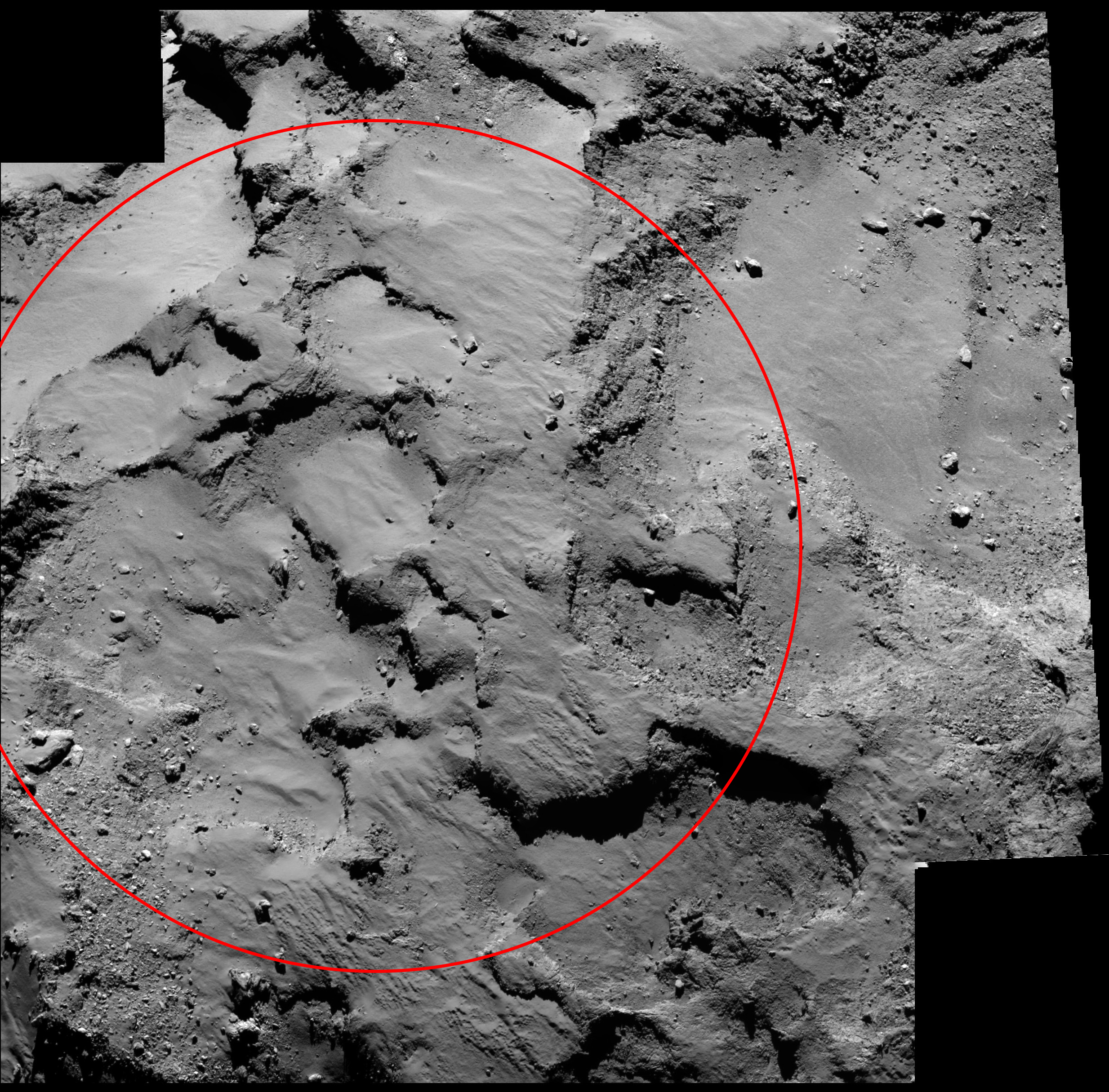
Close-up of the region containing Philae’s primary landing – “Agilkia” — which is located on the “head” of Comet 67P/Churyumov–Gerasimenko.
Credits: ESA/Rosetta/MPS for OSIRIS Team MPS/UPD/LAM/IAA/SSO/INTA/UPM/DASP/IDA
The European Space Agency’s Rosetta spacecraft is set to deploy its Philae lander for a first-time touchdown on a comet.
On November 11-12, Philae is set to separate from Rosetta at 09:03 GMT (10:03 CET) and touch down on Comet 67P/Churyumov-Gerasimenko at about 16:02 GMT (17:02 CET).
A timeline of the most crucial activities related to separation, descent and landing has been scripted by ESA. But be aware that many of these times are subject to change and confirmation, “given the extremely dynamic nature of this delicate and complex operation,” according to an ESA statement.
Landing site
The site where Rosetta’s Philae lander is scheduled to touch down on Comet 67P/Churyumov–Gerasimenko on November 12 now has a name: Agilkia.
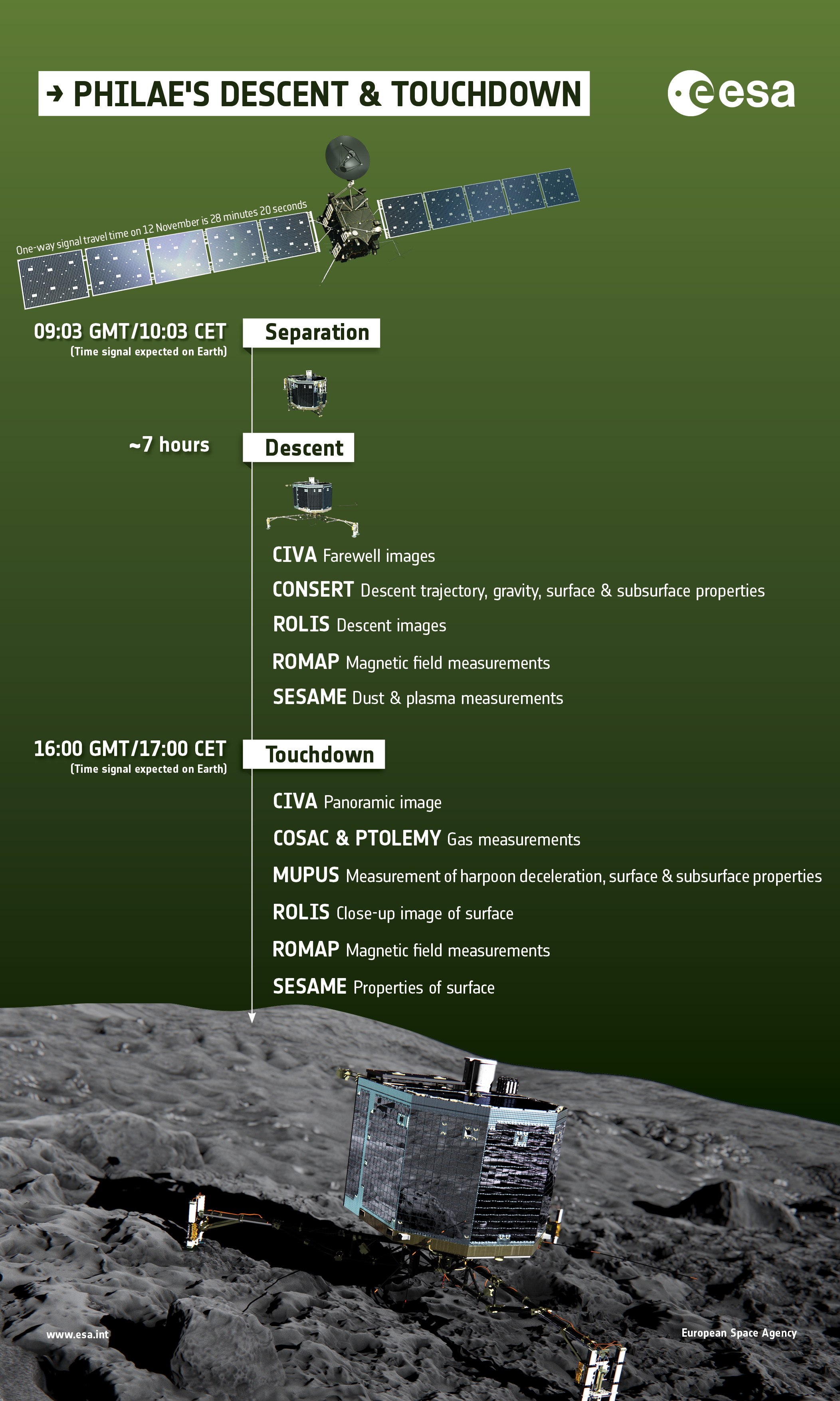
Timeline for touchdown.
Credit: ESA
The landing site, previously known as “Site J”, is named for Agilkia Island, an island on the Nile River in the south of Egypt. A complex of Ancient Egyptian buildings, including the famous Temple of Isis, was moved to Agilkia from the island of Philae when the latter was flooded during the building of the Aswan dams last century.
The name was selected by a jury comprising members of the Philae Lander Steering Committee as part of a public competition run October 16-22 by ESA and the German, French and Italian space agencies.
Rosetta was launched in 2004 and arrived at Comet 67P/Churyumov-Gerasimenko on August 6, 2014. It is the first mission in history to rendezvous with a comet, escort it as it orbits the Sun, and deploy a lander to its surface.
Rosetta is an ESA mission with contributions from its member states and NASA.
To keep updated on the attempted comet landing, go to:
NASA Television and the agency’s website will provide live coverage from 6-8:30 a.m. PST (9-11:30 a.m. EST) on Wednesday, November 12 of the European Space Agency (ESA) Rosetta mission’s scheduled landing of a probe on a comet.
NASA TV streaming video, downlink and updated scheduling information is at:
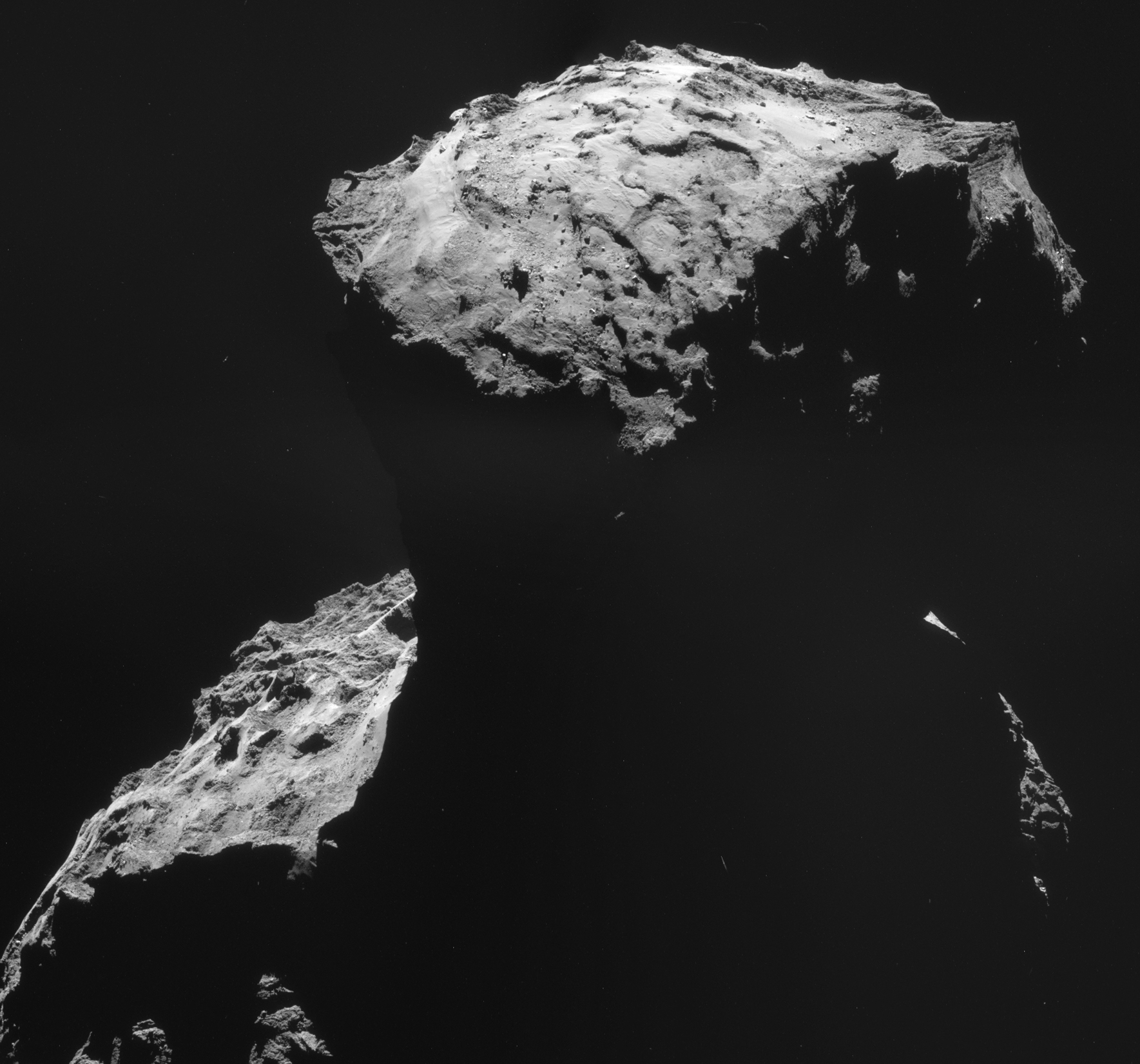
This four-image NAVCAM mosaic shows Philae’s landing site as Rosetta departed its 10 kilometer orbit in order to prepare for the deployment of Philae on November 12.
Credit: ESA/Rosetta/NAVCAM – CC BY-SA IGO 3.0
 Posted in

Space station astronaut Karen Nyberg uses instrument to create still and video imagery of her eye in microgravity.
Credit: NASA
Here’s a unique and novel opportunity for ophthalmology companies.
The National Space Biomedical Research Institute (NSBRI) and the Center for Space Medicine at Baylor College of Medicine have launched the Vision for Mars Challenge.
What’s being tackled here is addressing a key space biomedical issue. That is, after returning from space missions, some astronauts experience eye problems and changes to their vision.
The Challenge is meant to help identify and advance medical technologies for ocular health in space through collaboration and funding support.
New space syndrome
To help NASA better understand this new syndrome, clinical and business leaders within the ophthalmology sector are being asked to help identify cutting-edge, space-appropriate diagnostic approaches and devices.
 “We don’t understand the effects of reduced gravity on the optic nerve,” said Tim Stout, professor and chair of ophthalmology at Baylor. “However, we have some evidence that long term spaceflight can result in visual field defects in astronauts,” he said in an NSBRI press statement.
The next step is bringing the ophthalmologists and scientists needed to answer these questions to the same table.
Disruptive medical technologies
The Vision for Mars Challenge leverages an ongoing successful Industry Forum initiative called Space Medical and Related Technologies Commercialization Assistance Program or (SMARTCAP,) which identifies and funds small U.S.-based companies developing disruptive medical technologies.
At least three SMARTCAP grants in this cycle will be awarded to companies with innovative ophthalmology products.
Key Dates for the Vision for Mars Plan:
- November 6, 2014 – Vision for Mars Challenge conference in Houston, TX.
- December 4, 2014 – Application Deadline for SMARTCAP – Vision for Mars Challenge.
- February, 2015 – Winners of the SMARTCAP Vision for Mars Challenge announced.
Grant recipients must secure a 100-percent match in funding. This leveraging of federal funding actively fosters public-private collaborations and partnerships.
For full submission guidelines and additional information regarding SMARTCAP, go to: www.smartcap.org
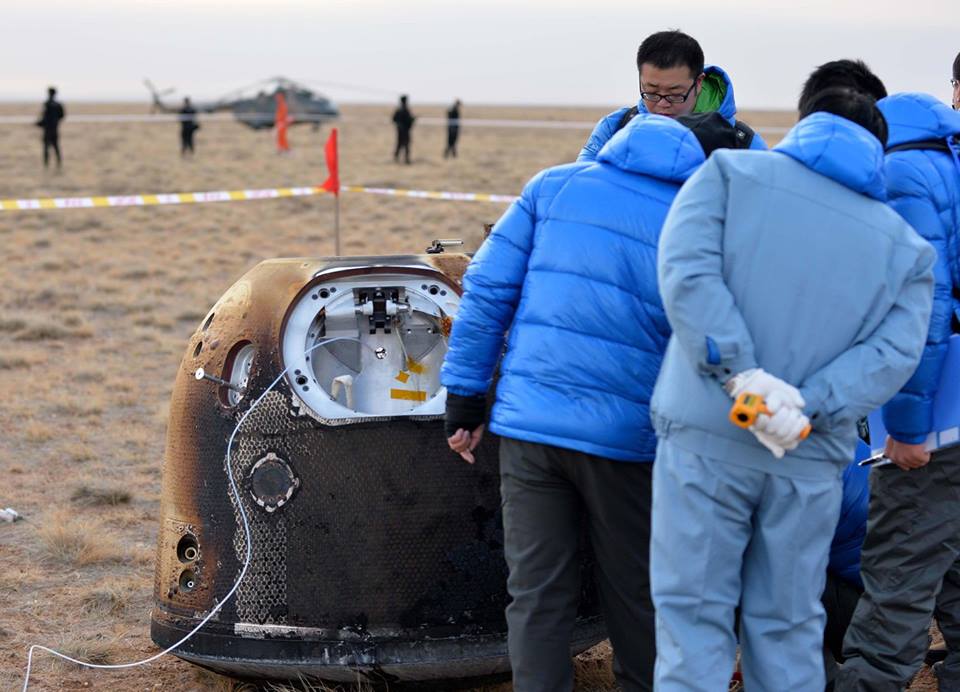
China’s recent Moon mission was a round-trip success.
Courtesy: China Space Website
A new story on the recent China succcess, posted today on Space.com:
China’s 1st Round-Trip Moon Shot Sets Stage for Bigger Lunar Feats
by Leonard David, Space.com’s Space Insider Columnist
November 05, 2014 07:00am ET
http://www.space.com/27661-china-moon-mission-sample-return.html
By the way, you might check out this video on the mission:
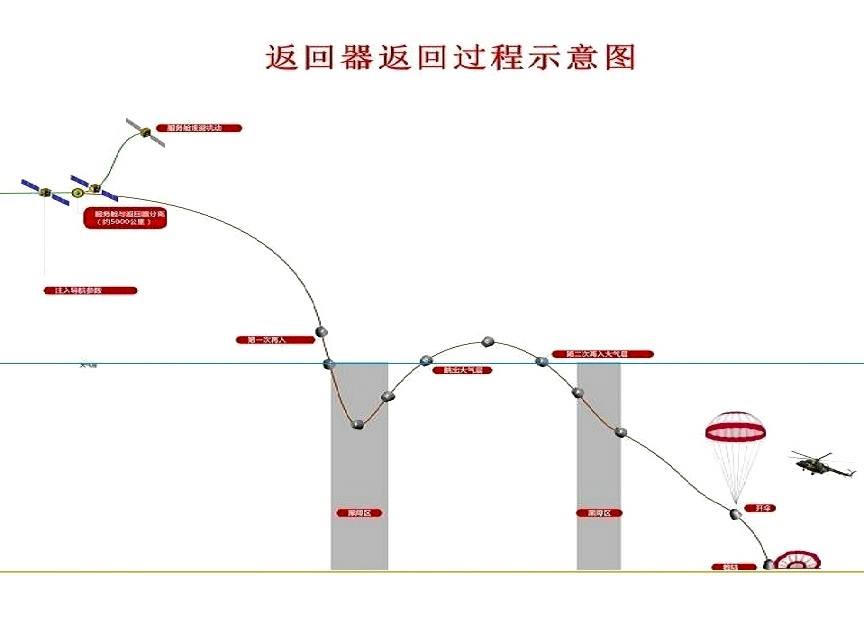
China mooncraft made a skip re-entry into Earth’s atmosphere, then parachuted into pre-selected landing site.
Courtesy: China Space
Website

Credit: Virgin Galactic
November 1st comments from Sir Richard Branson, founder of Virgin Galactic, at the Mojave Air and Space Port, California:
“This is a very tough time for all of us at Virgin Galactic, The Spaceship Company and Scaled Composites, and our thoughts remain with the families of the brave Scaled pilots, and all those affected by this tragedy.
We are determined to find out what went wrong and are working with the authorities to get that information. It is too early for me to add any details of the investigation at this stage.
We have always known that commercial space travel is an incredibly hard project. We have been undertaking a comprehensive testing program for many years and safety has always been our number one priority. This is the biggest test program ever carried out in commercial aviation history, precisely to ensure this never happens to the public.
The bravery of test pilots generally cannot be overstated. Nobody underestimates the risks involved in space travel. Commander Chris Hadfield is amongst those who has sent moving notes of support, in which he highlighted the nature of space projects. He wrote: ‘As a former test pilot, crashes and even deaths were frequent. It is a known part of the business. Little solace, but reality. Pushing the bounds of knowledge and possibility comes with unavoidable risk.’
In testing the boundaries of human capabilities and technologies, we are standing on the shoulders of giants. Yesterday, we fell short. We will now comprehensively assess the results of the crash and are determined to learn from this and move forward together as a company.
We have been touched by the overwhelming support coming from not just the space community but the world at large. If I could hug every single person who has sent messages of love, support and understanding over the past day, I would. The space community sticks together, and there have been touching messages of solidarity from NASA, X PRIZE, our customers, the media, the Virgin family and many, many thousand members of the public inspired by the vision of commercial space travel.
We do understand the risks involved and we are not going to push on blindly – to do so would be an insult to all those affected by this tragedy. We are going to learn from what went wrong, discover how we can improve safety and performance, and then move forwards together.
I truly believe that humanity’s greatest achievements come out of our greatest pain. This team is a group of the bravest, brightest, most determined and most resilient people I have ever had the privilege of knowing. We are determined to honour the bravery of the pilots and teams here by learning from this tragedy. Only then can we move forward, united behind a collective desire to push the boundaries of human endeavour.”

Courtesy: China Space
UPDATE: Chinese space groups and news services are reporting the successful landing of China’s test lunar orbiter, parachuting down in north China’s Inner Mongolia.
Before its reentry to Earth, the spacecraft was moving at a velocity of 11.2 kilometers per second. This speed can generate temperatures of more than 1,500 degrees Celsius.
To help the craft slow down, spacecraft controllers employed a reentry method by letting the craft “bounce” off the edge of the Earth’s atmosphere, before reentering again.
The reentry angle had to be guided so precisely that a 0.2 degrees deviation would render the mission a failure.
China’s circumlunar test vehicle carried out a “trial by fire” reentry – hotfooting itself back to Earth by performing a skip reentry to slow down. The craft appears to have landed in safe and sound condition under parachute after some eight days of flight.
Zhou Jianliang, chief engineer of the Beijing Aerospace Control Center told China’s Xinhua news agency that there were challenges for the spacecraft to make its way home.

Pre-launch photo shows China’s test craft that is now completing a circumlunar flight.
Credit: CASC/China Space
The window for landing was very small and required highly sophisticated telemetry, tracking and command system operations, Zhou said.The test orbiter maneuvered on the edge of the Earth’s atmosphere to slow from a speed of 11.2 kilometers per second before reentry, a process that generated extremely high temperatures.
Launched last Friday (Beijing time), the craft was hurled moonward by a Long March-3C rocket.This moon mission by China is seen as a partial test run for the Chang’e 5 spacecraft flight – part of the country’s multi-step program of lunar exploration.
Chang’e 5’s mission to return collected samples of the Moon’s surface back to Earth is expected in 2017, according to Chinese news sources.

Returned capsule. Courtesy: China Space

The Andromeda Strain – the 1971 movie, but how real for a 21st century return to
Earth of Mars samples?
Credit: Universal Pictures
Here’s a new story from me up on Space.com:
Ebola Outbreak May Hold Lessons for Handling Samples from Mars
by Leonard David, Space.com’s Space Insider Columnist
October 30, 2014 10:00am ET
http://www.space.com/27599-ebola-outbreak-mars-sample-lessons.html

China’s experimental mooncraft snapped this image of the Earth and Moon together during its circumlunar voyage expected to last about 8 days.
Courtesy: China Space
China’s experimental mooncraft is on target to return back to Earth on November 1st.
Adjustments to the trajectory of the spacecraft have been made, with other nudges expected. Doing so will set up the craft to made a skip-reentry into Earth’s atmosphere, slowing it down from a speed of 11.2 kilometers per second – then parachuting into a pre-selected landing site.
Launched on October 24th (China time), the mission is designed to last some 8 days.
This craft is conducting a test run of procedures and technologies useful for China’s Chang’e 5 mission that will gather samples from the moon’s surface and return them to Earth.

China’s current lunar mission is shown in this artist’s concept.
Credit: CCTV
One key element being evaluated on the mission currently underway is reentry technology – assuring that the return capsule can take the heat during its high-speed maneuvering through the Earth’s atmosphere.

Trajectory of China’s mooncraft, designed to test high-speed reentry techniques.
Courtesy: China Space
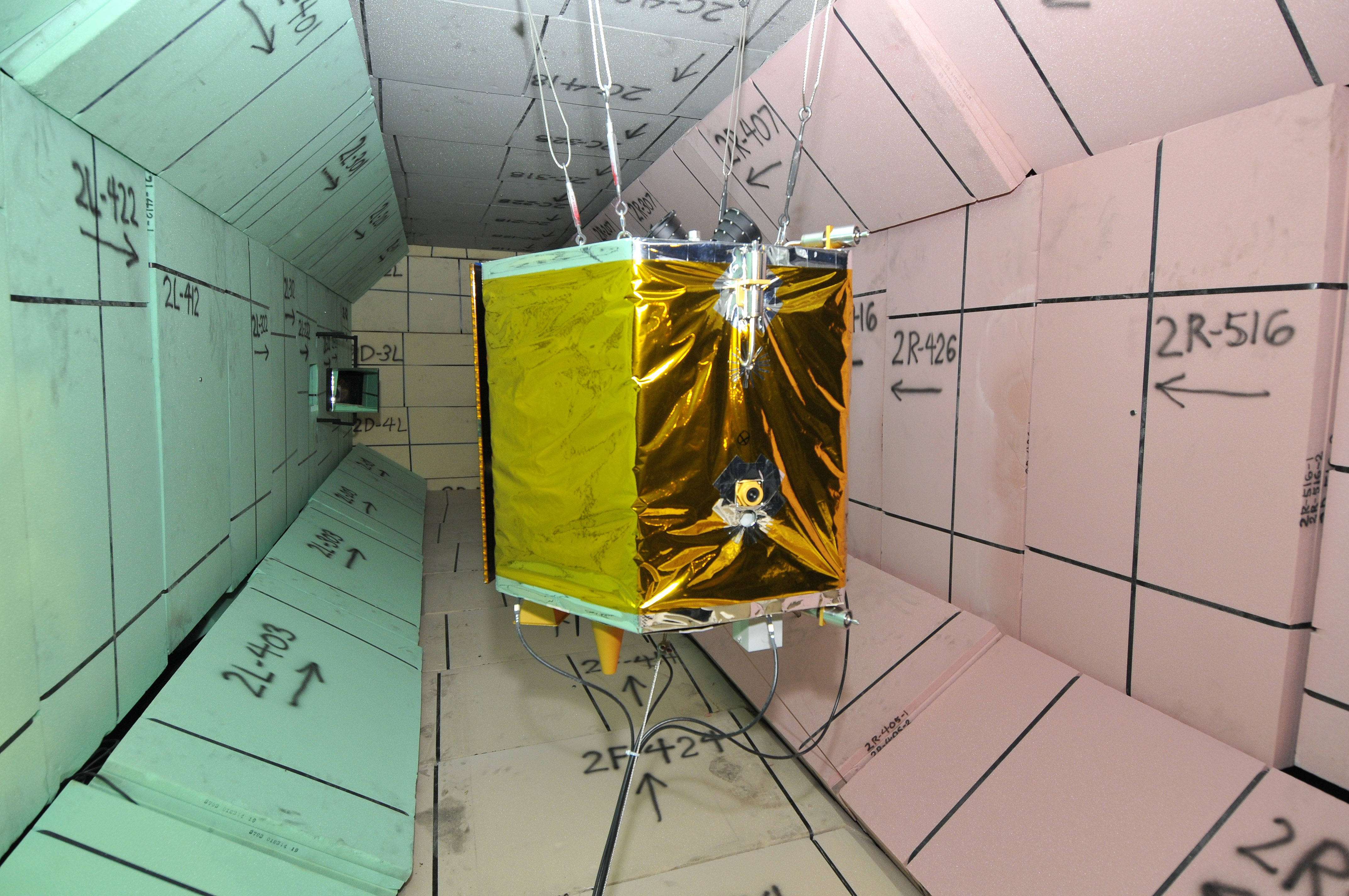
Doomed for destruction is DebriSat, a nonfunctional, full-scale representation of a modern satellite, shown here prior to test at the Range G target tank at the Arnold Engineering Development Complex in Tennessee.
Credit: U.S. Air Force/Jacqueline Cowan
A new story from me, up today on Space.com:
Mock Satellite Destroyed to Study Space Junk Collisions
By Leonard David, Space.com’s Space Insider Columnist
October 28, 2014 07:00am ET
http://www.space.com/27555-debrisat-space-junk-collisions.html

Credit: NASA Office of the Chief Technologist, 2014
A new NASA report provides an introduction and overview, and a look into the future, of the emerging “space ecosystem” and American private-sector space activities.
Titled Emerging Space: The Evolving Landscape of 21st Century American Spaceflight, the report is by the NASA Office of the Chief Technologist, 2014.
The report is available from NASA’s Emerging Space Office (ESO), “formed in recognition of the rising importance of private-sector individuals and organizations that invest their own time and money in space activities. This emerging space community is increasingly a major force in American space developments,” ESO’s website notes.
According to the newly issued report, the United States stands today at the opening of a “second Space Age.”
Industrial strength space
“Innovative NASA programs and American entrepreneurs together are transforming the space industry,” the report says.
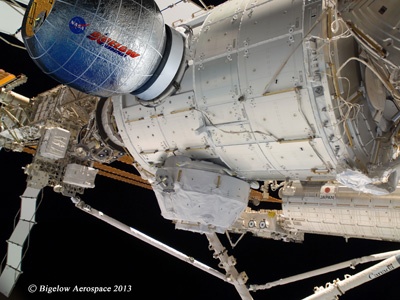
Bigelow Expandable Activity Module (BEAM) is set for deployment on the International Space Station next year.
Credit: Bigelow Aerospace
“These initiatives – both at NASA and in the private sector – are expanding the nation’s opportunities for exploration and for the economic development of the solar system.”
The report stresses that NASA’s goal is to develop the capabilities that will allow the American people to explore, pioneer, and expand our economic sphere into the solar system.
“To do this we will build on our long-standing relationships with American industry by embracing new and diverse forms of partnerships,” the report explains.
Special thanks to the Space Frontier Foundation for flagging the release of this informative report.
Go to the report, Emerging Space: The Evolving Landscape of 21st Century American Spaceflight, at:
http://www.nasa.gov/sites/default/files/files/Emerging_Space_Report.pdf
Also go to NASA’s Emerging Space Office (ESO) Website at:
http://www.nasa.gov/offices/oct/emerging_space/#.VElIsPnF8nV

An early Nimbus satellite undergoes vibration testing at NASA’s Goddard Space Flight Center in Greenbelt, Maryland, circa 1967.
Image Credit: NASA’s Goddard Space Flight Center
Researchers are recovering valuable data by perusing stashed away and nearly forgotten images from 5 decades old NASA Nimbus data tapes and black and white film.
The upshot is that they are finding treasures in the pictures.
Experts at the Boulder, Colorado-based National Snow and Ice Data Center — part of the Cooperative Institute for Research in Environmental Sciences (CIRES) — are expanding their understanding of sea ice in the Arctic and Antarctic.
In 1964, NASA launched the first of seven Nimbus spacecraft to study Earth from space.
Now fifty years later, scientists are getting an eye-full thanks to the old data via a NASA-sponsored Nimbus Data Rescue Project.

Early NIMBUS photo.
Credit: NASA
An informative video on this effort is available at:

