Author Archive
 Author:
  December 7th, 2014
New Horizons Mission Operations Manager Alice Bowman and operations team member Karl Whittenburg watch the screens for data confirming that the New Horizons spacecraft had transitioned from hibernation to active mode on Dec. 6.
Credit: APL
Smiles all around!
That’s the scene at the New Horizons Mission Operations Center at the Johns Hopkins Applied Physics Laboratory (APL) in Laurel, Maryland.
Data has streamed in from a long distance runner – NASA’s New Horizons spacecraft – showing its transition from hibernation to active mode on December 6.
New Horizons is on track for its long-awaited 2015 encounter with the Pluto system. The spacecraft will begin observing the Pluto system on Jan. 15.
The probe’s closest approach to Pluto will occur on July 14. But by mid-May, New Horizon will view the Pluto system better than what the powerful Hubble Space Telescope can provide of the dwarf planet and its moons.
The craft is now more than 2.9 billion miles from Earth, and just over 162 million miles from Pluto. Spacecraft signals take four hours and 26 minutes to reach Earth.
Active mode
Operators at the Johns Hopkins University Applied Physics Laboratory in Laurel, Md., confirmed at 9:53 p.m. (EST) on Saturday that New Horizons, operating on pre-programmed computer commands, had switched from hibernation to “active” mode.
NASA’s New Horizons was launched on January 19, 2006. About two-thirds of its flight time has been in hibernation mode – 18 separate hibernation periods, from mid-2007 to late 2014, slumber times ranging from 36 days to 202 days in length.
The team used hibernation to save wear and tear on spacecraft components and reduce the risk of system failures.
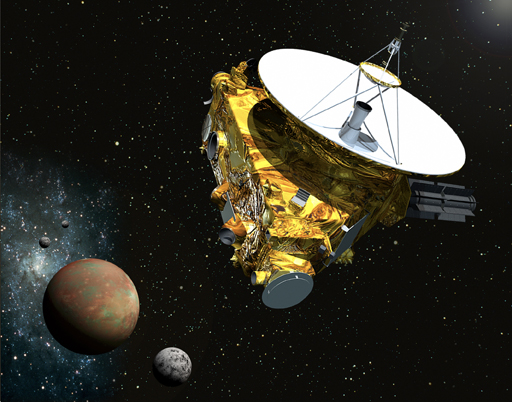
New Horizons en route to Pluto and beyond!
Credit: Johns Hopkins University Applied Physics Laboratory/Southwest Research Institute (JHUAPL/SwRI)
Listen to wake-up call
The Johns Hopkins Applied Physics Laboratory manages the New Horizons mission for NASA’s Science Mission Directorate. Alan Stern, of the Southwest Research Institute (SwRI) is the principal investigator and leads the mission; SwRI leads the science team, payload operations, and encounter science planning.
New Horizons is part of the New Frontiers Program managed by NASA’s Marshall Space Flight Center in Huntsville, Ala.
APL designed, built and operates the New Horizons spacecraft.
Listen to this special musical wake-up call by English tenor Russell Watson, a vocal salute to New Horizons including an inspirational “Where My Heart Will Take Me.”
The song was played in New Horizons mission operations upon confirmation of the spacecraft’s wake-up on Dec. 6.
Give a listen at:
http://pluto.jhuapl.edu/mp3/wakeup.htm
 Posted in

Credit: U.S. Navy Photo by Mass Communication Specialist 1st Class Charles White
On December 5, NASA’s Orion Crew Module descends to the Pacific Ocean under its three main parachutes as part of the Orion Program’s first exploration flight test.
Navy Divers assigned to Explosive Ordnance Disposal Mobile Unit 11 and Fleet Combat Camera Pacific attach a “horse collar” towing device to the NASA Orion Crew Module.
The amphibious transport dock USS Anchorage (LPD 23) is supporting the first exploration flight test for the NASA Orion program. EFT-1 is the fifth at sea testing of the Orion Crew Module using a Navy well deck recovery method.

Credit: U.S. Navy Photo by Mass Communication Specialist 1st Class Charles White
Meanwhile, upon successful launch and recovery of the Orion spacecraft on Friday, December 5, 2014, White House Office of Science and Technology Policy Director John P. Holdren issued the following statement:
“With today’s successful test launch and recovery of the Orion spacecraft, NASA has taken an important step towards the goal of human exploration of the solar system. Support from private-sector aerospace partners for the Orion effort – as well as for NASA’s Commercial Crew Program to develop safe, reliable, and cost-effective access to and from space – reflects the Administration’s commitment to create jobs, bolster the American economy, and build the strongest commercial space industry in the world. President Obama’s vision is to develop a balanced space program that supports a sustainable human exploration program, expands scientific knowledge, and invests in transformational technologies that will greatly increase our capabilities in space. We congratulate the men and women of NASA and their commercial partners for this successful test launch, and we look forward to future milestones on the journey to Mars.”
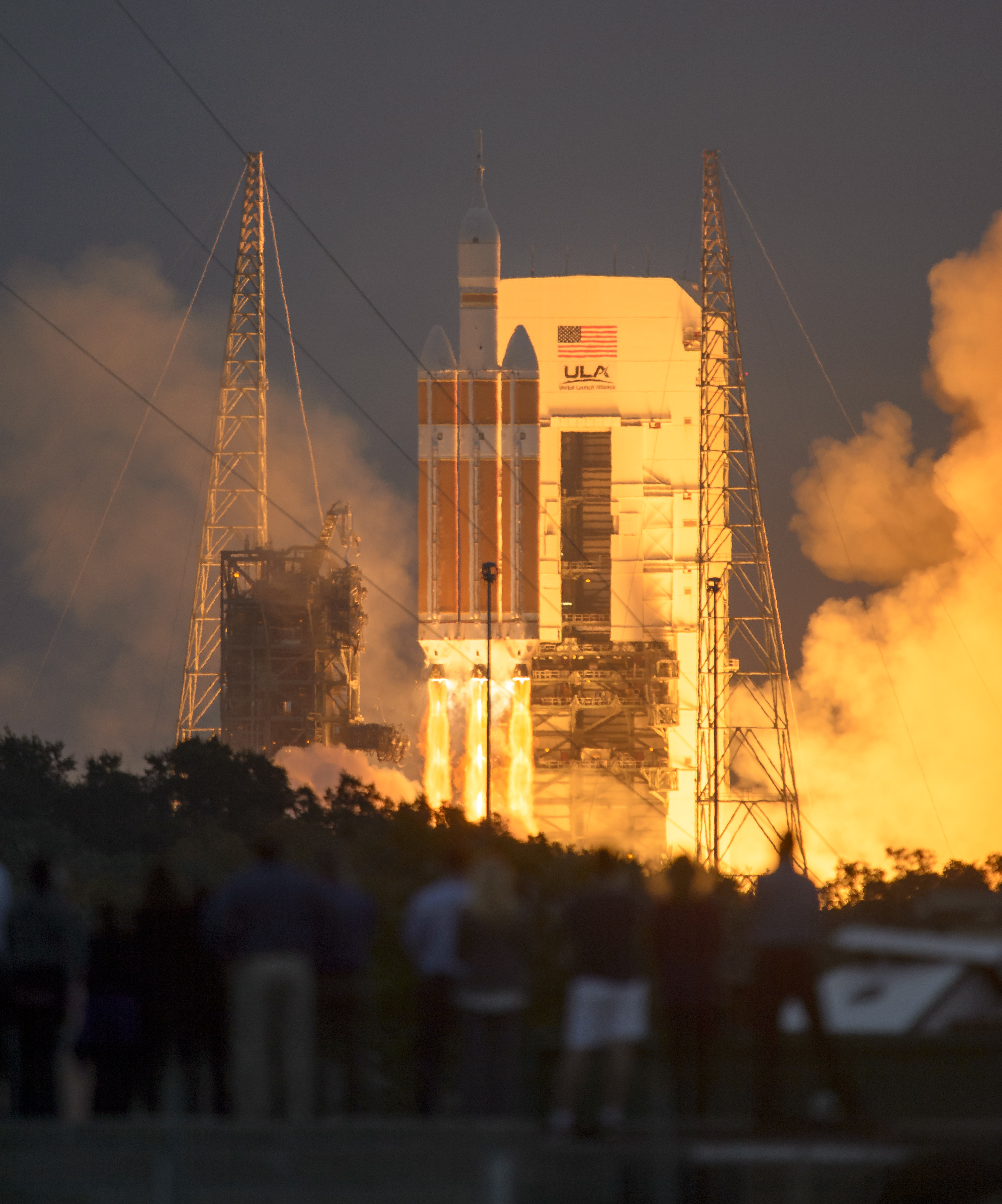
Liftoff of Orion capsule.
Credit: NASA
The new entry in human-carrying spacecraft, the Orion capsule, has been lofted into deep space – and onboard is a photograph of the first man on the Moon, as well as the last.
A photograph of the Apollo program’s Neil Armstrong (Apollo 11) and Eugene Cernan (Apollo 17) — the first person and last man to walk on the Moon — shows the two raising the American flag acknowledging a cheering crowd at Purdue’s Ross-Ade Stadium in 2007.

This photo of Purdue alumni astronauts Neil A. Armstrong (left) and Gene A. Cernan, is aboard the Orion space vehicle. The photo is from a 2007 football game in Purdue’s Ross-Ade Stadium.
Credit: Purdue University
That image is among items representing Purdue University’s contributions to flight and space history.
Purdue University Libraries’ Division of Archives and Special Collections provided the group photograph taken at the university’s 1999 Purdue astronaut reunion.

The Orion test flight carries this photo of Purdue alumni astronauts into space. The photo was taken during their reunion on Purdue’s campus in 1999.
Credit: Purdue University
Two Purdue pennants are on board, notes a Purdue University press statement.
“These items represent Purdue’s contributions to the U.S. space program – by not only its astronauts but also by the generations of engineers and scientists who have graduated from Purdue and gone on to work for NASA and in the aerospace industry.”
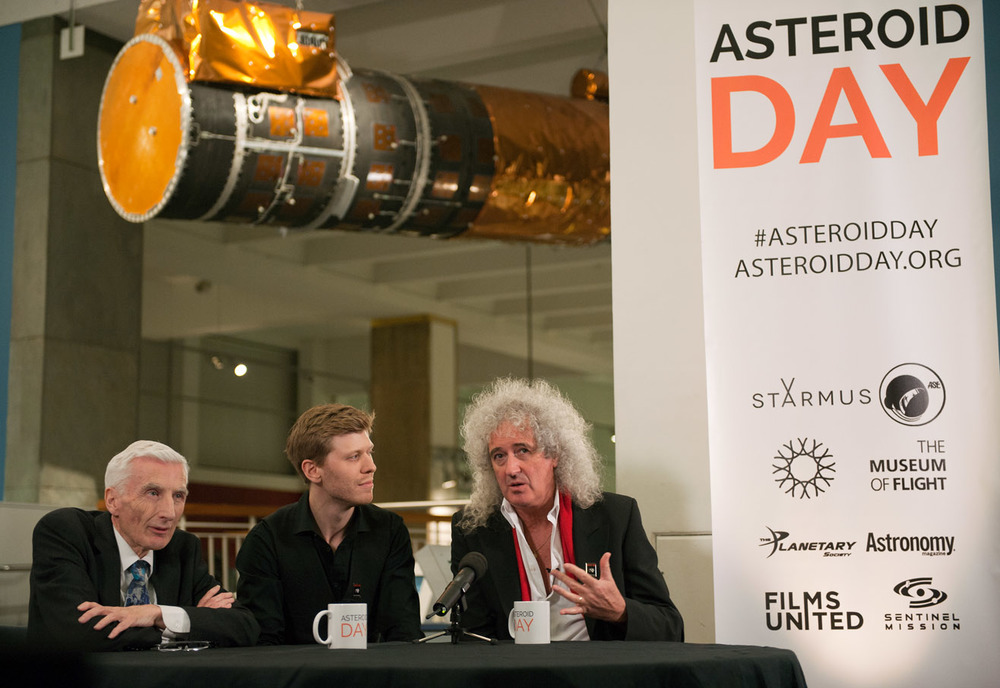
Taking part in a London presentation to promote Asteroid day, Lord Martin Rees, Grigorij Richters, and Dr. Brian May, astrophysicist and famed guitarist for the rock band Queen.
Photo by Max Alexander/Asteroid Day – London
A unique effort is now underway to establish an Asteroid Day.
As part of the initiative, a number of well-known dignitaries have put forth the 100x Asteroid Declaration, advocating the vital need for Near-Earth Asteroid detection.
Asteroid Day is to be held on the anniversary of the 1908 Siberian Tunguska event, the largest asteroid impact on Earth in recent history.
The Asteroid Day 100x Declaration was signed by astronauts, scientists, Nobel laureates, technologists and artists.
The 100x Asteroid Declaration’s call to action is as follows:
— Employ available technology to detect and track Near-Earth Asteroids that threaten human populations via governments and private and philanthropic organizations.
— A rapid hundred-fold (100x) acceleration of the discovery and tracking of Near-Earth Asteroids to 100,000 per year within the next ten years.
— Global adoption of Asteroid Awareness Day, heightening awareness of the asteroid hazard and our efforts to prevent impacts, on June 30, 2015.
For more information on this initiative, and how you can take part, go to:
http://www.asteroidday.org/declaration
Also, get an eye full with a series of videos by going to:
http://www.asteroidday.org/video/
Credit: JAXA
After a successful liftoff, the Japan Aerospace Exploration Agency (JAXA) received signals from the Asteroid Explorer Hayabusa2 at 3:44 p.m. on December 3, 2014 (Japan Standard Time) at the NASA Goldstone Deep Space Communication Complex (in California).
There is confirmation that the spacecraft’s initial sequence of operations — including the solar array paddle deployment and sun acquisition control — have been performed normally.
Hayabusa2 was launched on the H-IIA Launch Vehicle No. 26 from the Tanegashima Space Center at 1:22:04 p.m. on the same day (JST.)
The explorer is also confirmed to be inserted into the scheduled orbit by the H-IIA F26 booster.
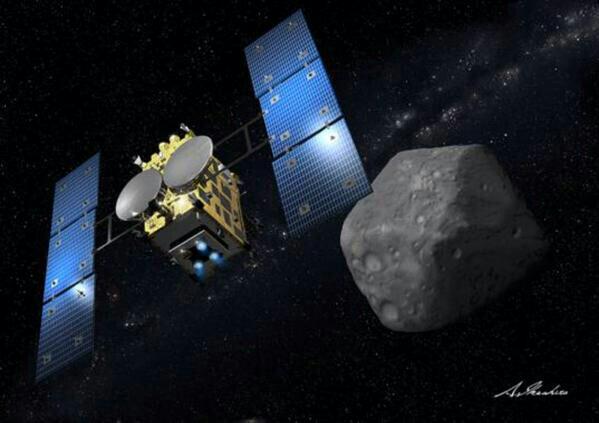
Credit: JAXA
The explorer is now in a stable condition.
For a video of the launch, go to:
https://www.youtube.com/watch?v=-9TwlwZobc4&feature=youtu.be
Asteroid Day 2015
Meanwhile, join in today to observe a major press event in which a declaration will be issued calling for increased awareness and tracking of dangerous asteroids.
Experts in science, physics and planetary defense, led by Astrophysicist and Musician Brian May and Lord Martin Rees in the UK, and Bill Nye, CEO of the Planetary Society, Ryan Wyatt, Director of the Morrison Planetarium and veteran astronauts Rusty Schweickart, Ed Lu and Tom Jones in the US, will hold a joint UK-US press conference to announce Asteroid Day 2015, and to release the 100x Declaration to protect the future of our planet from asteroid impacts.
A declaration will be issued calling for increased awareness and tracking of dangerous asteroids.
ASTEROID DAY is scheduled for June 30, 2015, the anniversary of the Tunguska, Siberia asteroid impact.
The press conference will be held December 3, 2014 in London and San Francisco simultaneously, linked via video.
•San Francisco, CA, USA: California Academy of Sciences | 10:30 a.m. (PST).
•London, UK: The Science Museum | Gallery 29 | 6:30 p.m. (GMT).
Event page link:
https://plus.google.com/events/c080grbf0u5stvb21mctei6u7og
YouTube page (where event will be streamed live):
There is an active “We the People – Your Voice in Government” petition to the White House/Obama administration that calls for an increase in NASA funding to one percent of the federal budget.
What’s being flagged by the petition is that for every dollar a U.S. citizen pays in federal taxes, less than one-half of one penny is allocated to the NASA budget.
Historical note: In 2013 the NASA budget was 0.49% of the budget, the lowest % since 1961, the petition adds.
Insufficient commitment?

The Moon and beyond – on what budget?
Credit: NASA
According to petition advocates in viewing today’s NASA budget: “This is an abysmally insufficient commitment to a program that has inspired so many, propelled the advancement of so much technology, and repeatedly demonstrated American leadership, ingenuity and big thinking.”
Indeed, these proponents of a NASA increase point to Europe’s recent landing of a robot probe on a distant comet. That sparked a worldwide media conversation about science.
“The U.S. needs to lead that conversation. By doing so, we can inspire much-needed passion for science in our students, create new technology and industries, all in one fell swoop.”
Petition: pro or con?
So, what’s your view?
Signatures on the petition that are needed by December 13, 2014 — to reach a goal of 100,000 – are now at 2,648 in number.
So if you’re a believer, where are those other 97,352 people?
Or do you disagree with this petition?
For more information, go to:
https://petitions.whitehouse.gov/petition/increase-nasa-funding-1-federal-budget/WZk0vgc2
Also, go to the White House response for giving NASA more money at:
https://petitions.whitehouse.gov/response/doubling-and-tripling-what-we-can-accomplish-space

WANDERERS is a short science fiction film by Erik Wernquist – a digital artist and animator from Stockholm, Sweden.
This image from the film makes use of photo taken by NASA’s Opportunity Mars rover and provides true landscape while adding in future Red Planet expeditionary crew.
Credit: Erik Wernquist
WANDERERS is a short science fiction film by Erik Wernquist – a digital artist and animator from Stockholm, Sweden.
Wernquist notes that the film is a vision of our humanity’s future expansion into the Solar System. Although admittedly speculative, the visuals in the film are all based on scientific ideas and concepts of what our future in space might look like, if it ever happens.
All the locations depicted in the film are digital recreations of actual places in the Solar System, built from real photos and map data where available.
Adding to the compelling nature of this video is the narrative voice of astronomer and author Carl Sagan. The audio used are excerpts from Sagan’s own reading of his book ‘Pale Blue Dot: A Vision of the Human Future in Space’ (1994).
To view this marvelous production, go to:

For the answer, courtesy of Astro Watch, go to:
http://www.astrowatch.net/2014/11/history-made-as-90000-earthlings-send.html
Update: There is a launch postponement of Japan’s Hayabusa2 from the Tanegashima Space Center to December 3 (Wed.), 2014 (Japan Standard Time). The liftoff delay is the result of a go/no go assessment that carefully checked the weather forecast and found that strong wind exceeding the weather restrictions was projected around the launch pad at the scheduled launch time.

Japan’s Hayabusa2 will target “1999 JU3” – a C-type asteroid – for detailed study.
Artwork: Akihiro Ikeshita
Weather conditions have prompted the Japan Aerospace Exploration Agency (JAXA) to delay the launch of its asteroid explorer, Hayabusa2.
Liftoff of the probe is now slated to occur on December 3 onboard the H-IIA Launch Vehicle No. 26.
Hayabusa2 is a successor of “Hayabusa” (MUSES-C), which successfully returned to Earth bits of an asteroid in June 2010.
Hayabusa2 will target “1999 JU3” – a C-type asteroid – for detailed study.
The craft should arrive at the asteroid in mid 2018, loitering on site for one and half years before leaving the asteroid at the end of 2019 and returning its cache of samples to Earth around the end of 2020.
Artificial crater to be made
Among the spacecraft’s asteroid duties is to attempt a new function, making use of a “collision device.” This hardware will create a crater artificially a few meters in diameter on the space rock.
After making the crater, samples will be acquired for return to Earth. Those fresh samples would be less weathered by the space environment or heat.

JAXA’s Hayabusa2 is ready for launch onboard the H-IIA Launch Vehicle No. 26.
Credit: JAXA
Hopping MASCOT
Also onboard Hayabusa2 is the Mobile Asteroid Surface Scout, or MASCOT.
This asteroid lander was developed by the German Aerospace Center (Deutsches Zentrum für Luft- und Raumfahrt; DLR).
Once dispatched from the Japanese spacecraft, MASCOT will descend to the surface of the asteroid – which measures just less than a mile (one kilometer) across and whose gravitational acceleration is 60,000 times weaker than that here on Earth – from a height of approximately 330 feet (100 meters). Mascot will conduct its measurements over two full asteroid days and nights – a period lasting up to 16 Earth hours.

Mobile Asteroid Surface Scout, or MASCOT, is prepared by engineers at the
German Aerospace Center (Deutsches Zentrum für Luft- und Raumfahrt; DLR).
Credit: DLR
MASCOT weighs just 22 pounds (10 kilograms). It will use an eccentric arm installed in its interior to “hop” almost (230 feet (70 meters) across 1999 JU3 – delivering the first measurements from different locations on an asteroid’s surface.
Meanwhile, take a look at this special JAXA video on the upcoming mission:
https://www.youtube.com/watch?v=TDbtQd4LeuA&feature=youtu.be

The lunar meteorite Oued Awlitis 001 with the surface of the Moon as background.
Credit: L. Ferrière
The Natural History Museum in Vienna is gatekeeper for the world largest and oldest meteorite display.
Now they’ve set their eyes on acquiring an extraordinary lunar meteorite – and they’ve started a fund-raising effort to do so, but they need your help!
“We’ve started a few days ago a project/campaign we call “Help Us Get the Moon,” says Ludovic Ferrière, curator of the museum’s rock collection and co-curator of their impressive meteorite collection.
The object of their attention?
The lunar meteorite, Oued Awlitis 001, was ejected from the Moon several thousands of years ago…then arrived on Earth hundreds of years ago after a very long journey through our Solar System, Ferrière explains.
Western Sahara landing site
Oued Awlitis 001– weighing in total about 410 grams – was discovered January 15, 2014 in Western Sahara. It was given that name given the desert area in which it was found.

The lunar meteorite Oued Awlitis 001 just after it was discovered in the Western Sahara.
Credit: M. Aid
“Less than five percent of the surface of the Moon was sampled during the Apollo missions,” Ferrière adds. “This meteorite is a providential way to continue the exploration of our natural satellite. It provides a spectacular asset to the study of the origin and evolution of the Moon.”
This unique lunar meteorite — an anorthositic melt rock ( formed during a meteorite impact on the Moon) — is now in the Meteorite Hall of the Natural History Museum Vienna. The object is by far the largest lunar meteorite in a European public display – at least until the end of the year 2014.
Now, given generous financial support, this celestial time capsule can be seen for the next centuries!
“You will see it, your children will see it, and many more generations will also have a chance to see and to study it…provided that this sample enters our collection,” Ferrière says.
Meteorite hall

View of the Meteorite Hall at the Natural History Museum Vienna, the world’s largest meteorite display.
Credit: K. Kracher
The objective of the fund-raising call is to acquire the lunar meteorite, display the object, but also to intensively study this unique meteorite.
A fragment of the meteorite is to be used for display purposes and for non-destructive analyses. A large fragment is to be used for the scientific analyses.
As soon as the meteorite is acquired, a consortium of scientists, from all around the world, will be able to analyze the object.
“Please help us to get the Moon to our museum by being a generous explorer,” says Ferrière.
For more information about this fund raising campaign – with details about special rewards for various levels of donation — go to:

