Author Archive
 Author:
  February 5th, 2025
The Center for Security and Emerging Technology within Georgetown University’s Walsh School of Foreign Service has issued a new report: Shaping the U.S. Space Launch Market
Key Takeaways from the document are:
The United States finds itself in the position of world leader in launch, with a relatively consolidated
market. The United States conducts 50% more launches than it did at the peak of the space race—
but more than five out of every six U.S. launches come from SpaceX.
While evaluating the American launch market’s ability to meet critical U.S. national security and
foreign policy needs, this paper found the following challenges and opportunities exist in the
market:
Opportunities
• The United States leads the world in space launch by nearly every measure: number of
launches, total mass to orbit, satellite count, and more.
• SpaceX’s emergence has provided regular, reliable, and relatively affordable launches to
commercial and national security customers.
• Alongside SpaceX is a small group of technically viable alternatives. This variety offers the
country a measure of resilience in the face of national security threats.
Challenges
• Today’s market consolidation coupled with the capital requirements necessary to develop
rockets make it difficult for new competitors to break in.
• China has shown the ability and willingness to invest the level of capital needed to create
international competitors to the American leaders.

Image credit: Center for Security and Emerging Technology
Source: Dates via Crunchbase and company websites
Recommendations
1. The U.S. Department of Defense and NASA should:
a. Conduct research and strategic investment toward in-space transportation technologies.
b. Execute small satellite missions and expand purchases of small launch vehicle services to cheaply test technology and encourage a competitive future launch market.
c. Expand launch infrastructure capacity, dispersion, and resilience to improve U.S. launch capacity in peacetime and safeguard it in case of conflict.
2. The federal government should promote competition in the commercial space launch industry by continuing to allocate launches among multiple competitive vendors to ensure resilience and innovation.
Given the national security implications of the launch market, the United States must continue to encourage innovation and progress. Technologies such as reusability have provided a window of time for U.S. advantage. Continued innovation will be necessary to advance and sustain that advantage.
To download full report, go to:
https://cset.georgetown.edu/publication/shaping-the-u-s-space-launch-market/
 Posted in
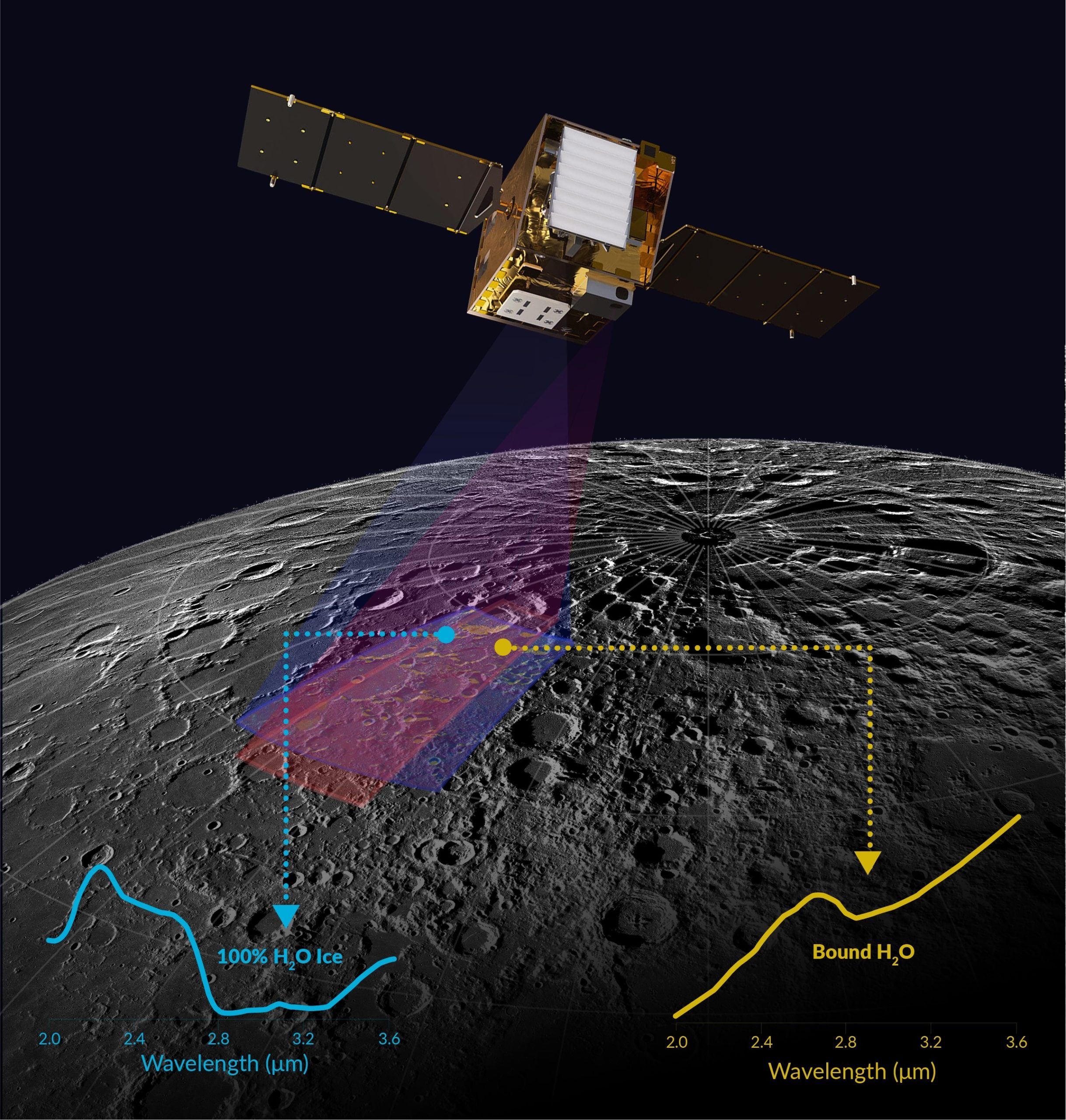
Science instruments onboard Lunar Trailblazer smallsat probe for lunar water.
Image credit: Jasper Miura, Lockheed Martin
LITTLETON, Colorado – A university-led lunar orbiter is nearing takeoff that will operate in patrol mode to detect signatures of ice in reflected light, pinpointing the locales of ice or water trapped in rock at the Moon’s surface.
The Lunar Trailblazer is now in Florida and slated to be stacked atop a SpaceX Falcon 9 launcher. It will be boosted in “rideshare” mode — likened to Uber/Lyft-pool transportation – along with the commercial Intuitive Machines-2 lunar lander named Athena.
Clean room preparation
Prior to its transport, I spent time here within a Lockheed Martin clean room where the probe was undergoing final grooming for shipping.

Leonard David, a dirty reporter in Lockheed Martin clean room gets up-close view of moonbound Lunar Trailblazer.
Image credit: Barbara David
Lunar Trailblazer utilizes the aerospace company’s new Curio platform – a novel and scalable deep space smallsat spacecraft architecture, designed for deep space exploration and probe scientific questions at less cost.
University/industry duties
Lunar Trailblazer is managed by NASA’s Jet Propulsion Laboratory and led by the California Institute of Technology (Caltech) in Pasadena, California. Bethany Ehlmann, professor of planetary science at Caltech is principal investigator for Lunar Trailblazer.
Lockheed Martin developed and built the roughly 440 pound (200 kilograms) spacecraft, as well as integrated the craft’s science instruments. The probe is outfitted with two deployable solar arrays.
For more information on this spacecraft and its duty to scout for water ice on the Moon, go to my new Space.com story – “SpaceX to launch water-hunting moon probe ‘Lunar Trailblazer’ on Feb. 26” – at:

The view by moonwalking astronauts standing on the edge of the Vallis Schrödinger canyon is captured in this artistic rendering.
Image credit: Lunar and Planetary Institute/Michael Carroll
Earth’s Moon continues to surprise!
In a major discovery, a team of scientists at the Lunar and Planetary Institute (LPI), an institute of the Universities Space Research Association (USRA), have found two Grand Canyon-scale features on the lunar far side.
Similar in width and depth to Earth’s Grand Canyon that took millions of years to form, the epic features were produced in minutes during a period of planetary upheaval when the Earth and Moon were being resurfaced by impacting asteroids and comets.
The research findings were published today in Nature Communications.

Views of the Schrödinger peak-ring impact basin and two radiating canyons carved by impact ejecta.
Image credits: NASA\SVS\Ernest T. Wright; LRO LROC WAC/Arizona State University/NASA GSFC
Formed in minutes
According to lead author of the new research paper, David Kring of the USRA’s LPI: “Nearly four billion years ago, an asteroid or comet flew over the lunar south pole, brushed by the mountain summits of Malapert and Mouton, and hit the lunar surface. The impact ejected high-energy streams of rock that carved two canyons that are the size of Earth’s Grand Canyon. While the Grand Canyon took millions of years to form, the two grand canyons on the Moon were carved in less than 10 minutes.”
The features are called Vallis Schrödinger and Vallis Planck. These deep groves were formed by rocky debris flung from the celestial impact that created the enormous 320-kilometer-diameter Schrödinger impact basin, near the lunar south pole.
Making use of imagery and elevation data churned out by NASA’s Lunar Reconnaissance Orbiter spacecraft, the canyons were found to be 20 to 27 kilometers wide, 2.7 to 3.5 kilometers deep, and 270 to 860 kilometers long.

Width and depth of the Grand Canyon along the Bright Angel hiking trail from the south to the north rim contrasted with width and depth of Vallis Planck.
Image credit: Kring, et al.
Energetic ejecta
Co-author Gareth Collins adds: “The Schrödinger crater is similar in many regards to the dino-killing Chicxulub crater on Earth. By showing how Schrödinger’s km-deep canyons were carved, this work has helped to illuminate how energetic the ejecta from these impacts can be.”
The colliding, canyon-producing culprit, an impacting asteroid or comet, likely struck the lunar surface at about 35,000 miles per hour (55,000 kilometers per hour). The Moon-specific big bang yielded the Schrödinger impact basin.
Most of the excavated rock was ejected away from the lunar south polar region, which Artemis astronauts will soon explore.
Geologic samples
The Schrödinger impact debris did not bury the lunar south polar region. Therefore, astronauts will find it easier to collect geologic samples from an even older epoch in lunar history.

Image credit: NASA
Furthermore, the two canyons provide an opportunity to sample material that is more ancient; this material was once two or three kilometers beneath the lunar surface.
That extraordinary geology will be matched by extraordinary vistas, Kring adds. “The splendor of the canyons is so dramatic that if exposed on Earth, they would be national or international parks.”
For more information on this exciting find, go to – “Grand canyons on the Moon” at:

Image credit: ESO/P. Horálek
It is labeled “noctourism” or nocturnal tourism, the hunger to experience first-hand, along with eyes-on, the nighttime sky in order to soak up the enveloping splendor.
Noctourism is a top travel trend for 2025, one that has been flagged by Booking.com, a leading digital travel firm headquartered in Amsterdam with local support offices around the globe. They underscore that voyage dictum, “It’s not the destination, it is the journey,” with looking up and outward as one trend that’s shaping the future of travel.

Image credit: Booking.com/Svalbard Hotel The Vault
Starbathing experiences
“With space tourism edging ever closer to reality, travelers will be focused on building connections with the universe as they turn to more attainable astro-pursuits in 2025,” observes Booking.com. Their research indicates nearly two thirds (62%) of those polled are considering visiting darker sky destinations with “starbathing” experiences (72%), star guides (59%), viewing once in a lifetime cosmic events (59%), and constellation tracking (57%) high on the stellar adventure to-do list.
“An appreciation for the nocturnal world,” Booking.com adds, “is also deepening travelers’ connections with nature, as the majority of travelers (54%) would book an accommodation without lights to encourage less light pollution and preserve flora and fauna.”

Capturing the constellation Orion and bright star Sirius taken from Mojave National Preserve.
Image credit: NASA/Preston Dyches
Key takeaways
According to the group, their travel predictions 2025 commissioned research surveyed a sample of adults who plan to travel for business or leisure in the next 12-24 months. In total, 27,713 respondents from 33 countries and territories were polled.
Along with trips around nocturnal, nature-based activities, other key takeaways from the research include:
- There will be an increased desire for authentic, off-the-beaten-path experiences
- Sustainability will be an even bigger priority
- A blend of wellness and adventure will drive travel choices
- Family values will hold more importance
- Trips and experiences will need to cater for diversity
Dark-sky zones
Booking.com points out that noctourism will see travelers seeking out dark-sky zones intent on marveling at the solar system and engaging in activities involving stargazing activities.
“And it’s not a handful of us, either – over 60% of the people we asked said they were considering visiting destinations with limited light pollution as a way to inch closer to the cosmos,” the online travel platform explains.
Interestingly, the trend in noctourism is being fueled by concerns around climate change here on Earth.
Over half of those surveyed plan to elevate their nighttime viewing sojourns to avoid rising daytime temperatures, with 42% of travelers preferring to vacation in cooler locations.
“Protection from UV rays is important for 61% of travelers who say they plan to reduce the amount of time they spend in the sun, while more than half (57%) expect to plan activities in the evenings and early mornings when the sun is at its lowest,” Booking.com states.

It’s a big Universe – any other skywatchers out there?
Credit: Space Telescope Science Institute
Night markets
Across both city and rural destinations, the digital travel firm said, noctourism will see existing attractions extending their opening hours to cater for changing visitor preferences, “alongside a host of new experiences springing up to meet demand (organized stargazing tours, night markets, and opportunities to witness once-in-a-lifetime cosmic events).”
Taking a longer look into future years, Booking.com suggests technology to further revolutionize how travelers plan and experience their excursions.
“AI-driven tools and neuro-inclusive innovations will make holidays more adaptable, ensuring all travelers feel catered to. Additionally, the growing focus on wellness suggests that travel will increasingly be seen as a tool for long-term self-care rather than just a brief escape,” they conclude.
For more information on Booking.com and their predictions for travel in 2025, go to:

Image credit: SETI Institute
Questions for the day, with universal appeal:
If an extraterrestrial civilization existed with technology similar to ours, would they be able to detect Earth and evidence of humanity? If so, what signals would they detect, and from how far away?
A research team led by Sofia Sheikh of the SETI Institute in Mountain View, California, in collaboration with the Characterizing Atmospheric Technosignatures project and the Penn State Extraterrestrial Intelligence Center, set out to detect answers.

Image credit: Sofia Sheikh , et. al
Types of technosignatures
“Our goal with this project was to bring SETI back ‘down to Earth’ for a moment and think about where we really are today with Earth’s technosignatures and detection capabilities,” said Macy Huston, co-author of a new research paper and postdoc at the University of California, Berkeley, Department of Astronomy.
“In SETI, we should never assume other life and technology would be just like ours,” Huston added, “but quantifying what ‘ours’ means can help put SETI searches into perspective.”
Indeed, the research paper notes, future telescopes and receivers could enhance our detection sensitivity or enable us to identify new types of technosignatures, such as other atmospheric signatures of pollution.

Image credit: NOAA
Observable outputs
As Sheikh and colleagues point out, Earth’s present-day technosignatures hold clues to humanity’s culture, society, and biosphere.
“Some of these clues may be straightforward to interpret correctly if the associated technosignature is detected, but others could be interpreted in wildly varying ways, as there are many activities or prior states that could produce the same astronomically observable outputs. We should keep this in mind as we ourselves hypothesize about the ETIs behind any future technosignature candidates.”
To access this paper in the Astronomical Journal — “Earth Detecting Earth: At What Distance Could Earth’s Constellation of Technosignatures be Detected with Present-day Technology?” – go to:
https://iopscience.iop.org/article/10.3847/1538-3881/ada3c7
Also go to this informative video at:
https://youtu.be/Pdg2x3NP2ds?si=7ln-ElTaNrgJXQhA

Credit: ESA/Hubble & NASA

Image credit: KSA
That large metallic ring that dropped into Africa’s Mukuku village, in Makueni county in the country’s south, is apparently still under study.
Reportedly tumbling “red-hot” into that village, the object was pronounced as a piece of rocket debris by investigators with the Kenya Space Agency (KSA) in Nairobia. They reported that the object, which is roughly 8 feet (2.5 meters) in diameter, tipped the scales at some 1,100 pounds (500 kilograms).

“Preliminary assessments indicate that the fallen object is a separation ring from a launch vehicle (rocket),” the KSA stated in a January 1st official statement. The KSA later dismissed a media report by Nation Africa that the country had demanded compensation for the debris dumping from India.
Await official findings
The KSA stressed that “investigations into the object’s origin are still ongoing,” and no official statement has been issued linking the debris to the Indian Space Research Organization (ISRO) “or any specific space mission.”


Image credit: KSAKSA advised the public to “await official findings.”But there continues to be discussion regarding the rocket detritus as possibly associated with the ISRO’s Space Docking Experiment (SpaDeX) launch on December 30.
The SpaDeX payload flew atop ISRO’s Polar Satellite Launch Vehicle (PSLV-C60), lifting off from the Satish Dhawan Space Centre, Sriharikota.
Meanwhile, since January 3, the KSA has offered no follow-on word on the purported skyfall nor identifying the object’s origin.

Image credit: ISRO/Inside Outer Space screengrab
Space debris webinar
However, the puzzling metal ring – as well as other incidents tied to space junk falling in Africa – were discussed in a recent January 30 webinar titled: Treating Effective Counter-Measures Against Space Debris in African Countries.
That webinar was hosted by Space in Africa, an analytics and consulting company in the space sector, serving both the institutional and commercial markets with a particular focus on Africa.

Image credit: Space in Africa
The webinar speakers were Dr. Yeshurun Alemayehu, State Minister for the ICT and Digital Economy Sector, the Ministry of Innovation and Technology, Ethiopia, and Dr. Doreen Agaba, Technical Lead, Department of Aeronautics and Space Science Uganda. The event was moderated by Mustapha Iderawumi, a senior analyst for Space in Africa.
In a description of the webinar posting by Space in Africa, they point out that, “as Africa’s engagement in space activities expands, the issue of space debris has become increasingly pertinent.”
Recent incidents
The intent of the webinar was to analyze recent space debris incidents in Africa, risks posed to African satellites and ground infrastructure, and emerging technological solutions for debris tracking, collision avoidance, and removal.

Taking the fall. Space hardware dives into Earth’s atmosphere with some fragments making their way to the ground.
Image credit: ESA/D.Ducros
“Recent incidents, such as the crash of a separation ring from a launch vehicle from the sky and landing in Mukuku Village, Makueni County in Kenya in December 2024, the space debris from a U.S.-based SpaceX satellite launch fell in western Uganda, causing property damage over a 40-kilometre area, and sightings of possible space debris streaking across southern skies in Ethiopia, highlight the immediate risks posed by falling debris to both space infrastructure and terrestrial communities,” the posted webinar description adds.

Pressurization sphere stemming from a rocket body that fell in Southern Africa years ago.
Image credit: NASA/Orbital Debris Program Office
Legal avenues
One webinar discussion point was the examination of international treaties “to understand the responsibilities of foreign space actors and the legal avenues available to African countries in the event of damage caused by space debris.”
Other areas addressed included assessing the impact of space debris on African space infrastructure and public safety.
The webinar also highlighted the significance of space debris issues among African policymakers, industry stakeholders, and the general public. Exploring mitigation strategies and best practices was another discussion area.
For informative on the webinar, go to:
Go to the webinar replay at:
Also, go to:
Space Debris Delays Flights to South Africa Amid Warnings of Falling Rocket Components

Image credit: White House
Yesterday, NASA requested the array of Assessment and Analysis Groups (AGs) that provide community input into Moon, Mars, the outer planets and other exploration target planning to pause all meetings.
While the pause is in action, NASA is conducting a review to ensure compliance with recent presidential actions by the President Trump Administration.
All of these AGs are being made aware of this action.
Clarification
The AGs are not “Advisory,” they are “Assessment or Analysis” Groups. These entities cannot be Advisory because they have not been chartered officially by the Federal Advisory Committee Act (FACA). The Mars Exploration Program Analysis Group (MEPAG) is the oldest “AG”; the only official Advisory Groups are the NASA Advisory Council (NAC) and subsidiaries, such as the Planetary Advisory Committee (PAC).
AGony
The communique from NASA:
“As NASA continues to review and ensure compliance with presidential actions, we are requesting that you please pause all meetings and activities of Planetary Science Analysis/Assessment Groups,” the communique explains.
“This includes ExMAG [Extraterrestrial Materials Assessment Group], LEAG [Lunar Exploration Analysis Group], MAPSIT [Mapping and Planetary Spatial Infrastructure Team], MEPAG [Mars Exploration Program Analysis Group], MExAG [Mercury Exploration Assessment Group], OPAG [Outer Planets Assessment Group] , OWWG [Ocean Worlds Working Group], SBAG [Small Bodies Assessment Group], VEXAG [Venus Exploration Analysis Group], the cross-AG EDIA [Equity, Diversity, Inclusion, and Accessibility] Working Group, and any other groups or activities that have been developed by the AGs.”

Image credit: White House
Executive orders, memoranda
The presidential actions NASA listed as leading to this pause may include, but are not limited to, the following Executive Orders and Presidential memoranda:
- Ending Radical and Wasteful Government Diversity, equity and inclusion (DEI) Programs and Preferencing
- Initial Guidance Regarding Diversity, Equity, Inclusion, and Access (DEIA) Executive Orders
Go to: https://chcoc.gov/content/initial-guidance-regarding-deia-executive-orders
- Initial Rescissions of Harmful Executive Orders and Actions
- Defending Women from Gender Ideology Extremism and Restoring Biological Truth to the Federal Government
- Initial Guidance Regarding President Trump’s Executive Order Defending Women
- Unleashing American Energy
Go to: https://www.whitehouse.gov/presidential-actions/2025/01/unleashing-american-energy/

Image credit: NASA

Pre-launch image of Blue Ghost lunar lander. Image credit: Firefly Aerospace
The commercial Blue Ghost moonbound lander has just over a week left in Earth orbit.
What comes next is performing the critical Trans Lunar Injection, a propulsive nudge that gives the craft a “transit ticket” to the Moon for about four days of coast period.
That engine burn will last for about 16 seconds, Firefly Aerospace told Inside Outer Space.
So far, following its January 15 takeoff, the moonbound lander is over two weeks into the group’s first mission to the Moon.

Image credit: Firefly Aerospace
Landing date
“Our Blue Ghost lunar lander has already clocked 715,000 miles, downlinked more than 7 GB of data, and completed several NASA payload science operations,” a just-issued Firefly Aerospace statement explains.
Blue Ghost is then slated to perform a Lunar Orbit Insertion and spend 16 days in lunar orbit before descent.
Blue Ghost’s final autonomous descent will take roughly an hour, starting with a Descent Orbit Insertion burn that will place Blue Ghost on its descent trajectory on March 2.

Blue Ghost will capture imagery of the lunar sunset and provide critical data on how lunar regolith reacts to solar influences during lunar dusk conditions. The lander will then operate for several hours into the lunar night.
Artwork credit: Firefly Aerospace/Inside Outer Space screengrab
Day/night operations
Blue Ghost is targeted to touchdown on the near side of the Moon near a volcanic feature called Mons Latreille within Mare Crisium.
If all goes well, upon touchdown, Blue Ghost will operate 10 NASA instruments for a complete lunar day (about 14 Earth days). Just before lunar night also approximately a 14 day period of time, Blue Ghost will capture high definition imagery of a total eclipse from the Moon where the Earth blocks the sun.
Those NASA instruments are onboard as part of the space agency’s Commercial Lunar Payload Services (CLPS) initiative.
At the end of the mission, the Blue Ghost Moon lander will capture the lunar sunset before operating several hours into the lunar night.

Firefly’s Blue Ghost lunar lander captured the Moon in the distance and Earth on the horizon from its top deck, showing the LEXI payload (right) and X-band antenna.
Image credit: Firefly Aerospace
First-ever images
One of Blue Ghost’s scientific payloads is a telescope that will capture the first-ever global images of the magnetic field that shields Earth from solar radiation.
The X-ray telescope is mounted on top of the lander, an instrument designed to capture the first-ever images of X-rays emanating from the edges of our planet’s vast magnetosphere.
That instrument, the Lunar Environment heliospheric X-ray Imager, or LEXI, was created by Brian Walsh, a Boston University College of Engineering associate professor.
Following Blue Ghost’s lunar landing, LEXI is set to deploy and power up, directing its focus back toward Earth as it collects images of the X-rays emanating from the edges of Earth’s magnetosphere.
Status report video
An array of other instruments are on the lunar lander, including devices designed to characterize the structure and composition of the Moon’s mantle by measuring electric and magnetic fields, collect regolith samples from the lunar surface using a burst of compressed gas, and gauge heat flow from the Moon’s interior.
Go to this informative, status-report video at:

Image credit: NASA/Association of Space Explorers
This video makes use of ethereal images recently taken on the International Space Station (ISS). Don Pettit, NASA astronaut, is a talented photographer of Earth. Currently on orbit (his 4th mission to the ISS) he took a series of long-duration photos, revealing tracks of urban night lights as the ISS passed over.
The stars show their own curving pattern, and the aurora adds even more mystery. For the movie, one frame morphs into the next in a magical dance.

In-space photographer, Don Pettit.
Image credit: NASA
Floating music
The music is by Mario Quiroga, a composer and musician in Chile. He is a “musico-terapista” (musical therapist), who creates floating music with his digital synthesizers, designed to help soothe the soul.
Featured is Quiroga’s “Aurora Boreal” composition – like a musical magic carpet as we soar over these ethereal views.
Produced by Association of Space Explorers, the professional association of flown astronauts.
For more videos in the Earth Music Theater series, go to:

Image credit: Thales Alenia Space/E.Briot
Autonomous access to the Moon by Europe is getting a boost by development of the Argonaut Lunar lander – a cargo delivery project.
The European Space Agency (ESA) and Thales Alenia Space in Italy have inked a new contract to have that aerospace firm develop Argonaut to deliver cargo, infrastructure and scientific instruments to the Moon’s surface.
Tons of cargo
The plan calls for Argonaut to be launched from the 2030’s. Tons of cargo will be delivered to the Moon’s surface by the vehicle.
“An Argonaut mission from launch to landing could take from a week to a month, depending on orbits and mission design. No area is off-limits for Argonaut – the spacecraft will be able to land at any region on the Moon,” according to ESA.

Image credit: ESA – P. Carril
Argonaut consists of three main elements:
- A lunar descent element (LDE) for flying to the Moon and landing on the target
- A cargo platform element that is the interface between the lander and its payload
- The element that the mission designers want to send to the Moon.
Package delivery
Argonaut cargo includes delivery of hardware for astronauts near the craft’s landing site, a rover, technology demonstration packages, production facilities using lunar resources, a lunar telescope or even a power station, according to a Thales Alenia Space statement.

A Lunar Crater Radio Telescope on the moon’s far side, a proposed idea funded by the NASA Innovative Advanced Concepts (NIAC) program.
Image credit: Volodymyr Vustyansky
“Thales Alenia Space is the prime contractor for the development of the Lunar Descent Element. The overall mission responsibility, i.e. the use of the LDE and integration with payload, will be the subject of a separate procurement in the future,” the company statement notes. “The Lunar Descent Element is an independent architecture block of the international lunar exploration activities, namely a versatile system to support a variety of missions.”
First mission
Argonaut’s first mission is envisioned to deal with delivery of dedicated navigation and telecommunication payloads as well as energy generation and storage system, as European enterprises explore the Moon’s southern area.
This major contract to develop the European lunar lander will enable Europe to access autonomously to the Moon’s surface.

