Author Archive
 Author:
  June 14th, 2015
Credit: DLR
The European Space Agency’s Philae lander has beeped back, coming out of hibernation and sending the first data to Earth.
“The lander is ready for operations,” said Stephan Ulamec, team leader at the German Aerospace Center (Deutsches Zentrum fuer Luft- und Raumfahrt; DLR) Lander Control Center.
Philae “spoke” for 85 seconds with its team on ground in its first contact since it went into hibernation.
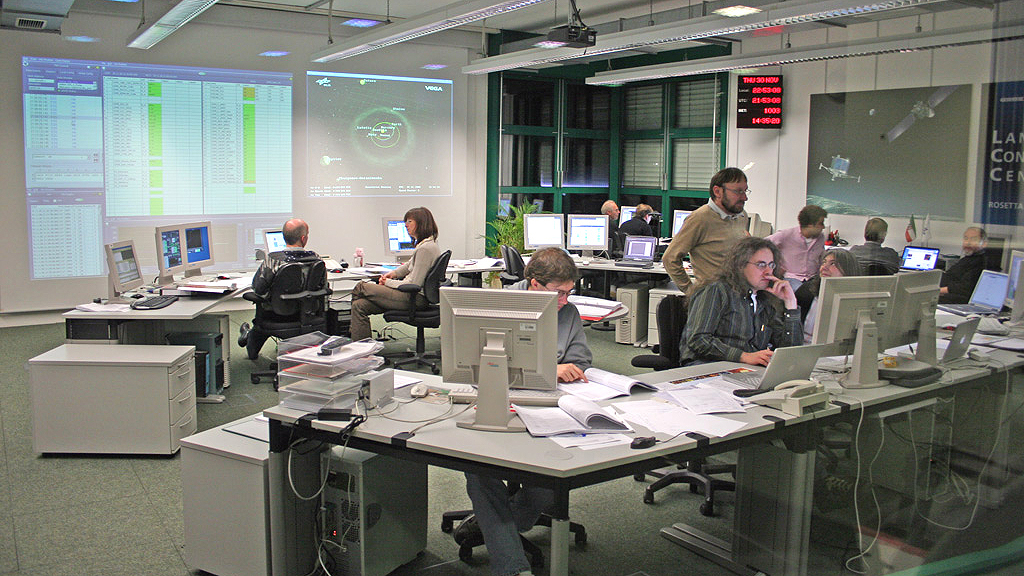
The Lander Control Center (LCC) at the German Aerospace Center (Deutsches Zentrum für Luft- und Raumfahrt; DLR) facility in Cologne is responsible for commanding and operating the Philae lander.
Credit: DLR (CC-BY 3.0)
Data packets
More good news! In Philae’s mass memory, there are still more than 8,000 data packets, which will give the DLR team information on what happened to Philae in the past few days on comet Churyumov-Gerasimenko.
Philae shut down on November 15, 2014 at 01:15 CET, after being in operation on the comet for about 60 hours.
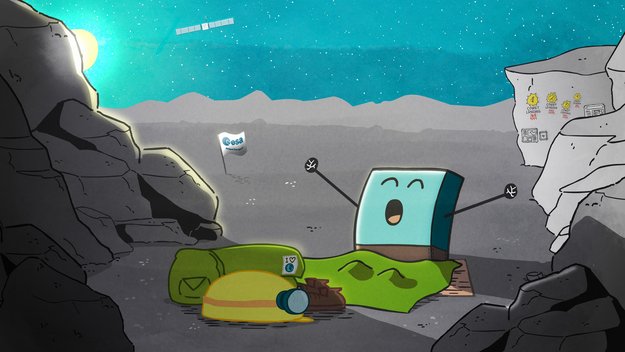
Credit: ESA
Since March 12, 2015 the communication unit on the Rosetta orbiter circling the comet has repeatedly been turned on to communicate with the lander and receive its reply.
Thanks to the lander’s reawakening, the exact whereabouts of Philae is expected to be identified.
 Posted in
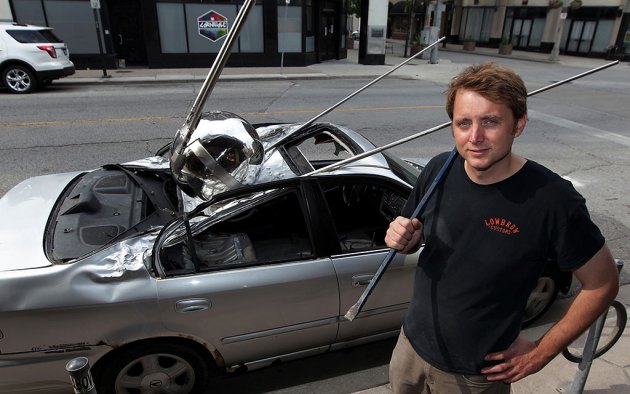
Sputnik 1 embedded into auto. Artist Brandon Vickerd with his clash/crash of cultures.
Photo courtesy: Artcite/Nick Brancaccio/The Windsor Star
There’s an “artistic bent” to the works of Brandon Vickerd – a Toronto-based sculptor.
Outside of Artcite Inc. of Windsor, Ontario, Canada, a replica of the former Soviet Union’s Sputnik 1– the first human-made satellite to orbit Earth – sits embedded into a parked car.
The Sputnik Returned #2 artwork by Vickerd is viewable from June 6 – August 1, 2015. It is an anchor exhibition for Summer Arts Fest 2015.
Vickerd is a professor of Visual Arts at York University and has done a number of pieces involving spacecraft.
Metaphor artwork
According to Art Mûr, a Canadian art gallery that represents Vickerd, an earlier Sputnik Returned work is called a metaphor “for the failed promises of a future predicated on scientific advancement,” according to the Art Mûr site.
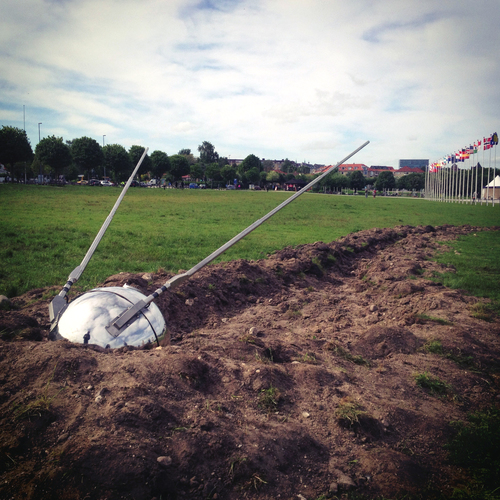
Credit: Brandon Vickerd
“The stainless steel orb, resting lifeless in a crater recalls a modern day Icarus, whose faith in technology lead to hubris and imminent demise as he fell back to earth. This simple design, streamlined and reflective, seems to encapsulate the space race of the 1950s. Today this design appears as a wonderfully crude relic of the period, a potential unmanned doomsday weapon mirroring the excesses of the cold war while also recalling the proto-modernist sculptures of Brancusi.”
Other Vickerd works include Satellite – a 2009 sculpture that is a full scale replica of a grounded Global Positioning System (GPS) satellite. AstroMonkey is a 2012 piece, while Northern Satellite in 2009 appears to depict a Voyager spacecraft that’s taken a nosedive into terra firma.
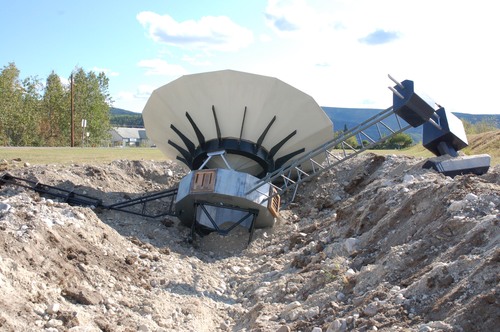
Credit: Brandon Vickerd
High and low culture
In an artist’s statement posted by Vickerd, he shares some of his views that stirred his works: “Purposely diverse, my work straddles the line between high and low culture, acting as a catalyst for critical thought and addressing the failed promise of a modernist future predicated on boundless scientific advancement. Whether through craftsmanship, the creation of spectacle, or humor, my goal is to provoke the viewer into questioning the dominate myth of progress ingrained in Western world views.”
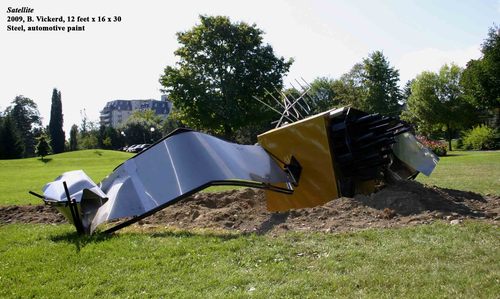
Credit: Brandon Vickerd
Elements of his works, Vickerd adds, “appear as wonderfully crude relics of past visions of the future, as vehicles or potential doomsday weapons mirroring the excesses of the cold war and the space race, while also recalling proto-modernist sculpture of the same period. I attempt to highlight our nostalgia for a past, when science held the promise of a limitless future, and not the very strange and often frightening world of tomorrow we find ourselves living in today.”
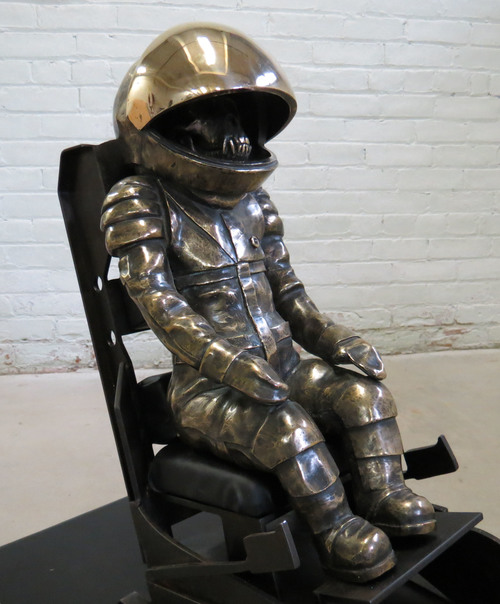
Credit: Brandon Vickerd
Resources
To take a close-up look at Sputnik Returned #2 and other artwork that’s part of the Summer Arts Fest 2015, Artcite is located in a storefront space in the Capitol Theatre and Arts Center in Windsor’s downtown core. The gallery is open 12:00 noon through 5:00 PM, Wednesdays through Saturdays.
Artcite is a non-profit, Artist-run Centre for the Contemporary Arts, dedicated exclusively to expanding the visibility of contemporary arts and advancing the professional presentation, promotion and animation of contemporary art forms.
Go to: http://www.artcite.ca/
For Brandon Vickerd’s website, go to:

Credit: Newsweek Magazine
Check out Newsweek Magazine’s cover story:
We Can Save Ourselves From Earth-Killing Asteroids, but Someone Has to Pay
By Nina Burleigh in Newsweek’s June 19th issue.
Go to:
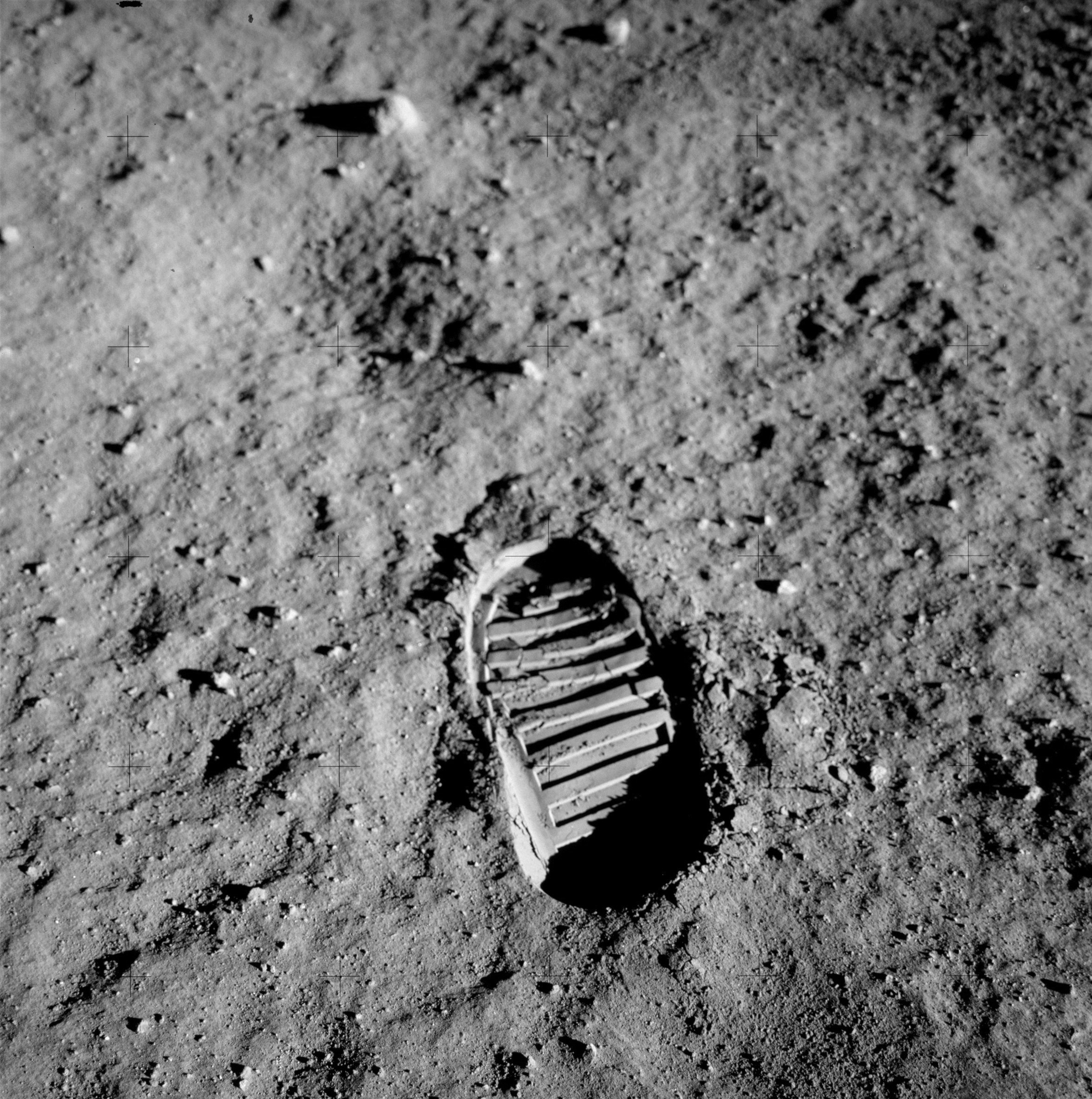
Credit: NASA
It is tagged as the Apollo 11 50th Anniversary Commemorative Coin Act.
U.S. Representatives Bill Posey (R-FL), Frederica Wilson (D-FL) John Culberson (R-TX), Gene Green (D-TX) and Rod Blum (R-IA) have introduced legislation to recognize and celebrate the 50th Anniversary of the Apollo 11 Moon landing with a Commemorative Coin.
July 20, 2019 will mark the 50th anniversary of the Apollo 11 mission moon landing.
Proceeds from the coin
According to a statement from lawmaker Posey’s office, the Apollo 11 50th Anniversary Commemorative Coin “would celebrate not only the innovative spirit and resolve that defined the Apollo program but also the estimated 400,000 Americans across the country who contributed to its extraordinary success.”
Additionally, proceeds from the coin will support college scholarships for students pursuing science, technology, engineering or mathematics (STEM) degrees, educational initiatives that promote space exploration, the Astronauts Memorial that honors the astronauts whom have fallen in the line of duty, and the National Air and Space Museum’s new “Destination Moon” exhibit– all at no cost to taxpayers.
Representative Posey worked on the Apollo program as a young man.

Apollo 11 moonwalkers, Neil Armstrong and Buzz Aldrin.
Credit: NASA
Great achievement
“It is an honor to cosponsor the Apollo 11 50th Anniversary Commemorative Coin Act. I will never forget the day that I and millions of others witnessed on television what is inarguably one of our nation’s greatest achievements,” said Representative Frederica Wilson.
Representative John Culberson added: “The landing of Apollo 11 marks an important milestone in human history and to-date, is the farthest humans have traveled. We need to inspire the next generation of scientists, engineers, and explorers to push the limits and take up the mantle of space exploration to Mars and beyond. So it is fitting that proceeds from the coin will fund STEM education scholarships and programs.”
Radio waves
“The commemorative coin will serve a reminder of what we’ve achieved and an inspiration to continue to strive for greatness,” said Texas representative, Gene Green.
Iowa Representative, Rod Blum, noted that there is a strong connection between Iowa’s First District and the Apollo missions.
Turns out that Cedar Rapids-based Rockwell Collins provided a Collins radio used to broadcast back to Earth Neil Armstrong’s immortal words: “That’s one small step for [a] man, one giant leap for mankind.”
“I am proud to support this bipartisan legislation,” Blum said.
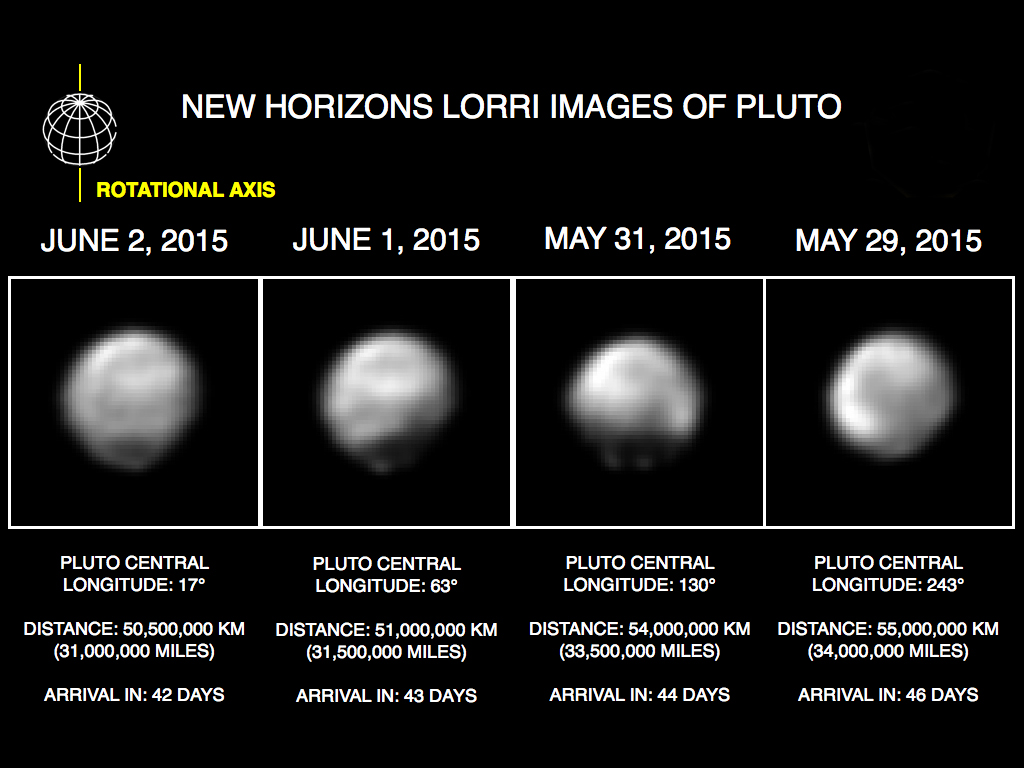
A series of new images obtained by the spacecraft’s telescopic Long Range Reconnaissance Imager (LORRI) during May 29-June 2 show Pluto is a complex world with very bright and very dark terrain, and areas of intermediate brightness in between. These images afford the best views ever obtained of the Pluto system.
Credit: NASA/Johns Hopkins University Applied Physics Laboratory/Southwest Research Institute
The countdown clock to Pluto is ticking away, now some 31 days, 22 hours away.
NASA’s New Horizons spacecraft is speeding toward the first reconnaissance of the dwarf planet Pluto and by venturing deeper into the distant, mysterious Kuiper Belt – a relic of solar system formation.
The surface of Pluto is becoming better resolved as New Horizons pulls in closer and closer to its July flight through the Pluto system.
New Horizons closest approach to Pluto is July 14, 2015.
New video
To help prepare for the encounter with the unknown, The Johns Hopkins University’s Applied Physics Laboratory – builder of the spacecraft – has just issued an impressive video.
Take a view of what’s in store next month at:

The Philae lander would only be a few pixels across in images acquired by the Rosetta orbiter’s Optical, Spectroscopic, and Infrared Remote Imaging System (OSIRIS). Most candidates fail after more detailed study. From these images, only the data acquired by OSIRIS in this image reveals a promising candidate.
Credit: ESA/Rosetta/NAVCAM; ESA/Rosetta/MPS for OSIRIS Team MPS/UPD/LAM/IAA/SSO/INTA/UPM/DASP/IDA
For months, there has been a dedicated search for a three-legged lander dropped off by ESA’s Rosetta spacecraft – now circling the comet 67P/Churyumov-Gerasimenko.
There are now some candidate images that could reveal Philae’s whereabouts.
Complex search
On November 12, 2014, the European Space Agency’s Philae lander “hopped” roughly one kilometer away from its planned landing site.
Philae’s harpoons designed to anchor the probe to the comet failed to fire and the ice screws in its feet were unable to secure the lander to the surface.
That search is complex because even when fully illuminated by the Sun, Philae will be just a few pixels across in images acquired by the Rosetta orbiter’s Optical, Spectroscopic, and Infrared Remote Imaging System (OSIRIS).

This series of 19 images, acquired by the Rosetta orbiter’s Optical, Spectroscopic, and Infrared Remote Imaging System (OSIRIS) on 12 November 2014, shows the Philae lander during its descent towards Comet 67P/Churyumov-Gerasimenko.
Credit: ESA/Rosetta/MPS for OSIRIS Team MPS/UPD/LAM/IAA/SSO/INTA/UPM/DASP/IDA
Possibility of contact
“The possibility of contact [with Philae} is improving as the comet moves closer to the Sun, and the chances of Philae receiving sufficient heat and energy are increasing,” explains Project Leader Stephan Ulamec from the German Aerospace Center (Deutsches Zentrum für Luft- und Raumfahrt; DLR).
Philae’s exact location could be determined when the lander wakes up from hibernation and provides further scientific data.
To do so, the lander needs to generate at least five watts of power and have an operating temperature above minus 45 degrees Celsius. Given those power and temperature requirements, the lander would switch itself into operating mode.
Slightly more energy – a total of 19 watts – is needed to communicate with the DLR team here on Earth.
Active comet
For the communications unit on board the Rosetta orbiter to be able to transmit the status of Philae, the orbiter’s flight path must allow it to “see” the lander.
Currently, the Rosetta orbiter is flying about 200 kilometers above the comet.
Since 67P/Churyumov-Gerasimenko is now always active and is ejecting gas and dust into space, the flight plan for Rosetta has become even more challenging.
“In recent weeks, the team at the DLR Lander Control Center has been preparing for the operation of Philae and its instruments…now we hope that it will get in touch with us,” says DLR’s Ulamec.
Credit: DLR
Rosetta is an ESA mission with contributions from its Member States and NASA.
Rosetta’s Philae lander is funded by a consortium headed by DLR, the Max Planck Institute for Solar System Research (MPS), CNES and the Italian Space Agency (ASI).
Credit: NASA
TIME Ideas
Buzz Aldrin: Why the U.S. Should Partner with China in Space
“Working with China—as we’ve learned with other space powers—presents scientific gains and boosts safety factors for all those engaged in human spaceflight. But there is much more.”
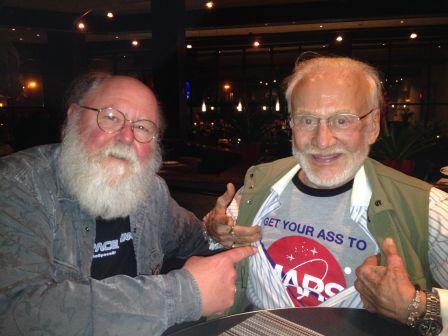
Buzz Aldrin, best known for his Apollo 11 moonwalk, holds a doctoral degree in astronautics and continues to wield influence as an international advocate of space science and planetary exploration. Aldrin and co-author, Leonard David, wrote Mission to Mars – My Vision for Space Exploration, published in 2013 by the National Geographic Society.
Credit: Rob Varnas
“I am resolute in my vision that Earth isn’t the only world for humanity anymore. The first humans on Mars will herald a remarkable milestone. Indeed, I’ve been a global envoy carrying a message: On the occasion of the 50th anniversary of Apollo 11’s touchdown on the Moon on July 20,1969, the U.S. president in 2019—she or he—can utter these words: “I believe this nation should commit itself, within two decades, to commencing an America-led, permanent presence on the planet Mars.”
To read the full article, go to:

Incoming: Tropical Rainfall Measuring Mission (TRMM) spacecraft.
Credit: NASA/GSFC
The Tropical Rainfall Measuring Mission (TRMM) spacecraft is nearing its uncontrolled re-entry, diving into the atmosphere in a destructive plunge next week.TRMM was a joint mission of NASA and the Japan Aerospace Exploration Agency (JAXA).
NASA/Goddard Space Flight Center (GSFC) provided the satellite, four passive sensors, and mission operations.
Roughly 12 pieces of debris from the nearly 3-ton (2,630 kilograms) TRMM spacecraft are expected to survive the heated re-entry and reach the surface of the Earth.

Pre-launch TRMM spacecraft assembly.
Credit: NASA/GSFC
Odds are…
NASA’s Orbital Debris Program Office estimates about a dozen components of the TRMM spacecraft could survive reentry. The chance that one of these pieces would strike someone is approximately 1 in 4,200, which is a relatively low chance.
As its name suggests, TRMM’s orbit brings it over the tropics between 35 degrees North latitude and 35 degrees South latitude.
The scientific satellite was launched on November 27, 1997, from Tanegashima, Japan. TRMM produced over 17 years of scientific data.
An expected re-entry date is June 17.

Credit: NASA/GSFC
Leftovers
The “potentially hazardous objects” due to TRMM’s fiery fall that are expected to survive include:
Two propellant tanks, a nitrogen pressurant tank, four Reaction Wheel Assembly flywheels, two Solar Array Drive Assembly actuators, a High Gain Antenna (HGA) boom bracket, and a TRMM Microwave Imager Bearing and Power Transfer Assembly housing and shaft.
The surviving objects are metallic (titanium alloys), nothing toxic. Total mass of objects expected to survive equates to 247 pounds (112 kilograms) – roughly four percent of the dry mass of TRMM.
Who should be called if someone suspects they found TRMM leftovers?
NASA advises that they should call their local authorities.
“The pieces of TRMM expected to survive re-entry are made of titanium or stainless steel. Although these materials are not toxic, they could have sharp edges and should not be touched or handled by private individuals,” according to a NASA Frequently Asked Questions list.

Credit: NASA
Estimated risk
According to the NASA Orbital Debris Program Office the estimated human injury risk (updated in 2015) is roughly one in 4,200. One in 4,200 means that if the same reentry were to occur repeatedly 4,200 times, the expectation is that that only one person on Earth would be harmed.
Due to TRMM’s orbit, the chances of spacecraft debris harming human life or property is slim, although the exact location of the re-entry cannot be predicted.
The U.S. Department of Defense and NASA are monitoring the decay and re-entry of TRMM.

Credit: NASA
The official source of reentry predictions for uncontrolled space objects is USSTRATCOM’s Joint Space Operations Center (JSpOC).
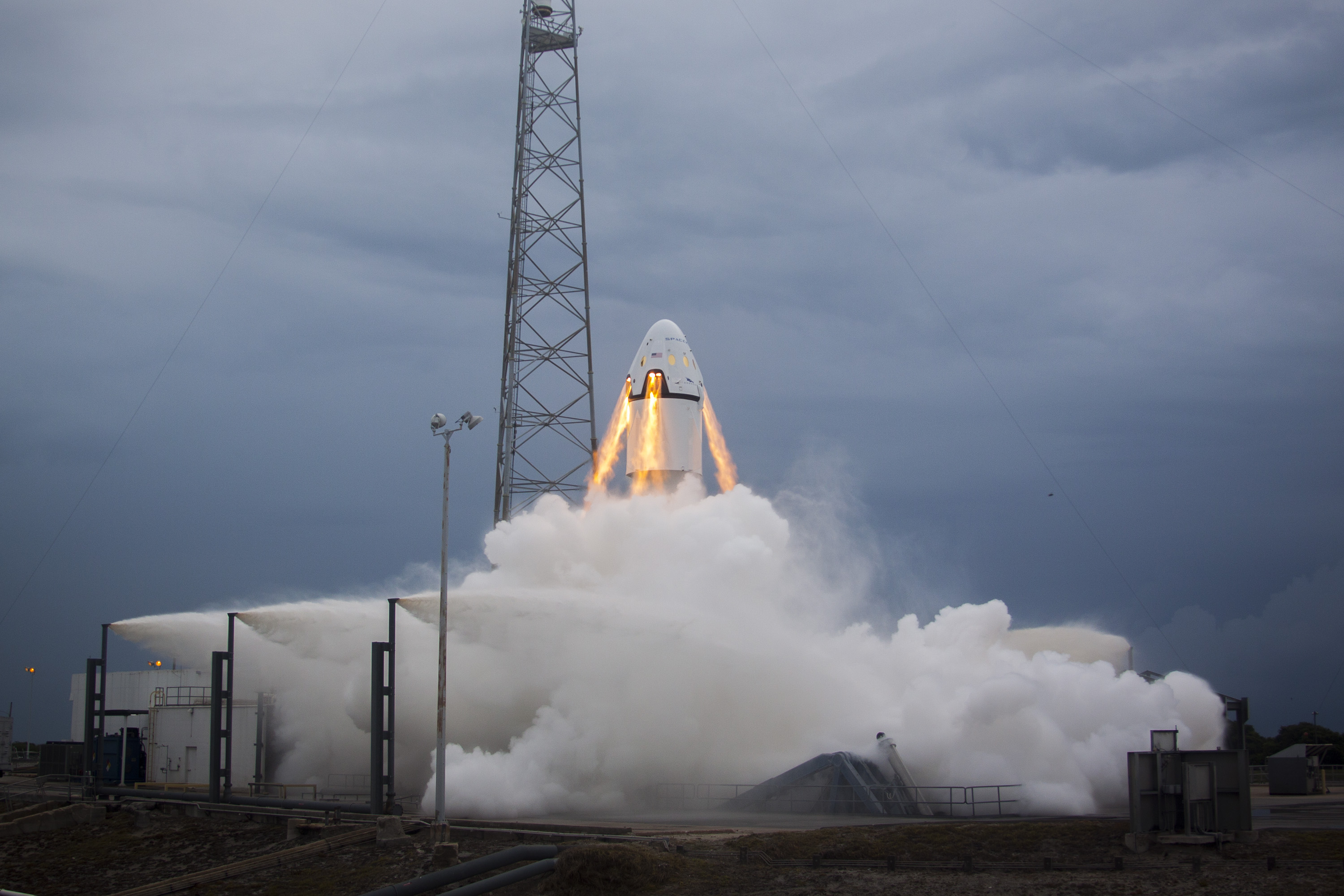
SpaceX Dragon pad abort launch.
Credit: SpaceX
The advancements being made by commercial space organizations – a new way of doing business.
Moreover, many new commercial startups will emerge to take advantage of the extra capacity and reduced pricing to access space.
An article appearing in the Huffington Post has been authored by Greg Autry, a professor that teaches technology entrepreneurship at The Lloyd Greif Center for Entrepreneurial Studies in the Marshall School of Business at the University of Southern California.
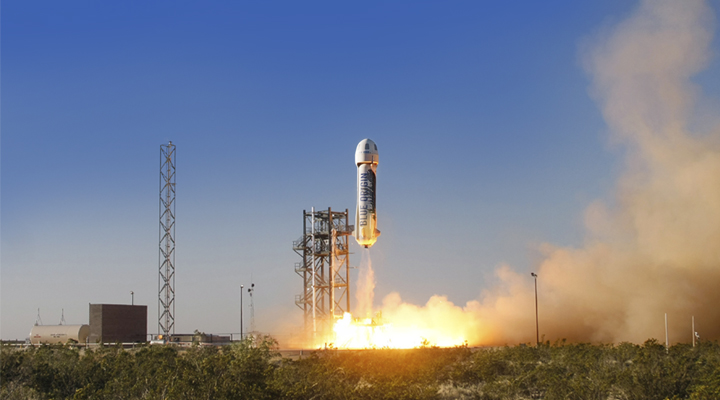
Test flight of New Shepard space vehicle.
Credit: Blue Origin
Rebuilding space dreams
Autry suggests that the Space Age has finally come. That being the case, he sees the promise of savings for American taxpayers, new high-quality jobs and economic opportunities that can’t be predicted.
Now underway, Autry contends, there is a rebuilding of America’s space dreams thanks to the unleashing of market forces.
“A sustainable, market driven economy is emerging from the stagnant cocoon of traditional governmental contracting,” Autry writes.
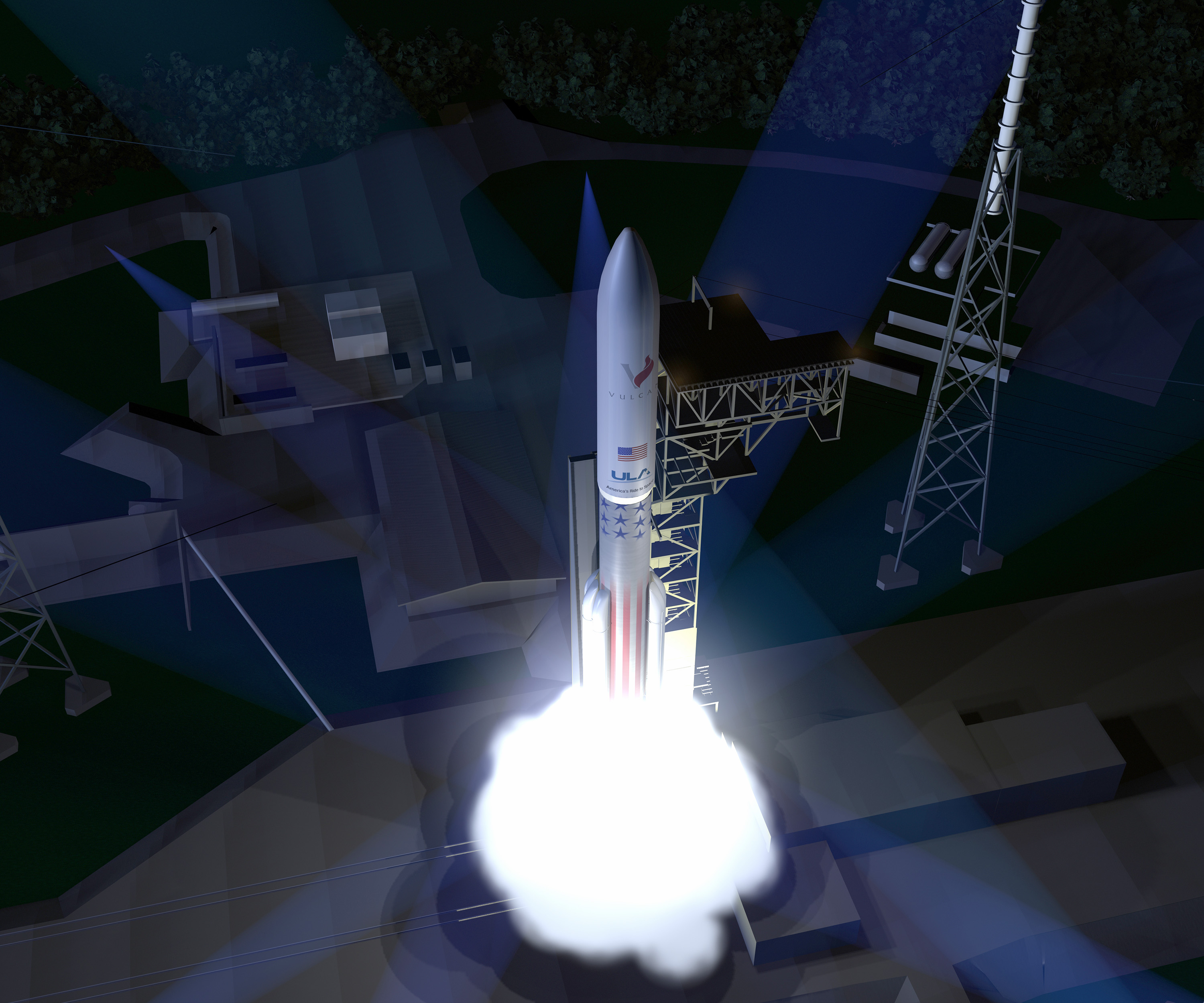
Concept art depicts United Launch Alliance’s Vulcan booster.
Credit: ULA
Take a read of the article at:
http://www.huffingtonpost.com/greg-autry/space-age-finally-arrived-_b_7535648.html
Also, while in the reading mode, dive into an informative study co-authored by Autry on Commercial Space Transportation:
An Analysis of the Competitive Advantage of the United States of America in Commercial Human Orbital Spaceflight Markets
Go to:
http://online.liebertpub.com/doi/pdfplus/10.1089/space.2014.0005
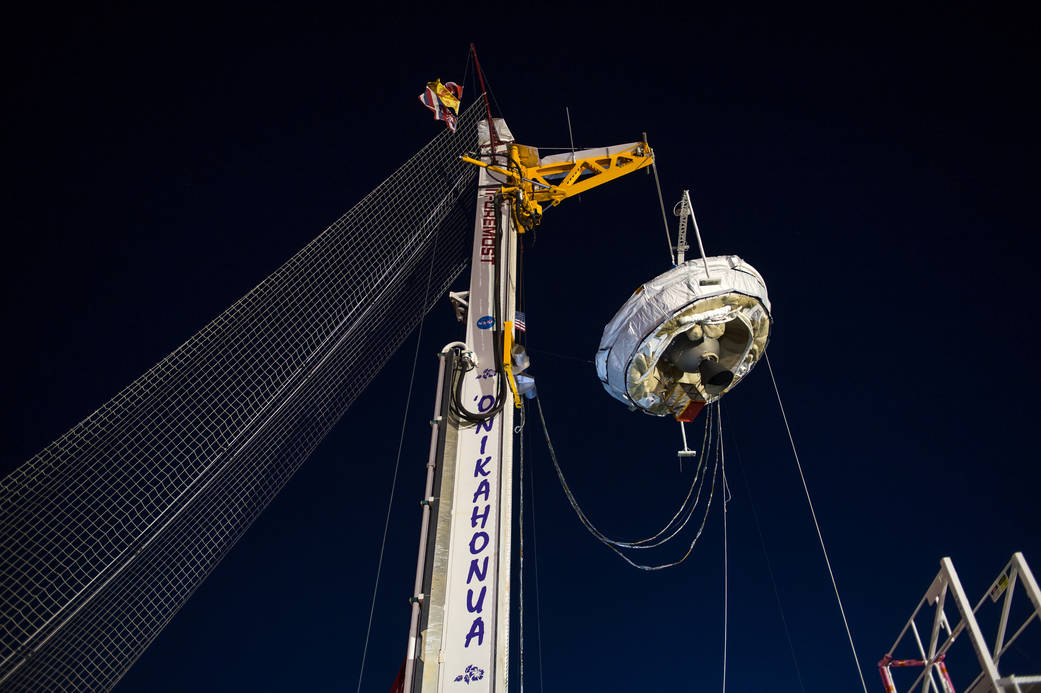
Pre-launch view of the Low-Density Supersonic Decelerator (LDSD) at the U.S. Navy Pacific Missile Range Facility in Kauai, HI. The LDSD crosscutting technology demonstration mission will test entry, descent and landing technologies that will enable large payloads to be landed safely on the surface of Mars.
Credit: NASA/JPL
On June 8, NASA’s Low-Density Supersonic Decelerator (LDSD) project tested two decelerator technologies – hardware that could enable larger payloads to land safely on the surface of Mars, and allow access to more of the planet’s surface by assisting landings at higher-altitude sites.
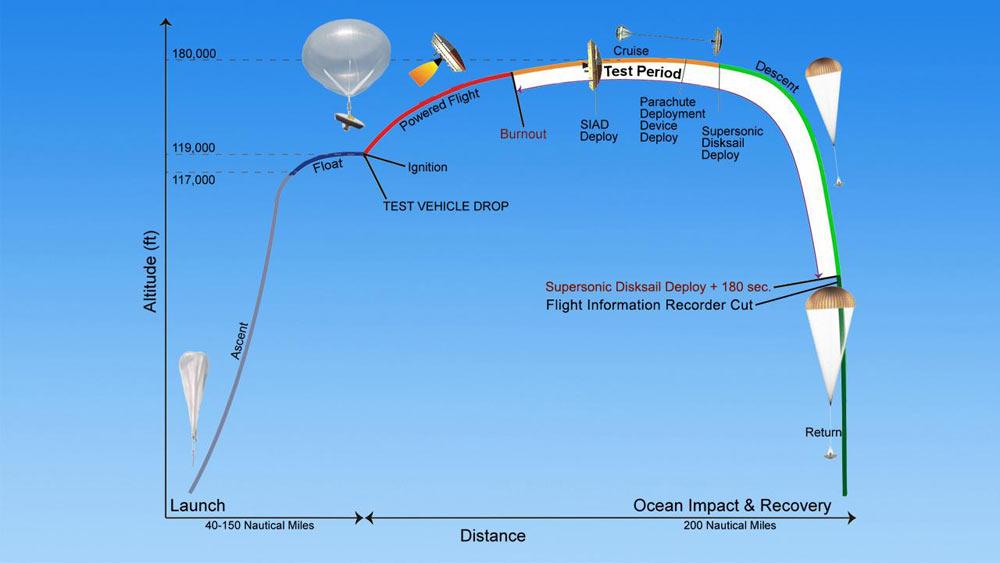
Liftoff of the LDSD took place at the U.S. Navy’s Pacific Missile Range Facility on Kauai. After its balloon ride high above Earth, the saucer-shaped LDSD craft was released, later splashing down in the Pacific Ocean off the west coast of the Hawaiian island of Kauai.
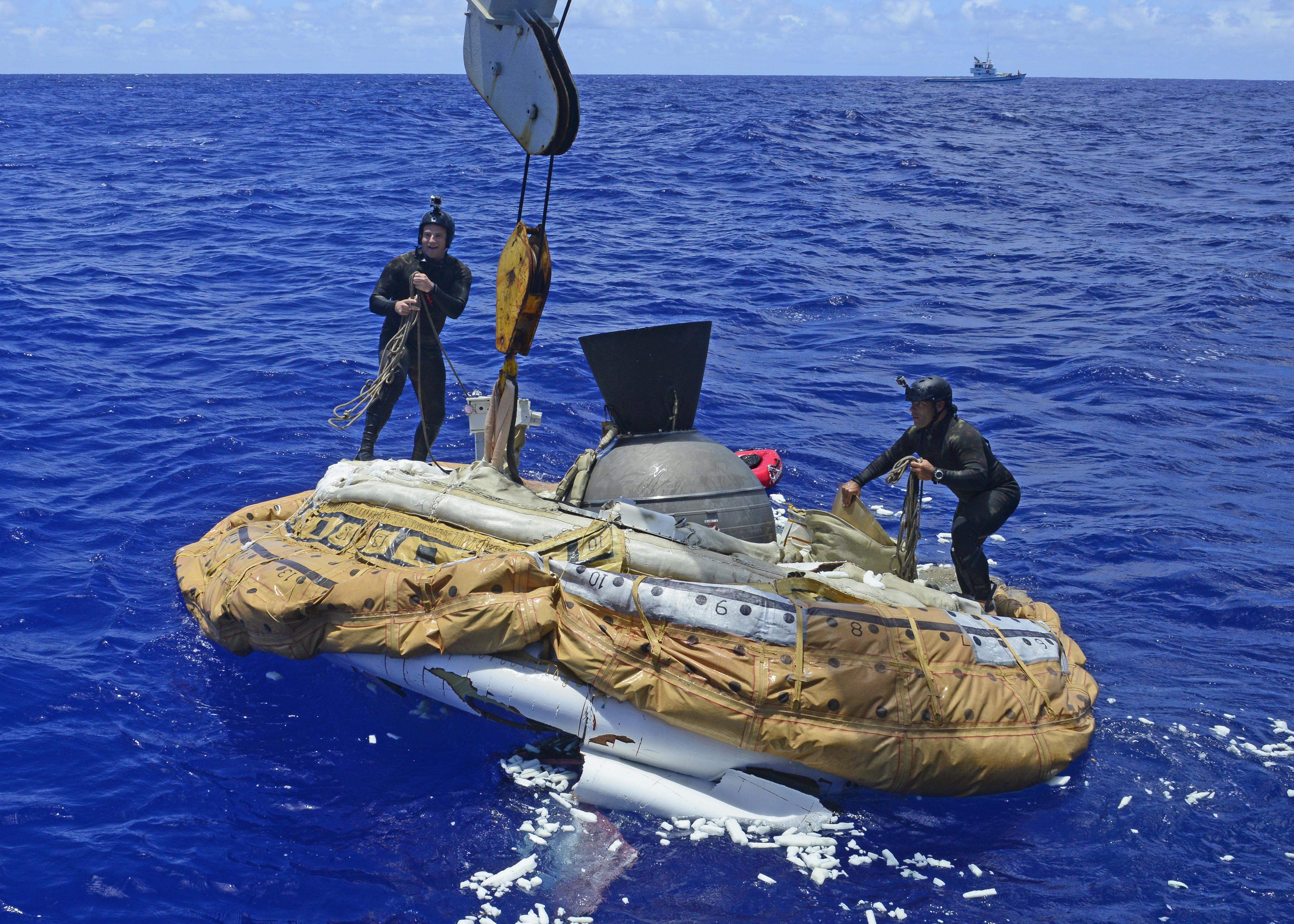
Sailors assigned to the Explosive Ordnance Detachment of Mobile Diving and Salvage Unit 1 recover the test vehicle for NASA’s Low-Density Supersonic Decelerator (LDSD) off the coast of the U.S. Navy’s Pacific Missile Range Facility in Kauai, Hawaii. NASA’s LDSD project is designed to investigate and test breakthrough technologies for landing future robotic and human Mars missions, and safely returning large payloads to Earth.
Credit: U.S. Navy photo by Chief Mass Communication Specialist John M. Hageman
Braking technology
The vehicle separated from the balloon at about 120,000 feet above the ocean. An onboard rocket motor then took the vehicle to 180,000 feet, where the first braking technology, the Supersonic Inflatable Aerodynamic Decelerator (SIAD), was successfully deployed at about Mach 3.
There was also successful deployment and inflation of a supersonic ballute – an inflatable drag device that extracts the large supersonic parachute.
Fourteen seconds after SIAD inflation, the test vehicle’s parachute was released into the supersonic slipstream.
“Tear…ifying”
Preliminary analysis of imagery and other data received during the test indicates the Supersonic Ringsail parachute also deployed. This 100-foot-wide parachute is the largest supersonic parachute ever flown.
Credit: NASA/JPL
However, a tear appeared in the canopy at about the time it was fully inflated. The supersonic parachute did not inflate as designed.
“Early indications are that we got what we came for, new and actionable data on our parachute design,” said Mark Adler, project manager for LDSD at NASA’s Jet Propulsion Laboratory (JPL) in Pasadena, California.
Ian Clark, principal investigator for LDSD at JPL said in a NASA press statement: “Going into this year’s flight, I wanted to see that the parachute opened further than it did last year before it began to rupture. The limited data set we have at present indicates we may not only have gone well down the road to full inflation, but we may have achieved it.”
High-speed imagery
For now, the data from the test is limited, but this will soon change.
With the test vehicle recovered, LDSD team members can inspect ultra-high resolution, high-speed imagery and other comprehensive information carried in the memory cards on board the LDSD test vehicle.
The flight test was the second for the project, mimicking the first LDSD flight on June 28, 2014.
NASA’s Space Technology Mission Directorate funds the LDSD mission, a cooperative effort led by JPL.

