Author Archive
 Author:
  February 23rd, 2025
Wait-a-Minute!
Image credit: Barbara David
Enter the “wait-a-minute” world of space stations.
Early this morning I saw the International Space Station slip across my Colorado mountain skyline.
I waved, but I don’t think they saw me.
But I did ponder the early demise of this huge human outpost in Earth orbit.
Incremental utility?
“It is time to begin preparations for deorbiting the Space Station,” recently explained SpaceX chief rocketeer Elon Musk on an X posting.

Sprawling but aging International Space Station.
Image credit: NASA
“It has served its purpose. There is very little incremental utility. Let’s go to Mars,” Musk said. “The decision is up to the President, but my recommendation is as soon as possible. I recommend two years from now,” Musk advised.
SpaceX has a NASA contract to junk the orbiting outpost into the ocean in coming years.

SpaceX-provided deorbiting of the International Space Station under NASA contract.
Image credit: SpaceX
Inclination “eternal”
But no need to worry. The Russian’s will soon fill the missing in action ISS void.
The first module of the Russian Orbital Station (ROS) is being prepared for hurling into polar orbit in less than three years.

Projected Russian orbiting station.
Image credit: Roscosmos/Inside Outer Space screengrab
That’s the word from RSC Energia’s Ilya Zheleznov, a lead engineer in the ROS design department.
In a recent Pro Kosmos interview, Zheleznov said that ROS will become the base for assembling and sending ships into deep space. The high orbital inclination of ROS will not only allow advancement in the development of radiation protection, but its modular design will extend the service life indefinitely.
“It could be eternal,” Zheleznov advised.

Image credit: Roscosmos/Inside Outer Space screengrab
Nose-dive
To nose-dive into the International Space Station discussion, go to:
NASA Responds to Musk Statements about Deorbiting ISS, Butch and Suni by space policy analyst Marcia Smith at:
Also, go to:
Ocean experts raise concerns over deorbiting the International Space Station at:
https://spacenews.com/ocean-experts-raise-concerns-over-deorbiting-the-international-space-station/
Lastly, check out the informative Pro Kosmos interview (in Russian) with Ilya Zheleznov at:
https://vkvideo.ru/video-219699195_456241129?ref_domain=prokosmos.ru

Wait-a-Minute!
Image credit: Barbara David
 Posted in
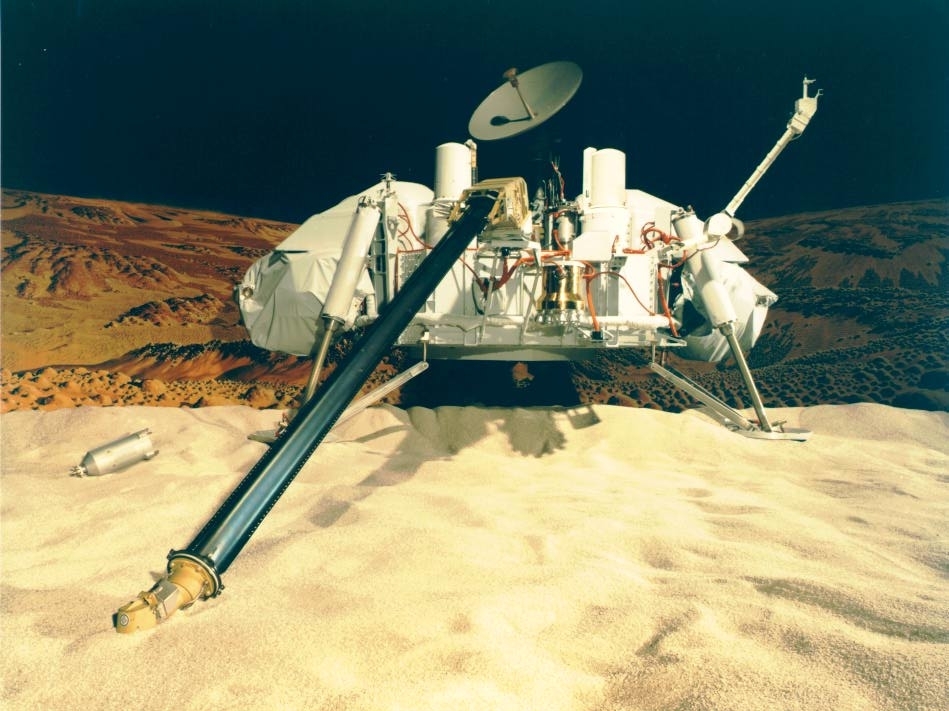
NASA Viking missions to Mars of the 1970s.
Credit: NASA
Back in 1976, the dual NASA Viking landers came to full stop on the Red Planet.
Their life detection experimental findings still reverberate within the scientific community – fueling the on-going discussion on a key question: Is there life on Mars?
Fast forward to today, a new paper tackles and reconsiders the results of the Viking Biology experiments.

NASA 1976 Viking 2 lander image of the Mars Utopian Plain.
Credit: NASA/JPL-CalTech
Perchlorate finding
The most significant change since those 1970’s experiments were conducted was the discovery of high levels of perchlorate on Mars. Perchlorate, plus abiotic oxidants, explains the Viking results and there is no requirement to postulate life on Mars.
“The discovery of perchlorate on Mars by the Phoenix mission has provided a basis for explaining the results of the Viking Landers,” the newly issued paper notes. “Thermal decomposition of perchlorate in the ovens of the [Viking] instrument can explain the lack of organics detected. Accumulation of hypochlorite in the soil from cosmic ray decomposition of perchlorate can explain the reactivity seen when nutrient solutions were added to the soil in the Viking Biology Experiments.”
However, the paper adds, “a non-biological explanation for the Viking results does not preclude life on Mars.”

Credit: NASA/Ben Clark
Revisit the results
The just-released paper — The Viking biology experiments on Mars revisited – has been authored by noted Mars researchers Christopher McKay, Richard Quinn and Carol Stoker. All three authors are from the space science division of NASA’s Ames Research Center at Moffett Field, California, near San Francisco.
“With Mars sample return on the horizon and the prospect of future missions to Mars, perhaps even including life detection instruments, it may be timely to revisit the results of the Viking Biology Experiments,” the research team suggests. “Since Viking landed on Mars, many things have changed, and many things have not. What has not changed in the past 50 years is our understanding of the limits of life in cold and dry environments.”
In a communiqué with Christopher McKay, he told Inside Outer Space: “It is important to note that we are not saying that the Viking results imply ‘no life on Mars.’ Nor are we saying the Viking results imply there is life on Mars.”

The first photo from the surface of Mars shows one of the Viking 1 lander’s footpads.
Credit: NASA/JPL
McKay said that their core point is that the Viking results are saying there is perchlorate and other oxidants on Mars, “and that is what the Viking biology experiments responded to.”
What this means is that the results of the Viking Biology experiments can’t be used to justify an approach to astronaut health and safety or a sample and/or astronaut quarantine policy for return to Earth that assumes no life on Mars.
New data
In their paper for the scientific journal, Icarus, the research trio explains that there have been big changes resulting from missions to Mars. “The most important new data, by far, was the surprising discovery from the Phoenix Mission that the soils of Mars contain about 0.5% perchlorate,” they observe. “This incredibly high concentration of perchlorate is still not adequately explained but the implications for the Viking results are profound.”

NASA Phoenix lander.
Credit: NASA/JPL
The space scientists in their paper explain that the perchlorate model and the resultant conclusion that Viking did not detect life in the surface soils of Mars will factor into any discussion of sample return or astronaut return from Mars.
“The Outer Space Treaty prohibits “adverse changes in the environment of the Earth resulting from the introduction of extraterrestrial matter.” Future experiments are needed to better understand the chemistry of martian soils and the possibility of life persisting there,” McKay and colleagues add.
Good targets
In summing up their research paper, they conclude that the perchlorate model for the Viking results “does not prove that there is no life on Mars, nor does it imply that the continued search for evidence of life on Mars, past or present, is pointless.”
Indeed, as the research team suggests, “we strongly argue for the search for evidence of extant life in future missions. Good targets are salt deposits and polar ground ice.”

The Red Planet as seen by Europe’s Mars Express.
Image credit: ESA/D. O’Donnell – CC BY-SA IGO
For access to the full paper – “The Viking biology experiments on Mars revisited” – go to:
https://www.sciencedirect.com/science/article/pii/S0019103525000132?via%3Dihub

Image credit: CCTV/Inside Outer Space screengrab
China’s Tianwen-2 spacecraft, designed to sample an asteroid, is now at the launch site and slated for launch in the first half of this year.
The China National Space Administration (CNSA) has announced the craft is at the Xichang Satellite Launch Center in southwest China’s Sichuan Province.
Tianwen-2’s targets: Collect samples from near-Earth asteroid 2016 HO3 and explore Comet 311P within the main asteroid belt between Mars and Jupiter.
Research hotspot
“The main-belt comet is another type of asteroid. It should be noted that it is not a true comet, but it may share some characteristics with comets, which is why it is called a main-belt comet or active asteroid,” said Yan Wei, a senior engineer at the National Astronomical Observatories of the Chinese Academy of Sciences.
The comet may emit substances, including gas and particles, when it is close to the sun, which has been observed and is “another research hotspot,” Yan told China Central Television (CCTV).

Image credit: CCTV/Inside Outer Space screengrab
Earth’s quasi-satellite
Asteroid 2016 HO3, which orbits stably near Earth and is known as “Earth’s quasi-satellite,” was first spotted on April 27, 2016, by the Pan-STARRS 1 asteroid survey telescope on Haleakala, Hawaii, operated by the University of Hawaii’s Institute for Astronomy and funded by NASA’s Planetary Defense Coordination Office.
This object contains ancient materials from the early solar system, reports CCTV, making it a “living fossil” useful for studying how the solar system formed and evolved.
With a diameter likely larger than 120 feet (40 meters) and smaller than 300 feet (100 meters), asteroid 2016 HO3 will be observed and analyzed by Tianwen-2, with the probe collecting samples of the object for return to Earth.

Image credit: CCTV/Inside Outer Space screengrab
Following the sample delivery to Earth, the probe is to fly onward to comet 133P, doing so with the assistance of swingbys of Earth and Mars.
The entire mission is expected to last about 10 years.
Material components
“We will also analyze collected spectral data [of the asteroid] to examine some of its material components, to find out what is the similarity between its material composition and that of the Moon and Earth. This is a key focus of our exploration this time,” said Yan Wei, a senior engineer at the National Astronomical Observatories of Chinese Academy of Sciences.

Asteroid 2016 HO3 has an orbit around the sun that keeps it as a constant companion of Earth.
Image credit: NASA/JPL-Caltech
China’s earlier Tianwen-1 mission was an orbiter/lander/rover deploy mission at Mars. Tianwen-3 is to be the country’s Mars sample return mission in the coming years.
For a video showcasing the Tianwen-2 mission, go to:

Image credit: Polish Space Agency (POLSA)
The Polish Space Agency’s (POLSA) Department of Space Security Team has confirmed that on February 19 there was an uncontrolled atmospheric entry of a SpaceX Falcon 9 rocket body that occurred over the territory of Poland.
The rocket stage, weighing approximately four tons, came from the Space X Starlink Group 11-4 mission, launched on February 1 from Vandenberg Air Force Base in California.
There are reports of rocket part leftovers reaching the ground.

Image credit: SpaceX
“Since the information about the discovery of probable rocket debris appeared, POLSA has been cooperating with the police, who are securing the area on site,” the space agency has stated. “A POLSA employee was immediately sent to these places to inspect the objects. POLSA also contacted SpaceX to confirm the origin of the debris and to plan further actions.”

Image credit: Adam Borucki/Facebook
Pressure vessels
Meanwhile, Marco Langbroek of SatTrackCam Leiden, the Netherlands, reports that there were lots of reports and videos of the reentry of the Falcon 9 upper stage that failed to perform its deorbit burn.
Reports have come in from the UK, the Netherlands, Germany, Denmark and Poland of a bright, slow, fragmenting fireball event, Langbroek explains. “Possible debris has been recovered around Poznan in Poland, two or three what appear to be composite wrapped pressure vessels,” he adds.
Indeed, Adam Borucki has posted imagery on the Internet of the object he found near Poznan, Poland – seemingly identified correctly as a pressure vessel.

Intuitive Machines IM-2 lunar lander within SpaceX Falcon 9 payload fairing.
Image credit: SpaceX
Intuitive Machines announced its IM-2 mission Nova-C class lunar lander, Athena, has completed all integration milestones.
The lunar lander is safely encapsulated within SpaceX’s payload fairing in preparation for launch. A multi-day launch window opens no earlier than February 26 from Launch Complex 39A at NASA’s Kennedy Space Center in Florida.

Firefly Blue Ghost now in lunar orbit.
Artwork credit: Firefly Aerospace/Inside Outer Space screengrab
Trio of lunar landers
“Humanity has never witnessed three lunar landers en route to the Moon at the same time, and Athena is ready to rise to the occasion,” said Intuitive Machines CEO Steve Altemus.
The two other landers are Firefly’s Blue Ghost now in lunar orbit, targeted for a March 2 landing, and Japan’s ispace lander expected to perform a Moon orbit insertion maneuver around early May.

ispace lunar lander/rover.
Image credit: ispace
Moon orbiter too
The Intuitive Machines IM-2 mission and Firefly’s Blue Ghost are part of NASA’s Commercial Lunar Payload Services (CLPS) initiative, viewed as central to the space agency’s Artemis lunar exploration plans.
Along with the upcoming departure of IM-2, the Caltech-led Lunar Trailblazer, an ice-snooping Moon orbiter, is also being integrated in the SpaceX payload fairing as a ride share.
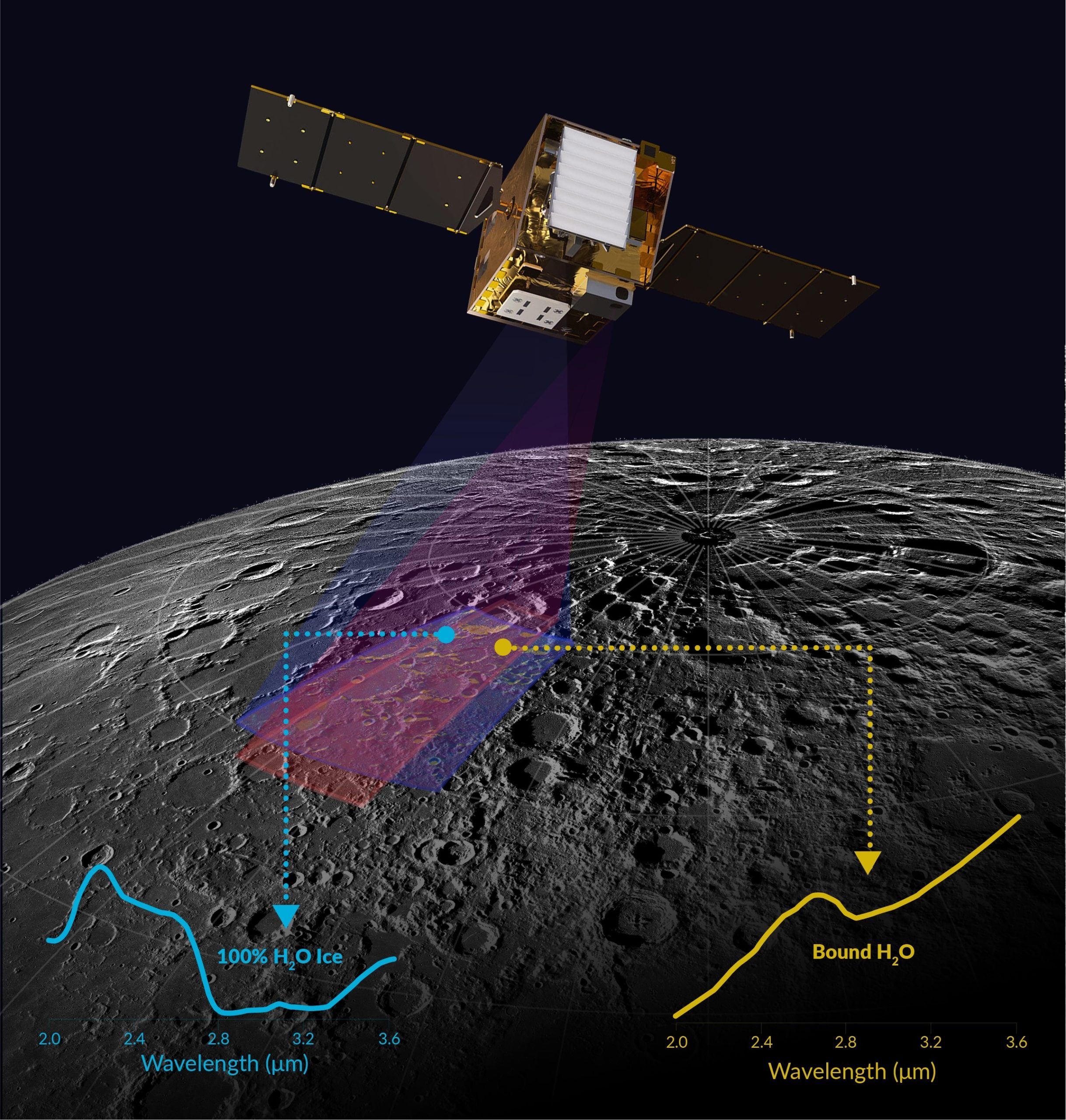
Science instruments onboard Lunar Trailblazer smallsat probe for lunar water.
Image credit: Jasper Miura, Lockheed Martin

New Horizons was built by the Johns Hopkins Applied Physics Laboratotry.
Credit: NASA/Johns Hopkins University Applied Physics Laboratory/Southwest Research Institute/Steve Gribben/Alex Parker
NASA’s New Horizons spacecraft conducted the first and only exploration flyby of the Pluto system, culminating at the closest approach of that distant world in July of 2015.
Sailing onward, the vehicle carried out a January 1, 2019 flyby of Arrokoth, a Kuiper Belt Object, or KBO, located in a region of space beyond Neptune called the Kuiper Belt. There could be scads of other icy worlds residing in the Kuiper Belt, celestial leftovers from the formation of our solar system.

New Horizons Principal Investigator Alan Stern of Southwest Research Institute (SwRI), Boulder, CO., left, with print of a U.S. stamp with suggested update since the New Horizons spacecraft explored Pluto in July 2015.
Credit: NASA/Bill Ingalls
For New Horizons, the gathering of more exploration science is, pun intended, on the horizon.
As for what’s coming next, go to my new Space.com story — Leaving Pluto in the dust: New Horizons probe gearing up for epic crossing of ‘termination shock’ – at

Image credit: Firefly Aerospace
The Firefly Moon landing team reports that a second lunar orbit maneuver has been attained.
Their Blue Ghost commercial lander performed a 3 minute, 18 second burn.
Blue Ghost Mission-1 will deliver 10 science and technology instruments to the lunar surface as part of NASA’s Commercial Lunar Payload Services (CLPS) initiative.
“This maneuver moved the lander from a high elliptical orbit to a much lower elliptical orbit around the Moon,” Firefly central explains.
In this orbit, the team will experience planned rolling communication blackouts as Blue Ghost goes around the far side of the Moon.

Closing in on the Moon! Firefly Blue Ghost new imagery.
Image credit: Firefly Aerospace
Landing date
When on the near side, the team will continue to downlink data and finalize the plan for the craft’s next maneuver that nudges Blue Ghost even closer to the lunar surface.
All is on track for sticking the lunar landing on March 2.
Blue Ghost will attempt to land near a volcanic feature called Mons Latreille within Mare Crisium.
Go to this newly released video of the Moon’s surface taken by Blue Ghost.

NASA’s Small Spacecraft Systems Virtual Institute (S3VI) has released the 2024 State-of-the-Art Small Spacecraft Technology report.
This informative and detailed 2024 edition reflects updates in several areas, including formation flying and rendezvous and proximity operations, additive manufacturing, free space optical communications and hosted orbital services.
Invaluable insights
The document provides invaluable insights in numerous areas, including power, in-space propulsion, guidance, navigation, and control, as well as thermal control, smallsat avionics and deorbit systems.
The S3VI is located at the NASA Ames Research Center in California’s Silicon Valley. The S3VI is sponsored by NASA’s Space Technology Mission Directorate (STMD).

Image credit: S3VI
Improved capabilities
“Technology maturation and miniaturization continues to expand small spacecraft capabilities with the rise in complex SmallSat mission designs. These improved capabilities have broadened the common SmallSat platform resulting in larger CubeSats and smaller SmallSats,” the report notes.
The NASA Small Spacecraft Technology State-of-the-art report is updated annually to capture new information on publicly available small spacecraft systems from NASA and other sources.

Image credit: S3VI
Mass categories
SmallSats are generally grouped according to their mass, and this report adopts the following five small spacecraft mass categories:
- minisatellites are spacecraft with a total mass of 100 – 180 kg;
- microsatellites have a total spacecraft mass of 10-100 kg;
- nanosatellites have a total mass of 1 – 10 kg;
- picosatellites have a mass of 1 – 0.01 kg; and
- femtosatellites have a total spacecraft mass 0.01 – 0.09 kg.
Bridging technology gaps
“While updates in all chapters reflect this growth in the small spacecraft market,” the report points out, “a focused effort was made to update areas with recent technology developments that may ultimately bridge existing technology gaps.”
To access a copy of this report, go to:
https://www.nasa.gov/wp-content/uploads/2025/02/soa-2024.pdf?emrc=0945a0
Also, be sure to check out the resource-rich Small Spacecraft Systems Virtual Institute website at:
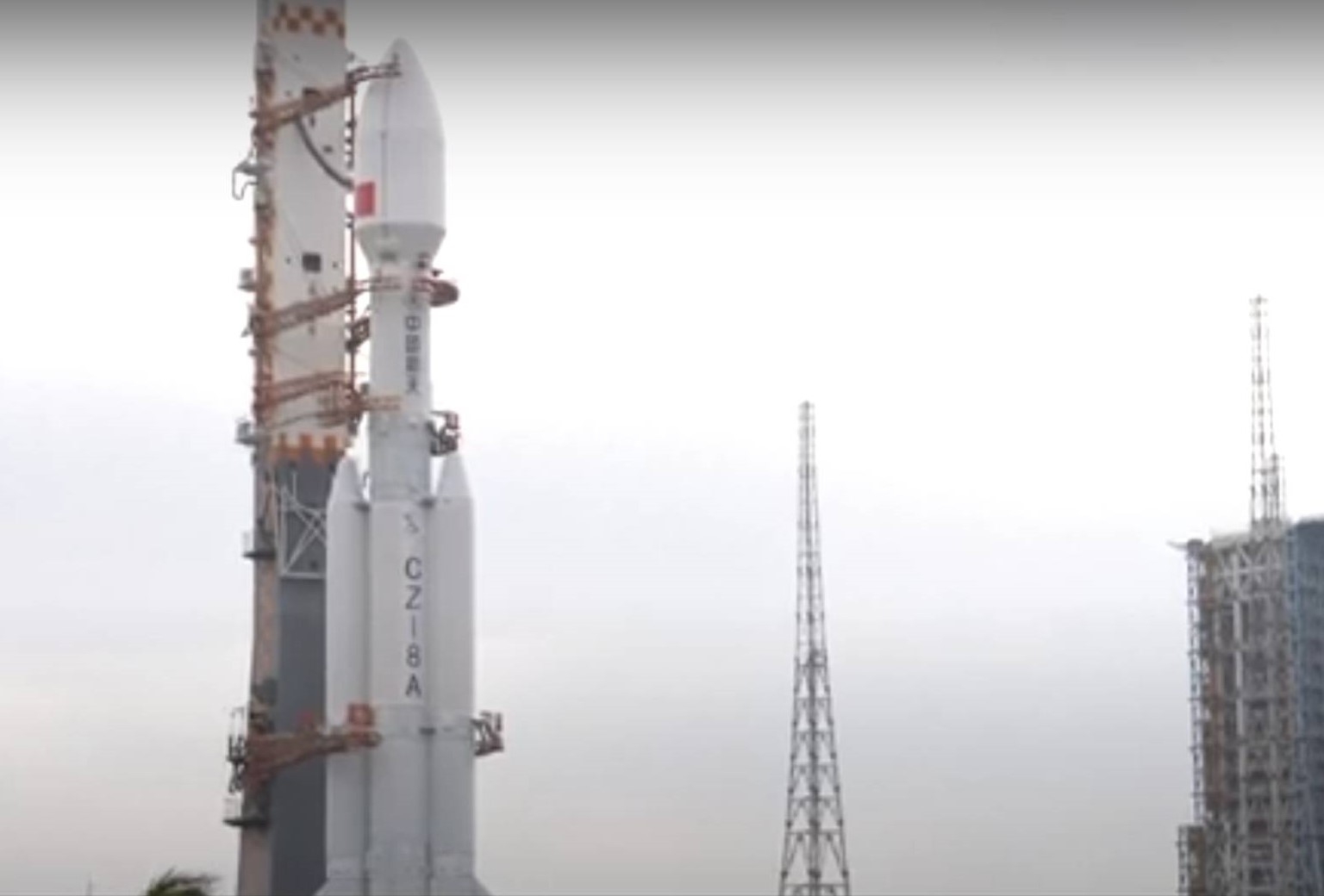
Image credit: China Central Television (CCTV)/China Aerospace Science and Technology Corporation (CASC)
Once again the Philippine Space Agency was on guard for possible rocket debris stemming from China’s recent launch of a Long March 8A rocket from Wenchang Spacecraft Launch Site in Wenchang, Hainan.
The maiden flight of the Long March 8A booster took place on February 11, reportedly hurling into orbit a set of satellites for China’s State-owned internet network.

Drop zones
As posted by the Philippine Space Agency (PhilSA) any expected debris resulting from the rocket launch were projected to fall within identified “drop zones.”
The Philippine Office of Civil Defense (OCD) alerted residents in the provinces of Palawan and Basilan, where parts of China’s Long March 8A rocket were expected to careen into coastal waters:
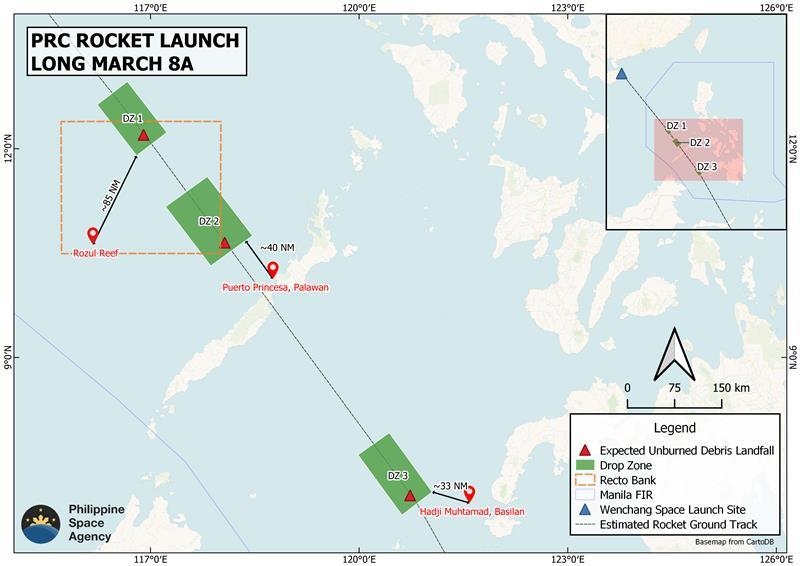
Image credit: PhilSA
Drop Zone 1: Approximate distance: 85 nautical miles from Rozul Reef.
Drop Zone 2: Approximate distance: 40 nautical miles from Puerto Princesa, Palawan.
Drop Zone 3: Approximate distance: 33 nautical miles from Hadji Muhtamad, Basilan.
Danger and potential risk
Meanwhile, the Bureau of Fisheries and Aquatic Resources (BFAR) temporarily barred fishermen from sailing at Rozul Reef in the Drop Zone 1.
In a February 11 PhilSA posted that while not projected to fall on land features or inhabited areas, “falling debris poses danger and potential risk to ships, aircraft, fishing boats, and other vessels that will pass through the drop zone.”

Rocket debris recovered in 2022.
Image credit: Philippine Coast Guard
There is also a possibility, PhilSA added, “for the debris to float around the area and wash toward nearby coasts.”
Toxic fuel
PhilSA reiterated its advice for the public to inform local authorities if suspected debris is sighted. “PhilSA also cautions against retrieving or coming in close contact with these materials that may contain remnants of toxic substances such as rocket fuel,” they stated.
As of Wednesday of this week, the PhilSA has not received reports about Long March 8A debris being found in coastal waters.
“The Long March 8A debris is expected to be from the side boosters and payload fairing of the rocket,” a PhilSA spokesperson told Inside Outer Space, based on the released information of a pre-launch Notices to Air Missions (NOTAMs) advisory.

China Long March-5B Y3 rocket remains from July 24, 2022.
Image credit: Philippine Coast Guard/Mamburao
No active search
It is safe to assume that the booster and payload fairing did land on the water within minutes after the launch, the PhilSA official added.
“As there have been no reports of pieces spotted floating in the water, it is also possible that the debris has sunk instead and therefore will not be found,” stated the PhilSA public relations and information division contact.
“Please note that we are not actively seeking out the debris. Our fishermen are not asked to do search parties for it. PhilSA only requests to be informed in case there are any sightings. Historically, the drop zones have been reliable,” said the official of the Philippine Space Agency.
In the past, on multiple occasions, Chinese rocket leftovers have peppered the area, including debris from a Long March 5B rocket launch in 2022. Filipinos later recovered launch litter thought to be parts of that booster plucked from waters off Mamburao, Occidental Mindoro.
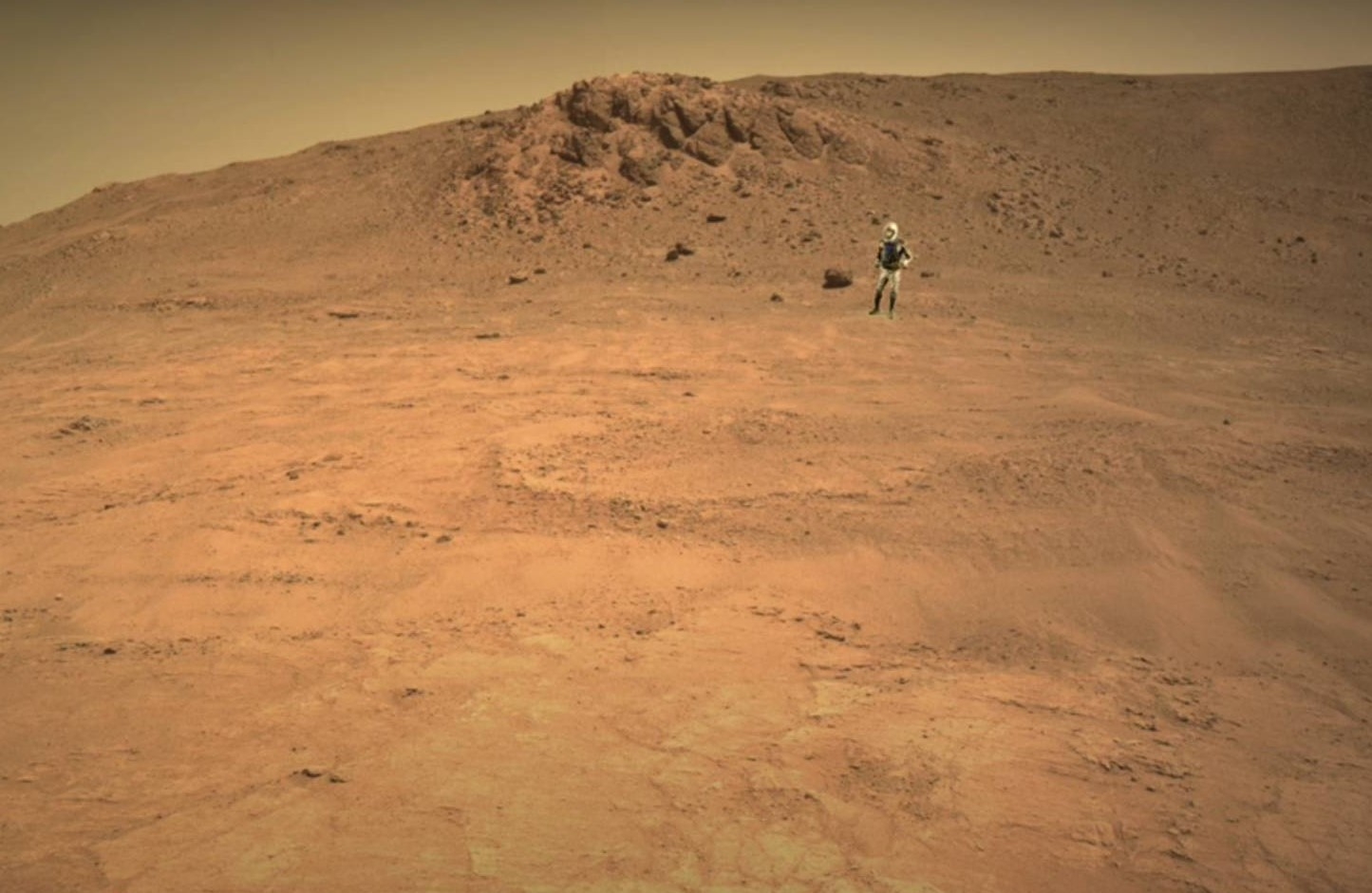
Image credit: Mars GuY
Mars refuses to share! That’s the word from Mars Guy in a new video episode.
NASA’s Perseverance Mars rover at Jezero crater drove back to the location of what could be one of the most significant discoveries of the mission.
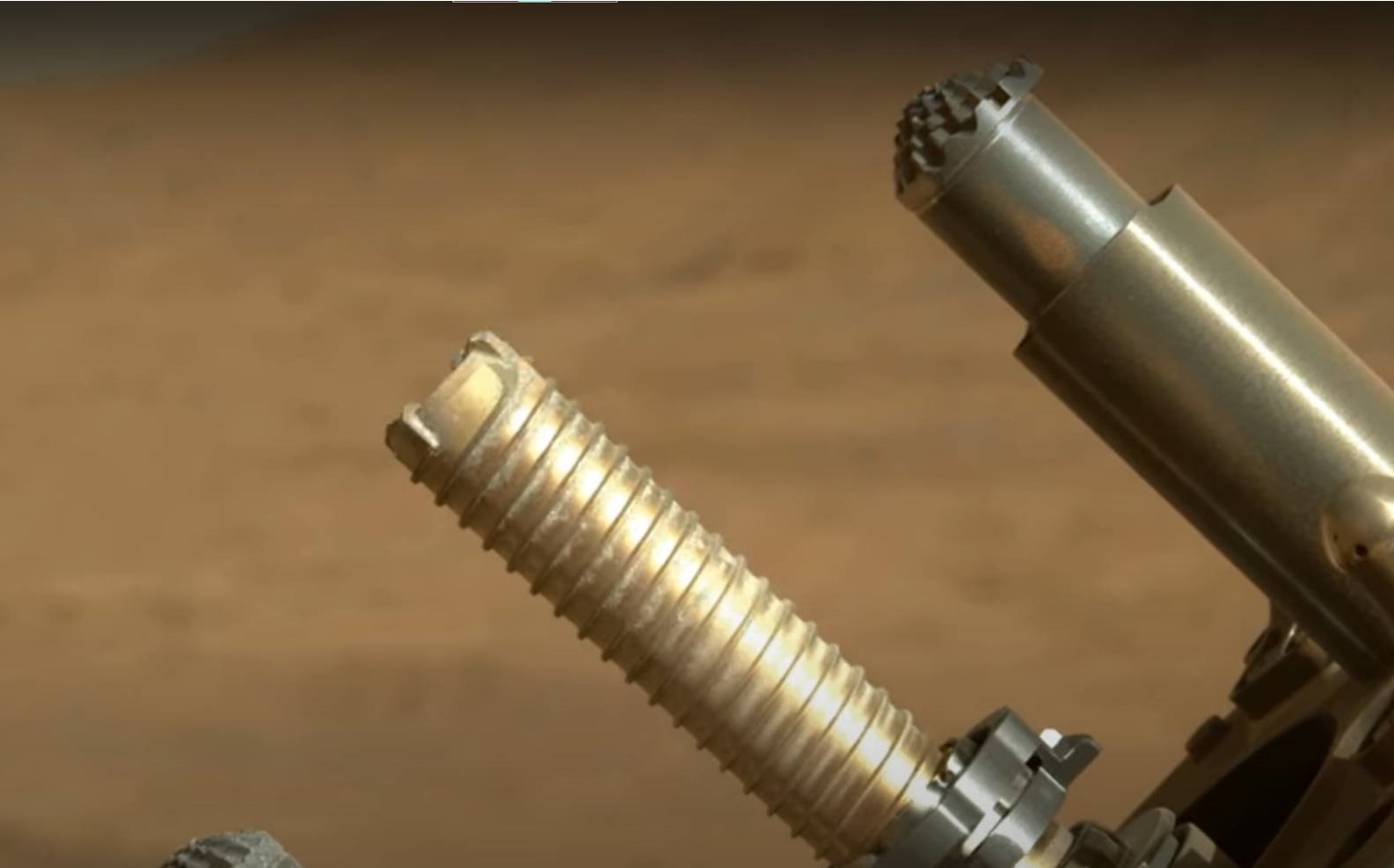
Image credit: NASA/JPL-Caltech/ASU
The plan this time was to collect a sample for return to Earth via a future Mars Return Sample campaign.
But Mars was not ready to participate in that plan.
What happened?
What’s at the “core” of this story?
Go to:
https://youtu.be/SuFE–SUfp8?si=-SUu1Ci1bVKaiEWc
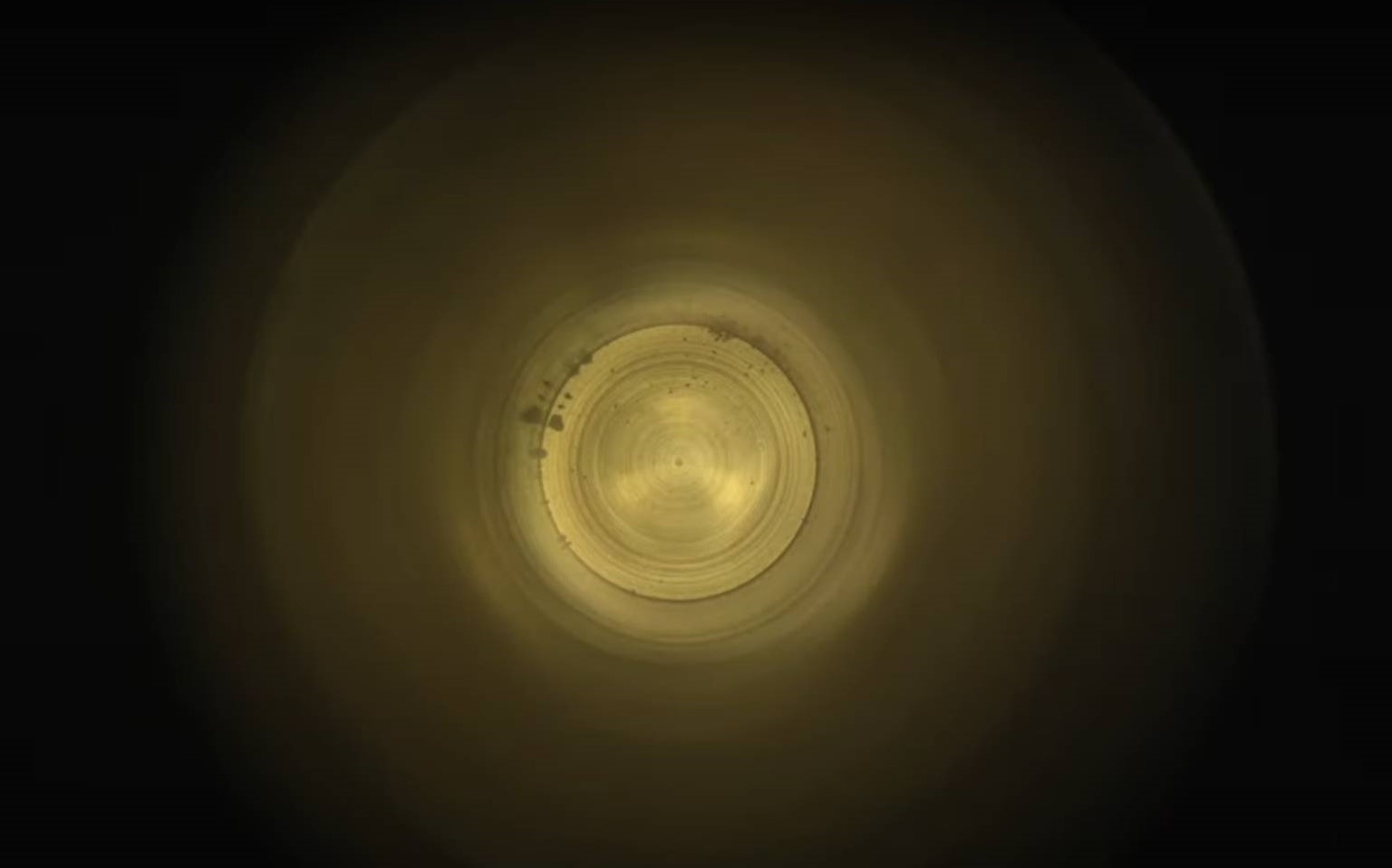
Image credit: NASA/JPL-Caltech

