Author Archive
 Author:
  December 12th, 2015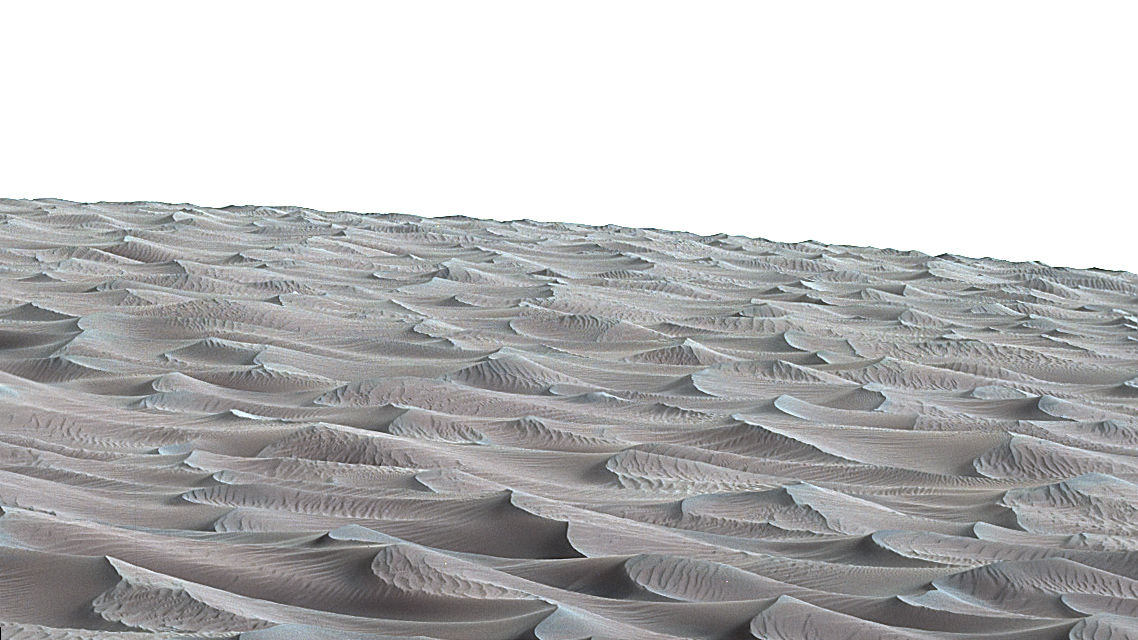
The rippled surface of the first Martian sand dune ever studied up close fills this Nov. 27, 2015 view of “High Dune” from the Mast Camera on NASA’s Curiosity rover. This site is part of the “Bagnold Dunes” field of active dark dunes along the northwestern flank of Mount Sharp.
Credit: NASA/JPL-Caltech/MSSS
The dune-inspecting Curiosity Mars rover is on a roll this weekend.
Scientists have scripted a weekend plan, making use of the robot’s tools to observe and study outcrop targets.
Curiosity has entered Sol 1191 with researchers planning to use the Mars Hand Lens Imager (MAHLI) to acquire images of “Elizabeth Ray” and “Pomona.”
According to Ken Herkenhoff of the USGS Astrogeology Science Center in Flagstaff, Arizona, Curiosity’s three-sol weekend plan is jam-packed with science duties.
As is always the case, carrying out planned rover activities are subject to change due to a variety of factors related to the Martian environment, communication relays and rover status.
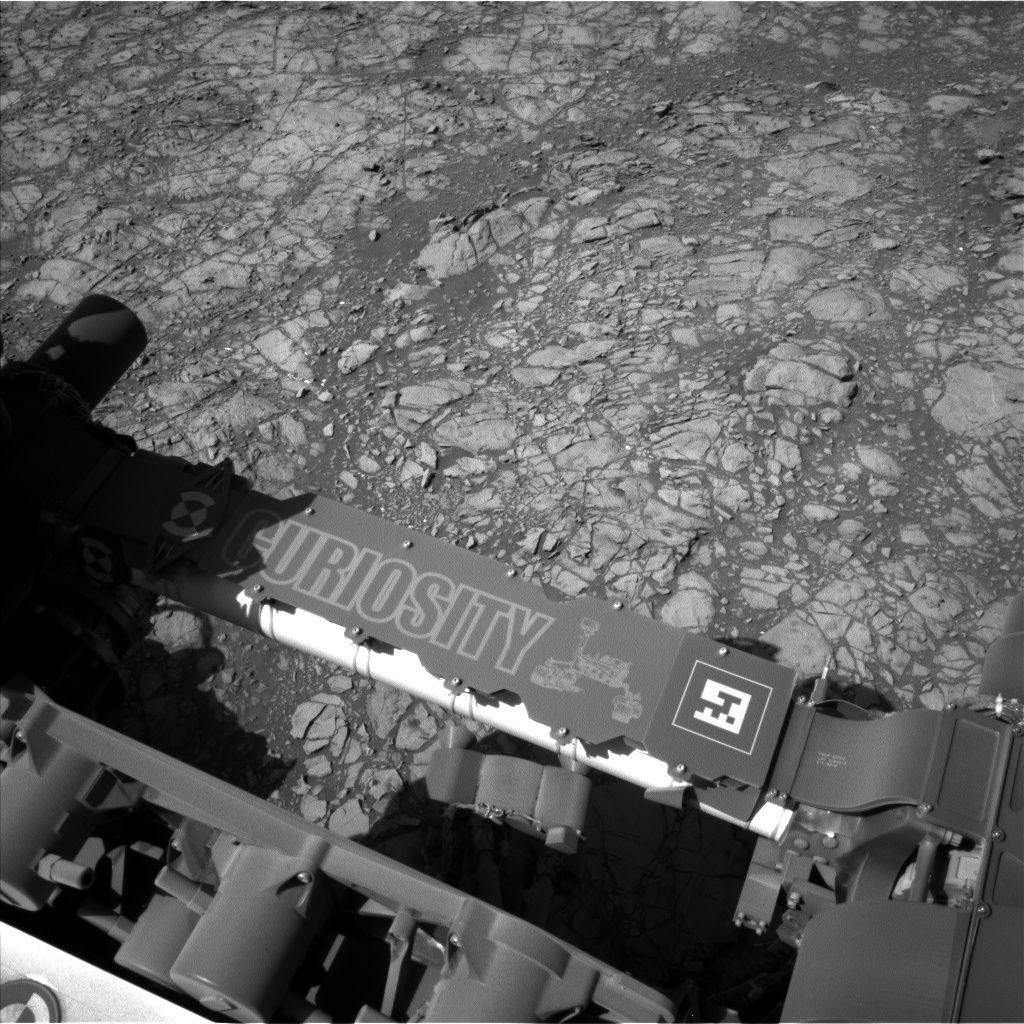
Navcam Left B image taken on Sol 1189, December 10, 2015.
Image Credit: NASA/JPL-Caltech
Morning clouds and dust devils
On tap is use of the Alpha Particle X-Ray Spectrometer (APXS) to be placed on Pomona. The rover’s Chemistry & Camera (ChemCam) and Mastcam are set to observe bedrock targets “Messum” and “Karoo,” Herkenhoff explains.
Early on Sol 1192, Mastcam will acquire another stereo mosaic of the Namib dune, Herkenhoff reports, taking advantage of morning light, and a single image of a ridge named “Paresis.”
Later that sol, the rover is slated to drive toward the southwest and acquire post-drive data. On Sol 1193, ChemCam will acquire calibration data and Navcam will search for clouds. Lastly, early on Sol 1194, the rover’s Navcam and Mastcam will search for morning clouds and dust devils, and measure the amount of dust in the atmosphere by imaging the Sun, Herkenhoff adds.
Dunes on the move
The Jet Propulsion Laboratory (JPL) Curiosity website has noted that Curiosity is using its wheels, as well as its science payload, to investigate sand that forms active dunes on Mars.
Curiosity has started up-close investigations of dark sand dunes up to two stories tall. The dunes are on the rover’s trek up the lower portion of a layered Martian mountain.
Observations from orbit of the “Bagnold Dunes” near Curiosity’s current exploration zone show that edges of individual dunes move as much as 3 feet (1 meter) per Earth year.
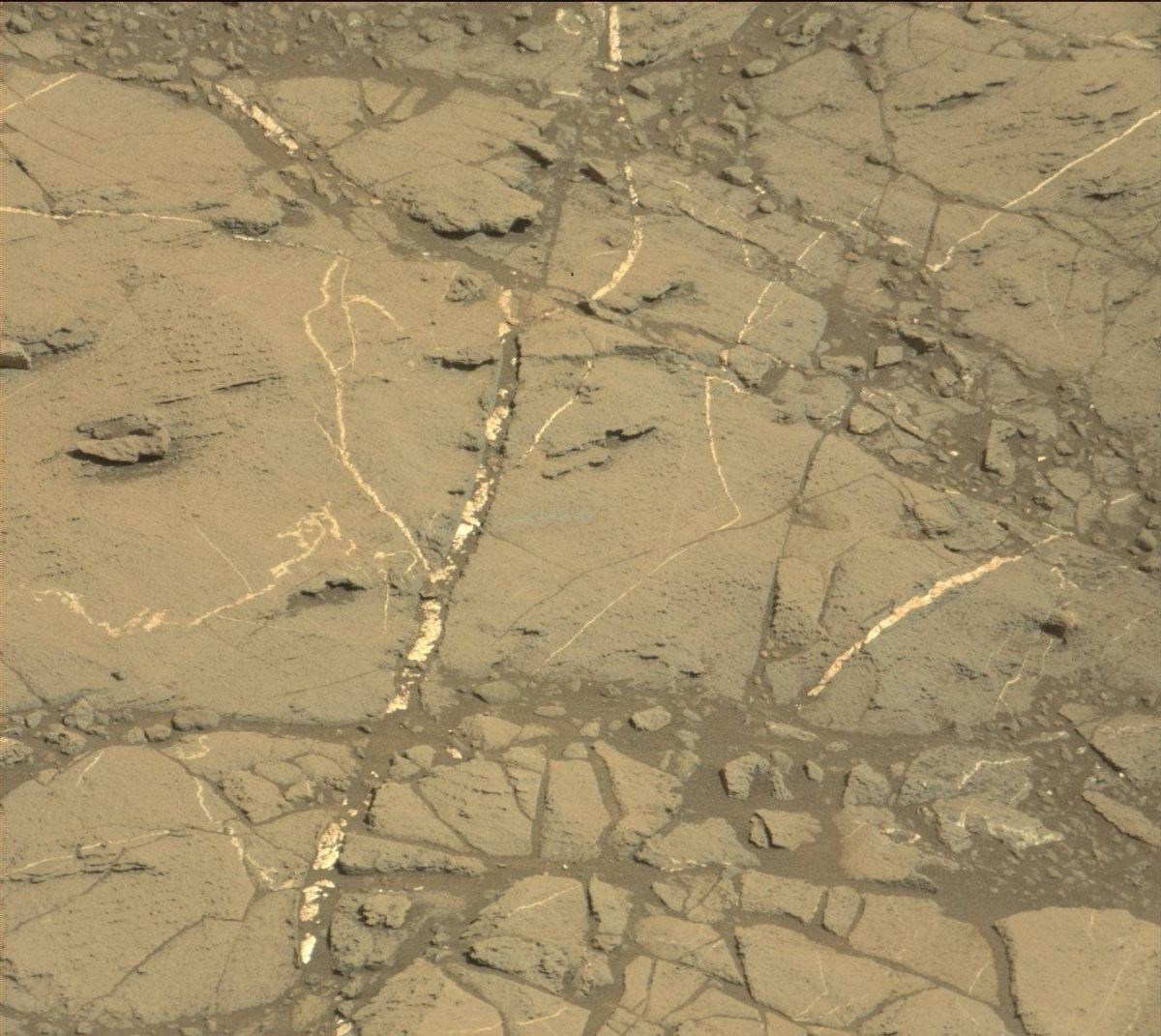
This image was taken by Curiosity’s Mastcam: Right camera on December 10, 2015, Sol 1189.
Credit: NASA/JPL-Caltech/MSSS
Curiosity has been exploring Mars since its landing in early August 2012.
The robot reached the base of Mount Sharp in 2014.
The main mission objective now is to examine successively higher layers of Mount Sharp.
 Posted in

The hit movie The Martian is receiving kudos from all over the world – including thumbs up reviews from viewers when the film recently premiered in China.
In a new posting, Apollo 11 moonwalker, Buzz Aldrin, lifts his space helmet visor and takes a clear look at The Martian – pros and cons. He also reflects on how the film truly plays in terms of the reality when the humans to Mars mission will start to unfold.
Writers on Writers
The review appears in Variety – the daily review of show business and entertainment. Aldrin contributes to “Contenders: Writers on Writers – #14.”
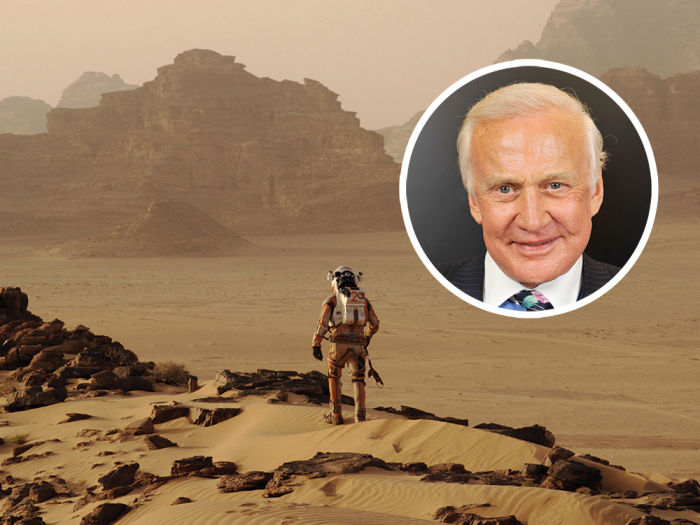
Credit: Variety/Fox
To take a read, go to:
http://variety.com/gallery/contenders-writers-on-writers-2/#!14/the-martian/

Destination Mars – Monkeys before astronauts?
Credit: NASA/USGS
The word from Russia is that the country wants to send monkeys to the Red Planet by 2017. But waving the red flag on such a plan: People for the Ethical Treatment of Animals (PETA).
A few months ago, it was reported that researchers from the Russian Academy of Science are busy training four macaque monkeys to make a long-distance trek to the Red Planet.
Researcher Inessa Kozlovskaya is the leader of the team responsible for teaching the monkeys at the Institute of Biomedical Problems of the Russian Academy of Sciences. Educating the animals includes joystick training and tapping into the cognitive thinking and learning skills of the animals.
While the sojourn to Mars of the monkeys would take six-months, it wasn’t immediately clear whether there’s any provision to return the animals back to Earth.
Misguided mission
“PETA has written to Igor Komarov, the head of the Russian Federal Space Agency, calling on him to cancel the misguided mission and instead use high-tech 21st-century space exploration methods,” said Harriet Barclay, European Outreach Liaison of the PETA Foundation.
Barclay told Inside Outer Space that PETA was shocked to hear that Russia is planning to send four macaque monkeys to Mars in 2017.

Soviet Union’s Sputnik 2 carried the dog, Laika, into Earth orbit in 1957.
Courtesy: NASA
“There’s no reason to repeat the dark days of early space exploration, in which dogs and primates died in horrific ways, all alone in a tiny shuttle hurtling through space,” Barclay said. “Laika, the husky-mix dog who was sent into space on [the former Soviet Union’s] Sputnik 2 in 1957, died of overheating and panic within hours of take-off. Others animals sent into space have died of suffocation, frozen to death or burned up on impact,” she adds.
Robotics rather than animals
Barclay explains that primates are sensitive, intelligent animals and are likely to experience extreme distress during the years of tests and training in the run-up to the monkeys-to-Mars mission. Because the animals would be “unable to understand what is happening to them, they would be terrified if they’re eventually sent on a fatal mission that they never signed up for,” Barclay says.

U.S. Mercury program’s Ham, the first chimpanzee ever to ride into space in January 1961 is shown off by his animal trainer at Cape Canaveral, Florida.
Credit: NASA/KSC
In the PETA letter to Komarov, the organization explains that primates are no longer sent into space by American or European space agencies and that China’s space agency is focusing on high-tech robotics rather than animals.
“We will also be organizing eye-catching demonstrations at Russian embassies across Europe and urging our supporters all over the globe to join us in sending the message that animals are not astronauts,” Barclay concludes.

Outward bound Voyager records with photos, messages, sounds.
Credit: NASA
Forget all that interstellar outreach to extraterrestrials – like the records on the Voyager spacecraft or the plaques on those Pioneer probes.
Furthermore, you might as well turn a deaf ear on those synthesizer tones used to converse with alien beings in the movie, “Close Encounters of the Third Kind.”
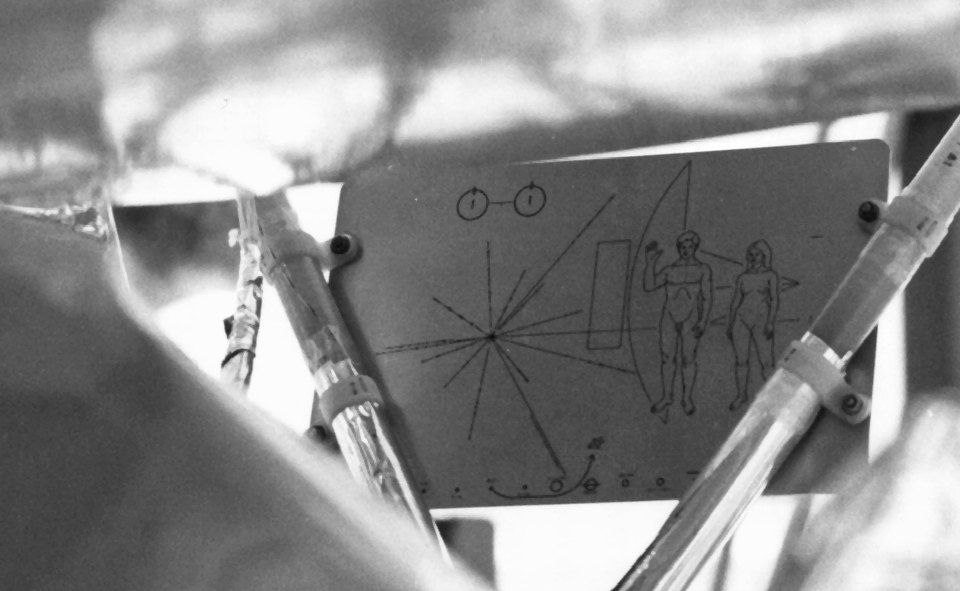
Pioneer plaques wave hello to ET.
Credit: NASA
Our human efforts here on Earth to communicate with ET via images or sound are doomed to failure, explains Don Hoffman, professor of cognitive sciences at the University of California, Irvine. And that may be for the best.
Deciphering dilemma
“Even the simplest of images will be misinterpreted,” Hoffman concludes in a paper on interstellar messages.
“We can’t even understand the language of dolphins despite decades of effort,” Hoffman points out. So the chance of aliens deciphering our words is similarly remote: “About zero,” he contends.
“It is not safe…to assume that images intelligible to humans using human rules of visual construction will also be intelligible to intelligent extraterrestrial species using their own rules of visual construction. It is even less safe to assume that intelligent extraterrestrials will use the same rules of cognitive interpretation that we do,” Hoffman writes.

Close encounters with ET via music, falling on deaf ears?
Credit: Columbia Pictures
Even the simplest of images will be misinterpreted, Hoffman suggests.
Psychophysical experimentation
His answer to reaching out and touching ET?
We should be prepared to engage, Hoffman suggests, “in the systematic, and potentially time-consuming, process of psychophysical experimentation and theory building that will be required to understand the rules of visual construction of each extraterrestrial species that we encounter.”
Moreover, we should be prepared for similar cross-species anthropological research to understand the rules of cognitive construction of each extraterrestrial species.
“Only then will we be able to construct images that communicate the messages we wish. And these images may look utterly alien to us,” Hoffman adds.
Repeatedly surprised
It is likely that contact with ET will be at a great distance.
“In this case we will not be able to conduct the controlled experiments that are necessary to understand the rules of visual construction used by the extraterrestrials. We will be limited to uncontrolled field studies: analyzing whatever signals we receive from the extraterrestrials and sending signals in return,” Hoffman observes.
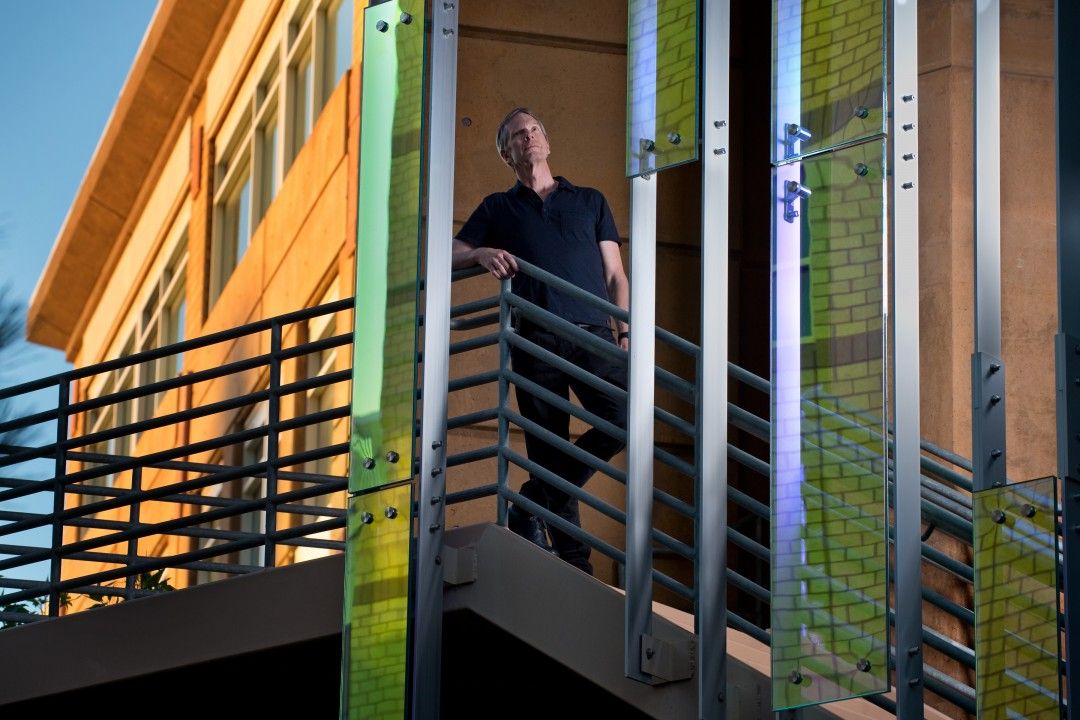
SETI speak specialist, Don Hoffman.
Credit: Steve Zylius/UCI
It will be tempting in this case, Hoffman asserts, “to assume prematurely that we understand how the extraterrestrials perceive and interpret images and related signals. This could be a serious mistake. Even with species here on earth with which we have coexisted for millennia, we are repeatedly surprised by the results of our controlled experiments.”
To view Hoffman’s intriguing paper, go to:
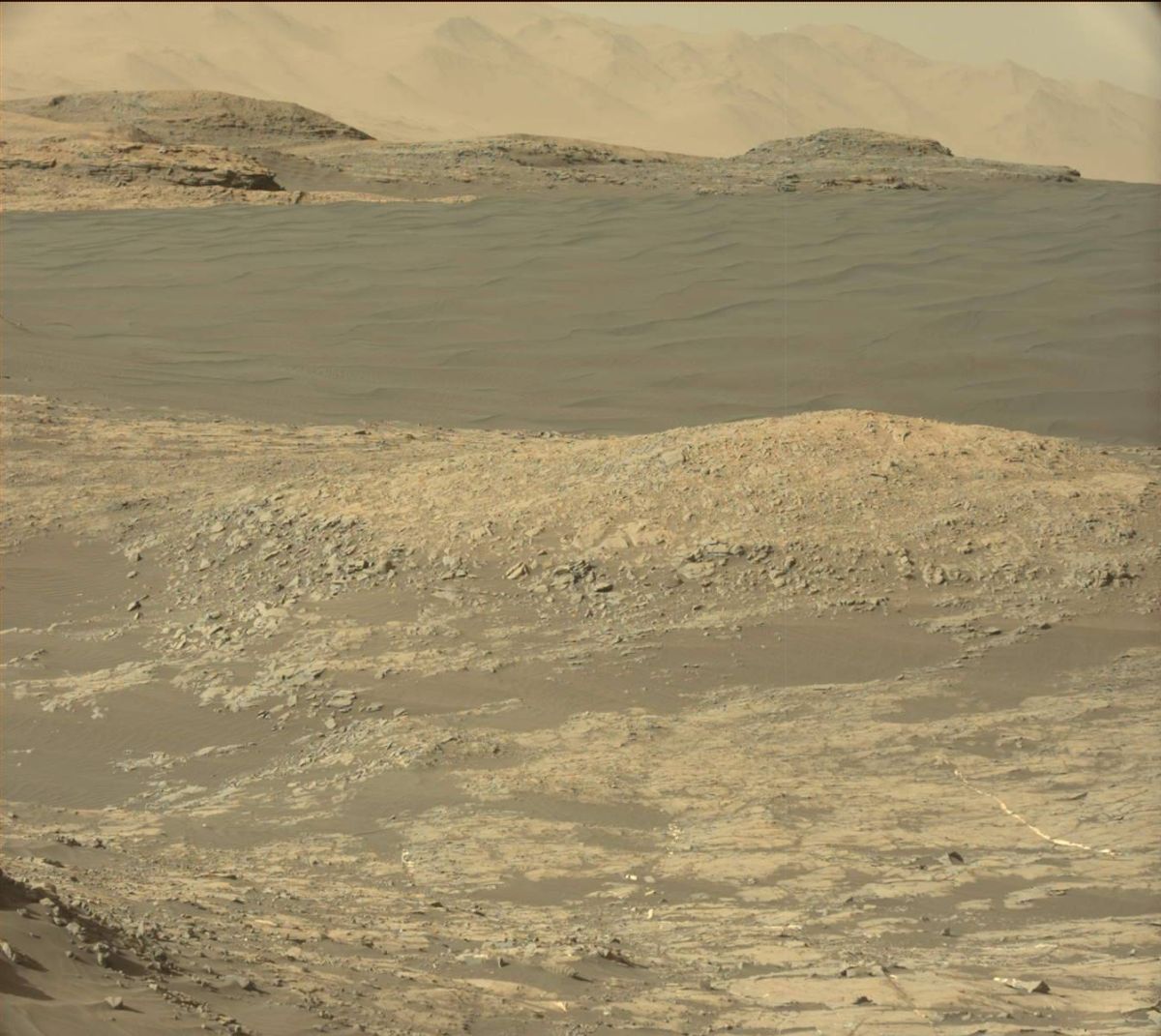
Curiosity image taken by the rover’s Mastcam Left on Sol 1185, December 6, 2015.
Credit: NASA/JPL-Caltech/MSSS
Wheeling about on Mars, the Curiosity rover successfully completed a mobility test last week, captured in images of the robot’s wheel tracks through a sand patch.
Curiosity drove roughly 115 feet (35 meters) toward a dune that is now named “Namib.”
“We’ve accomplished a lot of reconnaissance imaging of the dunes, and we’re looking ahead to monitoring the dune slipface and sampling the chemistry and mineralogy of an active dune,” reports Lauren Edgar, a research geologist at the USGS Astrogeology Science Center in Flagstaff, Arizona.
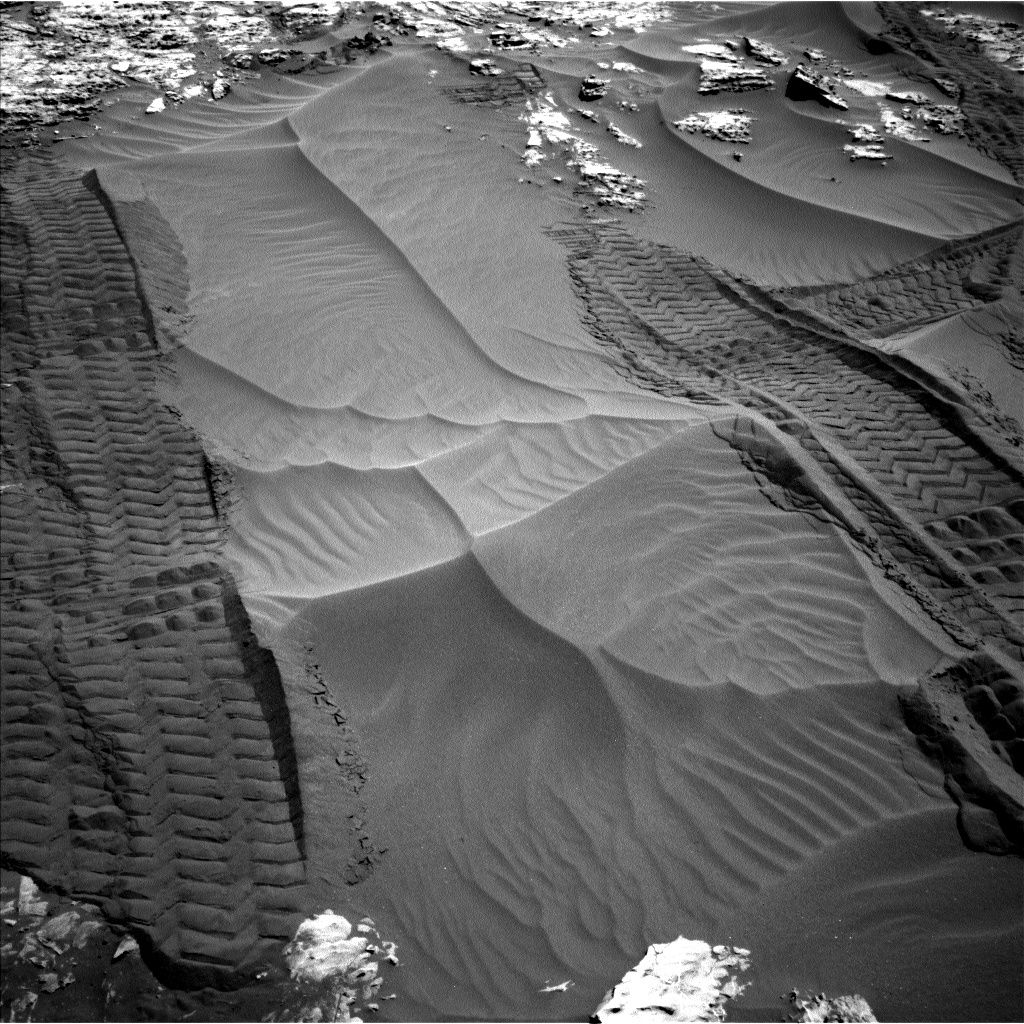
Curiosity’s Navcam Left B camera snapped this image on Sol 1185, December 6, 2015.
Credit: NASA/JPL-Caltech
Close-up images of sand grains were taken by Curiosity’s Mars Hand Lens Imager (MAHLI).
Now in Sol 1187, Edgar notes that the plan for the rover included several Chemistry & Camera (ChemCam) and Mastcam observations of the local bedrock at targets named “Rehoboth,” “Hamilton Range,” and “Twyfelfontein.”
“We’re also testing out some software for autonomous target selection. Then we’ll drive towards the “Namib” dune and take post-drive imaging to prepare for future targeting,” Edgar adds.
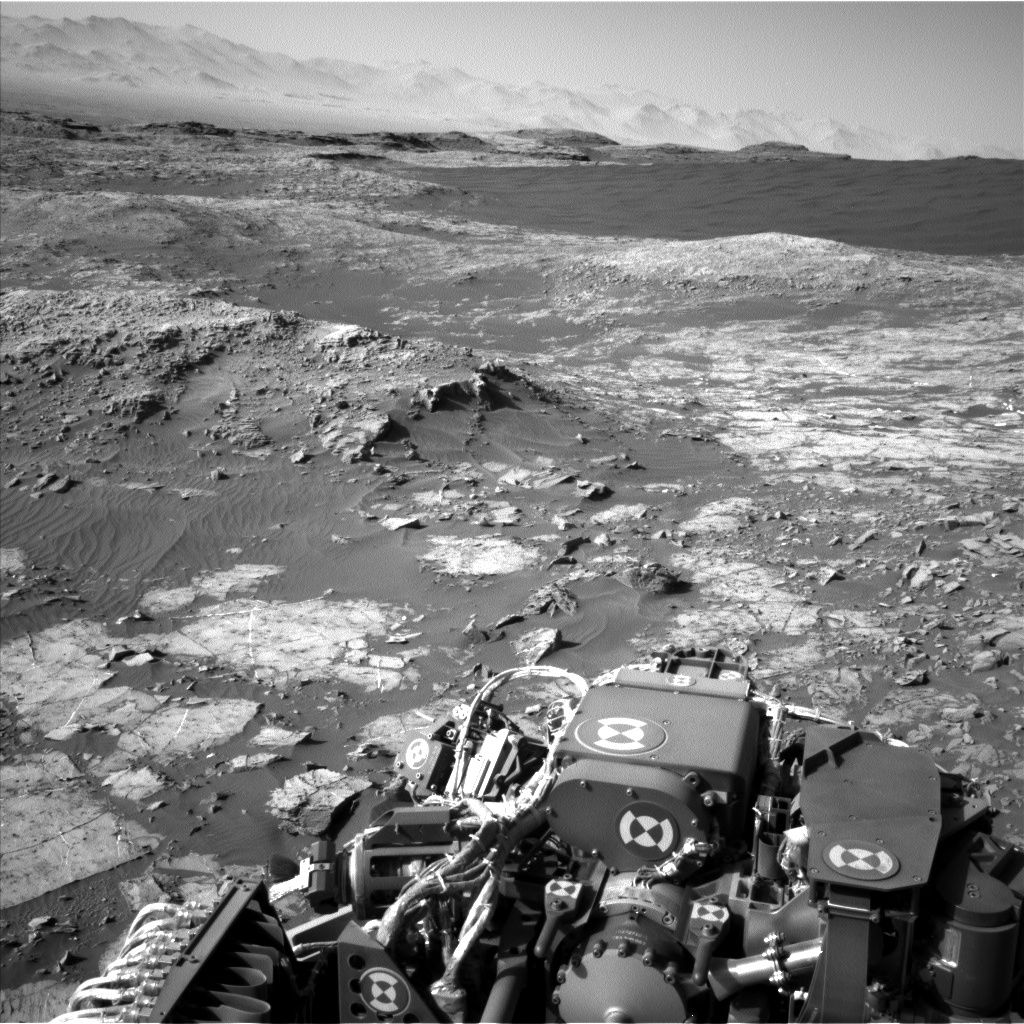
Curiosity Navcam Left B camera image taken on Sol 1185, December 6, 2015.
Credit: NASA/JPL-Caltech
Also slated is use of the rover’s ChemCam, Mastcam, and Navcam instruments to monitor the composition and opacity of the Martian atmosphere and search for dust devils.

The Haughton-Mars Project (HMP) Research Station will be home next year for the 20th HMP field campaign of a small international team of scientists.
Credit: NASA HMP
Devon Island doubles as a welcome mat for revealing safer and more efficient ways to live long and prosper on faraway Mars.
Future Mars explorers are sure to benefit by trekking to a high arctic site here on Earth that in many way offers scenery akin to the Red Planet.
On Devon Island you’ll find firmly planted the Haughton-Mars Project (HMP) – an international multidisciplinary field research venture. The undertaking started in 1997 and has been hosting NASA-supported research each year since then. In its first three years HMP benefited by National Research Council postdoctoral funding.

Devon Island offers training ground for future Mars expeditionary crews.
Credit: NASA/HMP
Rocky barren terrain
Devon Island is the largest uninhabited island on Earth, a wide expanse of landscape that is a rocky barren terrain, set in a polar desert. In terms of human exploration, that locale offers many challenges, from remoteness and isolation to extreme temperatures and lack of infrastructure.
To view my new Space.com story on Devon Island, go to:
Mars on Earth: Canadian Arctic Serves as Red Planet Training Ground
by Leonard David, Space.com’s Space Insider Columnist December 08, 2015 08:00am ET
http://www.space.com/31312-mock-mars-mission-devon-island.html

Still circling Earth after 200 days in orbit.
Credit: USAF
Mum’s the word: The secretive X-37B space plane has winged its way past the 200 day mark, carrying out a classified agenda for the U.S. Air Force.
Rocketed into orbit aboard a United Launch Alliance Atlas V rocket from Florida’s Cape Canaveral Air Force Station back on May 20 of this year, the reusable robotic space plane is also dubbed OTV-4 (short for Orbital Test Vehicle-4).
OTV-4 is the second flight of the second X-37B vehicle built for the Air Force by Boeing Space & Intelligence Systems.
Only two reusable X-37B vehicles have been confirmed as constituting the fleet.
Mini-shuttle
The X-37B space plane looks like a miniature version of NASA’s now-retired space shuttle orbiter. The military space plane is 29 feet (8.8 meters) long and 9.5 feet (2.9 m) tall, and has a wingspan of nearly 15 feet (4.6 m). The spacecraft sports a payload bay about the size of a pickup truck bed.

Recovery crew members process the X-37B Orbital Test Vehicle at Vandenberg Air Force Base after the program’s third mission complete.
Credit: Boeing
The Air Force Rapid Capabilities Office (AFRCO) runs the X-37B program.
While the overall duties of the space plane remain secretive, it was previously announced that this craft carries a NASA advanced materials investigation and an experimental propulsion system developed by the Air Force.
Track record
- The first OTV mission began April 22, 2010 and concluded on Dec. 3, 2010, after 224 days in orbit.
- The second OTV mission began March 5, 2011, and concluded on June 16, 2012, chalking up a mission of 469 days.
- The X-37B program completed its third mission on October 17, 2014 following 674 days on-orbit after its December 3, 2012 launch. This last flight extended the total number of days spent on-orbit for X-37B craft to 1,367.
Florida landing?
To date, all flights of the X-37B touched down at Vandenberg Air Force Base in California. When and where OTV-4 will return to Earth is not known.

Former shuttle processing area at the Kennedy Space Center has been overhauled by Boeing to prep the military’s secretive X-37B space plane.
Credit: Malcolm Glenn
In 2014, it was announced that Boeing Space & Intelligence Systems had consolidated its space plane operations by making use of NASA’s Kennedy Space Center (KSC) in Florida as a landing site for the X-37B.
According to Boeing, a former KSC space-shuttle facility known as Orbiter Processing Facility (OPF-1) has being converted into a structure that will enable the Air Force “to efficiently land, recover, refurbish and relaunch the X-37B Orbital Test Vehicle (OTV).”
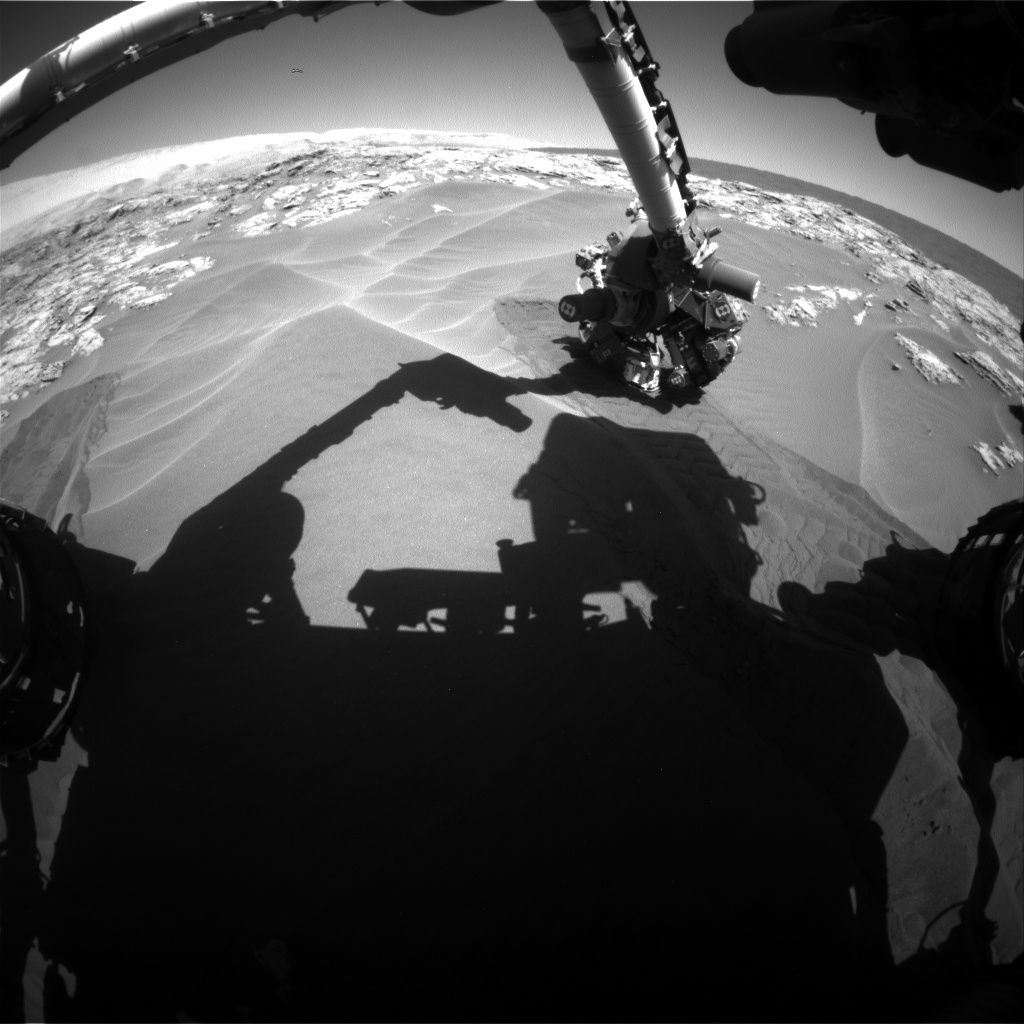
Curiosity Front Hazcam Right B image taken on Sol 1183, December 4, 2015.
Credit: NASA/JPL-Caltech
NASA’s Curiosity rover on Mars has been busy carrying out mobility testing, turning and backing out of Martian sand.
The robot documented its moves while taking multiple Hazcam images, then pausing to take Navcam and Mastcam images of the wheel tracks, reports Ken Herkenhoff of the USGS Astrogeology Science Center in Flagstaff, Arizona.
Images were taken to look for changes in a trench wall, and image the spots where the Alpha Particle X-Ray Spectrometer (APXS) was placed on the sand. APXS measures the abundance of chemical elements in rocks and soils.
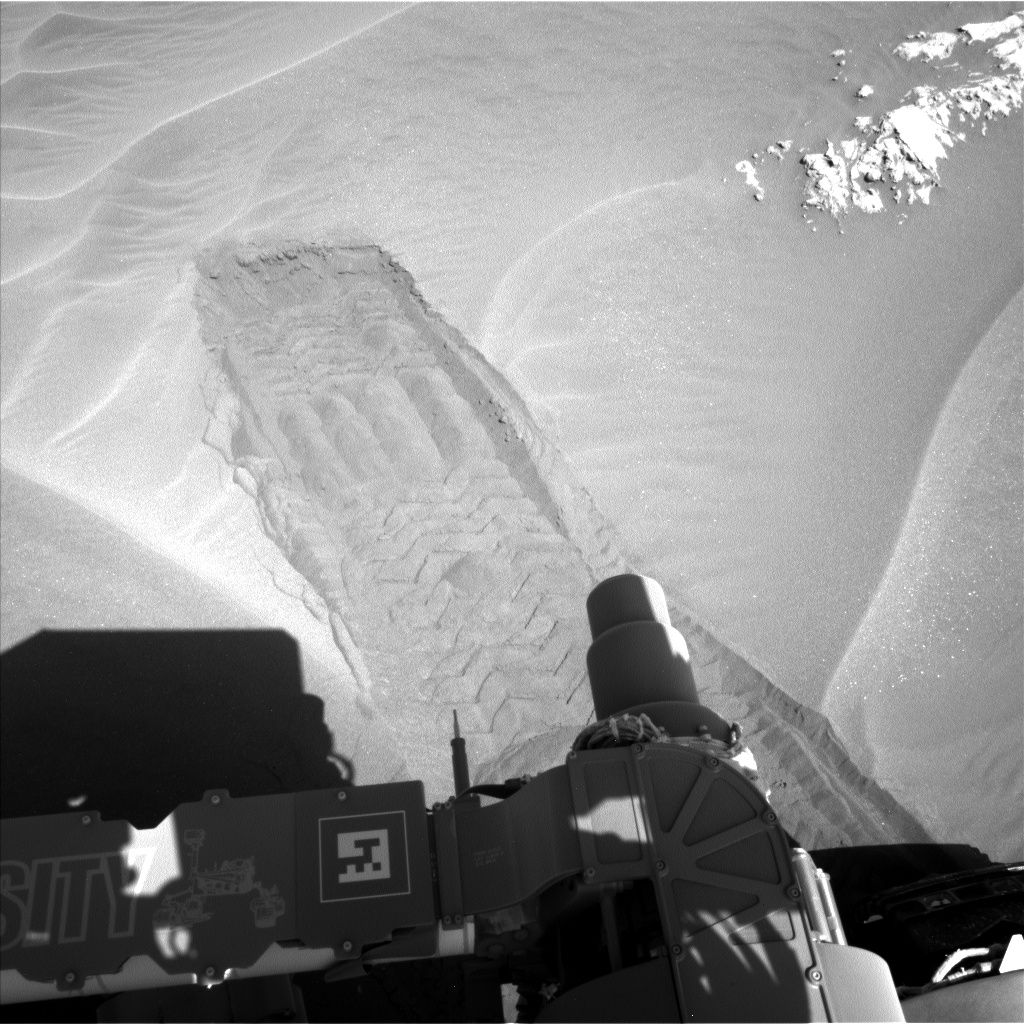
Curiosity Navcam Left B image taken on Sol 1183, December 4, 2015
Credit: NASA/JPL-Caltech
Dark dune sand
Rover operators were on task to drive the Mars machinery close enough to “High Dune” to allow contact science on the dark dune sand.
This weekend, the plan called for another drive of Curiosity.
Last week, the rover drove a little ways into a sand patch and then backed out, leaving trenches where the wheels were.
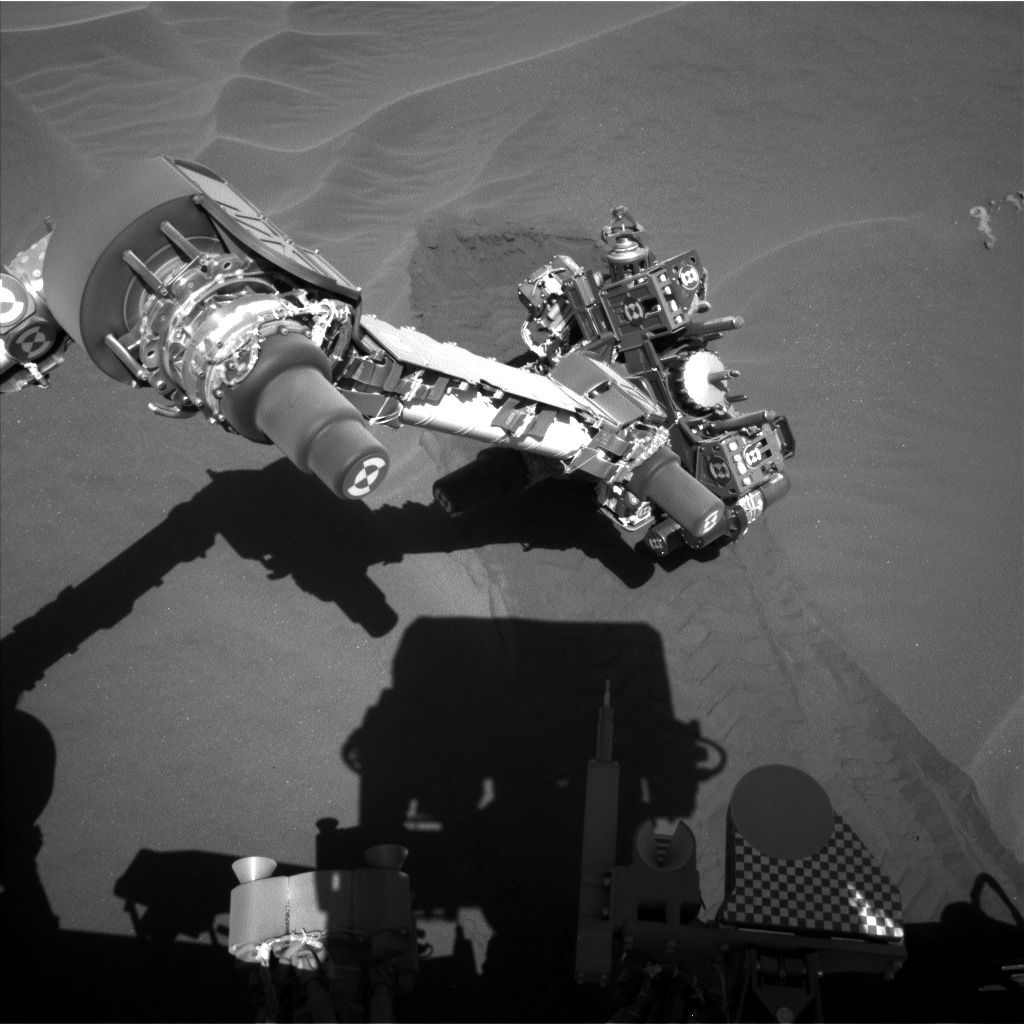
Curiosity Navcam Left B image taken on Sol 1181 December 2, 2015.
Credit: NASA/JPL-Caltech
Making trenches
“Yes, we’re disturbing some of the very photogenic sand ripples that we have been seeing, but it’s for a good cause,” reports Ryan Anderson, a planetary scientist at the USGS Astrogeology Science Center. “It teaches us more about how well we can drive in that sand, and by using the wheels to make trenches like this, we can get a better idea of the internal structure of the sand ripples,” he added.
Imaging undisturbed sand
Work last week involved contact science on the sand, with images taken by the robot’s Mars Hand Lens Imager (MAHLI) of the undisturbed sand, the walls of the wheel track, and the interior of the track, Anderson said.
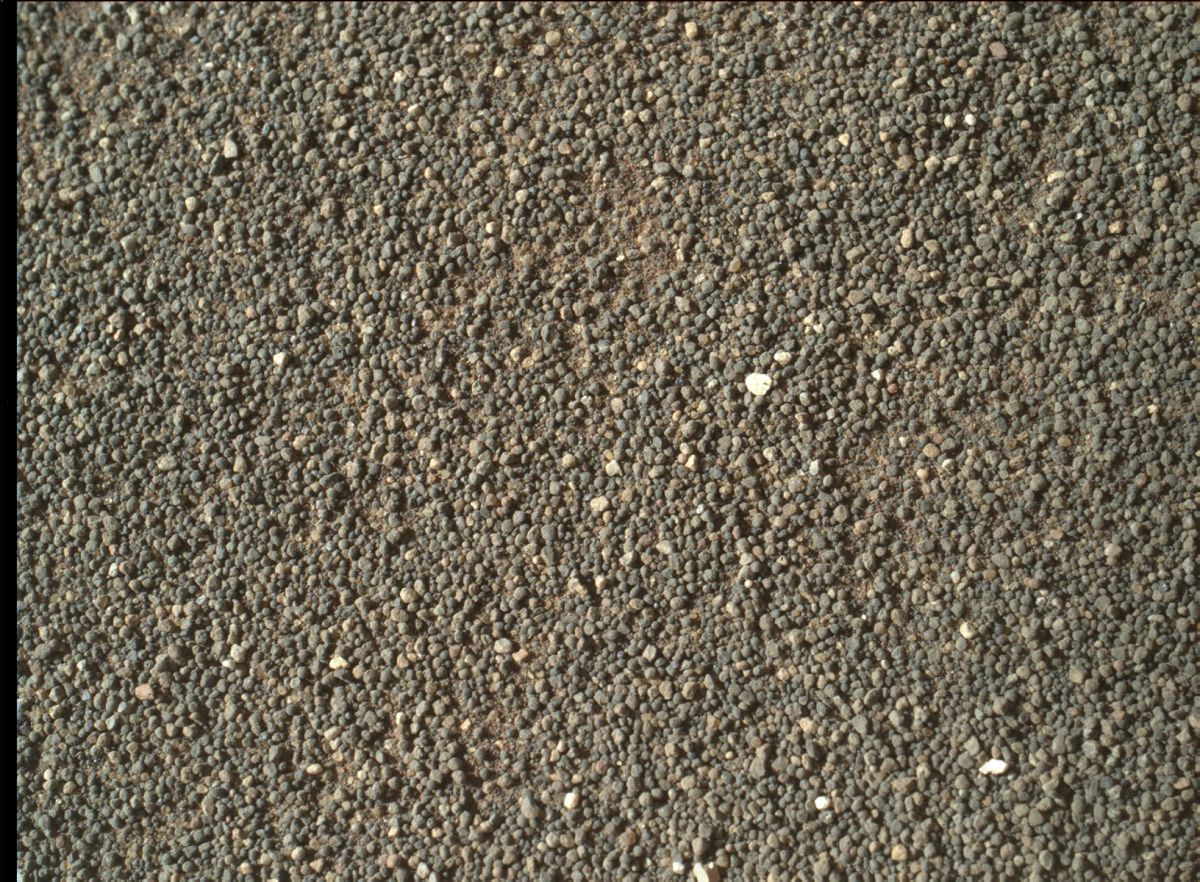
NASA’s Mars rover Curiosity acquired this image using its Mars Hand Lens Imager (MAHLI), located on the turret at the end of the rover’s robotic arm, on December 3, 2015, Sol 1182 of the Mars Science Laboratory Mission.
Credit: NASA/JPL-Caltech/MSSS
Dates of planned rover activities are always subject to change due to a variety of factors related to the Martian environment, communication relays and rover status.
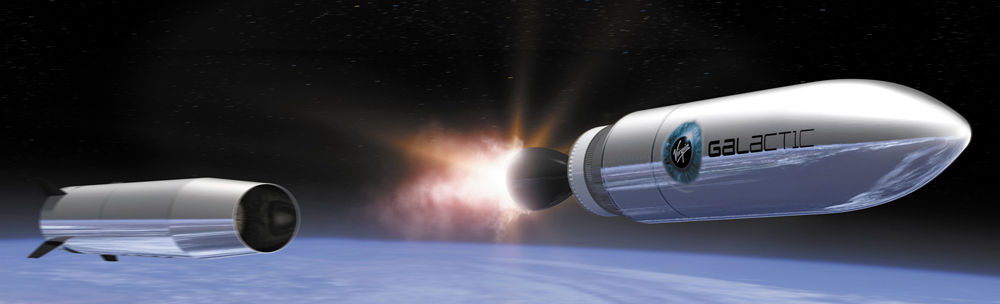
LauncherOne hauls satellites into orbit.
Credit: Virgin Galactic
Sir Richard Branson’s Virgin Galactic has introduced an addition to its fleet of vehicles as part of a technical update on its LauncherOne small satellite launch service.
A 747-400 commercial jet aircraft — previously operated by Virgin Atlantic under the nickname “Cosmic Girl” — will provide a dedicated launch platform for the LauncherOne orbital vehicle.
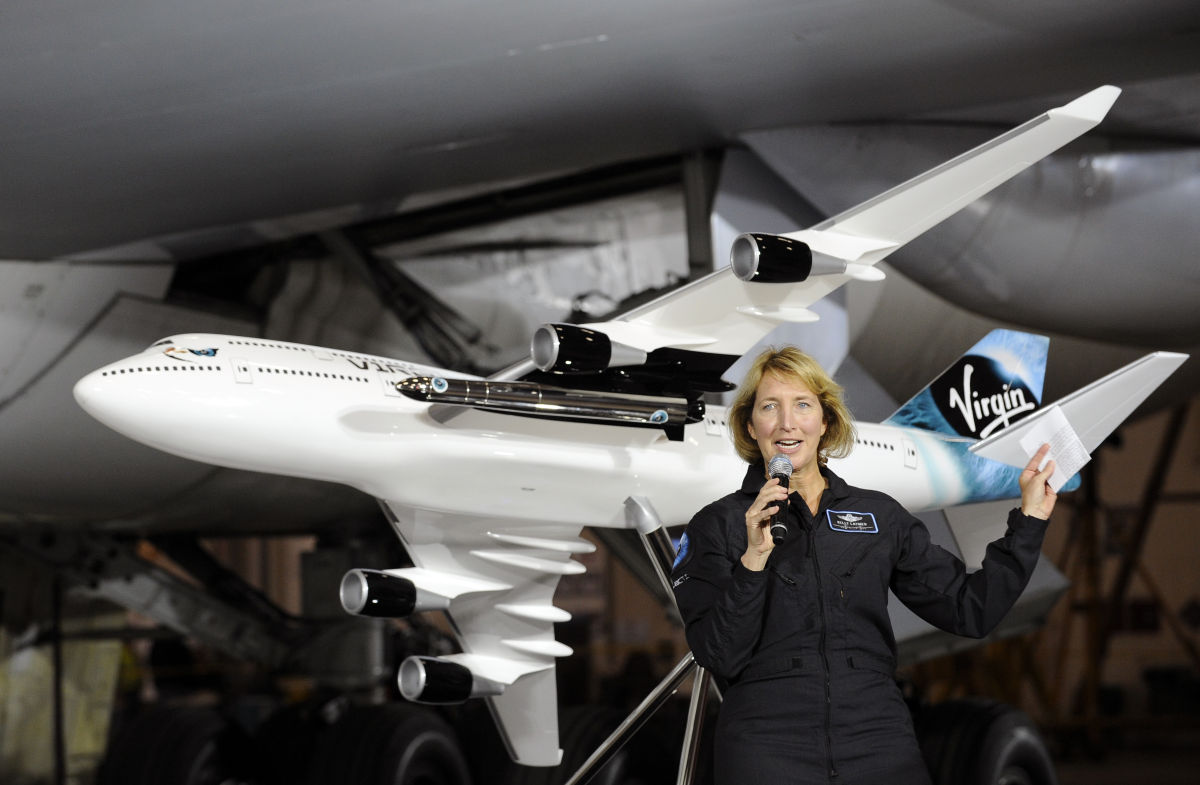
Virgin Galactic pilot, Kelly Latimer, explains use of a 747-400 commercial jet aircraft — previously operated by Virgin Atlantic under the nickname “Cosmic Girl” — to provide a dedicated launch platform for the LauncherOne orbital vehicle.
Credit: Virgin Galactic
Cosmic Girl went into service in 2001 and will spend her new life as an aerial platform for LauncherOne.
The acquisition of a 747-400 carrier to be the “dedicated air launch” vehicle for LauncherOne is intended to free up WhiteKnightTwo for Virgin Galactic’s human space flight program. That suborbital launch system for paying passengers makes use of the WhiteKnightTwo carrier craft and the SpaceShipTwo rocketship.
Commercial suborbital spaceflight services for ticket holders are to be carried out of Spaceport America in New Mexico.
Rapid service
“Air launch enables us to provide rapid, responsive service to our satellite customers on a schedule set by their business and operational needs, rather than the constraints of national launch ranges,” said George Whitesides, Virgin Galactic CEO in a press statement.
“Selecting the 747 airframe provides a dedicated platform that gives us the capacity to substantially increase our payload to orbit without increasing our prices,” Whitesides added.
Wing modification
The LauncherOne rocket will be mounted to the carrier aircraft under the left wing, adjacent to the position that has been used by other 747s to ferry a fifth engine.
Initial inspections and tests of Cosmic Girl have already been completed and, prior to the start of the wing modification.
A regularly scheduled maintenance check will be conducted by VT San Antonio Aerospace – a maintenance, repair and operations organization.
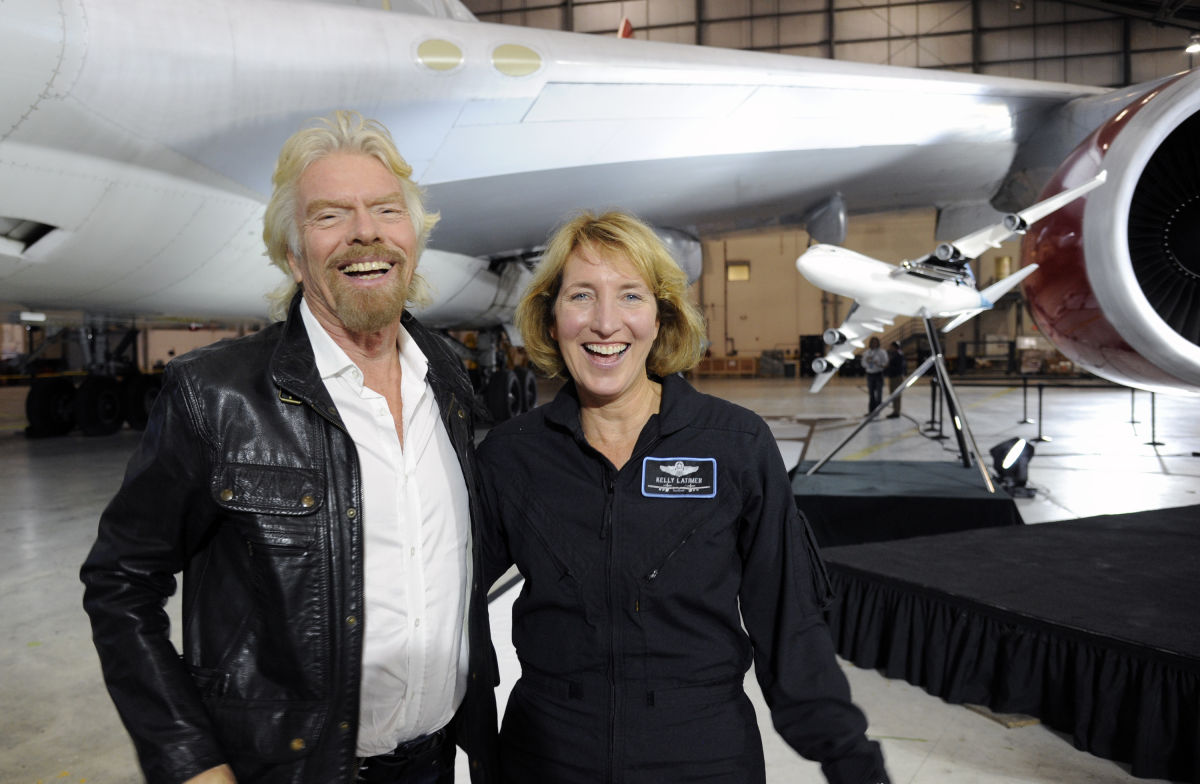
Sir Richard Branson and Kelly Latimer, a pilot for Virgin Galactic.
Launch prices
In September, Virgin Galactic announced it had doubled LauncherOne’s performance to 440 pounds (200 kilograms) into the standard Sun-Synchronous Orbit for a price below $10 million, with the option to purchase further increases in performance to the same orbit and for launches that reach other altitudes or inclinations.
The launch system is capable of launching over 880 pounds (400 kilograms) of payload to other orbits.
Initial inspections
The LauncherOne rocket will be mounted to the carrier aircraft under the left wing, adjacent to the position that has been used by other 747s to ferry a fifth engine.
Initial inspections and tests of Cosmic Girl have already been completed and, prior to the start of the wing modification, a regularly scheduled maintenance check will be conducted by VT San Antonio Aerospace. A maintenance, repair and operations (MRO) organization, VT San Antonio Aerospace has over the years re-delivered more than 3,000 aircraft.
Game-changing customers
According to Virgin Galactic President, Steve Isakowitz: “Our LauncherOne team moved into a 150,000 square foot facility for design and manufacturing, grew to more than 150 dedicated staff, completed multiple long-duration hot fires of our liquid rocket engines, doubled the L1[LauncherOne] payload capacity, and welcomed two game-changing customers from both new space and government, OneWeb and NASA.”
For more information, visit this special video on LauncherOne’s new mothership:
https://www.youtube.com/watch?v=L2OT8Fvo1zw&feature=youtu.be
New Update:
https://youtu.be/bLUXO_YdTDc

This artist’s concept depicts NASA’s InSight Mars lander fully deployed for studying the deep interior of Mars. InSight — short for Interior Exploration using Seismic Investigations, Geodesy and Heat Transport — will investigate processes that formed and shaped Mars.
Credit: NASA/JPL-Caltech
NASA’s next Mars lander has completed assembly and testing at Lockheed Martin Space Systems in Colorado – but one problem. A key science instrument to be carried on the mission is experiencing a problem.
The Interior Exploration Using Seismic Investigations, Geodesy and Heat Transport (InSight) spacecraft is to investigate processes that formed and shaped Mars.
But one major piece of hardware is experiencing a leak in the vacuum container carrying its main sensors. The sensors are part of an instrument called the Seismic Experiment for Interior Structure (SEIS), which is provided by the French Space Agency (CNES).
Ticking countdown clock
The seismometer is the prime science payload that will help answer questions about the interior structure and processes within the deep Martian interior.
The countdown clock is ticking for a slated blastoff to Mars in March of next year of the lander from Vandenberg Air Force Base, California.
The plan calls for the mission to launch during the period March 4 to March 30, 2016, and land on Mars Sept. 28, 2016.

Robot arm would deploy sensitive Seismic Experiment for Interior Structure (SEIS) (white object in foreground).
Credit: NASA/JPL
Bad news
According to a Jet Propulsion Laboratory InSight status report: “The SEIS instrument has three high-sensitivity seismometers enclosed in a sealed sphere. The seismometers need to operate in a vacuum in order to provide exquisite sensitivity to ground motions as small as the width of an atom. After the final sealing of the sphere, a small leak was detected, that would have prevented meeting the science requirements once delivered to the surface of Mars.”
Promising news
A CNES/JPL team is currently working to repair the leak, prior to instrument integration and final environmental tests in France before shipping to the United States for installation into the spacecraft and launch.
The Heat Flow and Physical Properties Package (HP3) from Germany and the rest of the scientific payload for InSight are already installed.
NASA and CNES managers are committed to launching InSight in March and are currently assessing the launch window timeline.
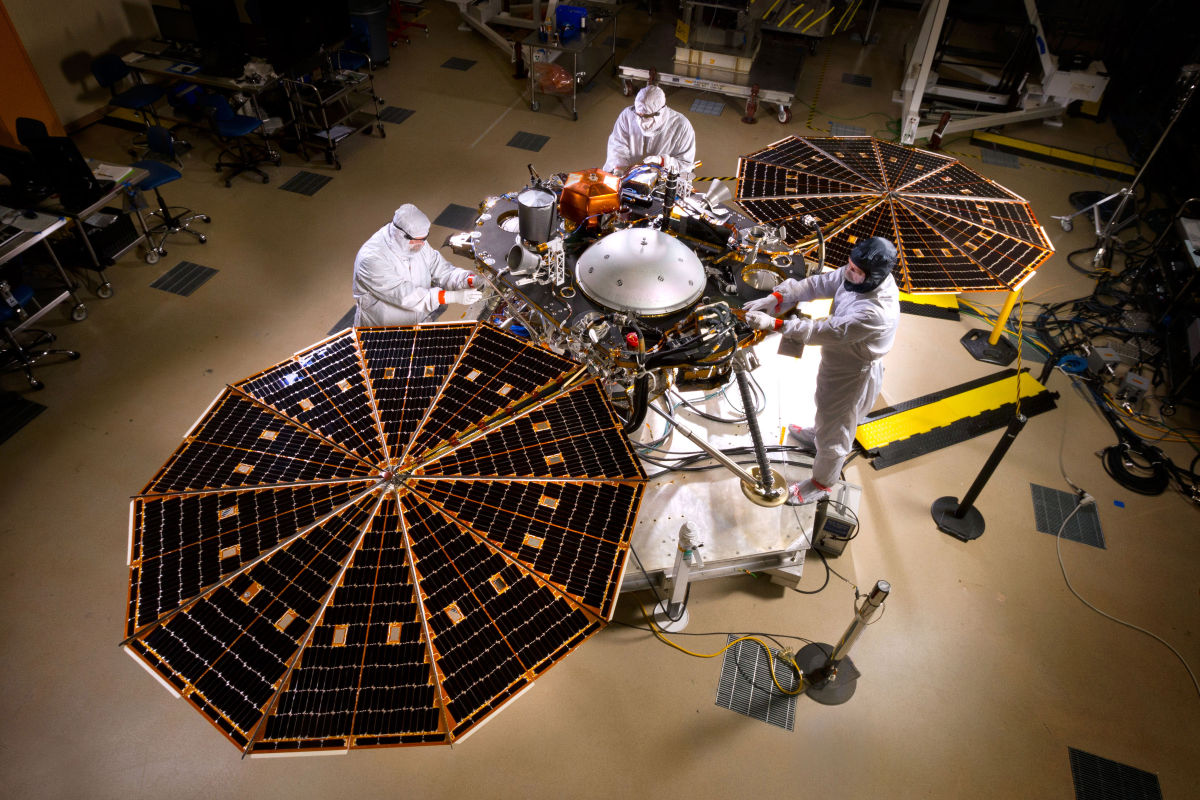
NASA’s InSight Mars lander spacecraft in a Lockheed Martin clean room near Denver. As part of a series of deployment tests, the spacecraft was commanded to deploy its solar arrays in the clean room to test and verify the exact process that it will use on the surface of Mars.
Credit: Lockheed Martin Space Systems
Meanwhile, Lockheed Martin Space Systems is prepared to ship InSight to the Vandenberg AFB launch site. Installation of the seismometer is planned for early January.
The InSight Project is managed by NASA’s Jet Propulsion Laboratory, Pasadena, California. The InSight mission is led by Bruce Banerdt of JPL.
Focus on mission success
In a statement provided to Inside Outer Space from InSight’s builder, Lockheed Martin:
“Lockheed Martin designed and built the InSight Mars lander for NASA on schedule and has recently completed the rigorous environmental testing phase. The spacecraft is now being readied for shipment to the launch site to begin the launch campaign. We understand the importance of this Mars mission and are doing everything possible to accommodate a late delivery of the French Space Agency’s SEIS instrument while still maintaining a focus on mission success.”

