Author Archive
 Author:
  September 4th, 2016

Courtesy: Goonhilly Earth Station
Surrey Satellite Technology Ltd and Goonhilly Earth Station are looking for CubeSat passenger payloads on a lunar mission. They are teaming up with the European Space Agency to create “the world’s first commercial deep space mission” for 2019.
Goonhilly Satellite Earth Station is a large radio communication site located on Goonhilly Downs near Helston on the Lizard peninsula in Cornwall, England, UK.
The plan is to carry customer payload in the form of CubeSats into lunar orbit and provide the relay link back to Earth via Goonhilly. “Our plan is to take a payload of scientific research nano-satellites as our paying customers into lunar orbit then provide the communications link back to Earth,” explains a press statement on the concept.
Relay satellite
The nano-satellites will use the standard CubeSat format and will be provided with a Consultative Committee for Space Data Systems (CCSDS) compliant radio communications card which will communicate via the Surrey Satellite Technology Ltd (SSTL) relay satellite in lunar orbit.

Lunar Pathfinder.
Courtesy: Goonhilly Earth Station
Given the growth in commercial space missions there’s interest in adding large antennas to the Goonhilly site’s Deep Space Inventory. There’s also a plan to expand the commercial Deep Space network to provide global coverage.
Lunar pathfinder
This new era in low cost space exploration is planned for 2019 – marking the 50th anniversary of the first human landing on the Moon.
The announced plan involves launch of a “Lunar Pathfinder,” built in the UK by SSTL and tracked and operated by Goonhilly.
Lunar Pathfinder will carry a payload of customer owned and built nano-satellites to lunar orbit. Once in orbit, Lunar Pathfinder will release the nano-satellites, some of which will remain in orbit and some may land on the lunar surface.
For more information, download related documents from this site:
http://www.goonhilly.org/lunar
 Posted in
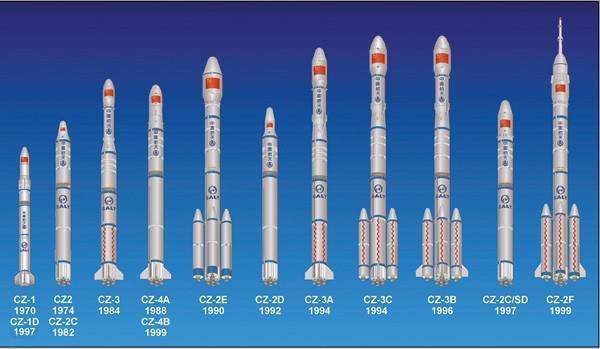
China is building upon a heritage of Long March boosters.
Credit: CALT
China is preparing to stage the maiden liftoff of the powerful Long March-5 booster.
Rocket components are transported from northern China’s Tianjin Port for the launch base in southern Hainan. The booster is expected to be launched by year’s end.
Long March-5 is central to carrying the Chang’e-5 lunar probe in 2017 and will be used to launch elements of China’s multi-modular space station and Mars-bound spacecraft.

China’s Long March 5 engine test.
Credit: CMSE/CCTV
Chinese news services are underscoring that the country has made “major breakthroughs” in designing and fabricating the booster.
Rocket building techniques
According to Cui Yun, deputy director of assembly shop of Long March-5 rocket:
“Expanding the diameter from 3.35 meters to 5 meters is not simply a change in numbers, but a breakthrough in rocket building techniques,” Cui says. “We cannot touch anywhere when standing inside the rocket. So we must rotate it to ensure installation is complete.”
He Wei, general designer of Long March-5 carrier rocket, China Aerospace Science and Technology Corporation adds in a report from CCTV-Plus:
“We can share the technology, lower research cost, and quickly develop a series of rockets that have various payload capacities and can operate in low, medium, and high Earth orbits.”

China’s human spaceflight program is moving forward on a multimodule space station in the 2020s.
Courtesy: CMSE
Modularized approach
He Wei, general designer of Long March-5 carrier rocket, China Aerospace Science and Technology Corporation also notes that “the design and building of the Long March-5 rocket is a great leap forward in terms of design technique, design tool and manufacturing mechanism, which lays a solid foundation for the future design of larger rockets for our country.”
Rocket designers in China say they have modularized the rocket to lower cost and facilitate future rocket design.
New technologies
According to CCTV, China has the intellectual property rights over all technologies used to build the Long March-5 rocket, including 247 key new technologies.
New technologies accounted for 100 percent of the total used for the rocket, much higher than the global average of 30 percent, explains CCTV.
The Long March-5 is the country’s most powerful carrier rocket, sporting a payload capacity of 25 tons in low Earth orbit and placing 14 tons into geostationary orbit.
To view the CCTV-Plus report, go to:
http://cd-pv.news.cctvplus.com/2016/0826/8030677_Preview_1472213773593.mp4
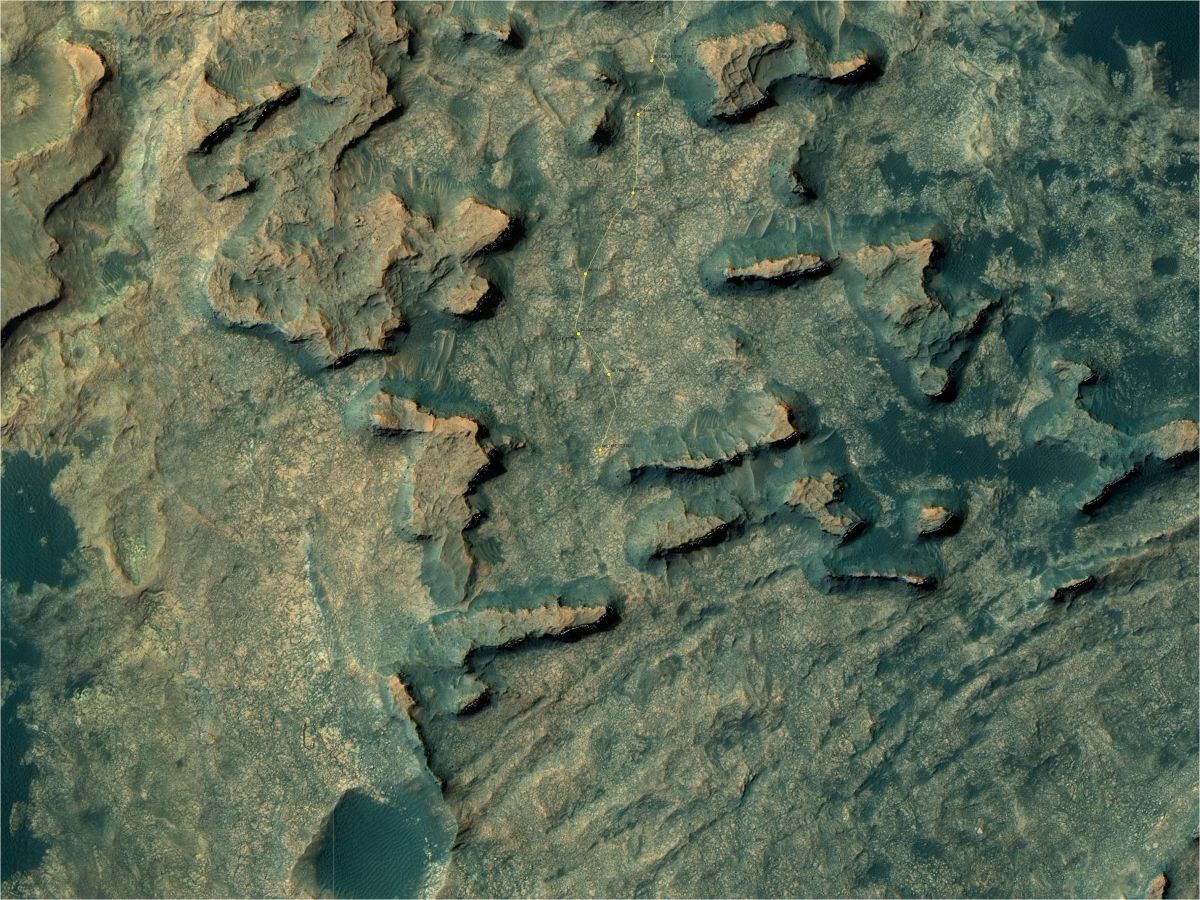
Credit: NASA/JPL-Caltech/Univ. of Arizona
The Curiosity Mars rover has just entered Sol 1448, continuing to investigate the surrounding scenery of buttes and distant features.
A new map has been released showing the NASA robot’s location through the 1446 Martian day, or sol, of the rover’s mission on Mars (August, 31, 2016).

Curiosity Navcam Right B image taken on Sol 1446, August 31, 2016.
Credit: NASA/JPL-Caltech
Numbering of the dots along the line indicate the sol number of each drive. North is up.

Curiosity Navcam Left B image taken on Sol 1446, August 31, 2016.
Credit: NASA/JPL-Caltech
From Sol 1439 to Sol 1446, Curiosity had driven a straight line distance of about 167.19 feet (50.96 meters).
Since touching down in August 2012, Curiosity has driven 8.69 miles (13.98 kilometers).
The base image from the map is from the High Resolution Imaging Science Experiment Camera (HiRISE) in NASA’s Mars Reconnaissance Orbiter.
In a newly posted report from Ken Herkenhoff of the USGS Astrogeology Science Center in Flagstaff, Arizona, he notes that the rover roved – almost 175 feet (53 meters), ending up in an area with nice exposures of bedrock.
Laser cleaning
“We were interested in taking MAHLI [Mars Hand Lens Imager] close-up images of the bedrock but were concerned that they would not be very useful if the surface as dusty as it typically is,” Herkenhoff explains. “We therefore considered using the ChemCam laser to clean off some of the dust and get chemical information before deploying the arm, but recognized that the MAHLI targets would be partly shadowed by the arm turret, which would make the MAHLI images more difficult to interpret.”
Maximize drive distance
A decision was made not to include the MAHLI images in the plan, and focus instead on Mastcam imaging of the nearby buttes and maximizing the drive distance.

Mars Hand Lens Imager (MAHLI) photo taken on August 28, 2016, Sol 1444.
Credit: NASA/JPL-Caltech/MSSS
Science team members for the robot were able to fit ChemCam and Mastcam observations of the “Luxilo” bedrock target into the plan, along with Right Mastcam images of “Caxito.”
After the drive and usual post-drive imaging, the Sample Analysis at Mars (SAM) scrubber was to be cleaned overnight.
On Sol 1449, Mastcam was to again measure the amount of dust in the Martian atmosphere.

Sentinel-1A.
Credit: ESA
European Space Agency engineers reported today that a solar panel on the Copernicus Sentinel-1A satellite was hit by a millimeter-size particle in orbit on August 23.
The strike produced a sudden small power reduction and slight changes in the orientation and the orbit of the satellite.
Preliminary investigation
“Following a preliminary investigation, the operations team at ESA’s control center in Darmstadt, Germany suspected a possible impact by space debris or micrometeoroid on the solar wing,” according to a ESA statement.
Engineers decided to activate the board cameras on the spacecraft to acquire pictures of the array. These cameras were originally carried to monitor the deployment of the satellite’s solar wings just a few hours after launch in April 2014, and were not intended to be used afterwards.

Sentinel-1A’s solar array before and after the impact of a millimeter-size particle on the second panel. The damaged area has a diameter of about 40 centimeters, which is consistent on this structure with the impact of a fragment of less than 5 millimeters in size.
Credit: ESA/ATG medialab
Solar panel strike
Following their switch-on, one camera provided a picture that clearly shows the strike on the solar panel.
This event has no effect on the satellite’s routine operations, which continue normally, ESA stated.
The Sentinel-1 satellites, part of the European Union’s Copernicus Program, are operated by ESA on behalf of the European Commission.

China’s soon-to-be-lofted space lab module – Tiangong-2.
Credit: CCTV
China is in final checkout mode for its next piloted space mission – a multi-faceted undertaking that lays the foundation for the country to construct in Earth orbit a multi-modular space station in the 2020s.
Both the Tiangong-2 (meaning “Heavenly Palace”) and the piloted Shenzhou-11 spacecraft are now undergoing checkout at the Jiuquan Satellite Launch Center in northwest China.
To be rocketed spaceward in mid-September, China’s Tiangong-2 is a true “space lab” that will verify key technologies for building China’s space station, explains its chief designer, Zhu Zongpeng.
For more information on China’s next space traveling step, go to my new Space.com story at:
China Readies Next ‘Heavenly Palace’ for Mid-September Launch
By Leonard David, Space.com’s Space Insider Columnist
August 31, 2016 07:00am ET
http://www.space.com/33911-china-readies-tiangong-2-human-spaceflight-mission.html
Also, take a look at this set of YouTube videos on China preparations:
https://www.youtube.com/watch?v=7McgnMuWUKo

Credit: Monash University
How can you survive on the Red Planet? What’s the science behind the human exploration of Mars?
Australia’s Monash University has created a world-first online course designed to teach participants for free about how to live on Mars, where there is no air, water or food – yet!
Starting October 24, the course will examine interdisciplinary skills and meticulous planning required for sustaining human life on the Red Planet’s hostile environment.
The course runs for four weeks at three hours per week.
Problem solving skills
Case studies and insights from leading experts in the field of chemistry, astronomy, physics and geology will demonstrate the basic science and problem solving skills you can use in everyday life – be it on Earth or Mars.

Home away from home.
Credit: NASA
The online course is led by a Monash University team: astrophysicist Jasmina Lazendic-Galloway, and chemist Tina Overton. They have developed an interdisciplinary online science journey to inspire new generations of Martian explorers.
The free FutureLearn course is for anyone who wants to learn more about the basic science required to survive on Mars, and does not require prior knowledge of the subject.
Resources
For more information go to:
https://www.futurelearn.com/courses/survive-mars
Also, you can access a FAQ about FutureLearn courses at:
https://about.futurelearn.com/about/faq/?category=course-sign-up-and-completion

Curiosity Mastcam Left image taken on Sol 1443, August 27, 2016.
Credit: NASA/JPL-Caltech/MSSS
On Mars, NASA’s Curiosity rover has just begun Sol 1446 activities.
The robot work plan for last weekend went well, reports Ken Herkenhoff at the USGS Astrogeology Science Center in Flagstaff, Arizona.
“The rover’s batteries have enough energy to proceed with another drive on Sol 1446,” Herkenhoff adds.

Curiosity Mastcam Right image taken on Sol 1443, August 27, 2016.
Credit: NASA/JPL-Caltech/MSSS
Laser measurements
New Mastcam images of the nearby buttes have been reviewed by science planners, prior to laying out details of a two-sol plan.
On Sol 1446, the schedule calls for Mastcam to extend coverage of previously-planned mosaics, and the Chemistry and Camera (ChemCam) will use its laser to measure the chemistry of “Muchinda” on a large outcrop block.
After the drive, ChemCam will autonomously make another observation using the Autonomous Exploration for Gathering Increased Science (AEGIS) software.

Curiosity Mastcam Right image taken on Sol 1444, August 28, 2016.
Credit: NASA/JPL-Caltech/MSSS
Upcoming: new drill sample
Overnight, Curiosity’s Chemistry & Mineralogy X-Ray Diffraction/X-Ray Fluorescence Instrument (CheMin) is slated to prepare and analyze an empty sample cell in anticipation of a new drill sample.

Curiosity Navcam Left B image taken on Sol 1444, August 28, 2016.
Credit: NASA/JPL-Caltech
Lastly, Herkenhoff notes that early on Sol 1447, the rover’s Mastcam and Navcam are on tap to measure the dust in the atmosphere and search for clouds. Most of these observations will be repeated, he notes, just before local noon and late in the afternoon to look for short-term changes.

Brush inspection image taken by Curiosity’s Mastcam Right camera on Sol 1444, August 28, 2016.
Credit: NASA/JPL-Caltech/MSSS
As always, planned rover activities are subject to change due to a variety of factors related to the Martian environment, communication relays and rover status.

An illustration of the orbits of the new and previously known extremely distant Solar System objects. The clustering of most of their orbits indicates that they are likely be influenced by something massive and very distant, the proposed Planet X.
Credit: Courtesy of Robin Dienel
Carnegie’s Scott Sheppard and Chadwick Trujillo of Northern Arizona University have observed several never-before-seen objects at extreme distances from the Sun in our Solar System.
That’s the word today as teams of researchers continue the look to discover a purported ninth “planet” in our Solar System.
Extreme objects
In 2014, Sheppard and Trujillo announced the discovery of 2012 VP113 (nicknamed “Biden”), which has the most-distant known orbit in our Solar System. They also noticed that the handful of known extreme trans-Neptunian objects all cluster with similar orbital angles.
That research prodded them to predict that there is a planet at more than 200 times our distance from the Sun. Its mass, ranging in possibility from several Earths to a Neptune equivalent, is shepherding these smaller objects into similar types of orbits.
Some have termed this world as Planet X or Planet 9.

X marks the spot? Artist’s conception of Planet X.
Credit: Courtesy of Robin Dienel
Origins and evolution
“Objects found far beyond Neptune hold the key to unlocking our Solar System’s origins and evolution,” Sheppard explained in a Carnegie press statement.
“Though we believe there are thousands of these small objects, we haven’t found very many of them yet, because they are so far away,” Sheppard said. “The smaller objects can lead us to the much bigger planet we think exists out there. The more we discover, the better we will be able to understand what is going on in the outer Solar System.”
Class act
The new objects they have submitted to the Minor Planet Center for designation include 2014 SR349, which adds to the class of the rare extreme trans-Neptunian objects.
Another new extreme object they found is 2013 FT28.
And yet another discovery, 2014 FE72, is the first distant Oort Cloud object found with an orbit entirely beyond Neptune. It has an orbit that takes the object so far away from the Sun (some 3000 times farther than Earth) that it is likely being influenced by forces of gravity from beyond our Solar System such as other stars and the galactic tide. It is the first object observed at such a large distance, according to the Carnegie Science press release.
Constrain the location
The more objects that are found at extreme distances, the better the chance of constraining the location of the ninth planet that Sheppard and Trujillo first predicted to exist far beyond Pluto (itself no longer classified as a planet) in 2014.
Sheppard and Trujillo have now submitted their latest discoveries to the International Astronomical Union’s Minor Planet Center for official designations. A paper about the discoveries has also been accepted by The Astronomical Journal.
For more information, go to:

Curiosity Mastcam Right image taken on Sol 1441, August 25, 2016.
Credit: NASA/JPL-Caltech/MSSS
Now in Sol 1444, the Curiosity Mars rover is to attempt a drive next week – failing to wheel forward last Wednesday due to an unanticipated flight software interaction, reports Lauren Edgar, a research geologist at the USGS Astrogeology Science Center in Flagstaff, Arizona.

Curiosity Front Hazcam Right B image taken on Sol 1441, August 25, 2016.
Credit: NASA/JPL-Caltech
Weekend plan
Now carrying out a weekend plan, the robot is slated to focus on Sample Analysis at Mars (SAM) Instrument Suite activities. A SAM pre-conditioning activity to prepare the sample cup prior to delivery of the Marimba2 drill sample is to be completed.
Also on the schedule is acquiring a Chemistry & Camera (ChemCam) observation of the target “Viana 2” to assess the chemistry of the local bedrock and nodules.

Curiosity ChemCam Remote Micro-Imager image taken on Sol 1443, August 27, 2016.
Credit: NASA/JPL-Caltech/LANL
Ridges and possible channel features
“Then we’ll take a Mastcam mosaic to document several light-toned ridges and possible channel features, followed by several environmental monitoring activities,” Edgar notes. “In the afternoon we’ll drop off the Marimba2 sample to SAM, and the evolved gas analysis will occur overnight.”
Other weekend tasks includes ChemCam observations of “Ganda” and “Catabola,” followed by use of the rover’s Dust Removal Tool (DRT) and carrying out contact science on “Ganda,” and use of the Mars Hand Lens Imager (MAHLI) and another short Alpha Particle X-Ray Spectrometer (APXS) integration on the target “Andulo.”

Curiosity Mastcam Right image taken on Sol 1441, August 25, 2016.
Credit: NASA/JPL-Caltech/MSSS
Complex plan
“This is a very power heavy and complex plan…a busy weekend,” Edgar concludes.
The last planned Sol is to be relatively light, with a ChemCam passive and Mastcam multispectral observation on “Ganda,” and additional ChemCam laser-induced breakdown spectroscopy (LIBS) looks at target “Calonda,” and some Mastcam deck monitoring.

Curiosity Navcam Left B image taken on Sol 1441, August 25, 2016.
Credit: NASA/JPL-Caltech
NASA’s Curiosity Mars rover is now in Sol 1442 operations, continuing to capture impressive views of the Murray Buttes as the robot presses onward to investigate lower Mount Sharp.

Curiosity Mastcam Right image taken on Sol 1439, August 23, 2016.
Credit: NASA/JPL-Caltech/MSSS
This site was informally named nearly three years ago to honor Caltech planetary scientist Bruce Murray (1931-2013), a former director of NASA’s Jet Propulsion Laboratory, Pasadena, California.
JPL manages the Curiosity mission for NASA.

This image was taken by the Curiosity Chemistry & Camera’s (ChemCam) Remote Micro-Imager on Sol 1441, August 25, 2016.
Credit: NASA/JPL-Caltech/LANL
The buttes and mesas are capped with rock that is relatively resistant to wind erosion. This helps preserve these monumental remnants of a layer that formerly more fully covered the underlying layer that the rover is now driving on.

Repeated post-drive looks at the health of wheels on Curiosity rover includes this Mars Hand Lens Imager (MAHLI), photo taken on August 18, 2016, Sol 1434.
Credit: NASA/JPL-Caltech/MSSS
Fossilized riverbeds
Meanwhile, new research from University College London (UCL) suggests there is an extensive system of fossilized riverbeds on an ancient region of the Martian surface. The discovery supports the view, according to a UCL press statement, that the now cold and dry Red Planet had a warm and wet climate about four billion years ago.

Perspective view of Aram Dorsum, an inverted channel on Mars and candidate landing site for the European Space Agency’s ExoMars rover in 2020.
Credit: NASA/JPL/MSSS)
Evidence of flowing water
The study has been published in the Geological Society of America’s Geology journal and funded by the Science & Technology Facilities Council and the UK Space Agency. The research work identified over 10,560 miles (17,000 kilometers) of former river channels on a northern plain called Arabia Terra, providing further evidence of water once flowing on Mars.
Preservation of biological material?
“We think the rivers were active 3.9–3.7 billion years ago, but gradually dried up before being rapidly buried and protected for billions of years, potentially preserving any ancient biological material that might have been present,” says lead author of the paper, Joel Davis (UCL Earth Sciences).
These ancient Martian flood plains would be “great places” to search for evidence of past life on the Red Planet, adds Matthew Balme, Senior Lecturer at The Open University and co-author of the study.
Balme points out that one area of the channels called Aram Dorsum is on the landing site list for the European Space Agency’s ExoMars Rover mission in 2020.
The new Geology research paper is available here:
http://geology.gsapubs.org/content/early/2016/08/23/G38247.1.full.pdf+html

