Author Archive
 Author:
  September 9th, 2016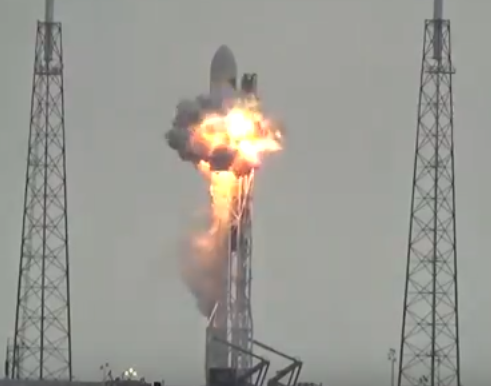
Credit: uslaunchreport.com
The recent loss of the Falcon 9 and its payload during group preparations for launch was highlighted by Elon Musk of SpaceX by this tweet on September 1, 2016:
Loss of Falcon vehicle today during propellant fill operation. Originated around upper stage oxygen tank. Cause still unknown. More soon.

Credit: uslaunchreport.com

Young Elon Musk sets up Twitter account.
Credit: Elon Musk
Difficult, complex failure
A burst of new tweets on the mishap from Musk are:
- Still working on the Falcon fireball investigation. Turning out to be the most difficult and complex failure we have ever had in 14 years.
- Important to note that this happened during a routine filling operation. Engines were not on and there was no apparent heat source.
- Support & advice from @NASA, @FAA, @AFPAA & others much appreciated. Please email any recordings of the event to report@spacex.com.
- Particularly trying to understand the quieter bang sound a few seconds before the fireball goes off. May come from rocket or something else.
NOTE: Here is a YouTube video of the event, provided by http: www.uslaunchreport.com
 Posted in
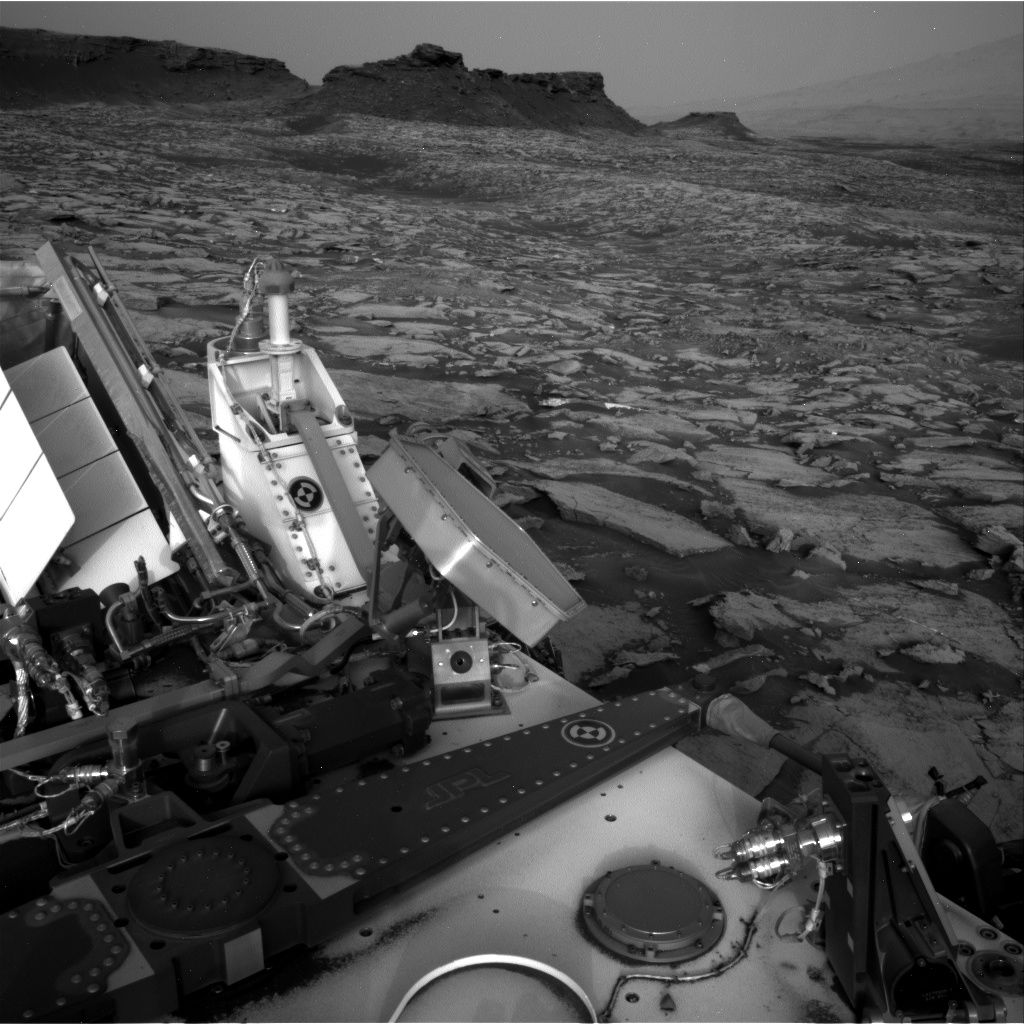
Curiosity Navcam Right B image taken on Sol 1454, September 8, 2016.
Credit: NASA/JPL-Caltech
On Mars it’s Sol 1455 for the Curiosity rover.
After another successful drive of roughly 130 feet (40 meters), Curiosity is aiming to approach the south side of a butte for its next potential drill site.
The area is known as “Quela” – a bright outcrop at the base of the butte.
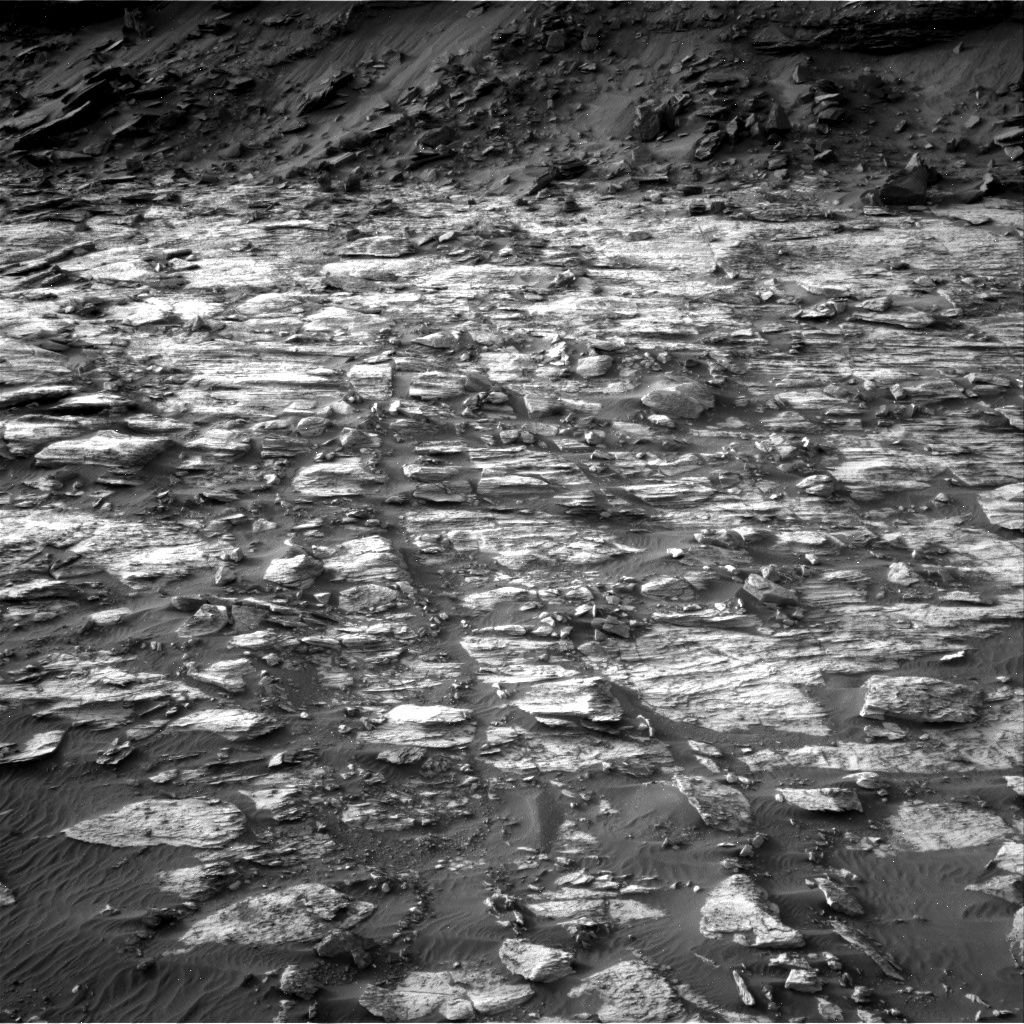
Potential rover drill site: an area known as “Quela,” and is seen in this Navcam image as the bright outcrop at the base of the butte. Curiosity Navcam Right B image taken o Sol 1454, September 8, 2016.
Credit: NASA/JPL-Caltech
Major dust storm?
Lauren Edgar, a research geologist at the USGS Astrogeology Science Center in Flagstaff, Arizona reports on the plan are several Mastcam mosaics to assess the local stratigraphy, laminations in the Murray formation, and to document the butte and proposed drill site.
Also on tap is acquisition of a Chemistry & Camera (ChemCam) observation of the bedrock at the target “Humpata,” and use of Mastcam to assess atmospheric opacity.
In addition to geology observations, the rover science team has increased the frequency of meteorological measurements with the Rover Environmental Monitoring Station (REMS) and imaging “in response to observations from other spacecraft at Mars of the potential start of a major dust storm,” Edgar adds.
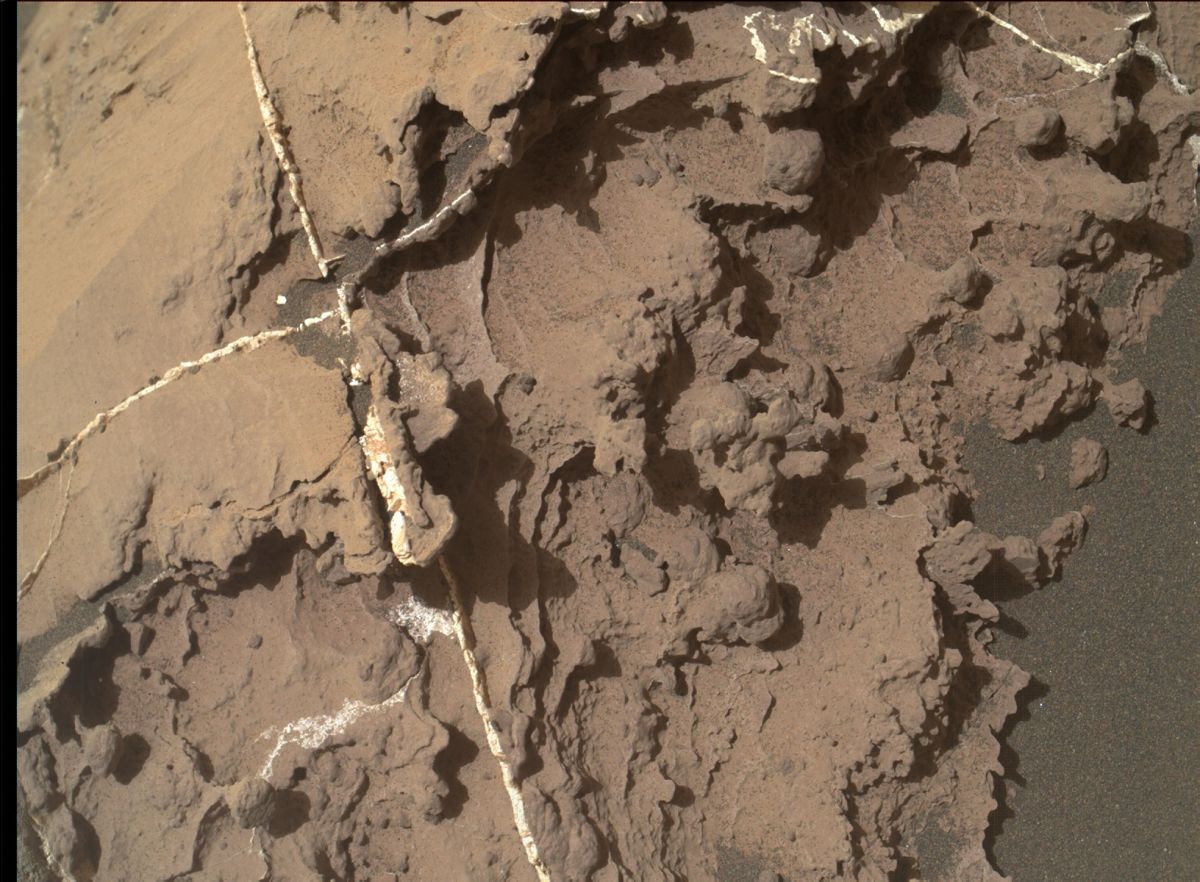
NASA’s Mars rover Curiosity acquired this image using its Mars Hand Lens Imager (MAHLI), located on the turret at the end of the rover’s robotic arm, on September 8, 2016, Sol 1454.
Credit: NASA/JPL-Caltech/MSSS
Drilling position
The drive in the current plan may put Curiosity in position at the next drill site, so post-drive imaging will help prepare scientists for that scenario.
“We’ll also squeeze in another autonomously selected ChemCam target in the afternoon,” Edgar concludes. “It’s exciting to think about drilling again already!”

Artist concept of Single-Person Spacecraft in use at the International Space Station.
Credit: Genesis Engineering Solutions
Creative and novel work is underway to create a Single-Person Spacecraft (SPS).
Genesis Engineering Solutions of Lanham, Maryland has highlighted their recent underwater, neutral buoyancy tests for an SPS at the U.S. Space & Rocket Center in Huntsville, Alabama.
Neutral buoyancy is a proven way to simulate the weightless space environment and the center has an Astronaut Training Facility ideally suited for that type of testing.
Right “glug” stuff
Unlike precise fitting space suits, the Single-Person Spacecraft is a one-size-fits-all vehicle. Therefore, it was necessary to use a range of different sized test subjects to represent the astronaut population.

Overall view of the U.S. Space and Rocket Center Astronaut Training Facility with SPS hardware installed.
Credit: Genesis Engineering Solutions
Twenty four underwater male and female “astronauts” — measuring from 5 foot, 3 inches to 6 foot, 3.5 inches in height — participated in three days of testing.
To provide complete test documentation, all operations were video recorded using two fixed cameras and another operated by a scuba diver in the water.
Following the tests each test astronaut completed an evaluation form then participated in a post-test briefing with the entire team.
Any-time access to space
According to Genesis Engineering Solutions (GES), historically, less than 20 percent of crew time related to extravehicular activity (EVA) is spent on productive external work.
For planetary operations space suits are still the logical choice; however, for safe and rapid access to the weightless environment, spacecraft offer compelling advantages.
The Single-Person Spacecraft, points out GES, is a concept that enables any-time access to space for short or long excursions by different astronauts.

Test subjects represented various operator heights within an underwater SPS test rig.
Credit: Genesis Engineering Solutions
Shirtsleeve cockpit
Here are some key SPS attributes, explains a company statement. For example:
— SPS does not require the pre-breathing time because it operates at the same cabin atmosphere as its host.
— Compared to the space suit pure oxygen environment, a mixed gas atmosphere lowers the fire risk and allows use of conventional materials and systems.
— For getting to the worksite, integral propulsion replaces hand-over-hand translation or having another crew member operate the robotic arm. This means less physical exertion and more time at the work site.
— In case of an emergency, SPS can return from the most distant point on ISS in less than a minute.
— Because SPS is a vehicle, its design offers better radiation and micro-meteoroid protection than space suits.
— The shirtsleeve cockpit uses conventional displays and controls which means the work is not strenuous, there is no suit trauma and rest days are not required.
Check out this video on the August underwater test activities at:
https://www.youtube.com/watch?v=LLFpLRK-iiU&feature=youtu.be

Credit: Blue Origin
“Our next flight is going to be dramatic, no matter how it ends,” explains Jeff Bezos, lead rocketeer of the Blue Origin group and Amazon.com guru.
Bezos notes in a new update that “this upcoming flight will be our toughest test yet.” The test should be in the first part of October, he says, “and we’ll webcast it live for your viewing pleasure. Details to come.”
Escape in flight
What Blue Origin will attempt is to intentionally trigger an escape in flight and at the most stressing condition: maximum dynamic pressure through transonic velocities.

Rocketeer Jeff Bezos.
Credit: Blue Origin
“We’ll be doing our in-flight escape test with the same reusable New Shepard booster that we’ve already flown four times,” Bezos adds. “About 45 seconds after liftoff at about 16,000 feet, we’ll intentionally command escape. Redundant separation systems will sever the crew capsule from the booster at the same time we ignite the escape motor.”
Here’s the scenario
The escape motor will vector thrust to steer the capsule to the side, out of the booster’s path. The high acceleration portion of the escape lasts less than two seconds, but by then the capsule will be hundreds of feet away and diverging quickly. It will traverse twice through transonic velocities – the most difficult control region – during the acceleration burn and subsequent deceleration.
The capsule will then coast, stabilized by reaction control thrusters, until it starts descending. Its three drogue parachutes will deploy near the top of its flight path, followed shortly thereafter by main parachutes.

Standard trajectory profile.
Credit: Blue Origin
Bad news for booster?
“It’s the first ever rocket booster to fly above the Karman line into space and then land vertically upon the Earth. And it’s done so multiple times. We’d really like to retire it after this test and put it in a museum,” Bezos explains.
“Sadly, that’s not likely. This test will probably destroy the booster. The booster was never designed to survive an in-flight escape,” Bezos adds.
The capsule escape motor will slam the booster with 70,000 pounds of off-axis force delivered by searing hot exhaust. The aerodynamic shape of the vehicle quickly changes from leading with the capsule to leading with the ring fin, and this all happens at maximum dynamic pressure.

Good-bye booster? Next flight may see desert impact.
Credit: Blue Origin
Retirement party
“Nevertheless, the booster is very robust and our Monte Carlo simulations show there’s some chance we can fly through these disturbances and recover the booster. If the booster does manage to survive this flight – its fifth – we will in fact reward it for its service with a retirement party and put it in a museum,” Bezos points out.
“In the more likely event that we end up sacrificing the booster in service of this test, it will still have most of its propellant on board at the time escape is triggered, and its impact with the desert floor will be most impressive,” Bezos concludes.
Check out this animation of what’s to come at:
https://www.youtube.com/watch?v=N5i-f-D_A-M&feature=youtu.be
Credit: NASA
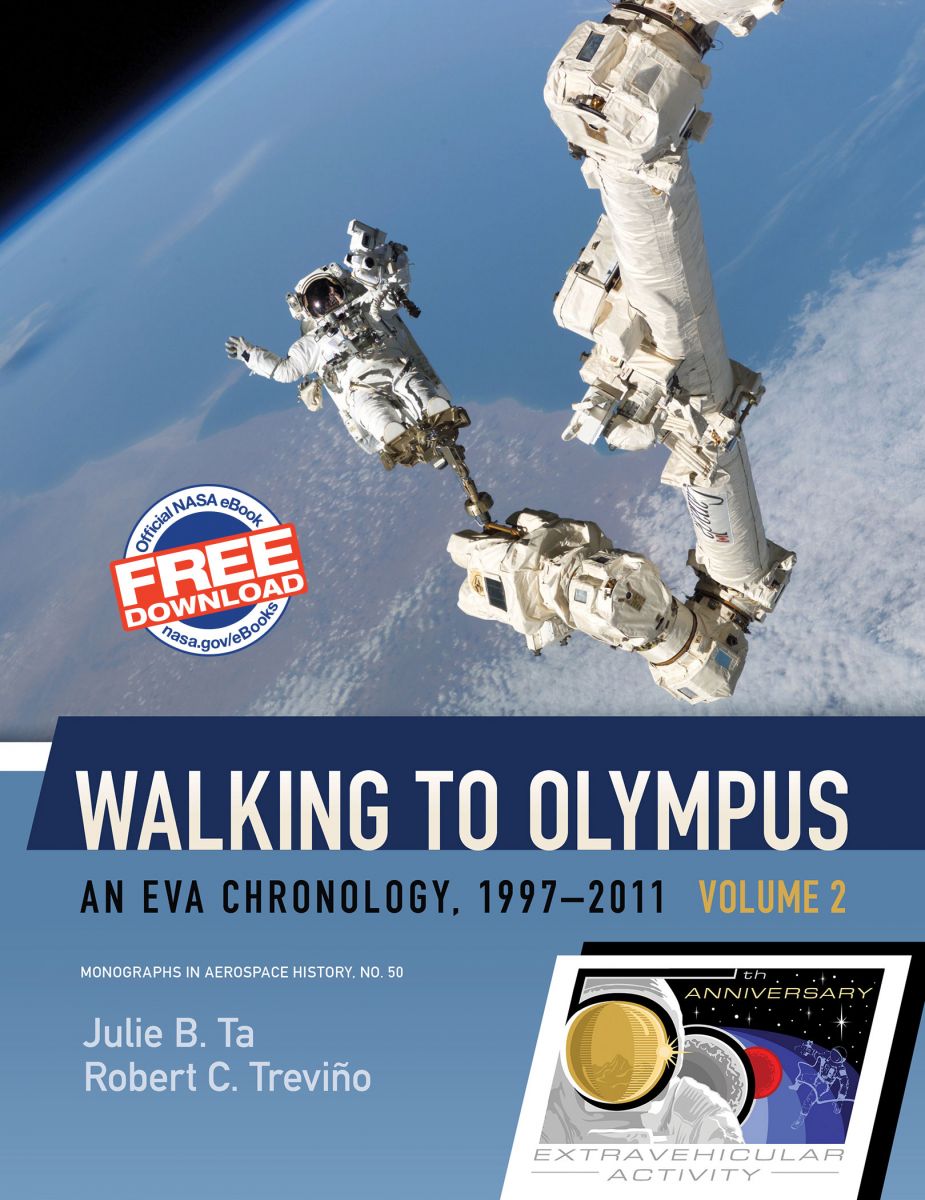
A new NASA history document is yours for the download – spotlighting the growth of spacewalking – known as extravehicular activity or EVA.
Walking to Olympus: An EVA Chronology, 1997–2011 Volume 2 has been written by Julie B. Ta and Robert C. Treviño.
Following the first volume of Walking to Olympus: An EVA Chronology, which recounted the period from the first spacewalks in 1965 to the end of the Shuttle-Mir program in 1997, this second volume of Walking to Olympus spans the period from 1997 to the end of the Space Shuttle Program in 2011.

Credit: NASA History Office
EVA community
The new work includes not only spacewalks performed by American and European astronauts and the Russian/Soviet cosmonauts, but also those of the newest members of the EVA community, the taikonauts of the People’s Republic of China.
Several key events and themes from this period include the building of the ISS, the servicing of the Hubble Space Telescope, and the STS-107 Columbia accident.
The publication of this second EVA chronology follows two major anniversaries of significance to the spaceflight community: the 50th anniversary of the first EVA and the 25th anniversary of the Hubble Space Telescope.
Making the journey
The phrase “Walking to Olympus” is a symbolic expression of humans inevitably landing on Mars and exploring the planet, including Olympus Mons, the largest volcano in our solar system.
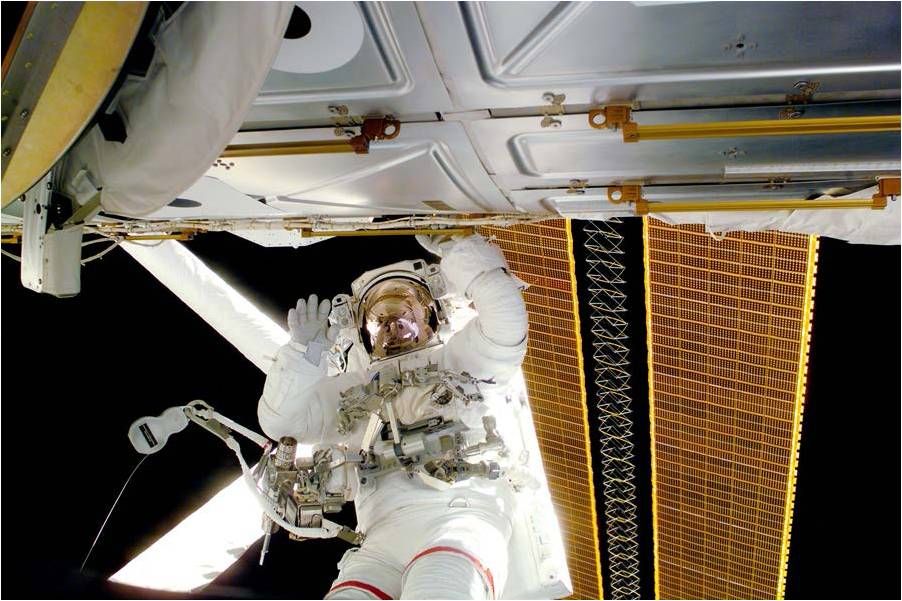
Credit: NASA
As noted in the foreword to the document:
“Human spaceflight is often considered the greatest challenge in space exploration and EVAs are at the crux of human spaceflight and exploration. While there are still many uncertainties about our eventual human voyages to Mars, there is still at least one certainty: we will need to be able to work successfully outside of the space vehicles and habitats to make that journey,” explains Dava Newman, Deputy Administrator of NASA.
To access this document, go to:
http://www.nasa.gov/sites/default/files/atoms/files/walking-to-olympus_tagged.pdf

Credit: U.S. Postal Service
Nearly 50 years to the day of the original airing of “Star Trek,” the U.S. Postal Service dedicated the Star Trek Forever stamps.
According to the U.S. Postal Service, these stamps will “live long and prosper,” because as Forever stamps they are good for mailing a 1-ounce First-Class letter anytime in the future — regardless of star date.
Digital illustrations
The stamps, under license by CBS Consumer Products, showcase four digital illustrations inspired by classic elements of the television program:
- The Starship Enterprise inside the outline of a Starfleet insignia against a gold background;
- The silhouette of a crewman in a transporter against a red background;
- The silhouette of the Enterprise from above against a green background; and,
- The Enterprise inside the outline of the Vulcan salute (Spock’s iconic hand gesture) against a blue background.
The words “SPACE… THE FINAL FRONTIER,” from Captain Kirk’s famous voice-over appears beneath the stamps against a background of stars.
For detailed information on the stamps, go to:
http://about.usps.com/news/national-releases/2016/pr16_068.htm
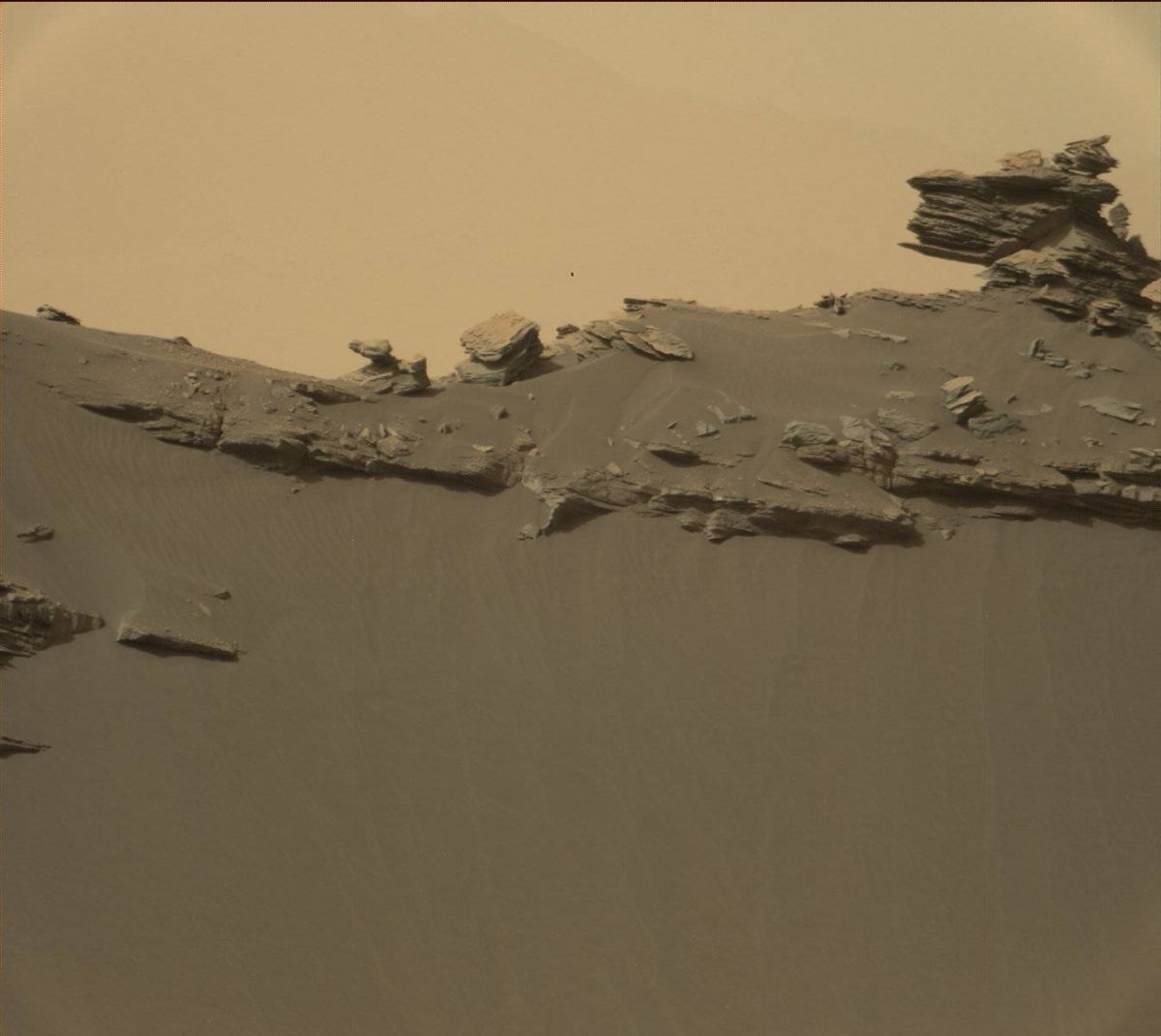
Curiosity Mastcam Right image taken on Sol 1450, September 4, 2016.
Credit: NASA/JPL-Caltech/MSSS
NASA’s Curiosity Mars rover is gearing up for Sol 1454 duties.
A four-sol plan over the holiday weekend went well, and Curiosity drove roughly 130 feet (40 meters) to the south, reports Lauren Edgar, a research geologist at the USGS Astrogeology Science Center in Flagstaff, Arizona.
“We’re currently just to the east of a butte that we’re planning to approach as our next potential drill site,” Edgar adds.
Local bedrock
On the rover’s agenda has been use of the robot’s Mars Hand Lens Imager (MAHLI) of the target “Eheke,” to characterize the local bedrock. Then scientists are to utilize Mastcam and Navcam to assess atmospheric opacity.
That would be followed by Chemistry & Camera (ChemCam) observations of the targets “Diyogha,” and “Donkerbos.”
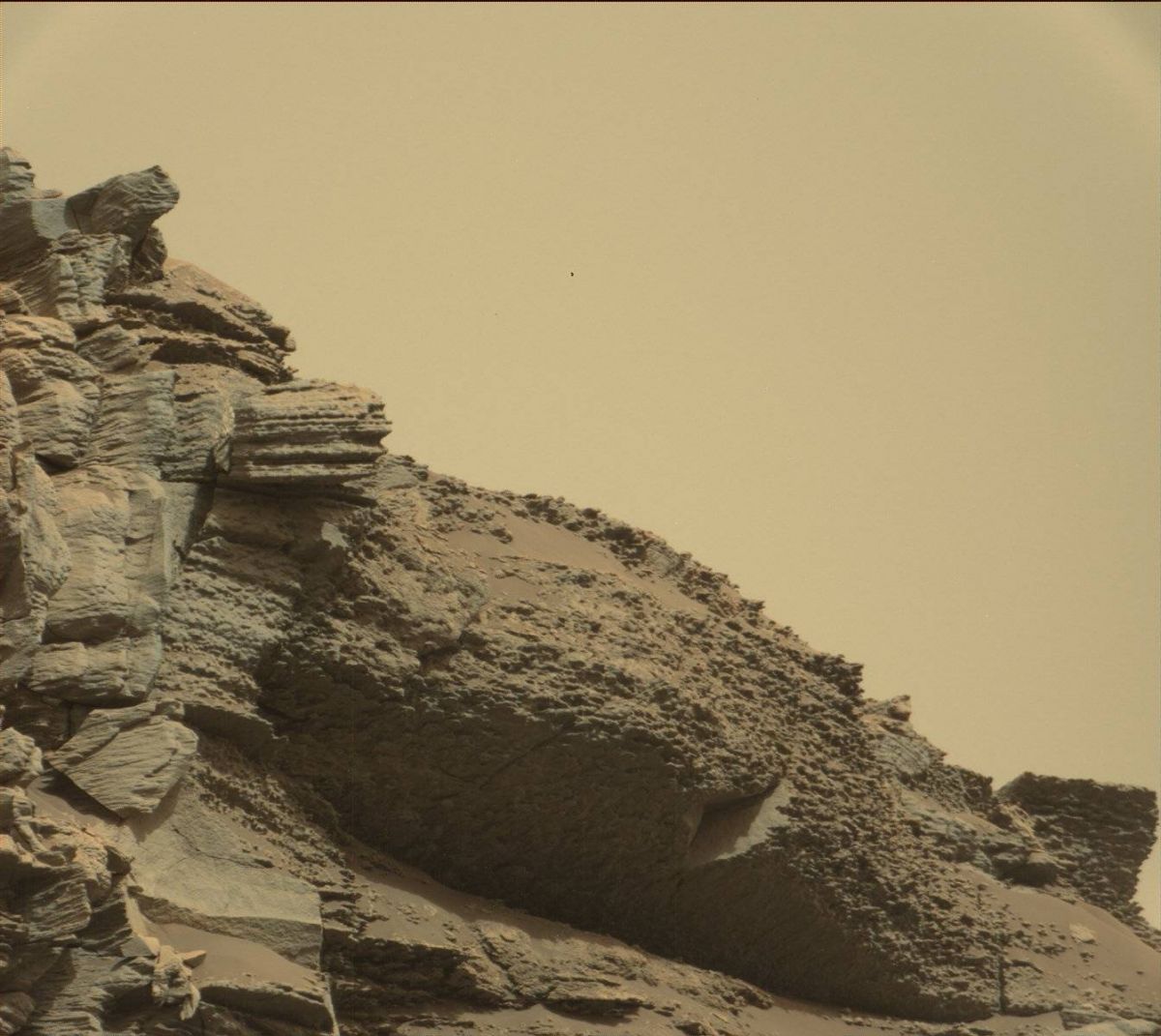
Curiosity Mastcam Right image taken on Sol 1450, September 4, 2016.
Credit: NASA/JPL-Caltech/MSSS
Next drill site
On tap is having the rover acquire a Mastcam mosaic of the “Karasburg” area to observe the contact between the Murray and Stimson formations, and another mosaic to document the stratigraphy in the buttes, Edgar notes. “Then we’ll drive to start approaching the next drill site.”
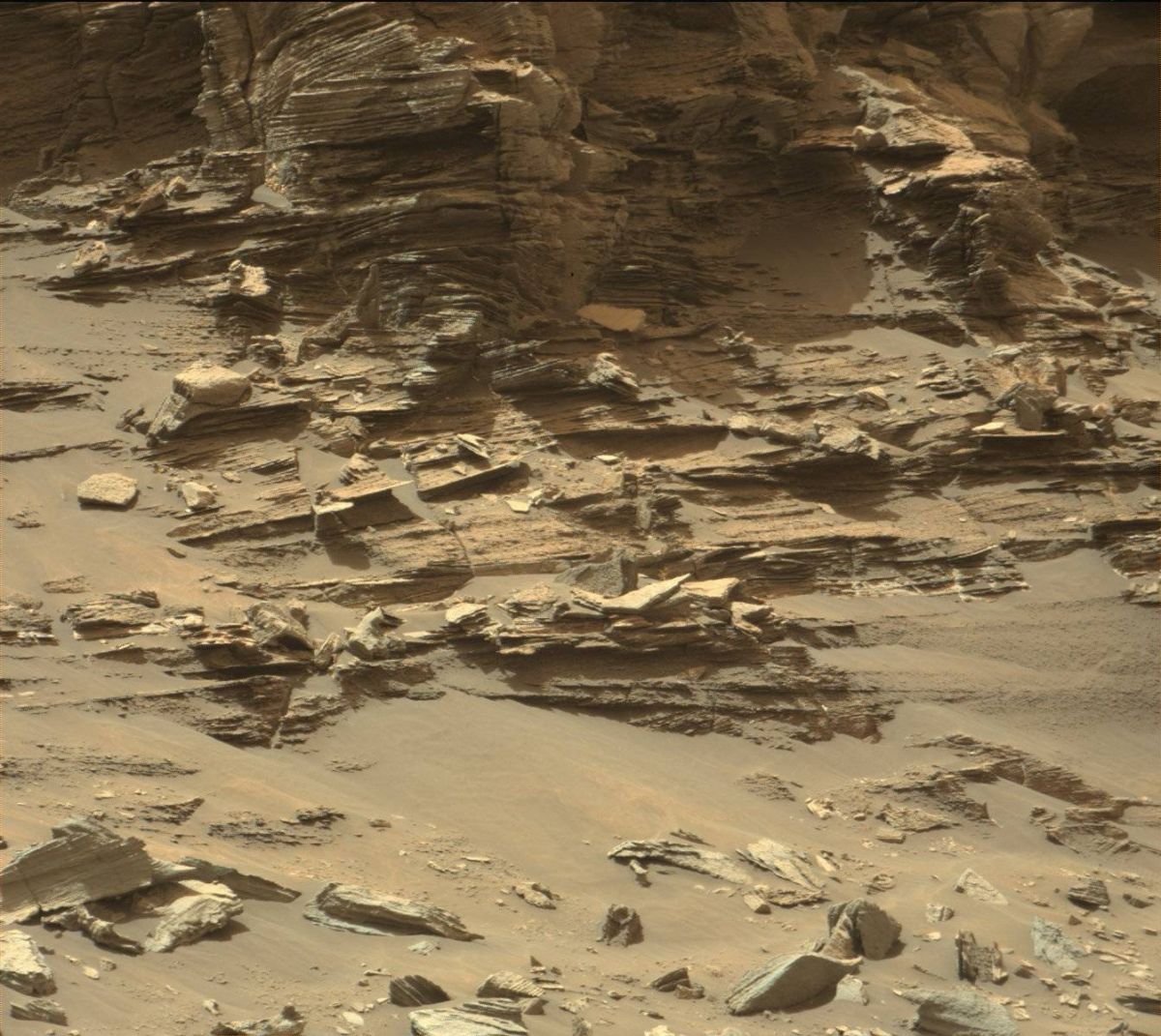
Curiosity Mastcam Right image taken on Sol 1450, September 3, 2016.
Credit: NASA/JPL-Caltech/MSSS
After Curiosity’s drive the plan calls for taking post-drive imaging for context and targeting.
Dates of planned rover activities are subject to change due to a variety of factors related to the Martian environment, communication relays and rover status.
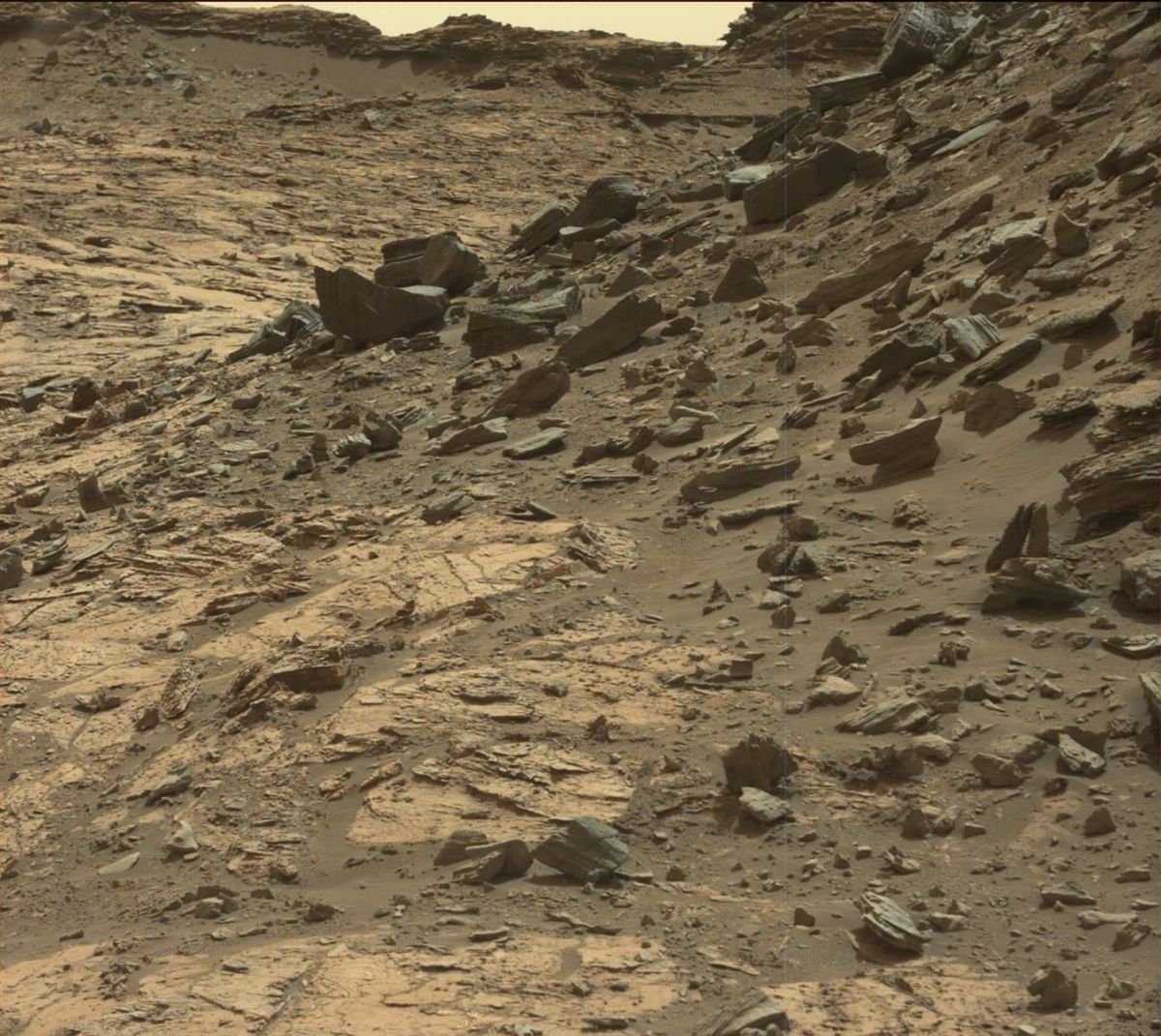
Curiosity Mastcam Left image taken on Sol 1452, September 6, 2016.
Credit: NASA/JPL-Caltech/MSSS

Credit: NAS
The National Academy of Sciences has released National Security Space Defense and Protection: Public Report (2016).
At the request of the Office of the Director of National Intelligence (ODNI) and the Office of the Secretary of Defense (OSD), the National Academies of Sciences, Engineering, and Medicine produced two classified reports that assess currently available options for addressing threats to space systems and recommend strategies for increasing resiliency.
The public report is an unclassified summary that discusses key background and policy issues featured in the reports.
Shaping the future
Highlighted in the report, a set of priorities:
- Develop a clear vision—or perhaps alternative options—of what the United States wants the future in space to be.
- Understand the extent to which the United States can shape that future, and the extent to which the future is subject to actions and activities beyond the control of the U.S. government and its allies.
- Identify and develop prudent methods to counter existing, evolving, and emerging threats to U.S. interests in space.
- Assess those methods in terms of how they affect the future in space and the ability and the commitment of the United States to shaping that future.
The study is available as a free download here:
https://www.nap.edu/download/23594
NOTE:
Also, another report has caught my eye regarding civilian use of classified assets:

Credit: NAS

ESA/Rosetta/MPS for OSIRIS Team MPS/UPD/LAM/IAA/SSO/INTA/UPM/DASP/IDA
The European Space Agency announced today that the Philae comet lander has been found!
Images taken by ESA’s Rosetta spotted the lander, wedged into a dark crack on Comet 67P/Churyumov–Gerasimenko.
Imagery clearly shows the main body of the lander, along with two of its three legs.

This series of 19 images, acquired by the Rosetta orbiter’s Optical, Spectroscopic, and Infrared Remote Imaging System (OSIRIS) on November 12, 2014, shows the Philae lander during its descent towards Comet 67P/Churyumov-Gerasimenko.
Credit: ESA/Rosetta/MPS for OSIRIS Team MPS/UPD/LAM/IAA/SSO/INTA/UPM/DASP/IDA
Ballistic bounces
Back in November 2014, Philae was last seen when it first touched down at Agilkia, bounced and then flew for another two hours before ending up at a location later named Abydos, on the comet’s smaller lobe.
After three days, Philae’s primary battery was exhausted and the lander went into hibernation, only to wake up again and communicate briefly with the Rosetta orbiter in June and July 2015 as the comet came closer to the Sun and more power was available.
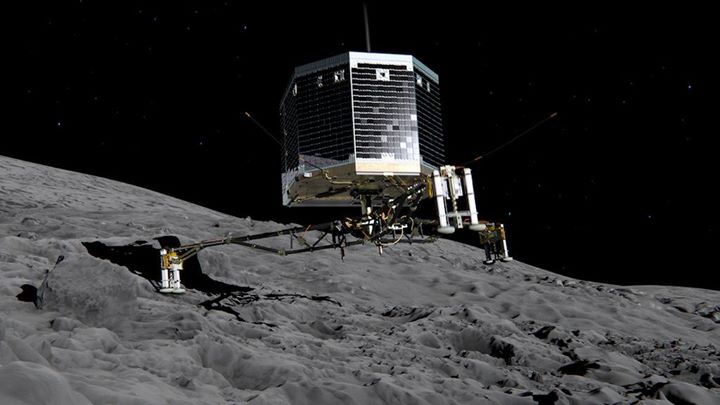
Artist view of the Philae lander that made historic landing.
Credit: ESA
Orbiter finale
The discovery comes less than a month before Rosetta descends to the comet’s surface. On September 30, the orbiter will be sent on a final one-way mission to investigate the comet from close up.
The images also provide proof of Philae’s orientation, making it clear why establishing communications was so difficult following its landing on November 12, 2014.
ESA scientists are keen on taking more images of the lost and now found Philae, with more details forthcoming about spotting the lander.
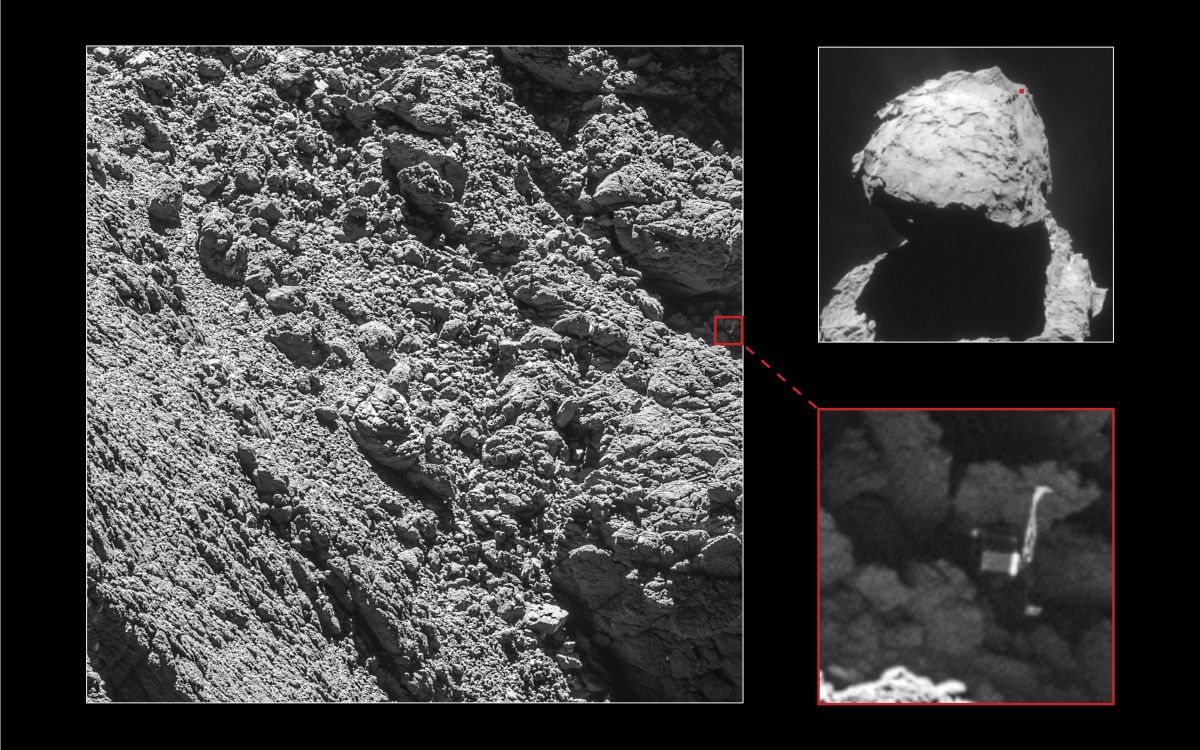
Main image and lander inset: ESA/Rosetta/MPS for OSIRIS Team MPS/UPD/LAM/IAA/SSO/INTA/UPM/DASP/IDA; context: ESA/Rosetta/NavCam – CC BY-SA IGO 3.0

Curiosity Mastcam Left image taken on Sol 1447, September 1, 2016.
Credit: NASA/JPL-Caltech/MSSS
Now in Sol 1451 on Mars, the Curiosity rover has a Labor Day of duties, but has recently been stymied by communication challenges.
Lauren Edgar, a research geologist at the USGS Astrogeology Science Center in Flagstaff, Arizona, reports that a Deep Space Network issue led to an entire Odyssey Mars orbiter pass to be lost.
“So we didn’t receive the workspace images that we would have needed to do contact science. Without those images we didn’t feel safe moving the arm. But the team did a great job putting together a full weekend plan,” Edgar adds.
Long weekend
Curiosity did wheel itself across Mars on a drive of roughly 255 feet (78 meters) on Sol 1448, Edgar notes, “which set us up for a lot of great science over the long (4-sol) weekend.”

Curiosity Mastcam Left image taken on Sol 1448, September 2, 2016.
Credit: NASA/JPL-Caltech/MSSS
The Mars robot was slated to carry out several Navcam observations to search for dust devils and monitor the atmosphere. Also scheduled was acquisition of a Mastcam mosaic “to document the beautiful buttes that we’ve been driving through,” followed by Chemistry and Camera (ChemCam) observations of the targets “Benguela” and “Gabela” to assess the composition of the local bedrock, Edgar says.
Buttes: better lighting conditions
Also on tap for Curiosity were more Mastcam mosaics of the buttes under better lighting conditions. Then the rover was to carry out a Sample Analysis at Mars (SAM) methane experiment.

Curiosity Mastcam Right image taken on Sol 1448, September 1, 2016.
Credit: NASA/JPL-Caltech/MSSS
A 360-degree Mastcam mosaic to document the geology as the robot drives through the Murray Buttes is also on the to-do list, followed by standard post-drive imaging for targeting and context.
Edgar says that after a busy weekend, the fourth sol is devoted entirely to Rover Environmental Monitoring Station (REMS) observations.
Gorgeous view

Curiosity Mastcam Left image taken on Sol 1449, September 2, 2016.
Credit: NASA/JPL-Caltech/MSSS
“While the buttes are beautiful, they pose a challenge to communications, because they are partially occluding communications between the rover and the satellites we use to relay data,” Edgar points out. Those orbiting assets are the Mars Reconnaissance Orbiter and the Odyssey spacecraft.
“So sometimes the data volume that we can relay is pretty low,” Edgar remarks. “But it’s a small price to pay for the great stratigraphic exposures and gorgeous view!”

