Author Archive

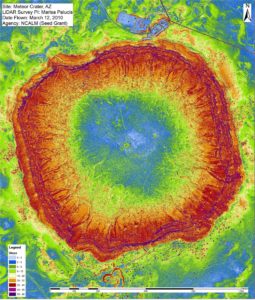
New Light Detection And Ranging (LiDAR) techniques are enhancing the resolution available for studies of the crater.
Courtesy: David A. Kring/Lunar and Planetary Institute


The Barringer, or Meteor Crater in Arizona is arguably the world’s best preserved and most dramatic looking impact crater.

Because of its similarity to lunar terrain, NASA used the crater during the Apollo era as a site for testing equipment that would be used on the lunar surface and for training astronaut crews.

Expanded edition

Courtesy: David A. Kring/Lunar and Planetary Institute

A new free volume — Guidebook to the Geology of Barringer Meteorite Crater, Arizona — is available courtesy of the Lunar and Planetary Institute (LPI).

They have released a greatly expanded edition of David Kring’s Guidebook to the Geology of Barringer Meteorite Crater, Arizona (a.k.a. Meteor Crater).


The book is being distributed electronically as a complimentary download so that it is available to the entire planetary science community.

100 years of exploration

This volume summarizes over 100 years of exploration at the crater and describes how impact cratering processes excavated the bowl-shaped cavity, distributing over 175 million metric tons of rock on the surrounding landscape.

Courtesy: David A. Kring/Lunar and Planetary Institute

As a leading authority on the crater, Kring explores both the geologic processes that shaped the crater and the biological effects the impact event may have had on an ice-age community of mammoths and mastodons.


Field training and research program

This excellent guidebook now contains over 150 figures with more than 200 photographs of the crater and samples from the crater. A large portion of the expanded material in the second edition is based on research conducted by students in LPI’s Field Training and Research Program at Meteor Crater.

To download your copy of this important and essential guidebook (164 MB), go to:

http://www.lpi.usra.edu/publications/books/barringer_crater_guidebook/

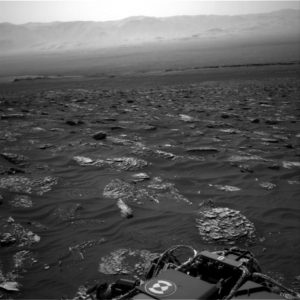
Curiosity Navcam Left B image acquired on Sol 1785, August 14, 2017.
Credit: NASA/JPL-Caltech


NASA’s Curiosity Mars rover is now performing Sol 1786 science tasks.

Credit: NASA/JPL-Caltech/University of Arizona

A new traverse map through Sol 1785 has been issued showing the robot’s drive and current location.

Numbering of the dots along the line indicate the sol number of each drive. North is up. The scale bar is 1 kilometer (~0.62 mile).

From Sol 1782 to Sol 1785, Curiosity had driven a straight line distance of about 99.05 feet (30.19 meters), bringing the rover’s total odometry for the mission to 10.62 miles (17.09 kilometers).

The base image from the map is from the High Resolution Imaging Science Experiment Camera (HiRISE) onboard NASA’s Mars Reconnaissance Orbiter.

Curiosity Navcam Right B image taken on Sol 1785, August 14, 2017 .
Credit: NASA/JPL-Caltech

Curiosity Mastcam Right photo acquired on Sol 1783, August 12, 2017.
Credit: NASA/JPL-Caltech/MSSS

Cargo carrying Peregrine lander.
Credit: Astrobotic

Astrobotic and United Launch Alliance (ULA) released today an end to end mission video for Astrobotic’s projected flight to the Moon during the 50th anniversary of Apollo 11 in 2019.

Astrobotic Technology Inc. is a lunar logistics company that delivers payloads to the Moon for companies, governments, universities, non-profits, and individuals.

The Peregrine Lunar Lander is designed to fly 35 kilograms of customer payloads on its first mission, with the option to upgrade to 265 kilograms on future missions.

According to Astrobotic 11 deals from six nations have already been signed for the 2019 mission.

The first mission in 2019 will serve as a key demonstration of service for NASA, international space agencies, and companies looking to carry out missions to the Moon.

To view the end to end mission video of Peregrine, go to:

https://youtu.be/PL27UCNd9Iw


Space rock slips by Earth.
Courtesy: Texas A&M

One of the largest of the near-Earth asteroids, will approach close to Earth at the end of August, and will shoot safely by our world on September 1.

“Although many known asteroids have passed by closer than this, all of them were smaller asteroids. Florence is the largest asteroid to pass this close to our planet since the first near-Earth asteroid was discovered over a century ago,” explains JPL’s Paul Chodas, manager of the Center for NEO Studies (CNEOS).

The JPL Center for NEO Studies (CNEOS) computes high-precision orbits for Near-Earth Objects (NEOs) in support of NASA’s Planetary Defense Coordination Office.

Credit: CNEOS

Detailed measurements

At its closest point, Florence will be 4.4 million miles (7.0 million kilometers) from Earth, or about 18 times the average Earth-Moon distance.

“The September 1 flyby of Florence will provide astronomers with an excellent opportunity to make detailed measurements of a large near-Earth asteroid,” Chodas adds. “In particular, radar scientists expect to obtain high-resolution images of Florence that could reveal surface features as small as about 10 meters (30 feet).”

Chodas says that infrared measurements from NASA’s Spitzer Space Telescope and the NEOWISE spacecraft indicate that Florence is roughly 2.7 miles (4.3 kilometers) in size, and measurements of its brightness variations indicate that it rotates once every 2.36 hours.

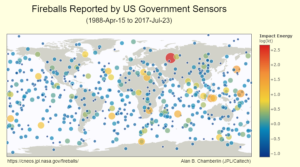
Fireball and bolide events are recorded by U.S. Government sensors. Chart shows reported fireball events for which geographic location data are provided. Each event’s calculated total impact energy is indicated by its relative size and by a color.
Credit: CNEOS

Easily visible

“As it approaches in late August and early September, it is expected to brighten to 9th magnitude, making it easily visible, even using a small telescope,” Chodas notes.

Asteroid Florence was discovered in 1981 and named in honor of Florence Nightingale (1820-1910), the founder of modern nursing.

Tracking observations of asteroid Florence span nearly 40 years and its orbit is already well known.

“The orbital calculations indicate,” Chodas concludes, “that asteroid Florence poses no risk of colliding with Earth for many centuries to come.”

SpaceX Dragon supply ship will be loaded with hardware for delivery to the International Space Station.
Credit: NASA

NASA commercial cargo provider SpaceX is targeting its 12th commercial resupply services mission to the International Space Station early next week.

Loaded with more than 6,400 pounds of research, crew supplies and hardware, the SpaceX Dragon spacecraft will launch on a Falcon 9 rocket.

The payloads include crucial materials to directly support several of the more than 250 science and research investigations to be conducted on the orbiting laboratory during Expeditions 52 and 53.

Credit: NASA

Spaceborne computer

Onboard the SpaceX Dragon is a year-long experiment, a team effort of Hewlett Packard Enterprise and NASA. That length of time will test a supercomputer’s ability to function in the harsh conditions of space.

From faster problem solving to astronaut survival, Hewlett Packard Enterprise’s (HPE) Spaceborne Computer is the first step in developing sophisticated onboard computing resources.

Mars mission

The Spaceborne Computer is part of a year-long experiment conducted by HPE and NASA to run a high performance commercial off-the-shelf (COTS) computer system in space, which has never been done before. The goal is for the system to operate seamlessly in the harsh conditions of space for one year – roughly the amount of time it will take to travel to Mars.

Credit: NASA

“We see the Spaceborne Computer experiment as a fitting extension to our HPE Apollo portfolio, purpose-built for supercomputing. HPE is excited to expand its relationship with NASA, pioneering HPC in space and taking one step closer to a mission to Mars,” explains Alain Andreoli, a senior vice president and general manager of HPE’s Data Center Infrastructure Group.

Memory-driven computing

According to Kirk Bresniker, chief architect of Hewlett Packard Labs, the mission to Mars will require the most powerful computing system the world has ever seen, “but the incremental increases we are seeing in our computing power will not meet the exponential demands of our future challenges.”

To that end, the 21st century computer to solve 21st century problems is HPE’s Memory-Driven Computing.

The Spaceborne Computer includes the HPE Apollo 40 class systems with a high speed HPC interconnect running an open-source Linux operating system. A unique water-cooled enclosure for the hardware has been designed. Also purpose-built system software addresses the environmental constraints and reliability requirements of supercomputing in space, according to HPE.

In order for NASA to approve computers for space, the equipment needs to be hardened to withstand the conditions in space: radiation, solar flares, subatomic particles, micrometeoroids, unstable electrical power, irregular cooling.

Credit: NOAA/SEC

Different approach

Physical hardening of a computer takes time, money and adds weight.

HPE took a different approach to “harden” the systems with software. HPE’s system software will manage real-time throttling of the computer system based on current conditions and can mitigate environmentally induced errors.

During high radiation events, the electrical power consumption and, therefore, the operating speeds of the computer systems are lowered in an attempt to determine if such systems can still operate correctly.

“Even without traditional ruggedizing, the system still passed at least 146 safety tests and certifications in order to be NASA-approved for space,” according to HPE.

Humans on Mars operations will demand powerful computers.
Credit: Boeing

Yottabytes

Given how the Spaceborne Computer reacts in space, future phases of this experiment will eventually involve sending other new technologies and advanced computing systems, like HPE’s Memory-Driven Computing, to the International Space Station.

HPE’s engineering eye is focused on Memory-Driven Computers with up to 4,096 “yottabytes” of data. That’s more than 250,000 times the size of our digital universe today.

The unit symbol for the yottabyte is YB. One YB = 10008bytes = 1024bytes = 1000000000000000000000000bytes = 1000zettabytes = 1trillionterabytes.

Resources

Go to these HPE videos:

Making the Mars mission compute, go to:

https://www.facebook.com/megwhitman/videos/10155276138385477/

A Mission to Mars: HPE Conquers Space and Time, go to:

https://www.youtube.com/watch?v=VpA-t4gJVoQ

HPE at The Atlantic’s On The Launchpad: Return to Deep Space, go to:

https://www.youtube.com/watch?v=ahkG7M6YysQ

Credit: Space Resources Program/CSM


The Colorado School of Mines is establishing a multi-disciplinary graduate program in space resources.

“We have launched a new, first-of-its-kind program at Mines on Space Resources,” said Angel Abbud-Madrid, Director of the Center for Space Resources at the Colorado School of Mines in Golden, Colorado.

Credit: Space Resources Program/CSM

The proposed program will focus on developing core knowledge and gaining design practices in systems for responsible exploration, extraction, and use of resources in the Solar System.

“The program will be fully implemented next year, but we are already offering classes this coming semester,” Abbud-Madrid told Inside Outer Space.

Leading institution

Since the 1990s, the School of Mines in Golden, Colorado has been a leading institution for the study of space resources and in situ resource utilization (ISRU). It has also become a destination for space scientists and engineers, government agencies, aerospace companies, entrepreneurs, the mining and minerals industry, financial and legal experts, and policy makers to discuss all topics related to space resources.

Space cowboys? International lawyers are trying to agree on what legislation will be needed to control the exploration of mineral resources in space to avoid a new ‘Wild West’.
Credit: James Vaughan

Abbud-Madrid notes that in recent years, growing interest in ISRU by space agencies and the private sector has been driven by an awareness that further development of space travel will be enabled through extraction of materials and production of propellants in space for more affordable and flexible transportation, facilities construction, and life support.

Business plan for asteroid mining.
Credit: Joel Sercel/ICS Associates Inc. and TransAstra

Many fields

The broad topic of space resources brings together many fields, Abbud-Madrid adds, in which Mines has a strong presence, including remote sensing, geomechanics, mining, materials/metallurgy, robotics/automation, advanced manufacturing, electrochemistry, solar and nuclear energy, and resource economics.

In anticipation of the new space resources program, this Fall 2017 the School of Mines will start offering a course entitled Space Resources Fundamentals (with synchronous distance-learning options available).

This activity will be followed in the Spring by a space systems engineering course, a design project class, and a seminar series – all with a space resources focus.

Resources

For detailed information on this multi-disciplinary graduate program in space resources, go to:

http://space.mines.edu/

Also, go to the website for the Center for Space Resources (CSR), a research and technology development center at the School of Mines dedicated to the human and robotic exploration of space and the utilization of its resources:

http://spaceresources.mines.edu

For an informative TEDxMileHigh talk on how to live off the land in space by Angel Abbud-Madrid, go to:

https://youtu.be/LuG2rf9enHE


Curiosity Navcam Left B image acquired on Sol 1782, August 11, 2017.
Credit: NASA/JPL-Caltech


NASA’s Curiosity Mars rover is now wrapping up Sol 1782 science duties.

Rachel Kronyak, a planetary geologist at the University of Tennessee in Knoxville, reports that the robot is busily taking measurements as it climbs Mount Sharp.

Curiosity Front Hazcam Left B image taken on Sol 1782, August 11, 2017.
Credit: NASA/JPL-Caltech


Up Mount Sharp

“Lately, one of our biggest science objectives is to conduct bedrock [Alpha Particle X-Ray Spectrometer] APXS measurements with every 5-meter climb in elevation,” Kronyak notes. “This allows us to systematically analyze geochemical changes in the Murray formation as we continue to climb Mount Sharp.”

Curiosity Navcam Right B image acquired on Sol 1782, August 11, 2017.
Credit: NASA/JPL-Caltech

For example, a recent drive by Curiosity brought it 20 feet (6 meters) higher in elevation, so another “touch and go” was orchestrated.


Slopes of Vera Rubin Ridge

On tap is analyzing the Murray target “Thorne” with APXS and the rover’s Mars Hand Lens Imager (MAHLI), followed by a short Chemistry & Camera (ChemCam) observation on the same target.

Curiosity Navcam Left B image acquired on Sol 1782, August 11, 2017.

“We’ll also take several additional Mastcam images of ‘Devilled Rocks’ and ‘Butter’ which will document blocks on the slopes of the Vera Rubin Ridge (VRR),” Kronyak adds.

Following the robot’s “touch” activities, the plan is to “go” and complete another  drive.


Weekend plan

“To set ourselves up for a nice weekend plan, we’ll take some post-drive images,” Kronyak explains.

Standard Rover Environmental Monitoring Station (REMS) and Dynamic Albedo of Neutrons (DAN) blocks of time are to be carried out.

Curiosity Mastcam Left photo acquired on Sol 1781, August 10, 2017.
Credit: NASA/JPL-Caltech/MSSS

“We should be arriving at our next VRR imaging stop after today’s drive,” Kronyak concludes, “so stay tuned for exciting Mastcam mosaics that we’ll be acquiring over the weekend!”


Clouds on the horizon

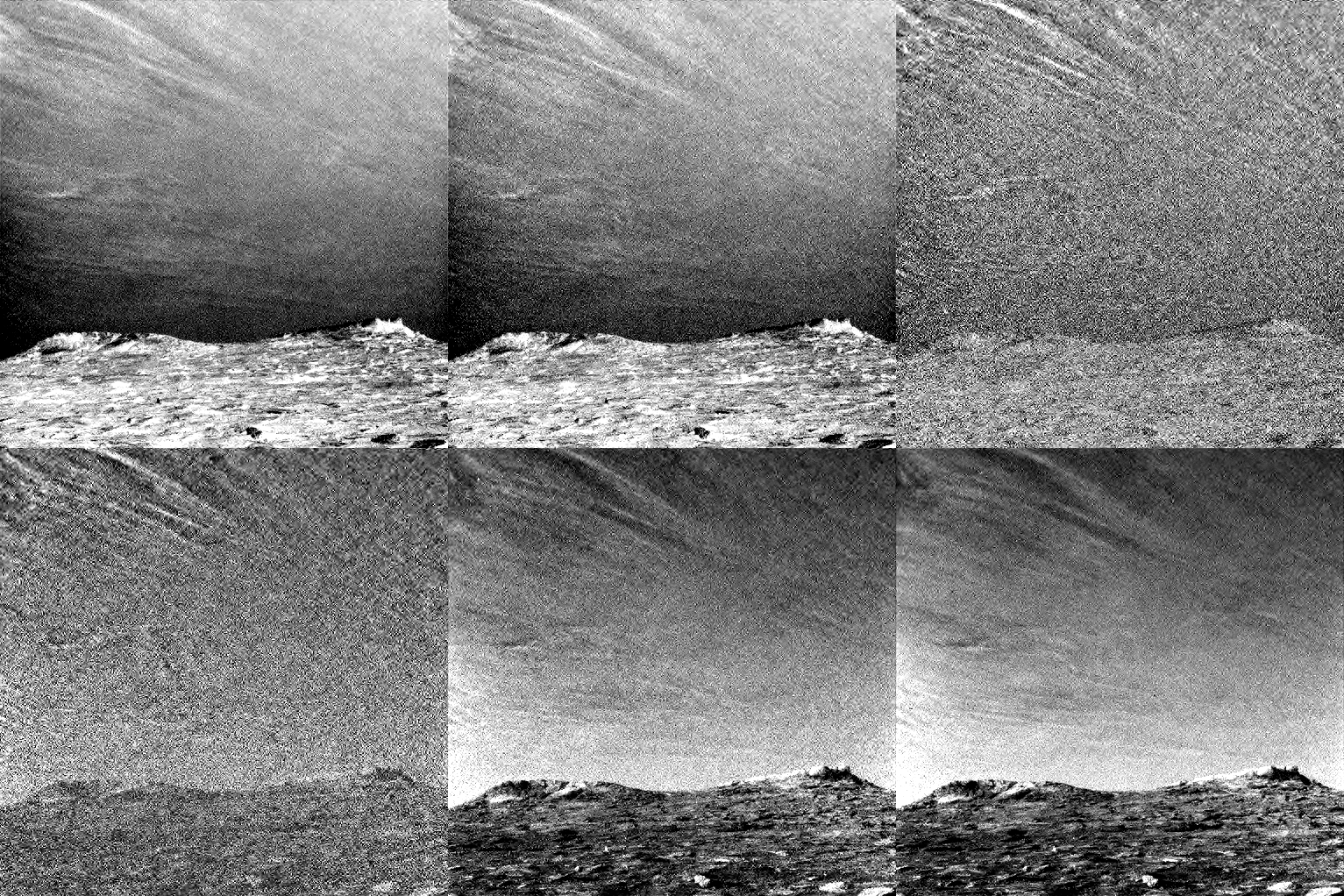
Meanwhile, JPL has issued an interesting view of clouds drifting across the sky above a Martian horizon.

An accelerated sequence of enhanced images from Curiosity can be seen here:

https://mars.jpl.nasa.gov/imgs/2017/08/msl-mars-clouds-PIA21840-full.gif

Cis-lunar Gateway Station.
Credit: Boeing


Boeing is pressing ahead on scoping out its deep space gateway and transport systems plans.

A recent Future In-Space Operations (FISO) seminar hosted Boeing’s Matt Duggan who spoke on: “Next Steps in Human Exploration: Cislunar Systems and Architectures.” He is the Boeing Manager for Exploration Integration and leads Boeing’s advanced  development projects on extending human presence to cislunar space and Mars.

Mars habitat gleaned from Space Launch System propellant tank.
Credit: Boeing

Gateway    

NASA’s Space Launch System (SLS), which Boeing is helping develop, would deliver the habitat to cislunar space near the Moon. Known as the Deep Space Gateway, the habitat could support critical research and help open opportunities for global government or commercial partnerships in deep space, including lunar missions. It would be powered by a Solar Electric Propulsion (SEP) system.

Cis-lunar Gateway elements.
Credit: Boeing

Waypoint for Mars

The Deep Space Gateway could be the waypoint for Mars missions. A Mars spaceship habitat, in fact, might be developed from SLS propellant tank structure.

Utilizing a docking system akin to what the International Space Station uses for commercial operations, it could host the Deep Space Transport vehicle, which would take humans to Mars.

Phobos lander.
Credit: Boeing

Humans on Mars operations.
Credit: Boeing

Once near Mars, crews could deploy a lander for surface missions or conduct other scientific and robotic missions in orbit – perhaps land on Phobos, one of the two moons of Mars.

The gateway and transport systems are partially being developed as part of NASA’s Next Space Technologies for Exploration Technologies (Next Step) program and an ongoing High Power SEP technology development effort within the NASA Space Technology Mission Directorate (STMD).

In this image, north is up and the bright crater at the upper right is Theophilus. The dark ring in the image is due to the pattern formed by the transmitting and receiving antennas.
Credit: Image courtesy Bruce A. Campbell, Smithsonian’s Air and Space Museum, GBT Green Bank Observatory/AUI/NSF, Arecibo Observatory.


A striking new radar view of the Moon has been produced, one that reveals craters and other geological features hidden beneath the lunar surface.

Astronomers from the Smithsonian’s Air and Space Museum have used the Arecibo and Green Bank radio telescopes to produce the image.

Radar signals were transmitted from the Arecibo telescope in Puerto Rico and received at the Robert C. Byrd Green Bank Telescope in West Virginia.

This technique can probe many meters below the surface of the Moon, just like ground-piercing radar on Earth.

Hidden from view

According to a Green Bank Observatory press statement, by using radar, lunar structures that can’t be seen in optical images are possible because they’re hidden from view under the layer of dust and rubble that covers the Moon’s surface.

Credit: GBT Green Bank Observatory

Reason for the radar scanning?

Scientists are searching for unseen structures of lunar geology, such as lava-flow complexes and buried craters.

The image released is of the Moon’s southeastern highlands, showing the densely cratered surface formed as the result of more than four billion years of meteorite impacts. The radar can distinguish the age of some craters. Younger impact craters have enhanced “radar return,” showing bright floors and surrounding areas due to rocky material that has not yet been worn away by very small meteorites.

Courtesy of the NAIC – Arecibo Observatory, a facility of the NSF


Assets used

The Green Bank Observatory is a facility of the National Science Foundation operated by Associated Universities, Inc., under a cooperative agreement with the National Science Foundation.

Planetary radar at Arecibo is funded by the NASA Near-Earth Object Observations program managed by USRA.


For All Moonkind, Inc Logo (PRNewsfoto/For All Moonkind, Inc)

A proposed multi-part plan to obtain international protection of the Apollo Lunar Landing Sites is being rolled out today at the Starship Congress 2017 in Monterey, California.

For All Moonkind, Inc. is a non-profit organization which seeks to work with the United Nations and the international community to preserve each of the six human lunar landing sites as part of our human heritage.

Group calls for protection of the six human exploration sites on the Moon.
Credit: NASA

The strategy to be pursued will utilize an international team of space lawyers, policymakers and marketers to achieve the organization’s goals.

For All Moonkind wants to be able to deliver a formal plan – already vetted by national space agencies – to the UN Committee on the Peaceful Uses of Outer Space in the summer of 2018.

Credit: For All Moonkind

Sobering wake-up call

Recently, For All Moonkind called the auction by Sotheby’s of the Apollo 11 Contingency Lunar Sample Return Bag used by astronaut Neil Armstrong a “sobering wake-up call.”  But it wasn’t the sale itself that was disturbing, the group argues.

Courtesy: For All Moonkind

“People need to wake-up and recognize the space doesn’t belong to billionaires, it belongs to all of us,” Angela Crawford, a spokesperson for the group, told Inside Outer Space. “And we should all keep a keen eye on what goes on up there.”

Private moon rovers

Similarly, the group is keeping a watchful eye on the Google Lunar XPRIZE, calling it a tremendous and welcome effort to jump start a commercial space economy.

“But the promise of private rovers on the Moon perhaps as early as this year spotlights the fact that there is nothing to stop anything or anyone from running over humankind’s first footprints on the Moon. That should alarm everyone,” notes Michelle Hanlon, the co-founder of For All Moonkind.

For more information about For All Moonkind, go to:

http://www.forallmoonkind.org.