Author Archive
 Author:
  November 21st, 2017
Credit: Rosie Muñoz on Instagram
NASA’s Origins, Spectral Interpretation, Resource Identification, Security – Regolith Explorer asteroid sample return mission – mercifully shortened to OSIRIS-Rex, is the first U.S. mission to collect a sample of an asteroid and return it to Earth for study.
Next year, in August 2018, OSIRIS-REx’s approach to asteroid Bennu will begin. It will use an array of small rocket thrusters to match the velocity of Bennu and rendezvous with the space rock.
In March 2021, the window for departure from the asteroid will open, and OSIRIS-REx will begin its return journey to Earth, arriving two and a half years later in September 2023.
The sample return capsule will separate from the spacecraft and enter the Earth’s atmosphere. The capsule containing the asteroid specimens will be collected at the Utah Test and Training Range.

Artist concept of OSIRIS-REx at Bennu. Credit: NASA/Goddard
Pocket spacecraft
Time is on your side – but for the moment take your own pocket spacecraft for an adventure right here on Earth.
Snap a photo of your spacecraft TAG-ing something interesting where you live, work, study or travel. Then share it by using the hashtag #MyOSIRISREx and tagging the mission account on Twitter (@OSIRISREx) or Instagram (@OSIRIS_REx).
Note, when sharing images on social media as part of the #MyOSIRISREx campaign, please be aware that they may be re-shared to a larger audience by the mission accounts and/or other users.
Share a photo
Going somewhere? #MyOSIRISREx has been spotted in 23 countries and 29 U.S. states.
Help fill in the map by printing your own pocket spacecraft and sharing a photo of it TAGing something interesting where you are.
Go to:
http://asteroidmission.org//wp-content/uploads/2017/05/MyOSIRISRExPocketSpacecraft.pdf
 Posted in

Lena Okajima, ALE leader and chief star shooter.
Credit: ALE
Shooting stars on demand…that’s the business plan of ALE Corporation, Inc. of Tokyo, Japan.
ALE (Astro Live Experiences) is a space entertainment startup that wants to create shooting stars by using microsatellites. Its mission is to contribute to scientific research through entertainment. It was founded in September 2011 by Lena Okajima, a serial entrepreneur with a Ph.D. in Astronomy from the University of Tokyo.
ALE’s plan is that in early 2019, the first-ever eye-catching artificial meteors will create a light show in the sky above Hiroshima and the surrounding Setouchi region.
Sky canvas
Natural shooting stars occur when dust particles of several millimeters in size enter the Earth’s atmosphere and burn due to plasma emission.

Microsatellite used to pepper Earth’s atmosphere with artificial meteors.
Credit: ALE
ALE’s artificial shooting star business can turn the nighttime heavens into a “Sky Canvas.”
“We aim to artificially reproduce shooting stars by releasing grains of special material from orbiting artificial satellites into outer space and entering into the atmosphere. The appearance of grain burning in the atmosphere is like a shooting star from the ground, and its radiance can be enjoyed at the same time,” notes the ALE website.
ALE reproduces this artificially by inventing shooting star particles and using specially designed microsatellites.

Credit: ALE
Mass driver
Each of ALE’s mini-spacecraft would be loaded with the shooting star particles. An artificial meteor is ejected by a mass driver installed on a microsatellite. The mass driver injects a “pill” at high velocity that then deorbits into the atmosphere.
Once ejected via the tiny satellite, those particles will travel roughly one-third of the way around the Earth. They then burn upon entering the atmosphere, becoming shooting stars visible from an area some 125 miles (200 kilometers) in diameter on the ground.
For more information, go to:
Check out this video on the enterprising ALE at:
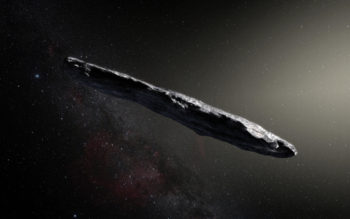
Credit: ESO/M. Kornmesser
This artist’s impression shows the first detected interstellar asteroid:`Oumuamua.
The unique object was discovered on October 19, 2017 by the Pan-STARRS 1 telescope in Hawai`i. Subsequent observations were done by telescopes around the world, including the Canada-France-Hawaii Telescope (CFHT), the United Kingdom Infrared Telescope (UKIRT) and the Keck Telescope on Maunakea, the Gemini South telescope, and the European Southern Observatory (ESO) Very Large Telescope (VLT) in Chile.
Findings show that the object was on a path which must have been travelling through interstellar space for millions of years before its chance encounter with our star system. `Oumuamua seems to be a dark red highly-elongated metallic or rocky object — about 1,300 feet (400 meters) long — and is unlike anything normally found in the Solar System.
`Oumuamua is rapidly fading as it heads out of the solar system and recedes from both the Sun and the Earth, leaving in its wake memories of the science fiction novel, Rendezvous with Rama, by British writer Arthur C. Clarke first published in 1973. Set in the 2130s, the story involves a 31 mile (50-kilometer) cylindrical alien starship that enters Earth’s solar system.

The historic Apollo 11 command module, Columbia, is on tour to celebrate the upcoming 50th anniversary of the first human landing on the Moon in July 2019.
The milestone-making spacecraft is currently on view at Space Center Houston, Houston, Texas, from Oct. 14, 2017–March 18, 2018.
It next appears at the Saint Louis Science Center, St. Louis, Missouri from April 14–Sept. 3, 2018.
National tour
The traveling exhibition is called Destination Moon: The Apollo 11 Mission and has been developed by the Smithsonian Institution Traveling Exhibition Service and the National Air and Space Museum.
The exhibition’s two-year national tour will celebrate the approaching 50th anniversary of the mission and explore the birth and development of the American space program and the space race.
The tour brings the command module and more than 20 one-of-a-kind artifacts from the historic mission to some of the top museums in the country.

Credit: Space Center Houston
Exhibit stops: 2018-2020
Follow-on stops of the exhibit are:
- Senator John Heinz History Center, Pittsburgh: Sept. 29, 2018–Feb. 18, 2019
- The Museum of Flight, Seattle: March 16–Sept. 2, 2019
The Apollo 11 command module will return to a place of honor in the new exhibition “Destination Moon,” slated to open in 2020. This new permanent gallery is to be staged at the National Air and Space Museum on the Mall in Washington, D.C.
Interactives
Through original Apollo 11-flown objects, models, videos and interactives, visitors will learn about the historic journey of the Apollo 11 crew—Neil Armstrong, Michael Collins and Buzz Aldrin.
“Destination Moon” will include an interactive 3-D tour, created from high-resolution scans of Columbia performed at the Smithsonian in spring 2016. The interactives will allow visitors to explore the entire craft including its intricate interior, an interior that has been inaccessible to the public until now.

Credit: Mars Society
Mars Mastermind Robert Zubrin reports that “a giant leap forward” has been reached in a plan for on-the-spot production of rocket propellant on the Red Planet.
From November 14-15, his Colorado-based research and development team at Pioneer Energy, a spinoff company of Pioneer Astronautics, conducted a 24-hour non-stop demonstration of an integrated reverse water-gas shift (RWGS)-Methanol system.

The team with the machine.
Courtesy: Robert Zubrin
Teasing out tons
“We also did a 5-hour demonstration of a system for turning the methanol into dimethyl ether. All tests were witnessed by judges from the X-Prize Carbon capture completion,” Zubrin explains. He adds that if the water produced by the system were electrolyzed, it would produce 72-kilograms of oxygen per day, or 36-metric tons over a 500-day period. The methanol system would produce 52.5-metric tons of methanol. The dimethyl ether (DME) system would produce 28.5-tons of DME.
Oxygen burns with DME at a “stoichiometric” ratio of 2.087. So if the 28.5-tons of DME produced were combined with 59.5-tons of oxygen, a total of 88-tons of useful bipropellant would be available, Zubrin explains. Stoichiometry is a branch of chemistry that deals with the application of the laws of definite proportions and of the conservation of mass and energy to chemical activity.
Alternatively, Zubrin points out, if oxygen is viewed as the limiting propellant, by combining the 36-tons of oxygen with 20-tons of DME (to run slightly fuel rich) 56-tons of useful bipropellant would be available. If the oxygen product were used in a liquid oxygen/RP (rocket grade kerosene) engine burning at 2.8:1, a total of 49-tons of useful bipropellant would be available.
Mars ascent vehicle
In any case, more propellant would be produced by such a system, Zubrin adds than that required for the Mars ascent vehicle in the NASA design reference mission.
“Finally, it may be noted that if the RWGS system were run in parallel in a Sabatier Electrolysis (S/E) system sized to produce 48-kilograms of methane (CH4) and 96-kilograms of oxygen (O2) per day, a total of 24-tons of methane and 84-tons of oxygen would be produced, which is sufficient to fly the Mars Direct mission,” Zubrin notes. In-situ Resource Utilization (ISRU) “has entered a new world,” he concludes.

Credit: NASA
NASA’s MOXIE
NASA is also investing in ISRU, testing the concept on the Mars 2020 rover now being built and tested. Among its experiments, The Mars Oxygen In-Situ Resource Utilization Experiment (MOXIE) will demonstrate a way that future explorers might produce oxygen from the Martian atmosphere for propellant and for breathing.
Zubrin told Inside Outer Space that MOXIE is a useful small step in testing ISRU on Mars. “But MOXIE will produce oxygen at a rate of 20 grams per hour. Our system can do 3 kilograms per hour, or 150 times the MOXIE rate. MOXIE is built on the scale of propellant manufacture for a robotic Mars sample return mission. Ours is full scale to make the ascent propellant for a human Mars expedition.”

Credit: Touchstone
Maximum results, minimum investment
Zubrin’s visionary Mars Direct plan was highlighted in the seminal book: The Case for Mars: The Plan to Settle the Red Planet and Why We Must, first published in 1996, and revised and updated in 2011. Zubrin is also President of the Mars Society.
Mars Direct is a sustained humans-to-Mars plan blueprinted by Zubrin that advocates a minimalist, live-off-the-land approach to exploring the Red Planet, allowing for maximum results with minimum investment. Using existing launch technology and making use of the Martian atmosphere to generate rocket fuel, extracting water from the Martian soil and eventually using the abundant mineral resources of the Red Planet for construction purposes, the plan drastically lowers the amount of material which must be launched from Earth to Mars, thus sidestepping the primary stumbling block to space exploration and rapidly accelerating the timetable for human exploration of the solar system.
For more information on Mars Direct, go to:
http://www.marssociety.org/home/about/mars-direct/

Curiosity Mastcam Left image taken on Sol 1877, November 16, 2017.
Credit: NASA/JPL-Caltech/MSSS

Curiosity Front Hazcam Right B image acquired on Sol 1879, November 18, 2017.
Credit: NASA/JPL-Caltech

Curiosity ChemCam Remote Micro-Imager photo taken on Sol 1879, November 18, 2017.
Credit: NASA/JPL-Caltech/LANL

Curiosity Mastcam Left image taken on Sol 1877, November 16, 2017.
Credit: NASA/JPL-Caltech/MSSS

Curiosity Mars Hand Lens Imager (MAHLI) photo acquired on Sol 1879, November 18, 2017.
Credit: NASA/JPL-Caltech/MSSS

The Indian Space Programme – India’s incredible journey from the Third World towards the First by Gurbir Singh; Astrotalkuk Publications, 2017, 600+ pages, 140+ illustrations, 8 appendices, 20+ tables and 1000+ endnotes; $55.00 softcover.
This book is an incredible resource and is an impressive, heavily researched volume. A unique piece of work, the book outlines how India has capitalized on space technology to foster the country’s progress into the 21st century.
Indeed, this month is viewed as the birth of the Indian Space Program. Fast forward and decades in the making, India’s space program has made impressive strides in space, from weather and Earth-monitoring satellite launches to lunar missions and orbiting Mars with the Mars Orbiter Mission (MOM), also called Mangalyaan.
Gurbir Singh has written an informative, fact-packed volume that’s unprecedented in its scope – be it describing the founders of India’s space program, the emergence of India’s spaceport, Sriharikota, to the inner-workings of the Indian Space Research Organization (ISRO) and its on-going strides in developing an array of boosters.
As Singh notes, “from a standing start in 1963, India has demonstrated the power of space-based technologies to transform a nation. Developing countries will remain developing countries unless they engage in modern space technologies.”
How is the citizenry of India benefiting from the country’s space program? How did India get to the Moon and Mars? What are the prospects for India’s ambitions in space for human spaceflight, military and science? In space, will India compete or collaborate with China, the United States and Russia? These are important questions and dutifully addressed in this very readable and engrossing book.
Singh has done a masterful job of pulling together unique material and photos for a popular reader. It’s a wide-ranging view of India’s space program – its past, current status and ambitions ahead.
For more information regarding this book, go to:

Credit: Caran d’Ache/MB&F
Think of it as one small step in penmanship – but at a giant leap in dollars: $19,900.
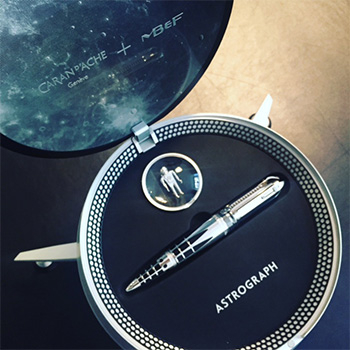
Caran d’Ache and MB&F have issued a creative odyssey: the Swiss-made Astrograph writing instrument.
This space rocket-shaped work of art contains a total of 99 components, comprising a multitude of innovative features: a “detent” system of vertical stabilization, launch-pad box, magnetic astronaut figurine.

Credit: Caran d’Ache/MB&F
It takes more than 500 manual operations to produce each instrument, “quite simply the most complex writing instrument ever made in the Caran d’Ache workshops,” notes the company’s website.
Climb on board
The rocket-shaped pen body is rhodium-plated. The base of the “engine” is plated with ruthenium. The stabilizer legs, the joints and miniature ladder are polished, sandblasted, satin-finished and rhodium-plated. A miniature lever – the entry door to the rocket — is concealed in the ring of the pen and activates the simultaneous lowering of three stabilizer legs. Once these have been deployed, it is possible to stand Astrograph up vertically, ready for take-off.
The magnetic miniature astronaut figurine is silver and rhodium-plated and can be attached at will to the body of the writing instrument, ready to “climb on board”.
Credit: Caran d’Ache/MB&F
Limited edition
A “launch pad” box is circular shaped, fitted with three articulated legs that allow the writing instrument to be kept inside or displayed outside, placed in the middle in a vertical position.
The Astrograph limited edition is available in three finishes. In homage to the 99 new components specially developed for the Astrograph limited edition, 99 fountain pens and roller pens are numbered: “1 in 99 pieces.”
Resources
This unique writing instrument comes complete with a manual. Go to:
https://www.mbandf.com/files/the-tribe/downs/Astrograph_user-manual.pdf
For more information on the Astrograph, scroll on over to:
https://www.mbandf.com/en/machines/co-creations/astrograph
Also, check out this Destination Moon video at:
https://www.mbandf.com/en/press/co-creations/destination-moon

Curiosity Mastcam Left image acquired on Sol 1874, November 13, 2017.
Credit: NASA/JPL-Caltech/MSSS
Now in Sol 1877, NASA’s Curiosity Mars rover has reached a new milestone in driving – 11 miles (17.70 kilometers) — since landing in August 2012.

Curiosity Front Hazcam Left B photo taken on Sol 1875, November 14, 2017.
Credit: NASA/JPL-Caltech
Science teams have been identifying and working out a plan to characterize several high-priority science targets, brought about due to the robot sitting right on the boundary between two geologic units observed from orbit.
Upper unit
Reports Christopher Edwards, a planetary geologist from Northern Arizona University in Flagstaff, Curiosity is set to drive over this contact between the lighter-toned, lower unit and the darker-toned, upper unit of the Vera Rubin Ridge.

Curiosity Navcam Left B image acquired on Sol 1875, November 14, 2017.
Credit: NASA/JPL-Caltech
“These brightness differences observed from orbit are quite striking and at Curiosity’s current position, both of these units were visible and reachable by the arm,” Edwards adds.
Very steep slope
In the plan, the robot will conduct contact science on a light-toned block dubbed “Fort Brown” and a dark-toned pebble dubbed “Middleton.”

Curiosity Mars Hand Lens Imager (MAHLI) image acquired on Sol 1875, November 14, 2017.
Credit: NASA/JPL-Caltech/MSSS
“These targets will have Alpha Particle X-Ray Spectrometer (APXS) data acquired of them, illuminating their major element chemistry. Curiosity will carry out these contact science activities all while parked on a very steep slope,” Edwards notes, a slope roughly 19 degrees, “which is about as steep as the steepest road on Earth, Baldwin Street in Dunedin, New Zealand.”

Curiosity ChemCam Remote Micro-Imager photo taken on Sol 1876, November 15, 2017.
Credit: NASA/JPL-Caltech/LANL
Journey continues
Edwards says that, in addition to the two contact science targets, the rover will measure several similarly appearing targets with the remote sensing Chemistry and Camera (ChemCam) instrument.

Credit: NASA/JPL-Caltech/Univ. of Arizona
“In the days to come Curiosity will gain a much better understanding of these darker-toned materials as it continues on its journey up Mt. Sharp,” Edwards concludes.
Traverse map
A recently issued map of Curiosity’s whereabouts through Sol 1873 shows the route driven by the robot through the 1873 Martian day, or sol.
Numbering of the dots along the line indicate the sol number of each drive. North is up.
The scale bar is 1 kilometer (~0.62 mile).
From Sol 1871 to Sol 1873, Curiosity had driven a straight line distance of about 1.80 feet (0.55 meters), bringing the rover’s total odometry for the mission to 11.00 miles (17.70 kilometers).
The base image from the map is from the High Resolution Imaging Science Experiment Camera (HiRISE) in NASA’s Mars Reconnaissance Orbiter.

NASA Kilopower project is viewed as a stepping stone to small fission-powered planetary science missions.
Credit: NASA
NASA is pushing forward on testing a key energy source that literally “empowers” human crews on distant Mars, energizing habitats and running on-the-spot processing equipment to transform Red Planet resources into oxygen, water, and fuel.
The agency’s Space Technology Mission Directorate (STMD) has provided multi-year funding for the Kilopower project. This work is viewed as a stepping stone to small fission-powered planetary science missions. The technology is moving into a methodical and milestone-making trial program.
Go to this informative video at:
For detailed information on the on-going work, go to:
https://www.nasa.gov/directorates/spacetech/feature/Powering_Up_NASA_Human_Reach_for_the_Red_Planet

