Author Archive
 Author:
  December 24th, 2017
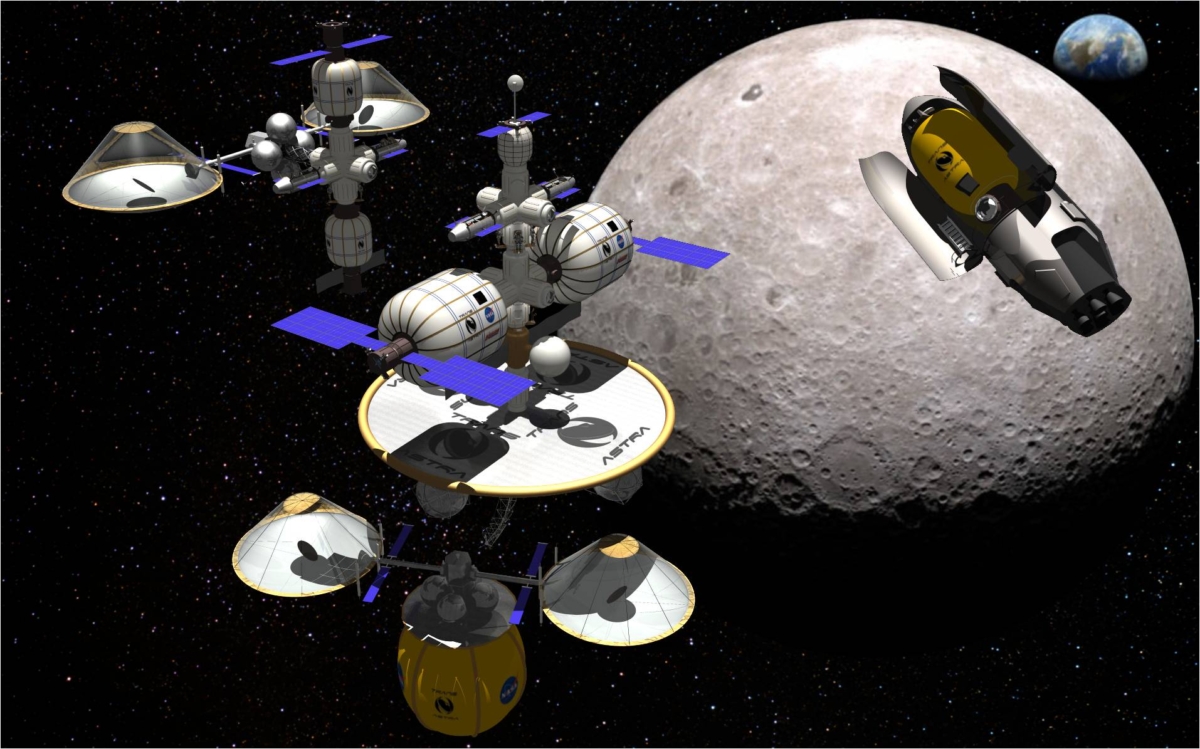
A recently completed economic analysis of space transportation supplied from near-Earth object (NEO) resources demonstrates “the potential to break the tyranny of increasing space transportation costs” created by dependence on Earth-based resources, particularly propellant.
Joel Sercel, Founder and Principal Engineer of TransAstra Corporation, authored the analysis, done under a NASA Innovative Advanced Concepts (NIAC) program Phase I economic research for space development grant.

Apis spacecraft and architecture overview.
Credit: TransAstra
Unaffordable ambitions
“The increasing challenges of space exploration, particularly by humans, rapidly become unaffordable if only Earth-based resources are available” the appraisal states. “NASA’s ambitions in the area of deep space human exploration are not projected to be affordable within a realistic budget (currently close to $20B/yr in 2017 dollars) without fundamental change,” the report notes.
Outlined in the Sercel report is use of an Asteroid-Provided In-Situ Supplies (Apis™) spacecraft to extract resources from near Earth objects (NEOs) and the creation of a space-based transportation infrastructure, including a crewed lunar outpost in an energetically advantageous lunar orbit for storage and propellant processing along with reusable spacecraft for transport purposes.

Honey Bee Robotic asteroid capture for ISRU resource return, as viewed in this artist’s conception.
Credit: TransAstra Corporation
Business case
Space resources can be utilized to support crewed lunar surface exploration, crewed NEO exploration, crewed Mars missions, and even space tourism. This analysis further suggests that with relatively modest initial government investment, a business case can be developed for a profitable industry in space resources.
Fundamental changes
The report suggests that two fundamental changes can enable an exciting program of human exploration that includes a deep space orbital outpost, a lunar surface outpost, a rich program of human exploration of Near Earth Asteroids, and multiple human missions to the Mars system which includes an orbital outpost and landed surface missions.

Propellant depot and outpost configuration.
Credit: TransAstra Corporation
These changes are:
- A large scale shift in implementation strategy focused on a Public Private Partnership to capitalize on private sector best practices for cost effective development, and
- The use of asteroid In-Situ Resource Utilization (ISRU) for all in-space transportation beyond low Earth orbit capitalizing on a propellant depot near the top of the Earth-Moon gravity well.
Resources
To view the final report — Stepping Stones: Economic Analysis of Space Transportation Supplied from NEO Resources — go to:
https://www.nasa.gov/sites/default/files/atoms/files/eso_final_report.pdf
Also, go to the TransAstra Corporation website at:
 Posted in
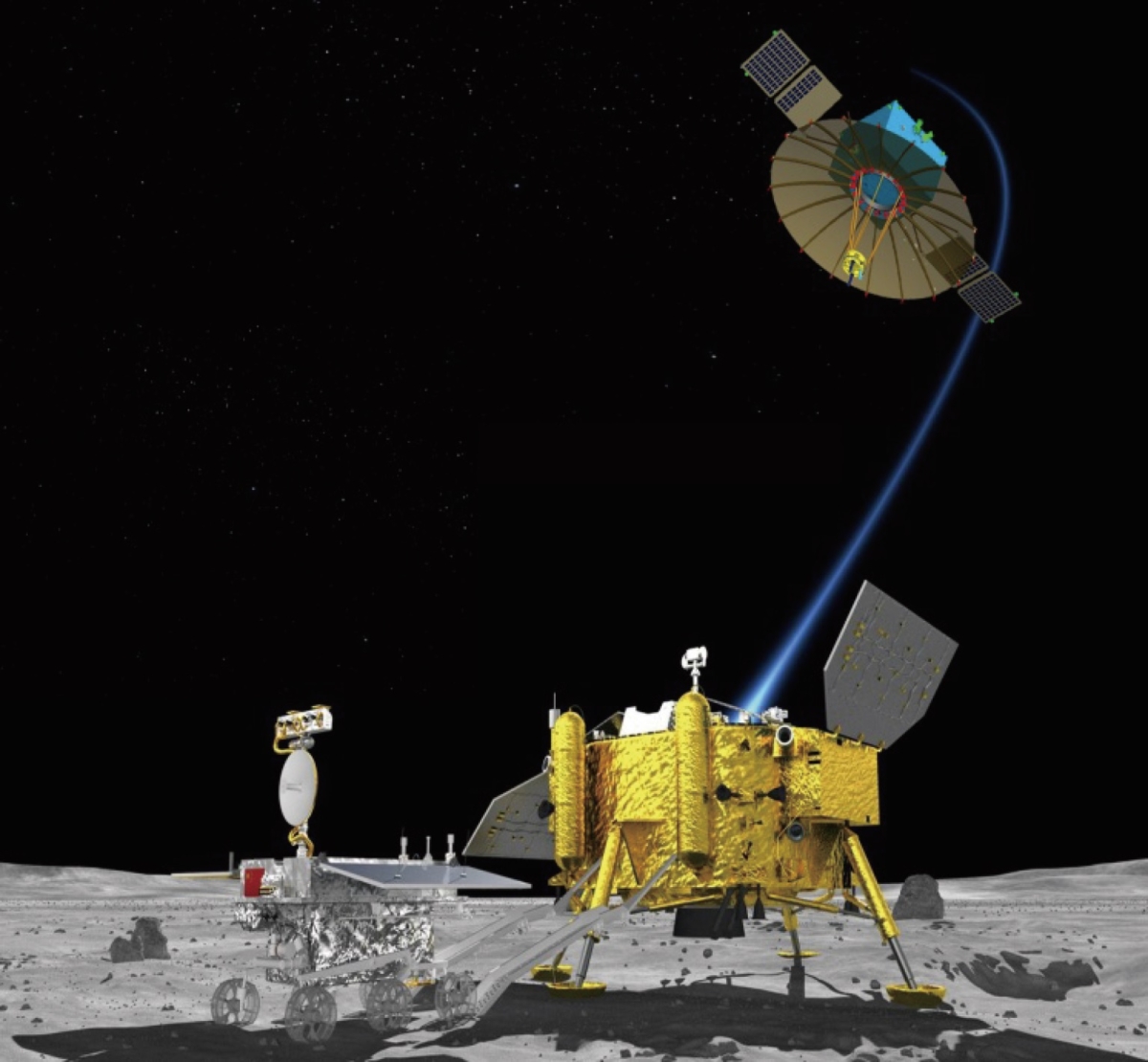
Chang’e-4 Moon lander and rover.
China is pressing forward on its Chang’e-4 lunar probe, to be launched in the latter half of next year. The spacecraft will attempt the first ever soft landing on the far side of the Moon.
As prelude to the mission, China is set to launch a relay satellite in the first half of 2018. This communications relay craft will be positioned at the Earth-Moon (E-M) Lagrangian 2 (L2) point, as reported by the State-run Xinhua news service.

Earth-Moon L2 relay link.
Credit: CNSA
Earth-Moon link
This E-M L2 locale makes possible linkage between Earth controllers and the Chang’e-4 lander and rover on the Moon’s far side.
Meanwhile, China is soliciting 20,000 messages that will be sent into space via the relay satellite. According to Xinhua, “people all over the world can follow the WeChat account “slecbj” to submit their wishes from Dec. 19, 2017, to March 6, 2018.

Opportunity Front Hazcam photo taken on Sol 4941.
Credit: NASA/JPL
NASA’s veteran Mars rover, Opportunity, is continuing her winter exploration of “Perseverance Valley” on the west rim of Endeavour Crater. Next month is will celebrate 14 years of planet prowling.
The robot landed on the Red Planet on January 25, 2004. It has snapped over 223,760 images and wheeled over 28 miles (45 kilometers).
Sols past “warranty”: 4855.
Fork in the road
The rover is positioned upstream of a fork in the flow channels. The team is collecting imagery to decide which fork, the north fork or the south fork, to explore next. To support that decision, extensive imagery is being collected on almost every sol.

Traverse map.
Credit: NASA/JPL
On Sol 4941 (Dec. 17, 2017), the robotic arm was used to collect a Microscopic Imager (MI) mosaic of a surface target within the work volume of the arm. The Alpha Particle X-ray Spectrometer (APXS) was then placed on that target.
With the upcoming holidays, the plan calls for the rover to remain in place for a period of time. This will allow multiple sols of APXS integration on this target.

Opportunity Mars rover is nearing 14 years of wheeling and dealing with Mars.
Credit: NASA/JPL
Twilight panorama
Late on Sol 4942 (Dec. 18, 2017), Opportunity collected a twilight panorama using the Panoramic Camera (Pancam) color stereo imager.
As of Sol 4942 (Dec. 18, 2017), the solar array energy production was 390 watt-hours with an atmospheric opacity (Tau) of 0.459 and a solar array dust factor of 0.622.

Curiosity Front Hazcam Left B image acquired on Sol 1910, December 20, 2017.
Credit: NASA/JPL-Caltech
Now in Sol 1911, NASA’s Curiosity Mars rover is “back on familiar ground,” reports Abigail Fraeman, a planetary geologist at NASA’s Jet Propulsion Laboratory in Pasadena, California.
The robot is near the targets “Lismore” and “Leadhills” that it imaged back on sol 1905.

Curiosity Rear Hazcam Left B photo taken on Sol 1910, December 20, 2017.
Credit: NASA/JPL-Caltech
Closer look
“We drove here to take a closer look at the transition between the blue-gray and red rocks in order to understand the geologic processes that may be responsible for this color change,” Fraeman explains. “Since we pulled up right alongside this transition, we were able to plan a monster, 180 frame Mastcam stereo mosaic that will cover the entire area with very high-resolution color information.”

Curiosity Navcam Left B image acquired on Sol 1910, December 20, 2017.
Credit: NASA/JPL-Caltech
Downlinking all of these frames from Mars to Earth may take some time, but there are opportunities to get big data downlinks from the rover during the upcoming holiday.
“I’m very much looking forward to spending the break,” Fraeman adds, “unwrapping the data bundles and seeing what’s there!”

Curiosity Navcam Left B image acquired on Sol 1910, December 20, 2017.
Credit: NASA/JPL-Caltech
Rim shots
In addition to the projected awesome mosaic, Curiosity will also carry out environmental science observations including an atmospheric tau measurement to monitor dust in the atmosphere, a Mastcam crater rim extinction observation, and a dust devil survey.
The plan calls for the robot to collect Chemistry and Camera (ChemCam), Mastcam, Alpha Particle X-Ray Spectrometer (APXS), and Mars Hand Lens Imager (MAHLI) closed cover data from targets named “Ben Loyal” and “Ben More.”

Curiosity Navcam Left B image taken on Sol 1910, December 20, 2017.
Credit: NASA/JPL-Caltech
Back to “Laphroaig”
“Because we’re coming up on a long holiday plan, we want to be extra careful that the MAHLI dust cover doesn’t unintentionally get left open during the long command uploading break, so we’re not opening it in today’s plan. After all this wraps up, we will drive back towards the target “Laphroaig” that we imaged on sol 1905 to do additional follow-up investigations of some interesting, small scale features,” Fraeman explains.

Curiosity Mastcam Left image acquired on Sol 1909, December 19, 2017.
Credit: NASA/JPL-Caltech/MSSS
Wet chemistry
A final note: terrific news from Sample Analysis at Mars (SAM) Instrument Suite investigators. Their first wet chemistry experiment on Mars ran successfully, Fraeman points out.
“Over the last few sols, the SAM team mixed some of the sample we’ve been carrying around since our investigation at Ogunquit Beach with special chemicals called “derivatization agents” that are designed to make certain molecules easier to detect,” Fraeman concludes. “I’m looking forward to hearing the results of their experiment once they complete their analyses!”

National Geographic’s online shop has lots of holiday discount specials, including my book, MARS: OUR FUTURE ON THE RED PLANET.
Also, stay tuned in 2018 for season 2 of Mars on the National Geographic channel.
For a sneak peek at all things Mars that requires further investigation and consideration, go to:
https://shop.nationalgeographic.com/product/space-collection/mars
Or try this link –
https://shop.nationalgeographic.com
and search for the book – “Mars: Our Future on the Red Planet”
As I post this, it’s selling for $21 on their site, rather than the cover price of $30. That’s about the same price as on Amazon.com – or support your local book store who might have specials too.
Thanks for your inquires and interest!
~ Leonard David

Curiosity Mastcam Left photo acquired on Sol 1907, December 17, 2017.
Credit: NASA/JPL-Caltech/MSSS
Now in Sol 1909 operations, the NASA Curiosity Mars rover continues its survey of the Vera Rubin Ridge.
Reports Lauren Edgar, a planetary geologist at the USGS in Flagstaff, Arizona, there’s been an important decision about where to drive the robot and how that will set up researchers for exciting science over the holidays.
“After much discussion, the team decided to return to some familiar yet intriguing rocks that we explored last week,” Edgar notes. “These rocks show a lot of color variations and alteration features, and we’re curious how they fit in the overall stratigraphy at Vera Rubin Ridge.”
Wet chemistry
The other main event in Curiosity planning is a Sample Analysis at Mars (SAM) wet chemistry experiment on the previously collected Ogunquit Beach sample.
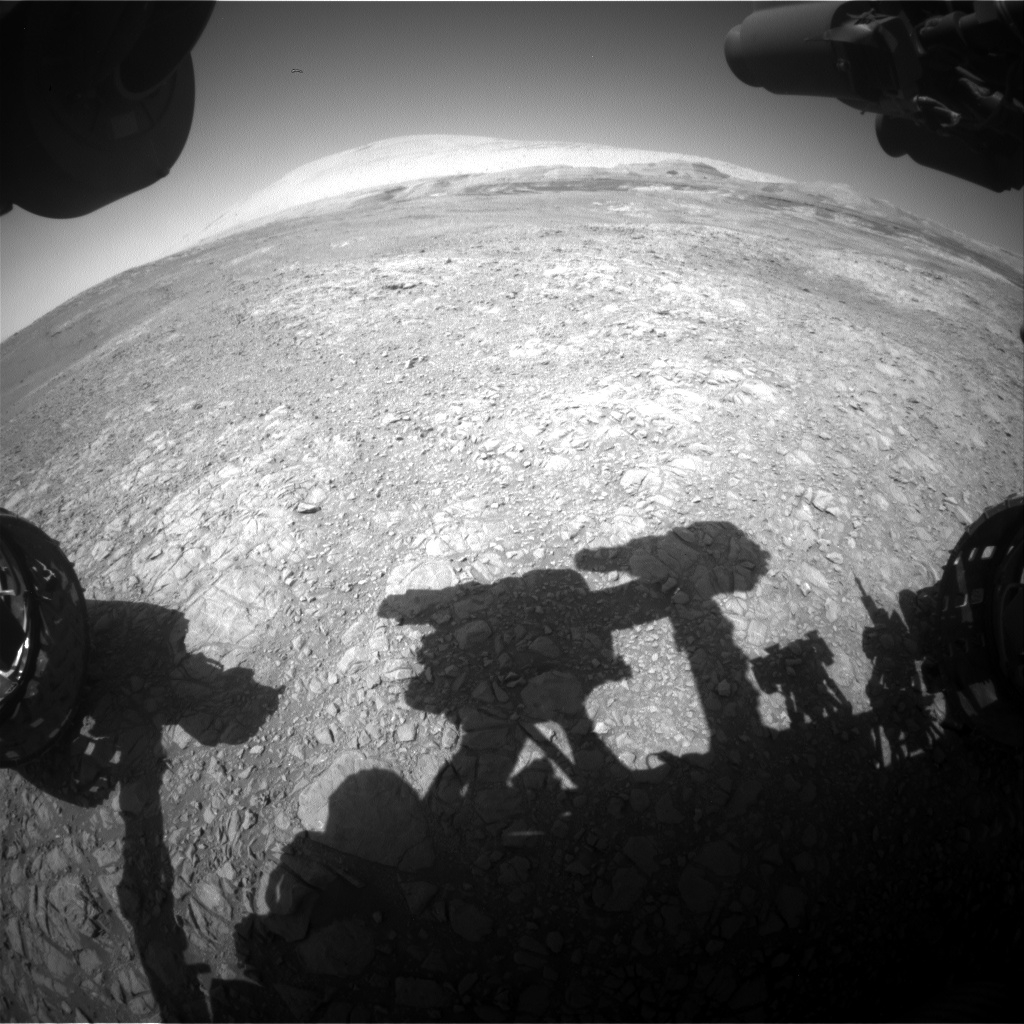
Curiosity Front Hazcam Right B photo taken on Sol 1908, December 18, 2017.
Credit: NASA/JPL-Caltech
“This is a very power hungry activity, so we had to keep our other remote sensing activities in check. The team planned two Mastcam mosaics to document the context of the site we’re driving back to, and to investigate similar color variations in an outcrop to the southeast,” Edgar explains.
Terrain documentation
After a busy night of SAM activities, Curiosity will spend the second sol driving back toward an area named “Lismore.”

Curiosity Navcam Left B image acquired on Sol 1907, December 17, 2017.
Credit: NASA/JPL-Caltech
During the drive, the rover a number of Mars Descent Imager (MARDI) images to document the terrain beneath the rover, and typical post-drive Navcam and Mastcam mosaics will be taken to prepare for targeting on Wednesday.
In the afternoon, Curiosity will acquire two Navcam movies to monitor the atmosphere and search for clouds.
“I’m looking forward to seeing some familiar rocks,” Edgar concludes, “and preparing for the long holiday plan!”

Courtesy: To The Stars Academy of Arts & Science
In the high-degree of strangeness department, the New York Times, Politico and the Washington Post have posted stories on a secret UFO program run by the Department of Defense, who worked with Bigelow Aerospace.
Go to:
The Pentagon’s Secret Search for UFOs
Funded at the request of Harry Reid, the program probed a number of encounters military pilots had with aircraft they believed didn’t operate like anything they had seen before.
https://www.politico.com/magazine/story/2017/12/16/pentagon-ufo-search-harry-reid-216111
Go to:
Glowing Auras and ‘Black Money’: The Pentagon’s Mysterious U.F.O. Program

Courtesy: To The Stars Academy of Arts & Science
Go to Washington Post story:
Head of Pentagon’s secret ‘UFO’ office sought to make evidence public
Also, go to:
To The Stars Academy of Arts & Science website that discusses GIMBAL, the first of three US military videos of unidentified aerial phenomenon (UAP) that has been through the official declassification review process of the United States government and has been approved for public release.

Video credit: NASA
Note: Not all browsers support viewing 360 videos. YouTube supports their playback on computers using Chrome, Firefox, Internet Explorer, and Opera browsers. Use the YouTube app to view it on a smart phone. For this impressive 360 video, go to:

Curosity Mastcam Right image taken on Sol 1903, December 13, 2017.
Credit: NASA/JPL-Caltech/MSSS
Now in Sol 1906, NASA’s Curiosity Mars rover is prowling around Vera Rubin Ridge, soaking in the vista in various directions.

Credit: NASA/JPL-Caltech/Univ. of Arizona
A new Curiosity’s traverse map through Sol 1905 has been issued by NASA’s Jet Propulsion Laboratory.
The map shows the route driven by NASA’s Mars rover Curiosity through the 1905 Martian day, or sol, of the rover’s mission on Mars as of December 15, 2017.
Numbering of the dots along the line indicate the sol number of each drive. North is up.
The scale bar is 1 kilometer (~0.62 mile).
From Sol 1903 to Sol 1905, Curiosity had driven a straight line distance of about 45.38 feet (13.83 meters), bringing the rover’s total odometry for the mission to 11.13 miles (17.90 kilometers).
Curiosity landed on Mars in August of 2012.
The base image from the map is from the High Resolution Imaging Science Experiment Camera (HiRISE) in NASA’s Mars Reconnaissance Orbiter.
Meanwhile, here’s a sampling of new imagery from the robot on Mars:

Curosity Mastcam Right image acquired on Sol 1903, December 13, 2017.
Credit: NASA/JPL-Caltech/MSSS

Curiosity Navcam Left B photo acquired on Sol 1905, December 15, 2017.
Credit: NASA/JPL-Caltech

Curiosity Navcam Left B photo acquired on Sol 1905, December 15, 2017.
Credit: NASA/JPL-Caltech

Curiosity Rear Hazcam Right B image taken on Sol 1905, December 15, 2017.
Credit: NASA/JPL-Caltech

Credit: National Academies
A new report, Recapturing a Future for Space Exploration: Life and Physical Sciences Research for a New Era, highlights the critical need for space life and physical sciences research both for enabling and expanding the exploration capabilities of NASA as well as for contributing unique science in many fields that can be enabled by microgravity.
The report assesses the progress made by NASA so far, and also lays out exploration-related science areas of highest importance that should be addressed in the remaining half of the decade.
ISS: undefined future
While the international partners have all committed to funding their International Space Station (ISS) partnerships through 2024, the strategy for ISS in the post-2024 timeframe is undefined.
The report recommends that NASA should develop this strategy for the ISS or other orbital platforms for research as soon as possible in order to provide a basis for planning and prioritization.
To view this new midterm assessment report by the National Academies (Free Download), go to:

