Author Archive
 Author:
  January 2nd, 2018
Credit: United Nations
There are a number of challenges related to registration of space objects and transparency of global space activities – and the United Nations’ Register of Space Objects is in need of an overhaul suggests an international team of researchers.
The paper – “Critical issues related to registration of space objects and transparency of space activities” – appears in the journal Acta Astronautica sponsored by the International Academy of Astronautics.
Since 1962, the United Nations has maintained a Register of Objects Launched into Outer Space. Following multi-year discussion among States, the Convention on Registration of Objects Launched into Outer Space entered into force in 1976.
In setting up the UN’s Register of Space Objects, the belief was that a mandatory registration system would assist in the identification of space objects hurled into outer space. “However, the furnished information is often so general that it may not be as helpful in creating transparency” as had been hoped, the paper explains.
Non-compliance
The paper provides data about the registration and non-registration of satellites and the States that have and have not complied with their legal obligations.
Furthermore, the paper focuses on the specific requirements of the Convention, the reasons for non-registration, new challenges posed by the registration of small satellites and the on-orbit transfer of satellites. Finally, the paper provides some recommendations on how to enhance the registration of space objects, on the monitoring of the implementation of the Registration Convention and consequently how to achieve maximum transparency in space activities
Open sources of information
One interesting idea advanced is the prospect of using some civilian meteorological satellites with infrared sensors to detect launches of missiles and satellites.
“It is worth examining the types of sensors on board civil meteorological satellites and see whether they can be used for the early warning and detection of launches of spacecraft and missile applications,” the paper suggests.
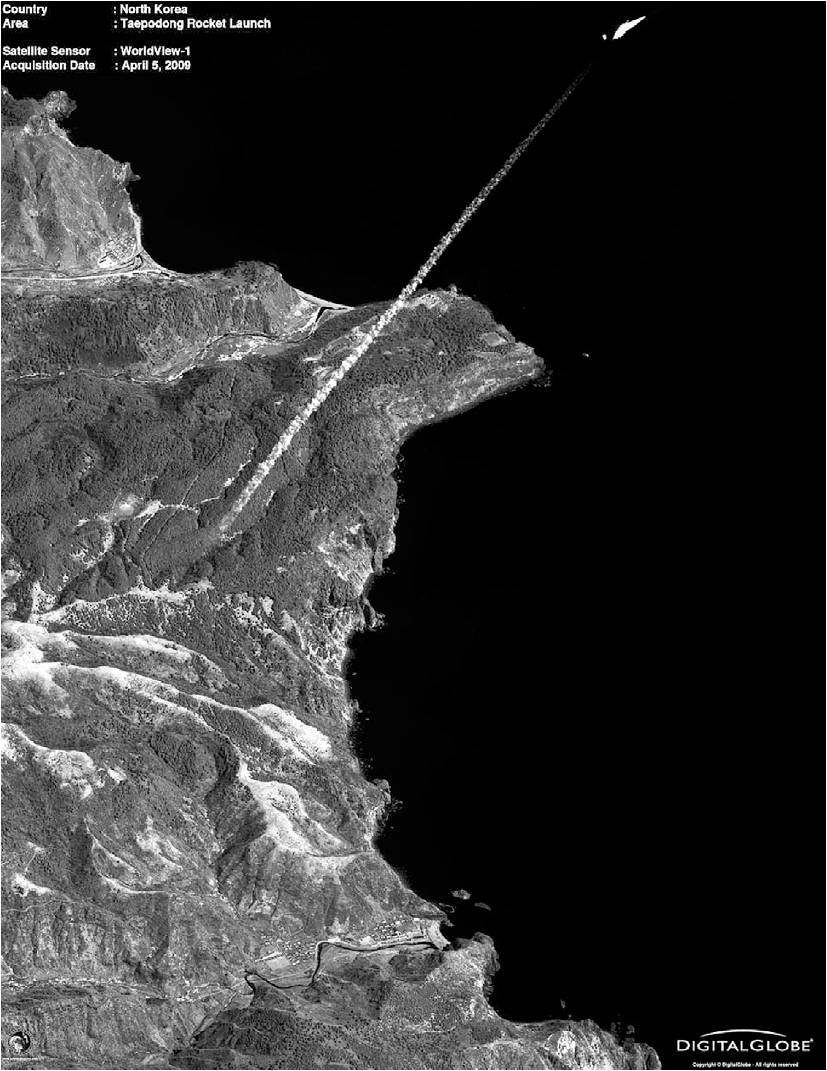
North Korean missile launch observed.
Credit: Digital Globe
Codes of conduct
It is proposed that Multi-lateral Technical Means (MTM) of verification should now be recognized as a viable and measure to detect and oversee space-related activities. It has also been proposed that an International Data Center (IDC) is established in support of the MTM.
“With the level of technical capabilities of most space faring nations, an MTM is now possible. Thus, MTM and IDC should be recognized not only in all the existing space-related treaties, conventions and Codes of Conduct but also in any other future measures for enhancing global space governance,” the researchers conclude.
The informative paper is authored by Ram Jakhu of McGill University’s Institute of Air & Space Law in Canada, Bhupendra Jasani from King’s College in London, and Jonathan McDowell from the Harvard-Smithsonian Center for Astrophysics.
It can be accessed here at:
http://planet4589.org/space/papers/JJM2018/JJM_published.pdf
 Posted in

Artist’s view of the James Webb Space Telescope (JWST) in space, up and operating tackling a full agenda of space science conquests.
Credit: Northrop Grumman
NASA’s James Webb Space Telescope (JWST) is the most expensive and complex telescope ever built in the history of humankind.
Now estimated to cost nearly $9 billion and delayed for sendoff until sometime in 2019, this promising engine of discovery will be 100 times more powerful in its Cosmos-peering skills than the iconic Hubble Space Telescope.

JWST’s combined science instruments and optical element recently completed 100 days of thermal vacuum testing inside NASA Johnson Space Center’s Chamber A. Engineers are seen by the hardware shortly after it emerged from the huge test facility on December 1, 2017.
Credit: NASA/Chris Gunn
But putting JWST in place is fraught with peril, including its launch and far-from-Earth deployment.
Take a look at my new Scientific American story for details about the JWST:
Is the James Webb Space Telescope “Too Big to Fail?”
Backers of NASA’s next great observatory contemplate its worst-case scenarios
By Leonard David on December 29, 2017
https://www.scientificamerican.com/article/is-the-james-webb-space-telescope-too-big-to-fail/
For a video look at JWST, go to Northrop Grumman overview published on Jan 24, 2017 at:

Held on December 1-2, the Reagan National Defense Forum included a panel discussion titled: Space Wars – Are we Prepared for the Next Domain of Warfare? Discussion was geared to evaluate whether the U.S. has the strategy, capacity, and know-how to prevail in space.
This gathering was held at the Ronald Reagan Presidential Library in Simi Valley, California.
Panelists:
- Hon. Kari Bingen, Acting Under Secretary of Defense (Intelligence)
- Ms. Leanne Caret, President and CEO of Defense, Space, & Security, The Boeing Company
- Gen. John Hyten, Commander, U.S. Strategic Command
- Congressman Mike Rogers, U.S. House of Representatives, Alabama
- Hon. Heather Wilson, Secretary of the Air Force
Moderator: David Martin, CBS News
To view this highly informative discussion, go to:
https://www.youtube.com/watch?v=wUIHctFgTac
also:
https://www.defense.gov/Videos/videoid/569946/#DVIDSVideoPlayer1133

I am very excited to learn that my book – Mars: Our Future on the Red Planet – will be available in Chinese and published there in July of 2018.
The volume has already been translated into Portuguese, Greek, German, Japanese, Italian and Dutch.
International outreach
Here are some links for our international readers to my book Mars: Our Future on the Red Planet in these languages:
TV series
As the companion book to the televised season 2 of Mars on the National Geographic Channel, take a look at the upcoming six-episode season of the National Geographic global sci-fi hybrid scripted/unscripted series slated to premiere in the spring of 2018 here:
http://ew.com/tv/2017/11/07/mars-season-2-exclusive-clip
There are special holiday prices for the book via National Geographic by going to:
https://shop.nationalgeographic.com/product/space-collection/mars

Hyped up about hypersonics? New study offers worrisome findings.
Credit: RAND
The development of commercial suborbital space vehicles could lead eventually to businesses such as commercial hypersonic point-to-point air travel and low-cost launches to low Earth orbit.
But could this prospect be stymied by military applications of this technology?
RAND researchers offer an overview of their key findings on hypersonic missiles — a new class of military threat capable of maneuvering and flying faster than 5,000 kilometers per hour.
This new report describes how speed and maneuverability enable such missiles to penetrate most missile defenses, and further compress the timelines for a response by a nation under attack.
Trigger-happy technology?
The study suggests the proliferation of hypersonic missiles is an emerging threat. For one, these high-speed weapons can compress the response time for a nation under attack. In some cases, decisions would need to be made in six minutes and give nations an incentive to become trigger-happy. World powers can take steps to prevent proliferation, but the window to act is tight, the RAND report adds.
This research, sponsored by the Carnegie Corporation of New York for its project Disruptive Technologies and the Future of Deterrence, suggests that there is probably less than a decade available to substantially hinder the potential proliferation of hypersonic missiles and associated technologies.
Resources
To read the RAND report — Hypersonic Missile Nonproliferation: Hindering the Spread of a New Class of Weapons, go to:
Also go to this informative video:
https://www.rand.org/multimedia/video/2017/09/27/hypersonic-missile-nonproliferation.html

Reality check: Point-to-pointless travel? Credit: Adobe Stock via CSIS
There is increasing interest in hurling people and cargo around the Earth, arriving at any location on the planet within 30 to 45 minutes.
For one, that’s just enough time to open that impenetrable package of peanuts typically dispensed on airliners today.
Grand dreams
Recently, SpaceX’s Elon Musk served up a good helping of his vision for suborbital transportation.

Credit: SpaceX
But Musk’s vision isn’t the first to fly, points out Kaitlyn Johnson, a research associate with the Aerospace Security Project at the Center for Strategic and International Studies (CSIS) in Washington, D.C. “Many are skeptical of its fruition, having heard these grand dreams before,” she explains.

X-30: This joint effort by NASA, the Department of Defense, and five major contractors explored development of technologies for a new generation of aerospace vehicles for hypersonic cruise in the atmosphere or single-stage-to-orbit using air breathing primary propulsion and horizontal takeoff and landing. A full-scale aircraft was never built as Congress ended funding in 1994, cancelling the program to build a vehicle to fly at Mach 25.
Credit: Rockwell/NASA
However, with the advent of suborbital transportation technologies, Johnson adds, “the U.S. Government should further work with industry to begin developing the regulations and standards necessary for such activities.”
Resources
Check out Johnson’s review of the promise of rapid transportation around the planet — Around the World in 60 Minutes (Or Less!) – by clicking on:
https://aerospace.csis.org/around-world-60-minutes-less/
Also, check out this video at:
https://aerospace.csis.org/wp-content/uploads/2017/12/SpaceX_final03.gif

Space rock slips by Earth.
Courtesy: Texas A&M
Several new initiatives are underway to better catalog asteroids and their potential to strike the Earth.
Headquartered in California’s Silicon Valley, the B612 organization is dedicated to protecting Earth from asteroid impacts.
Earlier this year, the organization created the Asteroid Institute with team members busy at work on hardware, new technologies, and applications intended to help accelerate knowledge and understanding of asteroids.
Cloud platform
One of those efforts is building on the Asteroid Decision Analysis Machine (ADAM) Cloud Platform. “The ADAM project will provide a cloud-based infrastructure for large-scale orbital dynamics and related computations that will enable the science, policy, and business community to better understand and make sense of opportunities and threats coming from the asteroids in the solar system,” explains Danica Remy, President of the B612 Foundation.
ADAM is a project of the Asteroid Institute, and in layman’s terms, the ADAM project is building the application and interface layer to access and make sense of the data comprising the asteroid map. A map is more than just a collection of data. For it to be truly useful, the data must be presented in a way that allows us to see the relationship amongst the elements and to calculate quantities of interest — for instance, a map of the probability distribution that a certain asteroid will impact the Earth on a particular date.
The ADAM project will allow researchers worldwide to build applications that make use of the data in the asteroid map.

Credit: ESA – P.Carril
Data pipeline
The Asteroid Institute’s Executive Director is former astronaut, Ed Lu and co-Founder, B612.
“Recently recruited Asteroid Institute researchers will be based at the Data Intensive Research in Astrophysics and Cosmology Center (DIRAC) and the Department of Astronomy at the University of Washington, “ Lu adds.
“Our work includes collaboration with the Large Synoptic Survey Telescope (LSST) working on the asteroid data pipeline, the Asteroid Decision Analysis Machine (ADAM), further development of synthetic tracking to improve our ability to discover small asteroids, and analysis of a future satellite constellation for detecting and tracking asteroids,” Lu says.
Satellite constellation under study
The B612 Asteroid Institute is also investigating the use of a constellation of small — under-100-kilogram — satellites in solar orbit to provide a catalog of the majority of smaller asteroids.
“The threat from even 30-meter objects is important enough to influence the development of future surveys. The nearly 100x increase in the number of objects compared to 140-meter size and larger requires new survey techniques to achieve a high level of completeness, “explains Harold Reitsema, Asteroid Institute Mission Director and leading the effort to develop methods to improve the rate of discovery of near-Earth asteroids.

Credit: B612
Proof-of-concept
In a recent report on this concept, Reitsema says that the satellites will perform on-board computation to identify and measure the motions of all near Earth Objects (NEOs) in an image, allowing them to communicate their findings to Earth using existing low-cost telecom equipment.
“We are currently working on the design of a proof-of-concept satellite that will fly in low Earth orbit to demonstrate the on-board ability while also sending all data to the ground for building confidence in the performance of the automated system,” Reitsema adds.
To review the B612 Foundation’s recently released progress report for 2017, go to:
https://b612foundation.org/b612s-2017-annual-progress-report-2/

Credit: The Aerospace Corporation
The Aerospace Corporation’s Center for Orbital and Reentry Debris Studies (CORDS) is sponsoring a “live on green event” guessing game. Entrants can compete for Aerospace swag with the closest estimate to the actual reentry date and time of China’s Tiangong-1 space lab.
Launched in late September of 2011, Tiangong-1’s uncontrolled reentry is currently predicted to be around mid-March of 2018 – plus or minus two weeks. This forecast was performed by The Aerospace Corporation on December 19, 2017.

Artist’s concept of the Tiangong-1 in Earth orbit.
Credit: CMSA
Crewed lab
Tiangong-1 is the first space station built and launched by China. It was designed to be a crewed lab as well as an experiment/demonstration for the larger, multiple-module space station.
The first Chinese orbital docking occurred between Tiangong-1 and an unpiloted Shenzhou spacecraft on November 2, 2011. Two piloted missions were completed to visit Tiangong-1: Shenzhou 9 in June 2012 and Shenzhou 10 in June 2013.

Docking of China’s Shenzhou 10 spacecraft with the Tiangong-1 space station June 13, 2013.
Credit: CCTV
Modules
There are two modules that compose Tiangong-1: A habitable experimental module and a resources module. It has a habitable volume of 15 cubic meters and is equipped with sleep stations for astronauts.
The space lab’s mass at launch was over 9 tons (18,740 pounds; 8,500 kilograms).
Tiangong-1’s length is 34 feet (10.5 meters) and sports a diameter of 11 feet (3.4 meters) It is outfitted with two solar panels that are roughly 7 meters by 3 meters.

Credit: CORDS
Where on Earth?
On March 21, 2016, an official Chinese statement declared that telemetry services with Tiangong-1 had ceased.
Based on The Aerospace Corporation’s analysis of Two-Line Element set data from the U.S. military’s Joint Space Operations Center (JSpOC), the last orbital adjustment for Tiangong-1 was made in December 2015.
As to where on Earth Tiangong-1’s will reenter, that’s an unknown. But given the spacecraft’s inclination, this object will reenter somewhere between 43° North and 43° South latitudes.
Experts at the European Space Agency (ESA) will host an international campaign to monitor the reentry of the Tiangong-1, conducted by the Inter Agency Space Debris Coordination Committee (IADC).
Owing to the Chinese station’s mass and construction materials, there is a distinct possibility that some portions of Tiangong-1 will survive and reach the surface, according to an ESA statement.

Credit: CORDS
Leftovers
Given its size, and possible fragments reaching the Earth, are there hazardous materials on board?
According to The Aerospace Corporation’s CORDS: “Potentially, there may be a highly toxic and corrosive substance called hydrazine on board the spacecraft that could survive reentry. For your safety, do not touch any debris you may find on the ground nor inhale vapors it may emit.”
Working group
In a December 8 communiqué from the Permanent Mission of China to the United Nations (Vienna), China has made note of the upcoming re-entry into the atmosphere of Tiangong-1.
“China attaches great importance to the re-entry of Tiangong-1. For this purpose, China has set up a special working group, made relevant emergency preparedness plans and been working closely with its follow-up tracking, monitoring, forecasting and relevant analyzing,” the communiqué explains.
Until November 26, Tiangong-1 had been orbiting at an average altitude of 184 miles (296.0 kilometers), circling Earth at an inclination of 42.65 degrees, explains the update.
Structural integrity
“Currently, it has maintained its structural integrity with stabilized attitude control,” the communiqué adds. “According to the latest forecast, its re-entry is expected between the first 10 days of February and the last 10 days of March 2018.”
Tiangong-1 uses methylhydrazine and dinitrogen tetroxide as its engine fuel.
“Based on analysis, the remaining small amount of fuel will be burned and destroyed along with its structural components during the course of re-entry and will therefore not cause any damage on the ground,” adds the communiqué. “China will continue to closely track and monitor the operation of Tiangong-1 and will regularly publish relevant information through the website of the China Manned Space Engineering Programme (www.cmse.gov.cn) as well as other relevant Media,” concludes the notification.

Credit: CORDS
Win booty
To take part in the CORDS “high stakes” guessing game, please note that you must be over the age of 13, and by submitting an entry you are signing up to receive other news and information from The Aerospace Corporation in El Segundo, California.
Enter your information for a chance to win some Aerospace booty with the closest guess to the actual reentry date and time of China’s Tiangong-1.
Submit your guess by going to:
http://www.aerospace.org/cords/live-on-green/
Background info
For more information on Tiangong-1’s reentry, please go to:
China’s Tiangong-1 Space Lab: Preparations for Uncontrolled Re-entry
https://www.leonarddavid.com/chinas-tiangong-1-space-lab-preparations-for-uncontrolled-re-entry/
International Campaign to Monitor Fall of China Space Lab
https://www.leonarddavid.com/international-campaign-to-monitor-fall-of-chinas-space-lab/
China’s Fall Guy – the “Heavenly Palace” Reentry
https://www.leonarddavid.com/chinas-fall-guy-the-heavenly-palace-reentry/
And for an older story of mine, back in June 2016, China’s Heavenly Palace – Headed for a Hellish Demise?, go to:
https://www.leonarddavid.com/chinas-heavenly-palace-headed-for-a-hellish-demise/

Credit: Space Legaltech
Space Legaltech is a free and impressive legal research platform dedicated to space law.
This innovation, created by the Space Institute for Researches on Innovative Uses of Satellites (SIRIUS Chair) provides access to all spatial laws and regulations around the world through an interactive map: laws, decrees, ordinances, authorization, launch, registration, control of space objects and security, etc.
Working tool
With nearly 100 countries represented, 250 legal texts referenced and 7 major spatial agencies analyzed, Space Legaltech is a working tool for the legal community wishing to follow more closely the evolutions and trends of space activity in the world.
Space Legaltech publishes different infographics to explain the national space law legislation in a visual and easy way. You can watch and download infographics of UK, France, US, Chinese, Canadian, Brazilian and Russian national space regulation.

Credit: Space Legaltech
Legal framework
The website is geared to several themes, such as:
- Learn more about how states deal with space activities
- Understand the hierarchy of the legal framework
- Discover states’ space agencies
- Find out how regulation is applied by national space agency
- Grasp the legislation’s reach
- Follow the evolution of space legislation
To tap into this informative space law tool, go to:

Curiosity Front Hazcam Right B image taken on Sol 1914, December 24, 2017.
Credit: NASA/JPL-Caltech

Curiosity Navcam Left B image taken on Sol 1912, December 22, 2017.
Credit: NASA/JPL-Caltech
NASA’s Curiosity Mars rover is now in Sol 1915, continuing its study of the Vera Rubin Ridge.
Some recent imagery from the robot shows the landscape being studied:

Curiosity Rear Hazcam Right B photo acquired on Sol 1914, December 24, 2017.
Credit: NASA/JPL-Caltech

Curiosity Mastcam Left mage taken on Sol 1912, December 22, 2017.
Credit: NASA/JPL-Caltech/MSSS