Author Archive
 Author:
  February 6th, 2018

Two side boosters make land in Florida!
Credit: SpaceX/screen grab.
February 6, 2018: For this test flight, Falcon Heavy’s two side cores are both flight-proven. One launched the Thaicom 8 satellite in May 2016 and the other supported the CRS-9 mission in July 2016.
SpaceX attempted to land all three of Falcon Heavy’s first stage cores during this test. Following booster separation, Falcon Heavy’s two side cores reached land at SpaceX’s Landing Zones 1 and 2 (LZ-1 and LZ-2) at Cape Canaveral Air Force Station, Florida.
Falcon Heavy’s center core was set to land on the “Of Course I Still Love You” droneship, which will be stationed in the Atlantic Ocean.
Following launch, Falcon Heavy’s second stage was on track to hurl the Tesla Roadster payload into a precessing Earth-Mars elliptical orbit around the sun.
Also onboard a tribute to Issac Asimov and a plaque carrying 6,000 SpaceX employee signatures.
“This is a revolution”
Explains Robert Zubrin, President of the Mars Society:
Explore Mars, Inc. congratulates SpaceX on the successful inaugural launch of its Falcon Heavy launch vehicle earlier today. After years of development, the debut of the Falcon Heavy provides the United States with a new, heavy lift capacity that could help to open the solar system to exploration and development.“This is a tremendous accomplishment by the SpaceX team and a great day for space exploration,” commented Explore Mars CEO Chris Carberry. “With this launch and other heavy lift vehicles slated to be launched in the upcoming years, we are truly on the verge the golden age of space exploration.”

Tesla Car – outward bound!
Credit: SpaceX/Screen grab.

Don’t panic! Tesla Roadster en route and outbound.
Credit: SpaceX/Screen grab.
 Posted in

Curiosity Front Hazcam Left B image taken on Sol 1956, February 5, 2018.
Credit: NASA/JPL-Caltech
NASA’s Curiosity Mars rover is now performing Sol 1957 operations.
During Sols 1957-1958, the robot is to make its way toward a gray patch on Mars, reports Rachel Kronyak, a planetary geologist at the University of Tennessee in Knoxville.
“Over the past several months we’ve made excellent progress up and along the Vera Rubin Ridge (VRR), taking stunning mosaics and using our instrument payload to examine the local geology,” Kronyak notes.
Plans for sols 1957-1958 call for continuing rover VRR investigations and carry out a drive further along to a next area of interest.

Curiosity Rear Hazcam Right B photo acquired on Sol 1956, February 5, 2018.
Credit: NASA/JPL-Caltech
SAM troubles
Kronyak reports that, unfortunately, the Sample Analysis at Mars (SAM) Instrument Suite experienced a minor fault over the weekend, “so we’ll be delaying those activities – a preconditioning test for an upcoming geochronology experiment – to Wednesday’s (Sol 1959) plan.”
Sol 1957 is to begin with two Chemistry and Camera (ChemCam) Laser-Induced Breakdown Spectrometer (LIBS) observations on the targets “South Harris” and “Drummock.”
“We got our first taste of Drummock over the weekend with ChemCam and decided to analyze it again to better understand geochemical variations within the rocks around the rover,” Kronyak adds. “We’ll take Mastcam images to document these ChemCam targets”.

“Bloodstone Hill” area as observed by Curiosity’s ChemCam Remote Micro-Imager Sol 1955 February 4, 2018.
Credit: NASA/JPL-Caltech/LANL
Further investigation
Also on tap is taking a Mastcam mosaic of “Bloodstone Hill,” another target from the weekend plan that warranted further investigation.
Another Mastcam observation in the plan is called a sky column, Kronyak points out, “which we use to periodically monitor material around the Mastcam sunshade.” +
Lastly for this sol, the robot will make a couple of Navcam movies to search for dust devils and cloud activity.
New drive
In the afternoon of Sol 1957, Curiosity is scheduled to drive nearly 200 feet (60 meters) to wheel itself in front of an area identified from orbit to contain an interesting gray patch of bedrock. Following that drive, the rover will take standard post-drive images to set Mars researchers up for remote and contact science on Wednesday.

Curiosity Navcam Right B image taken on Sol 1955, February 4, 2018.
Credit: NASA/JPL-Caltech
On the second sol, Sol 1958, science activities are primarily dedicated to environmental observations.
“First, we’ll use ChemCam to conduct a Passive Sky observation. Next, we’ll use Mastcam to take a series of images that help us measure both the amount of dust and the optical depth of the atmosphere,” Kronyak adds.

Mars Hand Lens Imager (MAHLI) product from Sol 1955, February 4, 2018. MAHLI is located on the turret at the end of the rover’s robotic arm.
Credit: NASA/JPL-Caltech/MSSS
Lastly, the robot is to perform standard Rover Environmental Monitoring Station (REMS) and Dynamic Albedo of Neutrons (DAN) activities in the plan.

Elon Musk’s ground control to Major Tom. SpaceX Falcon Heavy is to hurl Tesla Roadster while playing David Bowie’s Space Oddity.
Credit: RCA Records
The countdown clock for the maiden flight of the SpaceX Falcon Heavy booster is near at hand, slated to reach zero on February 6.
This mega-booster comes factory equipped with a Tesla Roadster as payload/ballast, meant to be hurled outward into space.

Tesla roadster to the Red Planet.
Credit: Tesla
Want to know more? Check out my new Space.com story:
Is the Tesla Roadster Flying on the Falcon Heavy’s Maiden Flight Just Space Junk?
February 5, 2018 06:45pm ET
Go to:
https://www.space.com/39602-falcon-heavy-tesla-not-just-space-junk.html

Credit: The Center for Space Policy and Strategy
First the good news: Significant asteroid impacts are, fortunately, few and far between.
However, a major asteroid strike could cause widespread devastation and profoundly affect life on Earth.
At this moment in time, a small group of nations have the expertise and resources needed to protect their territory and the entire planet.
Technical and political risks
But what are the technical and political risks of trying to divert or destroy an asteroid on a collision course with Earth? What are the obligations and strategic interests that would drive a decision to take action?
These questions and other issues are addressed in a new policy paper — Planetary Defense Against Asteroid Strikes: Risks, Options, and Costs – issued last month by The Center for Space Policy and Strategy, a specialized research branch within The Aerospace Corporation.
What are the options, risks, and costs involved in trying to divert or destroy an asteroid on a collision course with Earth?
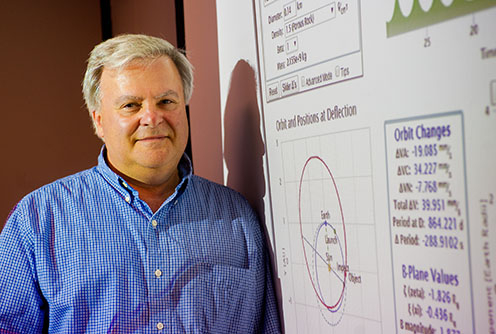
Nahum Melamed, The Aerospace Corporation, a researcher focused on potentially hazardous object threats.
Credit: The Aerospace Corporation/Elisa Haber
Wanted: advanced planning
A coordinated international response might be more economical, but may require the country to share technology with potential adversaries in space. An independent body could coordinate a global response while safeguarding sensitive technology—but such a body does not currently exist.

Credit: The Center for Space Policy and Strategy
In any case, the authors suggest, advanced planning will be critical to mitigating future asteroid threats. The low probability of a major impact should not diminish a sense of urgency. The best time to start preparing is now—well before any actual threat is detected.
Global response
The paper is authored by Nahum Melamed, The Aerospace Corporation and Avishai Melamed, Univ. of California San Diego. It examines the issue of planetary defense, largely from a U.S. perspective and draws upon a recent exercise by the 2017 Planetary Defense Conference that modeled global response to a hypothetical asteroid threat.
To read this important January 2018 paper, go to:
http://aerospace.wpengine.netdna-cdn.com/wp-content/uploads/2018/01/NEO_Defense.pdf

Curiosity Front Hazcam Left B image acquired on Sol 1953, February 2, 2018.
Credit: NASA/JPL-Caltech
Now wheeling and dealing with Mars on Sol 1954, NASA’s Curiosity rover operations feel like Groundhog Day, reports Abigail Fraeman, a planetary geologist at NASA/JPL in Pasadena, California.
“Every February 2nd the people of the United States and Canada observe a quirky holiday called Groundhog Day. In the US, the country turns its eyes to Punxsutawney, Pennsylvania to find out whether Punxsutawney Phil, a groundhog, will see his shadow and predict six more weeks of winter,” Fraeman explains.
“The holiday provides the namesake for a 1993 film in which reporter Phil Conners, brilliantly portrayed by Bill Murray, finds himself in a time loop while covering the events in Punxsutawney,” Fraeman adds.

Curiosity Navcam Left B photo taken on Sol 1950, January 30, 2018.
Credit: NASA/JPL-Caltech
Same location
Planning Curiosity’s activities on February 2nd, aka sol 1954 – 1956, “felt a little bit like Groundhog Day on Mars,” Fraeman notes. “Unfortunately the uplink to the rover for the sol 1952 – 1953 failed, so we unexpectedly found ourselves in the same location as Wednesday.”

Curiosity Mastcam Left Sol 1950 January 30, 2018
Credit: NASA/JPL-Caltech/MSSS
The Sol 1953 part of the plan was later uplinked to the rover.
“Never wanting to lose missed opportunities, we made a plan today that will recapture the missing Sol 1952 observations we were hoping to get in Wednesday’s plan, and also adds a few new things into the mix given additional time that is available to us,” Fraeman reports.
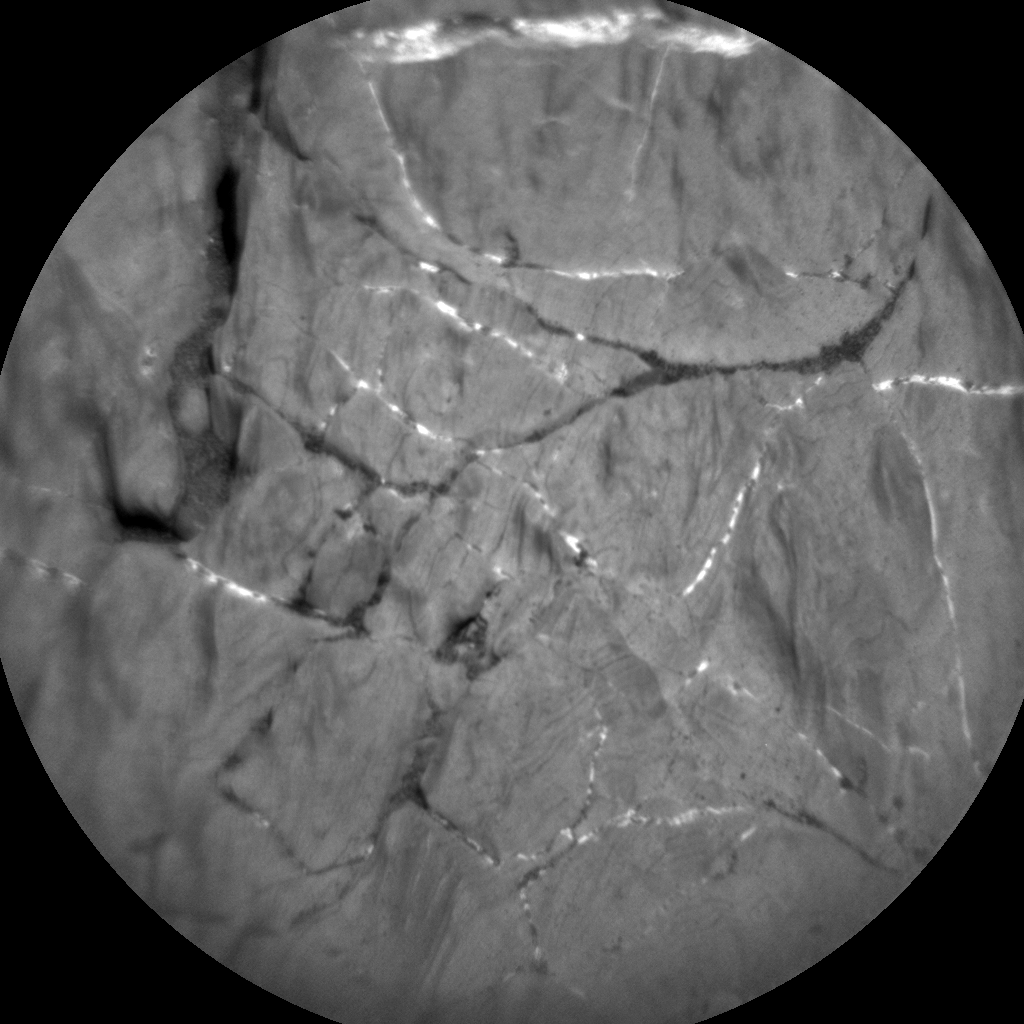
Curiosity ChemCam Remote Micro-Imager photo acquired on Sol 1953, February 2, 2018.
Credit: NASA/JPL-Caltech/LANL
SAM geochronology experiment
The biggest activity of the plan is setting up Curiosity to conduct a Sample Analysis at Mars (SAM) Instrument Suite geochronology experiment next week.
This activity is so power intensive and requires ground in the loop between certain steps, a robot drive will not occur. “We will instead do additional remote sensing with our extra time,”

Curiosity Mars Hand Lens Imager (MAHLI) product from Sol 1950, January 30, 2018.
Image Credit: NASA/JPL-Caltech/MSSS
Broken up rocks
Besides the SAM preparation activities, the main science carried out recently is focused on characterizing the broken up rocks in front of the rover, which are the typical targets on the top of Vera Rubin Ridge.
On tap is using the Mars Hand Lens Imager (MAHLI) on targets “Skara Brae,” “Glen Roy,” and “Drummock.”
Also slated is an observation using Curiosity’s Alpha Particle X-Ray Spectrometer (APXS) of Glen Roy and Skara Brae.

Curiosity Mastcam Left image taken on Sol 1950, January 30, 2018.
Credit: NASA/JPL-Caltech/MSSS
Crater rim mosaic
Additionally, a remote sensing block on the second sol of the plan is scheduled. In this block, the robot will collect Chemistry and Camera (ChemCam) Laser-Induced Breakdown Spectrometer (LIBS) data on Glen Roy, “Harra Ebb,” and “Cocksburnpath,” and a Remote Micro-Imager (RMI) mosaic of “Bloodstone Hill.”
All of the LIBS observations will be accompanied by Mastcam documentation images, Fraeman points out. Additional Mastcam images will be taken of two Autonomous Exploration for Gathering Increased Science (AEGIS) software-selected targets from an earlier plan, documentation of surrounding landscape with multispectral filters, scoping out an outcrop named “Scalpay,” and taking a large 37×2 mosaic of the crater rim.

Curiosity Mastcam Left photo taken on Sol 1950, January 30, 2018.
Credit: NASA/JPL-Caltech/MSSS
The third sol of the plan (Sol 1954-1956) is a morning science block with a Mastcam look at airborne dust, shooting a crater rim movie, a Navcam zenith movie, a Navcam suprahorizon movie, and a Navcam 360 degree sky survey, Fraeman concludes.
Credit: OeWF
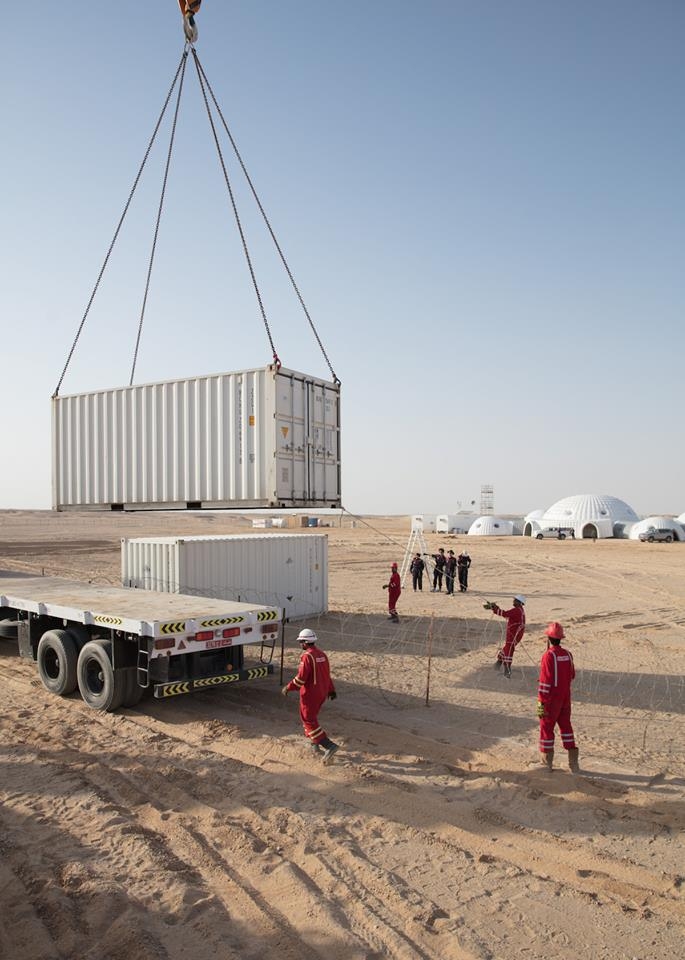
A highly international analog field simulation is in “green for go” mode, prepared to mimic a Red Planet expedition.
The site: In the Arabian desert Dhofar region, Oman.
Four-week simulation
AMADEE-18 is a Mars simulation mission led by the Austrian Space Forum (OeWF) in partnership with the Oman National Steering Committee and international research organizations. The effort involves 25 nations.
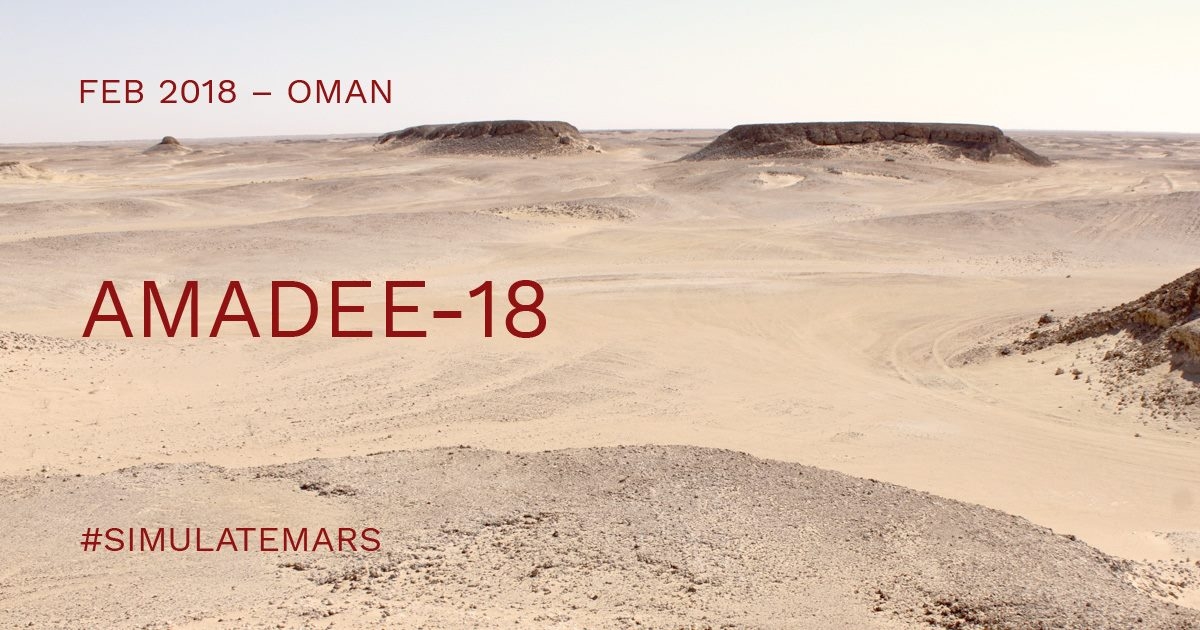
Credit: OeWF
The actual field mission will take place during four weeks this month.
A small field crew will conduct experiments preparing for future human Mars missions in the fields of engineering, planetary surface operations, astrobiology, geophysics/geology, life sciences and other disciplines. The undertaking offers an opportunity to study equipment, procedures and workflows under Mars analog conditions with humans-in-the-loop.
Credit: OeWF
Desert location
The deserts of Dhofar, the largest governorate — an administrative division of a country — in the Sultanate of Oman, have a resemblance to various Mars surface features, such as sedimentary structures dating back to the Paleocene and Eocene, salt domes of the South Oman Salt Basin and ancient river beds. The test site offers a wide range of sand and rocky surfaces combined with a broad variability in inclination.
The nearest major city is Salalah, expected temperatures at the test site this month typically range between 16-27°C with less than 10 mm of precipitation.

Credit: OeWF/Paul Santek
Mission control
The mission support center, based in Innsbruck, Austria, will be linked to base operations in Oman, but a 10-minute delay is enforced to simulate the time-lag in signals between Earth and the Red Planet.
The OeWF’s Analog Astronauts are: Stefan Dobrovolny, Austria; Carmen Köhler, Germany; Kartik Kumar, The Netherlands; João Lousada, Portugal; and Iñigo Muñoz Elorza, Spain.
For more information on this impressive analog Mars mission, go to:
Check out this informative video focused on AMADEE-18 at:
https://www.youtube.com/watch?time_continue=55&v=CQ6L9JAxmKk

Credit: NASA
A new kickstarter campaign is underway to create a feature documentary film about Apollo 8 and the three astronauts that crewed that amazing NASA mission into space.
Director Paul Hildebrandt explains that nearly 50 years ago three astronauts launched from the Earth and headed towards the Moon for the first time. The saga was undertaken by Frank Borman, Bill Anders, and James Lovell, the first people to ever leave the Earth, “and we have their story,” he notes.
True pathfinders
In December of 1968, amongst social strife, campus unrest, and a difficult war in Vietnam, these brave men ventured into unknown territory. They were the true pathfinders of the Apollo program.
“They brought back with them a photograph known as ‘Earthrise’ photographed by astronaut Bill Anders. This photo became one of the most printed and viewed photos in history,” Hildebrandt adds, an image that changed how we viewed our planet.
This documentary is told through their own interviews and rare archival photos and film.

Credit: NASA
Earthrise
If funded, “First to the Moon” will feature exciting photorealistic animations of the Apollo 8 flight, recreating famous moments from the mission, such as the Earthrise photo, and the reading of Genesis.
“The stories of these three men have never been fully realized on screen, and the journey of Apollo 8 has never been illustrated in the way that we intend to bring it to life,” Hildebrandt points out. “We are scanning in many rarely seen film reels from the National Archives and other sources which show how Apollo 8 really happened. These film reels will be painstakingly cleaned and restored in high definition.”
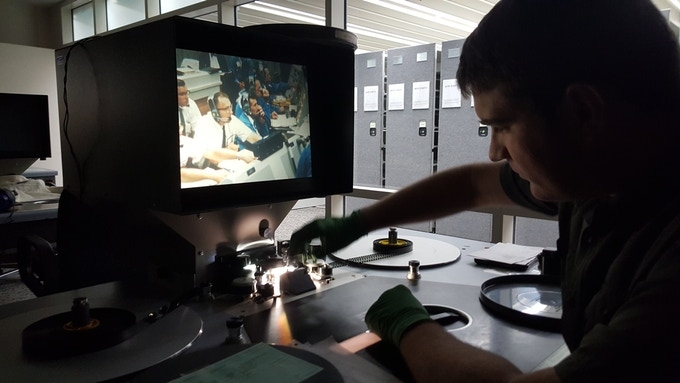
Director Paul Hildebrandt researching film at the National Archives.
Credit: Paul Hildebrandt
Filming is complete, and funds raised will be used for post-production and other tasks to have it released by December 2018, in time for the 50th anniversary of the Apollo 8 Mission.
More information
If you would like to contribute to this notable project, go to:
https://www.kickstarter.com/projects/420606009/first-to-the-moon-the-journey-of-apollo-8
Also, check out this trailer at:
https://www.youtube.com/watch?v=Ti7xbebAzkg

Credit: ESA/NASA
Earth’s celestial neighbor in gravitational lock – the moon — is far from being a “been there, done that world.” The scientific study of the moon, by robots and humans, is a “barely scratched the surface” enterprise.
Yes, between 1969 and the close of 1972, a dozen American moonwalkers strutted their Apollo right stuff across stretches of desolate, crater-pocked landscape. But now, over 45 years later, there’s a rising tide of multiple nations casting their eyes on moon return, among them, Europe, China, Russia, Japan, and India.

Inside look at one idea the European Space Agency is exploring in its formulation of a “Moon Village” that incorporates 3D printing.
Credit: ESA/ Foster + Partners
Trump directive
Not to be left behind in the lunar dust, NASA’s 2019 budget proposal to be released in February may well scope out details about how the agency plans to realize a new President Trump directive to retarget humans to the moon.
On the table, a crew-tended spaceport in cislunar space called the Deep Space Gateway, or DSG, an astronaut crewed node to gain access to the lunar surface and one that serves as a stepping stone to further deep space exploits.

Notional Deep Space Gateway.
Credit: NASA
After almost a half-century hiatus, lunar missions are once again becoming the next big thing in space science and exploration.
For my new Scientific American story on future Moon exploration, go to:
Shooting for the Moon–This Time to Stay
https://www.scientificamerican.com/article/shooting-for-the-moon-this-time-to-stay/

Credit: SpaceWorks Enterprises, Inc.
A new marketing forecast projects that as many as 2,600 nano/microsatellites will require launch over the next 5 years.
SpaceWorks Enterprises, Inc. (SEI) released today its annual nanosatellite and microsatellite market forecast.
According to an SEI press statement, compared with last year’s Nano/Microsatellite forecast, the current projections have been increased to reflect an increase in small satellite launch opportunities, the continued maturation of emerging small satellite operators, and a strong influx of venture capital financing into the space sector.
Analysis of trends by application suggests that Earth observation and remote sensing will remain the primary use for nano/microsatellites in the near term.
Record setting year
“2017 was a record setting year for the small satellite market, significantly reducing the satellite backlog that has been building since 2015,” explains Caleb Williams, SpaceWorks Space Systems Analyst.
“This year the global launch industry showed broader acceptance of small satellite rideshares and demonstrated its ability to accommodate near-term market demand even while small satellite launch vehicles continue to mature,” Caleb adds. “Ultimately the future of the small satellite market will depend largely on the ability of operators to secure capital and create sustainable customer relationships.”
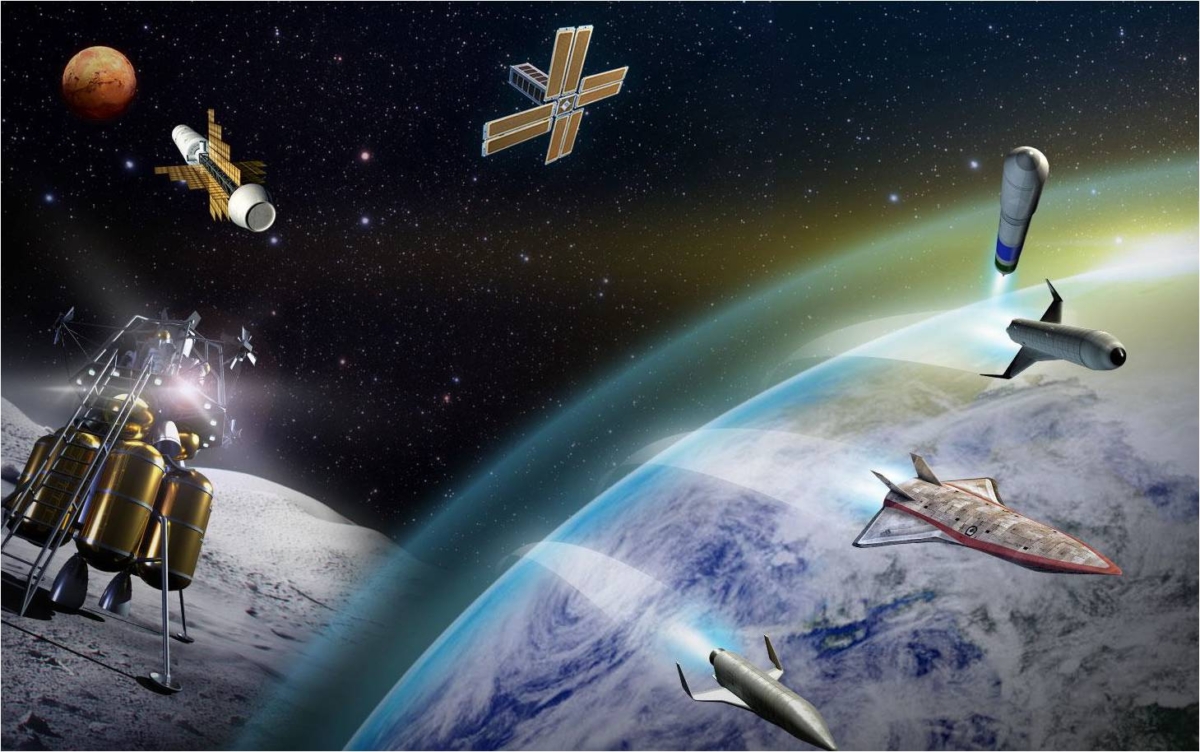
Credit: SpaceWorks Enterprises, Inc.
Free resource
The 2018 market forecast from SEI is available in presentation form as a free download on the SpaceWorks newly updated commercial website at:
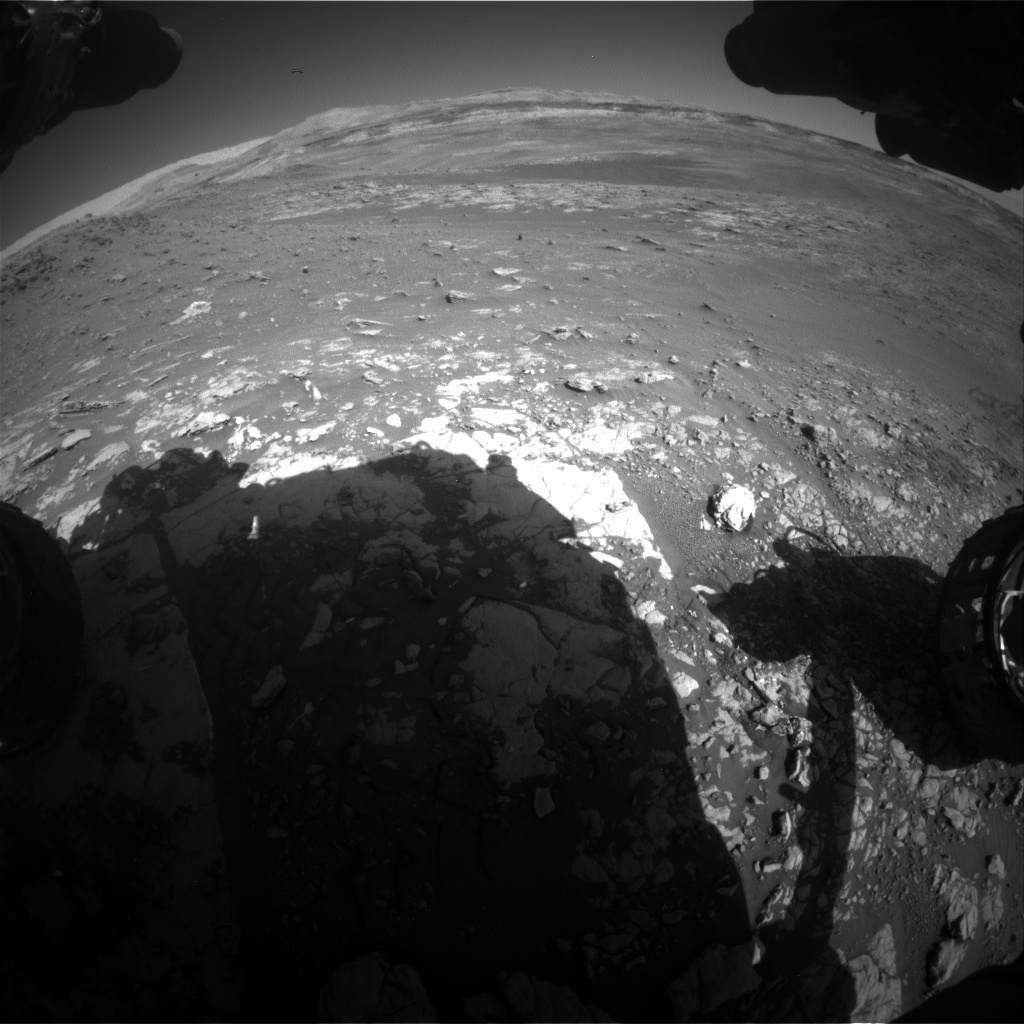
Curiosity Front Hazcam Right B image taken on Sol 1949, January 29, 2018.
Credit: NASA/JPL-Caltech
NASA’s Curiosity rover on Mars has just started to perform Sol 1950 duties.
“We are back on Vera Rubin Ridge today after a short diversion into the phyllosilicate unit,” reports Abigail Fraeman, a planetary geologist at NASA/JPL in Pasadena, California.
Detailing Curiosity duties for Sol 1950-1951: “Our workspace this morning contained rocks in various shades of red,” Fraeman notes. “The remote sensing and contact science observations we planned today are designed to investigate the chemistry, spectral properties, and fine scale textures associated with these color changes.”
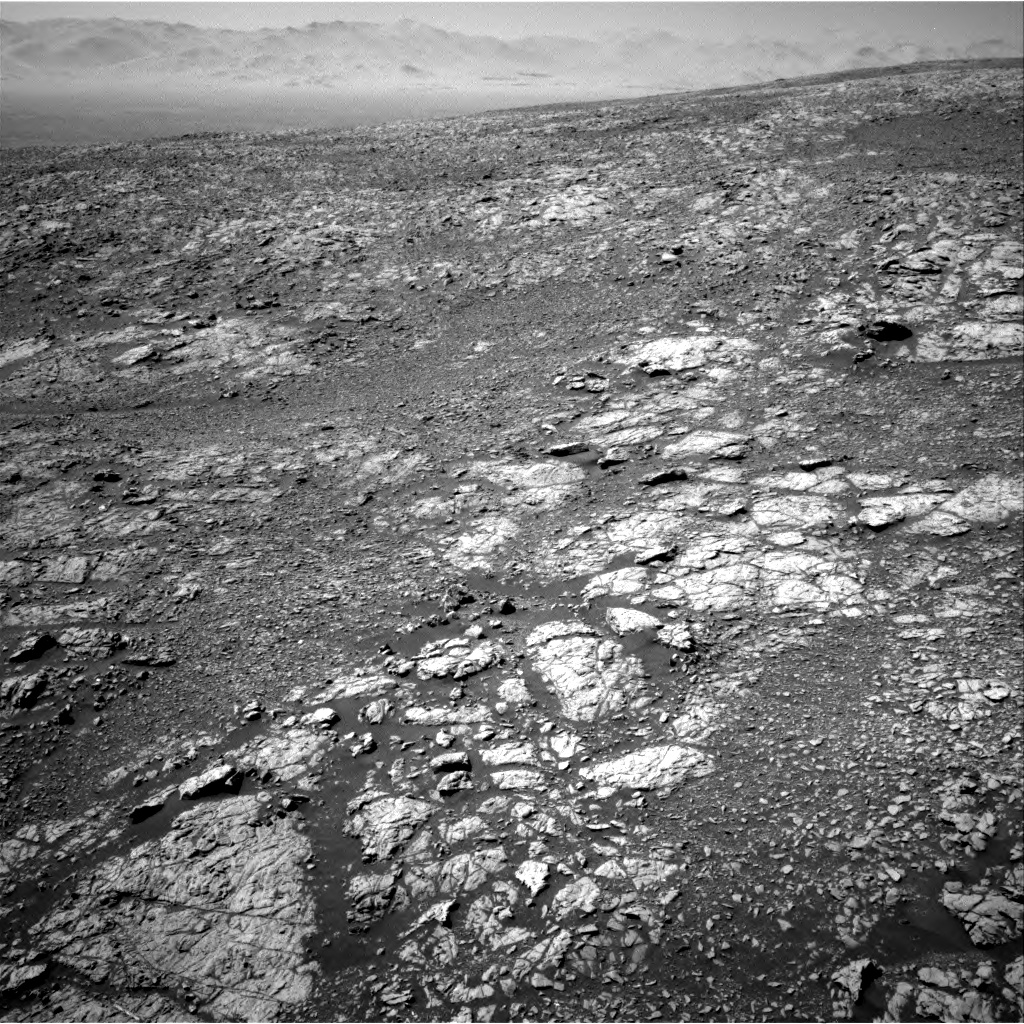
Curiosity Navcam Right B photo acquired on Sol 1949, January 29, 2018.
Credit: NASA/JPL-Caltech
Brush and observe
One contact science target, “Balmedie,” has been chosen for Curiosity to brush and observe with the Mars Hand Lens Imager (MAHLI) and the robot’s Alpha Particle X-Ray Spectrometer (APXS)
“This rock was one of the only rocks in the workspace that was big enough to safely brush, and the observations we take will provide information about the properties of the bedrock in the area,” Fraeman adds.
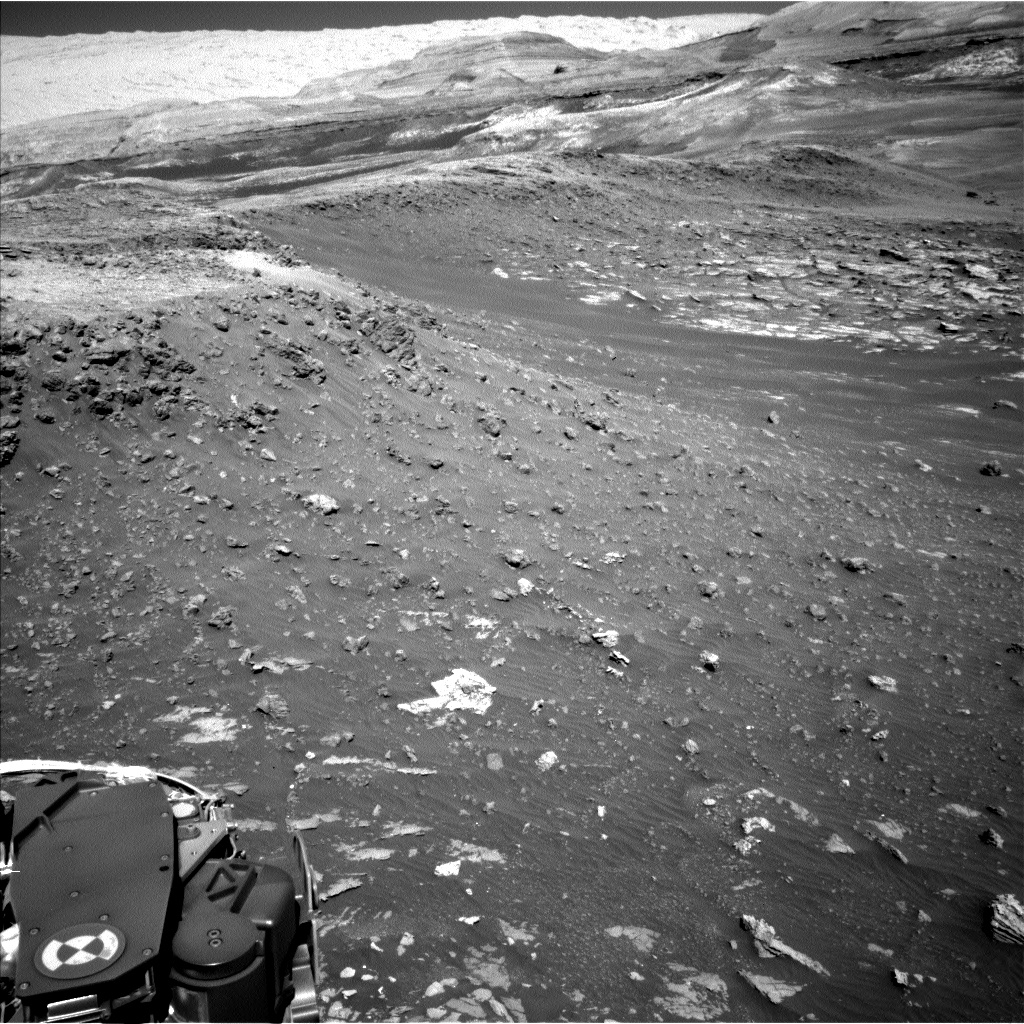
Curiosity Navcam Left B image acquired on Sol 1949, January 29, 2018.
Credit: NASA/JPL-Caltech
Different colors
The plan also calls for taking Mastcam multispectral observation of Balmedie and its surroundings. After the contact science block, on tap is collecting Chemistry and Camera (ChemCam) observations of bedrock targets that have different colors, “Killiecrankie” and “Bennachie.”
Also a ChemCam Remote Micro-Imager mosaic of a distant target on Mt. Sharp named “Muchalls” is on the schedule.
Mastcam will document the two ChemCam laser targets, and Curiosity will also take a 7×2 stereo mosaic of a distant target “Harris Bay,” which is a potential geologic contact.

Curiosity Mars Hand Lens Imager (MAHLI) produced this product by merging two to eight images previously taken by the instrument. MAHLI is located on the turret at the end of the rover’s robotic arm.AHLI Sol 1949, January 29, 2018.
Credit: NASA/JPL-Caltech/MSSS
Drive to the northeast
The first sol of the plan will end with a drive to the northeast. On the plan is use of Autonomous Exploration for Gathering Increased Science (AEGIS) software to make an auto-target observation on the second sol of the plan, along with a dust devil search.

Curiosity laser shots dot the surface of Mars near rover tire track.
Curiosity Mastcam Right photo taken on Sol 1948, January 28, 2018.
Credit: NASA/JPL-Caltech/MSSS
Fraeman notes that this week all of the Curiosity science team members are traveling to Pasadena for a bi-annual meeting.
“We will converse about the latest data and share our interpretations with one another,” Fraeman adds. “Team members are located all across the world, so it’s wonderful to be able to meet face to face to discuss all of our recent results!”

