Author Archive
 Author:
  June 7th, 2025
Luna-27 landing leg testing.
Image credit: NPO Lavochkin
Work on future robotic moon projects is pressing forward, recently highlighted by NPO Lavochkin in spotlighting work on Luna-27.
Lavochkin has completed development tests of a dynamically similar model of the landing vehicle for the Luna-27 mission, a south pole lander slated for launch after 2030.

Image credit: Roscosmos
Test stands
“This is one of the important stages of preparation for the upcoming lunar expedition, during which specialists worked out soft landing modes in conditions as close to real ones as possible,” reports a Lavochkin posting.

Artwork depiction of Luna-27 Moon lander.
Image credit: NPO Lavochkin
The device was also tested with a simulation of lunar gravity and contact with an analogue soil.
Lavochkin has created specialized stands to practice Moon landing modes. Last year, the stands were upgraded to meet the landing conditions of the Luna-27 spacecraft.
Lunar orbiter
Luna-27 is being developed as part of the Luna-Resource-1 project.
The first mission of the project is Luna-26 that will explore the surface from lunar orbit and select safe landing sites. To be launched in 2027, the lunar orbiter would create a topographic map of the Moon with a resolution of 2-3 meters in the southern polar region using stereo photography.

Russia’s Luna-26, a Moon orbiter.
Image credit: NPO Lavochkin
The second mission is the Luna-27 landing module itself. Its task is to study the composition of the regolith, record the presence of water, and measure the physical characteristics of the soil.
Luna-25 mishap
As part of the Luna-Glob project, NPO Lavochkin built the Luna-25 spacecraft, a small-sized demonstration landing station for testing basic soft landing technologies in the near-polar region and conducting contact studies of the south pole of the Moon.

Luna-25
Credit: Roscosmos
After Luna-25’s launch on August 10, 2023, the craft did enter lunar orbit. However, a maneuvering engine on the craft overshot its burn time, running for 127 seconds instead of 84 second. Subsequently, Luna-25 crashed onto the lunar surface on August 19, 2023.

During preparations for descent to the surface, Russia’s Luna-25 Moon lander experienced an anomaly that caused it to impact into the southwest rim of Pontécoulant G crater on Aug. 19, 2023.
Image credit: NASA Goddard Space Flight Center/Arizona State University
 Posted in

Image credit: NASA
Over the years, NASA has undergone ups and downs in terms of financial hits and shifts of priority.
While the projected White House recommended financial reductions and face-lifting ideas for the civilian space agency are not unique – they are being viewed by many as a budgetary bombshell.
But first a little space history.
More details at:

Image credit: NASA/Bill Ingalls
U.S. Senator Ted Cruz (R-Texas), Chairman of the Senate Committee on Commerce, Science, and Transportation, unveiled yesterday his legislative directives for Senate Republicans’ budget reconciliation bill.
“Talking Points & Messaging” includes beating China to Mars and the Moon. It dedicates almost $10 billion to win the new space race with China and ensure America dominates space. Makes targeted, critical investments in Mars-forward technology, Artemis Missions and Moon to Mars program, and the International Space Station.

Artist’s view of Space Launch System/Orion spacecraft on the launch pad.
Credit: NASA
Details, details, details
Section 0005, under Mars missions, Artemis missions, and Moon to Mars program.
This section would provide $9.995 billion for fiscal year 2025 as supplemental funds for critical Mars-forward infrastructure, broader Moon-to-Mars program, and NASA’s Artemis missions.
Of the amount appropriated under this section:
o Mars Telecommunications Orbiter – $700 million for the commercial procurement of a Mars Telecommunications Orbiter. This orbiter is dual-use for both a Mars Sample Return mission, to return core samples of Mars to Earth, and future manned Mars missions.

The Gateway space station will operate in a Near Rectilinear Halo Orbit supporting crewed Artemis missions to the moon.
Image credit: NASA/Alberto Bertolin, Bradley Reynolds
o Gateway – $2.6 billion to fully fund the lunar space station known as Gateway, which is critical for establishing a sustained human presence at the Moon, as required by statute.
o Space Launch System Rockets – $4.1 billion to fund two Space Launch System (SLS) rockets for the Artemis IV and V missions. The SLS is the only human-rated rocket available that can get humans to the Moon. Importantly, this funding would not preclude integrating new, commercial options if and when they become available.
o Orion Crew Vehicle – $20 million to fund the continued procurement of the fourth Orion multi-purpose crew vehicle for use with SLS for Artemis IV and reuse with subsequent Artemis Missions. Orion is the vehicle which will take astronauts to Gateway and return them safely to Earth.

Artist rendering of Lockheed Martin-built Orion spacecraft in deep space.
Credit: Lockheed Martin
o International Space Station – $1.25 billion for the International Space Station (ISS) operations over five years. This would provide necessary funding for space operations to, from, and on the ISS to ensure an orderly transition from ISS to commercial platforms after 2030 and ensure there is no gap in American leadership in low-Earth orbit.
o U.S. Deorbit Vehicle – $325 million to fund the U.S. Deorbit Vehicle to safely deorbit the ISS. This vehicle is necessary to safely deorbit the ISS once it has reached the end of its useful life, and without which the odds of re-entry over a population center are roughly one in ten.

Kennedy Space Center.
Credit: NASA
NASA centers
o NASA Center Improvements – $1 billion for infrastructure improvements at manned spaceflight centers. Between deferred maintenance and delayed construction of new facilities, NASA’s infrastructure backlog across all centers is above $5 billion. The funds in this subsection would focus only on the manned spaceflight centers and on the infrastructure needed to beat China to Mars and the Moon.
Specifically:
▪ John C. Stennis Space Center – $120 million for infrastructure repairs and upgrades. Stennis is the home of NASA’s rocket engine testing for the heavy-lift rocket engines necessary to get to deep space.
▪ John F. Kennedy Space Center – $250 million for infrastructure repairs. The Kennedy Space Center is NASA’s premier launch complex and from which every American astronaut has been sent to space.
▪ Lyndon B. Johnson Space Center – $300 million for infrastructure repairs and upgrades. JSC is home to mission control, the astronaut corps, and overall space operations.
▪ George C. Marshall Space Flight Center – $100 million for infrastructure repairs and upgrades. Marshall is NASA’s home for propulsion.
▪ Michoud Assembly Facility – $30 million for infrastructure repairs and upgrades.

Moon to Mars?
Image credit: NASA
Time lines
Section 0005 would also require that not less than 50 percent of the funds shall be obligated not later than September 30, 2028, 100 percent of the funds shall be obligated not later than September 30, 2029, and all associated outlays shall occur not later than September 30, 2034.
The CBO preliminarily estimates $9.96 billion will be obligated and expended within the ten year window.
To read the bill text, go to:
https://www.commerce.senate.gov/services/files/AD3D04CF-52B4-411F-854B-44C55ABBADDA

Image credit: ispace/Inside Outer Space screengrab
Japan’s ispace Resilience lunar lander mission has been concluded.
Following the landing sequence, the Mission Control Center was unable to establish communications with the lander, determining that it is unlikely that communication with the Moon probe will be restored.

ispace lunar lander/rover.
Image credit: ispace
“After communication with the lander was lost, a command was sent to reboot the lander, but communication was unable to be re-established.” For press conference, go to:
https://www.youtube.com/live/0yr1a-hf7SQ?si=4nrphBwP4p3YFUAX
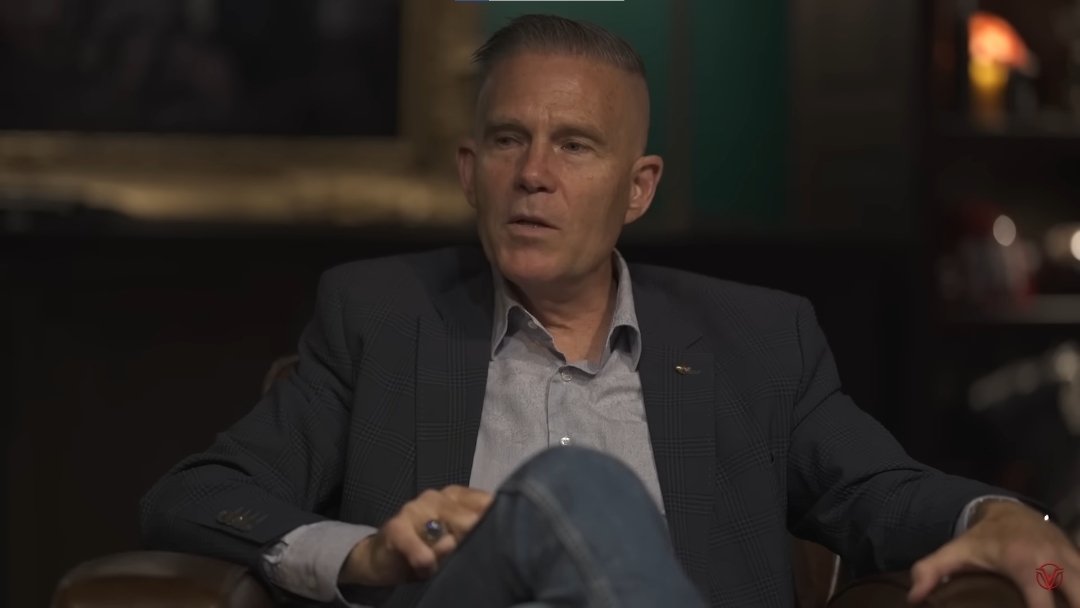
Image credit: Shawn Ryan Show, a Vigilance Elite production/Inside Outer Space screengrab
Steven L. Kwast appears to be the candidate of rumor to be a President Trump-nominee as NASA Administrator.
Kwast is a retired U.S. Air Force Lieutenant General and the Co-founder and CEO of SpaceBilt. He has been a key advocate for the U.S. Space Force, and an innovative thinker about space technology, speaking on national security, space policy, and economic development beyond Earth.
Go to this informative Shawn Ryan Show interview on May 22 with Kwast at:

Image credit: Blue Origin
Blue Origin has begun rolling out company plans to establish itself as a provider of hardware to enable long-term human stays on the moon.
One newly revealed key element is tagged the “Transporter,” a vehicle that can be launched on a single Blue Origin New Glenn launcher into low Earth orbit. It would harvest leftover propellant from the booster’s 2nd stage and then haul the hydrogen and oxygen to lunar orbit.

Earth orbit to Moon orbit…and beyond. Blue Origin’s Transporter.
Image credit: Blue Origin
On the mark
Blue Origin is also busily developing its Mark 1, a robotic lander, as well as a Mark 2 version able to land up to four astronauts on the moon, either to equatorial or polar sites, depending on NASA needs.
For more information on Blue Origin planning, go to my new Space.com story – “Lunar landers and ‘Transporter’ Tankers: Blue Origin unveils its blueprint for the moon” at: https://www.space.com/astronomy/moon/lunar-landers-and-transporter-tankers-blue-origin-unveils-its-blueprint-for-the-moon

Image credit: John Kraus/Polaris Program
Donald J. Trump posting on May 31, 7:40 PM:
“After a thorough review of prior associations, I am hereby withdrawing the nomination of Jared Isaacman to head NASA. I will soon announce a new Nominee who will be Mission aligned, and put America First in Space. Thank you for your attention to this matter!”
Statement from Jared Isaacman following his nomination withdrawal by President Trump:
I am incredibly grateful to President Trump, the Senate and all those who supported me throughout this journey. The past six months have been enlightening and, honestly, a bit thrilling. I have gained a much deeper appreciation for the complexities of government and the weight our political leaders carry.
It may not always be obvious through the discourse and turbulence, but there are many competent, dedicated people who love this country and care deeply about the mission. That was on full display during my hearing, where leaders on both sides of the aisle made clear they’re willing to fight for the world’s most accomplished space agency.

Entrepreneur Jared Isaacman, President Trump’s former nominee to be NASA administrator.
NASA / Bill Ingalls
The President, NASA and the American people deserve the very best–an Administrator ready to reorganize, rebuild and rally the best and brightest minds to deliver the world-changing headlines NASA was built to create.
I have not flown my last mission—whatever form that may ultimately take–but I remain incredibly optimistic that humanity’s greatest spacefaring days lie ahead. I’ll always be grateful for this opportunity and cheering on our President and NASA as they lead us on the greatest adventure in human history.
For an informative account of Jared Isaacman’s nomination withdrawal, go to this Marcia Smith posting, last updated June 1st at:
Jared Isaacman Out as NASA Administrator Nominee

Image credit: NASA
Just out is the President’s Fiscal Year 2026 Budget Request for NASA – one that reflects the Trump-Vance Administration’s “commitment to strengthening America’s leadership in space exploration while exercising fiscal responsibility. “
“With this budget, we aim to shape a Golden Age of innovation and exploration,” explains acting NASA Administrator, Janet Petro, in a Technical Supplement of the Fiscal Year 2026 Budget.

Embrace the challenge
In a May 30 message, Petro says “embrace the challenge.”
That budget includes $7 billion to focus space agency investments on sustainable human exploration of the lunar surface plus an additional $1 billion to prepare for human missions to Mars.
This budget creates a new Commercial Mars Payload Services Program – modeled off the success of Commercial Lunar Payload Services – to deliver science and technology payloads to Mars through commercial partnerships.
It also includes funding to test capabilities for a near-term human-class Mars lander, expands Mars communications relay capabilities through commercial partnerships, augments funding to begin crafting Mars-appropriate spacesuits, low-cost Mars robotic exploration missions and instrument payloads, and accelerates the development of low cost, high-performance space computers.

We are going…going, going gone! Artemis I Rollout: August 16, 2022
Credit: NASA/Joel Kowsky
Mars-forward
“Significant funds are provided for Mars-forward technologies and surface infrastructure that can be demonstrated on the Moon through the Artemis program,” the document notes.
Starting with Artemis IV, this budget shifts the NASA approach to transportation to the Moon by retiring the Space Launch System (SLS) and Orion spacecraft. SLS, Orion, and Exploration Ground System (EGS) government programs will be retired after Artemis III.
NASA will continue the Artemis campaign by procuring crew transportation services from U.S. companies, designed to minimize cost and reduce schedule risks with milestone-based planning and more streamlined operations.
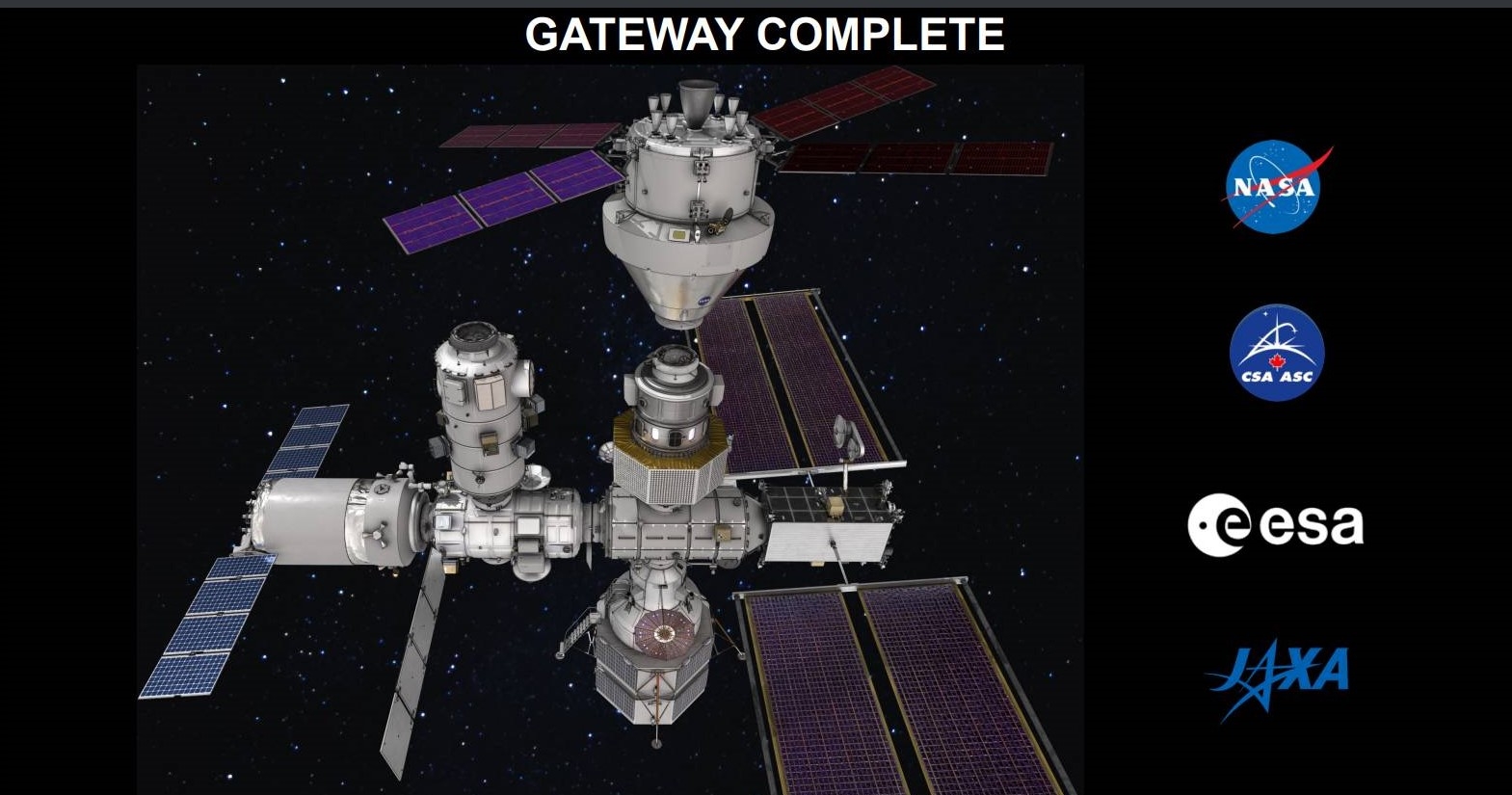
NASA’s cis-lunar Gateway facility.
Image credit: NASA
Sunset the Gateway
The budget document explains that NASA will “sunset the Gateway” – the planned lunar orbiting space station – to focus efforts on direct-to-surface exploration. NASA will explore opportunities for our commercial or international partners to repurpose elements of the Gateway.
NASA will continue the orderly closeout of the Gateway program in 2026. Gateway was designed to be a platform that orbited the Moon and supported orbital activities, lunar landers, and surface activities. Gateway was to augment the Orion spacecraft’s capabilities to support long-duration lunar surface missions as well as enable Mars forward deep space environmental testing and science.

Dragonfly on Titan.
Image credit: NASA/Johns Hopkins APL/Steve Gribben
In 2026, funding will be used to close out the current contracts while alternative uses of the Gateway hardware are evaluated by commercial and international partners.
Venus cuts
NASA will continue development of high-priority missions such as Dragonfly to Titan, a moon of Saturn, the Near-Earth Object Surveyor to keep a space-based eye out for Earth impacting space rocks.
The budget calls for ceasing support for the European Space Agency’s Rosalind Franklin Mars rover.
Also on the chopping block are the DAVINCI, VERITAS, EnVision Venus explorers.

NASA’s DAVINCI Venus lander.
Image credit: NASA GSFC visualization by CI Labs Michael Lentz and others
Scrap Mars Sample Return
It ends the current, unaffordable Mars Sample Return Program and pivots to supporting lower-cost, competitively selected Mars science missions that can complement our long-term human exploration goals.
NASA continues its commitment to the safe operation of the International Space Station (ISS) through its deorbiting and dunking into ocean waters in 2030.

Pile driving the International Space Station into the Earth’s atmosphere is on the books.
Image credit: NASA
“This budget represents not only an investment in space exploration, but also in American ingenuity, opportunity, and leadership on the global stage,” explains Petro.
For more details, go to this detailed document at:
https://www.nasa.gov/wp-content/uploads/2025/05/fy-2026-budget-technical-supplement-002.pdf
Also, go to additional budget documents available online at:

Image credit: SpaceX/Inside Outer Space screengrab
The Federal Aviation Administration (FAA) is requiring SpaceX to conduct a mishap investigation for the Starship Flight 9 mission that launched on May 27 from Starbase, Texas.
“All Starship vehicle and Super Heavy booster debris landed within the designated hazard areas. There are no reports of public injury or damage to public property,” the FAA reported today.
The mishap investigation is centered only on the loss of the Starship vehicle which did not complete its launch or reentry as planned.
Public safety requirements
“The FAA determined that the loss of the Super Heavy booster is covered by one of the approved test induced damage exceptions requested by SpaceX for certain flight events and system components. The FAA evaluated each exception prior to launch approval and verified they met public safety requirements,” the FAA statement explains.

Image credit: FAA
Also noted in the communiqué is that the FAA activated a Debris Response Area, out of an abundance of caution, when the Super Heavy booster experienced its anomaly over the Gulf of America during its flyback toward Texas.
“The FAA subsequently determined the debris did not fall outside of the hazard area. During the event there were zero departure delays, one flight was diverted, and one airborne flight was held for 24 minutes,” the FAA statement says.

Image credit: SpaceX/Inside Outer Space screengrab
SpaceX chief rocketeer, Elon Musk, unveiled his Mars roadmap at Starbase, Texas.
To watch the entire presentation, go to:
https://www.spacex.com/humanspaceflight/mars/
Photo highlights are:

Image credit: SpaceX/Inside Outer Space screengrab

Image credit: SpaceX/Inside Outer Space screengrab

Image credit: SpaceX/Inside Outer Space screengrab

Image credit: SpaceX/Inside Outer Space screengrab

Image credit: SpaceX/Inside Outer Space screengrab

Image credit: SpaceX/Inside Outer Space screengrab

Image credit: SpaceX/Inside Outer Space screengrab

Image credit: SpaceX/Inside Outer Space screengrab

