Author Archive
 Author:
  August 1st, 2018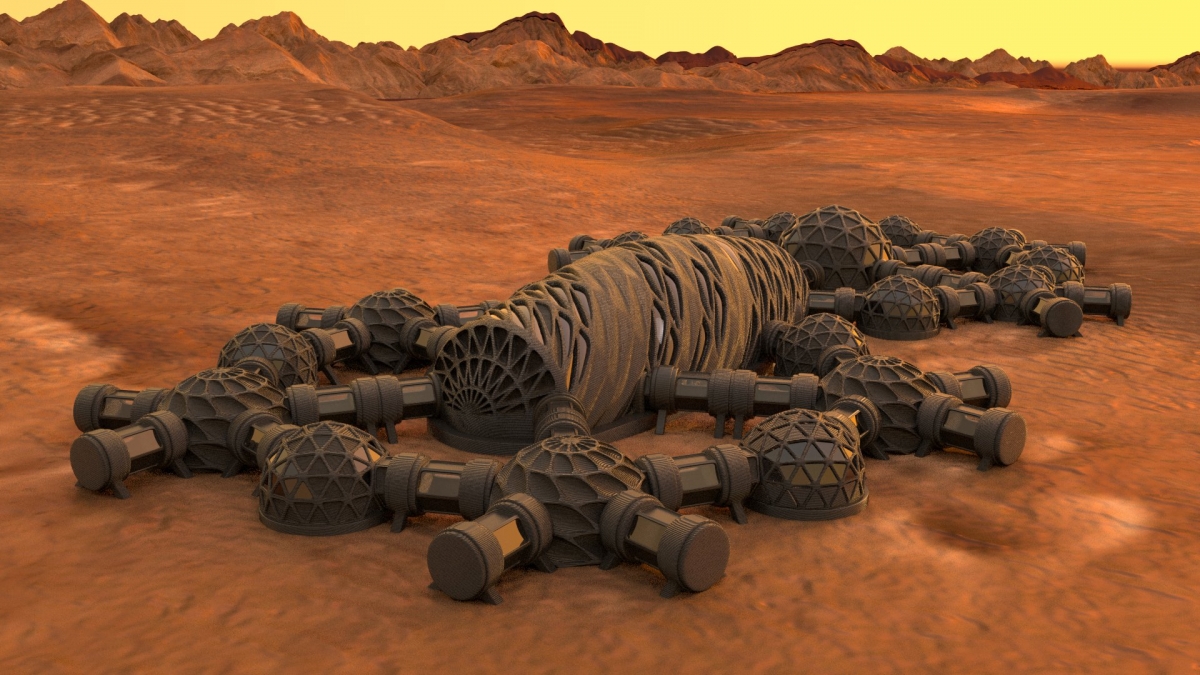
Credit: NASA/Autodesk
It doesn’t make sense to haul from Earth building supplies on missions to Mars. But 3D-printing robots could help build homes on the Red Planet using dirt and recycled plastic.
NASA’s Swamp Works lab at the Kennedy Space Center is working with Autodesk in experimenting with 3D-printing habitable structures using a process called robotic extrusion, and a composite material made up of loose sediment (soil, dust, broken rock, etc.) and recycled plastic.
Free-form additive manufacturing
Based on NASA specifications, Autodesk’s Advanced Consulting team designed the barrier using tools such as Fusion 360 and PowerMill to comply with structural as well as robotic extrusion requirements while achieving significant weight reduction.
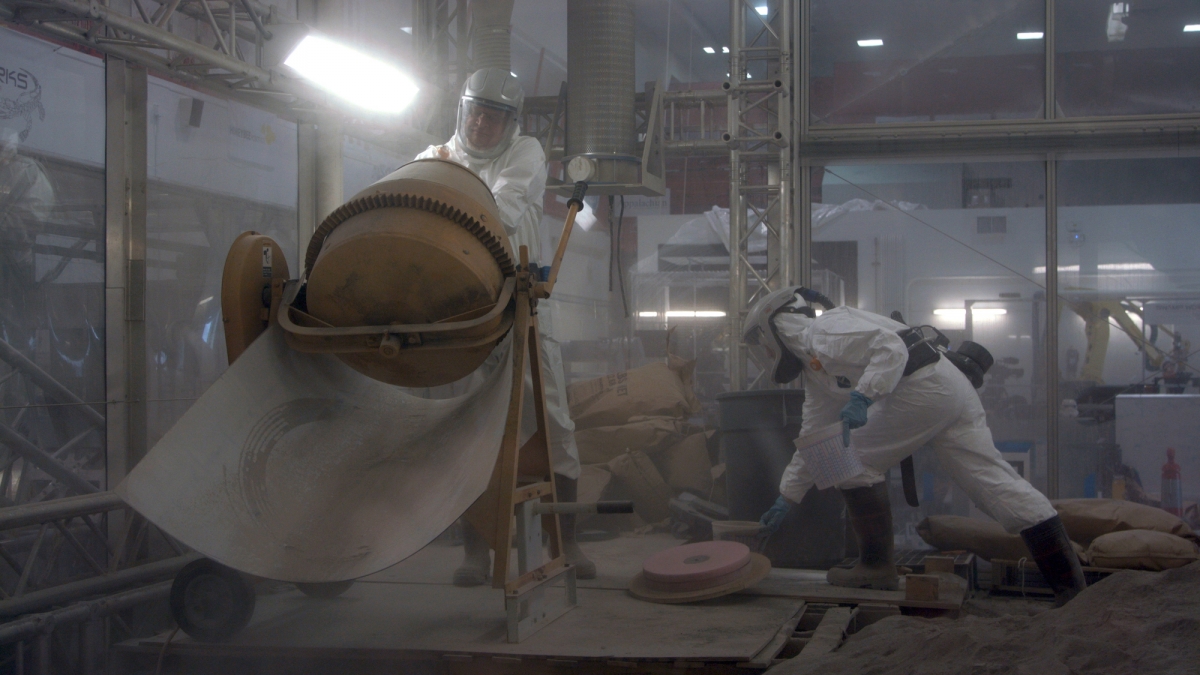
Credit: NASA/Autodesk
In a press statement, Autodesk said it also developed the software to control the industrial robot arm – fit with a specialized end effector designed by NASA – to enable free-form additive manufacturing without the need for outside support or scaffolding.
Take a look at this informative video at:
 Posted in
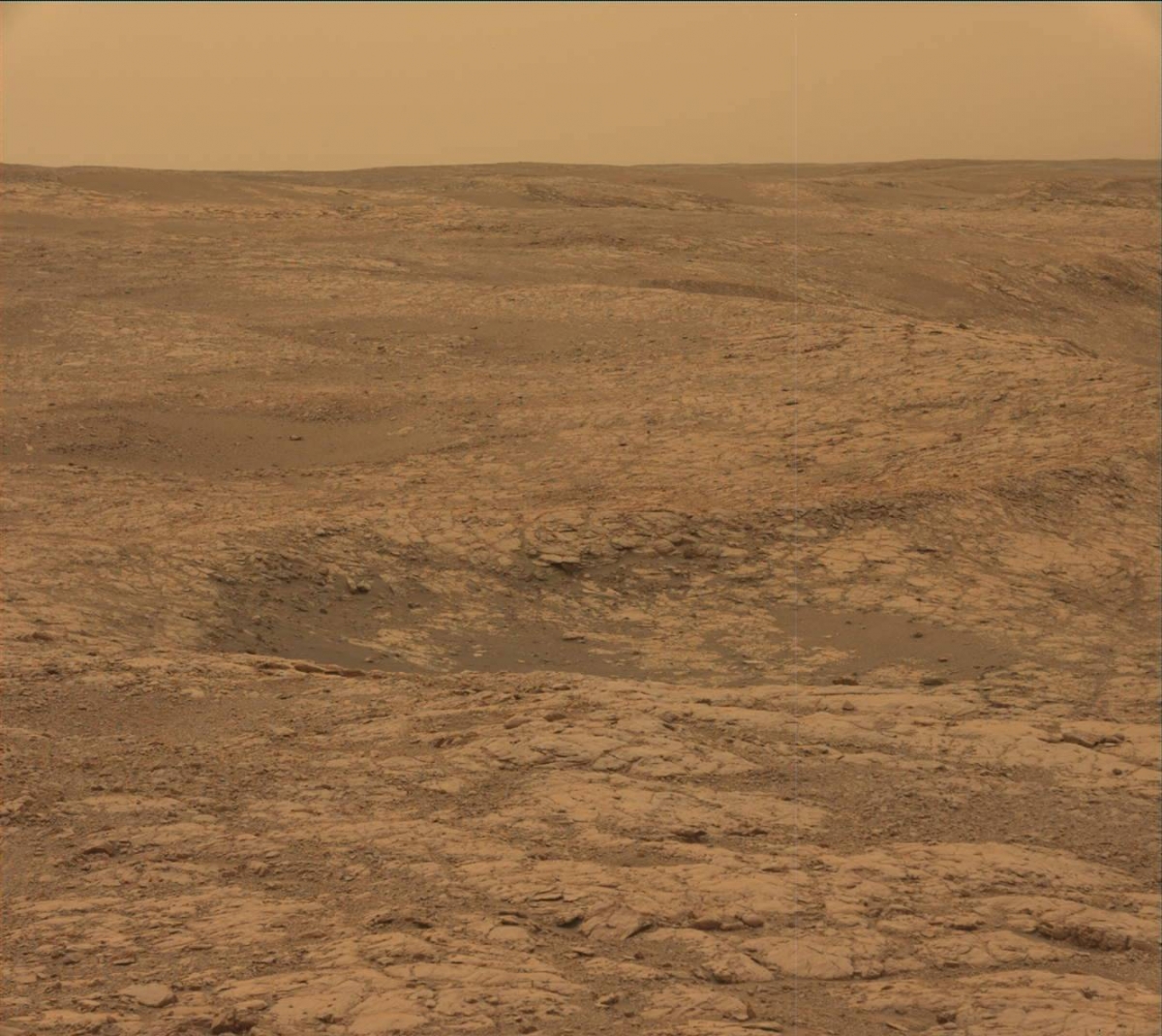
Curiosity Mastcam Left Sol 2126 July 30, 2018
Credit: NASA/JPL-Caltech/MSSS
NASA Curiosity Mars rover is now performing Sol 2128 duties.
The search for softer rocks on the Red Planet is on, reports Ryan Anderson, a planetary geologist at the USGS in Flagstaff, Arizona.
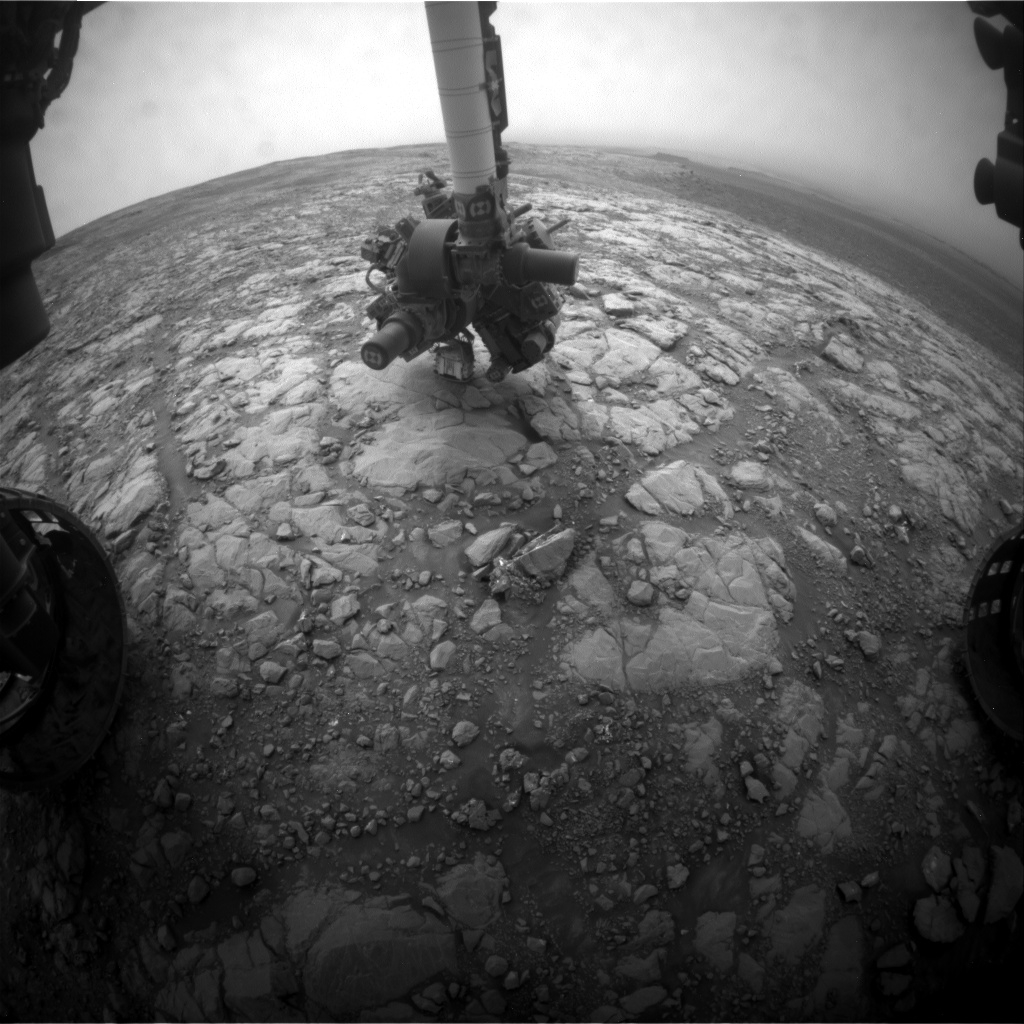
Curiosity Front Hazcam Left B image acquired on Sol 2127, July 31, 2018.
Credit: NASA/JPL-Caltech
Potential drill site
Curiosity is continuing toward a third potential drill site within the Pettegrove Point member of Vera Rubin Ridge, “where we are hoping to find slightly softer rocks,” Anderson notes.
On the plan, the rover is to carry out Chemistry and Camera (ChemCam) observations of the target “Slioch,” which was already analyzed by the Alpha Particle X-Ray Spectrometer (APXS), as well as the layered rock “Craignure Bay.”
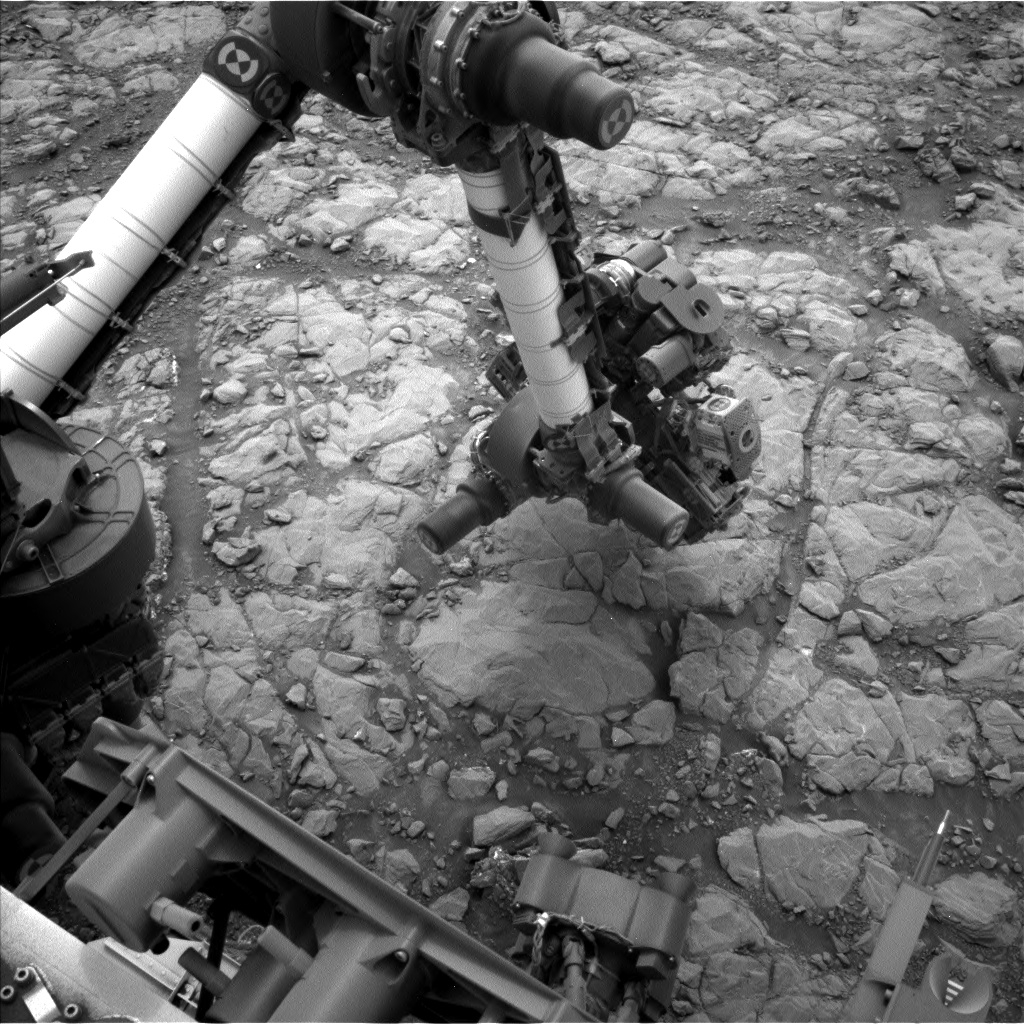
Curiosity Navcam Left B photo taken on Sol 2127, July 31, 2018.
Credit: NASA/JPL-Caltech
The robot’s Mastcam is slated to document both of these targets, using a small mosaic around Craignure Bay to capture images of some of the tilted rocks nearby as well.
Then Navcam is to do atmospheric observations.
Short bump
“After that, the rover will drive toward our next drill site and take some post-drive images. Navcam will do some more atmospheric measurements, and ChemCam will make an auto-targeted observation of the bedrock near the rover,” Anderson points out.
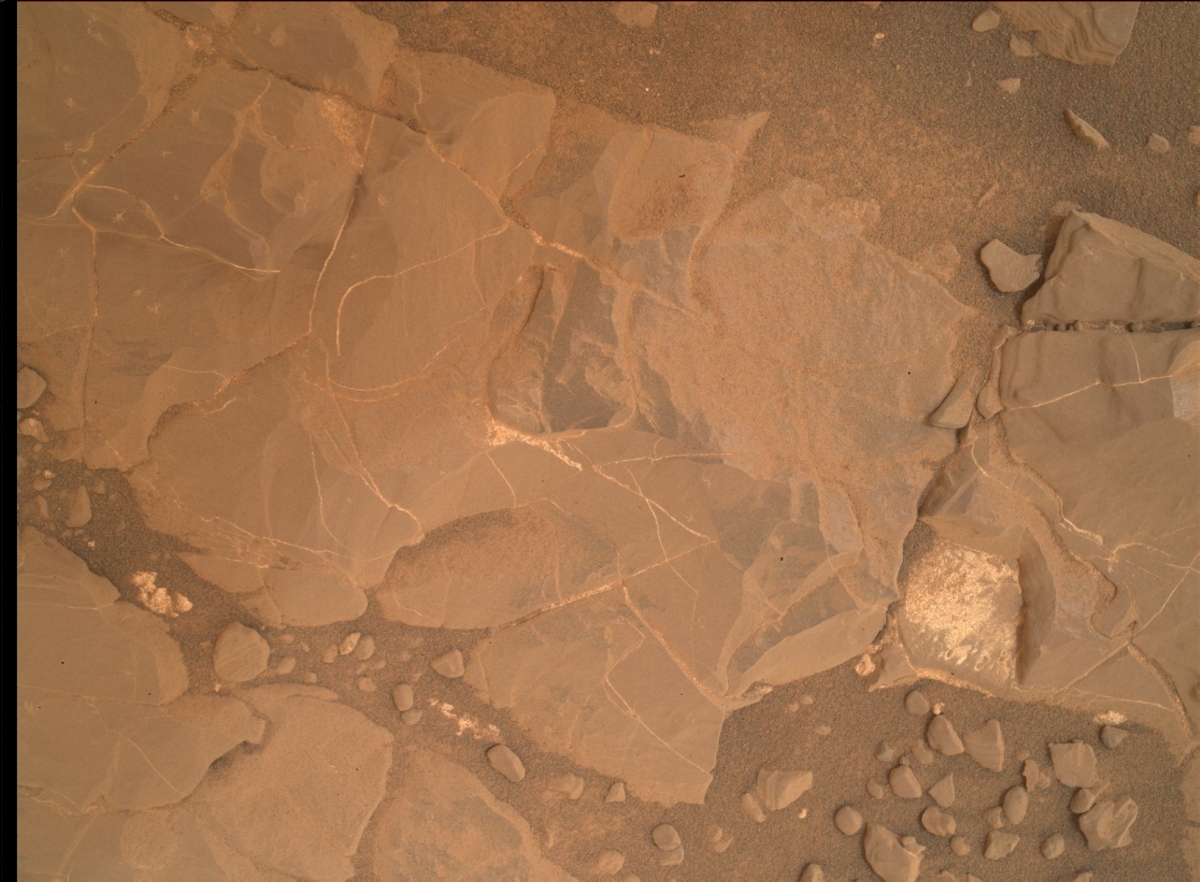
Curiosity Mars Hand Lens Imager (MAHLI) photo produced on Sol 2127, July 31, 2018.
Credit: NASA/JPL-Caltech/MSSS
The plan of rover actions will conclude with an 8-frame Navcam “movie” of the sky to look for clouds and measure the wind direction over Gale crater.
“Hopefully,” Anderson concludes, “we’ll be close enough to do just a short bump to the drill site so we can try drilling again this weekend!”
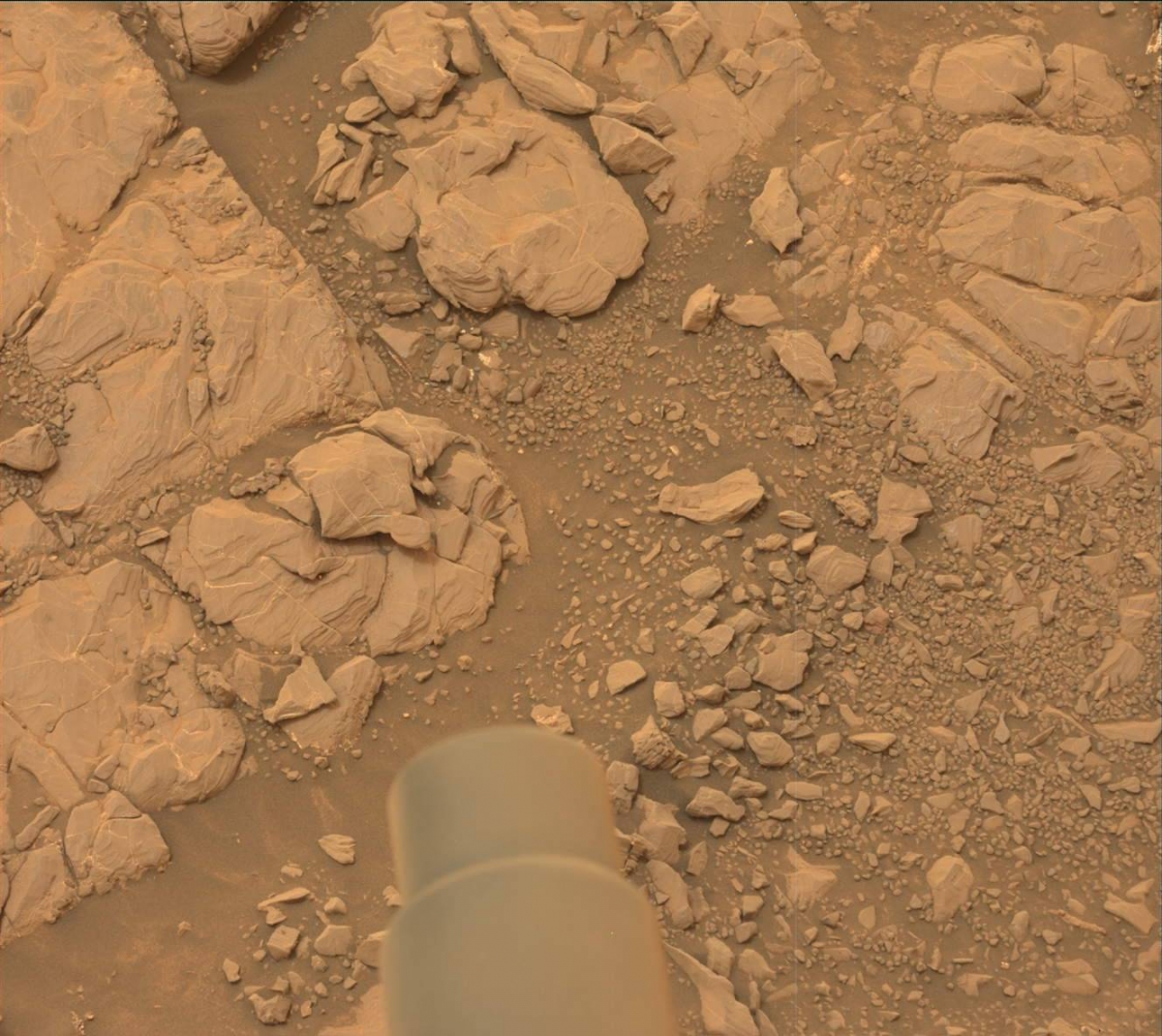
Curiosity Mastcam Left image taken on Sol 2126, July 30, 2018.
Credit: NASA/JPL-Caltech/MSSS

Credit: NASA/JPL-Caltech/Univ. of Arizona
NASA’s Curiosity Mars rover is now wrapping up Sol 2127 dutes.
Meanwhile, a new Curiosity Mars rover traverse map through Sol 2126 has been issued.
The map shows the route driven by NASA’s Mars rover Curiosity through the 2126 Martian day, or sol, of the rover’s mission on Mars (July 30, 2018).
Numbering of the dots along the line indicate the sol number of each drive. North is up. The scale bar is 1 kilometer (~0.62 mile).
From Sol 2120 to Sol 2126, Curiosity had driven a straight line distance of about 225.30 feet (68.67 meters), bringing the rover’s total odometry for the mission to 12.14 miles (19.54 kilometers).
The base image from the map is from the High Resolution Imaging Science Experiment Camera (HiRISE) in NASA’s Mars Reconnaissance Orbiter.
Mars imagery
Several new images have documented the robot’s latest actions:

Curiosity Mastcam Left photo acquired on Sol 2126, July 30, 2018.
Credit: NASA/JPL-Caltech/MSSS

Curiosity Front Hazcam Left B image taken on Sol 2127, July 31, 2018.
Credit: NASA/JPL-Caltech

NASA astronaut Tracy Caldwell Dyson, Expedition 24 flight engineer, looks through a window in the Cupola of the International Space Station. Credit: NASA
NASA’s Office of Inspector General (OIG) has released a report that assesses NASA’s progress in maximizing utilization of the International Space Station to accomplish its human exploration objectives and examines the challenges associated with transitioning the Station to commercial operations and its eventual retirement.
The report, NASA’s Management and Utilization of the International Space Station, questions whether a sufficient business case exists under which private companies will be able to develop a self-sustaining and profit-making business independent of significant Federal funding within the next 6 years.

International Space Station
Credit: NASA
Annual dollars
The OIG reports points out that any extension of the ISS past 2024 would require continued funding in the neighborhood of $3-$4 billion annually to operate and maintain the Station – a significant portion of which could otherwise be redirected to develop systems needed for NASA’s cislunar or deep space ambitions.
In addition, the OIG explains that extending the Station’s life would challenge NASA to manage the risks associated with continued operation of the Station’s aging systems and infrastructure. Furthermore, any extension will require the support of NASA’s international partners, whose continued participation hinges on issues ranging from geopolitics to differing space exploration goals.

NASA currently does not have the capability to ensure the ISS will reenter the Earth’s atmosphere and land in a targeted location in the South Pacific Ocean.
Credit: NASA
ISS deorbit
Lastly, at some future date NASA will need to decommission and deorbit the ISS either in response to an emergency or at the end of its useful life. However, the Agency currently does not have the capability to ensure the ISS will reenter the Earth’s atmosphere and land in a targeted location in the South Pacific Ocean.
For a copy of the OIG report, NASA’s Management and Utilization of the International Space Station, go to:

Pluto framed by New Horizons’ historic flight through the Pluto system on July 14, 2015.
Credit: NASA/Johns Hopkins University Applied Physics Laboratory/Southwest Research Institute/Alex Parker
A heady group of space scientists are ringing a bell concerning how to define the word “planet.”
The reminder has been targeted at The International Astronomical Union (IAU), the group that in 2006 voted to demote Pluto from planet status.
Titled, “On the Insensitive Use of the Term “Planet 9” for Objects Beyond Pluto,” the reminder is posted in the July 29th issue of the Planetary Exploration Newsletter.
Far from universally accepted
“We the undersigned wish to remind our colleagues that the IAU planet definition adopted in 2006 has been controversial and is far from universally accepted. Given this, and given the incredible accomplishment of the discovery of Pluto, the harbinger of the solar system’s third zone – the Kuiper Belt – by planetary astronomer Clyde W. Tombaugh in 1930, we the undersigned believe the use of the term “Planet 9” for objects beyond Pluto is insensitive to Professor Tombaugh’s legacy.”

Clyde W. Tombaugh at the door of the Pluto discovery telescope at the Lowell Observatory in Arizona.
Credit: Lowell
Observatory Archives
“We further believe the use of this term should be discontinued in favor of culturally and taxonomically neutral terms for such planets, such as Planet X, Planet Next, or Giant Planet Five.”
Signed by:
Paul Abell
Michael Allison
Nadine Barlow
James Bauer
Gordon Bjoraker
Paul Byrne
Eric Christiansen
Rajani Dhingra
Timothy Dowling
David Dunham
Tony L. Farnham
Harold Geller
Alvero Gonzalez
David Grinspoon
Will Grundy
George Hindman
Kampalayya M. Hiremath
Brian Holler
Stephanie Jarmak
Martin Knapmeyer
Rosaly Lopes
Amy Lovell
Ralph McNutt
Phil Metzger
Sripada Murty
Michael Paul
Kirby Runyon
Ray Russell
John Stansberry
Alan Stern
Mike Summers
Henry Throop
Hal Weaver
Larry Wasserman
Sloane Wiktorowicz

Curiosity ChemCam Remote Micro-Imager photo of drill hole taken on Sol 2123, July 27, 2018.
Credit: NASA/JPL-Caltech/LANL
Now performing Sol 2124 duties, NASA’s Mars Curiosity rover has been stymied once again by partially drilling into hard rock.
“Our attempt at drilling the target ‘Ailsa Craig’ was partly successful,” reports Ryan Anderson, planetary geologist at the USGS in Flagstaff, Arizona. “The drill behaved exactly as it was supposed to, but unfortunately we weren’t able to drill very deep. The rock here is just too hard!”
Moving on
Anderson adds that since the robot didn’t get a nice deep drill hole, the plan for the weekend is to do some final observations at this location and then move on another location to try again.

Curiosity Navcam Right B image acquired on Sol 2123, July 27, 2018.
Credit: NASA/JPL-Caltech
The science block on Sol 2124 starts with a Chemistry and Camera (ChemCam) passive observation of the pulverized rock tailings from the newer shallow drill hole.
That will be followed by an “active” (laser zapping) observation of the vein target “LamLash Bay” accompanied by Mastcam multispectral images.
Dust level monitoring
Later in the afternoon, the plan calls for use of the rover’s Mastcam and Navcam to do atmospheric observations to monitor the dust levels as the planet-encircling storm gradually dies down. The day is to be wrapped up with Alpha Particle X-Ray Spectrometer (APXS) observations on and off of the drill hole.

Curiosity Mastcam Right image taken on Sol 2123, July 27, 2018.
Credit: NASA/JPL-Caltech/MSSS
In the morning of Sol 2125, the plan involves Navcam and Mastcam taking atmospheric observations. “Later in the afternoon, ChemCam will also analyze the chemistry of the drill hole and tailings and Mastcam and Navcam will do some more atmospheric measurements, including watching for dust devils,” Anderson explains.
Next drill locale
On Sol 2126, Curiosity is slated to drive toward a next potential drill location.
“We’ll collect the usual post-drive images to help us choose targets on Monday, as well as some more dust monitoring with Navcam,” Anderson concludes.

Credit: NASA
Maintaining U.S. leadership in the face of global competition warrants a reevaluation of the U.S. political and legal landscape governing space.
On July 24, the Hudson Institute was joined by the U.S. Secretary of Commerce, Wilbur Ross, and House Science, Space, & Technology Committee Chairman Lamar Smith to discuss the Department of Commerce’s evolving role in the space sector.
Updating needed
The web of national, regional and international institutions—organized to guide and serve an industry undergoing dramatic transformation—needs to be updated.
Rising to meet this challenge, Congress and the Executive Branch have been working together to reshape the legal environment for the commercial use of outer space.
Keynote addresses by Secretary Ross and Congressman Smith were followed by a panel with senior government officials responsible for executing the reform agenda laid out by the Trump Administration.

Credit: Hudson Institute/Screengrab
Reform agenda
Speakers at the Hudson Institute gathering:
Hon. Wilbur Ross Speaker, U.S. Secretary of Commerce
Hon. Lamar Smith (R-TX) Speaker, Chairman, Committee on Science, Technology & Space, U.S. House of Representatives
Earl Comstock Speaker, Director, Office of Policy and Strategic Planning, U.S. Department of Commerce
Hon. Ian Steff Speaker, Deputy Assistant Secretary for Manufacturing and Acting Assistant Secretary for Global Markets and Director General of the United States and Foreign Commercial Service
Dr. Steve Volz Speaker, Assistant Administrator for Satellite and Information Services, National Oceanic and Atmospheric Administration, U.S. Department of Commerce
James Uthmeier Speaker, Senior Advisor & Regulatory Reform Officer, Office of the Secretary of Commerce, U.S. Department of Commerce
Brandt Pasco Speaker, Adjunct Fellow, Hudson Institute
Kevin O’Connell Speaker, Director, Office of Space Commerce, U.S. Department of Commerce
Dr. Joe Pelton Speaker, Director, Space and Advanced Communications Research Institute, George Washington University
Go to these videos at:

U.S. President Donald Trump holds up the Space Policy Directive – 1 after signing it, directing NASA to return to the Moon, alongside members of the Senate, Congress, NASA, and commercial space companies in the Roosevelt room of the White House in Washington, Monday, Dec. 11, 2017.
Credit: NASA/Aubrey Gemignani
The U.S. administration is planning to significantly enlarge the space portfolio of the U.S. Department of Commerce to help expand the nation’s commercial space sector and accelerate its evolution.
Remaking U.S. Regulation of Space Commerce is a newly released issue brief prepared by Dr. James Vedda of The Aerospace Corporation senior policy analyst in The Aerospace Corporation’s Center for Space Policy and Strategy.

Deep space architecture.
Credit: NASA
Adequate resources
Vedda notes that the reinvigoration of what traditionally has been a small office can start with providing adequate resources to carry out a space commerce strategic plan that has been in place for more than a decade.
Additionally, the office is expected to regulate and facilitate an array of space activities that are emerging in the private sector.
Range of responsibilities
A range of responsibilities will include far more than just regulatory reform and space traffic management, the two topics that dominate current planning.

Axiom space station.
Credit: Axiom
Among other topics are private-sector space stations; the exploitation of extraterrestrial resources; and utilities in cislunar space.
To view this informative issue brief, go to:
https://aerospace.org/sites/default/files/2018-07/Remaking-US-Regulation%200718.pdf

Credit: Galactic Getaways/ Slot Planet
A new interactive guide re-imagines the nine planets in our solar system as holiday resorts.
Now your imagination can run wild with Galactic Getaways, an off-Earth holiday guide.
From diamond rain and toasty temperatures of 464 degrees, to photo opportunities including the tallest mountain in the solar system and bright blue clouds, there’s a lot to select from in terms of where to take your intergalactic holiday.

Credit: Galactic Getaways/Slot Planet
Taking the nine planets (including Pluto!) in our Solar System, the guide accounts for all of the factors that are considered when planning a holiday, from weather and average temperatures, to sports and activities included within your travel itinerary.
Destination factors include: Travel time from Earth; average temperature; length of a day; moons; weather; along with photo opportunities and potential sports.
Go to:

Credit: JAXA, University of Tokyo and collaborators
The Japan Aerospace Exploration Agency’s (JAXA) Hayabusa2 has provided new imagery of asteroid Ryugu from an altitude of 4 miles (6 kilometers) distance.
Hayabusa2 arrived at asteroid Ryugu on June 27. The innovative spacecraft remained at a distance of about 12 miles (20 kilometers), dubbed the “Home Position” to continue to observe the asteroid.
During this time, the spacecraft maintained a hovering altitude above the asteroid surface.
Lower altitude
In the week of July 16, operations were begun to lower this hovering altitude, eventually bringing the spacecraft closer to the asteroid surface.

Japan’s Hayabusa2 is pulling up to Ryugu – a C-type asteroid – for detailed study.
Artwork: Akihiro Ikeshita
Imagery was captured with the Hayabusa2’s Optical Navigation Camera – Telescopic (ONC-T).
The resolution of new imagery is about 3.4 times higher than the images taken from the Home Position.
Crater, boulders
The largest crater on the surface of Ryugu is situated near the center of the image
Revealed in the imagery is that the surface of Ryugu is covered with a large number of boulders. Imagery taken by Hayabusa2 will provide important information as JAXA scientists select a landing site.

