Author Archive
 Author:
  September 27th, 2018
September 23, 2018: image captured immediately before hop of Rover-1B. 2018-9-23 09:46 (JST).
(Image credit: JAXA)

September 23, 2018 at 10:10 JST: surface image from Rover-1B after landing
(Image credit: JAXA)

Rover-1A snapped a photograph of its own antenna and pin! Image taken on September 23, 2018.
Credit: JAXA

September 23, 2018 at 09:43 JST: surface image taken from Rover-1A
(Image credit: JAXA)
Japan’s Hayabusa2 asteroid probe released the MINERVA-II1 rovers on September 21 to explore the surface of asteroid Ryugu.
New photos and video taken by one of the rovers shows the Sun moving across the sky as seen from the surface of Ryugu. Please take a moment to enjoy “standing” on this new world.
Go to video at:
https://twitter.com/i/status/1045278816619261953
 Posted in

Earth’s Moon and cis-lunar space are new destinations for numbers of nations. To what extent is that presence demand or promote a military presence?
Credit: Inside Outer Space
Leading military space strategy experts are pondering the role of cis-lunar space in the context of U.S. President Trump’s go-ahead to establish a U.S. Space Force.
Just how valuable is that property far from Earth, lying between the Earth and the moon’s orbit? Might this celestial real estate become hot property as an extension of military arenas in low Earth orbit, Medium Earth orbit, and geosynchronous orbit?

Presently, the military use of space is focused on geosynchronous Earth orbit inward, an arena of critical, multi-faceted spacecraft. Could cis-lunar space and the Moon itself become part of the military equation?
Credit: U.S. Air Force/Staff Sgt. Corey Hook
Given forecasts of 21st century Moon and cis-lunar activities by both private and government entities, could this be an economic area of development that needs protection in future years, decades?
For more information, go to my new SPACE.com story at:
Will the US Military Space Force’s Reach Extend to the Moon?
September 27, 2018 06:46am ET
https://www.space.com/41943-space-force-extend-earth-moon-space.html

Study area that shows location of the Apollo basin (white dashed line) near the rim of
the South Pole‐Aitken (SPA) basin and large impact craters for reference.
Credit: Ivanov, et al.
Lunar researchers have conducted a geological analysis of the northern portion of the South Pole‐Aitken (SPA) basin.
The SPA is the largest recognized and likely the oldest impact structure on the Moon.
Impact, volcanic events
Results of the team’s mapping efforts permitted the unraveling of the major sequence of impact and volcanic events that have shaped the basin throughout its evolution, the researchers note, and resulted in the discovery of the oldest materials related to the basin formation.
“Analysis of the distribution and concentrations of iron and titanium in the materials of different age within the SPA basin allows the characterization of the structure of the ancient lunar crust and mantle. These results introduce important constraints on the current models of the early evolution of the Moon,” the lunar authorities report.

Regional topography of the study area with black dashed line indicating the Apollo basin. Solid lines show position of topographic profiles. The hypsogram for the study area shows two principal topographic domains, the SPA floor and rim that were formed after the SPA event. Lastly, a topographic profile across the floor and the rim of the SPA is depicted.
Credit: Ivanov, et al.
Russian, U.S., German team
One of the major issues regarding the history and evolution of the SPA region is the age and extent of volcanic activity within the basin.
The mapping work – “Geologic history of the northern portion of the South Pole-Aitken basin on the Moon” – has been published in the Journal of Geophysical Research – Planets.
Mikhail A. Ivanov of the V.I. Vernadsky Institute of Geochemistry and Analytical Chemistry, Russian Academy of Sciences, in Moscow is lead author of the research paper, along with a U.S. lunar specialist and German experts.
For more information on this work, go to:
https://agupubs.onlinelibrary.wiley.com/doi/10.1029/2018JE005590

Proposed Lunar Meteoroid Impacts Observer.
Credit: LUMIO project
A CubeSat orbiting in the Earth–Moon region has been evaluated to provide data on flashes produced by impacts of meteoroids with the Moon’s surface.
Called the Lunar Meteoroid Impacts Observer, or LUMIO, the space mission concept would contribute to “Lunar Situational Awareness.”
LUMIO is an awarded winner of the European Space Agency’s (ESA) SysNova Competition “Lunar CubeSats for Exploration,” and as such it is now under consideration for future implementation by ESA.

Credit: LUMIO project
Flash-spotting camera
In a paper led by Ana Cipriano, Delft University of Technology, Delft, Netherlands, LUMIO is described as a 12U CubeSat, placed at Earth–Moon L2 point. It is equipped with an optical instrument,
the LUMIO-Cam, which is able to spot the flashes produced by impacts of meteoroids with the lunar surface.
Joining Cipriano in detailing LUMIO is Diogene Dei Tos and Francesco Topputo of the Department of Aerospace Science and Technology, Politecnico di Milano, Milan, Italy. The research work — Orbit Design for LUMIO: The Lunar Meteoroid Impacts Observer – has been published in the journal, Frontiers in Astronomy and Space Sciences.
Far side monitoring
LUMIO would monitor the lunar far side, complementing Earth-based observations of the lunar near side.

Credit: LUMIO project
To date, lunar meteoroid impact estimates of the larger than 1-kilogram meteoroid flux at the Moon varies across the scientific literature. Some estimates peg it at 1,290 impacts per year, to perhaps 23,000 impacts per year.
Cipriano and her colleagues explain that, in part, the discrepancies across the literature are due to the current lack of knowledge regarding meteoroid impact physics, such as the luminous efficiency of an impactor and a non-uniformity on how lunar meteoroid impacts data is processed, “As such, more experimental data on lunar meteoroid impacts is still required,” they add.
Viable tool
“The mission implements a novel orbit design and latest CubeSat technologies to serve as a pioneer in demonstrating how CubeSats can become a viable tool for deep space science and exploration,” the paper explains.
The LUMIO mission is conceived to address the following issues:
- Science Question – What are the spatial and temporal characteristics of meteoroids impacting the lunar surface?
- Science Goal – Advance the understanding of how meteoroids evolve in the cislunar space by observing the flashes produced by their impacts with the lunar surface.
- Science Objective – Characterize the flux of meteoroids impacting the lunar surface.
Halo orbits
For LUMIO, a number of potential orbit families were considered. As a result, L2 halo orbits have been selected.

Credit: LUMIO project
A duty of LUMIO is to investigate the characteristics of meteoroids and improve the meteoroid models of the solar system. “This might lead to a further study of the sources of these meteoroids, such as asteroids in the near-Earth environment and comets,” the research team concludes.
For more information, go to the paper — Orbit Design for LUMIO: The Lunar Meteoroid Impacts Observer—published September 19th at:
https://doi.org/10.3389/fspas.2018.00029
Also, go to this informative video at:

Credit: NASA/ESA
NASA has issued a new document – “the National Space Exploration Campaign Report.”
NASA sent Congress the human exploration roadmap required by the 2017 NASA Transition Authorization Act.
The 5 sections of the report are: Forward to the Moon, Mars and Beyond; Americans in Lunar Orbit and on the Lunar Surface; Living in Space Prepared Us for this Moment; Vistas of Opportunity and Discovery – Mars and Beyond; and Corporate Reform – Enabling Initiatives.
Strategic goals
“The National Space Exploration Campaign strategy is ready. It includes direction from the White House and Congress, with input from industry, academia, and most importantly, the American public,” the document explains. “It is not a repeat of efforts of the past 50 years. The National Space Exploration Campaign does not assume or require significant funding increases.”

Credit: NASA
The National Space Exploration Campaign has five strategic goals:
- Transition U.S. human spaceflight in LEO to commercial operations that support NASA and the needs of an emerging commercial economy.
- Lead the emplacement of capabilities that support lunar surface operations and facilitate missions beyond cislunar space.
- Foster scientific discovery and characterization of lunar resources through a series of robotic missions.
- Return U.S. astronauts to the surface of the Moon for a sustained campaign of exploration and utilization.
- Demonstrate on the Moon the capabilities required for human missions to Mars and other destinations.
To read the full document, go to:
https://spacepolicyonline.com/wp-content/uploads/2018/09/NASA-Human-Expl-Roadmap-Sept-2018.pdf
Note: Special thanks to Marcia Smith at Spacepolicyonline.com for flagging this key document.

How to Live in Space – Everything You Need to Know for the Not-So-Distant Future, by Colin Stuart, Smithsonian Books, September 2018; $17.95, 192 pages.
Stuart has written a witty and insightful book that spotlights life on the outside – of our own planet. This is a fun read, particularly if you’re in line, ticket in hand, for space tourism companies to make your dream vacation come true.
This book is a breezy encounter with the many sides of space, providing some needed information on training for space travel, living in space when you get there, and what the future holds. Dozens of well-illustrated short chapters make this book a pleasurable read, no matter what section you land on.
Stuart is a fellow of the Royal Astronomical Society and takes the reader on a voyage of possibilities, from checking in to space hotels, building a base on the Moon, to escalating yourself on a space elevator or breakthroughs necessary to attain interstellar flight. There’s even a slice of time travel ticking away for you to read. I skipped over the exercise section.
In this book, you’ll be encountering what the future of human space exploration offers. Count me in!
Still, Stuart does caution: “There’s no way it is going to be perfect. Progress is always a meandering path rather than a straight line.” That said, space is up and those that have the passion to break boundaries will find this volume a solid, delightful, fact-filled and astute guide to the possible.
Preparing for personal space travel doesn’t come easy. But Stuart has culled it all down to astronaut selection criteria, underwater training, as well as dealing with bouts of space sickness. Again, all nicely written tutorials for the taking.
How to Live in Space is an instructive, illustrated guide to life beyond our own planet that covers everything from training for and living in space to the future of space travel and tourism. For those on the go, securely helmeted and ready for liftoff, this book is a pre-launch requirement.
For more information on this book, go to:

Image captured by Rover-1A on September 21 at around 13:08 JST. This is a color image taken immediately after separation from the spacecraft. Hayabusa2 is at the top and the surface of Ryugu is bottom. The image is blurred because the shot was taken while the rover was rotating. Although the image is blurred due to the rover rotating, you can clearly see the body of Hayabusa2 and the paddle of the solar cells. The solar paddle appears blue.
Credit: JAXA
On September 21, the small compact MINERVA-II1 rovers separated from the Japan Aerospace Exploration Agency’s (JAXA) Hayabusa2 spacecraft.
The MINERVA-II1 consists of two rovers, Rover-1A and Rover-1B.
“We have confirmed both rovers landed on the surface of asteroid Ryugu. The two rovers are in good condition and are transmitting images and data. Analysis of this information confirmed that at least one of the rovers is moving on the asteroid surface,” explained a posting by the Hayabusa2 project.

Image captured by Rover-1B on September 21 at around 13:07 JST. This color image was taken immediately after separation from the spacecraft. The surface of Ryugu is in the lower right. The colored blur in the top left is due to the reflection of sunlight when the image was taken.
Credit: JAXA
Firsts
MINERVA-II1 is the world’s first rover (mobile exploration robot) to land on the surface of an asteroid. This is also the first time for autonomous movement and picture capture on an asteroid surface.
“MINERVA-II1 is therefore ‘the world’s first man-made object to explore movement on an asteroid surface.’ We are also delighted that the two rovers both achieved this operation at the same time,” a Hayabusa2 project statement added. “Operation of MINERVA-II1 will continue from now on. We are planning to acquire more data for analysis.”

Image captured by Rover-1A on September 22 at around 11:44 JST. Color image captured while moving (during a hop) on the surface of Ryugu. The left-half of the image is the asteroid surface. The bright white region is due to sunlight.
Credit: JAXA
Comments from project members
■ Tetsuo Yoshimitsu, Responsible for the Hayabusa2 Project MINERVA-II1.
Although I was disappointed with the blurred image that first came from the rover, it was good to be able to capture this shot as it was recorded by the rover as the Hayabusa2 spacecraft is shown. Moreover, with the image taken during the hop on the asteroid surface, I was able to confirm the effectiveness of this movement mechanism on the small celestial body and see the result of many years of research.
■ Takashi Kubota, Spokesperson for the Hayabusa2 Project (also responsible for the MINERVA-II1)
The good news made me so happy. From the surface of Ryugu, MINERVA-II1 sent a radio signal to the Earth via Hayabusa2 S/C. The image taken by MINERVA-II1 during a hop allowed me to relax as a dream of many years came true. I felt awed by what we had achieved in Japan. This is just a real charm of deep space exploration.
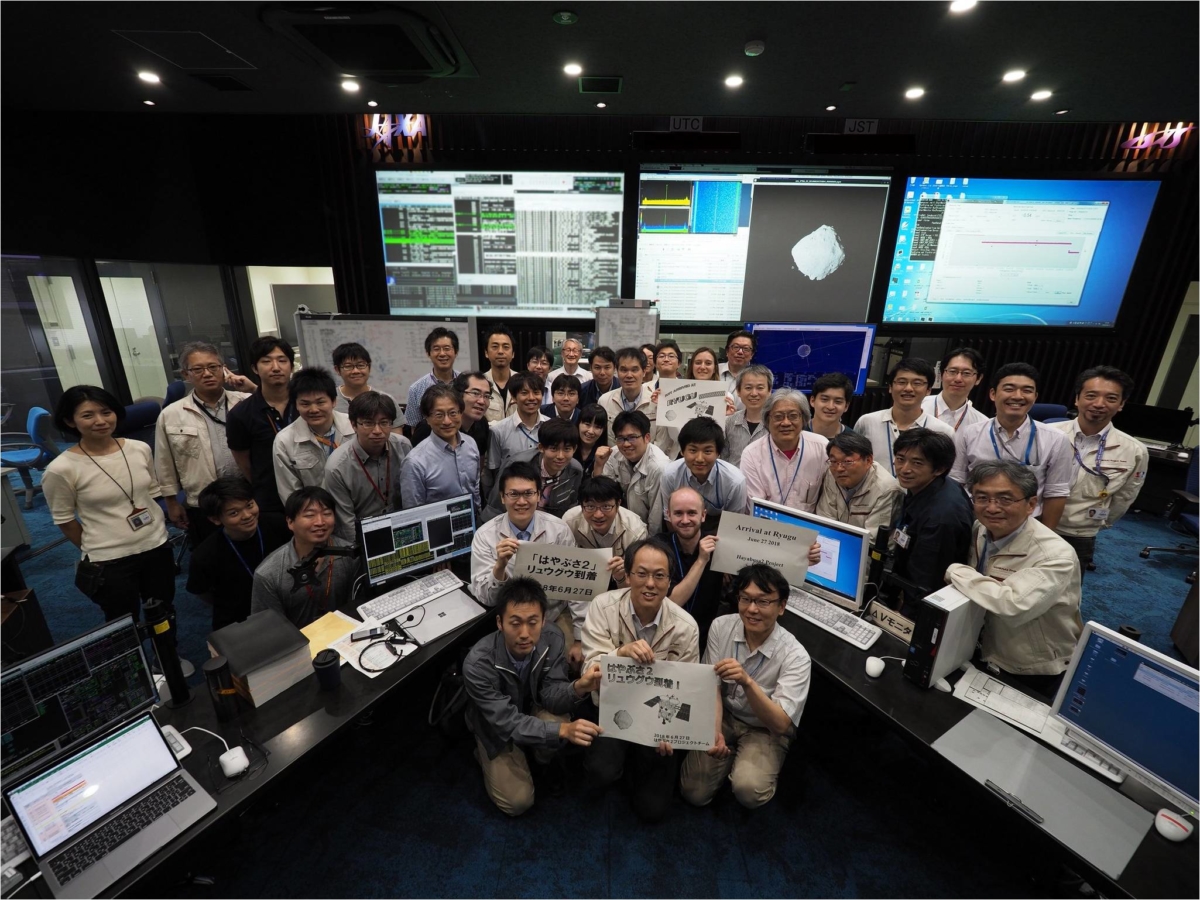
Hayabusa2 project members.
Credit: JAXA
■ Yuichi Tsuda, Hayabusa2 Project Project Manager
I cannot find words to express how happy I am that we were able to realize mobile exploration on the surface of an asteroid. I am proud that Hayabusa2 was able to contribute to the creation of this technology for a new method of space exploration by surface movement on small bodies.
■ Makoto Yoshikawa, Hayabusa2 Project Mission Manager
I was so moved to see these small rovers successfully explore an asteroid surface because we could not achieve this at the time of Hayabusa, 13 years ago. I was particularly impressed with the images taken from close range on the asteroid surface.

Photo captured by Rover-1A on September 22. It was taken on Ryugu’s surface during a hop. The left-half is the surface of Ryugu, while the white region on the right is due to sunlight.
Credit: Hayabusa2 Project
It is the world’s first human-made object to explore movement on an asteroid’s surface.
That’s the word from Japan Aerospace Exploration Agency (JAXA) scientists.
On September 21, the small compact MINERVA-II1 rovers separated from JAXA’s Hayabusa2 spacecraft.

Artist’s view of MINERVA-II1 rovers.
Credit: JAXA
In good condition
The MINERVA-II1 consists of two rovers, Rover-1A and Rover-1B. Ground controllers have confirmed both rovers landed on the surface of asteroid Ryugu.
The two rovers are in good condition and are transmitting images and data. JAXA also confirmed they both are moving on Ryugu’s surface.
MINERVA-II1 is the world’s first rover (mobile exploration robot) design to land on the surface of an asteroid. This is also the first time for autonomous movement and picture capture on an asteroid’s surface.

Space X’s Elon Musk gives boost to Moon-bound Yusaku Maezawa.
Credit: SpaceX
A message from #dearMoon Project Host Curator, Yusaku Maezawa:
I choose to go to the Moon, with artists.
If Pablo Picasso had been able to see the moon up-close, what kind of paintings would he have drawn?
If John Lennon could have seen the curvature of the Earth, what kind of songs would he have written?
If they had gone to space, how would the world have looked today?
People are creative and have a great imagination.
We all have the ability to dream dreams that have never been dreamt, to sing songs that have never been sung, to paint that which has never been seen before.
I hope that this project will inspire the dreamer within each of us.

Credit: #dearMoon Project/Screengrab
Together with Earth’s top artists, I will be heading to the moon… just a little earlier than everyone else.
I am truly blessed by this opportunity to become Host Curator of “#dearMoon”.

Credit: #dearMoon Project/Screengrab
I would like to thank Elon Musk and SpaceX for creating the opportunity to go around the moon in their BFR. I would also like to thank all those who have continuously supported me.
I vouch to make this project a success. Stay tuned!
— Yusaku Maezawa
For more information, go to:

Studio Samira Boon has created woven self supported origami structures from a single sheet of fabric and woven self supportive arc.
Credit: Studio Samira Boon
High-performance textiles and the flexible nature of origami are transforming architecture plans for smart human habitats and research stations on the Moon and Mars.
MoonMars is a collaboration between the International Lunar Exploration Working Group (ILEWG), ESA-ESTEC, research institutions and textile architect studio Samira Boon.
Digital weaving
The MoonMars team has incorporated origami structure into digital weaving processes to sculpt complex forms that are compact to transport and easy to deploy through inflatable, pop-up or robotic mechanisms in extraterrestrial environments.
The angled facets of origami structures mean that incoming micrometeorites are less likely hit surfaces at 90 degrees, dissipating the energy of potential impacts and the risks of penetration, thus protecting astronauts inside habitats.

A woven self supported origami dome from a single sheet of fabric and woven self supportive arc.
Credit: Studio Samira Boon
Solar panels embedded in shape-shifting textiles can follow the Sun to gather more energy through the day. Transparent and opaque facets can change direction to alter internal lighting and climate conditions.
Field testing
The results from initial field tests of the MoonMars project’s origami prototype have been presented at the European Planetary Science Congress (EPSC) 2018, held this week in Berlin.
“Origami structures made of textiles can be unfolded into a myriad of different shapes. They are lightweight. They can be easily deployed and re-used in different configurations and sizes for flexible spatial usage. Structures remain functional in changing circumstances, thereby extending their useable life-span,” explains Anna Sitnikova, leader of the MoonMars project on behalf of the ILEWG.

The prototype was deployed and tested to extreme conditions on the April 20 during the EuroMoonMars2018 simulation at ESA – ESTEC. The origami structure was designed as a gateway and sub-system between the exo-habitat, airlock system and exo-laboratory.
Credit: Anna Sitnikova
The MoonMars team is now planning an ambitious series of trials for 2019. In June, the IGLUNA project, led by the Swiss Space Center, will include tests of an origami habitat in the glacier above Zermatt in Switzerland. In September 2019 the team will travel to Iceland to participate in a campaign inside a lava-tube cave system.

