Author Archive
 Author:
  November 12th, 2018
Credit: NASA/ESA
The European Space Agency (ESA) is pressing forward on European payloads that could be contributed to a possible Moon exploration campaign.
A just-released request for information (RFI) is one leg of a campaign to be implemented within the framework of the European Space Exploration Envelope Program, subject to decisions at the ESA Council Meeting at Ministerial level planned for December 2019.

Credit: NASA
Moon missions
The campaign is focused on access to the Moon via missions as early as 2020, categorized as:
– Missions of Opportunity: where European payloads respond to flight opportunities made available by the private sector or international partners.
– Directed missions: where European payloads are contributed to missions that are defined and driven by ESA alone or with international partners, to achieve a predefined set of objectives.

Lunar base made with 3D printing
Credit: ESA/Foster + Partners
HERACLES
Another purpose of the RFI is establishment of a straw man payload for an ongoing ESA directed mission study, conducted with international partners, on a human lunar exploration precursor mission called HERACLES, mercifully short for Human-Enhanced Robotic Architecture and Capabilities for Lunar Exploration and Science.

Inside look at one idea the European Space Agency is exploring in its formulation of a “Moon Village” that incorporates 3D printing.
Credit: ESA/ Foster + Partners
The HERACLES mission study currently conceives of cooperation with the Canadian Space Agency (CSA) , the Japanese Space Exploration Agency (JAXA) and NASA with a launch not earlier than 2026; noting that the study is open to the inclusion of other agencies that may be interested to join the partnership.

An international team of lunar researchers has blueprinted an exploration scenario for humans and robots to investigate five sites on the Moon.
Credit: E.J. Allender et al./Advances in Space Research
Science topics
Payloads of interest for Missions of Opportunity include both scientific instrumentation and payloads for technology demonstration and testing.
Examples of scientific topics that could be addressed, but are not limited to:
- The bombardment history of the inner solar system
- The structure and composition of the lunar interior
- The diversity of lunar crustal rocks
- Volatiles at the lunar poles
- Volcanism
- Impact processes
- Regolith processes
- Atmospheric and dust environment
- Life sciences and astrobiology
- Fundamental physics
- Astronomy
- Space resource utilization
Technological topics
Areas of interest for technology demonstration payloads include, but are not limited to:
- Precision landing
- Hazard avoidance
- Mobility
- Autonomy
- Robotics
- Power generation and energy storage
- Low temperature operations and survival
- Dust mitigation
- Space Resource Utilization
- Communication/ navigation
Responses to this ESA-issued RFI are due December 15, 2018.
For more information, go to:
 Posted in

Opportunity views sunrise on Mars.
Credit: NASA/JPL
NASA’s Opportunity Mars rover has been silent, perhaps temporarily, following a dust-up with the Red Planet.
But researchers have created the soundtrack of the 5,000th Mars sunrise captured by Opportunity using “data sonification” techniques to create a two-minute piece of music.
Pixel by pixel
The piece of music was produced by scanning a picture from left to right, pixel by pixel, and looking at brightness and color information and combining them with terrain elevation. They used algorithms to assign each element a specific pitch and melody.

Tuning up to Mars, Domenico Vicinanza of Anglia Ruskin University.
Credit: Domenico Vicinanza
The maestros of Mars, Domenico Vicinanza of Anglia Ruskin University and Genevieve Williams of the University of Exeter will present the world premiere of the piece, entitled Mars Soundscapes in the NASA booth at the forthcoming Supercomputing SC18 Conference in Dallas next week.
The piece will be presented using both conventional speakers and vibrational transducers so the audience could feel the vibrations with their hands, thus enjoying a first-person experience of a sunrise on Mars.

Mars soundscapes.
Credit: Domenico Vicinanza
Flexible technique
In a press statement, Vicinanza, Director of the Sound and Game Engineering (SAGE) research group at Anglia Ruskin noted:
“Image sonification is a really flexible technique to explore science and it can be used in several domains, from studying certain characteristics of planet surfaces and atmospheres, to analyzing weather changes or detecting volcanic eruptions.”
In health science for example, Vicinanza says it can provide scientists with new methods to analyze the occurrence of certain shapes and colors, which is particularly useful in image diagnostics.
Give a listen to this:
https://www.youtube.com/watch?v=loXhsglsG-w&feature=youtu.be

Credit: National Geographic
National Geographic has officially launched Starstruck – a celebration of space across its global networks, magazines, books and more.
For starters, check out MARS: INSIDE SPACEX, premiering Monday, November 12, at 8 p.m. eastern, an unprecedented glimpse into SpaceX and Elon Musk’s plans to make Mars home.
For more information, go to:
http://www.natgeotv.com/int/mars-inside-spacex
Docudrama
Then stay tuned for the start of Season 2 of National Geographic’s TV docudrama MARS premiering on November 12 at 9 p.m. eastern.
MARS Season 2 trailer and Season 1 Recap –
https://www.nationalgeographic.com/tv/mars/clips
MARS Season 1 that premiered in 2016 (six episodes) –
https://www.nationalgeographic.com/tv/mars

Credit: National Geographic
For U.S. and international viewers, look for my book that’s now in six languages and coming out in Chinese shortly: Mars: Our Future on the Red Planet is the companion volume to the National Geographic Channel MARS TV series Season 2, a six-part docudrama that begins on November 12th. The book takes a look at the promise, problems, and potential pitfalls as humans land on and learn to live on Mars.
“This big, welcoming book—brimming with mind-revving photographs and artists’ conceptions and written with verve and precision by David—provides the foundation on which the scientifically rigorous, speculatively imaginative series was built.” —Booklist
Go to these sites or wherever books or sold:
https://shop.nationalgeographic.com/products/mars
https://www.amazon.com/Mars-Our-Future-Red-Planet/dp/1426217587
https://www.barnesandnoble.com/w/mars-leonard-david/1123480431?ean=9781426217586

Credit: National Geographic
International outreach
Here are some links for our international readers to the book in these languages:
German – https://verlagshaus24.de/mensch-und-natur/erde-und-weltall/mars
Italian – http://www.whitestar.it/prodotto/marte-la-storia-del-nostro-futuro-sul-pianeta-rosso
Japanese – http://natgeo.nikkeibp.co.jp/atcl/product/16/101400029
Dutch – http://www.fontaineuitgevers.nl/wp/mars
Portuguese – http://www.marcador.pt/conteudo/373-marte
The book is also available in Greek and forthcoming in Chinese. We will post those direct links as they become available. If you want to read these international websites in English, your browser should have a clickable link to translate them for you.

Artist’s impression of the ExoMars 2020 rover and Russia’s stationary surface platform in background.
Credit:
ESA/ATG medialab
Mars is going to be a busy place in 2021.
The U.S., China, and Europe will attempt robotic Mars landings, with the United Arab Emirates slated to send an orbiter towards the Red Planet.

ExoMars 2020 landing site candidates on elevation map.
Credit: NASA/JPL
The increasing pace of Mars exploration was shown last week by an ExoMars Landing Site Selection Working Group recommendation of Oxia Planum as the touchdown locale for the European Space Agency-Roscosmos rover and surface science platform that will launch to the Red Planet in 2020.
Clear winner
This proposed landing site will be reviewed internally by ESA and Roscosmos with an official confirmation expected mid-2019. Previously, Oxia Planum and Mawrth Vallis have both been under active study. Oxia Planum has been deemed “the clear winner” on both science and engineering constraints.
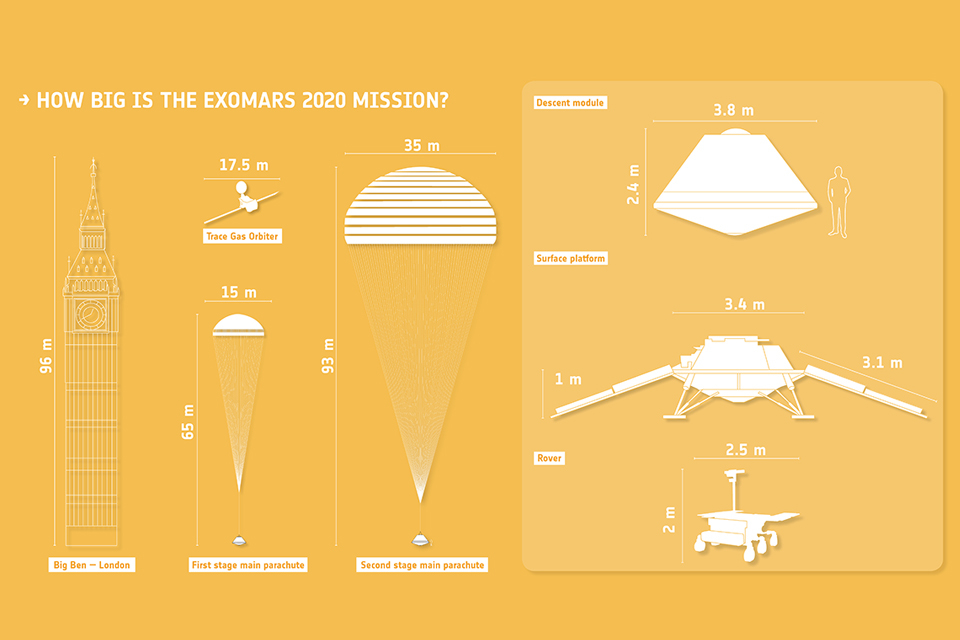
Sizes of key components of the ExoMars 2020 mission.
Credit: ESA
The ESA-led rover and Roscosmos-led surface science platform will launch in the July 25-August 13, 2020 launch window on a Proton-M rocket from Baikonur, Kazakhstan, and cruise to Mars in a carrier module containing a single descent module, arriving at Mars March 19, 2021.
Mars underground
At the heart of the ExoMars program is the quest to determine if life has ever existed on Mars. The ExoMars rover will travel across the Martian surface and drill down 6 feet (2 meters) depth to determine if evidence of life is buried underground.
Oxia Planum lies at the boundary where many channels emptied into the vast lowland plains. Observations from orbit show that the region exhibits layers of clay-rich minerals that were formed in wet conditions some four billion years ago, likely in a large body of standing water.

Europe’s ExoMars 2020 rover.
Credit: ESA
Also, Oxia Planum offers a safety margin for entry, descent and landing, as well as terrain that the rover can easily navigate to sites of scientific interest.
The ExoMars landing ellipse has low elevation and contains very few topographic obstacles or challenging slopes.

Curiosity Mastcam Left image taken on Sol 2225, November 9, 2018.
Credit: NASA/JPL-Caltech/MSSS
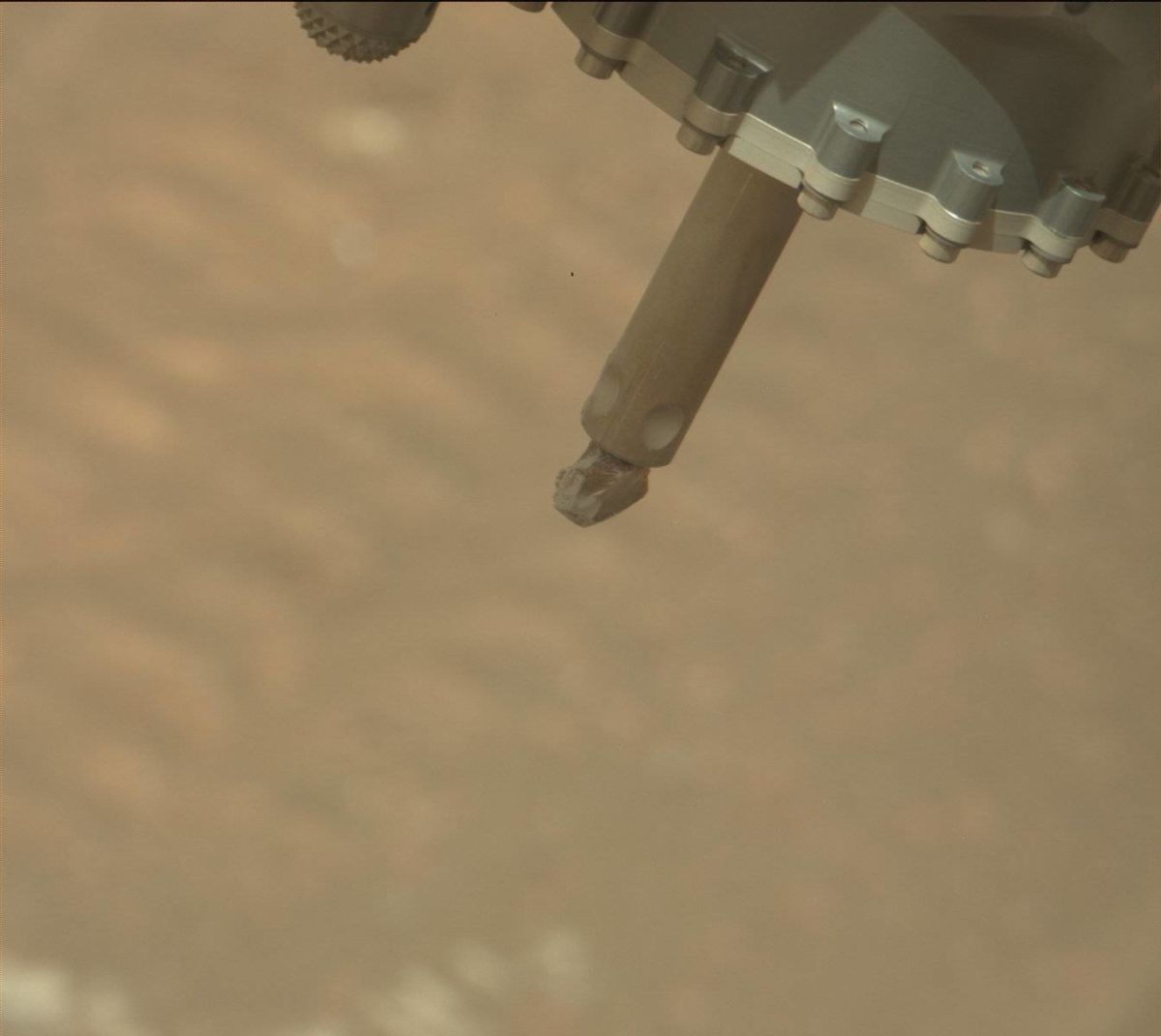
Mastcam Right image acquuired on Sol 2225, November 9, 2018.
Credit: NASA/JPL-Caltech/MSSS
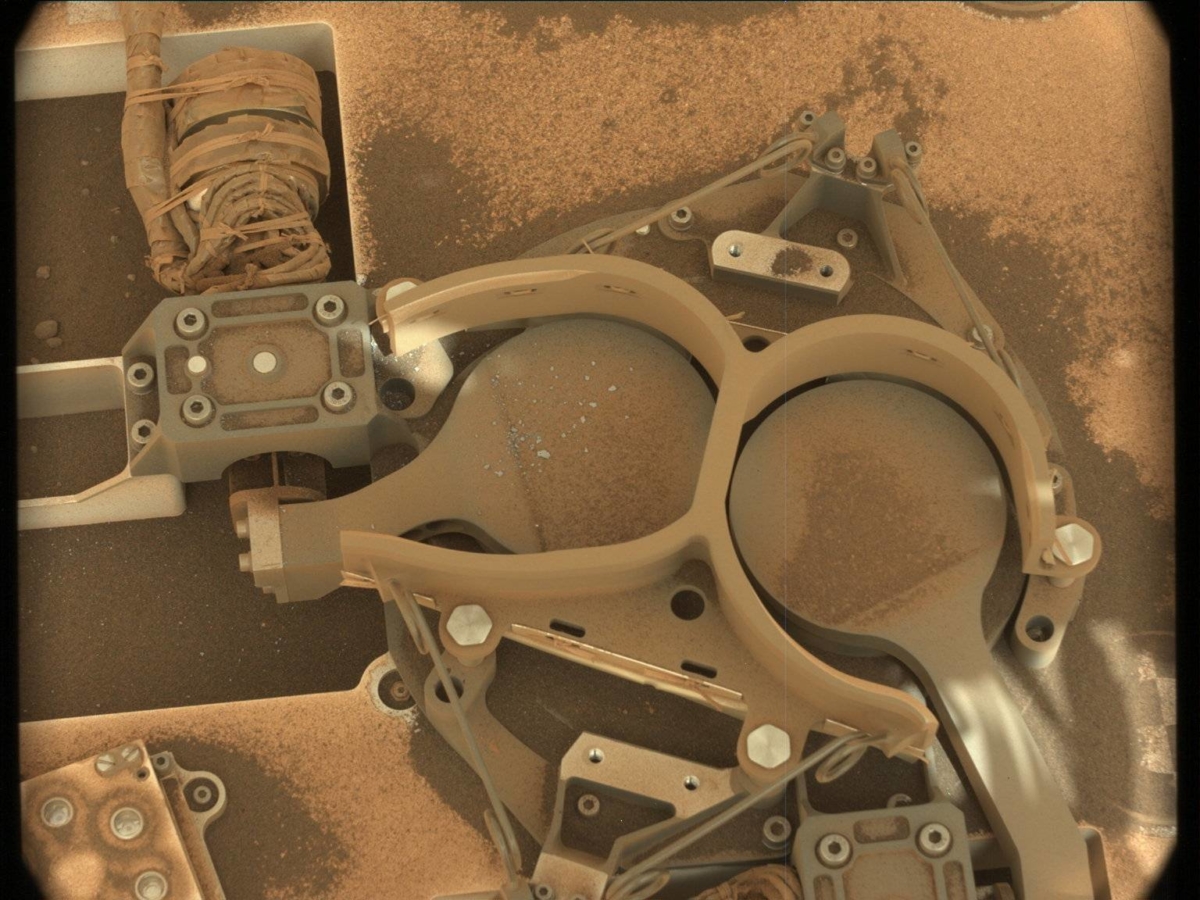
Curiosity Mastcam Left image taken on Sol 2225, November 9, 2018.
Credit: NASA/JPL-Caltech/MSSS

Mars Hand Lens Imager (MAHLI) image produced on Sol 2224, November 8, 2018. MAHLI is located on the turret at the end of the rover’s robotic arm
Credit: NASA/JPL-Caltech/MSSS
Now in Sol 2226, NASA’s Curiosity Mars rover is performing post-drilling tasks – the 18th drill hole completed by the robot.
New imagery from Curiosity shows the new drill site and self-inspection.
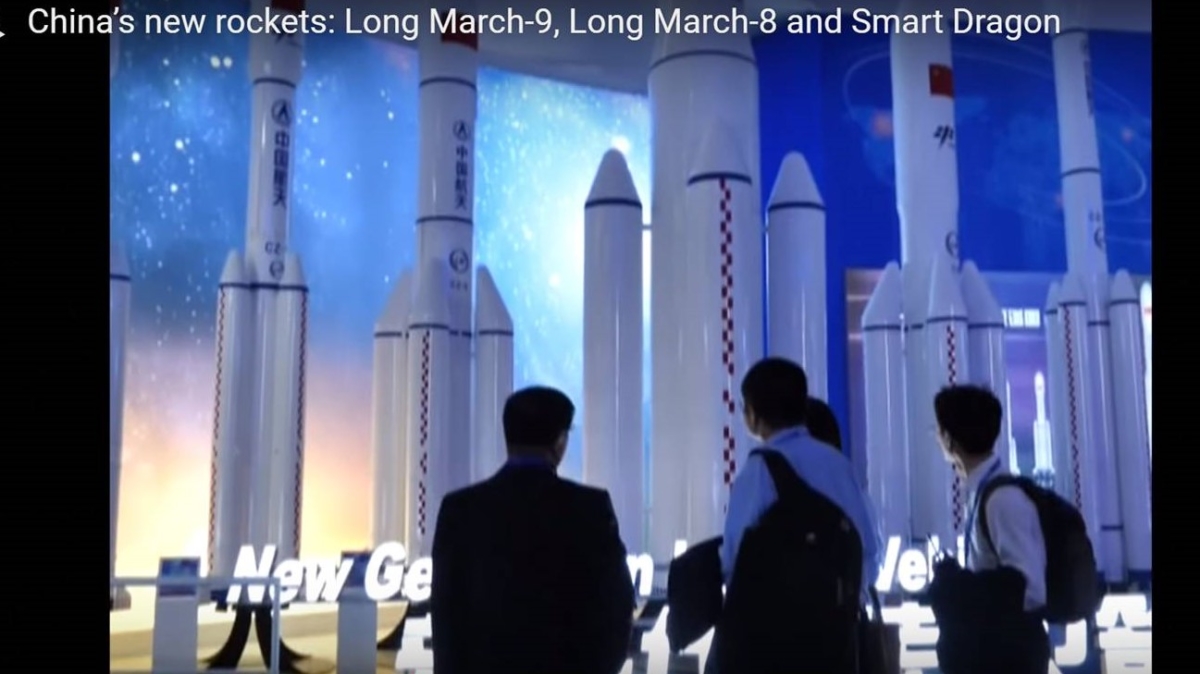
Credit: CCTV/Screengrab/Inside Outer Space
China’s new rockets, Long March-9, Long March-8 and Smart Dragon, were presented at the China International Aviation and Aerospace Exhibition, in Zhuhai, Guangdong Province.
Long March-9 (Chang Zheng-9) is a heavy-lift launch vehicle designed to carry a payload of 140 tonnes into low-Earth orbit and 50 tonnes into Earth-Moon transfer orbit.
China plans to launch Long March-9 around 2030.

Zhang Zhi, chief designer of Long March-9
Credit: CCTV/Screengrab/Inside Outer Space
Long March-8 (Chang Zheng-8) is a medium-lift launch vehicle, expected to make its maiden flight in 2020.
Smart Dragon No.1 or Lightning Dragon No.1 is the first rocket in the Lightning Dragon series, developed by ChinaRocket under the China Aerospace Science and Technology Corporation.
For this CCTV video, go to:
https://youtu.be/G6y_vBaIALo?list=PLpGTA7wMEDFjz0Zx93ifOsi92FwylSAS3
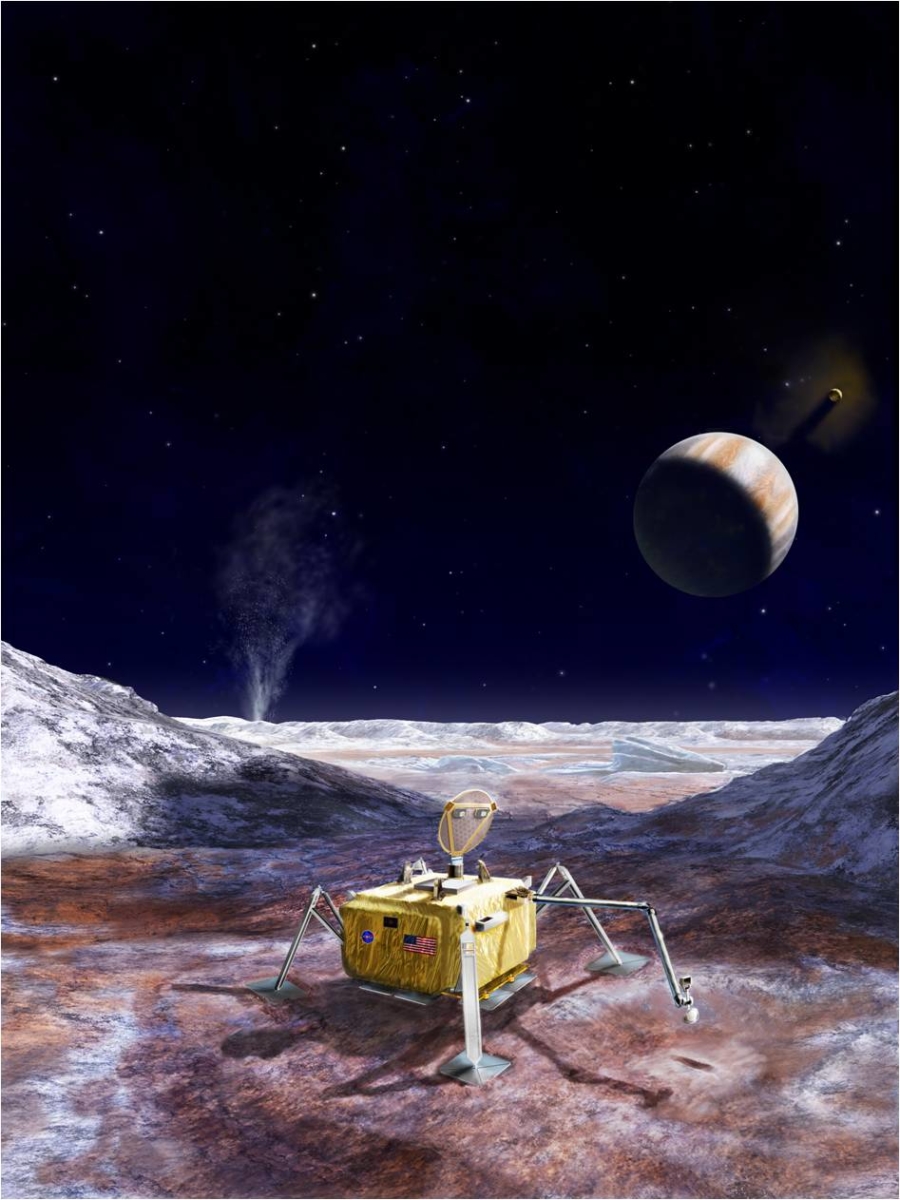
This artist’s rendering illustrates a conceptual design for a potential future mission to land a robotic probe on the surface of Jupiter’s moon Europa.
Credit: NASA/JPL-Caltech
Space scientists have been pinning their astrobiological hopes for a lander mission to Europa using political glue. Given the midterm elections, has the Europa lander project been put on ice?
As reported by FYI of the American Institute of Physics (AIP) and posted here with permission:
Rep. John Culberson (R-TX), who chairs the Commerce-Justice-Science Appropriations Subcommittee, lost his election in his Houston-area district.
Life beyond Earth
Culberson is an enthusiastic proponent of science and space exploration, and, since taking over as subcommittee chair in 2014, he has channeled years of funding increases to NASA, which has included adding nearly $800 million to the annual budget of the Planetary Science Division.
Culberson’s support for NASA has been driven largely by his conviction in the inherent value of its mission, and he has hoped that, with proper support, the agency will succeed in finding evidence of life beyond the Earth.
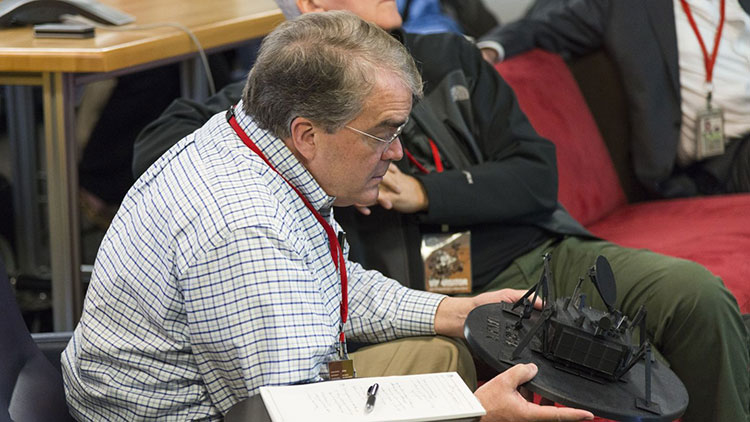
Rep. John Culberson (R-TX) examining a Europa lander model during a visit to NASA’s Jet Propulsion Laboratory.
Credit – NASA/JPL-Caltech via AIP
Accordingly, he has secured funding in recent budget cycles to advance two missions to Jupiter’s moon Europa. However, Culberson’s enthusiasm for space research was turned against him by his Democratic opponent, who accused him of not paying enough attention to Earth-bound problems such as the flooding from Hurricane Harvey.
Europa Clipper
There is agreement in the government that the Europa Clipper, which will perform multiple flybys, should be supported.
However, the Obama and Trump administrations have resisted Culberson’s push for a follow-on lander and an aggressive launch schedule for both missions.
A recent National Academies report also noted that the lander mission has not been properly vetted as a priority by the scientific community. Even in the minority, Culberson might have been a forceful advocate for his priorities. In his absence, momentum behind the lander could dissipate, and the fate of the budget increases he has marshalled for NASA remains to be seen.
Science agencies
Culberson’s subcommittee also has jurisdiction over the National Science Foundation, National Oceanic and Atmospheric Administration, and National Institute of Standards and Technology.
In general, Culberson has been favorably disposed to those agencies, though the subcommittee has recommended cuts to certain programs. However, Ranking Member José Serrano (D-NY) and other subcommittee Democrats have also spoken positively of the need to fund science agencies robustly.
For the full FYI AIP report, go to:
https://www.aip.org/fyi/2018/2018-midterm-election-results-outlook-science-policy
For the Europa Lander Study 2016 Report, go to:
https://europa.nasa.gov/resources/58/europa-lander-study-2016-report/
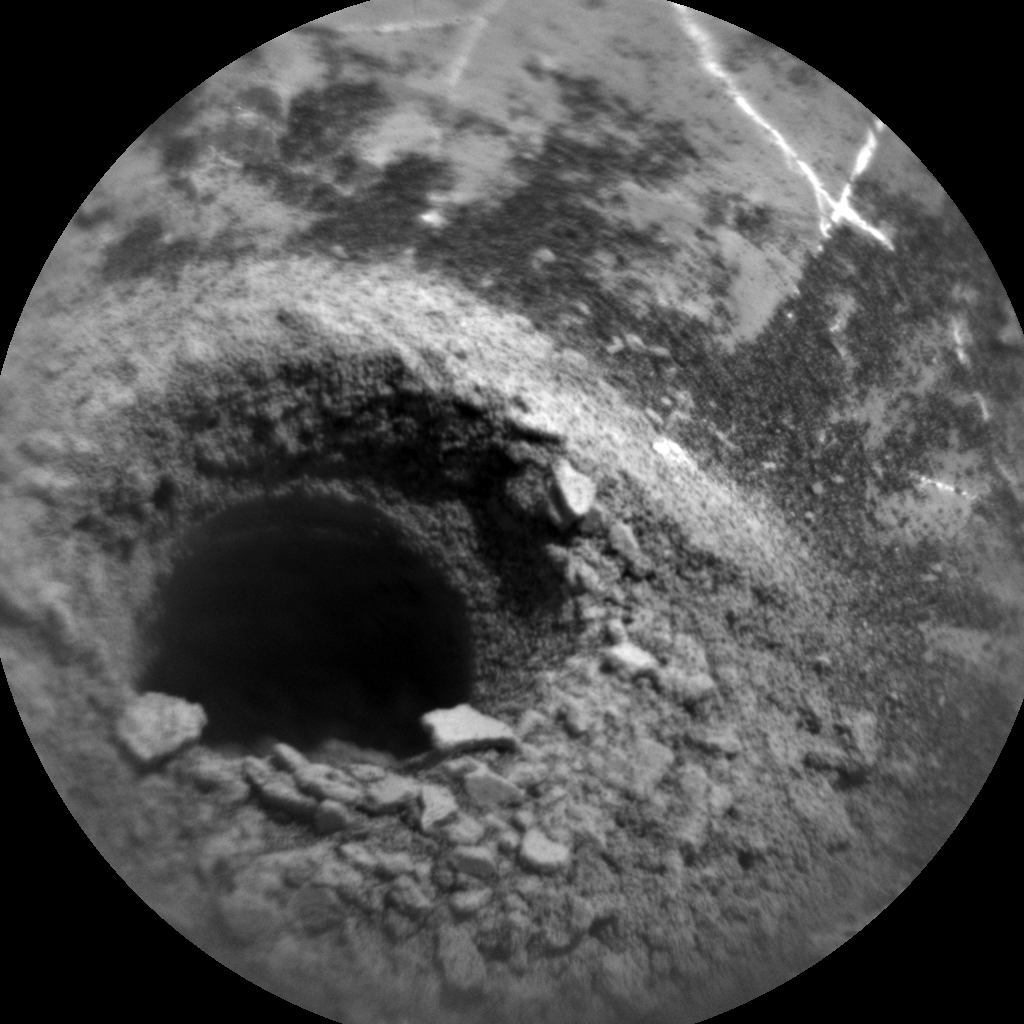
ChemCam Remote Micro-Imager photo taken on Sol 2225, November 9, 2018.
Credit: NASA/JPL-Caltech/LANL
NASA’s Curiosity Mars rover is now in Sol 2225 following a successful drilling in the “Highfield” target.
Reports Claire Newman, an atmospheric scientist at Aeolis Research in Pasadena, California: “Our eighteenth drill hole in the martian surface!”
“Not quite a ‘hole in one,’ as we tried to sample the same gray Jura rock type about 50 sols ago, but we finally have a sample of our highest value target on Vera Rubin Ridge,” Newman adds. “Rather than retreat to the club house for a well-earned celebration, however, Curiosity and the team stayed busy in Sol 2225, doing Mastcam and Chemistry and Camera (ChemCam) imaging of the new drill hole and tailings.”
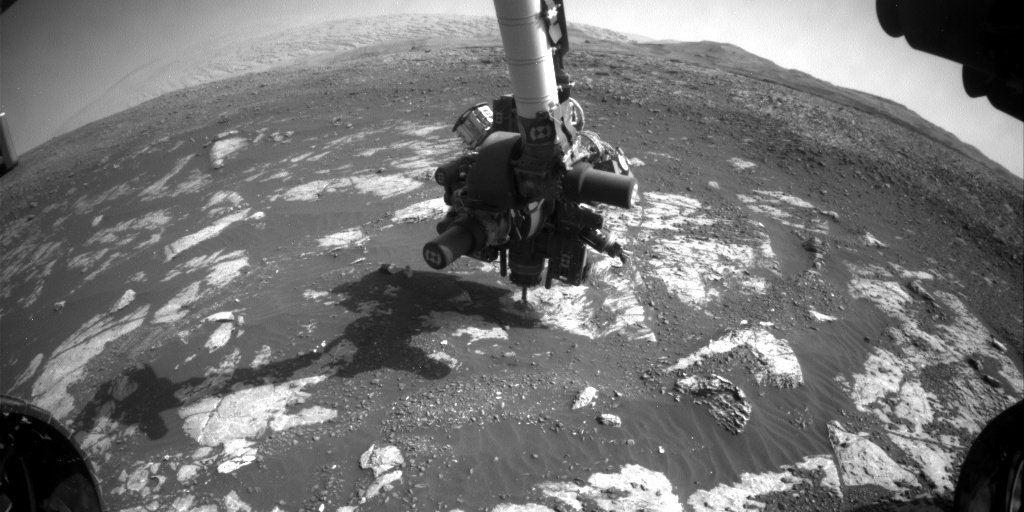
Curiosity Front Hazcam Left A image acquired on Sol 2224, November 8, 2018.
Credit: NASA/JPL-Caltech
Weekend plan
A weekend plan calls for further imaging of the drill hole and use of ChemCam’s Laser-Induced Breakdown Spectrometer (LIBS). Samples are to be dropped off to the rover’s Chemistry & Mineralogy X-Ray Diffraction/X-Ray Fluorescence Instrument (CheMin) for further analysis.
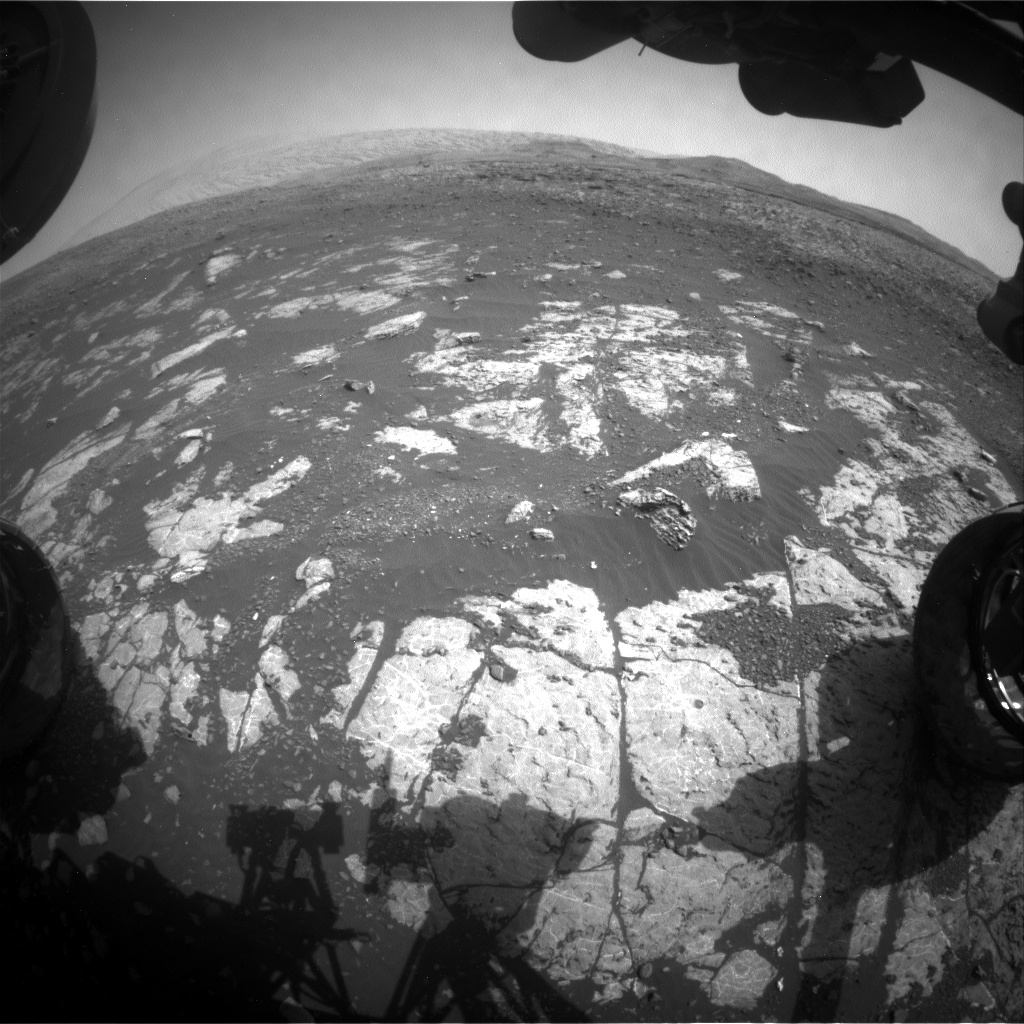
Curiosity Front Hazcam Right A photo acquired on Sol 2225, November 9, 2018.
Credit: NASA/JPL-Caltech
“In addition, there’s a packed program of environmental science over the next few sols, now that we’re back to full science operations,” Newman explains. “The global dust storm may have decayed, but we’re still interested in seeing whether the post-storm atmosphere differs compared to the same season in previous Mars years when no big storm occurred.”

Curiosity Navcam Right A photo acquired on Sol 2225, November 9, 2018.
Credit: NASA/JPL-Caltech
Convective vortices
Newman points out that the robot is still in the middle of southern summer, which means lots of ‘dust devils’ (dust-filled convective vortices) and more dust than usual in the atmosphere.
“So in addition to our regular meteorological (REMS), radiation (RAD), and sub-surface (DAN) monitoring, we added atmospheric opacity measurements and a 360° dust devil survey,” Newman adds. “Over the weekend, alongside the drill sample analysis, there will be a bumper crop of atmospheric activities.”
Sky survey
Those activities include characterizing the amount and size distribution of dust and water ice aerosols at different times of sol, in and above the crater, by means of a Mastcam ‘sky survey’ and opacity measurements, a ChemCam ‘passive sky’ activity, and Navcam cloud movies. “We’ll also take a dust devil movie as well as two more dust devil surveys.” Newman says.
Martian wind
“And finally, over the next few sols we’ll be watching those drill tailings to see how quickly the martian wind moves them away and in what direction,” Newman says.
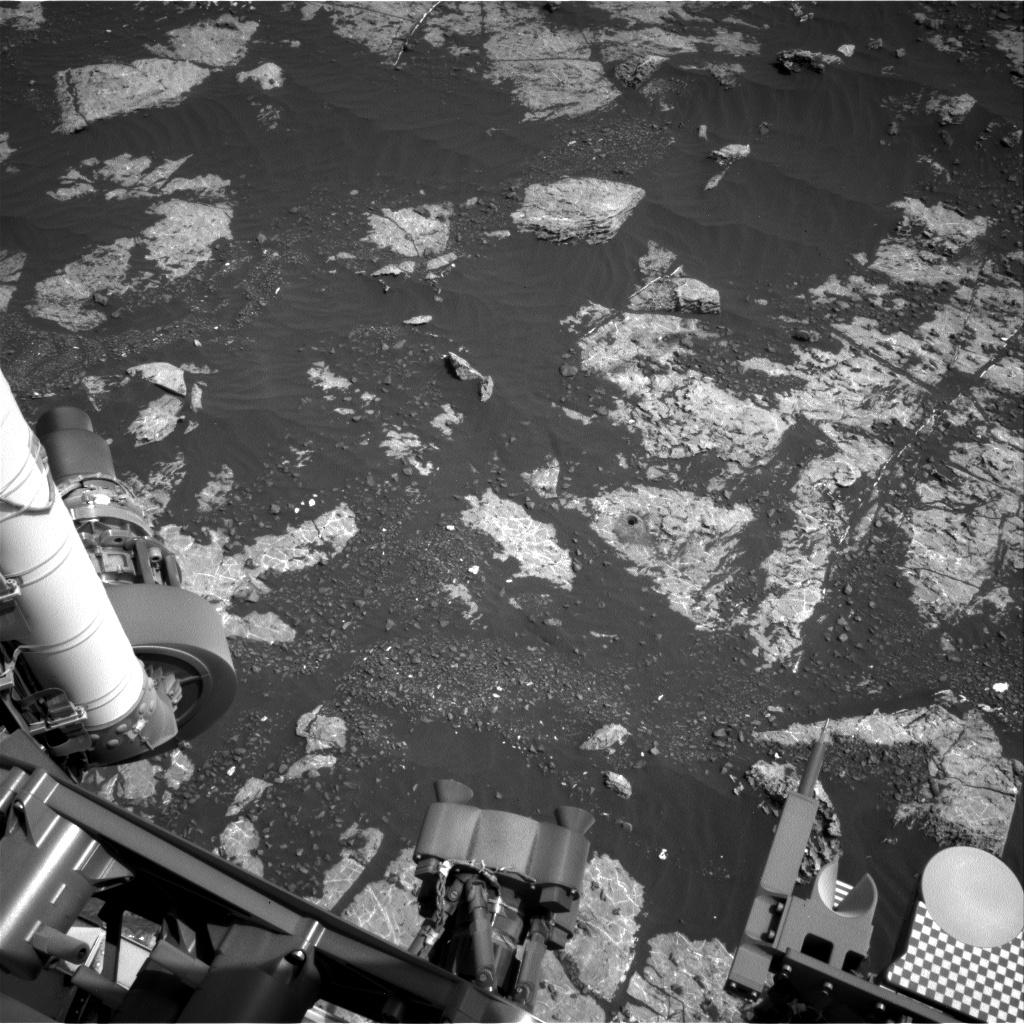
Curiosity Navcam Left A image acquired on Sol 2225, November 9, 2018.
Credit: NASA/JPL-Caltech
Also to be taken by Curiosity are ‘change detection’ images of below the rover with the Mars Descent Imager (MARDI), and of nearby grains and ripples with Mastcam, “again to see what the wind is doing at this time of year in our current location on the slope of Aeolis Mons,” Newman concludes.
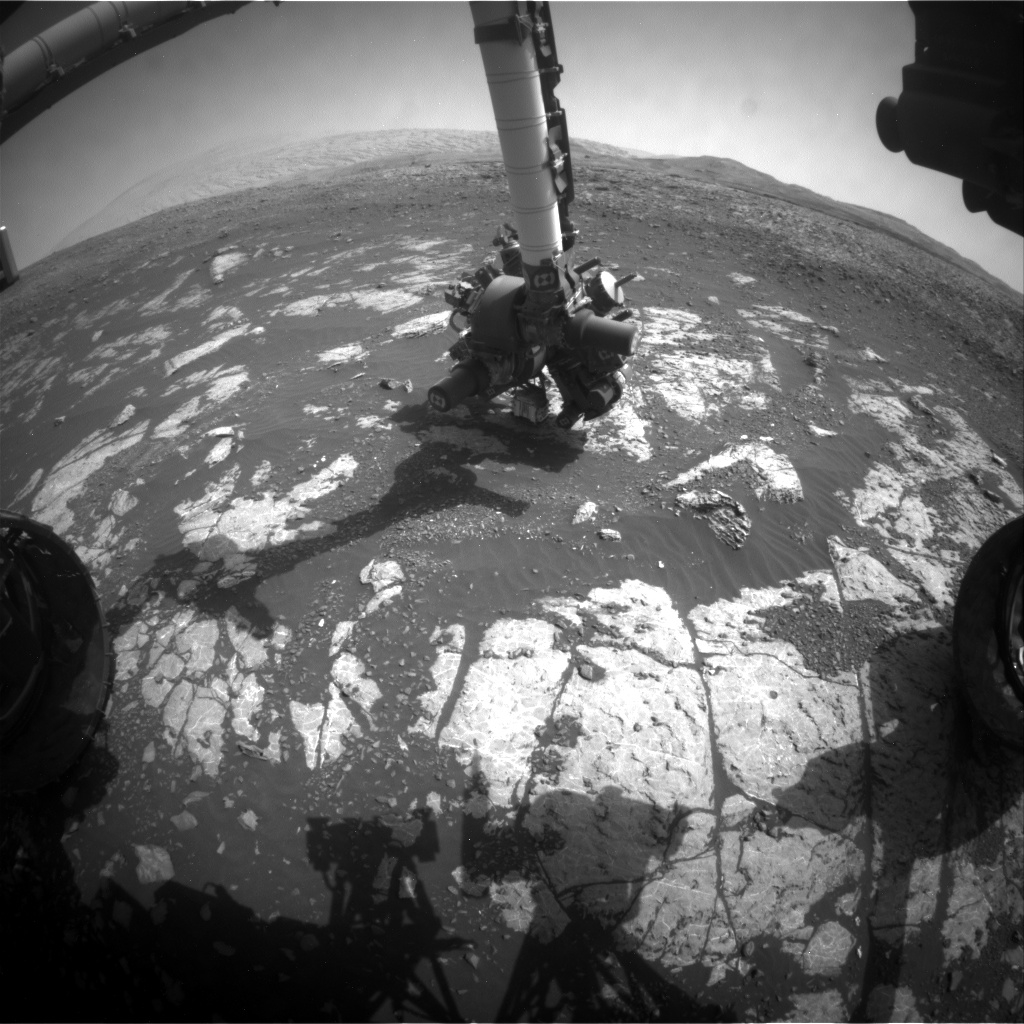
Curiosity Front Hazcam Left A photo acquired on Sol 2223, November 7, 2018.
Credit: NASA/JPL-Caltech
NASA’s Curiosity Mars rover is now performing Sol 2224 tasks.
On Sol 2222, Curiosity drove over 30 feet (roughly 10 meters) towards the “Lake Orcadie” location.
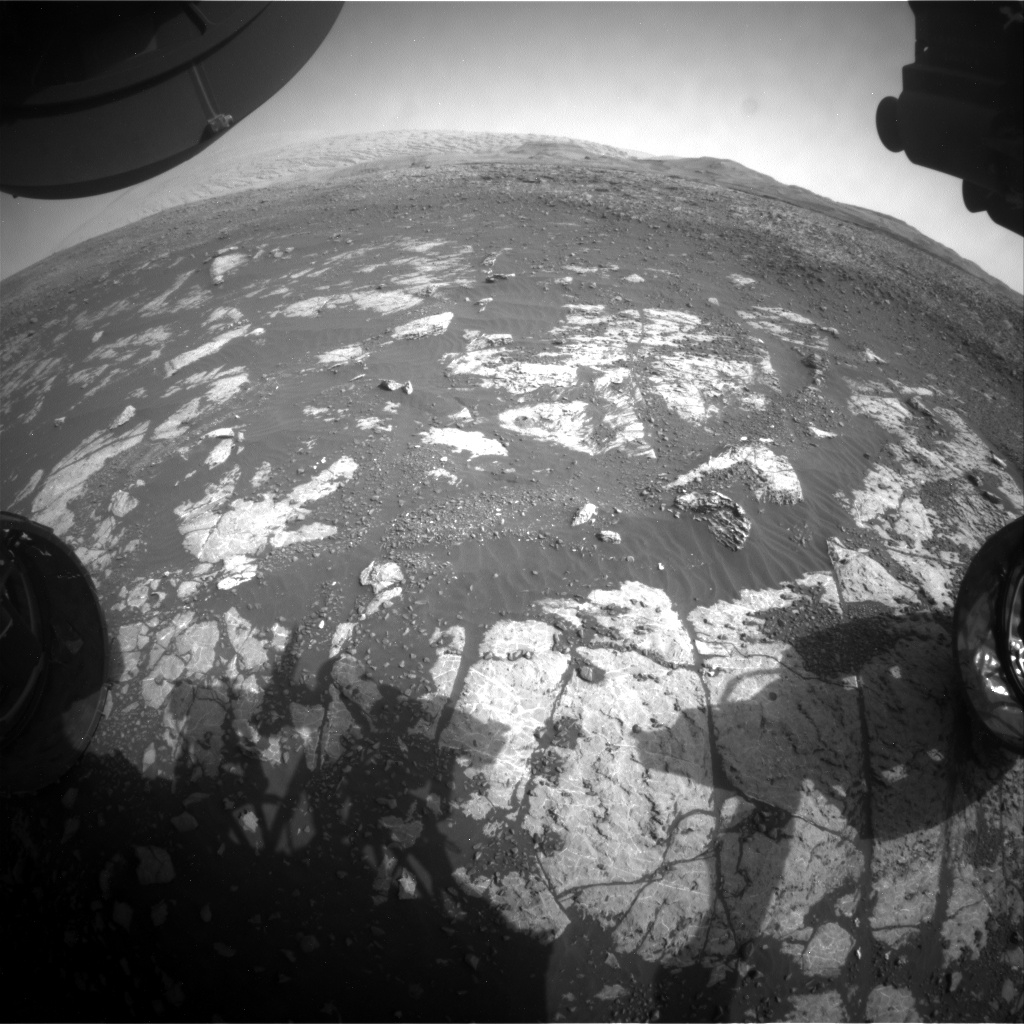
Curiosity Front Hazcam Left A image acquired on Sol 2224, November 8, 2018.
Credit: NASA/JPL-Caltech
Reports Lauren Edgar, a planetary geologist at the USGS in Flagstaff, Arizona the hopes are that the robot will be able to drill the gray Jura member there.
A new plan is focused on characterizing the target “Highfield,” a bright patch of outcrop and included pre-planned activities as part of standard drill site characterization.
Drill target prep
First Alpha Particle X-Ray Spectrometer (APXS) will carry out a short integration on the intended drill target, followed by two Mars Hand Lens Imager (MAHLI) images.

Curiosity Mastcam Right photo taken on Sol 2223, November 7, 2018.
Credit: NASA/JPL-Caltech/MSSS
Then the plan calls for use of the Dust Removal Tool to brush the target, followed by Mastcam imaging and a full suite of MAHLI images.
“Then we’ll do a drill pre-load test, which means that we’ll put weight on the drill bit to make sure the surface can support it,” Edgar notes, “and if it makes marks on the surface this might give us an indication of how hard or soft the surface is.”
Optimistic on sampling
Overnight, Curiosity will acquire a longer APXS integration on “Highfield.”
“We were pretty tight on both power and data volume…so it was a bit of a challenge to prioritize everything, but we’re optimistic that this will be our chance to sample the gray Jura member,” Edgar adds. “I’m eagerly awaiting our downlink and hoping that we’ll be ‘go’ for a full drill hole here!”
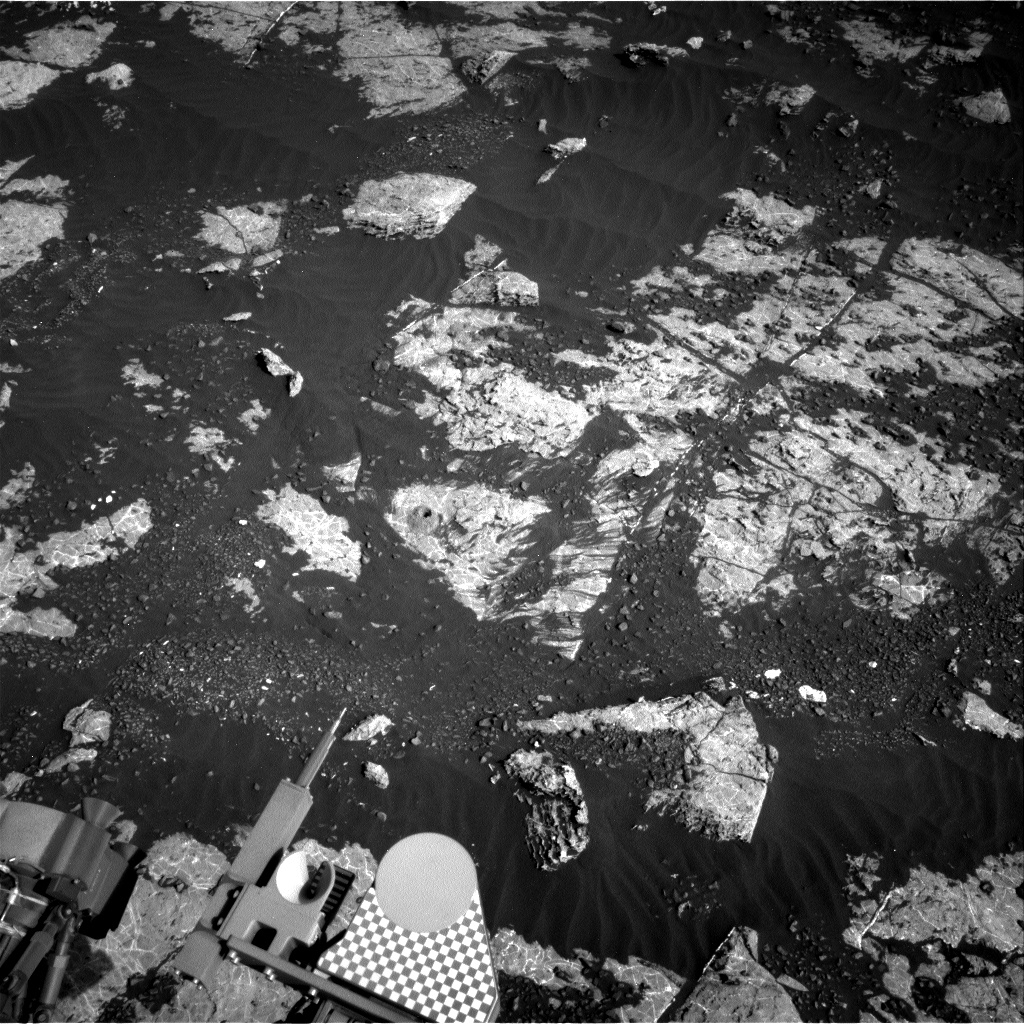
Curiosity Navcam Right A photo acquired on Sol 2224, November 8, 2018.
Credit: NASA/JPL-Caltech

Curiosity Mastcam Left image taken on Sol 2222, November 6, 2018.
Credit: NASA/JPL-Caltech/MSSS
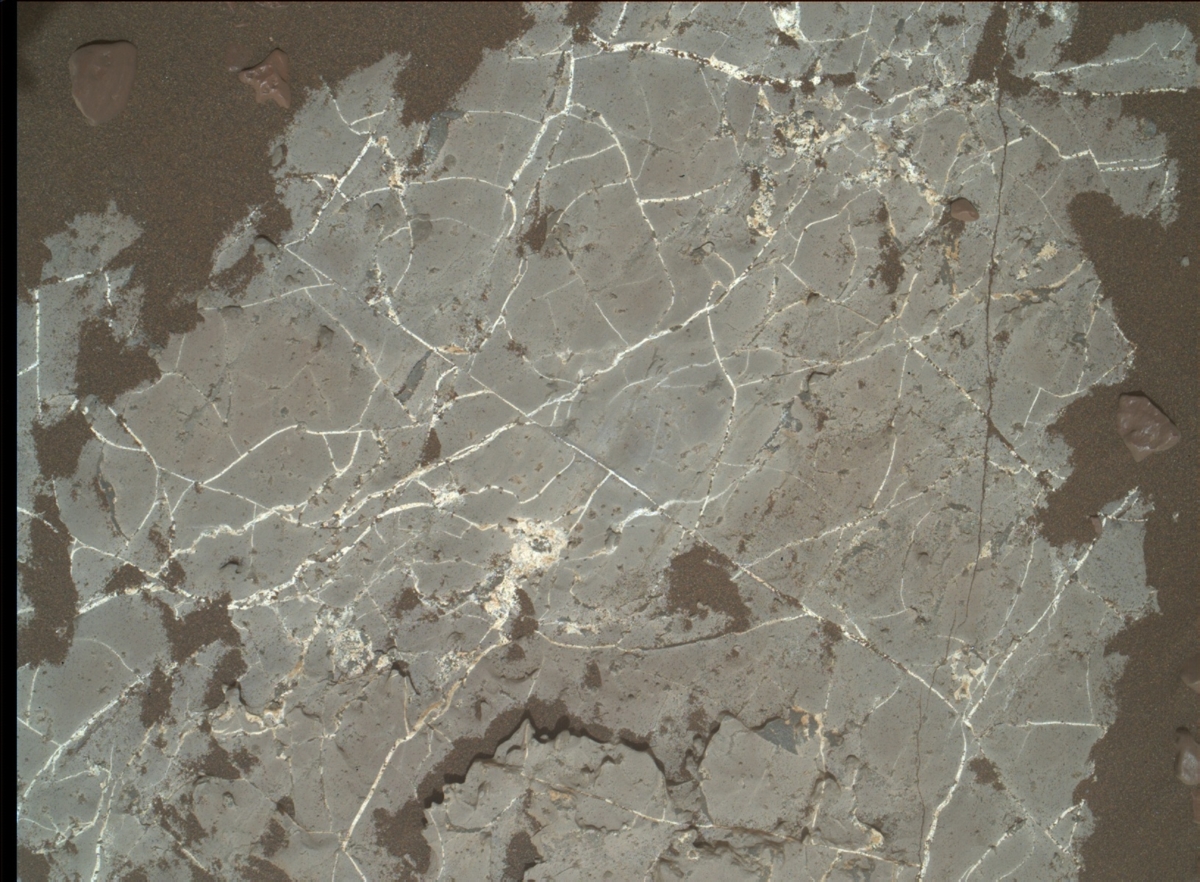
Mars Hand Lens Imager (MAHLI) photo acquired on Sol 2223, November 7, 2018. MAHLI is located on the turret at the end of the rover’s robotic arm.
Credit: NASA/JPL-Caltech/MSSS
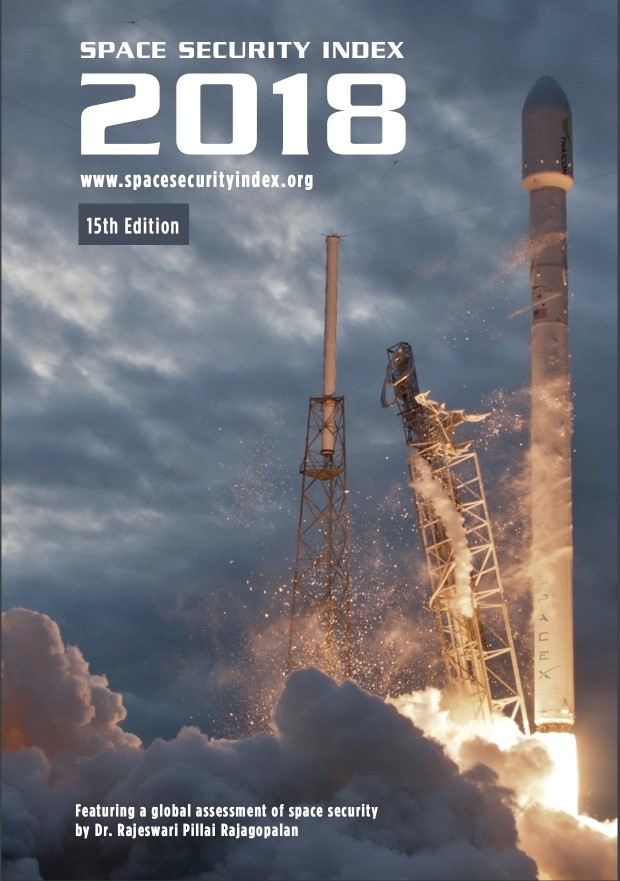
Credit: Project Ploughshares
The Space Security Index 2018 has been published by the Canadian peace-and-security think tank, Project Ploughshares.
Among key findings is noting the deteriorating security conditions in outer space in the absence of renewed governance efforts.
The just-issued report underscores:
Plans for mega-constellations of satellites that outpace sustainability rules;
A drive toward next-generation space exploration and resource extraction by private actors;
The emergence of dual-use technologies such as debris removal, satellite servicing, and maneuvering capabilities;
Continuing development and demonstration of anti-satellite capabilities;
U.S. plans for space-based ballistic missile interceptors that could mark the first deployment of space-based weapons.
Voluntary guidelines
Space Security Index 2018 also underscores the work of the UN Committee on the Peaceful Uses of Outer Space (COPUOS) that reached consensus on 21 voluntary guidelines to enhance the long-term sustainability of space activities.
In a press statement, Project Ploughshares project manager Jessica West explains that the growing geostrategic tension and mistrust discourage the development of constraints on the use of force in outer space. This lack of regulation has serious repercussions.
Space access
West asserts that space security is global security. Every facet of well-being – military security, humanitarian security, socioeconomic security, and environmental security – depends on the ability to access and use services from outer space. Dangerous activities could pollute the outer-space environment beyond repair through the production of space debris, limiting or ending such services.
Space Security Index 2018 was produced by civil society and academic organizations under the leadership of Canadian nonprofit organization Project Ploughshares. Partners include The Simons Foundation Canada; the Institute of Air and Space Law at McGill University in Montreal, Quebec; the Space Policy Institute at The George Washington University in Washington, DC; the Research Unit on Military Law and Ethics at the University of Adelaide Law School in Australia; and the School of Law at Xi’an Jiaotong University in China.
For a copy of the report, go to:
http://spacesecurityindex.org/wp-content/uploads/2018/06/C014894_space.security.2018-hires.pdf

