Author Archive
 Author:
  January 28th, 2019
Picture perfect: A selfie taken by NASA’s Curiosity Mars rover on Sol 2291 (January 15) at the “Rock Hall” drill site, located on Vera Rubin Ridge.
This was Curiosity’s 19th drill site. The drill hole is visible to the rover’s lower-left.
Credit: NASA/JPL-Caltech/MSSS
NASA’s Curiosity Mars rover has just begun Sol 2304 duties, with Red Planet scientists looking forward to the clay-bearing unit that the robot is set to explore.

Curiosity Front Hazcam Left A photo taken on Sol 2302, January 27, 2019.
Credit: NASA/JPL-Caltech
Ryan Anderson, a planetary geologist at the USGS in Flagstaff, Arizona reports that the last weekend plan started off on Sol 2301 with some Mastcam atmospheric observations, followed by Chemistry and Camera (ChemCam) analysis of “Loch Ness” and “Loch Skeen,” examples of brown and gray bedrock.
“ChemCam also had a long-distance image mosaic of an interesting outcrop in the clay-bearing unit. Once the remote sensing was done, it was time for some contact science,” Anderson adds.

Curiosity Mastcam Right image taken on Sol 2301, January 26, 2019.
Credit: NASA/JPL-Caltech/MSSS
Brush off
The robot’s Mars Hand Lens Imager (MAHLI) collected some images of Loch Ness before and after it was brushed, as well as the target “Puddledub.”
The Alpha Particle X-Ray Spectrometer (APXS) made a quick analysis of Puddledub and an overnight analysis of Loch Ness.
“On Sol 2302, we started off with a Navcam atmospheric observation, followed by Mastcam multispectral observations of Loch Ness and Loch Skeen. Mastcam also had a large stereo mosaic surveying the clay-bearing unit that we will soon be exploring,” Anderson explains.

Curiosity Mars Hand Lens Imager (MAHLI) photo produced on Sol 2301, January 26, 2019.
Credit: NASA/JPL-Caltech/MSSS
Looming large
The rover then drove for about 105 feet (32 meters) and collected some post-drive imaging including a routine Mastcam “clast survey” to document changes in the rocks and soils along its traverse, Anderson adds, “as well as some additional Navcam images to help with imaging the pediment that is looming large just beyond the clay-bearing unit.
This was followed by some Mastcam atmospheric observations and a Mars Descent Imager (MARDI) image of the ground beneath the rover.

Credit: NASA/JPL-Caltech/Univ. of Arizona
Anderson concludes that Sol 2303 rover work was dedicated to atmospheric observations, with the usual Mastcam “tau” images plus several Navcam movies. “Some of these were pointed at the sky to watch for clouds, while others were pointed out across the crater floor to watch for dust devils.”
On the trail
Meanwhile, a newly issued Curiosity traverse map through Sol 2302 shows the route driven Curiosity through the 2302 Martian day, or sol, of the rover’s mission on Mars (January 28, 2019).
Numbering of the dots along the line indicate the sol number of each drive. North is up. The scale bar is 1 kilometer (~0.62 mile).
From Sol 2300 to Sol 2302, Curiosity had driven a straight line distance of about 86.26 feet (26.29 meters), bringing the rover’s total odometry for the mission to 12.46 miles (20.05 kilometers).
The base image from the map is from the High Resolution Imaging Science Experiment Camera (HiRISE) in NASA’s Mars Reconnaissance Orbiter.
 Posted in

Credit: Boeing/screengrab
The secretive mission of a U.S. Air Force X-37B mini-space plane has winged past 500 days of flight. This robotic drone is performing classified duties during the program’s fifth flight.
This mission – tagged as Orbital Test Vehicle (OTV-5) — was rocketed into Earth orbit on September 7, 2017 atop a SpaceX Falcon 9 booster from Launch Complex 39A at NASA’s Kennedy Space Center in Florida.
Space-based demonstrations
The missions of the X-37B space planes are carried out under the auspices of the Air Force Rapid Capabilities Office, and mission control for OTV flights are handled by the 3rd Space Experimentation Squadron at Schriever Air Force Base in Colorado. This squadron oversees operations of the X-37B Orbital Test Vehicle.

Credit: Boeing
This Schriever Air Force Base unit is tagged as the Air Force Space Command’s premier organization for space-based demonstrations, pathfinders and experiment testing, gathering information on objects high above Earth and carrying out other intelligence-gathering duties.
And that may be a signal as to what the robotic craft is doing — both looking down at Earth and upward.

The first X-37B Orbital Test Vehicle waits in the encapsulation cell of the Evolved Expendable Launch vehicle on April 5, 2010 at the Astrotech facility in Titusville, Fla. Half of the Atlas V five-meter fairing is visible in the background.
Credit: U.S. Air Force
Flight-duration record
Each X-37B/OTV mission has set a new flight-duration record for the program:
OTV-1 began April 22, 2010, and concluded on Dec. 3, 2010, after 224 days in orbit.
OTV-2 began March 5, 2011, and concluded on June 16, 2012, after 468 days on orbit.
OTV-3 chalked up nearly 675 days in orbit before finally coming down on Oct. 17, 2014.
OTV-4 conducted on-orbit experiments for 718 days during its mission, extending the total number of days spent in space for the OTV program at that point to 2,085 days. It was launched in May 2015 and landed in May 2017.

The U.S. Air Force’s X-37B Orbital Test Vehicle 4 is seen after landing at NASA ‘s Kennedy Space Center Shuttle Landing Facility in Florida on May 7, 2017.
Credit: U.S. Air Force courtesy photo
On-orbit testing
On this latest clandestine mission of the space plane, all that’s known according to Air Force officials is that one payload flying on OTV-5 is the Advanced Structurally Embedded Thermal Spreader, or ASETS-II.
Developed by the U.S. Air Force Research Laboratory (AFRL), this cargo is testing experimental electronics and oscillating heat pipes for long duration stints in the space environment.

Asets-II payload logo.
Credit: AFRL
According to AFRL, the payload’s three primary science objectives are to measure the initial on-orbit thermal performance, to measure long duration thermal performance, and to assess any lifetime degradation.
Tarmac touchdown
Exactly when the space plane will land is unknown.
The last Air Force’s X-37B Orbital Test Vehicle mission touched down at NASA’s Kennedy Space Center Shuttle Landing Facility May 7, 2017 – a first for the program. All prior missions had ended with a tarmac touchdown at Vandenberg Air Force Base in California.
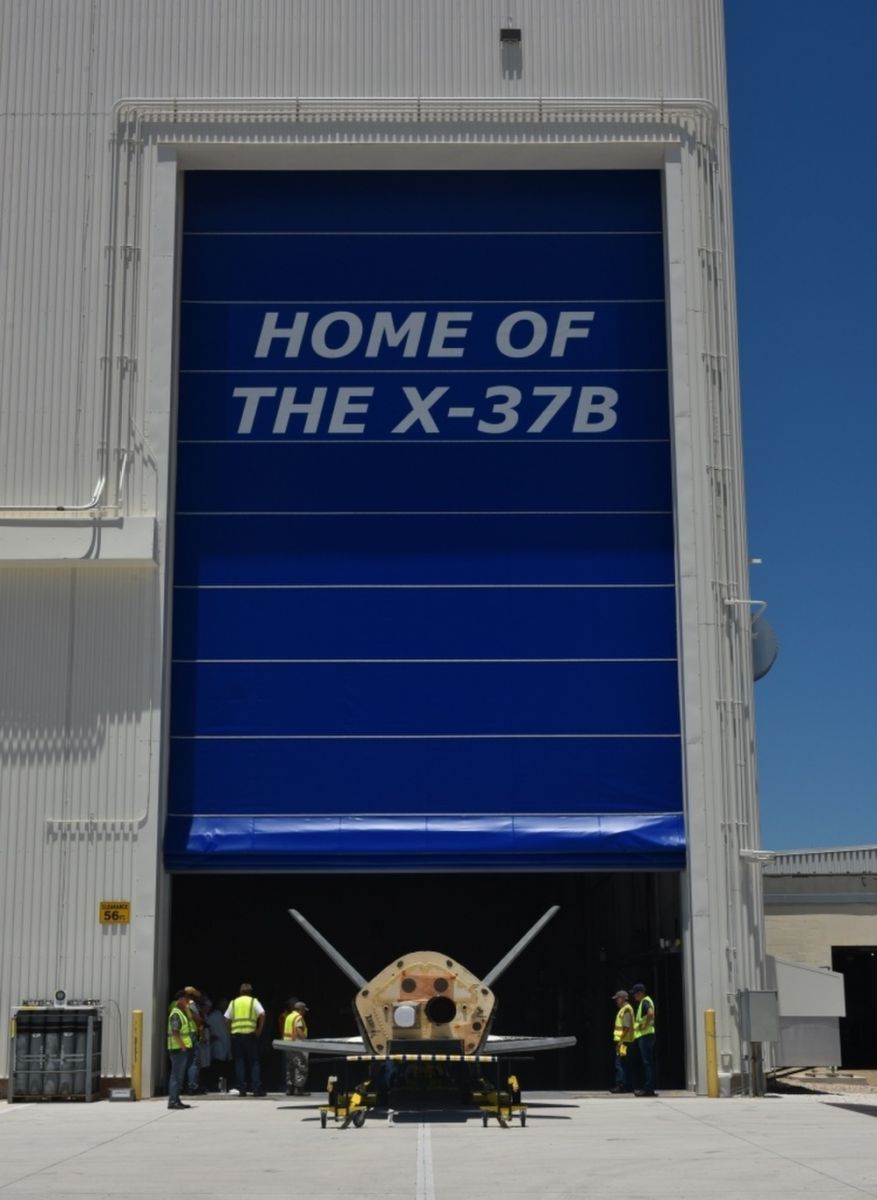
Back to hangar for another flight day. U.S. Air Force X-37B/OTV-4 is rolled into facility after its May 7 landing at Kennedy Space Center.
Credit: Michael Martin/SAF
Several website postings say that the sixth mission, X-37B OTV-6, is planned for this year on a United Launch Alliance Atlas-5(501) rocket. Launch would be from Cape Canaveral Air Force Station’s Space Launch Complex-41.
Reusable vehicles
The classified X-37B program “fleet” consists of two known reusable vehicles, both of which were built by Boeing.
The X-37B Orbital Test Vehicle was fabricated at several Boeing locations in Southern California, including Huntington Beach, Seal Beach and El Segundo. The program transitioned to the U.S. Air Force in 2004 after earlier funded research efforts by Boeing, NASA and the Defense Advanced Research Projects Agency.
Looking like a miniature version of NASA’s now-retired space shuttle orbiter, the military space plane is 29 feet (8.8 meters) long and 9.6 feet (2.9 m) tall, with a wingspan of nearly 15 feet (4.6 m).

Recovery crew members process the X-37B Orbital Test Vehicle at Vandenberg Air Force Base after the program’s third mission complete.
Credit: Boeing
The X-37B space plane has a payload bay of 7 feet (2.1 meters) by 4 feet (1.2 meters), a bay that can be outfitted with a robotic arm. X-37B has a launch weight of 11,000 lbs. (4,990 kilograms) and is powered on orbit by gallium-arsenide solar cells with lithium-ion batteries.
Milestone for the program
Prior to launch of OTV-5, Randy Walden, the director of the Air Force Rapid Capabilities Office said there were many firsts on this mission, making it a milestone for the program. “It is our goal to continue advancing the X-37B OTV so it can more fully support the growing space community.”
The Air Force also noted that the fifth OTV mission was launched into, and will be landed from, a higher inclination orbit than prior missions to further expand the X-37B’s orbital envelope.
Ground track
Ted Molczan, a Toronto-based satellite analyst, told Inside Outer Space that OTV-5 began September 2018 in an orbit about 243 miles (391 kilometers) high, inclined 54.5 deg to the equator. Its ground track repeated every three days, after 46 revolutions.
“In mid September, it lowered its altitude to 214 miles (344 kilometers), which caused its ground track to repeat every two days, after 31 revolutions,” Molczan said. “It appeared to still be in approximately that orbit when last observed, on January 26, by Alberto Rango, from Rome, Italy.”
Repeating ground tracks are very common, Molczan said, especially for spacecraft that observe the Earth. “I do not know why OTV has repeating ground tracks,” he said.
Kevin Fetter, an amateur Canadian satellite spotter in Brockville, Ontario, caught the OTV-5 craft zip by above a bright star. The video can be viewed at:
https://www.youtube.com/watch?v=eawPMcYLhZk&feature=youtu.be

Mission commander Alan Shepard assembles a double core tube. Astronauts Shepard and lunar module pilot Edgar D. Mitchell, who took this photograph, explored the lunar surface while astronaut Stuart A. Roosa, command module pilot, orbited the moon.
Credit: NASA
Apollo sample 14321 is a specimen collected during the Apollo 14 moonwalking mission in 1971 – and it may have a new story to tell.

Apollo 14 rock sample: 14321
Credit: NASA/LPI
As the third lunar landing, Apollo 14 touched down in the Fra Mauro highlands on February 5, 1971. Commander Alan Shepard and Edgar Mitchell, lunar module pilot, made the mission’s moonwalks.
Last week, Australia’s Curtin University announced that the lunar rock sample gathered by astronauts almost 50 years ago may be originally from Earth, thrown into space when an asteroid struck our planet billions of years ago.

Credit: NASA/Curtin University
Mineral traces
The sample was found to contain traces of minerals with a chemical composition common to Earth and very unusual for the Moon. The lunar collectible was on loan from NASA to Curtin University, where it was investigated in cooperation with researchers from the Swedish Museum of Natural History, Australian National University and Lunar and Planetary Institute in Houston.
Research author Alexander Nemchin, from Curtin’s School of Earth and Planetary Sciences, said the 1.8 gram sample showed mineralogy similar to that of a granite, which is extremely rare on the Moon but common on Earth.
The sample also contains quartz, which is an even more unusual find on the Moon, reports Nemchin.
The research has been published in the journal Earth and Planetary Science Letters.

Cone crater site.
Credit: USGS
Earth characteristics
By determining the age of zircon found in the sample, scientists were able to pinpoint the age of the host rock at about four billion years old, making it similar to the oldest rocks on Earth.
“In addition, the chemistry of the zircon in this sample is very different from that of every other zircon grain ever analyzed in lunar samples,” Nemchin adds, “and remarkably similar to that of zircons found on Earth.”
In a Curtin press statement, Nemchin says the chemistry of the zircon lunar sample indicated that it formed at low temperature and probably in the presence of water and at oxidized conditions, making it characteristic of Earth and highly irregular for the Moon.
Round-trip rock
“It is possible that some of these unusual conditions could have occurred very locally and very briefly on the Moon and the sample is a result of this brief deviation from normality,” Nemchin points out.
“However, a simpler explanation is that this piece was formed on the Earth and brought to the surface of the Moon as a meteorite generated by an asteroid hitting Earth about four billion years ago, and throwing material into space and to the Moon,” Nemchin says.
Further impacts on the Moon at later times would have mixed the Earth rocks with lunar rocks, at the Apollo 14 landing site too, where Apollo sample 14321 was collected by moonwalkers and hauled back to the Earth – perhaps making a celestial round-trip.

Location of rock sample 14321.
Credit: NASA
Big Bertha
Lunar Sample 14321, a breccia, was collected during the second EVA at Station C1, near the rim of Cone Crater. It was the largest sample returned during the Apollo 14 mission and was also known as “Big Bertha.” This sample is the third largest sample returned by any Apollo mission. The sample was returned in bag 1038.
According to transcripts of the two moonwalkers, Shepard collected sample 14321, a 20-pound (9.0-kilogram) breccia.
The research, Terrestrial-like zircon in a clast from an Apollo 14 breccia, can be found online in Earth and Planetary Science Letters, Volume 510, 15 March 2019, pages 173-185 here:
https://www.sciencedirect.com/science/article/pii/S0012821X19300202?via%3Dihub
For detailed information regarding the geology of the Apollo 14 landing site, go to:
Geological Survey Professional Paper 880 (Swann et al., 1977) here:

Curiosity Mastcam Left image taken on Sol 2299, January 24, 2019.
Credit: NASA/JPL-Caltech/MSSS
This image looks along the back edge of the Vera Rubin Ridge (top left to top center) down into the clay-bearing unit.
NASA’s Curiosity rover is now performing Sol 2301 tasks.
“Curiosity is on the brink of descending down off the Vera Rubin Ridge (VRR) onto the clay-bearing unit,” reports Lucy Thompson, a planetary geologist at the University of New Brunswick, Fredericton, New Brunswick, Canada.

Curiosity Mastcam Left image taken on Sol 2299, January 24, 2019.
Credit: NASA/JPL-Caltech/MSSS
“We are hoping to ‘beam up’ lots of interesting new data to the Mars orbiters, to be relayed to Earth after executing our plan on Mars tosol,” Thompson adds.
Touch and go tactic
Scientists have planned a typical “Touch and Go” sol, which includes using the arm to place contact science instruments – the Alpha Particle X-Ray Spectrometer (APXS) and the Mars Hand Lens Imager (MAHLI) — on a rock target to document chemistry and texture, Thompson explains. That is followed by remote science by Chemistry and Camera (ChemCam) instrument and the rover’s Mastcam to also look at chemistry and the larger scale view out the front window, before a drive.

Curiosity Mastcam Left image taken on Sol 2299, January 24, 2019.
Credit: NASA/JPL-Caltech/MSSS
“We are documenting how the chemistry and appearance of the rock is changing as we transition from the resistant VRR to the less resistant, orbitally distinct clay-bearing unit, and taking larger-scale images and mosaics to assist in future planning of our investigation of the clay-bearing unit,” Thompson notes.

Curiosity Front Hazcam Left A image acquired on Sol 2300, January 25, 2019.
Credit: NASA/JPL-Caltech
Looking for spectral variations
A reddish-purple, laminated bedrock target has been selected for APXS and MAHLI and tagged with the name “Linlithgow,” which is apparently the birthplace of Mary Queen of Scots and the future birthplace (in 2222) of Montgomery “Scotty” Scott, chief engineer of Star Trek’s Enterprise (hence the title)!

Curiosity Mastcam Left image taken on Sol 2299, January 24, 2019. MAHLI is located on the turret at the end of the rover’s robotic arm.
Credit: NASA/JPL-Caltech/MSSS
“The great grandfather of one of our science team members also compiled an anthology of poetry from the area in 1896, so a popular choice of name! Mastcam images will be taken of this target and an adjacent, rougher textured and different colored bedrock target, “Stoneywood” (also a ChemCam target), to look for spectral variations between the two areas,” Thompson adds.
Planned drive
The more typical bedrock target, “Stornoway” will be analyzed for composition by the robot’s ChemCam instrument. “A large Mastcam mosaic of 21×2 images was also planned of an area named ‘Boyndie Bay,’ says Thompson, “to document some interesting features that we are thinking of visiting during our investigation of the clay-bearing unit.”

Curiosity Mastcam Right image acquired on Sol 2300, January 25, 2019.
Credit: NASA/JPL-Caltech/MSSS
The planned drive should take Curiosity to the very edge of the VRR, and that will likely be its last stop before the rover drives down onto the clay-bearing unit. The plan calls for acquiring images to facilitate a full weekend of science activities at this important location, as well as a post-drive Dynamic Albedo of Neutrons (DAN) active measurement to investigate the distribution of subsurface hydrogen.
Additional Mastcam images and Rover Environmental Monitoring Station (REMS) meteorological observations were planned to monitor dust in the Martian atmosphere, Thompson concludes.

Credit: NASA/JPL-Caltech/Univ. of Arizona
New traverse map
A newly issued Curiosity traverse map shows the robot’s movements through Sol 2299 (January 24, 2019).
Numbering of the dots along the line indicate the sol number of each drive. North is up. The scale bar is 1 kilometer (~0.62 mile).
From Sol 2298 to Sol 2299, Curiosity had driven a straight line distance of about 88.19 feet (26.88 meters), bringing the rover’s total odometry for the mission to 12.42 miles (19.99 kilometers). The rover landed on Mars in August 2012.
The base image from the map is from the High Resolution Imaging Science Experiment Camera (HiRISE) in NASA’s Mars Reconnaissance Orbiter.

Credit: NASA/ESA
Another casualty of the government shutdown: The Lunar and Planetary Institute in Houston, Texas.
Founded at the height of the Apollo program in 1968, the Lunar and Planetary Institute (LPI) is pushing forward on its celebration this year of the 50th anniversary of Apollo and look to the future.
Still, the message from LPI’s Louise Prockter: “I am closing the LPI today at 5 pm, until further notice. Some staff are fully furloughed, some are partially furloughed. Some of our scientists and educators have grants that will continue to fund them for a while, but the rest of the staff do not have a charge code, unfortunately,” Prockter told Inside Outer Space.
“At some point we will no longer be able to pay even those who have grants, since we are not getting paid by the government. This shutdown is starting to have a significantly negative effect on contractors like ourselves.”

Credit: LPI
March event
Prockter said that she wants to stress that currently it is a mixture of non, partial and full furloughs (the science staff have grants so are unfurloughed for the next few weeks. Also, she adds that “we still expect the 50th Lunar and Planetary Science Conference (LPSC) to continue as planned.”
That major event is slated for March 18–22, 2019, held at The Woodlands Waterway Marriott Hotel and Convention Center, The Woodlands, Texas. This 4.5-day conference brings together international specialists in petrology, geochemistry, geophysics, geology, and astronomy to present the latest results of research in planetary science.
Although President Trump lifted the government shutdown today, Prockter said she has to go ahead with the furlough plans until receipt of authorization from NASA to continue funding the LPI.
“Hopefully that will come very early next week,” Prockter said.

Newly developed extraction technique for the Moon, thermal mining, makes use of mirrors to exploit sun-shy, water ice-laden polar craters.
Credit: School of Mines/Dreyer, Williams, Sowers
Cislunar side-step
In a similar predicament is the first lunar In Situ Resource Utilization (ISRU) workshop, “Developing a New Space Economy Through Lunar Resources and Their Utilization: A Stepped Approach to Establishing Cislunar Commerce Through Science and Exploration.”
It was to be held February 20–22, 2019 at the Universities Space Research Association (USRA) Headquarters in Columbia, Maryland.
“It is unfortunate that the government shutdown in the United States continues unabated. Despite the recent announcement of a temporary funding measure to open the government there is no guarantee that this will become permanent,” explained steering committee member, Clive Neal.
“This situation has had a debilitating effect on our Lunar ISRU Workshop, not only in terms of getting NASA participation, but also support from USRA. At this time, we have no choice but to postpone the workshop,” Neal explained in a statement.
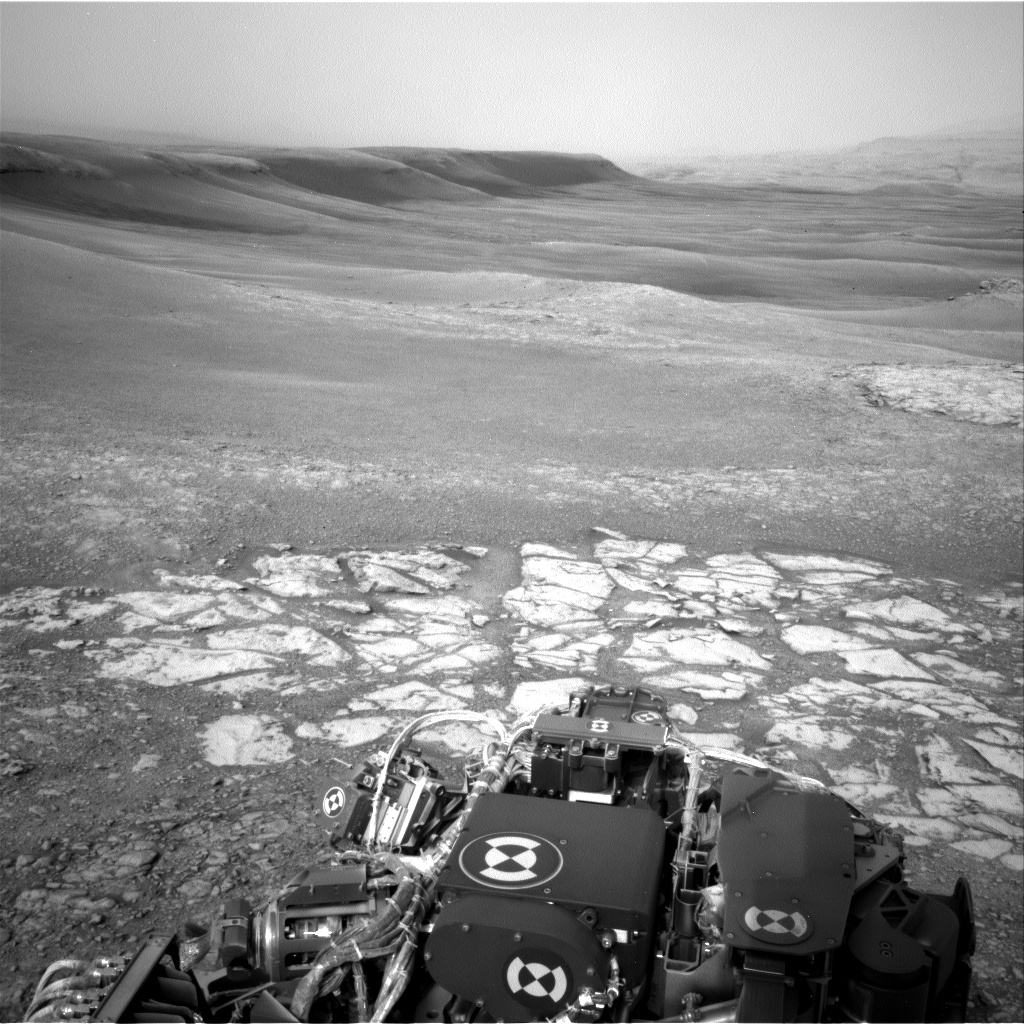
Curiosity Navcam Left A photo taken on Sol 2299, January 24, 2019.
Credit: NASA/JPL-Caltech
NASA’s Curiosity Mars rover is carrying out Sol 2299 duties.
The robot has moved for the first time since December 13, 2018 moving toward a new geological unit that scientists label as the “Clay-Bearing Unit” (CBU).

Curiosity Front Hazcam Left A photo taken on Sol 2299, January 24, 2019.
Credit: NASA/JPL-Caltech
Scott Guzewich, an atmospheric scientist at NASA’s Goddard Space Flight Center in Greenbelt, Maryland reports: “Curiosity is continuing the first phase of its journey to the clay-bearing unit…with a series of ‘touch-and-go’ driving sols.”
Melrose place
During these sols, the rover does contact science with its Mars Hand Lens Imager (MAHLI) and Alpha Particle X-Ray Spectrometer (APXS) in the morning, some additional remote sensing as time permits, and then drives away to a new location during the afternoon.

Curiosity Navcam Right A image taken on Sol 2299, January 24, 2019.
Credit: NASA/JPL-Caltech
“We want to closely examine the bedrock as we drive to help understand how the Vera Rubin Ridge and the clay unit are related,” Guzewich adds.
“Melrose” was the target for contact science. Additional Mastcam and Chemistry and Camera (ChemCam) observations were taken of other nearby geological targets.
“Curiosity is continuing to monitor a strong late-season dust storm,” Guzewich notes, “that’s increased the amount of dust locally for the last 1-2 weeks with Navcam and Mastcam observations of the atmosphere as well as an increased cadence of [Rover Environmental Monitoring Station] REMS meteorological observations.”
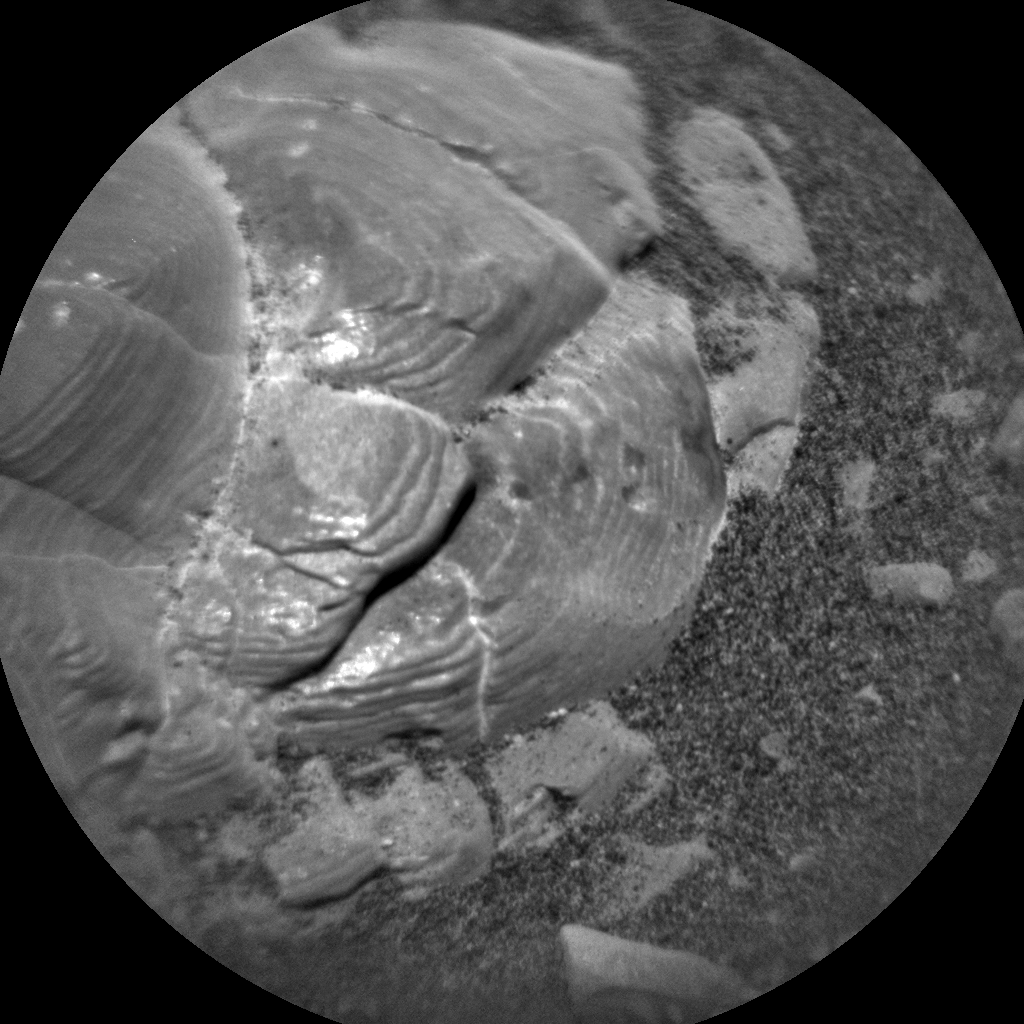
Curiosity ChemCam Remote Micro-Imager photo acquired on Sol 2299, January 24, 2019.
Credit: NASA/JPL-Caltech/LANL
Synergistic, collaborative discoveries
Roger Wiens, a geochemist at the Los Alamos National Laboratory in New Mexico, also notes that the Curiosity rover team, following previous rover teams, has organized itself into different campaigns to explore different geological units.
“Organizers are nominated to lead these campaigns, and their job is to help coordinate among the competing interests of the different instrument teams, helping to make synergistic, collaborative discoveries,” Wiens points out. “The organizers of the CBU campaign have been patiently waiting for their turn to lead the campaign. After all, their first meeting was well over a year ago, on October 3, 2017.”
Geological contact
The rover team is searching for the geological contact between bedrock of Vera Rubin Ridge and that of the Clay-Bearing Unit.
“The precise boundary is not clear from orbit, and it could also be a relatively gradual change as seen from rover images,” Wiens reports. “To have the best chance at observing the transition, Curiosity is doing relatively short drives, interspersed with frequent observations by both remote and contact instruments, as the terrain allows.”

Credit: NASA/JPL-Caltech/Univ. of Arizona
For example, the rover drove about 125 feet (38 meters) over the holiday weekend.
New road map
A new Curiosity traverse map through Sol 2297 has been posted.
The map shows the route driven by NASA’s Mars rover Curiosity through the 2297 Martian day, or sol, of the rover’s mission on Mars (January 22, 2019).
Numbering of the dots along the line indicate the sol number of each drive. North is up. The scale bar is 1 kilometer (~0.62 mile).
From Sol 2257 to Sol 2297, Curiosity had driven a straight line distance of about 115.54 feet (35.22 meters), bringing the rover’s total odometry for the mission that began in August 2012 to 12.38 miles (19.93 kilometers).
The base image from the map is from the High Resolution Imaging Science Experiment Camera (HiRISE) in NASA’s Mars Reconnaissance Orbiter.

Jeff Bezos, founder of Blue Origin.
Credit: Blue Origin
Blue Origin’s 10th flight yesterday of the New Shepard system was the 4th flight for this vehicle.

New Shepard liftoff on January 23, 2019.
Credit: Blue Origin/Screengrab/Inside Outer Space
The vehicle carried 8 NASA-sponsored research and technology payloads under the space agency’s Flight Opportunities program. In an upcoming mission, New Shepard will take payloads to space from around the world.
Step by step
From Jeff Bezos of Amazon.com fame and fortune and founder of Blue Origin: “A perfect day. New Shepard has now racked up 10 consecutive successful launches, 9 consecutive successful booster landings, 3 consecutive successful escape tests, and 11 consecutive successful crew capsule landings (including a pad escape),” Bezos explains.
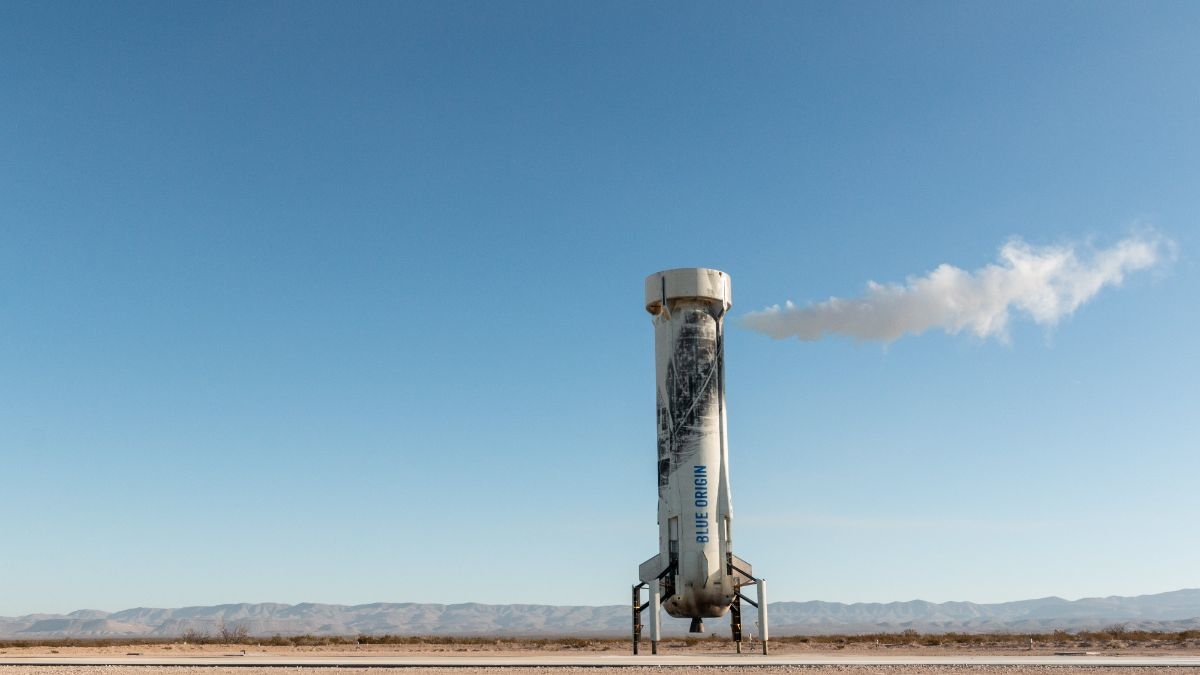
Perfect landing.
Credit: Blue Origin
Yesterday’s mission, Bezos adds, “was the 4th flight of this particular tail number — all with minimal refurbishment between flights. Step by step, we’re getting close to human flight. And all of this learning is being incorporated into New Glenn too. I did wear my lucky boots today, but I’m pretty sure it’s actually the incredible Blue Origin team.”

Passenger capsule back on Earth after suborbital voyage.
Credit: Blue Origin
Videos available
Go to this set of videos that details the recent flight.
Science and Research Payloads on New Shepard:
Building the New Shepard Fleet:
NS-10: New Shepard Flies 8 NASA Payloads to Space:
Replay of the NS-10 flight on January 23, 2019:

Richard Branson and founder of Under Armour, Kevin Plank.
Credit: Virgin Galactic
What can the well-dressed commercial space traveler expect in apparel?
A next generation of spacewear and astronaut performance programs is being scoped by way of collaboration between Sir Richard Branson’s Virgin Galactic and Under Armour.

Virgin Galactic Unveils Under Armour as Exclusive Technical Spacewear Partner.
Credit: Virgin Galactic
As Under Armour crafts the Virgin Galactic collection, it draws upon a heritage of innovative performance solutions for some of the world’s top athletes.
Feel good, look good
The partnership will also see Under Armour create uniforms for Virgin Galactic’s team at Spaceport America in New Mexico, be they engineers, astronaut trainers and hosts, or mission control staff.

Virgin Galactic’s suborbital plans include well-dressed space travelers.
Credit: Virgin Galactic/Quasar Media 2018
The custom-fitted Under Armour spacesuits “will inspire confidence through comfort and practicality without compromising the natural desire of every Virgin Galactic astronaut both to feel good and look good” as individuals head for the suborbital heights, notes a press statement.
Earth-bound masses
“The full range of apparel and footwear is set to be revealed later this year, ahead of Richard Branson’s inaugural commercial flight,” the Virgin Galactic statement explains.
“In the 1960’s, pop culture declared space ‘the final frontier.’ Over the 50-plus years since space travel began, only 559 people have ever been to space. The game is changing in 2019, as visionaries and leaders come together, innovating to make space accessible to the Earth-bound masses,” observes the Under Armour website.

The Red Planet as seen by Europe’s Mars Express.
Credit: ESA/D. O’Donnell – CC BY-SA IGO
As the shutdown of the U.S. government continues — and the State of the “Dis-Union” address is under back and forth banter – yet another space causality: A major meeting on Mars Extant Life has gone extinct.
A Mars Extant Life Conference, scheduled next week for Carlsbad, New Mexico has been postponed.
Conference organizers today said it is “with pain and regret” the meeting has been postponed.
Consequences
“The current shutdown of the U.S. government is exacting a toll on increasing numbers of people, and these consequences have now extended to many people involved in this conference.”
Despite a possible resolution of the shutdown, the organizers could not wait any longer.
“Unless something changes, our current estimate is that ~15% of our expected attendees (many of them civil servants) will be unable to attend on our currently scheduled dates. An additional 35% have sufficient worries or concerns that they have recommended postponing the conference to a later date,” meeting organizers explained.
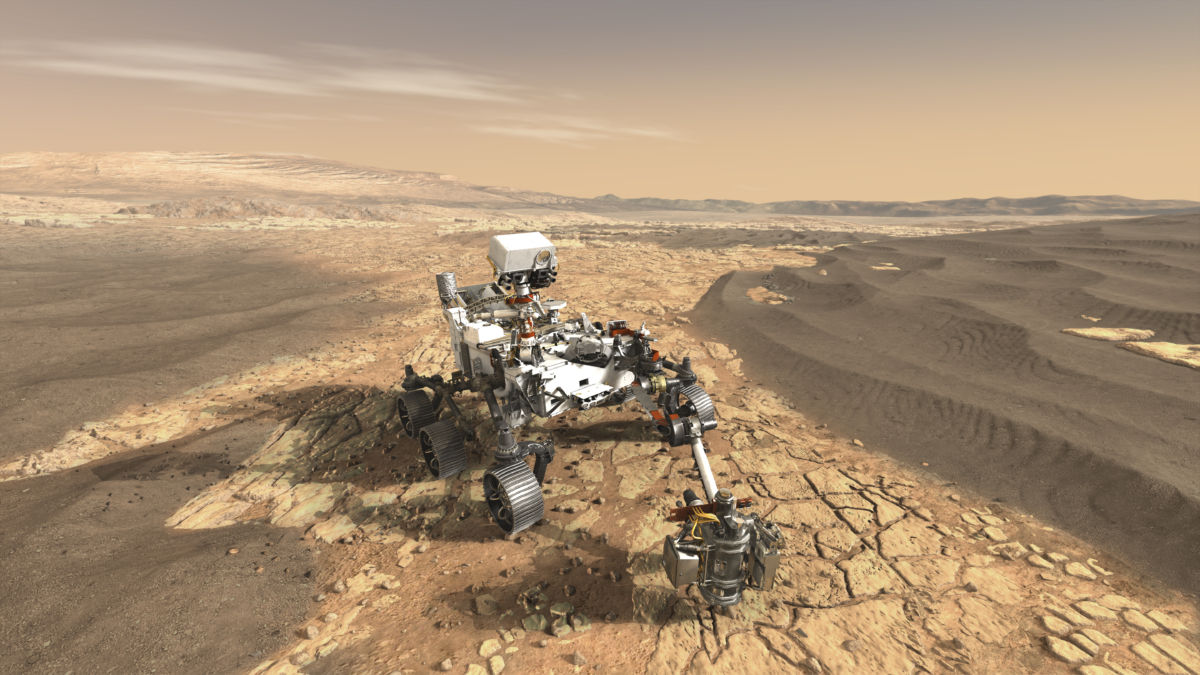
NASA Mars 2020 rover searches for postponed conference agenda in 2019.
Credit: NASA/JPL
Nationwide challenges
“Because of financial concerns many of us in the NASA system need to be careful with cash flow. We are seeing nationwide challenges with the airport security system involving the TSA [Transportation Security Administration] workers, and most of our registrants would be travelling by air to the conference venue. Our conference speakers have started to drop out at an alarming level,” advised the organizers.
“We apologize for the postponement of this conference, which is an action we have not taken lightly,” explained the meeting organizers. “We know all of you have made plans, and that this may cause unwanted disruptions to those plans. However, this decision seems to result in the greatest good for the greatest number. We will be in touch with you once things settle down, and we can focus on re-planning.”
Yes, life on Mars – so goes life on Earth.

“Horning in” on an asteroid. Sampler horn will be used to gather up space rock material.
Credit: JAXA/Screengrab/Inside Outer Space
Japan’s Hayabusa2 continues to make progress in preparing for its first touchdown (TD1) on asteroid Ryugu, planned for the week of February 18.
A backup week is March 4.
Newly posted status reports from the Hayabusa2 team explain that a prolonged injection test of the spacecraft’s thrusters has been conducted. This test is in connection with deploying the small carry-on impactor (SCI) that will create a crater on the space rock.

Following the small carry-on impactor (SCI) explosion, Hayabusa2 will sample the crater.
Credit: JAXA/Screengrab/Inside Outer Space
Seek and hide
After separating the impactor in the SCI operation, Hayabusa2 needs to swiftly hide behind the asteroid to avoid flying debris generated by the SCI explosion.
The recent test checked whether attitude control and the reaction control system (RCS) subsystem functions worked as expected under a strong disturbance that is not usually experienced.
Although the test was run for about half the final injection time, both the attitude control and RCS subsystem worked almost as expected, the Hayabusa2 controllers report, and they acquired valuable data for the actual SCI operation.

Hayabusa2 sampler arm operations.
Credit: JAXA/Screengrab/Inside Outer Space
Sampler horn
In addition, there’s also been an appraisal of the vibration the sampler horn may encounter.
This vibration test was to confirm that Hayabusa2 will not perform an emergency escape if it incorrectly detects the vibration of the sampler before landing.
With solar conjunction and the New Year holiday now over, Hayabusa2 operations have begun to ramp up.
First was the tour operation, moving Hayabusa2 to a region (so-called BOX-B) that is shifted slightly from the usual home position of the spacecraft – (so-called BOX-A).
A series of scientific observations were carried out, with the Sun directly behind the spacecraft.
From the Hayabusa2 team: “Let’s safely land! Hayabusa2 is working hard to realize the hope of the New Year after a refreshing rest!”
Go to this Japan Aerospace Exploration Agency (JAXA)-supplied video for a perspective on the upcoming touchdown operations:
https://youtu.be/OR-vN1xyfF0?list=PLCQJJ3lTBuyCtMDbvkQcg4fb7yAHheqyN

