Author Archive
 Author:
  February 1st, 2019
Credit: Institute of Biomedical Problems
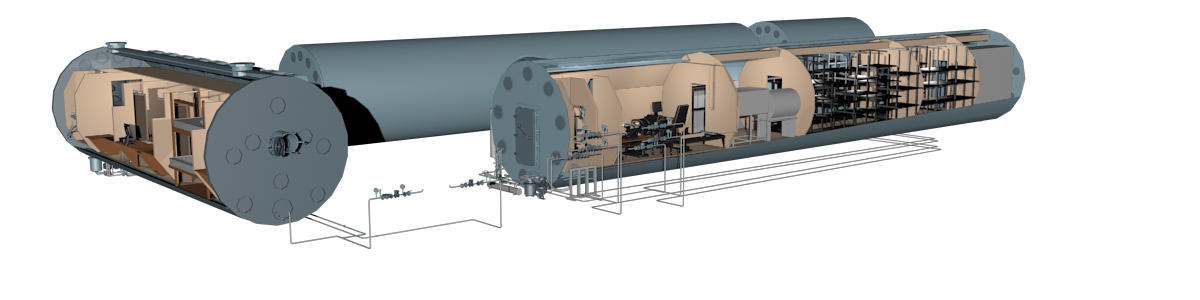
Starting in March, Russia’s SIRIUS (Scientific International Research in Unique Terrestrial Station) experiment will simulate a flight to the Moon.
The SIRIUS-19 experiment makes use of a six person team and is being staged by the Institute of Biomedical Problems (IBMP). The main objective of the mission: the choice of areas for the future construction of a lunar settlement/base.
Credit: Institute of Biomedical Problems
The four month isolation experiment simulates a flight to the Moon; finding a landing site; landing of four crew members for surface operations; a stay in the Moon’s orbit and remote control of a lunar rover to prepare a base; ending in a return to Earth.
General scenario
According to the Institute’s website, the general scenario of the SIRIUS-18/19 experiment includes several stages:

Credit: NASA
The crew starts to the Moon, reaches orbit and is joined to an orbital station.
For 2 months, the crew conducts observations of the lunar surface and makes a decision about the point of landing, during this period of time a series of dockings with transport ships are also performed.
Four crew members land on the moon, 2 or 3 crew members in lunar space suits perform several exits to the surface. The Moon circling spacecraft and the remaining two crew members continue to work in orbit and provide technical assistance and advice to their comrades on the surface.
Starting from the lunar surface and docking with the orbital ship.
Circling the Moon for several weeks, while the crew remotely controls lunar rovers (preparing for the construction of the lunar base), and also conducts a series of connections with transport ships.
Credit: Institute of Biomedical Problems
U.S. participation
The start of the SIRIUS-19 model insulation experiment is scheduled for March 19, 2019.
According to a TASS report, the final group of participants in the experiment will be determined on March 5; selection of eight persons is expected, six of them will make up the crew and two persons will be back-up crew members. Three women and three men are likely to make up the crew.
Two representatives of the United States and one representative of Belarus are also expected to take part in the isolation experiment.
The U.S. representatives, according to the Institute, Reinhold Povilaitis, an analyst of research and operations on NASA’s Lunar Reconnaissance Orbiter (LRO) and Allen Mirkadyrov in Telecommunication Networks and Technologies of NASA’s Goddard Space Flight Center.
NASA and the State Research Center Institute for Biomedical Problems of the Russian Academy of Sciences (IBMP) have a long and successful history of collaborating on joint research related to human health and well-being in space.
NASA’s HRP (Human Research Program), and IBMP are conducting research to identify preventive measures and technologies to protect the health of astronauts and astronauts during space flight.
 Posted in

Gretta Berghammer is the artistic director for the Sturgis Youth Theatre at the University of Northern Iowa.
Credit: University of Northern Iowa
This year we celebrate the 50th anniversary of Apollo 11. But there’s one small step, one giant leap being taken to celebrate that milestone – and in a distinct, creative way.
“To Touch the Moon” is a production honoring that triumph – but with a difference. It will blend drama and science to foster an explorer mindset in youth with autism and other developmental delays. The project is underway at the University of Northern Iowa in Cedar Falls, Iowa.
For more information, go to my new Space.com story:
‘To Touch the Moon’ Theater Production Is Tailored for Autism Spectrum Disorder
https://www.space.com/43175-to-touch-the-moon-autism-focused-play.html

The Translational Research Institute for Space Health (TRISH) and the MIT Media Lab Space Exploration Initiative is staging a February 6-7 workshop: Spaces in Space: Optimizing Behavioral Health and Cognitive Performance in Confined Environments.
This workshop highlights the many opportunities to re-think the design of personal environments for their potential to keep us well and enhance cognitive performance.
The spaces we design for space travel are new frontiers for health.
Human health technologies
Invited participants include leading engineers, academic researchers (in the fields of psychology, neuroscience, ecology, and AI), behavioral healthcare industry innovators, interior designers, architects, and entrepreneurs developing new technologies.
Partnering with NASA through a cooperative agreement, the Translational Research Institute for Space Health (TRISH) funds transformative human health technologies to predict, protect, and preserve astronaut physical and mental wellness during deep space exploration missions. We fund high-risk, high-reward, human health and performance solutions that can be adapted for use in space.
Workshop details
NOTE: The workshop is FREE & will be available as a live stream. You will need to register for the live stream. For more information and to register, go to:

Curiosity Mastcam Left photo taken on Sol 2304, January 29, 2019.
Credit: NASA/JPL-Caltech/MSSS
NASA’s Curiosity is presently performing Sol 2307 tasks.
Ashley Stroupe, a mission operations engineer at NASA/JPL in Pasadena, California, reports that Curiosity is venturing further into the clay unit territory.

Curiosity Image shows the ridge and the smooth terrain. Photo taken by Navcam Left A Sol 2306 January 31, 2019
Credit: NASA/JPL-Caltech
Several targets are being observed with Mastcam color and ChemCam to try to characterize the chemistry and texture of this new terrain. Also on tap is taking a Chemistry and Camera Remote Micro-Imager (RMI) mosaic of “Buchan Ridge,” an upcoming area of exploration within the clay unit, to aid in navigation and traverse planning.
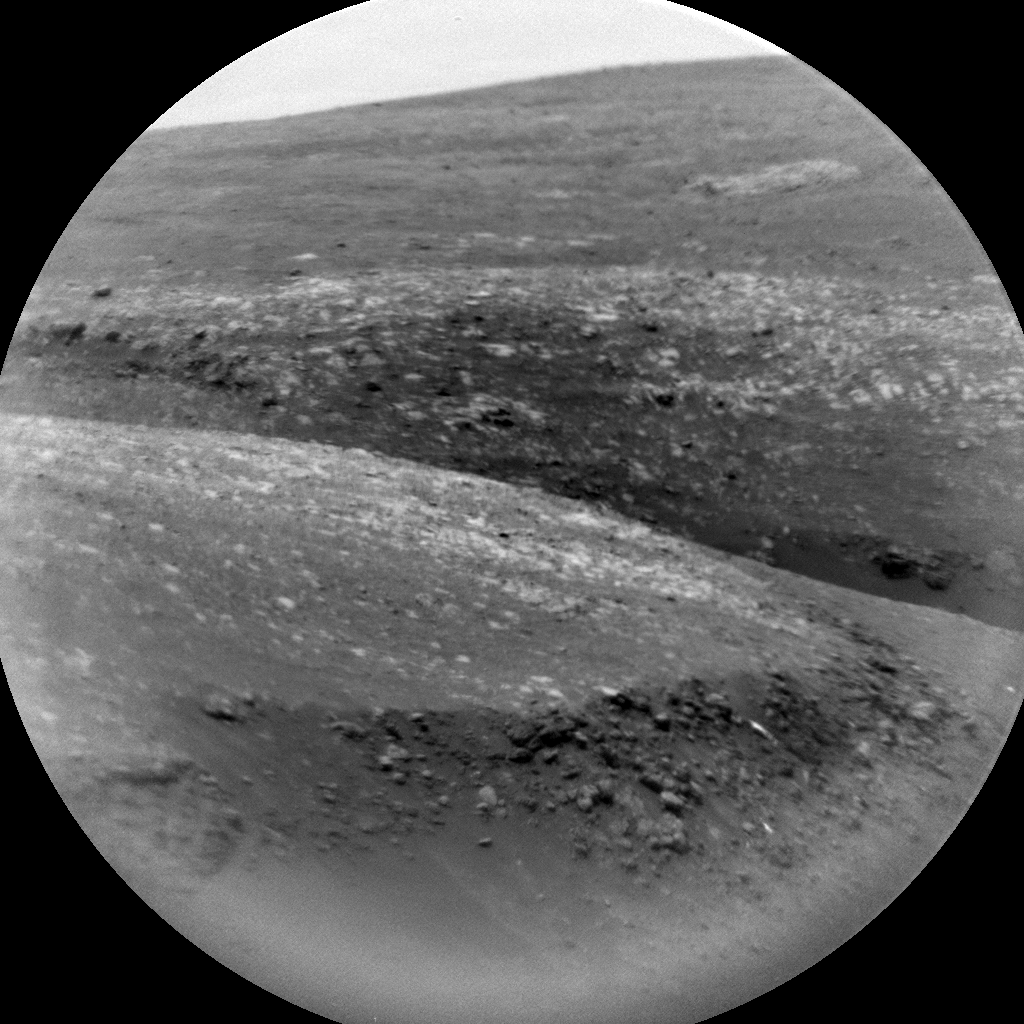
Curiosity ChemCam Remote Micro-Imager photo acquired on Sol 2306, January 31, 2019.
Credit: NASA/JPL-Caltech/LANL
Hidden from view
“We’re driving up to the crest of a ridge so that we will be able to see down the other side, which is currently hidden from our view,” Stroupe notes. “The new terrain is so featureless, that visual odometry is having trouble tracking our position and measuring slip, which caused the rover to stop the sol 2304 drive early.”
Stroupe adds that rover planners are using some extra imaging to help operators of the robot characterize how the rover performs on this new terrain.

Curiosity Front Hazcam Right A image taken on Sol 2306, January 31, 2019.
Credit: NASA/JPL-Caltech
“We are hoping something of interest will be in our workspace for contact science in the weekend plan,” Stroupe says. “Much of our post-drive imaging will also be of higher resolution than usual (lossless compression) so that we can see the fine details and get good stereo for drive planning.”

Curiosity Navcam Left A image acquired on Sol 2306 January 31, 2019
Credit: NASA/JPL-Caltech

Curiosity Navcam Left A image acquired on Sol 2306 January 31, 2019
Credit: NASA/JPL-Caltech

Curiosity Navcam Right A photo taken on Sol 2306, January 31, 2019.
Credit: NASA/JPL-Caltech

Curiosity Rear Hazcam Right A image taken on Sol 2306, January 31, 2019.
Credit: NASA/JPL-Caltech

Curiosity Mastcam Right photo taken on Sol 2304, January 29, 2019.
Credit: NASA/JPL-Caltech/MSSS
Blocks of memory
After Curiosity’s drive, the plan calls for continuing the monitoring of weather, with Mastcam taus, dust devil movies, and some other atmospheric imaging.
Also slated is use of Autonomous Exploration for Gathering Increased Science (AEGIS) software for automated ChemCam science, Stroupe explains, “which should help us find anything interesting in this terrain.”
“Last, but not least, we’re continuing our diagnostics to better understand our issues with the Side-B computer, dumping some more blocks of memory,” Stroupe concludes.

Outpost in Orbit: A Pictorial & Verbal History of the Space Station by David Shayler and Robert Godwin (Executive Editor Gary Kitmacher), Apogee Books, 2018; 8½ x 11, 320 pages full glossy color, $49.95.
So often above where I live there’s a marvel of space engineering that flies overhead – a finger-pointing exercise into the night sky. There are few that can appreciate the complexity of the International Space Station (ISS), how it was built, by whom, and what are the experiences of the folks that took the high road and roared off to live onboard this unique vessel of the vacuum.
This book is a beautiful illustration of getting a dream done. The volume celebrates the recent 20th anniversary of the astonishing ISS, but more than that details the foundation from which ISS grew.
Lavishly illustrated, and created with the assistance of NASA, Outpost in Orbit is a visual and noteworthy account of why space stations are mandatory for moving forward – not only giving us a leg up on low Earth orbit – but pushing onward.
The reader will find this read incredibly informative, not only about what the ISS represents today, but a great account about the pioneers that pushed the boundaries on why and how a station is needed and can be built. Personally, I found those pages of great benefit. What a legacy of thinking made the ISS what it is today – a heritage that few know, but underscored in this book.
This book is filled with comments from astronauts, engineers, managers, retirees and historians. Adding to the value of the book are interviews with key leaders from NASA, the Russian Space Agency, the European Space Agency, the Canadian Space Agency and the Japanese Space Agency – all of which contributed to making the ISS the triumph it is today.
In this unique anniversary accolade, you’ll be introduced to over 100 space stations designed by German Russians, British and American thinkers – all prelude to planting you onboard the high-flying ISS via hundreds of pictures, many never published before.
For more information on this book, go to:
http://www.cgpublishing.com/Books/9781989044032.html
Also go to this informative interview with author Robert Godwin about the book:
https://www.chch.com/outpost-in-orbit/
In addition, Godwin is interviewed on the popular Space Show to talk about the book, available at:
https://www.thespaceshow.com/show/27-jan-2019/broadcast-3259-rob-godwin

Previously released image of Chang’e-4 lander taken by Yutu-2 rover.
Credit: CNSA/CLEP
China’s Chang’e-4 lander and rover are in good shape following a cold spell on the Moon. They were put to sleep as night fell roughly two weeks ago at the Von Kármán crater landing site.
The China National Space Administration (CNSA) announced on Thursday that the lander woke up at 8:39 pm Wednesday. The rover, Yutu 2 (Jade Rabbit 2), awoke at about 8:00 pm Tuesday.

Yutu-2 lunar rover, ready for exploration duties. Credit: CNSA/CLEP
A lunar day equals 14 days on Earth, and a lunar night is the same length.
Relay satellite connection
CNSA also noted that communication and data transmission between Earth ground control and the farside hardware via the relay satellite Queqiao (Magpie Bridge) are stable.

Chang’e-4 relay link.
Credit: CCTV/Screengrab/Inside Outer Space
Both the lander and the rover ended the dormant mode automatically according to the elevation angle of sunlight now available at Von Kármán crater in the South Pole-Aitken Basin. Furthermore, key instruments have started to work.
Presently, the rover is located about 60 feet (18 meters) northwest of the lander.
Farside temps
As reported by China’s Xinhua news service: “According to the measurements of Chang’e-4, the temperature of the shallow layer of the lunar soil on the farside of the Moon is lower than the data obtained by the U.S. Apollo mission on the near side of the Moon,” said Zhang He, executive director of the Chang’e-4 probe project, from the China Academy of Space Technology (CAST).
“That’s probably due to the difference in lunar soil composition between the two sides of the moon. We still need more careful analysis,” Zhang added.

Chang’e-4’s farside landing zone.
Credit: NASA/GSFC/Arizona State University
Deep plunge
The lander and rover are outfitted with a radioisotope heat source.
The lander was also equipped with an isotope thermoelectric cell and dozens of temperature data collectors to measure the temperatures on the surface of the Moon during the lunar night, the Xinhua story notes.
China’s Global Television Network (CGTN) reports the first night’s temperature detection data, the temperature on the lunar surface plunged to a minimum of minus 190 degrees Celsius during the night.
Go to this CCTV News Agency video at:

Sol 63 image taken by InSight’s Instrument Deployment Camera (IDC) on January 30, 2019. Robotic arm with grapple fingers hovers over soon-to-be- deployed Wind and Thermal Shield.
Credit: NASA/JPL-Caltech
NASA’s InSight Mars lander is moving toward another deployment milestone in readying the probe for performing an agenda of scientific duties.
The InSight team finished fine-tuning the cable position last Sunday, the tether link to the Seismic Experiment for Interior Structure (SEIS) now in position on the surface of Mars.

Sol 63: InSight’s Instrument Context Camera (ICC) acquired this image on January 30, 2019. The InSight team has finished fine-tuning the tether link to the Seismic Experiment for Interior Structure (SEIS) now on the surface of Mars.
Credit: NASA/JPL-Caltech
Operators are ready to make use of the five mechanical fingers of a robotic arm grapple to pick up the Wind and Thermal Shield (WTS), placing it on top of the SEIS.
Deployment
“On Tuesday, we commanded the final stereo imaging of the SEIS in order to precisely localize its position for planning the arm motions to deploy WTS, and then positioned the grapple just above the WTS post,” said W. Bruce Banerdt, Principal Investigator of the InSight mission.

Artist concept showing the protective role of the wind and thermal shield (WTS) at the martian surface.
Credit: IPGP/David Ducros
Yesterday, the plan called for sending commands to grasp the WTS, Banerdt told Inside Outer Space. Today is a rest day for the operations team, he said, “and if everything goes according to plan we will command the WTS deployment on Friday, with confirmation images coming down on Saturday.”
Handle with care
InSight’s robotic arm is also slated to later deploy the heat flow probe – a mole that burrows 16 feet (five meters) into the ground. That’s deeper than any instrument that has ever been to Mars.
The grapple fingers close around a handle that resembles a ball on top of a stem. Each of the three items – the seismometer, the Wind and Thermal
Shield, and the heat flow probe, have one of these handles.

This artist’s concept depicts NASA’s InSight Mars lander fully deployed for studying the deep interior of Mars. Robot arm would deploy the sensitive Seismic Experiment for Interior Structure (SEIS) device, white object in foreground.
Credit: NASA/JPL-Caltech
Honeycomb structure
The WTS consists of an aerodynamically shaped aluminum cover with a honeycomb structure to which is attached a gold-coated thermal skirt.
The whole assembly rests on three legs that are to deploy automatically once the robotic arm lifts the dome off the lander’s platform.
Despite its design, the WTS could be struck by violent gusts of wind or a dust devil, forces that might dislodge or even lift the dome, causing it to fly away.
The shield has nonetheless been developed to withstand squalls of 60 meters per second and should even be able to survive winds of 100 meters per second.

China’s next Moon exploration phase: Sample return from the Moon.
Credit: CCTV/Screengrab/Inside Outer Space
China is poised to reactivate this year Moon sample return via the country’s Chang’e-5 lunar mission. That prospective outing get’s the go-ahead depending on an upcoming return-to-flight of a Long March-5 carrier rocket this July.

Long March-5 booster’s first liftoff occurred in early November 2016. Mishap on launcher’s second flight in July 2017. A return-to-flight Long March-5 mission is slated for this July.
Credit: CASC
If that third flight is successful, the fourth Long March-5 carrier rocket will be tasked to send the Chang’e-5 lunar probe to the Moon to bring lunar samples back to Earth at the end of 2019.

Soviet Union’s last Moon sample mission, Luna 24 sits on the edge of a 60 meter diameter crater. Photo taken by NASA’s Lunar Reconnaissance Orbiter Camera, or LROC.
Credit: NASA/GSFC/Arizona State University
Given victory, it would be the first lunar-sample-return mission in over four decades after the former Soviet Union’s Luna 24 project in 1976. That mission collected and returned to Earth 170 grams of Moon material.
Complex mission
Chang’e-5 is a multifaceted mission, divided into 15 sub-systems, including structure, thermal control, antenna, sample collecting and sealing and propulsion. It is composed of an orbiter, a returner, a lander and an ascender.
According to Peng Jing, deputy chief designer of the probe from the China Academy of Space Technology, Chang’e-5 will first enter an Earth-Moon transfer orbit. It will then slow near the Moon, entering lunar orbit, followed by descent of a lander, touching down at a pre-selected area for ground research work, including collecting lunar samples.
Sealed container
After completing its work on the Moon, the Chang’e-5 mission’s ascender will rise from the lunar surface for rendezvous and docking with the orbiter flying around the Moon. Then the returner — carrying the lunar collectibles — will fly back to Earth via transfer orbit, reenter the atmosphere and land at the Siziwang Banner (County) of Inner Mongolia Autonomous Region, Peng said in a recent China Central Television (CCTV) interview.
The lunar samples rocketed back to Earth by the Chang’e-5 probe will be sealed in a container and sent to labs for further analysis and research, Peng added.
Ground facility
Meanwhile, China has designed and completed fabrication of a ground facility to handle and study returning Moon specimens.
In a paper prepared for the 50th annual gathering of scientists at the Lunar and Planetary Science Conference (LPSC) to be held mid-March, a Chinese research team is slated to detail a lunar sample facility.
A key task, they note, is to collect lunar soil and rock samples and to seal them in good condition for scientific research here on Earth. The design of an advanced ground facility has been done, they add, geared to open sealed samples and transfer those treasured specimens in a way that they are free of contamination.

Map of Rümker region, target of Chang’E-5 sample return mission. Credit: Y. Qian, et al.

Credit: New China/Screengrab
Grasp and drill
China’s Chang’e-5 sample return mission plans to return over four pounds (2 kilograms) of lunar samples from the Moon’s Rümker region, explains Yuqi Qian of the School of Earth Sciences at the China University of Geosciences in Wuhan. Touchdown of the craft is within a zone of roughly 370 miles x 78 miles (600 kilometers × 125 kilometers).
The Rümker region is located in northern Oceanus Procellarum of the Moon and is the most distinctive geological feature in the area. The region is characterized by prolonged lunar volcanism. “In order to pick a science-rich site, many studies have been conducted and the Rümker region was selected and characterized for its geomorphology and geology,” Yugi and colleagues note in their LPSC abstract.

Apollo 15 image captures landing locale of China’s Chang’e-5 Moon lander – the Mons Rümker region in the northern part of Oceanus Procellarum.
Credit: NASA
There are two ways Chang’e-5 will acquire samples: grasp from the surface and drill into the surface to 6.5 feet (2 meters) depth. A ground drilling simulation using lunar regolith simulants has already been carried out using a system that resembles the equipment onboard the Chang’e-5 spacecraft.
Lunar research station
In another LPSC presentation, Lin Xu, General Office of the Lunar and Deep Space Exploration is on tap to detail China’s Moon plans. On the basis of the current lunar exploration, Chinese scientists and technical experts have proposed a tentative plan by several missions to preliminarily build a lunar research station at the Moon’s South Pole by implementing three to four missions before 2035.
The first mission will carry out comprehensive exploration in the South Pole of the Moon, including the topography, elemental composition and volatile contents of the Moon. Water ice in the permanently shadowed areas is one target of the investigation, Lin and colleagues are to explain.
After that, a sampling return mission will collect samples from the South Pole of the Moon and return them to the Earth. In addition to the scientific exploration of the Moon, the utilization of lunar resources is to be considered. In later missions, lunar platforms will be used to make astronomical or Earth observations and to consider the utilization of lunar resources, the Chinese lunar researchers note in their LPSC abstract.

Curiosity Front Hazcam Left A image acquired on Sol 2304 January 29, 2019.
Credit: NASA/JPL-Caltech

Curiosity Navcam Left A photo taken on Sol 2304 January 29, 2019.
Credit: NASA/JPL-Caltech

Curiosity Navcam Left A photo taken on Sol 2304 January 29, 2019.
Credit: NASA/JPL-Caltech

Curiosity Navcam Left A photo taken on Sol 2304 January 29, 2019.
Credit: NASA/JPL-Caltech

Curiosity ChemCam Remote Micro-Imager photo acquired on Sol 2304, January 29, 2019.
Credit: NASA/JPL-Caltech/LANL
NASA’s Curiosity Mars rover is now carrying out Sol 2305 duties.
New imagery from the Red Planet prowler has been posted, including these photos:
Long March-5 booster’s first liftoff occurred in early November 2016. Mishap on launcher’s second flight in July 2017.
Credit: CASC
An essential launcher for China’s future space station and Moon exploration plans is being readied for a July flight.
China’s next Moon exploration phase: Sample return from the Moon.
Credit: CCTV/Screengrab/Inside Outer Space
The third Long March-5 takeoff follows a mishap of this booster-class on July 2, 2017. An intensive investigation was carried out to identify why the rocket failed less than six minutes after liftoff.
China’s Xinhua news agency reports that Yang Baohua, vice president of the China Aerospace Science and Technology Corporation (CASC), that the cause of the failure had been found.
Analysis based on computer simulations and ground tests showed that a problem occurred in a turbine exhaust device in the engine of the first stage of the rocket, the China National Space Administration said earlier last year.

The Tianhe core module for China’s Space Station undergoes ground testing.
Credit: CCTV/Screengrab
If the third flight is successful, Yang said at a press gathering, the fourth Long March-5 carrier rocket will be tasked to send the Chang’e-5 lunar probe to the Moon to bring lunar samples back to Earth at the end of 2019.
Space station elements
Shang Zhi, director of the Department of Space under CASC added that the Long March-5B rocket will be the key for China’s future space missions.
A test version of the Long March-5B carrier rocket, Shang advised, which will serve China’s human space exploration agenda, is under development, and the research and development of the core module of the country’s space station have carried on as planned.

Artist view of China’s space station. Credit: CMSE
The Long March-5B rocket can lob into Earth orbit payloads greater than 22 tons and is tasked to rocket the core module and experiment modules of China’s space station in the future.
Joint tests and exercises are planned at the Wenchang Space Launch Center at the end of 2019, Shang said, to make preparations for the maiden flight of the Long March-5B, helping to lay the groundwork for the construction of China’s space station.

