Author Archive
 Author:
  February 26th, 2019
Credit: Mohammed bin Rashid Space Centre
The United Arab Emirates announced on Monday that one of two UAE astronauts will fly to the International Space Station later this year. That person will be the first Arab astronaut to travel to the orbiting outpost, said officials from the Mohammed bin Rashid Space Centre.
Emirati astronauts Sultan al-Neyadi and Hazza al-Mansoori remain in training, preparing for a September 25 sendoff aboard a Russian Soyuz rocket.
While one will make the trek the other astronaut will continue training for future missions.

Credit: Mohammed bin Rashid Space Centre
Selection process
“We are preparing the first Emirati and Arab astronaut to join scientists at the International Space Station. Our objective is to show the world that we are able to contribute to humanity through quality knowledge and scientific discoveries,” explains His Highness Sheikh Mohammed bin Rashid Al Maktoum.
The process of picking the two UAE astronauts emerged from 4,022 applications that were received with 95 shortlisted for medical assessment. An initial interview stage whittled that number down to 39, with 18 entering the final interview stage. Nine of those people were assessed by Russia’s Roscosmos, leading to the final selection of Sultan al-Neyadi and Hazza al-Mansoori.

Credit: Mohammed bin Rashid Space Centre
Hazza al-Mansoori, 35, has a Bachelor of Aviation Science from Khalifa Bin Zayed Air College. Al Mansoori has a 14 year experience in military aviation.
Sultan al-Neyadi, 37, holds a PhD in information technology and Master’s Degree in Information and Network Security from Griffith University in Australia.
Go to this Gulf News Report video of the press event at:
For more information on the Mohammed bin Rashid Space Centre and the UAE astronauts, go to:
 Posted in

Credit: Image: © Alamy)
Here is another head’s up warning about incoming space hardware – but this saga has a bit of an interplanetary tale to tell.
Peel back space history to the 1970’s, a time of Cold War space race histrionics between the Soviet Union and the United States.
The Soviet Union’s Cosmos 482 was launched on March 31, 1972 and was an attempted Venus probe that subsequently messed up its outward bound, rocket-powered escape to that cloud-veiled world.

Credit: © Ralph Vandenbergh
Now, some 47 years later, leftovers from Cosmos 482 are en route to an Earth reentry.
For more on this story, go to my new Space.com article at:
Failed 1970s Venus Probe Could Crash to Earth This Year
By Leonard David
Space.com Space Insider Columnist
https://www.space.com/failed-soviet-venus-spacecraft-falls-to-earth-soon.html

InSight on Sol 87 used the robotic arm-mounted Instrument Deployment Camera (IDC) showing placement of HP3. Image acquired on February 24, 2019.
Credit: NASA/JPL-Caltech

Credit: NASA/JPL-Caltech

Putting in place China’s space station will offer many new challenges.
Credit: CCTV/screengrab
Over a dozen experiment proposals from scientists around the world have been shortlisted for possible flight onboard China’s future space station.
China Daily has reported that 18 ideas are being assessed, with the final result to be detailed in June.
According to government plans, China will start piecing together the country’s space station around 2020.
Zhou Jianping, chief designer of the nation’s manned space program in April, explained that the multi-module space station, named Tiangong, or Heavenly Palace, will comprise three main parts: a core module attached to two space labs, combining for a weight of 66 metric tons.

The Tianhe core module for China’s Space Station undergoes ground testing.
Credit: CCTV/Screengrab
Call for partnership
Last May, the China Manned Space Agency, in collaboration with the United Nation’s Office for Outer Space Affairs issued the call for partnership opportunities on the station for scientists around the world.
By October, 42 applications from 27 countries had been submitted, with proposals extending across nine areas, including space medicine, space life science, and fundamental physics, the China Daily story explains.

Artist view of China’s space station. Credit: CMSE
An expert panel was formed by the UN office and China’s space agency to evaluate the candidates and pick the 18 to be shortlisted. Application teams are now working out a project implementation plan with China’s technical support.
Core module
China’s space station build-up will first see use of a Long March 5B heavy-lift rocket to orbit the outpost’s core module. About four crewed spaceflights will then be made sending astronauts to assemble the station.
The space station is expected to be fully operational around 2022 and is to operate for at least 10 years.
The China Daily also notes that, in 2024 the country’s orbiting complex may become the world’s only space station if the U.S. International Space Station is retired as planned.
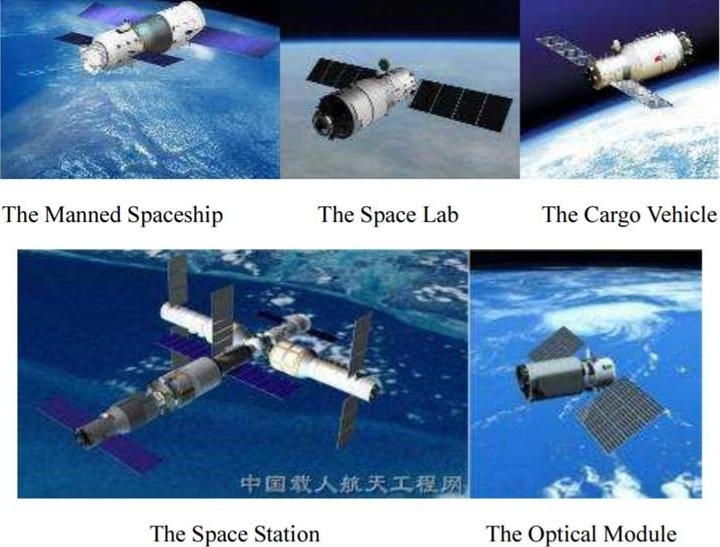
Credit: CMSA
Handbook
A version 1.0 handbook on the China Space Station (CSS) and its resources for international cooperation was issued May 28 of last year by the UN Office for Outer Space Affairs and China Manned Space Agency.
In many ways, China’s approach to space station operations mirror’s the fundamentals of the International Space Station – with some exceptions.
The 28-page document explains that the mission of the CSS project is:
To develop technology for long-term manned space flight and study related medical issues to find long-term solutions for the healthy living and efficient work of astronauts and lay the foundations for future exploration in long-term manned space flight;
To build a national space laboratory of an internationally advanced level for large-scale science and technology experiments, educative purposes and promote international/regional cooperation to study and uncover significant scientific results and benefits;
To establish a complete manned spacecraft operation and its corresponding operation and management systems, and to train a high-quality engineering and management team to lay the foundations for the future development of manned space exploration.

European Space Agency (ESA) astronaut Matthias Maurer joined Chinese colleagues in Yantai, China in August 2017 to take part in their sea survival training.
Returning from space in a Chinese capsule, astronauts need to be prepared for any eventuality – including landing in the sea. Water survival is a staple of all astronaut training but this is the first time non-Chinese astronauts have taken part.
Credit: ESA–Stephane Corvaja, 2017
Inclination, altitude, weight
Other areas of the handbook call attention to some key facts:
The CSS is designed to operate in low-Earth orbit about 400km above the Earth’s surface, with an inclination of approximately 41°~43°.
The station’s three main module components are horizontally symmetrical and T-shaped. The total mass is approximately 66 tons, and may reach roughly 100 tons when docked with several manned spaceships and cargo vehicles.
In-orbit life span (after the assembly of the three modules) is in the range of 10 years. Number of crew members 3 (rated) or 6 astronauts (at most).
Optical Module System
Along with station, a main section of an Optical Module System would be launched into orbit separately and flies along the same orbit as the CSS.
This system can support multi-color photometry, seamless spectrum survey and Earth observation with multi-function optical capabilities.
If necessary, it can dock with the CSS for refueling, equipment maintenance, payload equipment upgrade and other maintenance activities.

Robot arm under development for use in China’s station effort.
Credit: CGTN/screengrab
Experiment racks
A number of scientific experiment racks in the pressurized modules of the Space Station include a Human System Research Rack; Medical Sample Analysis Rack;
Ecological life Experiment Rack; Biotechnology Experiment Rack; Fluid Physics Experiment Rack; Two-Phase System Experiment Rack; High Temperature Materials Science Experiment Rack; Combustion Science Experiment Rack; and a Container-Free Materials Science Experiment Rack.
Life span extension
The in-orbit assembly of the basic configuration of the three modules of the China Space Station is planned to be completed around 2022 when the station is operational and able to carry out large-scale space science research.
The life span of the Station can be further extended by maintenance, replacement, upgrading and expansion to enable longer term space science research. Primarily, extensible interfaces are reserved on the Space Station.

Credit: CMSE
Extra modules
After completion of the basic configuration of the three modules, the inboard and outboard utilization support capabilities can be enhanced further by adding extra modules.
Secondly, outside the modules of the Space Station, many large-scale payload mounting points and extensible experiment platform interfaces are reserved, through which more payload support capability can be provided.
In addition, based on the need of space science research and international cooperation, the Space Station can meet the needs of evolving space science research through the maintenance, replacement and extension of payloads.
NOTE: The original United Nations/China Cooperation on Utilization of the China Space Station Application Form is available at:
http://www.unoosa.org/documents/doc/psa/hsti/CSS_1stAO/CSS_1stAO_ApplicationForm_2018.doc
To read the entire handbook, go to:
http://www.unoosa.org/documents/doc/psa/hsti/CSS_1stAO/CSS_1stAO_Handbook_2018.pdf

Space cowboys? International lawyers are trying to agree on what legislation will be needed to control the exploration of mineral resources in space to avoid a new ‘Wild West’.
Credit: James Vaughan
It is the combination of commercial activity and use of space resources that creates perception of tension.

Artist’s illustration of astronauts at an asteroid as well as other mining and transportation vehicles operating in space.
Credit: TransAstra Corporation & Anthony Longman
Some groups have expressed concern over a perceived gap in the law that creates uncertainty.
Others have expressed concern that use of space resources might be conducted to benefit only a few companies and spacefaring nations.
Then there are those who argue that the activity is illegal until a binding international regime is put into place to oversee it.
Go to this new paper published in Issues of Science and Technology — New Policies Needed to Advance Space Mining — VOL. XXXV, NO. 2, WINTER 2019 PERSPECTIVES.
Go to:
https://issues.org/new-policies-needed-to-advance-space-mining/
Also, go to this news story on the paper by Ailbhe Goodbody, published in Mining Magazine: “New space mining policy needed, says Colorado School of Mines,” at:

Hayabusa2 Image taken shortly after touchdown, from altitude of 98 feet (30 meters) or less.
Credit: JAXA, Tokyo University, Kochi Univ., Rikkyo University, Nagoya University, Chiba Institute of Technology, Meiji University, Aizu Univ., AIST

Hayabusa2 sampler arm operations.
Credit: JAXA/Screengrab Inside Outer Space

Hayabusa2 team celebrates successful asteroid touchdown.
Credit: JAXA/ISAS

The Israeli lunar spacecraft weighs only 1,322 pounds, or 600 kilograms.
Credit: Eliran Avital

Up and outward bound. SpaceX booster hurls Nusantara Satu satellite, Israeli lunar lander, and Air Force Research Laboratory (AFRL) S5 experimental small spacecraft.
Credit: SpaceX

Credit: SpaceIL
Japan Aerospace Exploration Agency’s Hayabusa2 asteroid explorer successfully and safely touched down upon Ryugu on February 21st.
Data relayed from the spacecraft confirmed the touchdown, including projectile firing into the space rock for sample collection.
Hayabusa2 then executed a maneuver to place it some distance from Ryugu.
In the beginning
Back here on Earth, SpaceX successfully hurled SpaceIL’s lunar spacecraft Beresheet (Hebrew for “in the beginning”), on a two-month trek to the Moon.
Israel’s Beresheet is en route to a near-side landing on the Moon in mid-April. If successful, the craft’s landing would be the first non-government lunar touchdown. It was built by Israeli nonprofit space venture SpaceIL and Israel Aerospace Industries (IAI), along with financial contributions from private donors.
Now outward bound, it’s the smallest spacecraft to ever attempt to land on the Moon, at only 1,322 lbs, or 600 kilograms. Its mission is to transmit photos and video of its new home and conduct scientific measurements.
First orbit around Earth
As of Friday morning, the spacecraft was 69,400 km above Earth, and is starting its way back to begin its first orbit around Earth.
In a statement released today, engineers at the SpaceIL and IAI control room have been conducting many in-orbit tests, and have identified high sensitivity to blinding by the sun’s rays in the star trackers, though this issue is being checked.
On Sunday the spacecraft is expected to conduct its first maneuver around Earth.

NASA’s InSight Mars lander acquired this image on February 20, 2019, Sol 83, using its lander-mounted, Instrument Context Camera (ICC).
Credit: NASA/JPL-Caltech
The NASA InSight Mars landing site is a busy place.
The German-supplied Heat Flow and Physical Properties Package (HP3) is at the end of its deployment phase. A camera on InSight’s robotic arm has been inspecting the placement of HP3 and its engineering tether – the cable running to the lander.
Upcoming is the firing of the frangibolts that will release the“mole” It weighs a little over 6.5 pounds (about 3 kilograms) and will hammer itself under the surface of Mars.

Components of the HP3 heat flow probe. Top left: the radiometer (RAD), which is used to measure the radiation temperature (roughly equivalent to the ground temperature) of the surface. Right: the casing with the mole penetrometer, the temperature measuring cable (TEM-P) and the data cable (ET) connected to the lander. In addition, the casing contains an optical length meter for determining the length of the temperature measuring cable that has been pulled from the casing. The mole contains the TEM-A active thermal conductivity sensor and the STATIL tiltmeter. Bottom left: the electronic control unit, known as the back end electronics (BEE), which remains on the lander and is connected to the probe via the ET.
Credit: DLR.
Mole command
If successfully released, the mole will be commanded to begin hammering next Tuesday, reports principal investigator Tilman Spohn from the German Aerospace Center’s (DLR) Institute of Planetary Research in Berlin.
“This will be the moment we all look forward to, the first 70 centimeter depth on Mars for the mole! Although we have tested the mole extensively and diligently, there remains an uncertainty,” Spohn adds. This has never been done before on Mars or on another terrestrial planet.
“Sure, the Apollo astronauts have drilled to about 3 meters on the Moon. But theirs was not a robotic mission,”Spohn says.

Credit: NASA/JPL
Taking the temperature
HP3 is designed to burrow down beneath the Red Planet’s topside — with its tether embedded with heat sensors — to a depth of 16 feet (five meters). The HP3 is slated to plow deeper than any previous arms, scoops, drills or probes before it.

InSight Sol 85 image taken by robotic arm-mounted, Instrument Deployment Camera (IDC). Image shows HP3 and its tether, acquired on February 22, 2019.
Credit: NASA/JPL-Caltech
HP3 can take Mars’ temperature to reveal how much heat is still flowing out of the interior of the planet.
The DLR HP3 heat flow probe has the mole pulling a ribbon cable equipped with 14 temperature sensors behind it. Once the probe has reached its target depth, the temperature will be measured by all of the sensors every 15 minutes for several months.
HP³ is now in a stable position approximately 5 feet (1.5 meters) from the lander and the Seismic Experiment for Interior Structure (SEIS) and HP³ are roughly 3 feet (one meter) apart.

The arrow tip marks the planned touchdown point of Hayabusa2.
Credit: JAXA, University of Tokyo, Kochi University, Rikkyo University, Nagoya University, Chiba Institute of Technology, Meiji University, University of Aizu, AIST
Japan’s Hayabusa2 project to explore asteroid Ryugu is approaching the time for touchdown this Friday.

Northern hemisphere of asteroid Ryugu fills most of the image. The tip of the arrow indicates the intended touchdown point.
Credit: JAXA, University of Tokyo, Kochi University, Rikkyo University, Nagoya University, Chiba Institute of Technology, Meiji University, University of Aizu, AIST

White dot at the arrow tip is the previously deployed target marker.
Credit: JAXA, University of Tokyo, Kochi University, Rikkyo University, Nagoya University, Chiba Institute of Technology, Meiji University, University of Aizu, AIST
The team has just released images from last month’s BOX-B operation – where the spacecraft’s distance from the surface is kept at about 12 miles (20 kilometers).
That operation also has Hayabusa2 move in a north-south and east-west direction to observe the space rock from different angles.
Northern hemisphere
This was the first time the team captured images of the northern hemisphere of Ryugu. By acquiring data on the equatorial region of Ryugu, the southern and northern hemisphere an accurate global shape model for Ryugu can be created.
NASA’s Curiosity Mars rover is now wrapping up Sol 2325 duties.
Last posted imagery taken Feb. 14-15 comes from Sol 2320 and includes these photos:

Curiosity Navcam Left A photo taken on Sol 2320, February 15, 2019.
Credit: NASA/JPL-Caltech

Curiosity Navcam Right A image acquired on Sol 2320, February 15, 2019.
Credit: NASA/JPL-Caltech

Curiosity Navcam Right A image acquired on Sol 2320, February 15, 2019.
Credit: NASA/JPL-Caltech

Curiosity Navcam Right A image acquired on Sol 2320, February 15, 2019.
Credit: NASA/JPL-Caltech

Curiosity Front Hazcam Left A image taken on Sol 2320, February 14, 2019.
Credit: NASA/JPL-Caltech

The nonprofit SpaceIL and Israel Aerospace Industries are ready to loft a robotic lunar landing mission from Cape Canaveral, Florida.
Credit: SpaceIL
A recent Falcon 9 booster static fire test was successful and launch as a secondary payload is Israel’s shoot for the Moon payload, scheduled for this Thursday evening!
Israel’s SpaceIL mission to northeast Serenitatis is the continuation of an international effort “forward to the Moon, to stay!”
Oded Aharonson heads the science team and a description of the mission science can be found here at:

