Author Archive
 Author:
  May 9th, 2019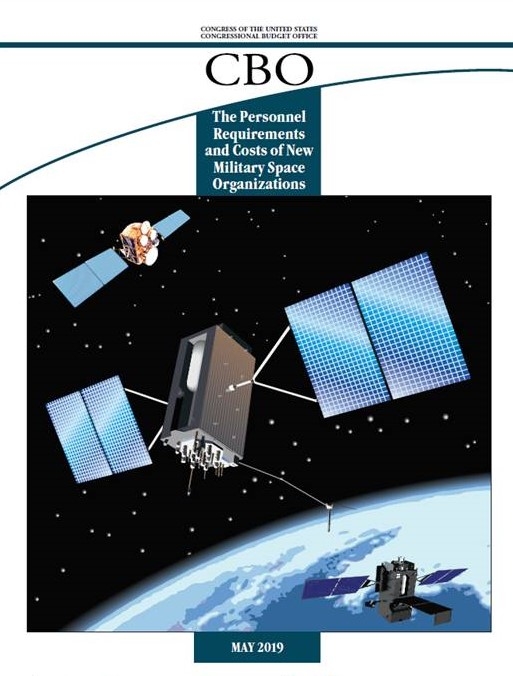
Credit: CBO
The Trump Administration has proposed creating what it calls a space force—an independent military service within the Department of the Air Force.
The Administration has also proposed two more space organizations in its budget proposal for fiscal year 2020: a new combatant command and a new agency that would be responsible for the development and acquisition of space systems.
Furthermore, the Administration has proposed creating a civilian Under Secretary for Space who would supervise the space service, report to the
Secretary of the Air Force, and perhaps make policy about space.
The Congressional Budget Office (CBO) issued its own estimates of the costs of the proposed Space Force and other new space organizations.
To read this report, go to:
https://www.cbo.gov/system/files/2019-05/55178-SpaceForce.pdf
 Posted in
Subcommittee on Space Hearing – Keeping Our Sights on Mars: A Review of NASA’s Deep Space Exploration Programs and Lunar Proposal
Date: Wednesday, May 8, 2019
Witnesses:
Mr. William H. Gerstenmaier, Associate Administrator, Human Exploration and Operations, National Aeronautics and Space Administration
Mr. Mark Sirangelo, Special Assistant to the Administrator, National Aeronautics and Space Administration
Dr. Jonathan Lunine, Director, Cornell Center for Astrophysics and Planetary Science, Co-Chair of the Former Committee on Human Spaceflight, National Academies of Sciences, Engineering, and Medicine
Dr. Patricia Sanders, Chair, Aerospace Safety Advisory Panel
Mr. Walt Faulconer, President, Faulconer Consulting Group, LLC (Republican Witness)
Go to this video of the hearing:

Credit: CCTV-Plus
At China’s Beihang University, two groups of volunteers have broken a world record by working rotations in China’s Lunar Base experiment cabin, Yuegong-1.
They stayed in a 150-square meter bio-regenerative life support system for a combined 370 days.
Notes Yi Zhihao, a participant, to work in an isolated lab for more than six months, he sometimes gets emotional.
“It’s incredible, I really did not expect to be able to make it for 200 days,” said Yi.

Credit: CNSA/China News Service Screengrab
Simulated space lab
Yuegong-1 is a simulated space lab, designed to observe how animals, plants and micro-organisms can co-exist in a lunar environment.
The volunteers planted crops and managed waste according to a recycling system. Only two percent of the supplies came from outside.
For Yi and his team, everything takes place here in this 150-square meter lab, from making moon cakes to hosting a birthday party.
Yi said more has to be done, as the space lab program should anticipate many more of the conditions that outer space has to offer.
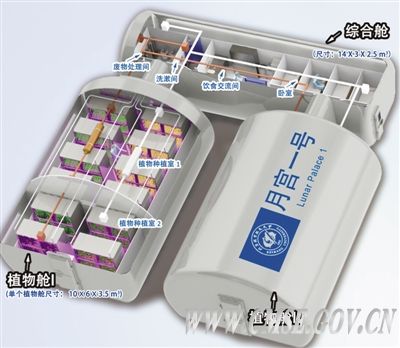
China’s Lunar Palace 1 – an experimental biosphere here on Earth.
Credit: CMSE
Self-contained cabin project
Yi specializes in agriculture. His education background qualifies him for this interdisciplinary project.
According to the story posted by Global Television Network (CGTN) on May 2, China plans to send astronauts to the Moon by 2036.
“This project gives us a better understanding of what it’s like to live and conduct explorations on the Moon over a longer period of time. We’ll also need this kind of system if we go to Mars,” said Wang Jun, academician at the Chinese Academy of Engineering.
According to the CGTN report, so far, 30 student researchers are committed to the self-contained cabin project, as more and more young people are interested in the nation’s space industry.
“Young people dream big, and they are ambitious. They are not afraid of making mistakes. I have confidence in China’s space exploration career,” said Li Hong, chief designer of Yuegong-1.
Yi said more has to be done, as the space lab program should anticipate many more of the conditions that outer space has to offer.

Credit: SpinLaunch Inc.
Albuquerque Business First has reported that SpinLaunch is to break ground on a new Spaceport America facility in New Mexico.
The idea behind SpinLaunch is to provide the world’s lowest-cost orbital launch service for the rapidly growing small satellite industry.
Kinetic energy
To do so, SpinLaunch is creating a system that accelerates the launch vehicle to hypersonic speeds using ground-based electricity. Applying the initial performance boost from a terrestrial-based launch platform enables the group to lower the cost by orders of magnitude and launch many times per day.

From years ago, an artist’s concept for a full scale “Slingatron.” Credit: Nextbigfuture
As reported earlier by Albuquerque Business First, SpinLaunch was founded in 2015 and is gunning to create a kinetic energy launch system not dependent on fossil fuels. The technology would spin spacecraft at high speeds on the ground and use that energy to catapult them into the atmosphere.
The new Albuquerque Business First story regarding SpinLaunch facility building is based on a media advisory from the New Mexico Spaceport
Space startup
SpinLaunch Inc., a Silicon Valley startup, announced last June the closing of a $35 million Series A funding round with a group of investors, including Airbus Ventures, GV (formerly Google Ventures), and Kleiner Perkins. This collective joins institutional investors including Lauder Partners, ATW Partners, Bolt, and Starlight Ventures to total $40M.
Investment funds will be used to scale the team and technology, through first launch by 2022.
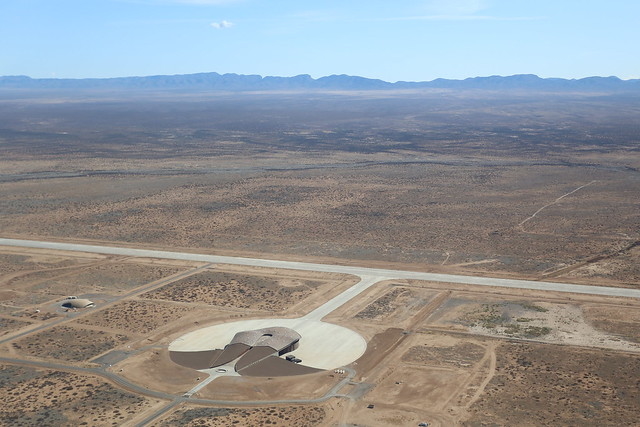
Aerial view of New Mexico’s Spaceport America.
Credit: Spaceport America
Groundbreaking ceremony
A SpinLaunch groundbreaking of its future test facility at Spaceport America is slated for May 7, 2019, according to a SpinLaunch press statement.
Dan Hicks, CEO, Spaceport America, will welcome SpinLaunch to the Spaceport as the newest member of the family of innovators at the New Mexico test site.
In January, Spaceport America announced a new lease agreement with SpinLaunch that will facilitate a new program of testing for the innovative new space company.
Spaceport America is the first purpose-built commercial spaceport in the world. The FAA-licensed launch complex, situated on 18,000 acres adjacent to the U.S. Army White Sands Missile Range in southern New Mexico, has a rocket friendly environment of 6,000 square miles of restricted airspace, low population density, a 12,000-foot spaceway, and 340 days of sunshine and low humidity.
For more information regarding SpinLaunch, go to:

Credit: DoD
The U.S. Office of the Secretary of Defense has issued its annual report: Military and Security Developments Involving the People’s Republic of China 2019.
As part of the report, a section on China’s Moon exploration program notes the farside Chang’e-4 lunar and rover.
“Building on the enabling capabilities such as lunar orbiting, soft landing, and sample return mastered through the legacy Chang’e program, China plans to assemble a lunar research station on the Moon around 2025 and a lunar research and development base around 2050.
Anti-satellite technologies
The report also notes that the Chinese People’s Liberation Army (PLA) is acquiring a range of technologies to improve China’s counterspace capabilities.
“In addition to the development of directed energy weapons and satellite jammers, China is also developing anti-satellite capabilities and has probably made progress on the anti-satellite missile system it tested in July 2014,” the report explains.
Although China has not publicly acknowledged the existence of any new programs since it confirmed it used an anti-satellite missile to destroy a weather satellite in 2007, Chinese defense academics often publish on counterspace threat technologies. These scholars stress the necessity of ‘destroying, damaging, and interfering with the enemy’s reconnaissance . . . and communications satellites,’ suggesting that such systems, as well as navigation and early warning satellites, could be among the targets of attacks designed to ‘blind and deafen the enemy.’
For the full report, go to:
https://media.defense.gov/2019/May/02/2002127082/-1/-1/1/2019_CHINA_MILITARY_POWER_REPORT.pdf

Curiosity Front Hazcam Left B image taken on Sol 2395, May 2, 2019.
Credit: NASA/JPL-Caltech
NASA’s Curiosity Mars rover has just begun Sol 2396 duties.
The drop off of “Kilmarie” drill sample to the robot’s Sample Analysis at Mars (SAM) Instrument Suite on Sol 2293 appeared to be successful, reports Michelle Minitti, a planetary geologist at Framework in Silver Spring, Maryland.
Full results of the SAM analysis to be assessed.

Curiosity Mastcam Left image taken on Sol 2393 April 30, 2019, show sample inlet (one open) of the rover’s Sample Analysis at Mars (SAM) instrument suite.
Credit: NASA/JPL-Caltech/MSSS
Volatile, organic makeup
“The results are needed to help determine if we will dive even further into the volatile and organic makeup of the Kilmarie sample,” Minitti adds. “There was no sitting around and twiddling actuators, however, even though the amount of power available was limited.”

Curiosity ChemCam Remote Micro-Imager photo acquired on Sol 2394, May 1, 2019.
Credit: NASA/JPL-Caltech/LANL
Curiosity will gather more details about the Kilmarie sample mineralogy via another Chemistry & Mineralogy X-Ray Diffraction/X-Ray Fluorescence Instrument (CheMin) integration, and also pepper a suite of broken up bedrock fragments around the rover – “Deinabo,” “Durnhill,” and “Dumyat” – with Chemistry and Camera (ChemCam) shots to compare their chemistry to that of the more-coherent bedrock that Kilmarie represents.
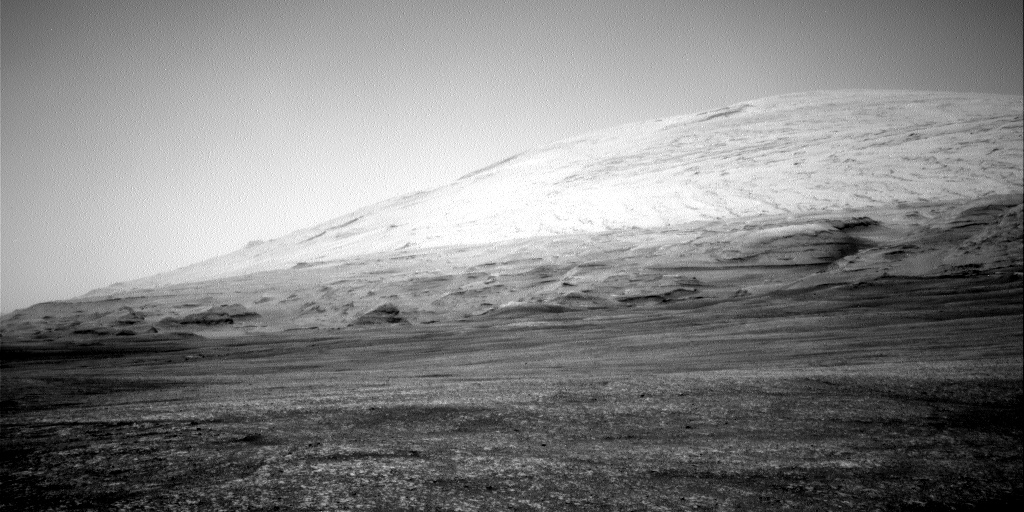
Curiosity Navcam Right B image taken on Sol 2394, May 1, 2019.
Credit: NASA/JPL-Caltech
Looking uphill
The rover is slated to acquire a long distance Remote Micro-Imager (RMI) mosaic, Minitti explains, “looking uphill toward the part of the Mount Sharp stratigraphy that is observed to have a strong spectral signature of sulfate from orbit.”
Changes caused by the wind are to be monitored by comparing the single Mars Descent Imager (MARDI) image acquired in a new plan to one acquired right after Curiosity’s arrival at Kilmarie on Sol 2381.
Changes in the environment will be monitored with a Navcam cloud movie and regular Rover Environmental Monitoring Station (REMS) and Radiation Assessment Detector (RAD) measurements.

Credit: Humans to Mars
Space is vast but seating is limited, register today!
I am very excited to be taking part in the upcoming Humans to Mars Summit 2019, being held at the prestigious National Academy of Sciences Building, Washington D.C. on May 14-16, 2019.
As the luncheon speaker on May 15, 2019, I’ll be focused on my new National Geographic book — Moon Rush: The New Space Race.
Spoiler alert: Subtitle – Back to the Moon – This Time to Stray?
Space protagonists
What better way to have a frank and open discussion with fellow space protagonists than to join for lunch?
Bound to be a food fight…I’m old, grumpy and still have a memory of space programs past. I’ve got things to say, and so do you!
Come join us.
Go to: https://h2m.exploremars.org/
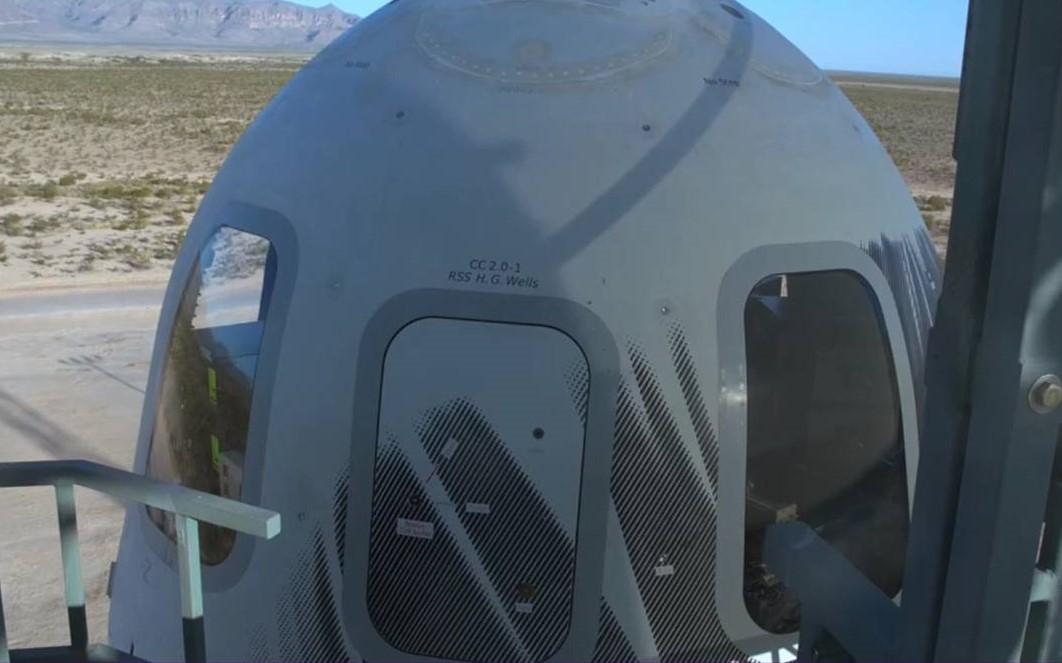
Credit: Blue Origin/Screengrab Inside Outer Space

Credit: Blue Origin/Screengrab Inside Outer Space

Credit: Blue Origin/Screengrab Inside Outer Space
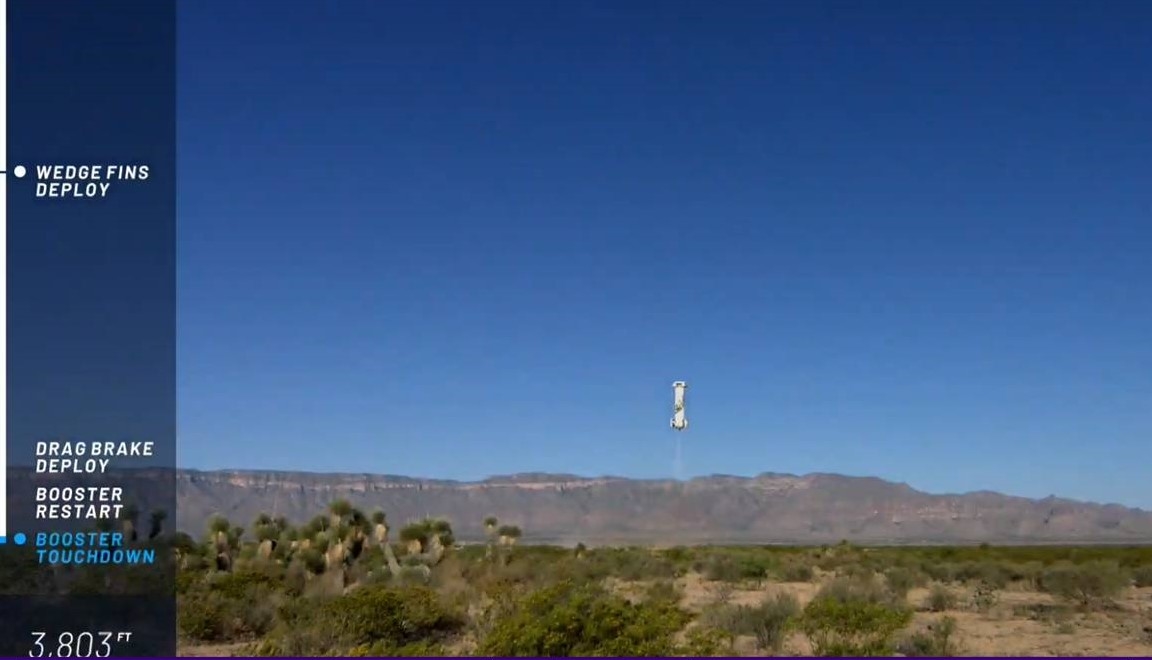
Credit: Blue Origin/Screengrab Inside Outer Space

Credit: Blue Origin/Screengrab Inside Outer Space
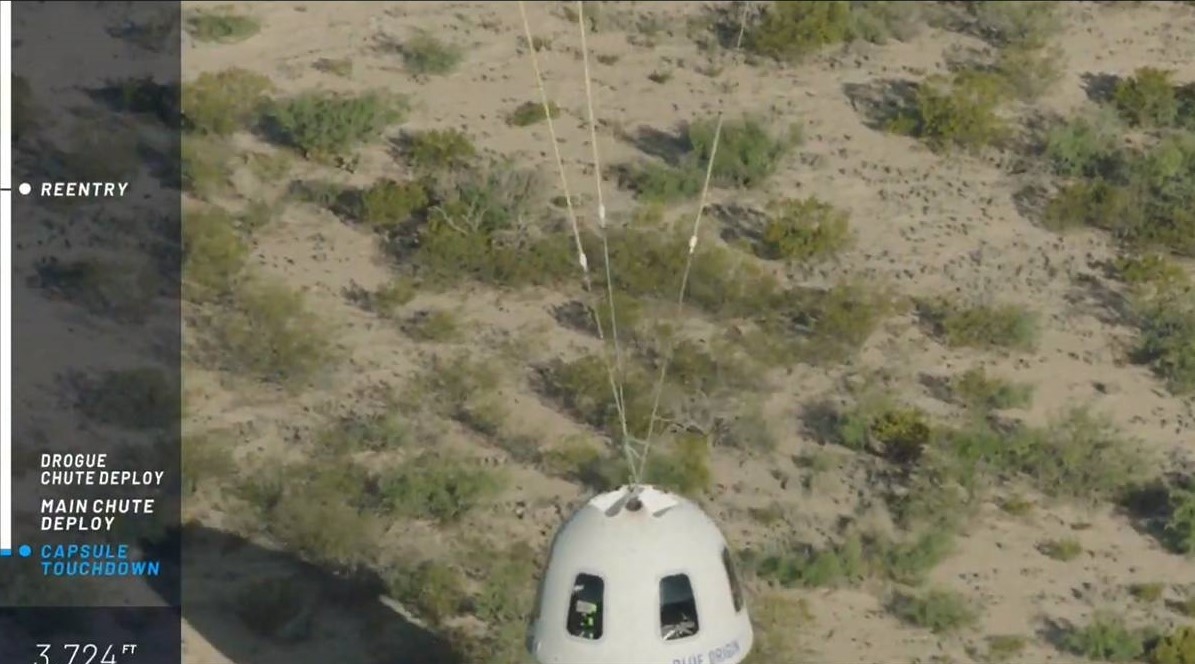
Credit: Blue Origin/Screengrab Inside Outer Space
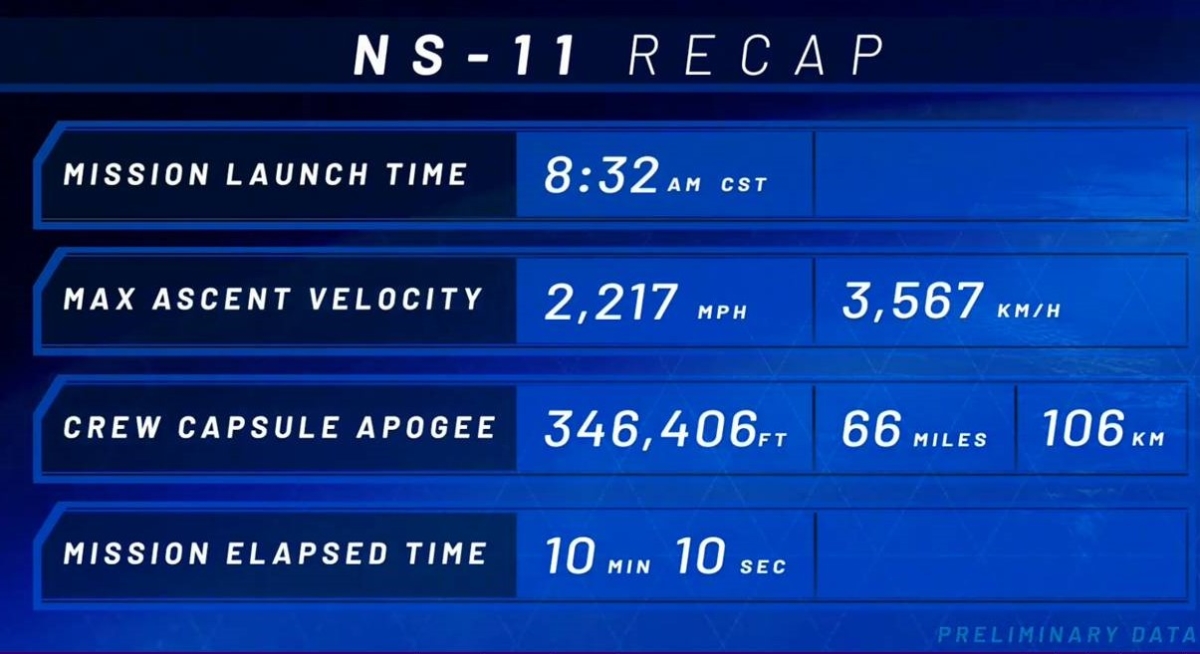
Credit: Blue Origin/Screengrab Inside Outer Space
The mission, named NS-11, took 38 payloads above the Kármán line into space.
Some of the payloads flying with us include:
Orbital Medicine – Orbital Medicine, a small business focused on aerospace medicine, comes to us through funding from NASA’s Flight Opportunities Program. On NS-11, Marsh Cuttino, MD, will demonstrate an experimental medical technology designed to treat a collapsed lung in zero gravity (which is a gravity-dependent procedure). Thanks to a previous flight on New Shepard, Dr. Cuttino has been able to evolve the technology and this flight will prove a near-final version that could one day save lives in space.
New Century Technology High School – A group of students from Huntsville, AL have designed an experiment to test temperature fluctuations in microgravity. The students were excited to get hands-on experience for a project they’ll be able to launch to space and worked with NASA engineers to perfect their design. By lowering launch costs, more and more students will have the chance to design, build and send technology to space.
MIT Media Lab Space Exploration Initiative – The Space Exploration Initiative is built on the spirit of the MIT Media Lab, uniting artists, engineers, scientists, and designers. As the first MIT flight with New Shepard, the Space Exploration Initiative is flying several scientific payloads, as well as two projects that use zero gravity as a medium for works of art. Telepresent Drawings in Space uses graphite to create a drawing that could only have been made in space.
Living Distance: A Spider-Inspired Robotic Dance in Weightlessness demonstrates a crystalline robotic device that navigates zero gravity, similar to a performance.
Other payloads include TESSERAE: Self Assembling Space Architecture, Floral Cosmonauts: Crystal Electro-Nucleation and Queen Bee Maiden Flight.

Credit: Jose Maria Madiedo/Jose L. Ortiz/MIDAS
The reported flash on the lunar surface during January’s total eclipse of the Moon was the result from a meteorite smacking into the Moon at roughly 38,000 miles per hour.
This event excavated a crater some 33 feet to 50 feet (10 to 15 meters) across.
Happening on January 21st — just after the total phase of the eclipse began – widespread reports from amateur astronomers indicated the flash was bright enough to be seen with the naked eye.
MIDAS touch
The Moon Impacts Detection and Analysis System (MIDAS), using eight telescopes in south of Spain recorded the moment of impact.
Jose Maria Madiedo of the University of Huelva, and Jose L. Ortiz of the Institute of Astrophysics of Andalusia, have published study results about the lunar impactor in a paper in Monthly Notices of the Royal Astronomical Society.

Credit: JM Madiedo
The impact flash lasted 0.28 second and is the first ever filmed during a lunar eclipse, despite a number of earlier attempts.
MIDAS telescopes observed the impact flash at multiple wavelengths improving the analysis of the event. Madiedo and Ortiz conclude that the incoming rock had a mass of 100 pounds (45 kilograms), measured 30 to 60 centimeters across, and hit the surface at 38,000 miles per hour (61,000 kilometers an hour). The impact site is close to the crater Lagrange H, near the west-south-west portion of the lunar limb.
Peak temperature
The two scientists assess the impact energy as equivalent to 1.5 tons of TNT, enough to create a crater up to 15 meters across, or about the size of two double decker buses side by side.
The debris ejected is estimated to have reached a peak temperature of 5,400 degrees Celsius, roughly the same as the surface of the Sun.
To read their paper — Multiwavelength observations of a bright impact flash during the 2019 January total lunar eclipse — go to:
https://academic.oup.com/mnras/article/486/3/3380/5480892
Also, go to this informative outreach video describing the event at:
https://www.youtube.com/watch?v=5ir8nPSSLYQ&feature=youtu.be

Credit: Joe Merrell
In the world of Unidentified Flying Object (UFO) research, there are those close encounter witnesses that report unknown fuming odors!
Los Angeles artist Joe Merrell has worked with perfumer Chris Gordon to create an eau de parfum called what else: “Abduction.”
The project started in 2016 with Saskia Wilson-Brown, founder and director of The Institute for Art and Olfaction, the two artisans working collaboratively to make several scents for Merrell’s art installation at Machine Project in Echo Park. One of these was based on what people report smelling during close encounter experiences.

Credit: Joe Merrell
Wearable fragrance
“There is very little research specifically related to scent and reported ufo/abduction phenomena,” Merrell told Inside Outer Space, “so I spent a great deal of time combing through books and talking to several people who report close encounters.”
Merrell adds, as is the case with other aspects of the UFO phenomenon, there was a fair amount of consistency in the reports.
“The challenge in this most recent iteration of the project was in making a perfume that stayed true to what was in the research and still worked on its own as a wearable fragrance,” Merrell said.

Credit: Joe Merrell
Sniff test
Merrell points to the research work of Antonio Rullán published in July 2000: Odors from UFOs: Deducing Odorant Chemistry and Causation from Available Data. The paper examines scents associated with physical craft.

Courtesy: Joe Merrell
As for the scents most often described in relation to abduction experiences, Merrell says they include cinnamon with a distinct cloying aspect, yeast, as well as damp organic/earthiness, even burning cardboard or paper.
The perfume that has been produced is reportedly true enough that it invokes feelings of familiarity from those that have experienced alien abduction.
For more information on Merrell’s work, as well as a posted copy of Rullán’s Odors from UFOs paper, go to his website, The Eyes Are Always There at:

