Author Archive
 Author:
  May 17th, 2019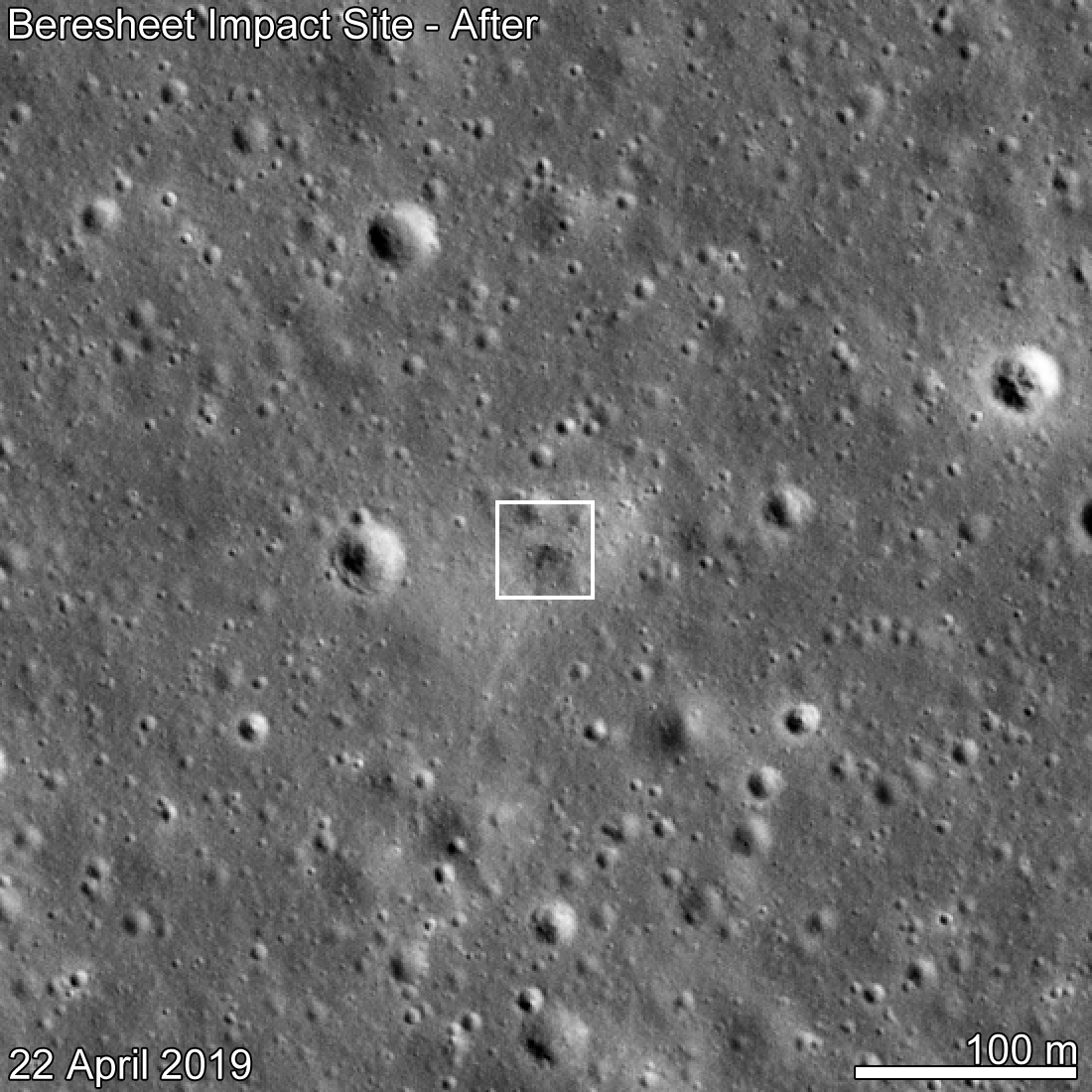
Credit: NASA/GSFC/Arizona State University
NASA’s Lunar Reconnaissance Orbiter (LRO) has used its high-powered LROC system to image Israel’s SpaceIL Beresheet crash site.
The imagery was taken eleven days after the attempted landing on April 11th.
Credit: NASA/GSFC/Arizona State University
Think gouge…rather than crater
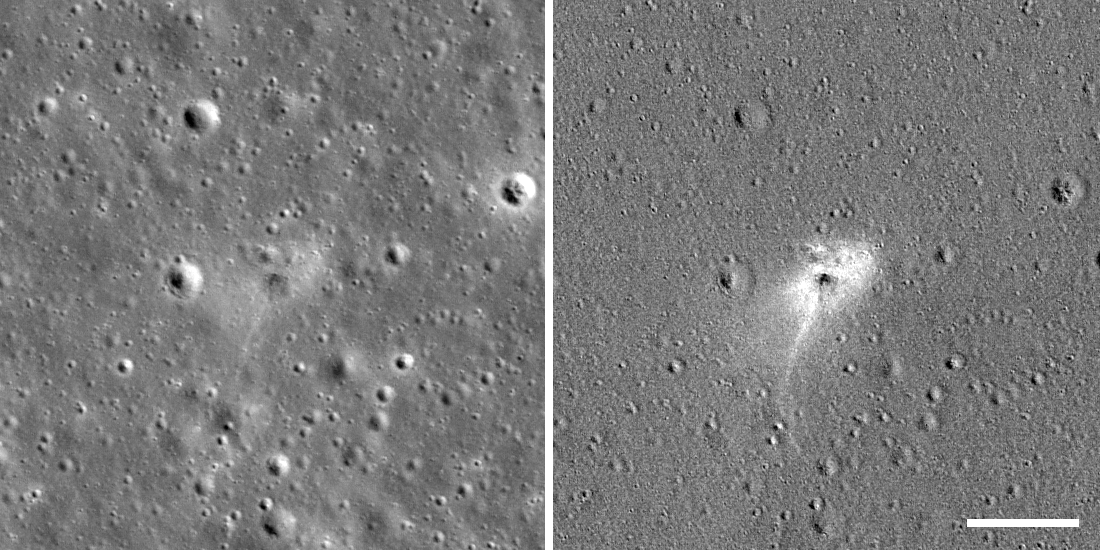
At the scale of the narrow angle camera image, photo specialists cannot detect a crater.
“Perhaps there is one but it is simply too small to be seen,” explains a posting from LRO central at Arizona State University (ASU), “or the low angle of impact (less than ten degrees relative to the surface), the fragility of the spacecraft, and the velocity precluded crater formation (think gouge rather than crater).”
Surrounding the smudge is an area of increased reflectance (up to 20% higher).
Ragged zone
This ragged zone spans 98 feet (30 meters) to 164 feet (50 meters) from the smudge and includes a ray that extends southward about 328 feet (100 meters).
“The higher reflectance was likely caused by gases or very fine high-speed particles rapidly moving away from the impact site, which smoothed the upper layer of regolith and redistributed fine soil particles, which in turn increased reflectance,” notes the ASU/LRO posting.
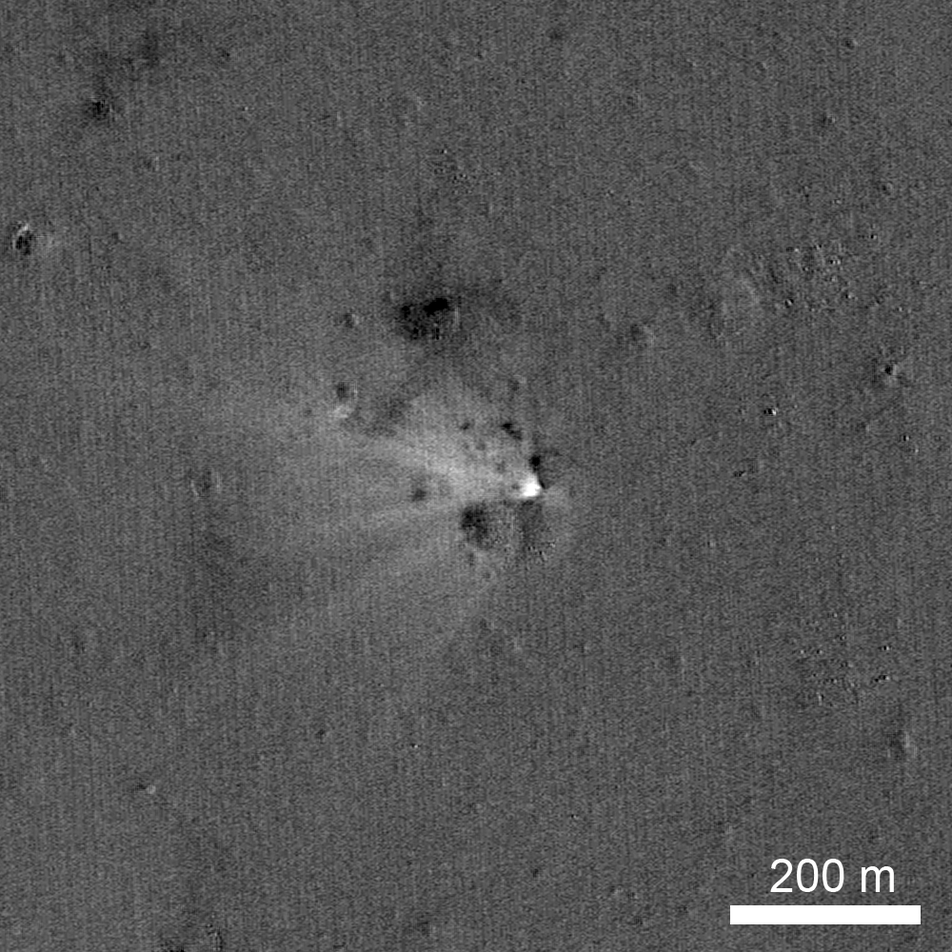
Depleted of fuel, NASA’s Lunar Atmosphere and Dust Environment Explorer spacecraft (LADEE) crashed on April 18, 2014. Its impact site on the eastern rim of Sundman V crater, the spacecraft was heading west when it impacted the surface. The ejecta form a V shaped pattern extending to the northwest from the impact point.
Credit: NASA/GSFC/Arizona State University
Small impact event
One upshot from the crash: while not a successful soft landing, the Beresheet impact provides another example of small impact events, explains the ASU/LRO website.
The crash site can be compared to NASA’s two GRAIL and the LADEE spacecraft that were purposely impacted on the Moon in 2012 and 2014, respectively. The study of these impacts is providing new insights into how the lunar regolith (soil) evolves over time.
“Despite the mishap, it is important to remember that Beresheet was the first spacecraft developed and flown by a non-profit entity to orbit the Moon,” explains the ASU/LRO posting. “And SpaceIL has announced they will be trying again, with Beresheet 2!”
 Posted in
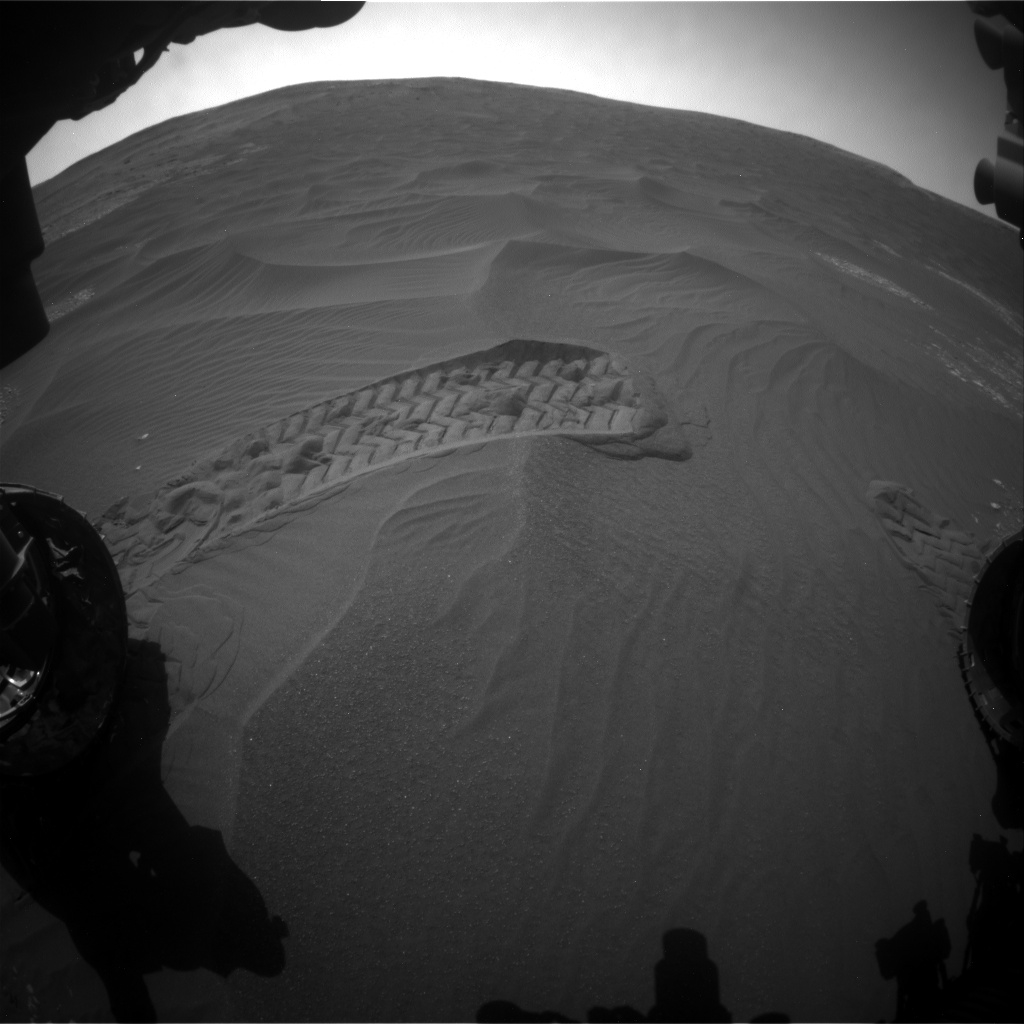
Curiosity Front Hazcam Left B image taken on Sol 2408, May 16, 2019.
Credit: NASA/JPL-Caltech
NASA’s Curiosity Mars rover is now performing Sol 2409 duties.
Now that the robot is back on the road following a drill campaign at Kilmarie, a quick “touch-and-go” activity was planned to characterize the local bedrock, explains Mark Salvatore, a planetary geologist at the University of Michigan in Dearborn.
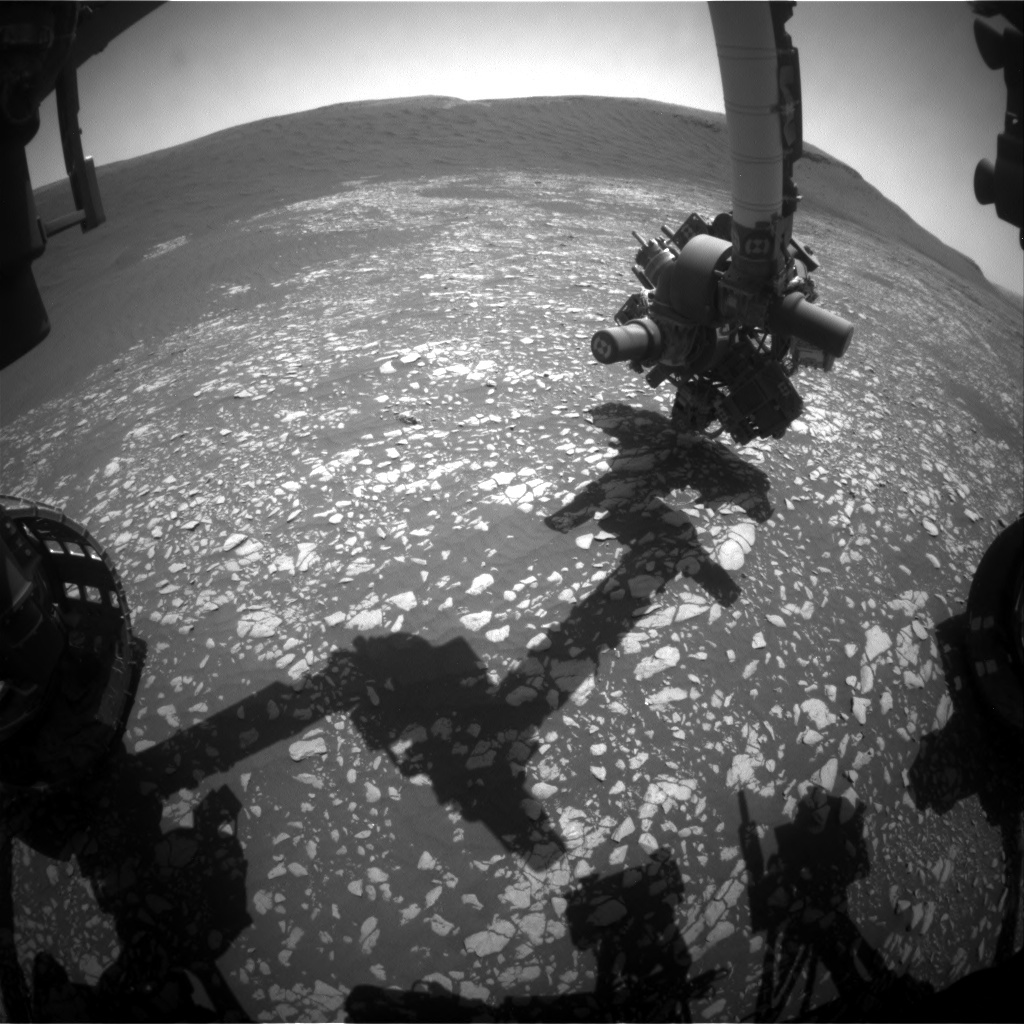
Curiosity Front Hazcam Left B image taken on Sol 2408, May 16, 2019.
Credit: NASA/JPL-Caltech
Ripple field
Curiosity recently drove a short 10 feet (3 meters) to the north towards a large ripple field named “Rigg,” which is where the “go” portion of “touch-and-go” took place.
Before then, however, Curiosity extended her arm and analyzed a patch of bedrock with the Alpha Particle X-ray Spectrometer (APXS) and then zapped bedrock off to the starboard side of the rover using the Chemistry and Camera (ChemCam) Laser Induced Breakdown Spectrometer (LIBS) instrument, Salvatore reports.
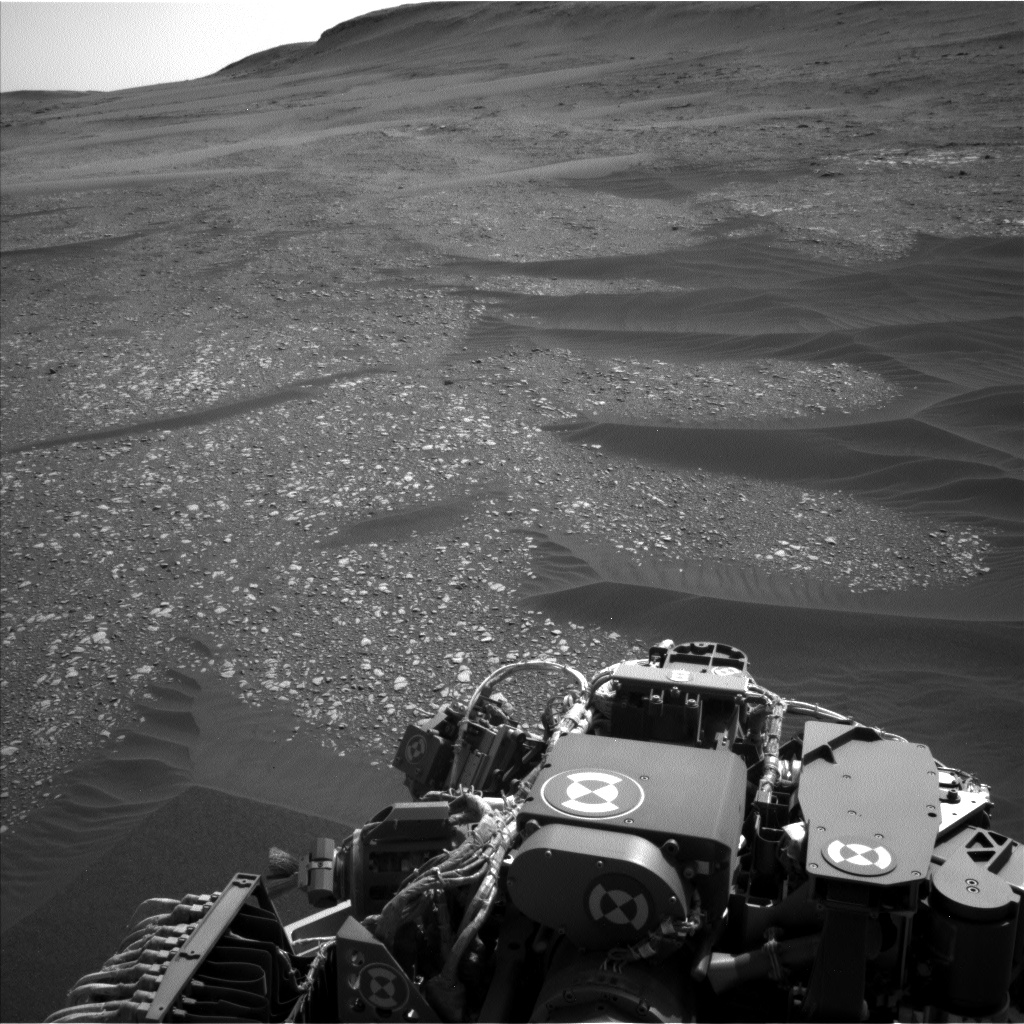
Curiosity Navcam Left B Sol 2408 May 16, 2019
Credit: NASA/JPL-Caltech
Well-planned dance
“She’ll then proceed with a well-planned dance that will dip one of Curiosity’s wheels into the nearby sand ripples, scuffing the surface and creating a small trench, and then orient herself in a position that will be better suited to study both the disturbed and undisturbed portions of the ripples,” Salvatore adds.
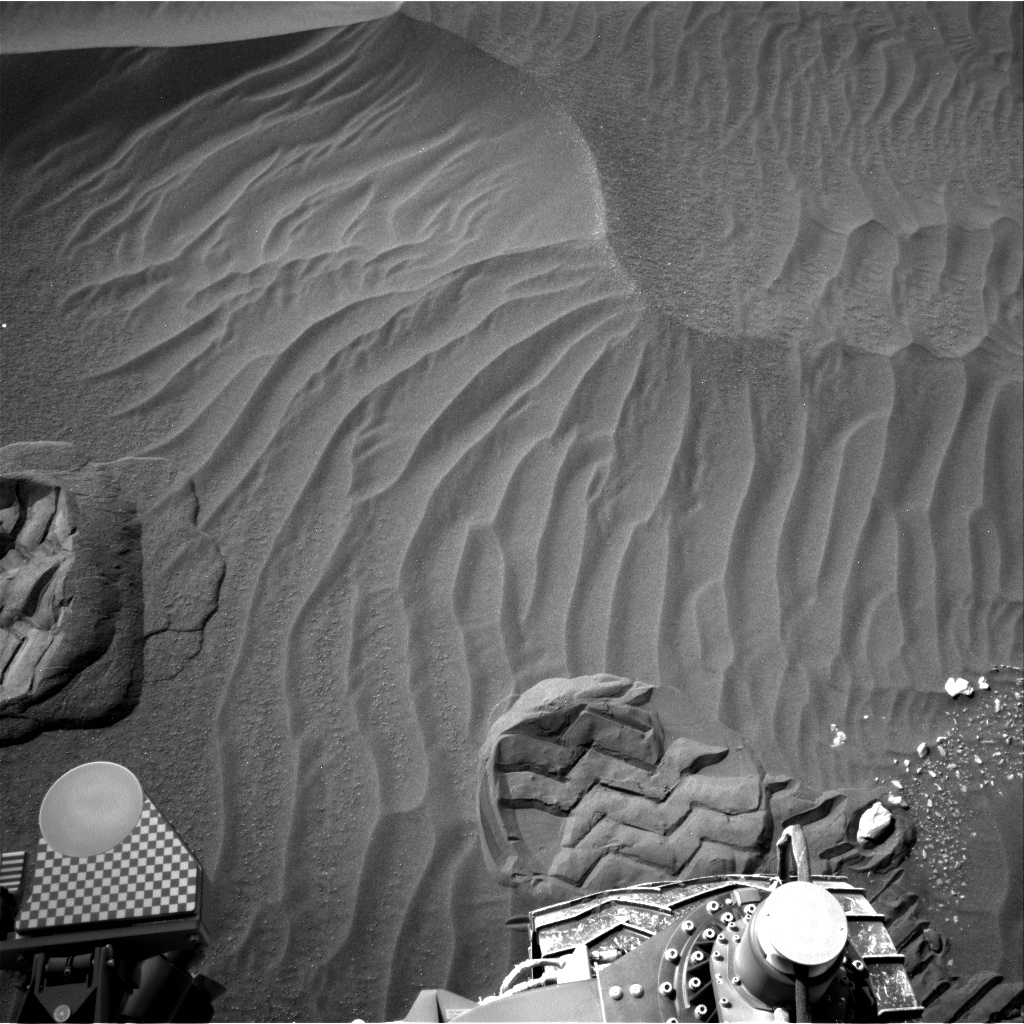
Curiosity Navcam Right B image acquired on Sol 2408, May 16, 2019.
Credit: NASA/JPL-Caltech
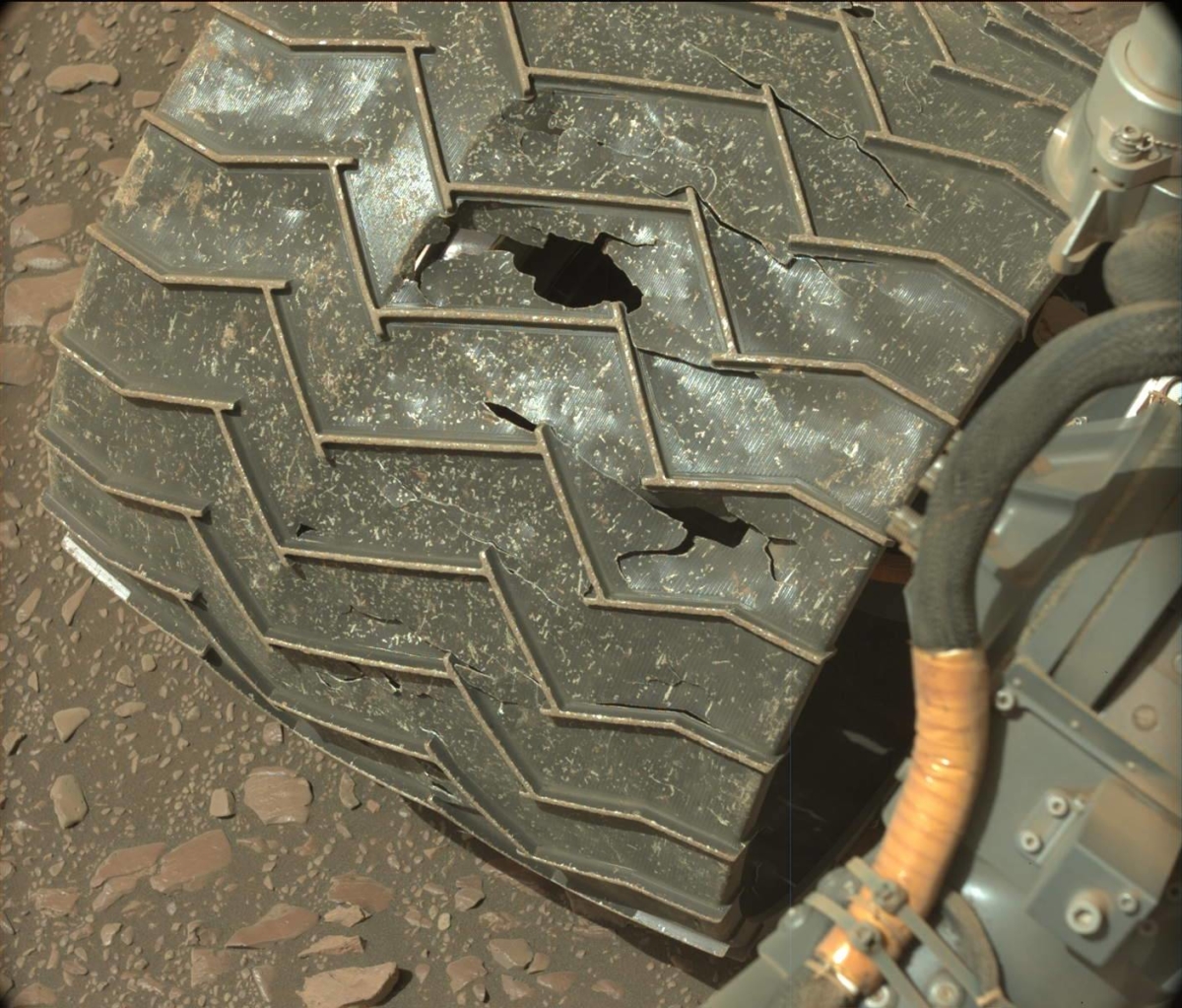
Wheel watch 2019. Curiosity Mastcam Left photo taken on Sol 2407, May 15, 2019.
Credit: NASA/JPL-Caltech/MSSS
The next few days will be dedicated to studying these ripples, Salvatore points out, before Curiosity planners have the rover investigate more of the clay-bearing materials of the Glen Torridon region to the south and east of Vera Rubin ridge.

The Red Planet as seen by Europe’s Mars Express.
Credit: ESA/D. O’Donnell – CC BY-SA IGO
Explore Mars, Inc. has released The Humans to Mars Report 2019, issued at the group’s summit meeting being held May 14-16 at the National Academy of Sciences Building in Washington D.C.
The report notes that the past year has been a particularly active year with regard to space policy. The National Space Council announced that it is now the goal of the United States to return humanity to the Moon by the year 2024.

Credit: Subcommittee on Space, Committee on Science, Space, and Technology/Screengrab
Broad-based, bi-partisan
According to NASA Administrator Jim Bridenstine, this will help enable human missions to Mars by 2033, as required by the NASA Transition Authorization Act of 2017. “This is essential as Mars exploration maintains broad-based bi-partisan support, with unwavering support coming from NASA, Congress, and industry,” explains the report.
Public interest in Mars also remains strong, as evidenced by recent public polling.

Credit: Bryan Versteeg
“Although a recent report argued that missions to Mars in 2033 may not be feasible under certain conditions, we maintain that if the United States adopts leaner architecture approaches than those assumed in that report and if both funding and political capital are applied to the new accelerated space policy, humans on Mars in 2033 remains an achievable goal,” says the report.

Credit: Bryan Versteeg
Moon/Mars synergies
Regarding the new thrust toward lunar exploration, the report embraces such a strategy, “as long as they do not significantly delay human missions to Mars.”
“We view Mars as a critical destination that will enable the exploration and development of space,” the new report explains, “and we firmly believe that humanity should set the goal of sending humans to Mars by 2033.”
In a press statement, according to Explore Mars, Inc. Board member and Executive Vice President, Joe Cassady: “It is interesting to note that while much is made of recent focus on returning to the Moon, many of the same architectural elements remain and are the keys to both a return to the Moon and to human missions to Mars in the 2030s. I am heartened by the spirit of cooperation and the many synergies we are finding between lunar and Mars advocates.”
To view the entire report — The Humans to Mars Report 2019 – go to:
https://www.exploremars.org/wp-content/uploads/2019/05/H2MR_2019_Web.pdf
For more information on Explore Mars, Inc., go to:

Credit: Smithsonian/NASM/Jim Preston
Neil Armstrong’s Apollo 11 spacesuit will go on display July 16, the 50th anniversary of the launch of Apollo 11.
“This is a big moment for us,” explains a Smithsonian Air and Space Museum statement, “because it will be the first time the suit is displayed in 13 years, and the suit just completed a multi-year conservation.”
The suit conservation was funded by thousands of public donations through a Kickstarter campaign in 2015.
A state-of-the-art display case and mannequin have been created to help protect the fragile suit while on display.

Credit: Smithsonian/NASM/Jim Preston
Leftover lunar dust
Does the suit look significantly different to the naked eye?
“No, but that’s the point! Our conservation of the Armstrong spacesuit didn’t aim to make it look brand new, but rather to preserve and stabilize the suit, keeping all of the history-making elements intact,” explains the museum statement.
You can even see Moon dust that remains on the suit from the lunar mission.
For a view of Neil Armstrong’s spacesuit in person, it will be on display at the museum in Washington, D.C. starting July 16.

Apollo Leadership Lessons: Powerful Business Insights for Executives by Dick Richardson; Authority Publishing 2019; paperback: 232 pages, $24.99.
As we close in on the July salute of the 50th anniversary of Apollo 11, you’ll find this book an inspiring read – one that captures hope and disappointment, villains and heroes, greed and sacrifice. At every step it’s a story of leadership.
With unique access to key leaders and NASA resources, author Dick Richardson has captured the leadership insights of America’s journey to the Moon and other space projects. These lessons are told through the lens of the people who were there–the executives, flight directors, and astronauts.
As the volume explains: “You may not go to the Moon, but this book will help you apply NASA’s leadership lessons to your company’s mission.”
Twelve chapters take the reader from Wernher von Braun and his adaptive leadership in action, John F. Kennedy’s ability to nurture a vision, the crisis of leadership due to the Apollo 1 pad fire to Apollo 13’s responsive innovation and the changing strategic intent of the Apollo-Soyuz project.
“Many of the leadership insights that came out of NASA are still there, sixty years later,” Richardson writes. “The people who grappled with tough situations, made difficult decisions, and led challenging teams left a lasting legacy from which we all continue to benefit,” he adds.
“Read the book. You may be spurred on to lead others to do things that are hard to do or even imagine. Whether in space or on earth, these are exciting and changing times, and you are a part of them,” explains David Leestma, astronaut and former director, Flight Crew Operations in the book’s foreword. “Dick Richardson is making a difference in helping leaders and his insights may make the journey easier and better.”
I concur.
This unique read is a real plus in helping the reader better appreciate the leadership principals and tactics employed by Apollo’s key decision-makers.
For more information on this book, go to:

Credit: UCSB/Lubin
One small, high-flying step toward interstellar travel!
Last month, UC Santa Barbara students sent up, via balloon, a prototype miniature spacecraft designed to further interplanetary and eventually interstellar flight.
“It’s part of a process of building for the future, and along the way you test each part of the system to refine it,” said UC Santa Barbara physics professor and experimental cosmologist Philip Lubin.

Credit: UCSB/Lubin/Screengrab Inside Outer Space
Wafer scale spacecraft
The prototype wafer scale spacecraft (WSS) is small enough to fit in the palm of one hand. It was launched into the stratosphere above Pennsylvania, to an altitude of 105,000 feet (32 km) — three times that of commercial airplanes — to gauge its functionality and performance.
The launch was conducted in collaboration with the United States Naval Academy in Annapolis on April 12, 2019 — 58 years to the day that Russian cosmonaut and pilot Yuri Gagarin became the first human to complete orbital space flight.
The spacecraft prototype worked flawlessly and collected more than 4,000 images of the Earth.
“It was designed to have many of the functions of much larger spacecraft, such as imaging, data transmission, including laser communications, attitude determination and magnetic field sensing,” said Nic Rupert, a development engineer in Lubin’s lab. “Due to the rapid advancements in microelectronics we can shrink a spacecraft into a much smaller format than has been done before for specialized applications such as ours.”

Artist rendering of the Directed Energy Interstellar Study.
Credits: P. Lubin
Ultra-lightweight
The project’s is to build an ultra-lightweight (gram scale) silicon wafer with embedded electronics, capable of being shot into space by way of directed energy propulsion while relaying data back to Earth.
Part of a NASA-funded endeavor called Starlight, the effort is supported also by the Breakthrough Foundation, where it is known as Starshot. UC Santa Barbara initiated the project in 2009 with modest funding from NASA’s Spacegrant program, receiving additional funds in 2015 via NASA’s Innovative Advanced Concepts (NIAC) program.
Go to this video at:
For more information, go to this story by Sonia Fernandez in UCSB’s The Current:
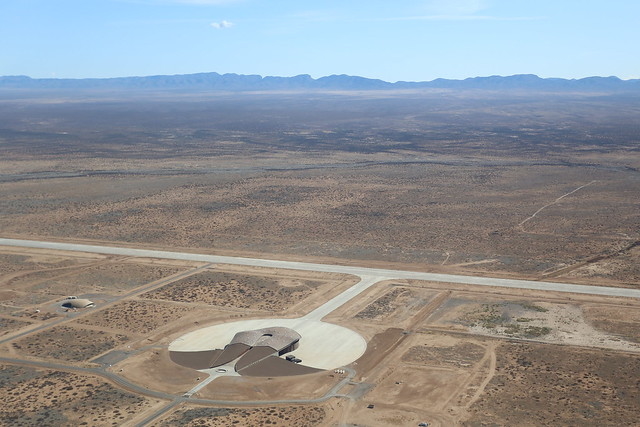
Aerial view of New Mexico’s Spaceport America.
Credit: Spaceport America
Richard Branson’s Virgin Galactic and Gov. Michelle Lujan Grisham announced today that the space company plans to relocate more than 100 employees to New Mexico’s Spaceport America as it begins to ramp up operations for commercial flights.
Virgin Founder Sir Richard Branson announced that Virgin Galactic’s development and testing program had advanced sufficiently to move the spaceline staff and space vehicles to their commercial operations headquarters at Spaceport America, New Mexico.
The move, which involves more than 100 staff, will commence imm

Credit: Spaceport America
ediately and continue through the summer.
$218 million investment
Spaceport America represents a $218 million investment by the state of New Mexico. The 18,000-acre FAA-licensed facility sits adjacent to the U.S. Army’s White Sands Missile Range and has three vertical launch complexes and a 12,000-foot runway.
Just 45 miles north of Las Cruces, Spaceport America has the most restricted airspace in the Unites States except for the sky over the White House.
To date, Spaceport America has hosted 204 vertical launches as well as student rocket and science competitions.

Virgin Galactic’s WhiteKnightTwo/SpaceShipTwo launch system flies above New Mexico’s Spaceport America – at that time, still under construction.
Credit: Virgin Galactic/Mark Greenberg
Coming home
“New Mexico delivered on its promise to build a world-first and world-class spaceport,” said Branson. “Today, I could not be more excited to announce that in return, we are now ready to bring New Mexico a world-first, world-class spaceline. Virgin Galactic is coming home to New Mexico, where together we will open space to change the world for good.”
Branson made the announcement in a ceremony at the New Mexico state capitol in Santa Fe. He said more than 100 employees will be moving to New Mexico to support the current staff bringing employment for Virgin Galactic at Spaceport America to approximately 150.
More jobs will follow as operations progress into commercial service in the coming year, Branson said.
Video: https://www.facebook.com/NewMexicoEconomicDevelopment/videos/420010298822223/

Curiosity Front Hazcam Right B image taken on Sol 2402, May 10, 2019.
Credit: NASA/JPL-Caltech
NASA’s Curiosity Mars rover has just started to perform Sol 2403 duties.
Reports Lucy Thompson, a planetary geologist at the University of New Brunswick, Fredericton, New Brunswick, Canada: The go ahead has been given to start planning to proceed with dumping the Kilmarie drill fines from the robot’s drill bit assembly.

Curiosity Mars Hand Lens Imager (MAHLI) image produced on Sol 2402, May 10, 2019. MAHLI is located on the turret at the end of the rover’s robotic arm.
Credit: NASA/JPL-Caltech/MSSS
Pulverized sample
Both the Sample Analysis at Mars (SAM) Instrument Suite and Chemistry & Mineralogy X-Ray Diffraction/X-Ray Fluorescence Instrument (CheMin) instrument have completed or are nearing completion of analyses of the pulverized Kilmarie sample, Thompson adds. Now it’s the turn of the Alpha Particle X-Ray Spectrometer (APXS) and Mars Hand Lens Imager (MAHLI) to analyze the material.

Curiosity Mastcam Right photo acquired on Sol 2401, May 9, 2019.
Credit: NASA/JPL-Caltech/MSSS
“As a member of the APXS team and the strategic planner today for our instrument, I was excited to use APXS and to start analyzing the drill fines,” Thompson explains.
“We have been waiting patiently to use APXS and MAHLI, because any arm activity is precluded while sample is in the drill bit assembly.”
Comparing drill holes
The chemical analysis of the dumped material by APXS and eventually the Chemistry and Camera (ChemCam) will be compared with that of the bedrock surface prior to drilling, as well as to the nearby “Aberlady” drill fines, “to look for variations in composition with depth and between the two drill holes,” Thompson adds.

Curiosity Navcam Right B image taken on Sol 2402, May 10, 2019.
Credit: NASA/JPL-Caltech
Specifically, the APXS-derived chemistry of the dumped material will be used by the Chemistry & Mineralogy X-Ray Diffraction/X-Ray Fluorescence Instrument (CheMin) team to refine their mineralogical analysis.

Curiosity Navcam Right B image taken on Sol 2402, May 10, 2019.
Credit: NASA/JPL-Caltech
Dumped material
“The close-up imaging by MAHLI will tell us about the texture and color of the fines in detail and assist the APXS team in determining exactly where our instrument was placed,” Thompson notes.

Curiosity Navcam Right B image taken on Sol 2402, May 10, 2019.
Credit: NASA/JPL-Caltech
Curiosity’s MAHLI will also image the drill hole and tailings (powdered rock material surrounding the drill hole) at a 25 centimeter standoff to assist placement of APXS and closer-up MAHLI imaging in the next plan.
Mastcam multispectral imaging and ChemCam passive spectroscopy of the Kilmarie dumped material will aid in further elucidating mineralogy.
Bedrock types
Aside from concentrating on the dumped Kilmarie drill fines, the plan included two ChemCam 5×1 active Laser Induced Breakdown Spectroscopy (LIBS) analyses to further characterize the transition between compositional end-member bedrock types exposed in the area (targets “Valtos” and “Wishaw”).
“A ChemCam experiment was also planned,” Thompson points out, “in order to test a new way of protecting ChemCam from being damaged by inadvertently pointing at the sun.”
The new method allows ChemCam to take advantage of local terrain features to block the sun, allowing the instrument to target more distant features than if it had to stay below an imaginary, level horizon.
Ripple field
“A Mastcam mosaic will add to images already acquired of a nearby ripple field, where we are planning to conduct a more detailed study in the near future,” Thompson reports.
The robot’s environmental observations included standard background Rover Environmental Monitoring Station (REMS) activities to monitor the daily martian weather; use of the Radiation Assessment Detector (RAD) to monitor the radiation environment; and Dynamic Albedo of Neutrons (DAN) passive measurements to study the abundance and distribution of subsurface H- and OH-bearing materials.
Lastly, Thompson says that a Navcam suprahorizon movie will look for clouds and optical depth of the atmosphere and a Mastcam tau observation pointed towards the sun will measure atmospheric opacity.

Credit: Blue Origin/Blue Moon
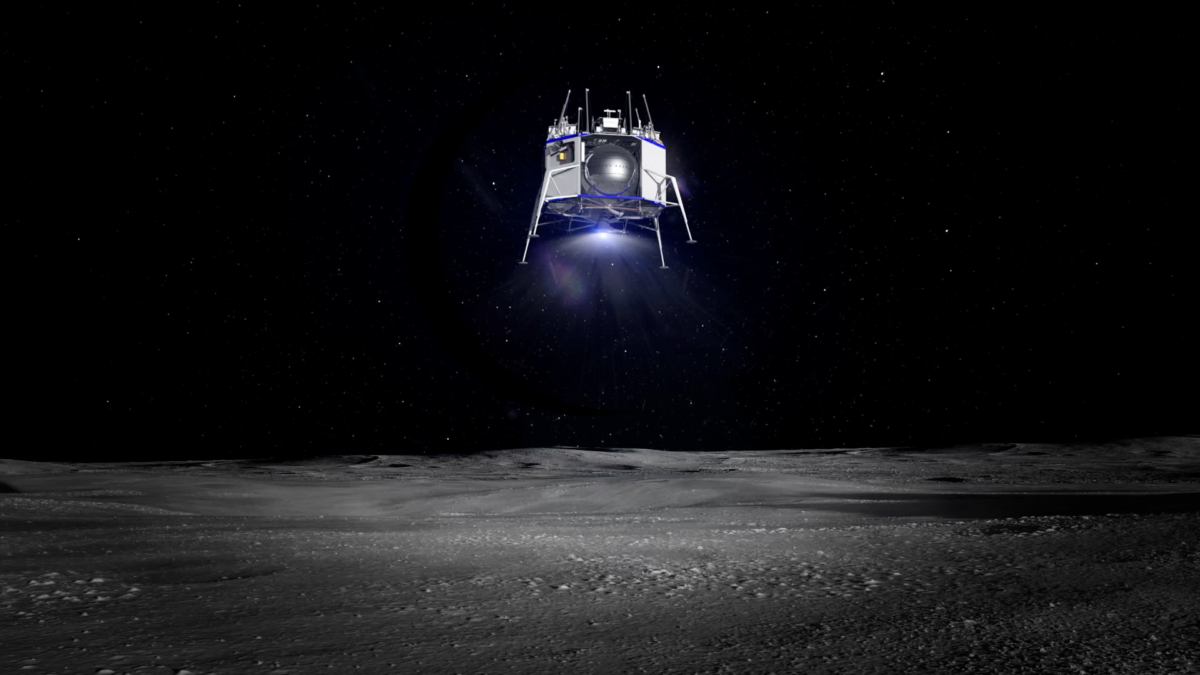
Jeff Bezos of Amazon.com fame and fortune detailed his company’s Blue Moon plans for flying cargo and crew to the Moon. The lunar strategy of the Bezos-backed Blue Origin group was revealed May 9 at the Walter E. Washington Convention Center in Washington, D.C.
Credit: Blue Origin/Blue Moon
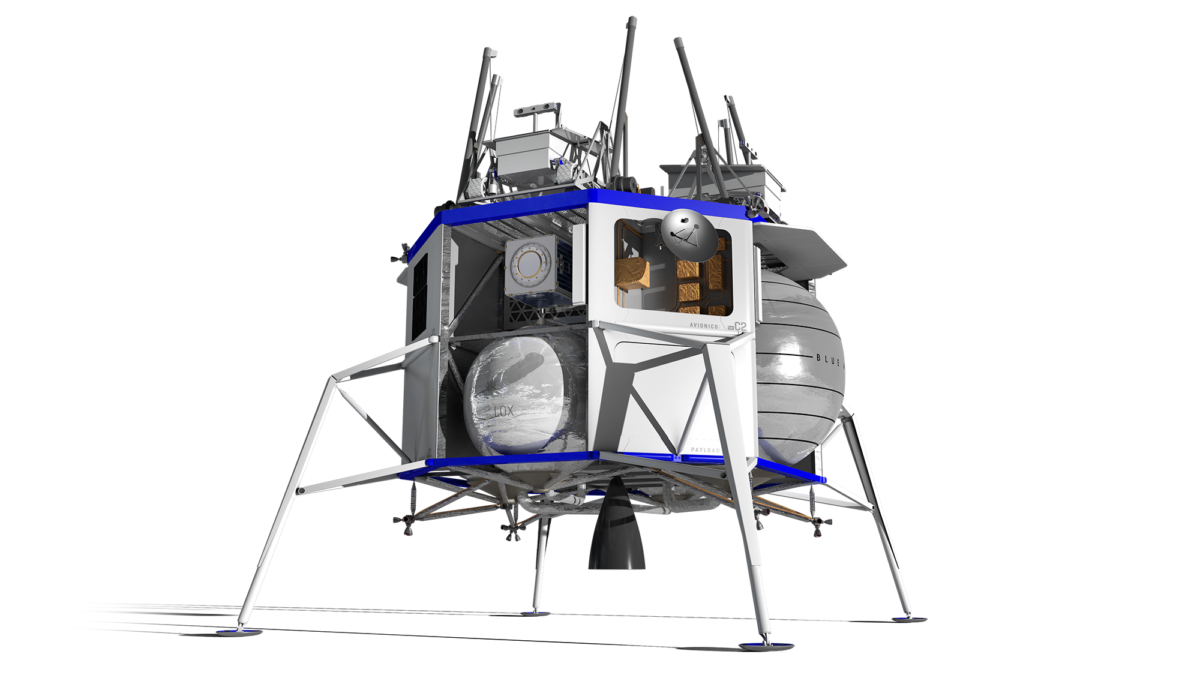
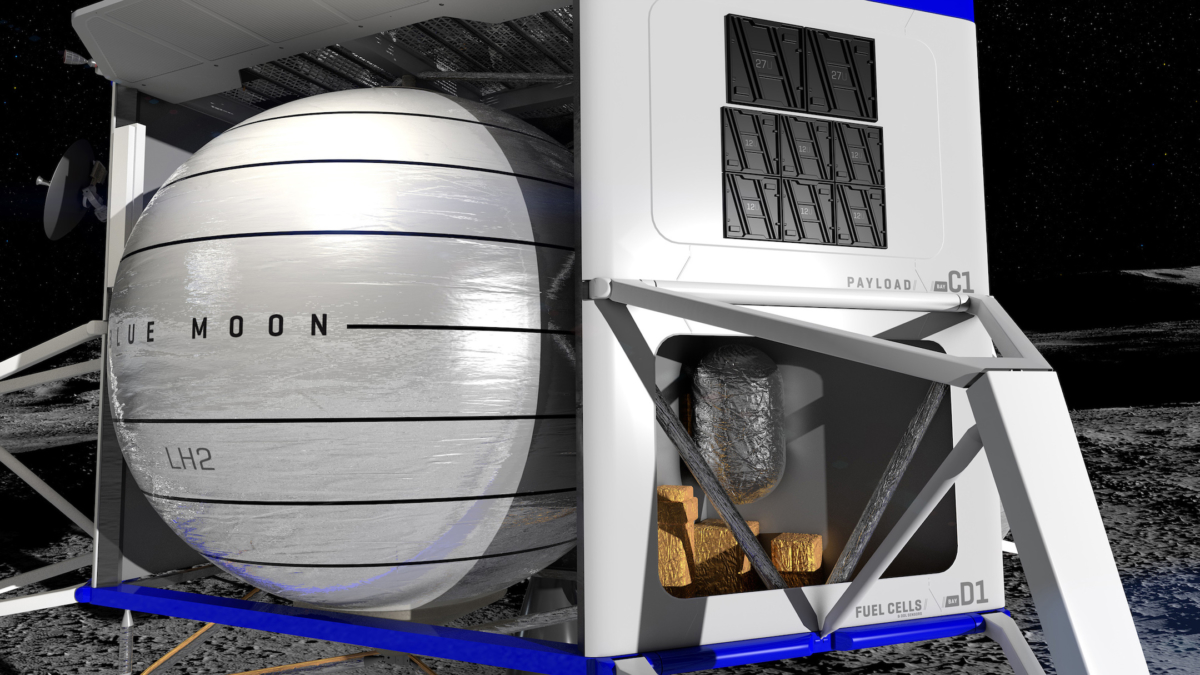
Blue Moon is a flexible lander that can deliver a wide variety of small, medium and large payloads to the Moon’s surface. “Its capability to provide precise and soft landings will enable a sustained human presence on the Moon,” according to Blue Origin’s website, now populated with details of the Blue Moon venture.
Credit: Blue Origin/Blue Moon
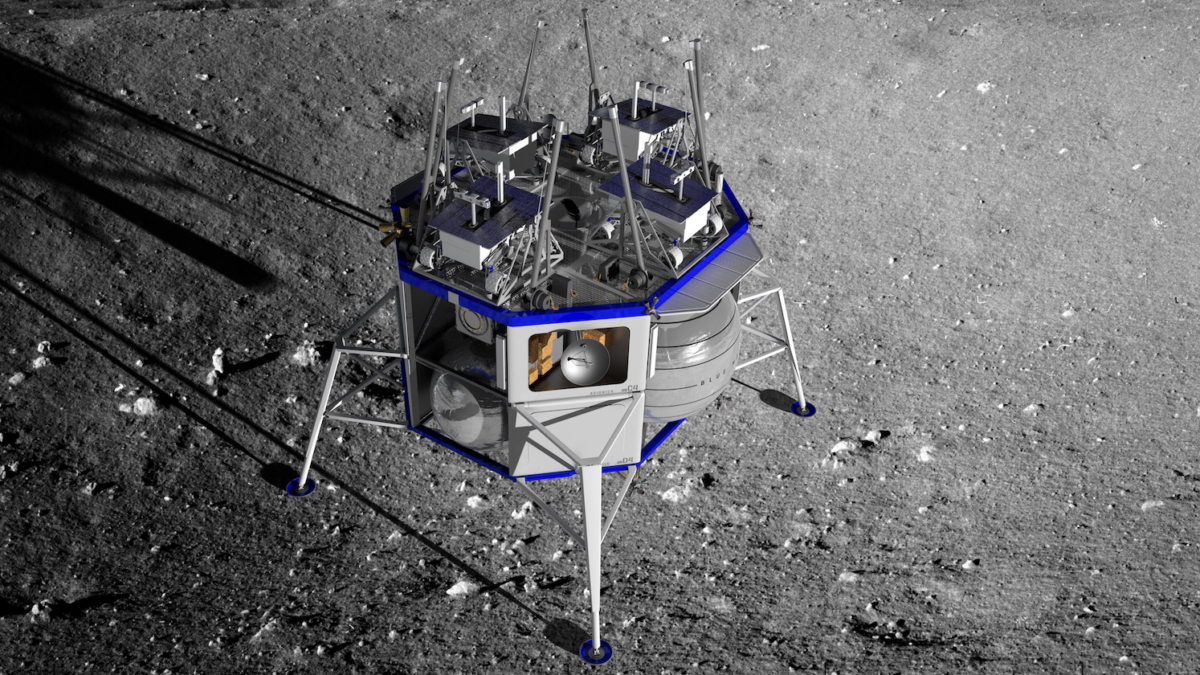
The Blue Moon lander can deliver large infrastructure payloads with high accuracy to pre-position systems for future missions. “The larger variant of Blue Moon has been designed to land an ascent vehicle that will allow us to return Americans to the Moon by 2024,” explains the Blue Origin website.
Credit: Blue Origin/Blue Moon
Science advisory board
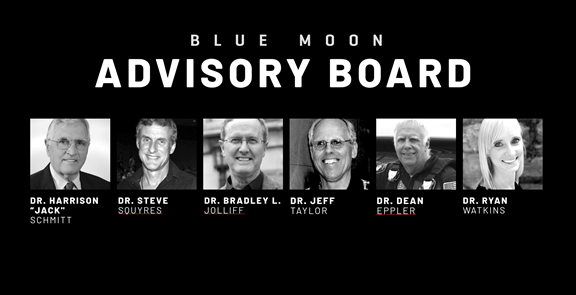
Meanwhile, Inside Outer Space has been advised about the members of a Science Advisory Board for the Blue Origin lunar transportation service:
- Bradley Jolliff, the Scott Rudolph Professor of Earth and Planetary Sciences at Washington University in St. Louis
- Apollo 17’s Harrison “Jack” Schmitt, geologist and former New Mexico Senator
- Dean Eppler, a former geologist at the Johnson Space Center in Houston, Texas and a participant in field tests of experimental spacesuits as part of the Desert RATS program
- Jeffrey Taylor of the Hawai‘i Institute of Geophysics and Planetology at the University of Hawai‘i
- Steve Squyres, professor of astronomy at Cornell University, Ithaca, N.Y.
- Ryan Watkins, a Planetary Science Institute research scientist in Tucson, Arizona
Science Advisory Board members are consultants to Blue Origin, not full-time employees.
Credit: Blue Origin/Blue Moon
Feedback
In a statement from Watkins, she described the role of the advisory group:
“My role has been to provide feedback regarding the Blue Moon lander design and landing site selection. The Board members provide feedback on their subsystem designs and payload capabilities,” Watkins said.
“My expertise has mainly been on landing site selection and some general feedback related to plume effects during landing – but at this stage we are all providing any kind of input we can regarding what we think is feasible and reasonable for their design concepts, from a science perspective,” Watkins added.

New Shepard reusable booster design has undergone a series of flights.
Credit: Blue Origin/Screengrab Inside Outer Space
Building on New Shepard
According to Blue Origin’s website: Years in development, the lander can deliver payloads to the lunar surface, host payloads and even deploy payloads during its journey to the Moon.
Its technology builds on the experience gained with the New Shepard reusable booster, with respect to LH2/LOX propulsion, precision guidance, vertical landing and landing gear systems.
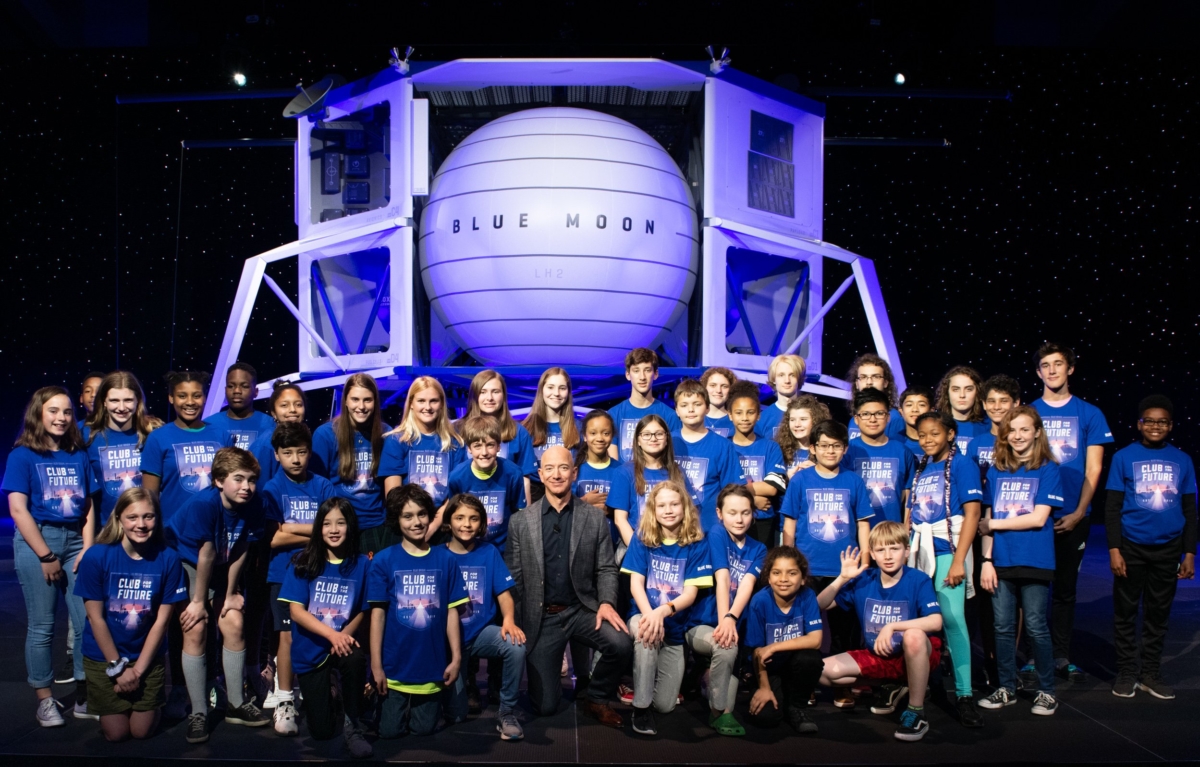
Jeff Bezos with students at Washington, D.C. event.
Credit: Blue Origin/Blue Moon
Metric tons
Blue Moon can land multiple metric tons of payload on the lunar surface.
The top deck and lower bays easily accommodate a wide variety of payloads, including large payloads and ESPA-class payloads with standard ring port interfaces.
ESPA stands for EELV Secondary Payload Adapter – a payload adapter ring for launching secondary payloads.

Credit: NASA
Day/night duration
There are lower mounting locations for payloads on the lunar lander, useful for closer access to the lunar surface and off-loading. The Blue Moon lander will provide kilowatts of power to payloads using its fuel cells, allowing for long mission durations and the ability to last through the lunar night.
Lastly, Blue Moon’s precision guidance and descent sensors are to utilize machine learning technology to accurately land anywhere on the lunar surface, starting with its first mission.
Jeff Bezos has previously identified Shackleton crater as an ideal locale to establish a base camp, a sun-shy feature thought loaded with water-ice for exploitation purposes and also a site that offers near-constant sun light at the crater’s rim.
Video of the May 9, 2019 event with Jeff Bezos discussing his vision to go to space to benefit Earth is available here:
https://www.youtube.com/watch?v=GQ98hGUe6FM&feature=youtu.be
For information on Blue Moon, go to:
Credit: AI SpaceFactory
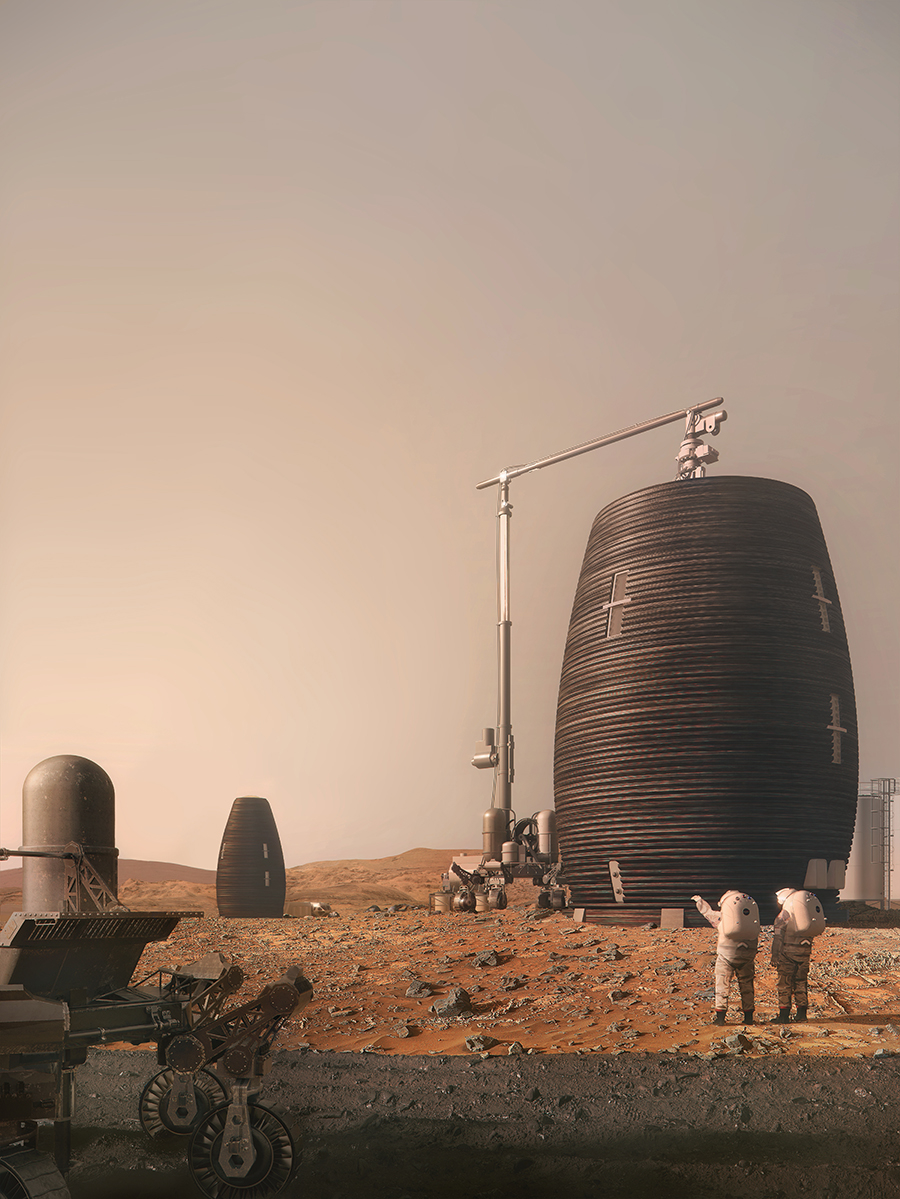
NASA has awarded multi-planetary architectural and technology design agency, AI SpaceFactory, $500,000 for the successful construction of its Mars habitat (MARSHA).
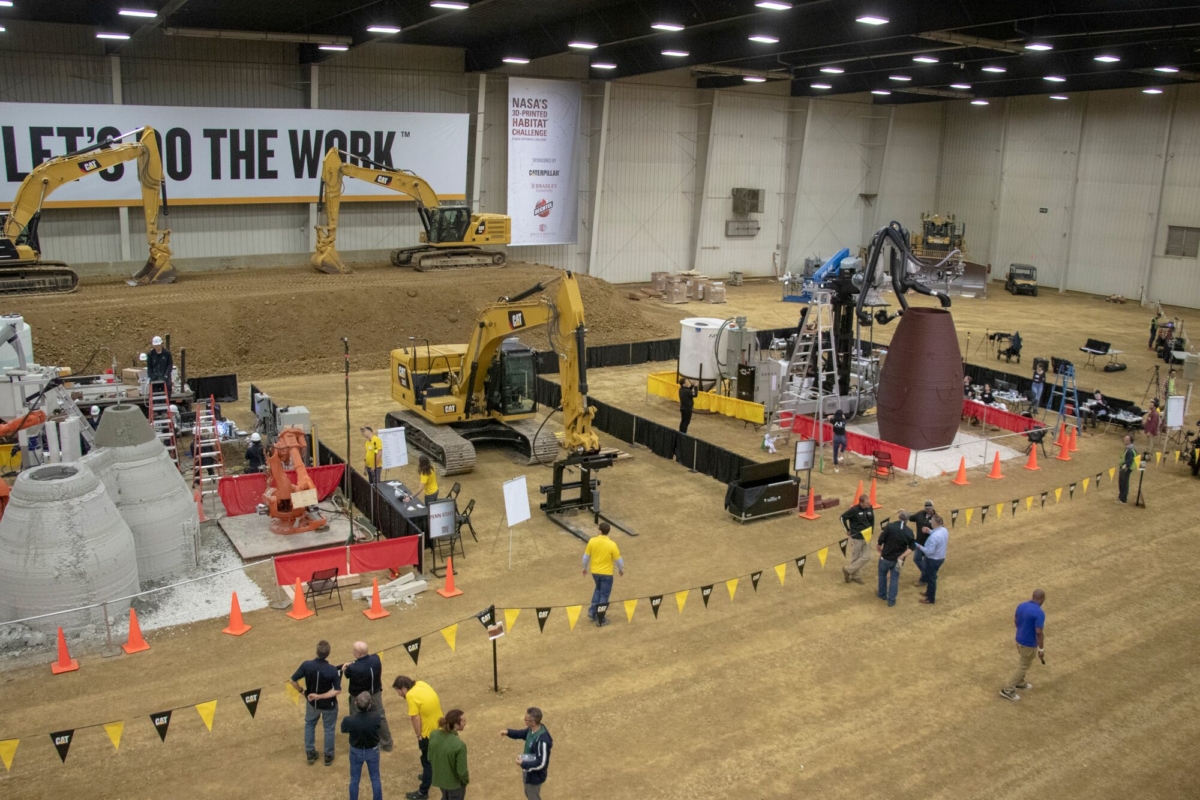
The habitat was 3D printed during the final phase of NASA’s Centennial Challenge.

Credit: AI SpaceFactory
Innovative composite
AI SpaceFactory, headquartered in New York, was announced the 1st place winner out of over 60 challengers for the automation of its print – completed with nearly no human assistance in 30 hours – as well as its innovative biopolymer basalt composite, a biodegradable and recyclable material derived from natural materials found on Mars.
Credit: AI SpaceFactory
MARSHA’s vertical shape and human-centric design marks a radical departure from previous, home away from home Martian designs.
After withstanding NASA’s pressure, smoke, and impact testing, this material was found to be stronger and more durable than its concrete competitors.
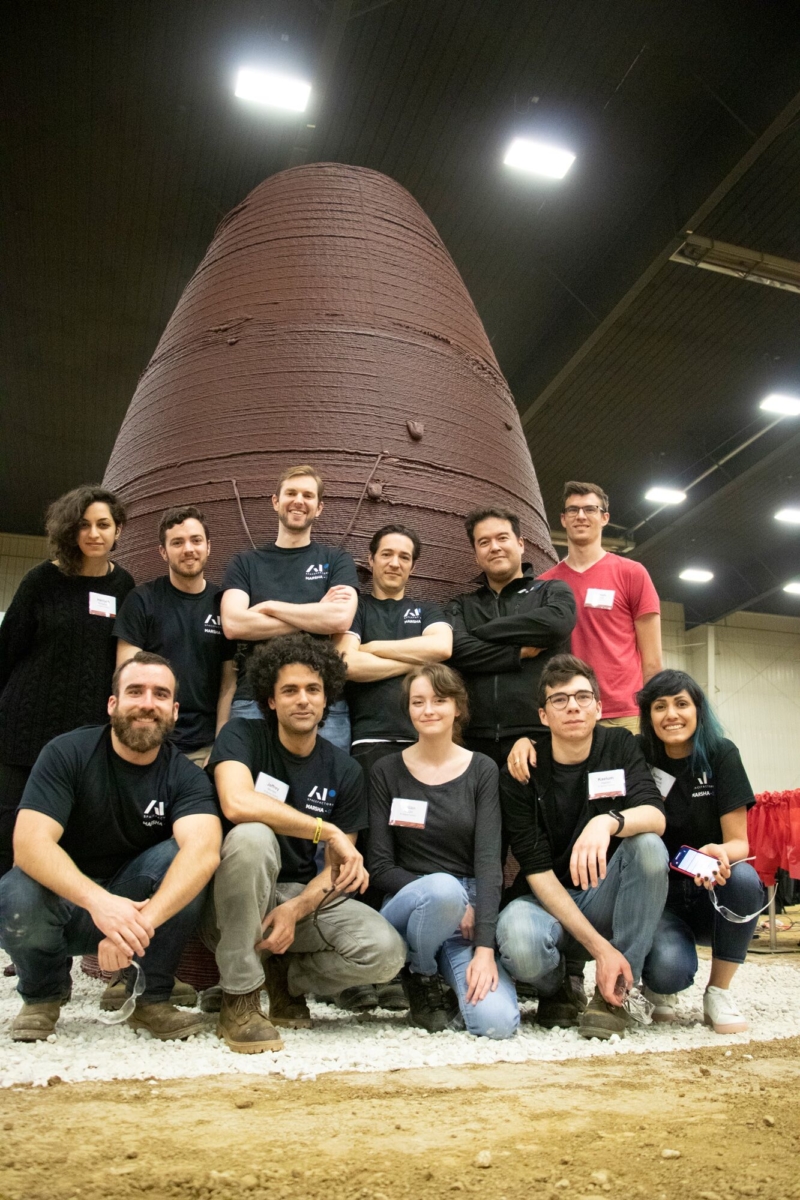
Winners all – AI SpaceFactory team. Credit: AI SpaceFactory
Eye on Earth construction
“We developed these technologies for space, but they have the potential to transform the way we build on Earth,” said David Malott, CEO and Founder of AI SpaceFactory. “By using natural, biodegradable materials grown from crops, we could eliminate the building industry’s massive waste of unrecyclable concrete and restore our planet.”

MARSHA will be recycled into TERA, the world’s first 3D printed space-tech eco habitat.
Credit: AI SpaceFactory
As early as this year, MARSHA will be recycled into TERA, the world’s first 3D printed space-tech eco habitat, and earthlings will finally be able to experience what life might be like on Mars, here on Earth. “It could change the way we build buildings,” said Lex Akers, Dean of the Caterpillar College of Engineering and Technology at Bradley University in Peoria, Illinois.
NASA/university partnership
The 3D-Printed Habitat Challenge is managed in partnership with NASA’s Centennial Challenges program and Bradley University.
NASA’s Centennial Challenges program is part of the agency’s Space Technology Mission Directorate (STMD), and is managed at NASA’s Marshall Space Flight Center in Huntsville, Alabama.
For more information on MARSHA, go to:

