Author Archive
 Author:
  May 29th, 2019
Curiosity Navcam Right B image taken on Sol 2416, May 24, 2019. Photo shows the rover’s view to the northeast, with the slope of Mount Sharp on the right and the scarp of Vera Rubin Ridge on the left.
Credit: NASA/JPL-Caltech
“We’ve left multiple tracks across the cobblestone plain of Glen Torridon,” reports Dawn Sumner, a planetary geologist at the University of California Davis in Davis, California.

Curiosity Navcam Left B image acquired on Sol 2420, May 28, 2019.
Credit: NASA/JPL-Caltech
“Curiosity had a nice, long drive retracing our path back toward the southwest where we want to look at some rock layers in more detail. It’s always nice to look back on an area that taught you a lot while heading forward to answer new questions,” Sumner adds.
Different colored pebbles
Scientists orchestrated another 3 sols of activities.

Curiosity Front Hazcam Left B image acquired on Sol 2420, May 28, 2019.
Credit: NASA/JPL-Caltech
“We start off sol 2419 with Mastcam images of ‘Scolty Bay’ and ‘Tomintoul,’ both of which we imaged on our way east on sols 2385 and 2363, respectively,” Sumner explains.
The plan calls for follow up with Chemistry and Camera (ChemCam) analyses and Mastcam documentation images of “Hillhead,” “Kinghorn,” and “Cumbernauld” to characterize different colored pebbles.

Curiosity ChemCam Remote Micro-Imager photo taken on Sol 2420, May 28, 2019.
Credit: NASA/JPL-Caltech/LANL
Drive to Woodland Bay
Later in the first sol, the plan calls for taking Mars Hand Lens Imager (MAHLI) photos of Hillhead, Kinghorn, and “Kintore” as well as analyze their elemental compositions with the rover’s Alpha Particle X-Ray Spectrometer (APXS). APXS will collect data on Kinghorn overnight to increase the precision of the analysis.

Curiosity Navcam Left B image acquired on Sol 2420, May 28, 2019.
Credit: NASA/JPL-Caltech
“We start sol 2420 by retracting the arm and swinging it to clean any dust off the APXS instrument,” Sumner notes. ChemCam then analyzes a fourth target, “Cupar,” before a drive of nearly 200 feet (60 meters) to Woodland Bay.
“Curiosity will take post-drive images to help us plan the next set of activities, and ChemCam will automatically analyze a target,” Sumner reports. “After Curiosity arrives at its new parking spot, we will take Mastcam and Navcam images of the sun and sky, plus look for dust devils.”
 Posted in

Credit: ESA
The European Space Agency (ESA) has released two new reports, one on use of space resources and a second document that reviews a strategy for Moon science.
Space resources will be a major topic of activity internationally over the next decade and may become a major motivation for investments in space exploration in the future.
According to this report, Europe has extensive expertise and capabilities to bring to this new field of investigation, from both space and Earth industries. Europe needs to engage now in order to have a role, to influence the way forward and benefit from the endeavor.
This document presents a strategic approach to the space resources opportunity, to enable sustainable human exploration in a way that seeks to optimize the terrestrial benefits, build a community and prepare a way to sustained and cost effective exploration in the future.
For the report — ESA SPACE RESOURCES STRATEGY, go to:
http://exploration.esa.int/moon/61369-esa-space-resources-strategy/
Credit: ESA
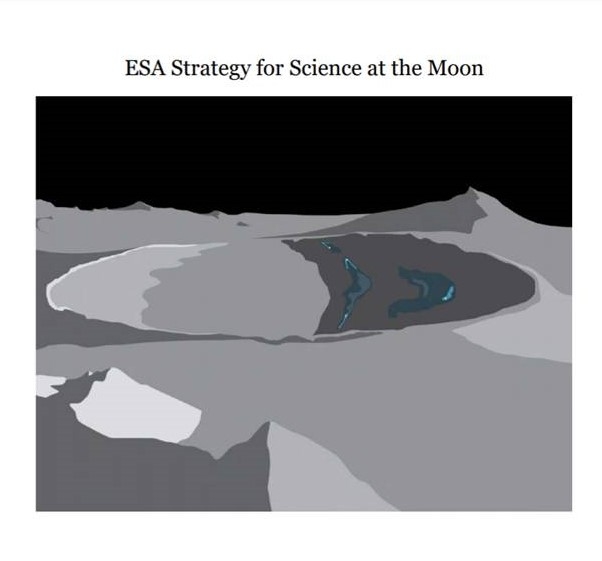
Moon science strategy
The Moon is a unique scientific resource, just three days from Earth, and whose true potential is only just being realized. The Moon is an archive of Solar System and cosmic history. The Moon preserves a record of the Earth-Moon system’s formation and the context for the emergence of life on Earth. The Moon provides a reference point for planetary science across the Solar System.
This report underscores the fact that the Moon may provide resources for future space exploration missions and to expand a space economy. The Moon provides a platform from which we can observe our Universe as never before. Recent scientific results have shown that we have only just begun to understand science of, on, and from the Moon and that there is a scientific imperative to return.
The document summarizes a strategy for science at the Moon that takes advantage of mission opportunities starting in the early 2020s and prepares for comprehensive scientific activities on European-directed missions.
For the report — ESA STRATEGY FOR SCIENCE AT THE MOON – go to:
http://exploration.esa.int/moon/61371-esa-strategy-for-science-at-the-moon/

The Japan Aerospace Exploration Agency’s (JAXA) Hayabusa2 asteroid probe is slated to perform a Pinpoint Touchdown – Target Marker operation from May 28-30.
Preparation for the descent above asteroid Ryugu will take place on May 28 and the spacecraft will start the descent on May 29. On the same day, the spacecraft’s speed will be reduced and the descent will reach an altitude above the space rock of about 115 feet (35 meters) on May 30, and then to roughly 33 feet (10 meters), the lowest point.

Surface of asteroid Ryugu around the artificial crater. The target marker will be dropped in area CO1, near area SO1.
Credit: JAXA, University of Tokyo, Kochi University, Rikkyo University, Nagoya University, Chiba Institute of Technology, Meiji University, University of Aizu, AIST
A highly reflective target marker will be separated just before the lowest altitude is reached. That marker on the asteroid’s surface is prelude to an attempted second sample extraction mission.
The spacecraft will then start to rise and return to a pre-descent home position on May 31.

Credit: JAXA
Aborted maneuver
This maneuver was first attempted May 14-16.
Hayabusa2 dropped to an altitude of about 164 feet (50 meters) before autonomously aborting the descent. This abort by the spacecraft was due to an incorrect distance measurement by the laser altimeter (LIDAR), therefore the target marker could not be dropped.
Despite this, it was possible to image around the previously created artificial crater at low altitude.

Credit: JAXA
In April, using a Small Carry-on Impactor (SCI), Hayabusa2 created an artificial crater on the asteroid’s surface. The blast tossed up material from within the object and Hayabusa2 operators hope to snag specimens from that area for later analysis.
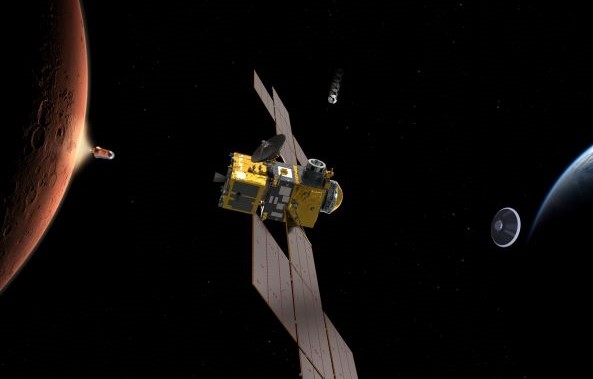
Artist’s impression of the elements required for a Mars Sample Return mission including the NASA’s Mars Ascent Vehicle (MAV), the European Space Agency’s Earth Return Orbiter, the Mars sample canister and the Earth entry capsule.
Credit: ESA/ATG Medialab
The European Space Agency (ESA) is working with NASA to explore mission concepts for an international Mars Sample Return campaign between 2020 and 2030.
As a first step, however, a key objective of NASA’s Mars 2020 mission is to rigorously document and store a set of samples in canisters in strategic areas to be retrieved later for flight to Earth.

NASA’s Mars 2020 rover will collect and cache samples for later retrieval.
Credit: NASA/JPL-Caltech
Fetch rover
The next step would involve a NASA launch sending a Sample Retrieval Lander mission to place a platform near the Mars 2020 site. At that location, a small ESA rover – the Sample Fetch Rover – would wheel out to retrieve the cached samples.
Once that robot has collected the specimens — in what can be likened to an interplanetary treasure hunt — it rolls back to the lander platform and loads the Mars collectibles into a single large canister on a Mars Ascent Vehicle (MAV).
The MAV is designed to perform the first liftoff from Mars and carry the container into Mars orbit.

Artist’s impression of ESA’s Earth Return Orbiter.
Credit: ESA/ATG Medialab
Sample container
ESA’s Earth Return Orbiter will be the next mission, timed to capture the basketball-size sample container orbiting Mars. The samples will be sealed in a biocontainment system to prevent contaminating Earth with unsterilized material before being moved into an Earth entry capsule.
The spacecraft will then return to Earth, where it will release the entry capsule for the samples to end up in a specialized handling facility.

Artist’s impression of ESA’s Earth Return Orbiter and Mars sample container over Earth.
Credit: ESA/ATG Medialab
ESA and NASA are exploring the concepts for the international Mars Sample Return campaign, with ESA assessing the Sample Fetch Rover and Earth Return Orbiter. This decision-making is to provide input to ESA’s 2019 council at ministerial level, where approval will be sought for the missions.

Artist’s concept of Restore-L mission.
Credit: NASA
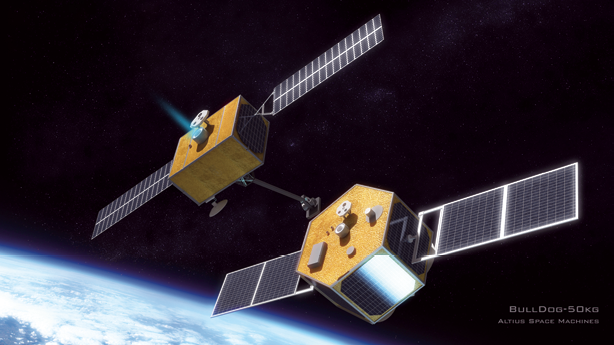
Satellites are tremendously isolated — once launched into orbit, they are left alone to do their work until they lose power or age into obsolescence. But what if satellites could be upgraded, refueled or repaired while in orbit?
The fourth report in The Aerospace Corporation’s Center for Space Policy and Strategy (CSPS) Game Changer series, On-Orbit Servicing: Inspection, Repair, Refuel, Upgrade, and Assembly of Satellites in Space, explores new on-orbit servicing (OOS) capabilities and what this ground-breaking technology could mean for the future of satellite operation, including the potential cost savings of hundreds of millions to salvage satellites and not replace them.
Credit: Altius Space Machines
Possible inhibitors
While the report acknowledges that there are several possible inhibitors to making on-orbit servicing common across the market, OOS is widely viewed as the most viable path forward for continuing to expand space activities beyond their present limitations.
To read this report — On-Orbit Servicing: Inspection, Repair, Refuel, Upgrade, and Assembly of Satellites in Space – go to:
https://aerospace.org/sites/default/files/2019-05/Davis-Mayberry-Penn_OOS_04242019.pdf

Artist’s concept of rail gun aboard ship. Credit: U.S. Navy
It’s going fast…and there’s a new directed energy arms race.
One project that’s part of that scenario is the Navy’s electromagnetic (EM) “rail gun,” reportedly due soon to see testing on a warship. That technology may have off-world implications for future Moon exploration and exploitation.
The Office of Naval Research work on the EM rail gun launcher is being pursued as a long-range weapon that fires projectiles using electricity instead of chemical propellants.

Electromagnetic mass drivers using solar power provide low cost transportation of materials to space construction sites.
Courtesy: Space Studies Institute
Recent testing of the electromagnetic rail gun under Navy auspices had the technology firing a projectile that exceeds Mach 6 – approaching a velocity that harkens back to early ideas of utilizing this machinery on the Moon to hurl payloads from the lunar surface.
Mach 6 equals 4,567.24 miles per hour with the escape velocity from the nearly airless Moon being about 5,300 mph.

Sparks of creativity. Mass driver workers Gerard O’Neill (center), Henry Kolm (left), Kevin Fine (right).
Payloads from the Moon
In 1974, Princeton University professor and space visionary, the late Gerard O’Neill first proposed use of an electromagnetic rail gun to lob payloads from the Moon.
“Mass drivers” based on a coilgun design were adapted to accelerate a non-magnetic object. One application O’Neill proposed for mass drivers: toss baseball-sized chunks of ore mined from the surface of the Moon into space. Once in space, the ore could be used as raw material for building space colonies and solar power satellites.
Given today’s push for plumbing and processing ice-rich craters on the Moon, could that water-ice resource shot off the Moon also be part of a cis-lunar, fuel-making enterprise?

Deflection plates near the end of the mass driver make minute adjustments to the trajectory of the launched ore to ensure it reaches its target: a mass catcher at the L-2 point.
Courtesy: Space Studies Institute
Mass driver work
O’Neill worked at MIT on mass drivers, along with colleague Henry H. Kolm, and a group of student volunteers to construct their first mass driver prototype.
Backed by grants from the Space Studies Institute, later prototypes improved on the mass driver concept, showing that a mass driver only 520 feet (160 meters) long could launch material off the surface of the Moon.
Ocean of space
Meanwhile, according to a story last Friday from the Seattle Times, the Navy’s latest Northwest Training and Testing draft Supplemental Environmental Impact Assessment explains that “the kinetic energy weapon (commonly referred to as the rail gun) will be tested aboard surface vessels, firing explosive and non-explosive projectiles at air- or sea-based targets.”
According to the assessment, “the system charges for two minutes and fires in less than one second,” also noting that “the system is shielded so as not to affect shipboard controls and systems. The amount of electromagnetic energy released from this system is low and contained on the surface vessel.”
As this know-how is trial-run on the Earth’s ocean…could it be a forerunner of technology useful for the ocean of space – a Moon-based technology?
Go to this video to see the Navy’s rail gun in operation:
https://www.dvidshub.net/video/539084/navy-railgun-successfully-fires-multi-shot-salvos?jwsource=cl

NASA’s Lunar Reconnaissance Orbiter has used its LROC system to provide looks at the Apollo 11 landing site. The remnants of Neil Armstrong and Buzz Aldrin’s historic first steps on the surface are seen as dark paths around the Lunar Module (LM), Lunar Ranging RetroReflector (LRRR) and Passive Seismic Experiment Package (PSEP), as well as leading to and from Little West crater.
Credit: NASA/GSFC/Arizona State University
Senators Gary Peters (D-Michigan) and Ted Cruz( R-Texas) have introduced a bill — the One Small Step to Protect Human Heritage in Space Act – seeking to preserve and protect Apollo 11 landing site.
The bill notes that the lunar landing sites of the Apollo 11 spacecraft, the robotic spacecraft that preceded the Apollo 11 mission, and the piloted and robotic spacecraft that followed, “are of outstanding universal value to humanity.”
The Act explains that such landing sites: are the first archaeological sites with human activity that are not on Earth; provide evidence of the first achievements of humankind in the realm of space travel and exploration; and contain artifacts and other evidence of human exploration activities that remain a potential source of cultural, historical, archaeological, anthropological, scientific, and engineering knowledge.
“As commercial enterprises and more countries acquire the ability to land on the Moon,” the bill notes, “it is necessary to ensure the recognition and protection of the Apollo 11 landing site and other historic landing sites together with all the human effort and innovation the sites represent.”

Credit: For All Moonkind
Common human heritage
“We were honored to work with Senator Peters’ office on this legislation,” says Michelle Hanlon, co-founder of For All Moonkind – a group that seeks to protect each of the six human lunar landing and similar sites in outer space as part of our common human heritage.
“When we first met in March, it was clear that the Senator and his staff share our passion for the preservation of human history in space,” Hanlon told Inside Outer Space. “They knew how important it was to get it right, and they recognized the need to develop a bill that would not violate international law by claiming any sort of possession or ownership of the historic lunar landing sites.”

Credit: For All Moonkind
Sustainable exploration
The bill is indeed a small step, Hanlon adds, but an incredibly significant one.
“Senator Peters and Senator Cruz are asking the U.S. to take the lead in assuring that we explore space sustainably with respect for history. We hope that the entire Senate will agree that it’s time to take this one small step and help nudge an important international conversation on protection of human heritage in space,” Hanlon says.
The bill was introduced on Thursday, May 23.
To read the entire Act, go to:
https://www.forallmoonkind.org/wp-content/uploads/2019/05/One-Small-Step-Act-bill-text.pdf
For more information on For All Moonkind, go to:

Credit: Space HD Wallpapers
How much of the Solar System should we leave as wilderness – off-limits to human development?
That’s the question tackled by Harvard astrophysicist Martin Elvis and Tony Milligan at the Department of Theology and Religious Studies, King’s College London.
Yes, the Solar System is big, the researchers admit. It is so big, they add, that the idea that humans may fully exploit and deplete its resources seems ridiculous.
“Yet if a true economy emerges in space it will start to make use of the vast yet finite resources of the Moon, Mars and small Solar System bodies (such as asteroids). We have no good reason to believe that such an off-world economy would behave in a radically different way from terrestrial economies and the latter (as we know) grow exponentially,” Elvis and Milligan write.

Artist’s illustration of astronauts at an asteroid as well as other mining and transportation vehicles operating in space.
Credit: TransAstra Corporation & Anthony Longman
They make a general argument that, as a matter of fixed policy, development should be limited to one eighth, with the remainder set aside. It is prudent to adopt a “1/8 Principle” as a tripwire, they suggest; do not exploit greater than 1/8 of the solar system.
Unchecked growth
In summary, Elvis and Milligan observe while we remain dependent upon the resources present inside the Solar System, and while economic growth remains exponential, we should regard, at most, one-eighth of the solar system as humanities to use. “The remaining seven-eighths of the solar system should be left as space wilderness,” they contend.

Newly developed extraction technique for the Moon, thermal mining, makes use of mirrors to exploit sun-shy, water ice-laden polar craters.
Credit: School of Mines/Dreyer, Williams, Sowers
“Failure to do so will mean that future generations will have insufficient ‘breaking distance’ after only a few centuries of exponentially growing economic activity/resource utilization,” they conclude. “If unchecked, such growth will tend towards a point of super-exploitation, i.e. a situation of resource depletion where new resources cannot readily be brought into use, even in an emergency situation. The dangers of super-exploitation, for a space-faring civilization whose limits are set by the bounds of a single solar system, are too great to be set aside.”
A practical upshot of the proposed approach by Elvis and Milligan is that we need to inventory the resources of the Solar System carefully and at a sufficiently early point in time in order to know just what lies out there.
Their research paper – “How much of the solar system should we leave as wilderness?” –is available in Acta Astronautica, sponsored by the International Academy of Astronautics.
Go to:
https://www.sciencedirect.com/science/article/pii/S0094576517318507
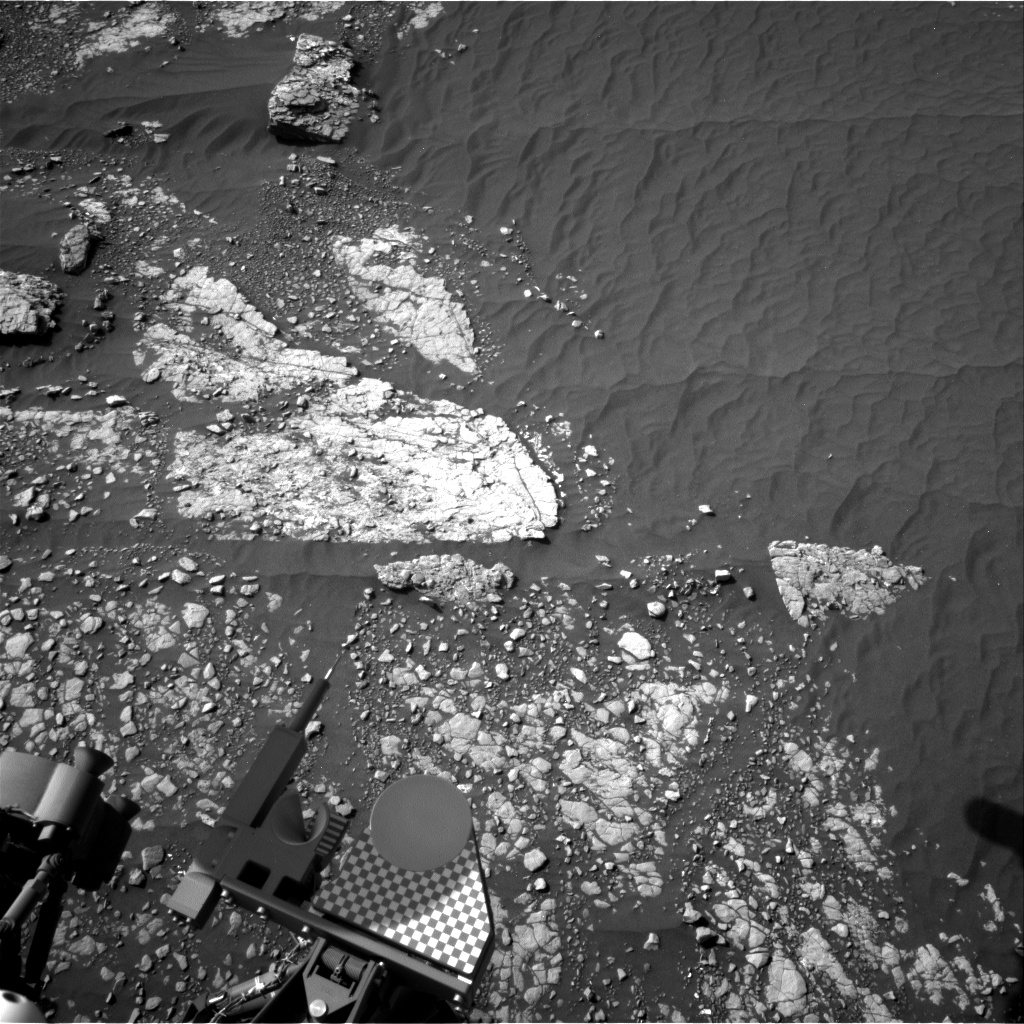
Bright block in the image center is Curiosity’s next potential drill spot, “Broad Cairn.”
Curiosity Navcam Right B photo taken on Sol 2414, May 22, 2019.
Credit: NASA/JPL-Caltech
NASA’s Curiosity Mars rover is now performing Sol 2416 science tasks.
Reports Fred Calef, a planetary geologist at the NASA/JPL in Pasadena, California, after Curiosity made a short drive of roughly 20 feet (six meters) to “Hallaig,” the science team began the investigation of a new potential drill target named “Broad Cairn,” a flat spot on a bright block in the clay-bearing unit.
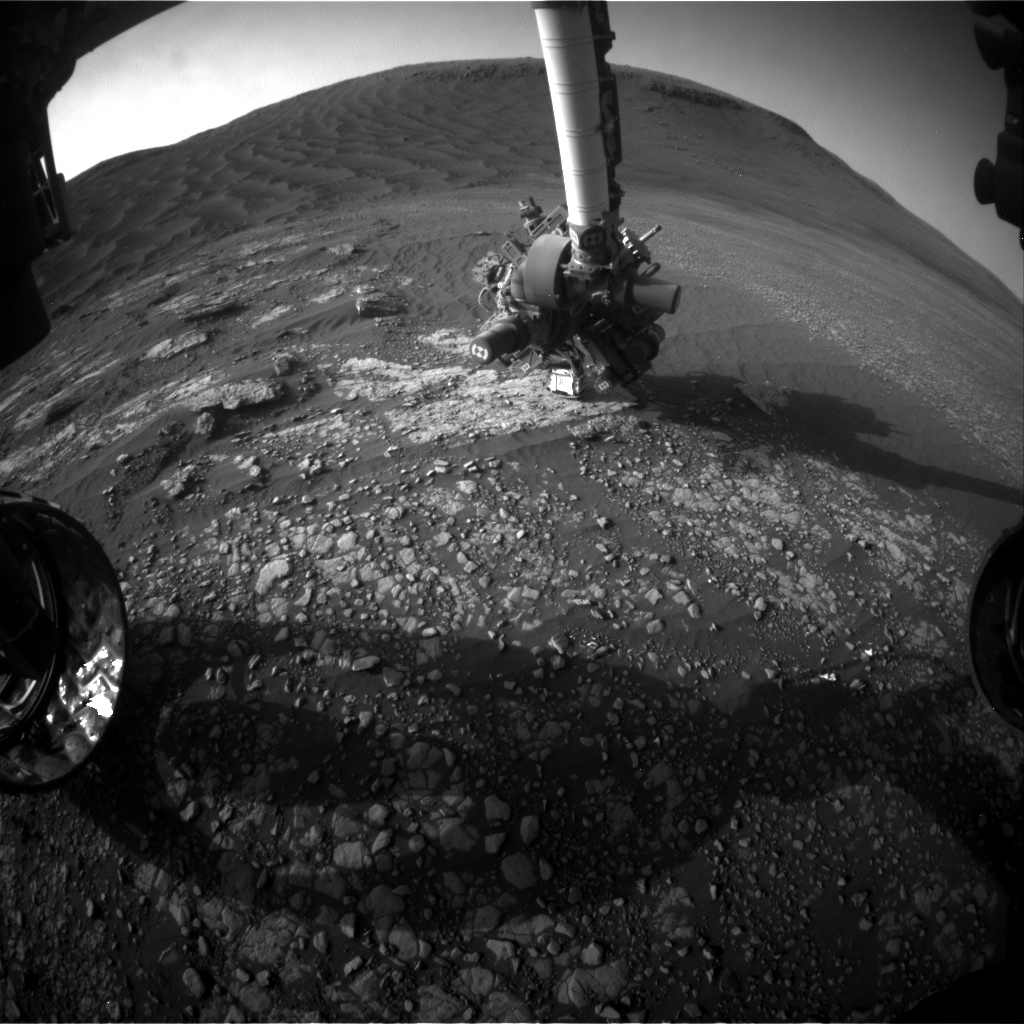
Curiosity Front Hazcam Left B photo acquired on Sol 2415, May 23, 2019.
Credit: NASA/JPL-Caltech
Dust removal
“To confirm whether this location is high in potassium (K), the rover was commanded to clean off the spot with the dust removal tool (DRT),” Calef adds, then take some close-up pictures with its Mars Hand Lens Imager (MAHLI) camera.
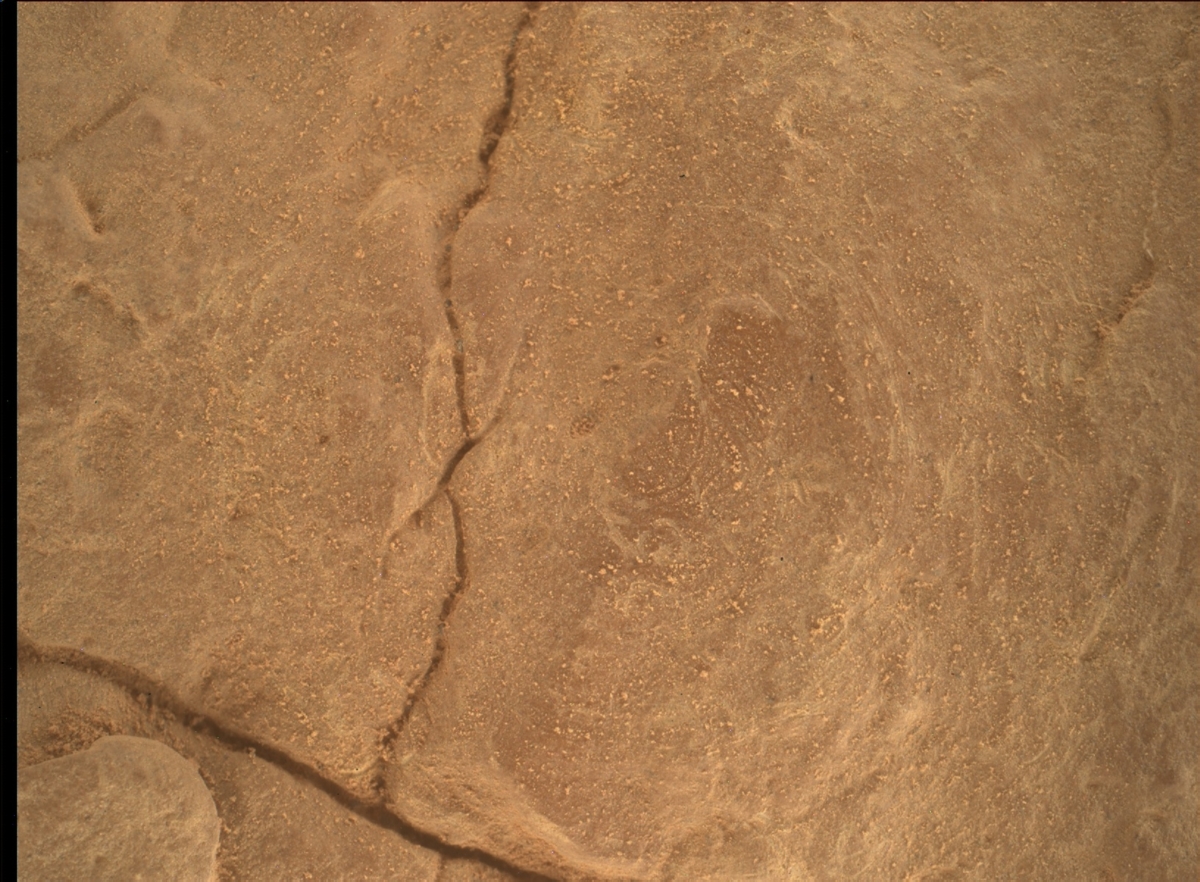
Curiosity Mars Hand Lens Imager (MAHLI) photo produced on Sol 2415, May 23, 2019. MAHLI is located on the turret at the end of the rover’s robotic arm.
Credit: NASA/JPL-Caltech/MSSS
This was followed by an Alpha Particle X-Ray Spectrometer (APXS) integration at the right time of day to maximize the data quality.
“Since getting the data back expeditiously was the highest priority, other science observations were pushed to the next planning sol,” Calef concludes. “For now, the science team waits with bated breath for the results.”
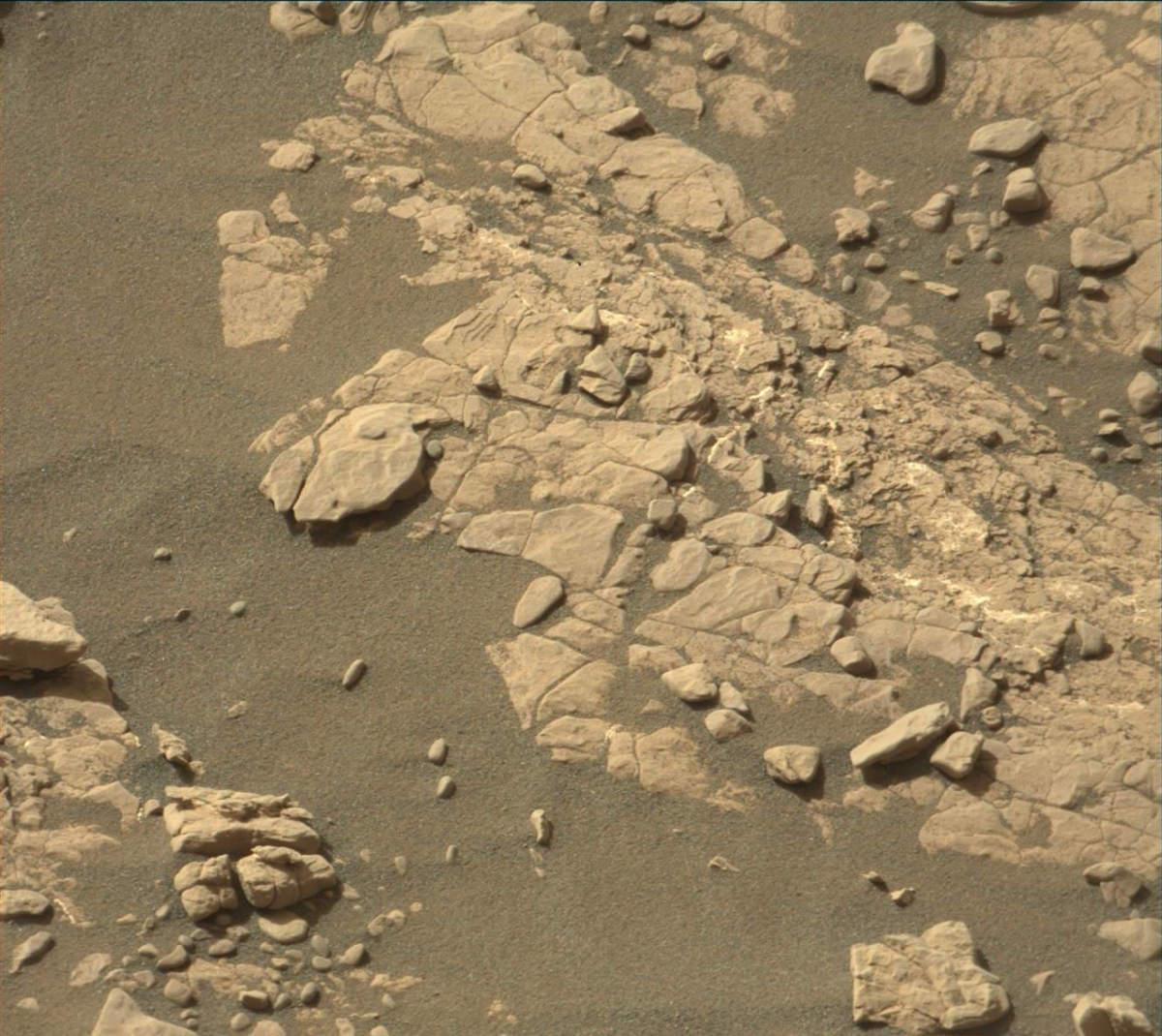
Curiosity Mastcam Right image taken on Sol 2414, May 22, 2019.
Credit: NASA/JPL-Caltech/MSSS
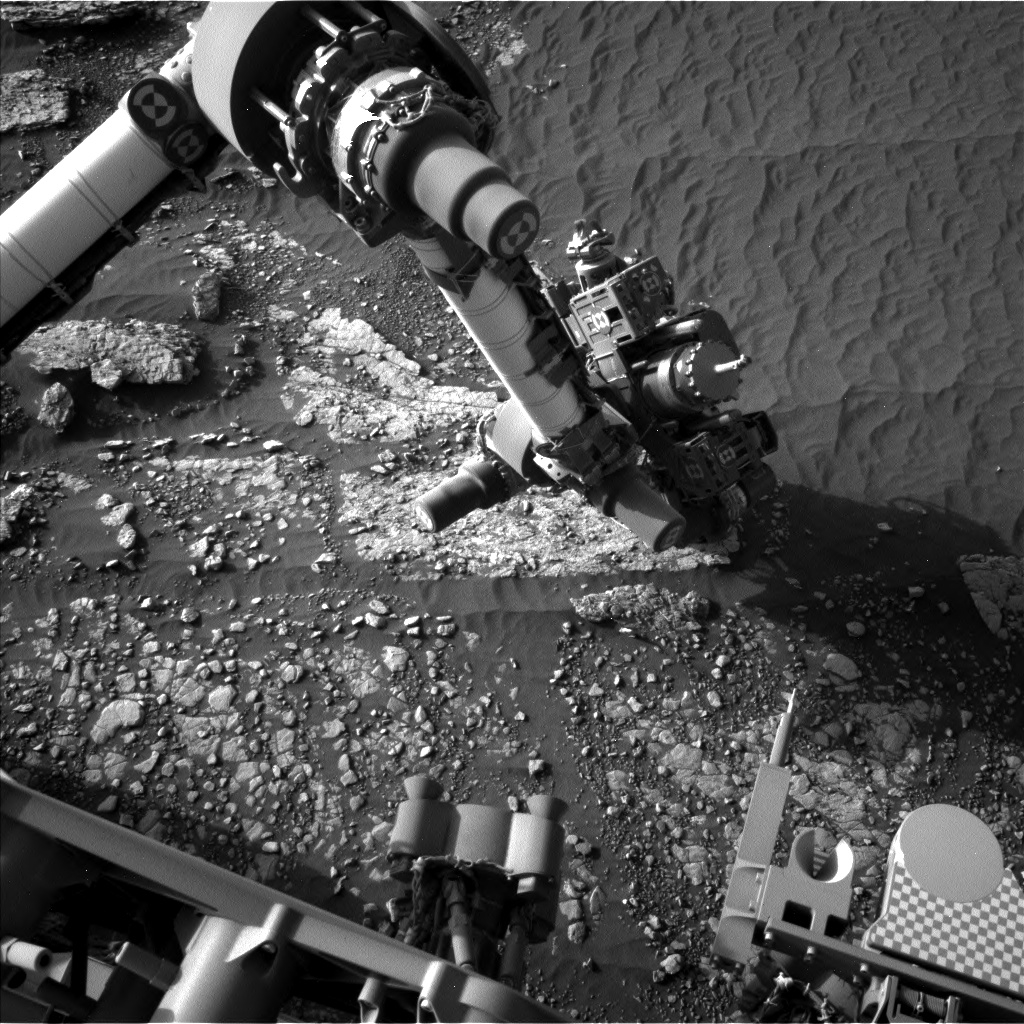
Curiosity Navcam Left B image taken on Sol 2415, May 23, 2019.
Credit: NASA/JPL-Caltech

Courtesy of NASA/JPL/USGS
U.S. Vice-President Pence recently announced the Trump Administration’s goal of returning American astronauts to the lunar surface by 2024. That NASA plan is nicknamed “Artemis.”
Last week the Administration delivered to Congress an amendment to its initially proposed fiscal year (FY) 2020 budget to reflect this ambitious new goal.

Credit: NASA
Pell grant reductions
However, a just-posted message from the American Astronomical Society (AAS) and the Division for Planetary Sciences (DPS) suggests that Artemis is an “ill-defined and untested proposal.”
“The budget amendment contained proposals to add a total of $1.6 billion to NASA’s FY20 budget, offset by reductions to the Pell Grant program in the Department of Education.
The amendment also contained a proposal to give the NASA Administrator the authority to transfer funds between appropriations accounts “…in the event that the Administrator determines that the transfers are necessary in support of establishment of a U.S. strategic presence on the Moon.”
Concern raised
As noted in the AAS/DPS posting:
“The proposed reductions to the Pell Grant program are certainly a concern for any organization that cares about the training of current and future generations of researchers and educators in our disciplines. There will be fierce opposition in Congress to this proposed budgetary offset.
“NASA Administrator Jim Bridenstine has publicly stated on at least a couple of occasions that it doesn’t make sense to cut science programs to achieve human exploration goals — mostly because Congress is opposed to such moves — and we take him at his word. However, this initial $1.6 billion augmentation is only a down payment, and some outside experts have put the likely additional annual funding augmentation need closer to $4-8 billion. While trimming science programs won’t come close to filling such budgetary holes, the proposed transfer authority is an item for serious concern should push come to shove in achieving the 2024 goal.
“One reason for this concern is that such transfers and communications to Congress about them take place in the shadows, outside of the sunshine of the normal public Congressional appropriations process.”
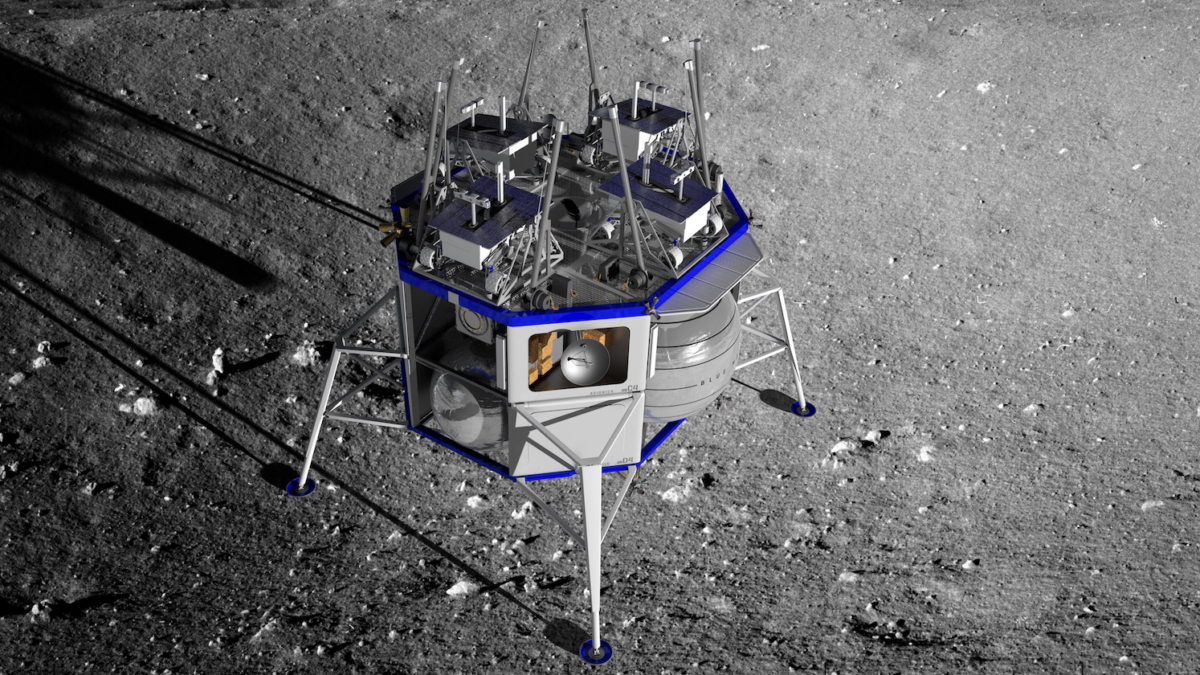
Private lunar landers.
Credit: Blue Origin/Blue Moon
Science priorities
Furthermore, the AAS/DPS posting adds:
“In addition to the Administration’s already-proposed Lunar Discovery and Exploration Program (LDEP) — which the House Appropriations Committee appears to be on track to support — the new $1.6 billion amendment allocates $90 million to NASA’s Science Mission Directorate (SMD) ‘for the purchase of commercial services to deliver a rover to…explore the Moon’s polar regions in advance of a human mission.’
Since the changes in civilian space policy to return to the Moon have occurred after the last planetary science decadal survey in 2013 and that survey’s midterm assessment in 2018, there is not a community-wide consensus on where the Administration’s proposed lunar science program would rank within the relative priorities for lunar science, let alone within the priorities for the overall planetary science enterprise.
The primary new lunar mission prioritized by the 2013 planetary decadal was the Lunar Geophysical Network (recommended for inclusion in the fifth New Frontiers competition). The 2013 survey also reaffirmed the 2003 survey’s Lunar South Pole-Aitken Basin Sample Return mission for the fifth New Frontiers competition since it wasn’t selected in the fourth New Frontiers round.

Example of a landing site traverse: This image depicts Malapert massif to South Pole-Aitken basin center.
Credit: E.J. Allender et al./Advances in Space Research
The current astronomy and astrophysics decadal survey is likely to consider lunar far-side project proposals, and the upcoming planetary science decadal survey will certainly need to consider the changes to civil space policy and commercial spaceflight capabilities as they impact the survey committee’s holistic approach to prioritizing lunar and planetary research. In the meantime the LDEP program within SMD appears to be doing an admirable job of finding synergies between efforts to kick-start a lunar commercial services industry and solid peer-reviewed science investigations and payloads, while adhering to science priorities described in the 2013 planetary decadal survey.”
Next steps
“We have decided against taking an official position on NASA’s Artemis proposal at this time. It is still very early, and we do not think that the benefits of public opposition to an ill-defined and untested proposal outweigh the use of political capital, at least not yet. We are clearly opposed to the Pell Grant offset on principle, and we have serious concerns about the proposed transfer authority and the as-yet undefined scientific content of the proposed crewed Artemis lunar program. The House Appropriations Committee responsible for NASA is working toward a 7% increase for NSF and a 4% increase for NASA SMD in FY20, which is a reassuring sign of their continued strong support for space sciences.
We will, however, have the AAS public-policy staff informally present our concerns — Pell Grant offset, transfer authority, and lack of community consensus on the science program — to relevant Congressional and Executive Branch staff. A Congressional Hill visit by the AAS Division for Planetary Sciences (DPS) Committee on May 10th preemptively delivered the core of this message, which was well received. If evolving circumstances require the AAS to take a strong public position for or against what NASA proposes or does, we will not hesitate to do so.”
The posted letter is signed by Megan Donahue, AAS President and Linda Spilker, DPS Chair.
The posting — Moon 2024? — is available at:
https://aas.org/posts/news/2019/05/moon-2024

U.S. President Donald Trump holds up the Space Policy Directive – 1 after signing it, directing NASA to return to the Moon, alongside members of the Senate, Congress, NASA, and commercial space companies in the Roosevelt room of the White House in Washington, Monday, Dec. 11, 2017.
Credit: NASA/Aubrey Gemignani
Response of concern
Meanwhile, the AAS/DPS posting has stirred the ire of lunar scientist, Jack Burns at the University of Colorado, Boulder.
Provided to Inside Outer Space, the Burns communique to Linda Spilker of DPS reads in full:
Dear Megan,
I am writing to express a bit on concern with respect to the letter sent out to the AAS regarding NASA’s new Artemis program.
First, you know that I am a long-time ‘lunatic’ so you are not surprised that I am excited to see NASA finally stepping up with an ambitious plan of new missions of exploration going first to the Moon and eventually to Mars. There are exciting opportunities for science from the Moon, including a sample return from the South Pole Aitken basin and a low radio frequency lunar farside array to study the Dark Ages and Cosmic Dawn. These were singled out in the Planetary Science Decadal Survey and in the NASA Astrophysics Roadmap, respectively. So, it is fair to say that these lunar-based science concepts have been vetted by the planetary and astrophysics community, unlike what is implied at the end of the letter.
Second, I share the concern about any funds being taken from the Pell Grant program. But, this is not NASA’s plan nor that which Congress is likely to follow but rather a proposal from the White House. Administrator Bridenstine made it clear it is Congress’ job to appropriate the funds from whatever source they choose. So, the Pell grant issue is a red herring in my opinion being used by some to bash the accelerated lunar program.
Third, there has been a misunderstanding about the authority that the Administrator is seeking for transferring funds. He has stated several times, including in a Congressional hearing last week, that he is seeking authority to transfer funds only within the lunar program not between directorates as is implied below. He has stated many times, including at the Space Astrophysics Landscape for the 2020’s workshop held in DC last month, that NASA will NOT cannibalize science to pay for the lunar program. In fact, he has proposed the opposite – to increase funding for lunar and related science. I certainly do understand the concern about other proposed cuts in the President’s budget for WFIRST and for some Earth Science programs. But, the Congress has the final authority to weigh in on these priorities.
Finally, I hope that the astronomy community is not sending out indirectly a message that it is prepared to oppose the human exploration program as some have done in the past out of fear for our telescopes. Because history shows just the opposite has been true. When the human program has been healthy, NASA science and the Agency has been healthy as well. This added attention to a bold initiative tends to energize the American public and the Congress giving NASA more positive attention. Our community tends to win under these circumstances.
So, I urge caution in how the AAS proceeds. Let Congress fully weigh in and in the process let’s advocate, as we’ve done in the past, for a balanced program of human and scientific exploration. It is unwise to divide our support for NASA between science and human exploration.
Also, I recommend that you meet with and talk directly with Administrator Bridenstine about these issues so you can better assess for yourself the relative risks. It has been a tradition for the AAS President to meet with the Administrator regularly.
Best wishes,
Jack

