Author Archive
 Author:
  June 15th, 2019
How much did this footprint cost? Credit: NASA
The Planetary Society has released a new Apollo cost analysis, reporting that the effort would cost nearly $300 billion in today’s dollars. The analysis comes in advance of the 50th anniversary of the Apollo 11 Moon landing.
As explained in the analysis, the United States spent $264 billion on Project Apollo when adjusted to today’s dollars.
Annual budget
The new analysis by Casey Dreier, The Planetary Society’s Senior Space Policy Adviser, spotlights that the total cost of the lunar effort grows to $288 billion when Project Gemini and the related robotic programs are included.
The United States spent an average of $24 billion per year for Apollo between 1961 and 1972—larger than NASA’s entire current annual budget of $21.5 billion.

Apollo 17’s Harrison “Jack” Schmitt was the last man to set foot on the lunar surface, taking part in the 6th human landing on the Moon in December 1972.
Credit: NASA
Resource pages
In addition to the new cost analysis, The Planetary Society also released mission summary resource pages for each Apollo mission.
These mission pages collate high-quality information including per-mission costs, major event timelines, memorable photographs, and links to historical sources such as press kits, videos, and flight journals.
To access this informative analysis and related materials, go to:
http://www.planetary.org/press-room/releases/2019/apollo-cost-analysis.html
 Posted in
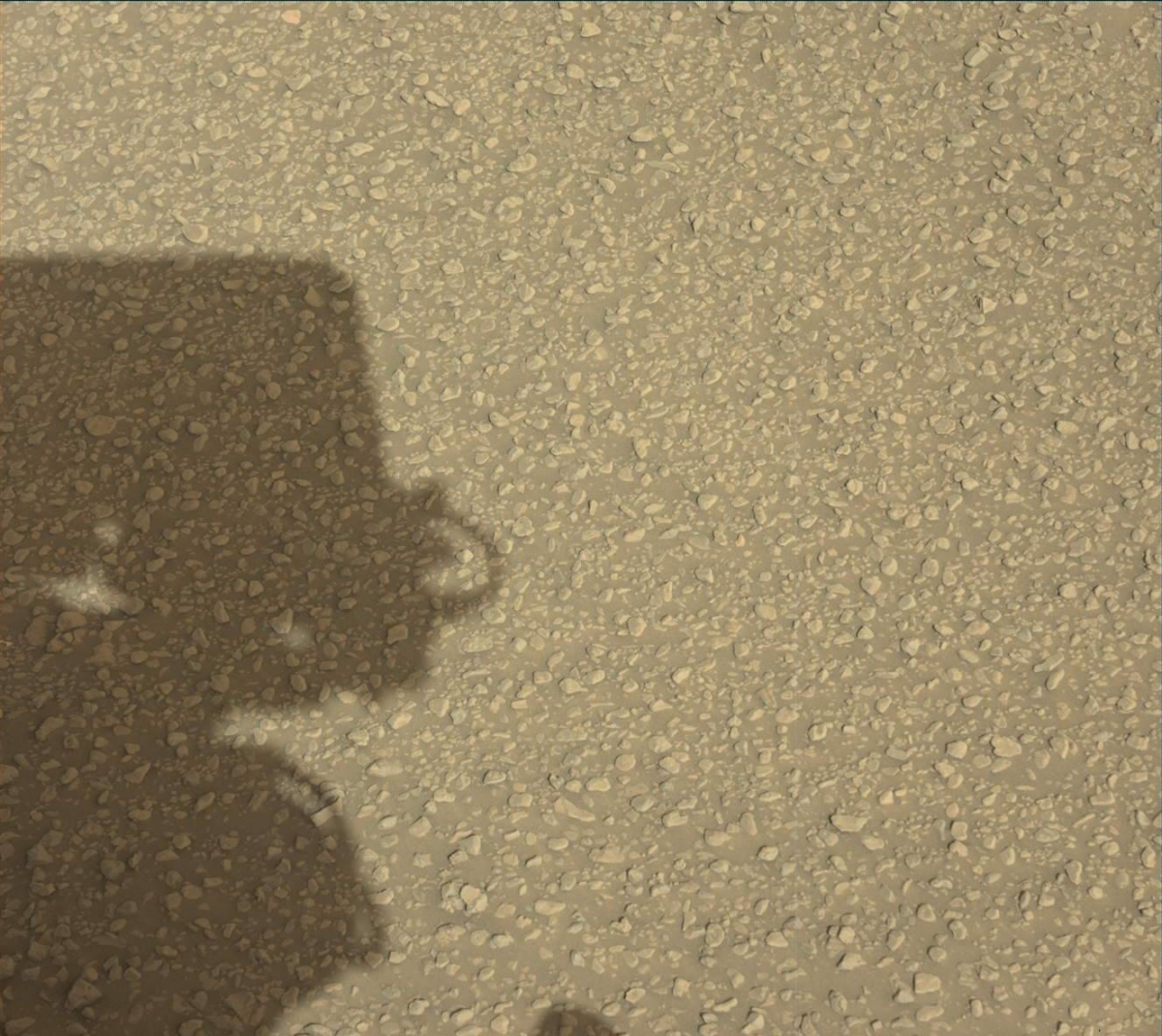
Curiosity Mastcam Left image taken on Sol 2435, June 13, 2019.
Credit: NASA/JPL-Caltech/MSSS
NASA’s Curiosity Mars rover is now performing Sol 2437 duties.
“We are investigating the ridges which are such a prominent feature in this section of Glen Torridon,” reports Catherine O’Connell, a planetary geologist at the University of New Brunswick; Fredericton, New Brunswick, Canada.
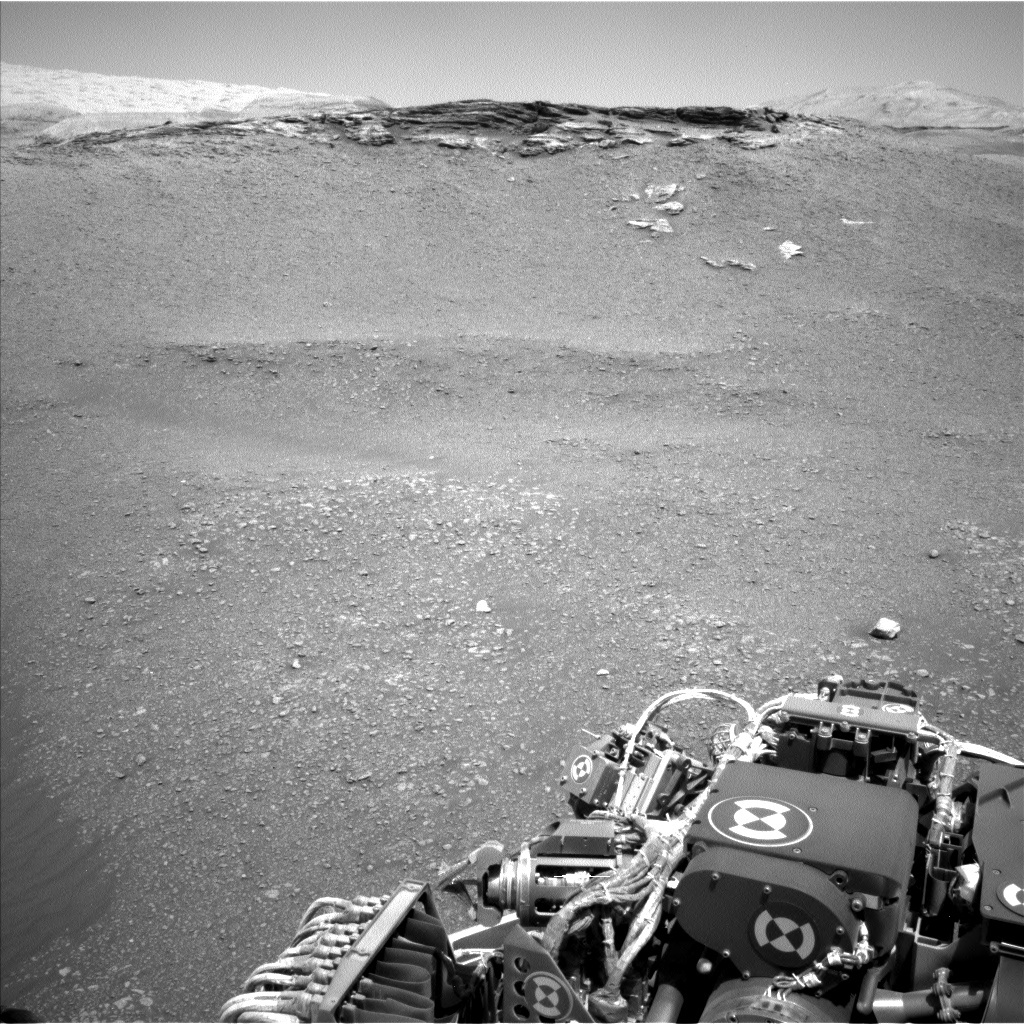
The ridge, with Mount Sharp in the background. Curiosity Navcam Left B image acquired on Sol 2436, June 14, 2019.
Credit: NASA/JPL-Caltech
“The ridges appear to be composed of sand and pebbles, capped with layered bedrock. The Rover Planners (RPs) at JPL assessed the ridge imaged, known as ‘Teal,’ and gave a go for driving up onto it,” O’Connell adds.
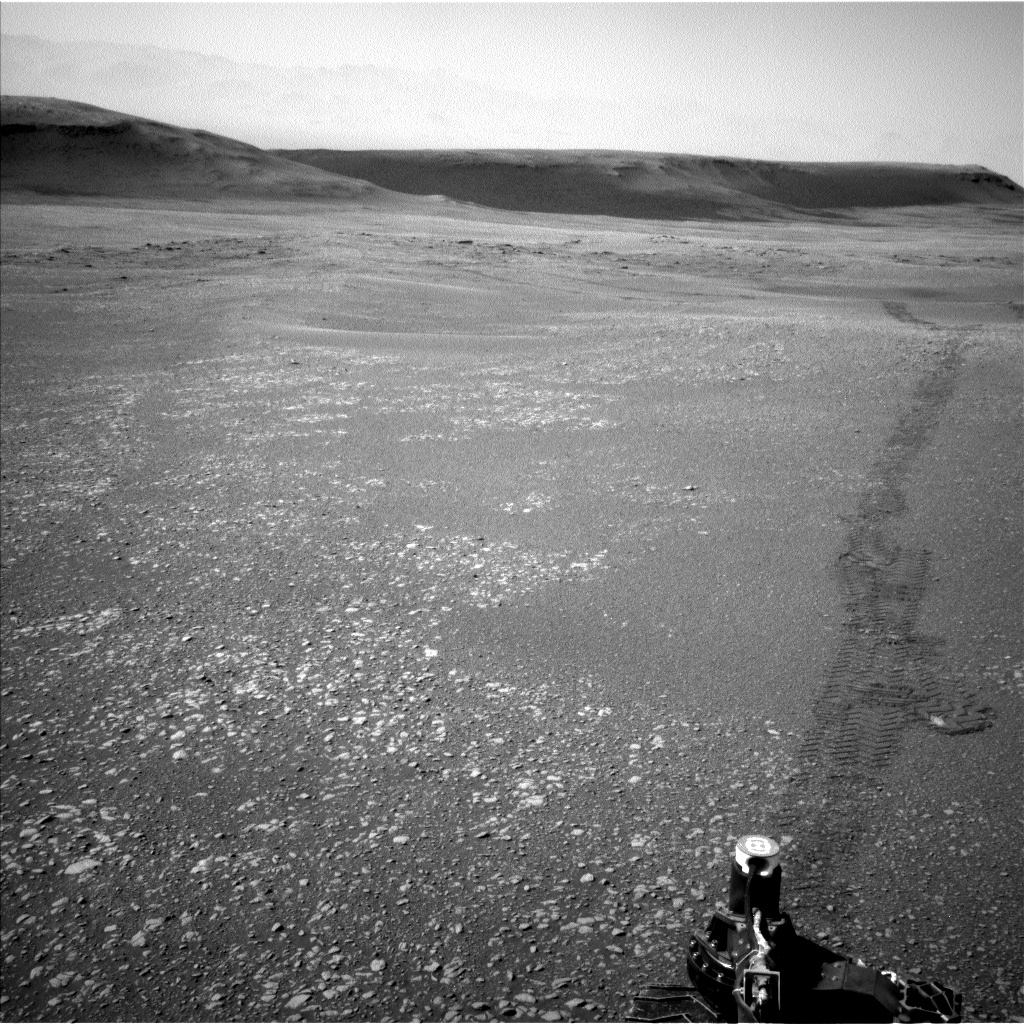
Curiosity Navcam Left B photo taken on Sol 2436, June 14, 2019.
Credit: NASA/JPL-Caltech
Two drives
The ascent by the rover was broken into two drives. “The RPs got us exactly to where we wanted to be for this plan, and we ended up on a very small outcrop of more coherent bedrock, surrounded by pebbles and sand,” O’Connell points out. “Those of us in the Geology theme group were very excited to find ourselves here, as this is the most substantial piece of bedrock we have seen this week.”
Curiosity’s Alpha Particle X-Ray Spectrometer (APXS) will analyze the “Iapetus” target on the bedrock, and do a 2-point raster “Almond” across small grey pebbles and sand.
The rover was too close to Iapetus to allow the robot’s Chemistry and Camera (ChemCam) to shoot it with the Laser-Induced Breakdown Spectroscopy (LIBS) laser without danger to the rover, O’Connell notes, so ChemCam focused on documenting pebbles here, looking at the targets “Angus,” “Braan,” and “Tweed.” A Mastcam multispectral image, using multiple filter types, will examine spectral variability of the pebbles and sand between Tweed and Almond.
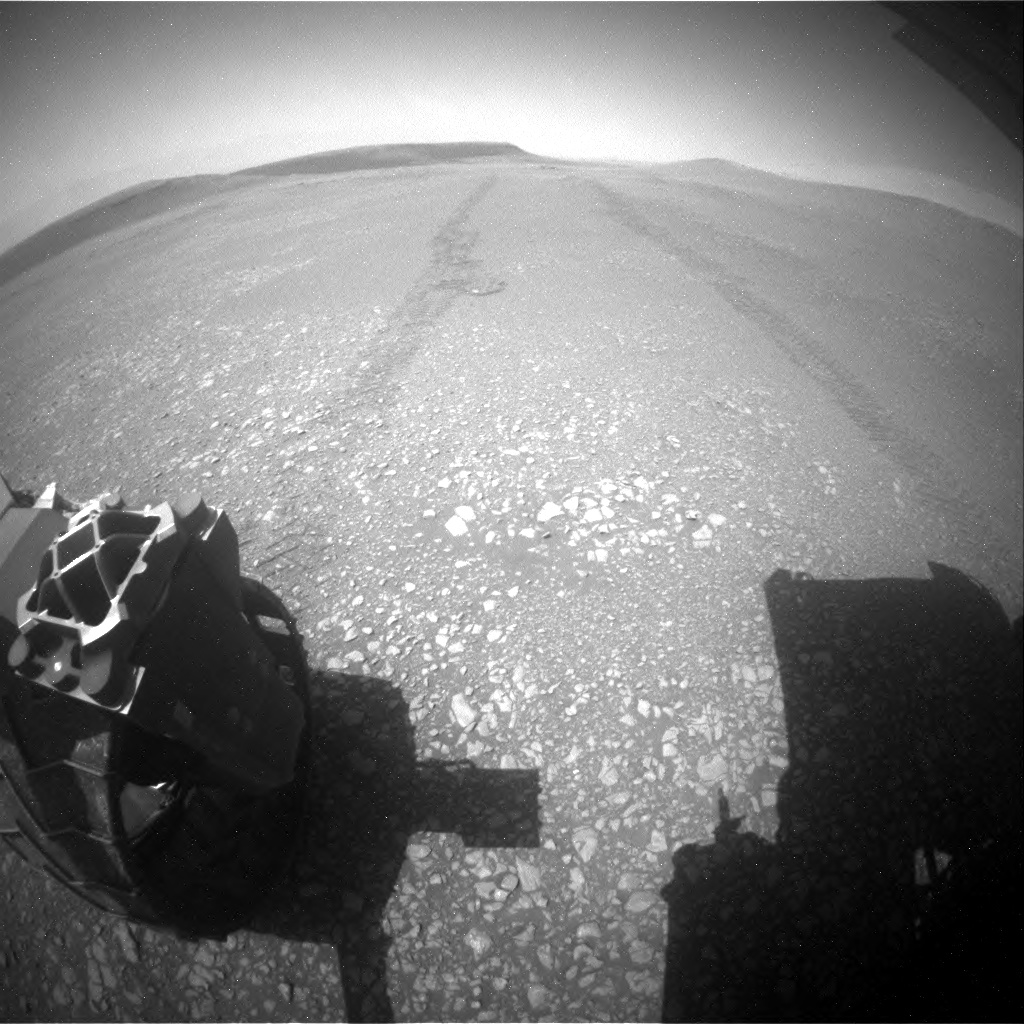
Curiosity Rear Hazcam Left B image taken on Sol 2436, June 14, 2019.
Credit: NASA/JPL-Caltech
Rubbly material
“Before climbing up onto the ridge, Mastcam will take some color imagery, looking at the rubbly material in the lower part of the ridge,” O’Connell reports, “and documenting the transition from the rubbly material to the capping material.”
Curiosity’s drive will hopefully take scientists bedrock, and once there, will acquire imagery (Mastcam and Navcam) of the rover’s new workspace and future drive direction, to be ready for a full week of exploration on top of this ridge when the robot comes back after the weekend.
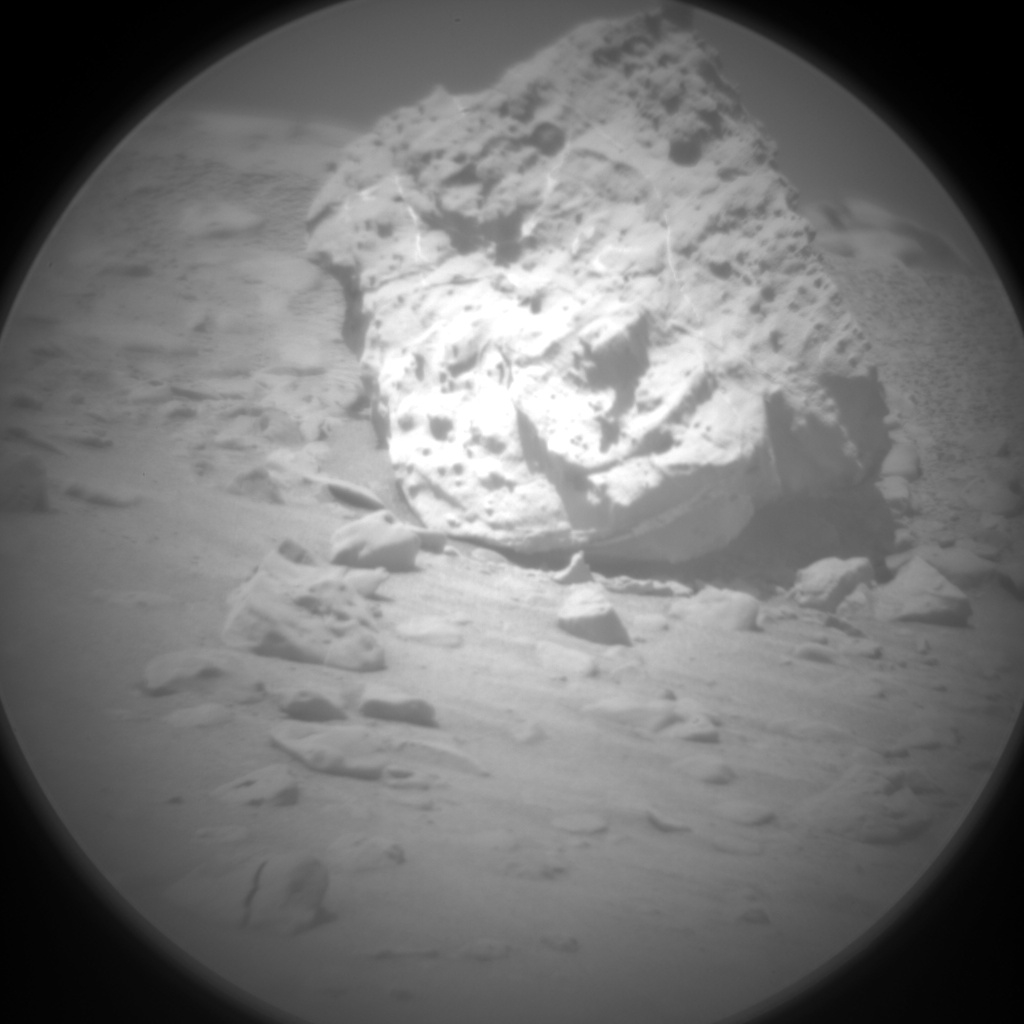
Curiosity ChemCam Remote Micro-Imager photo acquired on Sol 2436, June 14, 2019.
Credit: NASA/JPL-Caltech/LANL
“Mastcam will also get a post-drive image of the workspace under one of our wheels, as part of a long-running observation of bedrock, pebbles, and soils along our traverse,” O’Connell says.
Environmental sensing
The Environmental theme group (ENV) planned paired Mastcam observations for each sol of the plan, to determine the amount of dust in the crater (“crater rim extinction” measurements) and to measure the optical depth of the atmosphere and constrain aerosol scattering properties (“full tau” measurements).
The Rover Environmental Monitoring System (REMS) will acquire hourly temperature, pressure, humidity, and UV radiation measurements.
DAN (Dynamic Albedo of Neutrons) continues its search for subsurface hydrogen, with frequent passive (utilizing cosmic rays as a source of neutrons to measure hydrogen) and post-drive active (actively shooting neutrons from the rover) measurements.
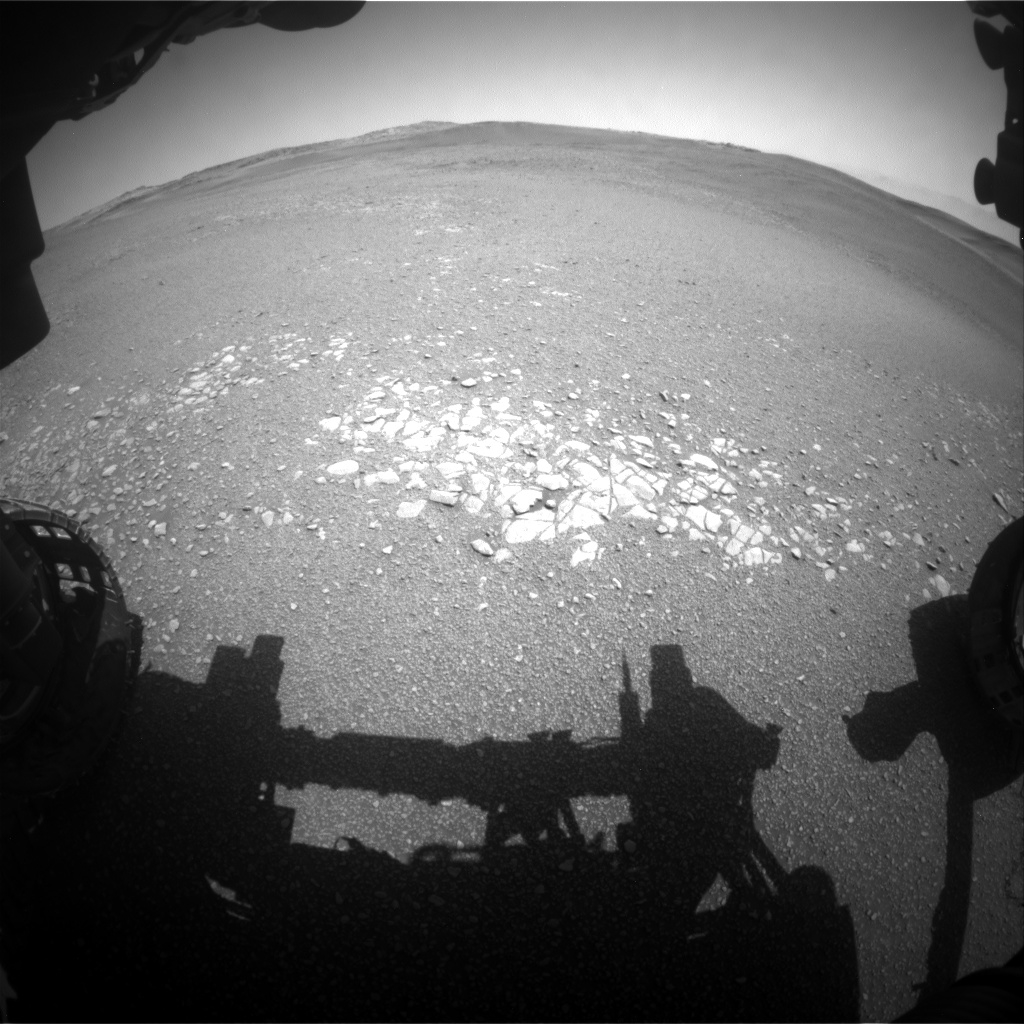
Curiosity Front Hazcam Left B photo taken on Sol 2436, June 14, 2019.
Credit: NASA/JPL-Caltech
Cloud movies
“Finally, ENV planned a number of movies, used to document clouds and dust devils,” O’Connell concludes. “Zenith” cloud movies look upwards, whilst “suprahorizon” movies look at clouds and variations in optical depth in a more horizontal direction.
“Dust devil movies can give information on surface heating and winds near the surface,” O’Connell adds.
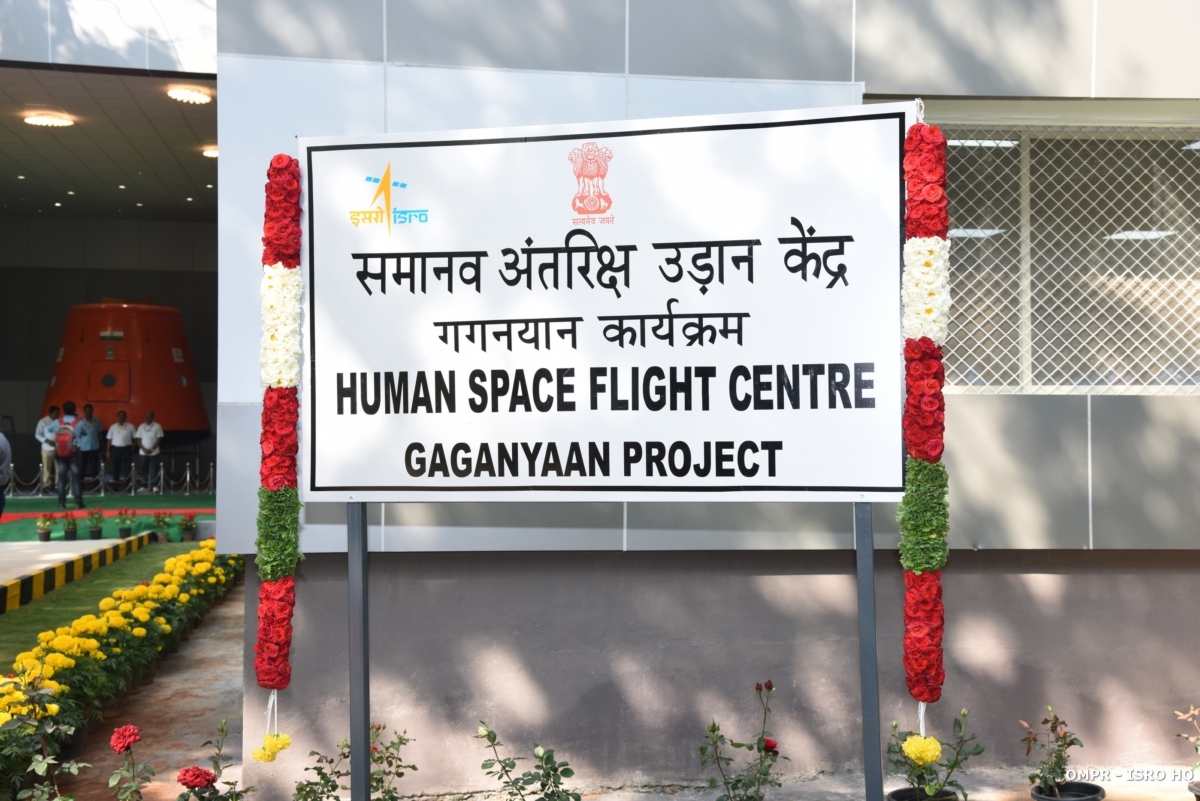
Credit: ISRO
India has announced they plan to construct their own space station.
“Our space station is going to be very small… useful to carry out experiments,” said Kailasavadivoo Sivan, Chairman of Indian Space Research Organization (ISRO).

India space program officials are all thumbs up. Behind them, full scale model of the Gaganyaan crew module.
Credit: ISRO
The orbiting facility, Sivan advised earlier this week, serves as an extension of its Gaganyaan mission; it aims to place New Delhi’s first ever astronauts into orbit by August 2022.
“We have to sustain the Gaganyaan program after the launch of the human space mission,” Sivan explains.
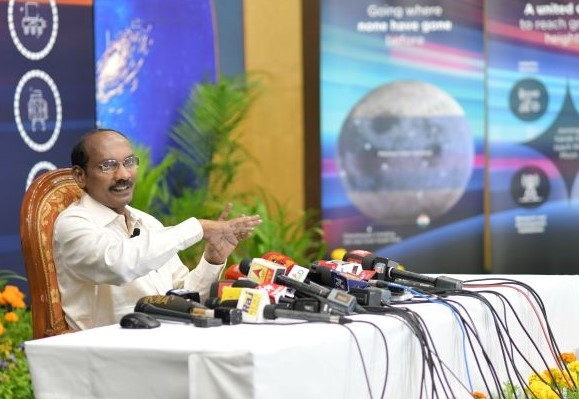
Kailasavadivoo Sivan, Chairman of Indian Space Research Organization (ISRO).
Credit: ISRO
Microgravity experiments
According to Indian media sources, a detailed plan for the station will be submitted to the administration of prime minister Narendra Modi. It is expected that, following the Gaganyaan mission, the proposed installation will be put into orbit around 2030.

ISRO hopes to deploy its biggest rocket, the Geosynchronous Satellite Launch Vehicle Mark III (GSLV Mk III), to send three Indians into space from the Sriharikota space port in Andhra Pradesh. GSLV Mk III is a three-stage heavy lift launch vehicle using two solid strap-ons, a core liquid booster, and a cryogenic upper stage.
Credit: ISRO
Once in Earth orbit, ISRO’s 20-ton (20,000 kilograms) space station is set to facilitate microgravity experiments. Astronauts would be able to stay on board the station for up to 15 to 20 days.
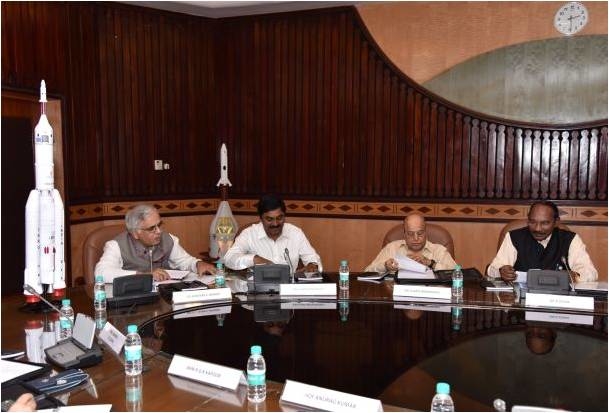
First meeting of Gaganyaan National Advisory Council.
Credit: ISRO
Setting priorities
Meanwhile, the first meeting of Gaganyaan National Advisory Council was held June 8 at ISRO Headquarters, Bengaluru chaired by Sivan.
“The council deliberated in detail on various aspects of Gaganyaan and appreciated the efforts made in this regard in the fast track mode and Institutional mechanisms put in place by ISRO,” according to a ISRO press statement. “It stressed the need for setting priorities at various National Institutions including Industries to accomplish Gaganyaan. Many essential aspects of Gaganyaan, especially the life support systems and crew selection and training, were discussed in detail.”
An upshot from the council was emphasis on further accelerating the efforts to realize Gaganyaan “in a very demanding time frame of December 2021 amidst formidable challenges.”
For more information regarding India’s human space initiatives, go to these earlier Inside Outer Space stories:
India Inaugurates Human Space Flight Center
https://www.leonarddavid.com/india-inaugurates-human-space-flight-center/
India Puts in Motion Human Spaceflight Plan: Make way for “Vyomnauts”
https://www.leonarddavid.com/india-puts-in-motion-human-spaceflight-plan-make-way-for-vyomnauts/
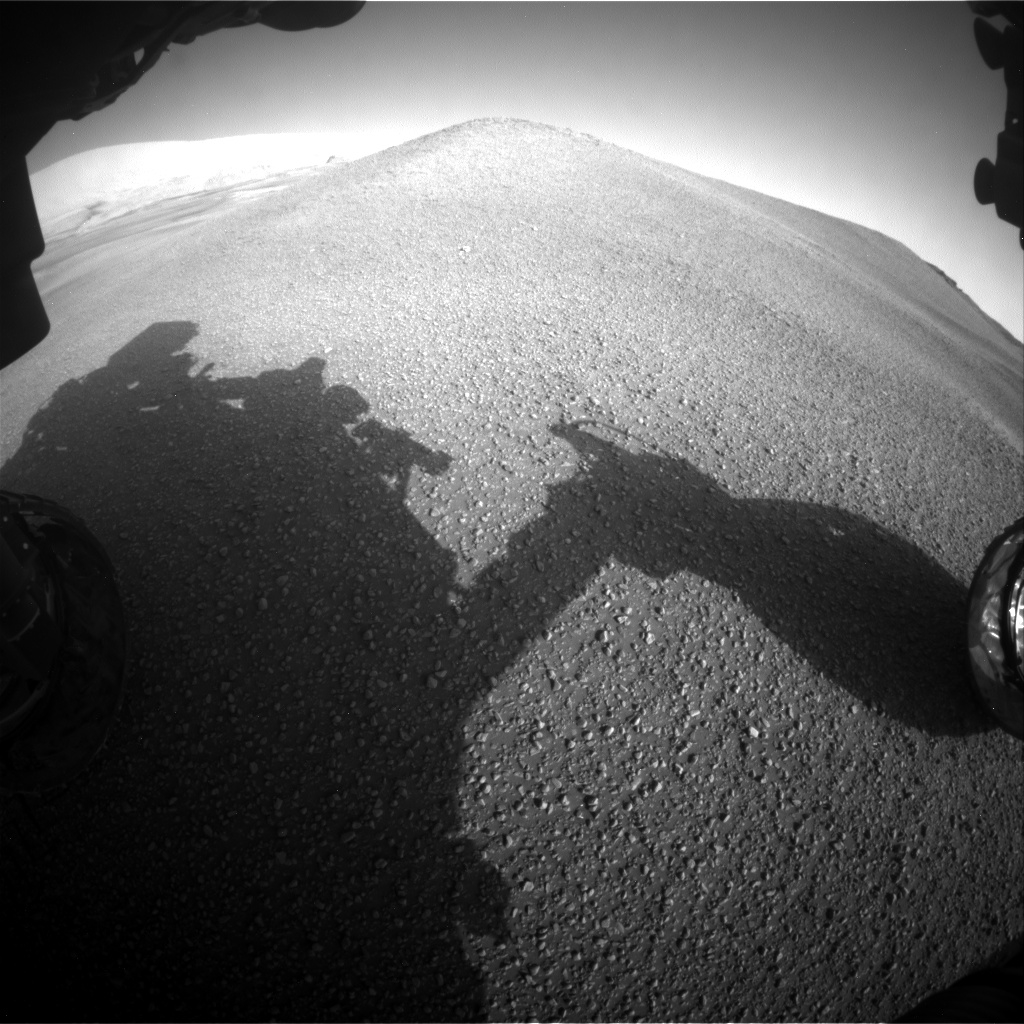
Curiosity Front Hazcam Left B photo taken on Sol 2434, June 12, 2019.
Credit: NASA/JPL-Caltech
NASA’s Curiosity Mars rover is now carrying out Sol 2435 duties.
Reports Mariah Baker, a planetary geologist at Johns Hopkins University in Baltimore, Maryland: “It’s a good thing that Curiosity doesn’t have any competition on the road as she drives fervently across undulating terrain towards a large geologic ridge of unknown origin…informally named Waypoint 4.”
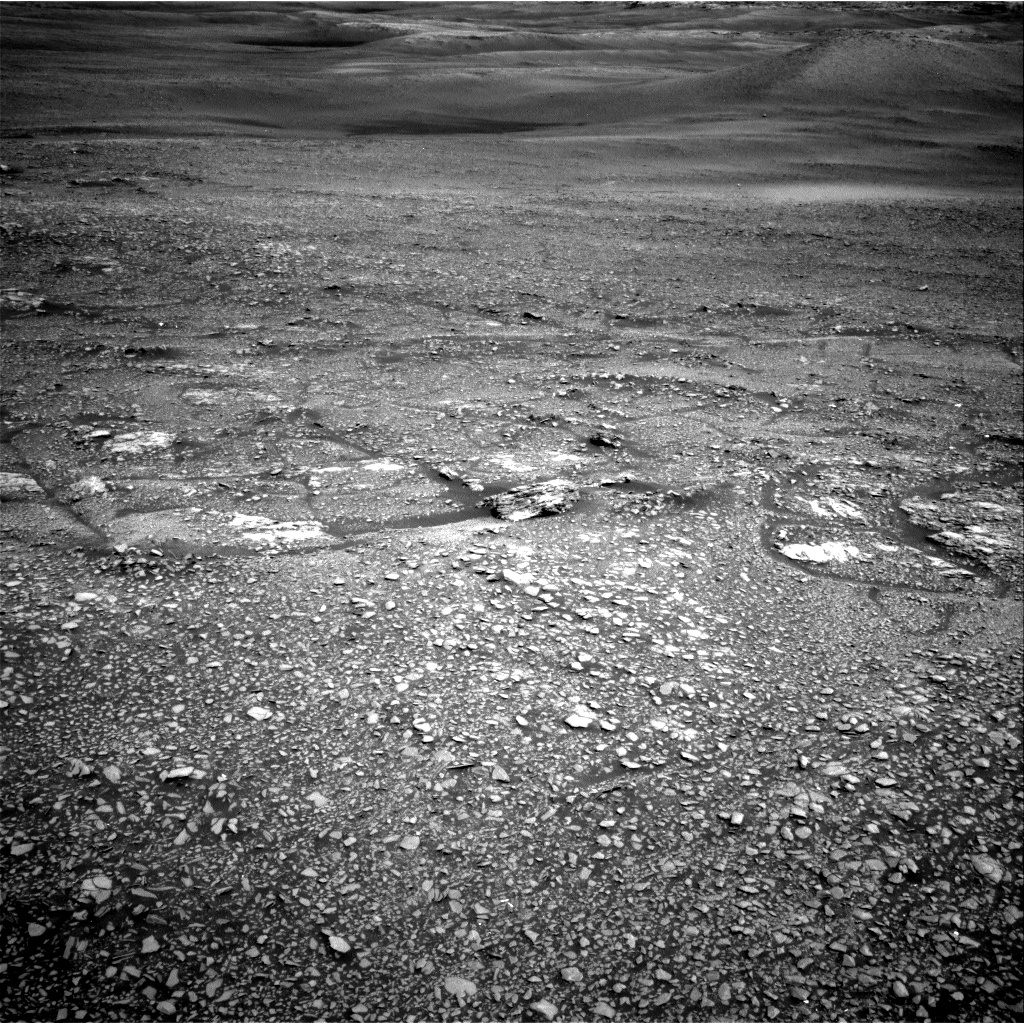
This Navcam image acquired on sol 2432 shows some of the rubbly terrain in front of Curiosity as well as the “Waypoint 4” ridge we are driving towards (upper right corner).
Curiosity Navcam Right B image acquired on Sol 2432, June 10, 2019.
Credit: NASA/JPL-Caltech
Long drive
Following a long 144 feet (44-meter) drive to put the robot into its current location (on a similar, but smaller ridge), and two more drives of 82 feet (25-meters) were planned for this week to put the rover into a good vantage point for imaging the side of the ridge.
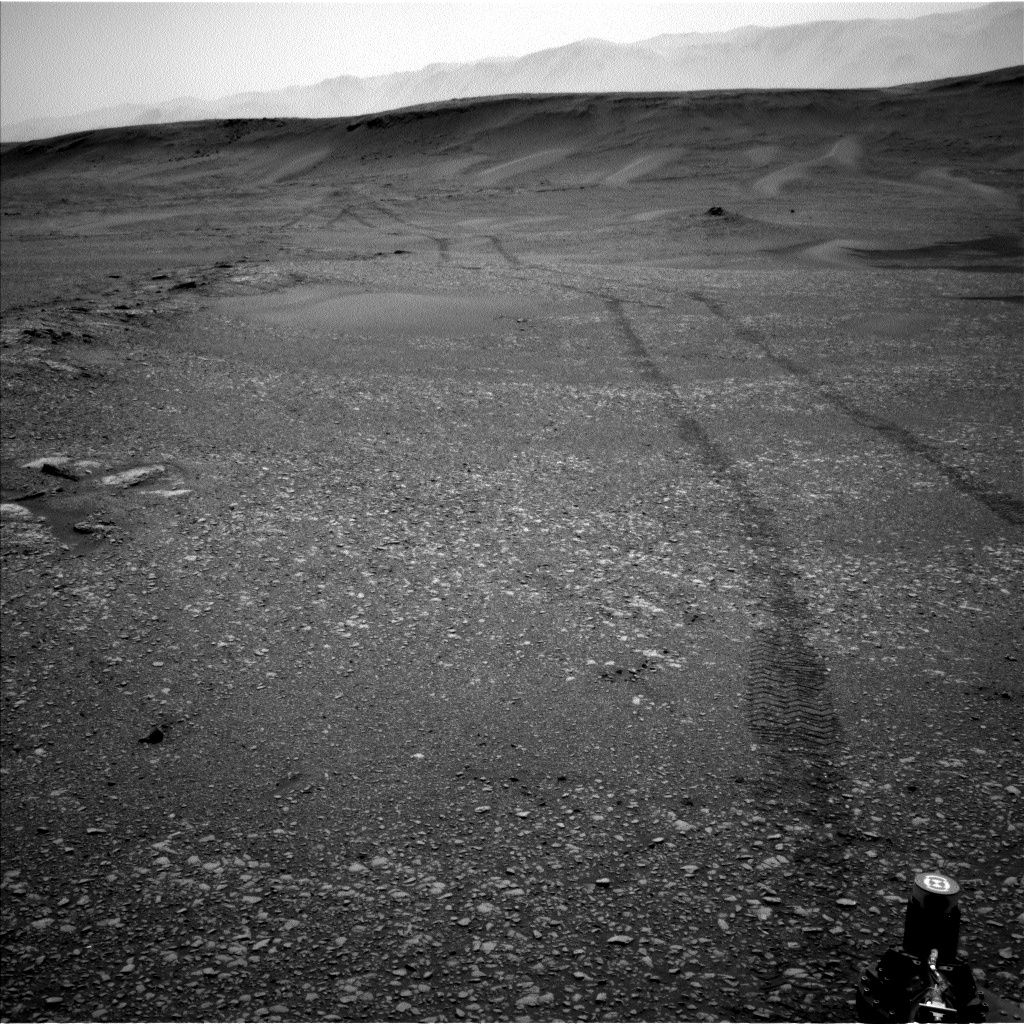
Curiosity Navcam Left B photo taken on Sol 2434, June 12, 2019.
Credit: NASA/JPL-Caltech
“But the team decided to put the pedal to the metal and try to make it to this ridgeline in just one drive. Ridge features are common throughout the Glen Torridon unit, so characterizing the morphology and chemical composition of these ridges can place important constraints on their formation and on the overarching geologic history of this region. This will be the goal of our investigation at Waypoint 4,” Baker says. “Although her current priority is getting to the large ridge as quickly as possible, Curiosity will still conduct science along the way.”
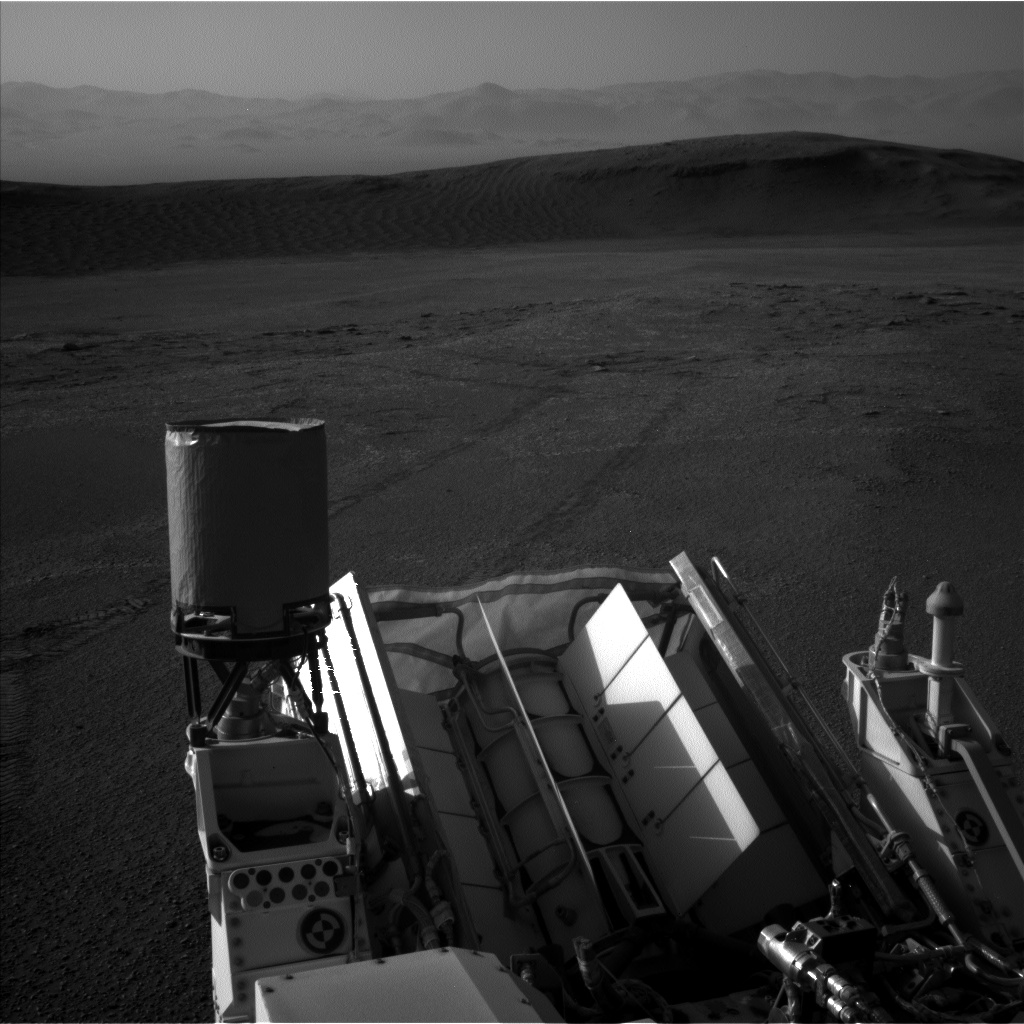
Curiosity Navcam Left B photo taken on Sol 2434, June 12, 2019.
Credit: NASA/JPL-Caltech
End-of-drive location
Various contact science and remote sensing observations are planned, including Chemistry and Camera Laser-Induced Breakdown Spectrometer (LIBS) on the target “Portessie,” and Alpha Particle X-Ray Spectrometer (APXS) and Mars Hand Lens Imager (MAHLI) on target “Smoogro.”
Mastcam stereo images will also be acquired on “Portessie” and “Lossie.”
“Once these activities have concluded, the rover will start her lengthy drive over to Waypoint 4. Post-drive imaging, including standard Navcam, Hazcam, and Mastcam mosaics as well as an extended Navcam upper tier mosaic, will help us assess our end-of-drive location and will provide the first up-close look at the ridge in question,” Baker points out.
Credit: NASA/JPL-Caltech/Univ. of Arizona
Road map
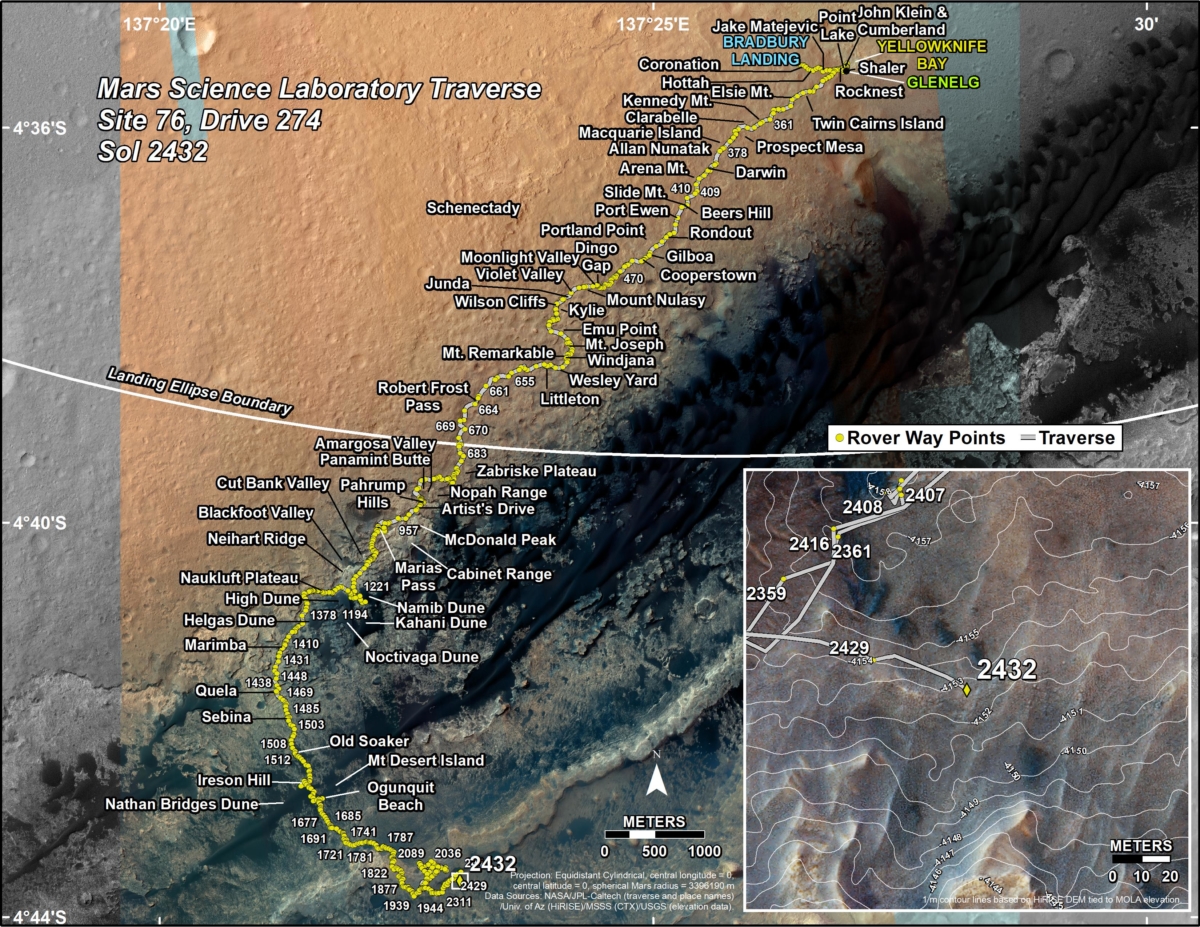
A newly released map shows Curiosity’s traverse through Sol 2432.
The map shows the route driven by NASA’s Mars rover Curiosity through the 2432 Martian day, or sol, of the rover’s mission on Mars (June 10, 2019).
Numbering of the dots along the line indicate the sol number of each drive. North is up. The scale bar is 1 kilometer (~0.62 mile).
From Sol 2429 to Sol 2432, Curiosity had driven a straight line distance of about 112.26 feet (34.22 meters), bringing the rover’s total odometry for the mission to 12.88 miles (20.73 kilometers).
The base image from the map is from the High Resolution Imaging Science Experiment Camera (HiRISE) in NASA’s Mars Reconnaissance Orbiter.

Credit: CMSA
The United Nations Office for Outer Space Affairs (UNOOSA) and the China Manned Space Agency (CMSA) announced today the winners of their joint opportunity to conduct experiments on board the China Space Station (CSS).
Six winning projects were selected, and three were conditionally selected. They were carefully evaluated by a team of around 60 experts from UNOOSA, CMSA and the international space community.
Variety of countries
The winning institutions come from a variety of countries, including Belgium, China, France, Germany, India, Italy, Japan, Kenya, the Netherlands, Norway, Mexico, Poland, Peru, Russian Federation, Saudi Arabia, Spain and Switzerland.

Credit: CMSA
The selected winners will have the chance to physically access space by flying their experiment on the CSS, developing their capabilities in space science and technology.
Next call for experiments?
CMSA Director-General, Chun Hao, said in a UNOOSA press statement: CMSA stands ready to help the winning teams prepare and implement their experiments on board of the Station. CMSA is working closely with UNOOSA to further our existing cooperation and create more opportunities to enhance access to space: for example, we are thinking of releasing the next call for experiments in the near future.”
Experiments selected
The following 6 proposals are ACCEPTED:
No. 1: POLAR-2: Gamma-Ray Burst Polarimetry on the China Space Station
This is an experiment project in astronomy in space.It was applied and will be implemented by four institutions from four countries, which are:The University of Geneva from Switzerland, the National Centre for Nuclear Research of Poland,the Max Plank Institute for Extra-terrestrial Physics of Germany, and the Institute of High Energy Physics of Chinese Academy of Sciences.
No. 2: Spectroscopic Investigations of Nebular Gas (SING)
This is an experiment in astronomy in space. It was applied and will be implemented by two institutions from two countries, which are: The Indian Institute of Astrophysics, and the Institute of Astronomy of the Russian Academy of Sciences.
No.3: Behaviour of Partially Miscible Fluid in Microgravity
This is an experiment in microgravity fluid physics and combustion. It was applied and will be implemented by two organizations from two countries, namely the Indian Institute of Technology (BHU) and the University Libre de Bruxelles (ULB) in Belgium.
No.4: Flame Instabilities Affected by Vortices and Acoustic Waves (FIAVAW)
This is an experiment project in microgravity fluid physics and combustion. It was jointly applied and will be jointly implemented by two institutions from two countries, which are: Tsinghua University from China and the University of Tokyo from Japan.
No.5: Tumours in Space: Signatures of early mutational events due to space-flight conditions on 3D organoid cultures derived from intra-individual healthy and tumour tissue
This is an experiment project in space life sciences and biotechnology. It was jointly applied and will be jointly implemented by four institutions from four countries, namely the Norwegian University of Science and Technology, International Space University, Vrije University Amsterdam in the Netherlands, and the Belgium Nuclear Research Centre.
No. 6: Effect of Microgravity on the Growth and Biofilm Production of Disease-Causing Bacteria
This is an experiment project in space life sciences and bio-technology. It was jointly applied and will be jointly implemented by the Mars Society – Peru Chapter, and the Mars Society – Spain Chapter.
Conditionally accepted
The following 3 proposals are CONDITIONALLY ACCEPTED,which signifies that the applicants will be given the opportunity to quickly update their respective excellent proposal, so they fully comply with detailed specifications of the CSS. They are:
No.7: Mid infrared platform for Earth observations
This is an experiment project in Earth science in space. It was jointly applied and will be jointly implemented by two organizations from one country, which are: the National Institute of Astrophysics Optics and Electronics (INAOE), and Benemérita Universidad Autónoma de Puebla (BUAP) from Mexico.
No.8: Development of Multi-Junction GaAs Solar Cells for Space Applications
This is an experiment project in space utilization technology. It was jointly applied and will be jointly implemented by two institutions from one country, which are: the National Centre for Nanotechnology and Advanced Materials, and the King Abdelaziz City for Science and Technology (KACST) from Saudi Arabia.
No. 9: BARIDISANA – High Performance Micro 2-Phase Cooling System for Space Applications
This is an experiment in microgravity fluid physics and combustion. It was applied and will be implemented by two institutions from two countries, which are: the Sapienza University of Rome in Italy, and the Machakos University in Kenya.

Credit: ISRO
The Indian Space Research Organization (ISRO) is showcasing the modules of the country’s Chandrayaan-2 that is scheduled to be launched between July 9 and 16 from the Satish Dhawan Space Centre in Sriharikota.
Chandrayaan-2 will attempt to soft land the lander -Vikram and rover- Pragyan in a high plain between two craters, Manzinus C and Simpelius N, at latitude of about 70° south.

Credit: ISRO
South pole science
The Moon’s south pole is especially interesting because of the lunar surface area here that remains in shadow is much larger than that at the North Pole. There is a possibility of the presence of water in permanently shadowed areas in that area. Lunar cold traps contain a fossil record of the early Solar System.

Credit: ISRO
The booster, GSLV Mk-III, will carry Chandrayaan-2 to its designated orbit. This three-stage vehicle is India’s most powerful launcher to date, and is capable of launching 4-ton class of satellites to Geosynchronous Transfer Orbit (GTO).
Video at:
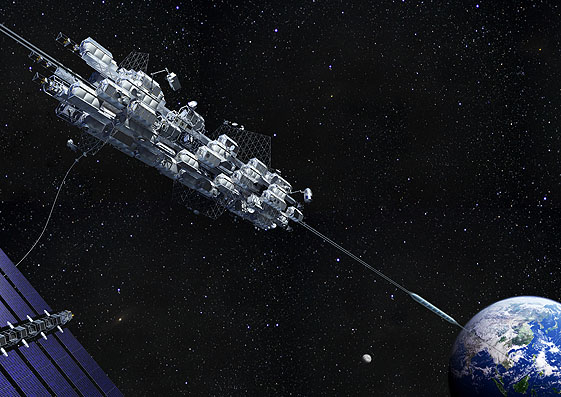
Credit: Obayashi Corporation of Tokyo, Japan
The Space Elevator is closer than you think.
That’s the topic of a free webinar offered June 14-15 by the International Space Elevator Consortium (ISEC).
This online seminar will have four short talks on the concept and the current planning and research to build a space elevator for Earth. The webinar will be presented twice over two days so you can pick the best time that works for you.

Climber makes it way up lengthy space elevator.
Credit: Frank Chase/Chase Design Studios
Register for free for one of the two online sessions below as space is limited.
Register for Session 1 – Friday, June 14, 2019 from 4pm to 8pm PDT (8am to 12pm Sat June 15 Tokyo time zone)
or
Register for Session 2 – Saturday, June 15, 2019 from 9am to 1pm PDT (6pm to 10pm Central Europe time zone)
Here is the planned agenda for each webinar:
- Introduction and Welcome by Dennis Wright/John Knapman (10 min)
- Space Elevators 101 by Pete Swan (45 min)
- Space Elevator Materials with Focus on Graphene by Adrian Nixon (45 min)
- Tethers, Space Elevators and Debris by Jerome Pearson (45 min)
- Space Elevator Research by Dennis Wright/John Knapman (45 min)
- Q & A (questions from registrants submitted during the webinar) (30 min)
- Closing by Dennis Wright/John Knapman (10 min)
Go to:
https://isec.org/free-space-elevator-webinars-june-14-15-2019/
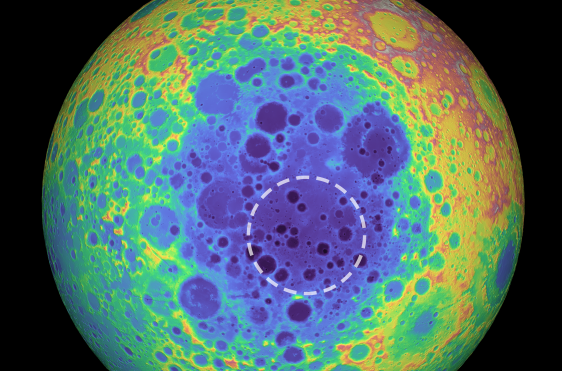
This false-color graphic shows the topography of the far side of the Moon. The warmer colors indicate high topography and the bluer colors indicate low topography. (Credit: NASA/Goddard Space Flight Center/University of Arizona) The South Pole-Aitken (SPA) basin is shown by the shades of blue. The dashed circle shows the location of the mass anomaly under the basin.
It is not quite the monolith uncovered at Clavius crater in the epic 2001: A Space Odyssey movie – but still a surprise.
New research points to the existence of a large excess of mass in the Moon’s mantle under the South Pole‐Aitken basin. It may contain metal from an asteroid that crashed into the Moon and formed the crater.
The surprisingly large amount of mass hundreds of miles underneath the South Pole-Aitken basin has been reported in a study – “Deep Structure of the Lunar South Pole-Aitken Basin” — published in the journal Geophysical Research Letters.
Unexpected mass
“Imagine taking a pile of metal five times larger than the Big Island of Hawaii and burying it underground. That’s roughly how much unexpected mass we detected,” said lead author Peter B. James, Ph.D., assistant professor of planetary geophysics in Baylor’s College of Arts & Sciences in a university press statement.

NASA’s twin GRAIL probes.
Credit: NASA
James and his fellow researchers analyzed data from dual spacecraft used for the NASA Gravity Recovery and Interior Laboratory (GRAIL) mission.
“When we combined that with lunar topography data from the Lunar Reconnaissance Orbiter, we discovered the unexpectedly large amount of mass hundreds of miles underneath the South Pole-Aitken basin,” James said. “One of the explanations of this extra mass is that the metal from the asteroid that formed this crater is still embedded in the Moon’s mantle.”

NASA’s Lunar Reconnaissance Orbiter (LRO).
Credit: NASA/Goddard Science Visualization Studio (SVS)
Iron-nickel core
The dense mass — “whatever it is, wherever it came from” — is weighing the basin floor downward by more than half a mile, he said. Computer simulations of large asteroid impacts suggest that, under the right conditions, an iron-nickel core of an asteroid may be dispersed into the upper mantle (the layer between the Moon’s crust and core) during an impact.
Another possibility is that the large mass might be a concentration of dense oxides associated with the last stage of lunar magma ocean solidification.
Important clues
The South Pole‐Aitken (SPA) basin is the largest preserved impact basin on the Moon and perhaps the largest universally recognized impact structure in the solar system.
The formation and structure of the SPA basin hold important clues about the history and evolution of the Moon.
Resource mining
Could this new finding have implications for on-the-spot resource mining?
“For the most part, no – the anomalies that we detect are likely far deeper than any practical drilling could exploit.,” James told Inside Outer Space. “However, modeling by my coauthor Jordan Kendall has suggested that oblique impacts like the one that created SPA may have resulted in some of the impactor core remaining at the surface, mixed in with the crust or ejecta.”
To read the new paper — Deep Structure of the Lunar South Pole-Aitken Basin – go to:
https://agupubs.onlinelibrary.wiley.com/doi/full/10.1029/2019GL082252

NASA astronaut Tracy Caldwell Dyson, Expedition 24 flight engineer, looks through a window in the Cupola of the International Space Station. A blue and white part of Earth and the blackness of space are visible through the windows.
Credit: NASA
A Reason Foundation study is calling for, and has outlined, a 10-year plan for shifting from a space exploration model centered on NASA to a commerce-based structure.
That structure is one in which the private sector assumes responsibility for all space transportation, large payload launch vehicles and launch operations, in-space facilities and more.

Credit: NASA
Basic space infrastructure
Using only NASA’s current funding levels, the study presents a timeline for public-private development of basic space infrastructure, including fuel depots for space vehicles, a shuttle for travel to the moon, lunar facilities to resupply and aid construction in space, and an orbital facility complex that would be part of the foundation for large-scale space exploration, research and commercialization.
The 86-page study by two veterans of the private space industry — Jeff Greason and James Bennett — concludes the private sector’s long-term space efforts could be funded by self-sustaining commercial activities and supplemented by government contracts.
Jeff Greason was a founder and initial CEO of commercial space company XCOR Aerospace, with prior experience at Rotary Rocket and Intel.
James Bennett was a co-founder of two space-launch start-ups, Starstruck, Inc. and American Rocket Company, which pioneered hybrid rocket propulsion.

Space rock slips by Earth.
Courtesy: Texas A&M
Commercial potential
Areas of commercial potential discussed in the study includes:
Tapping space-based clean energy sources;
Mining asteroids for useful raw materials;
Developing safe venues for new scientific experiments;
Sequestering hazardous but valuable debris in space;
Tapping sources of water in space, for several important uses;
And using low-gravity and low-temperature properties of space for research and manufacturing.

Honey Bee Robotic asteroid capture for ISRU resource return, as viewed in this artist’s conception.
Credit: TransAstra Corporation
Reason Foundation’s nonpartisan public policy research promotes choice, competition and a dynamic market economy as the foundation for human dignity and progress.
Links to the study and related materials can be found here:
The Economics of Space: An Industry Ready to Launch (Executive Summary) By Jeff Greason and James Bennett
https://reason.org/policy-study/the-economics-of-space/
Full Study (.pdf)
https://reason.org/wp-content/uploads/economics-of-space.pdf
Robert Poole’s Overview: New Study Calls for Major Rethinking and Reorganization of U.S. Space Policy By Robert Poole, director of transportation policy and Searle Freedom Trust Transportation Fellow at Reason Foundation.
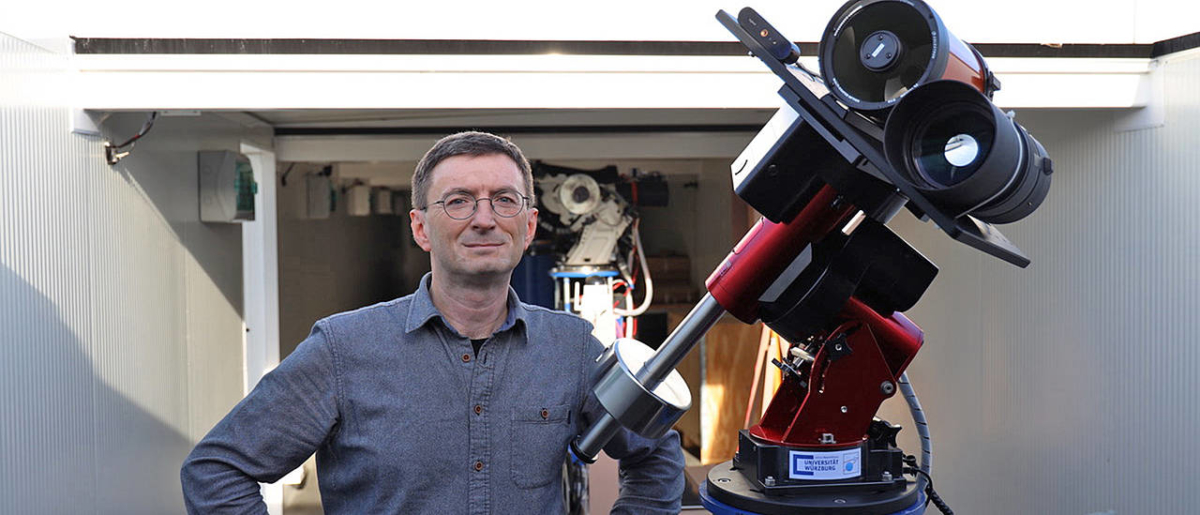
Hakan Kayal next to specialized Moon telescope.
Credit: Tobias Greiner/Universität Würzburg
Flashes of light that occur on the Moon are attracting renewed attention.
Called transient lunar phenomena, or TLPs for short, these bursts of light from the lunar surface have been known since the 1950s. Claims of short-lived lunar phenomena go back at least 1,000 years.
Maintaining a systematic and a long-term lunar look-see is on the astronomical agenda of Hakan Kayal, Professor of Space Technology at Julius-Maximilians-Universität Würzburg (JMU) in Bavaria, Germany.
Remote control
Kayal and his team have built a specialized lunar telescope, putting it into operation in April 2019. Situated in a private observatory in Spain, the weather conditions there viewed as ideal for observing the Moon.
The telescope is remote-controlled from the JMU campus. It consists of two cameras that keep an eye on the Moon night after nightfall, on the prowl to spot flashes of light. If both cameras register a luminous phenomenon at the same time, the telescope triggers further actions. It then stores photos and video sequences of the event and sends an e-mail message to Kayal’s team.

This map displays an approximate distribution of transient lunar phenomena. It is based on a monochrome map by Barbara Middlehurst and Patrick Moore that was published in the book, On the Moon in 2001. Red dots indicate TLP that appeared to the observer as a reddish cloud. Yellow dots are all other events.
Puzzling phenomena
Scientists do not know precisely how these phenomena occur on the Moon. Perhaps they occur due to impacts of a meteor, creating a brief glow. Maybe such flashes occur when electrically charged particles of the solar wind react with lunar dust.
“Seismic activities were also observed on the Moon. When the surface moves, gases that reflect sunlight could escape from the interior of the Moon. This would explain the luminous phenomena, some of which last for hours,” says Kayal in a JMU press statement.
AI software
Augmenting the system — and not yet completely finished – is the software, which automatically and reliably detects flashes and other light phenomena.
Kayal and his colleagues plan to use artificial intelligence methods to distinguish a Moon flash from technical faults or from objects such as birds and airplanes passing in front of the camera. It is estimated that another year of work will be required before this can be done.
Reducing the false alarm rate as much as possible is only the first milestone in this project. The system will later be used on a satellite mission. The cameras could then work in orbit around the Earth or the Moon and free of disturbances caused by our planet’s atmosphere.
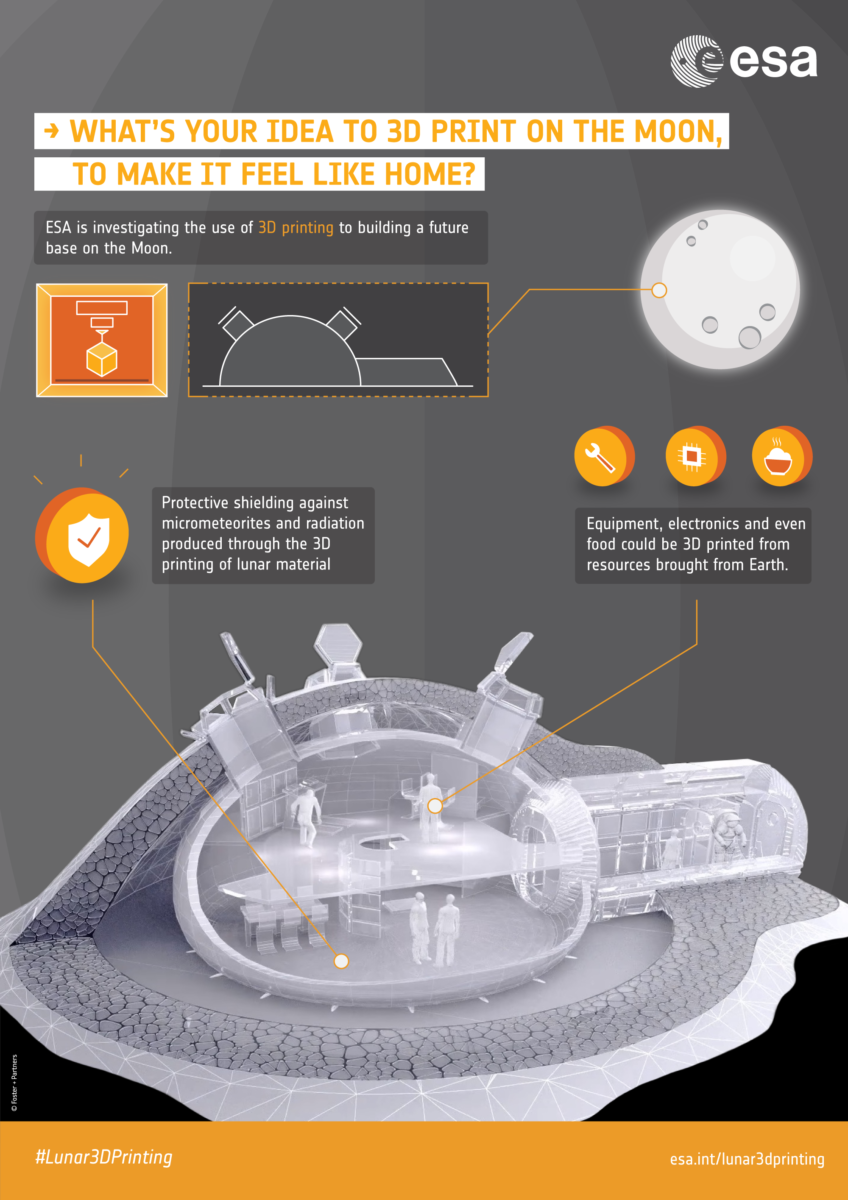
A new ESA-led project is investigating the ways that 3D printing could be used to create and run a habitat on the Moon. Everything from building materials to solar panels, equipment and tools to clothes, even nutrients and food ingredients can potentially be 3D printed.
Credit: ESA
Moonbase planning
Interest in the lunar luminous phenomena is currently high, stirred up in part by Moon exploration plans of Europe, China, India, the United States and others.
“Anyone who wants to build a lunar base at some point must of course be familiar with the local conditions,” says Kayal. So identifying what triggers the mysterious flashes and luminous phenomena is worthy of new study.

