Author Archive
 Author:
  June 21st, 2019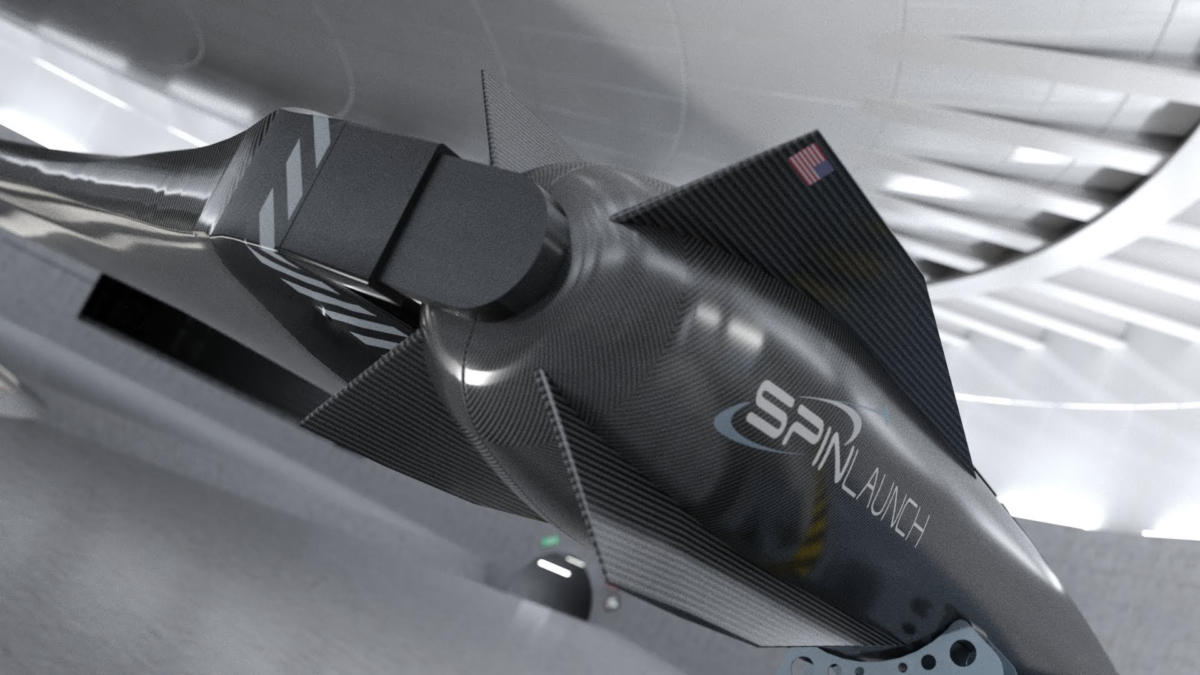
Credit: SpinLaunch
SpinLaunch has been awarded a responsive launch prototype contract from the Department of Defense, facilitated by the Defense Innovation Unit.
Work is moving forward on the SpinLaunch concept: developing a kinetic energy-based launch system that will provide a low-cost orbital launch services for the rapidly growing small satellite industry.

Tapping existing technology
According to SpinLaunch, the launch system utilizes existing technology and components from oil/gas/mining and wind turbine industries. In tapping these technologies, the group is constructing a mass acceleration system, one that achieves very high launch speeds without the need for enormous power generation or massive infrastructure.
After ascending above the atmosphere, a relatively small, low-cost onboard rocket will be used to provide the final required velocity for orbital insertion.
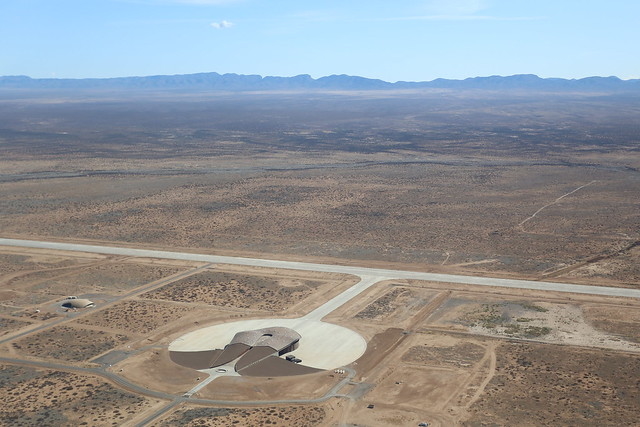
Aerial view of New Mexico’s Spaceport America.
Credit: Spaceport America
High frequency launch
A SpinLaunch fact sheet explains that, because the majority of the energy required to reach orbit is sourced from ground-based electricity, as opposed to complex onboard rocket propulsion, total launch cost is reduced by an order of magnitude over existing launch systems.

Credit: New Mexico Economic Development Department/Screengrab Inside Outer Space
SpinLaunch adds that the group is able to offer readily-available, low cost, dedicated launches at high frequencies and is working to provide up to five launches per day at a price of $250,000 per launch.
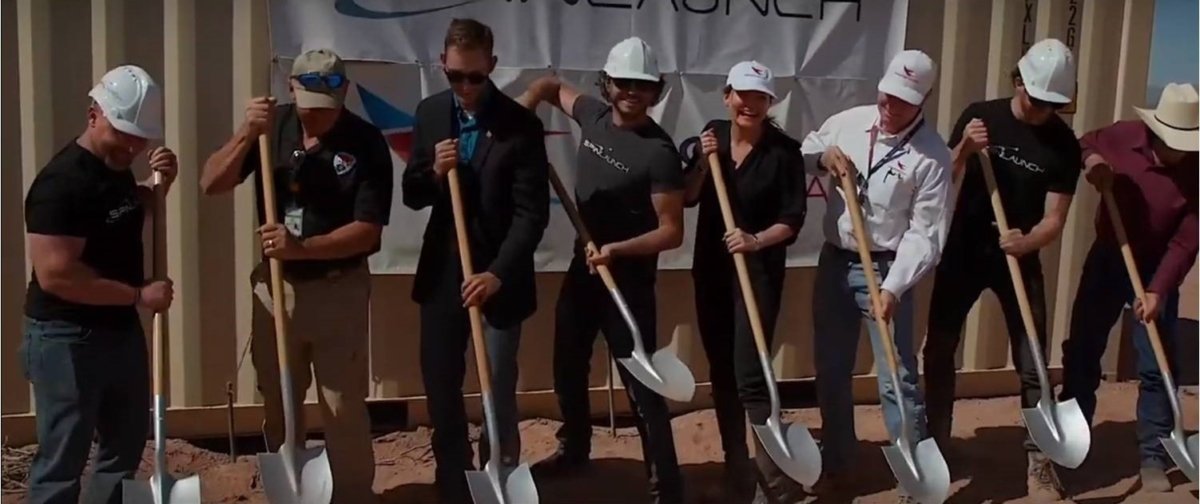
Groundbreaking for SpinLaunch facility at New Mexico’s Spaceport America.
Credit: Credit: New Mexico Economic Development Department/Screengrab Inside Outer Space
New Mexico test facility
In January 2019, SpinLaunch moved from Silicon Valley to its new 140,000 square foot headquarters in Long Beach, California and last month broke ground on a new $7 million test facility on 10 acres at New Mexico’s Spaceport America.
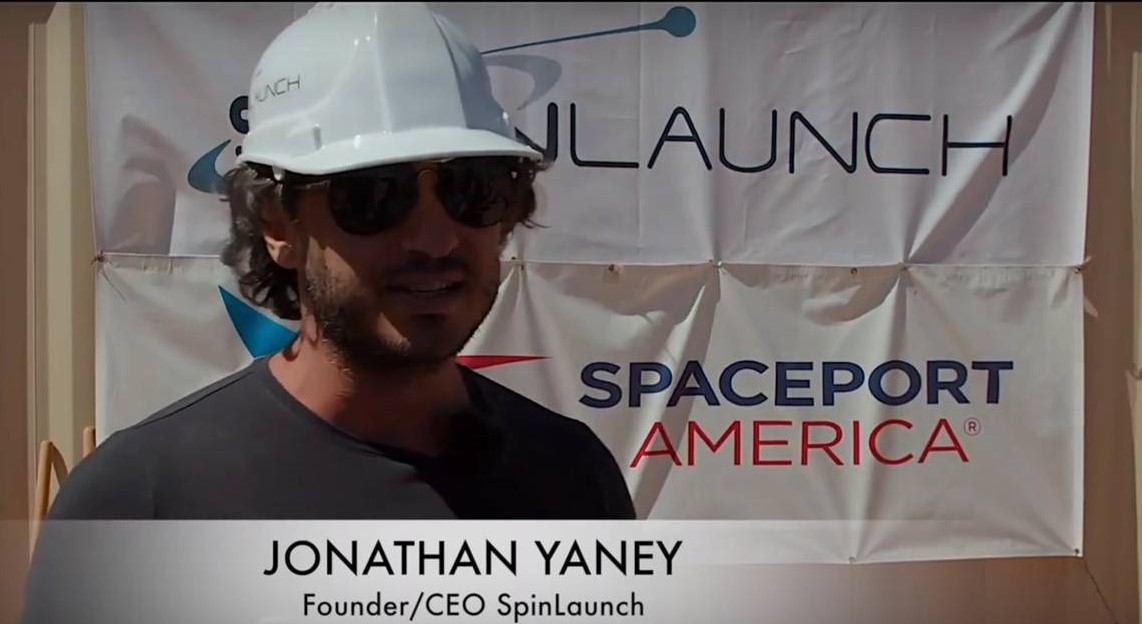
Credit: New Mexico Economic Development Department/Screengrab Inside Outer Space
First kinetic energy flight tests are expected to occur early 2020 and the company has announced its plans for first launch by 2022.
SpinLaunch was founded in 2014, by Jonathan Yaney, a 1,000+ hour pilot and serial entrepreneur with 15 years’ experience founding companies in aerospace, Fortune 500 consulting, IT, and construction industries.
Go to this New Mexico Economic Development Department ground breaking video at:
 Posted in
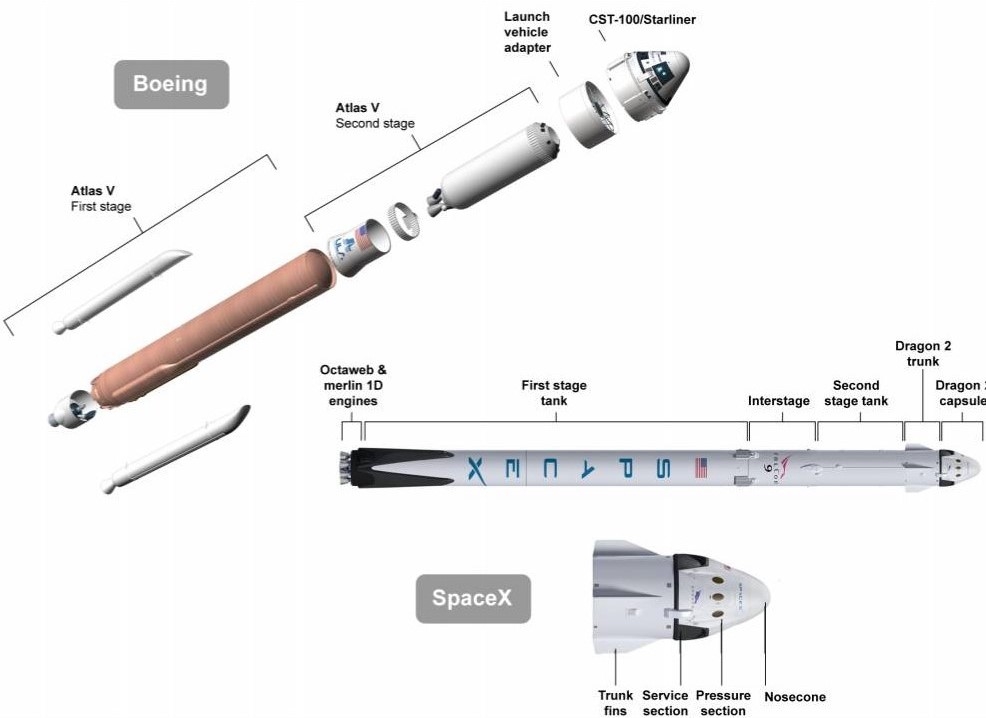
Source: ULA/SpaceX via GAO report 18-476
The United States Government Accountability Office (GAO) has released a report: “Schedule Uncertainty Persists for Start of Operational Missions to the International Space Station.”
In 2014, NASA awarded two firm-fixed-price contracts to Boeing and SpaceX, worth a combined total of up to $6.8 billion, to develop crew transportation systems and conduct initial missions to the International Space Station.
Before any missions can happen, NASA will have to certify that both contractors’ vehicles are safe for human spaceflight.
Chronic delays
But SpaceX and Boeing have run into chronic delays. While both contractors originally planned to be certified in 2017, now neither is expected to be ready until late 2019 at the earliest.
NASA has bought seats on a Russian vehicle to ensure U.S. access to the space station through September 2020, but does not have a plan if delays with U.S. contractors persist past then.
GAO continues to believe that NASA should develop a contingency plan to ensure uninterrupted access to the ISS if delays persist beyond September 2020. NASA generally agreed with GAO’s findings.
Highlights page go to:
https://www.gao.gov/assets/700/699882.pdf
Full report, go to:
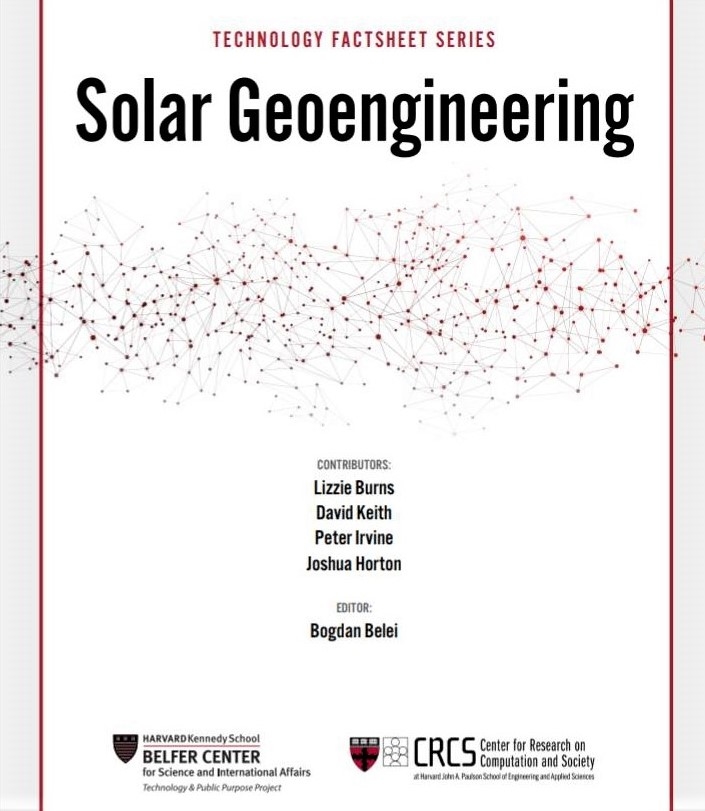
For those Mars terraforming advocates, you’ll find an interesting read from the Belfer Center for Science and International Affairs at the Harvard Kennedy School in Cambridge, Massachusetts.
A Belfer Center study group has looked at solar geoengineering – not for the Red Planet but for the Blue Marble – Earth.

DSCOVR spacecraft view of the entire sunlit side of Earth.
Credit: NASA
The factsheet comes from the center’s Technology and Public Purpose Project.
Risks and uncertainties
As explained in the report, solar geoengineering has the potential to reduce climate impacts around the globe, but it also carries its own risks and uncertainties.
“The science and the governance are very challenging. The question at issue now is not about deployment,” the report notes. “It is about whether there should be a serious research effort on solar geoengineering to advance understanding on the efficacy, benefits, and risks, and to identify strategies that might make it safer.”

Credit: Courtesy of SOHO/[instrument] consortium. SOHO is a project of international cooperation between ESA and NASA.
Moral hazard, slippery slope
Proposed solar geoengineering technologies for the Earth include: marine cloud brightening, cirrus cloud thinning, space-based techniques, and stratospheric aerosol scattering.
There are a number of policy issues for consideration, including:
For one, the study observes, there is serious concern that talking about, researching, and/or deploying solar geoengineering will reduce incentives to cut emissions—this problem is often referred to as “moral hazard.” It is highly likely that some fossil fuel interests will seek to exploit solar geoengineering to block mitigation.
Additionally, there is also concern that research on solar geoengineering could create powerful constituencies in favor of eventual deployment. Such a potential for socio-technical lock-in is sometimes called a “slippery slope.”
To read the full factsheet on Solar Geoengineering, go to:
https://www.belfercenter.org/publication/technology-factsheet-solar-geoengineering

Curiosity Front Hazcam Left B Image acquired on Sol 2441, June 19, 2019.
Credit: NASA/JPL-Caltech
NASA’s Curiosity Mars rover is now carrying out Sol 2442 duties, parked on Teal Ridge, in the midst of an extended contact science campaign.

Curiosity Navcam Right B photo taken on Sol 2442, June 20, 2019.
Credit: NASA/JPL-Caltech

Curiosity Mars Hand Lens Imager (MAHLI), located on the turret at the end of the rover’s robotic arm, produced this image on Sol 2441, June 19, 2019.
Credit: NASA/JPL-Caltech/MSSS

Curiosity Navcam Left B image taken on Sol 2441. June 19, 2019.
Credit: NASA/JPL-Caltech
At this ridge location, new imagery from the robot shows crossbedding in a bedrock layer, as well as a contact between the bedrock outcrop and a rubbly layer below.

Space Launch System (SLS) Credit: NASA/MSFC
The U.S. Government Accountability Office (GAO) issued today a report that flags the finding: “Due to continued production and testing challenges, NASA’s three related human spaceflight programs have encountered additional launch delays and cost growth.”

Artist rendering of Lockheed Martin-built Orion spacecraft in deep space.
Credit: Lockheed Martin
Trio of systems
NASA is developing a trio of systems to put astronauts into space: the Orion crew vehicle, Space Launch System (SLS), and Exploration Ground Systems (EGS).
“In the past we’ve reported on concerns over the way NASA is managing these large and complex efforts—such as working to overly optimistic schedules,” the new report explains. “NASA is unlikely to meet its recently revised launch date for the first test flight. In addition, its reporting of cost growth for SLS and Orion is distorted. We recommended that NASA adopt more transparent cost reporting practices.”
Reevaluate strategy
The report makes four recommendations to NASA, including that the SLS program should calculate cost growth based on costs that are currently included in the first mission and the Orion program should update its cost estimate to reflect the schedule agreed to in its baseline. In addition, the SLS and Orion programs should reevaluate their strategy for incentivizing contractors, the report adds.
“NASA’s SLS, Orion, and EGS programs are a multi-billion dollar effort to transport humans beyond low-Earth orbit, but the agency has been unable to achieve agreed-to cost and schedule performance,” notes the GAO study.

Artist’s view of Space Launch System/Orion spacecraft on the launch pad.
Credit: NASA
“NASA acknowledges that future delays to the June 2020 launch date are likely, but the agency’s approach in estimating cost growth for the SLS and Orion programs is misleading. And it does not provide decision makers, including the Administrator, complete cost data with which to assess whether Congress needs to be notified of a cost increase, pursuant to law,” adds the GAO assessment.
NASA’s acquisition management has been on GAO’s High Risk List since 1990.
For details on this new GAO study, go to:
https://www.gao.gov/assets/700/699822.pdf
and the full report, here:

Curiosity Front Hazcam Left B image taken on Sol 2440, June 18, 2019.
Credit: NASA/JPL-Caltech
NASA’s Curiosity Mars rover is now performing Sol 2440 science tasks.
“The outcrop in front of us is spectacular,” reports Dawn Sumner, a planetary geologist at the University of California Davis; Davis, California.

Curiosity Rear Hazcam Left B photo acquired on Sol 2440, June 18, 2019.
Credit: NASA/JPL-Caltech
Curiosity’s science team has planned regular weather observations, a survey of the sky at twilight, a movie looking for dust devils and a second one looking up at the clouds.
Also planned, Sumner adds, is a 360° Mastcam image to capture the regional outcrops as well as three Chemistry and Camera (ChemCam) Autonomous Exploration for Gathering Increased Science (AEGIS) analyses, where the instrument automatically selects targets within a region defined by the team.

Curiosity Mastcam Left image acquired on Sol 2439, June 17, 2019.
Credit: NASA/JPL-Caltech/MSSS

Curiosity Navcam Left B image taken on Sol 2439, June 17, 2019.
Credit: NASA/JPL-Caltech

Curiosity Navcam Left B image taken on Sol 2439, June 17, 2019.
Credit: NASA/JPL-Caltech

Curiosity Navcam Left B image taken on Sol 2439, June 17, 2019.
Credit: NASA/JPL-Caltech

Credit: John Fitzgerald Kennedy Library Foundation Incorporated
The John F. Kennedy Presidential Library’s JFK Moonshot, is a first-of-its-kind augmented reality documentary app experience, and is now available for free download.
JFK Moonshot is a retelling and recreation of the Apollo 11 mission and its connection to President Kennedy.

Credit: NASA
This year marks the 50th Anniversary of the historic Moon Landing; a significant moment in U.S. history catalyzed by a 1962 landmark speech by President Kennedy that shared his “moonshot” vision of human achievement that was then unimaginable.
Now, a half a century later, once again, space is in the headlines. There is a new space race between nations. Visionary entrepreneurs see space as the next frontier in human progress.
Five-day journey
The free JFK Moonshot app includes:
- First-ever full-scale AR recreation of the 363-ft Saturn V launch on its landing pad outside of the JFK Library in Boston or place the tabletop AR rocket to see it ready for takeoff anywhere in the world.
- Longest-running AR powered live-stream experience available, the app will take users on the five-day journey (July 16th-20th) from the Earth to the Moon.
- The mission simulation is made possible by combining 3D digital assets and actual archival footage and audio recordings.

Credit: NASA/ESA
Deeper dive
Using the latest in augmented reality technology, users are immersed into 1969 with a full-scale recreation of the Saturn V rocket and a 5-day real-time tracking simulation of the mission and moon landing.
Users can take a deeper dive into President Kennedy’s vision with interactive AR games, archival NASA footage and educational multimedia experiences.
Go to:

Wally Funk’s Race for Space: The Extraordinary Story of a Female Aviation Pioneer by Sue Nelson; Chicago Review Press, 2019; hardcover: 256 pages, $26.99
This is a wonderful read, one that underscores politics and prejudice in America’s embryonic human spaceflight program.
Wally Funk was a trailblazer, among the Mercury 13, the first group of American pilots to complete NASA’s 1961 Women in Space program.
Sue Nelson’s engaging and personal account of Funk’s lifetime pursuit of becoming an astronaut is also a story of tenacity and dogged perseverance. The book’s preface explains that in 2019, the same year as the fiftieth anniversary of the Apollo 11 Moon landing, Wally Funk will celebrate her 80th birthday.
“During that year,” Nelson writes, “she hopes to finally cash in her ticket with Virgin Galactic for one of the first commercial flights into space. Understandably, she is eager for this new era of space tourism to begin. History, for Wally, will then have come full circle.”
At age 23, Funk and her fellow women astronaut candidates participated in rigorous physical exams – as did the Mercury 7 male candidates. But the program to select female space travelers was suddenly shut down in 1961. NASA declared women could not qualify as astronauts, with the author describing the sexism facing women keen on orbital flight.
Funk went on to become one of America’s first female aviation inspectors and civilian flight instructors, with her dream of being an astronaut never fading and still intact.
The reader will find this book inspirational – a vibrant portrait of Funk’s can-do spirit and stick-to-itness. It’s a retro-fire back into space history and a tell-all tale of the flack that Funk endured.
For more information on Wally Funk’s Race for Space go to:
https://www.chicagoreviewpress.com/wally-funk-s-race-for-space-products-9781641601306.php

Credit: Feist/Apollo 11 in Real Time
A unique multimedia website has been launched, one that plays the entire Apollo 11 mission in real time.
Included are 2,000 photographs, 11,000 hours of Mission Control audio, 240 hours of space-to-ground audio, all onboard recorder audio, 15,000 searchable utterances, post-mission commentary, and astromaterials sample data.
The website is the most complete presentation of the mission’s historical film footage ever assembled, explains Ben Feist of NASA JSC/Jacobs-JETS.
Feist, along with archivist, Stephen Slater, produced the website that contains all of the 16mm film that was scanned for the recent film, Apollo 11.
Much of this silent film has had sound added to it for the first time, Feist adds, painstakingly lip synced with restored mission control audio that has been digitized.
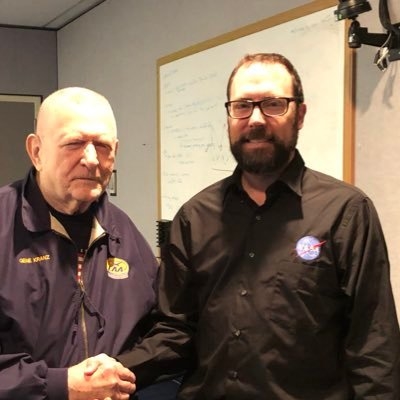
Ben Feist, software engineer and historian at NASA JSC and Goddard with Gene Kranz, retired NASA Flight Director and manager. Credit: Ben Feist
The 240-hour cut
The centerpiece of the website is 11,000 hours of Mission Control audio that has been synced to mission time. For any moment in the mission, visitors can open a panel that exposes 50 channels of audio covering every controller position in Mission Control and several other communication loops.
“It’s pretty much guaranteed that visitors will see things that they’ve never seen before,” Feist explains. “All footage is included, not just the popular stuff during landing that has been used over and over. We’ve been jokingly saying that apolloinrealtime.org is the 240-hour cut of the Apollo 11 film. It’s the whole thing.”
To access this invaluable website, go to:

Credit: Ocean Exploration Trust/Nautilus Live
A newly discovered hydrothermal field at the northern Gorda Ridge in the Pacific Ocean has been named the Apollo Vent Field in honor of the 50th anniversary of Apollo 11’s Moon landing this July.
The SUBSEA (Systematic Underwater Biogeochemical Science and Exploration Analog) Research Program team aboard Exploration Vessel Nautilus (E/V Nautilus) tagged the feature. Doing so is fitting since the SUBSEA project isn’t just ocean research – it is also an analog project designed to contribute to the future of space exploration.

Credit: Ocean Exploration Trust/Nautilus Live
Off-Earth ocean systems
The Apollo vent field offers a rare glimpse into environments that could be windows into ocean systems elsewhere in our Solar System – on moons such as Saturn’s Enceladus and Jupiter’s Europa.
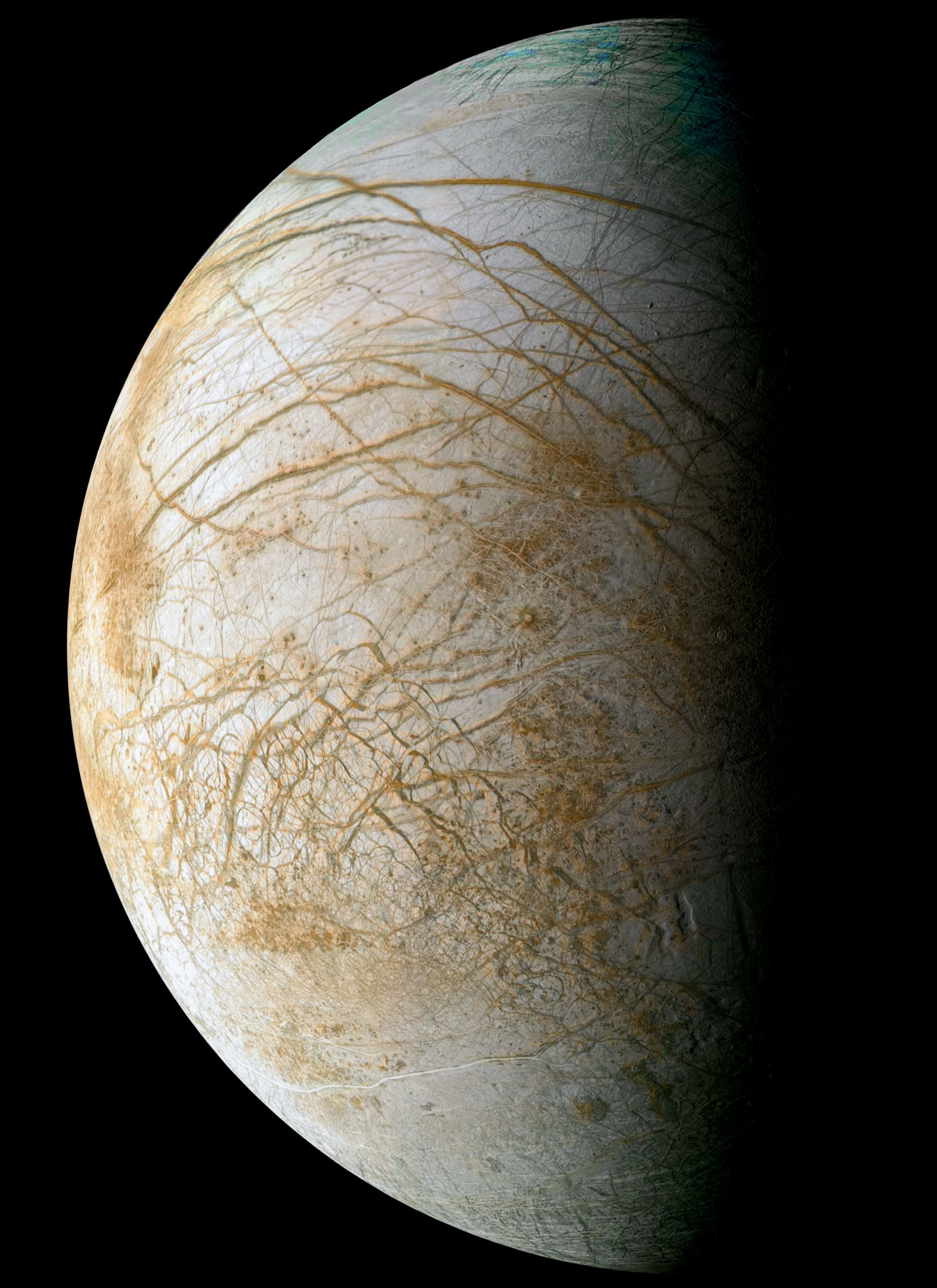
Jupiter’s Europa could be site for water…and life?
Credit: NASA/JPL/Ted Stryk
SUBSEA is a partnership between NASA Science Mission Directorate’S PSTAR Program, NOAA Office of Ocean Exploration and Research, Ocean Exploration Trust, and multiple academic research centers.
NASA’s Planetary Science and Technology from Analog Research (PSTAR) program addresses the need for integrated interdisciplinary field experiments as an integral part of preparation for planned human and robotic missions.
Darlene Lim, served as senior scientist on the Apollo Vent Field investigation. Lim is from NASA Ames/Bay Area Environmental Research Institute (BAERI).
Seafloor activity
The target of the 2019 SUBSEA expedition was the Gorda Ridge, discovered offshore of northern California and Oregon.
This section of mid-ocean ridge is of interest to ocean researchers in that it hosts seafloor hydrothermal activity that departs from the convention of “black smoker” hydrothermal systems.
The focus of exploration was the SeaCliff hydrothermal field, which has previously been reported to emit clear fluids at temperatures no greater than 300°C. The emphasis of the dive was on locating the SeaCliff hydrothermal field for the first time in roughly 15 years and then carry out geological reconnaissance of the site to identify its current size and shape and the number of vents present and the range of temperatures for those vents.
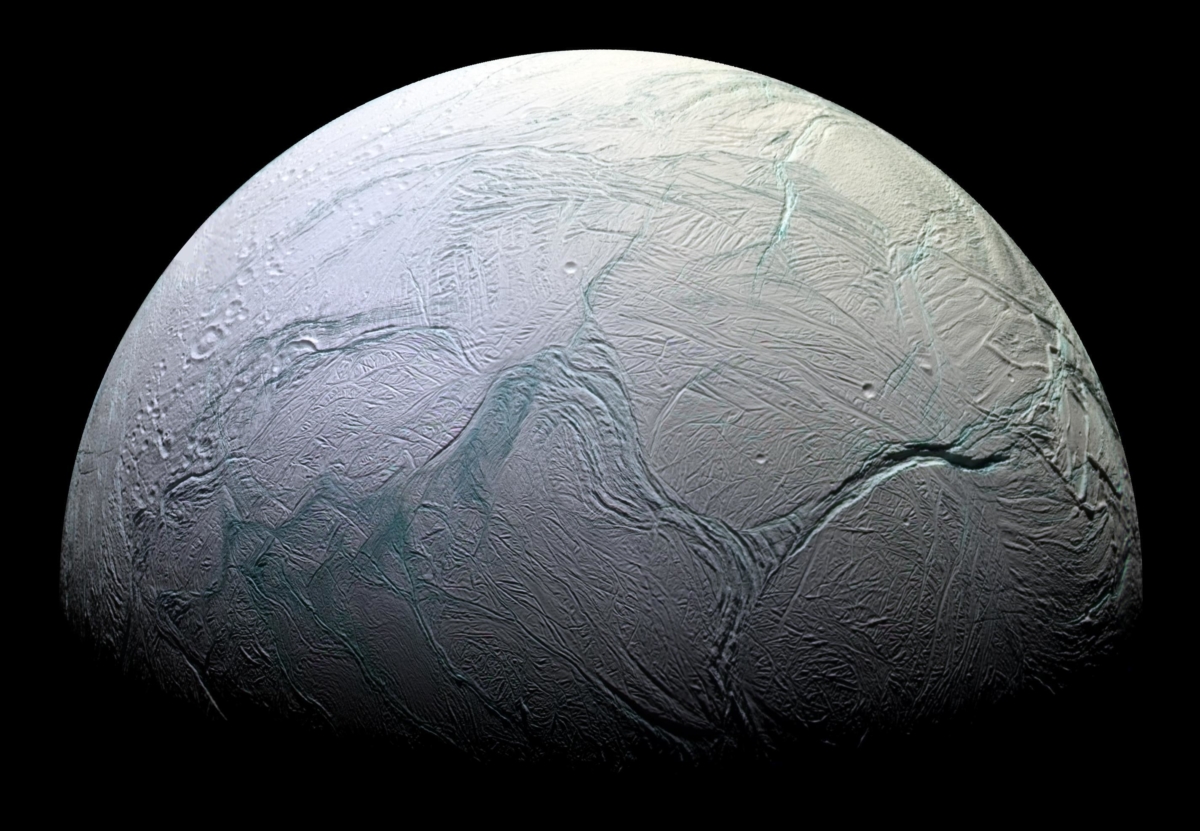
Saturn’s moon Enceladus.
Credit: NASA
Teleoperations
The SUBSEA Science team utilizes remotely operated underwater vehicles (ROVs) to observe, survey, gather instrument data, and collect samples from analog environments that mimic potential volcanic hydrothermal systems on other ocean worlds, such as Enceladus.
During the SUBSEA field deployment, researchers tested technology and scientific procedures necessary for crewed space exploration. A human-robotic mission to the Moon or Mars might parallel SUBSEA’s mission architecture using robotic explorers controlled by humans nearby, receiving direction from a remote team of scientists.
Ultimately, the results of SUBSEA’s research can inform both strategies for conducting science via teleoperations at destinations such as the Moon or Mars and scientists’ understanding of a wider range of deep-sea environments for conducting ocean world research.

The Apollo Vent Field is part of Gorda Ridge. Credit: Ocean Exploration Trust/Nautilus Live
The SUBSEA team work at the Gorda Ridge built upon the work conducted during the first field program at Lō`ihi Seamount off Hawai’i in 2018.
The E/V Nautilus is operated by the non-profit organization Ocean Exploration Trust, founded in 2008 by Robert Ballard to engage in pure ocean exploration.
Resources
To view the newly discovered Apollo Vent Field via a Nautilus Live video, go to:
E/V Nautilus is exploring unknown regions of the ocean seeking out new discoveries in biology, geology, and archaeology. You can join the team 24/7 for live video from the seafloor and to ask questions of the explorers currently aboard Nautilus at:
Also, go to this informative video about the underwater campaign at:

