Author Archive
 Author:
  July 17th, 2019
Image snagged by the Banxing-2 microsatellite that was deployed from the Tiangong-2 shows Shenzhou-11 (above) and Tiangong-2 docked in orbit on October 23, 2016.
Credit: Chinese Academy of Sciences via GBTimes
China’s Tiangong -2 space lab is scheduled on Friday to make a controlled re-entry into Earth’s atmosphere.
The space lab is 10.4 meters long, with the maximum diameter of 3.35 meters and a takeoff weight of 8.6 tons. With its solar panels unfolded, its wingspan is about 18.4 meters wide.
Taking the plunge
According to the China Manned Space Engineering Office (CMSEO), the space hardware will leave its orbit and re-enter on July 19 (Beijing time). Most of the spacecraft will be destroyed in the heated plunge through the atmosphere, and a small amount of debris is expected to fall in the safe sea area in the South Pacific (160-90 degrees west longitude and 30-45 degrees south latitude), according to the CMSEO.

Tiangong-2 space lab being readied for flight.
Credit: CAST
Key technologies tested
Tiangong-2 was lofted on September 15, 2016, with the space lab operating in orbit over 1,000 days, much longer than its two-year designed life.
Tiangong-2 hosted two Chinese astronauts for 30 days in what was China’s longest human space mission so far. China carried out a series of scientific and technological space experiments, and tested the in-orbit propellant refueling technology on Tiangong-2.
Back in early April 2018, an uncontrolled Tiangong-1 re-entered the atmosphere with the re -entry point located in the central region of the South Pacific Ocean, and most parts of that space lab were destroyed during its re-entry into the atmosphere.

China’s Tianzhou-1 resupply craft completed docking and refueling tasks with uncrewed Tiangong-2 space lab.
Credit: CCTV
Vital elements
These early space labs were vital elements of China’s human spaceflight program, one that is leading to assembling a larger space station in Earth orbit in the 2020’s.

Tiangong-1 reentry. Credit: The Aerospace Corporation/CORDS
China’s space station will be capable of hosting three astronauts for long durations and up to six during a change of astronauts. It is due to have two experiment modules and will be accompanied by a co-orbiting space telescope that can dock for maintenance and repairs.
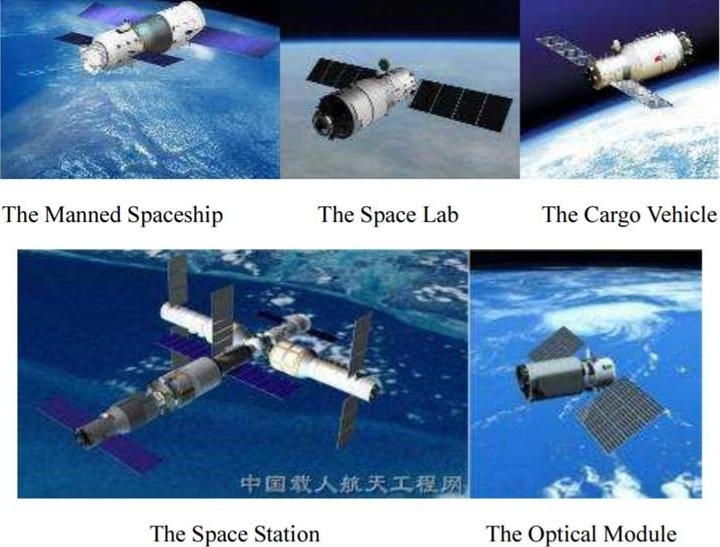
Credit: CMSA
 Posted in

Credit: Sotheby’s
Sotheby’s third annual Space Exploration auction will coincide with the 50th anniversary of the Apollo 11 Moon Landing.
The live auction begins in New York on July 20, 2019 at 9:00 AM MDT.
The sale is highlighted by the earliest, sharpest and most accurate surviving video images of man’s first steps on the moon: the only surviving original first-generation NASA recording of the Apollo 11 lunar landing. At a combined runtime of 2 hours and 24 minutes, the recording captures everything, from the historic moment that Commander Neil Armstrong became the first human to step foot on another world, to the “long distance phone call” with then-President Richard Nixon of the United States, to the planting of the American flag.
Videotape
Three metal reels (each 10 1/2 in. diameter) of Ampex 148 High Band 2-inch Quadruplex videotape, the tapes with video of the Apollo 11 lunar EVA recorded on July 20, 1969 at Mission Control, Manned Spaceflight Center, Houston, Texas, directly from narrow-band slow scan videotape converted to NTSC for network broadcast using Ampex VR-2000 video recorders.

Credit: Sotheby’s
The three tapes with running times of 45:04, 49:00, and 50:15 minutes, respectively, covering virtually the entire period of the EVA and including about 9 minutes at the beginning of reel 1 of Mission Control waiting for the lunar-surface camera to be deployed; the audio quality of all of the tapes is excellent. Each reel of videotape is housed in its original red-and-black manufacturer’s box with hinged lid (11 3/8 x 11 3/8 x 2 3/4 in.), the boxes also with printed adhesive labels reading “APOLLO 11 EVA | July 20, 1969.
Impressive collection
The sale also features a wide variety of material from the Mercury, Gemini, and Apollo missions, featuring direct consignments from astronauts including: Apollo 9 Lunar Module Pilot Russell Schweickart, Apollo 11 Lunar Module Pilot Buzz Aldrin, Apollo 13 Mission Commander James Lovell, and the Estate of Apollo 16 Mission Commander John Young.

Credit: Sotheby’s
The sale also offers an impressive collection of flown mission artifacts, the finest single owner collection of flown Robbins medallions, early contractor’s models, spacesuits, photography, charts and much more.
To view the catalog, go to:

Credit: University of Michigan
A new national survey has taken the pulse of Americans as they reflect on Apollo 11 and the space program.
The survey was carried out by Jon D. Miller, Director of the International Center for the Advancement of Scientific Literacy, Institute for Social Research, based at the University of Michigan in Ann Arbor.
Landmark achievement
According to the survey: “This brief examination of national survey data from 1988 and 2018 indicates that American adult tend to recall the first Apollo lunar landing as a landmark achievement of the space program, citing it more often than any other activity as the best achievement of the space program, the survey notes.

Credit: NEON/CNN
“Parallel national survey data indicate that a majority of American adults think that the space program has paid for itself through the development of new technologies and new scientific discoveries. The proportion of American adults holding this belief has increased steadily over the last 30 years.”
Broadly shared
In looking to the future, the survey concludes: “a substantial majority of American adults continue to believe that today’s space exploration should be viewed as similar to the earlier European explorations of this planet.”
Lastly, “the proportion of adults holding this view has increased over the last 30 years,” the survey concludes, and is broadly shared by American adults.
“This level of public recall and recognition reflect the deep-seated impact of the first moon landing in American culture,” notes Jon Miller in a University of Michigan press statement.
This report was submitted to NASA under a cooperative agreement.
To view the full report — Americans reflect on Apollo 11 and the space program — go to:

Simulated view of what Apollo 11’s Neil Armstrong saw as the Lunar Module Eagle approached the aim point on the northeast flank of West crater (190 meters diameter). The odd shape of the image area is due to the small windows in the Eagle. North is to the right.
Credit: NAC M131494509L/NASA/GSFC/Arizona State University
“Most people are familiar with the 16mm movie of the Apollo 11 landing,” explains Mark Robinson, leader of the Lunar Reconnaissance Orbiter Camera (LROC) at Arizona State University.
“However that viewpoint was looking out the right window, entirely missing the hazards that Armstrong saw as the Eagle approached the surface. The LROC team simulated what Armstrong saw out his window,” Robinson adds.
Visual record
As the LROC team explains:
The only visual record of the historic Apollo 11 landing is from a 16mm time-lapse (6 frames per second) movie camera mounted in Buzz Aldrin’s window (right side of Lunar Module Eagle or LM).
Due to the small size of the LM windows and the angle at which the movie camera was mounted, what mission commander Neil Armstrong saw as he flew and landed the LM was not recorded.

NASA’s Lunar Reconnaissance Orbiter has used its LROC system to provide looks at the Apollo 11 landing site. The remnants of Neil Armstrong and Buzz Aldrin’s historic first steps on the surface are seen as dark paths around the Lunar Module (LM), Lunar Ranging RetroReflector (LRRR) and Passive Seismic Experiment Package (PSEP), as well as leading to and from Little West crater.
Credit: NASA/GSFC/Arizona State University
Landing trajectory
The LROC team reconstructed the last three minutes of the landing trajectory (latitude, longitude, orientation, velocity, altitude) using landmark navigation and altitude call outs from the voice recording.
From this trajectory information, and high resolution LROC NAC images and topography, we simulated what Armstrong saw in those final minutes as he guided the LM down to the surface of the Moon.
Manual control
As the video begins, Armstrong could see the aim point was on the rocky northeastern flank of West crater over 620 feet (190 meters) in diameter, causing him to take manual control and fly horizontally, searching for a safe landing spot.

Apollo 11 moonwalkers, Neil Armstrong and Buzz Aldrin.
Credit: NASA
At the time, only Armstrong saw the hazard; he was too busy flying the LM to discuss the situation with mission control.
Side-by-side reconstruction
The LROC team acknowledges use of a time-synchronized version of the original 16mm film (Apollo Flight Journal) and the First Men on the Moon website, which synchronizes the air-to-ground voice transmission with the original 16mm film – resources that greatly aided the production of this work.
These sources were played side-by-side with our reconstruction during its production, allowing the LROC team to better match the reconstruction to the 16mm film and altitude callouts.
Go to this impressive video at:
http://lroc.sese.asu.edu/posts/1115
Note: “Be sure and check out the three alternate versions of the video
posted at the bottom of the Featured Image,” Robinson adds, “especially the two astronaut version: ‘What Armstrong and Aldrin Saw: Simulation vs.
Original Film.’
 A scientific team has reported on a way to make Mars habitable with a layer of aerogel – and by using the material it can mimic an Earthly greenhouse effect.
The researchers are from Harvard University, NASA’s Jet Propulsion Lab, and the University of Edinburgh.
“A system for creating small islands of habitability would allow us to transform Mars in a controlled and scalable way,” said Laura Kerber with NASA’s Jet Propulsion Laboratory. She is one of the authors of the just-published “Enabling Martian habitability with silica aerogel via the solid-state greenhouse effect” published in the journal, Nature Astronomy.
New approach
The paper explains that the low temperatures and high ultraviolet radiation levels
at the surface of Mars today currently preclude the survival of life anywhere except perhaps in limited subsurface niches.
“Several ideas for making the Martian surface more habitable have been put forward, but they all involve massive environmental modification that will be well beyond human capability for the foreseeable future,” the research team explains.
They present a new approach to this problem.

Scientists are exploring how aerogel, a translucent, Styrofoam-like material, could be used as a building material on Mars. Aerogel retains heat; structures built with it could raise temperatures enough to melt water ice on the Martian surface.
Credit: NASA/JPL-Caltech
Silica aerogel
“We show that widespread regions of the surface of Mars could be made habitable to photosynthetic life in the future via a solid-state analogue to Earth’s atmospheric greenhouse effect,” the Mars team adds.
Specifically, the team has demonstrated via experiments and computer models that under Martian environmental conditions, a 2–3 centimeter-thick layer of silica aerogel will simultaneously transmit sufficient visible light for photosynthesis, block hazardous ultraviolet radiation and raise temperatures underneath it permanently to above the melting point of water, without the need for any internal heat source.

The Red Planet as seen by Europe’s Mars Express.
Credit: ESA/D. O’Donnell – CC BY-SA IGO
Regional approach
“Placing silica aerogel shields over sufficiently ice-rich regions of the Martian surface could therefore allow photosynthetic life to survive there with minimal subsequent intervention,” they explain. “This regional approach to making Mars habitable is much more achievable than global atmospheric modification. In addition, it can be developed systematically, starting from minimal resources, and can be further tested in extreme environments on Earth today.”
Indeed, the researchers report they are going to test the material in Mars-like climates on Earth, such as the dry valleys of Antarctica or Chile.
The paper — Enabling Martian habitability with silica aerogel via the solid-state greenhouse effect – is available at:
NASA’s Curiosity Mars rover is now performing Sol 2467 science tasks.
New imagery from the robot includes these scenic shots:
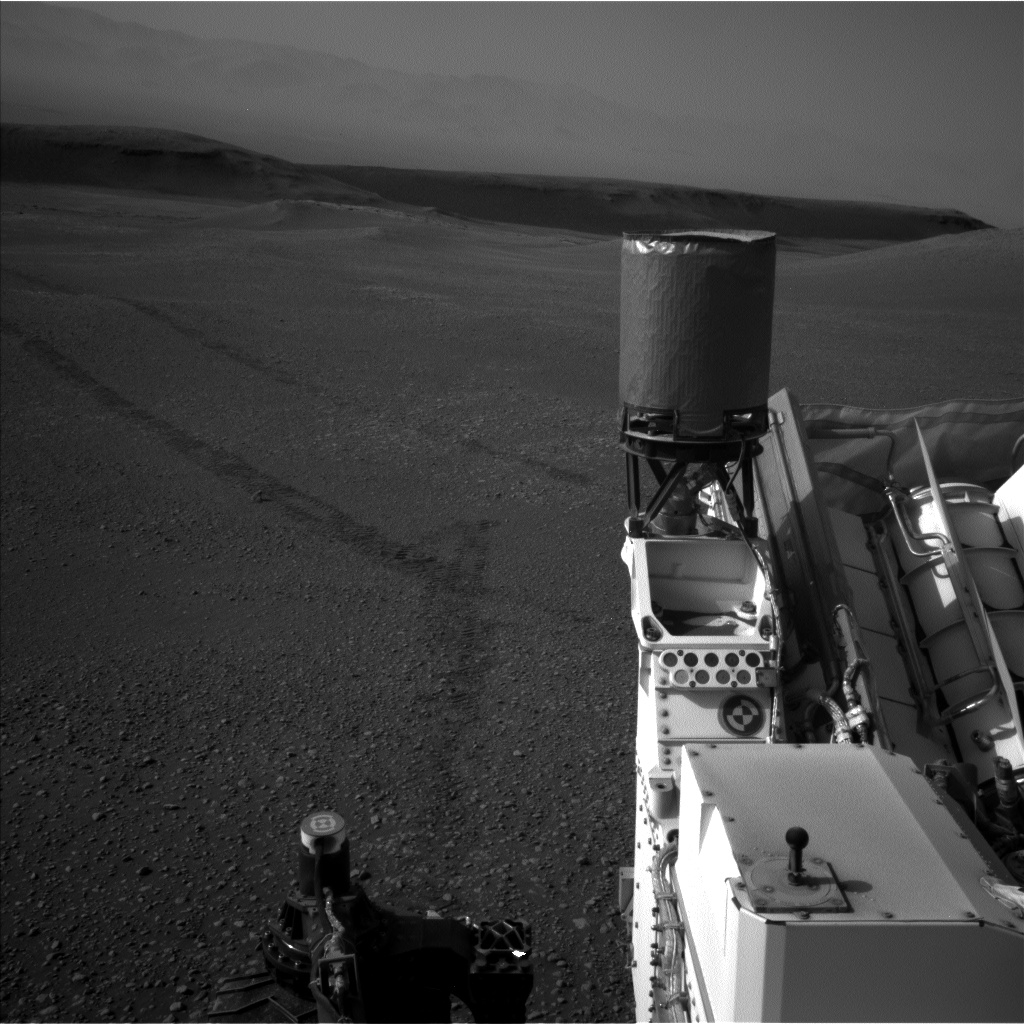
Curiosity Navcam Left B photo taken on Sol 2466, July 15, 2019.
Credit: NASA/JPL-Caltech
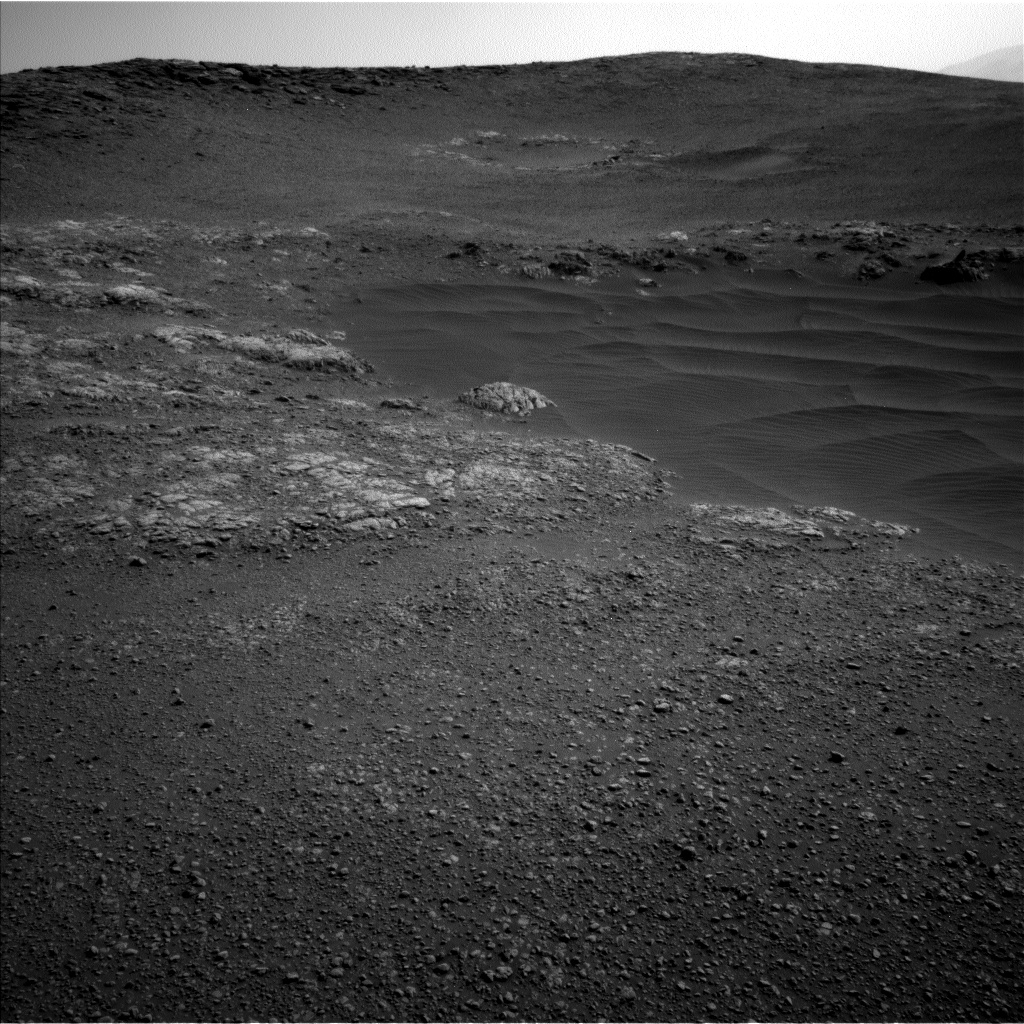
Curiosity Navcam Left B photo taken on Sol 2466, July 15, 2019.
Credit: NASA/JPL-Caltech
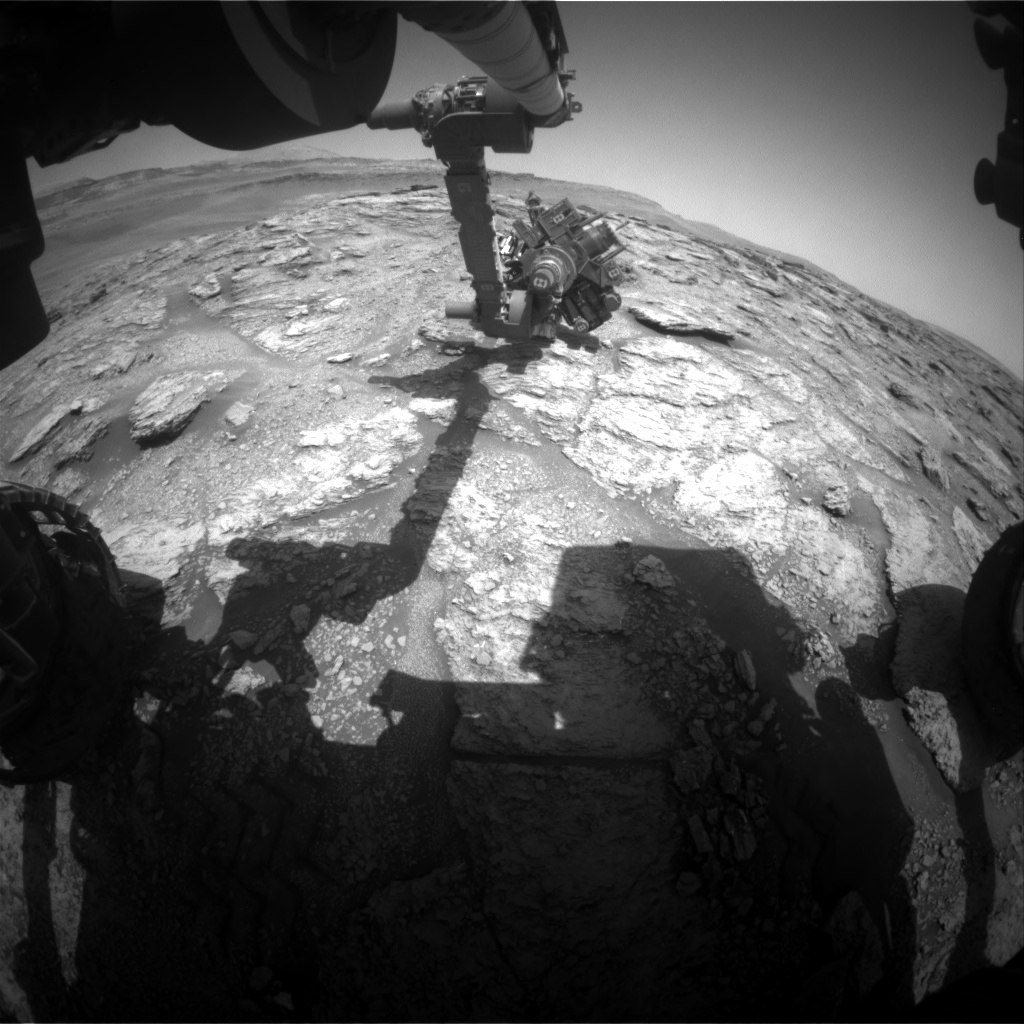
Curiosity Front Hazcam Left B photo taken on Sol 2466, July 14, 2019.
Credit: NASA/JPL-Caltech

Curiosity Mars Hand Lens Imager (MAHLI) produced this image on Sol 2466, July 14, 2019.
Credit: NASA/JPL-Caltech/MSSS

Credit: Wings Over the Rockies Air & Space Museum
I’m pleased to be taking part in “Apollopalooza” at the Wings Over the Rockies Air & Space Museum
Date: July 15
Time: 10:30 am – 11:30 am
Wings Over the Rockies Air & Space Museum
7711 East Academy Boulevard
Denver, Colorado 80230 United States
For overview information, go to:
https://wingsmuseum.org/event/keynote-presentation-leonard-david/
And also go to:
https://wingsmuseum.org/
Two new Gallup polls focus on the U.S. space program.

Credit: NASA
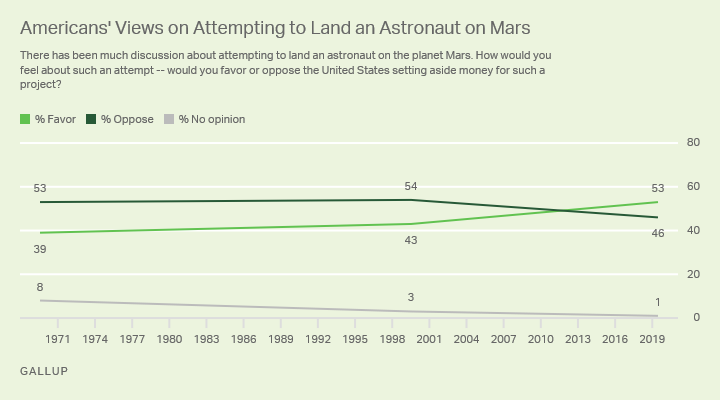
Five decades after Apollo 11’s Moon landing, support for the space program is high. A second poll notes that, for the first time, a majority in U.S. backs a human mission to Mars.

Credit: NASA
50 years after Moon landing, record-high 64% say space costs are justifiable.
About three in four say NASA funding should be maintained or increased.
NASA receives its highest ratings in 20 years.

Credit: Gallup
Credit: Gallup
Go to:
For First Time, Majority in U.S. Backs Human Mission to Mars
53% favor, 46% oppose attempting to land an astronaut on Mars.
Support for a Mars mission is up from previous decades.
Democrats, Republicans equally supportive of the Mars goal.
Go to:

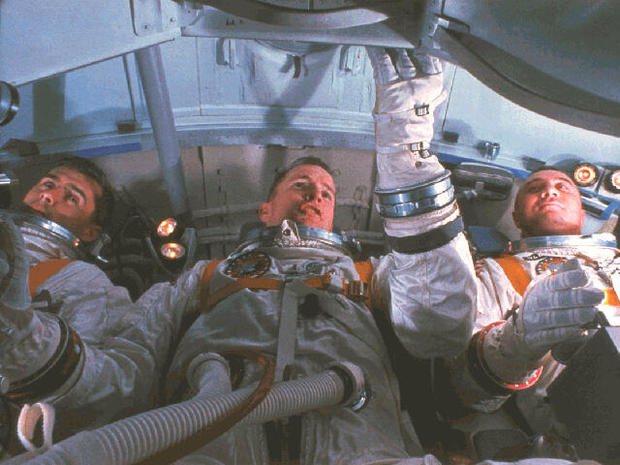
Apollo 204 fire.
Credit: NASA
Tuesday, July 9, 2019 – Eugene F. Kranz Former Apollo Flight Director, Speaker and Author:
Testimony before the Senate Commerce, Science and Transportation Committee Subcommittee on Aviation and Space: NASA Exploration Plans: Where We’ve Been and Where We’re Going
The Kranz Dictum (speech to the control team after the Apollo I fire on January 27, 1967)
Spaceflight will never tolerate carelessness, incapacity, and neglect. Somewhere, somehow, we screwed up. It could have been in design, build, or test. Whatever it was, we should have caught it. We were too gung-ho about the schedule and we locked out all of the problems we saw each day in our work. Every element of the program was in trouble and so were we. The simulators were not working, Mission Control was behind in virtually every area, and the flight and test procedures changed daily. Nothing we did had any shelf life. Not one of us stood up and said, ‘Dammit, stop!’ I don’t know what Thompson’s committee will find as the cause, but I know what I find. We are the cause! We were not ready! We did not do our job. We were rolling the dice, hoping that things would come together by launch day, when in our hearts we knew it would take a miracle. We were pushing the schedule and betting that the Cape would slip before we did.
Credit: NASA
From this day forward, Flight Control will be known by two words: ‘Tough’ and ‘Competent.’ Tough means we are forever accountable for what we do or what we fail to do. We will never again compromise our responsibilities. Every time we walk into Mission Control we will know what we stand for. Competent means we will never take anything for granted. We will never be found short in our knowledge and in our skills. Mission Control will be perfect. When you leave this meeting today you will go to your office and the first thing you will do there is to write ‘Tough and Competent’ on your blackboards. It will never be erased. Each day when you enter the room these words will remind you of the price paid by Grissom, White, and Chaffee. These words are the price of admission to the ranks of Mission Control.

Curiosity Mastcam Left image acquired on Sol 2459, July 7, 2019.
Credit: NASA/JPL-Caltech/MSSS
NASA’s Curiosity Mars rover is now performing Sol 2464 tasks.
Curiosity has continued work on and around “a gorgeous outcrop” that was started on Sol 2461, reports Michelle Minitti, a planetary geologist at Framework in Silver Spring, Maryland.

Curiosity Front Hazcam Left B photo taken on Sol 2463, July 11, 2019.
Credit: NASA/JPL-Caltec
“The layers of the outcrop – with their different colors, textures and thicknesses – tell us a story,” Minitti explains, one that scientists have worked to decipher with the rover’s full complement of contact and targeted science instruments.

Curiosity Navcam Left B image taken on Sol 2463, July 11, 2019.
Credit: NASA/JPL-Caltech
Clearer story
The robot’s Mars Hand Lens Imager (MAHLI) and its Alpha Particle X-Ray Spectrometer (APXS) is on tap to analyze a grayish red target, “Tay.”

Curiosity Navcam Left B image taken on Sol 2463, July 11, 2019.
Credit: NASA/JPL-Caltech

Curiosity Navcam Left B image taken on Sol 2463, July 11, 2019.
Credit: NASA/JPL-Caltech
“The team hoped Tay’s grayish red color would be indicative of less dust cover,” Minitti adds, “in other words, a chance for Tay to tell us a clearer story!”
The Chemistry and Camera (ChemCam) instrument is slated to shoot another gray target, “Donside,” and “Fountainbridge,” located on the farside of the outcrop where it exhibits a cracked texture.

Curiosity Navcam Left B image taken on Sol 2463, July 11, 2019.
Credit: NASA/JPL-Caltech
Future exploration sites
“Off to the right of the rover, Mastcam will image a block, “Achmelvich,” near the right rear wheel that was shifted during our last drive, revealing the steep face of a sand deposit sitting amongst the bedrock in the area,” Minitti points out.
Curiosity’s Mastcam has also turned its gaze to the scene, looking toward future sites of exploration.
A recently scripted plan calls for a five image stereo mosaic of “Annan,” and a 19 image stereo mosaic of “Craigeven Bay.”

Curiosity Mars Hand Lens Imager (MAHLI) photo produced on Sol 2463, July 11, 2019.
Credit: NASA/JPL-Caltech/MSSS
Bedding structures
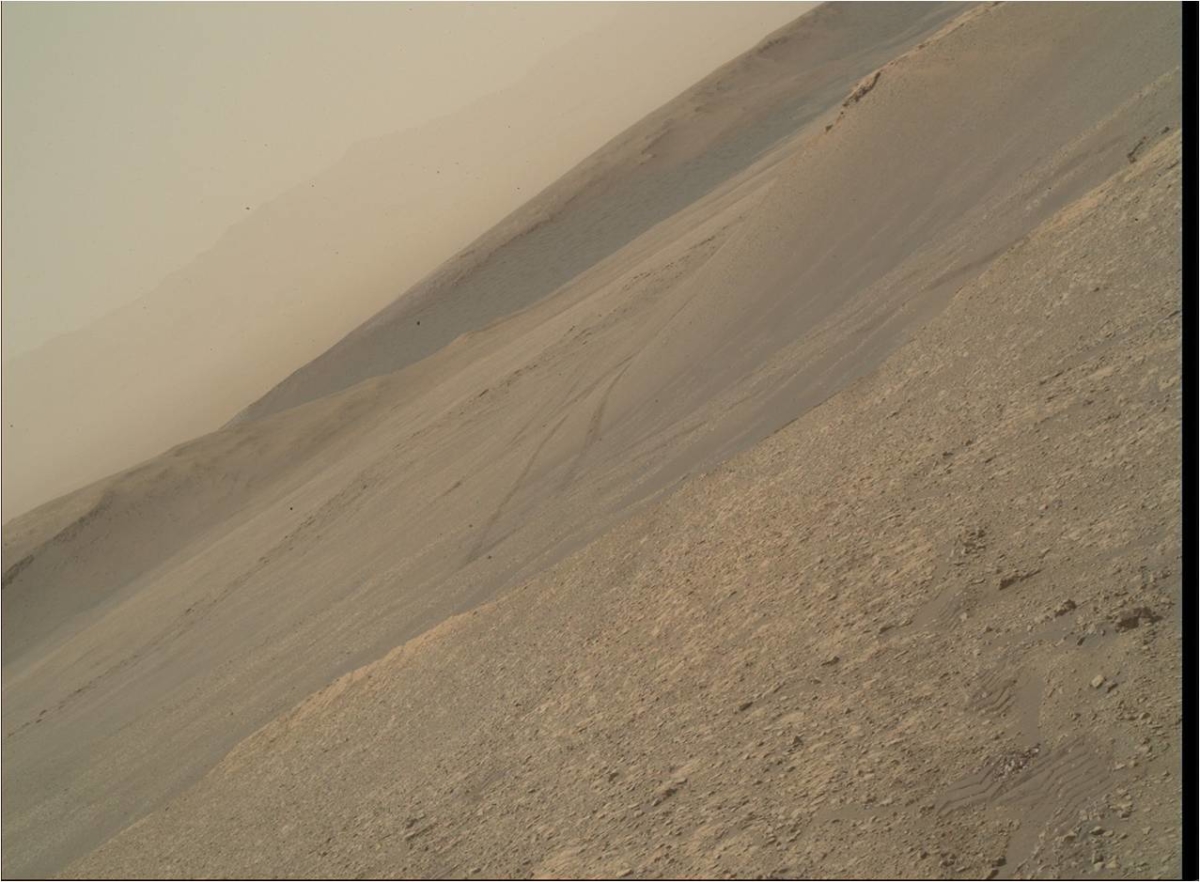
“Both Annan and Craigeven Bay exhibit bedding structures that caught the team’s eye; stereo imaging will give us a better three-dimensional sense for those structures,” Minitti adds. “MAHLI also got in on the landscape-imaging act, acquiring an image from the stowed position. MAHLI’s view will incorporate our path over the last month or so. The last MAHLI stowed image was acquired over 700 sols ago!”
Annan is not far from Curiosity’s workspace – only about 23 feet (7 meters) away.
After the drive, the plan has the rover unstowing its arm to get a clearer look at the available workspace. “The short drive means we can still reliably target Mastcam at distant targets. Thus, Mastcam will gather multispectral data from outcrops that we will visit in the coming weeks and months,” reports Minitti.
Curiosity Mars Hand Lens Imager (MAHLI) photo produced on Sol 2463, July 11, 2019.
Credit: NASA/JPL-Caltech/MSSS
Differences among the terrains
“The hope is that these data will highlight differences among the terrains that are not apparent at visible wavelengths of light alone,” Minitti notes. “Curiosity will briefly look skyward, acquiring Navcam and Mastcam images looking for clouds and measuring atmospheric opacity.”

Credit: NASA/JPL-Caltech/Univ. of Arizona
The plan has the rover’s Chemistry & Mineralogy X-Ray Diffraction/X-Ray Fluorescence Instrument (CheMin) completing the plan with an activity to make sure one of its reusable cells is empty and ready for the next sample, Minitti concludes.
Traverse map
A recently issued Curiosity traverse map shows the route driven by the rover through the 2459 Martian day, or sol, as of July 08, 2019.
Numbering of the dots along the line indicate the sol number of each drive. North is up. The scale bar is 1 kilometer (~0.62 mile).
From Sol 2454 to Sol 2459, Curiosity had driven a straight line distance of about 8.50 feet (2.59 meters), bringing the rover’s total odometry for the mission to 12.99 miles (20.91 kilometers).
The base image from the map is from the High Resolution Imaging Science Experiment Camera (HiRISE) in NASA’s Mars Reconnaissance Orbiter.

