Author Archive
 Author:
  August 16th, 2019
Neil Armstrong being suited up.
Credit: NASA/National Archives/Inside Outer Space Screengrab
Help wanted: Within the archival film holdings from NASA at the National Archives, you will find a treasure trove of video relating to the space agency’s space flight programs, including Mercury, Gemini, Apollo, Skylab, and the joint United States-Soviet Union program, Apollo-Soyuz.

Media briefing of Apollo 1 crew: Grissom, White and Chaffee.
Credit: NASA/National Archives/Inside Outer Space Screengrab
Meticulous steps
This incredible series of films includes footage of rigorous training exercises, mock run-throughs, launches, parachute and spacecraft recovery, and other astronaut activities, all detailing the meticulous steps involved in mission preparation and space exploration.

Make records more searchable
Help tag descriptive details within these NASA films relating to space flight programs.
You can tag names of astronauts, locations, launches, and even machinery and equipment shown within each film.
Every tag helps makes these records more searchable.
To view these unique videos, go to:
NOTE: “Citizen Archivists” must register for a free user account in order to contribute to the National Archives Catalog. We encourage you to read our Citizen Contribution Policy. Register now.
Go to:
https://www.archives.gov/citizen-archivist/registerandgetstarted
 Posted in

Curiosity Front Hazcam Left B image acquired on Sol 2496, August 14, 2019.
Credit: NASA/JPL-Caltech
NASA’s Curiosity Mars rover is now performing Sol 2497 tasks.
Curiosity is go for analyzing a new drill sample, reports Ashley Stroupe, a mission operations engineer at NASA’s Jet Propulsion Laboratory in Pasadena, California.
After seeing that the redo of the Sample Analysis at Mars (SAM) Instrument Suite preconditioning in Monday’s plan was successful, the SAM team was ready to drop-off four portions to SAM for evolved gas analysis.

Curiosity Rear Hazcam Left B photo taken on Sol 2496, August 14, 2019.
Credit: NASA/JPL-Caltech
Targeted science
“The power demands of SAM left little room for other activities on the first sol of the plan, but we were able to fit in some additional science on the second sol,” Stroupe adds.
In the afternoon of sol 2498, the plan called for the robot to do targeted science, including Mastcam and Chemistry and Camera (ChemCam), of the targets “Liberton” and “Torberg” to get the chemistry of the other plates near the drill target.

Curiosity Mastcam Right image taken on Sol 2495, August 13, 2019.
Credit: NASA/JPL-Caltech/MSSS
Additional analysis
“There are also some standard environmental observations, such as Mastcam tau and crater rim extinction imaging and Navcam imaging to search for dust devils clouds,” Stroupe notes.

Navcam image shows the view of the Mount Sharp summit from Curiosity’s current location. Navcam Right B image taken on Sol 2495, August 13, 2019.
Credit: NASA/JPL-Caltech
Also planned was obtaining another data readout from the Chemistry & Mineralogy X-Ray Diffraction/X-Ray Fluorescence Instrument (CheMin) on the sample dropped off on Monday.
“The results of the SAM analysis will be available prior to planning on Friday, and based on those results, the SAM team will determine whether to do additional analysis on the Glen Etive drill sample in the weekend plan,” Stroupe adds.

Artist view of China’s space station. Credit: CMSE
China is offering space experiment “room and board” on the country’s future space station, as well as upcoming Moon, asteroid and comet explorers.
In early June, the China Manned Space Agency announced the first batch of nine international cooperation projects for the country’s space station involves 23 entities from 17 countries.
The deadline for new station proposals is August 31st.

Credit: CMSA
Rack space
Domestically, research institutions, universities, science and technology enterprises, and even the public are welcome to suggest experiments to be conducted on the Chinese space station through an online portal.
Sixteen experiment racks are to be installed in the core module of the space station, and two lab capsules of the space station and an extravehicular experiment platform.
Each rack is regarded as a lab that can support various space experiments, and astronauts can upgrade and replace the facilities. In addition, a capsule holding a large optical telescope will fly in the same orbit as the Chinese station, according to a report by Xinhua News Agency, quoting the Technology and Engineering Center for Space Utilization of the Chinese Academy of Sciences.

Prototype of the Tianhe core module. China’s space station is expected to be operational around 2022.
Credit: CCTV/Screengrab/Inside Outer Space
Future applications
In the future, applications will be reopened every two or three years, explains Zhang Wei, director of the Technology and Engineering Center for Space Utilization at the Chinese Academy of Sciences.
China is scheduled to complete the construction of the space station around 2022.
More information about the United Nations/China Cooperation on the Utilization of the China space station can be found here:
China Space Station Progress: Shortlist of Experiment Ideas
https://www.leonarddavid.com/china-space-station-progress-shortlist-of-experiment-ideas/
Also, go to:
http://www.unoosa.org/oosa/en/ourwork/psa/hsti/chinaspacestation/ao_main.html

Credit: CNSA
Lunar exploration
In related China space news, an August 31st deadline has been set for proposals to fly on the Chang’e-6 lunar sample return mission.
Chang’e-6’s launch time and landing site will depend on the status of the upcoming Chang’e-5 lunar sample and return to Earth mission.

China’s Chang’e-6 lunar sample return mission elements.
Credit: CNSA
The orbiter and the lander will each provide 22 pounds (10 kilograms), with a total of 44 pounds (20 kilograms) for scientific payloads onboard.

Space experiment spots available onboard Chang’e-6 Moon mission.
Credit: CNSA
Asteroid, comet studies
Also available for ride-along experiments is a Chinese sample return mission to Asteroid 2016HO3 and the orbiting of a main-belt comet.
Following Earth return of the asteroid samples, the Chinese probe will make a gravity assist of Earth and Mars, and arrive at the asteroid belt and orbit the Comet 133P. Comet 133P/(7986) Elst–Pizarro is a body that displays characteristics of both an asteroid and a comet.

Credit: CNSA
The entire mission will last roughly 10 Earth years.
The deadline for scheme proposals for Chang’e-6 and the asteroid mission is August 31, 2019.
Contacts for submitting ideas at the China National Space Administration (CNSA) is Gan Yong. At CNSA’s Lunar Exploration and Space Engineering Center the contact is Yang Ruihong.
Website: www.cnsa.gov.cn

Courtesy of NASA/JPL/USGS
If you have your eyes on the Moon and making money on water mining operations, a new analysis concludes the current market is over $200 billion.
The new market study has looked at the need for water in space over the next three decades.
Producing water on the Moon is considered to be viable and the assessment suggests that “the first company to exploit this identified demand will likely reap extraordinary profits.”

A source of water on the Moon could help make future crewed missions more sustainable and affordable.
Credit: RegoLight, visualization: Liquifer Systems Group, 2018
Attractive rates
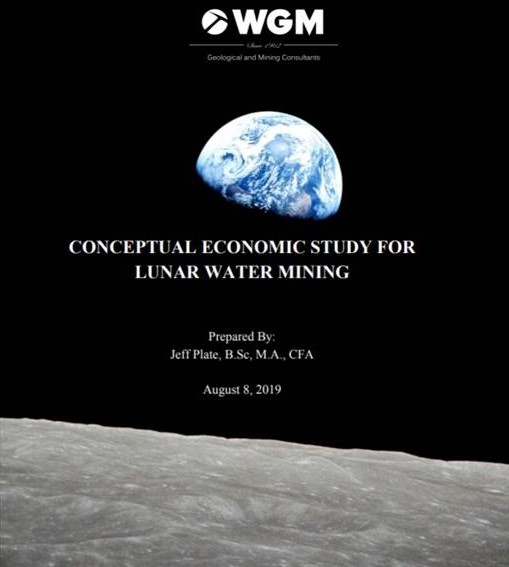
The appraisal — Conceptual Economic Lunar Water Mining — comes from Watts, Griffis and McOuat Limited (WGM), based in Toronto, Canada.
WGM has concluded the current market is over $200 billion and that a viable water mining operation on the Moon could produce water at economically attractive rates.
Fundamental questions
According to WGM, the purpose of the study was to answer some fundamental questions regarding the viability of space water mining operations:
- Is there a potential future market for water in space?
- What is the expected market price for water in space?
- Is it technically feasible to produce water in space and at what cost?
“Based on our research, the answer is yes to all these questions,” WGM explains, but adds: “We should note our work is a first-order estimate and is not definitive, as the market is evolving rapidly.”
No assurances
While bullish on lunar water prospects, WGM explains that its analysis is of a conceptual nature and there are “no assurances” that the group’s demand estimates are correct and cautions readers that there is a very high level of variance likely.

Credit: James Vaughan (Used with permission) http://www.jamesvaughanphoto.com/directory-aerospace-defense-illustrations
That said, WGM’s analysis of the space-based water market shows both economic and technical potential to create a space-based mining operation.
“Although our analysis does not conform to terrestrial standards for technical reporting, we have attempted to employ similar methodologies in creating our model. WGM trusts our work will assist future efforts to open up new ventures in space.”

South pole crater exploration.
Credit: NASA
Market demand
In spotlighting the market demand, the study includes looks at satellite refueling, International Space Station demand, as well as a lunar gateway space station, even space tourism and hotels.
The report recommends that additional engineering work be carried out by governments, academic groups and private enterprise to solve some of the technical challenges they have identified.
Credit: WGM
“We also challenge Earth’s entrepreneurs and financiers to consider how to finance and launch commercial ventures to take advantage of these markets. By doing so, WGM believes the colonization of space by humankind will be achievable in the not-too-distant future,” the study explains.
To read the full study — Conceptual Economic Lunar Water Mining – go to:
http://wgm.ca/wp-content/uploads/2019/08/ConceptualSpaceMiningStudyandBusinessCase.pdf

Credit: ISRO
The Chandrayaan-2 lunar orbiter/lander/rover mission has successfully entered Lunar Transfer Trajectory.
The final orbit raising maneuver of the Chandrayaan-2 spacecraft was carried out August 14, 2019 at 02:21 am IST.
During this maneuver, the spacecraft’s liquid engine was fired for about 1,203 seconds. With this burn, Chandrayaan-2 entered the Lunar Transfer Trajectory.

Chandrayaan-2 lunar orbiter/lander/rover mission.
Credit: ISRO
Spacecraft health
Earlier, the spacecraft’s orbit was progressively increased five times during July 23 to August 6, 2019.
The health of the spacecraft is being continuously monitored from the Mission Operations Complex (MOX) at the Indian Space Research Organization’s (ISRO) Telemetry, Tracking and Command Network (ISTRAC) in Bengaluru with support from Indian Deep Space Network (IDSN) antennas at Byalalu, near Bengaluru.

Geosynchronous Satellite Launch Vehicle Mark III (GSLV Mk III).
Credit: ISRO
Since its launch on July 22, 2019 by a GSLV MkIII-M1 launcher, all systems onboard Chandrayaan-2 spacecraft are performing normally, reports ISRO.
Lunar orbit
Chandrayaan-2 will approach the Moon on August 20, 2019 and the spacecraft’s liquid engine will be fired again to insert the spacecraft into a lunar orbit.
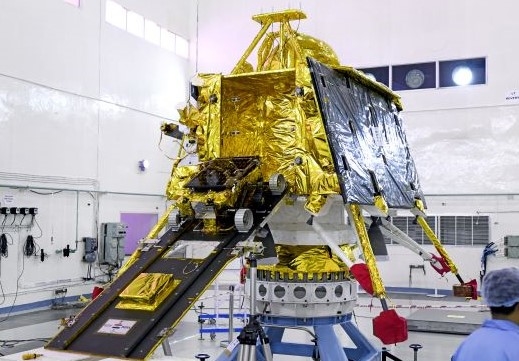
India’s Pragyan rover mounted on the ramp projecting from out of the sides of Vikram lunar lander.
Credit: ISRO
Following this, there will be further four orbit maneuvers to have the spacecraft enter into its final orbit passing over the lunar poles at a distance of about (62 miles (100 kilometers) from the Moon’s surface.
A tentative plan for future operation after Trans Lunar Injection has the spacecraft placed in a roughly 71 x 80 mile (114 x 128 kilometer) orbit at the Moon.
Subsequently, the mission’s Vikram lander will separate from the orbiter on September 2, 2019. Two orbit maneuvers will be performed on the lander before the initiation of a powered descent to make a soft landing on the lunar surface on September 7, 2019, touching down near the Moon’s south pole.

Could the presence of methane gas signal life on Mars?
Credit: Newcastle University
Bursts of methane on Mars have been detected by NASA’s Curiosity rover and remote ground-based sensing observations.
Seasonal changes in methane background levels and “methane spikes” have been detected on the spot on Mars a few feet above the Martian surface. Larger methane plumes has been identified via ground-based remote sensing, however their origin have not yet been adequately explained.
Methane can be created over time through both geological and biological routes. Since its first detection in the Martian atmosphere in 2003, there has been speculation about the source of the gas.
Does the presence of this gas signal life on the Red Planet?

Selfie of Curiosity Mars rover on the prowl.
Credit: NASA/JPL-Caltech/MSSS
Rock erosion ruled out
New research by Newcastle University scientists in the UK appears to rule out that wind erosion of Mars rocks is eking trapped methane from fluid inclusions and fractures on the planet’s surface.
“Ultimately, what we’re trying to discover is if there’s the possibility of life existing on planets other than our own,” explains Emmal Safi, a postdoctoral researcher in the School of Natural and Environmental Sciences and lead author of the just-published research.
The new work – “Aeolian abrasion of rocks as a mechanism to produce methane in the Martian atmosphere” – appears in Scientific Reports.

June 2018 graphic relates that Curiosity rover detected seasonal changes in atmospheric methane in Gale Crater.
Credit: NASA/JPL
Different rock types
“The questions are – where is this methane coming from, and is the source biological? That’s a massive question and to get to the answer we need to rule out lots of other factors first,” said principal investigator, Jon Telling, a geochemist also based in the School of Natural and Environmental Sciences at Newcastle University.
The scientists realized that one potential source of the methane that people hadn’t really looked at in any detail before was wind erosion, releasing gases trapped within rocks.
High resolution imagery from Mars orbit over the last decade have shown that winds on the Red Planet can drive much higher local rates of sand movement, and hence potential rates of sand erosion, than previously recognized.
The research used new data alongside previously published data to consider the likely methane contents of different rock types and whether they have the capacity to produce measurable levels of methane when worn away.
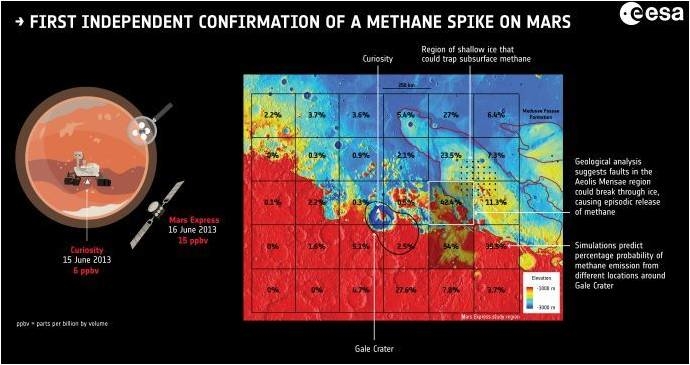
Europe’s Mars Express orbiter matches methane spike measured by Curiosity
Credit: ESA/Giuranna et al (2019)
Unlikely scenario
The upshot: The team found that for wind erosion to be a viable mechanism to produce detectable methane in the Martian atmosphere, the methane content of any gases trapped within rocks would have to rival those of some of the richest hydrocarbon containing shales on Earth – a highly unlikely scenario, they found.
Funded by the UK Space Agency, the study concludes that the cause of methane spikes on Mars is still unknown.
“It’s still an open question. Our paper is just a little part of a much bigger story,” Safi says.
Other sources
“From the data put forward in this paper, we conclude that aeolian abrasion of basaltic or sedimentary rocks on the Martian surface is an unlikely mechanism to produce methane concentrations detected by in situ observations from the MSL [Mars Science Laboratory] Curiosity rover and remote ground-based sensing observations,” the research team explains.
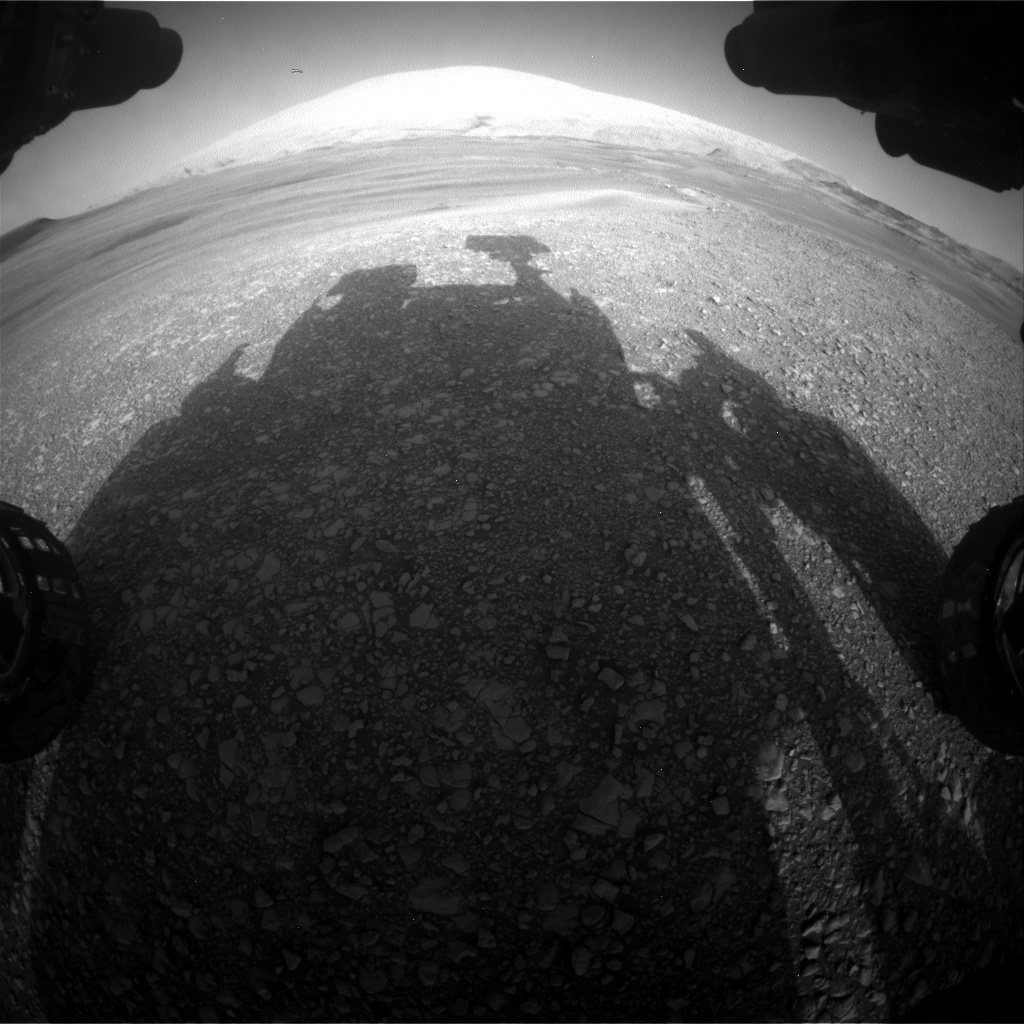
Curiosity Front Hazcam Right B image taken on Sol 2429, June 7, 2019.
Credit: NASA/JPL-Caltech
“Hence, we suggest that other sources of methane gas must be inferred to explain both the seasonal variations in background atmospheric methane and higher concentration plumes detected on Mars,” the researchers conclude.
To read the entire research paper – “Aeolian abrasion of rocks as a mechanism to produce methane in the Martian atmosphere” – go to Scientific Reports, a Nature Research journal at:
https://www.nature.com/articles/s41598-019-44616-2
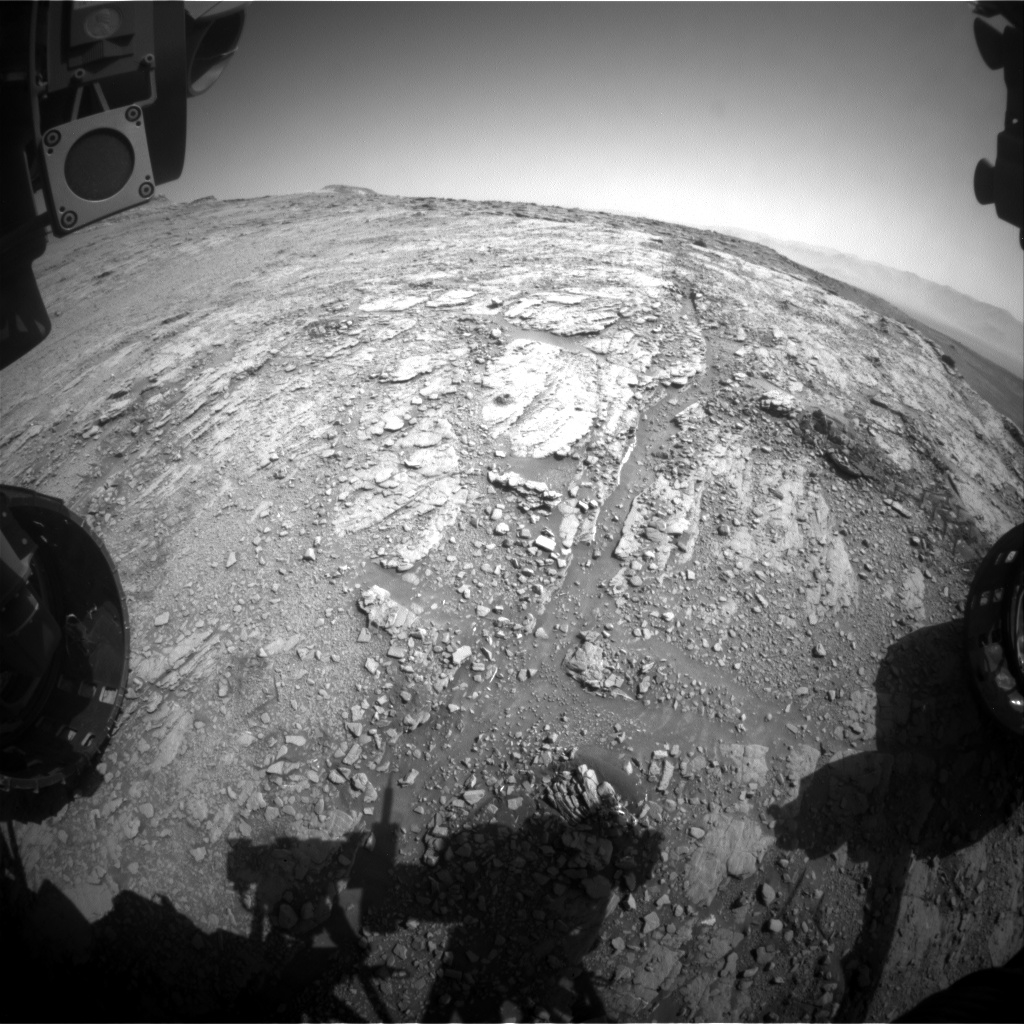
Curiosity Front Hazcam Left B image acquired on Sol 2494, August 12, 2019.
Credit: NASA/JPL-Caltech
NASA’s Curiosity Mars rover is now performing Sol 2495 duties.
Recent Curiosity planning began with a bit of a shuffle as scientists learned that the sample cup that was used for Sample Analysis at Mars (SAM) Instrument Suite preconditioning over the weekend didn’t seal as well as desired, reports Vivian Sun, a planetary geologist at NASA’s Jet Propulsion Laboratory in Pasadena, California.
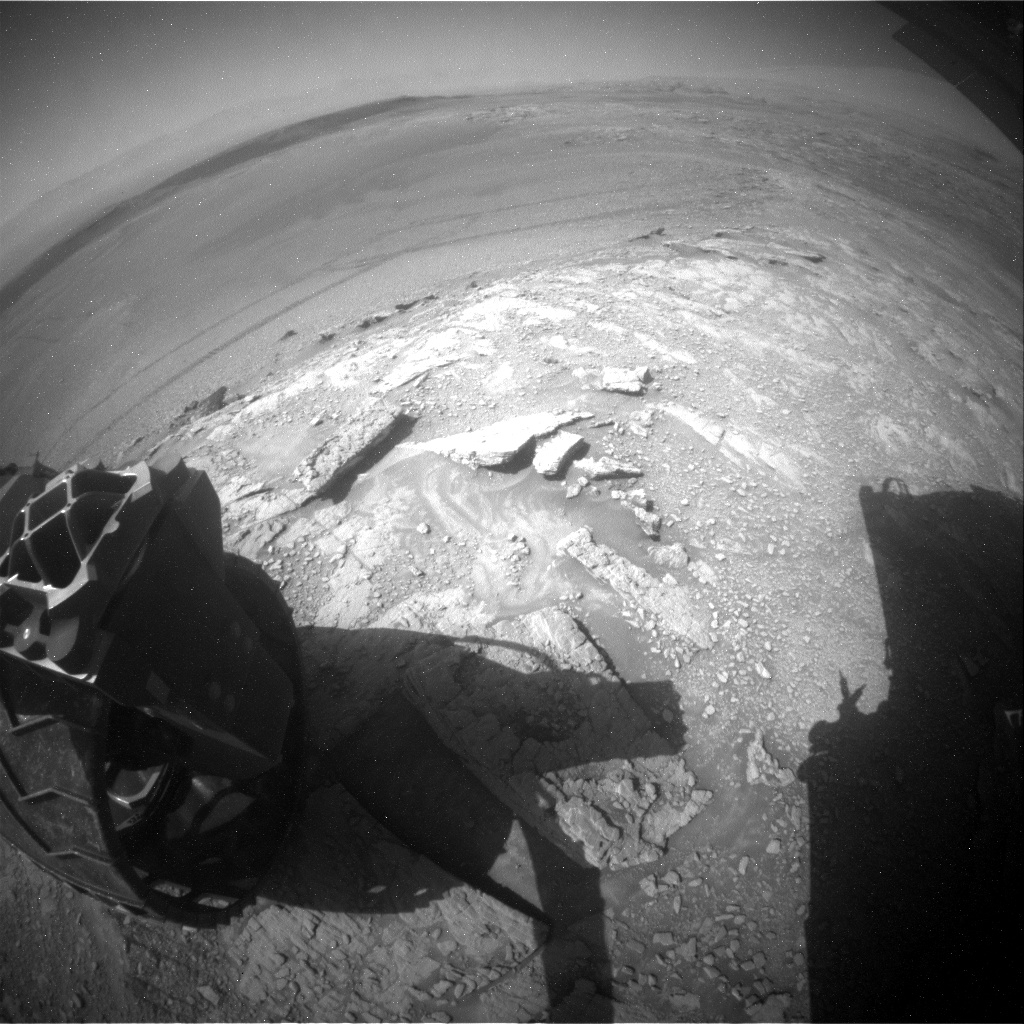
Curiosity Rear Hazcam Left B photo taken on Sol 2494, August 12, 2019.
Credit: NASA/JPL-Caltech
“This preconditioning step is required before we can perform SAM Evolved Gas Analysis (EGA) on the ‘Glen Etive’ drill sample,” Sun adds.
In response, Mars researchers decided to redo the SAM preconditioning activity using another cup, in addition to running another Chemistry & Mineralogy X-Ray Diffraction/X-Ray Fluorescence Instrument (CheMin) analysis.
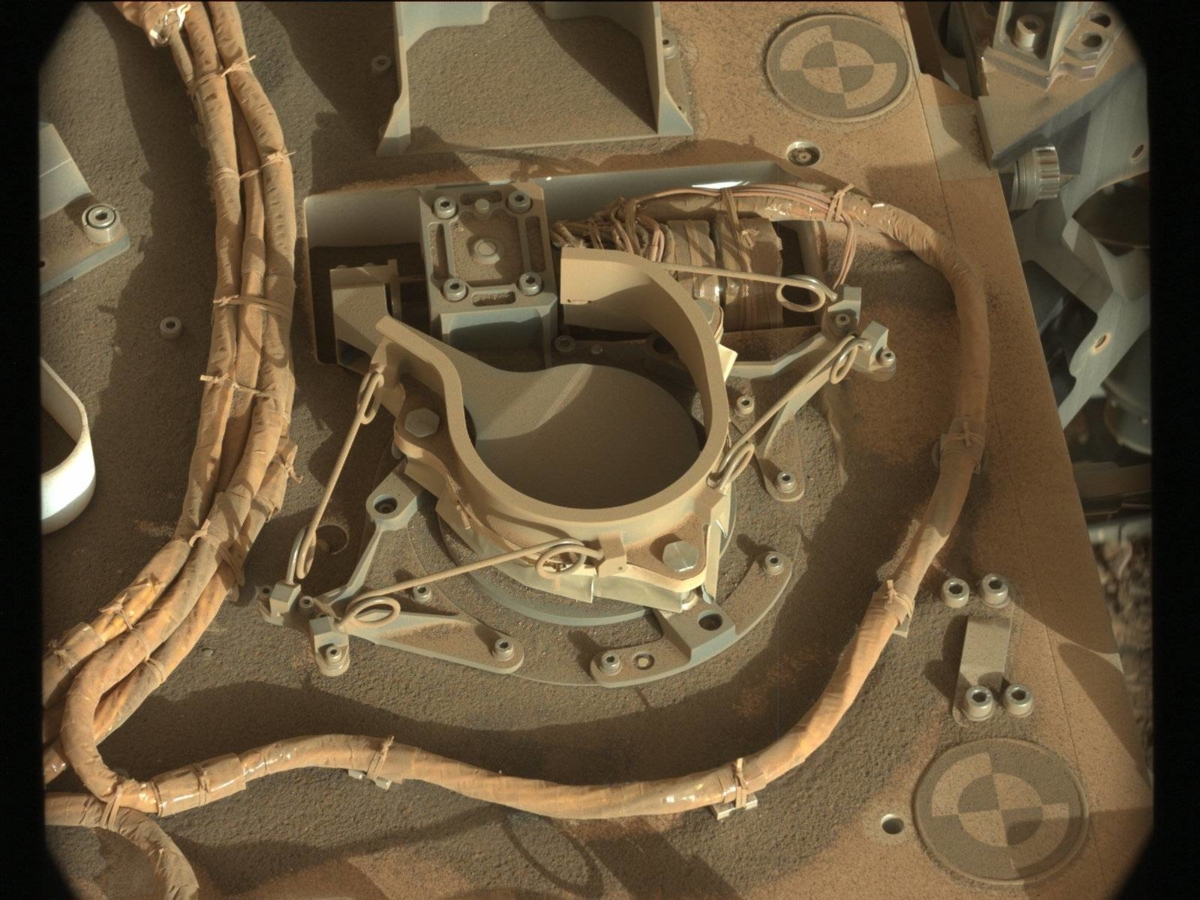
Curiosity Mastcam Left image taken on Sol 2492, August 10, 2019.
Credit: NASA/JPL-Caltech/MSSS
These changes freed up additional time for remote sensing observations in a recently scripted two sol plan for the rover.

Curiosity Navcam Right B photo acquired on Sol 2493, August 11, 2019.
Credit: NASA/JPL-Caltech
Retargeting drill hole
Also planned were a variety of Chemistry and Camera (ChemCam) observations, including a retargeting of the Glen Etive drill hole in order to better adjust the focus parameters of the instrument.
We identified a rock called ‘Scone’ with nicely exposed layers that we will sample with a vertical raster, and will also target another bedrock target called ‘Crannog,’ Sun explains.
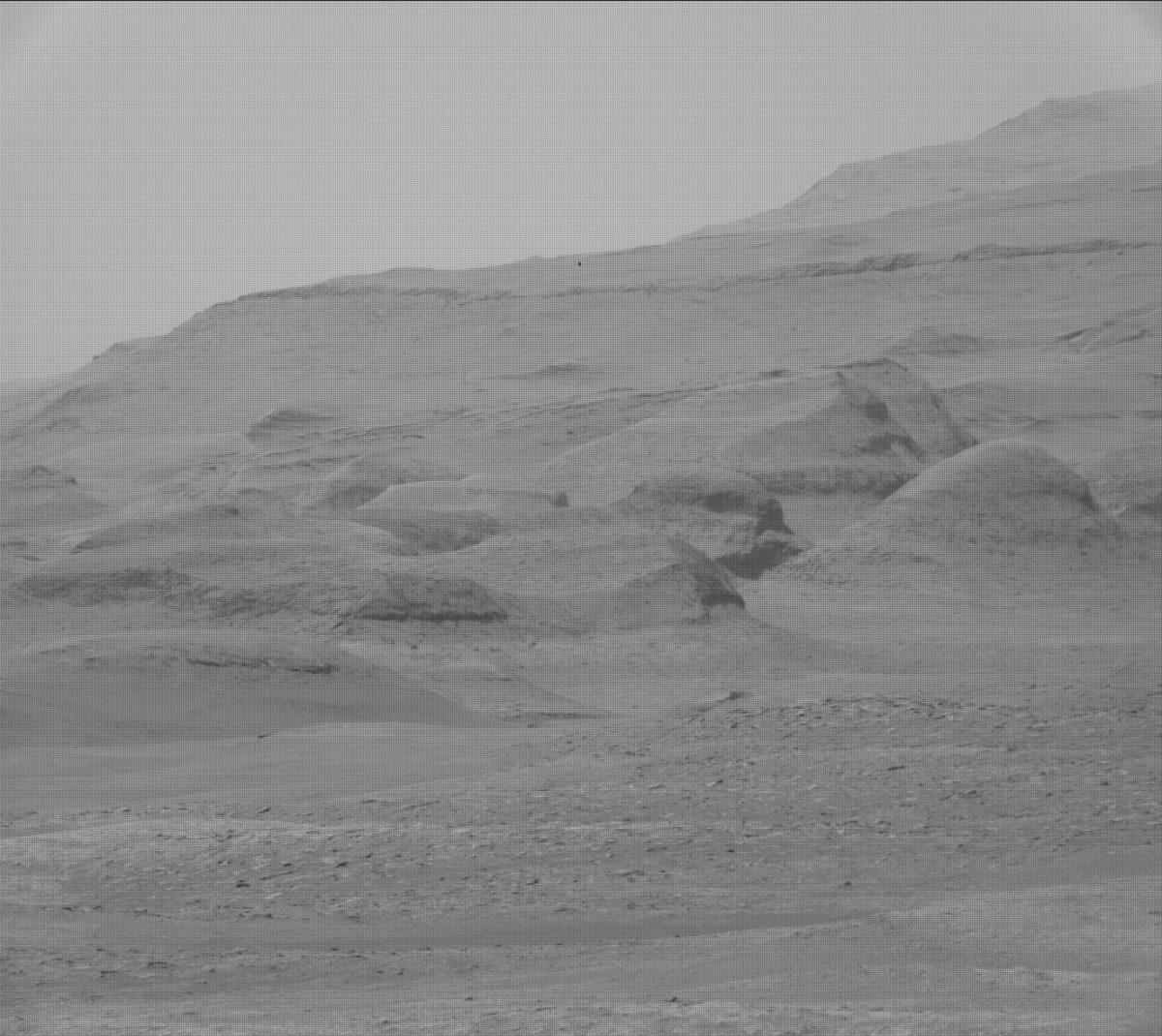
Curiosity Mastcam Right photo acquired on Sol 2492, August 10, 2019.
Credit: NASA/JPL-Caltech/MSSS
Long distance imaging
There was also time to take a long distance Remote Micro-Imager (RMI) mosaic of the sulfate unit to image sedimentary structures in these distant rocks.
Supporting Mastcam documentation images were planned for each of these observations, as well as Navcam movies designed for determining cloud height,” Sun concludes. “If all goes well with the redo of the SAM preconditioning, we’ll be continuing along the drill sol path in no time!”

Curiosity ChemCam Remote Micro-Imager photo taken on Sol 2492, August 10, 2019.
Credit: NASA/JPL-Caltech/LANL

Air Force space plane in Earth orbit for over 666 days.
Credit: Boeing/Inside Outer Space Screen Grab
The puzzling and classified U.S. Air Force X-37B space plane appears ready to set a new milestone in its hush-hush current mission: Breaking a new long-duration record in circling the Earth.
Also tagged as the Orbital Test Vehicle (OTV) – 5 mission, this space plane was lofted into low Earth orbit back on September 7, 2017.
Hurled skyward atop a SpaceX Falcon 9 booster from Launch Complex 39A at NASA’s Kennedy Space Center in Florida, the space plane is approaching a milestone for the program.

OTV-5 test image taken June 29.
Credit: Ralf Vandebergh
Last and lengthiest
The last and lengthiest Air Force’s X-37B mission, OTV-4 — after 718 days of flight — touched down at NASA’s Kennedy Space Center Shuttle Landing Facility May 7, 2017 – a first for the program. All prior missions had ended with a tarmac touchdown at Vandenberg Air Force Base in California.
“It is our goal to continue advancing the X-37B OTV so it can more fully support the growing space community,” said Randy Walden, the director of the Air Force Rapid Capabilities Office in a statement about the current spacecraft in orbit,” he said.
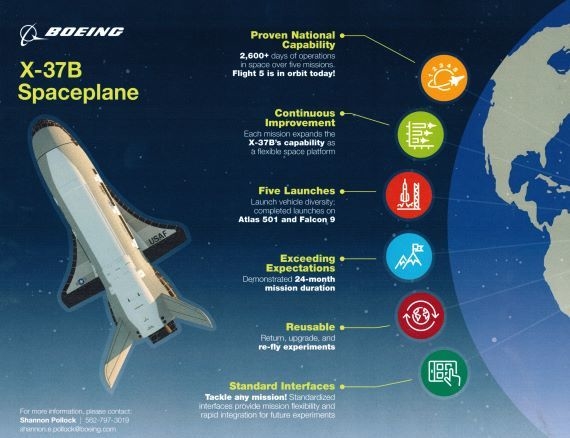
X-37B handout.
Credit: Boeing
New flight-duration record
Each X-37B/OTV mission has set a new flight-duration record for the program:
OTV-1 began April 22, 2010, and concluded on Dec. 3, 2010, after 224 days in orbit.
OTV-2 began March 5, 2011, and concluded on June 16, 2012, after 468 days on orbit.
OTV-3 chalked up nearly 675 days in orbit before finally coming down on Oct. 17, 2014.
OTV-4 conducted on-orbit experiments for 718 days during its mission, extending the total number of days spent in space for the OTV program at that point to 2,085 days. It was launched in May 2015 and landed in May 2017.

The X-37B Orbital Test Vehicle mission 4 (OTV-4), the Air Force’s unmanned, reusable space plane, landed at NASA’s Kennedy Space Center Shuttle Landing Facility May 7, 2017.
Credit: USAF
Adversaries don’t know
It is always touch and go regarding what can/cannot be said about the space plane program.
However, former Secretary of the Air Force Heather Wilson laid out some basic details of the X-37B’s mission during an appearance at the Aspen Security Forum last month.
“The Air Force has acknowledged that we own a space plane, the X-37 – looks like a small version of the shuttle, but it’s unmanned. One of the things that’s fascinating about that space plane is that it can do an orbit that looks like an egg, and when it’s close to the Earth it is close enough to the atmosphere to turn where it is, which means our adversaries don’t know – and that happens on the far side of the Earth from our adversaries – they don’t know where it’s going to come up next, and we know that drives them nuts,” Wilson said.

Last Air Force’s X-37B Orbital Test Vehicle mission touched down at NASA ‘s Kennedy Space Center Shuttle Landing Facility May 7, 2017.
Credit: Michael Martin/USAF
Observing orbits
Ted Molczan is a Canada-based amateur astronomer who specializes in observing satellites and analyzing their orbits.
In commenting on Wilson’s statement: “The description is severely lacking in detail, but it appears to be of a maneuver made at the perigee of an elliptical orbit. The phrase ‘close enough to the atmosphere to turn where it is,’ suggests that the atmosphere plays some role in changing the orbital plane, Molczan told Inside Outer Space. “I am not familiar with maneuvers in the atmosphere, but I can comment on plane-changes, which consist of a change of inclination and/or longitude of the ascending node.”
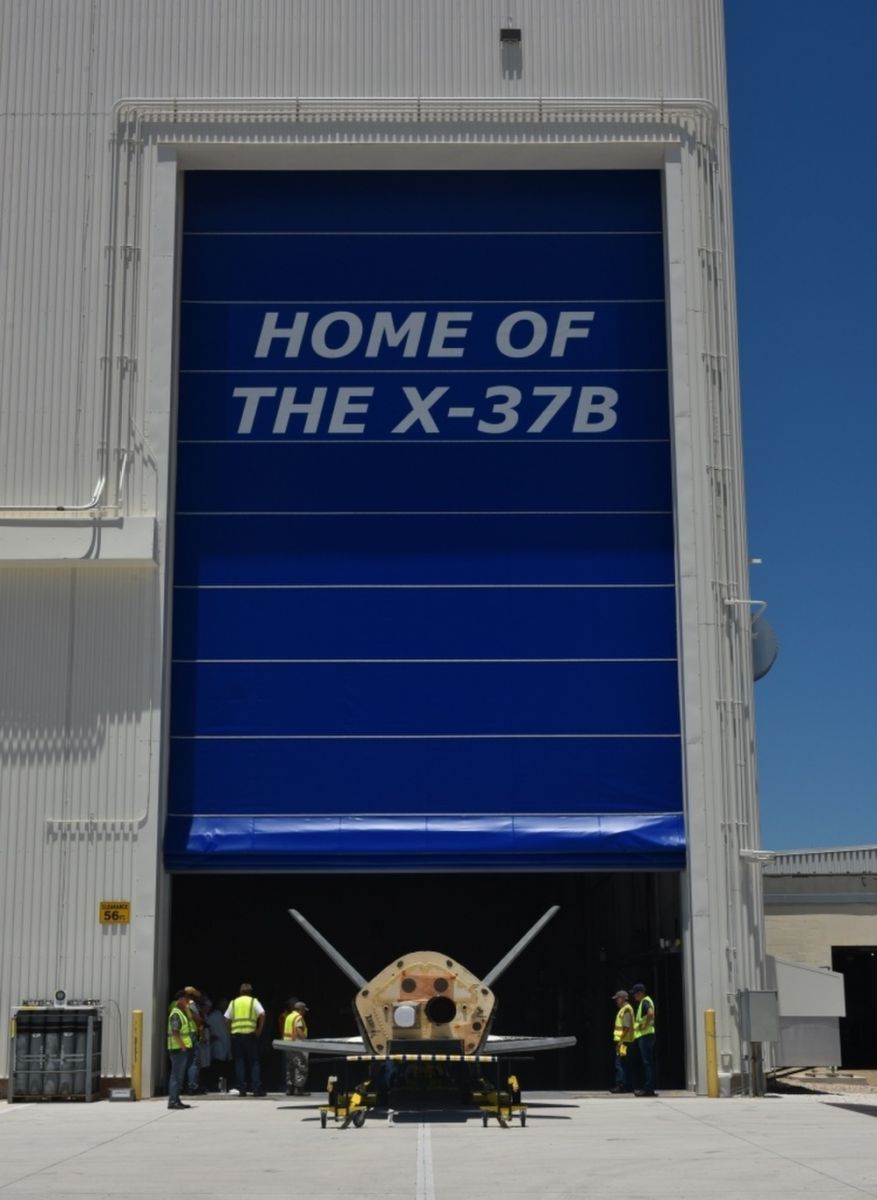
Back to hangar for another flight day. U.S. Air Force X-37B/OTV-4 is rolled into facility after its May 7 landing at Kennedy Space Center.
Credit: Michael Martin/SAF
Satellite trackers
Molczan said his fellow sky watchers have tracked significant portions of all five X-37B missions to-date.
“We detected only circular orbits. Maneuvers consisted almost exclusively of changes of altitude. The few small plane changes that were detected did not disrupt tracking of the spacecraft. In some cases, it took weeks or months before we detected newly launched spacecraft in orbit. I doubt that large maneuvers occurred prior to our initial observations, but I cannot exclude the possibility,” Molczan said.
Tantalizing thought
Bottom line: Exactly when the OTV-5 space plane will land is unknown.
Meanwhile, a tantalizing thought: Could the program shoot for two X-37B vehicles in Earth orbit at the same time?
According to some launch websites, a United Launch Alliance Atlas 5 rocket will launch the AFSPC 7 mission for the U.S. Air Force this December. The mission’s primary payload is the X-37B, with liftoff from Cape Canaveral Air Force Station – SLC-41.
For more information on the X-37B project, go to:
Military Space Plane: Headed for New Record?
https://www.leonarddavid.com/military-space-plane-headed-for-new-record/
Also, go to this 8/5/2019 Defense News report at:
Credit: ESA
There’s concern regarding the European Space Agency’s (ESA) ExoMars-2020 becoming ExoMars-2022.
The issue involves parachute testing and a series of snags to flight qualify the system. ExoMars teams continue to troubleshoot the parachute design following an unsuccessful high-altitude drop test last week.
This ESA ExoMars mission comprises a rover and surface science platform, destined for launch next year. The mission is slated for liftoff within a July 25–August 13, 2020 launch window, arriving at Mars in March 2021.

Artist’s impression of the ExoMars 2020 rover and Russia’s stationary surface platform in background.
Credit:
ESA/ATG medialab
Oh chute!
In a just-issued ESA statement:
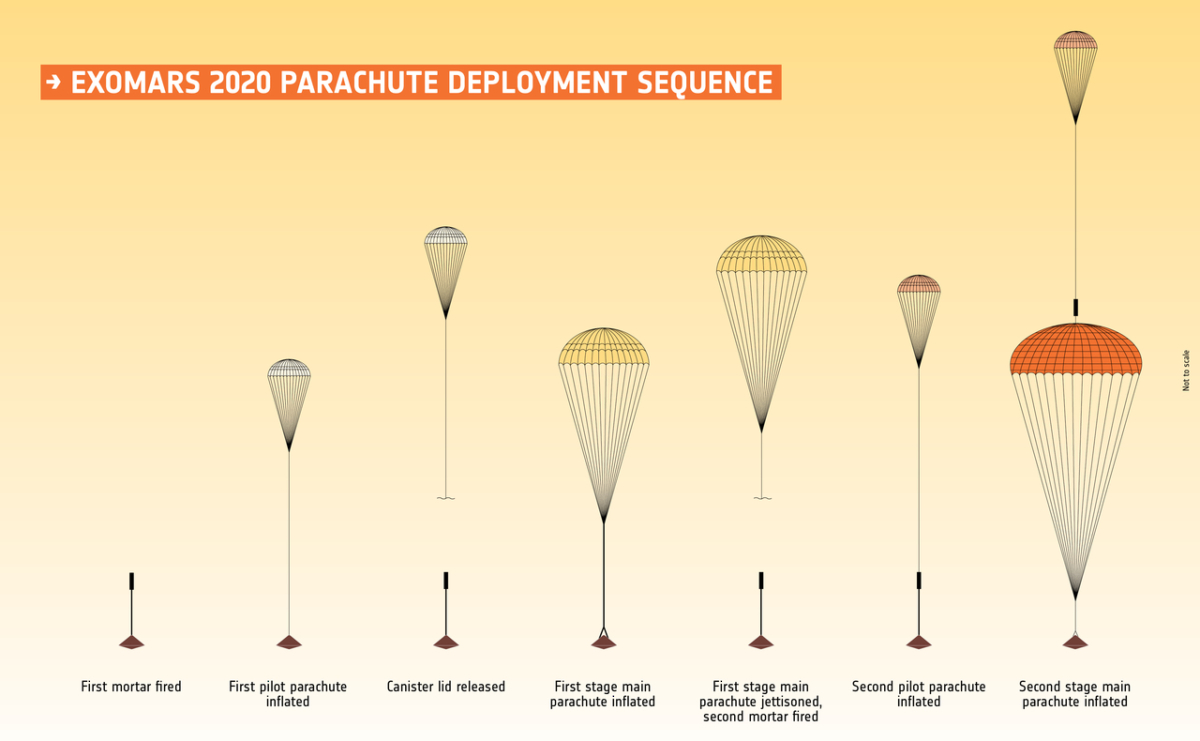
As part of the planned ExoMars testing prior to launch, several parachute tests were conducted at the Swedish Space Corporation Esrange site. The first took place last year and demonstrated the successful deployment and inflation of the largest main parachute in a low-altitude drop test from 1.2 kilometers, deployed by a helicopter. The parachute has a diameter of 115 feet (35 meters) – the largest parachute ever to fly on a Mars mission.
“On May 28 this year, the deployment sequence of all four parachutes was tested for the first time from a height of 29 km – released from a stratospheric helium balloon. While the deployment mechanisms activated correctly, and the overall sequence was completed, both main parachute canopies suffered damage.”
Following hardware inspection, adaptations were implemented to the design of the parachutes and bags ready for the next high-altitude test, which was conducted on August 5, this time just focusing on the larger 35-meter diameter parachute.
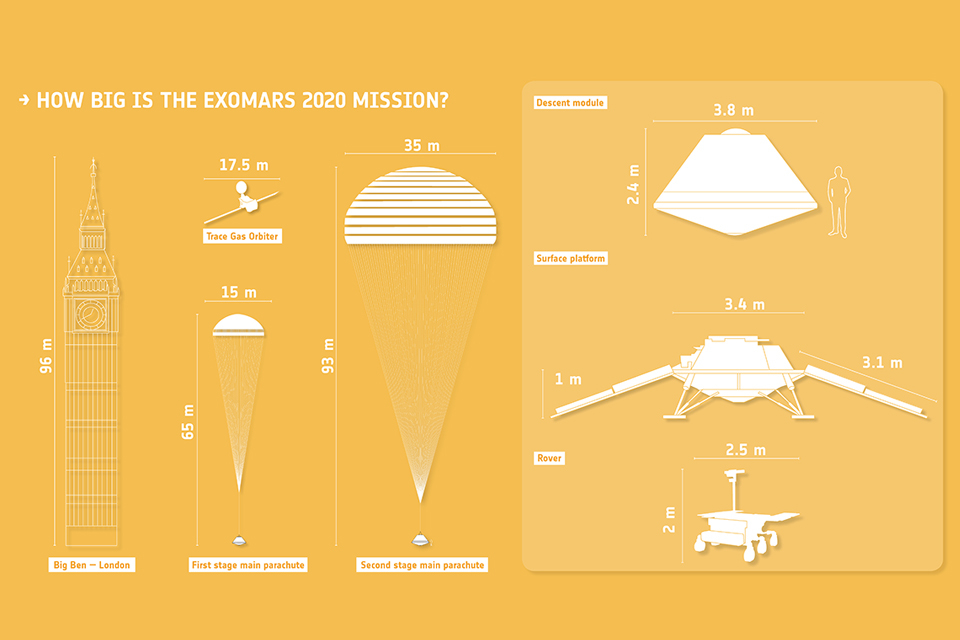
Sizes of key components of the ExoMars 2020 mission.
Credit: ESA
Canopy damage
According to the ESA statement, preliminary assessment shows that the initial steps were completed correctly, however damages to the canopy were observed prior to inflation, similar to the previous test. As a result, the test module descended under the drag of the pilot chute alone.
According to ESA, a further high-altitude test is already foreseen for the first main parachute before the end of 2019. The next qualification attempt of the second main parachute is then anticipated for early 2020.
Ground simulations
Additionally, and in parallel, ExoMars teams are investigating the possibility to manufacture additional parachute test models and conducting ground-based simulations to mimic the dynamic nature of parachute extraction, since there are not many opportunities for full-scale high-altitude drop tests.
Lastly, in addition to the regular forum of exchanges between ESA and NASA experts, a workshop of Mars parachute specialists will convene next month to share knowledge.

NASA Mars Exploration Rover parachute undergoes rigorous testing within NASA Ames facility.
Credit: NASA
Time running short
Inside Outer Space sources underscore that the ExoMars mission does have a far more complex parachute decelerator system than those used for NASA Mars missions.
Whether ExoMars is experiencing a parachute problem or other things associated with the parachute system is not clear.
And with time running short, ESA/NASA discussions can be muddled due to Technical Assistance Agreement (TAA) and International Traffic in Arms Regulations (ITAR) rules and regulations.

NASA Curiosity mission parachute testing.
Credit: NASA
NASA nail biting
On the NASA side, the Mars Exploration Rover (MER) project – Spirit and Opportunity – went through similar nail biting as parachute drop testing at China Lake encountered problems. A chute redesign was needed, along with use of the National Full-Scale Aerodynamics Complex (NFAC) at NASA Ames Research Center.
NASA’s mega-parachute for the Curiosity Mars lander mission underwent a total of six different tests between October 2007 and April 2009 within the NFAC. That parachute had 80 suspension lines, measured more than 50 meters (165 feet) in length, and opened to a diameter of nearly 51 feet (16 meters).
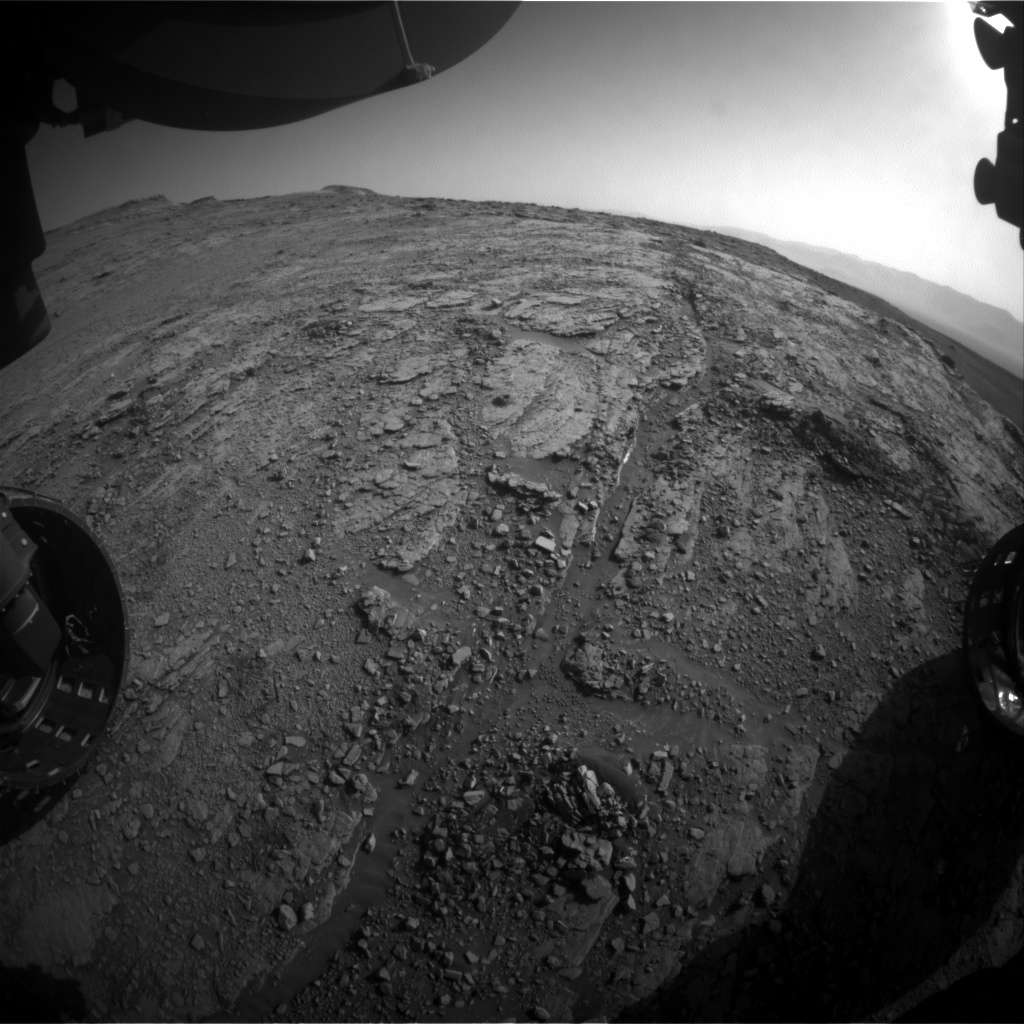
Curiosity Front Hazcam Left B image acquired on Sol 2490, August 8, 2019.
Credit: NASA/JPL-Caltech
NASA’s Curiosity Mars rover is now performing Sol 2491 tasks.
Over the weekend, Curiosity successfully dropped off a portion of the Glen Etive drill sample. But reports Claire Newman, an atmospheric scientist at Aeolis Research in Pasadena, California, “for some reason, the sequence was interrupted, so no images of the portion were acquired.”
Diagnose the issue
Curiosity’s Remote Sensing Mast (RSM), on which the robot’s Chemistry and Camera (ChemCam), both Mastcams, and all four Navcams are mounted, briefly stopped pointing as commanded on Sol 2488.

Curiosity Navcam Right B image taken on Sol 2488, August 6, 2019.
Credit: NASA/JPL-Caltech
“The RSM worked well in the tests planned on sol 2489 and downlinked ahead of today’s planning, however. So while the engineers continue to diagnose the issue,” Newman explains, “such as whether it involves recent changes to the way we heat motors connected to the RSM, we used it again cautiously in the Sol 2490 plan.”
Avoid risk
This meant avoiding observations, Newman adds, that require the Mars researchers to look up from the surface or deck, to avoid any risk of dust piling up on lenses if the RSM became stuck there.
The net result was that most of the environmental science theme group’s cloud and dust monitoring activities could not be included, as all of them involve using Mastcam or Navcam to look near the horizon or higher up.

Curiosity Navcam Right B image taken on Sol 2488, August 6, 2019.
Credit: NASA/JPL-Caltech
Monitoring the environment
In the Sol 2489 plan, the script included some attempted dust devil imaging using the Rear Hazcams, a more recent plan scientists focused on adding extra Rover Environmental Monitoring Station (REMS) one-hour extended blocks to measure air and ground temperature, pressure, humidity, and UV radiation.
“This should result in us measuring over 37 of the 48 Mars hours contained in this two-sol plan, compared to the 13 hours we’d have measured usually, including seven periods with 5 hours of continuous REMS,” Newman adds.

Curiosity Navcam Right B image taken on Sol 2490, August 8, 2019.
Credit: NASA/JPL-Caltech
“Long periods of continuous atmospheric data are useful for tracking weather patterns, atmospheric wave activity, and even clouds that we can detect in the REMS UV and ground temperature data after sunset,” Newman points out.
The environmental group also planned Dynamic Albedo of Neutrons (DAN) and Radiation Assessment Detector (RAD) observations.

Curiosity ChemCam Remote Micro-Imager photo acquired on Sol 2487, August 5, 2019.
Credit: NASA/JPL-Caltech/LANL
Inlet imaging
Meanwhile, the geology science theme group planned to recover planned observations that were lost due to the RSM issue.
Because delivery of the Glen Etive sample to the Sample Analysis at Mars (SAM) Instrument Suite inlet cover and documentation imaging did not complete, the highest priority for the Sol 2490 plan was to perform the SAM drop-off and do ChemCam Laser-Induced Breakdown Spectrometer (LIBS) observations of the drill hole, Newman notes.
Other activities were ChemCam and Mastcam observations of a single rock target “Argyll,” consisting of dark bedrock with a white vein, of “Dornock” and “Thrumster,” both containing sulfate veins, and of “Tap O Noth,” a nearby bedrock target.

Curiosity Rear Hazcam Left B image taken on Sol 2490, August 8, 2019.
Credit: NASA/JPL-Caltech
Change detection
“Finally, further Mastcam imaging was performed to monitor any surface changes that may occur as a result of strong winds or intense atmospheric vortices that are able to move sand and/or dust particles,” Newman says. “Targets of this imaging included the rover deck as well as images of two surface targets called ‘Dundee 1’ and ‘Dundee 2.’ These targets were chosen because they contain both sand and bedrock, which makes it easier to spot small changes between images, such as sand shifting slightly further onto the rock.”

Curiosity Rear Hazcam Right B photo taken on Sol 2489. August 7, 2019.
Credit: NASA/JPL-Caltech
These “change detection” studies are repeated at roughly equal intervals over the Mars year, and help scientists understand how sand motion and dust lifting varies with season, Newman points out, “which in turn helps us to understand how dunes form, how the surface is eroded, and how dust storms occur.”

