Author Archive
 Author:
  May 8th, 2026
Image credit: Impact Flash/NASA GEODES
During their far-flung voyage around the moon, the Artemis II crew remained vigil while zipping by the darkened side of the moon, on the ready to try and record meteoroid impact flashes visually on the lunar landscape.
But it’s extremely difficult to capture impact flashes with a camera – which is one of the benefits of sending trained crew to observe the Moon.
The latest from the Artemis II Lunar Science Team is that they are currently working to archive the science data from the Artemis II mission on NASA’s Planetary Data System.
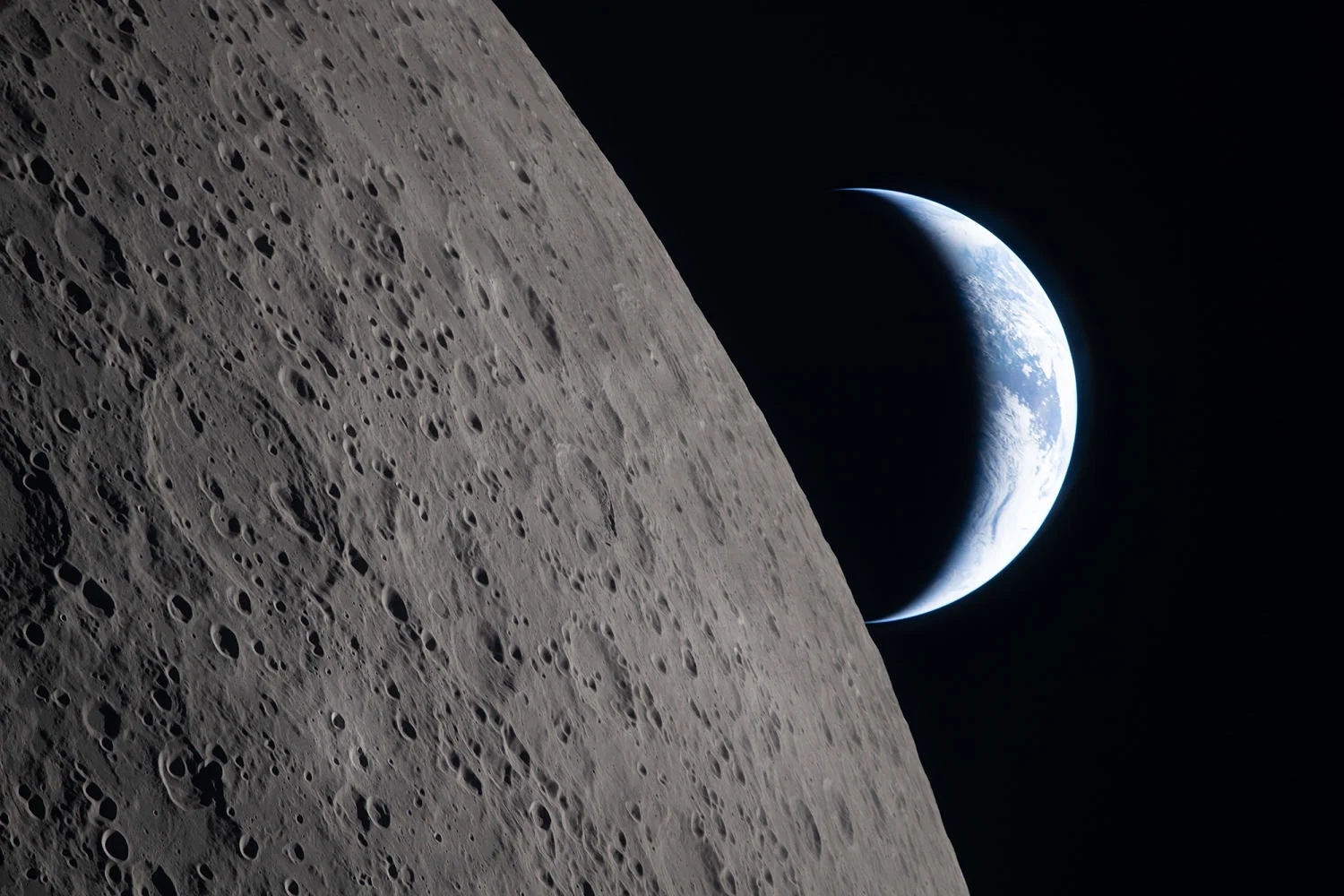
Image credit: Artemis II/NASA
Scientists excited
For Artemis II, the Orion spacecraft carried 31 cameras designed to capture the mission from every angle, be it from external cameras to internal cabin equipment used to document the distant sojourn around the Moon.
NASA’s Artemis 2 astronauts saw flashes on the far side of the Moon that cameras struggle to capture.
Here’s why scientists are excited…and for more details, go to my new Space.com story – “NASA’s Artemis 2 astronauts saw flashes on the far side of the Moon that cameras struggle to capture” – at:
 Posted in

Wait a Minute!
Image credit: Barbara David
If the winds and whims of politics play out, U.S. President Donald Trump is to trek to Beijing for a summit with Chinese President Xi Jinping on May 14 and 15.
No telling the outcome(s) from such a two-nation mind meld given the entourage that will accompany Trump, folks that typically engage in off-stage banter to propose, detail, iron-out, trash, and agree on new ideas.
It might be a wait-a-minute moment for space collaboration.
Could one of those pitches retro-fire back to a U.S. John Kennedy and then Soviet Union Premier’s Nikita Khrushchev discussion of a joint Moon mission?

Space race rivals: Soviet Union’s Premier
Nikita Khrushchev with U.S. President, John F. Kennedy.
Image credit: Kennedy Library
Yes, a blunt, but bold initiative – and at a time when rocket rhetoric has it that both the U.S. and China are in a heated “Space Race.”
Joint-mission messages
Let’s revisit a page in space history.
When U.S. President Kennedy and former Soviet Union leader Nikita Khrushchev met in June 1961, the Soviet leader said “nyet” to the idea of a joint Moon adventure. Kennedy further pushed for a bi-national lunar landing idea during a United Nations address on September 20, 1963.
After JFK met his doom in Dallas, the joint-mission idea fell to the wayside…and the rest was history as Apollo 11’s Neil Armstrong and Buzz Aldrin came to full-stop on the barren Moon’s surface in July 1969.

Image credit: NASA
Measured in months, not years
Fast forward to today, China has road mapped a plan to plant the country’s own boots on the dusty, cratered Moon by 2030, maybe even earlier.
It also seems clear that, if they are successful, Chinese moonwalkers may likely strut their right stuff across lunar real estate ahead of NASA’s current Artemis lunar landing plans.
That possibility is much to the consternation of NASA and the U.S. Congress.
NASA Administrator Jared Isaacman has repeatedly stated that America finds itself with a real geopolitical rival, one that is challenging American leadership in the high ground of space. Success or failure in countering that confrontation will be measured in months, not years, he has explained.
“This time, the goal is not flags and footprints. This time, the goal is to stay. America will never again give up the Moon,” Isaacman has said.

Image credit: White House
Artemis program agenda
Rhetoric aside, there isn’t as yet a “Department of Wiggle Room” that can stave off the uncertainty of NASA funding, government shutdown ramifications, space agency layoffs, restructuring of space agency field centers – as well as hiccups in pushing forward on the Artemis program agenda.
In the meantime, China’s intention to place their astronauts on the Moon is progressing smoothly and appears on track. They have enough financial resources. They have already demonstrated a technical ability that equals or exceeds America in some instances. But they too could encounter setbacks.
China’s robotic sample return of lunar collectibles from the Moon’s near side and far side have been done, with more missions plotted out. They are building international partnerships that include sharing precious lunar material with other nations.
The long haul
Like the United States, China is detailing their own Moon-situated research base, in partnership with Russia’s space agency, Roscosmos.
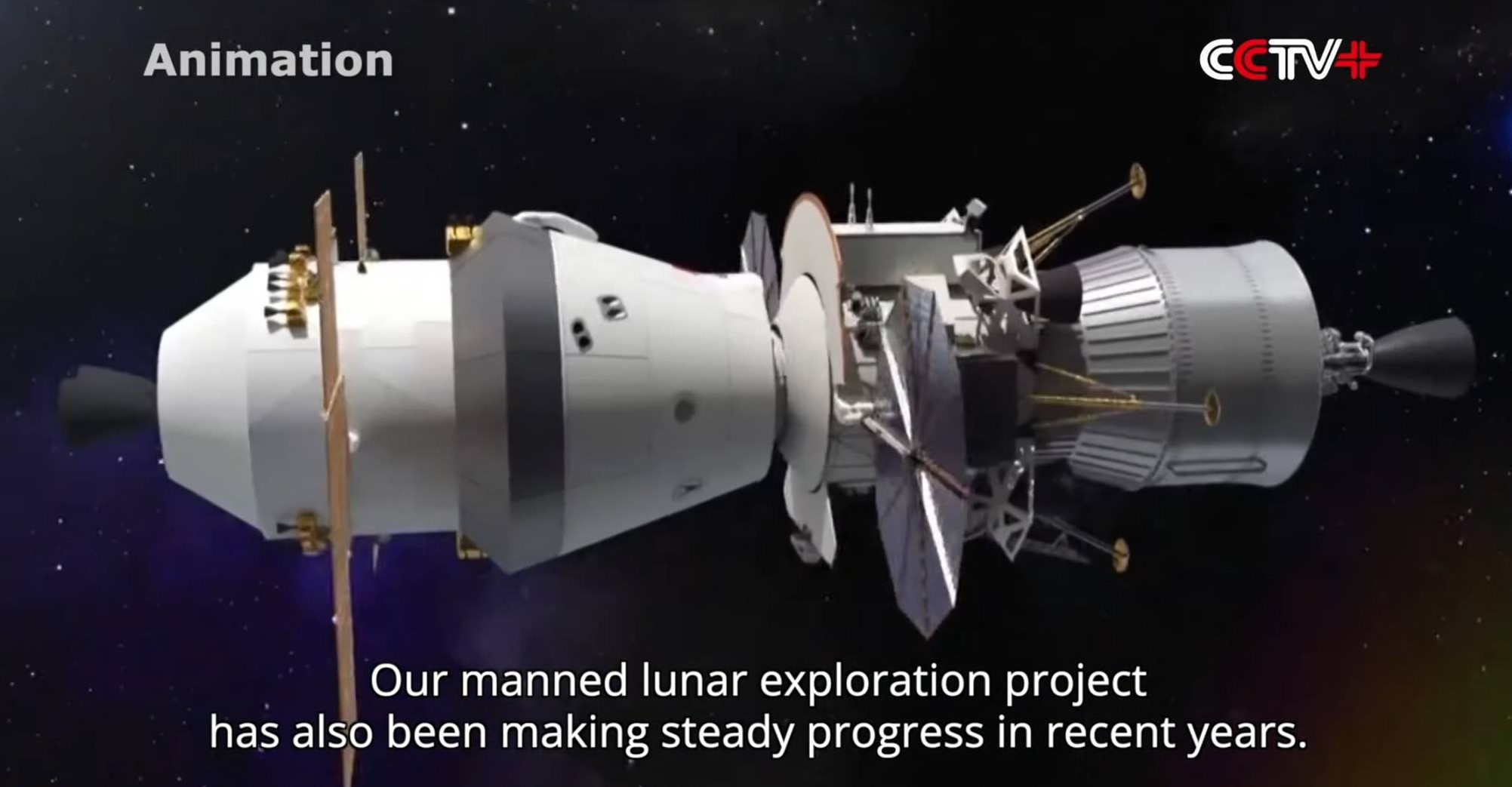
Image credit: CCTV/Inside Outer Space screengrab
China’s encampment will benefit by a sequence of two upcoming robotic lunar landers. The Chang’e-7 mission later this year is tasked to accomplish environment and resource surveys in the lunar south pole region. Chang’e-8 in 2028 is to tackle on-the-spot utilization of lunar resources.
All this suggests that — like the U.S. — China is into Moon exploration and utilization – and for the long haul.
Both nations are putting in place an aggressive agenda of technological development for “rebooting” the Moon, this time in the 21st century.
Is the window of opportunity open once again regarding the idea of superpower space cooperation in space?
Bring your own Windex!
What are your views?

Wait-a-Minute!
Image credit: Barbara David

Space explorer soaks up the scenery on Titan.
Artwork credit: Michael Carroll
After “re-booting” the moon and establishing a base there, followed by dispatching expeditionary crews to the Red Planet…where to after that? Next month, a first of its kind gathering will blueprint an eventual human trek to tantalizing Titan, a giant moon of Saturn.
An inaugural “Humans to Titan Summit” is on tap to make the case for an astronaut outing to that far off moon. To be detailed are the science goals and concepts of human missions to Titan as well as necessary forerunner robotic missions.
What are the issues for flinging flesh and bone to eye, first-hand, that distant globe?
“It’s not too soon to begin thinking about this,” explains a leading space scientist.
For details, go to my new Space.com story – “Should Saturn’s huge moon Titan be humanity’s next destination…after the moon and Mars?” – at:

Image credit: Composite image by Ella Maru Studio for the National Academy of Sciences
Planetary protection sounds like some sort of essential cosmic condom.
The ongoing quest to look for life on other planetary bodies demands that we don’t haul life from Earth via spacecraft, a downer of a dilemma called forward contamination.
At present, spacecraft microbial reduction protocols for outward-bound spacecraft prioritize bacterial spores. But it appears there might be a worrisome breach in planetary protection strategies.
A new study has identified 23 fungal strains isolated from NASA spacecraft assembly cleanrooms that are capable of surviving a pre-launch cleansing of ultraviolet radiation exposure.
For more details, go to my new Scientific American story – “Could this fungus live on Mars? Maybe it already does” – at (open link in incognito window):
https://www.scientificamerican.com/article/could-this-fungus-live-on-mars-maybe-it-already-does/
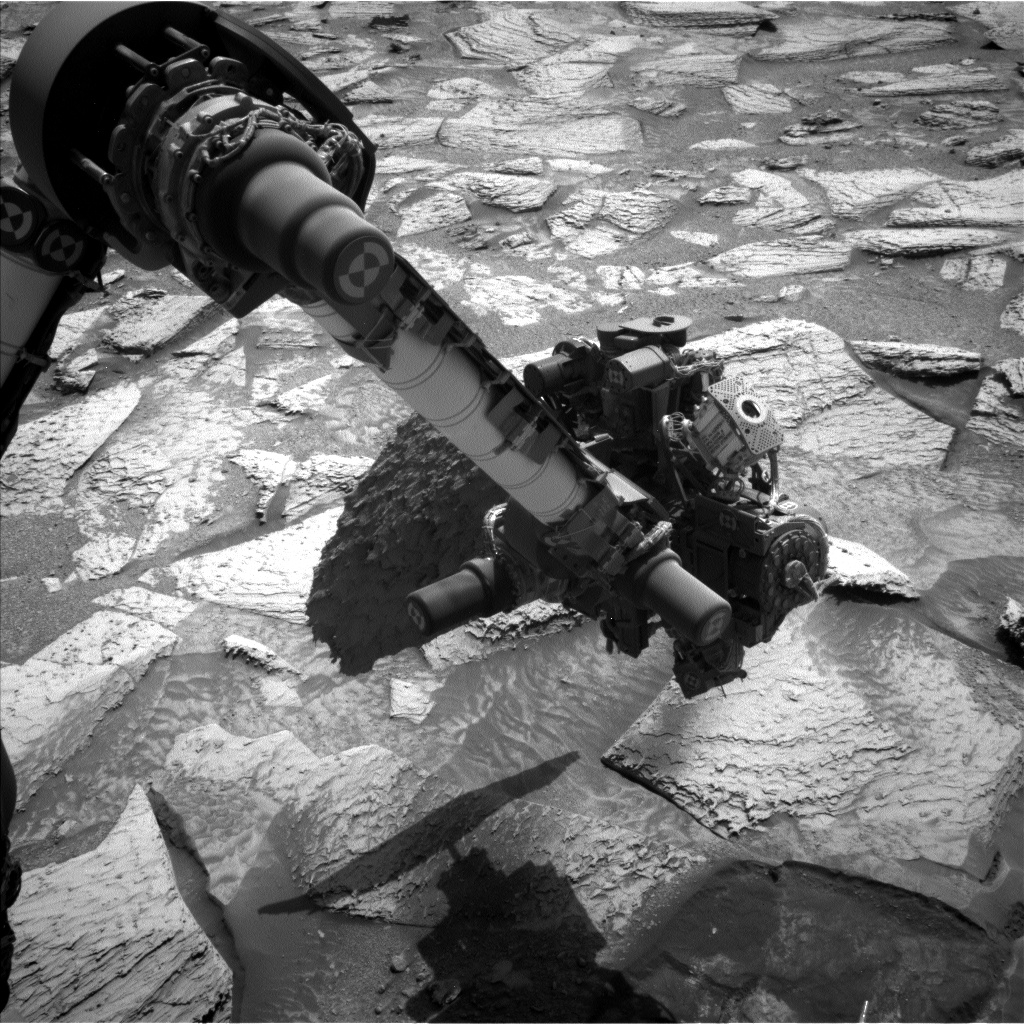
Curiosity Left Navigation Camera image taken on May 2, 2026.
Image credit: NASA/JPL-Caltech
The Atacama drill target on Mars presented a challenge to the Curiosity rover and to the rover team reports William Farrand, a senior research scientist at the Space Science Institute.
Downlinked data from the Mars machinery indicating that a successful drill hole was made in the Atacama target, Farrand explains, “but the rock being drilled into was a detached block and as the arm was raised to extract the drill, the rock came along with it!”
Bite of the drill bit
Curiosity’s rover planners went to work to develop a plan to extract the drill bit from the rock.
“These included efforts at changing the orientation of the drill bit, and attached block, as well as carrying out percussion to try to vibrate the rock off,” Farrand adds. “Ultimately, as a result of activities like these in the Sol 4883-4885 plan, we freed the drill from the Atacama block.”
Future activities involve wrapping up the drill campaign on Atacama and, nominally, seeking a more “firmly rooted drill target” in order to collect drill tailings for analysis, says Farrand, “which were lost from Atacama as part of the effort to dislodge the drill bit from the rock.”
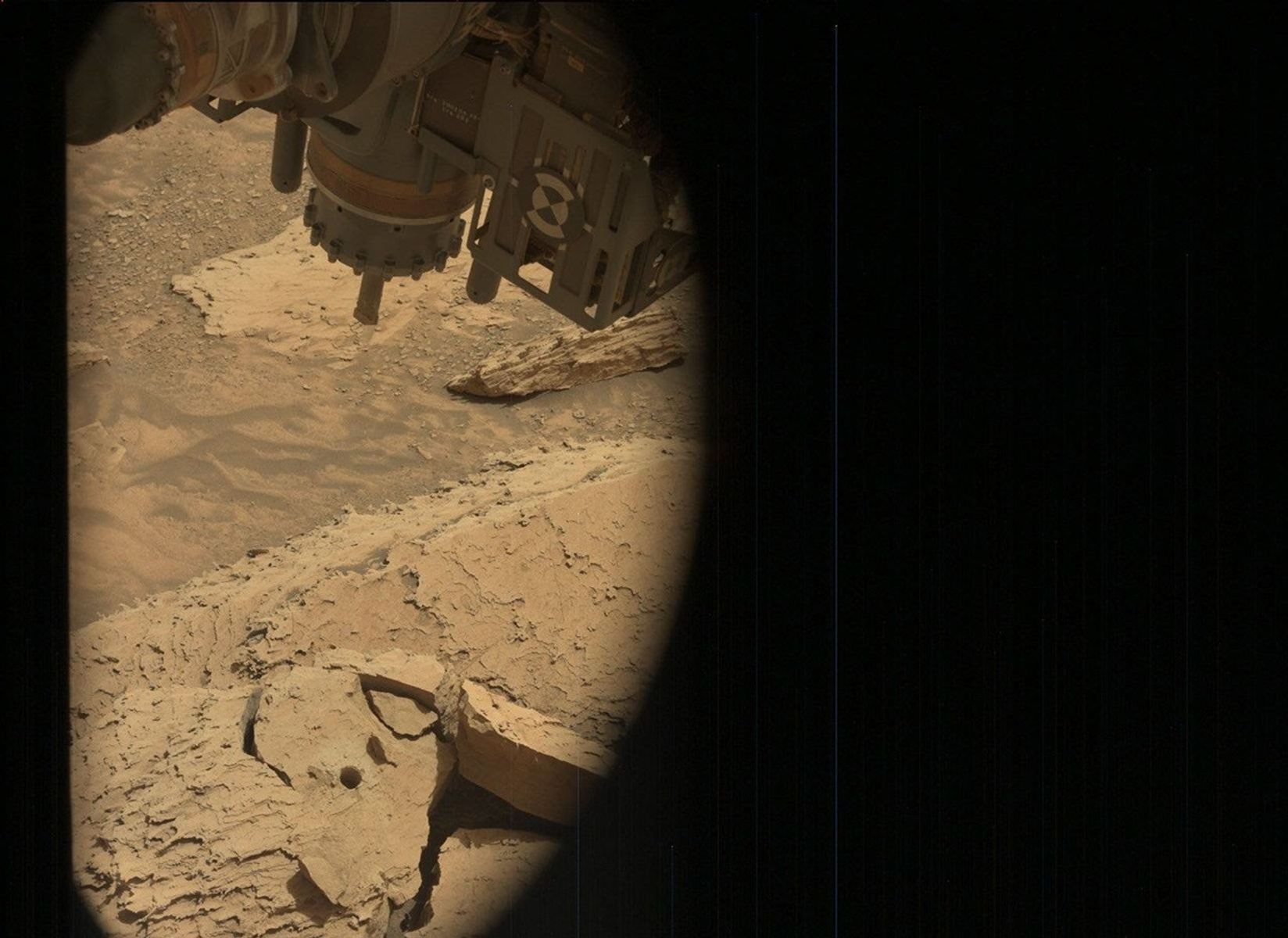
NASA’s Mars rover Curiosity acquired this image of its drill (above, now free of the Atacama block) and the stubborn stone block, again back on the surface (below), on May 2, 2026.
Image credit: Mast Camera (Mastcam) on Sol 4883/NASA/JPL-Caltech/MSSS
Here’s the history
On April 25, 2026, Curiosity drilled a sample from a rock nicknamed “Atacama,” which is an estimated 1.5 feet in diameter at its base, 6 inches thick and weighs roughly 28.6 pounds (13 kilograms).
When the rover retracted its arm, the entire rock lifted out of the ground, suspended by the fixed sleeve that surrounds the rotating drill bit. Drilling has fractured or separated the upper layers of rocks in the past, but a rock has never remained attached to the drill sleeve.
The team initially tried vibrating the drill to shake off the rock, but saw no change.
Freedom
On April 29, the team tried reorienting Curiosity’s robotic arm and vibrating the drill again. Imagery shows sand falling from Atacama, but the rock stayed attached to the rover.
Finally, on May 1, Curiosity’s team tried again, tilting the drill more, rotating and vibrating the drill, and spinning the drill bit.
The team planned to perform these actions multiple times but the rock came off on the first round, fracturing as it hit the ground.
Check out this NASA/JPL-Caltech link to see Curiosity’s dilemma at:
https://science.nasa.gov/photojournal/nasas-curiosity-rover-frees-its-drill-from-a-rock/
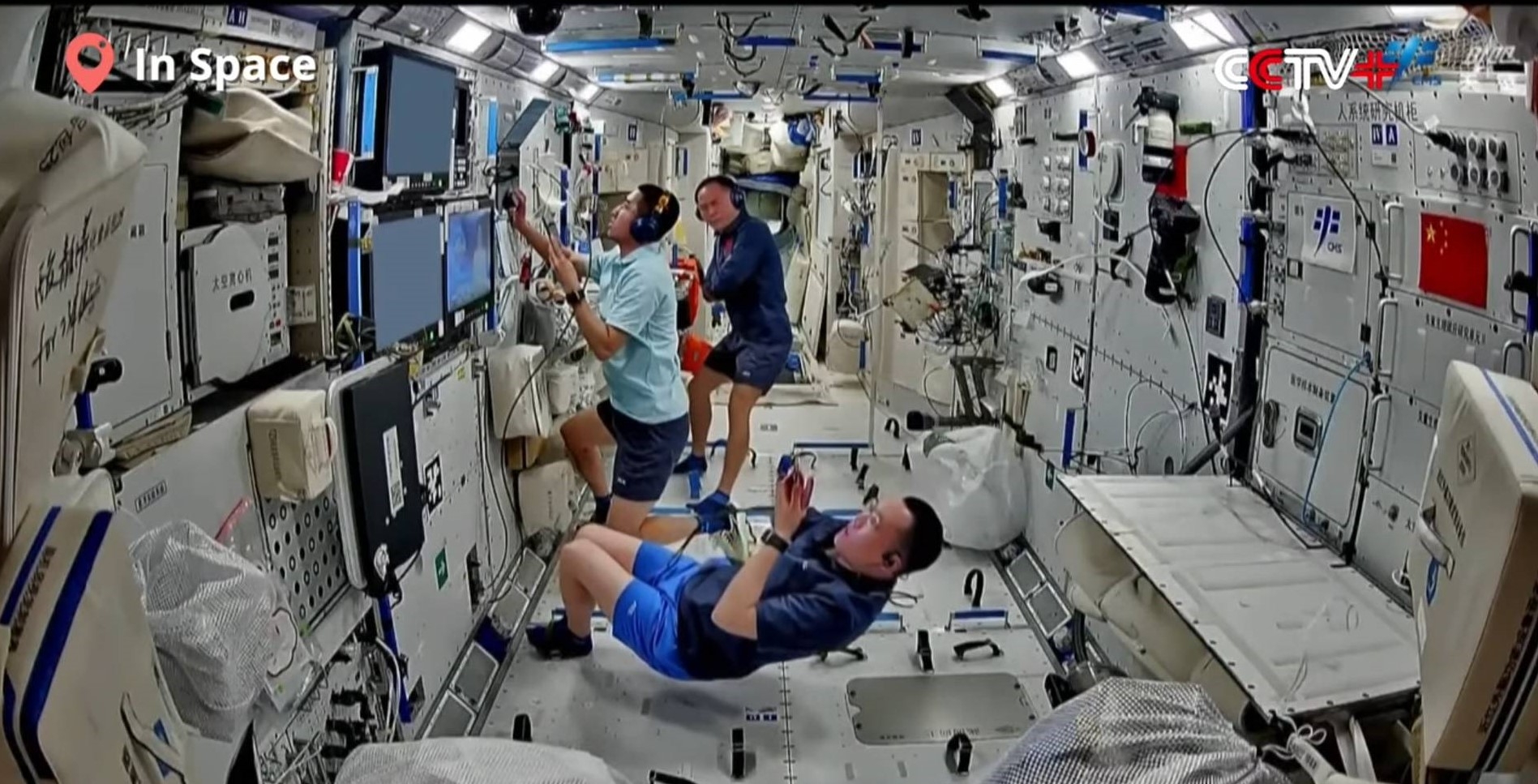
Image credit: CCTV/Inside Outer Space screengrab
China’s Shenzhou-21 crew — Zhang Lu, Wu Fei, and Zhang Hongzhang — has begun their one-month extended mission aboard the country’s Tiangong space station.
The taikonaut trio entered the space station on November 1, 2025. The threesome have completed their initial six-month stay in orbit and are now working an extra month in space.
With this extension, the Shenzhou-21 crew is set to break the previous record of 204 days in orbit set by Shenzhou-20. So far, they have completed three spacewalks and conducted 27 scientific projects.
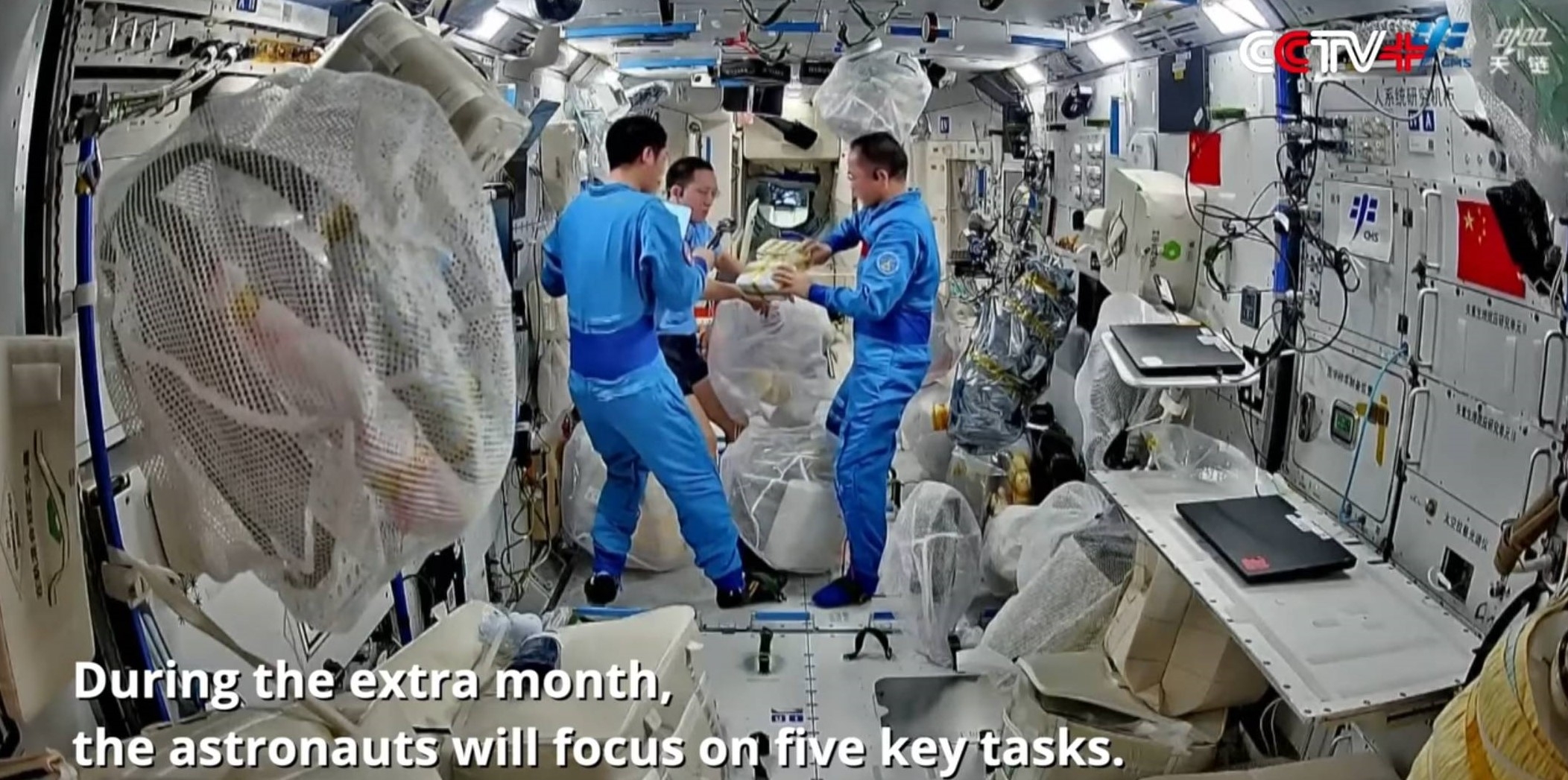
Image credit: CCTV/Inside Outer Space screengrab
Key tasks
During the extra month, the astronauts will focus on five key tasks, reports China Central Television (CCTV).
- they will prepare for handover. This includes wrapping up scientific experiments, sorting data, and thoroughly checking payloads, cabin systems and life support equipment to get prepared for the arrival of the next crew.
- they will pack experimental samples and equipment for return to Earth, while transferring waste to the Tianzhou-9 cargo spacecraft for later disposal.
- they will conduct detailed inspections of the spacecraft. This includes verifying airtight seals on hatches, checking the return module’s life support systems, communication equipment, portholes, and structural integrity to rule out any risks from space debris impacts.
- the crew will intensify physical training to adapt to Earth’s gravity and enhance monitoring of their biorhythms, psychological state, and crew compatibility to support future long-term missions.
- they will review all return procedures to ensure a safe journey.
In the coming month, the crew will also welcome the arrivals of a Tianzhou-10 resupply spacecraft, as well as the Shenzhou-23 crew.
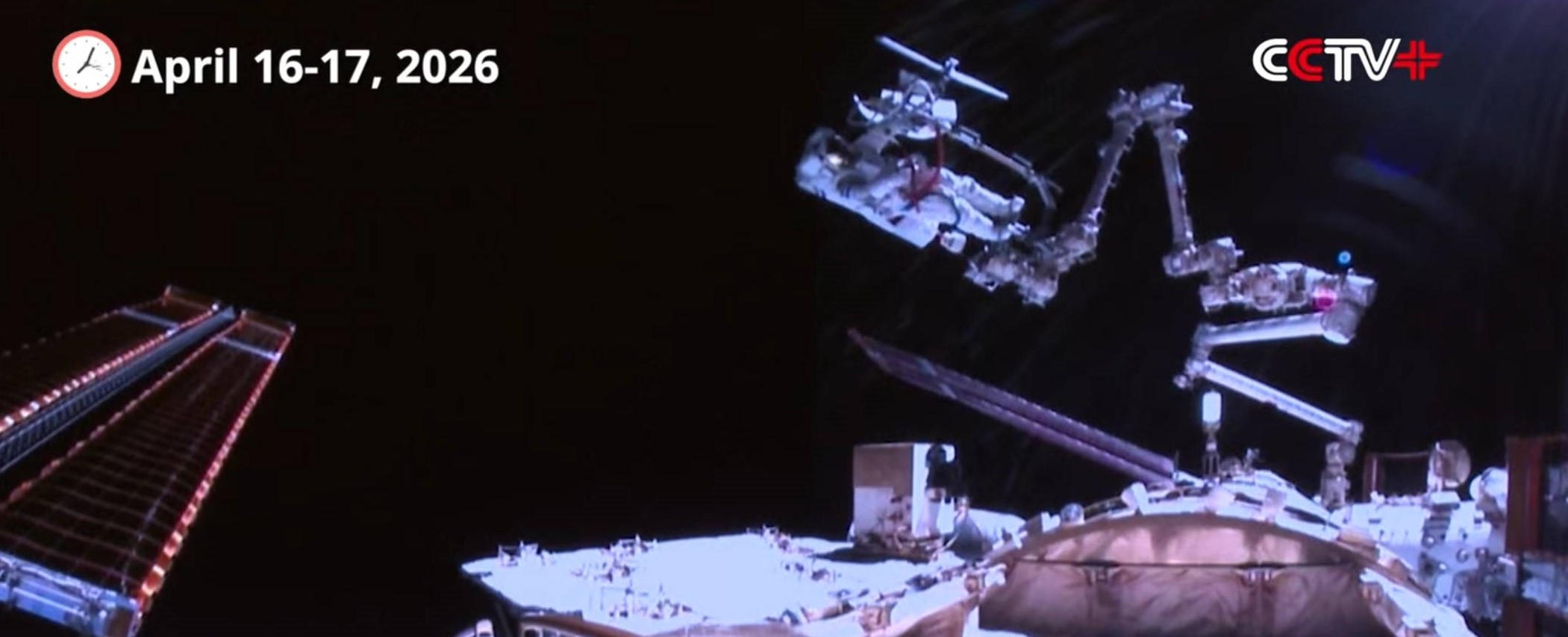
Image credit: CCTV/Inside Outer Space screengrab
On-orbit research
The CCTV reports that the now-in-orbit crew conducted on-orbit electroencephalogram (EEG) research. Using EEG acquisition devices, VR glasses, and other equipment, they conducted multiple experiments, providing relevant data for ground-based researchers for further study.
In the field of behavioral and psychological research, the astronauts performed executive function training by observing images on a laptop and responding via keyboard inputs. They also completed emergency decision-making assessments and emotional state tests, providing valuable data for studying the effects of long-duration spaceflight on decision-making abilities and mental well-being.
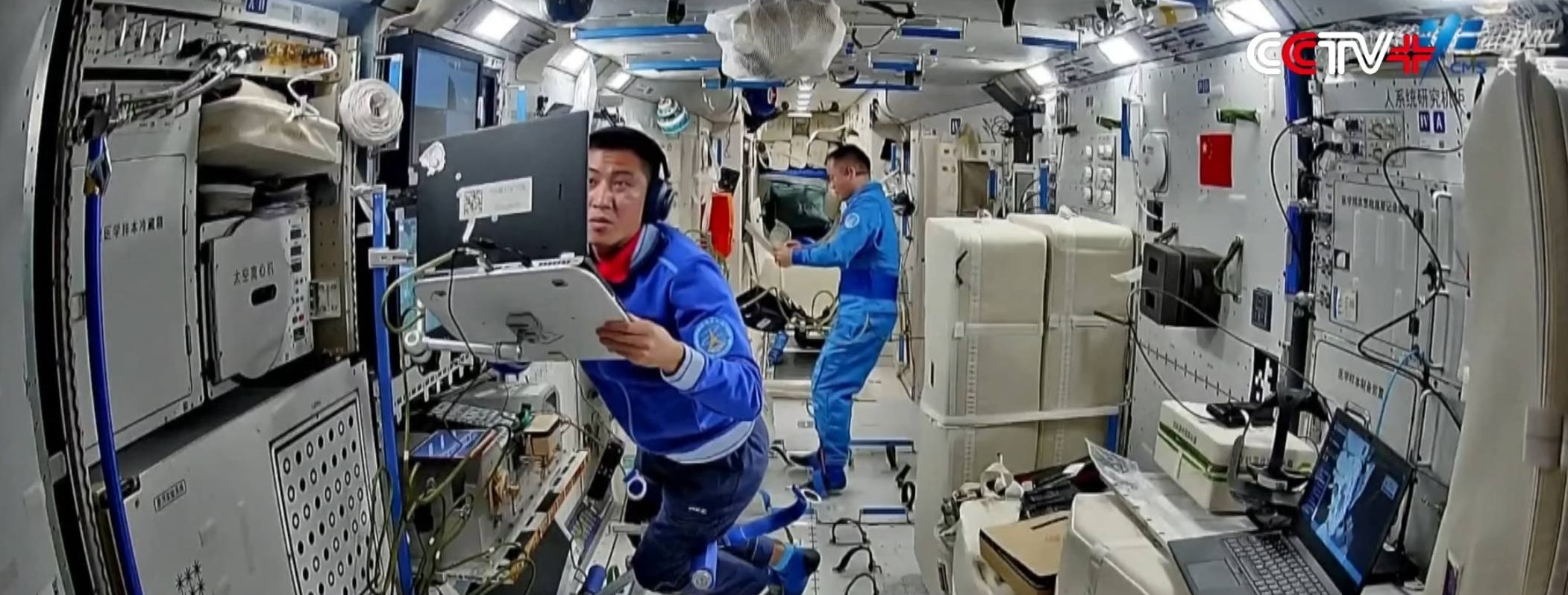
Image credit: CCTV/Inside Outer Space screengrab
Station maintenance
The three space travelers also conducted rendezvous and docking simulation training to maintain operational proficiency.
Also the crew replaced the filters and sampling covers in the combustion science experiment cabinet, conducted research on space fluid storage and transportation and completed tasks such as sample cleaning, and electricity component maintenance.
For space station maintenance, the astronauts inspected and serviced the life support systems, measured cabin noise levels, cleaned the living areas, and organized supplies.
On the health front, they completed routine medical checks such as hearing tests and muscle ultrasound examinations while continuing regular physical exercises.
Go to this video at:
https://www.facebook.com/reel/1334964331808238

China’s Tiangong space station as imaged by MAXAR satellite.
Image credit: MAXAR
Curiosity Left Navigation Camera image taken on May 2, 2026.
Image credit: NASA/JPL-Caltech
“There was excitement in the air as the Curiosity Science Team kicked off a drill campaign at the Atacama site to characterize the first Mount Sharp layered-sulfate bedrock since leaving the boxwork terrain,” explains Sharon Wilson Purdy, Planetary Geologist at the Smithsonian National Air and Space Museum
A recent three-sol plan (4873-4875) focused on “drill sol 1” activities that included a pre-load test on Curiosity’s drill target as well as triage contact science.
Variations in the bedrock
The robot’s Alpha Particle X-ray Spectrometer (APXS) assembled a set of repeated observations on the Atacama drill target, and the coordinated Mars Hand Lens Imager (MAHLI) images taken with different lighting will provide an opportunity to detect possible changes between the datasets.
Mastcam assembled stereo mosaics to document the Atacama drill site, investigate variations in the bedrock at “Kimsa Chata,” and characterize the layering within Paniri butte.
Another three-sol plan (4876-4878) included the full drill and portion characterization related to “drill sols 2 and 3” activities.
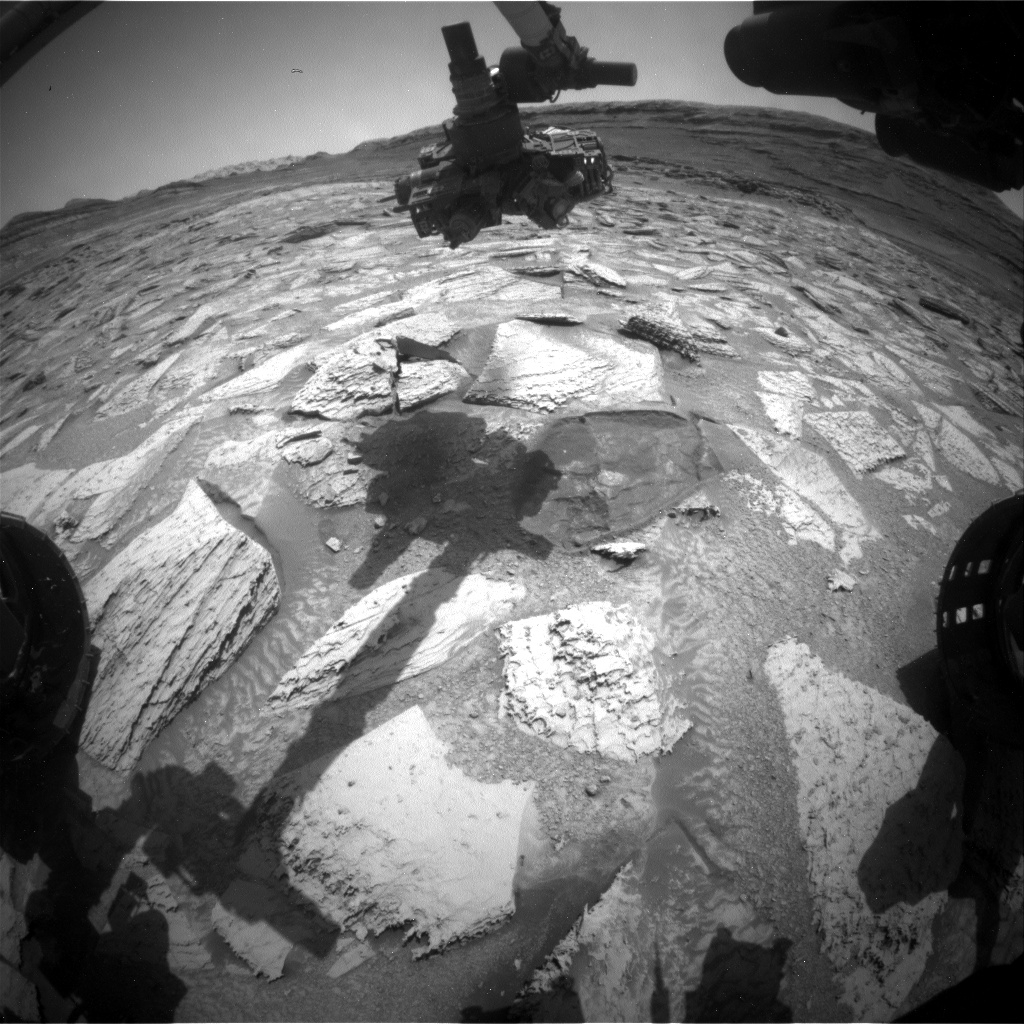
Curiosity Front Hazard Avoidance Camera photo taken on May 2, 2026.
Image credit: NASA/JPL-Caltech
Rock broken by rover drive
Mastcam planned stereo mosaics of rocks in the workspace including a laminated rock with an exposed edge named “Queen of the Andes,” a rock with polygonal fractures that was broken when the rover drove over it named “Curaco,” and more coverage of the “El Almendrillo” target.
Rounding out the plans, the Environmental theme group continued to monitor dust in the atmosphere, study cloud movements, and document the presence of dust devils. The rover will also autonomously select two targets to be analyzed by the Chemistry and Camera (ChemCam) instrument.
Drill campaign
Mars scientists look forward to continuing the drill campaign, where the next step will be delivering a portion of the Atacama target to the Chemistry and Mineralogy (CheMin) instrument for analysis.
The science team is looking forward to seeing how the mineralogy of the layered sulfate unit here compares to the last drill of the same unit at the Mineral King site, which is nearly 160 meters (525 feet) below the rover’s current location, Purdy concludes.
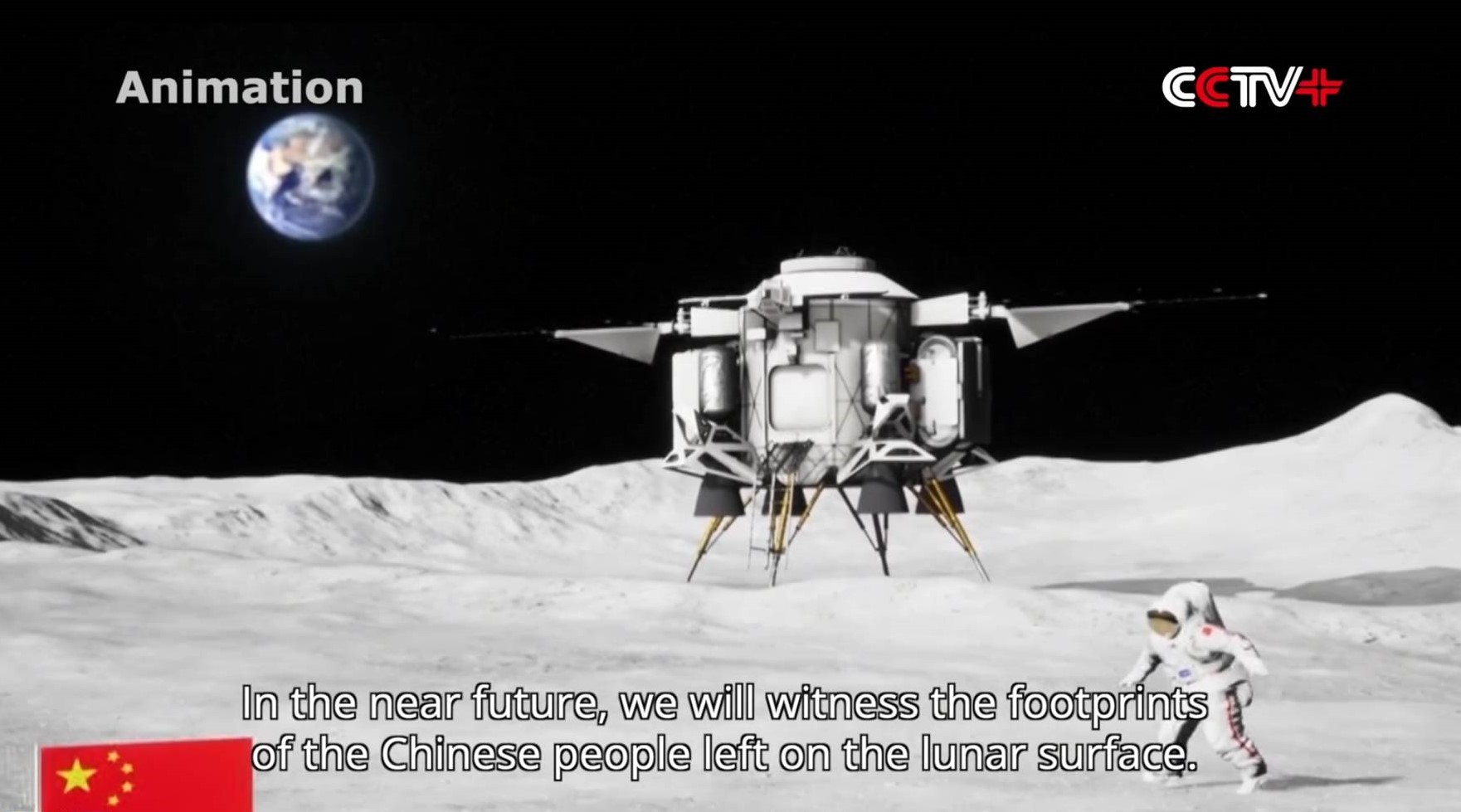
Image credit: CCTV/Inside Outer Space screengrab
Expect new breakthroughs in China’s space exploration program in the near future.
Leading researchers at the China Aerospace Science and Technology Corporation (CASC) note that critical space missions are scheduled this year and next.
China will launch its latest lunar probe and its Hubble-class Xuntian Space Telescope, as well as hundreds of satellites to support its Guowang broadband constellation.

Artistic view of China’s Xuntian space telescope. Image credit: CGTN/Inside Outer Space screengrab
“This year, we will send the Chang’e-7 probe to the Moon. There will be another space station mission next year, which might be the most valuable space station project in the history of science, and it will be launched by the Long March-5B rocket,” rocket designer Feng Shaowei from China Academy of Launch Vehicle Technology of the CASC told China Central Television (CCTV).
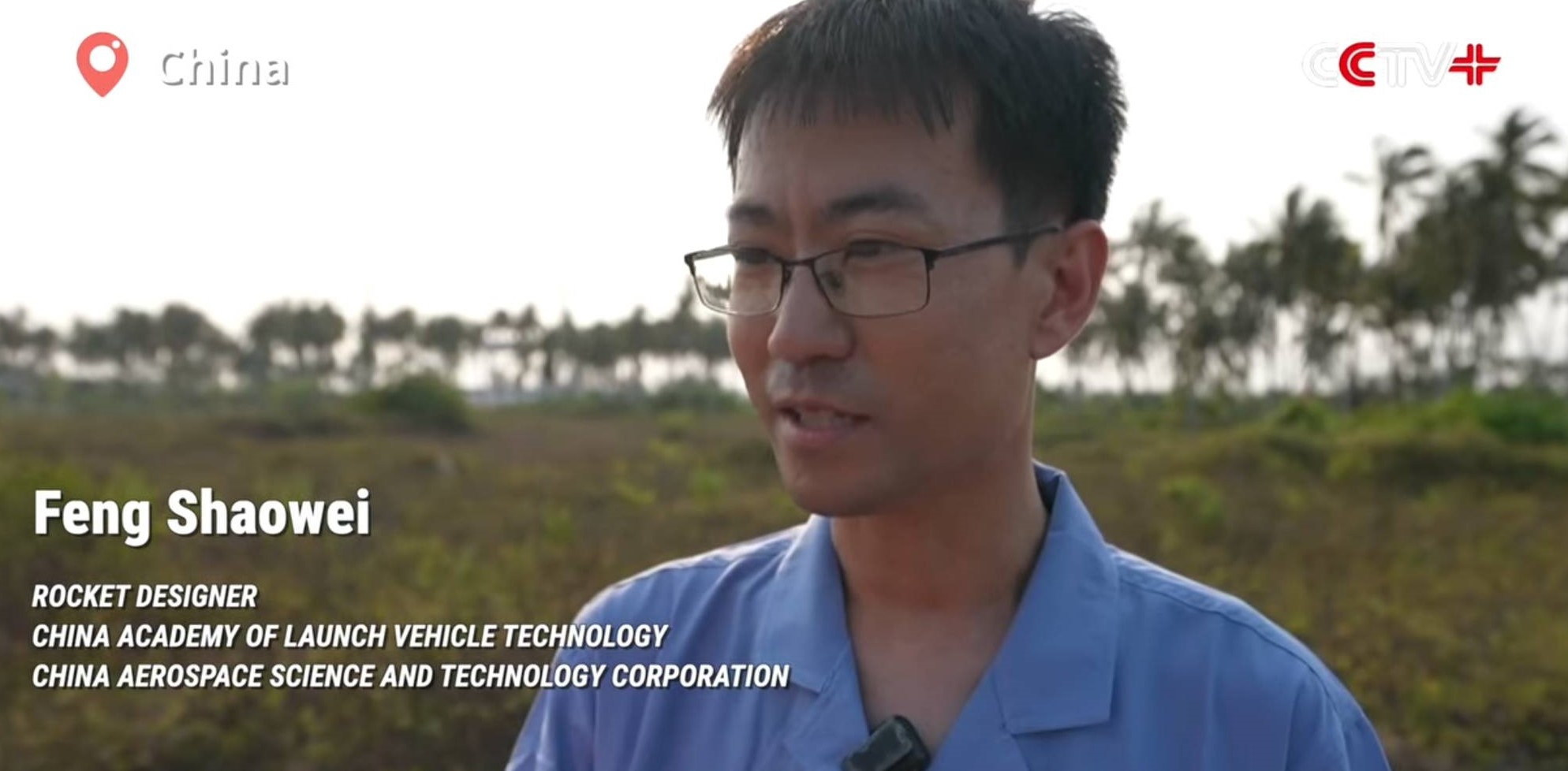
Image credit: CCTV/Inside Outer Space screengrab
Upcoming lunar exploration
Chang’e-7 will explore the Moon’s south pole, focusing on locating water ice and other resources in anticipation of a crewed lunar landing in the future.
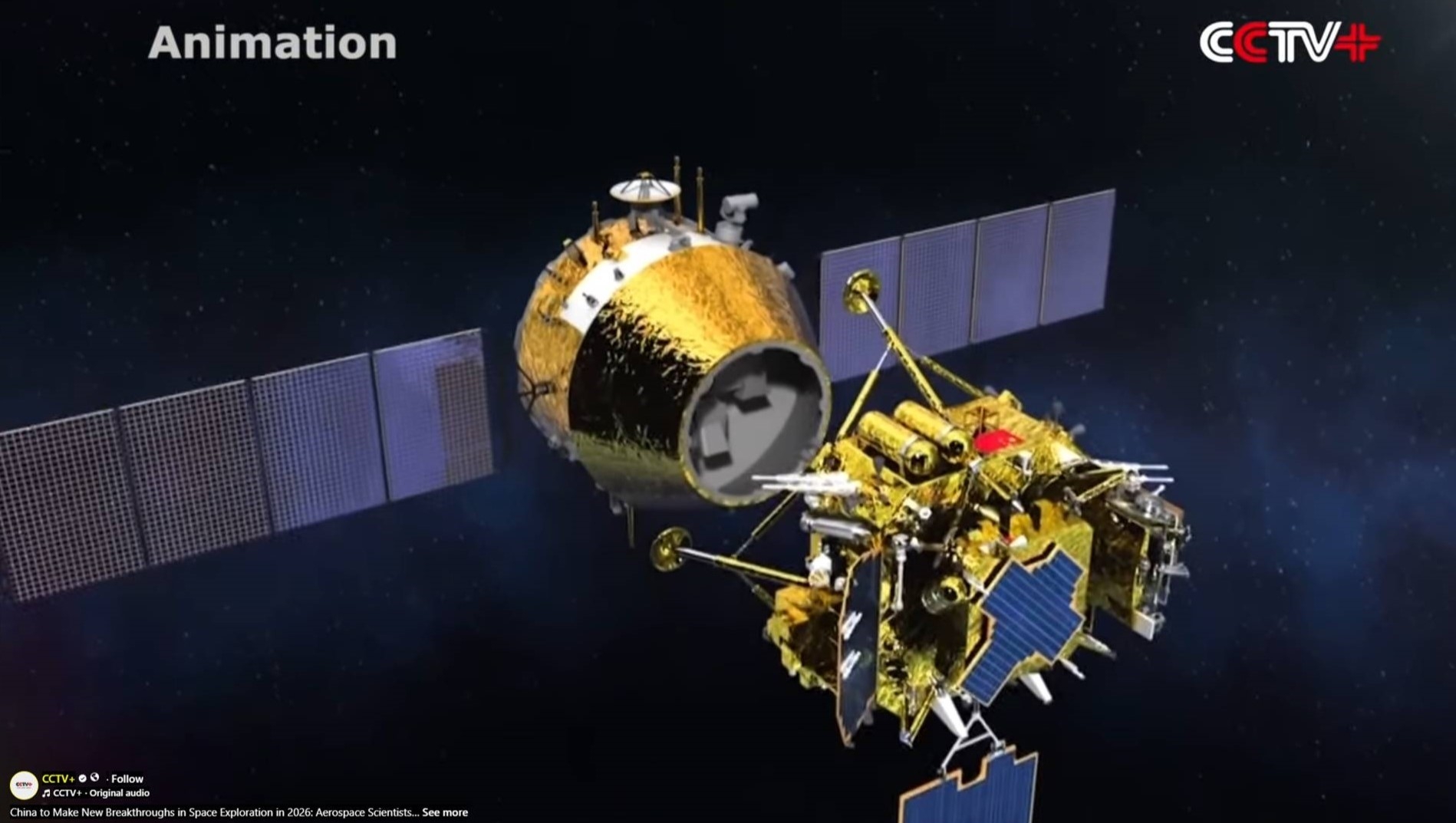
Chang’e-7 artwork. Image credit: CCTV/Inside Outer Space screengrab
According to CCTV, China’s Tiangong space station will continue to carry out its wide-ranging experimental research, both inside the station’s laboratories and outside its walls, with the use of robotic arms.
These arms are often used for research in exposing materials to space, but increasingly, they are also used to carry out complex logistical tasks, from collecting space cargo crafts to rearranging the station’s solar arrays.

Image credit: CCTV/Inside Outer Space screengrab
New station modules
Hou Yongqing, a space station systems expert from China Academy of Space Technology of the CASC, told CCTV that in the future, the country’s space station may see the addition of more modules to expand application capabilities. “At the same time, we will enhance the capabilities of our robotic arms, enabling them to perform even more complex tasks,” Hou said.
According to the CASC aerospace scientists, the coming years could even see China become the second country ever to put astronauts on the Moon.
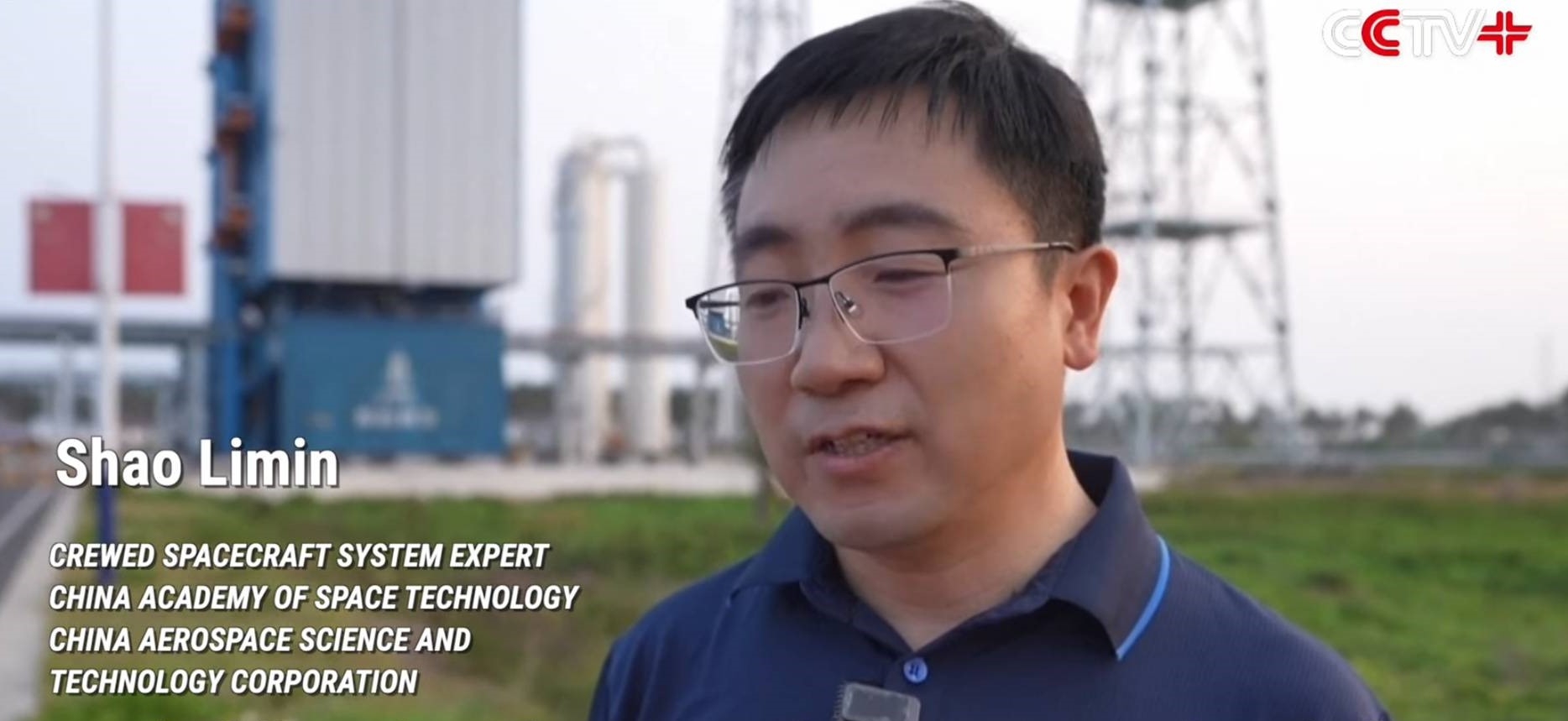
Image credit: CCTV/Inside Outer Space screengrab
New crewed spacecraft
“One thing we look forward to is seeing the new generation of crewed spacecraft flying into space, building a brand-new round-trip transportation platform between Earth and space for astronauts,” said Shao Limin, an expert in crewed spacecraft systems of China Academy of Space Technology.
“Our manned lunar exploration project has also been making steady progress in recent years. In the near future, we will witness the footprints of the Chinese people left on the lunar surface,” said Shao.
Go to this newly released CCTV video at:
https://www.facebook.com/reel/1245248530697645
Image credit: CCTV/Inside Outer Space screengrab
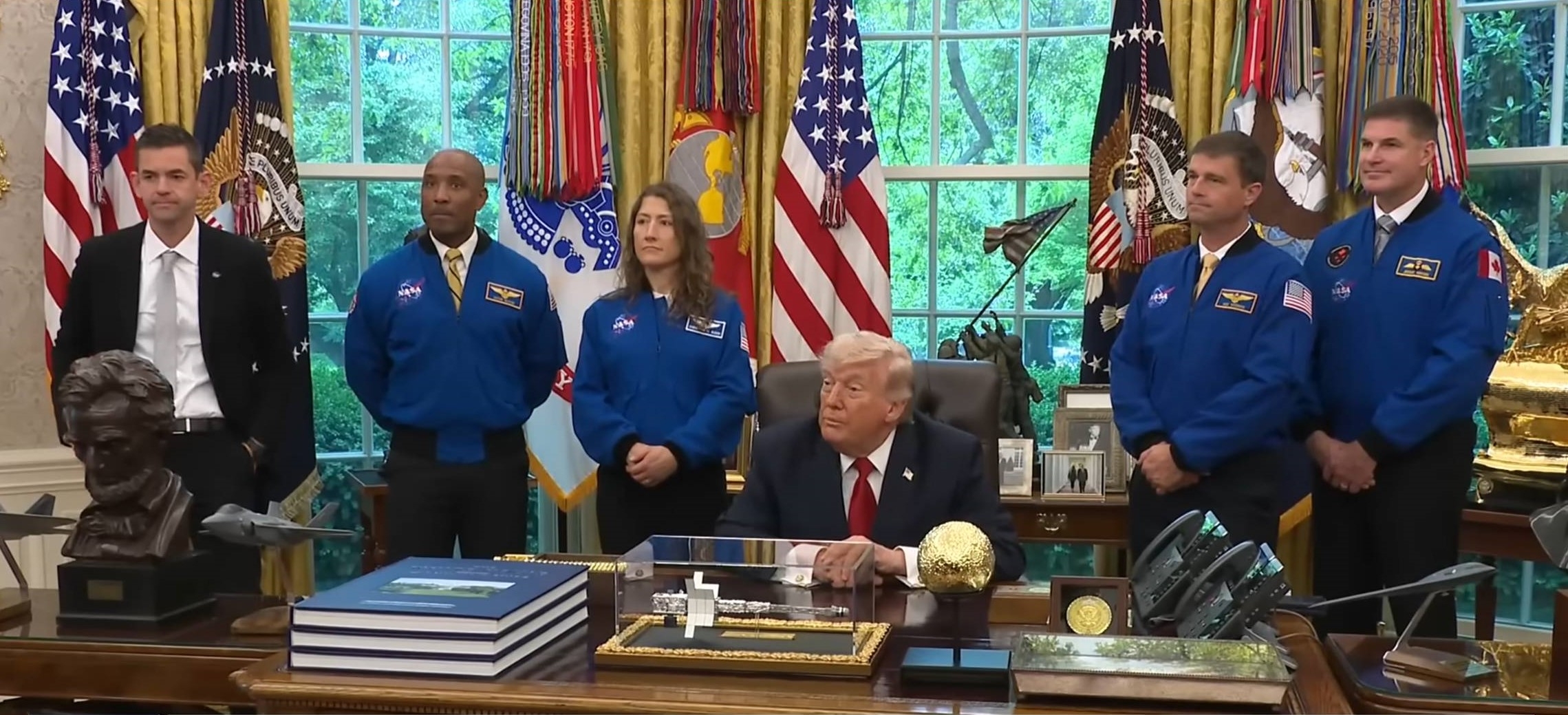
Note Space Reactor-1 (SR-1) Freedom on POTUS desk.
Image credit: White House/Inside Outer Space screengrab
The Artemis II crew and NASA chief, Jared Isaacman, took part April 29, 2026 in White House discussion of that mission and the future of America’s return to the Moon plans.
Go to:
https://www.whitehouse.gov/videos/artemis-ii-crew-visits-the-oval/
President Trump welcomes the astronauts of the Artemis II mission to the Oval Office at:
https://www.youtube.com/live/4hLYFGv9ktM?si=08P7Ybz2PUMHhcll
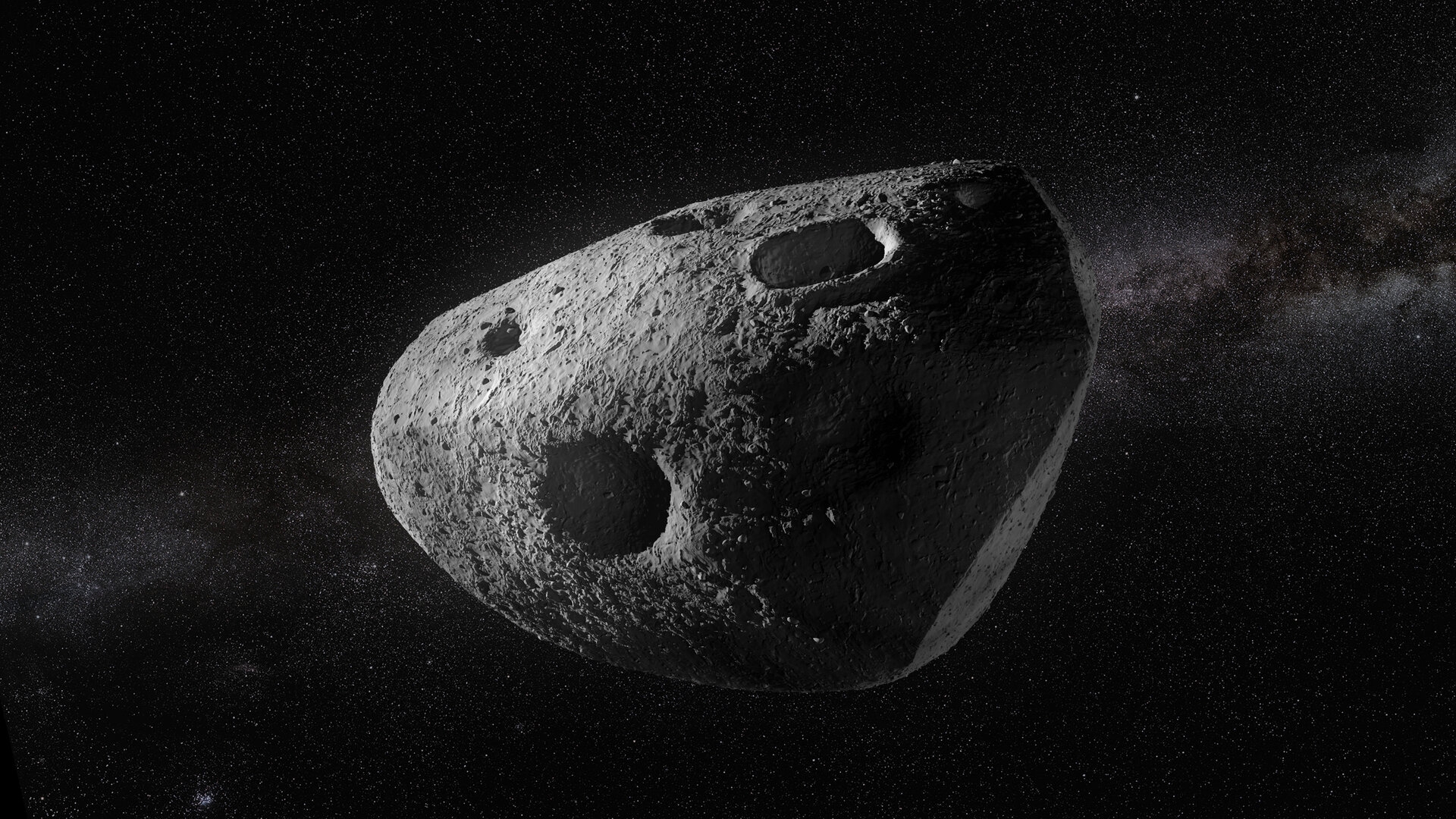
Planetary defense work is underway via the first commercial deep space rideshare mission, the Apophis EX mission by Exploration Labs.
Image credit: ExLabs
Colorado Springs, Colorado – Asteroid Apophis is a major rocky world visitor that in 2029 is whisking by Earth but also serves as a wake-up call for getting our planetary defense act together.
This Friday the 13th 2029 Apophis passage is stirring up — as luck would have it — considerable multi-nation action plans to reconnoiter that object at various stages as it careens toward Earth.

Asteroid Institute leader Edward Lu, former NASA astronaut, details his view of deflection techniques during panel discussion.
Image credit: Barbara David
A new entry for in-space Apophis-watching is what’s billed as the first commercial deep space rideshare mission: Exploration Labs’ (ExLabs) Apophis EX mission.
For more details, go to my new Space.com story – “This is going to be what makes the Earth secure – How one California company plans to protect us from dangerous asteroids,” – at:

