Author Archive
 Author:
  August 31st, 2025
Image credit: Ryan A Lannom/Jet Propulsion Laboratory
On the Moon, several moonwalkers stumbled and fell onto the lunar surface.
One technological out to this issue could be a pair of wearable robotic arms that extend out from a backpack. The arms could also crab-walk around a spacecraft’s exterior as an astronaut inspects or makes repairs.
Yes, this sounds a bit like “Inspector Gadget” or “Doctor Octopus,” but MIT’s Erik Ballesteros and his advisor, Harry Asada, have developed a system dubbed SuperLimbs.
Ballesteros is working with NASA Jet Propulsion Laboratory engineers to improve the design, which he plans to introduce to astronauts at the Johnson Space Center in the next year or two, hungry for practical testing and user feedback.
Ballesteros and Asada are continuing the work and refining the SuperLimbs concept.
 Posted in

Image credit: NASA/Bill Ingalls
It looks like Senator U.S. Senator Ted Cruz (R-Texas) and Creedence Clearwater Revival are singing from the same lyrics page.
From the popular rock group:
I see the bad moon a-rising
I see trouble on the way
I see earthquakes and lightning
I see bad times today.
U.S.-China space race
Fast forward to Senator Cruz, Chairman of the Senate Committee on Commerce, Science, and Transportation.

Image credit: CCTV/Inside Outer Space screengrab
Cruz is holding a Congressional hearing: “There’s a Bad Moon on the Rise: Why Congress and NASA Must Thwart China in the Space Race” in early September.
The September 3 hearing will examine legislative priorities for the upcoming reauthorization of NASA to ensure continued U.S. leadership in space.
“It will also explore the strategic, economic, and scientific importance of American dominance in low Earth orbit (LEO), lunar operations, Mars exploration, and deep space missions,” states a Cruz posting. “The hearing will assess how U.S. policy and investments can foster America’s competitive edge in the face of growing challenges from adversarial nations, like China, whose rapid space advancements pose a direct threat to U.S. leadership in the domain.”
Global leader
Announcing the upcoming hearing, Sen. Cruz notes:

Image credit: Huazhong University
“For decades, NASA has made the United States a global leader in space explorations, scientific discovery, and innovation. But make no mistake: we are in a 21st century space race. Communist China is not playing by the same rules, and they are aggressively investing resources to dominate space,” contends Cruz.
The lawmaker adds that the hearing promises to be an important opportunity to chart a course that “reinforces American leadership in space, strengthens NASA, fuels our growing commercial space sector, and protects our economic and national security interests in the final frontier.”

Image credit: Huazhong University
Witnesses
The on-tap hearing witnesses, with an additional witness perhaps announced at a later date, are:
Jim Bridenstine, Managing Partner of the Artemis Group and Former NASA Administrator
Dave Cavossa, President of the Commercial Space Federation
Allen Cutler, President and Chief Executive Officer of the Coalition for Deep Space Exploration
Dave Cavossa, President of the Commercial Space Federation
The September 3 hearing at 10:00 AM Eastern Time will stream live on the Committee web site and YouTube.
Go to: https://www.commerce.senate.gov/home
Also, go to my recent Space.com story – “China is making serious progress in its goal to land astronauts on the moon by 2030” – at:

Image credit: CCTV/CMSA/Inside Outer Space screengrab

NASA’s Robert Mosher displays a piece of webbing material, known as Zylon, which comprise the straps of HIAD aeroshell samples now in Earth orbit aboard the military’s X-37B space plane.
Image credit: NASA/Joe Atkinson
Another payload has been identified flying aboard the recently launched Space Force X-37 space plane – an experiment that may help land humans on Mars.
Lofted into Earth orbit on August 21, the X-36 carries several pieces of webbing material, known as Zylon that are being exposed to the harsh vacuum of space.
The Zylon material is under study as part of NASA’s Hypersonic Inflatable Aerodynamic Decelerator – or HIAD in space shorthand. HIAD is an aeroshell concept under development by NASA’s Langley Research Center in Hampton, Virginia.
The HIAD aeroshell technology is designed to allow larger spacecraft to safely descend through the atmospheres of celestial bodies like Mars, Venus, and even Saturn’s moon, Titan.

Illustration of Low-Earth Orbit Flight Test of an Inflatable Decelerator (LOFTID).
Image credit: NASA
Webbing material
“We’re researching how HIAD technology could help get humans to Mars. We want to look at the effects of long-term exposure to space – as if the Zylon material is going for a potential six to nine-month mission to Mars,” said Robert Mosher, HIAD materials and processing lead at NASA Langley. “We want to make sure we know how to protect those structural materials in the long term,” he added in a NASA statement.
Flying Zylon material aboard the Space Force’s X-37B mission will help NASA researchers understand what kind of aging might occur to the webbing on a long space journey before it experiences the extreme environments of atmospheric entry, during which it has to retain strength at high temperatures.
NASA’s HIAD aeroshell work builds on the agency’s Low-Earth Orbit Flight Test of an Inflatable Decelerator (LOFTID) mission back in 2022.

X-37B (OTV-8) military space plane being readied for flight, with its service module not shown in photo.
Image credit: U.S. Air Force/U.S. Space Force
Sensor, laser communications testing
The Boeing-built X-37B space plane – also identified as the Orbital Test Vehicle (OTV-8) – is outfitted with a service module that expands the capacity for experiments for mission partners, which include the Air Force Research Laboratory and the Defense Innovation Unit.
OTV-8 is to perform a quantum inertial sensor demonstration, as well as testing laser communications.
Shortly after its August 21 launch, the secretive U.S. Space Force X-37B deployed in Earth orbit a payload dubbed Limasat, probably ejected from the space plane’s service module, according to seasoned amateur satellite trackers.
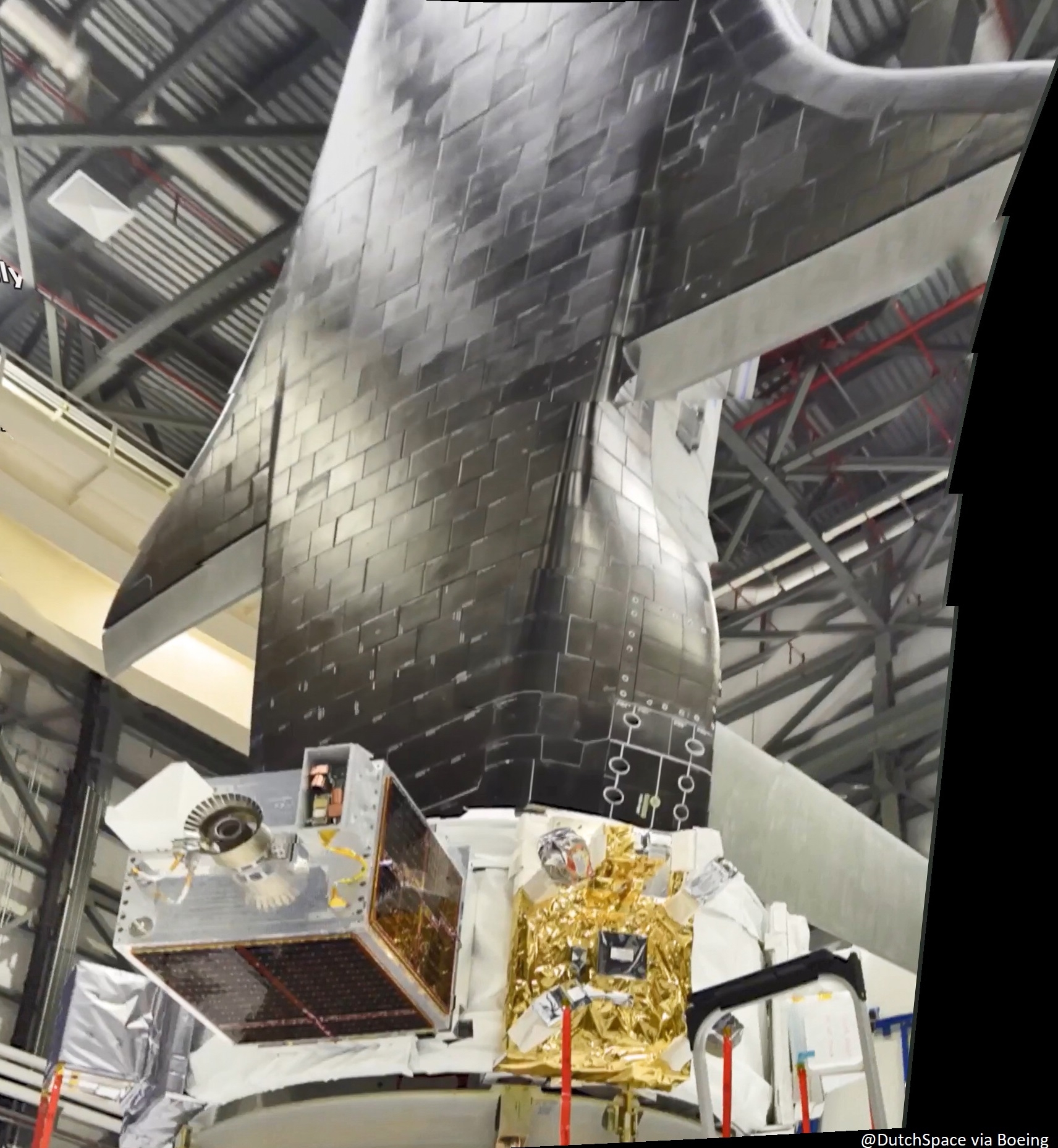
Image of Falconsat 8 mounted on the X-37B OTV-6 service module..
Image credit: Boeing via DutchSpace
Small canisters
As for NASA’s HIAD experiment, multiple samples of strap material are in small canisters on the X-37B, some tightly coiled up while others are loosely stuffed in.
“Typically, we pack a HIAD aeroshell kind of like you pack a parachute, so they’re compressed,” NASA’s Mosher said. “We wanted to see if there was a difference between tightly coiled material and stuff-packed material like you would normally see on a HIAD.”
Some of the canisters also include tiny temperature and humidity sensors set to collect readings at regular intervals.
When the U.S. Space Force de-orbits the X-37B – no telling how long the craft will be in orbit, NASA’s Mosher said he compare them to a set of samples that have remained in canisters here on Earth to look for signs of degradation.

The U.S. Space Force’s X-37B Orbital Test Vehicle Mission Seven successfully landed at Vandenberg Space Force Base, Calif., March 7, 2025. The X-37B landed at Vandenberg SFB to exercise the service’s ability to recover the spaceplane across multiple sites.
Image credit: U.S. Space Force courtesy photo
Previous flights
In related news regarding the hush-hush military space plane, U.S. President Trump’s “One, Big Beautiful Bill Act,” H.R. 1 includes $1 billion for the U.S. Space Force X-37B military spacecraft program.
Here’s a listing of previous flights of the space plane:
OTV-1: launched on April 22, 2010 and landed on December 3, 2010, spending over 224 days on orbit.
OTV-2: launched on March 5, 2011 and landed on June 16, 2012, spending over 468 days on orbit.
OTV-3: launched on December 11, 2012 and landed on October 17, 2014, spending over 674 days on-orbit.
OTV-4: launched on May 20, 2015 and landed on May 7, 2015, spending nearly 718 days on-orbit.
OTV-5: launched on September 7, 2017 and landed on October 27, 2019, spending nearly 780 days on-orbit.
OTV-6: launched on May 17, 2020 and landed on November 12, 2022, circling Earth for 908 days.
OTV-7: lofted on December 28, 2023 and touched down on March 7, 2025, circling Earth for 434 days.
OTV-8: launched on August 21, 2025 with no reported landing date.

Artwork depicts X-37B space plane. Image credit: Boeing/Inside Outer Space screengrab
Testing critical technologies
“OTV-8 exemplifies the X-37B’s status as the U.S. Space Force’s premier test platform for the critical space technologies of tomorrow,” said Air Force Rapid Capabilities Office (AFRCO) Acting Director, William Blauser, in an August 14 press statement. “Through its mission-focused innovation, the X-37B continues to redefine the art of the possible in the final frontier of space,” he stated.
Go to these previous Inside Outer Space-posted stories regarding this latest mission of the X-37B:
U.S. Military Space Plane – August Takeoff
https://www.leonarddavid.com/u-s-military-space-plane-august-takeoff/
Caught on Camera: U.S. Space Force Secretive Space Plane – Payload Deployed

Artwork depicts HIAD use for humans-to-Mars program.
Image credit: NASA Langley Research Center

Image credit: Rocket Lab
Rocket Lab has cut the ribbon on its high-tech Launch Complex 3, built to support its Neutron reusable rocket.
The complex is located within the Virginia Spaceport Authority’s Mid-Atlantic Regional Spaceport (MARS) at Pad 0D on Wallops Island, Virginia.

Image credit: Rocket Lab
Neutron is Rocket Lab’s reusable vehicle designed to loft 13,000 kilograms (33,000 pounds) to space for commercial constellations, national security and interplanetary missions, and eventually human spaceflight.
A Rocket Lab Launch Complex 3 official opening was held on August 28.

Image Credit: Rocket Lab
Novel design
Neutron utilizes a novel design that brings the stage 1 and payload fairings back to Earth as a single, integrated stage. Doing so maximizes cadence in a 13-ton to orbit reusable performance capability, explains Rocket Lab.
Neutron is powered by nine Archimedes engines on stage 1 and one vacuum-optimized Archimedes engine on stage 2.
“Our Neutron rocket, with its ability for responsive space access as a high cadence reusable launch vehicle, expands Virginia’s aerospace capabilities to enable the United States to quickly and reliably reach the International Space Station and low Earth orbit, as well as explore beyond Earth and on to the Moon and Mars,” said Rocket Lab founder and CEO, Sir Peter Beck prior to the ribbon cutting.

Image credit: Rocket Lab/Inside Outer Space screengrab
Complex complex
Shaun D’Mello, Rocket Lab’s vice president for Neutron, added that Launch Complex 3 was built and is now operational in less than two years of construction.
“Launch Complex 3 is an incredibly complex engineering feat that serves as a monument to exquisite design, streamlined operations, and the competitive advantage of Rocket Lab’s speed and efficiency.”
Construction on Launch Complex 3 began in late 2023, officially opened and declared operational in August 2025.
More than 60 contractors were involved in the site’s development to supply services, hardware, and materials – many of them Virginia-based local workers and companies, stated Rocket Lab.

Image credit: Rocket Lab
Propellant farms
The site’s roughly 30 feet 9 meters tall launch mount containing 700-plus tons of steel, operated by hydraulic mechanisms that support, hold, and will subsequently release Neutron for test and launch operations.
Launch equipment vaults at the complex house electrical and control equipment needed to operate the site’s ground systems and launch vehicle.
Additionally, the complex has 180,000 gallon liquid oxygen and Liquefied natural gas propellant farms that will store and load the Neutron booster with fuel and oxidizer for test and launch operations, alongside 45,000 gallons of stored liquid nitrogen in three vertical tanks.

Shower of praise at ribbon cutting.
Image credit: Rocket Lab
Wet and wild
The sprawling complex supports a 200,000–plus gallon capacity water supply tower standing at 200-plus feet tall.
That water supply to be used at Neutron’s roaring liftoff was showcased during the facility’s August 28 ribbon cutting.
Providing a wet and wild moment during the event, alongside Rocket Lab’s Beck and D’Mello, was Governor of Virginia, Glenn Youngkin, Congresswoman Jen Kiggans, Virginia Secretary of Transportation W. Sheppard Miller III, and Roosevelt Mercer, Jr., Maj Gen, USAF (Ret.), CEO & Executive Director of the Virginia Spaceport Authority.
Go to this Rocket Lab Launch Complex 3 official opening at:
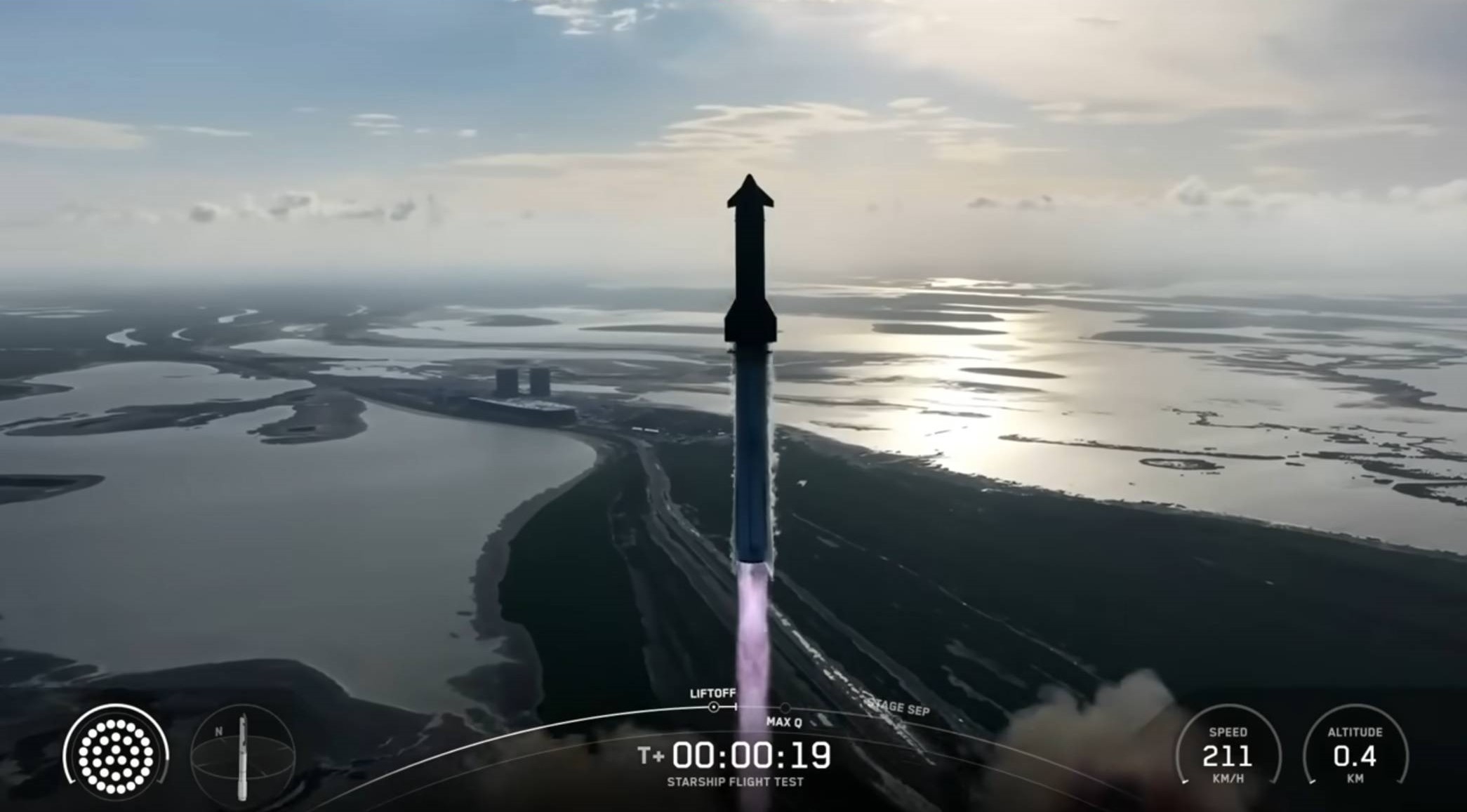
Image credit: SpaceX/Inside Outer Space screengrab
SpaceX has posted the following account of the Starship’s tenth flight test, highlighting milestones achieved (slightly abridged):
The flight test began on August 26, 2025 at 6:40 p.m. Central Time from Starbase, Texas.
Super Heavy lifted off by igniting all 33 Raptor engines and ascending over the Gulf of America.
Hot-staging maneuver
Ascent was followed by a hot-staging maneuver, with Starship’s upper stage igniting its six Raptor engines to separate from Super Heavy and continue the flight to space.
Following stage separation, the Super Heavy booster completed its boostback burn to put it on a course to a pre-planned splashdown zone.

Eight Starlink simulators deployed in the first successful payload demonstration from Starship. Image credit: SpaceX/Inside Outer Space screengrab
The booster descended and initiated its landing burn, intentionally disabling one of its three center engines during the final phases of the burn and using a backup engine from the middle ring.
Super Heavy entered into a final hover above the water before shutting down its engines and splashing down into the water.
In-space objectives
Starship completed a full-duration ascent burn and achieved its planned velocity, putting it on a suborbital trajectory.
The first in-space objective was then completed, with eight Starlink simulators deployed in the first successful payload demonstration from Starship.
Starship then completed the second ever in-space relight of a Raptor engine, demonstrating a key capability for future deorbit burns.

Pre-explosion image. Image credit: SpaceX/Inside Outer Space screengrab

Post-explosion debris caught in this image.
Image credit: SpaceX/Inside Outer Space screengrab
Pushing the envelope
Moving into the critical reentry phase, Starship was able to gather data on the performance of its heatshield and structure as it was intentionally stressed to push the envelope on vehicle capabilities.
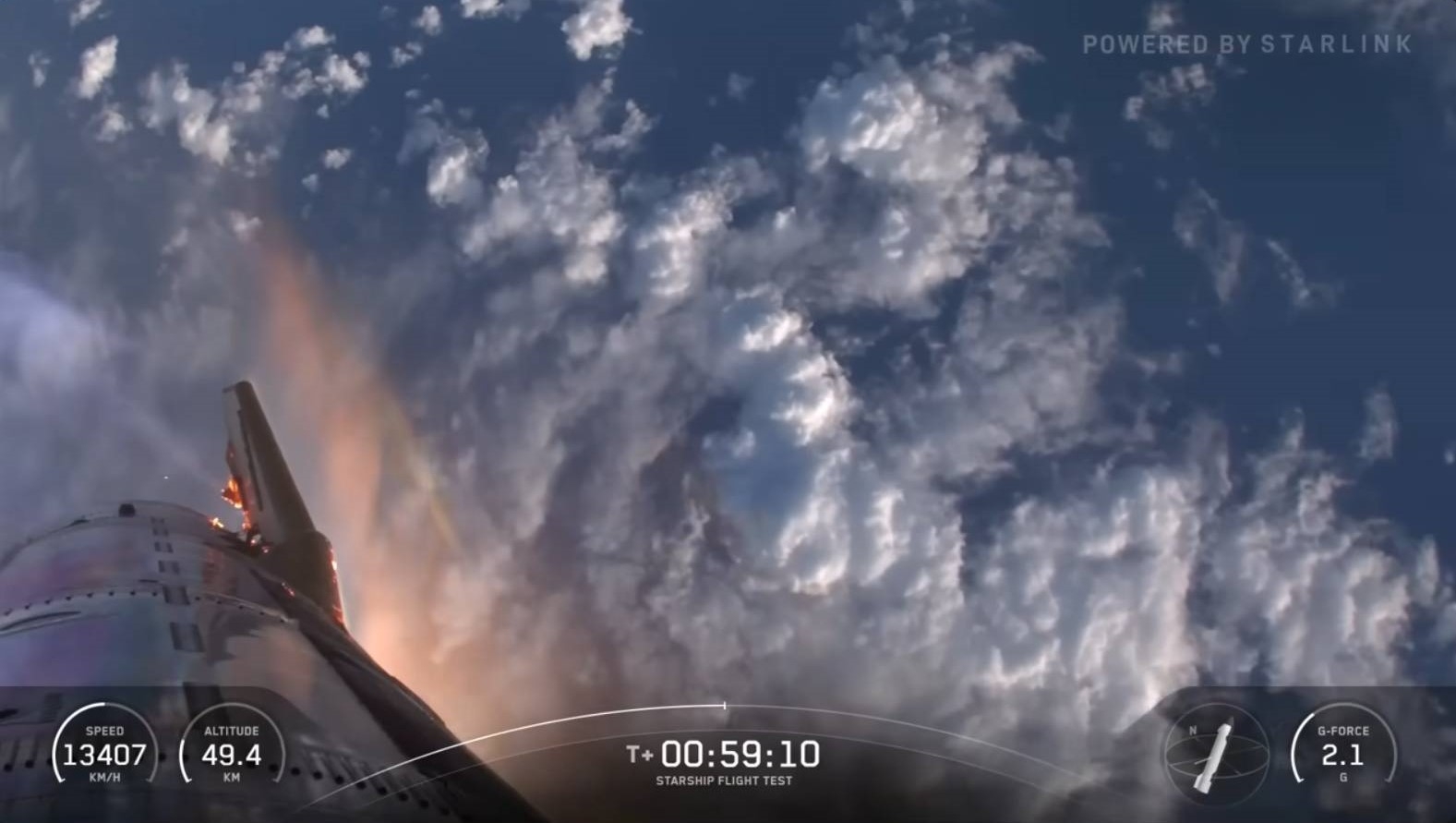
Image credit: SpaceX/Inside Outer Space screengrab
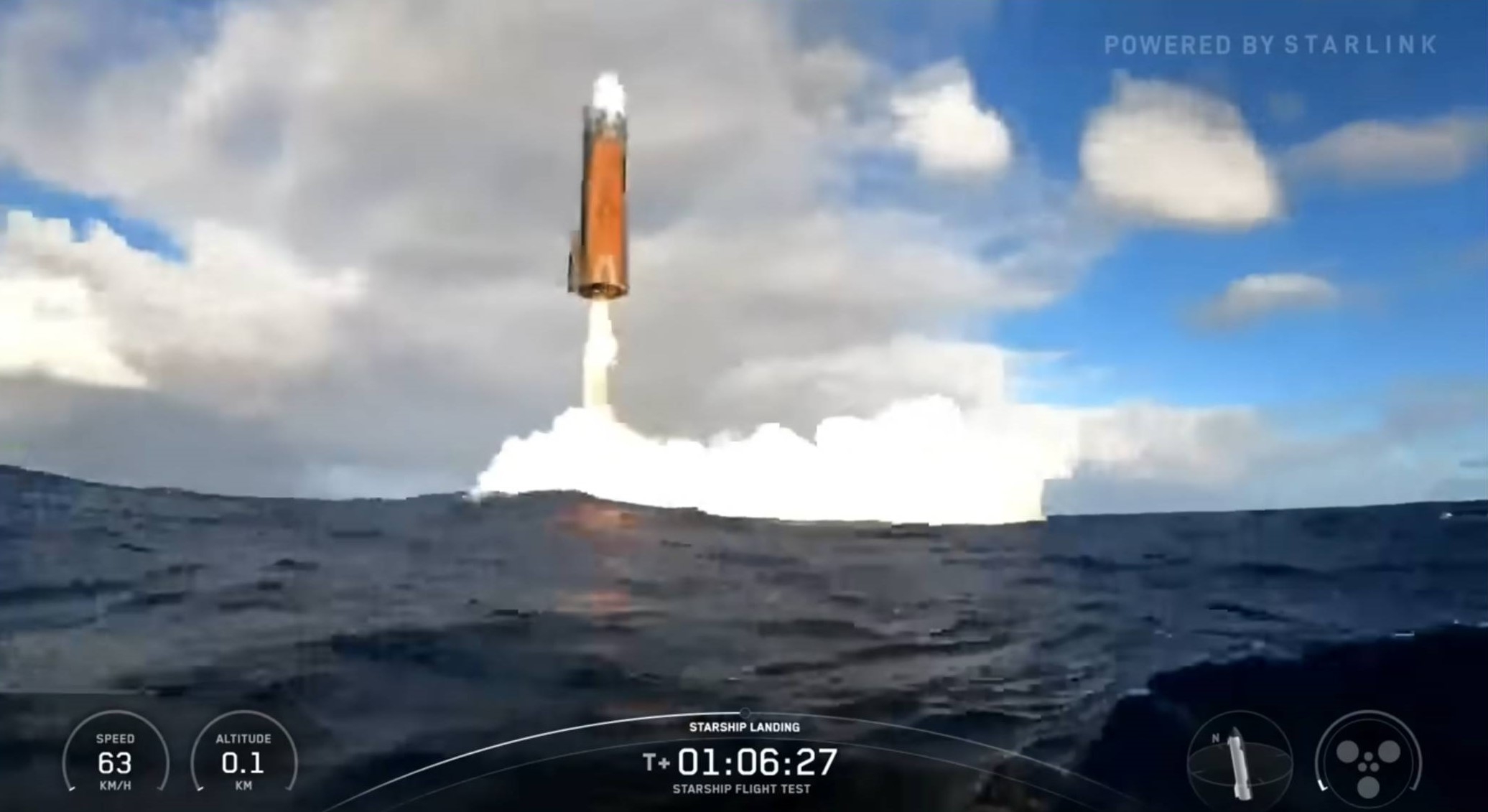
Image credit: SpaceX/Inside Outer Space screengrab
Using its four flaps for control, the spacecraft arrived at its splashdown point in the Indian Ocean, executed a landing flip, and completed the flight test with a landing burn and soft splashdown.
“Over the course of a flight test campaign, success will continue to be measured by what we are able to learn, and Starship’s tenth flight test provided valuable data by stressing the limits of vehicle capabilities and providing maximum excitement along the way,” the SpaceX posting concludes.
Editor’s note: For an independent review of the flight, go to this video by Scott Manley at:

Image credit: NordSpace/Inside Outer Space screengrab
A Canadian space startup is taking one small step toward an orbital capability.
NordSpace is launching a pathfinder demonstration flight of its fully Canadian-made suborbital rocket – Taiga.
The launch window is currently August 29, with Taiga’s liftoff from NordSpace’s Atlantic Spaceport Complex (ASX) SLC-02, outside the town of St. Lawrence in Newfoundland and Labrador, Canada.
Making history
The Taiga mission is called “Getting Screeched In” and is billed as the first commercial liquid rocket launch in Canadian history, and the first commercial launch from a commercial Canadian spaceport.

Image credit: NordSpace
In the future, the plan is for the Atlantic Spaceport Complex to support equatorial to polar orbits using multiple launch pads.
Taiga is roughly 17 feet tall and 1 foot in diameter and powered by the group’s proprietary 3D printed liquid rocket engine, called the Hadfield Engine. Taiga’s flight is a partially-fuelled test that will last about 60 seconds.

Orbital rocket
NordSpace is currently working on its orbital rocket, Tundra, which will be a two-staged vehicle powered by multiple of our 3D printed Hadfield engines.
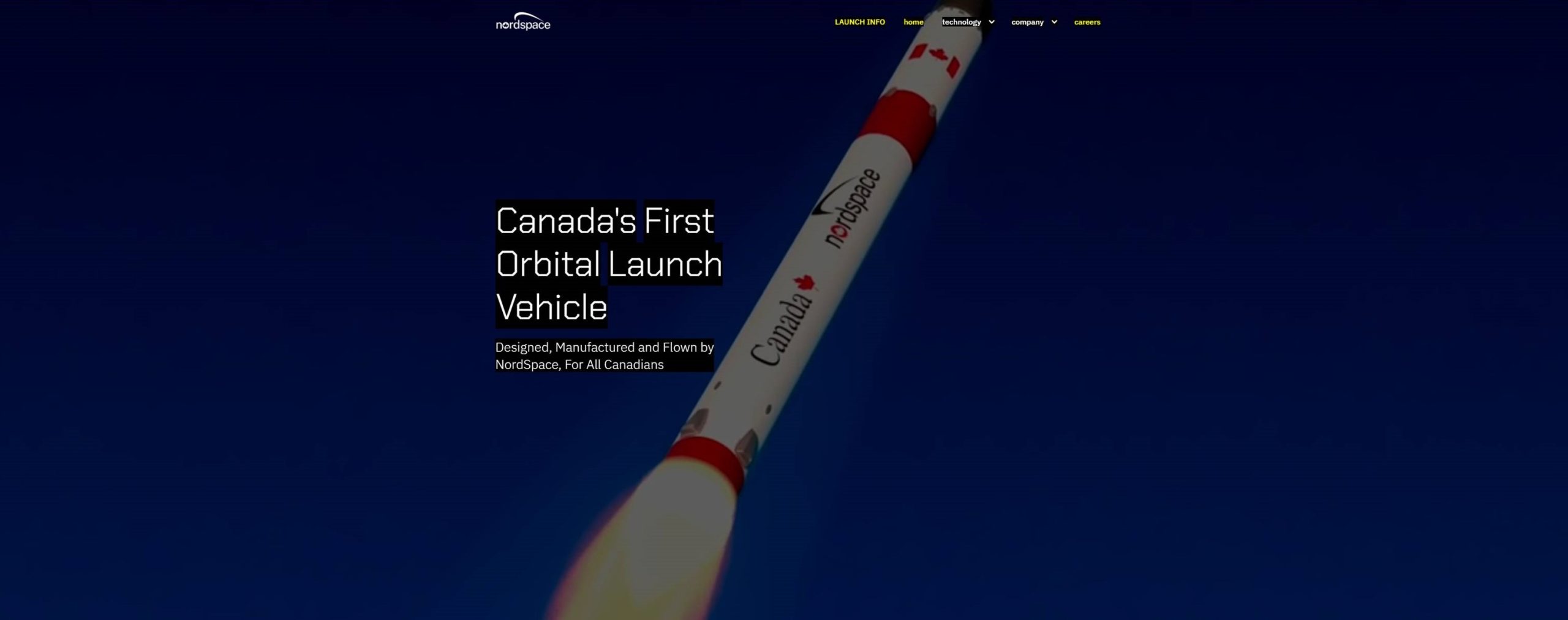
Image credit: NordSpace/Inside Outer Space screengrab
Tundra would be about 75 feet tall and approximately 15 feet in diameter. The group’s goal is to fly Tundra for the first time as early as 2027, according to the NordSpace website at:
A livestream of the Taiga suborbital launch will start approximately one hour prior to launch on Friday August 29, and is available at:
Image credit: CCTV/Inside Outer Space screengrab
China’s quest to land the country’s astronauts on the moon by 2030 is on full throttle.
That was clearly evident in an August 15 ground test of the first stage propulsion system of the Long March 10 (CZ-10) launch vehicle, China’s in-development rocket to boost a crewed spacecraft and a two-person lunar lander toward the Moon.
The recent static fire test of the Long March-10 follows a progression of other humans-to-the-moon milestones this year by China.
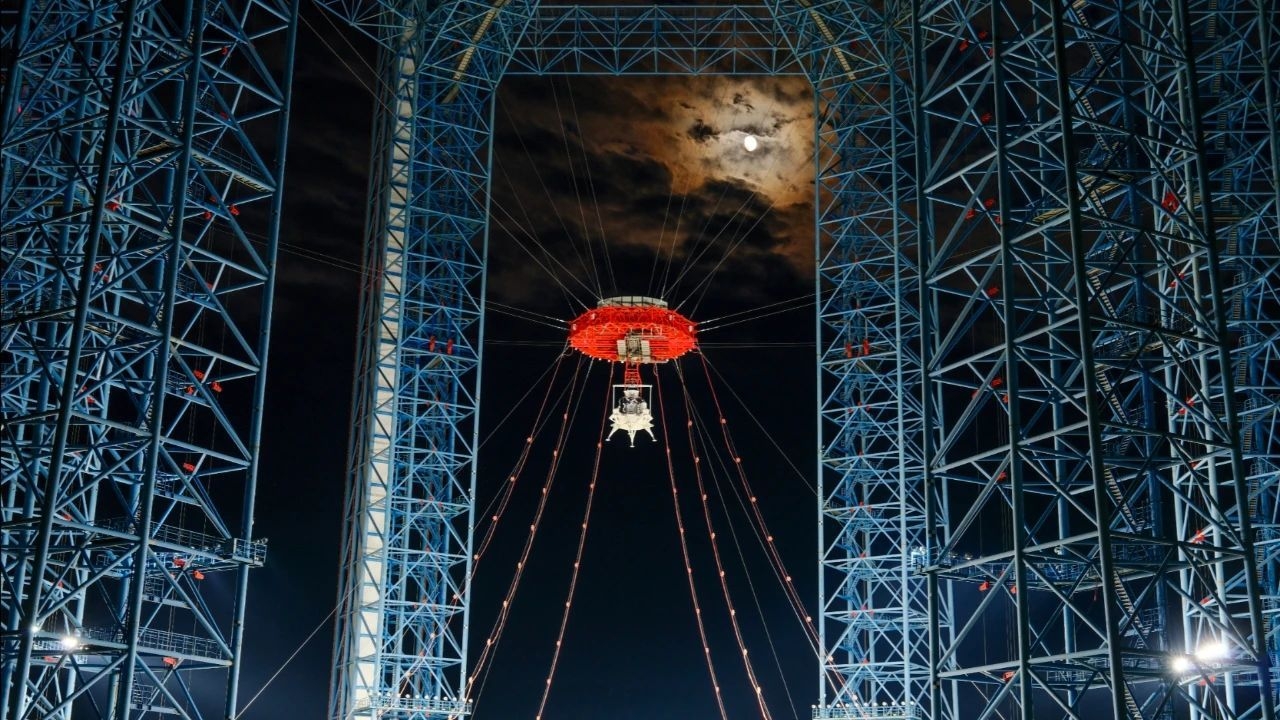
China completed a comprehensive test of its crew-carrying Moon lunar lander Lanyue in north China’s Hebei Province, August 6, 2025. Image credit: CGTN//China Media Group.
There was a successful zero-altitude escape flight test in June of the Mengzhou crewed spacecraft, as well as an August landing and takeoff test of the Lanyue piloted lunar lander.
For more information, go to my new Space.com story – “China is making serious progress in its goal to land astronauts on the moon by 2030” at:

August 26 liftoff of China’s Long March 8A.
Image credit: CCTV/Inside Outer Space screengrab
Once again, the Philippine Space Agency has issued an advisory regarding the August 26th launch of China’s Long March 8A booster from the Hainan commercial spacecraft launch site in the southern island province of Hainan.
The Long March 8A hurled a new satellite group into space early Tuesday, the tenth of its kind that will constitute an internet constellation.
Expected debris
The Philippine Space Agency (PhilSA) reports that expected debris from the rocket launch were projected to have fallen within identified drop zones approximately 130 nautical miles (NM) away from El Nido, Palawan, 55 NM away from Tubbataha Reef Natural Park, and 27 NM away from Hadji Muhtamad, Basilan.
Details of the rocket drop zone were disclosed through a Notice to Airmen (NOTAM) warning of an “aerospace flight activity.”
PhilSA disseminated a pre-launch report to relevant government agencies and authorities prior to the launch.
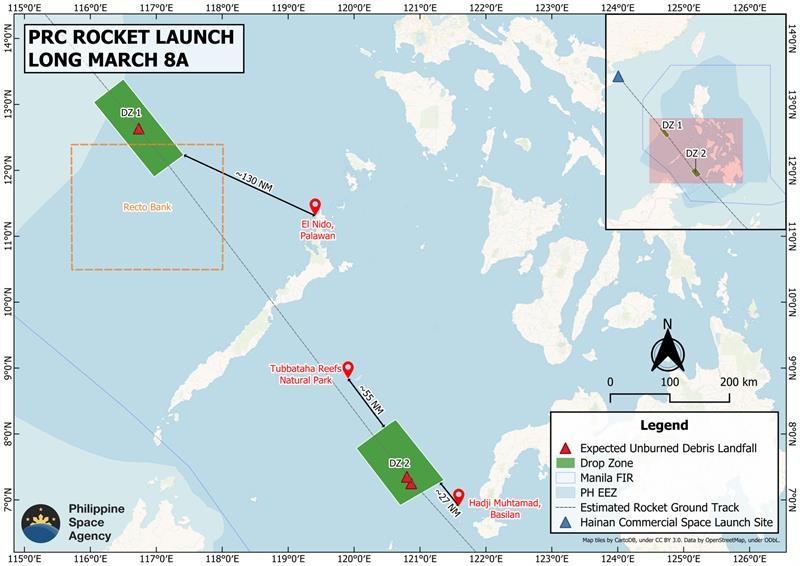
Estimated drop zone of the Long March 8A Launch.
Image credit: Philippine Space Agency
Potential risk
“Unburned debris from rockets, such as the booster and fairing, are designed to be discarded as the rocket enters outer space. While not projected to fall on land features or inhabited areas, falling debris poses danger and potential risk to ships, aircraft, fishing boats, and other vessels that will pass through the drop zone,” explains the PhilSA advisory.
“There is also a possibility for the debris to float around the area and wash toward nearby coasts. Additionally, the possibility of an uncontrolled re-entry to the atmosphere of the rocket’s upper stages returning from outer space cannot be ruled out at this time,” the advisory adds.
As it has repeatedly done, PhilSA also advises the public to inform local authorities if suspected debris is sighted. “PhilSA also cautions against retrieving or coming in close contact with these materials that may contain remnants of toxic substances such as rocket fuel.”

Another China launch, another day of picking up the pieces. Photo taken earlier this month on August 14 shows recovery operations.
Image credit: Philippine Coast Guard
For views of the launch via China Central Television (CCTV), go to:
https://www.facebook.com/reel/664171196076224
Go to this earlier Inside Outer Space story at:
https://www.leonarddavid.com/china-rocket-debris-recovered-by-philippine-coast-guard/
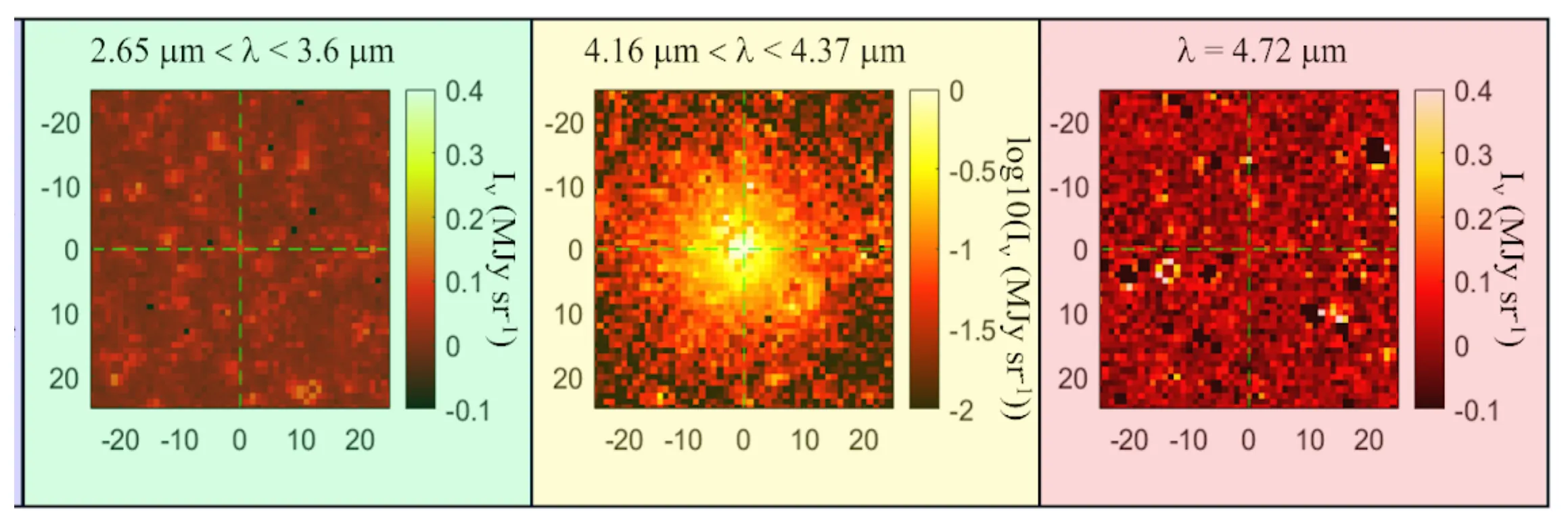
Images of 3I/ATLAS taken by the NASA SPHEREx Space Observatory.
Image credit: C.M. Lisse et al, 2025
Launched a few months ago, NASA’s SPHEREx space-based observatory has focused in on that interstellar intruder, object 3I/ATLAS.
The spacecraft has found strong water ice absorption and an extended carbon dioxide coma.
SPHEREx is short-speak for, get ready and steady – Spectro-Photometer for the History of the Universe, Epoch of Reionization and Ices Explorer.
Sent spaceward on March 11, 2025, SPHEREx is to conduct over a two-year planned mission gathering data on more than 450 million galaxies along with more than 100 million stars in the Milky Way in order to explore the origins of the universe. It will create an all-sky map of the universe.

This artist’s concept shows the spacecraft and its distinctive conical photon shields, which protect SPHEREx’s telescope from infrared light and heat from the Sun and Earth.
Image credit: NASA
Puzzling observation
From August 8 to August 12 the SPHEREx team observed interstellar object 3I/ATLAS.
In a newly released SPHEREx report, they note that the strong reflectance signature of water ice can be explained by the presence of abundant water ice in 3I’s nucleus and coma dust particles.
“The lack of a bright water gas coma is puzzling as 3I was not too far outside the Solar system’s “water ice line” at 2.5 AU during the observations.” Most likely, they add, 3I is so carbon dioxide rich that its evaporative cooling is pinning the solid’s temperature at roughly 120 Kelvin and suppressing the water ice’s vapor pressure.
Future work to observe the object is on tap as 3I/ATLAS will also pass through SPHEREx’s planned survey pattern again in November-December 2025.

Avi Loeb
Image credit: Chris Michel, National Academy of Sciences, 2023)
True nature?
The new findings are of great interest to Avi Loeb, head of the Galileo Project, and founding director of Harvard University’s Black Hole Initiative.
Loeb suggests that 3I/ATLAS may not be a water-rich comet as envisioned by comet experts when it was discovered.
“Alternatively, 3I/ATLAS may have targeted the inner solar system by technological design,” Loeb suggests. “This possibility is consistent with the alignment of its trajectory with the orbital plane of the planets around the Sun.”
Admittedly a controversial view, Loeb adds: “Here’s hoping that as the Sun turns on the heat on 3I/ATLAS in the coming months, it will reveal its true nature.”
X-37B (OTV-8) military space plane being readied for flight, with its service module not shown in photo.
Image credit: U.S. Air Force/U.S. Space Force
That secretive U.S. Space Force X-37B space plane in Earth orbit is under surveillance by amateur satellite trackers.
The Orbital Test Vehicle-8 (OTV-8), also labeled as USSF-36, was lofted on August 21 and has deployed in Earth orbit a payload dubbed Limasat, probably ejected from the space plane’s service module.
That’s the take from sky sleuth Marco Langbroek in the Netherlands.
The craft is in a preliminary orbit of 327 x 334 kilometers, in a 49.5 degree inclined orbit, Langbroek posted on his SatTrackCam Leiden website.

OTV-6 was the first mission to introduce a service module that expanded the capabilities of the spacecraft.
Image credit: Staff Sgt. Adam Shanks
Observables
“This morning (early 24 August 2025) weather finally cooperated and I managed to observe both of the USSF-36 payloads, two days after launch: the X-37B spaceplane OTV-8 (2025-183A) and LIMASAT (2025-183B)” Langbroek explains. “Limasat was about half a minute in front of OTV-8.”
Also posted by Langbroek is footage of both objects taken during the overhead pass. “The footage was obtained from my home in Leiden, the Netherlands, using a WATEC 902H2 Supreme camera with a Samyang 1.4/85 mm lens filming at 25 frames/second. This was an early twilight pass low in the south-southwest (27 degrees maximum elevation).”
Shortly after launch, Kevin Fetter, another satellite tracker in Canada, observed the OTV-8, posting on August 23 that “something came by roughly 15 seconds ahead of OTV. It took the same path as OTV 8 took. The object didn’t have a stable magnitude.”

Artwork depicts X-37B in Earth orbit with deployed solar panel. Image credit: Boeing/Inside Outer Space screengrab
Laser communications
According to a pre-launch Boeing statement, OTV-8 is flying with a service module. Doing so expands the capacity for experiments for mission partners, which include the Air Force Research Laboratory and the Defense Innovation Unit.
OTV-6 was the first mission to introduce a service module.
“The mission will host demonstrations of high-bandwidth inter-satellite laser communications technologies,” Boeing explains, “as well as the highest performing quantum inertial sensor ever tested in space. The U.S. Space Force will leverage insights from this mission to inform future space architectures.”
Image of Falconsat 8 mounted on the X-37B OTV-6 service module..
Image credit: Boeing via DutchSpace
Mission-focused innovation
In an X posting by DutchSpace, “for those wondering about the additional satellite, called limasat, on X-37B OTV-8, my guess would be that it was on the service module,” also posting an image of Falconsat 8 mounted on the X-37B OTV-6 service module.
“OTV-8 exemplifies the X-37B’s status as the U.S. Space Force’s premier test platform for the critical space technologies of tomorrow,” said Air Force Rapid Capabilities Office (AFRCO) Acting Director, William Blauser, in an August 14 press statement. “Through its mission-focused innovation, the X-37B continues to redefine the art of the possible in the final frontier of space,” he stated.
Langbroek’s video can be viewed at:

