Author Archive
 Author:
  January 24th, 2020
DLR sample carrier containing bacteria and fungi during its nine-hour journey into the stratosphere.
Credit: NASA
Late last year, astrobiologists let loose a “zoo” of microorganisms that traveled by high altitude stratospheric balloon for nine hours – a journey up to 19 miles (30 kilometers) above the Earth.
At this altitude, the shielding effects of Earth’s atmosphere are greatly reduced, and the temperature, radiation and pressure are akin to the conditions found on Mars.
The astrobiologists were from the German Aerospace Center (Deutsches Zentrum für Luft- und Raumfahrt), the DLR.
The DLR scientists took part in a NASA program called “Microbes in Atmosphere for Radiation, Survival and Biological Outcomes Experiment” or MARSBOx for short.
Preliminary findings
The results of that September 2019 trip are under analysis by a DLR team. The preliminary biological findings are now available.

The MARSBOx sample holder containing dried mould spores (left) and bacteria (right).
Credit: DLR
“These show that most of the bacteria have been killed, with the strong ultraviolet radiation proving to be particularly problematic for them,” points out a DLR statement on the MARSBOx flight. Only a few staphylococci – human pathogens – survived the journey. In contrast, mould spores survived better under the extreme conditions in the stratosphere.
Some of the organisms underwent testing outside the protective troposphere for the very first time.
Survival properties
Ralf Möller, a microbiologist at the DLR Institute of Aerospace Medicine in Cologne, explains: “In order to proliferate, moulds form spores that are highly resistant to extreme conditions such as dryness and radiation. In addition, fungi have very efficient protective mechanisms against radiation, such as strong black pigmentation and effective DNA repair.”

MARSBOx sample carrier back with the DLR microbiologists.
Credit: DLR (CC-BY 3.0).
Although many bacteria have properties that are similar to this, Möller adds that the mould spores are much more resistant to the extreme Martian conditions than the bacteria that the DLR team tested.
“The results demonstrate how important it is to continue with research into microorganisms,” Möller says, “particularly fungi, and their survival properties in space, not least in the interests of the health of astronauts on long-term missions to space stations and, later, to habitats on the Moon and Mars.”

Earth orbiting research lab – the International Space Station (ISS).
Credit: NASA
Major test campaign
Bacteria and fungi are part of nature and human life. Whether they live on the outside of our bodies – on our skin – or inside us,
Many species of bacteria and fungi are harmless. Some are even useful. On the other hand, there are also varieties that can be dangerous to humans and cause serious diseases. These pose invisible dangers to space travelers on space stations or on future journeys to outposts situated on other worlds, such as Mars.
Issues of “planetary protection” must also be considered. If landers, rovers or other space vehicles carrying bacteria or fungi set down on planets and celestial bodies, they could contaminate the surface.
Investigations into microorganisms under space conditions are ongoing.
For example, as early as summer 2020, samples for a major test campaign will be transported to the International Space Station (ISS) to investigate how they are affected by microgravity conditions in the short and long term.
 Posted in
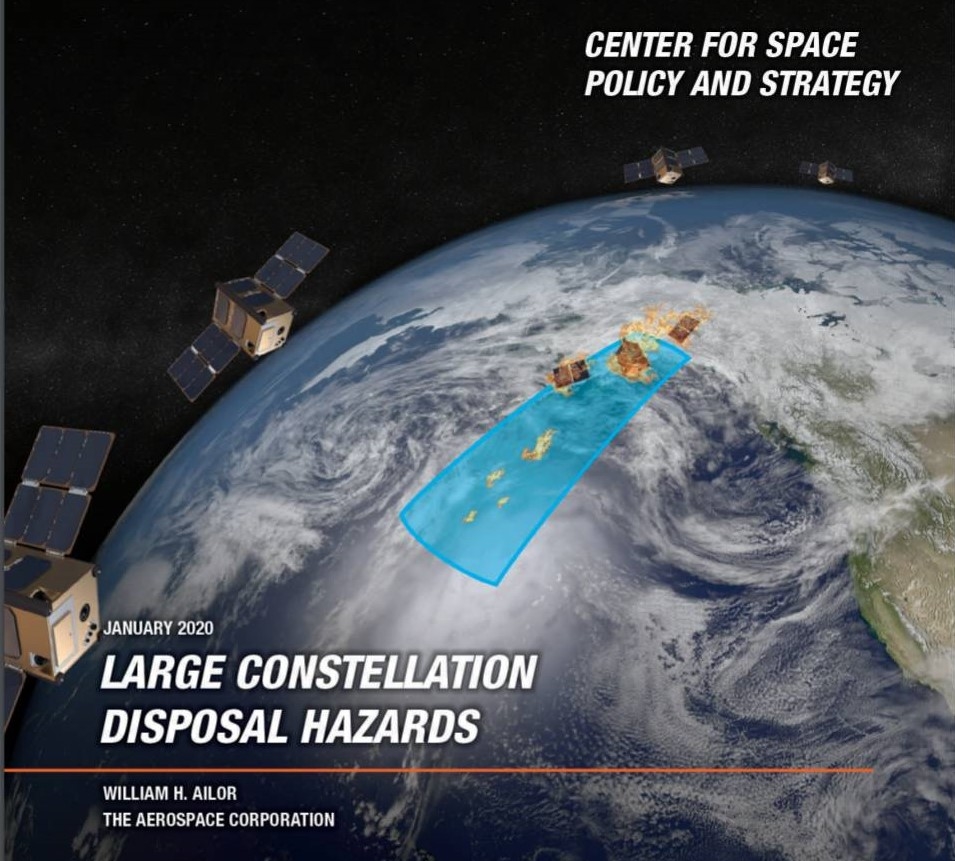
A new report looks at the yearly reentry of large numbers of satellite constellations, noting that they can pose a significant hazard to people, both on the ground and in aircraft.
But how great are the risks we face?
The assessment — Large Constellation Disposal Hazards – has been authored by William Ailor of The Aerospace Corporation and issued by the group’s Center for Space Policy and Strategy. Ailor is a Technical Fellow with the Center for Orbital and Reentry Debris Studies at The Aerospace Corporation in El Segundo, California.
Random reentries
This first-order appraisal of potential risks to people and aircraft from random reentries of large numbers of satellites from large constellations in low Earth orbits shows that risks to aircraft posed by small debris surviving a reentry might be a major problem facing owners of large constellations, with worldwide risk of an aircraft striking a reentering debris fragment on the order of once every 200 years.

One object that survived reentry of an Iridium satellite has been discovered on the ground. Debris hat survived reentry of Iridium satellite on October 11, 2018.
(Photo courtesy Kings County Sheriff’s Office)
Furthermore, the report explains that hazards to people on the ground from larger debris objects will also be a significant problem, with expectations as high as one casualty every 10 years.
Debris survival

Credit: The Aerospace Corporation/Center for Space Policy and Strategy
The report adds that spacecraft components and features could be designed to have fewer large and small fragments survive, but only limited hard data on actual debris survival currently exists.
Given that hundreds of satellites per year from very large constellations could reenter, designers might find it difficult to eliminate many small fragments hazardous to aircraft and to verify whether proposed mitigation techniques perform as desired.
For a copy of this informative report, go to:
https://aerospace.org/sites/default/files/2020-01/Ailor_LgConstDisposal_20200113.pdf

China’s Mars Orbiter, Lander, Rover effort.
Credit: China Aerospace Technology Corporation
China space officials have announced the month of this year’s launch for the country’s Mars orbiter/rover/lander: July.
According to China’s Xinhua news agency, this is the first time the country disclosed the launch month of its Mars exploration program.

China’s Mars mission elements.
Credit: CCTV/Inside Outer Space screengrab
The Mars probe mission will be sent to the Red Planet by the Long March-5 Y4 carrier rocket. That booster recently completed a 100-second test for its high thrust hydrogen-oxygen engine, which is the last engine examination before final assembly.
In an earlier China Global Television Network (CGTN) story, Ye Jianpei, chief scientist of Space Science and Deep-space Exploration with the Chinese Space Technology Academy, said: “The mission is going smoothly. If no surprise, the Mars explorer is going to be launched in 2020, and land before 2021.”

Credit: CCTV/Inside Outer Space screengrab
Triple tasks, one mission
The mission is designed to examine the Red Planet’s atmosphere, landscape, geological and magnetic characteristics, which could provide clues to the origin and evolution of Mars and the solar system, Ye said.
“Mars exploration is very innovative. If it proves to be a success, it will be the world’s first time a country completes the three tasks in one mission,” Ye added.

NASA’s Mars 2020 rover will collect and cache samples for later retrieval.
Credit: NASA/JPL-Caltech
Multiple Mars launches
If all goes well, China’s Mars explorer will have company.
The favorable Mars opposition launch window in 2020 is the target for the European Space Agency’s ExoMars lander mission (now facing parachute test issues); NASA’s Mars 2020 mega-rover (near ready to be shipped to Florida); as well as the UAE’s Hope Mars orbiter.

Mars landing simulation facility, making use of a tower nearly 460 feet (140 meter) in height.
Credit: CGTN
Test facility
Late last year, China unveiled a simulated Mars landing facility, making use of a tower nearly 460 feet (140 meter) in height, a testing structure situated at Huailai County, Hebei Province, north China. The six pylon tower facility included a servo system and a Martian surface simulation area.
The experiment simulated the gravity of Mars, about one-third of the gravity on Earth, to test the design of the lander, according to China Central Television (CCTV).

Testing facility for China’s Mars lander.
Credit: CGTN
Ambassadors and diplomats from 19 countries including France, Italy and Brazil, as well as representatives from the European Union, the African Union and the Asia-Pacific Space Cooperation Organization were invited to watch the experiment, said CCTV.
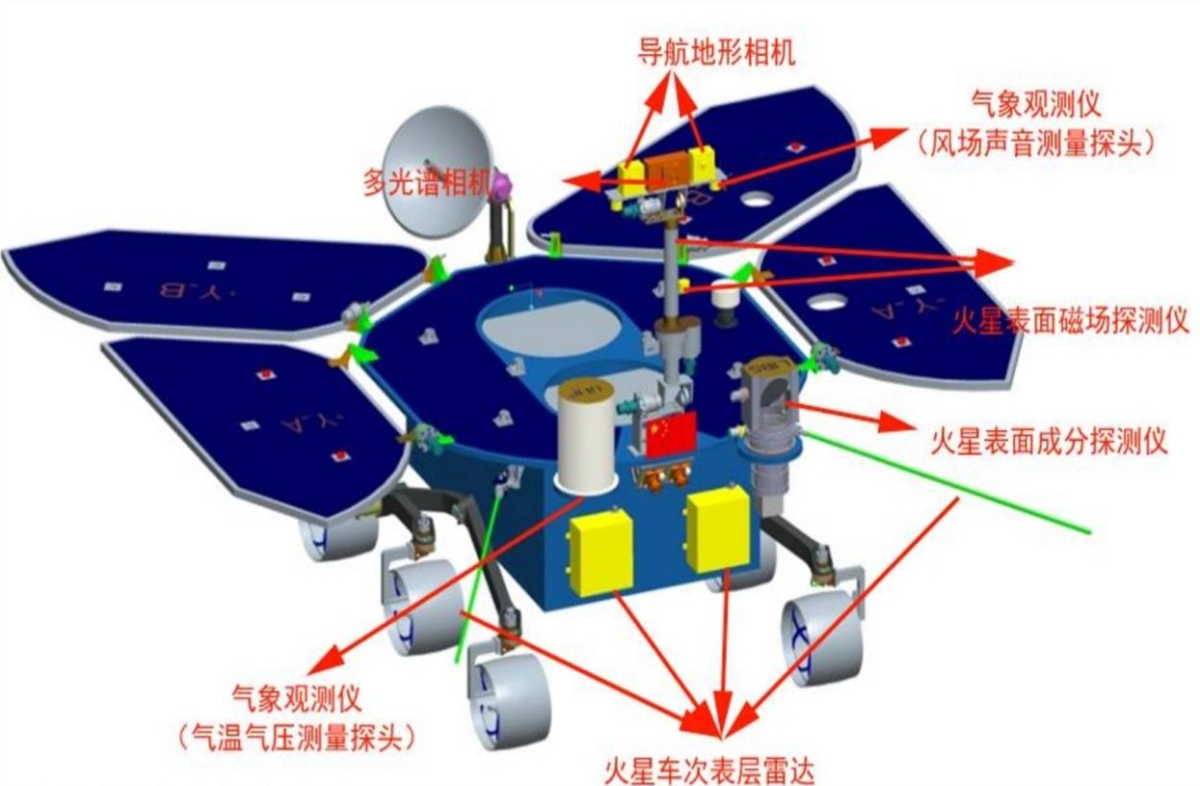
China’s Mars rover.
Courtesy: James Head
Landing procedure
In an earlier Xinhua news agency story, Zhang Rongqiao, chief designer of China’s first Mars exploration mission, said in order to simulate the landing procedure under the gravitational acceleration of Mars demanded construction of the facility.
A red platform in the middle of the pylons is fixed by 36 steel cables. Through precise control, Xinhua reports, the platform is able to simulate the Martian gravitational environment.
On the ground underneath the pylon tower, engineers created slopes and craters to mimic the environment of the Martian surface.

China’s Mars landing regions.
Courtesy: James Head
Touchdown regions
According to Xinhua, the test verified the procedures including the lander’s separation with the main body of the spacecraft from a height of 230 feet (70 meters), and then hovering at 67 meters above the surface, searching for a safe landing spot, and then descending to 20 meters above the surface in an obstacle-avoiding mode.
Regarding the selection of China’s robotic Mars landing site, a recent briefing from James Head of Brown University explained that two regions have been identified that represent a wide array of scientific sleuthing, including appraising possible habitats of life.
For a look China’s Mars exploration program, go to this embedded CGTN video at:
Also, go to this China National Space Administration (CNSA) video at:
https://www.youtube.com/watch?v=avuLL6XMYeg
Go to this video for a preview of China’s mission to Mars:
https://www.youtube.com/watch?v=hdj8-XSOAg8

Curiosity Right B Navigation Camera photo acquired on Sol 2648, January 17, 2020.
Credit: NASA/JPL-Caltech
NASA’s Curiosity Mars rover is now performing Sol 2653 tasks.
Curiosity has regained its knowledge of orientation to proceed with arm activities and mobility and is ready for science once more, reports Scott Guzewich, an atmospheric scientist at NASA’s Goddard Space Flight Center in Greenbelt, Maryland. “And a very full science plan was made!”
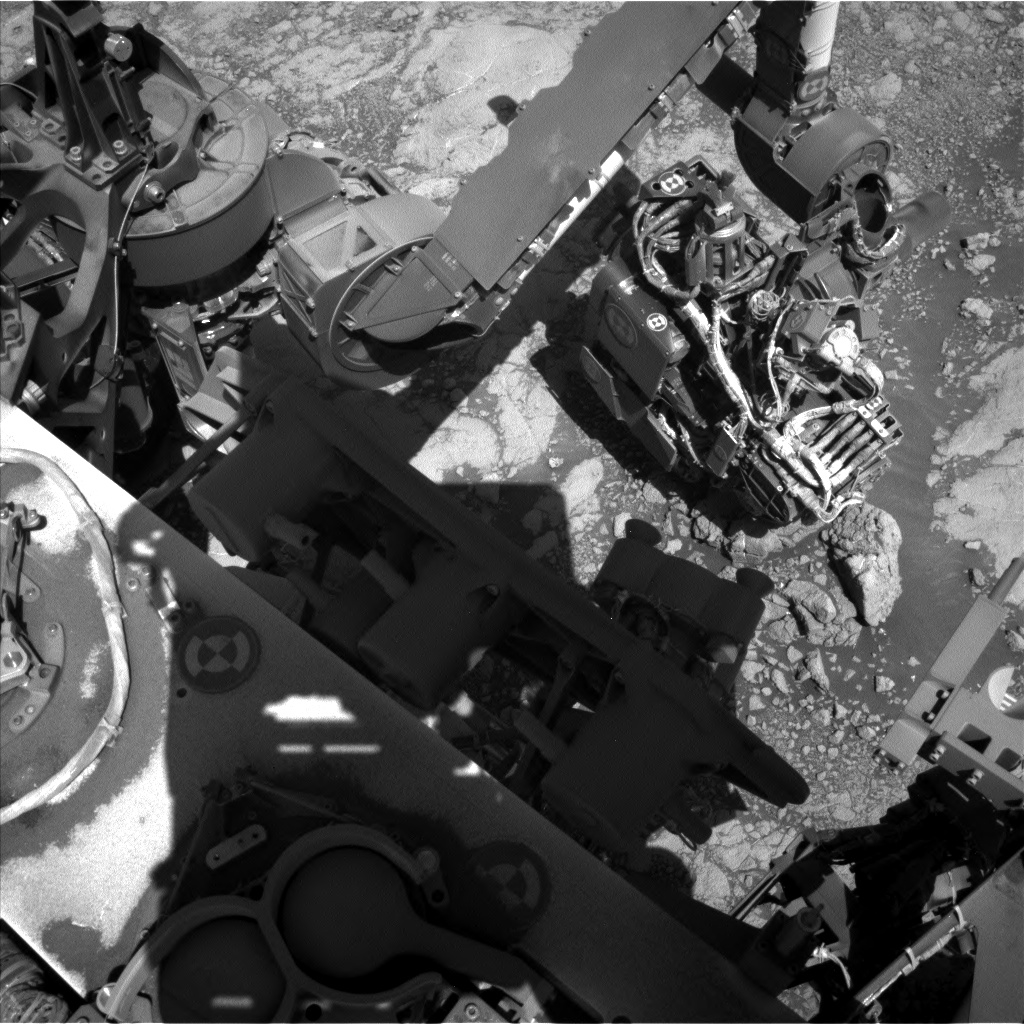
Curiosity Left B Navigation Camera image taken on Sol 2648, January 17, 2020.
Credit: NASA/JPL-Caltech
Much of that plan was recycled from last Friday’s intended plan, including contact science with the robot’s Alpha Particle X-Ray Spectrometer (APXS) and Mars Hand Lens Imager (MAHLI) on bedrock targets Moffat Hills and Trossachs.
Mosaic of Western Butte
Guzewich also reports that there was a plethora of Chemistry and Camera (ChemCam) Laser Induced Breakdown Spectroscopy (LIBS) targets, a Mastcam mosaic of Western Butte, Mastcam multispectral images on Trossachs, and environmental movies to search for clouds and dust devils while also documenting atmospheric dust levels.

This Hazcam image shows Curiosity’s arm extended out to perform an Alpha Particle X-Ray Spectrometer (APXS) analysis of the bedrock. Curiosity has to know the exact angle of every joint to move safely. Credit: NASA/JPL-Caltech
Curiosity Front Hazard Avoidance Camera Right B image taken on Sol 2648, January 17, 2020.
Credit: NASA/JPL-Caltech
Also planned was a rare measurement with APXS to measure the argon abundance in the atmosphere, Guzewich adds.
Argon variation
“Approximately 25 percent of Mars’ carbon dioxide-rich atmosphere condenses on the winter polar ice cap, while trace gases like argon do not,” Guzewich explains. “This leads to seasonal variations in the relative fraction of argon to carbon dioxide in the air. APXS can measure this argon variation by simply turning on and looking at the sky while the arm is stowed. Seeing argon vary through the year is akin to watching Mars breathe!”
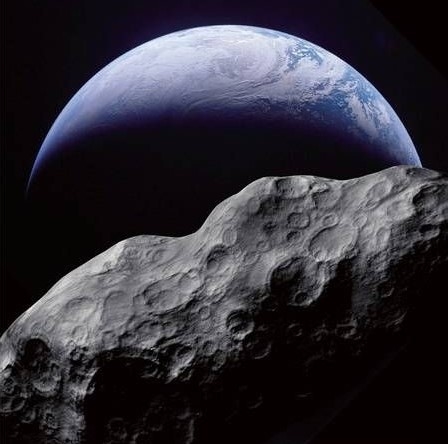
Credit: Image design by Tim Warchocki. Images courtesy of NASA (Earth) and Tim Warchocki (asteroid and stars).
Credit: Space Studies Board/National Research Council
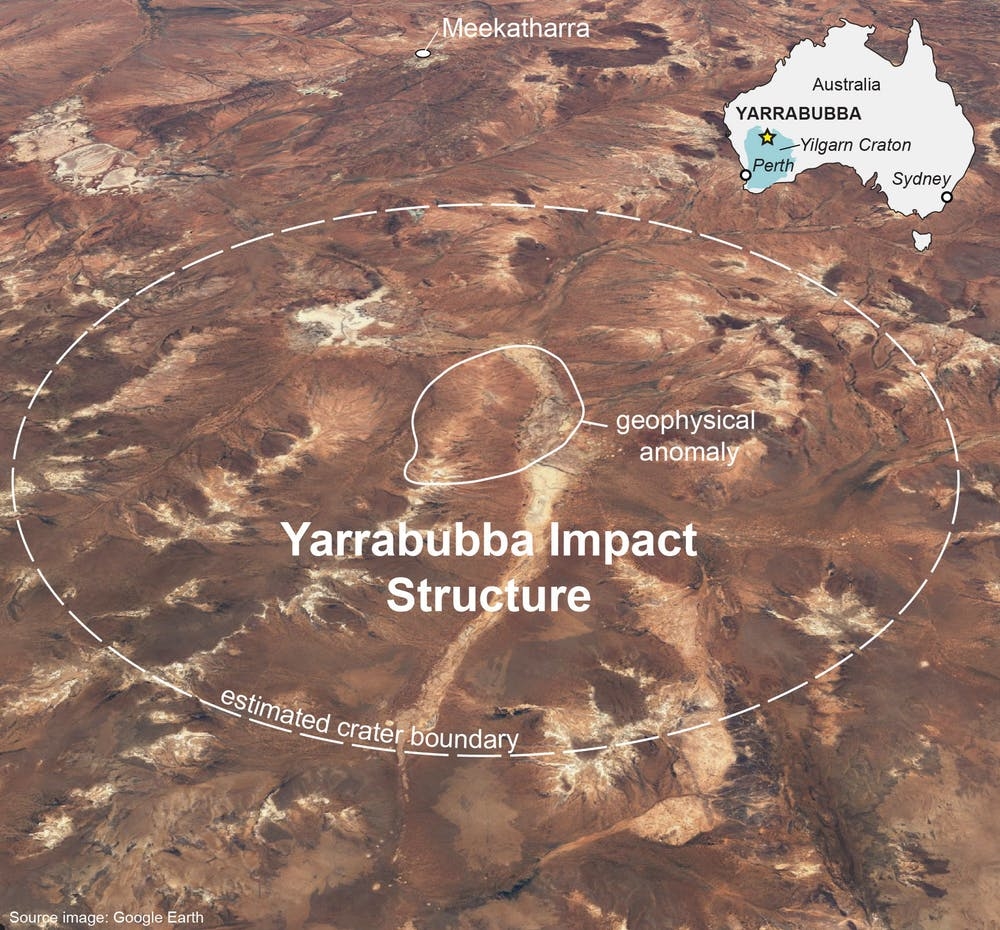
The roughly 44 mile (70 kilometers) in diameter Yarrabubba impact structure in Western Australia has been radiometric age dated to 2.2 billion years old, making it Earth’s oldest recognized asteroid impact structure.
That determination extends the terrestrial cratering record back greater than 200 million years.
Research led by Timmons Erickson from NASA Johnson Space Center and Curtin University in Australia, along with his colleagues, has been published in Nature Communications.
Extraterrestrial bombardment
In an introduction to their research, the team explains that extraterrestrial bombardment flux is speculated to have had major consequences for the development of Earth’s surface environment. “However, the terrestrial impact record is fragmentary, principally due to tectonics and erosion and is progressively erased into the geologic past when, conversely, the bombardment rate was larger than today,” they note.
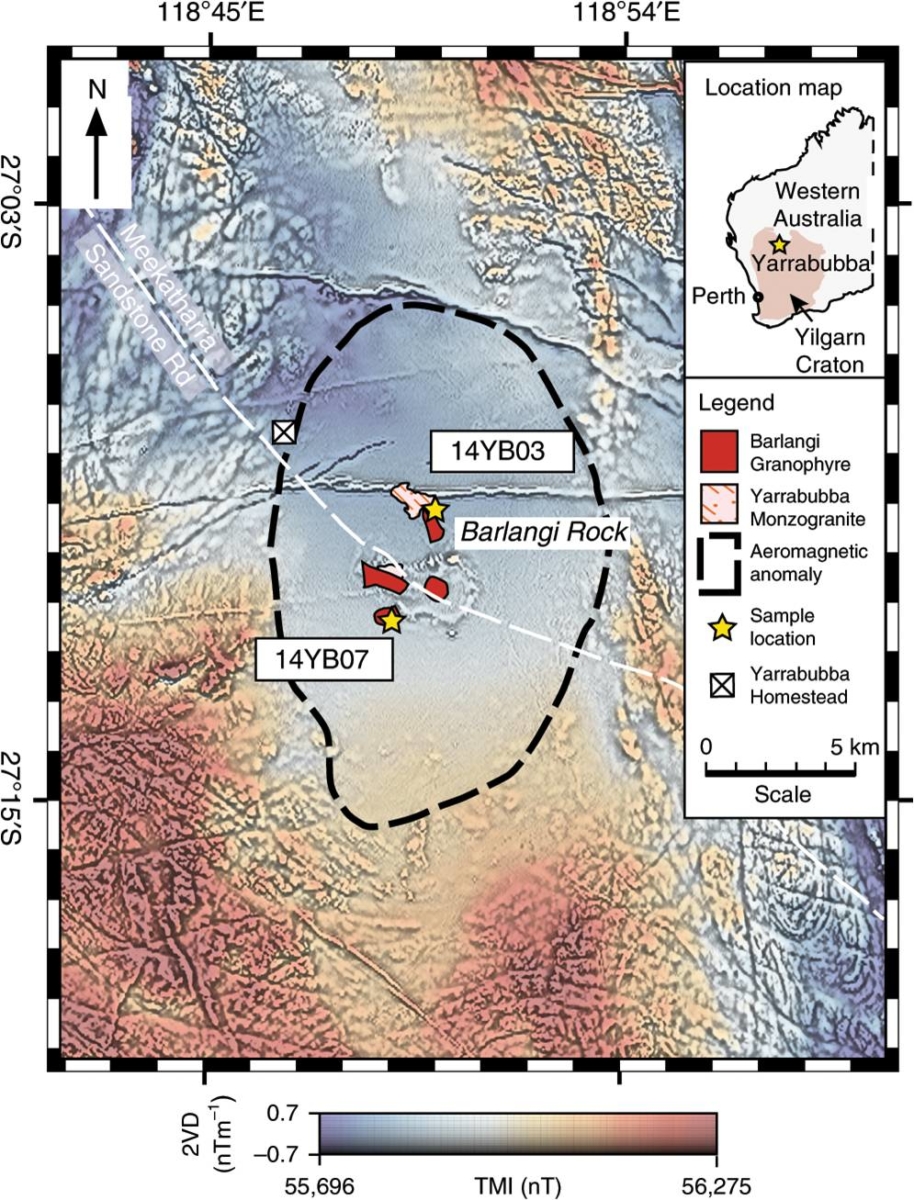
Map of the Yarrabubba impact structure and sample localities.
Credit: Erickson, et al.
Yarrabubba is a recognized impact structure located within the Murchison Domain of the Archaean granite—greenstone Yilgarn Craton of Western Australia. The research paper notes that no circular crater remains at Yarrabubba; “however, the structure has an elliptical aeromagnetic anomaly consisting of an even, low total magnetic intensity domain.”
The roughly 12 mile (20 kilometer) diameter magnetic anomaly has been interpreted to represent the remnant of the deeply buried central uplift of the structure, which is consistent with an original crater diameter of 44 miles (70 kilometers), they report.
Time of impact
These results establish Yarrabubba as the oldest preserved impact structure on Earth.
Furthermore, Erickson and colleagues suggest the 4.3 mile (7 kilometer) wide asteroid that shaped the Yarrabubba impact site could have been covered by a continental ice sheet at the time of impact.
The slam-bang result was spewing water vapor into the atmosphere and potentially warming Earth’s climate on a global basis. The research team applied numerical simulations to tease out the possible effects that a Yarrabubba-sized impact may have had on climactic conditions.
In their paper, the scientists say the findings “prompts further consideration of the ability of meteorite impacts to trigger climate change.”
To read the full paper – “Precise radiometric age establishes Yarrabubba, Western Australia, as Earth’s oldest recognized meteorite impact structure” – go to:

Core module of China’s first space station.
Credit: CGTN/Inside Outer Space screengrab
The core module of China’s first space station has reached the Wenchang Satellite Launch Center on Monday, according to the China Manned Space Engineering Office (CMCEO).

Credit: CGTN/Inside Outer Space screengrab
Named “Tianhe” — meaning harmony in the sky — the core is the management and control center of the space station. It is 54 feet (16.6 meters) long, with a maximum diameter of 14 feet (4.2 meters) and a launch mass of 22.5 tons.

Credit: CGTN/Inside Outer Space screengrab
Guidance, navigation and control
According to China Global Television Network (CGTN) and Xinhua news services, the core module can host three astronauts and do long-term missions in orbit. It will manage guidance, navigation and control for the entire space station. To date, it is the largest spacecraft developed by China and is able to support various space science and technical experiments inside and outside the capsule.
The module also contains a non-habitable service section and a docking hub.

Credit: CGTN/Inside Outer Space screengrab
Robotic arm
Tianhe-1’s debut also featured engineers from China Aerospace Science and Technology Corporation (CASC) to showcase the operation of a robotic arm to help station occupants to grab, hold and move objects.
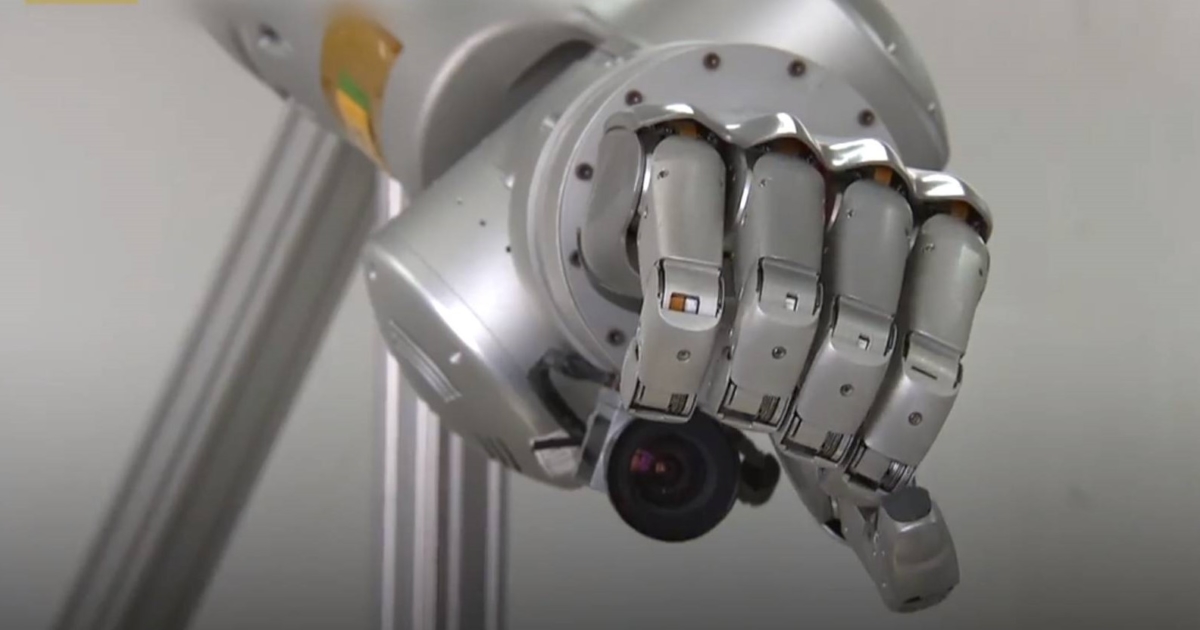
Credit: CGTN/Inside Outer Space screengrab
A Long March-5B booster is scheduled to arrive at the Wenchang space launch site in early February. The mission is expected to be carried out later in 2020. This would be followed by a series of launches for other components of the space station, including two space labs, which will dock with the core module.

Credit: CCTV/Inside Outer Space screengrab
New-generation spacecraft
In a related story, China’s new-generation piloted spacecraft is ready for a test launch, said the China Manned Space Engineering Office on Monday.
A test ship arrived safely at south China’s Wenchang Space Launch Center on Monday.
According to CCTV, the orbit height of the unpiloted test flight will be about 5,000 miles (8,000 kilometers) – an altitude never reached by China’s Shenzhou series manned spacecraft.

Credit: CCTV/Inside Outer Space screengrab
Greater heat resistance
“The new spacecraft uses new heat-resistant material and structure, which is only a third in density compared to the Shenzhou spacecraft, but the heat resistance is three to four times greater,” said Huang Zhen, chief assistant designer of the new manned spacecraft.

Credit: CCTV/Inside Outer Space screengrab
“We also upgraded our control on the return trip, which means we will further improve the accuracy of the landing point, and at the same time make sure the astronauts can withstand the impact,” Huang told CCTV.
The test ship will be launched by the Long March-5B rocket. There will also be verification on a new landing method using grouped parachutes and airbags, as well as reusability-related technologies.
A China Global Television Network (CGTN) detailing the core module and China’s space station plans can be viewed here at:
https://news.cgtn.com/news/33637a4e316b7a6333566d54/index.html
For a CCTV video on China’s new spaceship, go to:
This Hazcam image shows Curiosity’s arm extended out to perform an Alpha Particle X-Ray Spectrometer (APXS) analysis of the bedrock. Curiosity has to know the exact angle of every joint to move safely. Credit: NASA/JPL-Caltech
Curiosity Front Hazard Avoidance Camera Right B image taken on Sol 2648, January 17, 2020.
Credit: NASA/JPL-Caltech
NASA’s Curiosity Mars rover just entered Sol 2652. The robot has an “attitude” problem.
“Partway through its last set of activities, Curiosity lost its orientation. Some knowledge of its attitude was not quite right, so it couldn’t make the essential safety evaluation,” reports Dawn Sumner, a planetary geologist at University of California Davis.
“Thus, Curiosity stopped moving, freezing in place until its knowledge of its orientation can be recovered,” Sumner adds.
Curiosity Left B Navigation Camera image taken on Sol 2648, January 17, 2020.
Credit: NASA/JPL-Caltech
Recovery plan
“Curiosity kept sending us information,” Sumner continues, “so we know what happened and can develop a recovery plan.”
Curiosity engineers did build a plan to inform Curiosity of its attitude and to confirm what happened. “We want Curiosity to recover its ability to make its safety checks, and we also want to know if there is anything we can do to prevent a similar problem in the future. This approach helps keep our rover safe,” Sumner notes.
Curiosity Right B Navigation Camera photo acquired on Sol 2648, January 17, 2020.
Credit: NASA/JPL-Caltech
Body awareness
Sumner explains the situation:
“Knowing where our bodies are helps us move through the world. We know if we are standing or sitting, if our arms are out or by our sides (or for some people, not there at all). This body awareness is essential for staying safe.”
“Rovers also need to know where their bodies are relative to their surroundings. Curiosity stores its body attitude in memory, things like the orientation of each joint, which instrument on the end of its arm is pointing down, and how close APXS [Alpha Particle X-Ray Spectrometer] is to the ground. It also stores its knowledge of the environment, things like how steep the slope is, where the big rocks are, and where the bedrock sticks out in a dangerous way.”
Safety checks
“Curiosity evaluates this information before any motor is activated to make sure the movement can be executed safely. When the answer is no – or even maybe not – Curiosity stops without turning the motor. This conservative approach helps keep Curiosity from hitting its arm on rocks, driving over something dangerous, or pointing an unprotected camera at the sun. These safety checks require an accurate knowledge of the rover position within its environment and are an essential part of good engineering practice. They have kept Curiosity safe over the years.”

Courtesy: Michael Masters
Those purported eye-catching and sky-cruising unidentified flying objects over the decades have captured the public’s attention. As exoplanet detection is on the rise, why not consider that star-hopping visitors from afar might be buzzing through our friendly skies by taking an interstellar off-ramp to Earth?

Courtesy: thortful.com https://www.thortful.com/
On the other hand, could those piloting UFOs be us – our future progeny that have mastered the landscape of time and space? Perhaps those reports of people coming in contact with strange beings represent our distant human descendants, returning from the future to study us in their own evolutionary past?
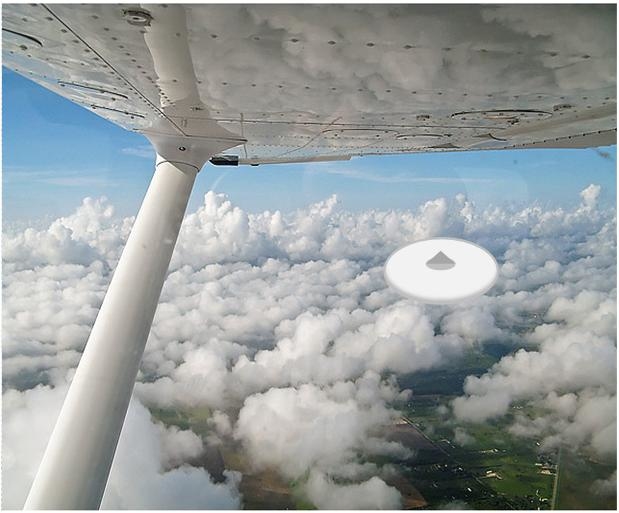
Credit: MUFON
The idea of us being them has been advanced before. But a new book, Identified Flying Objects: A Multidisciplinary Scientific Approach to the UFO Phenomenon takes a fresh look at this prospect, offering some thought provoking proposals.
For more information on this concept, go to my new Space.com story at:
Are the aliens us? UFOs may be piloted by time-traveling humans, book argues
https://www.space.com/aliens-time-traveling-humans-ufo-hypothesis.html

China’s champion – long duration Yutu-2 rover.
Credit: CNSA/CLEP
China’s Chang’e-4 lander and rover have resumed work for the 14th lunar day on the farside of the Moon after “sleeping” during the extremely cold night, reports the Xinhua news service.

China’s Chang’e-4 lander as viewed by Yutu-2 rover.
Credit: CNSA/CLEP
Both the lander and the rover are in normal working order, according to the Lunar Exploration and Space Program Center of the China National Space Administration (CNSA).
A lunar day equals 14 days on Earth, and a lunar night is the same length. The Chang’e-4 mission elements switch to dormant mode during the lunar night due to the lack of solar power.

Movement of the Chang’e 4 rover, Yutu-2, captured in NASA’s Lunar Reconnaissance Orbiter’s LROC images.
Credit: NASA/GSFC/Arizona State University
The Chang’e-4 mission was launched on December 8, 2018. It made the first-ever soft landing within the Von Kármán crater in the South Pole-Aitken Basin on the farside of the Moon on January 3, 2019.
The Yutu-2, or Jade Rabbit-2 rover, has worked much longer than its three-month design life, becoming the longest-working lunar rover on the Moon.

Chang’e-5 lunar lander.
Credit CCTV Video News Agency/Inside Outer Space screengrab
Sample return: fourth quarter 2020
In related lunar exploration news, the next mission in China’s Moon exploration program — Chang’e-5 — will land a probe on an area never reached by astronauts or spacecraft and is expected to bring back at least 2.2 pounds (1 kilogram) of samples, reports China Daily.
Peng Jing, deputy chief designer of the Chang’e-5 probe at the China Academy of Space Technology, said it is scheduled to be launched atop a Long March-5 carrier rocket.
The mission will depart Wenchang Space Launch Center in Hainan province during the fourth quarter of this year. This mission is targeted for the northwestern part of the Oceanus Procellarum, a lunar mare on the western edge of the Moon’s near side, after flying for dozens of days.
Credit: New China/Screengrab
Sophisticated and challenging
Compared with previous Chinese lunar missions, Chang’e-5 will be more sophisticated and challenging, Peng said.
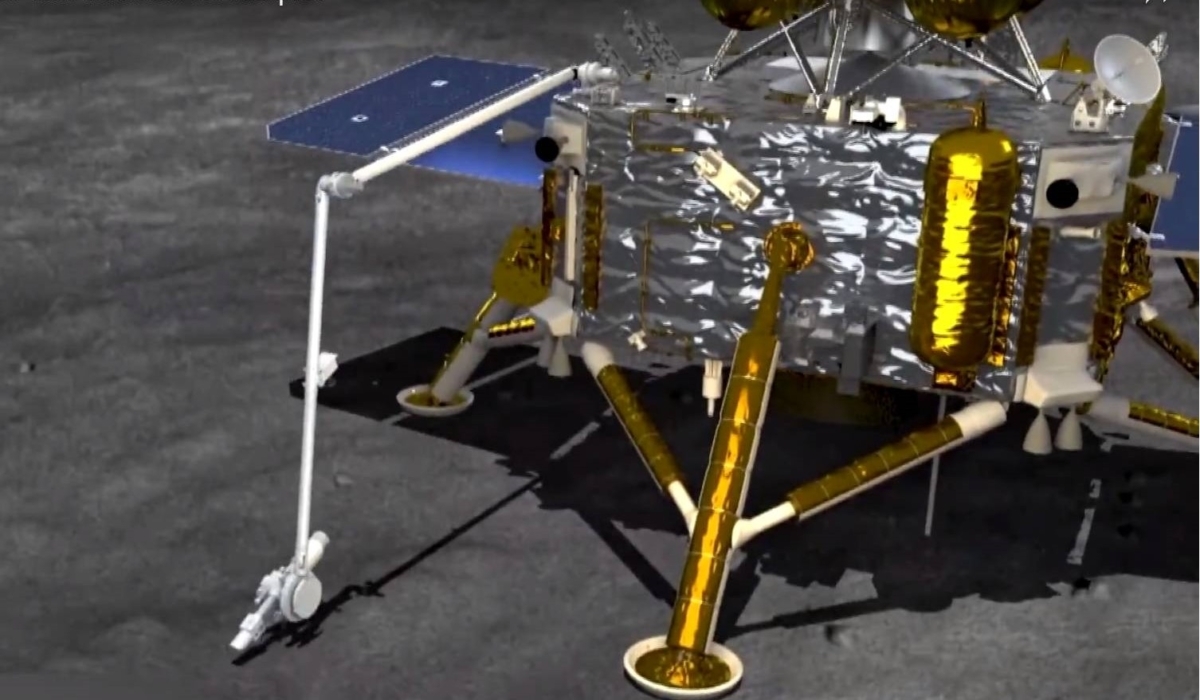
The 8.2-metric-ton probe has four components: an orbiter, lander, ascender and re-entry module. After the probe reaches lunar orbit, the components will separate into two parts, with the orbiter and re-entry module remaining in orbit while the lander and ascender head toward the lunar surface.
The lander and ascender will make a soft landing. One task is using a drill to collect underground rocks and a mechanical arm to gather lunar soil.
After the surface operations are done, the ascender’s rocket will lift it into lunar orbit to dock with the re-entry module. It will transfer lunar samples to the module, which will carry them back to Earth.
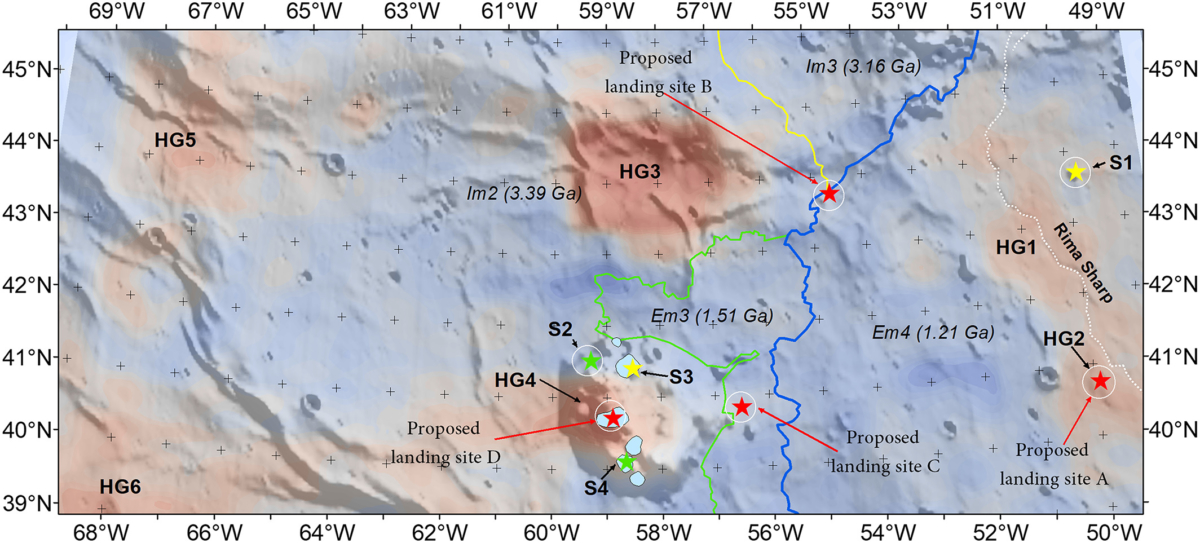
Locations of proposed Chang’e-5 landing sites (marked by red stars) from new study.
Credit: Chisenga, et al.
Quantity of samples
If the mission is successful, China would be the third nation to bring lunar samples back to Earth, after the United States and Russia, and also make Chang’e-5 effort the world’s first lunar sample-return mission in more than four decades.

Chang’e-5 mission is intended to return lunar specimens back to Earth.
Credit: CCTV/Screengrab/Inside Outer Space
“The quantity of samples it will bring back depends on many factors, such as the landing site’s geology. We hope that it can collect at least 1 kilogram, and if everything goes well, it may bring two kilograms or even more,” Peng said in the China Daily story.
“The samples will be distributed to scientists for research on topics including the Moon’s physical composition, geological traits and shallow structures,” Peng added, “which will consequently help with the understanding of the Moon’s evolution.”
Turning to future lunar exploration, Peng said scientists and engineers have proposed that two or three missions could be made to set up a simple scientific outpost on the Moon, which would be able to accommodate astronauts for short-term stays, to carry out experiments and explore the feasibility of long-term visits.

China’s new crewed spaceship. A prototype of this new-generation piloted spacecraft has arrived at the launch site. The test ship is designed for use in China’s space station operations and also crewed lunar exploration. Credit: CCTV
New spaceship
According to Ma Xiaobing, deputy chief designer of China’s new-generation manned spacecraft, which has yet to be named, said that the new spaceship’s prototype will make its debut flight during the first mission of the Long March-5B rocket this year at the Wenchang center.

China’s space station scheduled to be operational in 2020’s.
Photo credit: CMSA
The three-day flight will test and verify several key pieces of equipment on the new spacecraft, which will be bigger than the previous Shenzhou-series manned spaceships, Ma said, noting the new model will be reusable.
Booster’s maiden flight
In a related story, Xinhua news agency reports that China’s Long March-5B carrier rocket has passed testing and examination before leaving the factory and is expected to make its maiden flight in the first half of 2020, according to the China Manned Space Agency.

Credit: CMSA
The Long March-5B is a modified version of Long March-5 and will be used to launch segments of China’s space station. China aims to complete the construction of its space station around 2022.
Weighing 66 tons, the space station will be a T shape with the Tianhe core module at the center and the Wentian and Mengtian lab capsules on each side.
In addition, a capsule holding a large optical telescope will fly in the same orbit as the station, adds the Xinhua news story.

Credit: CCTV Video News Agency/Inside Outer Space screengrab
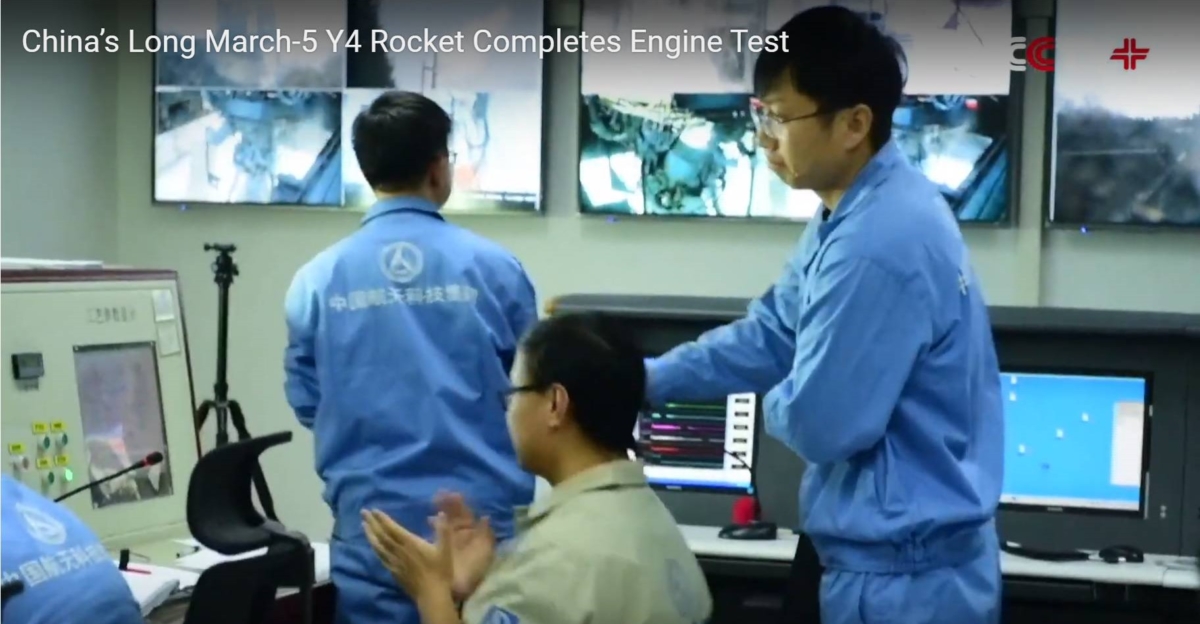
China’s Long March-5 Y4 rocket completed a 100-second test for its high thrust hydrogen oxygen engine on Sunday afternoon in Beijing.
Credit: CCTV Video News Agency/Inside Outer Space screengrab
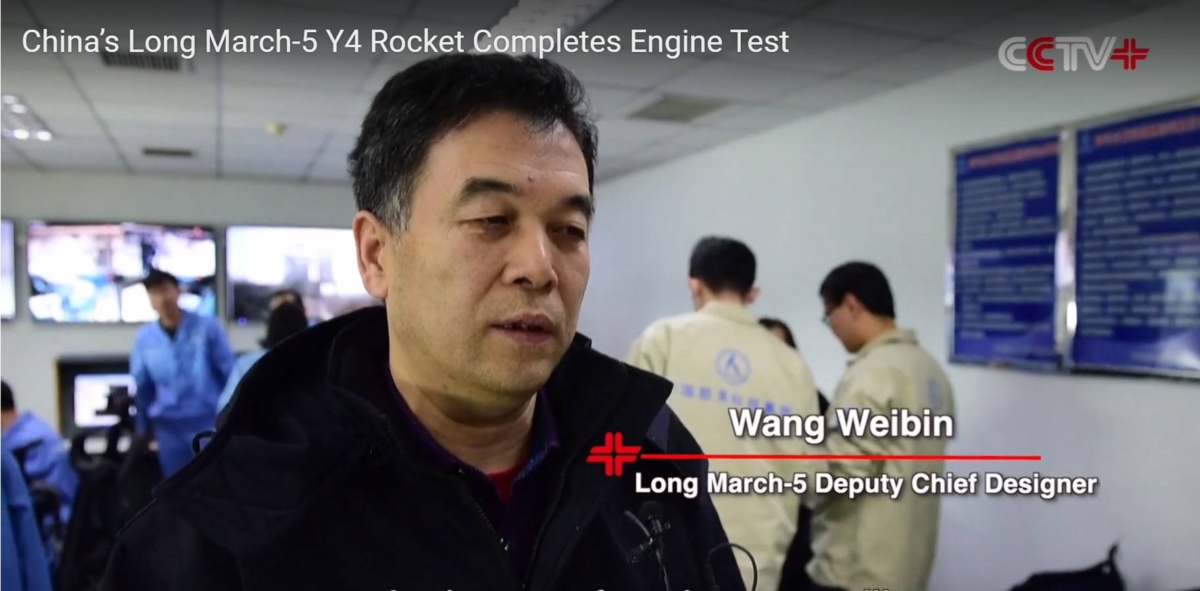
“The experiment went on smoothly. In the next few days we will have thorough analysis of data and careful examination of the product,” said Wang Weibin, Long March-5 deputy chief designer.
“If everything is alright, the engine will be sent to Tianjin for Long March-5 Y4 final assembling, which will carry out the mission of sending probe to the Mars,” Wang added in a CCTV Video News Agency interview.
Credit: CCTV Video News Agency/Inside Outer Space
Red planet probing
The successful test means the engine has met required standard and is ready for final assembling.

Credit: CGTN
This is the second high thrust hydrogen oxygen engine in China after the successful launch of Long March-5 Y3 rocket in late December of 2019.
China will launch its Mars lander/rover later this year for arrival on the Red Planet in early 2021. A second Mars mission by China in 2028 is slated to rocket back to Earth samples of the planet.
Go to this CCTV Video News Agency report at:

