Author Archive
 Author:
  April 9th, 2020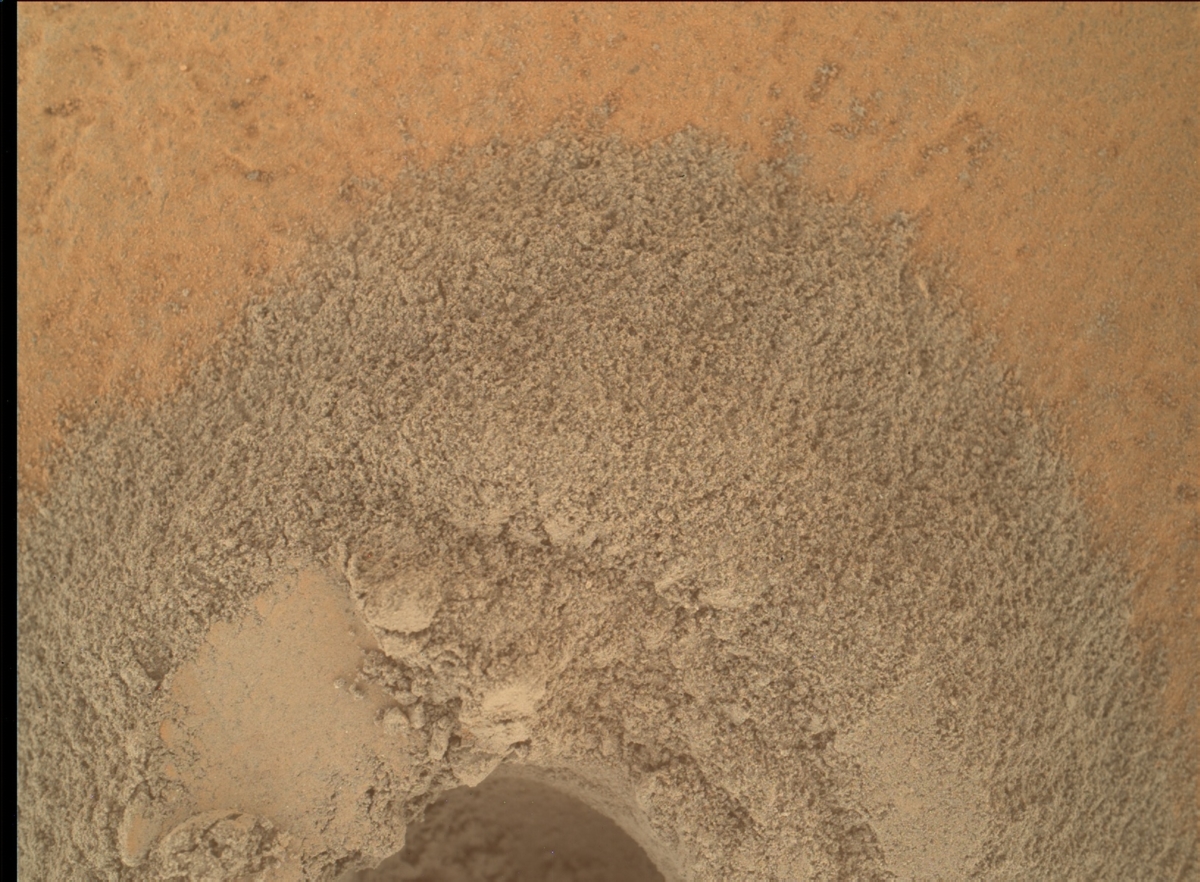
Curiosity Mars Hand Lens Imager photo produced on Sol 2728, April 9, 2020.
Credit: NASA/JPL-Caltech/MSSS
NASA’s Curiosity Mars rover is now carrying out Sol 2729 tasks.
“Many of us on Earth are being especially diligent lately about washing our hands for at least 20 seconds after touching a new surface,” reports Scott Guzewich, an atmospheric scientist at NASA’s Goddard Space Flight Center in Greenbelt, Maryland.
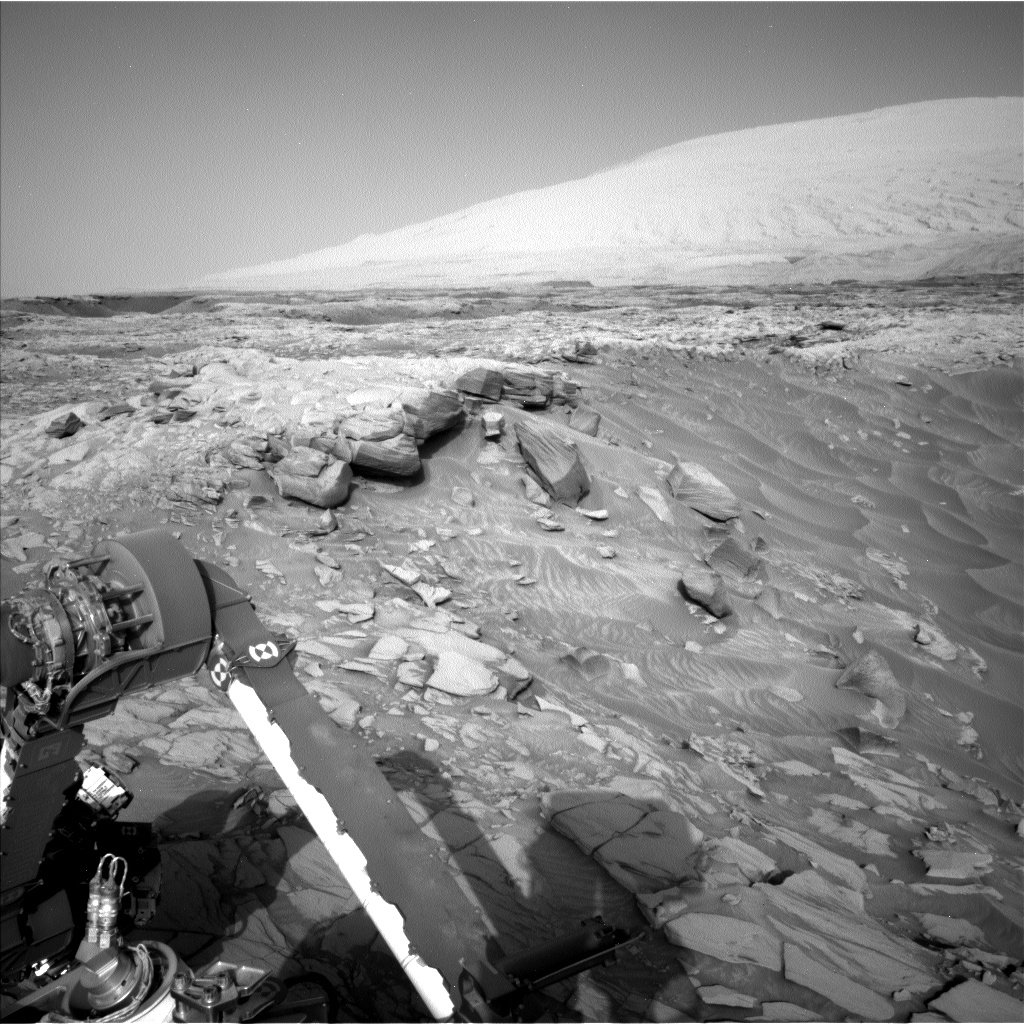
Curiosity Left B Navigation Camera photo acquired on Sol 2728, April 9, 2020.
Credit: NASA/JPL-Caltech
“On Mars, Curiosity is used to doing something a little bit similar, but for a very different reason: to prevent cross-contamination between samples taken at different locations,” Guzewich explains.
Of course, the lack of water and soap prevents the rover from “washing,” but scientists, still have to make sure the rover’s instruments stay as clean as possible after touching a new surface.

Curiosity Left B Navigation Camera photo acquired on Sol 2728, April 9, 2020.
Credit: NASA/JPL-Caltech
Arm retraction
During last Monday’s plan, the rover’s arm was placed over the drill tailings from the Edinburgh drill hole to study them with the robot’s Alpha Particle X-Ray Spectrometer (APXS) and the Mars Hand Lens Imager (MAHLI).
In a recent plan, the call is to retract the arm from that position and stow it so Curiosity can drive away.
“During that process, we swing the turret back-and-forth to shake off and remove any bits of sand or dust that may have been clinging to APXS so when we next use it, APXS only measures materials at the new location and nothing that came with us from Edinburgh,” Guzewich adds.
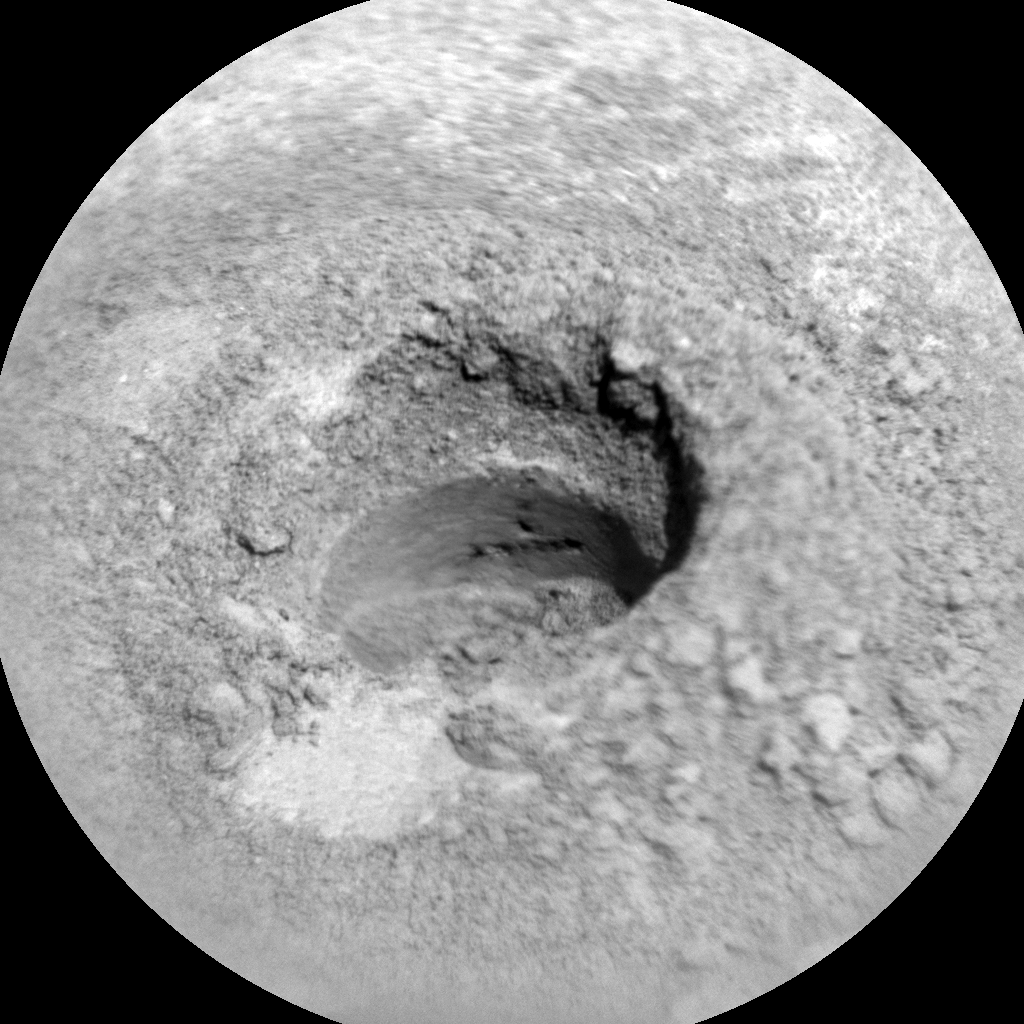
Curiosity Chemistry & Camera RMI photo taken on Sol 2728, April 9, 2020.
Credit: NASA/JPL-Caltech/LANL
Inside wall
After the robot’s arm is stowed, the plan calls for the Chemistry and Camera (ChemCam) to target the inside wall of the drill hole as well as take a long-distance mosaic of Gediz Vallis and the Greenheugh Pediment.
“Then we’ll conduct a short drive to a nearby patch of soil that we hope to study over the weekend,” Guzewich explains.
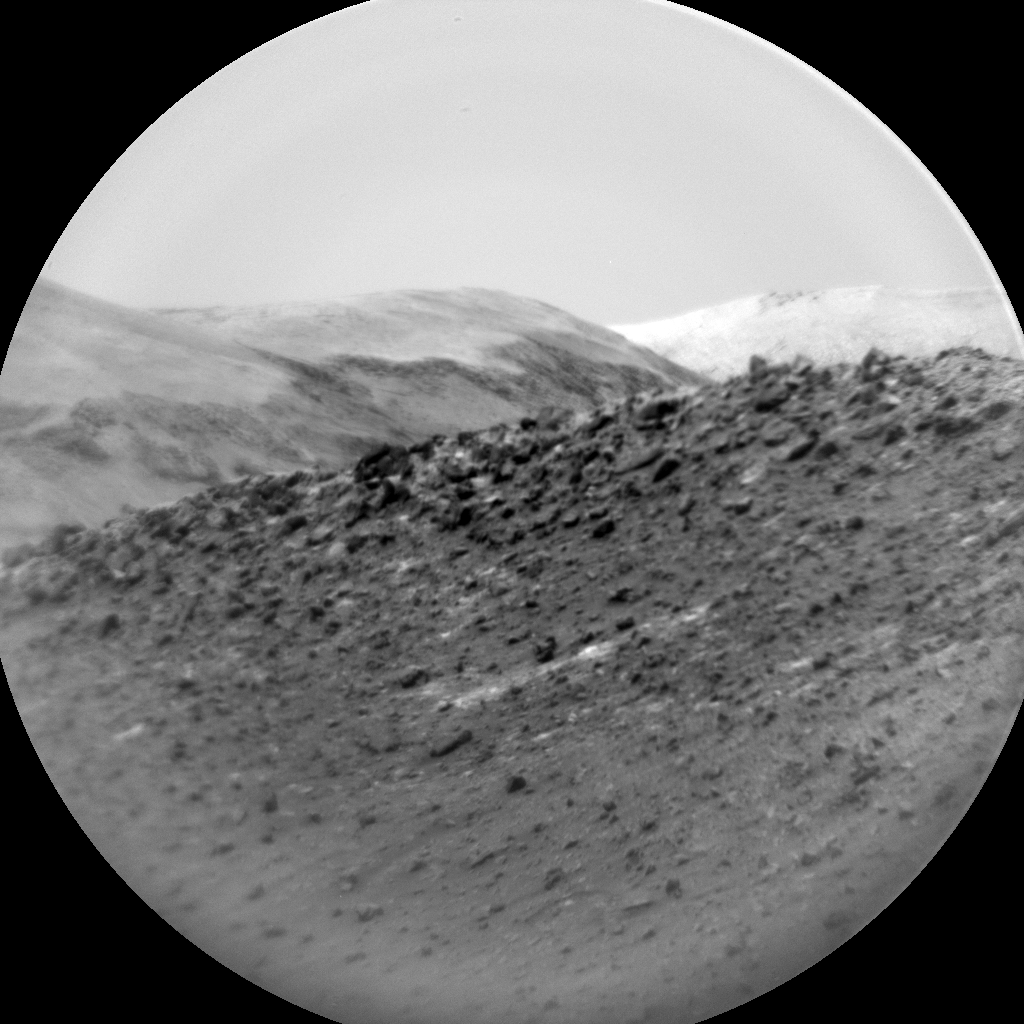
Curiosity Chemistry & Camera RMI photo taken on Sol 2728, April 9, 2020.
Credit: NASA/JPL-Caltech/LANL
On the second sol of the plan, a ChemCam Autonomous Exploration for Gathering of Increased Science (AEGIS) software activity is slated (where ChemCam picks its own targets!), as is a search for dust devils and monitoring the dust levels in the atmosphere.

Curiosity Front Hazard Avoidance Camera Left B image taken on Sol 2728, April 9, 2020
Credit: NASA/JPL-Caltech
Upcoming is the equinox on Mars and spring begins for the southern hemisphere, Guzewich notes. “This is also when the dust storm season (generally the second half of the martian year) begins. Last Mars year (2018), we had a global dust storm and will be carefully watching to see if another develops this year!”
 Posted in

Credit: NIAC
The NASA Innovative Advanced Concepts (NIAC) program has unleashed a new volley of creative concepts, selecting study efforts that receive Phase I, Phase II and Phase III funding.
A number of the just announced NIAC-funded initiatives focus on Moon exploration objectives.
NIAC’s role is to nurture visionary ideas that could transform future NASA missions with the creation of breakthroughs — radically better or entirely new aerospace concepts — while engaging America’s innovators and entrepreneurs as partners in the journey.
NIAC is under the wing of NASA’s Space Technology Mission Directorate, or STMD for short.

Courtesy: Saptarshi Bandyopadhyay/JPL
Lunar radio telescope
An ultra-long-wavelength radio telescope on the farside of the Moon has tremendous advantages compared to Earth-based and Earth-orbiting telescopes, suggests Saptarshi Bandyopadhyay of NASA’s Jet Propulsion Laboratory.

Courtesy: Saptarshi Bandyopadhyay/JPL
The proposal is to deploy a one kilometer diameter wire-mesh antenna in a three to five kilometer diameter farside lunar crater. To do so, wall climbing DuAxel robots would deploy the antenna.
Called the Lunar Crater Radio Telescope (LCRT), the radio telescope would be the largest filled-aperture radio telescope in the Solar System! “LCRT could enable tremendous scientific discoveries in the field of cosmology” Bandyopadhyay explains, in frequencies that have not previously been explored by humans.

Courtesy: Matthew Kuhns/Masten Space Systems
Instant landing pads
A technique to create instant landing pads for future NASA Artemis lunar missions was selected by NIAC, a proposal from Matthew Kuhns of Masten Space Systems.
The engine plume or multi-engine plumes from large lunar landers may pose a range of risks, from high-velocity ejecta abrasion damaging the lander to ejecta damaging other lunar landers or orbital assets, or even creating a crater under the lander as deep as the columnated engine plume, Kuhns explains.

Courtesy: Matthew Kuhns/Masten Space Systems
“The Masten in-Flight Alumina Spray Technique (FAST) Landing Pad changes the approach to landing on planetary bodies by mitigating the landing plume effects by creating a landing pad under the lander as it descends onto a surface,” Kuhns adds. “This approach uses engineered particles injected into the rocket plume to build up a coating over the regolith at the landing location.”
The FAST concept enhances overall lunar access and access to other planetary surfaces, including Mars, Kuhns explains in his proposal, where loose regolith characteristics pose critical mission risks.

Courtesy: Philip Metzger/University of Central Florida
Lunar water extraction
A new method to extract lunar water is tagged as Aqua Factorem. This ultra-low-energy lunar water extraction idea is proposed by Philip Metzger of the University of Central Florida.
This proposal takes advantage of the processing that the unique lunar geology has already performed, Metzger says.
“Micrometeoroid bombardment has already broken most solid material in the upper part of the regolith into fine grains. This includes solid material of all compositions, including the ice, which is as hard as granite at PSR [permanently shadowed region] temperatures and is therefore essentially another type of rock,” Metzger reports. “These ice grains are intermixed with all the other minerals, so a simple, ultra-low-energy grain-sorting process can extract the ice without phase change.”
The ice can then be hauled to a chemical processing unit in solid phase and converted into rocket propellant.
The Aqua Factorem idea is eyeing the mining of propellants commercially for space tugs that boost commercial communication satellites from Geosynchronous Transfer Orbit (GTO) to Geostationary Orbit (GEO) then return to the lunar surface for refueling.
“The study will also test the innovative Aqua Factorem process through laboratory experiments, and this will produce basic insights into the handling of lunar resources,” Metzger says.

Harrison (Jack) Schmitt collecting a sample at Station 5 (Camelot
Crater) during the second extra-vehicular activity (EVA) of the
Apollo 17 mission in December 1972.
Credit: NASA
Weight off the back
Another NIAC-supported, lunar assisting idea is the offloading of astronauts for more effective exploration making use of a “BioBot.” This is an autonomous robotic system to handle life support umbilicals on planetary surfaces in the vicinity of obstacles and snag hazards.
The BioBot system concept from David Akin, University of Maryland, College Park, consists of a robotic rover which is capable of traversing the same terrain as a spacesuited human. It carries the primary life support system for the astronaut, including consumables, atmosphere revitalization systems (e.g., carbon dioxide scrubbing, humidity and temperature management, ventilation fan), power system (e.g., battery, power management and distribution), and thermal control system (e.g., water sublimator, cooling water pump), along with umbilical lines to connect to the supported astronaut via the autonomous umbilical handling system.

Courtesy: David Akin, University of Maryland, College Park
“No parameter in the design of spacesuits for planetary exploration is more important than ‘weight on the back’- the weight of the suit system which must be supported by the wearer under the gravity of the Moon or Mars,” Akin explains. “The added weight of the spacesuit garment and portable life support system (PLSS) drives the required exertion level of the wearer, and ultimately sets limitations on EVA duration, distance traveled on foot, and productivity of the exploration mission,” he says in advocating the BioBot system.

Courtesy: Joel Sercel, Trans Astronautica Corporation
Sun flowers, dynamic mining
A Lunar Polar Mining Outpost (LPMO) architecture has been detailed by Joel Sercel of Trans Astronautica Corporation. LPMO promises to greatly reduce the cost of human exploration and industrialization of the Moon.
“LPMO is based on two patent pending inventions that together solve the problem of affordable lunar polar ice mining for propellant production,” Sercel points out.
Sun Flower is a deployable, lightweight reflecting tower that provides nearly continuous solar power into areas where likely ice-rich regolith resides in perpetual darkness. The second enabling innovation is Radiant Gas Dynamic mining to solve the problem of economically and reliably prospecting and extracting large quantities (1,000s of tons per year) of volatile materials from lunar regolith using landed packages of just a few tons each.
Sercel also notes that a large lander — such as the Blue Moon vehicle proposed by Blue Origin — can sit on mineable ice at ground level in perpetual sunlight provided by lightweight reflectors. A single Blue Origin New Glenn launch can deliver a Sun Flower with over one megawatt of solar arrays, tower, and reflector in an integrated package.
Overall, Sercel says his NIAC-funded work “promises to vastly reduce the cost of establishing and maintaining a sizable lunar polar outpost that can serve first as a field station for NASA astronauts exploring the Moon, and then as the beachhead for American lunar industrialization, starting with fulfilling commercial plans for a lunar hotel for tourists.”
For more information on the entire suite of NIAC 2020 awards, go to:
https://www.nasa.gov/directorates/spacetech/niac/2020_Phase_I_Phase_II/
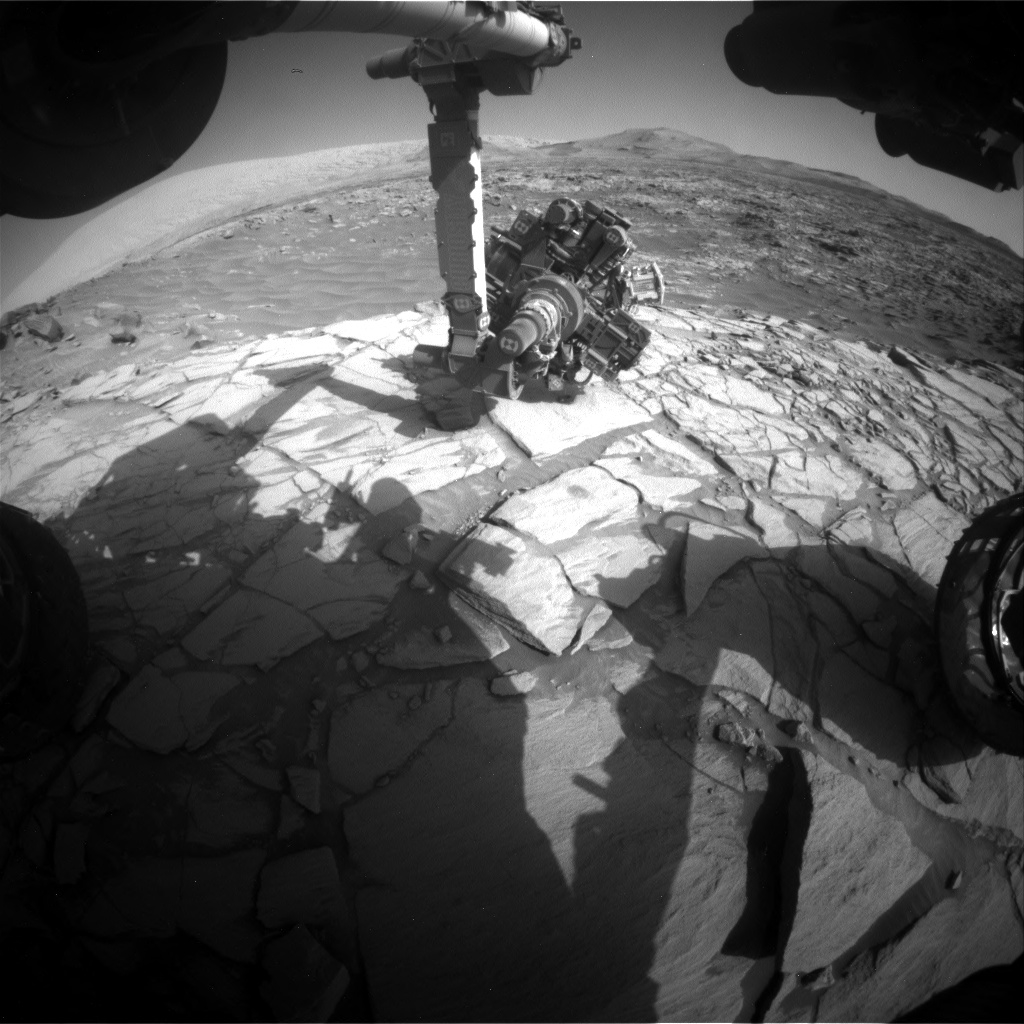
Curiosity Front Hazard Avoidance Camera Right B image taken on Sol 2727, April 8, 2020.
Credit: NASA/JPL-Caltech
NASA’s Curiosity Mars rover is now performing Sol 2728 tasks.
Reports Kristen Bennett, a planetary geologist at USGS Astrogeology Science Center in Flagstaff, Arizona: In the last weekend plan the remainder of the “Edinburgh” drill sample was dumped, “which means that we are almost finished with activities in this drill location.”
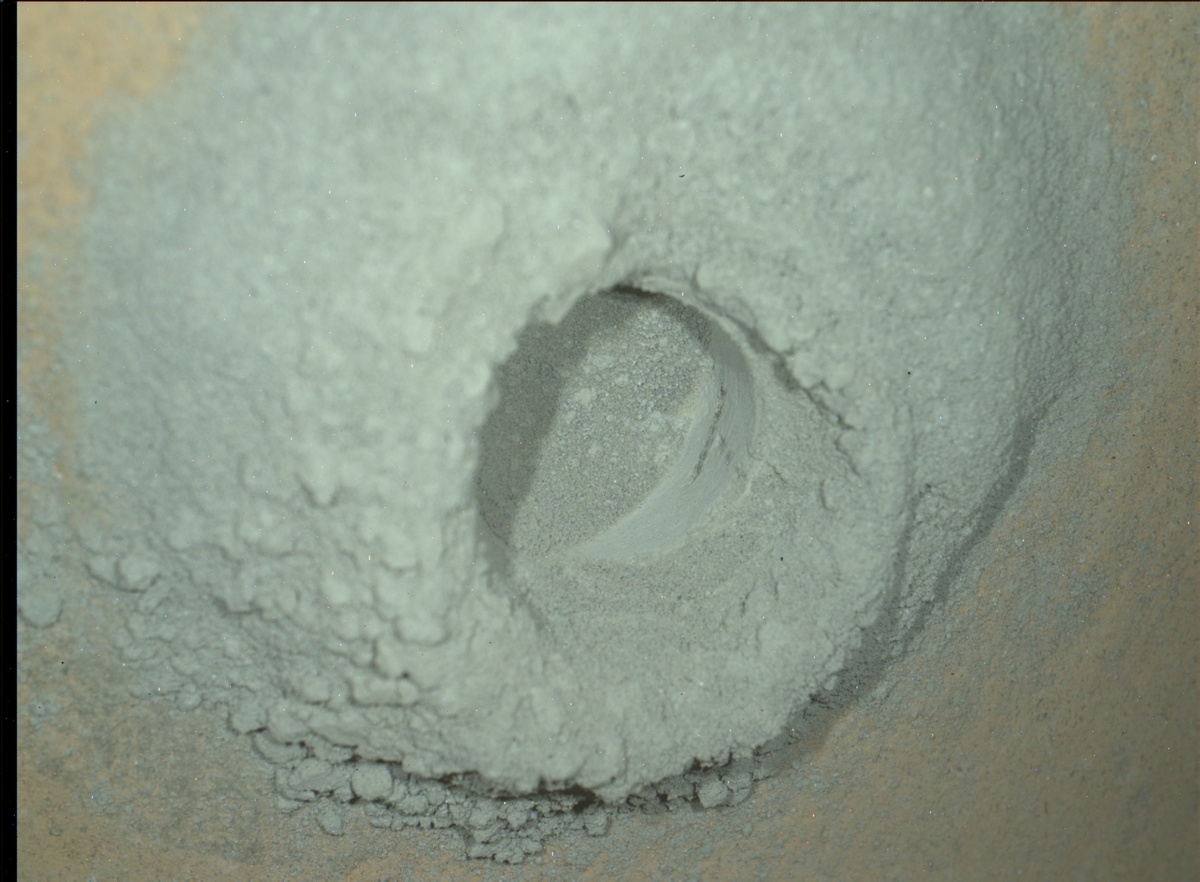
Curiosity Mars Hand Lens Imager photo produced on Sol 2727, April 8, 2020.
Credit: NASA/JPL-Caltech/MSSS
A recent two-sol plan was filled with activities to characterize the dump pile and drill hole as well as remote sensing observations.
Dump pile imagery
The rover’s Alpha Particle X-Ray Spectrometer (APXS) attempted to document the new dump pile in the weekend plan, “but that observation was offset from the intended target because we did not know exactly where the dump pile would be,” Bennett notes.
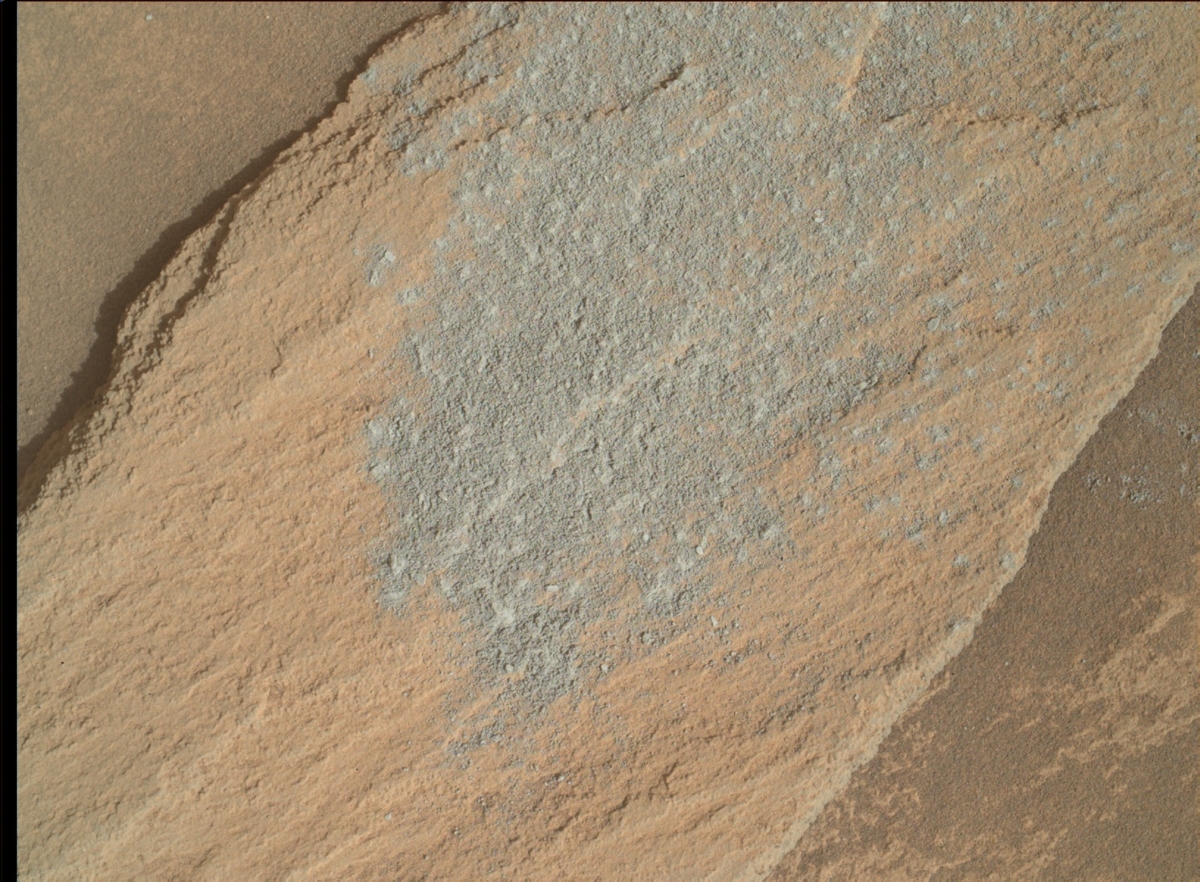
Curiosity Mars Hand Lens Imager photo produced on Sol 2727, April 8, 2020.
Credit: NASA/JPL-Caltech/MSSS
“Now that we have images of the dump pile, we know its specific location and APXS will redo that measurement,” Bennett says. “Additionally, APXS will observe the drill hole tailings.”
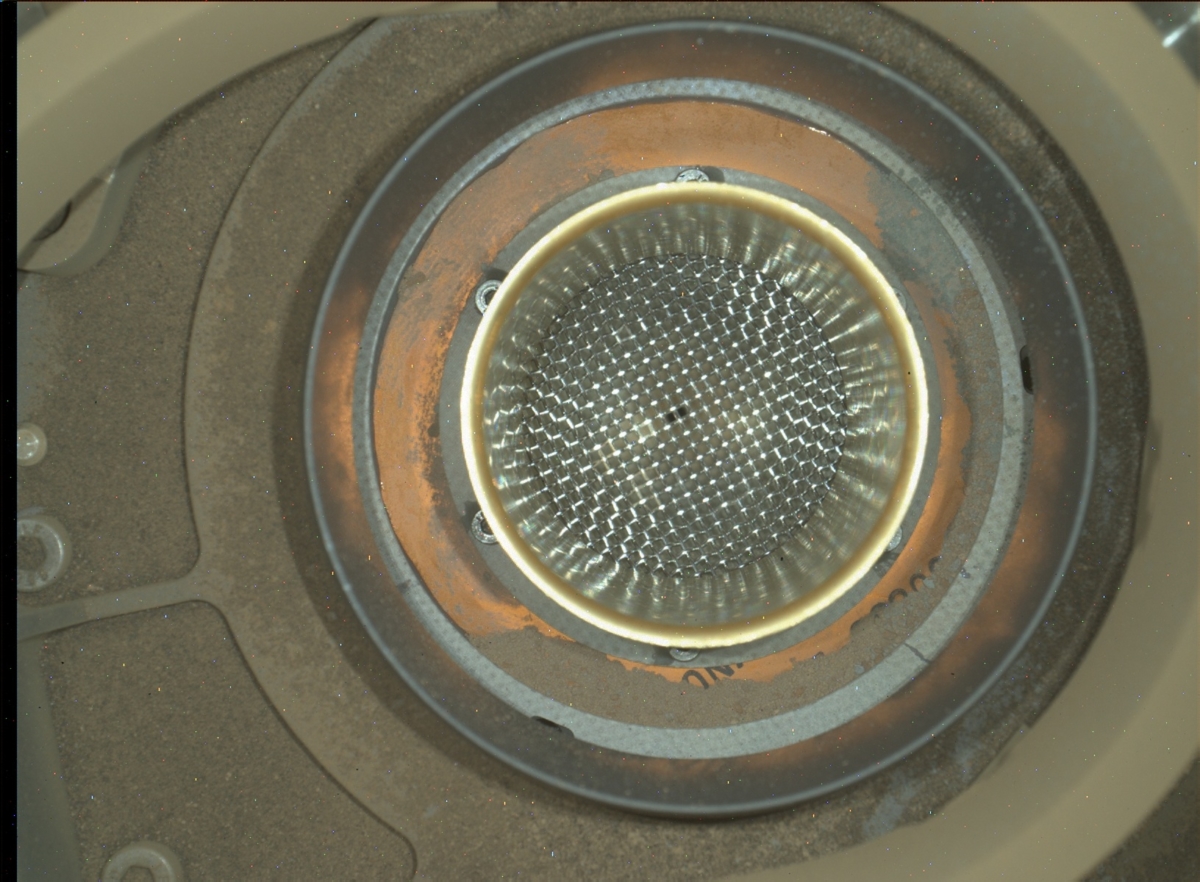
Curiosity Mars Hand Lens Imager photo produced on Sol 2727, April 8, 2020.
Credit: NASA/JPL-Caltech/MSSS
The robot’s Mars Hand Lens Imager (MAHLI) will be used to document the dump pile and the drill hole tailings. In this plan MAHLI will also take nighttime images of the drill hole walls and of the Chemistry & Mineralogy X-Ray Diffraction/X-Ray Fluorescence Instrument (CheMin) inlet to make sure all the sample made it through the inlet.
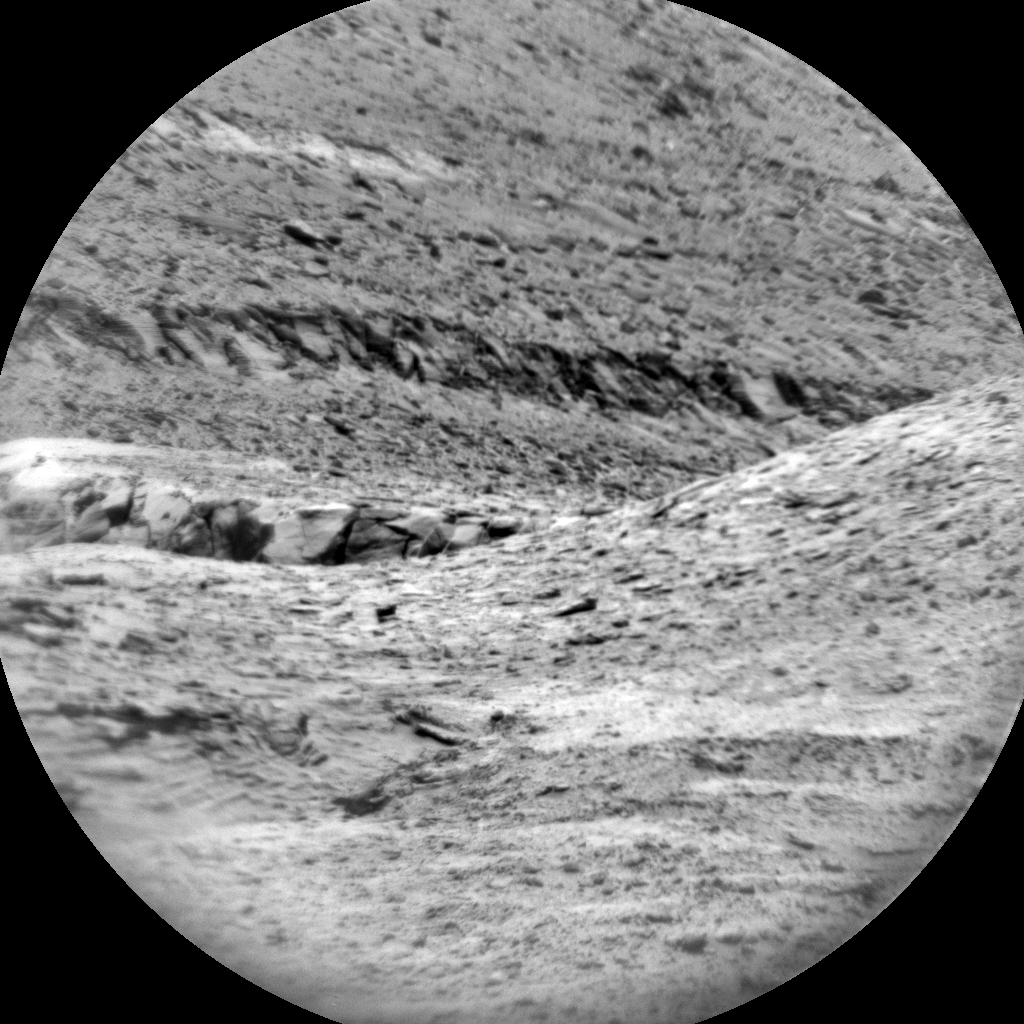
Curiosity Chemistry & Camera RMI photo taken on Sol 2726, April 7, 2020.
Credit: NASA/JPL-Caltech/LANL
Spectacular view
For remote sensing, ChemCam will take a Remote Micro Imager (RMI) telescope observation looking towards Gediz Vallis.
“From our current location on the “Greenheugh” pediment we have a spectacular view looking up towards Mount Sharp and “Gediz Vallis,” so this observation is part of a series of ChemCam RMIs documenting areas that will be obscured once we descend off the pediment. ChemCam will also target the Edinburgh drill hole and tailings in this plan,” Bennett adds.
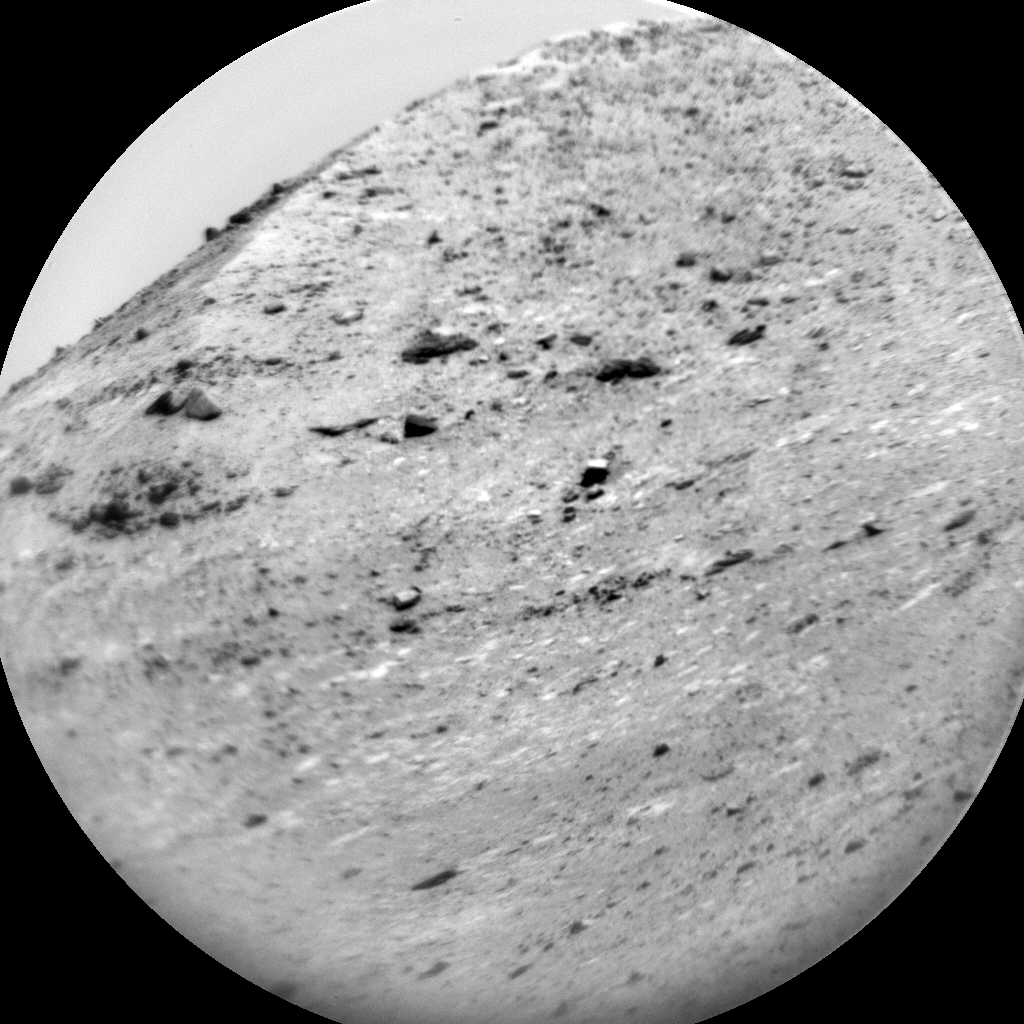
Curiosity Chemistry & Camera RMI photo taken on Sol 2726, April 7, 2020.
Credit: NASA/JPL-Caltech/LANL
Hilltop mosaic
Curiosity’s Mastcam will be retaking a portion of the “Hilltop” mosaic, Bennett explains. “The instrument’s arm ended up “waving at us” in the original mosaic…which is fun (Hi, Curiosity!), but we decided to retake those frames so we can see the bedrock that the arm obscured.”
“We will also be finishing up a Navcam/Mastcam photometry experiment in this plan. The goal of this experiment is to model how light scatters off the surface,” Bennett continues. “While Curiosity has been sitting here at the Edinburgh drill site, Navcam and Mastcam have been taking images of the same locations at multiple times of day to learn how light scatters from the surface at different sun angles. The final Navcam images were taken in this plan.”
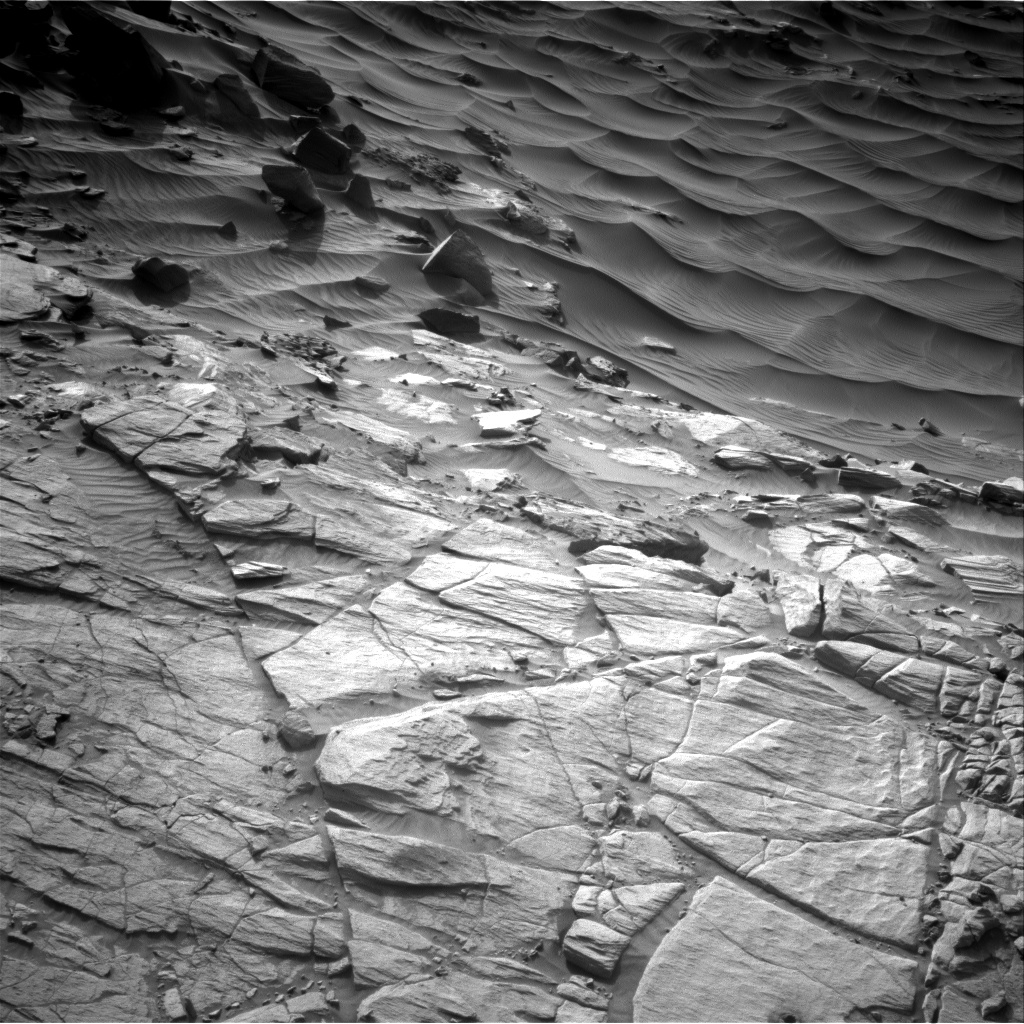
Curiosity Right B Navigation Camera image acquired on Sol 2727, April 7, 2020.
Credit: NASA/JPL-Caltech
Changes in ripples
Finally, there will be several change detection observations to constrain the amount of wind activity in this area.
The first observation is with Mastcam of a nearby ripple field to search for any changes in the ripples,” Bennett reports. The second is with the rover’s Mars Descent Imager (MARDI) “because this instrument has been staring at the same patch of ground underneath the rover so if anything moved because of the wind or drill activities, MARDI is ready to observe the evidence.”
In completing activities at the Edinburgh drill site, Mars scientists soon expect to drive away from the rover’s current location.

The Andromeda Strain – the 1971 movie, but how real for a 21st century return to Earth of Mars samples?
Credit: Universal Pictures
Shipment back to Earth by robotic means of bits and pieces from Mars remains an expensive and daunting task. Having our planet on the receiving end of Mars collectibles is deemed a “low risk” affair in terms of ecological and public safety – but that risk is not zero.
Rocketing Martian flotsam could well mean dealing with biological “hot property,” not to mention sparking heated oratory and public anxiety about creepy-crawlies from Mars chomping away at Earth’s biosphere.

High-magnification and replication. Creepy-crawler snagged in outer space and brought back to Earth in movie, Andromeda Strain.
Credit: Universal Pictures
Sci-fi, real-time?
In many ways, hauling back the goods from the Red Planet resonates in some quarters as a replay of novelist Michael Crichton’s Andromeda Strain, transformed into a 1971 sci-fi film that dramatized the idea of alien organisms infecting the Earth.

Overview of the NASA/European Space Agency Mars Sample Return mission as now foreseen.
Credit: ESA/K. Oldenburg
Does the ongoing COVID-19 pandemic hold some clues for how to handle samples brought back to Earth from Mars, a place that could potentially host extraterrestrial microbes?
For more information, go to my new Space.com story:
Could Mars samples brought to Earth pose a threat to our planet? What the coronavirus (and ‘Andromeda Strain’) can teach us – The coronavirus pandemic reinforces that it’s best to be prepared.
https://www.space.com/mars-sample-return-threat-earth-coronavirus-andromeda-strain.html
Unabashed plug: My National Geographic book – Mars: Our Future on the Red Planet – details ethical exploration of the Red Planet, including sample return and terraforming that world.
It can be found here:
https://www.amazon.com/Mars-Our-Future-Red-Planet/dp/1426217587

The proposed Protected Antipode Circle, a circular piece of lunar landscape to be reserved for scientific purposes on the farside of the Moon.
Credit: Claudio Maccone
There is pressing need to protect the Moon’s farside, to keep pristine this unique real estate for scientific activities.

FARSIDE project is a proposed low radio frequency interferometric array on the farside of the Moon that could work in concert with NASA’s Gateway initiative.
Courtesy: Jack Burns, University of Colorado, Boulder
Nonetheless, the quickening pace of lunar exploration by multiple nations and the up swell of entrepreneurial space groups eager to seek lunar lucre could well interfere and overtake this viewpoint.
An International Academy of Astronautics (IAA) Symposium on Moon Farside Negotiations was held via teleconference on March 25.
Spearheading the meeting was Claudio Maccone of the IAA and the Istituto Nazionale di Astrofisica in Italy.
For more information, go to my new article at Scientific American:
Astronomers Battle Space Explorers for Access to Moon’s Far Side
Without protection from radio interference, a giant observatory on the moon’s hidden hemisphere could prove unworkable
Go to:

Curiosity Mars Hand Lens Imager photo produced on Sol 2724, April 5, 2020.
Credit: NASA/JPL-Caltech/MSSS
NASA’s Curiosity Mars rover has just begun Sol 2727 operations.

Curiosity Mars Hand Lens Imager photo produced on Sol 2725, April 6, 2020.
Credit: NASA/JPL-Caltech/MSSS

Curiosity Mast Camera Right photo acquired on Sol 2724, April 5, 2020.
Credit: NASA/JPL-Caltech/MSSS
“Curiosity is still at the Edinburgh drill site as part of a mini campaign to sample the Greenheugh pediment,” reports Lauren Edgar, a planetary geologist at the USGS Astrogeology Science Center in Flagstaff, Arizona.
“We’re finishing drill-related analyses and activities, and the three-sol weekend plan is focused on dumping sample from the drill bit assembly and documenting the dump pile and drill tailings,” Edgar explains.
Extra data points
There was a “busy but fun day” of remote operations. The plan includes Chemistry and Camera (ChemCam) observation of the Edinburgh drill hole to get some extra data points to characterize the drill site, as well as the “Calders Sandstone” bedrock target, and Mastcam documentation.

Curiosity image of Mars moon Phobos, part of a Mastcam Phobos video. Mast Camera photo taken on Sol 2723, April 4, 2020.
Credit: NASA/JPL-Caltech
Edgar adds that Curiosity is to dump the sample and document the pile with Mastcam and the robot’s Mars Hand Lens Imager (MAHLI), followed by the Alpha Particle X-Ray Spectrometer (APXS).

Curiosity Mast Camera image taken on Sol 2725, April 6, 2020.
Credit: NASA/JPL-Caltech/MSSS
Twilight viewing
Also within the planning, Edgar points out, is having the rover pause to take in the view at twilight – including a Navcam image of the horizon in which Earth and Venus should be visible! That’s followed by an overnight APXS integration on the dump pile.
ChemCam is on tap to take long distance a Remote Micro Imager (RMI) telescope mosaic of the pediment capping unit to assess the stratigraphy and sedimentary structures exposed on the flank of Gediz Vallis.

Curiosity Chemistry & Camera image taken on Sol 2726, April 7, 2020.
Credit: NASA/JPL-Caltech/LANL

Curiosity Chemistry & Camera RMI Sol 2725 April 6, 2020
Credit: NASA/JPL-Caltech/LANL

Curiosity Chemistry & Camera RMI Sol 2725 April 6, 2020
Credit: NASA/JPL-Caltech/LANL

Curiosity Chemistry & Camera RMI Sol 2725 April 6, 2020
Credit: NASA/JPL-Caltech/LANL

Curiosity Mast Camera image taken on Sol 2725, April 6, 2020.
Credit: NASA/JPL-Caltech/MSSS
Additional ChemCam RMI mosaics are also tap, followed by a Mastcam multispectral observation of the dump pile, and Mastcam documentation of some interesting dark layers in the mound stratigraphy.
Atmospheric activity
“Throughout the plan there are also a number of the Mastcam and Navcam observations to complete a photometry experiment. The rover will also continue to monitor atmospheric activity with a Navcam line of sight observation, dust devil survey, and Mastcam tau observation, and a whole suite of activities early on the morning of Sol 2727,” Edgar adds.
“While everyone is staying safe at home,” Edgar concludes, “it’s especially nice to hear so many voices from our team members and to look forward to exciting new data from Mars!”
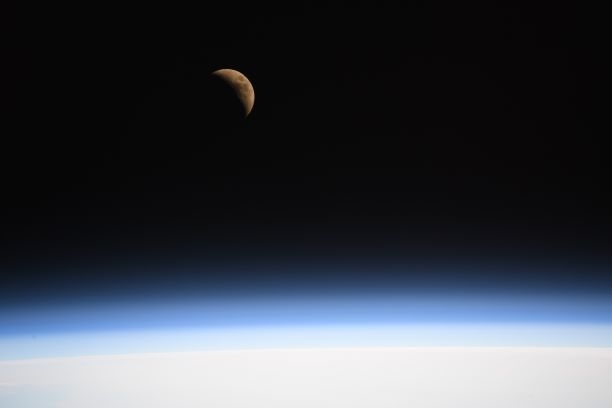
Credit: NASA
U.S. President Donald J. Trump is encouraging international support for the recovery and use of space resources, signing an Executive Order that directs the Secretary of State to lead a U.S. Government effort to develop joint statements, bilateral agreements, and multilateral instruments with like-minded foreign states to “enable safe and sustainable operations for the commercial recovery and use of space resources, and to object to any attempt to treat the 1979 Moon Agreement as expressing customary international law.”

Moon base design.
Credit: ESA/P. Carril
Nevertheless, in seeking international support, the United States may draw on legal precedents and examples from other domains to promote the recovery and use of space resources.
According to a White House fact sheet, “American industry and the industries of like-minded countries will benefit from the establishment of stable international practices by which private citizens, companies and the economy will benefit from expanding the economic sphere of human activity beyond the Earth.”

Credit: NASA
Moon agreement
The April 6 Executive Order spotlights the “The Moon Agreement”:
“The United States is not a party to the Moon Agreement. Further, the United States does not consider the Moon Agreement to be an effective or necessary instrument to guide nation states regarding the promotion of commercial participation in the long-term exploration, scientific discovery, and use of the Moon, Mars, or other celestial bodies,” the Executive Order notes.
“Accordingly, the Secretary of State shall object to any attempt by any other state or international organization to treat the Moon Agreement as reflecting or otherwise expressing customary international law.”
For more information, go to:
and
Warning: Shameless Plug
For a detailed discussion regarding the 1972 Moon Treaty, pros and cons, please read my latest book – Moon Rush – The New Space Race, published last year by National Geographic.
For copies, go to:
https://www.amazon.com/Moon-Rush-New-Space-Race/dp/1426220057


BepiColombo spacecraft is to conduct an Earth flyby in a few days.
Credit: ESA/ATG medialab
In a few days, the European Space Agency’s BepiColombo spacecraft is to conduct an Earth flyby before heading towards Venus – and in doing so the probe will scan the Moon using a unique instrument.
Earth’s Moon will be observed for the first time in the thermal infrared and examined for its mineralogical composition using the Mercury Radiometer and Thermal Infrared Spectrometer (MERTIS) instrument. New information on rock-forming minerals and temperatures on the lunar surface is expected.
As early as April 9, with its Earth-facing side illuminated by the Sun, the Moon will be observed by the MERTIS instrument, developed and built by the German Aerospace Center (DLR) – the national aeronautics and space research centre of the Federal Republic of Germany.
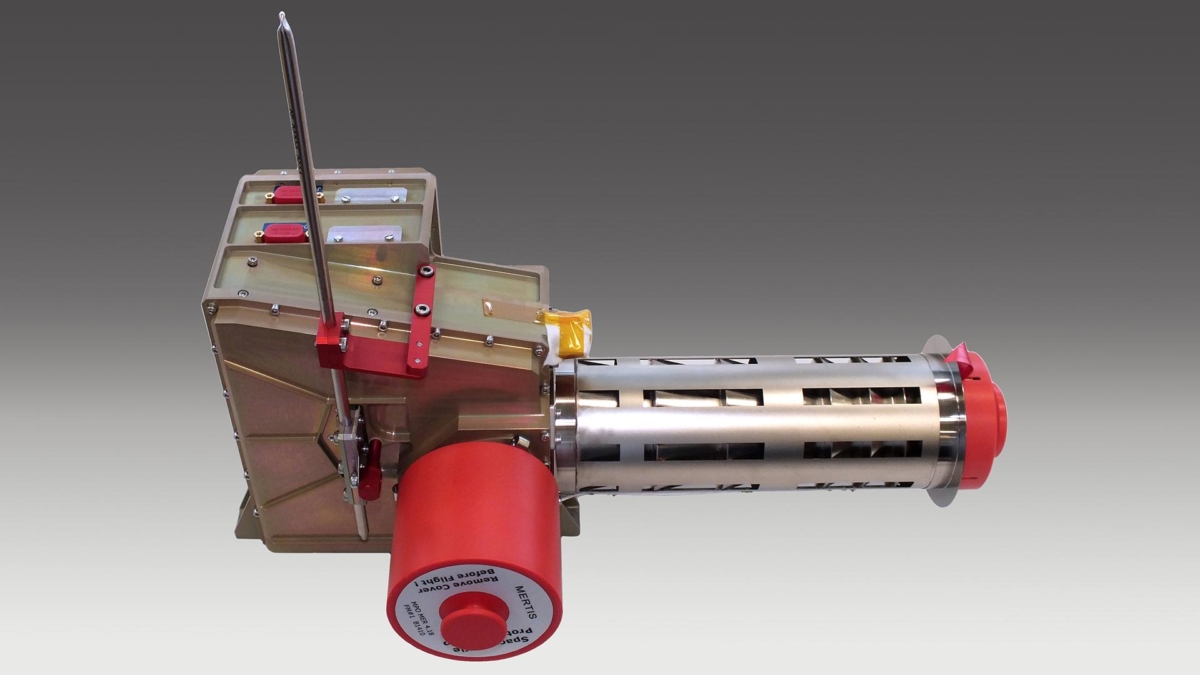
The Mercury Radiometer and Thermal Infrared Spectrometer (MERTIS) instrument combines an imaging spectrometer with a radiometer, which is used for determining irradiance.
Credit: DLR (CC-BY 3.0)
One-of-a-kind opportunity
“Observing the Moon with our MERTIS instrument on board BepiColombo is a one-of-a-kind opportunity,” says Jörn Helbert from the DLR Institute of Planetary Research, who is a Co-Principal Investigator for MERTIS.
“We will examine the Earth-facing side of the Moon spectroscopically in the thermal infrared for the first time,” Helbert said in a DLR statement. “Without any absorption by Earth’s atmosphere, the view from space will provide a valuable new data set for lunar research. This is also an excellent opportunity to test how well our instrument works and to gain experience in preparation for operations in Mercury orbit.”
Intensive preparations
MERTIS has two uncooled radiation sensors. Its spectrometer covers a wavelength range from seven to 14 micrometers, and its radiometer to a wavelength range from seven to 40 micrometers. It will identify rock-forming minerals in the mid-infrared at a spatial resolution of 500 meters.
“I am anticipating many exciting results from the observations with MERTIS. After about 20 years of intensive preparations, the time will finally come on Thursday – our long wait will be over, and we will receive our first scientific data from space,” explains Harald Hiesinger from the University of Münster, Principal Investigator for the MERTIS experiment.

Schematic representation of BepiColombo’s Earth flyby on April 10, 2020.
Credit: DLR, based on an ESA model
Good planning
MERTIS will observe the Moon from distances of between 460,000 miles (740,000 kilometers) and 422,532 miles (680,000 kilometers) for four hours, explains Gisbert Peter, MERTIS Project Manager at the DLR Institute of Optical Sensor Systems.
“Having the Moon in the spectrometer’s field of view before the flyby is partly an astronomical or geometric ‘coincidence’ and, above all, due to good planning,” Peter added.
Six year journey
The main purpose of the Earth flyby is to slow down BepiColombo somewhat without expending propellant, in order to bring the spacecraft onto a trajectory towards Venus.
With two subsequent close flybys of Venus (the first flyby will take place on October 16, 2020), BepiColombo will then be on a trajectory that will take it to the final destination of the six-year journey, an orbit around Mercury, the innermost planet of the Solar System.
BepiColombo was launched on 20 October 20, 2018 by an Ariane 5 launch vehicle.
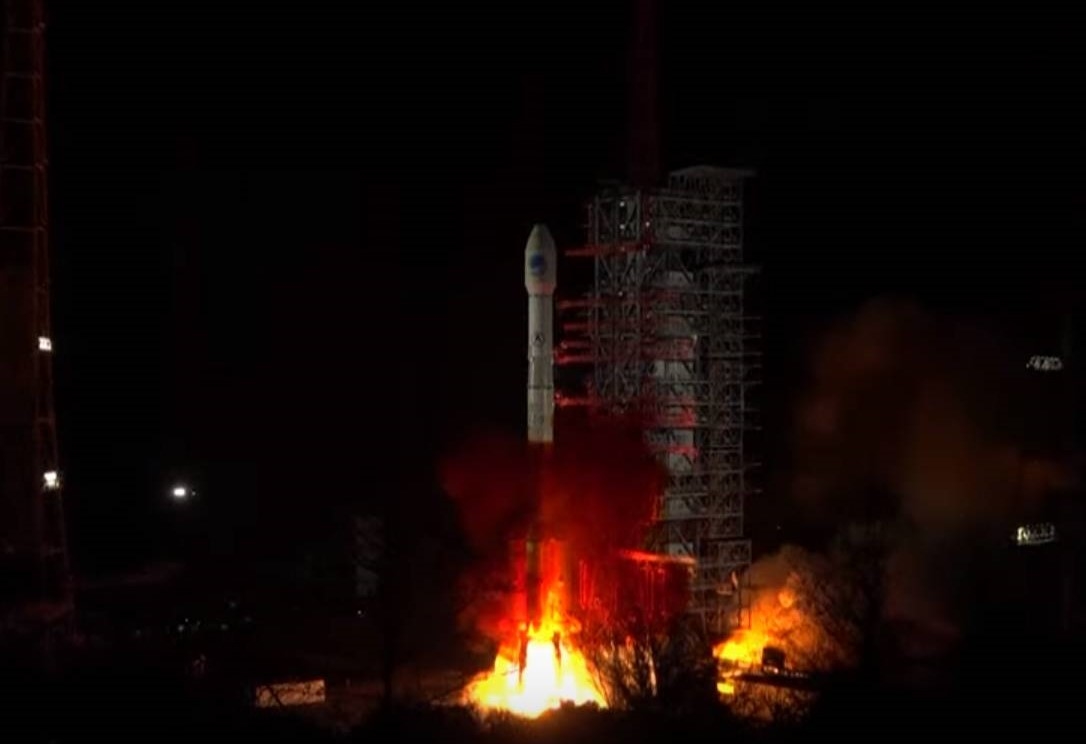
A new parachute system was tested March 9 via a Long March-3B carrier rocket.
Credit: CCTV/Inside Outer Space Screengrab
Chinese researchers are working on a new system designed to prevent rocket boosters from falling unpredictably in areas with human activity.

Credit: CCTV-Plus/Inside Outer Space Screengrab
China Central Television (CCTV) reports that the first accurate landing of a Long March 3B booster was made possible with a parachute control system.
The system was tested on March 9 when the 54th satellite of the BeiDou Navigation Satellite System was sent into a geostationary orbit via a Long March-3B carrier rocket from the Xichang Satellite Launch Center in southwest China’s Sichuan Province.

Credit: CCTV-Plus/Inside Outer Space Screengrab

Credit: CGTN screenshot via CCTV
The parachute assisted landing system can adjust its direction and posture when en route to the ground, and finally lead it to a targeted point. This test verified the feasibility of the overall scheme of the parachute control system, and also laid the foundation for further improvement.

Parachute to parafoil
“The landing area of a booster was 90 kilometers long and 30 kilometers wide in the past. The 2,700-square-kilometer landing area has been greatly scaled down as we now control the booster with parachutes and make it land in the designated area,” said Zhang Puzhuo, chief designer of the parachute control system with China Academy of Launch Vehicle Technology.

Zhang Puzhuo, chief designer of the parachute control system with China Academy of Launch Vehicle Technology.
Credit: CCTV-Plus/Inside Outer Space Screengrab
CCTV reports that more tests are expected this year.
Meanwhile, Chinese rocket engineers are moving forward with adopting a larger parafoil to achieve more accurate landing of spent boosters.
Go to this CCTV-Plus video at:
http://cd-pv.news.cctvplus.com/2020/0403/8139426_Preview_9397.mp4
Also watch the March 9 launch of the Long March-3B carrier rocket at:
https://youtu.be/by4-Kt3Ig_g?list=PLpGTA7wMEDFjz0Zx93ifOsi92FwylSAS3

NASA has scripted a 21st Century plan for sustained human presence on the Moon.
In a report to the National Space Council, NASA’s Artemis program sets the stage for a sustained lunar surface presence. To do this, the report calls for development of an Artemis Base Camp at the South Pole of the Moon.

A South Pole landing site has not been determined, but this image shows sites of interest near permanently shadowed regions, which may contain mission enhancing volatiles. These sites may also offer long-duration access to sunlight, direct-to-Earth communication, surface slope and roughness that will be less challenging for landers and astronauts.
Sustainable foothold
“Artemis Base Camp will be our first sustainable foothold on the lunar frontier,” moving from one to two-month stays by astronauts.
In time, Artemis Base Camp, the report explains, might also include a hopper that could deliver science and technology payloads all over the Moon and which could be operated by crew at Artemis Base Camp and refueled using locally sourced propellant.

Credit: NASA
A lunar far-side radio telescope could also be remotely emplaced and operated from Artemis Base Camp.
First humans to Mars
Furthermore, the report explains that the Artemis program will use the Moon as a testbed for crewed exploration outward, beginning with Mars.

Orion approaches an evolved Gateway.
Credit: NASA
America’s Moon to Mars space exploration approach is a proposed multi-month split-crew operation at the Gateway and on the lunar surface that would test the agency’s concept for a human mission to the Red Planet in the 2030s.

A Lunar Terrain Vehicle (LTV) will be a human-rated, unpressurized (unenclosed) rover that will be used to help astronauts explore and conduct experiments at the lunar South Pole.
To review NASA’s Plan for “Sustained Lunar Exploration and Development” go to:

