Author Archive
 Author:
  June 4th, 2020
What steps are necessary to establish a cislunar sustainability paradigm?
A new publication underscores the fact that, as more nations become spacefarers and cislunar traffic increases, established and emerging players should employ lessons learned from operations in low Earth orbit and geosynchronous Earth orbit “to be better caretakers of the expanded orbital neighborhood.”
The report — Cislunar Stewardship: Planning for Sustainability and International Cooperation – is available from the Center for Space Policy and Strategy, part of The Aerospace Corporation, a nonprofit organization that advises the government on complex space enterprise and systems engineering problems.
Basic assumptions
Why is cislunar space important? The report notes that, between now and mid-century, some basic assumptions about the state of space operations are reasonable.
— Geosynchronous Earth orbit (GEO) will continue to be valuable and actively used.
— The number of operational satellites, especially in low and medium Earth orbits (LEO and MEO), will increase.
— Space operators will become more numerous and more diverse.
— Orbital debris will continue to be a significant concern.
— A greater variety of cislunar orbits will be used for an assortment of space applications, including communications, navigation, space domain awareness, scientific remote sensing, and human exploration.
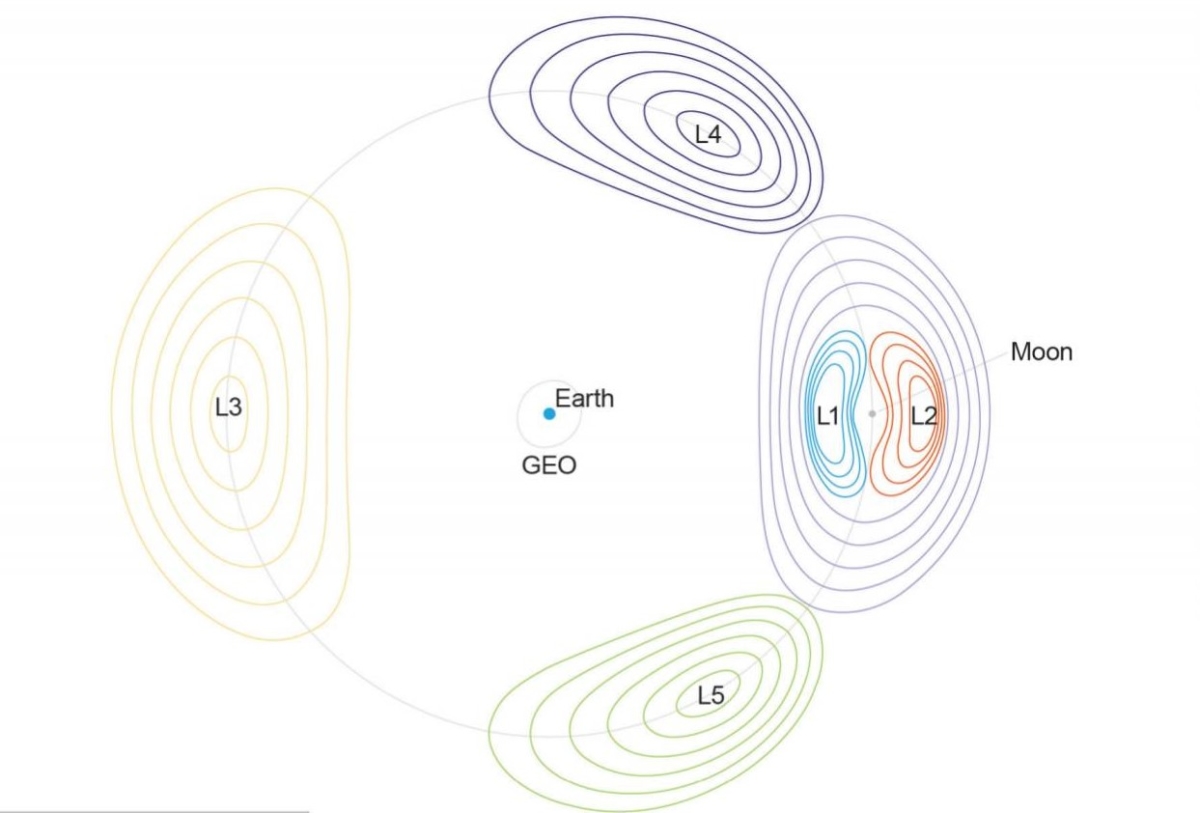
Illustration of several types of cislunar orbits: halo and Lyapunov orbits about the five Lagrange points; distant
retrograde orbits.
Credit: Jonathan Aziz/Center for Space Policy and Strategy
Gravitational and policy stability
“Space operations are expanding beyond the geosynchronous Earth orbit (GEO) to other parts of the Earth-Moon system. As this trend continues, space operators will find preferred orbits and seek to leverage points of relative gravitational stability,” the report explains. “These locations can enable lower-energy transits or provide useful parking places for various types of facilities (e.g., fueling depots, storage sites, and way stations with access to the lunar poles). As cislunar activity grows, a policy framework should be developed to promote the sustainability of operations in these locations.”
To access the report — Cislunar Stewardship: Planning for Sustainability and International Cooperation – go to:
https://aerospace.org/sites/default/files/2020-06/Pollock-Vedda_CislunarStewardship_20200601.pdf
 Posted in
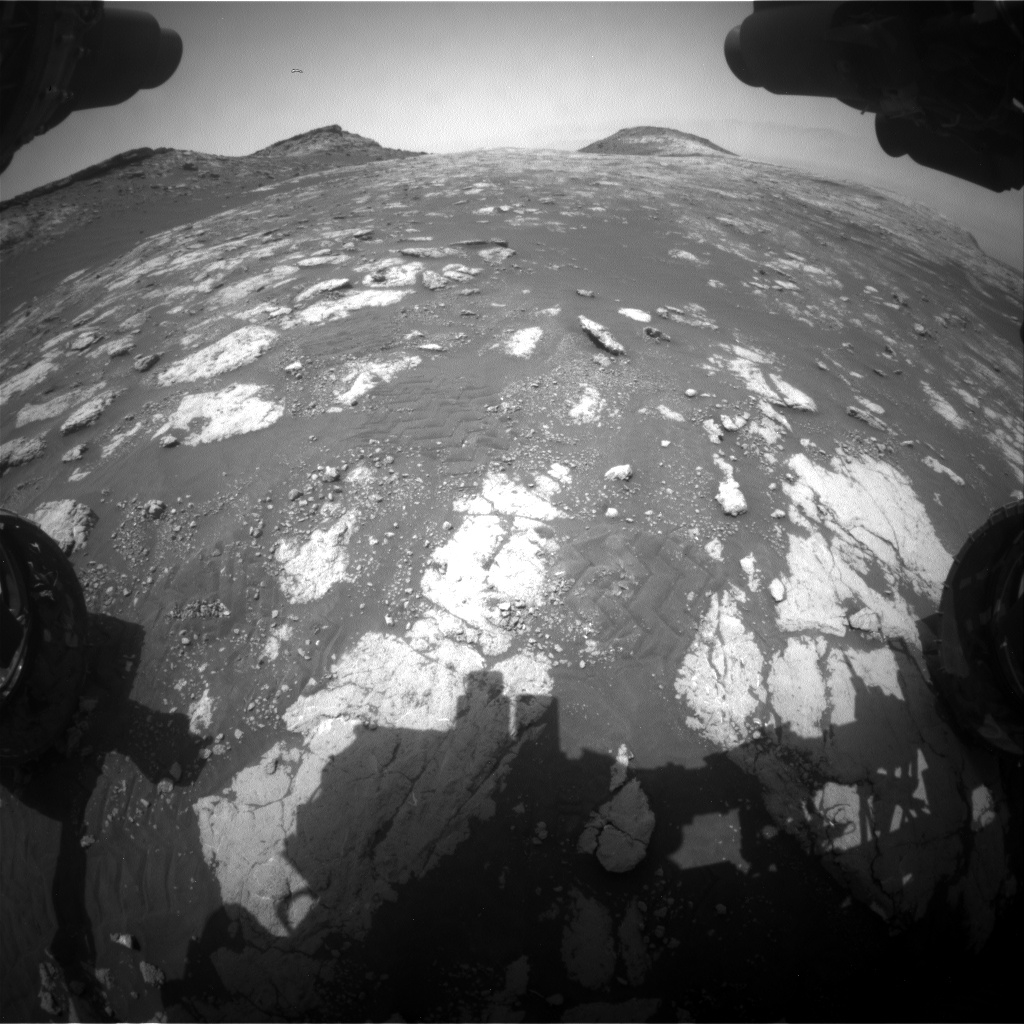
Curiosity Front Hazard Avoidance Camera Right B photo acquired on Sol 2782, June 3, 2020.
Credit: NASA/JPL-Caltech
NASA’s Curiosity Mars rover is now performing Sol 2783 tasks.

Credit: NASA/JPL-Caltech/Univ. of Arizona
Meanwhile, a new rover road map has been issued.
This map shows the route driven by NASA’s Mars rover Curiosity through the 2780 Martian day, or sol, of the rover’s mission on Mars (June 1, 2020).
Numbering of the dots along the line indicate the sol number of each drive. North is up. The scale bar is 1 kilometer (~0.62 mile).
From Sol 2747 to Sol 2780, Curiosity had driven a straight line distance of about 119.44 feet (36.41 meters), bringing the rover’s total odometry for the mission to 13.75 miles (22.13 kilometers).
The base image from the map is from the High Resolution Imaging Science Experiment Camera (HiRISE) in NASA’s Mars Reconnaissance Orbiter.
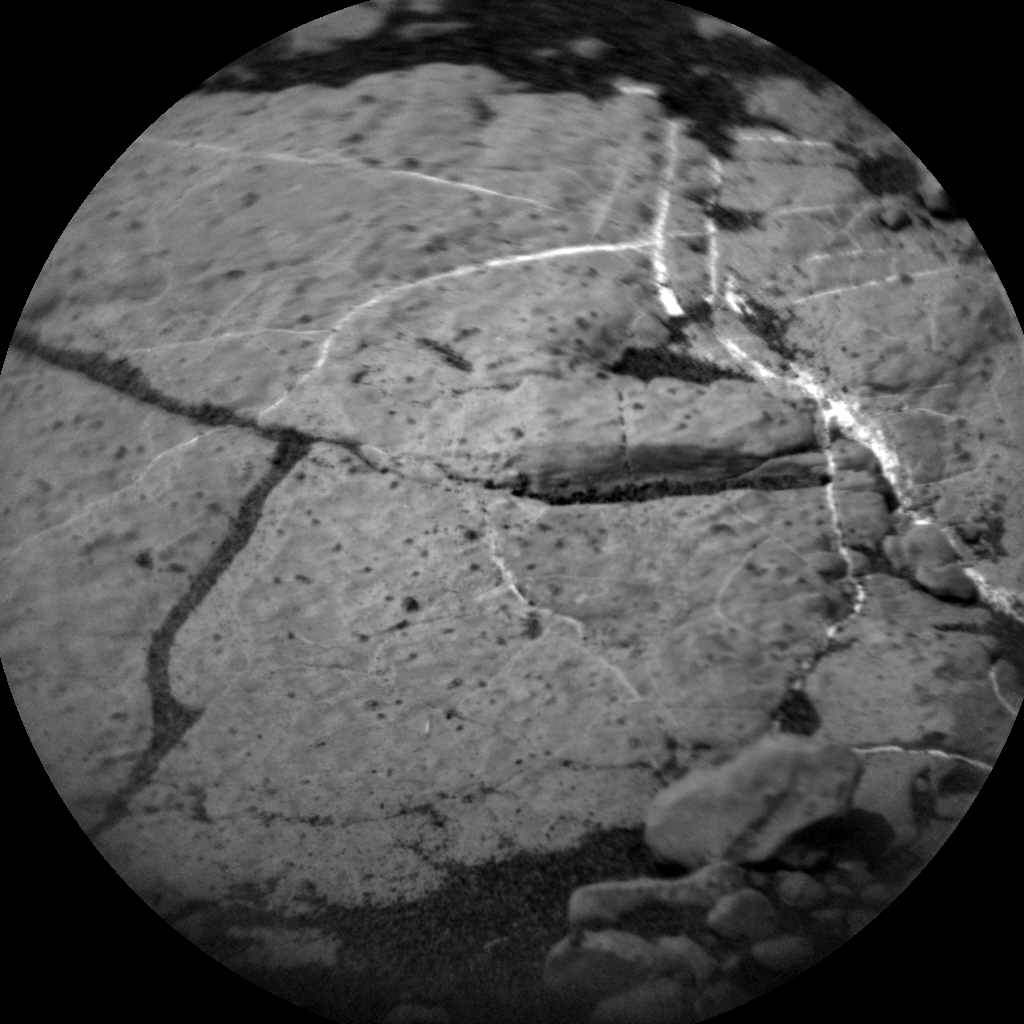
Curiosity Chemistry & Camera Remote Micro-Imager (RMI) photo taken on Sol 2782, June 3, 2020.
Credit: NASA/JPL-Caltech/LANL
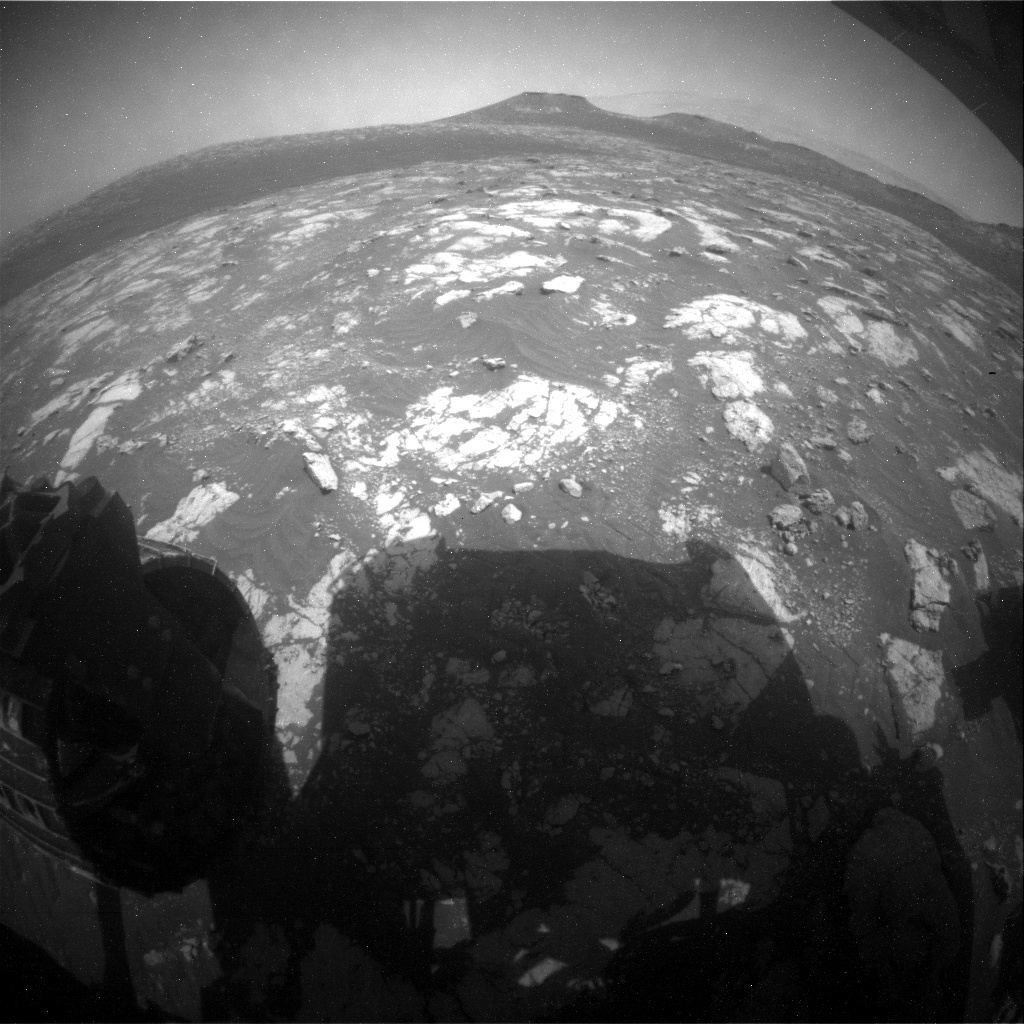
Curiosity Rear Hazard Avoidance Camera Right B image taken on Sol 2782, June 3, 2020.
Credit: NASA/JPL-Caltech

Curiosity Left B Navigation Camera image taken on Sol 2781, June 2, 2020.
Credit: NASA/JPL-Caltech
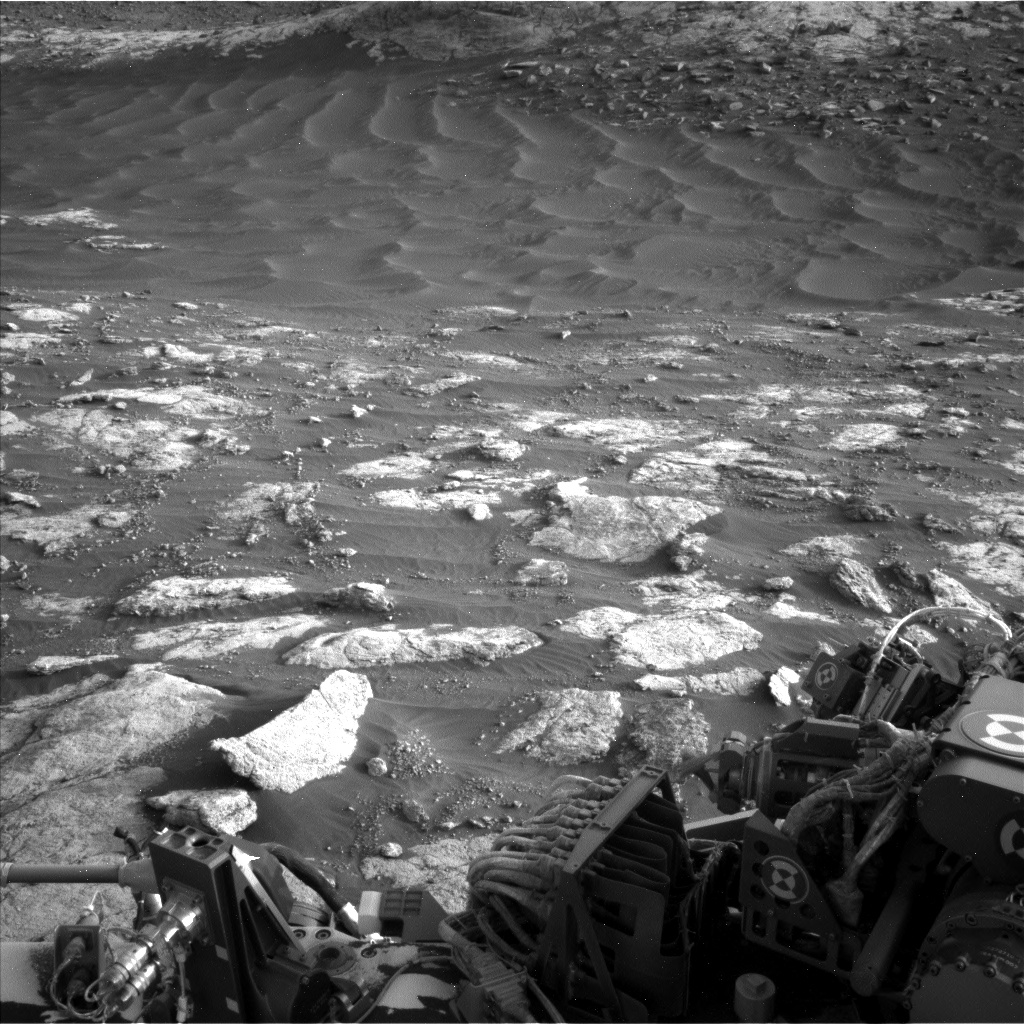
Curiosity Left B Navigation Camera image acquired on Sol 2781, June 2, 2020.
Credit: NASA/JPL-Caltech

Curiosity Mars Descent Imager (MARDI) photo taken on Sol 2781, June 2, 2020.
Credit: NASA/JPL-Caltech/MSSS
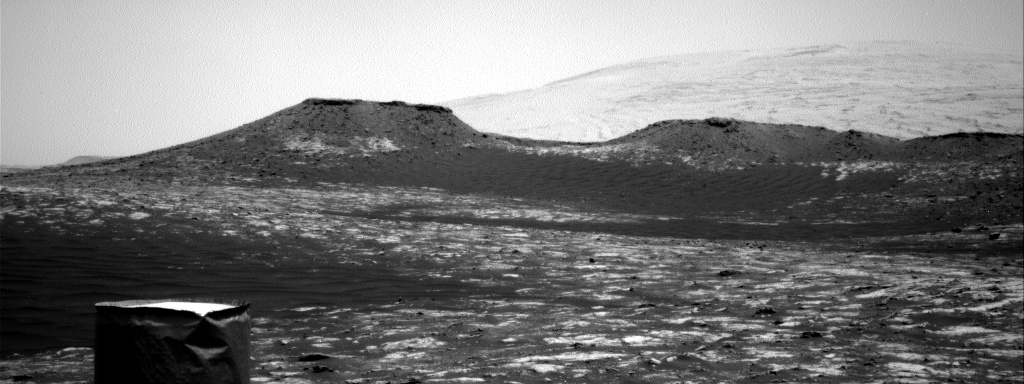
Curiosity Right B Navigation Camera photo taken on Sol 2782, June 3, 2020.
Credit: NASA/JPL-Caltech
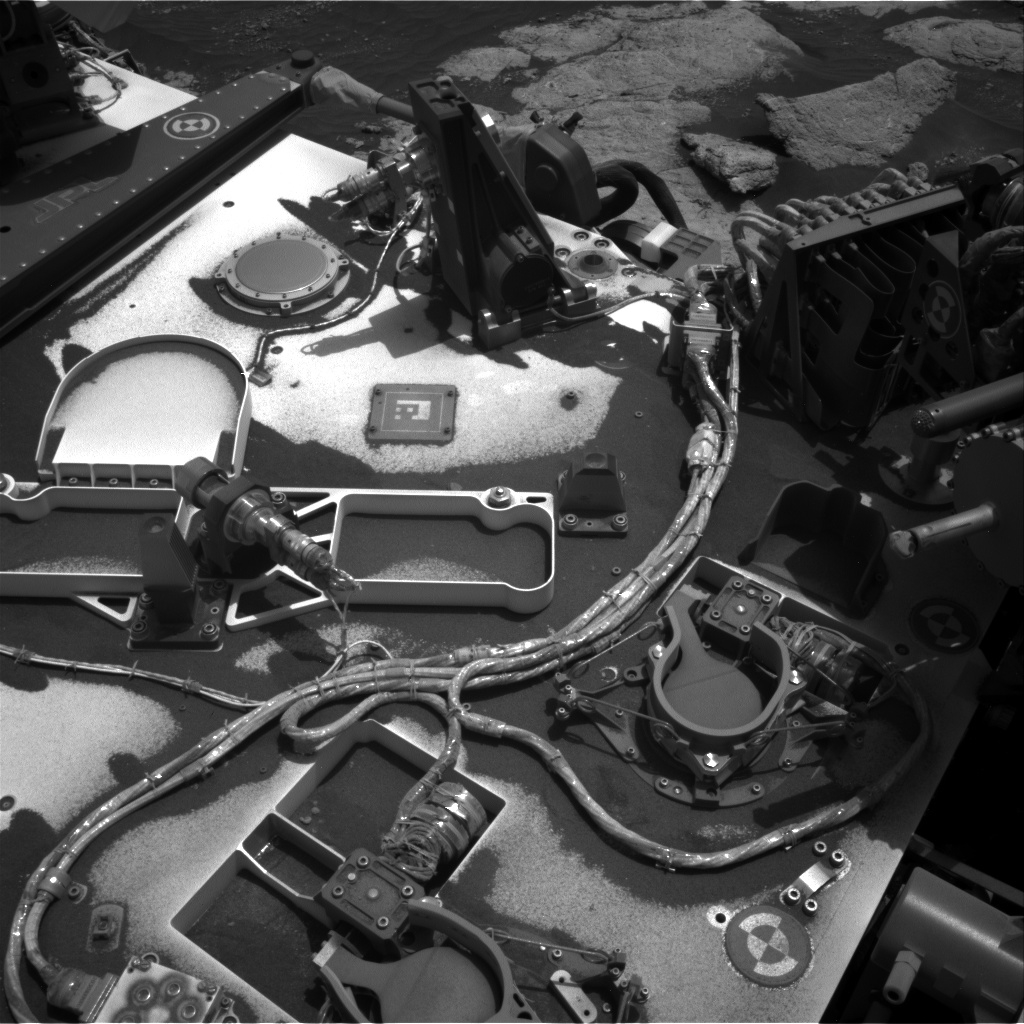
Curiosity Right B Navigation Camera photo acquired on Sol 2782, June 3, 2020.
Credit: NASA/JPL-Caltech

NASA’s InSight Mars lander acquired this image of the “mole” using its robotic arm-mounted, Instrument Deployment Camera (IDC) on June 1, 2020, Sol 538.
Image Credit: NASA/JPL-Caltech
A new update on that troubled Heat Flow and Physical Properties Package (HP3) experiment deployed by NASA’s Insight Mars lander.
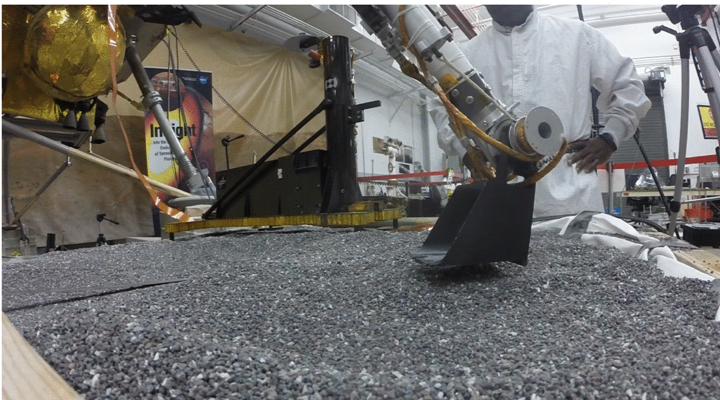
Engineers in a Mars-like test area at NASA’s Jet Propulsion Laboratory try possible strategies to aid the Heat Flow and Physical Properties Package (HP3) on NASA’s InSight lander, using engineering models of the lander, robotic arm and instrument.
Credit: Tilman/NASA/JPL-Caltech
The “mole” is part of the HP3 and has only managed to partially bury itself since it started hammering in February 2019.
Good news
“We have good news! The mole is in the ground and we will be starting testing whether or not it will proceed on its own now next Saturday,” reports Tilman Spohn of the German Aerospace Center’s (DLR) Institute of Planetary Research in Berlin.
Spohn adds that the back-cap push series of operations on Insight was quite risky and went on slowly and step by step. “I was more inclined to be able to report success rather than failure. I hope for your understanding,” he notes.

NASA’s InSight Mars lander acquired this image using its robotic arm-mounted, Instrument Deployment Camera (IDC) on October 27, 2019, Sol 326.
Credit: NASA/JPL-Caltech
Corona lock-down
“One of these days we may perhaps dare to say that the team used the Corona lock-down well to bring the mole in,” Spohn concludes. “In fact communications with everybody else sitting in front of their computers was comparatively easy.”
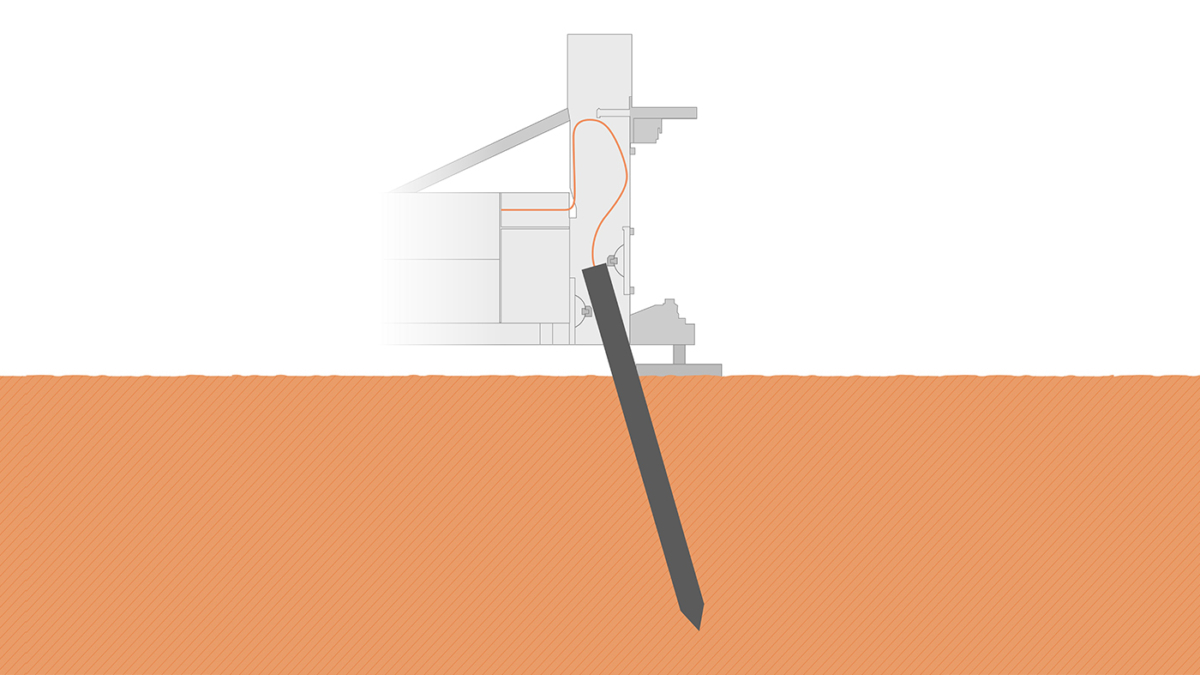
The self-hammering mole, part of the Heat Flow and Physical Properties Package (HP3) on NASA’s InSight lander, was only partially buried in the soil of Mars as of early June 2019, as shown in this illustration.
Credit: NASA/JPL-Caltech/DLR
The Germany-provided HP3 was deployed by NASA’s Insight lender that touched down on the Red Planet in November 2018.
“Mars (and the mole) continue to make our lives…how should I say…interesting,” explained Spohn in an earlier communiqué this year.

Curiosity Left B Navigation Camera image taken on Sol 2780, June 1, 2020.
Credit: NASA/JPL-Caltech
NASA’s Curiosity Mars rover is now performing Sol 2781 duties.
Recent planning calls for the robot wheeling more than 1.5 kilometers – driving to the next major unit of Mt. Sharp, the “sulfate-bearing” unit.

Curiosity Front Hazard Avoidance Camera Left B image acquired on Sol 2780, June 1, 2020.
Credit: NASA/JPL-Caltech
“During this traverse the focus will be on driving as far as we can each sol, but we’ll still be doing plenty of science along the way,” reports Ryan Anderson, a planetary geologist at USGS Astrogeology Science Center in Flagstaff, Arizona.

Curiosity Left B Navigation Camera image taken on Sol 2780, June 1, 2020.
Credit: NASA/JPL-Caltech
Polygonal patterns
Sol 2781 begins with Chemistry and Camera (ChemCam) observations of smooth bedrock at the target “Beaconsfield” and nodular bedrock at the target “Pict.”
The rover’s Mastcam will then document the ChemCam targets and collect a stereo mosaic of some nearby polygonal patterns. Navcam will then study atmospheric dust and take a mosaic of the rover deck.

Curiosity Right B Navigation Camera image taken on Sol 2780, June 1, 2020.
Credit: NASA/JPL-Caltech
Driving on autonav
“After that the rover will drive as far as possible,” Anderson adds, “first using our usual driving mode and then using the rover’s “autonav” capability. Autonav uses the onboard computer to map the terrain so the rover can carefully continue driving farther than our current images can see well. It has been a while since we used autonav, but we’re using all the tools at our disposal to make progress toward the sulfate unit.”
Curiosity’s Navcam will take some images during and after the drive. After the drive Mastcam will make some atmospheric observations and take an image of the ground to monitor soils and rocks during the drive.

Curiosity Left B Navigation Camera image taken on Sol 2780, June 1, 2020.
Credit: NASA/JPL-Caltech
The Mars Descent Imager (MARDI) will also document the ground beneath the rover.
Autonomously targeted observation
“On Sol 2782, Navcam will observe the rover deck again, as well as watch for dust devils, and ChemCam will make an autonomously targeted observation,” Anderson says.

Curiosity Chemistry & Camera Remote Micro-Imager (RMI) photo acquired on Sol 2779, May 31, 2020.
Credit: NASA/JPL-Caltech/LANL

Curiosity Chemistry & Camera Remote Micro-Imager (RMI) photo acquired on Sol 2779, May 31, 2020.
Credit: NASA/JPL-Caltech/LANL
Also, the Chemistry & Mineralogy X-Ray Diffraction/X-Ray Fluorescence Instrument (CheMin) will do an overnight observation of an empty cell (this gives a baseline to compare with when analyzing samples later on), Anderson concludes.

Who2 has created GIANT LEAPS: Heroes of Space and Flight – a new solitaire game that celebrates great pilots, astronauts, inventors, and daredevils of the past two centuries, from Neil Armstrong to the Montgolfier Brothers, even Russia’s Laika space dog!
Who2 staffers Paul Hehn and Fritz Holznagel chose the 52 groundbreaking figures and wrote the text.

Game on!
The game itself was the creation of Neal Taparia and Darshan Somashekar, the creative minds behind the site Solitaired.
As an education entrepreneur, Taparia told Inside Outer Space “our goal is to spread the word and to also demonstrate how games can be used to educate.”
Taparia added that an online solitaire game is also available, which you can find at:
https://solitaired.com/solitaire/space-flight
For more information on GIANT LEAPS: Heroes of Space and Flight go to:
https://www.who2.com/solitaire-with-a-who2-twist-try-giant-leaps/

A Europlanet Telescope Network collaboration will initially link 15 observatories around the globe to provide coordinated observations and rapid responses in support of planetary research.
“Our aim with this new network is to support a global community that can react fast and effectively to observational alerts and participate in coordinated observational campaigns related to objects in our Solar System and planets orbiting distant stars,” explains Manuel Scherf, the coordinator of the Europlanet Telescope Network.
Professionals and trained amateurs
This new collaboration will provide professional and trained amateur observers with access to telescopes located around the globe ranging from 0.25 – 2 meters in diameter.
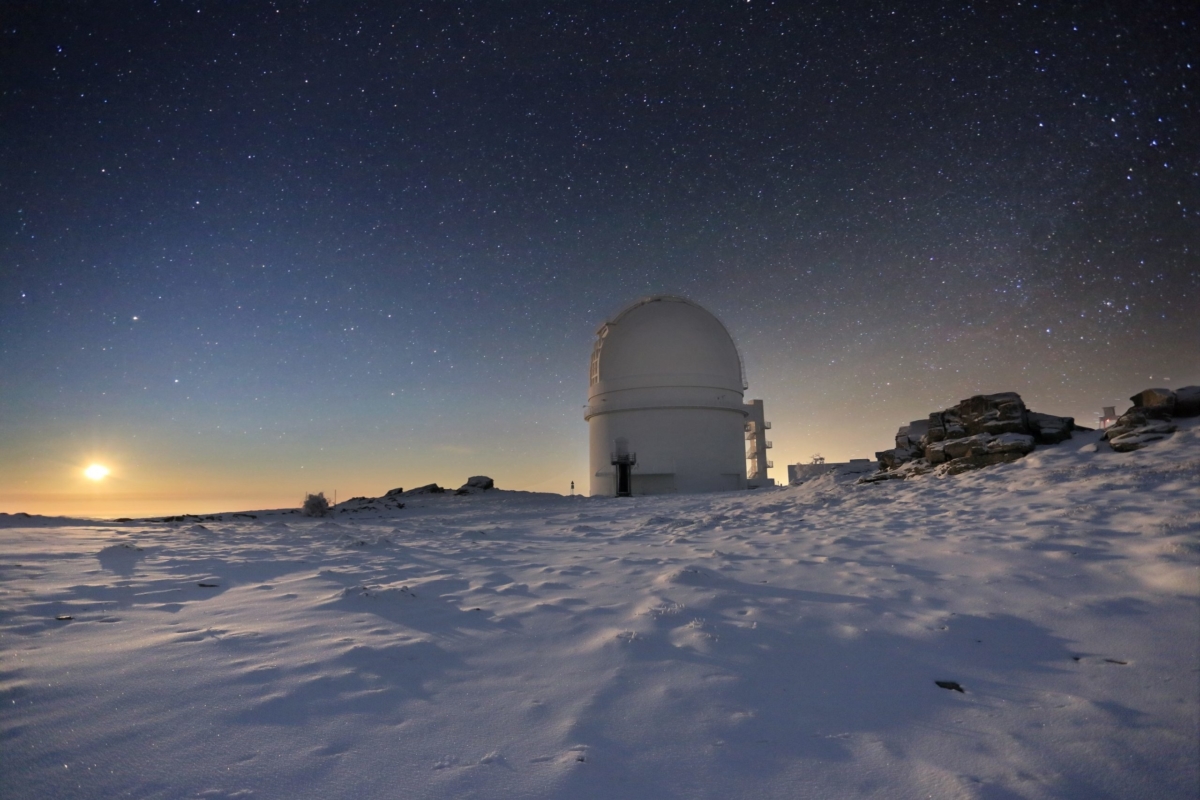
Calar Altao Observatory. Credit: Ricardo Huesometers in diameter.
The network will also be used in studies that require significant amounts of observing time, like searches for lunar impact flashes, and observations from multiple locations simultaneously, such as to reveal the size, shape and orbit of asteroids that might be hazardous to Earth.
Visit the facilities
Professional and amateur astronomers can now apply to visit the facilities participating in the Europlanet Telescope Network and have their expenses covered for the time needed to make their observations, which can range from hours to several weeks.

Beacon Observatory, University of Kent, UK: 42cm remote controllable astrograph.
Credit: University of Kent
Visits will start from the autumn, subject to any local travel restrictions due to the Covid-19 pandemic.
The network plans to draw in additional facilities and build new collaborations, particularly in geographical regions that are currently under-represented in the planetary science community.

Skalnate Pleso Observatory. Credit: Marek Husarik
Participating observatories
The observatories participating in the project are:
- Pic du Midi Observatory, IMCCE, Observatoire de Paris, CNRS, France: 1.06m-telescope
- Moletai Astronomical Observatory, Vilnius University, Institute of Theoretical Physics and Astronomy, Lithuania: 1.65m-telescope and 35/51cm-telescope
- Kryoneri Observatory, National Observatory of Athens, Greece: 1.2m-telescope
- Skalnate Pleso Observatory, Astronomical Institute of the Slovak Academy of Sciences, Slovakia: 1.3m-telescope and 61cm-telescope
- Faulkes Telescope Project, UK (accessing the Las Cumbres Observatory, LCO, global network): Two 2m-robotic telescopes, nine 1m-robotic telescopes, and ten 40cm-robotic telescopes
- Tartu Observatory, University of Tartu, Tartu Observatory, Estonia: 1.5m telescope, 60cm telescope, 30cm robotic telescope
- Danish 1.54m telescope at ESO La Silla Observatory (Chile), Copenhagen University, Niels Bohr Institute, Denmark: 1.54m mirror telescope
- Beacon Observatory, University of Kent, UK: 42cm remote controllable astrograph
- Observatorie del Teide, Instituto de Astrofisica de Canarias, Spain : 82cm IAC-80 telescope, 45cm telescope
- Calar Alto Observatory, Junta de Andalucia and the Instituto de Astrofisica de Andalucia, Spain : 1.23m telescope
- Lisnyky Observation Station, AO KNU, Ukraine: 70cm telescope
- Chuguev Observatory, Institute of Astronomy of V.N. Karazin Kharkiv National University, Ukraine: 70cm telescope
- Terskol Peak Observatory, International Center for Astronomical, Medical and Ecological Research of the National Academy of Sciences of Ukraine (IC AMER), Ukraine: 2m telescope, 60cm telescope
- Konkoly Observatory, Research Centre for Astronomy and Earth Sciences, Hungary: 1m telescope, 80cm telescope
- Ussuriysk Astrophysical Observatory, Institute of Applied Astronomy of the Russian Academy of Sciences, Russia: 25cm-telescope, 50cm-telescope
For more information on the Europlanet Telescope Network, go to:
https://www.europlanet-society.org/europlanet-2024-ri/telescope-network/
The White House
Office of the Press Secretary
FOR IMMEDIATE RELEASE
May 30, 2020
REMARKS BY PRESIDENT TRUMP
AT KENNEDY SPACE CENTER
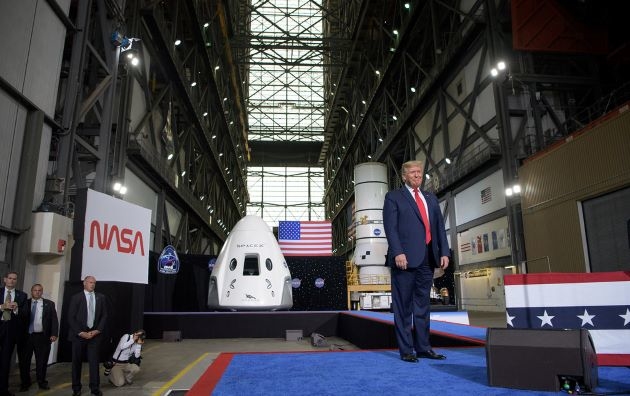
President Donald Trump speaks inside the Vehicle Assembly Building following the launch of a SpaceX Falcon 9 rocket carrying the company’s Crew Dragon spacecraft on NASA’s SpaceX Demo-2 mission with NASA astronauts Robert Behnken and Douglas Hurley onboard, Saturday, May 30, 2020, at NASA’s Kennedy Space Center in Florida.
Photo Credit: NASA/Bill Ingalls
Moments ago, as we witnessed the launch of two great American astronauts into space, we were filled with the sense of pride and unity that brings us together as Americans. That same spirit which powered our astronauts to the Moon has also helped lift our country to ever greater heights of justice and opportunity throughout our history.

Photo Credit: NASA/Bill Ingalls
So today, as we mark a renewed commitment to America’s future in space, a tremendous commitment it is. Let us also commit to a brighter future for all of our citizens right here on Earth.
When Americans are united, there is nothing we cannot do. From day one of my administration, we put America first. (Applause.)
This afternoon, I’m delighted to be with you at Cape Canaveral, in this storied home of American daring, aspiration, and drive.
This is the first big space message in 50 years. Think of that. And it is an honor to be delivering it.

Photo Credit: NASA/Bill Ingalls
Today, as we gather in this special place to celebrate not only the launch of a new spacecraft but also our nation’s bold and triumphant return to the stars, it’s a special day. Moments ago, the world bore witness to the flight of the first new manned U.S. spacecraft in nearly 40 years since the Space Shuttle launched in 1981 — a long time ago.
I am thrilled to announce that the SpaceX Dragon Capsule has successfully reached low-Earth orbit and that our astronauts are safe and sound. (Applause.)
With this launch, the decades of lost years and little action are officially over. A new age of American ambition has now begun.
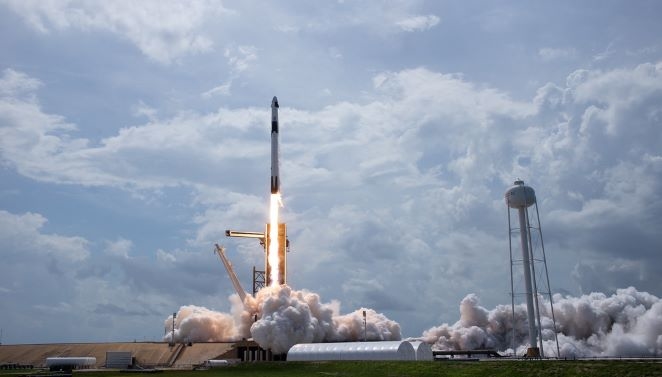
Photo Credit: NASA/Bill Ingalls
Past leaders put the United States at the mercy of foreign nations to send our astronauts into orbit. Not anymore. Today, we once again proudly launch American astronauts on American rockets, the best in the world, from right here on American soil. (Applause.)
Those of us who saw the spectacular and unforgettable liftoff this afternoon watched more than an act of history; we watched an act of heroism. Every time our astronauts climb aboard a rocket — which is many, many stories of only engine and fuel — and vault across the sky, they display breathtaking valor.
What Colonel Douglas Hurley and Colonel Robert Behnken did this afternoon was pure American genius and courage. They join the ranks of just seven prior American astronauts who have made the perilous maiden voyage to test a new class of spacecraft.
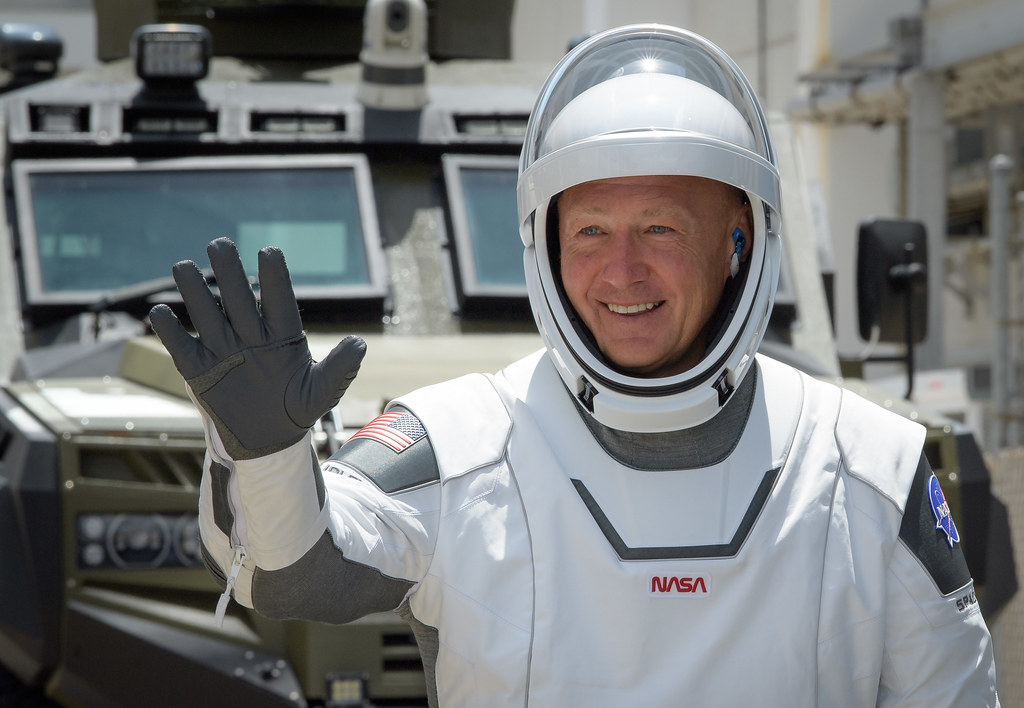
NASA astronaut Douglas Hurley.
Photo Credit: NASA/Bill Ingalls
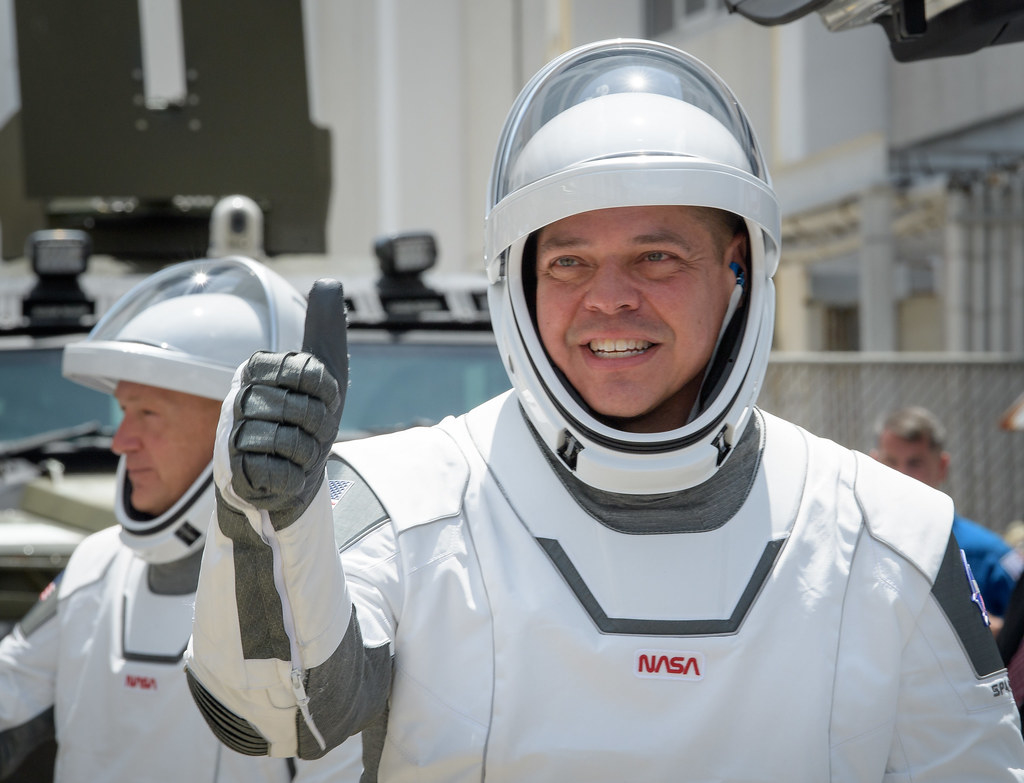
NASA astronaut Robert Behnken.
Photo Credit: NASA/Bill Ingalls
The names of Hurley and Behnken will stand in the history books alongside those of legends like Alan Shepard, Gus Grissom, John Young. Now these brave and selfless astronauts will continue their mission to advance the cause of human knowledge as they proceed to the International Space Station before returning to Earth. We wish them Godspeed on their journey, and as one proud nation, we salute their fearless service.
Thank you. Thank you. (Applause.) Thank you.
I also want to send our nation’s gratitude to the wives of these valiant astronauts, both of whom are astronauts themselves: Karen Nyberg and Megan McArthur. We join them in praying for our heroes’ safe return.
As you know, this spring, our nation has endured the pain and hardship of a global pandemic. As we usher in a new era of manned spaceflight, we are reminded that America is always in the process of transcending great challenges. Our nation is blessed with limitless reserves of talent, tenacity, and resolve. The same spirit of American determination that sends our people into space will conquer this disease on Earth. It should’ve never happened. Nothing — not even gravity itself — can hold Americans down or keep America back.

NASA Administrator Jim Bridenstine speaks inside the Vehicle Assembly Building following the launch of a SpaceX Falcon 9 rocket carrying the company’s Crew Dragon spacecraft on NASA’s SpaceX Demo-2 mission.
Photo Credit: NASA/Bill Ingalls
We are grateful to NASA Administrator Jim Bridenstine and Director of the Kennedy Space Center Bob Cabana for welcoming us this evening. Very special. Thank you very much. Thank you. Thank you. (Applause.) Thank you. Great job. Great job. Come a long way in three and a half years, Jim, haven’t we? Huh? A long way.
To the incredible men and women of NASA, from here at Kennedy Space Center, to the Johnson Space Center in Texas — we love you too — to NASA Plum Brook Station in Sandusky, Ohio: Thank you all for working so hard to make this day a reality. We have many other great days almost ready to happen.
Also with us are many members of my Cabinet, including our great new DNI, John Ratcliffe. Thank you, John. Thank you. (Applause.) We have a great friend of mine, a special man, ran a great, great campaign: Governor of Florida, Ron DeSantis. (Applause.) Thank you, Ron. Thank you, Ron.
Your Senators Rick Scott and Marco Rubio. Thank you very much. Thank you. (Applause.) Thank you. Thank you. Leader Kevin McCarthy. Kevin, thank you very much. (Applause.) Great job you do, Kevin.
And Representatives Matt Gaetz, John Rutherford, Michael Waltz, Bill Posey, Gus Bilirakis, Daniel Webster, Brian Mast, Elise Stefanik, Bill Flores, Brian Babin, Rodney Davis, Roger Marshall, and Steven Palazzo. Thank you very much, fellas. Thank you. (Applause.) What a great group of people. They’re warriors. They’re really warriors. They helped so much get this done, and so many other things.
With us also is our Air Force Chief of Staff, General David Goldfein. General, thank you very much. (Applause.) Thank you. Thank you, General. Thank you. And Chief of Space Operations — the first-ever named — and now a member of the Joint Chiefs of Staff, because we created the United States Space Force — General Jay Raymond. Thank you very much. Jay. (Applause.) Thank you, Jay. And senior members, also, of our great United States military. It’s never been stronger than it is right now.
Also, Attorney General of Florida, Ashley Moody, and Chief Financial Officer of Florida, Jim Patronis, and many other distinguished guests.
Thank you very much for being here. (Applause.) We appreciate it.
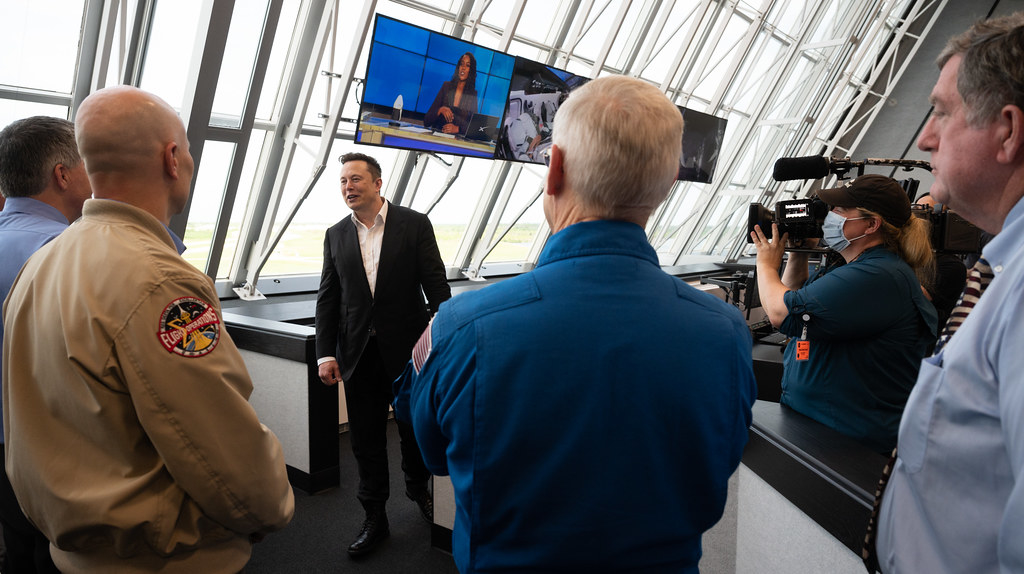
Elon Musk, SpaceX Chief Engineer, speaks with NASA managers following the launch of a SpaceX Falcon 9 rocket carrying the company’s Crew Dragon spacecraft on the Demo-2 mission.
Photo Credit: NASA/Joel Kowsky
I especially want to congratulate someone who truly embodies the American ethos of big thinking and risk-taking. After achieving success as an Internet entrepreneur, he could have spent his fortune doing anything, including yachting, lots of things. He could do lots of things. But in 2002, he began pouring tens of millions of dollars of his own money into research and development for a new rocket. He’s a little different than a lot of other people. He likes rockets. He assembled a crew of some of the greatest minds and talent in American aerospace.
In the years since, SpaceX has become the first private company to develop and successfully launch its own rocket into orbit, the first to launch and recover its own capsule, and of course, moments ago, Space X became the first private company to put humans into orbit around the Earth.
Elon Musk, congratulations. Congratulations, Elon. (Applause.) Thanks, Elon.
For Elon and 8,000 SpaceX employees, today is the fulfillment of a dream almost two decades in the making. For years on end, they have worked hand-in-hand with NASA, sculpting aluminum, tightening valves, tuning nozzles, testing parachutes, and filling massive tanks with thousands and thousands of pounds of kerosene and liquid oxygen.
Credit: NASA
Today, the groundbreaking partnership between NASA and SpaceX has given our nation the gift of an unmatched power: a state-of-the art spaceship to put our astronauts into orbit at a fraction of the cost of the Space Shuttle. And it’s much better.
From now on, the United States will leverage the fast-growing capabilities of our commercial sector and the finest pieces of real estate on Earth — which you need very badly — to send U.S. astronauts into space.
Under NASA’s Commercial Crew program, we will use rockets and spacecraft designed, built, owned, and launched by private American companies, at a fixed price for the American taxpayer.
Today’s launch makes clear the commercial space industry is the future. The modern world was built by risk-takers and renegades, fierce competitors, skilled craftsmen, captains of industry who pursued opportunities no one else saw and envisioned what no one else could ever think of seeing. The United States will harness the unrivaled creativity and speed of our private sector to stride ever further into the unknown.
This launch also marks an exciting turning point for NASA. This agency will now focus its unmatched ex- — expertise, like nobody has ever seen, and power and integrity to do what NASA does better than anyone else — and it’s not even close: embark on the most difficult, most daring, most audacious missions in the history of humankind.
When I first came into office three and a half years ago, NASA had lost its way, and the excitement, energy, and ambition, as almost everybody in this room knows, was gone. There was grass growing through the cracks of your concrete runways. Not a pretty sight. Not a pretty sight at all.

Kennedy Space Center.
Credit: NASA
The last administration presided over the closing of the Space Shuttle and almost all of the giant facility that keeps so many people working, so many brilliant minds going. People were crying. They were devastated. But now it’s the greatest of its kind anywhere in the world and will get greater and greater with years to come. I promise you that. (Applause.)
We have created the envy of the world and will soon be landing on Mars, and will soon have the greatest weapons ever imagined in history. I’ve already seen designs. And even I can’t believe it.
The United States has regained our place of prestige as the world leader. As has often been stated, you can’t be number one on Earth if you are number two in space. (Applause.) And we are not going to be number two anywhere. (Applause.)

President Donald Trump signs S.1790, the National Defense Authorization Act for Fiscal Year 2020 on, Friday, Dec. 20, 2019 at Joint Base Andrews. The act directed the establishment of the U.S. Space Force as the sixth branch of the armed forces.
Credit: Airman 1st Class Spencer Slocum, 11th Wing Public Affairs
Nowhere is this more true than with our military, which we have completely rebuilt. Under my administration, we have invested two and a half trillion dollars in new planes, ships, submarines, tanks, missiles, rockets — anything you can think of. And last year, I signed the law creating the sixth branch of that already very famous United States Armed Forces: the Space Force. (Applause.)
For every citizen who has eagerly waited for America to reignite those engines of will, confidence, and imagination that put a man on the Moon, I stand before you to say: You need wait no longer.
Through NASA’s Artemis program, the United States is preparing for a crewed mission to Mars. Earlier this week, I saw the Orion capsules being worked on in this building. As part of the Artemis Moon-to-Mars program, those capsules will soon return Americans to lunar orbit for the first time in over 50 years — half a century.

NASA has orchestrated the Artemis Accords that sets the stage for America returning to the Moon.
Credit: NASA
By 2024, our astronauts will return to the lunar surface to establish a permanent presence and the launching pad to Mars. (Applause.) And the first woman on the moon will be an American woman. And the first nation to land on Mars will be the United States of America. (Applause.)
Since I signed the order to establish these goals shortly after taking office, we have made rapid gains. A new 22,000- pound capsule is already built. The next generation of space suits are already made. Colossal rockets are now being tested. And the contracts for three separate lunar landers have been awarded and signed, and they are magnificent.
In the years ahead, America will go bigger, bolder, further, faster, and America will go first. America will always be first. (Applause.)
To be certain, we will meet the adversity and hardship along the way. There may even be tragedy, because that is the danger of space. There’s nothing we can do about that. The power that we’re talking about is unrivaled. There’s nothing we can do about problems. But we’ll have very few of them.
We will confront all of those challenges, knowing that the quest for understanding is the oldest and deepest hope in our souls. The innate human desire to explore and innovate is what propels the engines of progress and the march of civilization. We will preserve and persevere, and we will ensure a future of American dominance in space.

Credit: NASA
To that end, over the last three years, I reestablished the National Space Council. I issued a directive cutting red tape for innovative space companies such as SpaceX. We created the world’s first comprehensive space traffic management system. Last month, I signed an executive order establishing U.S. policy for the recovery and use of space resources and minerals. Administrator Bridenstine announced the Artemis Accords to govern the future of space exploration and development.
Together, we will assert America’s rightful heritage as the greatest space-faring nation on the planet. And already, it’s not even close.
In the half a century since the United States stopped sending astronauts to deep into space — 1972 — no other country has ever done it. The reasons are simple: cost, technological complexity, and tremendous danger.
For instance, I was told that the rocket you just witnessed had to be launched within one second, or it would be impossible for it to hit its target. And I was here two days ago, and I said to Jim: “Jim, it’s okay. Why don’t you wait 5 or 10 minutes?” (Laughter.) And he said, “Sir, we only have a window of one second.” And I walked out of here shaking my head. (Laughter.) Is that true, Jim? Yes, it true.

NASA’s Artemis return humans to the Moon by 2024 program.
Credit: NASA
Space travel is not a feat of engineering alone. It’s also a moral endeavor — a measure of a nation’s vision, its willpower, its place in the world. Exploration is a test of our values and of our faith. America is a nation defined by its commitment to discovery — to solve mysteries, to chart the unknown, to press the limits, to achieve the fullest expression of life’s potential, and to ensure that America is the nation that always leads the way, and especially in space.
This evening, I am more confident than ever before that America stands poised to thrive in this grand undertaking. It’s incredible. We are a nation of pioneers. We are the people who crossed the ocean, carved out a foothold on a vast continent, settled a great wilderness, and then set our eyes upon the stars. This is our history, and this is our destiny.
Now, like our ancestors before us, we are venturing out to explore a new, magnificent frontier. It’s called: space. Our most daring feats, our most epic journeys, our biggest adventures, and our finest days are just beginning. America’s proudest moments are still ahead. We are on the verge of our most exciting years, and next year may be the most exciting of all. You just watch.

Confirmation of the existence and extent of life on Mars, whether ancient or current, will benefit human exploration. Here an exobiologist examines what appears to be a porous relic of a hot spring that has fallen from the canyon wall.
Credit: NASA/Pat Rawlings
So today, as our brave American astronauts shake the Earth and blaze a trail of fire and steel into the heavens, we proclaim for all to hear that we have not yet tested the full strength of the American character, and the world has not yet seen the full glory of the American spirit. For our country, for our children, and for humanity’s march into the stars, the best is yet to come. (Applause.)
It was a great honor for me to deliver this speech. God bless our brave astronauts now soaring through the heavens. God bless the men and women of NASA. And God bless America. Thank you very much. Thank you. (Applause.)
END 5:49 P.M. EDT

Curiosity Front Hazard Avoidance Camera Left B photo taken on Sol 2777, May 29, 2020.
Credit: NASA/JPL-Caltech
NASA’s Curiosity Mars rover is now carrying out Sol 2778 duties.
“This week the science team decided not to drill a second hole next to the ‘Glasgow’ target, and so we’re able to hit the road again this weekend,” reports Scott Guzewich, an atmospheric scientist at NASA’s Goddard Space Flight Center in Greenbelt, Maryland.

Curiosity Rear Hazard Avoidance Camera Right B image acquired on Sol 2777, May 29, 2020.
Credit: NASA/JPL-Caltech
“We’re heading east, past a large sand sheet, and toward the sulfate unit farther up the slopes of Mt. Sharp that Curiosity will be exploring in the future,” Guzewich adds. “The sulfate unit is the last unexplored region that originally led to Gale Crater’s selection as the landing site for Curiosity.”

Curiosity Chemistry & Camera image taken on Sol 2777, May 29, 2020.
Credit: NASA/JPL-Caltech/LANL
Wrapping up activities
Before driving this Sunday, Curiosity is wrapping up activities at Glasgow with a very full science plan and the opportunity to complete several activities that are rather infrequent.
A series of observations with Mastcam and Navcam will monitor sand and dust motion on the surface.

Curiosity Mast Camera Left photo taken on Sol 2775, May 27, 2020.
Credit: NASA/JPL-Caltech/MSSS
“We call these ‘change detection’ images and they help inform us about how Mars’ many sand dunes form and move and how the surface has been eroded over billions of years of history,” Guzewich notes.
Argon monitoring
Curiosity’s Alpha Particle X-Ray Spectrometer (APXS) will monitor the atmosphere.

Curiosity Mast Camera Left photo taken on Sol 2775, May 27, 2020.
Credit: NASA/JPL-Caltech/MSSS
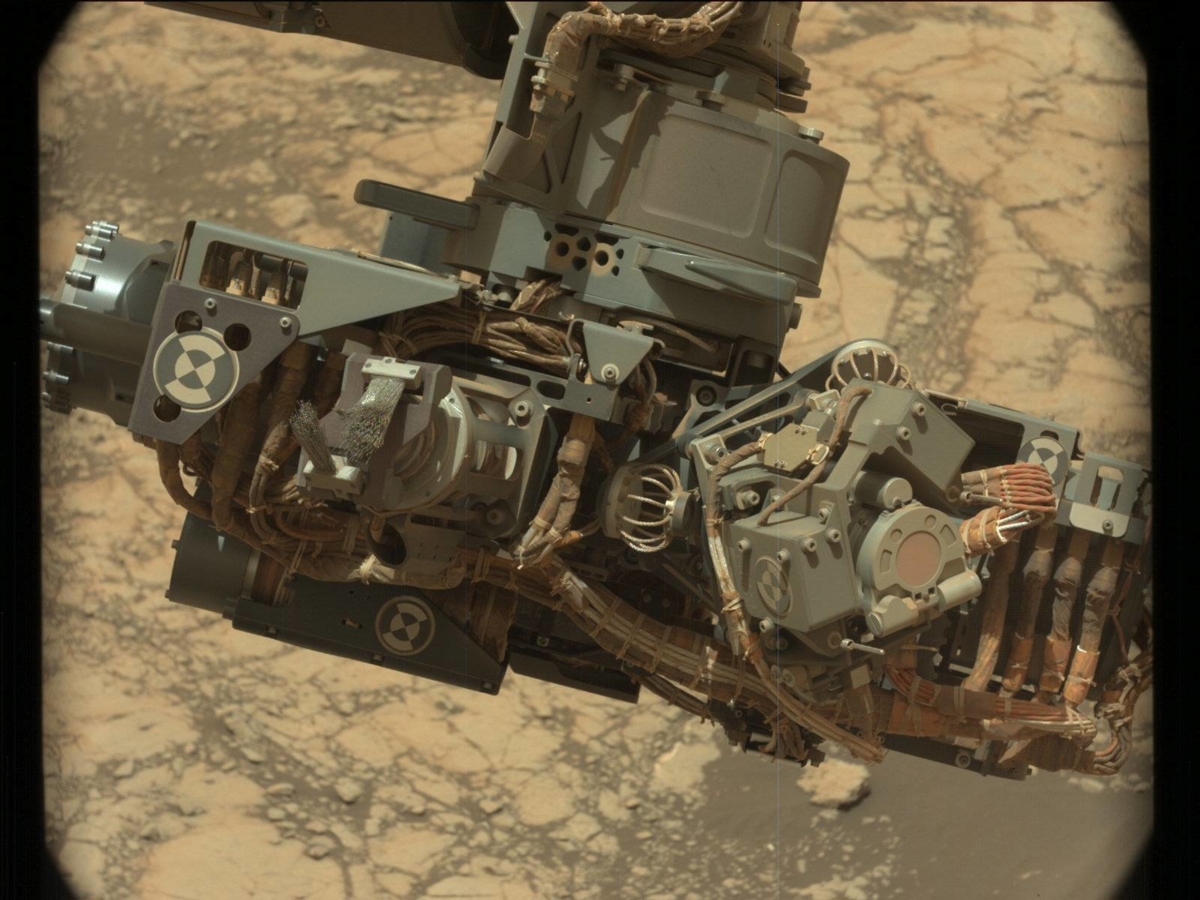
“Usually, APXS is placed down on the surface for contact science on a rock target, but the instrument is also sensitive to argon, a trace gas in both Earth’s and Mars’ atmospheres,” Guzewich explains. “Because of Mars’ climate, where a large amount of the atmosphere freezes onto the polar caps in winter, the relative amount of argon in the atmosphere changes, and APXS can monitor that cycle.”

Curiosity Mast Camera Left photo taken on Sol 2775, May 27, 2020.
Credit: NASA/JPL-Caltech/MSSS
Curiosity Mast Camera Left photo taken on Sol 2775, May 27, 2020.
Credit: NASA/JPL-Caltech/MSSS
Storm watch
Lastly, Mars researchers have planned a Chemistry and Camera (ChemCam) observation (a “passive sky”) where they use ChemCam, without the laser, to look at the atmosphere and monitor how gases like water vapor and dust amounts change seasonally.
“We’re in the early portion of the dusty season on Mars,” Guzewich concludes, “so we’re keeping a close eye on the sky to watch for storms.”
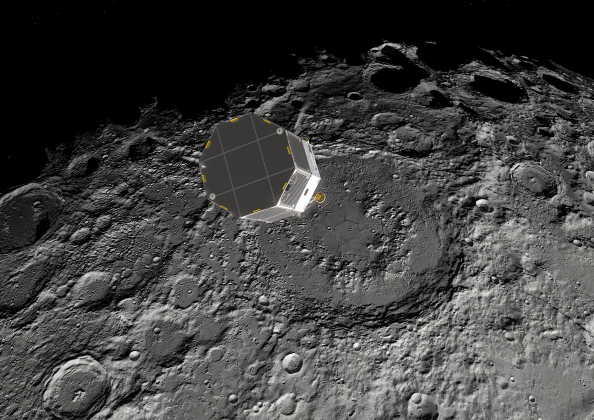
European Large Logistic Lander enables a series of proposed ESA missions to the Moon that could be configured for different operations such as cargo delivery, returning samples from the Moon or prospecting resources found on the Moon.
Credit: ESA/ATG-Medialab
Key steps are underway in Europe to develop its first ever lunar lander.
Set to launch on an Ariane 64 rocket later this decade and return to the Moon on a regular basis, the large lander idea comes hot on the heels of the European Space Agency (ESA) signing an agreement to start building the third European Service Module for NASA’s Artemis program. This module will drive the spacecraft that ferries the next astronauts to the Moon.
Autonomous access
The European-led large lunar lander program provides autonomous access to the Moon, delivering 1.5 tons of material from Europe’s Spaceport in Kourou, French Guiana.
The program, currently known as the European Large Logistics Lander or EL3 for short, is designed to incorporate different types of uncrewed missions, from supply runs for Artemis astronauts, to stand-alone robotic science and technology demonstration missions and even a lunar return mission to bring samples to laboratories on Earth.

Unloading cargo frp, European Large Logistic Lander.
Credit: ESA/ATG-Medialab
Configured for different operations
“This European lander will be able to access locations all over the Moon from the equator to the poles, from the near side to the farside, opening up tremendous opportunities to deliver science, research technology and infrastructure,” says James Carpenter, ESA’s Exploration science and research coordinator. “Developing this capability is a hugely important strategic step for Europe. It will allow us to take a lead in future robotic missions and support international activities at the Moon’s surface.”
The EL3 enables a series of proposed ESA missions to the Moon that could be configured for different operations such as cargo delivery, returning samples from the Moon or prospecting resources found on the Moon.
Credit: NASA/GSFC
Lunar south pole
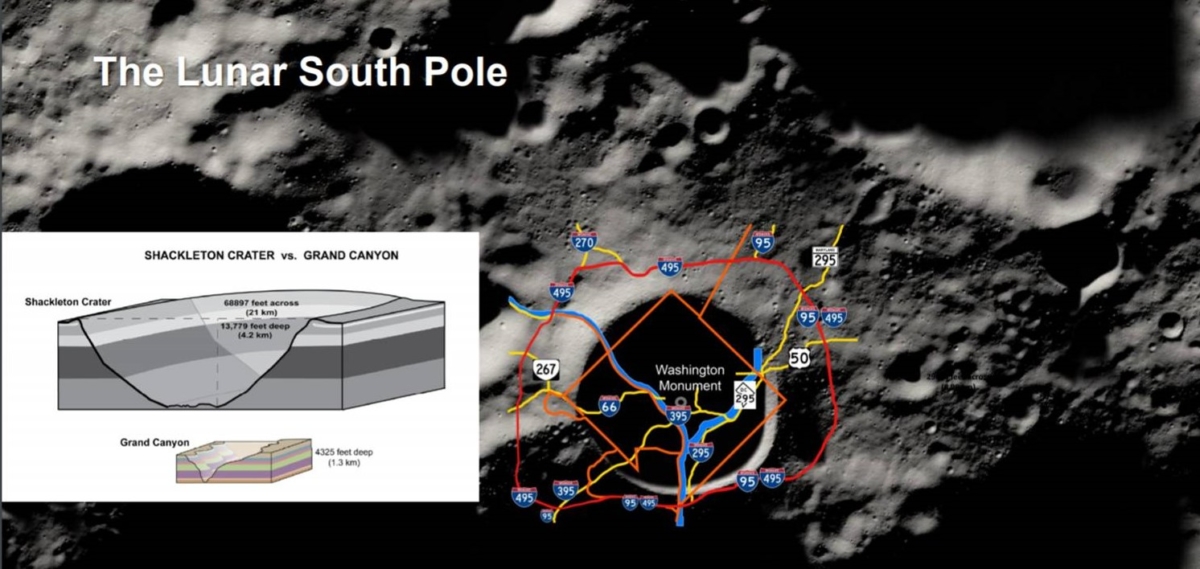
An EL3 sample return package, for example, could be sent to a previously unexplored region near the lunar South Pole – an interesting area for researchers.
Other goals of the missions include testing new hardware, demonstrating technology and gaining experience in operations while strengthening international partnerships in exploration. Its development will provide an Ariane 64-based lunar cargo lander available for potential future commercialization by European industry, according to an ESA statement.
“The lunar lander program is not a one-shot mission,” ESA says, “but promises regular launches starting in the later part of this decade and continuing into the 2030s.”
This 8-minute film gives an overview of the past, present, and future of Moon Exploration, from the Lunar cataclysm to ESA’s vision of what Lunar exploration could be.

Credit: CCTV/Inside Outer Space screengrab
Scientists will be included among China’s next batch of astronauts as the country opens up its space program to a wider range of talents, said Zhou Jianping, chief designer of China’s manned space program, in Beijing on Tuesday.
The third batch of astronauts, which follows the previous selections in 1995 and 2009, will participate in the construction of China’s space station, the third step of China’s manned space program.

Credit: CCTV/Inside Outer Space screengrab
Flight engineers and scientists will be selected besides fighter pilots. The selection will be completed around July, said Zhou in an online interview posted by China Central Television (CCTV).
Scientific devices
“When we send a scientist to the space, he can adjust and improve the plans accordingly with his expertise and personal operation. Higher efficiency will be achieved in this way,” Zhou said in the CCTV interview.
A large number of scientific experimental devices will be deployed at the space station, including those for space life science, space material science, space microgravity science, combustion science, and basic physics and astronomy.
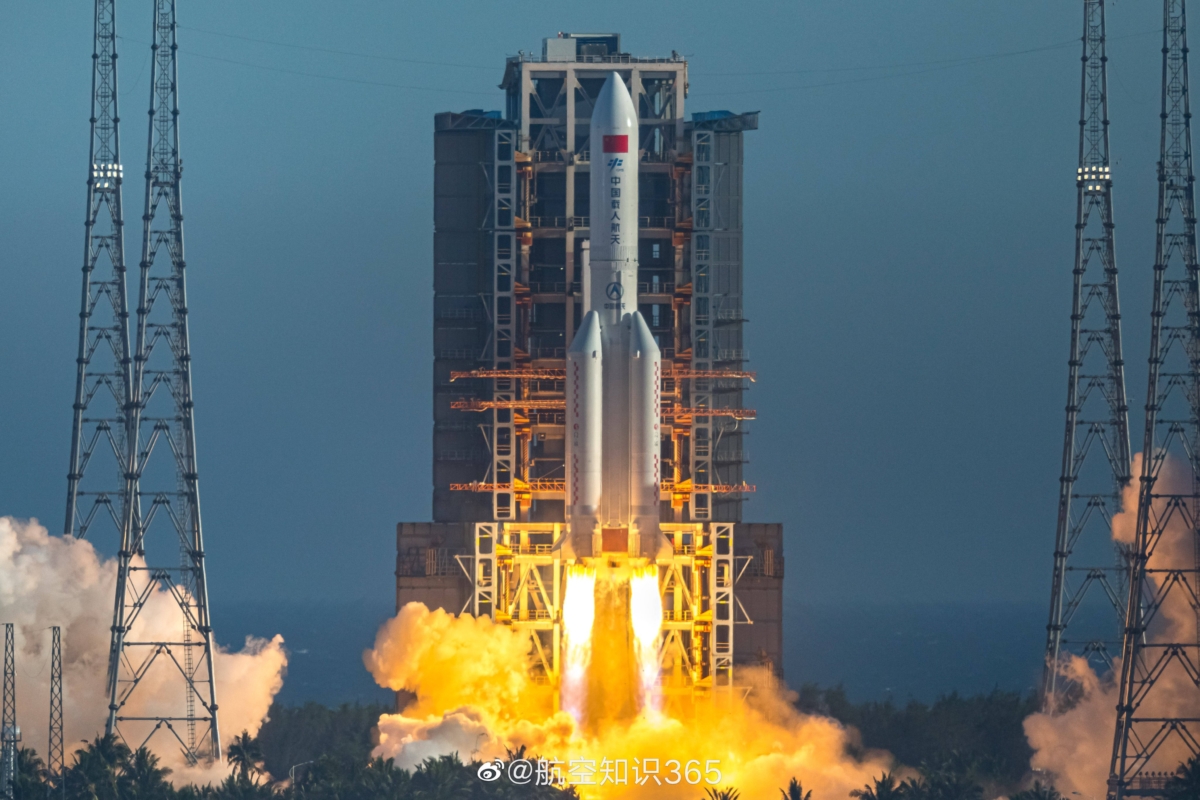
Credit: Weibo
“The successful maiden flight of the Long March-5B carrier rocket marks the start of the construction of the space station,” Zhou added. “Greater challenges are ahead.”
Space station construction
Zhou explained that China will launch space station modules starting next year.

Credit: CMS/CCTV/Inside Outer Space screengrab
“We will finish the construction of the space station and test of key technologies in over two years. During this period of time, we will launch the core module and two experimental capsules of the station, as well as four manned spacecraft and four cargo spacecraft. All the work, in 11 flight missions, will be completed in two years,” Zhou said.

Credit: CMS/CCTV/Inside Outer Space screengrab
A sky survey optical module will also be established as part of space station operations to explore origin of the space and habitable planets.
Humans to Moon
China will also extend its exploration to the Moon and prepare manned spacecraft for the Moon, Zhou said.

China’s New-generation spaceship.
Credit: CCTV/Inside Outer Space screengrab
“The test spaceship that was successfully retrieved was designed both for the requirement of Earth orbit and the future manned exploration of the Moon, or even for manned deep space exploration,” Zhou said. “It will take the mission of manned spacecraft for the Moon in the future.”
To view the CCTV interview, go to:

