Author Archive
 Author:
  September 25th, 2025
Image credit: CCTV/Inside Outer Space screengrab
China’s Shenzhou-20 astronauts have wrapped up their 4th series of extravehicular activities, spacewalking outside the country’s Tiangong space station.
According to the China Manned Space Agency (CMSA), Chen Zhongrui and Wang Jie worked for roughly six hours in space, completing a set of assigned tasks and aided by Chen Dong inside the facility, along with ground controllers.

Image credit: CCTV/CMSA/Inside Outer Space screengrab
The duo completed the installation of debris protection devices and the inspection and maintenance of external equipment, according to the CMSA.
This crew has been in orbit for more than 150 days, entering the space station on April 25 for a mission expected to last around 6 months.

China’s Tiangong space station as imaged by MAXAR satellite.
Image credit: MAXAR
 Posted in
Image credit: NordSpace/Inside Outer Space screengrab
NordSpace’s inaugural flight from the Atlantic Spaceport Complex has been complex and perplexing. Repeat launch attempts have been thwarted to fly the group’s pathfinder mission, called “Getting Screeched In”, a demonstration flight of the fully Canadian-made sub-orbital rocket – Taiga.
As Canada’s first commercial spaceport, the Atlantic Spaceport Complex (ASX) can support equatorial to polar orbits, multiple launch pads, and represents a milestone in the making from Newfoundland and Labrador.

Image credit: NordSpace/Inside Outer Space screengrab
Fuel-rich scenario
Following this week’s latest technical snag to loft the Taiga rocket, the update from NordSpace is the following:
September 25, 2025 08:00:
“We have made the decision to postpone our launch attempt, and we will share a new expected launch date in the coming weeks. After detailed review over the last 15 hours, the root cause has been discovered to be related to our propellant quality slightly differing between vehicle tests at our test facility in Ontario, compared to our first launch test in Newfoundland and Labrador at our spaceport.”
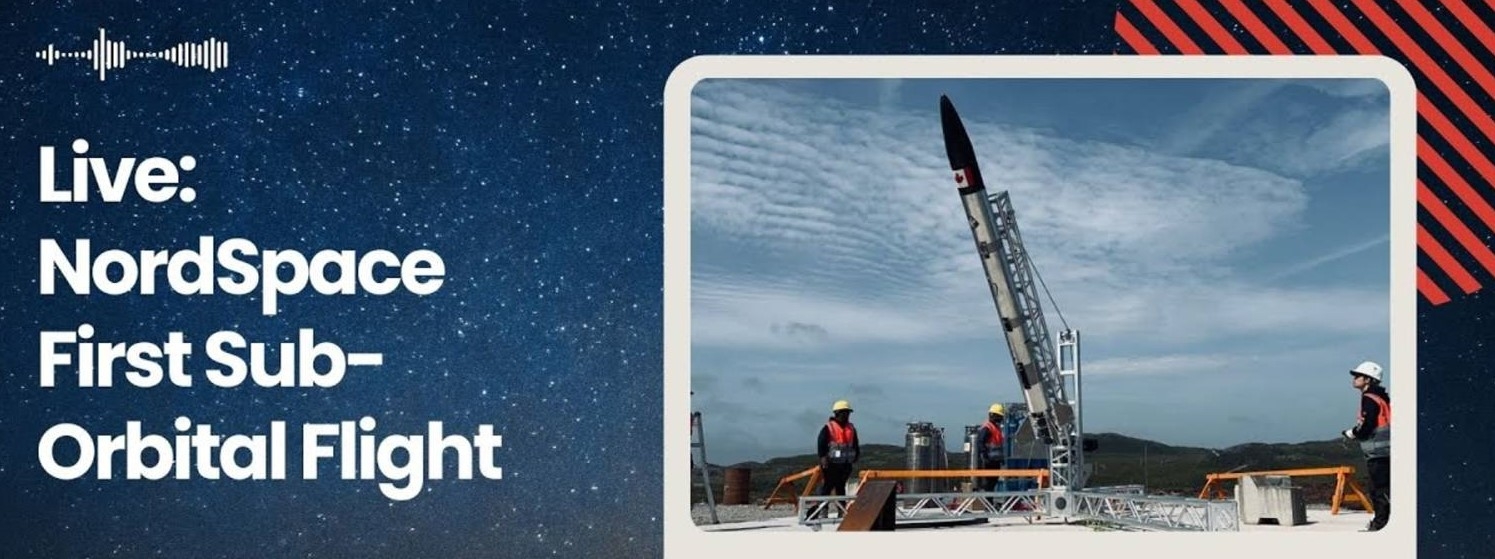
Image credit: NordSpace
This led to a fuel-rich scenario, NordSpace posts. “All systems on the rocket and ground performed nominally after careful review.”
As the NordSpace manufacturing and testing facilities are located in Ontario, “there’s no expedient way to make the necessary modification with the temporary infrastructure and suppliers we have in place at our launch site.”
Permanent presence
Undaunted, although all of their major facilities and capabilities are located in Ontario, “we are rapidly developing our permanent presence in Newfoundland and Labrador both in St. John’s and in St. Lawrence to better support Canada’s sovereign launch efforts.”
Image credit: NordSpace/Inside Outer Space screengrab
That permanent presence includes on-site propellant generation, manufacturing, water deluge systems, range tracking radar, weather monitoring stations, satellite communications, mobile all-season launch hangars, permanent mission control, and more.
Lastly, NordSpace appears resolute in their quest:
“Success is not final, failure is not fatal,” points out the group. “It is the courage to continue that counts. Codspeed!”
Go to this informative website to keep an eye on NordSpace at:

China’s Chang’e-6 lander/ascender in farside sampling scenery.
Image credit: CNSA/CLEP
An international team of researchers from China, along with collaborators from the University of Hawaii, have used China’s Chang’e-6 lunar lander data to probe water distribution on Moon.
The research highlights the roles of solar wind and impact-driven gardening in the formation and evolution of lunar surface water.
Lander plume
Analyzing data from the Chang’e-6 landing site, the scientists found that areas disturbed by plumes generated by the lander display distinct temperature and water-content patterns, driven by the redistribution of fine regolith.
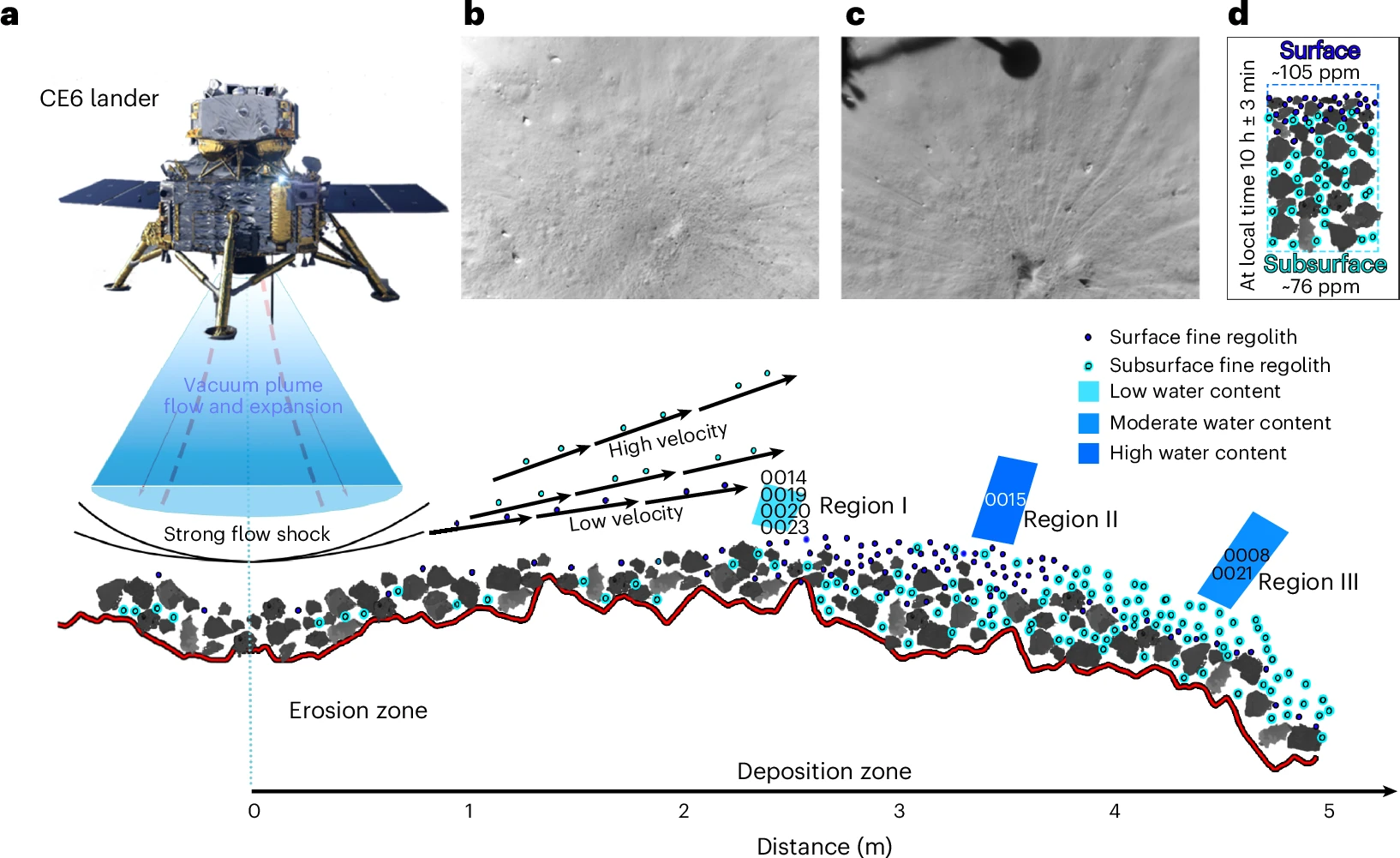
Image credit: Bin Liu , et al.
According to the team, lunar lander plumes displace and expose millimeter to centimeter-sized regolith during descent, providing the opportunity to study subsurface water.
Their work has been just published in the journal Nature Astronomy.
Landing site water content differences
The average water content at the Chang’e-6 landing site in 2024 is, on average, notably higher (roughly twice the content) than that at the Chang’e-5 landing site in 2020.

Map of Rümker region, target of Chang’E-5 sample return mission. Credit: Y. Qian, et al.
“The above difference in the water contents could be interpreted as being due to correlations with the glass contents, particle sizes, depths and local times, although more observations are needed to untangle these parameter dependencies,” reports study leader Bin Liu of the Laboratory of Lunar and Deep Space Exploration in Beijing China.
Water formation
“Our findings highlight the roles of solar wind implantation and impact gardening in water formation and its distribution in the lunar surface and subsurface, with implications for other airless bodies like Mercury, Vesta and the near-Earth objects, Bin and colleagues report. “The fine regolith from the lunar surface to subsurface depths of millimeters to centimeters or deeper will probably be an important source of lunar water.”
Shuai Li of the Hawaii Institute of Geophysics and Planetology at the University of Hawaii, Honolulu, Hawaii, also took part in the study.

Far side scenery taken by Chang’e-6 lander/ascender.
Image credit: CNSA/CLEP
Interesting question
But how much plume effluents, therefore contamination, had to be weighed and what was the impact of that additive engine exhaust on the findings?
Responds Shuai Li of the Hawaii Institute of Geophysics and Planetology at the University of Hawaii.
“The short answer is we do not exactly know,” Li told Inside Outer Space.
“But my guess is that the plume fine particles from the shallow subsurface may cover greater than 50 percent of the surface in the deposition zone that shows very low surface temperature – almost no thermal contamination up to 3.2 micron,” Li said. “This is an interesting question to many people in the community and I think there will be more efforts working on this problem.”
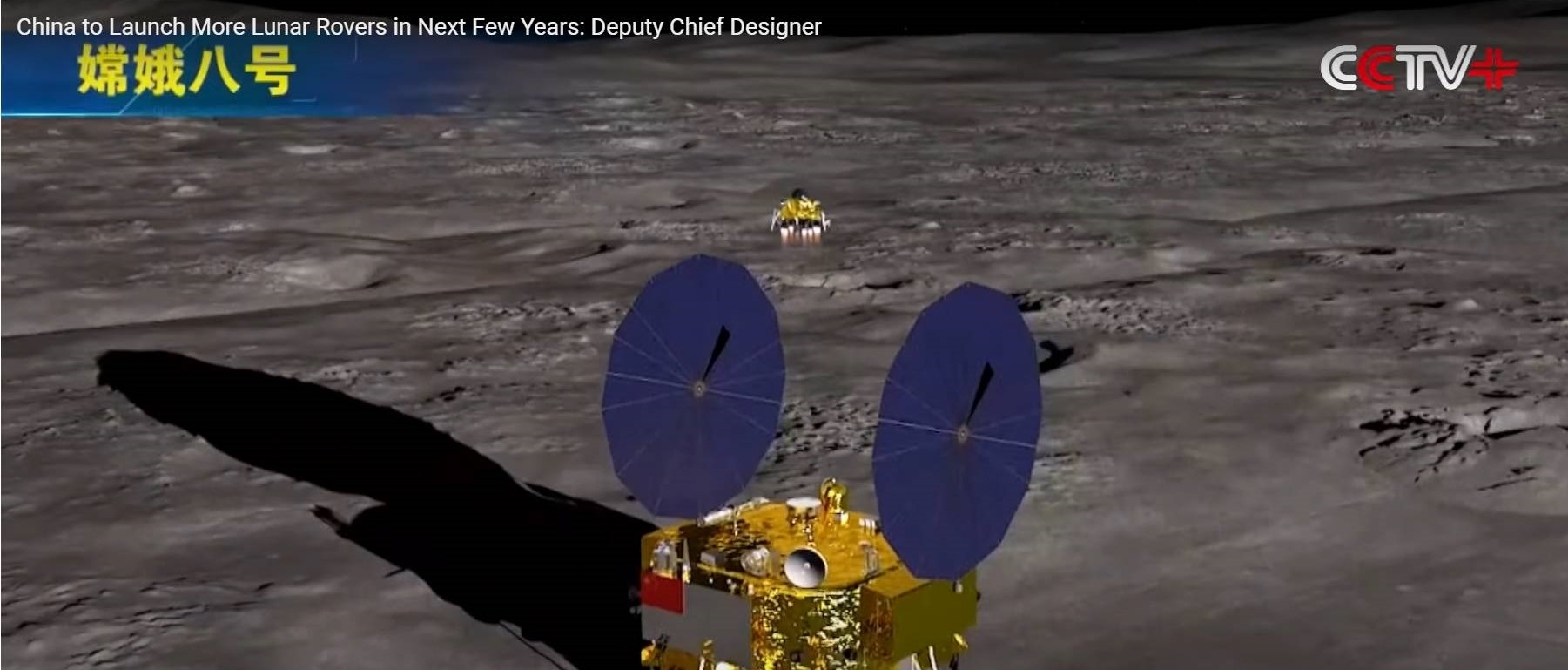
Artwork shows Chang’e-7 deployment of Moon hopper. Image credit: CCTV/Inside Outer Space screengrab
Future landers
The Chang’e-6 mission rocketed to Earth the first-ever sampling from the South Pole-Aitken Basin on the far side of the Moon.
The Chang’e-5 lunar sample probe touched down on the northwest region of the Ocean of Storms.
As noted by China’s state-run Xinhua news agency, more lunar landers from China are on tap.
The Chang’e-7 lunar lander mission in 2026 is to touch down at the Moon’s south pole, making use of a mini-hopping probe and a rover. It will be followed by the Chang’e-8 mission targeted for the Leibnitz-Beta Plateau near the lunar south pole region.

Artwork depicts China lunar research station. Image credit: CCTV/Inside Outer Space screengrab
These two lander mission are to lay the groundwork on the Moon for China/Russia collaboration in establishing a multi-phased International Lunar Research Station.
To access the study – “Lunar surface and subsurface water revealed by Chang’e-6” – go to:

Specialists examine flies and other animals kept within the Bion-M no. 2 module.
Image credit: Roscosmos
They came from outer space – 75 mice, cell cultures, microorganisms, plant seeds, and other items.
A Russian biological research satellite toting more than 30 experiments landed September 19 in the steppes of the Orenburg region after spending 30 days in Earth orbit.
Why was this mission important for future human space travel?
For details, go to my new story on Space.com – “Russian ‘Noah’s Ark’ probe carrying 75 mice and 1,500 flies lands back on Earth” — at:
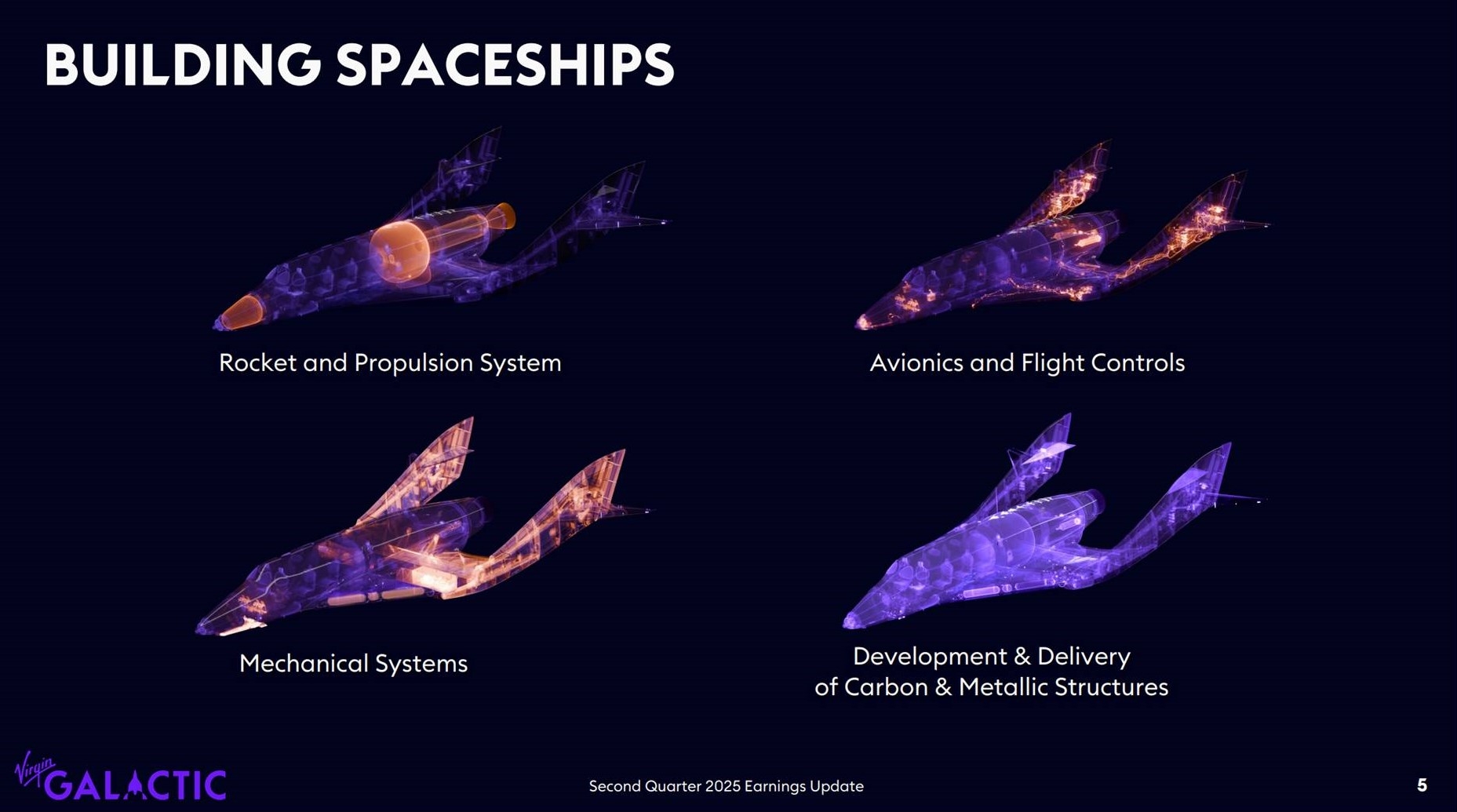
Image credit: Virgin Galactic
Virgin Galactic and Purdue University announced today a groundbreaking partnership to send an all-Boilermaker crew on a suborbital research flight, the first of its kind for a U.S. university.
The mission, Purdue 1, is slated for launch in 2027 and will include Purdue engineering professor Steven Collicott and distinguished graduate student(s) and alumni who will conduct live, human-tended experiments in microgravity.

Purdue engineering professor Steven Collicott.
Image credit: Purdue University
Collicott started flying experiments on Blue Origin’s sub-orbital New Shepard rocket and was selected by NASA as the first professor to fly with an experiment to space and back in the sub-orbital Virgin Galactic spaceship.
Designed to seat up to six passengers, Virgin Galactic’s next generation spaceship is customizable and will have one seat removed for this mission to fly the five crew members and allow space for a payload rack to hold the research experiments.
Announced today, flying with Collicott will be current Purdue graduate student Abigail Mizzi; and alumnus Jason Williamson.
Direct access
Mike Moses, Virgin Galactic’s President of Spaceline, is also a Purdue graduate.
“This mission with Purdue University is a powerful demonstration of what becomes possible when research institutions and educators gain direct access to the microgravity environment,” Moses said in a press statement.
“By enabling researchers to accompany and interact with their experiments in real time, we are not just advancing science – we are empowering the next generation of innovators and expanding the frontiers of educational opportunity,” Moses said. “Purdue 1 is a milestone for our Spaceline and for the broader research and education community, showing how suborbital spaceflight can transform both scientific inquiry and hands-on STEM education.”
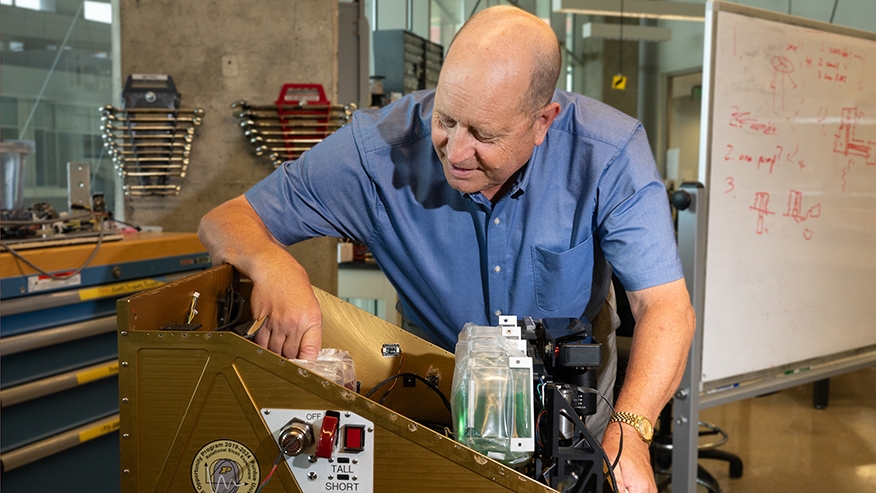
Steven Collicott, a professor of aerospace engineering, demonstrates an automated experiment that flew on a previous suborbital flight. Collicott will conduct real-time experiments as part of an all-Purdue crew on a Virgin Galactic flight in 2027.
Image credit: Purdue University photo/John Underwood
Announcement and panel discussion with Purdue and Virgin Galactic representatives is available at:

Image credit: NASA/University of California’s Berkeley Space Sciences Laboratory
Two Mars-bound spacecraft for NASA have been delivered to the Kennedy Space Center for launch, scheduled to occur no earlier than this fall on Blue Origin’s New Glenn rocket.
The University of California’s Berkeley Space Sciences Laboratory’s ESCAPADE mission probes were built, tested and integrated by Rocket Lab, as part of NASA’s Small Innovative Missions for Planetary Exploration (SIMPLEx) program.

Image credit: Rocket Lab
Blue and Gold for the Red Planet
Once en route for a 22-month cruise to Mars, the Blue and Gold Escape and Plasma Acceleration and Dynamics Explorer (ESCAPADE) twins will settle into their mission, capturing data from two regions of Mars’ magnetosphere.
That information should offer insight into the Red Planet’s atmospheric escape history and space weather environment, informing future human exploration strategies.
Go to an ESCAPADE mission video at:

Wait-a-Minute!
Image credit: Barbara David
Yet another wait-a-minute moment for NASA’s return to the Moon with humans program.
As it has repeatedly warned, panel members of the Aerospace Safety Advisory Panel (ASAP) – a group that reports to NASA and the U.S. Congress – have once again red-flagged the SpaceX Starship’s development tied to the space agency’s needs to return human boots to the Moon
A September 19th ASAP gathering underscored Starship’s longer than planned evolution to support the Artemis 3 mission to land a crew at the lunar south pole.
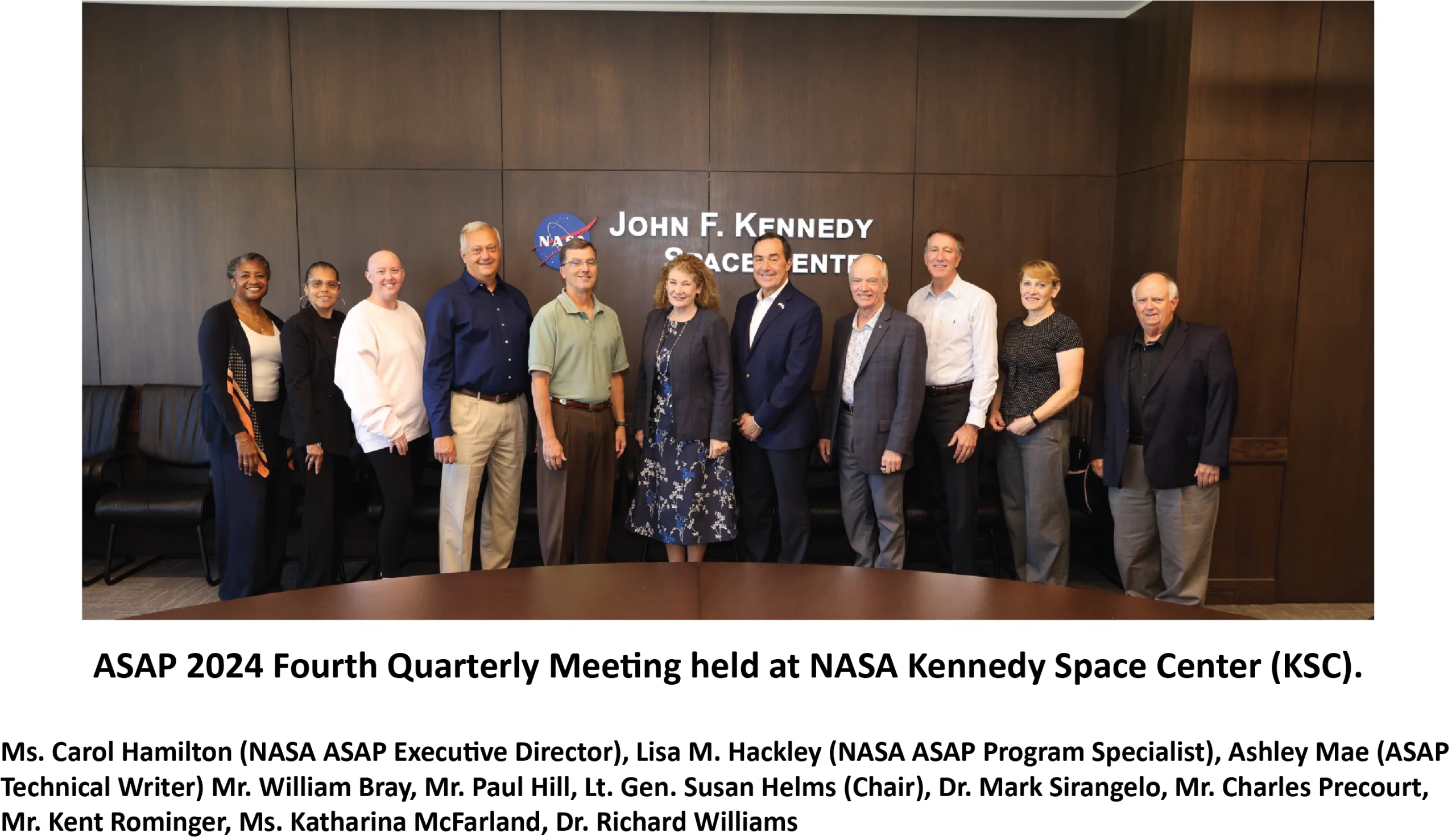
Image credit: ASAP
NASA officials are reportedly considering pushing off Artemis 3 to 2028 while other appraisals don’t see a Starship-aided Moon landing before 2032.
If so, the window of opportunity for China’s human exploration of the Moon by 2030 looms large.
Technical readiness level
The ASAP annual report for 2024 provides the backdrop of concern.
“Artemis III is planned as a crewed surface landing and exploration of the lunar south pole region. The Panel remains very concerned that, on the current schedule and with the current technical readiness level of some segments of the architecture, the Artemis III mission is oversubscribed.”
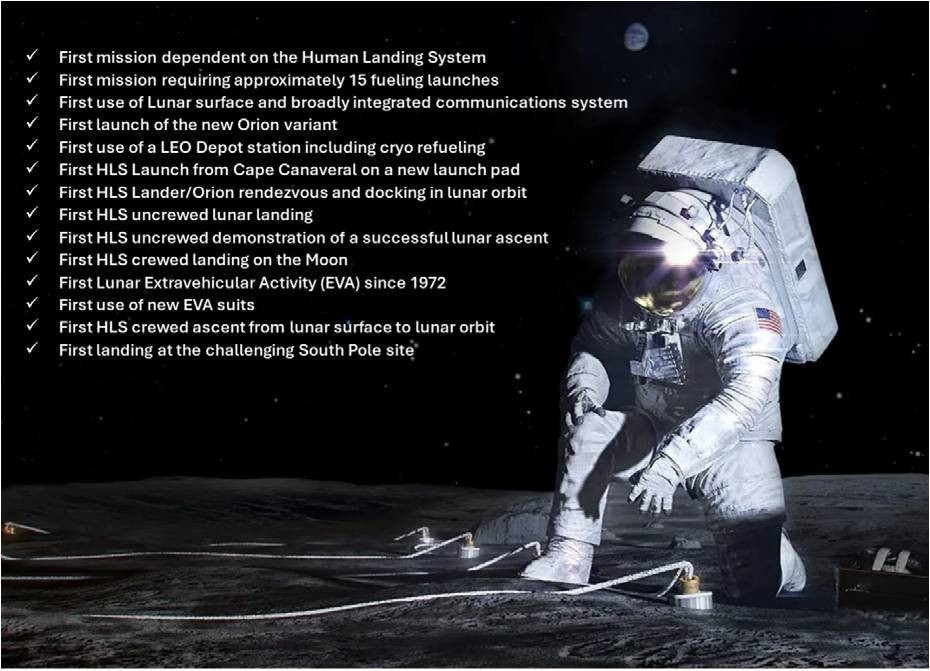
Image credit: ASAP
As the ASAP previously detailed in its 2023 Annual Report, “the aggregated risk associated with accomplishing so many ‘first-time’ milestones, including several critical prerequisite demonstrations, may be too high.”
Bottom line: Starship HLS remains a critical path item for the successful execution of Artemis III.
For details on the recent ASAP meeting, go to Marcia Smith’s detailed reporting on her Spacepolicyonline.com website at:
https://spacepolicyonline.com/news/nasa-safety-panel-estimates-significant-delays-for-starship-hls/
Hearing – anybody listening?
Angst regarding the status of Artemis 3 also penetrated U.S. Senator Ted Cruz’s Senate hearing back on September 3.

Image credit: Inside Outer Space screengrab
That hearing was titled: “There’s a Bad Moon on the Rise: Why Congress and NASA Must Thwart China in the Space Race.”
Among the witnesses testifying, former NASA chief, James Bridenstine stated in written testimony that the United States does not have a lunar lander.
“Unless something changes, it is highly unlikely the United States will beat China’s projected timeline to the Moon’s surface. Our complicated architecture requires a dozen or more launches in a short time frame, relies on very challenging technologies that have yet to be developed like cryogenic in-space refueling, and still needs to be human rated,” Bridenstine said.
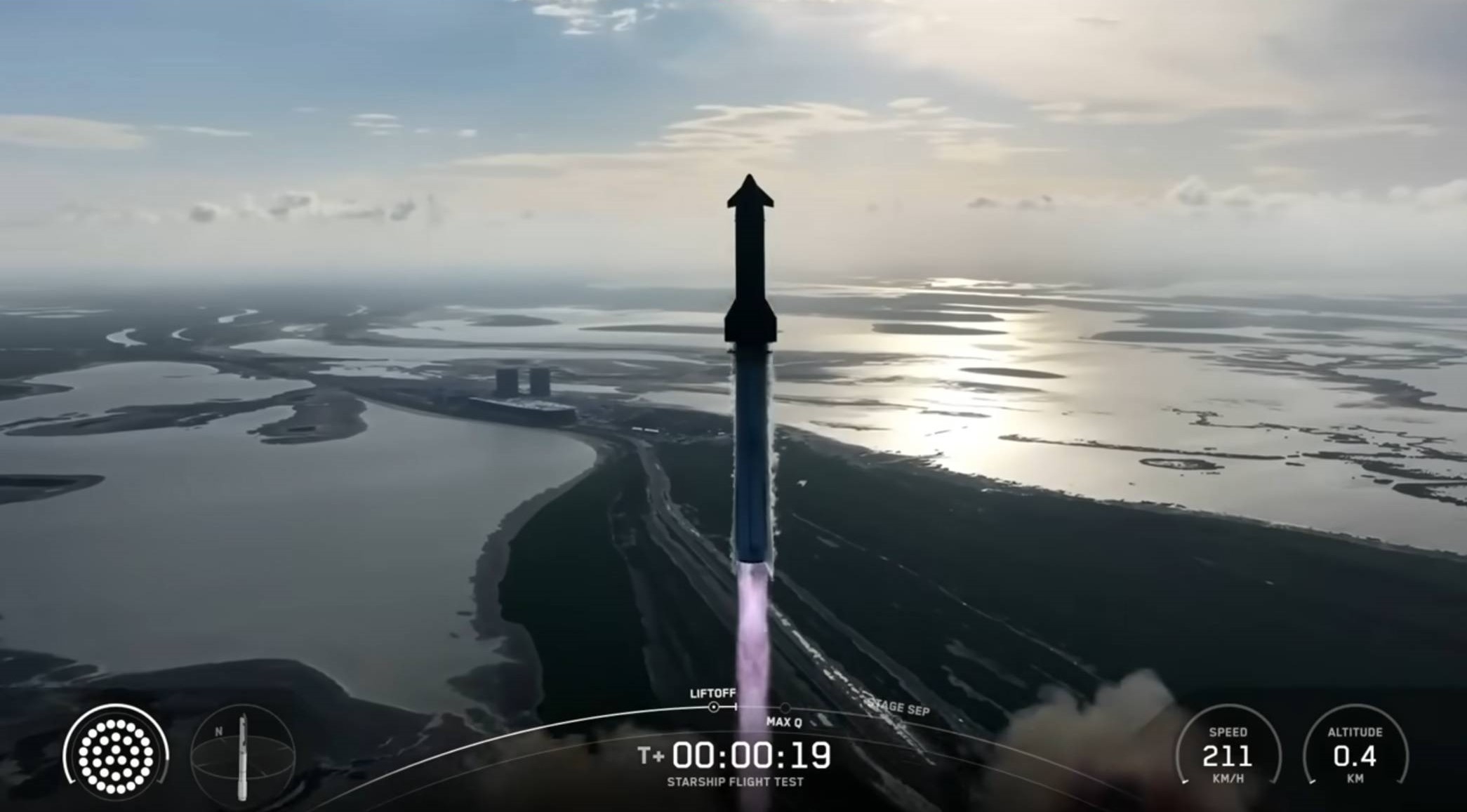
Starship 10 departure.
Image credit: SpaceX/Inside Outer Space screengrab
“While the capability could be transformational over time if payload capacity increases (so far it has decreased), the complexity of the architecture precludes alacrity,” the former NASA chief added.
Meanwhile, Elon Musk’s SpaceX Starship team is making progress on the next flight test of the Super Heavy/Starship at the firm’s Starbase facility in Texas.
No target launch date has been announced as yet for Starship Flight 11.
Fly…learn…repeat…fingers-crossed…fly…learn…repeat…

Wait-a-Minute!
Image credit: Barbara David
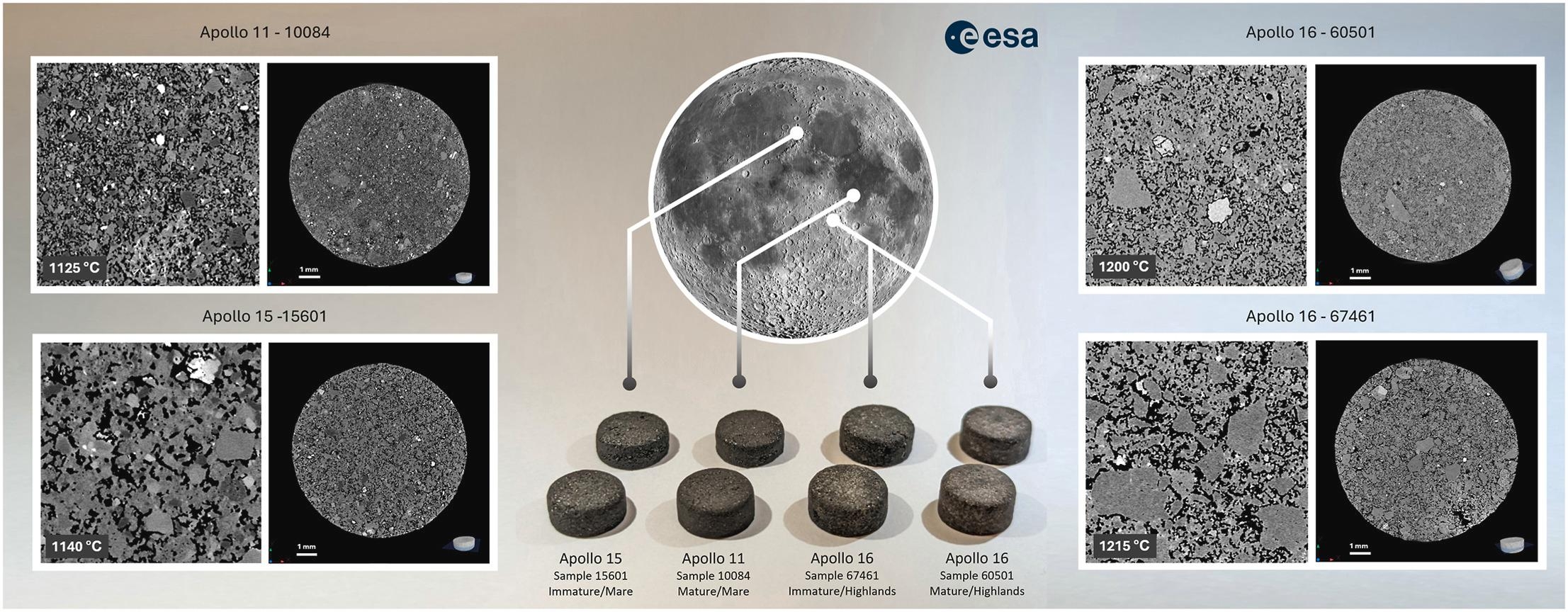
Image credit: ESA
New research is being called the first detailed examination of sintering “real” lunar regolith. Used in the work were precious Moon samples returned to Earth by Apollo 11, Apollo 15 and Apollo 16 moonwalkers.
There is growing interest in establishing a permanently crewed base on the Moon. Lunar regolith sintering has gained significant attention as a technique for constructing on-the-spot radiation- and meteoroid-resistant habitats, roads or landing pads and other infrastructure or tools.
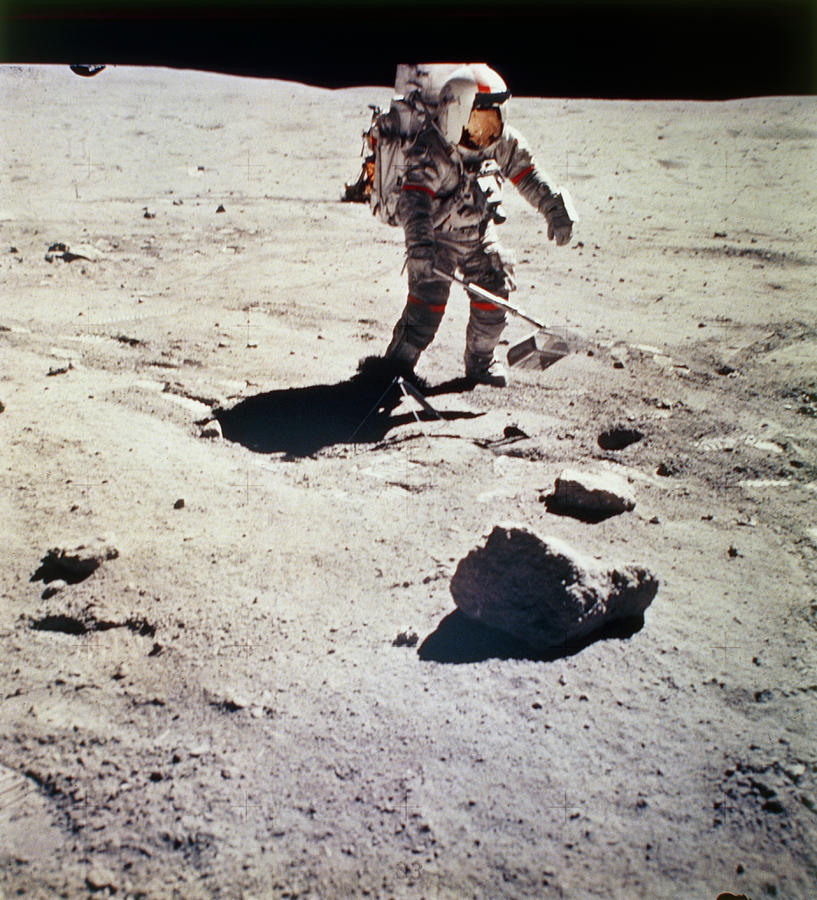
Apollo 16 photo shows on-site gathering of lunar specimens.
Credit: NASA
“Sintering” allows the transformation of loose powdered material into a consolidated mass using heat and/or pressure. The technique fuses particles together without melting the material to the point of liquefaction.
The term “regolith” refers to the topside layer on the Moon that covers solid rock on the lunar surface which is loose, heterogeneous, superficial deposits.
Apollo pellets
The work involved sintering of eight 0.5 g pellets from four Apollo regolith samples: 10084, 15601, 60501, and 67461. Each Apollo pellet sample was selected to examine the compositional differences between mare and highland material on the Moon, as well as the differences due to sample maturity.
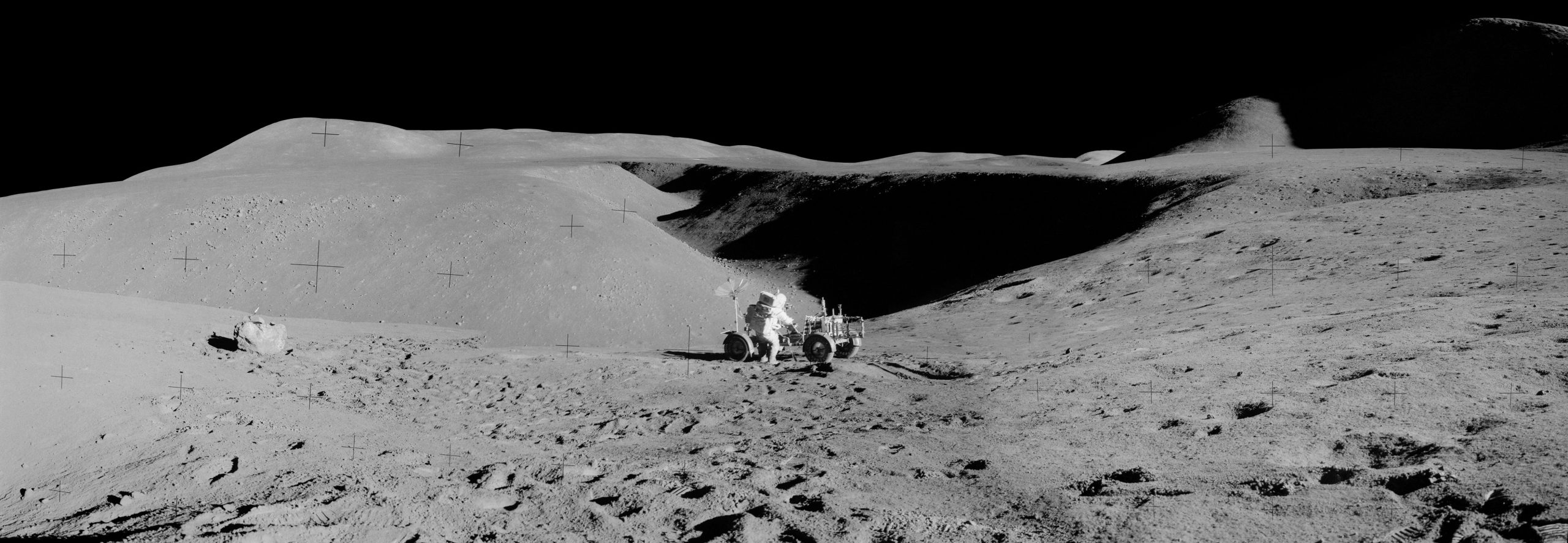
Apollo 15’s Dave Scott and Lunar Rover at a Hadley Rille location.
Image credit: NASA
This research was supported by the European Space Agency (ESA) internal research funding. Findings from the work have been published in the journal Materials Today Advances.
Leader of the work is Bethany Lomax of ESA’s European Space Research and Technology Center (ESTEC) in Noordwijk, the Netherlands.
Comparison of samples
“The crux of it for me – regolith can be sintered. But different lunar regoliths behave differently when we try to process them,” explains James Carpenter, head of the Lunar Science Office within ESTEC, and a co-author of the paper, “Sintering lunar regolith pellets: a comparison of four samples from Apollo 11, 15, and 16.”
“In general if we want to work with regolith for construction or ISRU [In-situ Research Utilization] then the specifics of the materials we find at a site matter,” Carpenter explains. “And whatever we think we are learning from simulants needs to be tested against real materials.”

Inside look at one idea the European Space Agency is exploring to fabricate a lunar habitat.
Image credit: ESA/ Foster + Partners
Simulants are synthesized from terrestrial materials, concocted to mimic the chemical, mechanical or engineering properties of materials available on the Moon.
“While many high-quality simulant materials exist, lunar regolith has properties unique to space weathering processes in the lunar environment, which are challenging to mimic on Earth,” states Lomax and colleagues.
Sintering behavior
“Lunar regolith sintering is proposed as a technique to produce consolidated objects on the lunar surface from locally sourced materials,” said Carpenter. “Understanding the sintering behavior of real lunar regolith is necessary to optimize this process, however, due to the precious nature of samples it is rare for material to be allocated for such destructive studies.”
According to Carpenter, results of the new work show that real lunar regolith sinters at temperatures comparable to lunar regolith simulants sintered under the same conditions.
“This work represents the first detailed examination of sintering real lunar regolith,” Carpenter said.
To access this pioneering work – “Sintering lunar regolith pellets: a comparison of four samples from Apollo 11, 15, and 16” – go to:
https://www.sciencedirect.com/science/article/pii/S2590049825000657

ICON’s Project Olympus is a space-based construction system under active development to support the future exploration of the Moon with NASA and for commercial lunar construction projects. The Olympus construction system is being designed and engineered to construct landing pads, roadways, non-pressurized structures,
and pressurized habitats.
Image credit: ICON
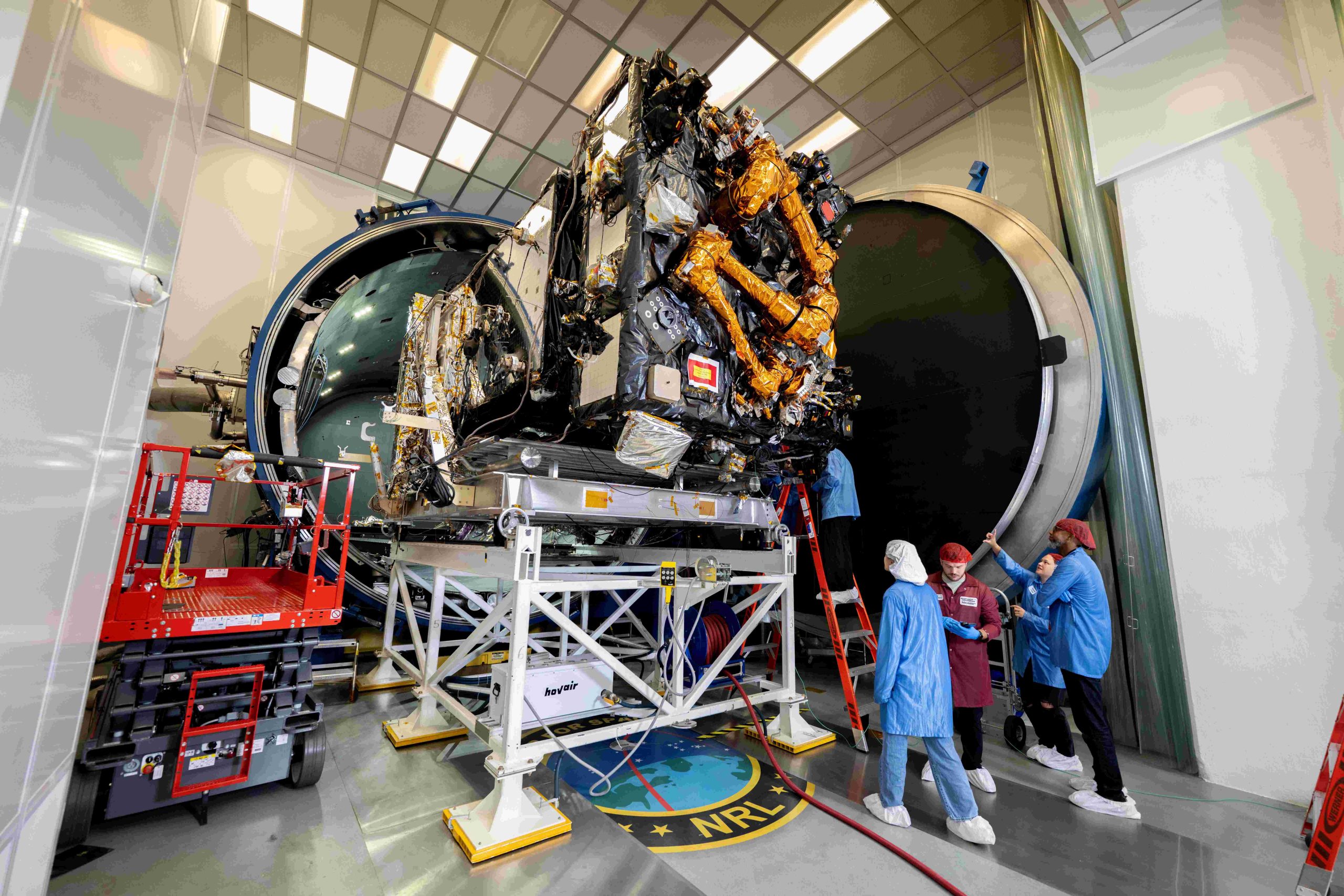
The Robotic Servicing of Geosynchronous Satellites (RSGS) payload integrated with the Northrop Grumman Mission Robotics Vehicle (MRV) spacecraft bus sits outside the cryogenic thermal vacuum chamber after completing testing at the U.S. Naval Research Laboratory’s (NRL) Naval Center for Space Technology (NCST) in Washington, D.C.
Image credit: NRL/Jonathan Steffen-Arnold
Declared as a new program milestone, the Robotic Servicing of Geosynchronous Satellites (RSGS) payload is now integrated with the Northrop Grumman Mission Robotics Vehicle (MRV) spacecraft bus.
This robotic spacecraft is designed to extend and upgrade satellites already in orbit.
The RSGS program is the result of over 20 years of research and development at the Naval Research Laboratory (NRL), aimed at creating robotic systems that can repair and improve satellites in geosynchronous orbit, roughly 22,000 miles above Earth.
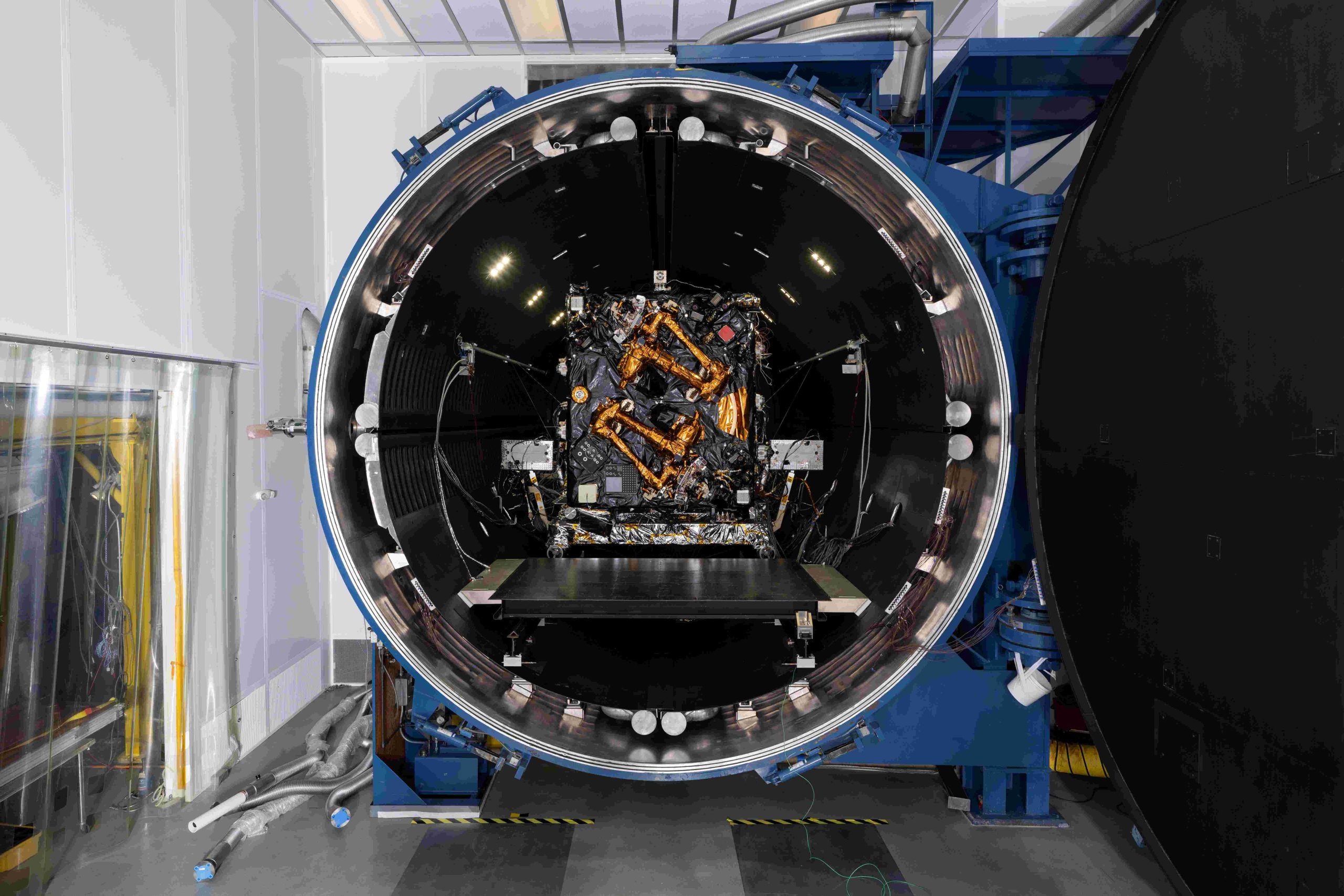
Final space-readiness testing on RSGS, a robotic payload designed to extend and upgrade satellites already in orbit.
Image credit: NRL/Sarah Peterson
On September 5, at NRL, a critical round of space-readiness testing was achieved.
That testing is known as thermal vacuum (TVAC) to assure the spacecraft bus can withstand the brutal conditions of cold, heat and vacuum conditions of space.
Two robotic arms
As a public private partnership between the Defense Advanced Research Projects Agency (DARPA) and Northrop Grumman’s SpaceLogistics, the NRL-developed robotic servicing payload is designed to enable close inspections, orbital adjustments, hardware upgrades, and even in-orbit repairs.
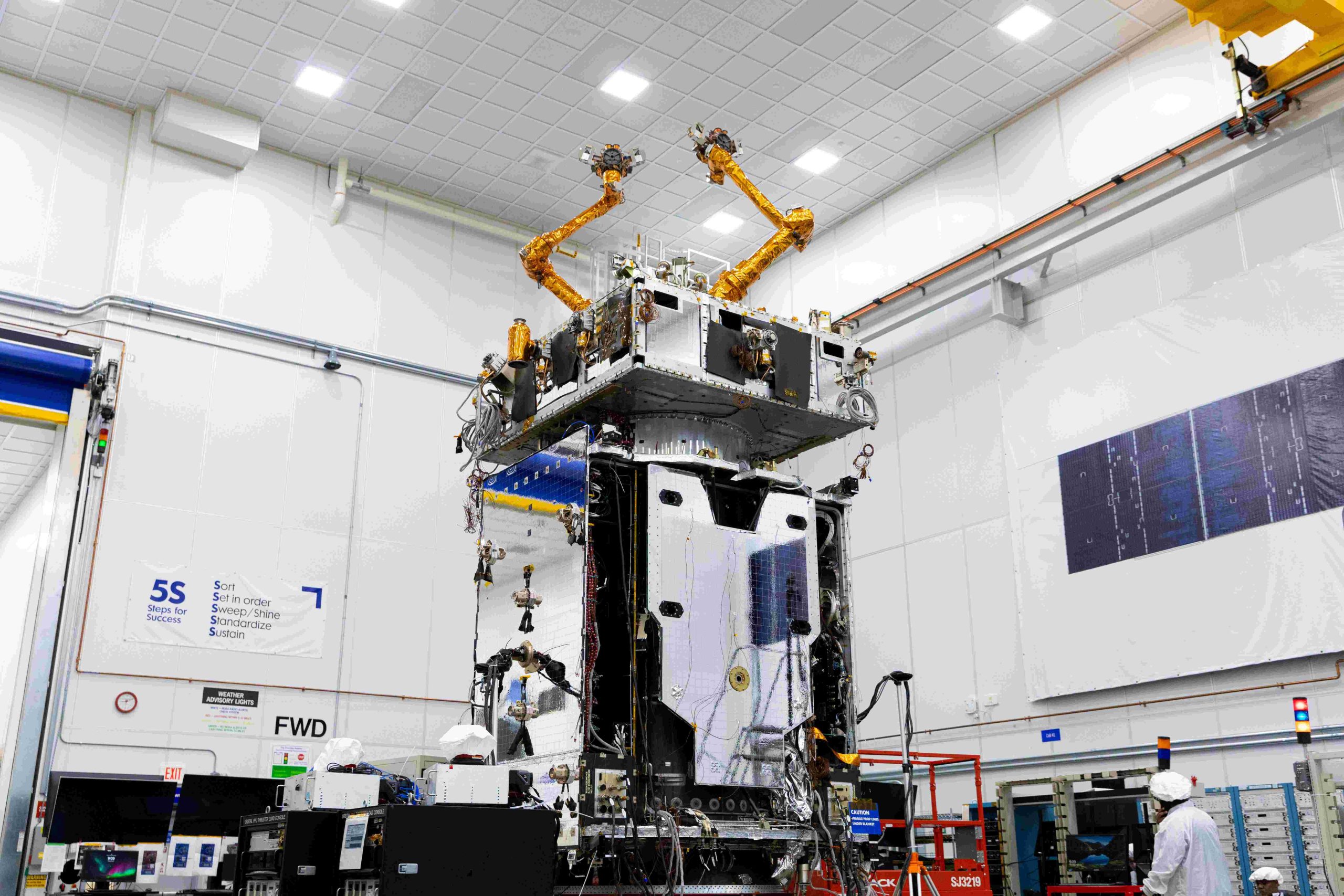
Last June, Northrop Grumman integrated the robotics payload, developed by the Naval Research Laboratory (NRL), onto its Mission Robotics Vehicle at the company’s Dulles, Virginia, facility.
Image credit: Northrop Grumman
RSGS is outfitted with two robotic arms, equipped with lights, cameras, and tool changers, enabling capture, inspection, and perform upgrade tasks. The initiative promises longer lifespans, lower costs, and new opportunities for innovation in space infrastructure.
What next?
Next up for the spacecraft is to undergo final integrated systems testing this Fall at Northrop Grumman’s facility in Dulles, Virginia, prior to shipment to the launch site.
No launch date has been announced.
Once in orbit, the MRV and payload will enter checkout before beginning proximity operations, rendezvous, and client servicing demonstrations.
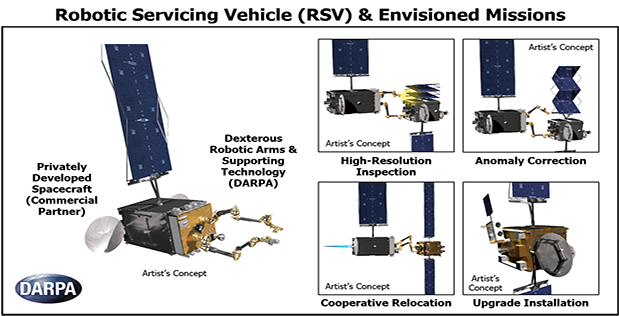
Image credit: DARPA

Lights-on for the ice-hound!
Image credit: NASA
It’s alive!
NASA has picked Blue Origin to deliver the VIPER rover to the Moon’s south pole.
The contentious NASA VIPER (Volatiles Investigating Polar Exploration Rover) project has gone through a paywall of issues in the past.
Following a comprehensive internal review, NASA announced on July 17th, 2024 its intent to discontinue development of the VIPER project.
VIPER is designed to search for volatile resources, such as ice, on the lunar surface and collect invaluable science data useful for the long-term stay of Artemis crew members on the Moon.
Important insights
“Our rover will explore the extreme environment of the lunar south pole, traveling to small, permanently shadowed regions to help inform future landing sites for our astronauts and better understand the Moon’s environment – important insights for sustaining humans over longer missions, as America leads our future in space,” declared acting NASA administrator Sean Duffy in a late Friday press statement.

The VIPER rover heading into the Thermal Vacuum (TVAC) Chamber for testing.
Image credit: Daniel Andrews/LinkedIn
NASA awarded Blue Origin of Kent, Washington, a CLPS (Commercial Lunar Payload Services) task order with an option to deliver VIPER to the Moon’s south pole region in late 2027.
The task order is called CS-7. It has an award base to design the payload-specific accommodations and to demonstrate how Blue Origin’s flight design will off-load the rover to the lunar surface.
There is an option in the contract to deliver and safely deploy the rover to the Moon’s surface.
Exercise that option
“NASA will make the decision to exercise that option after the execution and review of the base task and of Blue Origin’s first flight of the Blue Moon MK1 lander,” stated NASA.
This approach will reduce the agency’s cost and technical risk, NASA adds. The rover has a targeted science window for its 100-day mission that requires a landing by late 2027.

Artwork depicts NASA’s VIPER, on the prowl for water and other resources.
Image credit: NASA Ames/Daniel Rutter
The reaction to the decision has been swift from the space community.
“Thank you to NASA for working really hard to find an alternative, cost-effective approach to address the objectives of the VIPER mission. And thank you to the community for ensuring that NASA understood how important this mission is to lunar science and exploration. We look forward to learning more about the planned implementation in the months ahead,” responded Benjamin Greenhagen, chair of the Lunar Exploration Analysis Group (LEAG).
Blue Origin responsibilities
According to NASA, Blue Origin will be responsible for the complete landing mission architecture and will conduct design, analysis, and testing of a large lunar lander capable of safely delivering the lunar volatiles science rover to the Moon.

An early close-up view of the areas that were to be explored by VIPER, showing a nominal traverse route and highlighting permanently shadowed regions that may contain water ice and other volatiles.
Credit: NASA’s Scientific Visualization Studio/Ernie Wright
“Blue Origin also will handle end-to-end payload integration, planning and support, and post-landing payload deployment activities. NASA will conduct rover operations and science planning,” NASA stated.
NASA’s Ames Research Center in California’s Silicon Valley led the VIPER rover development and will lead its science investigations, and NASA’s Johnson Space Center in Houston provided rover engineering development for Ames.
Astrobotics statement
Also issuing a statement today regarding NASA’s decision to fly Blue Origin is the CLPS provider, Astrobotics.
“Astrobotic believes in the deep scientific significance of NASA’s VIPER mission. We are heartened to hear it will have the opportunity to fly and potentially yield critical insights for the broader lunar community,” an Astrobotics statement noted.
“Given the compressed timeline of the CS-7 mission and our commitments to existing customers, Astrobotic made the strategic decision not to submit a bid. Our focus remains on the successful delivery of our customer payloads aboard Griffin-1, and our third lander mission thereafter.”

Artistic image shows Blue Origin’s Blue Moon Mark 1 lander and NASA’s VIPER (Volatiles Investigating Polar Exploration Rover) on the lunar surface.
Image credit: Blue Origin

