Author Archive
 Author:
  December 8th, 2020

China’s returner spacecraft and re-entry capsule containing lunar samples.
Credit: CCTV/Inside Outer Space screengrab
China’s Chang’e-5 ascender vehicle has been purposely ditched on the Moon – the hardware used to transfer lunar samples to the orbiter/returner vehicles.
The returner craft will fly back to Earth with its cargo of lunar specimens via an Earth-Moon transfer orbit shortly. After reentering the Earth’s atmosphere, the return capsule is slated to land under parachute in the Siziwang Banner of north China’s Inner Mongolia Autonomous Region.
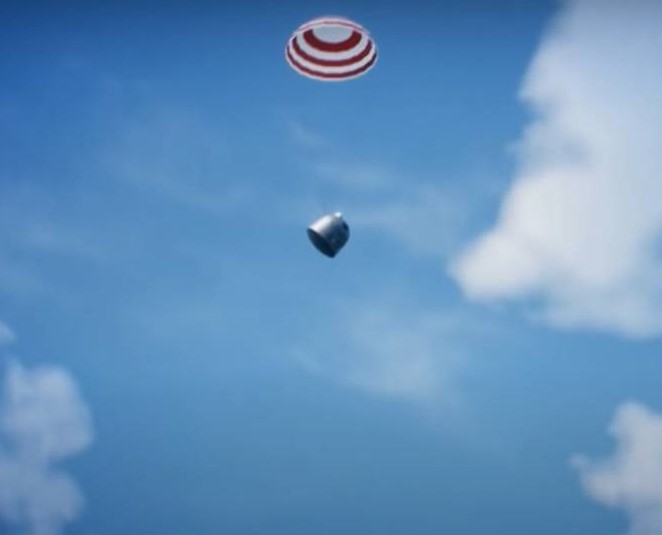
Credit: CCTV/Inside Outer Space screengrab
The next step in the Chang’e-5 mission is separation between the returner and orbiter prior to the journey back to China.
High-speed dive
According to Ren Junjie, a researcher of Lunar Exploration and Space Program Center under the China National Space Administration (CNSA), the separation is expected to take place in the next few days.

Credit: CCTV/Inside Outer Space screengrab
The re-entry capsule will handle the high-speed dive into the Earth’s atmosphere like a stone can skip over water. The return capsule will sprint into the atmosphere and then ascend again out of the atmosphere, reducing its speed to around eight kilometers per second, before landing at its designated site.

“We designed these separations to reduce fuel consumption in the following procedure, Ren said in a China Central Television (CCTV) interview. An inflatable aerodynamic decelerator and thermal protection system (TPS) will be used to control performance.
Zha Xuelei, vice chief engineer of Chang’e-5 probe from the Shanghai Academy of Spaceflight Technology, said “we’ve cleverly enabled, by design, the returner to skip the atmosphere and detect how fast the Earth is rotating. It is done in a way similar to how we dealt with the re-entry of Shenzhou spacecraft’s returners when the speed was appropriate for its re-entry.”
Lunar sample laboratory
The Chang’e-5 mission, comprised of an orbiter, a lander, an ascender and a returner, was launched on November 24. The lander-ascender combination touched down at Mons Rümker, a 70-kilometer-wide volcanic mound in the region known as Oceanus Procellarum — Latin for “Ocean of Storms” — on the Moon’s near side.

Part of China’s lunar sample receiving laboratory.
Credit: G. L. Zhang, et al.
According to the China Global Television Network (CGTN), the Chang’e-5 lunar samples will be sent to a lunar sample laboratory at the National Astronomical Observatory (NAO) under the Chinese Academy of Sciences in Beijing, for storage, processing and analysis.
Once it has landed on Earth, the samples will be transferred to the lab in a sealed container. The lab has a special facility that will prevent the sample from being contaminated by the atmosphere and water on Earth, CGTN reports.
Some of the sample will also be set aside for public display, according to Li Chunlai, deputy chief designer of the Chang’e-5 mission.
Go to this recent CCTV video discussing the return of the lunar samples to Earth at:
 Posted in

Ascender (left) departs orbiter/returner.
Credit: CCTV/Inside Outer Space screengrab
China’s Chang’e-5 mission performed an aerial ballet above the Moon, an uncrewed rendezvous and docking of spacecraft and transfer of collected samples in lunar orbit.

Credit: CCTV/Inside Outer Space screengrab
At 23:10 (Beijing Time) on December 3, the ascender of Chang’e-5 took off from the lunar surface with its cache of Moon samples.
At 05:42 (Beijing Time) on December 6, the ascender successfully rendezvoused and docked with the orbiter-returner combination on the lunar orbit, and at 06:12, the lunar samples were transferred to the returner of Chang’e-5.
Beyond expectations
“The transfer of lunar samples of the Chang’e-5,” said Ye Peijian, the chief director of Chang’e-5 program, “is what has never been done before in the world. The rendezvous and docking of the ascender and the combination of orbiter and returner is also the first time in the world. I think we have done a great job. Actually, it has been completed beyond my expectation,” Ye told China Central Television (CCTV).

Credit: CCTV/Inside Outer Space screengrab
Yang Yuguang, Vice Chairman, Space Transportation Committee, said the orbiter and re-entry capsule combination has a mass about 2.3 tons while the ascender has a mass about 400 kilograms.

Engineers at China Aerospace Science and Industry Corporation (COSIC) developed techniques and technologies for the automated rendezvous and docking for Chang’e-5 mission.
Credit: COSIC via CGTN
Crash cushions
In a China Global Television Network (CGTN) story, engineers at China Aerospace Science and Industry Corporation (COSIC) detailed the technologies they developed for the Chang’e-5 mission: an accelerometer, crash cushions or dampers to reduce impact of docking, while microwave radar served as the eyes of the ascender-orbiter pair to “look” at each other.
COSIC specialists performed months of experiments and carried out 15 simulations to assure the radars would work as intended, even taking the interference of lunar dust into consideration.
Having completed its mission, the Chang’e-5’s ascender separated from the orbiter-sample return vehicle.
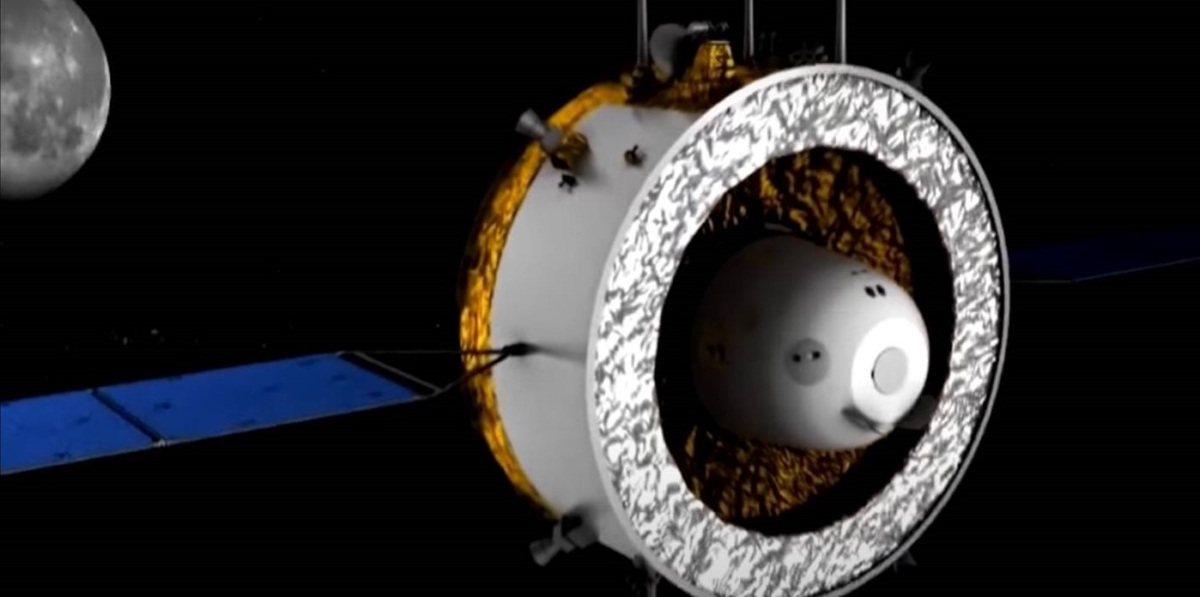
Returner spacecraft carries re-entry capsule and its cache of lunar samples.
Credit: CCTV/Inside Outer Space screengrab
According to Gao Lei, a CNSA official, the orbiter-returner will orbit the Moon for about six to seven days. It will then enter an Earth-Moon transfer orbit, and experience another three to four days of flight before returning to Earth.
New videos
For new videos showcasing the lunar rendezvous and docking tasks, go to:
— Chang’e-5 orbiter-sample return vehicle separates from ascender.
— Chang’e-5 – rendezvous and docking explained. Li Gefei (researcher, Beijing Aerospace Control Center) explains the rendezvous maneuvers and Peng Jing (deputy chief designer of the Chang’e-5 probe) explains the docking process.
— Docking, Separation of Chang’e-5 Modules Conquer Technical Difficulties: Experts
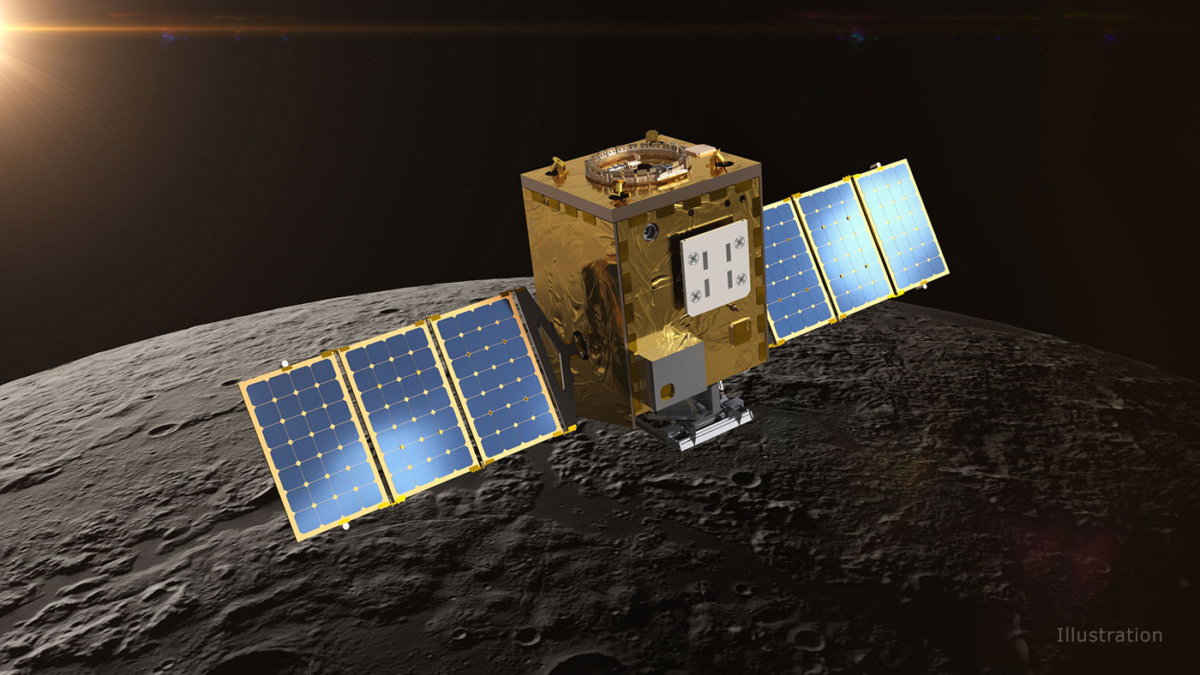
Artistic view of Lunar Trailblazer.
Credit: Lockheed Martin
There is big science via small satellites to help appreciate the lunar water cycle – how it forms, its abundance, and location related to geology.
To help find the answers, high on the launch list is Lunar Trailblazer, a mission selected under NASA’s Small Innovative Missions for Planetary Exploration (SIMPLEx) program.
Last month, it passed a Key Decision Point-C milestone, obtaining NASA endorsement to begin final design of hardware and build. Its launch is currently planned for February 2025 and is slated to get a ride on NASA’s Interstellar Mapping and Acceleration Probe (IMAP) mission.
The flight system delivery is October 2022. NASA is also investigating potential for an earlier ride for the spacecraft, Ehlmann told Inside Outer Space.
“Passing this key decision point means we have the green flag to proceed with production on the spacecraft. I’m very excited to see all the big science this compact spacecraft will surely bring back to us,” said Joshua Wood, Lockheed Martin Lunar Trailblazer program manager.
Lockheed Martin Space will build and integrate the Lunar Trailblazer spacecraft at its Waterton facility, located near Denver, Colorado.

Artist’s rendering of water ice in the Moon’s permanently shadowed regions.
Credit: Hongyu Cui
Reflect on this
Peering into the Moon’s permanently shadowed regions, Lunar Trailblazer will detect signatures of ice in reflected light, and it will pinpoint the locations of micro-cold traps less than a football field in size.
Collecting measurements at multiple times of day over sunlit regions, the mission will help scientists understand whether the water signature on the illuminated surface changes as the lunar surface temperature changes by hundreds of degrees over the course of a lunar day.
By measuring both direct light and low levels of terrain-scattered light, Lunar Trailblazer will generate comprehensive maps of surface water ice, even in the Moon’s darkest regions.

Credit: NASA
Scanning the landscape
The Lunar Trailblazer satellite will measure just under 12 feet (3.5 meters) in length with its solar panels fully deployed. The craft will spend over a year orbiting the Moon at a height of 62 miles (100 kilometers) above the lunar landscape, scanning it with two instruments: a visible-shortwave infrared imaging spectrometer built by NASA’s Jet Propulsion Laboratory and a multispectral thermal imager built by the University of Oxford.
Helping to answer big planetary science questions with a small satellite gets a thumbs up by Bethany Ehlmann, the mission’s principal investigator, of Caltech.
“Given the importance of water on the Moon for future robotic and human missions, Lunar Trailblazer will provide critical basemaps to guide future exploration,” Ehlmann said in a NASA statement.
For more information on NASA’s Lunar Trailblazer mission, visit:
https://trailblazer.caltech.edu/
Also go to my Scientific American story on the search for water resources on the Moon at:
https://www.scientificamerican.com/article/nasas-hunt-for-lunar-water-intensifies/

Credit: CCTV-Plus/Inside Outer Space screengrab
The ascender of China’s Chang’e-5 lunar sample return mission successfully rendezvoused and docked with the orbiter-returner spacecraft segments in lunar orbit, the China National Space Administration (CNSA) announced Sunday.
Samples collected from Oceanus Procellarum were transferred from the ascender to the returner. The orbiter-returner has now separated from the ascender, and is waiting for the right timing to return to Earth.

Credit: CCTV-Plus/Inside Outer Space screengrab
“According to Beijing’s real-time data, monitoring and judging, the sample transfer is completed normally. The returner hatch is closed, and the following work will continue according to the flight control plan,” said Liu Jiangang, chief dispatcher of Chang’e-5 mission Beijing base in a China Central Television (CCTV-Plus) interview.

Credit: CNSA/CLEP
Step-by-step
Launched on November 24, the Chang’e-5 mission consists of an orbiter, a lander, an ascender and a returner.
On December 1, the lander-ascender combination touched down on the north of Mons Rümker in Oceanus Procellarum, also known as the Ocean of Storms.
On December 3, after lunar samples were collected and sealed, the Chang’e-5 ascender rocketed off the Moon to join up with the orbiter/returner segments.
Meanwhile, all the data gathered by the scientific payloads on China’s Chang’e-5 probe has been sent back to the Earth. Researchers are now busy analyzing the data about the landing site.

Credit: CCTV-Plus/Inside Outer Space screengrab
Science payloads
The lander of the Chang’e-5 carried four science payloads to the moon, including a landing camera, a panoramic camera, a lunar soil structure detector and a lunar mineralogical spectrometer.

Credit: CCTV-Plus/Inside Outer Space screengrab
“During the landing process, the landing camera snapped multiple photos of the lunar surface. After that, the other three payloads started to work and collected lunar surface data for scientific research,” said Fu Qiang, the chief designer of the Operation and Management Subsystem of the Chang’e-5 mission ground application system in a CCTV-Plus interview.

Credit: CCTV-Plus/Inside Outer Space screengrab
Soil structure
Fu said that the lunar soil structure detector explored the soil before and after the drilling of samples, collecting information about the difference of the soil structure several meters under the lunar surface.
The panoramic camera took multiple panoramic photos of the landing site before and after the collection of lunar surface samples. Over 700 photos of the lunar surface were obtained.

Credit: CCTV-Plus/Inside Outer Space screengrab
“During the collection of lunar surface samples, the lunar mineralogical spectrometer conducted a dozen full-spectrum explorations of the sampling site, the rocks and the lunar surface soil,” Fu added. “It also completed a full-field multispectral scanning for the sampling site. So far, all the scientific data has been sent back to the Earth and our research team is processing and analyzing the data.”
Credit: CCTV-Plus/Inside Outer Space screengrab
Rock sizes
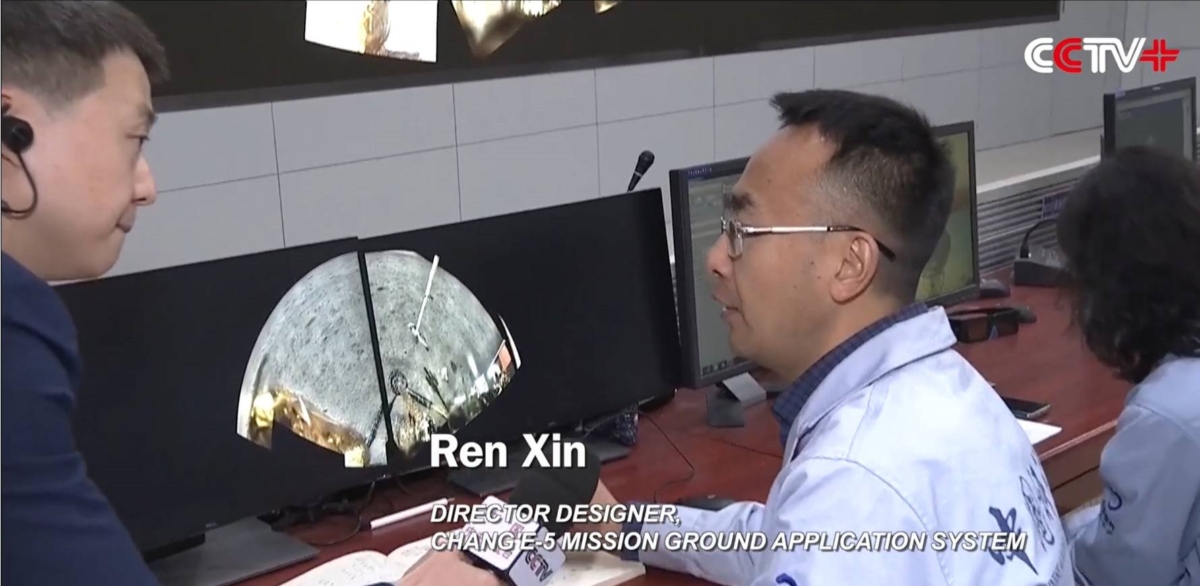
Ren Xin, the director designer of Chang’e-5 mission ground application system, said a panoramic image was created by stitching together 120 photos taken by the panoramic camera after the landing and before the collection of lunar surface samples.
“By enlarging the image, we can see a crater on the left which has a rough surface with a lot of gravel, which means the crater is quite young,” Ren added. “In other areas, we can also find that the surface is quite rough with rocks of different sizes. This is different from the lunar surface images sent back by Chang’e-4 and shows that the age of the lunar surface at Chang’e-5’s landing site is younger than that of the Chang’e-4.”
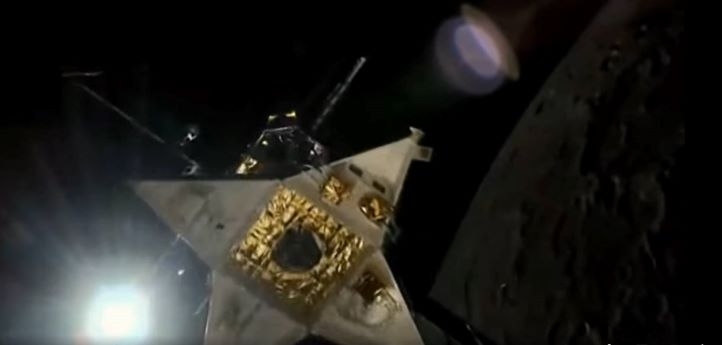
The orbiter and returner successfully separated from the spacecraft’s ascender.
Credit: CCTV-Plus/Inside Outer Space screengrab
Earth return
The orbiter and returner combination of China’s Chang’e-5 probe successfully separated from the spacecraft’s ascender at 12:35 Sunday (Beijing Time), according to the CNSA.

Credit: CCTV-Plus/Inside Outer Space screengrab
“After its separation from the ascender at noon, the orbiter-returner combination will orbit the Moon for about six to seven days, then enter the Earth-moon transfer orbit, and experience another three to four days’ flight before returning to Earth,” said Gao Lei, an official of CNSA’s lunar exploration program told CCTV-Plus.
The returner of the mission is expected to release the sample-carrying capsule for a landing at the Siziwang Banner in north China’s Inner Mongolia Autonomous Region in mid-December.
Go to these new CCTV-Plus videos:
Chang’e-5 beams back data gathered by scientific payloads at:
The Chang’e-5 ascender’s rendezvous and docking with the orbiter-returner can be viewed at:
Video showing release of ascender at:

Curiosity’s Location on Sol 2959. Distance driven 14.68 miles (23.63 kilometers).
Credit: NASA/JPL-Caltech/Univ. of Arizona
NASA’s Curiosity Mars rover is now performing Sol 2962 tasks.
The rover is marching forward, reports Mark Salvatore, a planetary geologist at the University of Michigan. “Curiosity continues to make swift progress on her climb up Mt. Sharp. After ascending a relatively steep portion over the last few weeks, Curiosity is now on “’flatter’ ground and covering lots of ground with each drive,” he explains.

Curiosity Right B Navigation Camera image taken on Sol 2961, December 4, 2020.
Credit: NASA/JPL-Caltech
Interesting outcrops
Curiosity recently stopped to investigate the local bedrock and to acquire some long-distance and high-resolution images of the interesting outcrops that lie ahead.

Curiosity Chemistry & Camera Remote Micro-Imager (RMI) photo acquired on Sol 2960, December 3, 2020.
Credit: NASA/JPL-Caltech/LANL
The team selected four targets to analyze using the Chemistry and Camera (ChemCam) Laser Induced Breakdown Spectroscopy (LIBS) instrument to better characterize the chemistry of the local bedrock.
“Three of these targets are designed to characterize color variations in relatively smooth bedrock,” Salvatore adds, “while the final target was selected to investigate a more nodular piece of bedrock observed in front of the rover.
Two long-distance Mastcam color mosaics of some likely geologic transitions located ahead of the rover were planned, as well as a Mastcam multispectral observation of two large boulders to the east.

Curiosity Right B Navigation Camera image taken on Sol 2961, December 4, 2020.
Credit: NASA/JPL-Caltech
Compositional differences
“These multispectral observations will help the team to determine whether there are compositional differences between the boulders and the surrounding landscape, which could help to decipher the origin of the boulders and whether they represent more exotic geologic units than those currently being explored,” Salvatore reports. “In the coming days, Curiosity will stick around at this location as we gather more data and perform some routine rover maintenance before continuing her march to the east.”

Box indicates Chang’e 5 lander on the basaltic plains of Oceanus Procellarum (“Ocean of Storms”) on December 2, 2020. The lander is the bright spot in the center of the outline. The areas around the lander has been brightened due to the descent engine plume impingement on the surface (similar to what has been observed at other landing sites).
Credit: NASA/GSFC/Arizona State University
Here is the first look from NASA’s Lunar Reconnaissance orbiter (LRO) of China’s recent Moon lander – Chang’e-5.
Box indicates China’s Chang’e-5 lander on the basaltic plains of Oceanus Procellarum (“Ocean of Storms”) on December 2, 2020.
The team supporting the LRO’s super-powerful LROC camera computed the coordinates of the lander to be 43.0576° N, 308.0839°E, –2570 m elevation, with an estimated accuracy of plus-or-minus 20 meters.
The lander is the bright spot in the center of the outline.
The areas around the lander has been brightened due to the descent engine plume residue on the surface which is similar to what has been observed at other landing sites, according to LROC-central at ASU.
Credit: CNSA/CLEP

Ascender powers into lunar orbit.
Credit: CCTV/Inside Outer Space screengrab
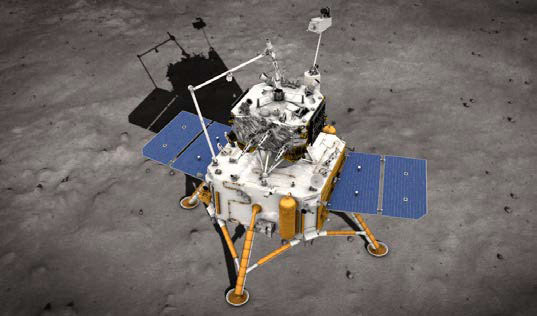
China’s Chang’e-5 lunar sample return capsule is preparing for transit back to Earth. The mission’s lander/ascender spent about 19 hours snagging samples from the Moon’s surface on Thursday and completed the country’s first-ever takeoff from an extraterrestrial body.

Credit: CCTV/Inside Outer Space screengrab
Carrying its precious cargo of lunar collectibles, the ascender module of the Chang’e-5 lander spacecraft powered itself into Moon orbit to rendezvous and dock with other mission modules.
“It took six minutes for the module to enter into the lunar orbit after taking off and seven minutes later, it unfolded its solar panels. It is impossible for us to intervene during such a short period of time if anything happens. So, we have made special designs to enable the module to make decisions on its own,” said Xing Zhuoyi, a designer of the Chang’e-5 probe from the China Academy of Space Technology (CAST) under the China Aerospace Science and Technology Corporation.
The ascender module will dock with the orbiter/returner modules, transferring the lunar sample container into those elements.
“After the docking, the combination of orbiter and returner will stay in orbit for a few days. It will be waiting for a specific window period that allows the combination to return to the Earth, said Xing in a China Central Television (CCTV) interview.

Credit: CCTV/Inside Outer Space screengrab
Skip re-entry
In depositing the sample-carrying capsule into the Earth’s atmosphere, designers have developed a skip reentry method mimicking a skipping stone to lower the craft’s speed and protect it during the scorching reentry.
“The speed is too high because of the reentry at the second cosmic velocity. So we need to reduce the speed through the inflatable aerodynamic decelerator,” said Shu Yan, chief designer of the Chang’e-5 mission. “By this way, the returner can re-enter the atmosphere at a lower speed, like the Shenzhou spacecraft, and successfully return to the Earth.”

Capsule return with Moon samples, landing at Siziwang Banner in north China’s Inner Mongolia Autonomous Region.
Credit: CCTV/Inside Outer Space screengrab
The lunar rocks and soil gathered by Chang’e 5’s lander/ascender combination are scheduled to parachute into a preset site in North China’s Inner Mongolia autonomous region in mid-December.
Experimental spacecraft
China launched an experimental spacecraft on October 24, 2014, to test technologies used for the Chang’e-5 mission.
Comprising a re-entry capsule and a service module, that craft flew halfway around the Moon. After the re-entry and service capsules separated, the re-entry vehicle approached Earth’s atmosphere at about 11.2 km per second.

Following a circumlunar voyage in 2014, a return capsule parachuted to Earth. This test was a prelude to China’s Chang’e-5 lunar mission.
Courtesy: China Space
That test return capsule touched down at the designated landing area in Siziwang Banner, north China’s Inner Mongolia Autonomous Region, on November 1, 2014.
The service module flew back to orbit the moon for further tests and reached the L2 point of the Earth-Moon system to conduct experiments.
Go to these newly issued CCTV videos detailing the Chang’e-5 mission:

Chang’e-5 lunar lander flag system.
Credit: CCTV

Credit: CNSA/CLEP
Before China’s Chang’e-5 ascender blasted off into Moon orbit today, a five-star red flag was deployed on the Moon’s surface.
According to China Central Television (CCTV) this is the first time that China has realized the “independent display” of the five-star red flag on the lunar landscape.
The five-star red flag weighs only 1 kilogram and can still “maintain its true colors” under a temperature difference of plus or minus 150 degrees Celsius.

Credit: CNSA/CLEP
“Fabric version”
A lunar flag display system consisted of three parts: the lunar flag, the compression release device, and a small pyrotechnic deployment mechanism – and is about half a meter long.
Unlike the five-star red flag on China’s earlier lunar vehicles — Chang’e-3, Chang’e-4, and Yutu lunar rover that used spraying methods — the “fabric version” of the five-star red flag on Chang’e-5 is a real flag.

China’s Chang’e-4 lander with China flag sprayed on.
Credit: CNAS/CLEP
The five-star red flag that unfolded in the form of a scroll is relatively flat and was designed to be wrinkle-proof.
The scientific research team spent more than a year in selecting materials, and finally selected 20 or 30 fiber materials. A new type of composite material was chosen so that the five-star red flag can withstand the harsh environment of the Moon and does not fade, color, or deform.
“Although this is just a thin five-star red flag, it has a very high technological content,” said Ma Wei, the commander of the five-star red flag display system project, according to CCTV.

Departing ascender imaged by the Chang’e-5 lander.
Credit: CNSA/CLEP
China’s Chang’e-5 ascender vehicle has blasted off from the Moon, successfully positioning its cargo of lunar samples for rendezvous, docking, and transfer to an awaiting orbiter/returner craft.

Ascender liftoff from lunar surface.
Credit: CCTV/Inside Outer Space screengrab
China Central Television (CCTV) reports at 23:10 on December 3 (Beijing time), the 3000 newton-thrust engine of the Chang’e-5 ascender worked for about 6 minutes and successfully hurled the ascender carrying the samples to the scheduled orbit around the Moon.

Credit: CGTN/Inside Outer Space screengrab

Credit: CGTN/Inside Outer Space screengrab

Credit: CGTN/Inside Outer Space screengrab

Ascender is to dock with awaiting orbiter circling the Moon.
Credit: CCTV/Inside Outer Space screengrabBecause there is no navigation constellation at the Moon, CCTV explains, after the ascender takes off, it needed to use its own special sensors to achieve autonomous positioning and attitude determination with the help of ground measurement and control.
Prior to liftoff of the ascender from the Moon, a Chinese flag was deployed from the lander.
Capsule return with Moon samples, landing at Siziwang Banner in north China’s Inner Mongolia Autonomous Region.
Credit: CCTV/Inside Outer Space screengrab
Moon-Earth transfer window
After takeoff, the ascender reportedly went through three stages of vertical ascent, attitude adjustment and orbit injection, and entered the scheduled orbit around the Moon.
Subsequently, the ascender will rendezvous and dock with the orbital assembly waiting around the Moon and transfer the lunar sample to the returner, which will wait for a suitable Moon-Earth transfer window to prepare for its return to Earth.
According to one source, docking with the orbiter will happen on December 6, Beijing Time.
https://twitter.com/i/status/1334523926404362240

Successful sampling of the Moon.
Credit: CNSA/CLEP
China’s Chang’e-5’s ascender is ready for departure from the Moon later today, hauling into lunar orbit a cache of specimens picked up and packaged from the Ocean of Storms.

Landing leg of Chang’e-5 lander.
Credit: CNSA/CLEP
The processes of drilling and packing rocks and soil from beneath the lunar surface finished at 4:53 am on December 2, the China National Space Administration (CNSA) said, and the mechanical arm was still gathering surface samples.

Samples onboard ascender.
Credit: CCTV/Inside Outer Space screengrab
Immediately after the successful lunar touchdown, the Chang’e-5 hardware began the collection work using two methods: drilling and surface collecting. Hauling back to Earth some 4.4 pounds (2 kilograms) of Moon specimens was the goal of the Chang’e-5 mission.
The packaging and sealing work was performed on the Moon to ensure intact samples are not affected by the external environment when returning to Earth.

Drilling into the lunar surface.
Credit: CNSA/CLEP
Smoother than expected
Ren Junjie, a researcher at the National Space Administration’s Lunar Exploration and Space Engineering Center said the entire lunar surface sampling process went smoother than anticipated. In the entire meter sampling process, a dozen samples were carried out. The container for the meter sampling was filled, and the sampling task was finished ahead of schedule.
The Chang’e-5 lunar lander is equipped with multiple payloads including a landing camera, panorama camera, lunar regolith penetrating radar and lunar mineralogical spectrometer, which detects lunar surface topography and mineral composition, as well as the Moon’s shallow subsurface structure.
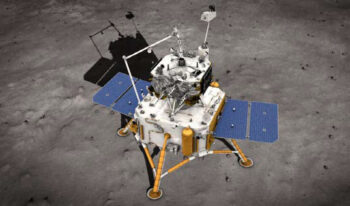
China’s Chang’e-5 lunar mission will attempt to haul back to Earth samples of the Moon.
Credit: CNSA/CLEP
Before the sample drilling process, the lunar regolith penetrating radar analyzed the subsurface structure in the sampling area, offering data reference for sampling.
According to one report, the Chang’e-5 lunar probe was also to directly measure charged lunar dust, expected to reveal the secret of floating lunar dust.

Ascender departs lunar surface with samples. Credit: New China TV/Inside Outer Space screengrab
Express package
After the ascender speeds into lunar orbit using its 3,000-newton-thrust, it will merge with the orbiter and returner combination and deliver the “express package” of lunar specimens to them. The orbiter/returner capsule is in lunar orbit at an average altitude of about 124 miles (200 kilometers).

Autonomous rendezvous and docking between ascender and orbiter.
Credit: CCTV/Inside Outer Space screengrab
The orbiter-reentry combination capsule will then return to Earth orbit, where the pair will break up, and the reentry capsule skims the Earth’s atmosphere to slow down. This series of complicated maneuvers leads to return of the capsule in mid-December, to a preset landing site in the Inner Mongolia autonomous region.

Credit: CCTV/Inside Outer Space screengrab
High hopes
Peng Jing, deputy chief designer of Chang’e-5 probe with the China Academy of Space Technology, said they hold high hopes that the samples collected will open new perspectives for lunar scientists.
“China’s scientists said it requires samples from different (geologic) ages to piece together the full history of the Moon,” Peng told China Central Television (CCTV). “Analysis has shown that the samples we could gather from the designated northwest area of the Ocean of Storms are rather new. Together with the more ancient samples, we could gain a better knowledge of the formation and evolution of the Moon,” he said.
Gao Lei, an official from the China National Space Administration’s lunar exploration program, said the Chang’e-5 mission technologies will also prove to be helpful in similar future operations.
“One of our main missions of planet exploration is sample collecting and their usage. So I think the technologies that we’ve used this time will prove useful for other sample-collecting missions in the future, whether it’s on the Moon, Mars, or other planets,” Gao said.
Go to these new videos for Chang’e-5 mission progress:
http://pv.news.cctvplus.com/2020/1203/8168047_Preview_9665.mp4
Hong Kong University Makes Key Contributions to China’s Lunar Mission

