Author Archive
 Author:
  December 21st, 2020
NASA’s Curiosity Mars rover is now performing Sol 2978 tasks.
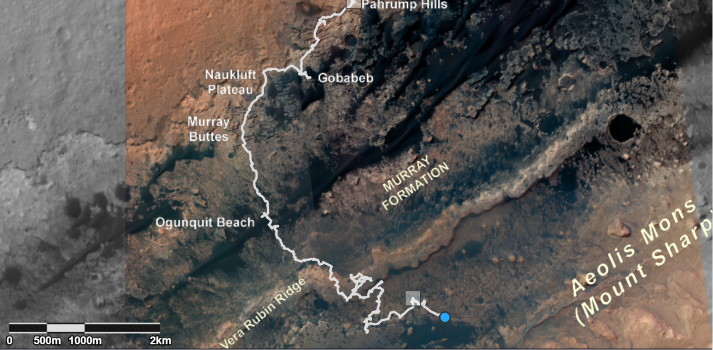
Curiosity’s Location as of Sol 2972. Distance Driven 14.78 miles (23.78 kilometers)
Credit: NASA/JPL-Caltech/Univ. of Arizona
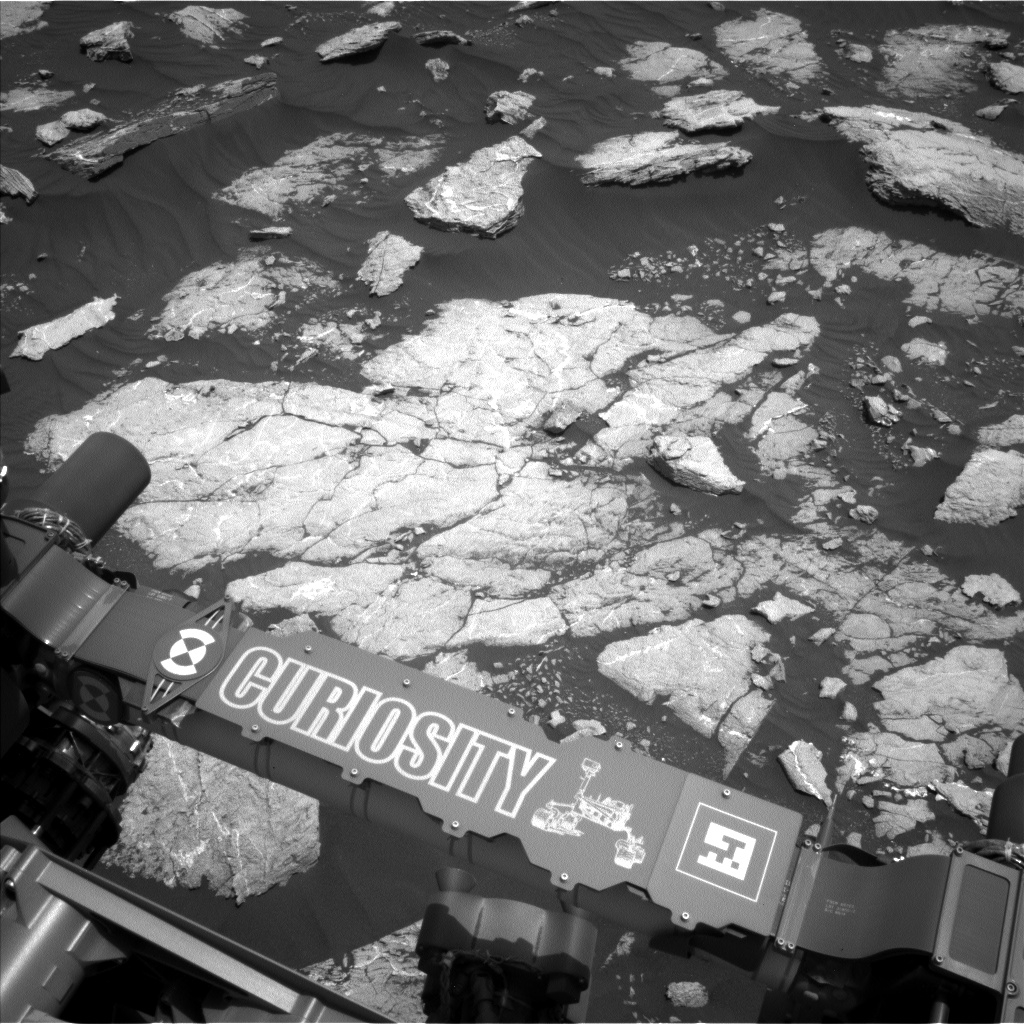
Curiosity Left B Navigation Camera image taken on Sol 2977, December 20, 2020.
Credit: NASA/JPL-Caltech
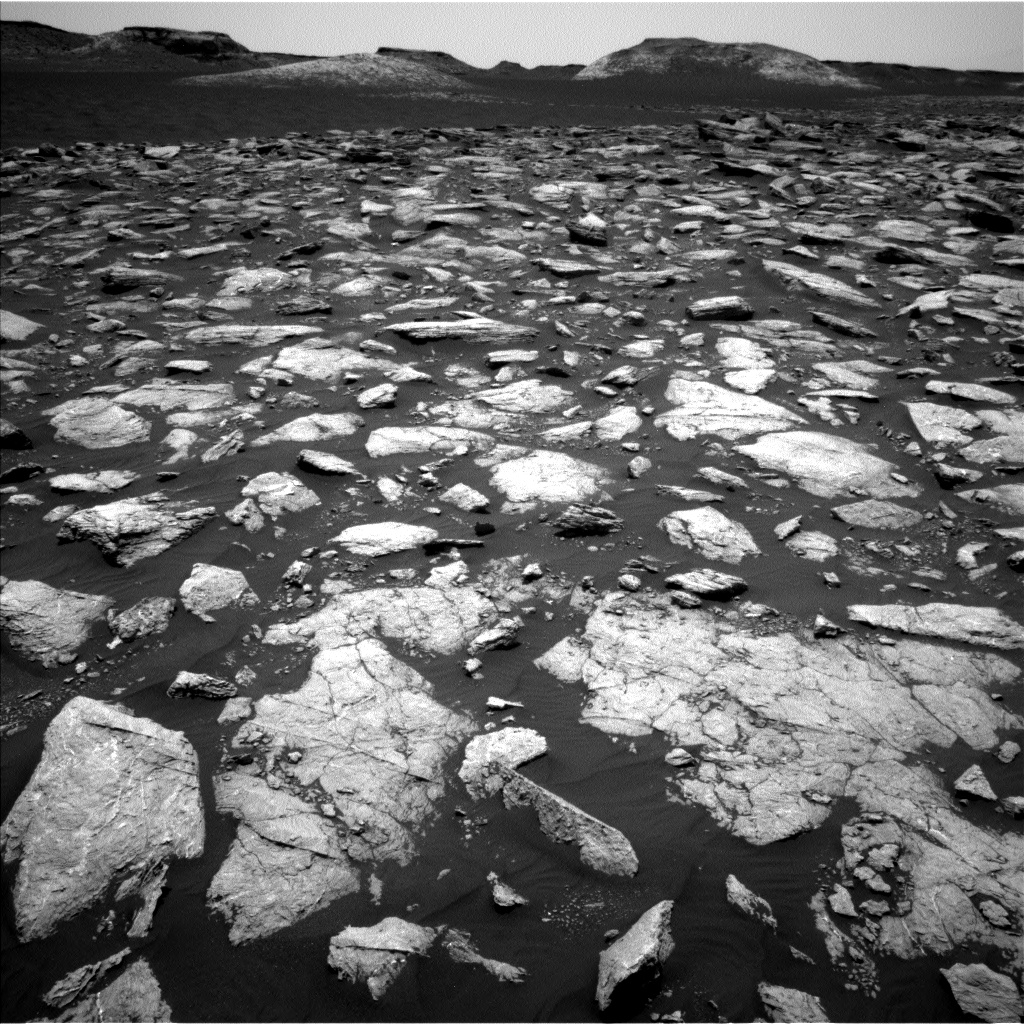
Curiosity Left B Navigation Camera image taken on Sol 2977, December 20, 2020.
Credit: NASA/JPL-Caltech
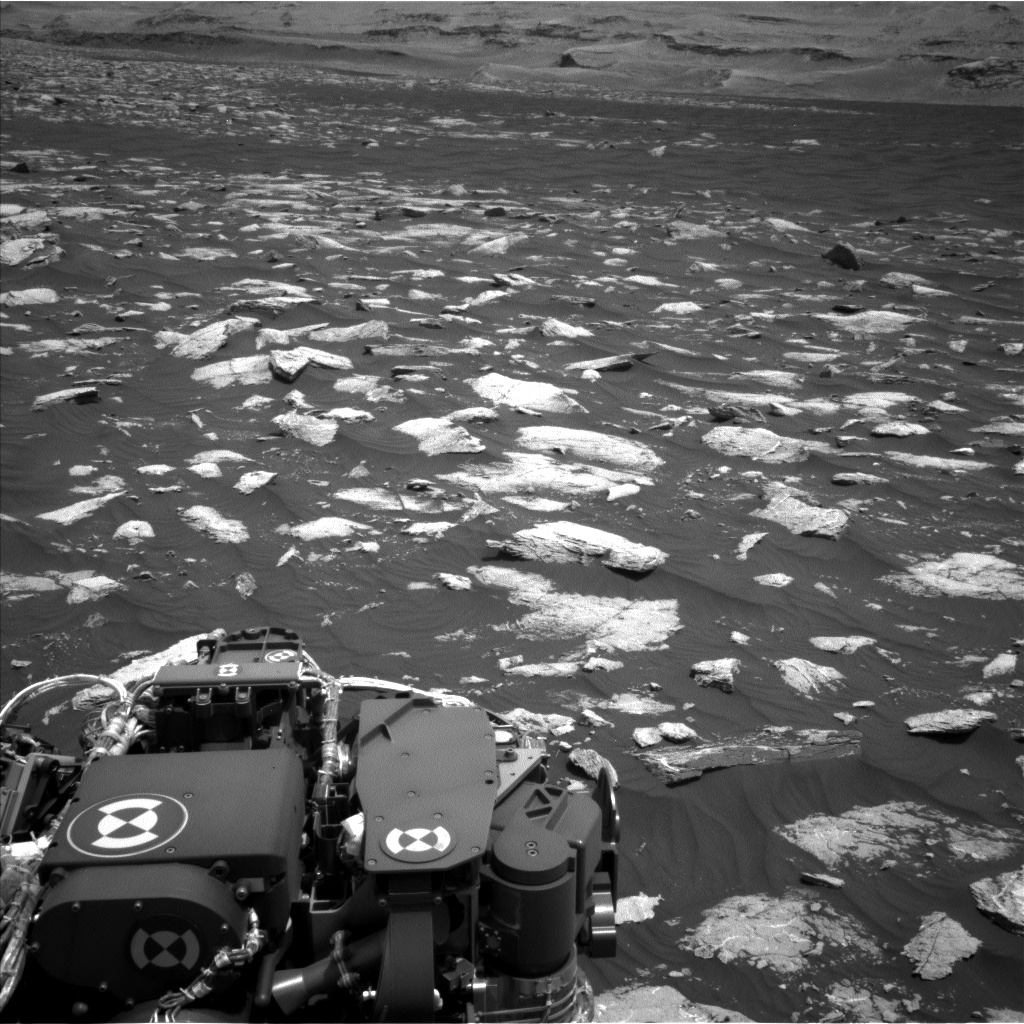
Curiosity Left B Navigation Camera image taken on Sol 2977, December 20, 2020.
Credit: NASA/JPL-Caltech
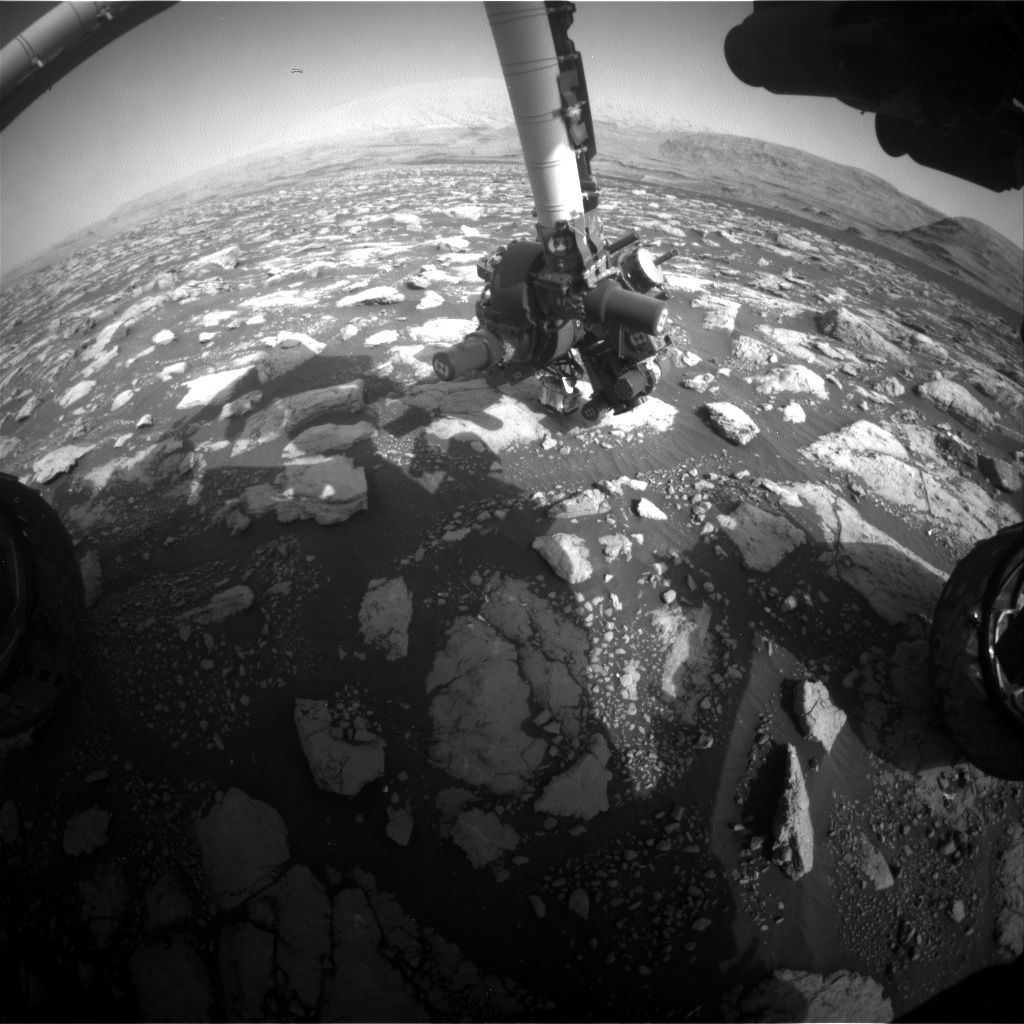
Curiosity Front Hazard Avoidance Camera Right B photo taken on Sol 2976, December 20, 2020.
Credit: NASA/JPL-Caltech
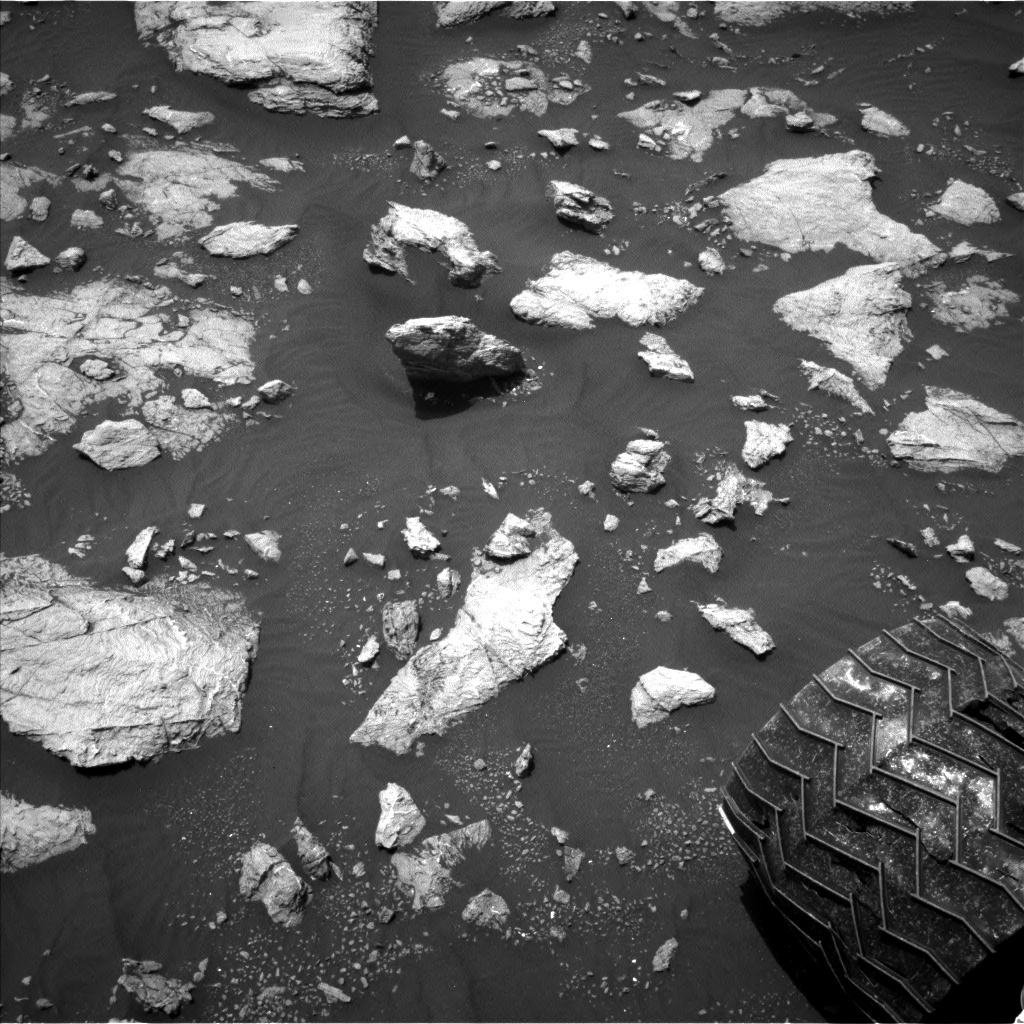
Curiosity Left B Navigation Camera image taken on Sol 2977, December 20, 2020.
Credit: NASA/JPL-Caltech
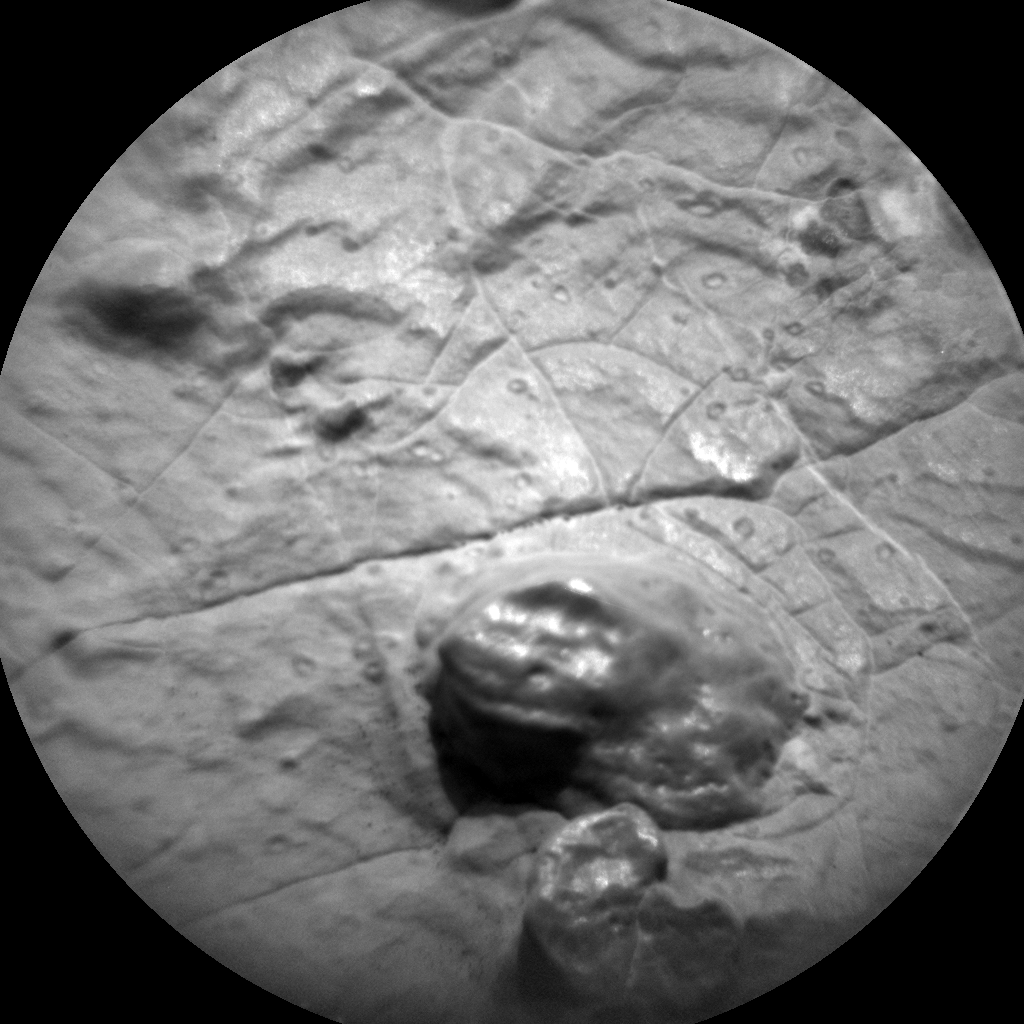
Curiosity Chemistry & Camera Remote Micro-Imager photo acquired on Sol 2977, December 20, 2020.
Credit: NASA/JPL-Caltech/LANL
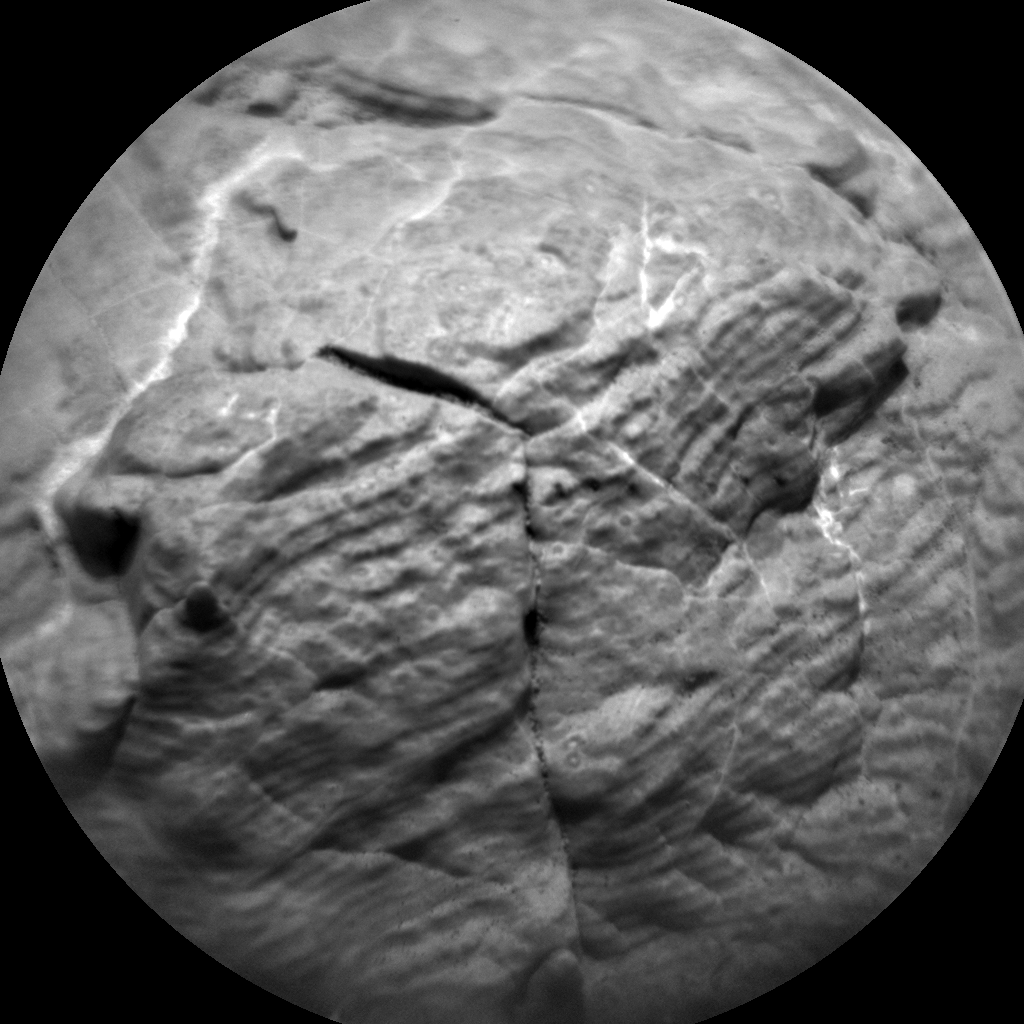
Curiosity Chemistry & Camera Remote Micro-Imager photo taken on Sol 2976, December 19, 2020.
Credit: NASA/JPL-Caltech/LANL
Newly relayed imagery shows the robot’s sandy and rocky surroundings:
 Posted in

“Tourist” photograph of Apollo 17’s Jack Schmitt taken by Gene Cernan prior to beginning exploration during EVA-3.
Credit: NASA
Apollo 17 moonwalker, Harrison Schmitt’s new Chapter 12 is now online.
“Pages of History” constitutes the seventh installment of “Apollo 17: Diary of the Twelfth Man” – with other chapters to follow.
This captivating section chronicles EVA-3, the continuation of the exploration of the lunar surface at Taurus-Littrow on the third day after landing back in December 1972.
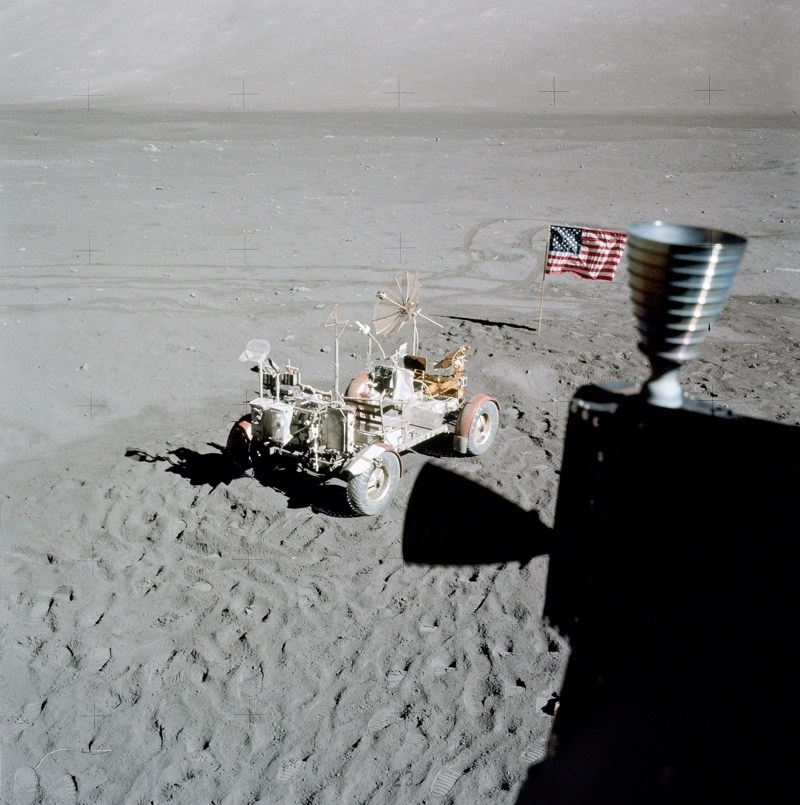
View of the Rover from Challenger’s LMP window prior to the beginning of EVA-3 showing its equipment and the repaired fender. Credit: NASA
Co-editor of this diary, Ronald Wells explains that added features to this chapter include the ability to download some photos in a window separate from the text at higher resolution which will cover most of the browser screen, and can also be enlarged for further examination by clicking areas of the image.
Evidence of events
“Apollo 17’s third and final day of exploration can be interpreted to have provided evidence of events occurring within a few tens of millions of years of the birth of the Moon and its parent Solar System, as well as documentation on four of the major, basin-forming impacts that occurred within the first billion years of Solar System history,” Schmitt explains.
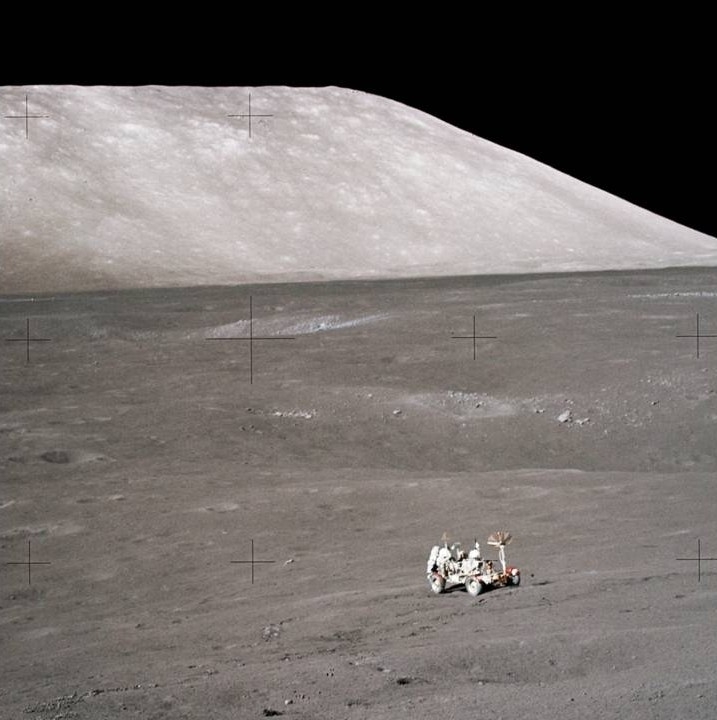
Part of Taurus-Littrow Valley seen from Station 8. Credit: NASA
The chapter ends with the return to the lunar module and a close-out of EVA-3, Schmitt adds, “so far the most recent in history, which includes my Olympic record-breaking hammer throw!”
To access this unique diary, go to:
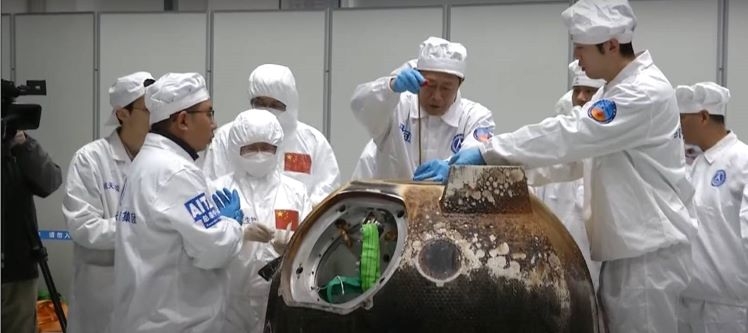
Technicians extract the lunar sample container from the return capsule.
Credit: CCTV/Inside Outer Space screengrab
Fresh from the Moon via China’s Chang’e-5 mission about 3.8 pounds (1,731 grams) of lunar samples have been transferred to the National Astronomical Observatory under the Chinese Academy of Science on Saturday in Beijing.

Credit: CCTV/Inside Outer Space screengrab
The container loaded with the specimens was carefully extracted from the recovered return capsule, and then escorted to the National Astronomical Observatory for opening.

Credit: CCTV

Credit: XinhuaVideo/Inside Outer Space screengrab
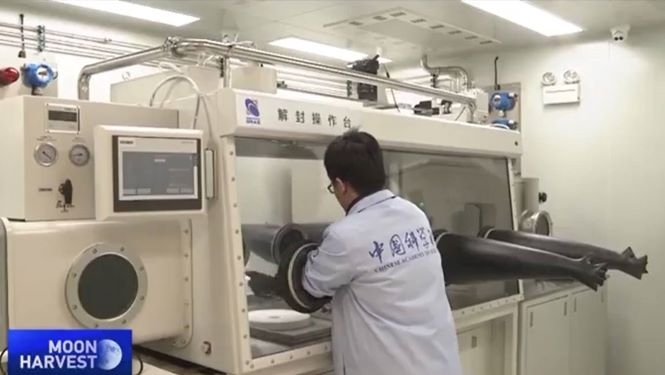
The samples are sealed in the nearly vacuum lunar environment. They will be unsealed under vacuum condition in China’s first lunar sample laboratory at the National Astronomical Observatory.
Credit: CCTV/Inside Outer Space screengrab
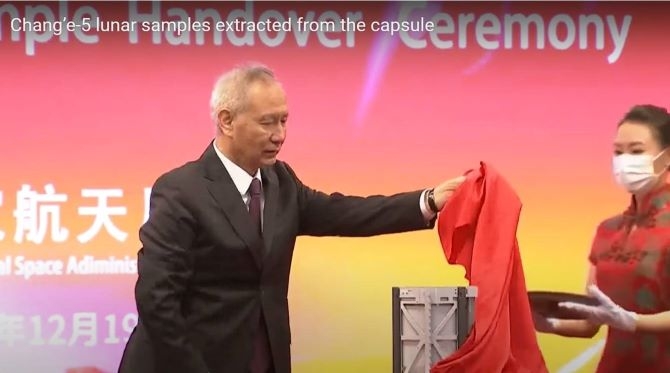
Hou Jianguo, President of the Chinese Academy of Sciences, addressed a special ceremony, handing over the collectibles to researchers charged with storage, analysis and sample research.
Difficult space mission
The return capsule of Chang’e-5 mission parachuted into north China’s Inner Mongolia Autonomous Region in the early hours of Thursday.
The 8.2 metric ton Chang’e-5 comprised an orbiter, a lander, an ascender and a returner.
The sample return mission was launched on November 24 by a Long March 5 heavy-lift carrier rocket at the Wenchang Space Launch Center in southern China’s Hainan province, setting out on China’s most complex space mission and a first to retrieve lunar samples since 1976.

Photo taking during surface sampling.
Credit: CCTV/Inside Outer Space screengrab
The lander-ascender combination touched down on the north of the Mons Rümker in Oceanus Procellarum, also known as the Ocean of Storms, on the near side of the Moon on December 1st.
The Moon sampling operation was completed on December 2, spanning about 19 hours. Regolith and rock were packed into a vacuum container inside the ascender which blasted off the Moon on December 3, later linking up with the orbiter/returner vehicles and transferring the lunar samples into the reentry capsule.

Fresh samples from the Moon delivered by China’s Chang’e-5 return capsule.
Credit: Xinhua News Video/Inside Outer Space screengrab
The orbiter/returner made two orbital maneuvers after traveling in a near-circular lunar orbit for nearly six days. After the maneuvers, the pair entered a Moon-Earth transfer trajectory on Sunday and began to fly back toward Earth.
Return to Earth
The orbiter/returner separated from each other early on Thursday morning. The reentry capsule with its precious cache of lunar specimens touched down at a preset landing site in Siziwang Banner of the Inner Mongolia autonomous region. It was then airlifted to Beijing, where scientific personnel successfully removed the lunar sample container after related processing work.

Credit: CCTV/Inside Outer Space screengrab
“We have delivered the lunar samples to the research units, hoping they can achieve more results. This is a very important moment for us. We anticipate that with the lunar samples, we can take more resolute steps in building China into a major power in space exploration,” said Hu Hao, chief designer of the third phase of China’s lunar exploration program.
Li Chunlai, deputy chief designer of the third phase of China’s lunar exploration program said that “our ground-based research team will start the work on the storage, preparation and processing of the samples for further research. Lunar samples study is long-term, systemic work, and so there will be more scientific results achieved along the way.”
Go to these newly issued videos that show the lunar sample container and the transfer of the Moon specimens from China National Space Administration (CNSA) to the Chinese Academy of Sciences (CAS) for research.

Credit: Larry Kuznetz
You could call him the Coronavirus spaceman.
Larry Kuznetz is on a mission. A recently formed startup is called Planetary ProTech and has two key goals: Develop a unique spacesuit for Mars explorers by 2025 and a “Q-suit” for Earth by 2021.
A 50-year veteran of the space program, Kuznetz was a flight controller during Apollo, worked on the space shuttle program, and was a life science experiment manager for the International Space Station. He is an inventor, entrepreneur and currently teaches Mars spacesuit design at UC Berkeley.

MarsSuit Project.
Credit: Larry Kuznetz

Photo of the Q-suit being tested in Japan, replete with barrier to entry/barrier to exit design, as well as face to face exposure elimination, super filters and other MarsSuit attributes.
Credit: Larry Kuznetz
Alien environment
“The Covid-19 pandemic has exposed our vulnerability to pathogens as small as 1.5 microns. Imagine then the chaos that might ensue from even smaller pathogens being inadvertently returned from the alien environment of space,” Kuznetz told Inside Outer Space. “Precautions must be taken now before serious planetary exploration begins. And they must be embodied in space suits of the future starting with Mars.”
What Mars has to do with Coronavirus is quite a bit, Kuznetz contends.
First of all, the Committee on Space Research (COSPAR) is an international group that’s responsible for planetary protection, both forward and backwards.
“Forward means if you send a spacecraft to another planet, like Mars for example, you’re required to try and prevent the dissemination and spread of earthborn contaminants for both ethical and scientific reasons, Kuznetz explains. “For the former, do not do to other worlds what we’ve done to planet Earth. And for the latter, don’t deposit human effluent in the biosphere of that other world…because if you’re looking for life you’ll find it. And it’ll be you not aliens,” he adds.

Digging in…on Mars.
Credit: NASA Langley Advanced Concepts Lab/Analytical Mechanics Associates
What lurks on Mars?
As for backward contamination, it’s forward in reverse and that’s where Cronavirus comes in.
On the Red Planet, nobody knows what lurks in the canyons of Candor Chasma or the valleys of Valles Marineris.
“But if it’s anything like Coronavirus you better not bring it back home. And that is what led to the MarsSuit project, a university/public/government/industry Hypernet using web resources to hypercharge the development of a radically different spacesuit for Mars,” says Kuznetz.
There are many reasons why the MarsSuit has to be different from all others before it: 38% gravity on Mars makes all prior spacesuits far too heavy; the carbon dioxide-laden atmosphere, as light as it is, would render current life-support systems functionless, Kuznetz adds.
Then there’s the dust and the cold that would foul many of the mechanical systems. And most relevant, Kuznetz points out that present suit designs are a magnet for dust and all creatures in it, big and small, a clear violation of backward contamination rules.

Credit: Larry Kuznetz/Inside Outer Space screengrab
Preliminary design
“After decades of thinking about this and vetting it through hundreds of students, engineers, professionals, and the interested public, we’ve got a preliminary design for this MarsSuit,” Kuznetz says.
This by the way, Kuznetz observes, is not the first suit designed to protect us against pathogens carried back from another planet. A biological isolation garment (BIG) was created during project Apollo to shield humans from potential “moon bugs” toted back by early Apollo crewmembers.
It’s all about space technology brought back to Earth, Kuznetz notes.
“It is not a big stretch to imagine some of these elements migrating into Coronavirus-fighting Personal Protective Equipment (PPE) to allay the fears of frontline medical personnel. Most of my time these days is spent advancing the design of such a suit. This includes materials, testing, cost effectiveness, ease of manufacturing and a host of other considerations,” Kuznetz says.

On Earth recovery, Apollo 11 crew donned Biological Isolation Garments to protect Earth from possible Moon bugs.
Credit: NASA
“I can’t reveal more as it is proprietary,” Kuznetz makes clear, “but rest assured it will look nothing like a BIG suit. At the moment, things are looking good and we are optimistic. Hopefully, this MarSuit derivative will soon take the forefront against Covid-19 and its insidious relatives waiting in the rafters. We are now actively soliciting partnerships either inside or outside the aerospace industry to produce the Q-suit in quantity, including manufacturers of PPE and hazmat suits,” he concludes.
For website references, MarsSuit development resources can be found on twitter under ME 292 and on YouTube at:
A video demo link is available at:

Press briefing featured China space officials.
Credit: XinhuaVideo/Inside Outer Space screengrab
China space planners are outlining future space exploration goals, bolstered by the success of their Chang’e-5 lunar sample return mission.

Credit: XinhuaVideo/Inside Outer Space screengrab
Wu Weiren, chief designer of China’s lunar exploration program, said the country plans to build a prototype for a scientific research station at the south pole of the Moon by 2030.
Moon missions
In a China Daily report, Wu Yanhua, deputy head of the China National Space Administration (CNSA) said Chang’e-6 will collect samples from the Moon’s south pole or possibly sample the farside of the Moon.

Queqiao relay spacecraft is in a halo orbit around the second Lagrangian (L2) point of the Earth-Moon system, utilized to set up a communication link between the Earth and the Moon’s farside.
Credit: CNSA
The Chang’e-6 farside destination will depend on a still-functioning Queqiao relay satellite, Wu said, now in use to support the Chang’e-4 lander/Yutu-2 rover that continues to explore the farside of the Moon since January 2019. Queqiao, was stationed in a halo orbit near the Earth-Moon L2 point in June 2018 to enable communications between the Chang’e-4 mission on the lunar farside and the Earth.
At a Chinese Foreign Ministry press briefing that focused on the success of the Chang’e-5 lunar sample mission, Wu also noted that the Chang’e-7 and Chang’e-8 missions will investigate the technological viability of international cooperation to establish a robotic scientific research outpost on the Moon in the coming 15 years.

China’s space station scheduled to be operational in 2020’s.
Photo credit: CMSA
Space Station
As to whether China will undertake manned lunar missions, Wu said the decision will be made after the nation puts its crewed space station into service, which is scheduled to take place in 2022.

Credit: CCTV/Inside Outer Space screengrab
Wu also stated at the December 17 press event that 2021-2022 will be extremely busy, according to China’s Xinhua news service.
Wu said a total of 11 missions are planned to put in place China’s space station, including the construction of the core module that is set to be launched in the first half of next year, two lab capsules, as well as four piloted craft and four cargo craft.
Go to these recently released videos:
— We plan to build a prototype for a scientific research station at the South Pole of the moon by 2030, says the chief designer of China’s lunar exploration program.
— What are China’s plans for future space exploration?
— Press briefing on China’s Chang’e-5 lunar mission
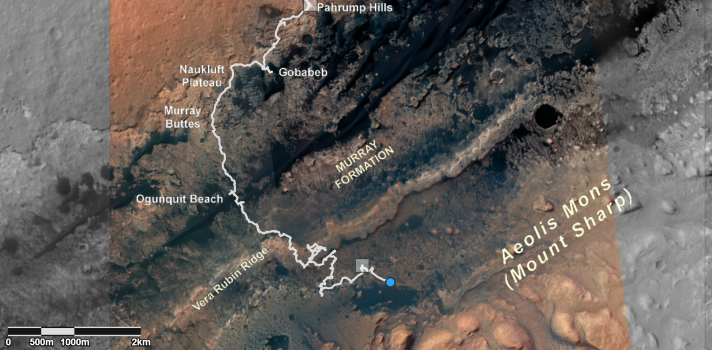
Sol 2972 Distance Driven 14.78 miles (23.78 kilometers)
Credit: NASA/JPL-Caltech/Univ. of Arizona
NASA’s Curiosity Mars rover is now performing Sol 2975 tasks.
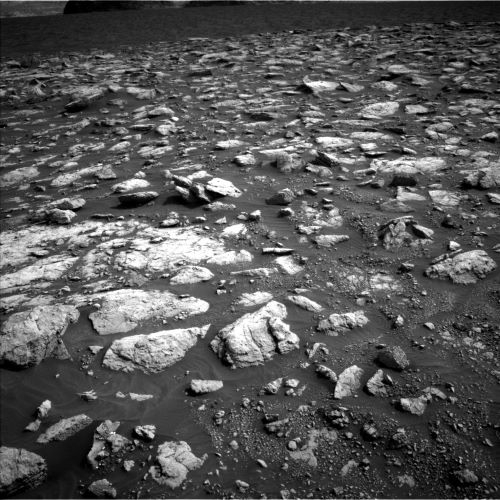
After two busy sols of science, the rover will continue to drive even further into the rubbly terrain on her way to a large sand sheet just south of its current location (seen in the background of this Navcam left image taken on Sol 2972, December 15, 2020.)
Credit: NASA/JPL-Caltech
“With the successful completion of Monday’s drive, Curiosity has entered a new geologic unit that is characterized by a particularly rubbly surface texture,” reports Mariah Baker, a planetary geologist at the Center for Earth & Planetary Studies, Smithsonian National Air & Space Museum.
“From orbit, this distinct geomorphology is also accompanied by a unique spectral signature, which piqued the team’s interest and motivated a short contact science stop within this unit,” Baker adds. “The ground truth data acquired during this stop will be crucial in determining why the rocks here look so different from others we have encountered along the traverse.”
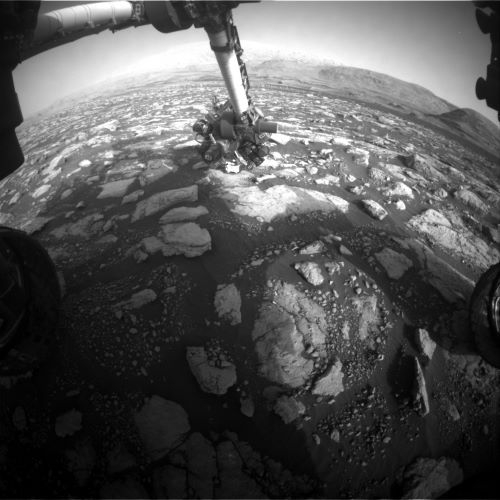
Curiosity Front Hazard Avoidance Camera Left B image taken on Sol 2974, December 18, 2020.
Credit: NASA/JPL-Caltech
Science blocks
A recent plan called for two hefty 2-hour-long science blocks and no drive, which allowed scientists to collect double the data at this unusual stop before the rover drives away.
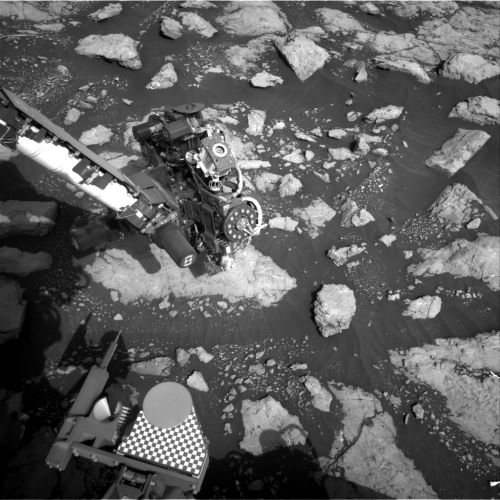
Curiosity Right B Navigation Camera photo acquired on Sol 2974, December 17, 2020.
Credit: NASA/JPL-Caltech
Full contact science with the rover’s Alpha Particle X-Ray Spectrometer (APXS) and Mars Hand Lens Imager (MAHLI) was planned for a pair of targets, “Cod Baa” and “Carn Mor” (with a bonus MAHLI observation on “An Dun”), and the dual science blocks were filled to the brim with remote science activities.
Chemistry and Camera Laser Induced Breakdown Spectroscopy (LIBS) measurements and Mastcam documentation images were to be acquired on bedrock targets “Cod Baa,” “Northmavine,” and “St Abbs,” as well as soil target “Houster.”
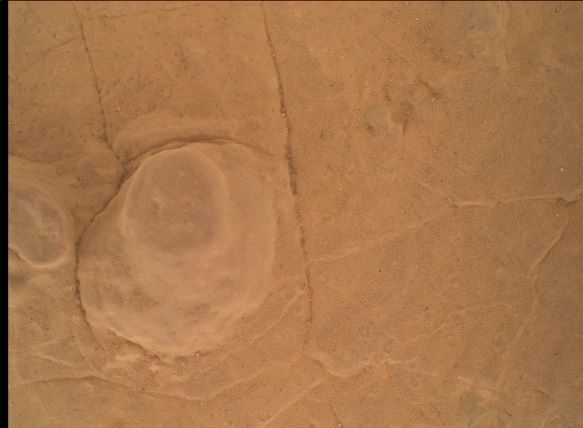
Curiosity Mars Hand Lens Imager photo produced on Sol 2974, December 17, 2020.
Credit: NASA/JPL-Caltech/MSSS
Rock surfaces, sand ripples
Four Mastcam mosaics will provide extended coverage of nearby rock surfaces and sand ripples, and two long distance ChemCam Remote Micro-Imager (RMI) observations allow a closer look at distant rock outcrops, Baker explains.
“Two Mastcam multispectral observations will also provide additional data on the rubbly surface around the rover,” Baker adds.
“Along with acquiring data on the local geology, the team also planned a large set of observations aimed at studying current environmental conditions.”
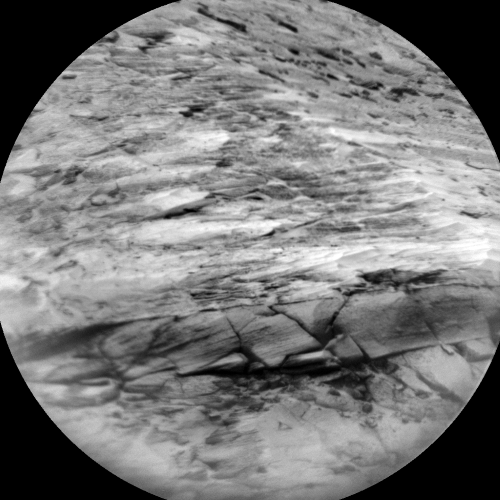
Curiosity Chemistry & Camera Remote Micro-Imager (RMI) photo taken on Sol 2974, December 17, 2020.
Credit: NASA/JPL-Caltech/LANL
Busy sols of science
The first science block planned called for Navcam zenith and suprahorizon movies, a Mastcam tau image to measure atmospheric dust levels, and a Navcam image of the rover deck to monitor wind.
The second science block was slated to include two Navcam line-of-sight observations, a Navcam dust devil survey, and a Mastcam image of the crater rim, all of which will help assess ongoing dust activity.
“After two busy sols of science, the rover will continue to drive even further into the rubbly terrain on her way to a large sand sheet just south of our current location,” Baker concludes.

Curiosity Left Navigation Camera image taken on Sol 2970. The ground under the robot’s wheels now has small pebbles and is generally smooth. But right ahead of the rover is a different unit with much larger blocks of rock that has a distinct “rubbly” texture in images from orbit.
Credit: NASA/JPL-Caltech
NASA’s Curiosity Mars rover is now performing Sol 2974 tasks.
The robot is currently sitting at the edge of two geologic units, and a newly formed plan was focused on helping find that boundary and begin to determine the differences between them, reports Scott Guzewich, an atmospheric scientist at NASA’s Goddard Space Flight Center in Greenbelt, Maryland.
According to the plan, after a quick touch-and-go on one of the pebbles nearby (“Torness”), the rover’s Mastcam will take a large stereo mosaic of the boundary between these two geologic units and its Chemistry and Camera (ChemCam) device will target three nearby rocks for Laser Induced Breakdown Spectroscopy (LIBS) analysis.

Curiosity Mars Hand Lens Imager photo produced on Sol 2972, December 15, 2020.
Credit: NASA/JPL-Caltech/MSSS

Curiosity Front Hazard Avoidance Camera Left B image taken on Sol 2973, December 16, 2020.
Credit: NASA/JPL-Caltech
Sand sheet
“Then we’ll perform a short drive — a “bump” in rover-speak — onto this rubbly unit where we’ll plan more contact science in Wednesday’s plan,” Guzewich adds.
Meanwhile, farther ahead is a large sand sheet that Curiosity will investigate after the New Year.
Environmental researchers are keeping an eye on dust devil activity over the sand sheet with two Navcam dust devil searches, Guzewich concludes.

Curiosity Front Hazard Avoidance Camera Right B photo acquired on Sol 2972, December 15, 2020.
Credit: NASA/JPL-Caltech
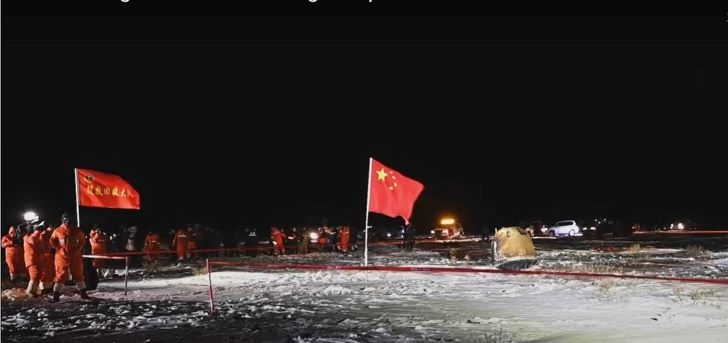
Credit: China Central Television (CCTV)/China National Space Administration (CNSA)/Inside Outer Space screengrab
The Chang’e-5 returner capsule carrying lunar samples is headed for a Beijing laboratory for opening, with an eagerly awaiting research team set to study the fresh Moon specimens.
Given the success of the lunar exploration mission, China space officials say a next step is to cooperate with scientists of other nations to analyze the Moon samples.
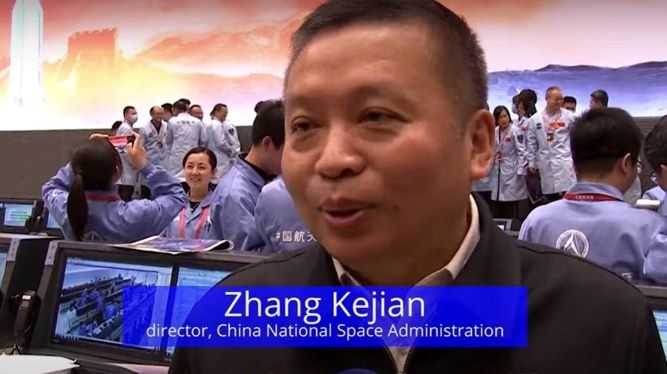
Credit: China Central Television (CCTV)/China National Space Administration (CNSA)/Inside Outer Space screengrab
China is set to establish a lunar sample analysis solicitation, with a team of domestic and foreign scientists organized to consider requests for the samples.
China will be sharing a portion of the lunar rock and soil samples brought back by its Chang’e-5 probe with other countries, said Wu Yanhua, deputy head of China National Space Administration, on Thursday.
Sharing samples
Speaking at a press conference in Beijing, Wu said that while the samples will be mainly used for scientific research, China is prepared to share some of the samples with the rest of the world.
“There are three types of use: The first type, or the main purpose, is for scientific research. The second is to enable the public to see the samples as early as possible. Thus a portion of the samples will be sent to the National Museum as exhibits for the public to enjoy. And the third will be to share samples with other countries and scientists around the world, in accordance with the relevant international cooperation conventions as well as multilateral and bilateral cooperation agreements. We will soon release guidelines on the management of the lunar samples and data. And part of the samples may be used as diplomatic gifts according to precedents set by the United States and Russia,” Wu said.
Zhang Kejian, head of the China National Space Administration (CNSA), declared the Chang’e-5 mission a success. It marks a successful conclusion of China’s current three-step lunar exploration program of orbiting and landing, and bringing back samples, which began in 2004.
Photo taking during surface sampling.
Credit: CCTV/Inside Outer Space screengrab
“Now that the Chang’e-5 probe’s returner has come back with samples of lunar soil, an important step next is that we will carry out extensive cooperation with scientists of other countries in carrying out in-depth studies of the lunar soil,” Zhang said in a China Central Television (CCTV) interview.
The Chang’e-5 mission laid a foundation for future manned lunar and deep space exploration. “China is drawing up plans for future lunar exploration, including constructing a basic version of a scientific research station,” said Pei Zhaoyu, deputy director of CNSA’s Lunar Exploration and Space Program Center.

Return capsule skips through Earth’s atmosphere en route to landing zone.
Credit: CCTV/CNSA/Inside Outer Space screengrab
“We hope to cooperate with other countries to build the international lunar scientific research station, which could provide a shared platform for lunar scientific exploration and technological experiments,” Pei said.
Search and recovery teams
According to the CNSA, under ground control, the return capsule separated from the Chang’e-5 orbiter/returner craft high above the Atlantic. The capsule entered the Earth’s atmosphere and after aerodynamic deceleration, skipped out of the atmosphere. Then the capsule re-entered the atmosphere to perform a second aerodynamic deceleration.
Credit: XinhuaVideo/Inside Outer Space screengrab
At about 6 miles (10 kilometers) above the ground, a parachute opened with the capsule landing in the predetermined area, with search and recovery teams finding the hardware in short order.
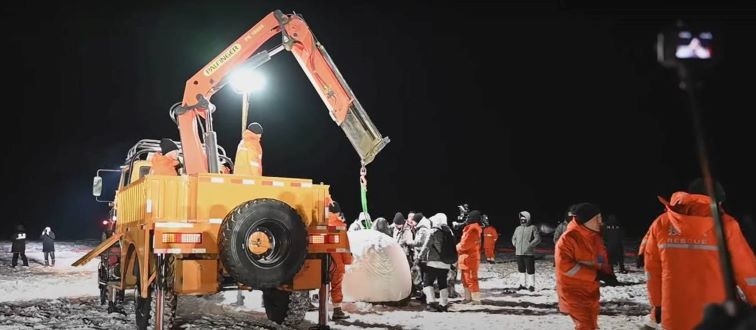
An air team in helicopters spotted the capsule using infrared cameras, while a ground team followed in SUVs to reach the snow-covered landing site. Ground teams cordoned off the area, confirmed coordinates, and set up a communication station to connect with Beijing Aerospace Flight Control Center.
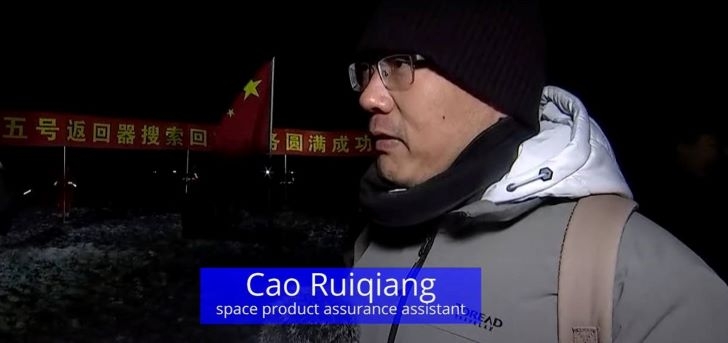
“We have just measured the shape of the crater that the returner landed on, which is part of the scientific data collection. Then the returner will be put on ‘new warm coat’ to prevent the remaining propellant inside from being frozen during the transportation to Zhurihe Airport, where the propellant will be expelled from returner,” said Cao Ruiqiang, a space product assurance assistant, in a CCTV interview.
Credit: China Central Television (CCTV)/China National Space Administration (CNSA)/Inside Outer Space screengrab
The Chang’e-5 capsule was loaded onto a truck, and then transported by helicopter and airplane to Beijing.
Lunar lab
Chang’e-5’s return capsule has reportedly brought back 4.4 pounds (two kilograms) of lunar samples. The mission made use of an orbiter, a lander, an ascender and a returner.
The multi-phased mission was launched on November 24. On December 1 its lander-ascender combination touched down north of Mons Rümker in Oceanus Procellarum, also known as the Ocean of Storms, on the near side of the Moon.
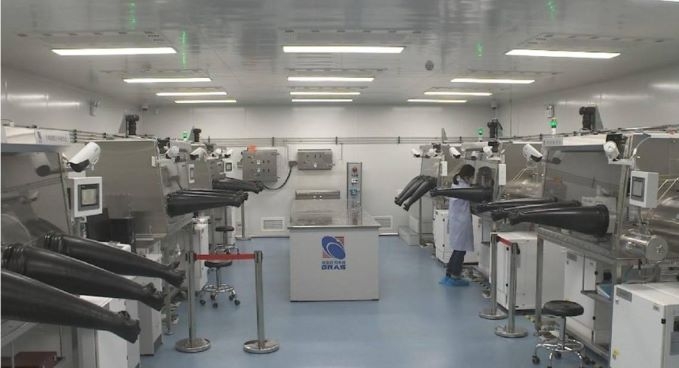
Lunar Sample Laboratory at the National Astronomical Observatory. (NAO)Credit: China Central
Television (CCTV)/Inside Outer Space screengrab
In Beijing, CNSA will transfer the lunar materials to the Lunar Sample Laboratory at the National Astronomical Observatory (NAO) under the Chinese Academy of Sciences, which has been built specially for storage, processing and analysis of the samples.
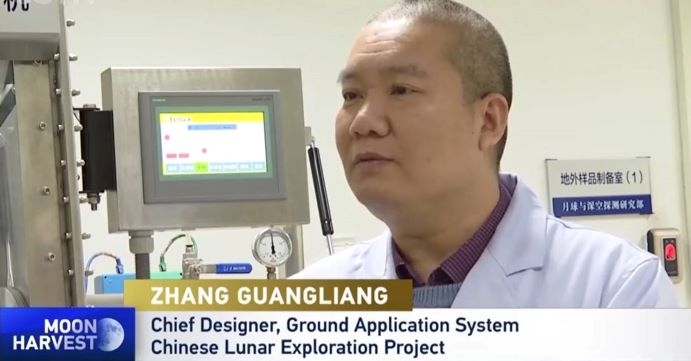
“The biggest challenge is unsealing in the atmosphere the sample package, which is sealed in a vacuum environment [on the moon]. To address that, we have verified several times and designed a special process. We will unpack the samples in a vacuum environment, and transfer them to a nitrogen environment for storage and processing,” said Zhang Guangliang, chief designer of the Ground Application System of Chinese Lunar Exploration Project’s third phase in a CCTV interview.
Credit: CGTN
Analysis methods
“The first thing we consider is to use some damage-free analysis methods as much as possible, such as observation of optical characteristics under a microscope, and spectral measurement in the laboratory,” said Zhou Qin, also identified as a chief designer of the Ground Application System of Chinese Lunar Exploration Project’s third phase in a CCTV interview.
Credit: CGTN
“Of course, these measurements will be conducted and analyzed under a special environment such as with high purity nitrogen, so as to minimize the impact of the Earth’s environment on lunar samples,” Zhou said. “In addition, we will also do some chemical composition analysis which will cause damage. We will make analysis comprehensively, and try to obtain more useful information with the smallest sample amount.”
To view newly-released videos focused on the Chang’e-5 return capsule go to:
Fresh samples from the Moon delivered by China’s Chang’e-5 return capsule.
Credit: XinhuaVideo/Inside Outer Space screengrab
China has scored a major milestone in space exploration, robotically hauling back samples of the Moon to Earth. It is a feat that has not been duplicated by humans or automated means since 1976.
The Chang’e-5 sample return capsule skyrocketed into the Siziwang Banner in north China’s Inner Mongolia Autonomous Region on December 16 with a search and retrieval team at the ready, fighting bitter cold, snow, and nighttime conditions in order to locate the capsule of lunar collectibles. The capsule landed at 17:59 UTC (December 17, 01:59 local time).

Return capsule parachutes into Siziwang Banner in north China’s Inner Mongolia Autonomous Region.
Credit: CCTV/China National Space Administration (CNSA)/Inside Outer Space screengrab
Upon the capsule’s touchdown, ground crews began securing the location, with other teams assessing the vehicle’s condition and then manipulate the lander and transport it to a protected location.
Chang’e-5’s step-by-step mission to the Moon and back also bolsters that country’s plan to place Chinese astronauts on Earth’s celestial neighbor – as well as bring back specimens from Mars.

Re-entry capsule performed slow-down dips within Earth’s atmosphere.
Credit: CCTV/Inside Outer Space screengrab
Fresh samples
Carrying the world’s freshest lunar samples in over 40 years, China’s Chang’e-5 lunar probe’s returner craft parachuted down on Earth early Thursday (Beijing time), marking a successful conclusion of the country’s three-step lunar exploration program of orbiting and landing, and bringing back samples.
“What a great achievement and a fantastic advance for lunar science,” said lunar researcher, Clive Neal at the University of Notre Dame in Indiana.
Photo taking during surface sampling.
Credit: CCTV/Inside Outer Space screengrab
Explained James Head, a Moon expert at Brown University’s Department of Earth, Environmental and Planetary Sciences in Providence, Rhode Island: “This is an amazing accomplishment by our Chinese colleagues!”
Head said that there are so many outstanding questions derived from the last almost 50 years of analysis of existing lunar samples. Chang’e-5 landed in a never-before visited critical area, he said.
“This is a huge step forward in lunar exploration and understanding of the Moon and planets, including Earth,” Head said “This is also a great ‘rehearsal’ Mars sample return by NASA/ESA and China,” he told Inside Outer Space. “Congratulations to our Chinese colleagues!”

Box indicates Chang’e 5 lander on the basaltic plains of Oceanus Procellarum (“Ocean of Storms”) on December 2, 2020. The lander is the bright spot in the center of the outline. The areas around the lander has been brightened due to the descent engine plume impingement on the surface (similar to what has been observed at other landing sites).
Credit: NASA/GSFC/Arizona State University
Milestone-making mission
The Chang’e-5 mission was comprised of a lander, an ascender, an orbiter and a returner, and was hurled toward the Moon on November 24. Its lander-ascender combination successfully planted itself on the near side of the Moon — north of Mons Rümker (a younger volcanic complex) in Oceanus Procellarum, also known as the Ocean of Storms, on December 1, and then collected roughly 4.4 pounds (2 kilograms) of samples from both the lunar surface and beneath.
The milestone-making mission achieved several firsts for China, including the country’s first lunar sampling, the first liftoff from an extraterrestrial body, the first automated rendezvous and docking in lunar orbit and the first spacecraft carrying samples to re-enter Earth’s atmosphere at high speed.
Go to these new videos from the landing site at:
Xinhua’s Yu Jia reports from the spacecraft’s landing site in Inner Mongolia at:

Nearly home – Chang’e-5 orbiter/returner.
Credit: CNSA/CLEP
China’s Chang’e-5 orbiter/returner completed its second trajectory correction on its Moon-to-Earth transfer voyage Wednesday morning, according to the China National Space Administration (CNSA).
At 9:15 am (Beijing time) two 25 newton thrust engines on the orbiter/returner combination fired for about eight seconds. The CNSA said all systems on the orbiter/returner combination that carries the lunar specimens are in good condition.
Return capsule skips through Earth’s atmosphere en route to landing zone.
Credit: CCTV/CNSA/Inside Outer Space screengrab
Still to come, however, is the critical release of the reentry capsule later today from the orbiter, an action that is staged roughly 3,107 miles (5,000 kilometers) from Earth. The capsule is expected to land at the Siziwang Banner in north China’s Inner Mongolia Autonomous Region with a search and retrieval team at the ready.
Along with its cache of lunar collectibles, the return capsule is toting a variety of plant seeds. According to the Space Breeding Innovation Alliance, its space breeding program was part of the payload consisting of seeds, including rice, orchids, alfalfa and oats. The seeds embarked on the round trip to the Moon on November 24 when the Chang’e-5 mission was launched.
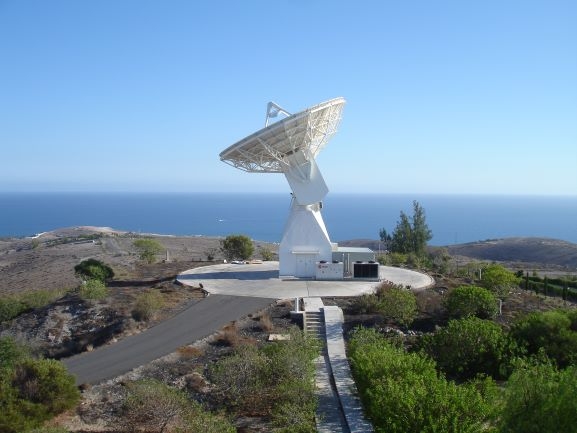
Signal from the orbiter/returner acquired via the 15-meter Maspalomas antenna, operated by the Instituto Nacional de Técnica Aeroespacial (INTA) in Spain.
Credit: ESA/ESOC/INTA
Meanwhile, the European Space Agency (ESA) announced that they have acquired the signal from the orbiter/returner via its Maspalomas ground station in Spain, operated by the Instituto Nacional de Técnica Aeroespacial (INTA). There is a live link from the Maspalomas station that goes via ESA’s European Space Operations Center to a control center in China.

Map notes projected Chang’e-5 reentry capsule trajectory, produced by satellite tracker, Scott Tilley.
Credit: Scott Tilley
Blackout zone
The measurement and control team responsible for locating and recovering the return capsule have set up and tested their tracking devices at the designated landing area. They have had to deal with temperatures as low as minus 30 degrees Celsius, a challenge to the team and their measurement and control devices.

Recovery team at the ready to retrieve return capsule.
Credit: CCTV/Inside Outer Space screengrab
Technician Wang Yuxiang said the Chang’e-5 capsule will enter a blackout zone during its returning, which will pose a loss of signal.
“When the returner is in the blackout zone, our team cannot track its downward signal or judge its position,” Wang said in a China Central Television (CCTV) interview. “In this period, we can only carry out the search using the pre-set points and theoretical trajectories. After the returner gets out of the blackout zone, we can then judge its position based on the amplitude of its signal, and better implement the searching work,” Wang added.

Credit: CCTV/Inside Outer Space screengrab
Retrieval simulations
China’s ground search and retrieval teams have carried out a comprehensive training program, one that simulated various conditions in the search for the return capsule by aerial and ground vehicles.
The team from the Xi’an Satellite Control Center in northwest China has completed setting up and testing their equipment at the designated landing zone. They are responsible for providing fast, accurate measurement and control data to make the search for and retrieval of the landed capsule as efficient as possible.
Take a view of a newly issued video regarding the recovery team awaiting the return capsule at:

