Author Archive
 Author:
  September 23rd, 2021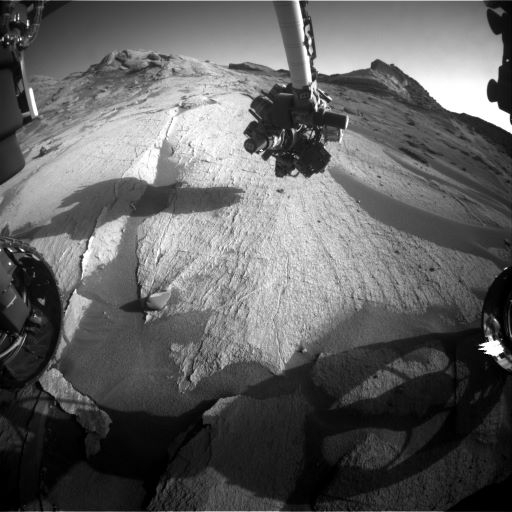
Curiosity Front Hazard Avoidance Camera Left B image taken on Sol 3245, September 22, 2021.
Credit: NASA/JPL-Caltech
NASA’s Curiosity Mars rover at Gale Crater is now performing Sol 3246 duties.
Reports Mark Salvatore, a planetary geologist at the University of Michigan, a recently scripted two-sol (3246-3247) plan will wrap up the robot’s drilling activities at the Maria Gordon drill location before it continues the drive up-section and towards the southwest.
“On the first sol of the plan, Curiosity will primarily be performing arm activities to further characterize the recently dumped drill sample and the drill hole,” Salvatore adds.
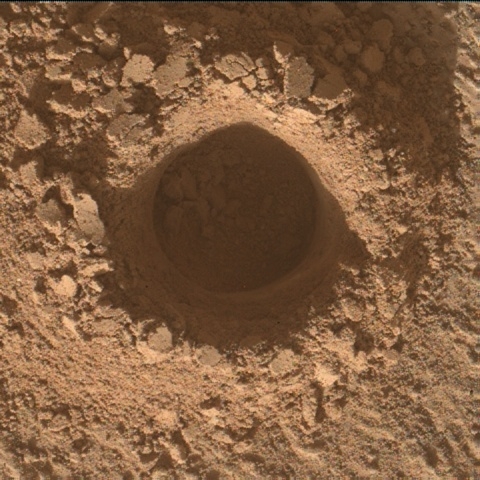
Curiosity Mars Hand Lens Imager photo produced on Sol 3245, September 22, 2021.
Credit: NASA/JPL-Caltech/MSSS
Daytime and evening imaging will occur using the Mars Hand Lens Imager (MAHLI) camera on the end of the arm.
Overnight, the Alpha Particle X-Ray Spectrometer (APXS) instrument will be used to characterize the chemistry of the drill tailings.
Drill dump pile
On the following sol, the team has planned a series of Mastcam mosaics and a long-distance Chemistry and Camera (ChemCam) image mosaic, in addition to a Mastcam multispectral image on the drill dump pile.
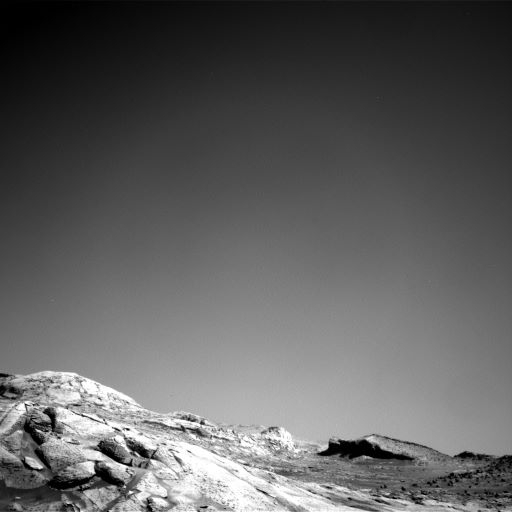
Curiosity Right B Navigation Camera image taken on Sol 3245, September 22, 2021.
Credit: NASA/JPL-Caltech
“Following this suite of science activities, Curiosity will drive away from this drill location and towards a region that contains a high abundance of nodules in the bedrock,” Salvatore notes. “Curiosity will use a driving technique designed to better prepare the nodular surface for additional investigations.”
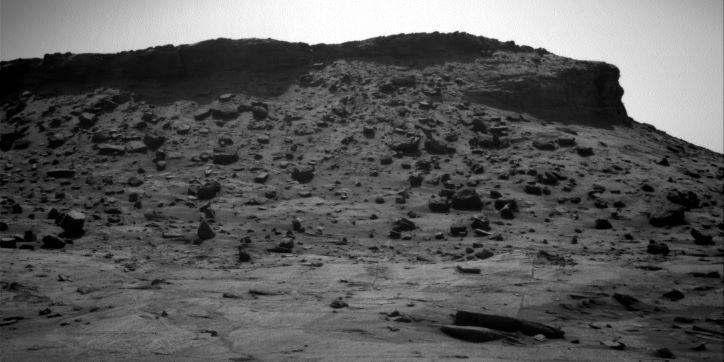
Curiosity Right B Navigation Camera image taken on Sol 3245, September 22, 2021.
Credit: NASA/JPL-Caltech
Nodular targets
Salvatore explains that, once Curiosity reaches her intended target at the end of the drive, she will perform a series of small maneuvers designed to crush any nodular targets on the surface before turning back around and putting herself in position to analyze the surface.
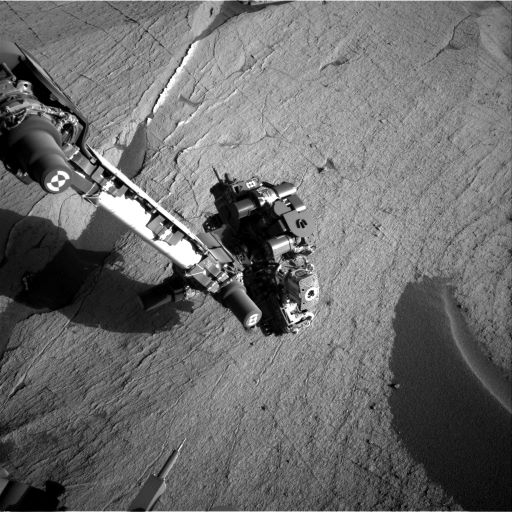
Curiosity Right B Navigation Camera image taken on Sol 3245, September 22, 2021.
Credit: NASA/JPL-Caltech
“If successful, we hope that this technique will result in better preparing the surface for additional imaging and compositional analyses, beyond what is commonly performed by Curiosity during normal imaging and surface analysis campaigns,” Salvatore concludes.
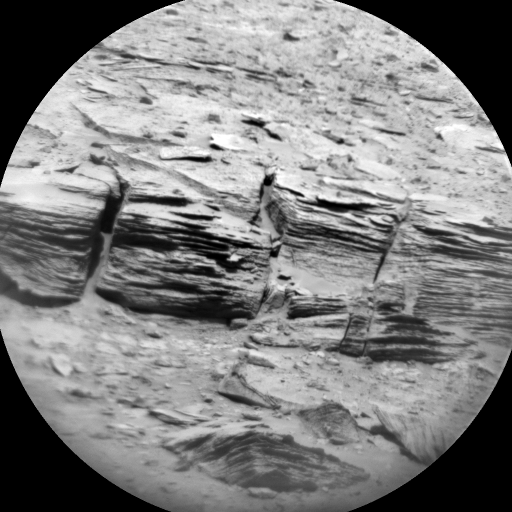
Curiosity Chemistry & Camera Remote Micro Imager (RMI) taken on Sol 3245, September 22, 2021.
Credit: NASA/JPL-Caltech/LANL
 Posted in

International Space Station – showing its age.
Credit: NASA
NASA’s Future in Low Earth Orbit: Considerations for ISS Extension & Transition, a House Space & Aeronautics Subcommittee Hearing, was held Tuesday, September 21, 2021.
“Now, after more than 20 years of continuous operations, the ISS is beginning to show its age,” said Subcommittee Ranking Member Brian Babin in an opening statement.
Cracks and leaks
“Cracks and leaks are popping up, solar arrays were recently upgraded, and the spacesuits necessary for spacewalks need to be replaced. The first segments of the ISS have a design life of roughly 15 years with a safety factor of two, meaning that with appropriate life extension measures the segments can reasonably be expected to last to 2028,” Babin said. “While no law prevents NASA from operating the ISS as long as it deems necessary, it is past time to have a conversation about the future of the ISS and our presence in low Earth orbit.”

Credit: NASA/ESA/Thomas Pesquet
Written testimony
- Robyn Gatens, Director, International Space Station, NASA: https://republicans-science.house.gov/sites/republicans.science.house.gov/files/2021-09-21%20Testimony%20Gatens.pdf
- Kathleen “Kate” Rubins, NASA Astronaut: https://republicans-science.house.gov/sites/republicans.science.house.gov/files/2021-09-21%20Testimony%20Rubins.pdf
- Jeffrey Manber, Chief Executive Officer, Nanoracks, LLC: https://republicans-science.house.gov/sites/republicans.science.house.gov/files/2021-09-21%20Testimony%20Manber.pdf
- Todd Harrison, Senior Fellow and Director of the Aerospace Security Project, Center for Strategic and International Studies: https://republicans-science.house.gov/sites/republicans.science.house.gov/files/2021-09-21%20Testimony%20Harrison.pdf
- Captain William Shepherd (USN, Ret), former Astronaut, NASA: https://republicans-science.house.gov/sites/republicans.science.house.gov/files/2021-09-21%20Testimony%20Shepherd.pdf
To view the entire hearing, go to this video at:

Credit: NASA/JPL/UArizona
A super-powerful camera on NASA’s Mars Reconnaissance Orbiter has captured new imagery of slope streaks on the Red Planet. The sharp-shooting High Resolution Imaging Science Experiment (HiRISE) snagged a set of new dark streaks.
Slope streaks are common in the tropics of Mars. Once thought to be caused by flowing water, most scientists now believe that they are avalanches of dust, explains HiRISE team member Paul Geissler of the U.S. Geological Survey.
“They are typically darker than their surroundings and often fan outwards downslope. This suggests that the dust sediment is sticky, so that the avalanche broadens as it flows downhill,” Geissler explains on the HiRISE website at the University of Arizona.
Time scales
“Slope streaks are known to fade over time, but the slope streaks at this monitoring site in Arabia Terra go beyond that. Here, old slope streaks appear to be brighter than the surrounding terrain,” Geissler adds.
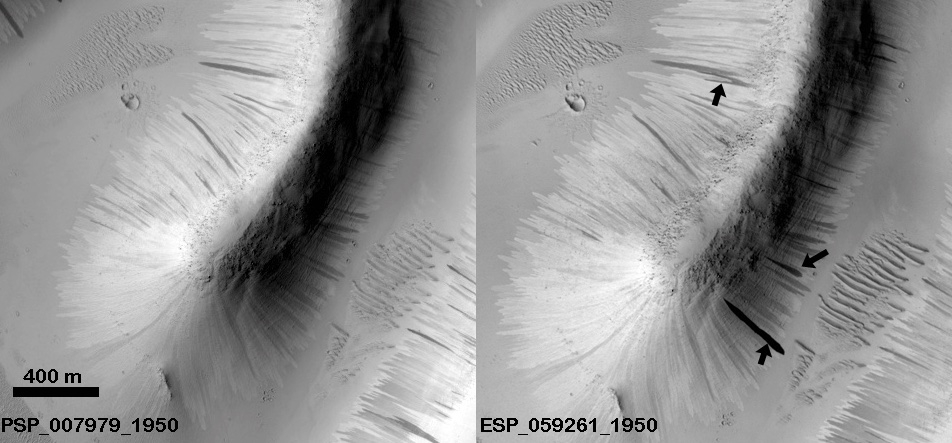
Comparative HiRISE images taken in 2008 and in 2019 show very few changes in the dark and bright streaks.
Credit: NASA/JPL/UArizona
Comparing HiRISE images taken in 2008 and in 2019 show very few changes in the dark and bright streaks.
“We can see three new dark streaks in our more recent image,” Geissler says. “These were the only changes spotted among the hundreds of streaks observed in the monitoring site, suggesting that new streak formation and fading take place on time scales of at least decades.”

Credit: Aaron Ahles, et al.
As humankind stretches out beyond Earth, a critical requirement for outposts and settlements on the Moon and Mars is the use of on-the-spot resources to create pressurized, human-rated habitats. Those distant domiciles need to be low mass (high tensile strength), must be highly reliable (high toughness) and can be easily fabricated.
The cost of hauling materials from Earth is viewed as prohibitive.
A new study suggests that Mother Nature has supplied the raw ingredients for construction purposes – in the form of an iron-nickel alloy typical of iron meteorites and M-type asteroids.
Iron-nickel (Fe–Ni) meteorites harvested on the Moon and Mars — after collection, melting and casting – can be used to create metallic sheets which can be welded into pressurized structures, at low energy and infrastructure costs.
The research into this extraterrestrial home-away-from-home idea is led by Aaron Ahles, Jonathan Emery and David Dunand of Northwestern University in Evanston, Illinois.

NASA’s Mars Exploration Rover Opportunity found an iron meteorite on Mars, the first meteorite of any type ever identified on another planet. The pitted, basketball-size object is mostly made of iron and nickel. Readings from spectrometers on the rover determined that composition
Credit: NASA/JPL/Cornell
Melting, purifying, and casting
“Extraterrestrial settlements and colonies, on planetary surfaces or in orbit, require pressurized habitats and rockets made from materials with high tensile strength (to minimize mass) and toughness (to resist fracture). Beyond early small outposts, in-situ resource utilization (ISRU) is favored, as the cost of materials transportation from Earth becomes rapidly prohibitive,” the researchers explain in their paper – “Mechanical properties of meteoritic Fe–Ni alloys for in-situ extraterrestrial structures” – appearing in a recent issue of the journal, Acta Astronautica.
They conclude that Fe–Ni meteorites can credibly be used after melting, purifying, and casting to create metal sheets that can be welded into pressurized habitats on the surfaces of the Moon and Mars or in orbit.
So far, NASA rovers have identified 15 metallic meteorites on Mars, the team notes, ranging from a few centimeters to over a meter in size, and from tens of grams to hundreds of kilograms in mass. The 12 metric ton mass of a metallic shell requires 20–30 iron-nickel meteorites, of the size/mass observed by NASA rovers on the surface of Mars, Ahles and his colleagues say.

Psyche spacecraft sidles up to M-type asteroid 16-Psyche Credit: NASA/ASU
Psyche mission
An additional impetus for the study of binary Fe–Ni alloys is the Psyche mission, soon to be launched by NASA.
That spacecraft will analyze the composition of the M-type asteroid 16-Psyche suspected to be the exposed Fe–Ni core of an early planetary body or a metal-stony asteroid whose surface is covered with metal by “ferrovolcanism” from its metallic core.
Certain weight classes loaded with nickel that are found in M-type asteroids and iron-nickel meteorites “show mechanical properties well suited for tensile load-bearing applications on Mars, on the Moon or in orbit, in particular for pressurized shells for habitats or rockets,” the researchers report.
To access the paper — “Mechanical properties of meteoritic Fe–Ni alloys for in-situ extraterrestrial structures” — go to:
https://www.sciencedirect.com/science/article/pii/S0094576521004781

NASA VIPER rover.
Credit: NASA
NASA’s Volatiles Investigating Polar Exploration Rover (VIPER) is headed for the near western edge of Nobile crater. That site was selected in a review of 15 locales, then down to four spots, with the Nobile site a final pick.
VIPER is a resource-mapping mission and while on the Moon, VIPER will get a close-up view of the location and concentration of ice and other resources.

Nobile crater is labeled and a box is drawn around the area VIPER will explore. Credit: NASA’s Scientific Visualization Studio/Ernie Wright
The intent is that the automated rover will assist in pushing forward lunar science and human exploration as part of Artemis missions.

The Earth rises above the terrain of the Nobile region. From this vantage point, the Earth appears upside-down.
Credit: NASA’s Scientific Visualization Studio/Ernie Wright
Scientists and mission operators will leverage near real-time Earth-to-Moon communications and work together to drive the rover along an unexplored region of the Moon’s South Pole.

A close-up view of the area that will be explored by VIPER, showing a nominal traverse route and highlighting permanently shadowed regions that may contain water ice and other volatiles.
Credit: NASA’s Scientific Visualization Studio/Ernie Wright
The rover will be delivered to the Moon’s surface in late 2023 under the Artemis program and part of the agency’s Commercial Lunar Payload Services initiative.
Astrobotic of Pittsburgh is the commercial carrier that will deliver VIPER to the Moon.
During its 100-Earth-day mission, the approximately 1,000-pound rover will roam several miles and use its four science instruments to sample various soil environments.

Credit: CCTV/Inside Outer Space screengrab
Another step toward China’s space station program has been successfully accomplished. The country’s Tianzhou-3 cargo spacecraft was launched on Monday, delivering supplies to the construction site of the Tiangong orbital outpost.
The craft docked with the country’s space station’s core module Tianhe at 10:08 pm on Monday, 6.5 hours after its launch, according to the China Manned Space Engineering Office. The cargo ship docked onto Tianhe’s backward facing port using the automatic fast docking process.

Credit: CCTV/Inside Outer Space screengrab
Multiple launches
A Long March-7 Y4 rocket hurled the Tianzhou-3 spaceward, blasting off from the Wenchang Spacecraft Launch Site in the southern island province of Hainan.
Prior to the launch, on September 18, the Tianzhou-2 cargo craft separated from the rear docking port of Tianhe core module and docked with its front docking port – making way for the newer supply craft.

Credit: CCTV/Inside Outer Space screengrab
China launched its space station core module Tianhe on April 29. The country plans to complete the verification of key technologies and the in-orbit construction of the space station through multiple launches within two years. The Earth-circling facility is slated to be completed by the end of 2022.
Five tons of cargo
The Tianzhou-3 cargo spacecraft has been fine-tuned for its mission to deliver supplies and prepare for the following Shenzhou-13 crewed mission next month.
“Compared with its predecessor Tianzhou-2, Tianzhou-3 is also fully loaded with nearly five tons of cargo including more than 200 packages,” said Yang Sheng, general chief designer of the cargo spacecraft system of the China Academy of Space Technology under the China Aerospace Science and Technology Corporation.
“According to the plan, the Shenzhou-13 crew will stay in orbit for six months, and we have to make an adjustment accordingly to the supplies delivered by Tianzhou-3 to ensure their healthy stay in orbit during this period,” Yang told China Central Television (CCTV).

Credit: CCTV/Inside Outer Space screengrab
Construction project
Cheng Tangming, chief designer of the Long March-7 carrier rocket told CCTV that the space station construction is in full swing.
“This was the fifth launch for the construction project, which will be followed by seven other launches to be completed next year. We will turn into the next launch mission right away,” Cheng said.
On Sept 18, the Tianzhou-2 cargo craft separated from the rear docking port of Tianhe and docked with its front docking port.
At this stage of station construction, the rendezvous and docking of Tianzhou-3 and the Tianhe core module required the rocket to be launched within a short and pre-calculated time frame.

Docking of Tianzhou-3 cargo spacecraft with core module.
Credit: CNSA/China Media Group/CCTV/Inside Outer Space screengrab
“The deviation of the rocket entering orbit must not exceed four seconds. This is a very high accuracy requirement,” said Zhang Borong, designer-in-charge of the orbit of Long March-7 rockets. “Only if the launch is accurate on time, can the cargo spacecraft effectively dock with the space station. There are very high requirements for the launch time, the orbit entry time, and the accuracy and position of the orbit entering process.”

Credit: CCTV/Inside Outer Space screengrab
Propellant carried by Tianzhou-3 will be used for the combination of the space station core module Tianhe and cargo crafts, and its engines will be used by the core module for attitude and orbit control, and regular in-orbit maintenance, so as to ensure safe operation of the combination, said Yang.
In addition, engineers have also developed an intelligent cargo management system to facilitate astronauts in finding their items. A QR code is printed on the surface of each of the 40-plus lockers installed in the 40-cubic-meter cargo. By scanning the code, astronauts will easily identify what’s inside.
Fast automated rendezvous
Shortly after takeoff, Xu Xiaoping, deputy chief designer of the cargo spacecraft system at the Fifth Academy of China Aerospace Science and Technology Corporation (CASC), said the newly launched cargo vehicle will go through multiple steps before docking with the already orbiting core module and Tianzhou-2 supply vehicle.

Credit: CCTV/Inside Outer Space screengrab
“We will continue this fast automated rendezvous and docking of ours. We started to give the instruction for rendezvous and docking about 15 minutes after the spacecraft entered the orbit just now. After about 45 minutes, we may start the first orbital transfer. Through a total of six orbital transfers, we will finish the remote-controlled, automated instruction in three hours and 45 minutes. After another three hours, we may start our capture of the docking mechanisms. About 15 minutes after the capture step, the docking will be completed in success. Then we will do some settings for its postures. Then the Tianzhou-3 spacecraft can form a combination with the core module and Tianzhou-2 to operate in orbit,” Xu said in a CCTV interview.

Credit: CCTV/Inside Outer Space screengrab
The Wenchang Spacecraft Launch Site has carried out 13 launch missions since 2016. And the launching of the Tianzhou-3 cargo spacecraft will be the 14th.
“China’s space missions have evolved from single tasks to big projects, such as the space station construction involving the participation of two launch sites, Jiuquan and Wenchang, three types of rockets, space station, cargo spacecraft, Shenzhou spacecraft and other spacecraft, which is a very complicated systematic project. For us, it is an unprecedented project,” Mao Wanbiao, deputy director of Xichang Satellite Launch Center, told CCTV.

China’s space station is projected to be completed in late 2022.
Credit: CAST
A number of videos have been issued focused on the Tianzhou-3/Long March-7 Y4 launch.
Go to:

Rollout of Long March-7 Y4 and the Tianzhou-3 cargo spacecraft.
Credit: CCTV/Inside Outer Space screengrab
China’s Tianzhou-2 cargo spacecraft on Saturday was repositioned at the country’s space station construction site.
The cargo craft docked with the front port of China’s core module Tianhe, in order to make room for upcoming Tianzhou-3 cargo spacecraft.
According to China Central Television (CCTV) the Tianzhou-2 cargo craft separated from the rear docking port of Tianhe at 10:25 (Beijing time) Saturday, then completed a computer-orchestrated rendezvous and docking with the front port of Tianhe.
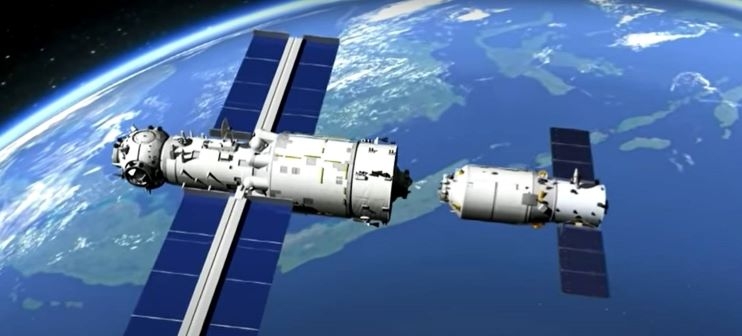
Credit: CCTV/CNSA/Inside Outer Space screengrab
Make room
Yang Sheng, general chief designer of cargo spacecraft system of the China Academy of Space Technology under the China Aerospace Science and Technology Corporation, noted there are two main reasons for the change of position at this time: to make room for Tianzhou-3 cargo spacecraft and create conditions for the radial docking of the soon-to-launched Shenzhou-13 piloted spacecraft, targeted for launch in October.
Yang said that the core module has docking ports at both front and rear, and during orbit, Tianzhou-2 only needs to turn itself 180 degrees to complete a “U-turn” in space.
China’s space station is projected to be completed in late 2022.
Credit: CAST
Autopilot repositioning
After separation, Tianzhou-2 moved backwards, during which it always keeps in communication with the core module. Then it circled under the core module.
During the rendezvous, the Tianzhou-2 cargo spaceship made a U-turn, and the core module maintained a steady position. After moving to the front of the core module, it docked with the front port of the core module.

Repositioned
Tianzhou-2 cargo spacecraft.
Credit: CCTV/Inside Outer Space screengrab
“The entire process is all automatic from separation to docking,” Yang told CCTV. Reportedly, the entire start to end process lasted approximately four hours.
The combination of the Tianzhou-3 cargo spacecraft and a Long March-7 Y4 carrier rocket has been transferred to the launching area of the Wenchang Spacecraft Launch Site, stated the China Manned Space Agency (CMSA).
The CMSA said the Tianzhou-3 cargo spacecraft will be launched in the near future “at an appropriate time” – with Monday the likely liftoff day.
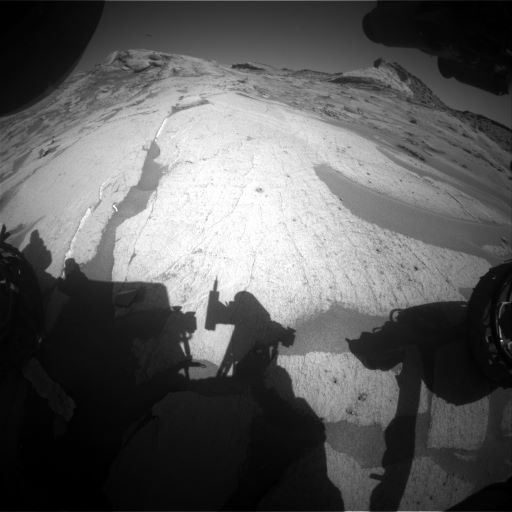
Curiosity Front Hazard Avoidance Camera Right B image taken on Sol 3240, September 17, 2021.
Credit: NASA/JPL-Caltech
NASA’s Curiosity Mars rover at Gale Crater is now performing Sol 3241 tasks.
Reports Catherine O’Connell-Cooper, a planetary geologist at University of New Brunswick; Fredericton, New Brunswick, Canada, a sample of Mars was delivered to the robot’s SAM (Sample Analysis at Mars) for an EGA (evolved gas analysis) activity. That step involved heating the sample to very high temperatures and measuring the gases that bake out of the sample with each temperature increment.
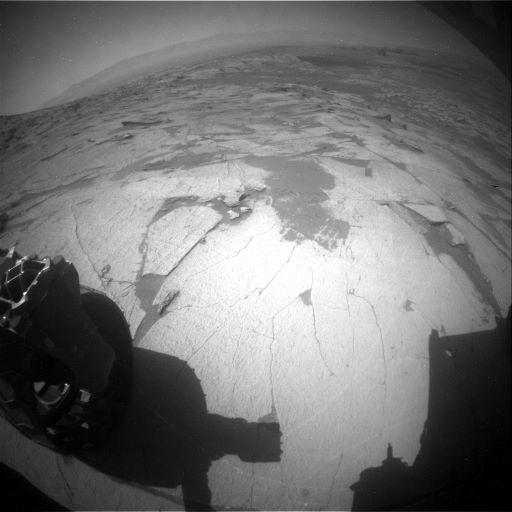
Curiosity Rear Hazard Avoidance Camera Right B photo acquired on Sol 3240, September 17, 2021.
Credit: NASA/JPL-Caltech
Researchers were waiting to see what SAM thought – had it got enough information from the sample, or was there interest in going further?
“And SAM said Yes please!…and requested a follow up activity, using the gas chromatograph and mass spectrometer (GCMS), which can identify different compounds,” O’Connell-Cooper adds.
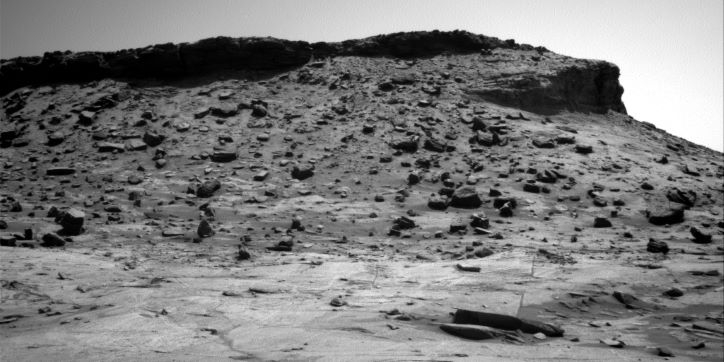
Curiosity Right B Navigation Camera photo taken on Sol 3239, September 16, 2021.
Credit: NASA/JPL-Caltech
Weekend plans
On the first sol of the weekend, SAM will uplink a sequence to clean the SAM Gas Columns (GC) before analyzing the sample on the second sol of the weekend plan (Sols 3241-3243).
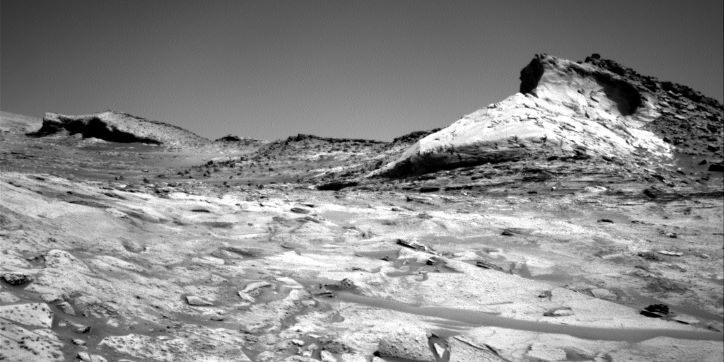
Curiosity Right B Navigation Camera photo taken on Sol 3239, September 16, 2021.
Credit: NASA/JPL-Caltech
“These are very power intensive procedures,” O’Connell-Cooper notes, so the rover was limited in its activities. “Luckily, this workspace continues to interest us.”
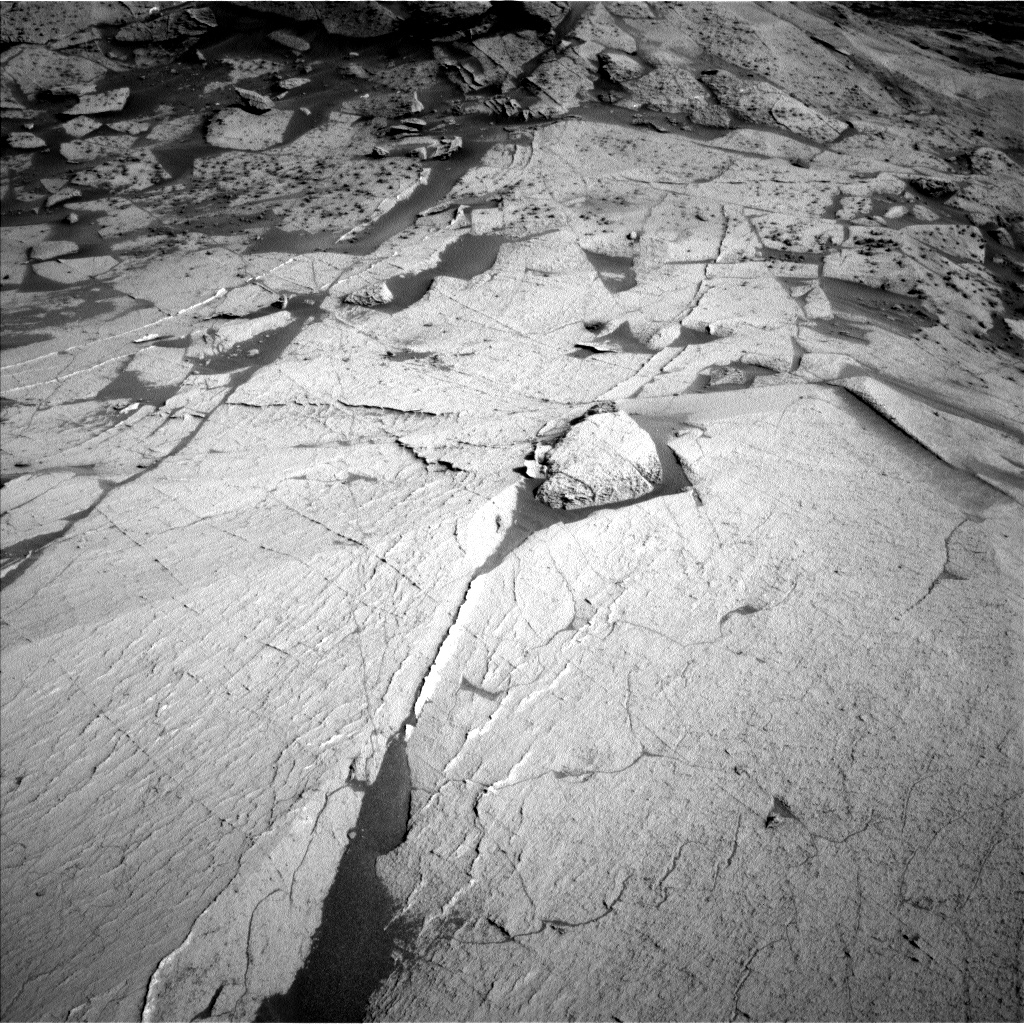
A raised vein area, with one sample “Falls of Shin” right on the vein itself and a second sample “Falls of Foyers” a little beyond the vein area. This image was taken by Left Navigation Camera, with the Chemistry and Camera (ChemCam) target “Falls of Shin” in the center of the image. Photo taken on Sol 3222, September 29, 2021.
Credit: NASA/JPL-Caltech
Curiosity’s Chemistry and Camera (ChemCam) is conducting a paired experiment across a raised vein area, with one sample “Falls of Shin” right on the vein itself and a second sample “Falls of Foyers” a little beyond the vein area.
“This will allow the ChemCam team to study the alteration effects associated with the vein,” O’Connell-Cooper explains.
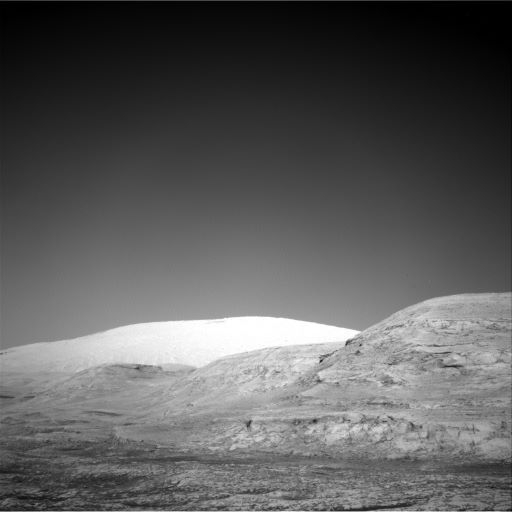
Curiosity Right B Navigation Camera image acquired on Sol 3240, September 17, 2021.
Credit: NASA/JPL-Caltech
Moving toward conjunction
No Alpha Particle X-Ray Spectrometer (APXS) or Mars Hand Lens Imager (MAHLI) activity is allowed until the drilled sample is emptied from the drill.
“However, next week will be busy, cramming all our final contact science investigations on the Maria Gordon drilled samples before we move into conjunction the following week,” O’Connell-Cooper adds.” Curiosity gets to take a bit of a vacation for a couple of weeks, as it moves behind the sun, and all communications will cease for two weeks.”
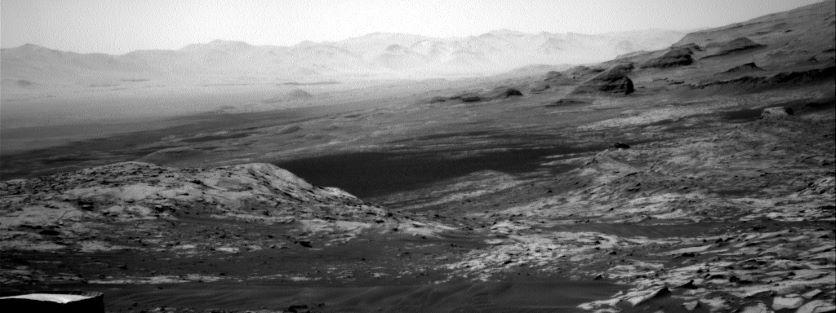
Curiosity Right B Navigation Camera image acquired on Sol 3240, September 17, 2021.
Credit: NASA/JPL-Caltech

Credit: CNSA/CCTV/Inside Outer Space Screengrab
China’s trio of Taikonauts have returned to Earth. The Shenzhou-12 crew — Nie Haisheng, Liu Boming and Tang Hongbo — touched down on September 17 at the Dongfeng landing site in north China’s Inner Mongolia Autonomous Region.

Credit: CNSA/CCTV/Inside Outer Space screengrab
The crew spent three-months in Earth orbit, the first sent to begin assembling China’s space station.

Credit: CCTV/Inside Outer Space screengrab
On June 17, the Shenzhou-12 spaceship was launched from the Jiuquan Satellite Launch Center in northwest China and docked with the space station core module Tianhe. After docking, the three astronauts entered the core module and began their three-month stay in space.
During the space trek, the crew carried out two extravehicular activities, ran a set of space science and technology experiments, some dedicated to the continuous construction and operation of the space station. Also evaluated, were recycling and life support system gear, as well as station operations and in-orbit maintenance.
To watch just-released video of the return of the crew, go to:

Credit: SAS Foundation
A “Safeguarding the Astronomical Sky Foundation” has been established to preserve the astronomical sky by calling for a halt to further launches and deployment of megaconstellations.
According to those engaged in the effort, humankind stands at a precipice from which there will be no return.
“A Great 21st Century Space Rush is now underway by commercial enterprises and the military, fomented and enabled in the U.S. by the FCC [Federal Communications Commission] and other U.S. government agencies to grab, deploy, transform, and own the Heavens for private gain, defense, and weaponization.”
At issue for the Italy-based SAS Foundation: Over the next 10 years 80,000+ non-stationary low orbit satellites will be launched and seamlessly integrated in terrestrial 4G/5G/6G+ industrial and military networks. Scores of new satellites are being launched every week from the U.S. and other countries.
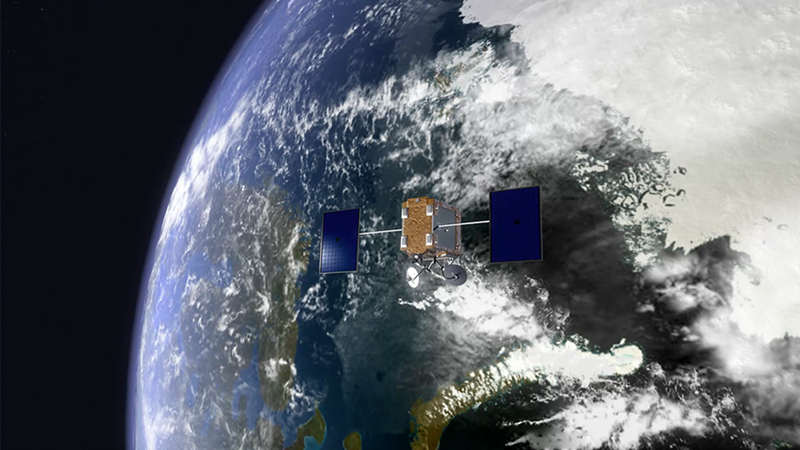
Credit: One spacecraft of the OneWeb satellite constellation.
Credit: OneWeb Satellites
Suing the FCC
It’s the SAS Foundation view that ground-based astronomical observations will be severely damaged by the ongoing deployment of large fleets of satellites to ensure the functioning of future telecommunications technologies.
A legal action called “Healthy Heavens Trust Initiative” was begun a few months ago, which is currently suing the American FCC in American federal courts of justice – filed on August 13.
The SAS Foundation was established as a non-profit-making non-governmental organization (NGO)-type Association/Foundation, “to give a clear reference to all environmental protection associations, professional and amateur astronomical associations, individual astronomers and all astronomical bodies and societies.”

Starlink satellites visible in a mosaic of an astronomical image.
Courtesy of NSF’s
National Optical-Infrared Astronomy Research Laboratory/NSF/AURA/CTIO/DELVE)
Not a distant threat
The SAS Foundation, together with the “Appeal by Astronomers” supports the Società Astronomica Italiana petition initiative against the night-sky light pollution.
“Astronomers are extremely concerned by the possibility that Earth may be blanketed by tens of thousands of satellites, which will greatly outnumber the approximately 9,000 stars that are visible to the unaided human eye. This is not some distant threat. It’s already happening,” according to the Appeal by Astronomers.
After gathering more than 2,000 signatures of astronomers from more than 50 countries the Appeal is now ready to be used at the local level to increase awareness by governments and NGOs of some of the harms that will be caused by those satellites.
For more information, go to:
https://astronomersappeal.wordpress.com/safeguarding-the-astronomical-sky-foundation-sas-foundation/
Healthy Heavens Trust Initiative (HHTI) at:
https://healthyheavenstrust.org/
The Appeal by Astronomers at:
https://astronomersappeal.wordpress.com/safeguarding-the-astronomical-sky-foundation-sas-foundation/

