Author Archive
 Author:
  January 1st, 2022
Pioneering Inspiration4 mission crew member Hayley Arceneaux, a physician assistant at St. Jude Children’s Research Hospital and pediatric cancer survivor, circuited Earth for nearly three days in September 2021. (Image credit: Inspiration4/St. Jude Children’s Research Hospital)
A new study sponsored by NASA investigates the feasibility of sending people with disabilities safely into space and returning them back to Earth.
The appraisal — Parastronaut Feasibility Foundational Research Study — has made a number of recommendations, including revising medical standards for astronaut selection. Also, the study recommends utilizing parabolic flights to demonstrate parastronaut proof-of-principle.
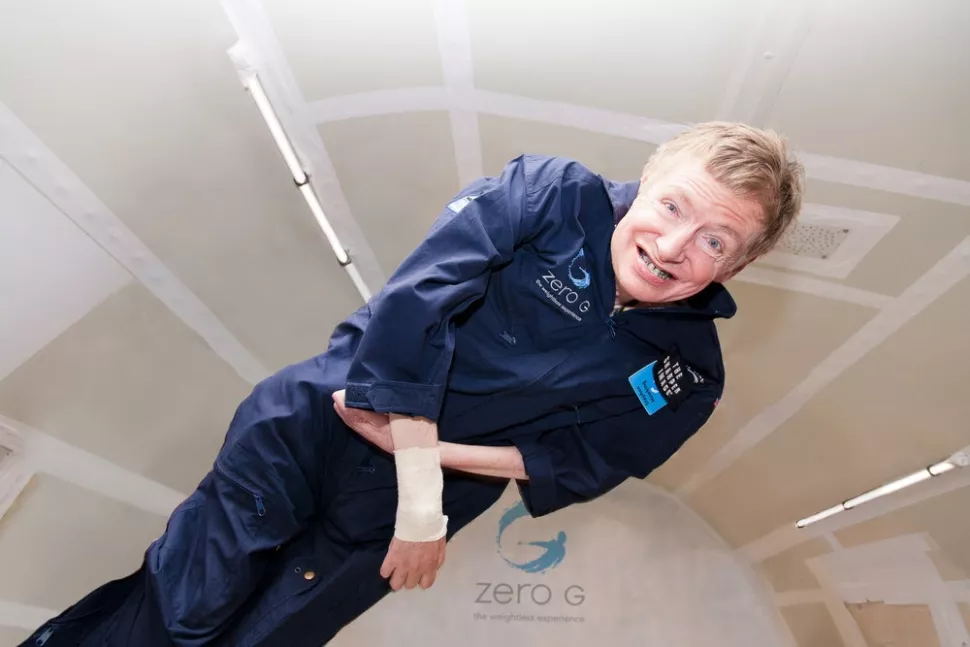
In 2007, wheelchair-bound theoretical physicist Stephen Hawking floated freely during a zero-gravity airplane flight. Hawking said of the experience: “For me, this was true freedom. People who know me well say that my smile was the biggest they’d ever seen. I was Superman for those few minutes.” (Image credit: Steve Boxall/ZERO-G Corporation via AstroAccess)
“Parastronauts” is defined in the new study as individuals with certain physical disabilities, such as lower leg deficiencies, short stature, leg length differences, among other physical impairments. The report’s intent is to make progress toward increased inclusion for human spaceflight.
For more information, go to my newly posted Space.com story — Equal access to space: New study investigates how to get more ‘parastronauts’ aloft – The report may lay the groundwork for more inclusive human spaceflight in the future – at:
https://www.space.com/inclusive-human-spaceflight-parastronaut-study
 Posted in

Credit: China National Space Administration (CNSA)/China Media Group(CMG)/China Central Television (CCTV)
Caught on Camera!

Credit: China National Space Administration (CNSA)/China Media Group(CMG)/China Central Television (CCTV)
The China National Space Administration (CNSA) published on Saturday a set of images taken by a free-floating camera dispatched from the country’s Tianwen-1 Mars circling spacecraft, including the first full photo of the mission orbiter.
According to the CNSA, in-orbit photos were taken by a detachable sensor equipped with two wide-angle lenses on the outer wall of the probe, under control from Earth.
Also released – a sweeping panorama taken by China’s Zhurong Mars rover.

Credit: China National Space Administration (CNSA)/China Media Group(CMG)/China Central Television (CCTV)
The Tianwen-1 orbiter was captured in orbit around Mars by a camera released from the orbiter.

Credit: China National Space Administration (CNSA)/China Media Group(CMG)/China Central Television (CCTV)/Inside Outer Space screengrab
The on-the-surface panorama is composed from three images recently obtained by the Zhurong rover using the Navigation and Terrain Camera (NaTeCam).
The Tianwen-1 mission was launched from the Wenchang Spacecraft Launch Site on July 23, 2020. The spacecraft entered Martian orbit in February 2021. In May 2021, after release of a lander from the orbiter, the Zhurong rover drove onto the Martian surface from its landing platform.

Credit: China National Space Administration (CNSA)/China Media Group(CMG)/China Central Television (CCTV)/Inside Outer Space screengrab
For video detailing the images, go to:

Credit: CNSA
Russia’s Roscosmos and the China National Space Administration will develop a list of “topical mutually beneficial projects” that will be included in a new Cooperation Program for 2023-2027. This work will be a continuation of the program of Russian-Chinese cooperation in the field of space for 2018-2022.
“Currently, the most ambitious project of Russian-Chinese cooperation in the field of space is the creation of the International Scientific Lunar Station, which provides for the construction of a complex of experimental research facilities for a wide range of scientific work on the surface and orbit around the Moon by 2035. A feature of this project is the openness for participation of other international partners in it,” stated Roscosmos in a posted statement.

Credit: via Roscosmos
In this regard, work is underway to create an appropriate regulatory framework. In March this year, an intergovernmental Memorandum of Understanding was signed on cooperation in the creation of an International Scientific Lunar Station.
Agreement topics
A draft of a legally binding Russian-Chinese intergovernmental agreement on this topic is being worked out, the signing of which is scheduled for 2022.
It is assumed that the agreement will include:
- Flight system between the Earth and the Moon;
- An auxiliary system for a long period of operation on the lunar surface;
- A system for moving along the lunar surface and performing operations;
- Automatic means with scientific equipment complexes;
- Ground support and application software systems, etc.
Possible areas of cooperation are seen as:
- Strategy development and coordination related to the exploration and use of the Moon, identification of areas of cooperation and planning, including the development of next steps in relation to the exploration and use of the Moon;
- Joint substantiation of scientific and engineering tasks within the framework of the creation of an International Scientific Lunar Station ( MNLS);
- Joint development of legal documents regulating relations;
- Study of existing standards that can be used to create MLNS;
- Joint conceptual and preliminary design, modeling and validation of MLNS and its components;
- Joint scientific and technical research, development and creation of space vehicles, including assembly, integration and testing of MLNS components;
- Cooperation in the launch of MLNS components, joint operation, management, including support for ground stations and other activities;
- Exchange of scientific and technical data, joint scientific research and space experiments, which are carried out in accordance with the legislation of the Parties in the field of export control.

Russia’s Luna-26 to be placed in a circumlunar polar orbit for remote sensing of the Moon’s surface.
Credit: NPO Lavochkin
Interdepartmental agreements
Roscosmos and the Chinese National Space Administration have already begun implementing interdepartmental agreements on cooperation/coordination of the Russian mission Luna-Resource-1 (OA) orbital spacecraft and the Chinese mission to explore the polar region of the Moon “Chang’e-7”, as well as on cooperation on the creation of a joint data center for lunar and deep space exploration, signed on September 17, 2019.
Wu Yanhua, deputy administrator with the CNSA, recently stated that a go-ahead has been given to proceed on the fourth phase of China’s lunar missions: Chang’e-6, 7 and 8.
China plans to launch the Chang’e-7 probe to the lunar south pole first, followed by Chang’e-6 for a sampling and return mission from the lunar south pole.
Chang’e-8 is being cited as the last piece of the fourth phase, tied to constructing a primary form of the International Lunar Research Station.

Artist’s view of China/Russia International Lunar Research Station to be completed by 2035. Credit: CNSA/Roscosmos
Go to this Roscosmos Media video on the International Scientific Lunar Station (MNLS) at:
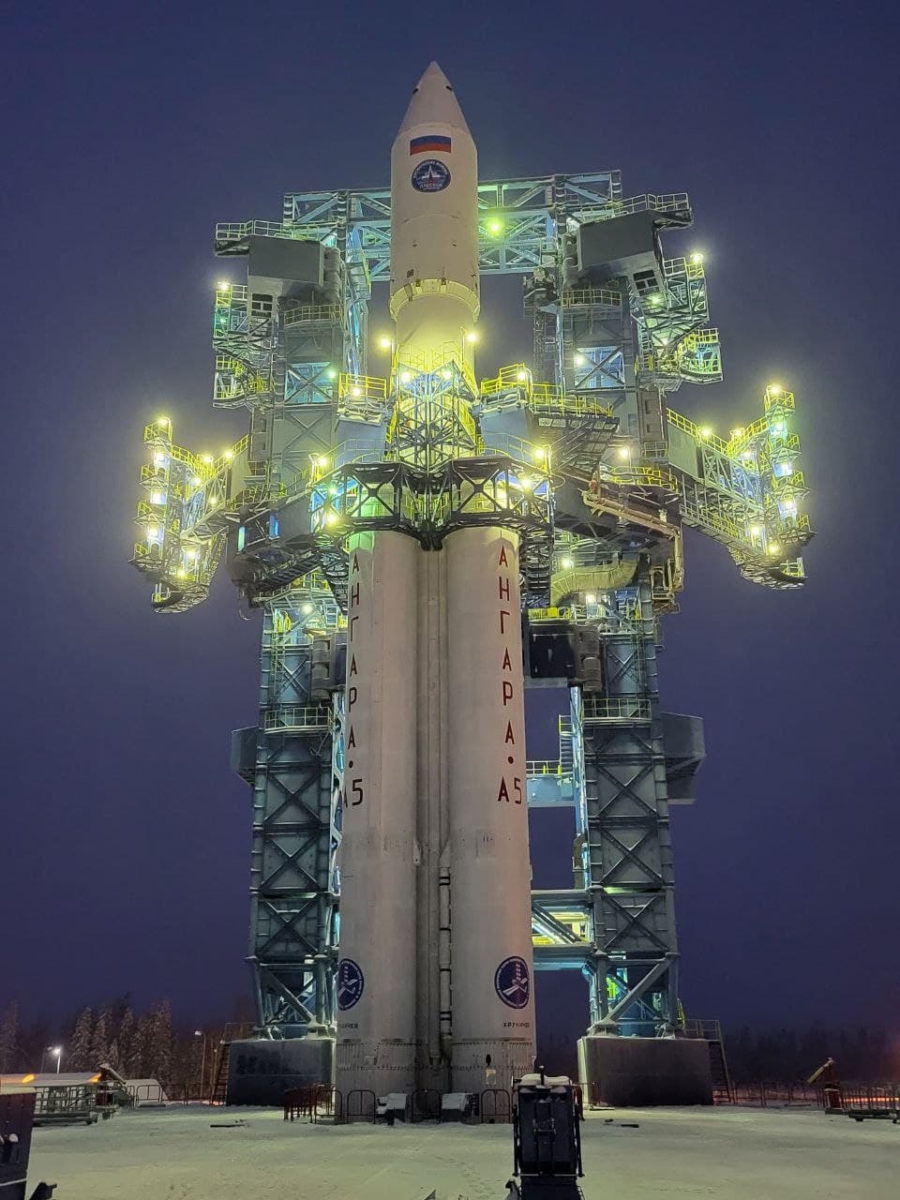
Angara-A5 booster.
Credit: Roscosmos
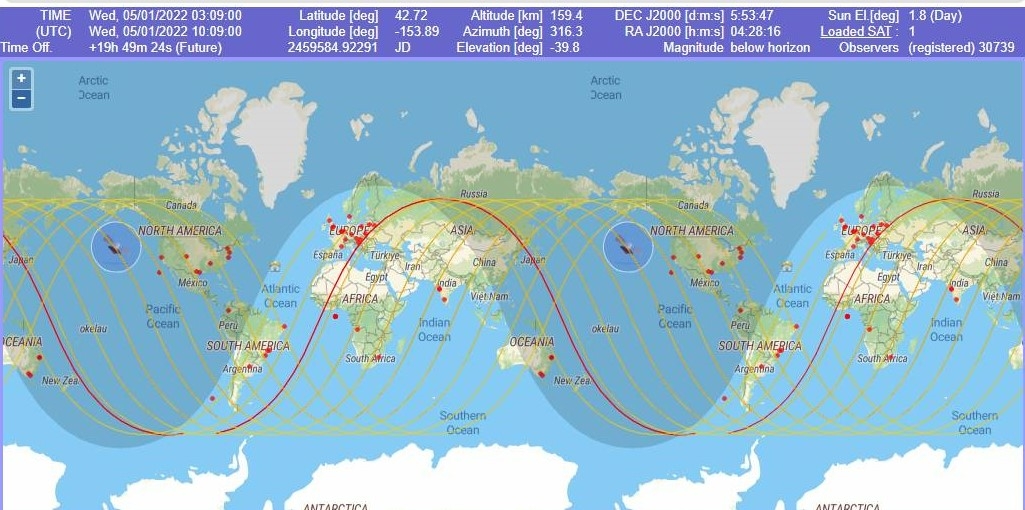
Update: This object is expected to decay around Wed, 05/01/2022 10:09:00 +/- 7 hours UTC (these predictions are provided by Joseph Remis) via Satflare.com.
Russia’s next-generation Angara-A5 rocket flew from Plesetsk Cosmodrome in northern Russia, launched by the Russian space forces on December 27. This was the third launch of the booster; the earlier two in 2014 and 2020.
However, while the launch was successful, ditched in low Earth orbit was a multi-ton dummy payload. The flight test of Persei — a Block DM-03 upper stage variant for Angara – failed to restart for a second burn, resulting in the dummy payload now stranded in a decaying orbit.
According to the Moskovsky Komsomolets newspaper, the Persei upper stage payload combo is expected to reenter in weeks.
The Persei stage is a modernized version of a unit originally meant for the Proton-M carrier rocket and was developed by RSC Energia. The Angara booster is a product of the Khrunichev State Research and Production Space Center.
Cataloged by the U.S. NORAD as object 50505, according to one satellite tracking group – Satflare.com – the errant object is expected to decay around Friday, January 7, 2022 at 21:29:00 +/- 52 hours UTC according to predictions provided by Joseph Remis. (see update, top of story).

Credit: CGTN/Inside Outer Space screengrab
2021 has been a major year for putting into operation early elements of China’s space station.
The Tianhe core module was sent into orbit, and two batches of Chinese astronauts boarded that element for lengthy stays.
Looking forward to 2022, the station’s construction is due to be completed after further crewed missions.
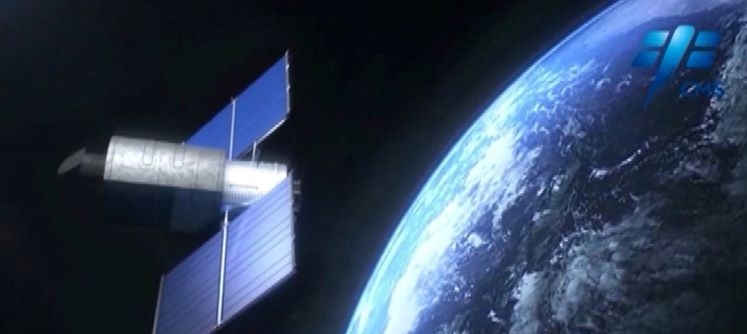
China’s space station agenda also includes lofting an optical module that carries a space telescope, touted as having a better field angle than the NASA Hubble space telescope.
Credit: CCTV/Inside Outer Space screengrab
For example, next year, the Wentian Laboratory Cabin Module and Mengtian Laboratory Cabin Module are to be attached to expand station operations. Additionally, at a later date, the Xuntian Space Station Telescope is to be launched, touted as having a better field angle than the NASA Hubble space telescope.
Credit: CCTV/Inside Outer Space screengrab
Upcoming milestones
What to expect from China’s space station in 2022?
For details, go to this China Global Television Network (CGTN) “Tech Breakdown” video at:
https://www.facebook.com/ChinaGlobalTVNetwork/videos/458798169105076
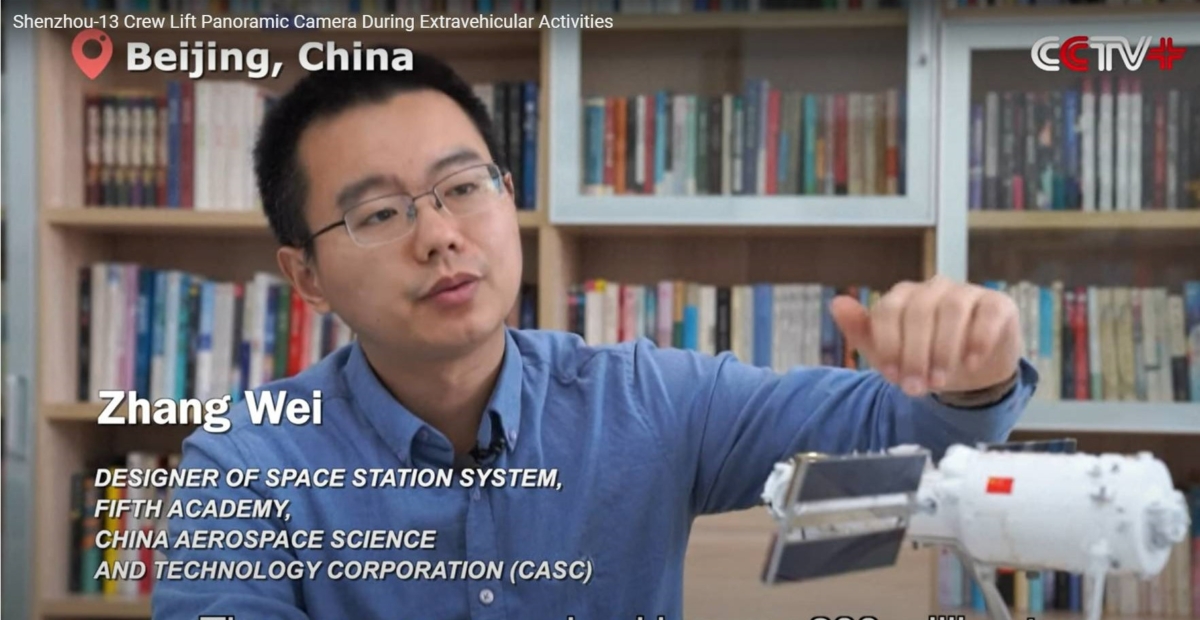
Additionally, several new videos capture China’s space activities in 2021, description of a panoramic camera outfitted on the station, as well as what new materials are being developed for space missions.
Go to:

Discovering Mars – A History of Observation and Exploration of the Red Planet by William Sheehan and Jim Bell; Published by University of Arizona Press (2021); 744 pages; Hardcover: $30.00
This splendid book is the product of historian William Sheehan and astronomer and planetary scientist Jim Bell. As the authors explain in the book’s preface: “We hope you enjoy the stories told here chronicling the characters, technologies, human (and robotic) failures and successes, and the incredible scientific discoveries that have revealed and continue to reveal the true nature of our most Earthlike of celestial neighbors.”
Presented in 22 chapters of well-written and superb research, Discovering Mars covers it all – from the Red Planet being little more than a fuzzy place of mystery through telescopic eyepieces here on Earth to robotic explorers circling Mars and the powerful Perseverance rover and its Ingenuity helicopter drone, now busily at work within Jezero Crater.
There’s a number of appendix pieces chock full of details, including NASA’s historical investment in Mars exploration.
The collective talents of Bell and Sheehan shine throughout the book. The rich history of why Mars continues to tug on humankind’s curious nature and what constitutes multiple pathways to create a future Mars – be it robots or humans, dotting the world with small, expeditionary encampments, or transforming the planet into an Earth II via terraforming – or is it terrorforming?
“Even much of the basic reconnaissance work that robots do so well could be done much more quickly and efficiently by trained professionals in the field, although that is not adequate justification on its own to support the risk of human lives and the expenditure of scare resources,” the authors note.
The march of Mars machinery, starting with the Mariner and Viking missions of the 1960s and 1970s, have yielded tell-tale data that, in a true sense, allows us to “re-discover” Mars over and over again. Who knows when and what evidence is lurking there to show that the Red Planet was indeed once an extraterrestrial address for life – and perhaps that life is alive and well today.
This epic and one-of-a-kind volume is best read with a mind in full-inquisitive mode and why our technologies have provided decade-after-decade of astounding and captivating reveals…and what awaits us.
For more information on this book, go to:

Credit: CCTV/Inside Outer Space screengrab
China has urged the United States to abide by the outer space international treaty of 1967 and take responsible measures to protect the safety of astronauts following close encounters of SpaceX Starlink satellites with the country’s in-construction space station.
A Chinese Foreign Ministry spokesman at a press briefing in Beijing on Tuesday outlined the problem, one that caused the space station to perform preventive collision avoidance control maneuvers in July and October.

Starlink satellites.
Credit: SpaceX
The close encounters sparked China to inform the Secretary-General of the United Nations about the “phenomena” that constituted dangers to the life or health of astronauts aboard the China space station, a UN document states.
China’s submitted document to the UN can be read at:
https://www.unoosa.org/res/oosadoc/data/documents/2021/aac_105/aac_1051262_0_html/AAC105_1262E.pdf
The comments of the Chinese Foreign Ministry spokesman at a press briefing in Beijing on Tuesday can be viewed here at:

China’s space station is projected to be completed in late 2022.
Credit: CAST
China’s in-progress space station has performed preventive collision avoidance control to avoid being struck by SpaceX Starlink satellites. China has informed the United Nations Secretary-General of the issue.
In a document posted by the UN Committee on the Peaceful Uses of Outer Space dated December 6, 2021, there is notification by China under Article V of the Outer Space Treaty concerning preventive collision avoidance between the China Space Station (international designation 2021-035A) and United States’ Starlink-1095 (international designation 2020-001BK) and Starlink-2305 (international designation 2021-024N) satellites.
Starlink satellites.
Credit: SpaceX
Dangers to astronauts
“The China Manned Space Program completed five launch missions in 2021, with the successful launching into orbit of the Tianhe core module of the China Space Station, the Tianzhou-II and Tianzhou-III cargo spacecraft and the Shenzhou-XII and Shenzhou-XIII crewed spacecraft. The China Space Station has travelled stably in a near-circular orbit at an altitude of around 390 km on an orbital inclination of about 41.5 degrees,” the document points out.
“During this period, Starlink satellites launched by Space Exploration Technologies Corporation (SpaceX) of the United States of America have had two close encounters with the China Space Station. For safety reasons, the China Space Station implemented preventive collision avoidance control on 1 July and 21 October 2021, respectively.”
“China hereby informs the Secretary-General of the following phenomena which constituted dangers to the life or health of astronauts aboard the China Space Station,” the document states.
The incident was first flagged by the U.K.’s Express as well as Reuters news agency.
The UN document can be read at:
https://www.unoosa.org/res/oosadoc/data/documents/2021/aac_105/aac_1051262_0_html/AAC105_1262E.pdf

Credit: CCTV/Inside Outer Space screengrab
New EVAs
Meanwhile, China astronauts have just wrapped up about six hours of EVAs.
China’s taikonauts, Zhai Zhigang and Ye Guangfu, safely returned to the Tianhe space station core module. Female astronaut Wang Yaping stayed inside the module, supporting the spacewalking duo, including operation of the station’s robotic arm.
This was the fourth time for Chinese astronauts to conduct EVAs during the construction of the country’s space station and the second by the Shenzhou-13 crew.
Zhai and Ye completed such tasks as adjusting a panoramic camera, tested goods transport, installed hardware for future use and evaluated the EVA spacesuits.

Credit: CNSA/CMG/CCTV/Inside Outer Space screengrab
Accumulated experience
Yang Yanbo, deputy commander of space mission team, Beijing Aerospace Control Center told China Central Television (CCTV):
“We have made proper arrangements for the extravehicular activities such as readjusting settings of mechanical arm’s movement and the platform, which allowed astronauts to operate equipment and mechanical arm simultaneously, thus improving the efficiency of extravehicular activities.”

Credit: CCTV/Inside Outer Space screengrab
Zhu Guangchen, deputy chief designer of the space station system at the China Academy of Space Technology under the China Aerospace Science and Technology Corporation said:
“The extravehicular activities have further tested designs of the core module airlock module, the mechanical arm and the extravehicular suit, and assessed the coordination between space and Earth, which will accumulate experience for the future assembly and construction tasks.”
Zhou Jianping, chief designer of China’s manned space program, told CCTV:
“All the tasks have been performed smoothly so far, with key construction technologies tested. All indicators show that the functions and performance of our space station meet the requirements, and some of them are even far better than what we had expected, this laying a solid foundation for the future space station construction and operation.”
Step-by-step
China’s space program has successfully completed five launches, five rendezvous and docking missions, and four EVAs since the Tianhe space station core module was sent into Earth orbit on April 29, 2021.
The China Manned Space Agency (CMSA) noted that extravehicular operations are becoming the normal work of the space station flight missions. Chinese astronauts will carry out more and complicated EVAs to provide support for the completion of the construction and the stable operation of the space station.
The orbiting outpost is to be completed by the end of 2022.

Courtesy of Seger Yu/Twitter
Six-month mission
China launched the trio of Shenzhou-13 taikonauts on October 16. The crew is on a six-month mission to construct China’s space station.
The Shenzhou-13 crew will continue their in-orbit work to greet the coming new year. This is also the first time that Chinese astronauts to greet a new year in space, the CMSA added.
The CMSA noted that extravehicular operations are becoming the normal work of the space station flight missions. Chinese astronauts will carry out more and complicated EVAs to provide strong support for the successful completion of the construction and the stable operation of the space station.
The Tianhe core module is the first and main component of the in-construction China space station, informally known as Tiangong (Heavenly Palace).
Next year, China is to loft new segments of the station.
To view newly-issued videos regarding the completed 2nd EVAs go to:

Credit: CNSA/CMG/CCTV/Inside Outer Space screengrab
China’s Shenzhou-13 taikonauts are performing extravehicular activities (EVAs) for the second time during their mission on Sunday, according to the China Manned Space Agency (CMSA).

Credit: CMSA
Astronaut Ye Guangfu opened the hatch and carefully translated outside of the Tianhe core model first.

Credit: CGTN/Inside Outer Space screengrab
Ye and Zhai Zhigang are carrying out the EVAs, with astronaut Wang Yaping staying inside to support her crewmates in completing the operations. Wang is providing support from within the core module, including operation of the robotic arm.

Credit: GLOBALink/Inside Outer Space screengrab
The three astronauts were sent to the space station in October aboard the Shenzhou-13 spacecraft for a six-month mission – the longest ever in China’s space program.
The team also performed a 6.5-hour spacewalk in November, during which Zhai and Wang went outside and Ye stayed inside.
The first spacewalk was declared a success, further testing the functions of China’s self-developed extravehicular spacesuits and the reliability and safety of the supporting equipment related to the EVAs.

Credit: CGTN/Inside Outer Space screengrab
In-orbit training
So far, the trio has conducted various tasks and missions, including medical checks, space experiments, inspection and daily maintenance of the space station, and in-orbit training programs including emergency evacuation and medical rescue.
On December 9, Wang broadcast a space lecture from the Tianhe core module to Chinese students on Earth.

Credit: CGTN/Inside Outer Space screengrab
The three-person crew launched into Earth orbit via a Long March-2F launch vehicle, lifting off from the Jiuquan Satellite Launch Center on October 15, 2021.
The Tianhe core is the first and main component of the China Space Station), informally known as Tiangong (Heavenly Palace). China space program planners have stated the fully-outfitted facility will be complete by late 2022.
To watch newly issued videos of the Shenzhou-13 crew conducting their 2nd EVA from the in-construction space station, go to:
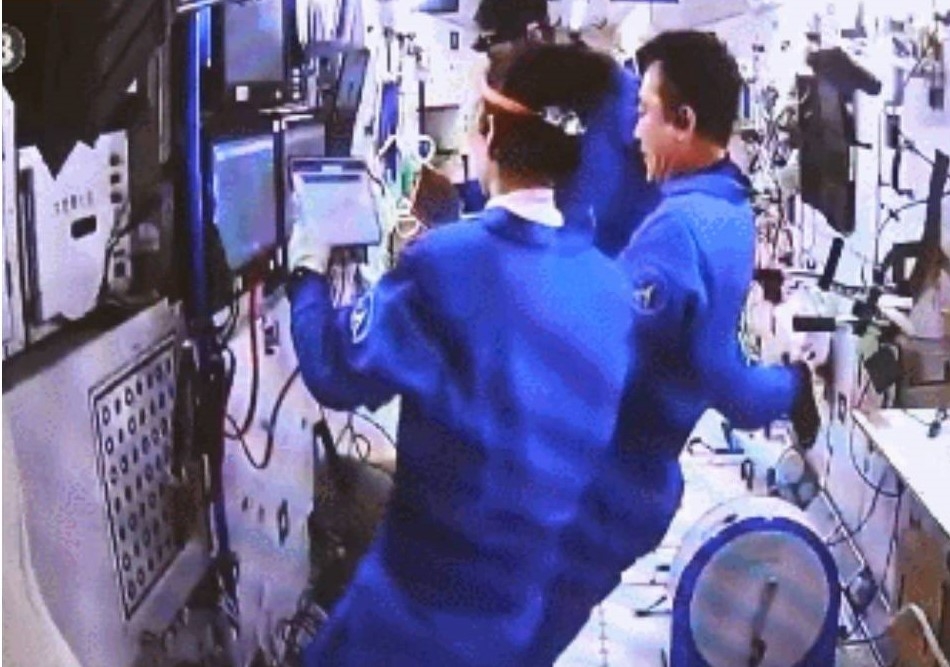
Shenzhou-13 crew conducts an emergency evacuation drill onboard the country’s space station, November 7. 2021. CCCTV/China Media Group
China’s Shenzhou-13 crew living and working on the in-construction Tiangong space station are ready to carry out second space walk duties.
Taikonauts Zhai Zhigang and Ye Guangfu will conduct the EVAs. Wang Yaping will remain inside the core module to support her crewmates.
The trio of astronauts has been in orbit since they were launched on October 16 on a projected six-month journey.

First space walk assignment for Shenzhou-13 crew was in November.
Credit: CMSE/China Media Group/CCTV/Inside Outer Space screengrab
Daily work
Since the crew conducted the first EVAs on November 7, they have performed their daily work, including in-orbit medical checks, space experiments and space station inspections, according to the Xinhua news agency.
Other tasks included in-orbit training programs such as emergency evacuation and medical rescue drills. Also, the crew gave the first live class from the country’s space station on December 9.
Shenzhou-13’s first space walk outing lasted 6.5 hours, carried out by Zhai Zhigang and Wang Yaping, with Ye Guangfu remaining in the cabin to support the EVAs.

