Author Archive
 Author:
  January 25th, 2022
Curiosity Left B Navigation Camera image acquired on Sol 3366, January 24, 2022.
Credit: NASA/JPL-Caltech
NASA’s Curiosity Mars rover at Gale Crater is now performing Sol 3367 duties.
The rover has moved closer to one of the interesting, more resistant ledges that are exposed in the area (“The Prow”), as Curiosity continues her climb up Mount Sharp, reports Lucy Thompson, a planetary geologist at the University of New Brunswick; Fredericton, New Brunswick, Canada.

Curiosity Mast Camera Left photo taken on Sol 3365, January 23, 2022.
Credit: NASA/JPL-Caltech/MSSS
“These resistant ledges have caught our attention because they reveal distinct textures. Being able to get close-up, high resolution imaging accompanied by compositional data, will help the science team better understand how they were formed,” Thompson adds.

Curiosity Mast Camera Left photo taken on Sol 3365, January 23, 2022.
Credit: NASA/JPL-Caltech/MSSS
On/off the rocks
However, Curiosity ended up perched on a couple of rocks and at a tilt, such that researchers were not able to safely deploy the arm and use either its Mars Hand Lens Imager (MAHLI) or Alpha Particle X-Ray Spectrometer (APXS).
“This meant that the rover engineers had to figure out how to move Curiosity off the rocks, but keep the areas of interest within reach of the arm instruments,” Thompson explains.

Curiosity Mast Camera Left photo taken on Sol 3365, January 23, 2022.
Credit: NASA/JPL-Caltech/MSSS
Without the use of the arm in a recently scripted plan, the science team set about planning how to utilize the remaining instruments to continue characterizing this important area.
Finer grained
On tap was use of the Chemistry and Camera (ChemCam) to analyze a small area within the resistant ledge that appears to be finer grained (“La Ventana”), to see if it has the same composition as the surrounding, sand-size grains.

Curiosity Mast Camera Left photo taken on Sol 3365, January 23, 2022.
Credit: NASA/JPL-Caltech/MSSS
A Mastcam mosaic was also to acquire imagery of the La Ventana target and surrounding area.
Two other areas on the resistant ledge (“Caramambatai” and “Potaru”) will be imaged with the ChemCam Remote Micro-Imager (RMI), “providing even more sedimentological and textural information. Mastcam will also image an area of nearby cliffs (“East Cliffs”) to look at shed blocks,” Thompson says.

Curiosity Right B Navigation Camera image taken on Sol 3366, January 24, 2022.
Credit: NASA/JPL-Caltech
New workspace
The environmental scientists planned several observations to continue monitoring changes in the atmospheric conditions. These included: Mastcam basic tau and stereo sky column observations, and Navcam 360 sky survey, large dust devil survey and line of sight observations.

Curiosity Right B Navigation Camera image taken on Sol 3366, January 24, 2022.
Credit: NASA/JPL-Caltech
“After our hopefully successful bump, we will execute a ChemCam AEGIS analysis to autonomously measure the chemistry of a rock target in the new workspace,” Thompson notes. AEGIS stands for Autonomous Exploration for Gathering Increased Science) – a software suite that permits the rover to autonomously detect and prioritize targets.

Curiosity Mars Descent Imager photo taken on Sol 3365, January 23, 2022.
Credit: NASA/JPL-Caltech/MSSS
Also planned, the terrain beneath the rover wheels will be imaged with the Mars Descent Imager (MARDI). Standard Rover Environmental Monitoring Station (REMS), Radiation Assessment Detector (RAD) and Dynamic Albedo of Neutrons (DAN) activities round out this plan.

Curiosity Right B Navigation Camera image taken on Sol 3366, January 24, 2022.
Credit: NASA/JPL-Caltech
As the APXS strategic planner this week, Thompson is excited “to hopefully be able to place the APXS on this interesting outcrop in tomorrow’s plan and see what textures and information can be teased out with MAHLI close up imaging.”
Sand avalanches
As noted in a previous posting, it looks like the robot disturbed the exploration area around The Prowl.
Explains Lauren Edgar, a planetary geologist at the USGS in Flagstaff, Arizona:
“Yes, I think it’s likely that these sand avalanches are the result of the rover disturbing and destabilizing the slope. We actually drove past this area on a previous sol and then returned on 3365, so I’d have to check to see if it was disturbed on the previous drive or this more recent one,” Edgar told Inside Outer Space. “We’ve commonly seen these dry granular flows in areas that the rover has disturbed. I guess the insights are that it’s loose sand, not cemented, and on a slope steep enough to allow for avalanching.”
 Posted in

Location of impact craters considered in this study (red dots): (a) the Earth: (b) the Moon: (c) Mars.
Credit: Lagain et al.
Researchers have analyzed more than 500 large craters on Mars finding issue with previous studies that suggested spikes in the frequency of asteroid collisions for the Earth, the Moon, as well as the Red Planet.
Western Australia’s New Curtin University scientists have confirmed the frequency of asteroid collisions that formed impact craters on Mars has been consistent over the past 600 million years.
Lead researcher for the study, Anthony Lagain, from Curtin’s School of Earth and Planetary Sciences, says the rate of impacts did not vary much at all for many millions of years.

Impact crater on Mars.
Courtesy: New Curtin University
Crater detection algorithm
Past studies had suggested that there was a spike in the timing and frequency of asteroid collisions due to the production of debris.

Crater counts on an ejecta blanket of a 40 kilometer impact crater. (a) Ejecta blanket mapping (outlined in blue) and automatically detected craters (in green). Red circles correspond to impact craters larger than 1 kilometer in diameter compiled in the manual crater database.
Credit: Lagain et al.
“When big bodies smash into each other, they break into pieces or debris, which is thought to have an effect on the creation of impact craters,” Lagain said in a university statement. “Our study shows it is unlikely that debris resulted in any changes to the formation of impact craters on planetary surfaces.”
The work and findings stem from a crater detection algorithm previously developed at Curtin, which automatically counts the visible impact craters from a high-resolution image.

Credit: ISS/NASA
Formation frequency
Co-author and leader of the team that created the algorithm, Gretchen Benedix, said the algorithm could also be adapted to work on other planetary surfaces, including the Moon.
“The formation of thousands of lunar craters can now be dated automatically, and their formation frequency analyzed at a higher resolution to investigate their evolution,” Benedix added.
The full paper – “Has the impact flux of small and large asteroids varied through time on Mars, the Earth and the Moon?” – published in Earth and Planetary Science Letters, is available at:
https://www.sciencedirect.com/science/article/pii/S0012821X2100618X
Now performing Sol 3366 tasks, NASA’s Curiosity Mars rover inspects “The Prow” and other sedimentary structures preserved in this region – perhaps creating shifting sands during the survey?

Curiosity’s location as of Sol 3363. Distance driven 16.79 miles/27.03 kilometers.
Credit: NASA/JPL-Caltech/Univ. of Arizona

Curiosity Front Hazard Avoidance Camera Right B image taken on Sol 3365, January 23, 2022.
Credit: NASA/JPL-Caltech

Curiosity Left B Navigation Camera photo acquired on Sol 3365, January 23, 2022.
Credit: NASA/JPL-Caltech

Curiosity Left B Navigation Camera photo acquired on Sol 3365, January 23, 2022.
Credit: NASA/JPL-Caltech

Curiosity Right B Navigation Camera image taken on Sol 3365, January 23, 2022.
Credit: NASA/JPL-Caltech

Curiosity Left B Navigation Camera image taken on Sol 3365, January 23, 2022.
Credit: NASA/JPL-Caltech

Curiosity Left B Navigation Camera image taken on Sol 3365, January 23, 2022.
Credit: NASA/JPL-Caltech

Curiosity Left B Navigation Camera image taken on Sol 3365, January 23, 2022.
Credit: NASA/JPL-Caltech

Curiosity Left B Navigation Camera image taken on Sol 3365, January 23, 2022.
Credit: NASA/JPL-Caltech

Curiosity Left B Navigation Camera image taken on Sol 3365, January 23, 2022.
Credit: NASA/JPL-Caltech

Curiosity Right B Navigation Camera image taken on Sol 3365, January 23, 2022.
Credit: NASA/JPL-Caltech

Curiosity Right B Navigation Camera image taken on Sol 3365, January 23, 2022.
Credit: NASA/JPL-Caltech

Curiosity Mast Camera Right imagery collected on Sol 3364, January 22, 2022.
Credit: NASA/JPL-Caltech/MSSS

China’s Long March-8 maiden flight.
Credit: CASC
Following a week of ocean transport, China’s new generation carrier rocket, the Long March-8 Y2, has arrived at the Wenchang Space Launch Center in Hainan province.
The rocket was carried in pieces to the center by ship from Tianjin, a northern coastal municipality.
According to the China Academy of Launch Vehicle Technology, the Long March-8 mission is to take off between late February and early March.

Credit: CCTV/Inside Outer Space screengrab
Rocket details
The Long March-8 is a two-stage medium-lift carrier rocket, with two side boosters. It is 50.3 meters long, with a takeoff weight of 356 tons. It uses liquid propellants with a 5-ton capacity for sun-synchronous orbit at an altitude of 700 kilometers, or hurling satellites weighing up to 2.8 tons to geostationary transfer orbit.
This booster is designed for both land and sea launches, and made its maiden flight on December 22, 2020 from the Wenchang coastal launch site. Long March 8 can also be launched from the Jiuquan Satellite Launch Center in the northwestern Gobi Desert.

Long March-8 flyback booster.
Credit: CCTV/Inside Outer Space screengrab
Similar to SpaceX first stages, the Long March-8 is ultimately to make upright landings.
Backbone of launches
The Long March series is the backbone supporting China’s space launches. It has shouldered 92 percent of China’s launch missions since a Long March rocket placed the Dongfanghong-1 satellite in orbit 51 years ago. In the past half century and more, the series has sent over 700 spacecraft into space, with a success rate of 96 percent, reports China’s People’s Daily.
China carried out the most space launch missions in the world over 2021. Among the missions, 48 launches were made by the Long March series carrier rockets, all successful. It was the first time in history that the Long March series completed more than 40 launch missions within a year. The 400th launch of the series also came last year, notes the People’s Daily story.
For an earlier video dated December 22, 2020 that focuses on this booster, go to:

Credit: Scientific Coalition for UAP Studies (SCU)
Throughout last year there has been an upsurge of peculiar sightings reported thanks to individuals armed with an iphone or other video gear that spot and record strange glimmerings in the sky.
Could they be a SpaceX parade of orbiting Starlink satellites, airplane-deployed flares, falling space junk, maybe floating specialty balloons or purposely-faked UFO incursions by people with too much time on their hands?
Then there’s the prospect of Earth being on the receiving end of aliens on holiday excursions speeding in from Alpha Centauri that find themselves want of brake fluid and crash into New Mexico.

GOFAST
Credit: DOD/U.S. Navy/Inside Outer Space screengrab
Many of these are ultimately flagged as what they are.
Nonetheless, is 2022 the year of the revelatory “disclosure” that we Earthlings are not only alone but there’s immediate need to start cogitating just how crowded it is out there with intelligent starfolk, busily scooting through our skies?
Go to my new Space.com story:
“2022 could be a turning point in the study of UFOs – Interest in UFOs continues to grow, both among scientists and government officials,” at:

Curiosity Front Hazard Avoidance Camera Left B image taken on Sol 3362, January 20, 2022.
Credit: NASA/JPL-Caltech
NASA’s Curiosity Mars rover at Gale Crater is now performing Sol 3363 duties.
It is a “sedimentologist’s delight,” reports Lauren Edgar, a planetary geologist at USGS Astrogeology Science Center in Flagstaff, Arizona.

Curiosity Mars Hand Lens Imager photo produced on Sol 3362, January 20, 2022.
Credit: NASA/JPL-Caltech/MSSS

Curiosity Mars Hand Lens Imager photo produced on Sol 3362, January 20, 2022.
Credit: NASA/JPL-Caltech/MSSS
After a few sols of challenges that prevented researchers from getting close-up Mars Hand Lens Imager (MAHLI) imaging of a dark outcrop in front of the robot, scientists were finally able to plan the contact science that they were hoping for, Edgar explains.
Kick that rock
Recently, there was a small rock under the right rear rover wheel, so controllers had to kick that rock to the curb to get into a stable position for using the rover arm.
A downlink of data confirmed that Curiosity had cleared the rock and scientists “are good to go with a fantastic set of contact science activities,” Edgar adds. “As a sedimentologist, I am drooling over some of these beautiful structures throughout this area.”

Curiosity Right B Navigation Camera photo acquired on Sol 3362, January 20, 2022.
Credit: NASA/JPL-Caltech
Sedimentary structures
A slated two-sol plan (Sols 3362-3363) is focused on contact science on the first sol and a drive on the second sol.
“The plan starts with several Mastcam mosaics to document sedimentary structures and their spatial relationships, as well as the processes responsible for carving this landscape,” Edgar points out.
On the schedule is obtaining a Chemistry and Camera (ChemCam) Laser Induced Breakdown Spectroscopy observation on “Kako” to investigate the chemistry of nearby nodular bedrock, followed by a long-distance Remote Micro-Imager (RMI) mosaic to investigate the stratigraphy exposed in the “Mirador” butte.

Curiosity Mast Camera Left image taken on Sol 3361, January 19, 2022.
Credit: NASA/JPL-Caltech/MSSS
“Dog’s eye” mosaic
“After that, we’ll put the arm to work,” Edgar notes. “We’ll acquire a MAHLI ‘dog’s eye’ mosaic of the target ‘Caroni’ in which the camera will get an edge-on perspective of the exposed laminae, and a set of images that coincide with the [Alpha Particle X-Ray Spectrometer] (APXS) targets ‘Coati’ and ‘Morok.’”
“All of these contact science targets are intended to understand the grain size, sedimentary structures, and composition of the dark outcrop in front of us,” Edgar explains.

Curiosity Mast Camera Left image taken on Sol 3361, January 19, 2022.
Credit: NASA/JPL-Caltech/MSSS
Dust and dust devils
Previously, Curiosity has acquired remote sensing observations of this outcrop, and Mars researchers are excited to get new, detailed information from MAHLI and APXS.
“After the evening APXS integrations, the rover will go to sleep, and wake up the next morning for more science,” Edgar reports.
Also on tap, a suite of observations to characterize atmospheric dust and search for dust devils.
“Then Curiosity will drive back along this dark outcrop to another interesting location to setup for more contact science in the weekend plan,” Edgar concludes. “Looking forward to a great set of data from this location!”

Credit: Ding L., et al.
Data and images collected by China’s Yutu-2 rover indicate it has experienced varying degrees of mild slip and skid. The lunar terrain trod by the six-wheeled, off-road robot, is relatively flat at large scales but scattered with local gentle slopes.
“Cloddy soil sticking on its wheels implies a greater cohesion of the lunar soil than encountered at other lunar landing sites,” reports Ding Liang with the Harbin Institute of Technology.
The Moon machinery uses four steering motors on the corner wheels with a meshed surface.

Credit: Ding L., et al.
Cloddy soil, gel-like rocks
Researchers from Harbin Institute of Technology and Beijing Aerospace Control Center analyzed the locomotive data and images collected by Yutu-2, presenting their findings in the peer-reviewed journal, Science Robotics.
China’s Chang’E-4 mission successfully targeted the Moon’s farside and deployed the teleoperated Yutu-2 rover to investigate inside the Von Kármán crater in the South Pole-Aitken Basin. The robot has encountered cloddy soil, gel-like rocks, and fresh small craters inside the Von Karman crater in the South Pole-Aitken Basin.

Credit: Ding L., et al.
Rolling past designed lifetime
The Moon mission – a lander and the rover – touched down on January 3, 2019. The rover has operated for three years, rolling past its initial three-month designed lifetime.
Researchers used the rover wheel as a trenching device to approximate the properties of the lunar soil.

Cover photo credit: Beijing Aerospace Control Center (BACC)
Ding Liang, the paper’s first author, State Key Laboratory of Robotics and System, Harbin Institute of Technology, said that the findings are helping shape in-depth studies for China’s subsequent lunar missions.
To read the study – “A 2-year locomotive exploration and scientific investigation of the lunar farside by the Yutu-2 rover” – go to:
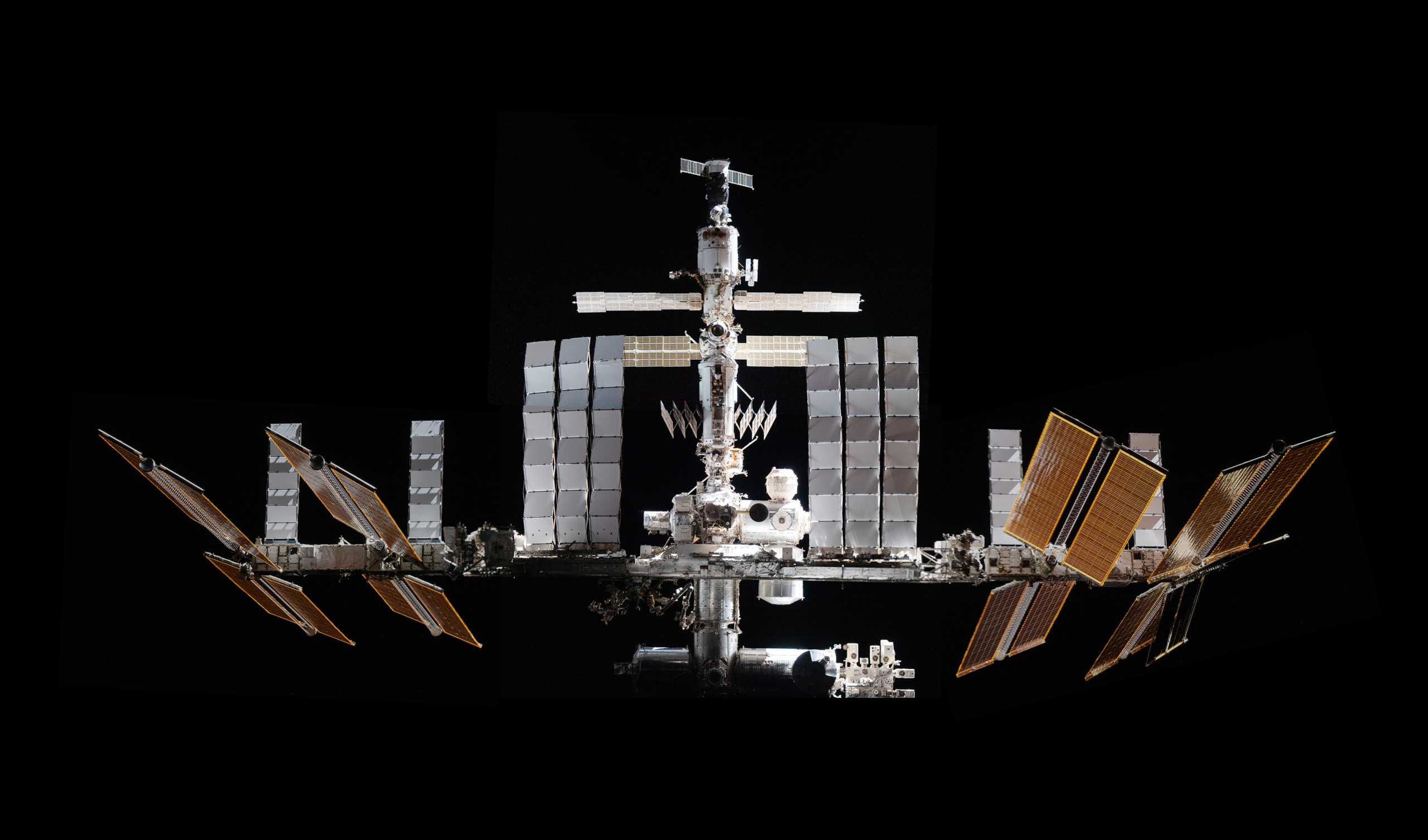
The International Space Station, home-away-from-home and a social, cultural study site. ISS mosaic created with imagery from Expedition 66.
Credit: NASA
A worldwide group of researchers is engaged in a unique, archaeological study of crew culture within the International Space station, focused on the orbiting habitat as a “microsociety in a miniworld.”
This global inside look at the ISS is called The International Space Station Archaeological Project (ISSAP) and is expected to supply new insights regarding human life in space and issues of habitation design.

Watch this space! Archaeological research is underway.
Credit: NASA
Findings of the ISSAP could prove useful to other mini working cultures here on Earth, be they Antarctic research stations, long-deployment nuclear submarines, and on a more outer space-oriented note, future Mars expeditions.
Go to my new Space.com story – “’Space archaeology’ research on the ISS will help design better space habitats – The new project could aid NASA’s crewed push to Mars” – at:
https://www.space.com/space-archaeology-iss-crew-culture-project

Future human missions to the Red Planet and the voyage back to Earth are expected to take two to three years.
During those lengthy sojourns, significant amounts of waste will be generated.
A crowdsourcing competition is seeking innovative approaches to repurpose, recycle, and reprocess the waste generated onboard to enable mission sustainability.
HeroX is a platform and open marketplace for crowdsourced solutions and had launched the competition: “Waste to Base Materials Challenge: Sustainable Reprocessing in Space”
The challenge
NASA’s Waste to Base Challenge asks the larger community to provide inventive approaches to waste management and conversion in four specific categories:
- Trash
- Fecal waste
- Foam packaging material
- Carbon dioxide (CO2) processing
“Since the logistics of supply ships to support a Mars mission are very difficult, the spacecraft needs to be as efficient and self-sufficient as possible,” explains a HeroX statement.

Any humans to Mars expedition will require spacecraft as efficient and self-sufficient as possible.
Credit: Bob Sauls – XP4D/Explore Mars, Inc. (used with permission)
“This challenge is all about finding ways to convert waste into base materials and other useful things, like propellant or feedstock for 3D printing. The challenge is looking for your ideas for how to convert different waste streams into propellant and into useful materials that can then be made into needed things and cycled through multiple times,” the HeroX statement continues.
Although a perfectly efficient cycle is unlikely, ideally, competitive solutions will result in little to no waste.
NASA could eventually integrate all the different processes into a robust ecosystem that allows a spacecraft to launch from Earth with the lowest possible mass.
Prize money
Multiple winners in each category will each be awarded a prize of $1,000. Additionally, judges will recognize four ideas as “best in class,” each with a prize of $1,000. A total prize purse of $24,000 will be awarded.
The prize is open to anyone aged 18 or older participating as an individual or as a team. Individual competitors and teams may originate from any country, as long as United States federal sanctions do not prohibit participation (some restrictions apply).
For more information, and to accept the challenge, visit:
https://www.herox.com/WasteToBase

Curiosity’s location as of Sol 3359. Distance driven 16.78 miles/27.01 kilometers
Credit: NASA/JPL-Caltech/Univ. of Arizona
NASA’s Curiosity Mars rover at Gale Crater is now performing Sol 3361 tasks.

Curiosity Left B Navigation Camera image taken on Sol 3361, January 19, 2022.
Credit: NASA/JPL-Caltech
“We continue to document rocks similar to what we saw at ‘The Prow,’ a dark appearing rock outcrop with amazing sedimentary structures and details,” reports Catherine O’Connell-Cooper, Planetary Geologist at University of New Brunswick; Fredericton, New Brunswick, Canada.

Curiosity Left B Navigation Camera image taken on Sol 3359, January 17, 2022.
Credit: NASA/JPL-Caltech
“To do this, we need to get as close as possible to an outcrop surface but that has called for some short multi-plan drives, as we maneuver to a new feature called ‘Panari’ – a length of roughly [65-feet] 20 meters away from The Prow.”

In the last plan, the robot edged towards the inclined rock in the front right corner of the image, ending on some flatter rock a safe distance back.
This image was taken by Left Navigation Camera on Sol 3356, January 14, 2022.
Credit: NASA/JPL-Caltech
Flatter rock
In the last plan, the robot edged towards an inclined rock, ending on some flatter rock a safe distance back.
“This end of drive,” O’Connell-Cooper adds, “allows the rover planners to vet the inclined rock, finding the optimal location to place us for up close contact science after a short ‘bump’ or drive (less than [10-feet] 3 meters in total) on the third sol of this plan [Sols 3357-3360].”

Curiosity Mast Camera (Mastcam) Left photo acquired on Sol 3359, January 17, 2022.
Credit: NASA/JPL-Caltech/MSSS

Curiosity Mast Camera (Mastcam) Left photo acquired on Sol 3359, January 17, 2022.
Credit: NASA/JPL-Caltech/MSSS

Curiosity Mast Camera (Mastcam) Left photo acquired on Sol 3359, January 17, 2022.
Credit: NASA/JPL-Caltech/MSSS
First however is documenting the flatlying rock underneath the rover. The target “Chimata” in front of the rover will be brushed to clear the dust and then analyzed by both the Alpha Particle X-Ray Spectrometer (APXS) and Mastcam.
Tonal differences
“This material is a somewhat paler color than The Prow and the inclined rocks at Panari, so we are investigating to see if the tonal differences are reflected in the composition,” O’Connell-Cooper notes.
Curiosity’s Chemistry and Camera (ChemCam) will use the Laser Induced Breakdown Spectroscopy (LIBS) instrument to target two smaller targets (“Mataui” and “Kamarang”) and the Mastcam targets “Auyan” and “Uei” look at sand movement overlying fractures and along the side of flatlying bedrock.

“Chimata” in front of the rover is brushed to clear the dust. Curiosity Mast Camera (Mastcam) Right image taken on Sol 3359, January 17, 2022.
Credit: NASA/JPL-Caltech/MSSS
Changing dust levels
ChemCam will also target the inclined block with LIBS (“Apparam”) and its imaging tool, the Remote Micro-Imager (RMI) (target “Karwai”), whilst Mastcam will image a similar block “Quino” a bit further in the distance, O’Connell-Cooper says.

Curiosity Left B Navigation Camera image taken on Sol 3359, January 17, 2022.
Credit: NASA/JPL-Caltech
There are also multiple monitoring activities, looking at changing dust levels in the atmosphere, and a full day of Rover Environmental Monitoring Station (REMS) only activities of the last day of a recent, but crammed, four sol plan, O’Connell-Cooper concludes.

