Author Archive
 Author:
  February 17th, 2022
Credit: SWF/CSIS/Department of Aerospace Engineering and Engineering Mechanics at the University of Texas at Austin
An inventive, web-based tool has been created to portray space situational awareness data, to help promote strategic stability in the space domain.
Called the Satellite Dashboard, its intent is to better appreciate potentially threatening actions in space.
“Our hope is that policymakers, space experts, commercial industry, and the media will be able to use the Dashboard as a reference to better understand potentially destabilizing activities in space in a way that supports informed decision-making and open dialogue,” according to the dashboard’s website.
The Dashboard collates data from multiple sources, including publicly-available data provided by the U.S. military, commercial space situational awareness (SSA) providers, and data from international, scientific, and academic sources.

Photo illustration by Thomas Gaulkin for the Bulletin of the Atomic Scientists’ January 2022 issue (used with permission).
Deceive, disrupt, deny, degrade, or destroy
Satellite Dashboard is a collaboration between the Secure World Foundation (SWF), the Center for Strategic and International Studies (CSIS), and the Department of Aerospace Engineering and Engineering Mechanics at the University of Texas at Austin.
“This project was initiated because the number of actors and types of activities that rely on space is rapidly and dramatically increasing,” the dashboard website explains. “More countries than ever are investing in counterspace capabilities that will enable them to deceive, disrupt, deny, degrade, or destroy space systems of potential adversaries, including the United States.”
To check out this valuable new source, go to:
 Posted in

Curiosity’s location as of Sol 3387. Distance driven to that sol is 16.93 miles/27.25 kilometers.
Credit: NASA/JPL-Caltech/Univ. of Arizona
NASA’s Curiosity Mars rover at Gale Crater is now performing Sol 3388 duties.

Curiosity Left B Navigation Camera image taken on Sol 3387, February 15, 2022.
Credit: NASA/JPL-Caltech
“Curiosity is advancing westward through a largely boulder-strewn channel that is leading us toward the Greenheugh Pediment,” reports Scott Guzewich, an atmospheric scientist at NASA’s Goddard Space Flight Center in Greenbelt, Maryland.

Curiosity Left B Navigation Camera image taken on Sol 3387, February 15, 2022.
Credit: NASA/JPL-Caltech
The Pediment is where the rover will spend the next many months, Guzewich adds, “as we turn back uphill to the south and continue our ascent up Mt. Sharp. Despite it being quite craggy in our current location, we did have to drive over a large sand patch to get to our current parking location!”

Curiosity Left B Navigation Camera image taken on Sol 3387, February 15, 2022.
Credit: NASA/JPL-Caltech
Days ahead
A recent planned objective was to study one of the last remaining bedrock patches available to Curiosity before it ascends onto the Pediment in the days ahead.

Curiosity Left B Navigation Camera image taken on Sol 3387, February 15, 2022.
Credit: NASA/JPL-Caltech
Mars researchers quickly identified “Loch Coruisk” as their preferred bedrock slab for contact science with the Mars Hand Lens Imager (MAHLI) and Alpha Particle X-Ray Spectrometer (APXS).

Curiosity Left B Navigation Camera image taken on Sol 3387, February 15, 2022.
Credit: NASA/JPL-Caltech
The robot’s Chemistry and Camera (ChemCam) is set to zap that target with Laser Induced Breakdown Spectroscopy (LIBS) in addition to two other bedrock pieces nearby.

Curiosity Mast Camera Right image acquired on Sol 3386, February 13, 2022.
Credit: NASA/JPL-Caltech/MSSS
Dust storm season
“Both ChemCam and Mastcam will also be imaging the edge of the Pediment to our southwest and northwest so we can study the geologic contact that the edge represents,” Guzewich points out. “That imaging includes a Mastcam 360° mosaic, which will surely be spectacular!”

Curiosity Mast Camera Right imagery taken on Sol 3386 February 13, 2022
Credit: NASA/JPL-Caltech/MSSS
As the rover is quickly approaching the dust storm season on Mars, scientists also added several dust devil movies with Navcam and observations to monitor the dust amounts in the atmosphere above Curiosity and within Gale Crater itself, Guzewich concludes.

Curiosity’s location as of Sol 3386. Distance driven to this date: 16.92 miles/27.24 kilometers.
Credit: NASA/JPL-Caltech/Univ. of Arizona
NASA’s Curiosity Mars rover at Gale Crater is now performing Sol 3387 duties.
Sean Czarnecki, a planetary geologist at Arizona State University in Tempe, Arizona reports that on Valentine’s Day, Curiosity was slated to carry out a full workload with Chemistry and Camera (ChemCam) Laser Induced Breakdown Spectroscopy (LIBS) and the Alpha Particle X-Ray Spectrometer (APXS) of “Loch Garten” followed by Mars Hand Lens Imager (MAHLI) photos of this target before and after dust removal.

Curiosity Left B Navigation Camera photo taken on Sol 3386, February 14, 2022.
Credit: NASA/JPL-Caltech
In addition, ChemCam and Mastcam was set to image “Stivva Hea”’ and Mastcam will image “Blackcraig.”

Curiosity Left B Navigation Camera photo taken on Sol 3386, February 14, 2022.
Credit: NASA/JPL-Caltech
Navcam will be looking for dust devils and taking other images, while DAN, RAD, and REMS will be taking standard measurements.

Curiosity Left B Navigation Camera photo taken on Sol 3386, February 14, 2022.
Credit: NASA/JPL-Caltech
Steep slopes
In an earlier report focused on Sols 3385-3386, Vivian Sun, a planetary geologist at NASA’s Jet Propulsion Laboratory, said “we continue making progress towards the ‘Greenheugh Pediment’ and will hopefully be almost on top of the pediment after the weekend drive.”

Curiosity Left B Navigation Camera photo taken on Sol 3386, February 14, 2022.
Credit: NASA/JPL-Caltech
As the robot climbs onto the pediment via its steep slopes, “Curiosity will drive as far as we have available navigation mesh, so this drive will be similar to the last plan’s drive in terms of distance,” Sun adds.
But before continuing the drive towards the pediment, the plan calls for plenty of contact science and remote sensing at the rover’s current location.

Curiosity Right B Navigation Camera image acquired on Sol 3386, February 14, 2022.
Credit: NASA/JPL-Caltech
Three-dimensional understanding
“We will be obtaining APXS and MAHLI measurements of ‘Kintradwell,’ a smooth bedrock surface, that will provide us with more data about changes in bedrock composition as we approach the contact with the pediment capping unit.”

Curiosity Mast Camera Right mosaic, taken on Sol 3386, February 13, 2022.
Credit: NASA/JPL-Caltech/MSSS
ChemCam observations of “Apardion” and “Copp Crag,” two nodular targets, will give compositional data on these diagenetic textures, similar to what researchers observed in past workspaces.

Dust removal image taken by Mars Hand Lens Imager (MAHLI), produced on Sol 3386, February 14, 2022.
Credit: NASA/JPL-Caltech/MSSS
Credit: NASA/JPL-Caltech/MSSS
“We’ll also be thoroughly documenting the fantastic landscape around us, with more Mastcam and ChemCam imaging of ‘Maringma Butte,’ focusing in particular on a protruding lens of rocks, and Mastcam imaging of ‘Blackcraig Butte.’ Although we have imaged these buttes before from previous locations, these additional images are useful not only because they will be higher resolution (since we are closer now), but also because imaging the same feature from different angles is how we build up our three-dimensional understanding of the layering and sedimentology in these buttes,” Sun concludes.

Mast Camera (Mastcam) Left image taken on Sol 3386, February 14, 2022.
Credit: NASA/JPL-Caltech/MSSS

Mast Camera Right photo taken on Sol 3386, February 13, 2022.
Credit: NASA/JPL-Caltech/MSSS

Mast Camera Right photo taken on Sol 3386, February 13, 2022.
Credit: NASA/JPL-Caltech/MSSS

Mast Camera Right photo taken on Sol 3386, February 13, 2022.
Credit: NASA/JPL-Caltech/MSSS
As always, dates of planned rover activities described in these reports are subject to change due to a variety of factors related to the Martian environment, communication relays and rover status.

The lunar far side as imaged by NASA’s Lunar Reconnaissance Orbiter using its LROC Wide Angle Camera.
Credit: NASA/Goddard/Arizona State University
The international scientific community has long been discussing the need to keep the farside of the Moon free from human-made radio frequency intrusion.
What’s at issue?
The lunar farside always faces away from Earth. Consequently it is “radio-quiet,” shielded by the moon itself from radio-frequency interference (RFI) crackling through space, pumped out by powerful Earth-based transmitters.

The proposed Protected Antipode Circle, a circular piece of lunar landscape to be reserved for scientific purposes on the farside of the Moon.
Credit: Claudio Maccone
A just-established Moon Farside Protection Permanent Committee of the International Academy of Astronautics (IAA) has begun to frame issues and solutions to guard against RFI corruption of the Moon’s farside.

Crater Daedalus on the lunar farside as seen from the Apollo 11 spacecraft in lunar orbit.
Credit: NASA
For more details, go to my new Space.com story – “Moon group pushes for protection of ultraquiet lunar far side – The far side is a great place for radio telescopes, astronomers say” at:
https://www.space.com/moon-far-side-radio-quiet-telescope-project

Credit: Polaris Program
Jared Isaacman, founder and CEO of Shift4, announced today the Polaris Program, a first-of-its-kind effort to rapidly advance human spaceflight capabilities.
An American billionaire businessman, Isaacman was the commander of the SpaceX flight Inspiration4 in September 2021.

Credit: Polaris Program
No earlier than the fourth quarter of 2022, SpaceX’s Falcon 9 rocket will launch the Polaris Dawn mission from Launch Complex 39A at Kennedy Space Center in Florida. Dragon and the Polaris Dawn crew will spend up to five days in orbit.

Credit: Polaris Program
During that time, the crew will attempt the first-ever commercial extravehicular activity (EVA) with SpaceX-designed extravehicular activity (EVA) spacesuits, upgraded from the current intravehicular (IVA) suit.
The program will consist of up to three human spaceflight missions that will demonstrate new technologies, conduct extensive research, “and ultimately culminate in the first flight of SpaceX’s Starship with humans on board,” states a Polaris Program website.

Credit: Polaris Program
First mission objectives
This Polaris Dawn flight will flyer higher than any Dragon mission to date and endeavor to reach the highest Earth orbit ever flown by humans. Orbiting through portions of the Van Allen radiation belt, Polaris Dawn will conduct research with the aim of better understanding the effects of spaceflight and space radiation on human health.
At approximately 310 miles (500 kilometers) above the Earth, the crew will attempt the first-ever commercial extravehicular activity (EVA) with SpaceX-designed extravehicular activity (EVA) spacesuits, upgraded from the current intravehicular (IVA) suit. “Building a base on the Moon and a city on Mars will require thousands of spacesuits; the development of this suit and the execution of the EVA will be important steps toward a scalable design for spacesuits on future long-duration missions,” the Polaris Program website explains.

Ready for first flight: SpaceX Starship.
Credit: Polaris Project
While in orbit, the crew will conduct scientific research designed to advance both human health on Earth and our understanding of human health during future long-duration spaceflights.
The Polaris Dawn crew will be the first crew to test Starlink laser-based communications in space, providing valuable data for future space communications system necessary for missions to the Moon, Mars and beyond.
For more detailed information, go to:
NASA’s Curiosity Mars rover at Gale Crater is now wrapping up Sol 3385 tasks. New imagery shows the surroundings being explored by the robot:

Curiosity Right B Navigation Camera image taken on Sol 3385, February 13, 2022.
Credit: NASA/JPL-Caltech

Curiosity Right B Navigation Camera photo taken on Sol 3384, February 12, 2022.
Credit: NASA/JPL-Caltech

Curiosity Right B Navigation Camera photo taken on Sol 3384, February 12, 2022.
Credit: NASA/JPL-Caltech

Curiosity Right B Navigation Camera photo taken on Sol 3384, February 12, 2022.
Credit: NASA/JPL-Caltech

Curiosity Right B Navigation Camera photo taken on Sol 3384, February 12, 2022.
Credit: NASA/JPL-Caltech

Curiosity Right B Navigation Camera photo taken on Sol 3384, February 12, 2022.
Credit: NASA/JPL-Caltech

Curiosity Right B Navigation Camera photo taken on Sol 3384, February 12, 2022.
Credit: NASA/JPL-Caltech

Liftoff ofCZ-3C GJ-II Y12 carrier rocket in 2014.
Via Seger Yu
According to Bill Gray of Pluto Project software:
Corrected identification of object about to hit the Moon – not a SpaceX upper stage.
“Short version: back in 2015, I (mis)identified this object as 2015-007B, the second stage of the DSCOVR spacecraft. We now have good evidence that it is actually 2014-065B, the booster for the Chang’e 5-T1 lunar mission. (It will, however, still hit the moon within a few kilometers of the predicted spot on 2022 March 4 at 12:25 UTC, within a few seconds of the predicted time.)”

Chang’e 5-T1 lunar mission took this image during its flight.
Via Seger Yu
Convincing evidence
Gray adds that “in a sense, this remains ‘circumstantial’ evidence. But I would regard it as fairly convincing evidence. So I am persuaded that the object about to hit the moon on 2022 Mar 4 at 12:25 UTC is actually the Chang’e 5-T1 rocket stage.

Chang’e 5-T1 lunar spacecraft was precursor mission for China’s step-by-step Moon exploration program.
Via Seger Yu
Eric Berger, senior space editor at Ars Technica, has an updated article on this topic .
Go to:
https://arstechnica.com/science/2022/02/actually-a-falcon-9-rocket-is-not-going-to-hit-the-moon/
China space watcher, Seger Yu, has posted a set of photos related to the CE-5 T1 probe, noting that the upper stage is from the CZ-3C GJ-II Y12 carrier rocket.

The second Long March-8 launch vehicle, Long March-8 Y2, is being prepared to be launched from the Wenchang Spacecraft Launch Site, Hainan Province, China.
Credit: China Media Group(CMG)/China Central Television (CCTV)/Inside Outer Space screengrab
China is pressing forward to send over 50 spacecraft into space in 2022.
The country plans to launch the Long March-8 Y2 rocket, a two-stage medium-lift rocket between late February and early March this year.
Long March-8 will depart the Wenchang Spacecraft Launch Site in south China’s Hainan Province – the first launch of China’s new configuration of the Long March-8 rocket without boosters.
According to the developer, the rocket will be carrying 22 commercial satellites in the coming mission, the largest number of satellites to be launched in one flight by China.

Credit: China Media Group(CMG)/China Central Television (CCTV)/Inside Outer Space screengrab
“Now the Long March-8 Y2 is undergoing sub-system testing. Judged from the progress of our sub-system testing and data interpretation, the current testing results are normal, and the entire rocket is in a controllable condition,” said Wu Yitian, deputy chief designer of the Long March-8 rocket in a China Central Television (CCTV) interview.
Space station completion
China plans to make a record six launches in 2022 to finish building its space station, according to a blue paper released by the China Aerospace Science and Technology Corporation (CASC), the main contractor of China’s space program, on Wednesday.

Credit: CCTV/Inside Outer Space screengrab
The launch vehicles scheduled to dock with the space station are standing by, including the Long March 2F Y15, designed to carry three crew members to the station in November this year.
“The Y15 rocket is undergoing testing for final assembly in the workshop, and it will be transported to the Jiuquan Satellite Launch Base for the launch mission after all the jobs are done,” said Jing Muchun, chief designer of the Long March 2F, the carrier rocket system of Tiangong-1, which was China’s first prototype space station.
Go to videos at:

Image Credit: NASA/JPL-Caltech
NASA’s Ingenuity Mars Helicopter acquired these images using its navigation camera, acquired on Feb. 8, 2022 (Sol 345 of the Perseverance rover mission). This was the date of Ingenuity’s 19th flight.

Credit: NASA/JPL-Caltech

Credit: NASA/JPL-Caltech
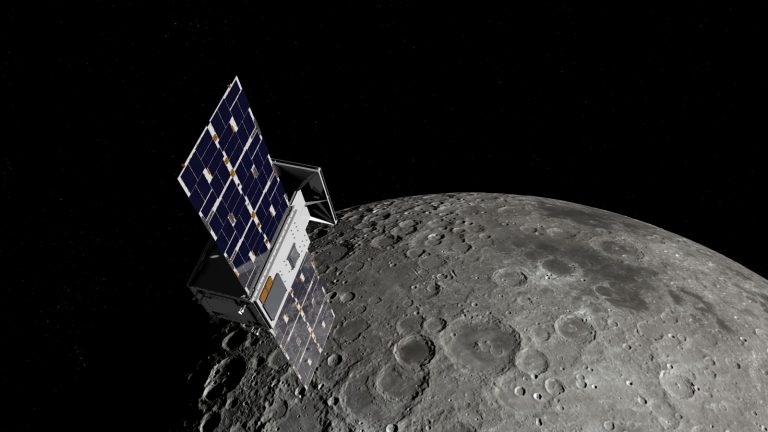
CAPSTONE
Credit: NASA
A soon-to-launch cubesat will be one of the first ever to fly in the unique Near Rectilinear Halo Orbit (NRHO).
Advanced Space owns and operates the Cislunar Autonomous Positioning System Technology Operations and Navigation Experiment (CAPSTONE) mission going to the Moon in the early part of 2022.
CAPSTONE is a pathfinder mission for NASA’s Artemis program using a small spacecraft.
The planned NASA Lunar Gateway station will be in a NRHO around the Moon.

Orion spacecraft pulls up to Gateway.
Credit: NASA
Advanced Space of Westminster, Colorado has entered into a Cooperative Research And Development Agreement (CRADA) with the U.S. Air Force Research Laboratory (AFRL), Space Vehicles Directorate, and the Spacecraft Technology Division to share data collected from cislunar space through the CAPSTONE mission.
Data sharing
The CRADA focus is to share data collected from the CAPSTONE cubesat as it treks between the Earth and Moon. The opportunity to analyze data retrieved from the mission will be beneficial for future mission design and navigation strategies for defense and other customers, according to an Advanced Space statement.

Credit: Advanced Space
Significant amounts of data are anticipated to be collected while the CAPSTONE’S Cislunar Autonomous Positioning System, or CAPS, allows the spacecraft to explore and maneuver the orbit.
The CAPSTONE mission will provide “invaluable insight to fortify our space domain awareness of cislunar space, a domain of increased importance,” said James Frith, AFRL’s program manager for Cislunar Space Domain Awareness.

