Author Archive
 Author:
  March 26th, 2022
Credit: Elon Musk/SpaceX
The Federal Aviation Administration (FAA) intends to issue the Final Programmatic Environmental Assessment (PEA) for the SpaceX Starship/Super Heavy project on April 29, 2022.
The previous target date was March 28, 2022.
The FAA is currently reviewing the Final PEA and completing consultation and coordination with agencies at the local, State, and Federal level.
Important note: “The completion of the environmental review will not guarantee that the FAA will issue a license to SpaceX to launch its Starship / Super Heavy vehicle. SpaceX’s license application must also meet FAA safety, risk and financial responsibility requirements,” the FAA adds.

SpaceX Boca Chica Launch Site in Cameron County, Texas.
Credit: Elon Musk/SpaceX
Public review and comment
On September 17, 2021, the FAA published the Draft Programmatic Environmental Assessment for the SpaceX Starship/Super Heavy Launch Vehicle Program at the SpaceX Boca Chica Launch Site in Cameron County, Texas, doing so for public review and comment.
The FAA intended to release the Final PEA on March 28, 2022. The FAA now plans to release the Final PEA on April 29, 2022 “to account for further comment review and ongoing interagency consultations. A notice will be sent to individuals and organizations on the project distribution list when the Final PEA is available.”

Credit: FAA
Operator license
SpaceX proposes to conduct Starship/Super Heavy launch operations from the Boca Chica Launch Site. SpaceX must apply for and obtain an experimental permit(s) and/or a vehicle operator license from the FAA Office of Commercial Space Transportation to operate the Starship/Super Heavy launch vehicle.
The FAA’s evaluation of a permit or license application includes a review of 1) public safety issues (such as overflight of populated areas and payload contents); 2) national security or foreign policy concerns; 3) insurance requirements for the launch operator; and 4) potential environmental impact.
Petition posted
Meanwhile, a petition has been posted on change.org by writer and space advocate Howard Bloom titled “The West Must Own Space.”

Credit: SpaceX
China plans to own space by 2035, the petition reads, “but America is still in the lead in the new space race. If only the FAA will move faster on approval of a major launch hub in Texas. America leads the world with the development of a gamechanger, SpaceX’s Starship, a space ship that will carry 100 passengers at a time to the Moon or Mars.”
“The Starship could have its first orbital launch in May, IF the FAA will grant approval on the SpaceX launch facility in Boca Chica Texas. We urge the FAA to approve the SpaceX launch site ASAP. We must stay ahead of the Chinese,” the petition states.
For additional information from the FAA on their engagement with the SpaceX Starship/Super Heavy project, go to:
https://www.faa.gov/space/stakeholder_engagement/spacex_starship/
The petition – “The West Must Own Space” – can be found here:
 Posted in

Dust storm on Mars.
Credit: CNSA
China’s Mars orbiter – Tianwen-1- has taken imagery of dust storms on the Red Planet, of the country’s Zhurong rover, as well as NASA’s Perseverance rover.
Released by the China National Space Administration (CNSA) on Thursday, the new pictures with a resolution of 0.5 meters were captured by a camera on the probe, which has been operating in orbit for 609 days.
The Tianwen-1 orbiter has monitored dust activities in the northern hemisphere of Mars since late January and sent back pictures of regional dust storms in February. The Mars mission was launched on July 23, 2020.

Photo taken by the Tianwen-1 orbiter shows NASA’s Mars rover Perseverance and blast marks from Sky Crane. Credit: CNSA
Dusty weather
Reports China’s Xinhua news agency, while the Martian northern hemisphere is entering the autumn season, during which there will be frequent dust storms, no obvious dusty weather has been observed in the Zhurong rover’s inspection area, citing the CNSA.
China on Thursday also unveiled a picture taken by the Tianwen-1 orbiter on March 7, showing NASA’s Mars rover Perseverance while imaging the Jezero Crater, about 656 feet (200 meters) southeast of the probe’s landing site.
In addition, the Zhurong rover snapped selfies on January 22 that show a layer of dust on the Mars machinery, a build-up that is in contrast to images taken shortly after it first wheeled onto the planet.

Credit: CNSA

Credit: CNSA
On a roll
Dust can reduce rovers’ power supply, but Chinese technologists have specially designed the rover’s solar wing to offset the efficiency decline caused by dust coverage. CNSA reports that the rover now has sufficient energy to continue its exploration on Mars.
The Zhurong rover has been working on the surface of Mars for 306 Martian days, traveling a total of a little over 1 mile (1,784 meters). A lander, carrying the rover, performed a successful soft-landing on Mars on May 14, 2021.

Credit via Twitter: WLR2678@TheElegant05 High-res version available at: https://drive.google.com/file/d/1ySUwcbhex8mvjpFSOnus50iTuoMwTzSM/view
For video showing the newly issued Tianwen-1 imagery and photos from the Zhurong rover, go to:

Curiosity Right B Navigation Camera image taken on Sol 3423, March 24, 2022.
Credit: NASA/JPL-Caltech
NASA’s Curiosity Mars rover is performing Sol 3424 tasks.
From up close, you can admire the nature of those rocks: broken up with sharp edges, reports Susanne Schwenzer, a planetary geologist at The Open University, Milton Keynes in the United Kingdom.
“The eagle-eyed geologists amongst you might think they look like ventifacts.” Ventifacts are rocks, shaped by wind coming from the same direction(s) for a very long time,” Schwenzer adds.

Curiosity Mars Hand Lens Imager photo produced on Sol 3423, March 24, 2022.
Credit: NASA/JPL-Caltech/MSSS
“The wind carries fine particles that cause the abrasion to shape those rocks. But, as we all know, looks can always deceive at first glance,” Schwenzer says. “So, to get behind what actually happened here, and especially why it happened in some ridges that give the gator-back impression, Curiosity is taking many more images today and of course adding some chemistry to the mix, too!”

Curiosity Front Hazard Avoidance Camera Right B photo acquired on Sol 3423, March 24, 2022.
Credit: NASA/JPL-Caltech
The next robot drive is short to an area Mars researchers have seen more rock textures, and where they hope to find out a lot more about this interesting area.
“Stand by for more images of sharp, pointy, laminated, and otherwise interesting rocks,” Schwenzer concludes.

Credit: DARPA
Fresh ways of designing and manufacturing large structures on orbit has been bolstered by the Defense Advanced Research Projects Agency (DARPA).
Eight teams have been selected under DARPA’s Novel Orbital Moon Manufacturing, Materials, and Mass Efficient Design (NOM4D) program.
“Current space systems are all designed, built, and tested on Earth before being launched into a stable orbit and deployed to their final operational configuration,” said Bill Carter NOM4D program manager in DARPA’s Defense Sciences Office.
Carter said that such constraints are particularly acute for large structures such as solar arrays, antennas and optical systems, where size is critical to performance.

Watch this space! Credit: ESA/Matthias Maurer
“NOM4D aims to enable a new paradigm where future structures that support DoD space systems are built off-Earth using designs optimized for the space environment, shedding launch constraints. This would enable enhanced capability, improved robustness, operation in higher orbits, and future cislunar applications,” Carter said in a DARPA statement.
Variety of challenges
The selected eight industry and university research teams are to tackle a variety of challenges focused on two areas.
For in-space materials and manufacturing, the teams are:
HRL Laboratories, LLC, Malibu, California, will be developing new die-less fabrication processes to make orbital mechanical elements and bonded structures on-orbit.
University of Florida, Gainesville, Florida, will develop predictive material and correlative process models to enable on-orbit use of laser forming.
University of Illinois Urbana-Champaign, Champaign, Illinois, is working to develop a high precision in-space composite forming process utilizing self-energized frontal polymerization.

Lunar regolith-derived, glass-ceramic mechanical structures for use in large-scale orbital applications.
Credit: NASA
Physical Sciences, Inc., Andover, Massachusetts, will develop continuous fabrication of regolith-derived, glass-ceramic mechanical structures for use in large-scale orbital applications.
Teledyne Scientific Company, LLC, Thousand Oaks, California, will build a comprehensive materials properties database of additive-modified regolith for use in controlled thermal expansion precision orbital structures.
For mass-efficient designs for in-space manufacturing, the teams are:
University of Michigan, Ann Arbor, Michigan, will explore new design approaches to mass-efficient, high- precision, stable and resilient space structures based on metamaterial and metadamping concepts.
Opterus Research and Development, Inc., Loveland, Colorado, will develop designs for extreme mass efficient large-scale structures optimized for resiliency and mobility.
California Institute of Technology, Pasadena, California, will design novel tension and bending hybrid architectures and structural components with highly anisotropic mechanical response.

Credit: ISS/NASA
Follow-on efforts
For NOM4D, the selected teams won’t be launching raw materials into space, collecting lunar samples or building structures on orbit. Any orbital experimentation would happen in potential follow-on efforts.
DARPA’s Carter said that, “assuming current space technology trends continue, in 10-20 years we expect to see advances that will enable DoD to take full advantage of the NOM4D-developed technologies and capabilities.”
This includes robotic manipulation sufficient to enable assembly of large structures from NOM4D-manufactured components, enhanced on-orbit mobility, and routine re-fueling of on-orbit assets.
“We also anticipate several other advantages, including more affordable space access and launch costs in LEO [low-earth orbit], GEO [geosynchronous orbit], cislunar space, and beyond,” Carter said.
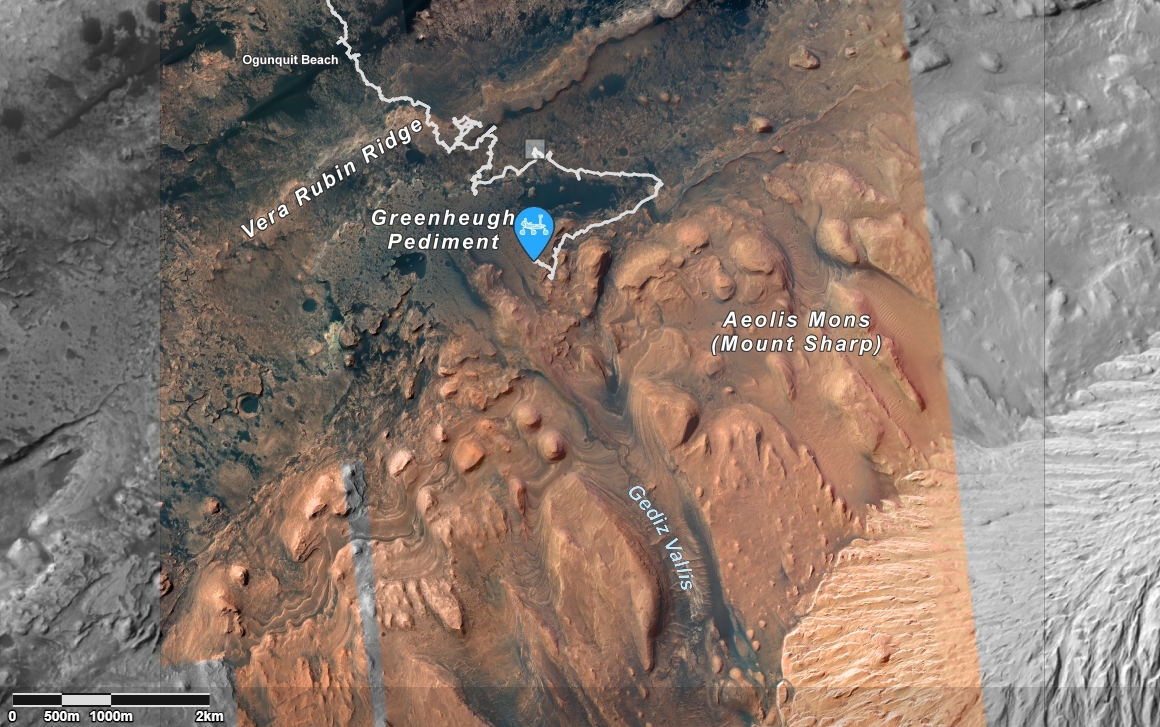
Curiosity’s location as of Sol 3420. Distance driven at that Sol, 17.04 miles/27.42 kilometers.
Credit: NASA/JPL-Caltech/Univ. of Arizona
NASA’s Curiosity Mars rover at Gale Crater is now wrapping up Sol 3422 duties.
Lauren Edgar, a planetary geologist at USGS Astrogeology Science Center in Flagstaff, Arizona, reports that the robot is investigating the different surface expressions of the Greenheugh pediment. Last weekend’s drive put the rover next to some “gator-back terrain.”
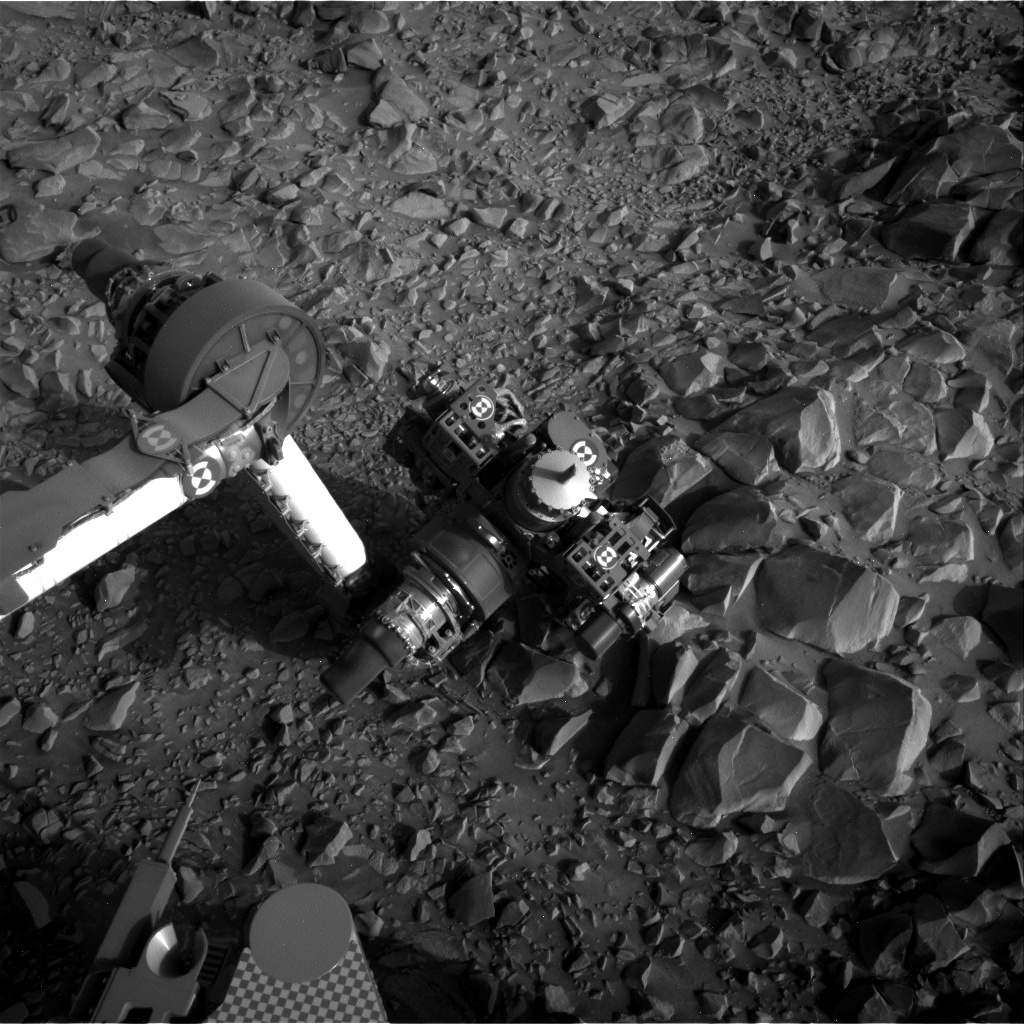
Curiosity Right B Navigation Camera image acquired on Sol 3421, March 22, 2022.
Credit: NASA/JPL-Caltech
That’s some evenly spaced ridges with a blocky expression, Edgar adds. A recent one sol (Sol 3421) plan is focused on a close encounter with one of these ridges through contact science and remote sensing.
Sedimentary structures
Edgar explains that the Chemistry and Camera (ChemCam) Laser Induced Breakdown Spectroscopy (LIBS) observation of “Scandal Beck” is to assess the chemistry of the blocky outcrop.
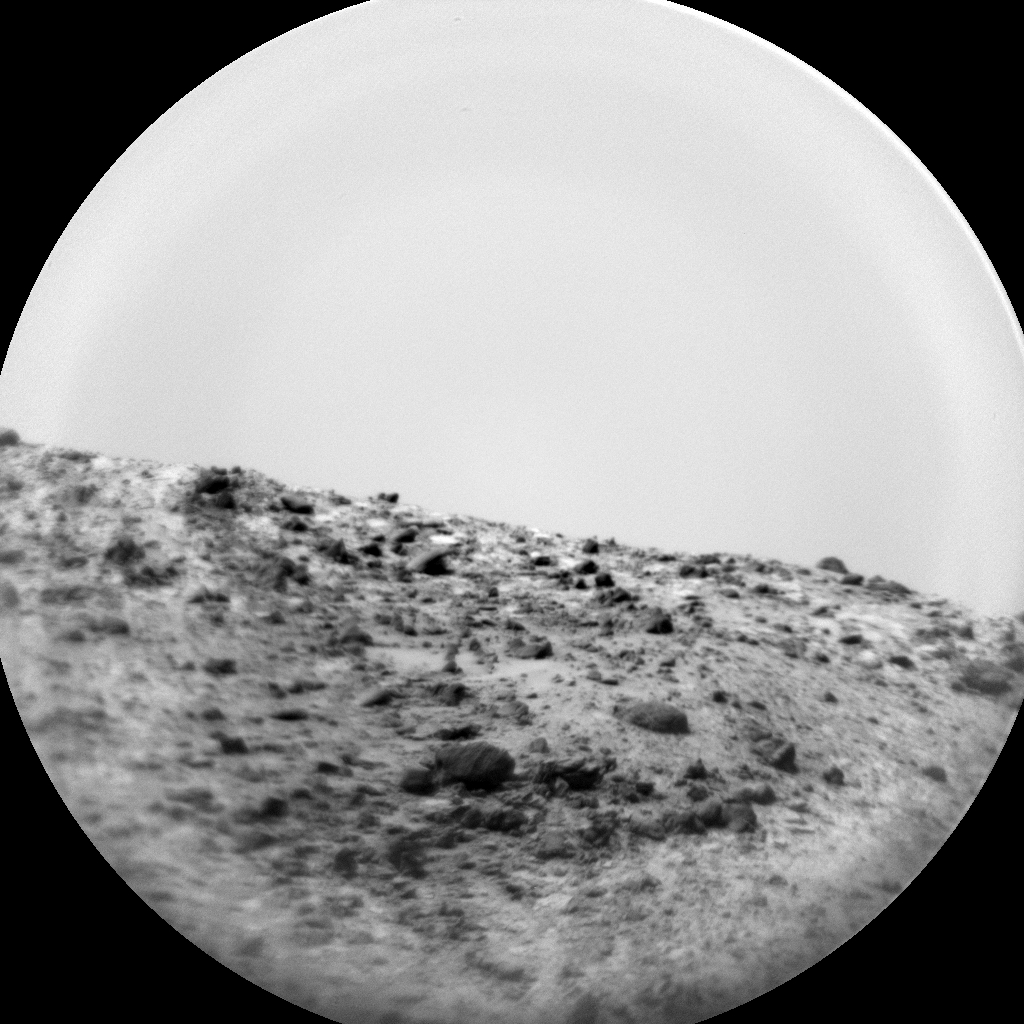
Curiosity Chemistry & Camera (ChemCam) Remote Micro-Imager (RMI) photo taken on Sol 3421, March 22, 2022.
Credit: NASA/JPL-Caltech/LANL
“Then we’ll acquire 2 long-distance RMI [Remote Micro-Imager] mosaics to investigate the stratigraphy exposed in Gediz Vallis ridge. Afterwards, Mastcam will take two large mosaics to look at the sedimentary structures exposed in the “gator-back” ridge and characterize the erosion of these blocks,” Edgar notes.
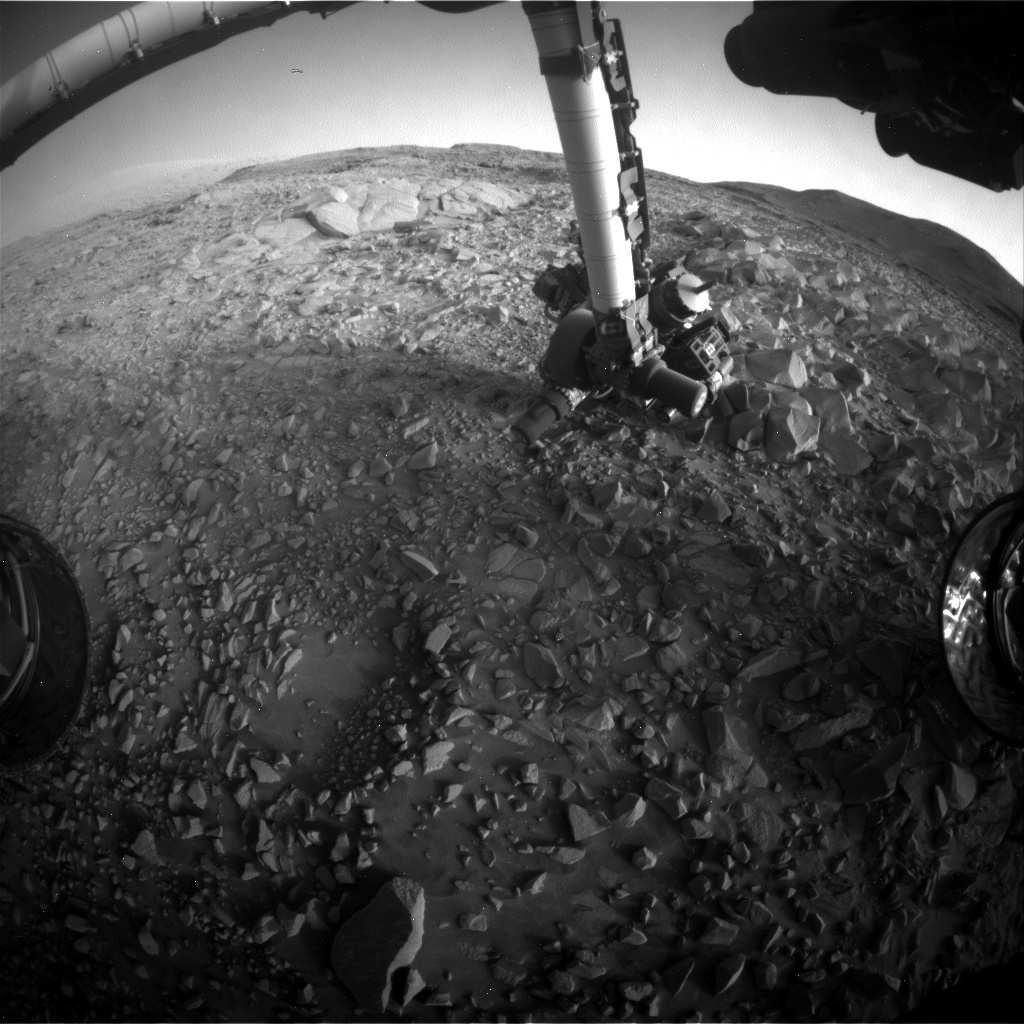
Curiosity Front Hazard Avoidance Camera Right B image taken on Sol 3422, March 23, 2022.
Credit: NASA/JPL-Caltech
The rover was then slated to also take a Navcam dust devil survey now that Curiosity has entered the dusty season on Mars. In the afternoon, the plan called for the Mars Hand Lens Imager (MAHLI) to take a closer look at the grain size of these rocks at the target “Calder,” followed by an overnight Alpha Particle X-Ray Spectrometer (APXS) integration to learn about its chemistry.
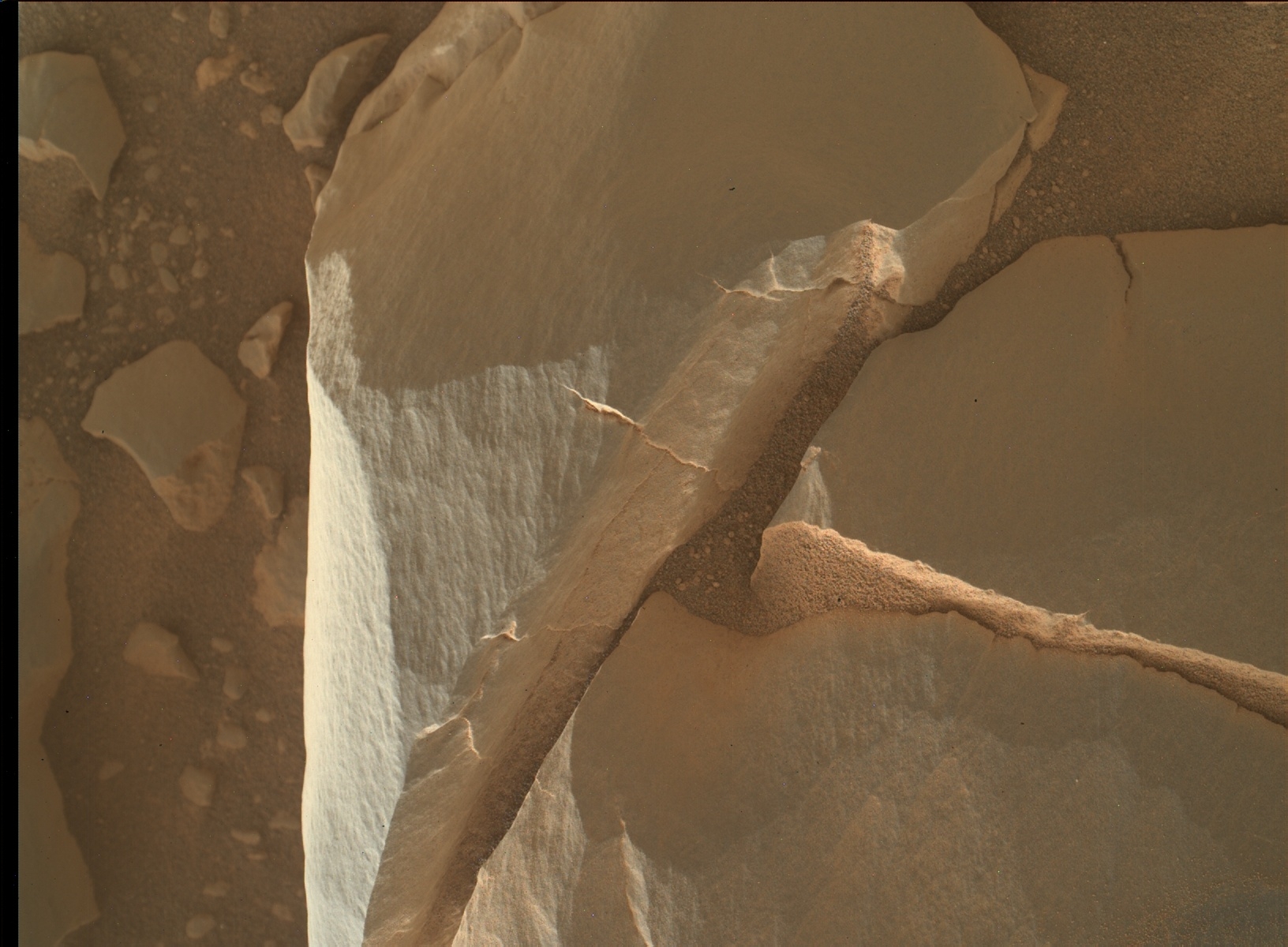
Curiosity Mars Hand Lens Imager (MAHLI) photo produced on Sol 3422, March 23, 2022.
Credit: NASA/JPL-Caltech/MSSS
Good vantage point
Early the next morning Mastcam, Edgar reports, the script calls for the rover to acquire a mosaic of Gediz Vallis ridge “to document this feature from our good vantage point and morning lighting conditions.”
Prior to arriving on the Greenheugh pediment, the team had been intrigued by the “washboard texture” preserved on its surface, as identified in orbital images.
“Now that we’re here,” Edgar concludes, “it’s quite surprising to see how rugged it is, and the informal description of this “gator-back terrain” seems very fitting!”
Textural transition
In an earlier report, Mark Salvatore, a planetary geologist at the University of Michigan, explains that after Curiosity made a drive of roughly 49 feet (15 meters) to the west along the top of the Greenheugh Pediment, the robot was in position at an interesting textural transition within the pediment’s surface units.
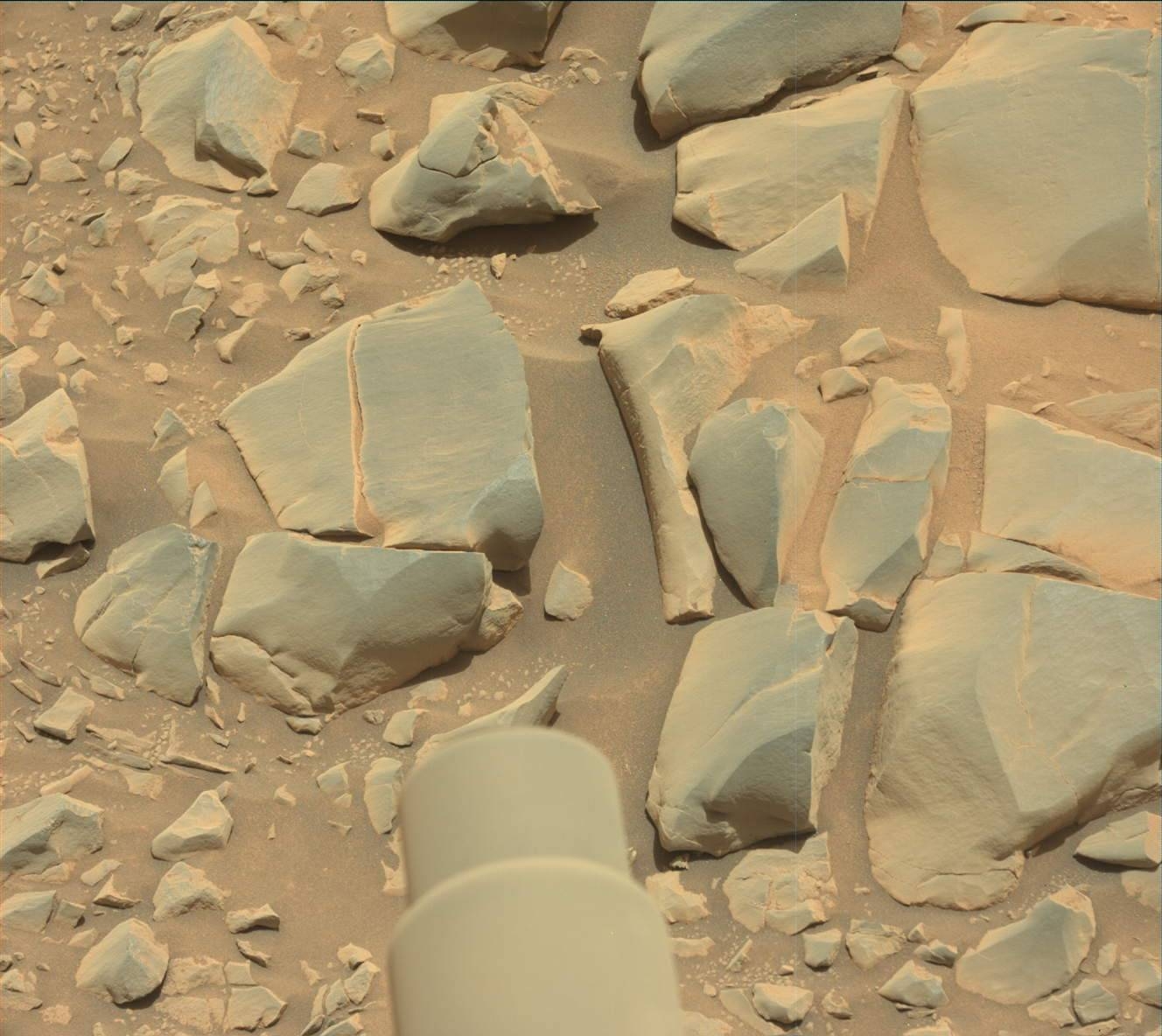
Curiosity Mast Camera Left image acquired on Sol 3420, March 21, 2022.
Credit: NASA/JPL-Caltech/MSSS
“Quite a large amount of the pediment is dominated by a washboard-like pattern at the surface that can be easily observed from orbit, while the region Curiosity ascended onto the pediment surface is rugged yet lacks those clear washboard-like features,” Salvatore observes. “With this latest drive, Curiosity is now positioned at the transition between these two surface units, and the team is continuing to assess the traversability of these units.”
Landscape ahead
With this new vantage point, the plan is for Curiosity to characterize the different morphological features observed on top of the pediment. Several Mastcam imaging sequences were designed to characterize the washboarding that is observed in the landscape ahead of the rover.
The terrain’s small-scale roughness and oriented ventifacted rocks led the Science Team to informally refer to these textures as “gator-back terrain.”
Curiosity was on tap to also perform two ChemCam LIBS analyses on two different targets – a smooth outcrop target named “Macmerry” and a rougher knobby target named “Ochiltree.”
Planned drive to the west
After a ChemCam passive sky observation around midday on sol 3419, Curiosity, the plan called for the rover to unstow its arm to conduct an APXS integration on the outcrop target named “Blackadder” and an overnight APXS measurement to characterize the martian atmosphere.
On sol 3420, Curiosity was scheduled to complete Mastcam and ChemCam observations (including a long-distance remote imaging mosaic) before embarking on a planned drive of roughly 115 feet (35 meters) to the west to continue the investigation of the pediment and the interesting surface textures found on its surface, Salvatore reports.
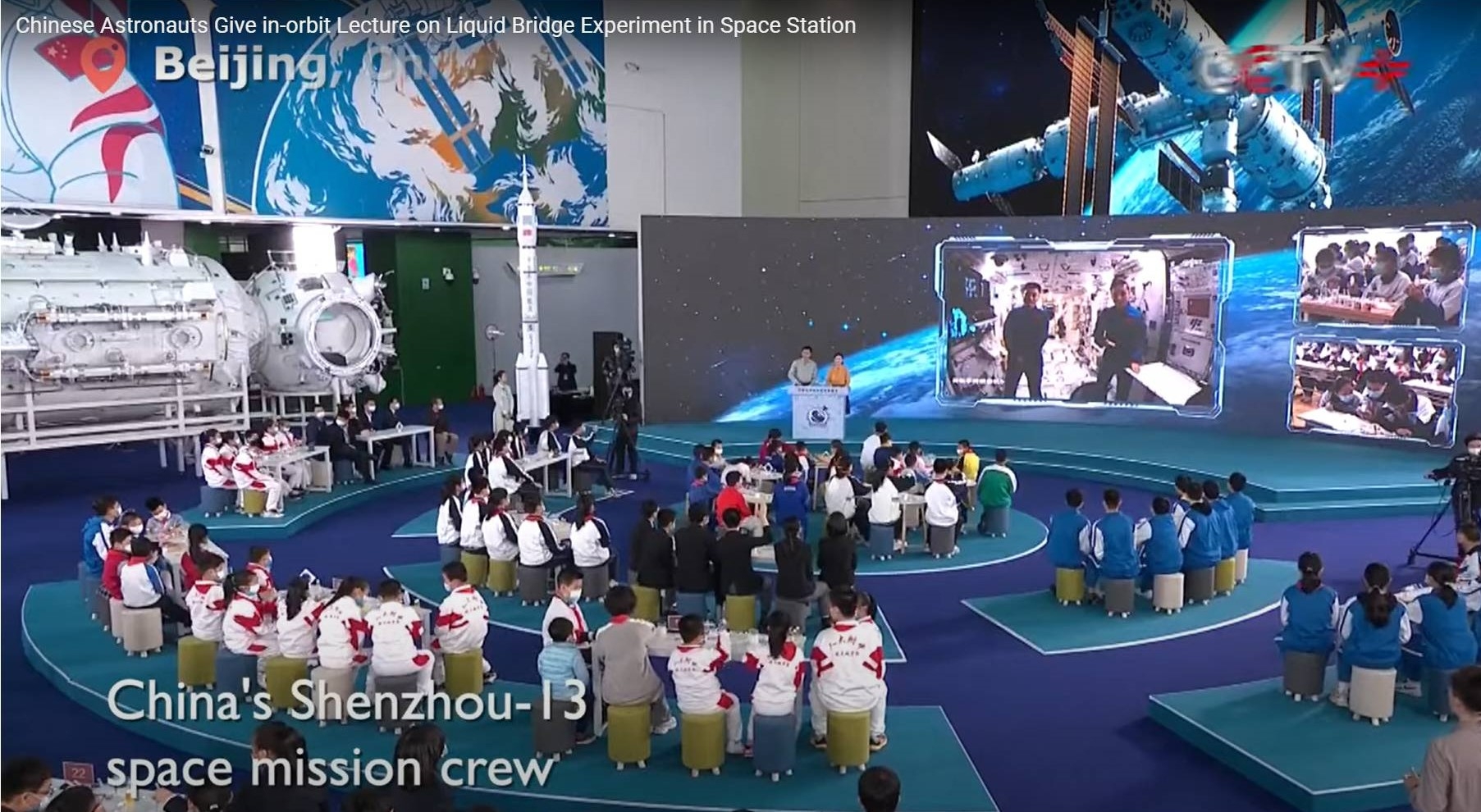
Credit: CCTV Video News Agency/Inside Outer Space screengrab
China’s Shenzhou-13 crew turned the in-construction Tiangong space station into an off-Earth school house, giving assembled students a lecture on the impact of microgravity on processes.
The lecture given by Zhai Zhigang, Wang Yaping and Ye Guangfu, was broadcast live worldwide by China Media Group (CMG). The experiment demonstrated how oil is separated from water by a centrifugal force in a gravity-free condition.
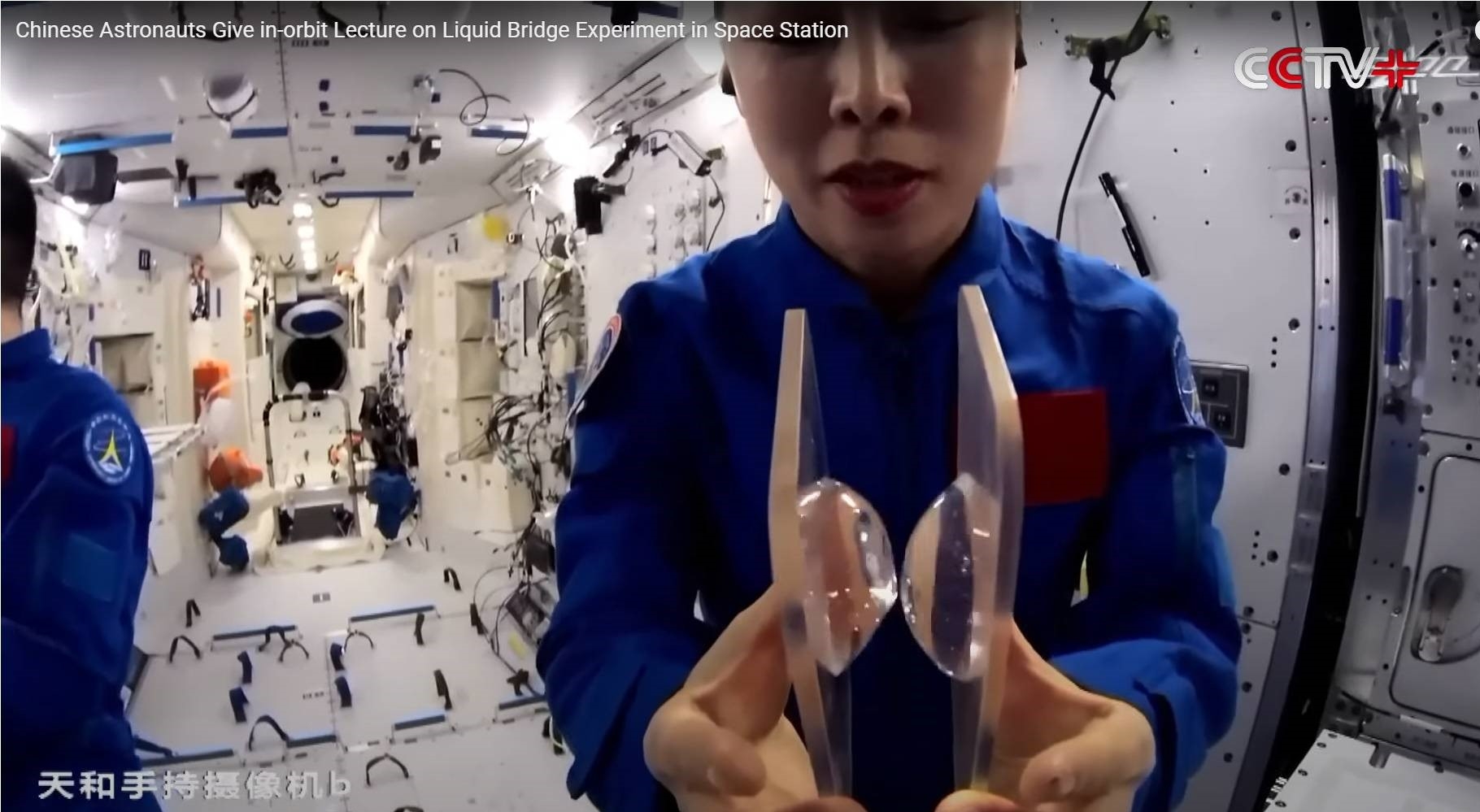
Credit: CCTV Video News Agency/Inside Outer Space screengrab
The Tiangong space station is equipped with a centrifuge, which is used for the separation of medical samples like blood and urine.
Liquid bridge
China’s Shenzhou-13 astronauts have completed more than 20 scientific experiments in orbit, carrying out research in the Tianhe space station core module.
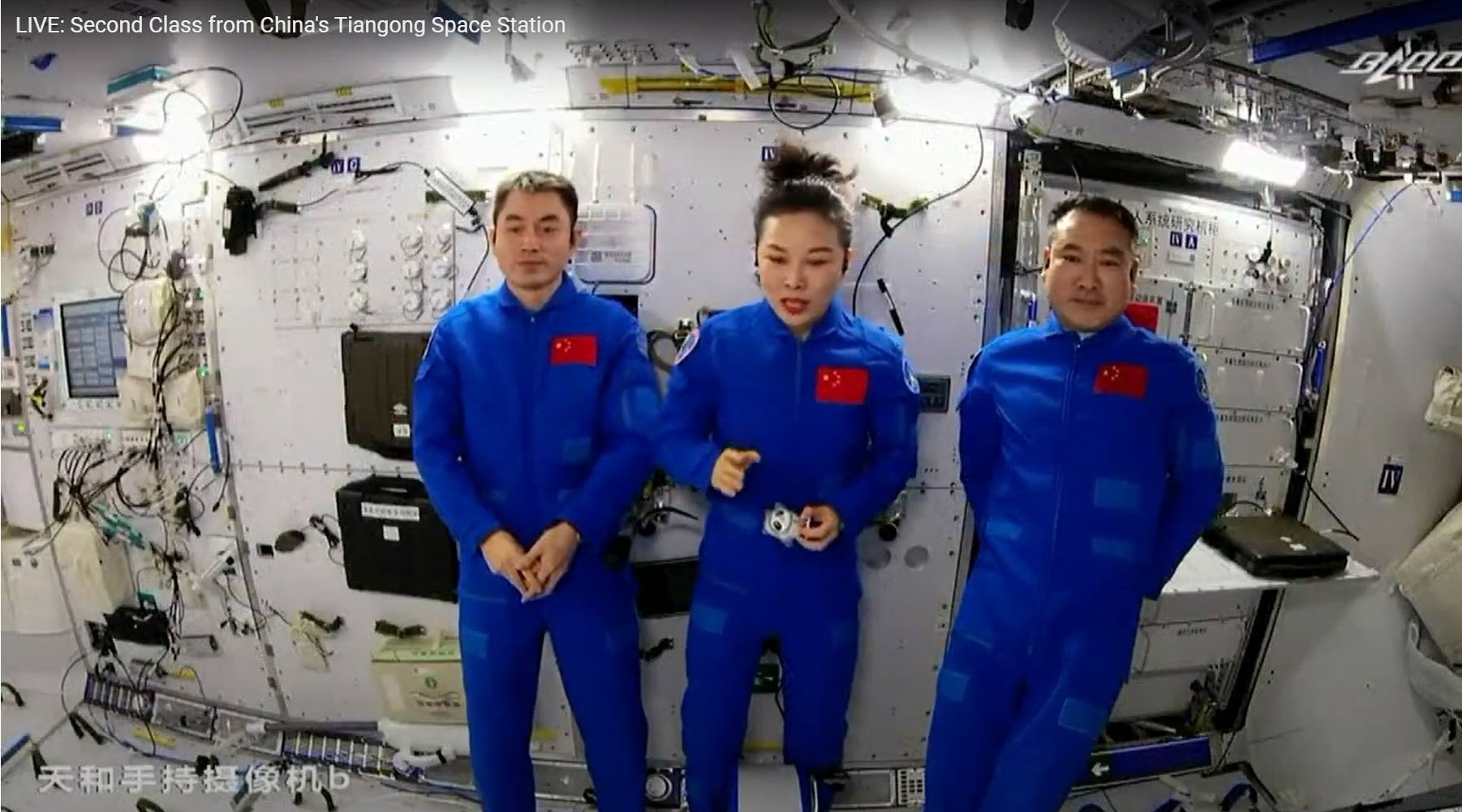
Credit: CCTV Video News Agency/Inside Outer Space screengrab
The Shenzhou-13 crew gave a special in-orbit lecture on knowledge about surface tension of liquid, and conducted a liquid bridge experiment to students on the Earth Wednesday afternoon.
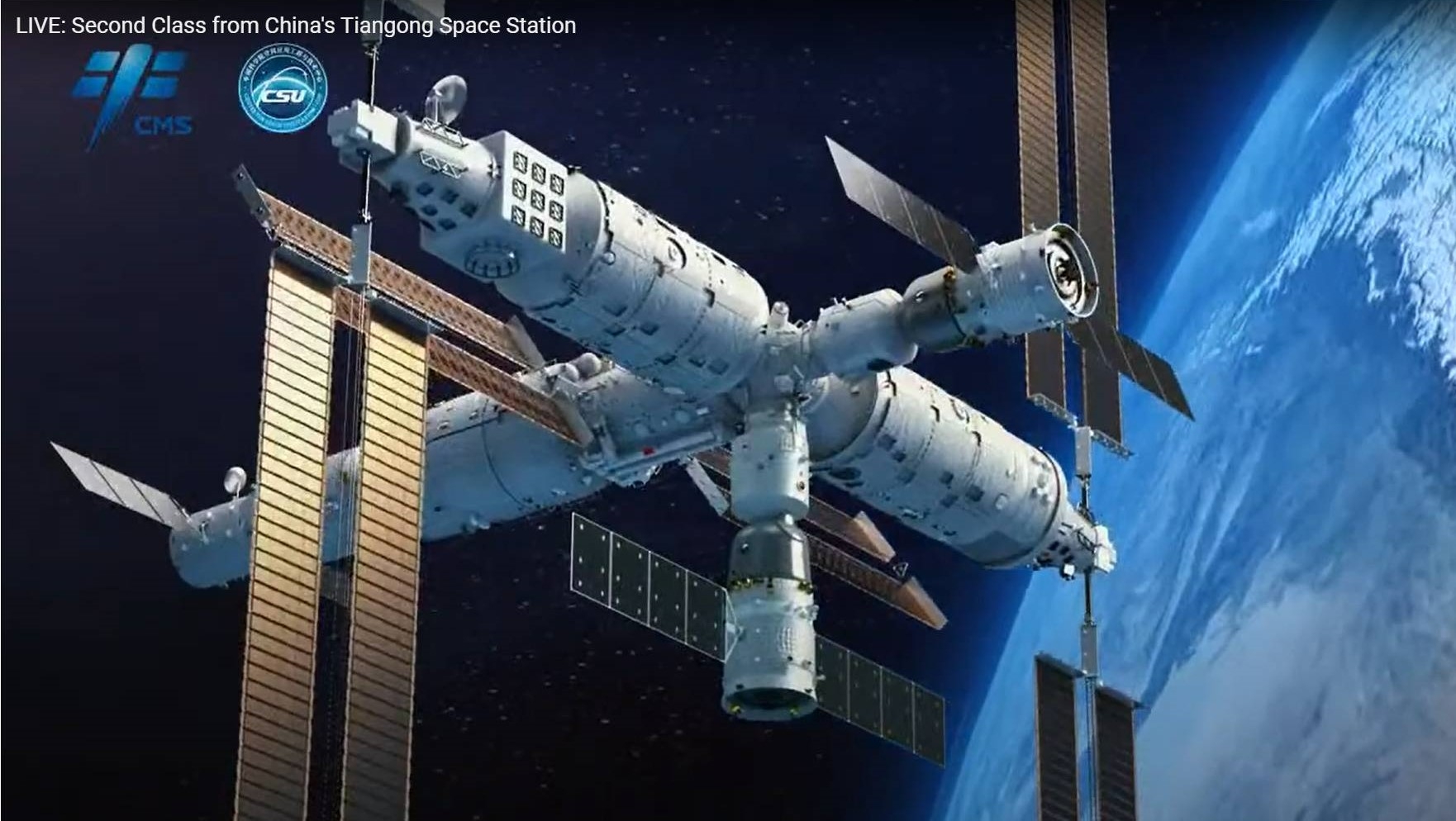
CCTV Video News Agency/Inside Outer Space screengrab
During the lecture, details were given regarding experiment racks that will be installed on the orbiting complex this year.
To view newly issued videos on this second class from China’s Tiangong space station go to:
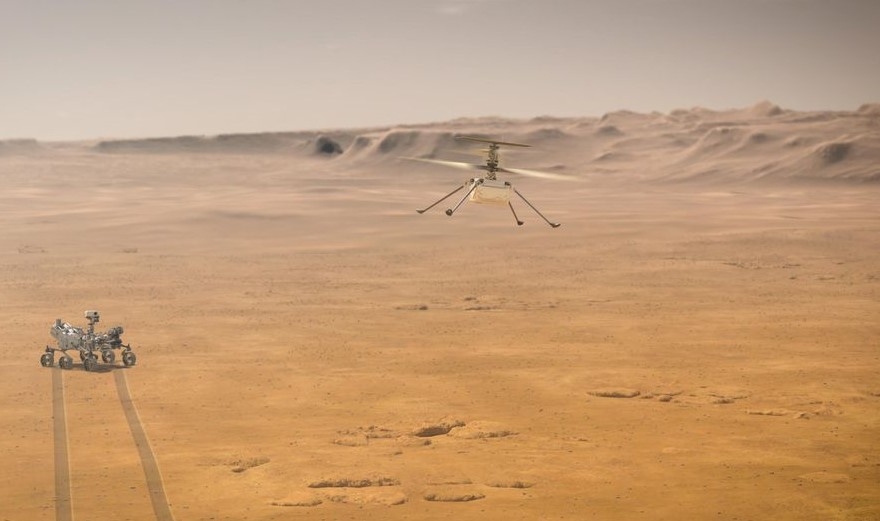
Photo credit: NASA/JPL-Caltech
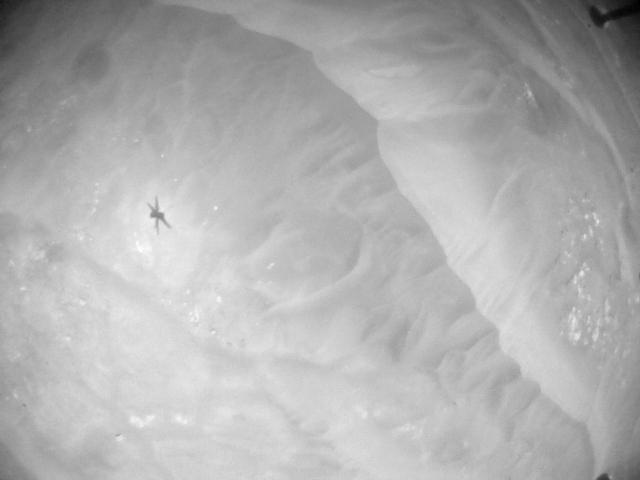
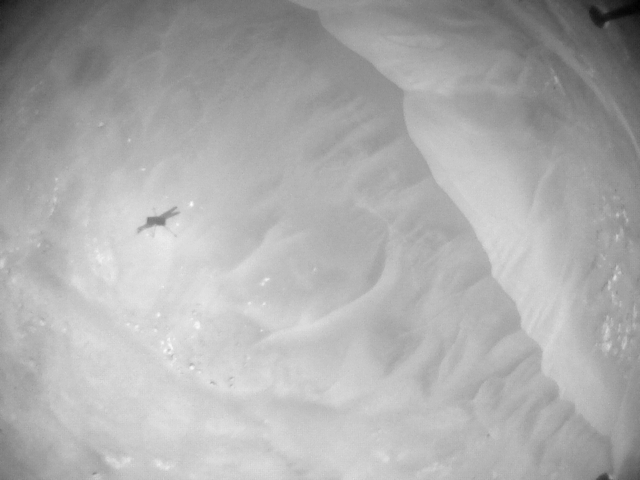
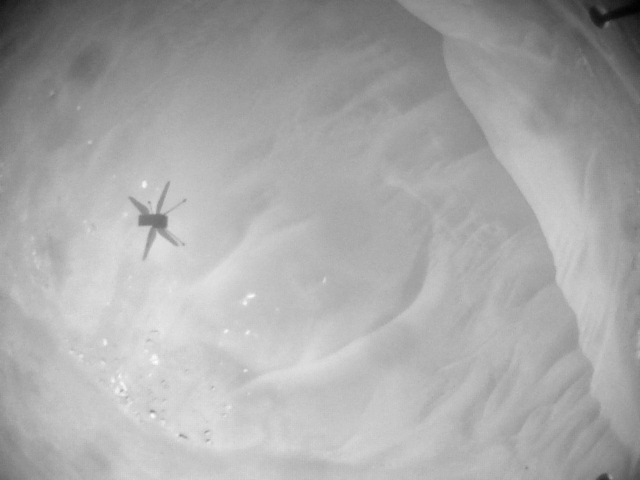
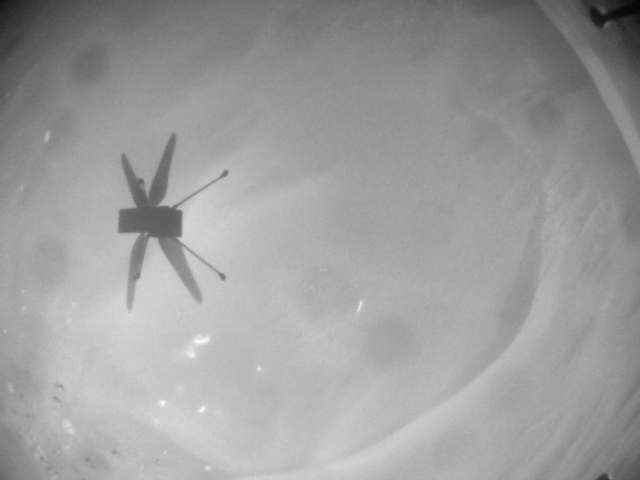
NASA’s Mars helicopter has performed its 22nd flight over last weekend.
The trip lasted 101.4 seconds and Ingenuity got up to 33 feet (10 meters) in the air.
Word from the JPL team is that another flight could take place perhaps as early as later this week.
The rotorcraft is on its way to setting more records during its second year of operations. NASA has extended Ingenuity’s flight operations through September as it continues with scouting efforts for the NASA Perseverance rover.
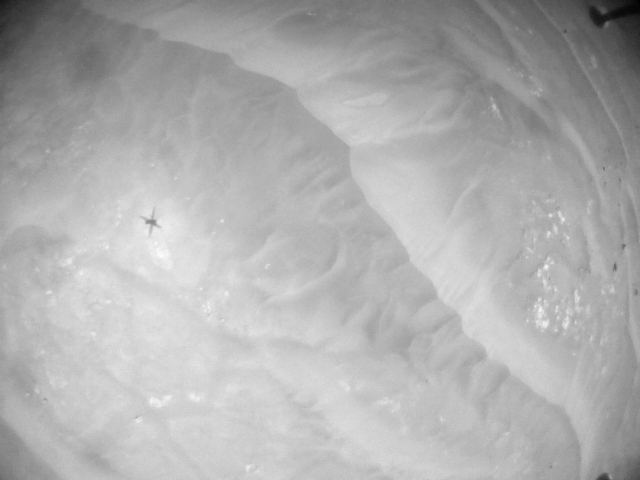
Meanwhile, the first flight 22 photos have been posted, taken by the craft’s Navigation Camera mounted in the helicopter’s fuselage and pointed directly downward to track the ground during flight.
These images were acquired on March 20, 2022 (Sol 384 of the Perseverance rover mission):
Credit: NASA/JPL-Caltech
Credit: NASA/JPL-Caltech
Credit: NASA/JPL-Caltech
Credit: NASA/JPL-Caltech
Credit: NASA/JPL-Caltech
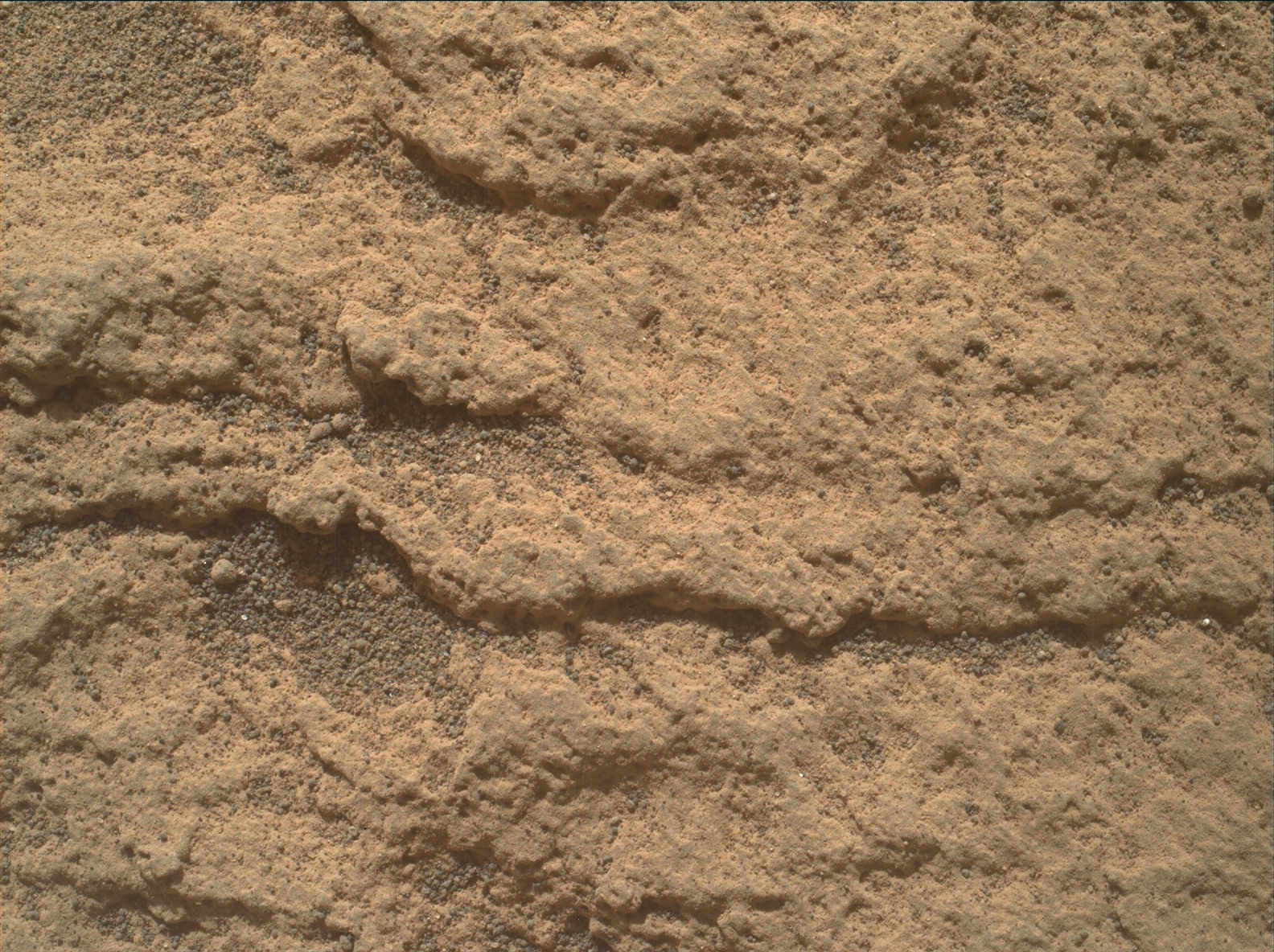
Curiosity Mars Hand Lens Imager Sol 3420 photo produced on March 21, 2022.
Credit: NASA/JPL-Caltech/MSSS
NASA’s Curiosity Mars rover at Gale Crater is now performing Sol 3421 duties.
Reports Mark Salvatore, a planetary geologist at the University of Michigan, after the robot made a drive of roughly 50 feet (15 meters) drive to the west along the top of the Greenheugh Pediment, Curiosity is now positioned at an interesting textural transition within the pediment’s surface units.
“Quite a large amount of the pediment is dominated by a washboard-like pattern at the surface that can be easily observed from orbit, while the region Curiosity ascended onto the pediment surface is rugged yet lacks those clear washboard-like features,” Salvatore said. “With this latest drive, Curiosity is now positioned at the transition between these two surface units, and the team is continuing to assess the traversability of this units.”
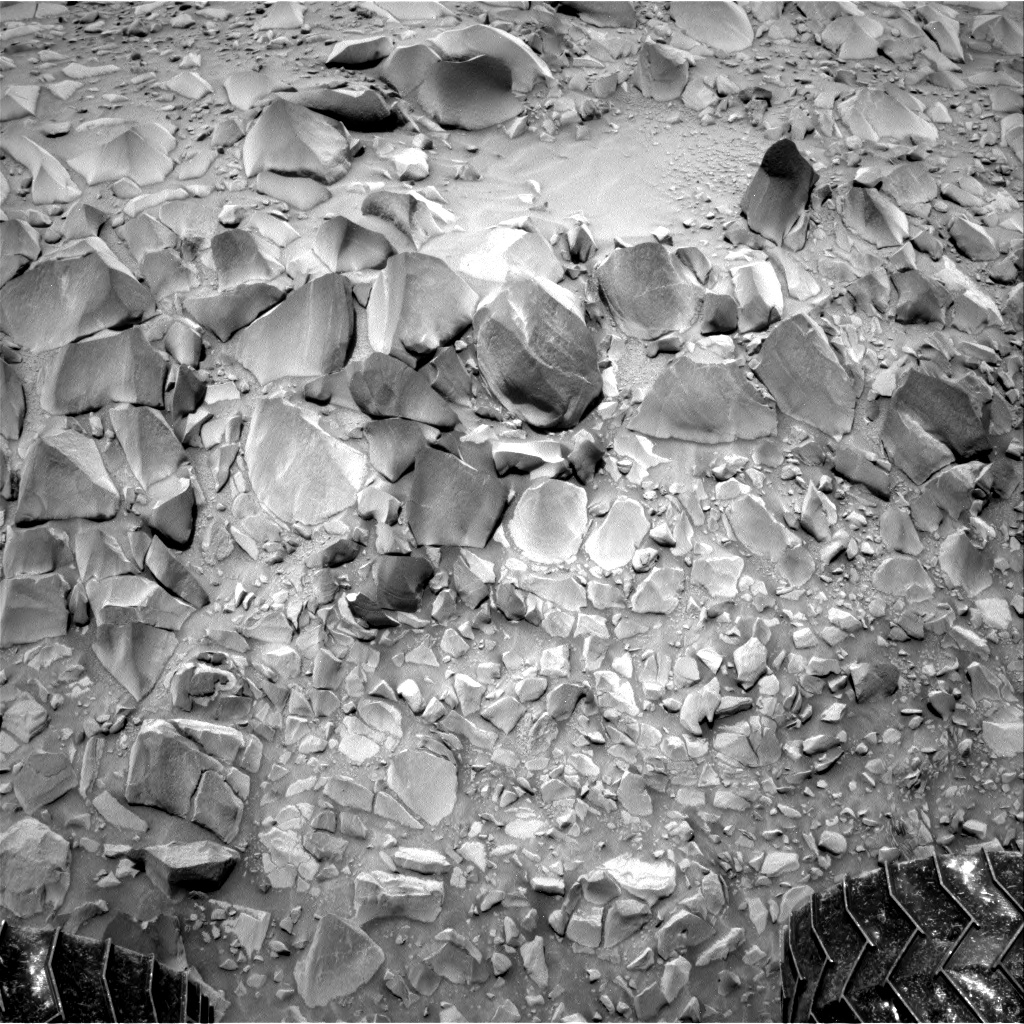
Curiosity Right B Navigation Camera photo acquired on Sol 3420, March 21, 2022.
Credit: NASA/JPL-Caltech
Washboarding
Given the robot’s new vantage point, the plan is for Curiosity to spend time characterizing the different morphological features observed on top of the pediment.
The last weekend plan was scripted to start with several Mastcam imaging sequences designed to characterize the washboarding that is observed in the landscape ahead of the rover.
The terrain’s small-scale roughness and oriented ventifacted rocks led the science team to informally refer to these textures as “gator-back terrain.”
Curiosity was also slated to perform two Chemistry and Camera (ChemCam) Laser Induced Breakdown Spectroscopy (LIBS) analyses on two different targets – a smooth outcrop target named “Macmerry” and a rougher knobby target named “Ochiltree.”
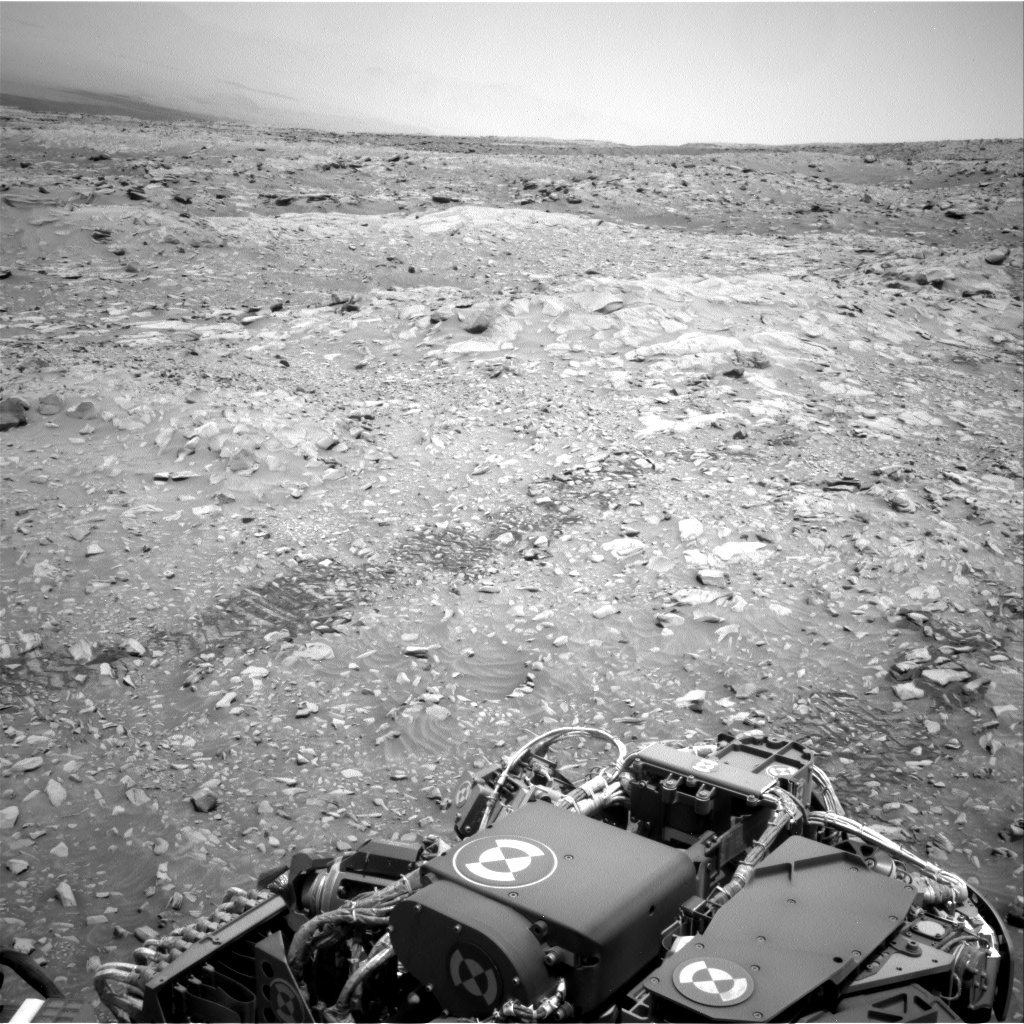
Curiosity Right B Navigation Camera photo acquired on Sol 3420, March 21, 2022.
Credit: NASA/JPL-Caltech
Planned drive
After a ChemCam passive sky observation around midday on sol 3419, Curiosity was set to unstow its robotic arm to conduct a Alpha Particle X-Ray Spectrometer (APXS) integration on the outcrop target named “Blackadder” and an overnight APXS measurement to characterize the martian atmosphere.

Curiosity Left B Navigation Camera image taken on Sol 3420, March 21, 2022.
Credit: NASA/JPL-Caltech
Salvatore lastly reports, on Sol 3420, Curiosity was scheduled to complete Mastcam and ChemCam observations (including a long-distance remote imaging mosaic) before embarking on a planned drive of approximately 115 feet (35 meters) drive to the west to continue the investigation of the pediment and the interesting surface.

China’s space station to be completed by end of 2022.
Credit: CCTV/Inside Outer Space screengrab
China’s space station is a work-in-progress, with two new modules — Wentian and Mengtian — being readied for launch this year to the low Earth orbit construction site.
According to the Technology and Engineering Center for Space Utilization (CSU) under the Chinese Academy of Sciences, a set of multidisciplinary “frontier scientific experiments” are to be performed on the Tiangong space station.
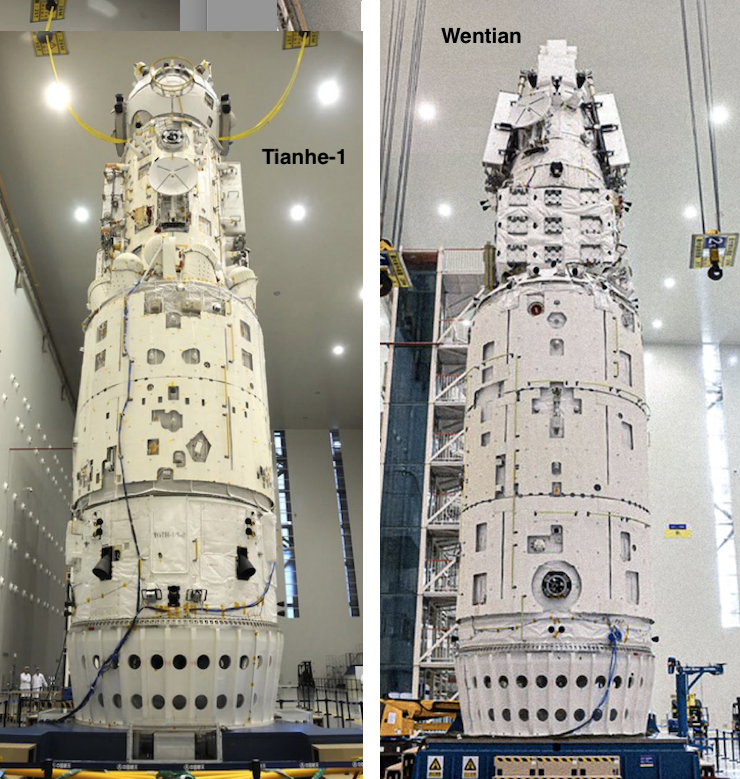
Next up station modules.
Credit: CNSA
The Xinhua news agency reports that the experiments include raising fish, growing vegetables, setting up the most precise clocks in space, developing new materials, studying physical laws and exploring how humans can survive in space for long periods.
Experiment racks
Testing work on the experiment racks has begun, already installed in the Tianhe core module, which was launched last year. These will be used for container-free material science and high microgravity experiments, said Zhang Wei, director of the Utilization Development Center of CSU.

Credit: CCTV/Inside Outer Space screengrab
Additional experiment racks will be included in the two lab modules, focused on fluids, space materials, fundamental physics and combustion, together with the extravehicular experiment platform, Zhang said.
Zhang reports that more than 10 life-science experiments on plants, animals and microbial cells will be carried out in the Wentian lab module, including a small closed ecosystem composed of small fish, microorganisms and algae, adds the Xinhua story.
Atomic clock
The Mengtian lab module is to house the world’s first space-based cold atomic clock consisting of a hydrogen clock, a rubidium clock and an optical clock.
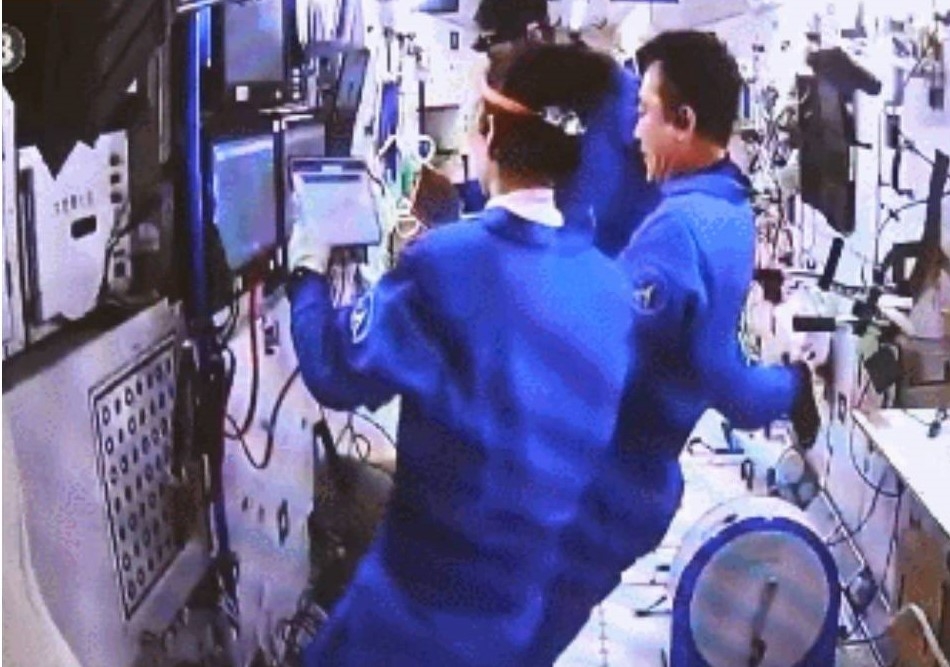
Shenzhou-13 crew now wrapping up 6 month flight.
Credit: CCCTV/China Media Group
Space cold atomic clock technology is expected to contribute to higher-precision satellite positioning and navigation, and support fundamental physics research such as dark matter probes and gravitational wave detection.
Gao Ming, director of the CSU and general director of the space application system of China’s human spaceflight program, added that a number of scientific research facilities have been developed to support more than 1,000 in-orbit research projects.
A ground experiment base in Huairou Science City in the northeastern suburbs of Beijing is being built. It will provide experimental conditions similar to those of the space station enabling ground verification for the space station program, and to support space-earth comparison experiments, Zhang said.

Shenzhou-13 crew members.
Credit: CNS/Inside Outer Space screengrab
Public lecture
Meanwhile, the currently orbiting crew members aboard China’s core station — the Shenzhou-13 astronauts Zhai Zhigang, Wang Yaping and Ye Guangfu – are set to livestream their second public lecture this week.
The first lecture in the “Tiangong Class” series was delivered on Dec. 9, 2021.
The Shenzhou-13 crew entered the Tianhe core module of China’s space station on October 16, 2021 and are now wrapping up a six-month stay in space – China’s longest-ever crewed mission. They are expected to return to Earth in mid-April.
Credit: NASA/JPL/UArizona
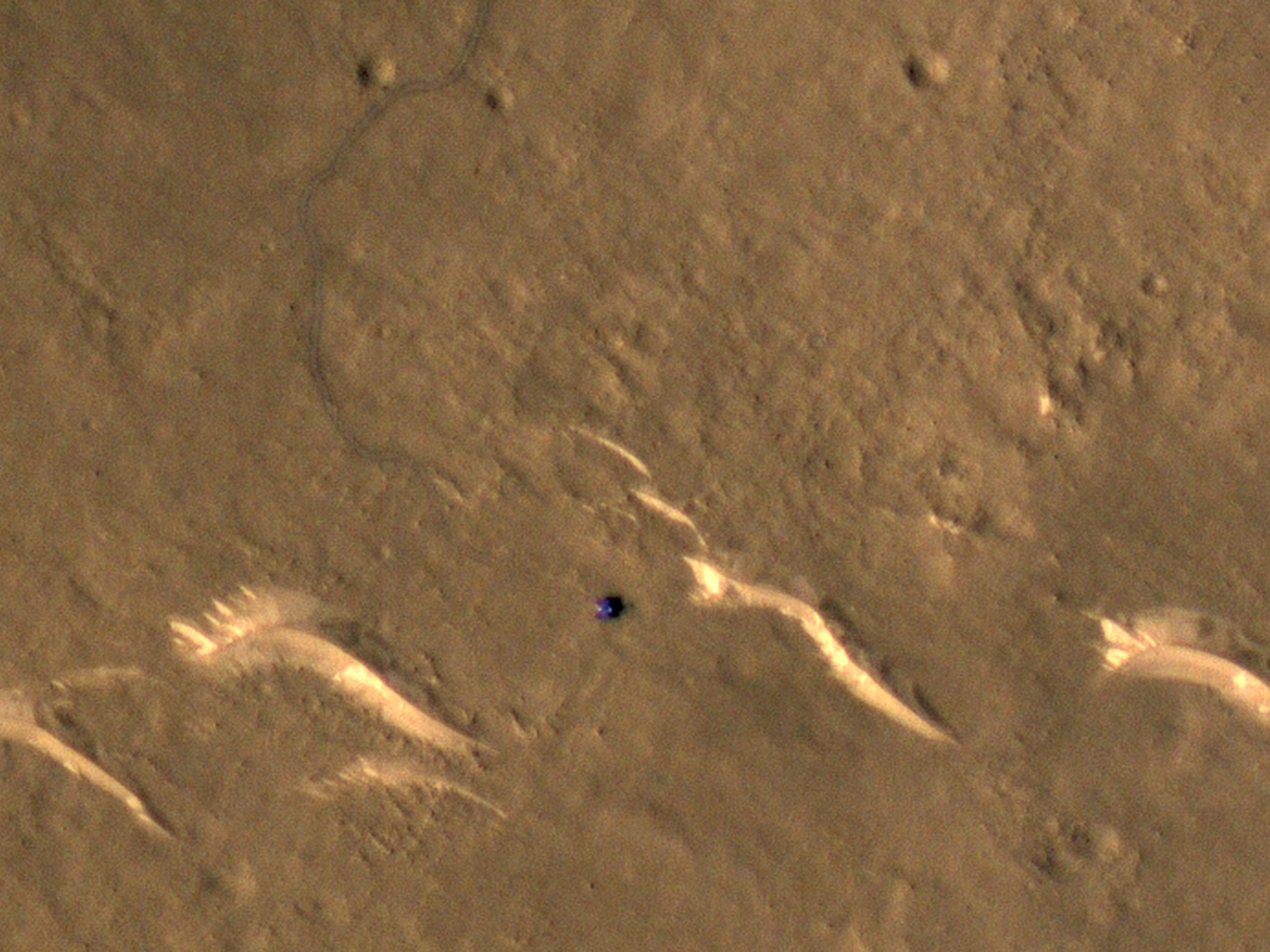
That super-powerful camera — HiRISE (High Resolution Imaging Science Experiment) – aboard NASA’s Mars Reconnaissance Orbiter (MRO) has snagged new imagery of the Chinese Zhurong rover.
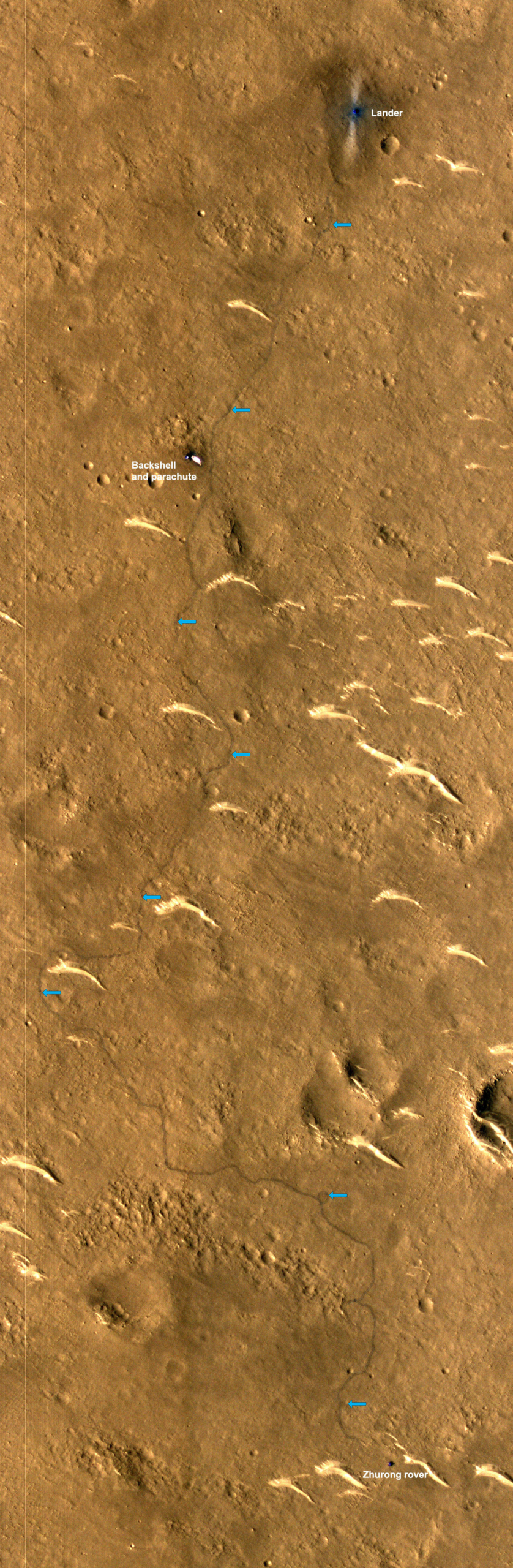
This cutout highlights the rover and the rover’s path (with contrast enhanced to better reveal the tracks). Credit: NASA/JPL/UArizona
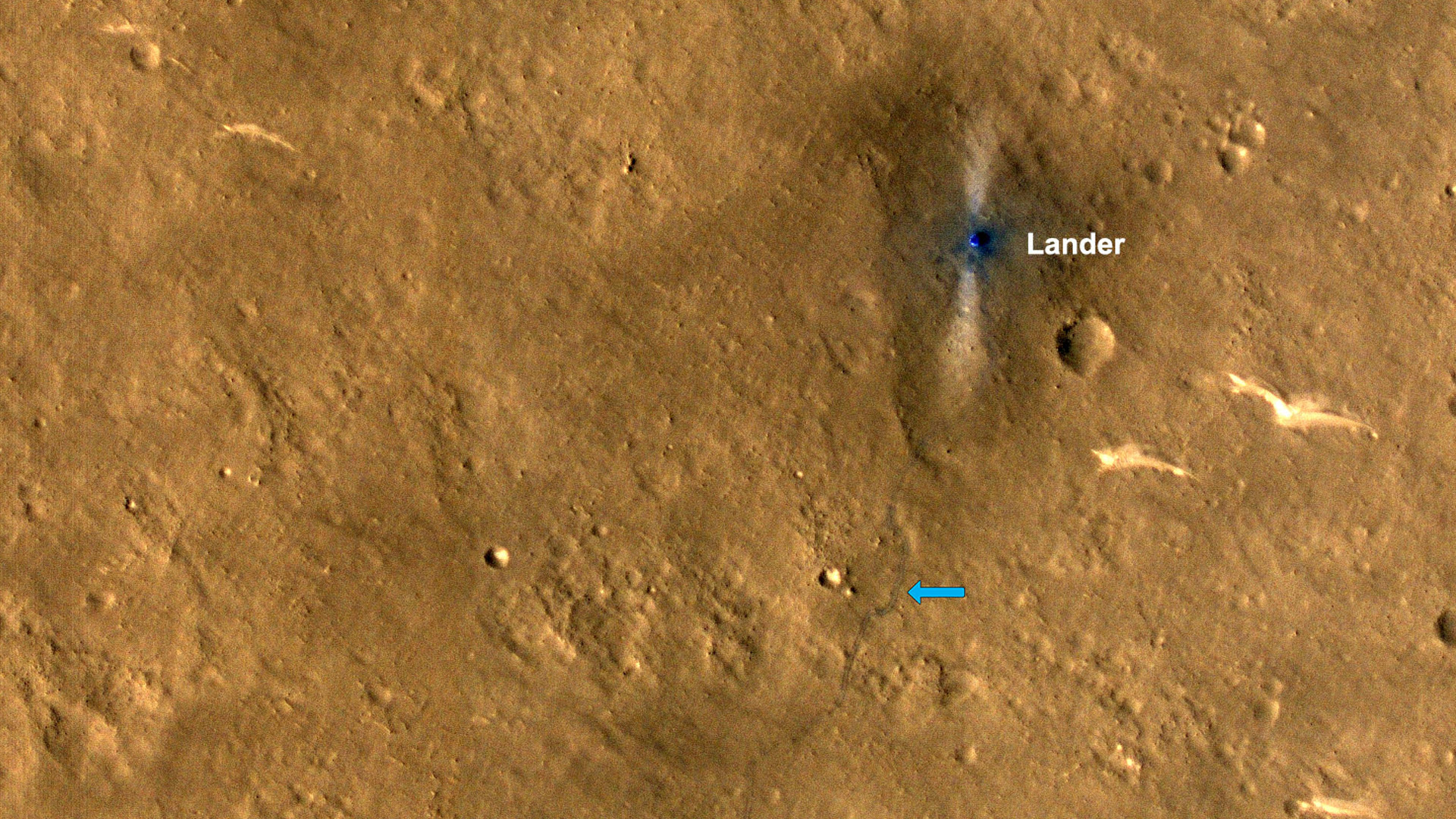
This HiRISE image, acquired March 11, 2022, shows how far the rover has traveled in the 10 months since it landed in May 2021.
MRO’s altitude above Mars when the imagery was taken: 179.3 miles (288.5 kilometers).
“In fact, its exact path can be traced from the wheel tracks left on the surface. It has traveled south for roughly 1.5 kilometers (about 1 mile),” notes HiRISE principal investigator, Alfred McEwen at the University of Arizona in Tucson.

China’s Zhurong Rover.
Credit: CNSA/Inside Outer Space screengrab
Credit: NASA/JPL/UArizona
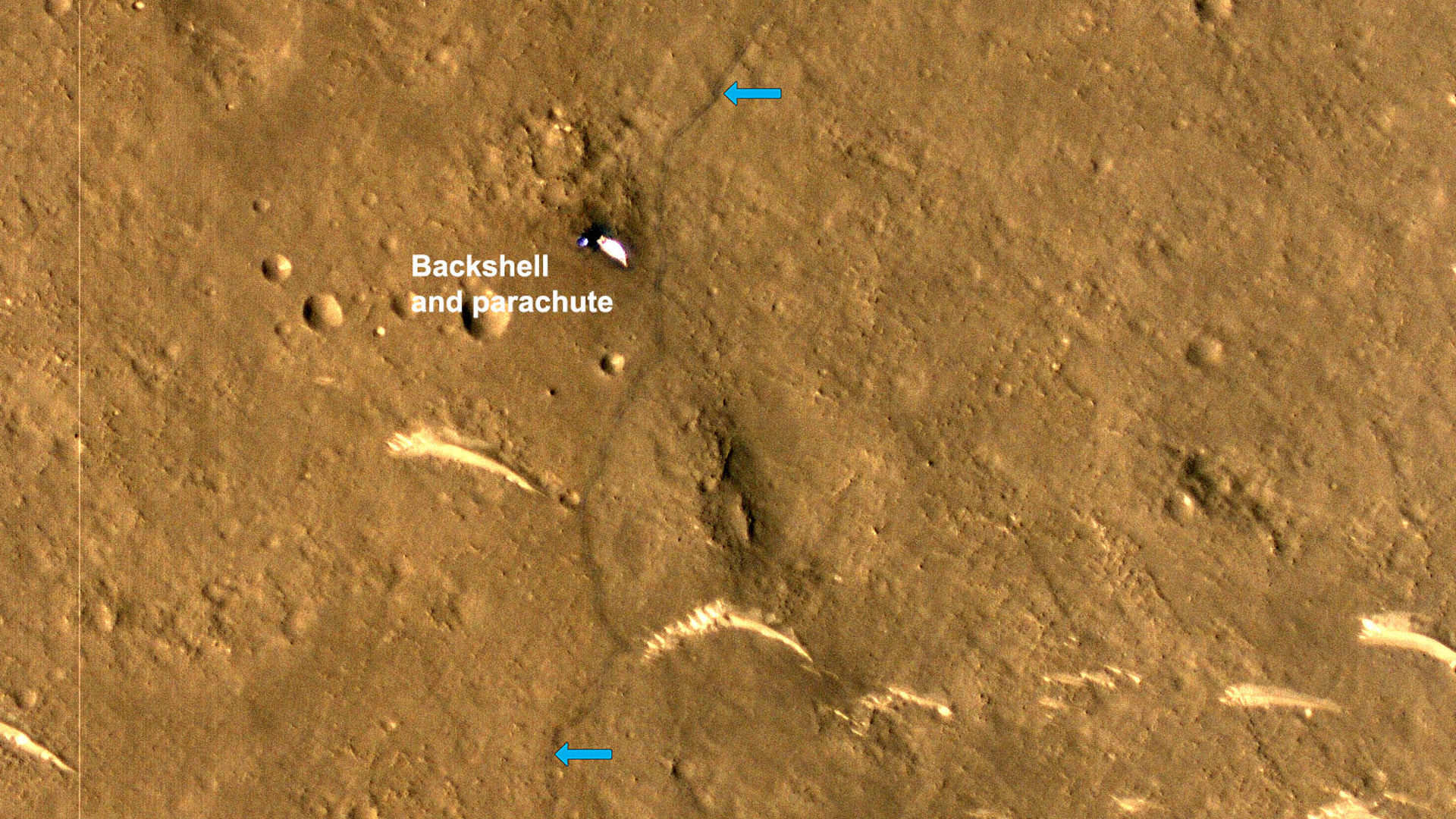
Credit: NASA/JPL/UArizona
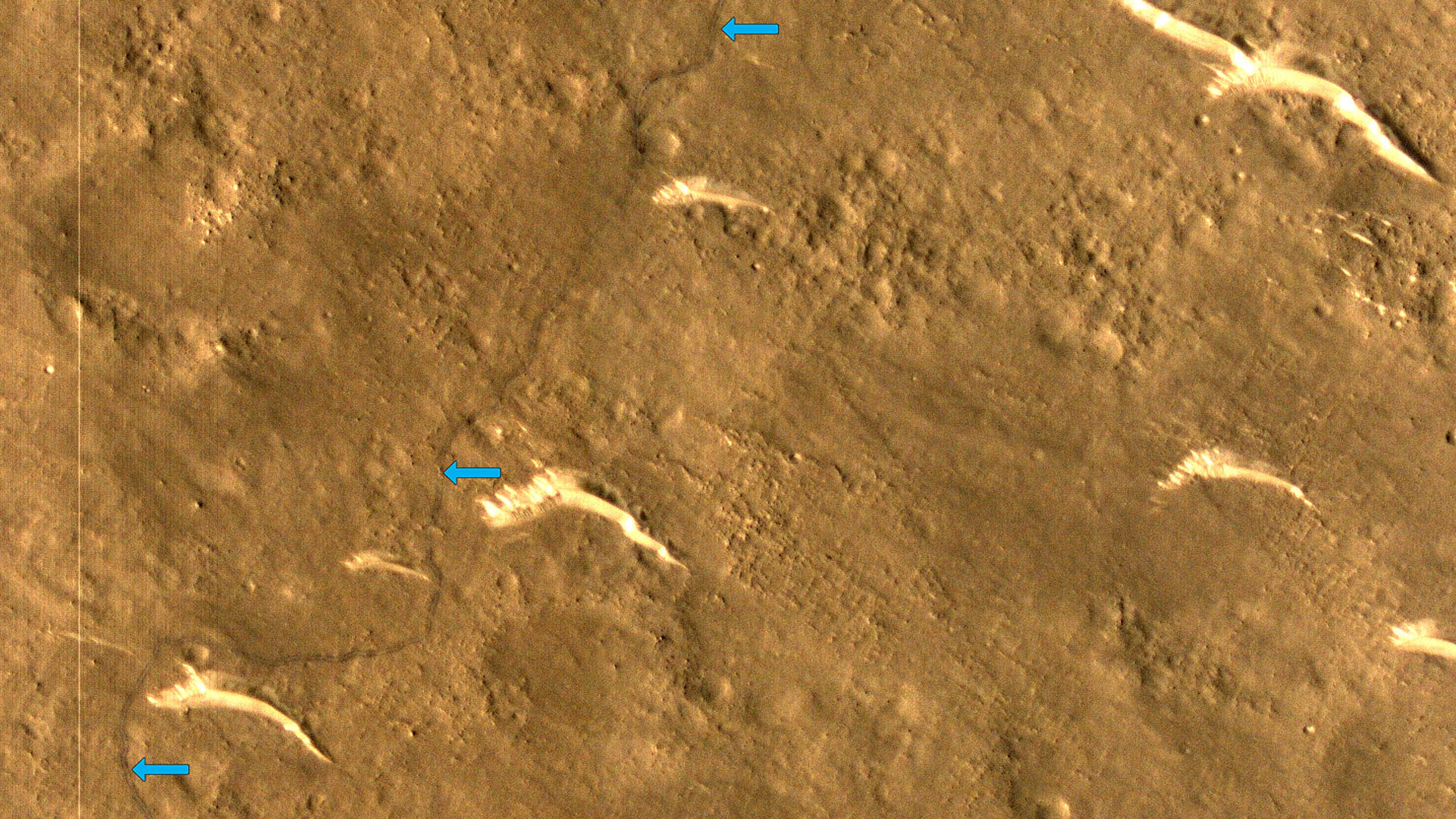
Credit: NASA/JPL/UArizona
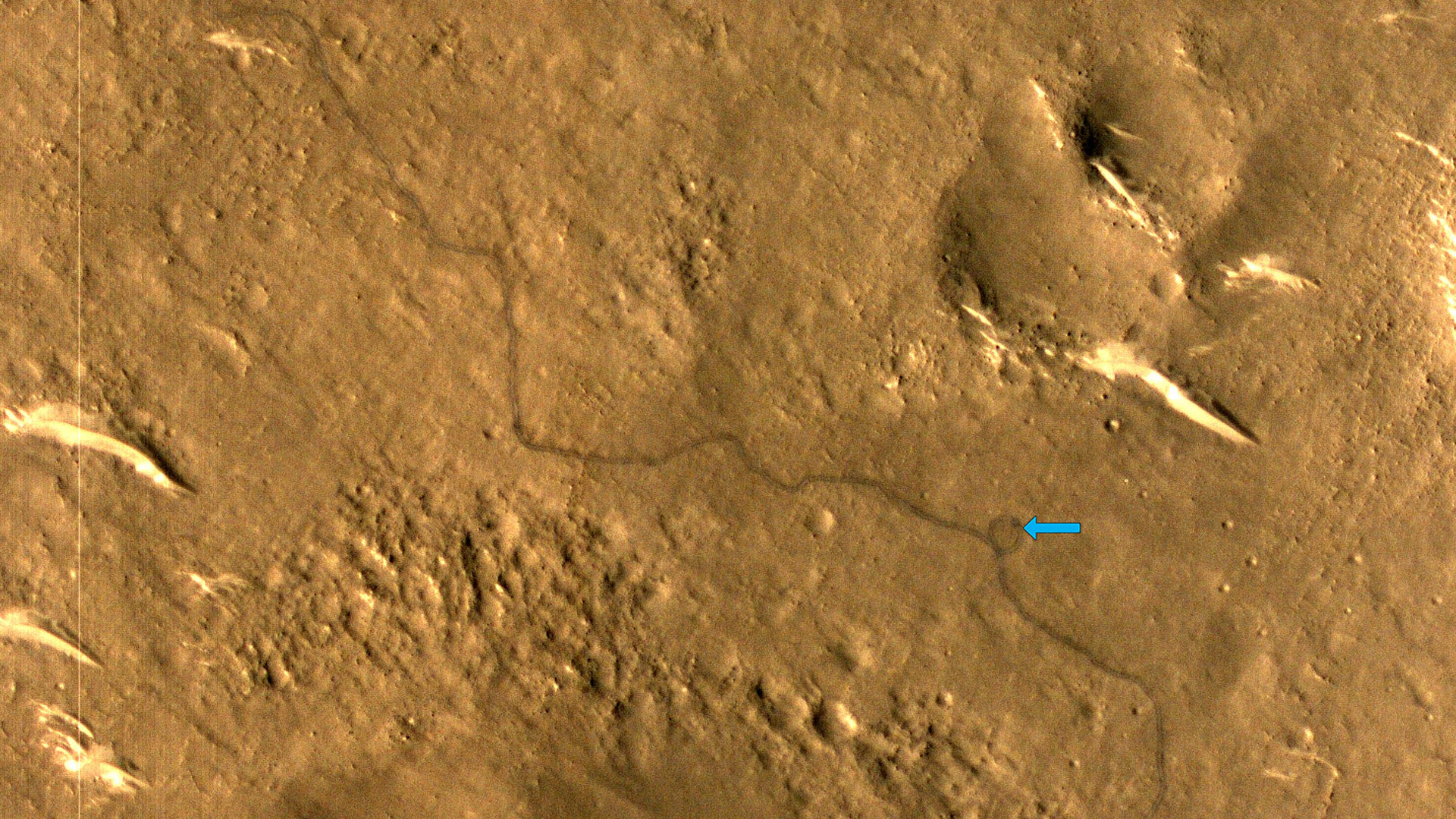
Credit: NASA/JPL/UArizona

On patrol – NASA’s Mars Reconnaissance Orbiter (MRO).
Credit: NASA/JPL

