Author Archive
 Author:
  May 13th, 2022
Curiosity Front Hazard Avoidance Camera Left B image acquired on Sol 3471, May 12, 2022.
Credit: NASA/JPL-Caltech
NASA’s Curiosity Mars rover at Gale Crater is now performing Sol 3472 duties.
After a successful drive of 154 feet (47 meters), with roughly 16 feet (5 meters) of elevation gain, the robot arrived at more new and interesting terrain to investigate, reports Elena Amador, a systems engineer and planetary scientist at NASA’s Jet Propulsion Laboratory.
In a recently scripted two sol plan (Sols 3471-3472), Curiosity continued a systematic chemical characterization of the bedrock using its Alpha Particle X-Ray Spectrometer (APXS) and Chemistry and Camera (ChemCam) and making its way through the clay/sulfate transition.
Nodular bedrock

Curiosity Mars Hand Lens Imager (MAHLI) photo produced on Sol 3469, May 10, 2022.
Credit: NASA/JPL-Caltech/MSSS
Two contact science targets, “Pastora” and “Tama Tama,” are nodular bedrock, and the rover was to also use the Mars Hand Lens Imager (MAHLI) imager to take a close look at their fine-texture.
“Together the imaging and compositional information will provide clues for how these rocks formed and how they have been subsequently altered,” Amador notes.
The plan also calls for imaging distant buttes and layered stratigraphy using Mastcam and the ChemCam Remote Micro-Imager (RMI) to learn about the depositional environments they formed in.

Curiosity Right B Navigation Camera photo taken on Sol 3470, May 11, 2022.
Credit: NASA/JPL-Caltech
Dustiest season
“Our environmental team continues to monitor the atmosphere as we are approaching our dustiest season by taking tau measurements and line-of-sight observations across the crater, in addition to other weather monitoring observations,” Amador explains.

Curiosity Right B Navigation Camera photo taken on Sol 3470, May 11, 2022.
Credit: NASA/JPL-Caltech
“The most fun part of my day as Science Operations Coordinator (SOC),” Amador adds, “was brokering the discussion between the science team and the Rover Planners for our drive and most importantly our end-of-drive location – which sets us up for the work we’ll do in Friday’s plan.”

Curiosity Right B Navigation Camera photo taken on Sol 3470, May 11, 2022.
Credit: NASA/JPL-Caltech
Up the mountain
The science team typically provides the SOC with several science targets that they are interested in landing on, with the SOC working with the Rover Planners to understand if those targets work with the resources available for the drive (for example, power and proper imaging), if accessing those targets is safe (for example, are they on a steep hill where the rover may slip?), and if the targets are generally along our high-level strategic path.
“After lots of fun back and forth, the team decided to drive 98 feet (30 meters) towards some unique dark layered blocks,” Amador reports. “If our drive is successful, we’ll get to do some contact science this weekend before continuing our journey up the mountain!”
 Posted in
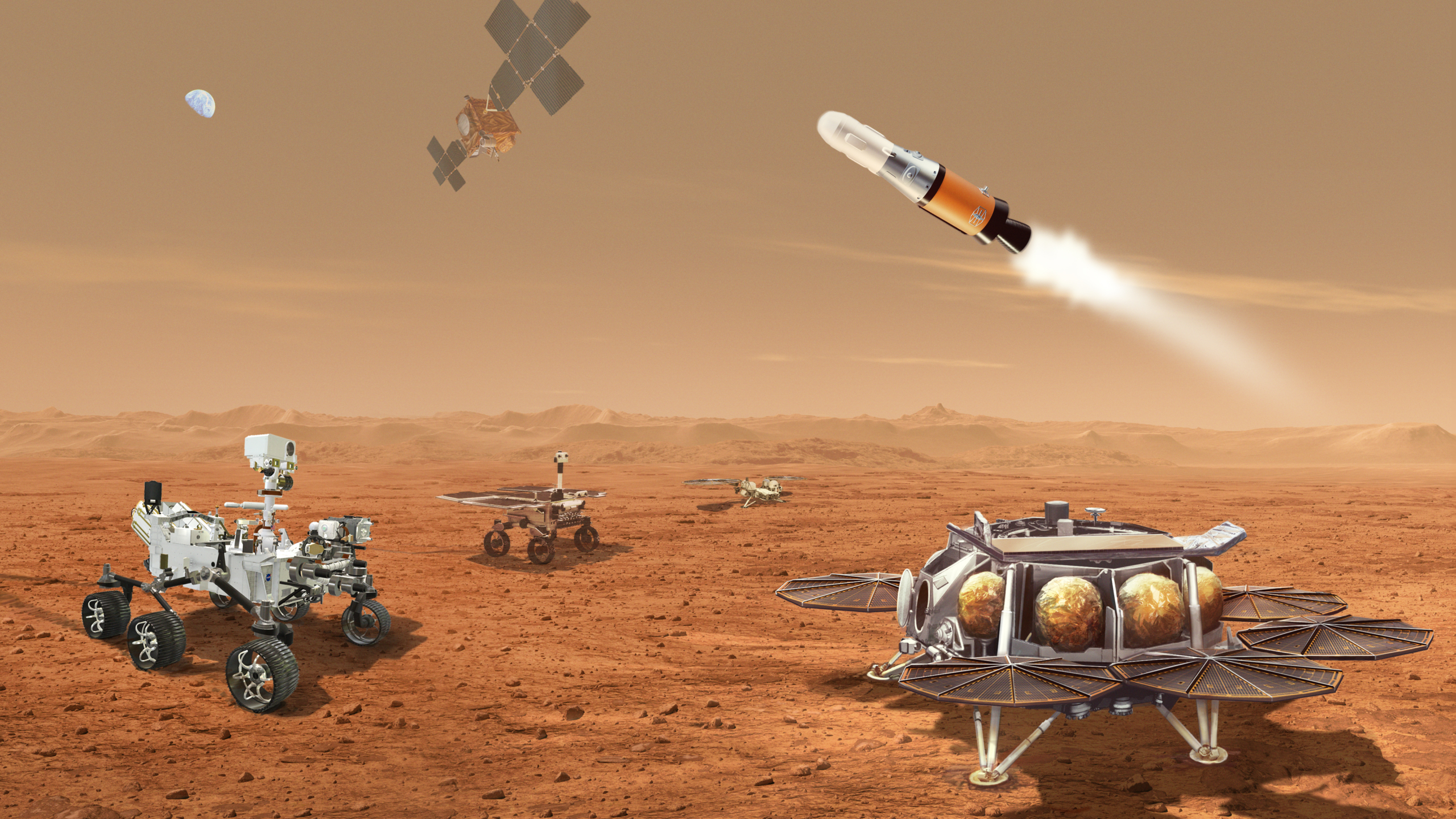
This illustration shows a concept for multiple robots that would team up to ferry to Earth samples collected from the Mars surface by NASA’s Mars Perseverance rover.
Credit: NASA/JPL-Caltech
Robotic return of samples from the surface of Mars has been a holy grail goal of Red Planet investigators for many, many years.
Over that time, strategies for returning Red Planet collectibles have ranged from “grab and go” acquisition from the surface, dust collection in the atmosphere, to on-planet scientific selection by specially equipped rovers – a task now underway by NASA’s Perseverance robot wheeling about Jezero Crater.
A Mars Sample Return (MSR) campaign is now being orchestrated by NASA and the European Space Agency (ESA), scooping up geologic and atmospheric samples gathered by Perseverance for return to Earth in the early 2030s.

Credit: NASA/JPL-Caltech
Shipment back to Earth by robotic means of bits and pieces from Mars is a multi-billion dollar, daunting task. Having our planet on the receiving end of Mars scraps that might contain Martian life is deemed a “low risk” affair in terms of ecological and public safety – but that risk is not zero.
Go to my new Space.com article:
“Mars sample return: Could Red Planet life contaminate Earth?” at:
https://www.space.com/mars-sample-return-contamination-concerns


Credit: Heritage Auctions
Back to Tomorrowland!
These sleek white and black rockets were part of a Disneyland’s Tomorrowland refurbishment. They took thousands of little astronauts on aerial adventures. Few of these vehicles have ever been offered for public sale. This attraction vehicle is numbered 67. It measures 114″ long x 48″ wide x 48″ tall – that’s almost ten feet long. The condition is very good, having received professional restoration to the paint and to the orange nose cone.
The headlamp is said to work but has not been tested. A sound speaker was installed by the previous owner but is also untested. The round gray mounting for the rocket at the back of the vehicle is slightly warped from age and doesn’t quite slide into place.
Sold as-is with no implied warranty.
Heritage Auctions reports some assembly will be required, and some additional hardware may be necessary.
For detailed information, go to:

China’s Zhurong rover.
Credit: CNSA
China’s Zhurong rover on Mars has detected recent aqueous activities within its exploration zone at Utopia Planitia.
A new research paper in Science Advances notes that Mars’ climate is cold and dry in the most recent epoch, and liquid water activities are considered extremely limited. Previous orbital data only show sporadic hydrous minerals in the northern lowlands of Mars excavated by large impacts.

Credit: Steve Yang Liu, Et al.
But using the short-wave infrared spectral data obtained by the Zhurong rover of China’s Tianwen-1 mission, scientists have identified hydrated sulfate/silica materials on the Amazonian terrain at the landing site.
These hydrated minerals are associated with bright-toned rocks, and are interpreted to be duricrust developed locally.

Credit: Steve Yang Liu, Et al.
Groundwater rising or subsurface ice melting
The lithified duricrusts suggests that formation with substantial liquid water originates by either groundwater rising or subsurface ice melting. The rover has gathered on-the-spot evidence for aqueous activities suggesting a more active Amazonian hydrosphere for Mars than previously thought.

Illustration of the scientific payloads mounted on Zhurong rover. The group picture of the rover (left) and the lander (right) was taken by the WiFi camera (Image Credit: the ChinaNational Space Administration (CNSA)). NaTeCam: Navigation and Terrain camera. RoMAG: Mars Rover Magnetometer. MSCam: Multispectral Camera. MSC-1: MarsClimate Station (Wind field and sound probe). MSC-2: Mars Climate Station (Air
temperature and pressure probe). MarSCoDe: Mars Surface Component Detector. RoPeR(CH1): Mars Rover Penetrating Radar (channel 1). RoPeR (CH2): Mars Rover
Penetrating Radar (channel 2).
Credit: Steve Yang Liu, Et al.
“The Zhurong landing site (and the northern lowlands) may contain a considerable amount of accessible water in the form of hydrated minerals and possibly ground ice for in situ resource utilization for future human Mars exploration,” the research paper concludes.
The Tianwen-1 lander, carrying the rover, performed a successful soft-landing on Mars in mid-May 2021.
Lead author of the paper is Steve Yang Liu of the State Key Laboratory of Space Weather, National Space Science Center, Chinese Academy of Sciences in Beijing, China.
To view the paper – “Zhurong reveals recent aqueous activities in Utopia Planitia, Mars” – go to:
https://www.science.org/doi/10.1126/sciadv.abn8555

Space journalist Leonard David will provide a presentation on current space exploration activities not only in the U.S. but internationally, and the promise of public space tourism and future trends in the coming years.

Registration is required for this online program.
Go to this link to register –
https://nederland.libcal.com/event/9136402
This Zoom presentation is hosted by the Nederland Community Library in Colorado and has a limit of 50 participants to allow time for participants’ Q&A.
You will see when registering that it refers to reserving a “seat”. Just “pull up a chair” and join us on Zoom!
Registrants will receive the link on Thursday about an hour before the presentation which starts at 7:00 PM (U.S. Mountain Time).
Hope to see you there!
Any questions?

Designed and built by Terran Orbital, CAPSTONE will support NASA’s Artemis program in reducing the risk for future Moon bound spacecraft.
Credit: Terran Orbital
A small satellite is en route toward the Moon…via New Zealand.
The Cislunar Autonomous Positioning System Technology Operations and Navigation Experiment, otherwise known as CAPSTONE, will support NASA’s Artemis program.
As a pathfinder for NASA’s Gateway station, a Moon-orbiting outpost, CAPSTONE’s mission is to help reduce the risk for future spacecraft by validating innovative navigation technologies and verifying the dynamics of the Near Rectilinear Halo Orbit (NRHO).

Artwork depicts CAPSTONE spacecraft in a near rectilinear halo orbit (NRHO) around the moon.
Credit: NASA/Advanced Space
Staging area
CAPSTONE’s orbit also establishes a location that is an ideal staging area for missions to the Moon and beyond. Its location at a precise balance point in the gravities of the Earth and the Moon offers stability for long-term missions like Gateway and requires minimal energy to maintain.
Designed and built by Terran Orbital, the CAPSTONE payload and its software are owned and operated by Advanced Space for NASA.
CAPSTONE is a 12U CubeSat that includes a radio tower on top that extends its size from a traditional 12U form factor.

Jeffrey Parker, chief technology officer of Advanced Space (left) explains the CAPSTONE mission to U.S. Senator John Hickenlooper over a full-size model of the spacecraft.
Credit: Advanced Space/Jason Johnson
Ballistic lunar transfer
The smallsat is soon to be launched (no earlier than May 31st) Rocket Lab Electron rocket from Rocket Lab Launch Complex 1 (LC-1) on the Mahia Peninsula of New Zealand. That company’s Lunar Photon satellite upper stage will send the spacecraft on its planned lunar transfer trajectory.
CAPSTONE will not go directly to the Moon. Instead, it will follow a “ballistic lunar transfer” that takes the craft out as far as 1.5 million kilometers before returning into lunar orbit. That transfer, which will take about four months to complete, is designed to save propellant, making the mission feasible for such a small spacecraft.

Credit: Rocket Lab

Colorado has been selected for a planned spaceflight training facility and a “Lab-to-Orbit”™ research campus.
Billed as the world’s first space readiness and innovation campus, Star Harbor unveiled today its planned 53-acre mixed-use development campus and training center south of Denver in Lone Tree, Colorado.
At its heart will be the Star Harbor Academy that features microgravity flights, neutral buoyancy facility, a high-gravity centrifuge, as well as land-based and underwater habitats, hypobaric and hyperbaric chambers, simulation labs, and human performance center.

Credit: Star Harbor
Additional campus features will include a space-themed hotel, office space, Sensitive Compartmented Information Facility space, non-profit Public Inspiration center and entertainment and event venues, including an e-sports arena.
The Star Harbor campus is expected to attract more than two million annual visitors, according to the organization.
Unprecedented renaissance
“There is an unprecedented renaissance occurring within the space industry today and our leading edge capabilities and people-centered approach will accelerate this transformation in ways that are not only critically needed in the industry but will foster a new vision for how space can be leveraged to improve life on Earth,” said Maraia Tanner, founder and CEO of Star Harbor, an astrophysicist and former aerospace engineer.
“We have the opportunity to foster a new generation of explorers, innovators, entrepreneurs, educators and technologies to leave a powerful, positive legacy for generations to come,” Tanner said in a press statement.

Credit: Star Harbor
The planned Star Harbor Lab-to-Orbit research campus will lower barriers-to-entry for commercial innovation, scale and speed.
Significant partnerships
Star Harbor has already established more than 30 significant partnerships and memorandums of understanding encompassing major aerospace, technology, and defense companies, leading educational organizations, international space agencies, and relevant U.S. government entities. The company said it will share these partnerships in the coming weeks.
The commercial astronaut training, space workforce development and technology incubator program also launched a Series B fundraising round through July 15, 2022 to further the development of the project. With initial offerings beginning in 2026, the mixed-use campus will host customers and the public.
“Our staff includes astronauts, experts in the aerospace and travel industry sectors, and educators,” said Star Harbor senior advisor, Alan Ladwig, and a member of the board of directors. Retired from NASA, Ladwig was formerly director of Office of Policy and Plans at NASA headquarters and senior policy advisor in NASA’s Office of the Administrator.

Dr. Sian Proctor, a member of SpaceX’s Inspiration4 civilian orbital spaceflight.
Credit: Inspiration4
A Star Harbor team includes Dr. Sian Proctor, a member of SpaceX’s Inspiration4 civilian orbital spaceflight and the first black woman to pilot a spacecraft; and Ronald Garan Jr., a former NASA astronaut and retired Air Force test pilot. Board members include Dennis Muilenburg, Boeing (retired) and Kenneth Svendsen, Entertainment Cruises, Disney and Hilton (retired).
For more information on this enterprising space readiness and innovation campus, go to:
Or email at:

Credit: Alexander Madurowicz/Bruce Macintosh
A futuristic technique could enable astronomical imaging far more advanced than any present today to image exoplanets.
Stanford scientists have proposed a gravity telescope.
The concept proposes positioning a telescope, the Sun, and exoplanet in a line with the Sun in the middle. Doing so, scientists could use the gravitational field of the sun to magnify light from the exoplanet as it passes by.
As opposed to a magnifying glass which has a curved surface that bends light, a gravitational lens has a curved space-time that enables imaging far away objects.
Solar gravitational lensing
In a paper published on May 2 in The Astrophysical Journal – “Integral Field Spectroscopy with the Solar Gravitational Lens” — the researchers describe a way to manipulate solar gravitational lensing to view planets outside our solar system.
“We want to take pictures of planets that are orbiting other stars that are as good as the pictures we can make of planets in our own solar system,” said Bruce Macintosh, a physics professor at in the School of Humanities and Sciences at Stanford and deputy director of the Kavli Institute for Particle Astrophysics and Cosmology (KIPAC).

Credit: Alexander Madurowicz/Bruce Macintosh
“With this technology, we hope to take a picture of a planet 100 light-years away that has the same impact as Apollo 8’s picture of Earth,” Macintosh adds.
“The solar gravitational lens opens up an entirely new window for observation,” said Alexander Madurowicz, a PhD student at KIPAC. “This will allow investigation of the detailed dynamics of the planet atmospheres, as well as the distributions of clouds and surface features, which we have no way to investigate now.”
To access the research paper, go to:
https://iopscience.iop.org/article/10.3847/1538-4357/ac5e9d/pdf
Also, go to this Stanford University story that details the concept at:
https://news.stanford.edu/2022/05/02/gravity-telescope-image-exoplanets/

Curiosity’s location as of Sol 3465. Distance driven to that Sol is 17.27 miles/27.79 kilometers.
Credit: NASA/JPL-Caltech/Univ. of Arizona
NASA’s Curiosity Mars rover at Gale Crater is now performing Sol 3466 tasks.
The rover has cleared the “Greenheugh pediment” and the mix of sandy, steep, and rough terrain that challenged its drives up and down it, reports Michelle Minitti, a planetary geologist at Framework in Silver Spring, Maryland.
“However, we are finding that as we make our way up Mount Sharp along a new route, some of the same driving gremlins are with us,” Minitti adds.

Curiosity Left B Navigation Camera image acquired on Sol 3465, May 6, 2022.
Credit: NASA/JPL-Caltech
Higher than expected tilts
A recent drive made it just about all the way to its endpoint, but Curiosity encountered higher than expected tilts as the robot attempted to turn toward a desired heading to enable clear communications with Earth via high gain antenna.

Curiosity Left B Navigation Camera image acquired on Sol 3465, May 6, 2022.
Credit: NASA/JPL-Caltech
“The turn did not complete, so direct communication with Curiosity via the high gain antenna was blocked. The current relative positions of Earth and Mars plus the pediment and scenic buttes around us give us fewer heading options for direct communication, so we are less robust to a missed turn here or a drive fault there,” Minitti explains.

Mars Hand Lens Imager (MAHLI) photo produced on Sol 3465, May 6, 2022.
Credit: NASA/JPL-Caltech/MSSS
That meant researchers had to wait until the morning of Sol 3465 to communicate with Curiosity another way – through one of the many orbiters circling Mars that we use to send our data to Earth. As such, Curiosity was to chill on Sol 3464, but then spring into action on Sol 3465 with the plethora of activities the science team planned.
Undaunted
“The science team was certainly undaunted by having only one sol to plan when we were expecting two, Minitti notes. “We did our best to cram in just about everything we wanted!”
The Alpha Particle X-Ray Spectrometer (APXS) was the odd instrument out, as the dusty bedrock and less-ideal integration time available for them led them to take a pass on the workspace.
APXS’s usual science partner, the Mars Hand Lens Imager (MAHLI), had rocks to look at, in particular a nice layered block.
MAHLI was slated to acquire a mosaic across the layers centered on target “Firina,” and will then zoom in to look at the rock texture at target “Bartica.”

Curiosity Front Hazard Avoidance Camera Left B image taken on Sol 3465, May 6, 2022.
Credit: NASA/JPL-Caltech
The Chemistry and Camera (ChemCam) was also shoot the layers of that layered block at the target “Rio Mucajai.”
Large buttes
Mastcam will image two large buttes – the one looming to the left of the rover, and “Mirador” butte – both of which have been imaged from different positions previously.
“Imaging them from a different perspective can really clarify the orientations of the structures within the buttes, and those orientations are often key to understanding the processes that formed those rocks,” Minitti reports.

Curiosity Front Hazard Avoidance Camera Right B image taken on Sol 3465, May 6, 2022.
Credit: NASA/JPL-Caltech
Mastcam was also to image a set of newly-visible structures in the terrain below Mirador butte, centered on the target “Akopan dal Cin.”
The Rover Environmental Monitoring Station (REMS), the Radiation Assessment Detector (RAD) and the Dynamic Albedo of Neutrons (DAN) run throughout the sol.
“With our data in hand,” Minitti concludes, “we will drive further up the slope in front of us, alongside the large butte we imaged today. Here’s hoping the terrain is more forgiving!”

