Author Archive
 Author:
  July 3rd, 2022
Aerospace engineering doctoral student Adrien Bouskela (left) and aerospace and mechanical engineering professor Sergey Shkarayev hold an experimental sailplane. They hope to one day send a custom version of a similar plane to Mars.
Credit: Emily Dieckman/College of Engineering/University of Arizona
Winging over Mars via motorless sailplane, even taking deep dives at Valles Marineris – the spectacular, huge canyon system of the Red Planet.
That’s the vision of a team of University of Arizona engineers, imagineering an 11-pound craft that can soar over the Martian surface for days at a time, using only wind energy for propulsion.

Credit: Adrien Bouskela, et al.
A Mars sailplane would contain a custom-designed array of navigation sensors, a camera, as well as temperature and gas sensors to harvest data about the Martian atmosphere and landscape.
The sailplane would exploit atmospheric wind gradients for dynamic soaring, and slope/thermal updrafts for static soaring.

Credit: Adrien Bouskela, et al.
Low-cost secondary payload
Packaged in CubeSats and on release, sailplanes would either unfold, like origami, or inflate, like high-tech pool floaties, then rigidize at their full size. The sailplane concept, unlike previous proposals for Mars, would be a low-cost secondary payload, price-tagged at $100 million or less.
After making its flight for days at a time, a sailplane would make a soft belly landing on the Martian surface and transform into a meteorological station, continuing to relay information about the atmosphere.
Equations of motion for the sailplanes were combined with wind profiles from the Mars Regional Atmospheric Modeling System (MRAMS) for two representative sites: Jezero crater, Perseverance’s landing site, and over a section of the Valles Marineris canyon.

The team conducted a tethered launch of an early version of the sailplane, in which it descended slowly to Earth attached to a balloon.
Credit: University of Arizona
Close-to-wall flying
Numerical results demonstrated that Mars sailplanes can do close-to-wall flying passes over locations inaccessible by conventional landers and rovers, thus providing a unique, close-up oblique viewing of the canyons and their stratigraphy.
This summer, the university team will test experimental planes at about 15,000 feet above sea level, where Earth’s atmosphere is thinner and flight conditions are more akin to those on Mars.
The research – “Mars Exploration Using Sailplanes” — has been published in the monthly journal, Aerospace.
To read the full paper, go to:
 Posted in
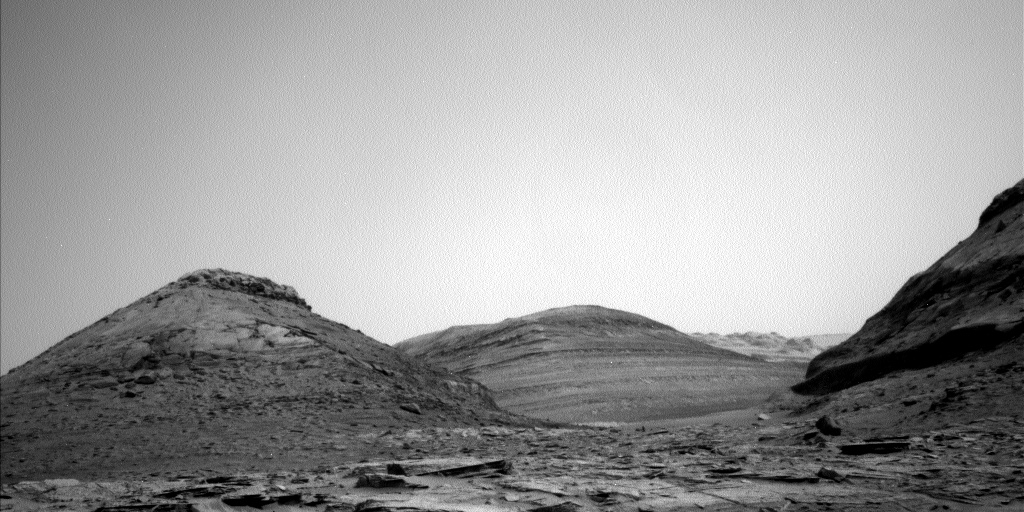
“Deepdale” on the left and the edge of “Bolivar” on the right. Curiosity Left Navigation Camera image taken on June 26, Sol 3515, at drive 3152, site number 95. While it looks like it’s about the same size as the hills that bound it, this effect is just due to forced perspective. In reality, Kukenán is nearly five times farther away and over three times as tall as Deepdale!
Credit: NASA/JPL-Caltech
NASA’s Curiosity Mars rover at Gale Crater is now performing Sol 3521 duties.
Abigail Fraeman, a planetary geologist at NASA’s Jet Propulsion Laboratory, reports that Curiosity is proceeding through a pre-planned checklist of activities for drill campaigns, after a successful drilling of Avanavero.
The rover team is waiting for the downlink that contains data from the robot’s Chemistry & Mineralogy X-Ray Diffraction/X-Ray Fluorescence Instrument (CheMin) – the first analysis of the Avanavero drilled sample.
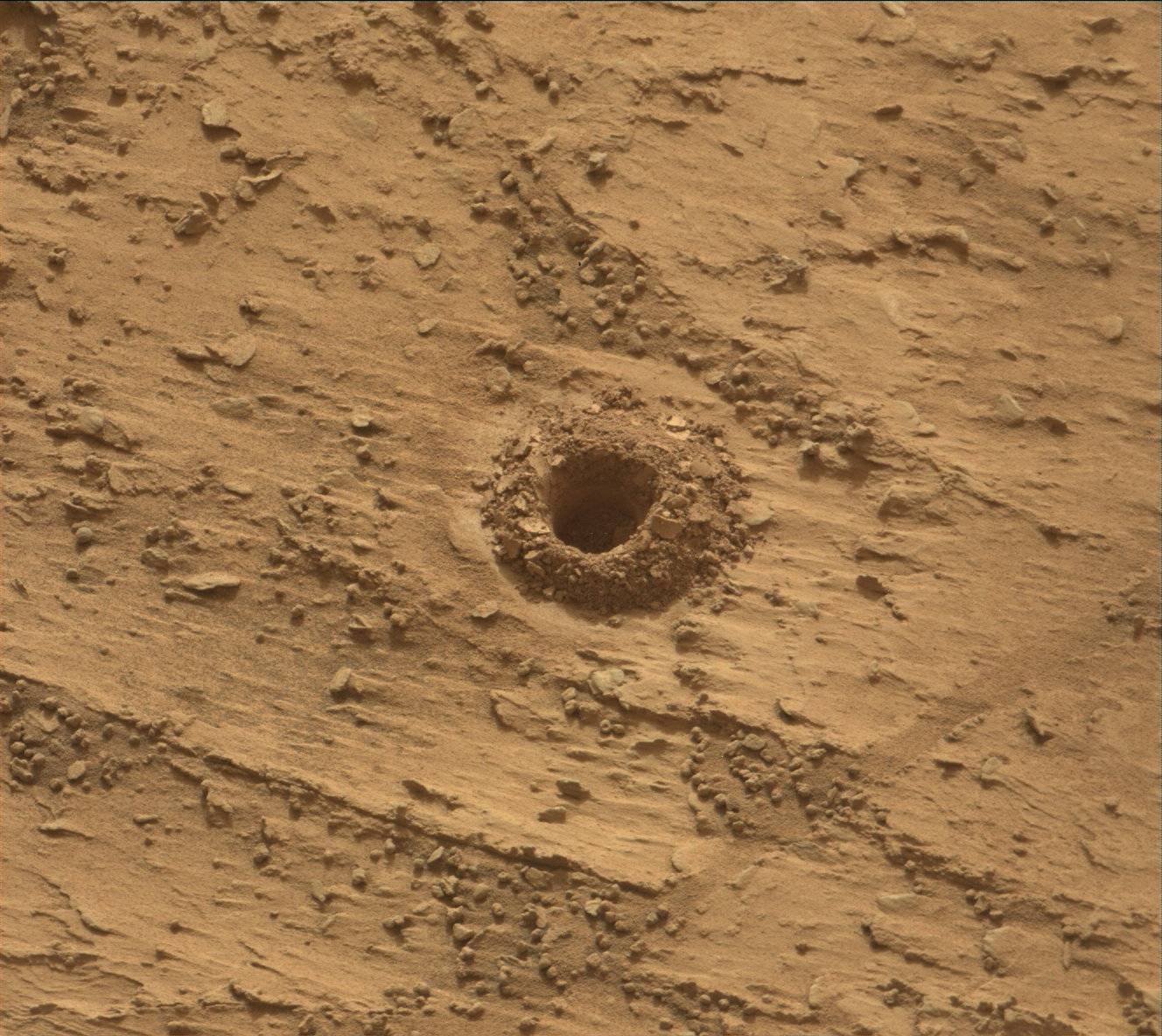
Curiosity Mast Camera image of drill hole taken on Sol 3512, June 23, 2022.
Credit: NASA/JPL-Caltech/MSSS
That data helps Mars researchers to decide whether to analyze the sample with the Sample Analysis at Mars (SAM) Instrument Suite as well.
Onboard lab work
“While we wait today, we planned a whopping six sols worth of activity that will cover the upcoming July 4th US holiday,” Fraeman adds. “The main activities in the plan included a second evening of analysis of Avanavero with CheMin, and an activity to prepare the SAM instrument to accept a sample so that we can be ready to say ‘Go for sample analysis!’ on Tuesday after we see the CheMin results.
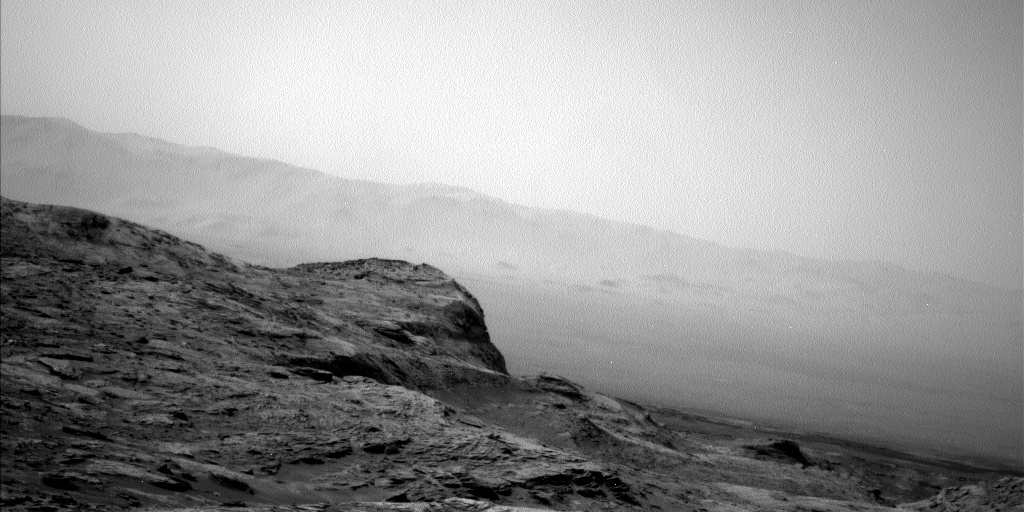
Curiosity Left B Navigation Camera image taken on Sol 3519, June 30, 2022.
Credit: NASA/JPL-Caltech
“We planned lots of remote sensing activities around the tasks of our SAM and CheMin onboard laboratories. We will be collecting several high resolution Mastcam mosaics of the area and environmental sensing data,” Fraeman explains.
Impressive expression
Also slated is collecting Chemistry and Camera (ChemCam) Laser Induced Breakdown Spectroscopy (LIBS) observations of rock targets named “Tocobirem” and “Uaiparu,” a soil target named “Simibi,” and the drill hole itself.
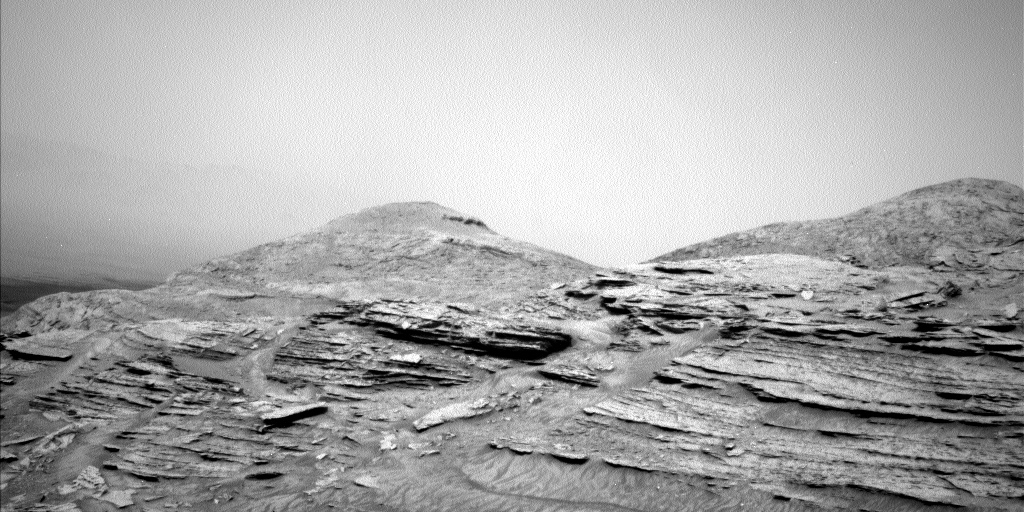
Curiosity Left B Navigation Camera image taken on Sol 3519, June 30, 2022.
Credit: NASA/JPL-Caltech
On top of that, ChemCam will also acquire two long distance Remote Micro-Imager (RMI) mosaics, one over Gediz Vallis ridge, and one over a far distant hill named “Kukenán.”
“Kukenán’s Earth namesake is a tepui, or distinctive isolated table-top mountain, found in South America. The Martian Kukenán is also somewhat flat topped and an impressive expression in Mt. Sharp’s topography,” Fraeman adds.
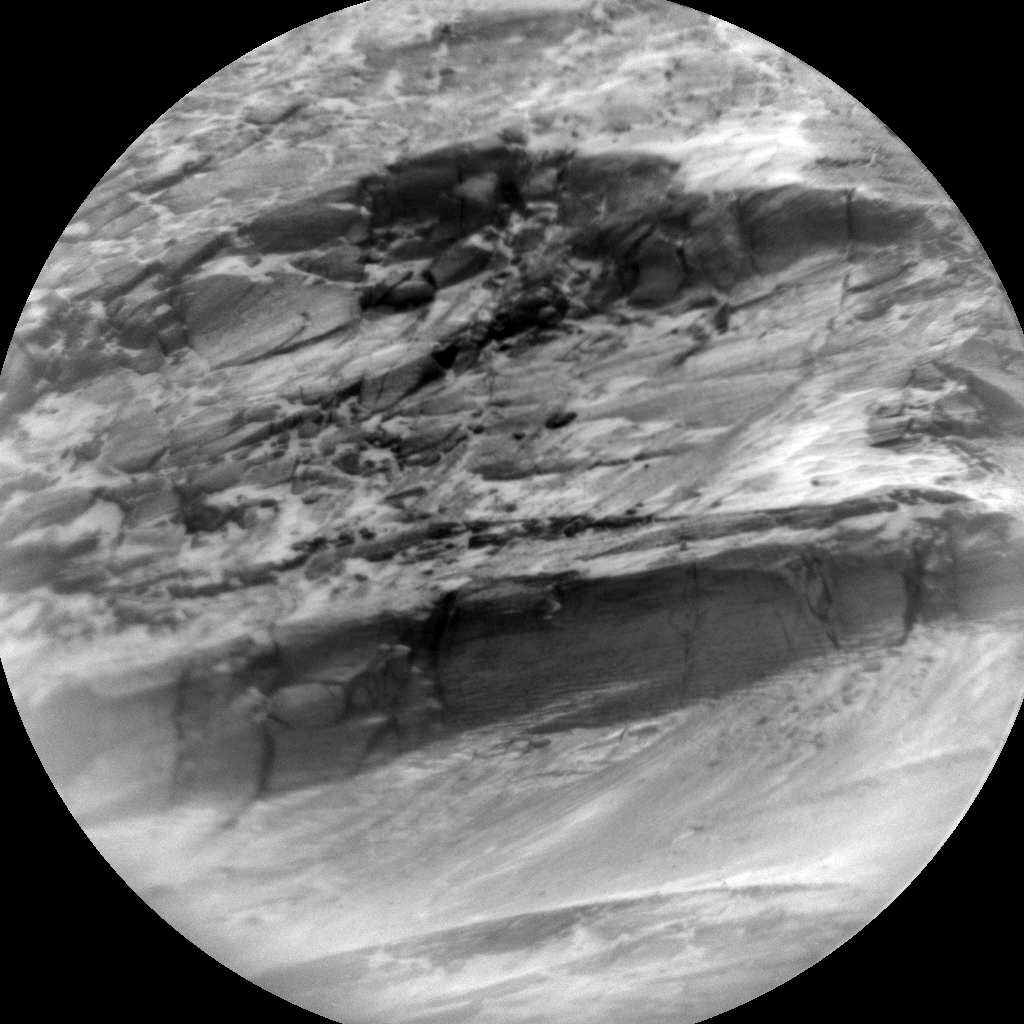
Curiosity Chemistry & Camera (ChemCam) Remote Micro-Imager (RMI) photo taken on Sol 3520, July 1, 2022.
Credit: NASA/JPL-Caltech/LANL
“Curiosity’s strategic traverse path takes the rover right past Kukenán in about a kilometer or so,” Fraeman notes, “so this feature will become a familiar landmark rising in our windshield for months to come.”
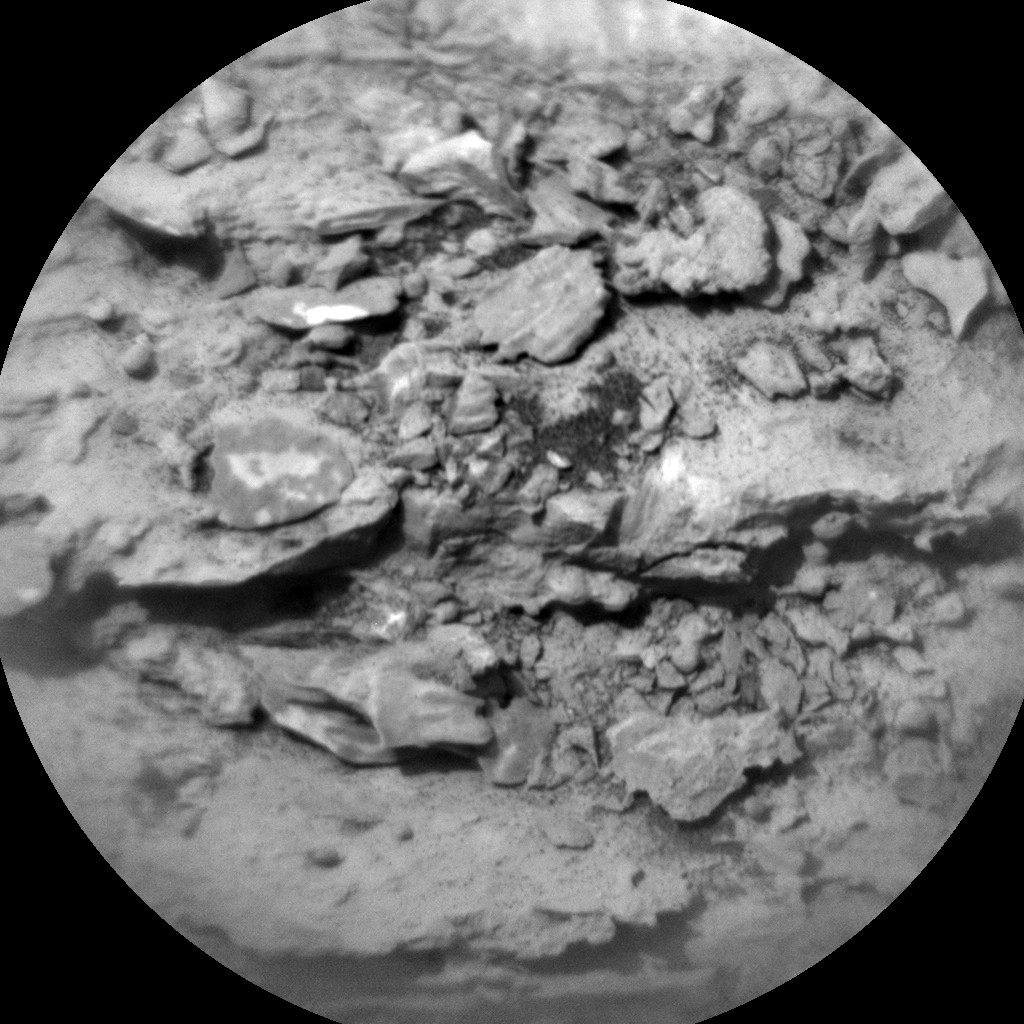
Curiosity Chemistry & Camera (ChemCam) Remote Micro-Imager (RMI) photo taken on Sol 3520, July 1, 2022.
Credit: NASA/JPL-Caltech/LANL

Credit: JAXA/NHK/Paul Spudis
Similar to house hunting on Earth, being on the lookout for desirable property on the Moon gives rise to a common, but extraterrestrial maxim: “location, location, location.”
NASA is eying an Artemis Base Camp, calling it “our first foothold on the lunar frontier.” The ingredients for that encampment are a Lunar Terrain Vehicle – an unpressurized rover – to transport suited astronauts around the site; a habitable mobility platform – a pressurized rover – to enable long-duration treks away from Artemis Base Camp. Lastly there would be the surface habitat itself, capable of housing four humans at a lunar south pole locale.

Credit: NASA
This home-away-from-home demands a lot of infrastructure such as communications, power, and radiation shielding, waste disposal and storage space too. All of these domicile niceties, NASA planners say, are requirements for a sustained capability on the Moon that can be revisited and built upon over the coming decades.
Go to my new Space.com story – “Where will NASA set up its moon base? – Scientists and mission planners are searching for the best site” – at:

Credit: NASA/Institute of Biomedical Problems
A 5-member international crew is wrapping up 240 days in conditions that simulate the work of a real space expedition on a lunar orbital station and the surface of the Moon.
Called the Scientific International Research In Unique terrestrial Station (SIRIUS), dozens of experiments were carried out related to preparation for further space exploration by humans.

Credit: Institute of Biomedical Problems
SIRIUS-21 has been underway at the Moscow-based Institute of Biomedical Problems (IBMP) of the Russian Academy of Sciences. SIRIUS is supported by the NASA Human Research Program.
The crew (three men and two women) includes Russian, American and Arab participants.

Sirius-21 crew members.
Credit: Institute of Biomedical Problems
Isolation study
On July 3, 2022, the SIRIUS-21 space experiment is to be completed. The mission began November 4, 2021.
This 240-day isolation study included simulating a voyage to the Moon.
During the experiment that mimicked a flight to the Moon, there were a number of problems expeditionary space crews faced, such as:
- sensory deprivation, monotony, limited social contacts, limited living space and managed habitat
- factors of autonomous interplanetary flight, including limiting the resources of the expedition and extravehicular activities on the planet’s surface
- professional activities of the crew (docking of transport ships, landing of the lunar module, control of robotic equipment)
- communication delay up to 5 minutes one way
An unexpected emergency
The mission began with a crew of six but one person had to exit the study early in the mission for medical reasons, with the remaining five completing the mission this Sunday.
At the time IBMP released a statement as it was a Russian crew member.
“On the Mission Day 33, a real emergency situation took place – one of the crew members, Ekaterina Karyakina, received a minor arm injury during exercise on the working model of a multifunctional weight training machine. Being in close cooperation with the ground support services, the crew provided E. Karyakina with the necessary medical assistance and helped with providing diagnostic measures.”
Given expert medical advice, the management of the SIRIUS Project decided to withdraw Karyakina from the experimental facility. Implementation of the scientific program for the SIRIUS-21 240-day Isolation Experiment continued in full.
Exploration stresses

Credit: Institute of Biomedical Problems
SIRIUS analog missions assist NASA in gaining knowledge about the physiological and psychological “exploration stresses” of remoteness and confinement in humans – all in preparation for sustained Artemis expeditions to the Moon and on-the-horizon flight of crews to Mars.

Credit: Institute of Biomedical Problems
Composition of the crew includes a crew commander, flight engineer, a doctor and researchers.
The activities of the crew during the experiment are based on the basic provisions of the Code of Professional Ethics of Cosmonauts of the Russian Federation and the Code of Conduct for the International Space Station crew.

Credit: Inmarsat
A worrisome new report finds that people are unaware about the benefits of using space, and a majority view space as a threat, with space junk and climate change main concerns.
The newly-released society snapshot took in 20,000 respondents across 11 countries.
Unveiled by Inmarsat, a global, mobile satellite communications provider, the report signals that people have a low understanding of the size and richness of the work being done in space today.

Credit: Inmarsat
Underappreciated and misunderstood
Rajeev Suri, CEO of Inmarsat, said in a statement: “This report should be a wake-up call for our industry. Space appears to be underappreciated and misunderstood in the real-world. In many respects, the knowledge we possess as a society is inaccurate and incomplete.”
The Inmarsat report — “What on Earth is the value of space?” — found that those aged 65 and above, who were teenagers when humans first walked on the Moon, are more optimistic and hopeful than Gen-Z. They are more likely to associate space with research and exploration, rockets, and satellites – with their understanding of space more rooted in science than science-fiction.
Report findings
Other findings of the report include:
- People’s ambitions for space center around tackling major challenges on Earth – finding new energy sources, essential resources, and helping solve climate change. However, this does not yet counteract our fears – as 97 per cent of the global population feel space is a threat.
- One in 9 people are “terrified” of what could happen in space – with space junk and collisions in orbit (47 per cent), pollution (39 per cent), and damaging the Earth’s atmosphere (35 per cent) seen as the top threats. Older people are more worried about space junk, while younger generations fear the environmental impact most.
- Only a quarter of the public (23 per cent) said they feel space exploration is “important.” Almost half (46 per cent) consider satellites when thinking of space, while 37 per cent think of expeditions to the Moon and Mars, 21 per cent think of aliens, and almost 1 in 10 think of Star Wars (9 per cent). Fewer than 1 in 10 people globally think of communications and connectivity.
- The research highlights a small core of people globally who are aware of the potential for space to answer many of the world’s challenges. For example, 7% of respondents said that space can alleviate poverty. While another 7% thought space can support the goal of producing enough food to feed our growing population. 11% imagined space will have a role in researching and finding cures for diseases like cancer.

Credit: Inmarsat
Global respondents
Touted as the largest independent global representative consumer survey of attitudes towards space included 20,000 respondents (18-65+ years of age) across the UK (3,000), US (2,000), Brazil (2,000), Canada (2,000), Germany (2,000), Australia (2,000), China (2,000), India (2,000), South Korea (1,000), Japan (1,000) and UAE (1,000).

Credit: Inmarsat
The study was conducted by Yonder Consulting in April 2022 on behalf of Inmarsat.
To view the full report — “What on Earth is the value of space?” — go to:
https://www.inmarsat.com/en/insights/corporate/2022/value-of-space.html

China’s Tianwen-1 Mars orbiter.
Credit: CNSA
China’s Tianwen-1 Mars mission has completed all of its “preset” scientific tasks.
The China National Space Administration (CNSA) stated on Wednesday that the orbiter has obtained medium-definition images of the entire planet, marking the completion of its scientific goals.
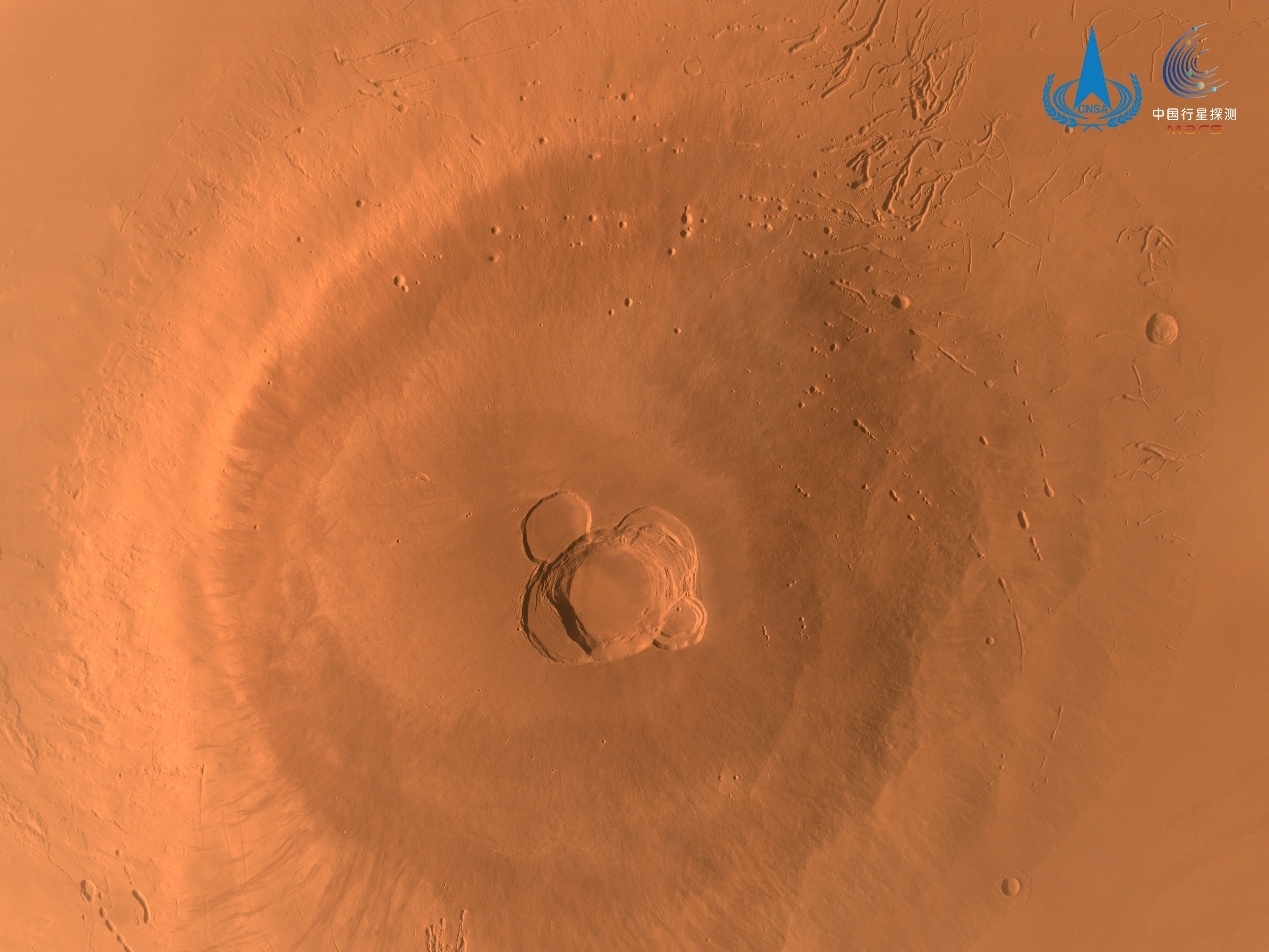
Tianwen-1 orbiter imagery is being used to create a global mosaic of the Red Planet. Shown here is Ascraeus Mons imaged by the orbiter’s Moderate Resolution Imaging Camera.
Credit: CNSA

Credit: CNSA

Credit: CNSA

Credit: CNSA
CNSA said that orbiter will continue to carry out extended remote-sensing operations and technological tests.
Several new orbiter images were released by CNSA.
Dormant rover
In the meantime, the Zhurong Mars rover, now in dormant mode since mid-May, is expected to resume its duties in December, when the weather on the Red Planet is more favorable.

China’s Zhurong rover.
Credit: CNSA
Zhurong has wheeled nearly 1.2 miles (2,000 meters) across its Utopia Planitia exploration zone.
According to the CNSA, the 13 scientific instruments on the orbiter and the rover have transmitted nearly 1,040 gigabytes of raw data back to Earth.
The Tianwen-1 Mars mission — comprised of an orbiter, lander, and rover — was launched on July 23, 2020, slipping into orbit in February of last year.

Credit: Asteroid Day Live
The Asteroid Foundation’s annual Asteroid Day LIVE program returns in person Thursday, June 30, 2022 at 11:00 Central European Time (CET). Astronauts, experts and science communicators from across the world will converge on Luxembourg to discuss the importance of asteroid research, missions, and advances in space-based technologies.
The four-hour-long program promises to vividly bring the solar system’s smallest worlds to life for audiences of all ages and backgrounds.

Credit: Asteroid Day Live
Seven panel discussions will tell the full story of asteroids; from the formation of the Solar System, 4.6 billion years ago, to the scientific work taking place today, and our future prospects as we begin to imagine ways to utilize the resources asteroids contain. Also spotlighted is how can we defend Earth if and when we spot a threatening asteroid.
Asteroid Day is held on June 30 each year to mark the date of Earth’s largest asteroid impact in recorded history: the Tunguska, Siberia event.

Credit: SES
Connections
Asteroid Day’s Luxembourg-based partners Broadcasting Center Europe (BCE) and SES will make Asteroid Day TV available for millions to tune in via SES satellite.
For more details on Asteroid Day LIVE, visit
https://asteroidday.org/asteroid-day-live
Join in the Asteroid Day conversation on Social Media:
Hashtags: #AsteroidDay #AsteroidDayLIVE #AsteroidDayTV #Luxembourg
Website: https://asteroidday.org/
Twitter: @asteroidday
Twitch: https://www.twitch.tv/asteroidday
Facebook: www.facebook.com/AsteroidDay
YouTube: www.youtube.com/user/asteroidday
Instagram: https://www.instagram.com/asteroidday
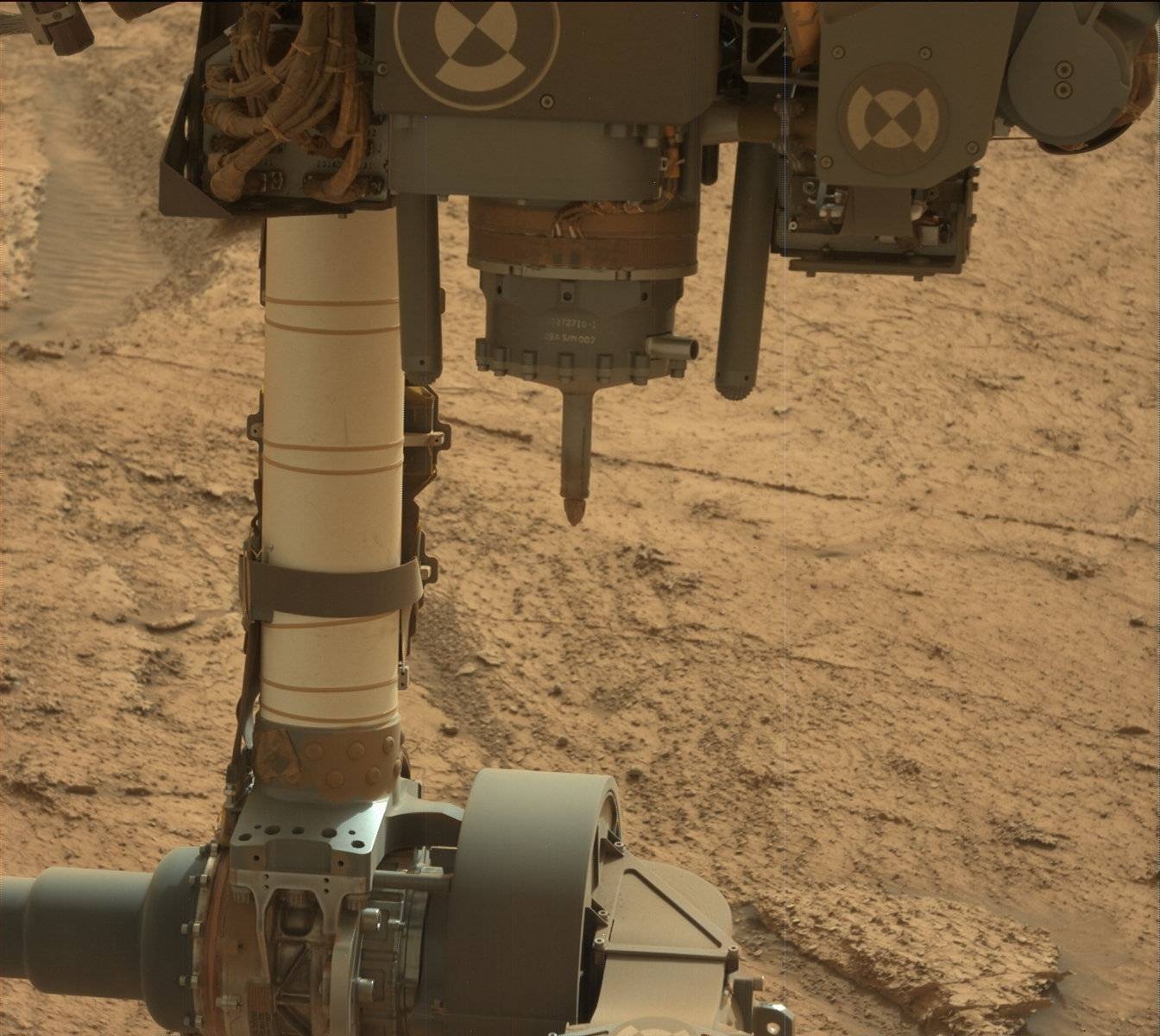
Curiosity Mast Camera (Mastcam) Left photo acquired on Sol 3512, June 23, 2022.
Credit: NASA/JPL-Caltech/MSSS
NASA’s Curiosity Mars rover at Gale Crater is now performing Sol 3514 duties.
“Drill success!” reports Ken Herkenhoff, a planetary geologist at USGS Astrogeology Science Center in Flagstaff, Arizona. “Our first drill attempt since last November was successful!”
The new drill hole is surrounded by drill tailings as expected. This is one of several times in Curiosity’s mission, Herkenhoff adds, that drilling had to be re-designed to overcome an anomaly, again requiring lots of careful planning and testing using nearly identical drill hardware at JPL. “Kudos to the anomaly resolution team and thanks for all the good work that enabled the capability to drill again!”
Drilling is required to acquire samples of rock and deliver them to the laboratory instruments, the Sample Analysis at Mars (SAM) Instrument Suite and Chemistry & Mineralogy X-Ray Diffraction/X-Ray Fluorescence Instrument (CheMin) inside the rover.
“So this is a day of celebration for the MSL science team,” Herkenhoff notes.

Curiosity Mast Camera (Mastcam) Right image taken on Sol 3512, June 23, 2022.
Credit: NASA/JPL-Caltech/MSSS
Portion characterization
“But before any sample can be delivered to CheMin or SAM, we have to see the results of the drill sample portion characterization that was planned last Wednesday,” Herkenhoff explains. “These results will not be relayed to Earth in time for planning Sols 3514 through 3516, so this weekend’s plan includes many remote sensing and environmental observations, including more Mastcam and Navcam images of the terrain east and west of the rover at various times of day to improve the sampling of observational geometries needed to constrain the photometric behavior of the surface materials.”

Curiosity Chemistry & Camera (ChemCam) Remote Micro-Imager (RMI) photo taken on Sol 3513, June 24, 2022.
Credit: NASA/JPL-Caltech/LANL
Such photometric observations are useful in determining the scattering properties and roughness of the rocks, soil and dust on the surface.
Sedimentary structures
Curiosity’s Chemistry and Camera (ChemCam) will also be busy, with the Laser Induced Breakdown Spectroscopy (LIBS) rasters planned on each sol, of targets “Magna Brava” (local bedrock), “Rio Uraricoera” (a vein), and “Wiapri” (a dark rock).
Mastcam will document the LIBS spots on each of these targets, Herkenhoff adds, and on the morning of Sol 3514 will acquire a 12×2 stereo mosaic extending the coverage of sedimentary structures at Marbura Hill and a multispectral observation of disturbed soil at “Kamana.” That afternoon, Navcam and Mastcam will examine the properties of dust in the atmosphere and Mastcam will acquire two more stereo mosaics, of “Amacuro” and “Deepdale.”

Curiosity Left B Navigation Camera image taken on Sol 3513, June 24, 2022.
Credit: NASA/JPL-Caltech
Dust, dust devils and clouds
On Sol 3515, Mastcam and Navcam will measure the amount of dust in the atmosphere and Navcam will search for dust devils and clouds more extensively than usual, as additional time and power are available this weekend.
Navcam will search for clouds before dawn and Mastcam will measure the amount of dust above the rover later the next morning. Navcam will search again for clouds and dust devils later that sol.
“The rover will wake up before dawn again on Sol 3517 to allow Navcam to search for clouds,” Herkenhoff reports. “Later than morning, Mastcam and Navcam will measure atmospheric dust content before Navcam searches for clouds one more time.”

NASA’s Curiosity Mars rover captured this view of layered, flaky rocks believed to have formed in an ancient streambed or small pond. The six images that make up this mosaic were captured using Curiosity’s Mast Camera, or Mastcam, on June 2, 2022.
Credit: NASA/JPL-Caltech/MSSS
Rover Environmental Monitoring Station (REMS) and Dynamic Albedo of Neutrons (DAN) will also monitor the environmental conditions through the weekend plan.
“So MSL [Mars Science Laboratory/Curiosity] will be busy,” Herkenhoff concludes, “while we wait for news of the sample portion characterization!”
As always, dates of planned rover activities are subject to change due to a variety of factors related to the Martian environment, communication relays and rover status.

Credit: Boeing/Inside Outer Space Screengrab
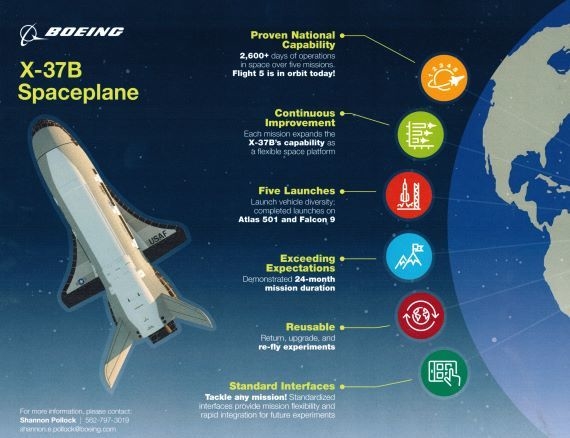
That Earth-circling U.S. military X-37B robotic space drone is closing in on a new long-duration record.
The Orbital Test Vehicle (OTV-6) is also called USSF-7 for the U.S. Space Force, and was launched on May 17, 2020 by an Atlas-V 501 booster and is winging past 770 days.
Flight of a previous record-holder was OTV-5 that spent nearly 780 days on-orbit.

Encapsulated X-37B Orbital Test Vehicle for U.S. Space Force-7 mission, now in Earth orbit.
Credit: Boeing
Onboard experiments
While the Boeing-built robotic space plane’s on-orbit primary agenda is classified, some of its onboard experiments were discussed pre-launch.
One experiment onboard the space plane is from the U.S. Naval Research Laboratory (NRL), an investigation into transforming solar power into radio frequency microwave energy. The experiment itself is called the Photovoltaic Radio-frequency Antenna Module, PRAM for short.
X-37B handout.
Credit: Boeing
Along with toting NRL’s PRAM into Earth orbit, the X-37B also deployed the FalconSat-8, a small satellite developed by the U.S. Air Force Academy and sponsored by the Air Force Research Laboratory to conduct several experiments on orbit.
In addition, two NASA experiments are tucked onboard the space plane to study the effects of the space environment on a materials sample plate and seeds used to grow food.
OTV-6 is the first to use a service module to host experiments. The service module is an attachment to the aft of the vehicle that allows additional experimental payload capability to be carried to orbit.

The U.S. Air Force’s X-37B Orbital Test Vehicle 4 is seen after landing at NASA ‘s Kennedy Space Center Shuttle Landing Facility in Florida on May 7, 2017.
Credit: U.S. Air Force courtesy photo
Earlier flights
Here’s a roster of X-37B missions showing the increasing duration of flight time.
OTV-1: launched on April 22, 2010 and landed on December 3, 2010, spending over 224 days on orbit.
OTV-2: launched on March 5, 2011 and landed on June 16, 2012, spending over 468 days on orbit.
OTV-3: launched on December 11, 2012 and landed on October 17, 2014, spending over 674 days on-orbit.
OTV-4: launched on May 20, 2015 and landed on May 7, 2015, spending nearly 718 days on-orbit.
OTV-5: launched on September 7, 2017 and landed on October 27, 2019, spending nearly 780 days on-orbit.
As to when and where OTV-6 will return to a wheels-stopped landing is anybody’s guess.
OTV-1, OTV-2, and OTV-3 missions landed at Vandenberg Air Force Base, California, while the OTV-4 and OTV-5 missions landed at Kennedy Space Center, Florida.
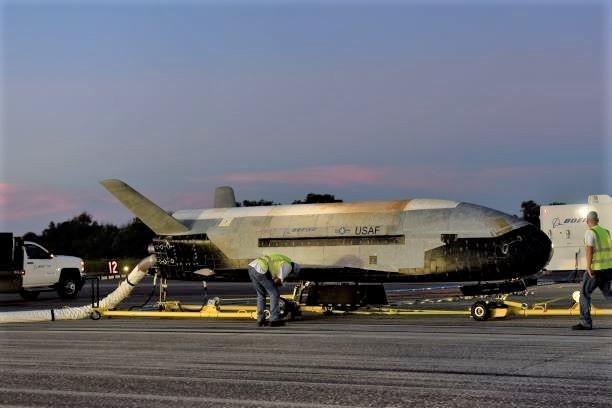
Post-landing of OTV-5 at NASA’s Kennedy Space Center Shuttle Landing Facility.
Courtesy Photo 45th Space Wing Public Affairs
Overseeing operations
The X-37B program is flown under the auspices of a U.S. Space Force unit called Delta 9, established and activated July 24, 2020.
In a description of Delta 9, current as of September 2020:
“Delta 9 Detachment 1 oversees operations of the X-37B Orbital Test Vehicle, an experimental program designed to demonstrate technologies for a reliable, reusable, unmanned space test platform for the U.S. Space Force,” according to a fact sheet issued by Schriever Air Force Base in Colorado.

Delta 9 unit emblem.
Credit: U.S. Space Force
“The mission of Delta 9 is to prepare, present, and project assigned and attached forces for the purpose of conducting protect and defend operations and providing national decision authorities with response options to deter and, when necessary, defeat orbital threats,” the fact sheet explains. “Additionally, Delta 9 supports Space Domain Awareness by conducting space-based battlespace characterization operations and also conducts on-orbit experimentation and technology demonstrations for the U.S. Space Force.”
Vehicle features
Boeing, as the space plane maker, notes that the vehicle features many elements that mark a first use in space, including:
- Avionics designed to automate all de-orbit and landing functions.
- Flight controls and brakes using all electro-mechanical actuation; no hydraulics on board.
- Built using a lighter composite structure, rather than traditional aluminum.
- New generation of high-temperature wing leading-edge tiles and toughened uni-piece fibrous refractory oxidation-resistant ceramic (TUFROC) tiles.
- Advanced conformal reusable insulation (CRI) blankets.
- Toughened uni-piece fibrous insulation (TUFI) impregnated silica tiles.

Air Force X-37B space plane.
Credit: Boeing
According to a Boeing fact sheet, “the X-37B is one of the world’s newest and most advanced re-entry spacecraft, designed to operate in low-earth orbit, 150 to 500 miles above the Earth. The vehicle is the first since the Space Shuttle with the ability to return experiments to Earth for further inspection and analysis. This United States Air Force unmanned space vehicle explores reusable vehicle technologies that support long-term space objectives.”
At first designed to fly 270 days per mission, Boeing adds that “the X-37B has set progressive records for time on orbit during each of its five previous missions.”

Credit: Kevin Fetter
Go to this June 25, 2022 video of OTV-6 flying overhead, taken by Canadian skywatcher Kevin Fetter. “Nice to have a clear sky again, after a few cloudy one’s,” he says.
Video at: https://youtu.be/WbpLxDxVDS8

CAPSTONE over the Moon’s North Pole. After arrival at its cis-lunar destination, CAPSTONE will begin its 6-month-long primary mission. The mission will validate a near rectilinear halo orbit’s characteristics by demonstrating how to enter into and operate in the orbit.
Illustration credit: NASA/Daniel Rutter
NASA’s CAPSTONE CubeSat mission is set for its Moon-bound departure to demonstrate a unique orbit for future NASA Artemis missions.
Liftoff from the Rocket Lab launch facility in Mahia, New Zealand atop the firm’s Electron booster is now set for Tuesday, June 28, 2022. CAPSTONE launch broadcast coverage from New Zealand starts at 5:00 a.m. EDT. Instantaneous launch opportunity is at 5:55 a.m. EDT.

Rocket Lab’s Electron rocket sits on the pad at the company’s Launch Complex 1 in New Zealand for wet dress rehearsal ahead of the CAPSTONE launch.
Credit: Rocket Lab
The Cislunar Autonomous Positioning System Technology Operations and Navigation Equipment (long space-speak for CAPSTONE) is to head for cislunar space – the orbital area near and around the Moon – and demonstrate an innovative spacecraft-to-spacecraft navigation technology.

Orion spacecraft pulls up to Gateway.
Credit: NASA
Gateway outpost
The destination for this microwave oven-size CubeSat is a near rectilinear halo orbit (NRHO), the orbit of choice planned for Gateway, the multipurpose outpost for long-term lunar missions as part of NASA’s Artemis program.
The Gateway in lunar orbit is where astronauts will transfer between the Orion piloted spacecraft and the lander on regular Artemis missions.
Gateway will remain in orbit for more than a decade. In that time it provides a place to live and work, and support long-term science and human exploration on and around the Moon.

CAPSTONE team members install solar panels onto the Cislunar Autonomous Positioning System Technology Operations and Navigation Experiment – at Tyvak Nano-Satellite Systems Inc. in Irvine, California.
Credits: NASA/Dominic Hart
Key players
CAPSTONE is commercially owned and operated by Advanced Space in Westminster, Colorado, on behalf of NASA’s Space Technology Mission Directorate.
Other key players for CAPSTONE include:
- Tyvak Nano-Satellite Systems, Inc., a Terran Orbital Corporation: Spacecraft design, development and implementation, hardware manufacturing, assembly, testing and mission operations support.
- Stellar Exploration: Propulsion subsystem provider.
- Space Dynamics Lab (SDL): Iris radio and navigation firmware provider.
- Orion Space Solutions (formerly Astra): Chip Scale Atomic Clock (CSAC) hardware provider necessary for the 1-way ranging experiment.
- Tethers Unlimited, Inc.: Cross Link radio provider.
Six days after launch, the Rocket Lab Photon upper stage will release CAPSTONE into space for the first portion of the spacecraft’s solo flight.
After a four-month journey to the Moon, CAPSTONE will test the dynamics of the NRHO for at least six months.
Live launch coverage will begin at 5 a.m. Eastern on NASA Television, at: https://www.nasa.gov/nasalive

