Author Archive
 Author:
  July 20th, 2022
Credit: Lockheed Martin/Goodyear
Transport on the Moon, dealing with one-sixth gravity and rough, cratered landscape is no trouble-free drive.
Tackling the issue of lunar vehicle tires is a new, well-rounded partnership struck between Lockheed Martin and the Goodyear Tire & Rubber Company. The work is focused on commercializing lunar mobility.
Airless tire technology
There’s need for lunar surface transportation, vehicles driven by astronauts or operated autonomously without crew, said Kirk Shireman, vice president of Lunar Exploration Campaigns at Lockheed Martin.

Credit: Goodyear Tire & Rubber Company
“We’re developing this new generation of lunar mobility vehicle to be available to NASA and for commercial companies and even other space agencies to support science and human exploration,” Shireman said in a Lockheed Martin statement.
For its part, Goodyear is drawing from its advanced airless tire technology used on Earth with micro-mobility, autonomous shuttles and passenger vehicles, to advance lunar mobility and withstand the challenging conditions on the Moon.
The companies are already applying existing expertise to the project including testing concepts in lunar soil test beds
Longer distances, greater temperature extremes
It’s a good time to look back on the Apollo program, today saluting the first human touchdown on July 20, 1969.

Apollo 16 exploration site.
Credit: NASA/Washington Heritage Register
Several follow-on missions included Lunar Roving Vehicles (LRVs), purposely built for just a few days of use on excursions within five miles of their landing sites. Three LRVs were driven on the Moon, one on Apollo 15 by astronauts David Scott and Jim Irwin, one on Apollo 16 by John Young and Charles Duke, and one on Apollo 17 by Gene Cernan and Harrison Schmitt.
Given the NASA Artemis program, future missions will need to traverse rugged terrain over much longer distances while operating in greater temperature extremes.

Credit: NASA
Years of durability
New tire capabilities will need to be developed for years of durability and even survive the night that sees temperatures of below -250 degrees Fahrenheit and daytime temps of over 250 degrees Fahrenheit.
“Everything we learn from making tires for the Moon’s extremely difficult operating environment will help us make better airless tires on Earth,” said Chris Helsel, senior vice president, Global Operations and Chief Technology Officer at Goodyear.
The companies, along with MDA of Canada that will provide commercial robotic arm technology to be used on the human-rated lunar mobility vehicles, expect to have its first vehicle on the surface of the Moon in time to support NASA’s first landed mission.
That Artemis target time for the first woman and first person of color walking on the Moon is currently planned for 2025.
 Posted in

Credit: Piplsay
Remember that great line in the Stealers Wheel 1970’s song?: “Clowns to the left of me, jokers to the right. Here I am, stuck in the middle with you,” written by Joe Egan and Gerry Rafferty.
Let’s spin that recording up into the 21st century and fly it next to all the perplexing chitter-chatter of Unidentified Aerial Phenomenon (UAP) and Unidentified Flying Object (UFO) folklore.
Here’s my premise: For one, the Twitter/Facebook frenzy about this topic is fraught with folks pointedly posting imagery that are intentionally faked.
The question is: Should there be a law about this given that Congress is opening up the floodgates for a new ability to report UAPs? In a recent UAP hearing this was briefly mentioned, of people purposively clogging the Internet wavelengths with false sightings.

Credit: MUFON
Perhaps, it’s time to deal with this problem now?
Ought to be a law?
“Well, while people certainly fake images, which has become easier and easier to do. As far as problems with this regarding the government investigations, I don’t see how that applies,” responds Mark Rodeghier, the scientific director of the Center for UFO Studies in Chicago.
“For better or worse, the government investigations are only going to use, as I read it, reports from military or other government personnel, or data from various government instrumented systems, and this would include UFO photos,” Rodeghier adds.

Credit: Scientific Coalition for UAP Studies (SCU)
“They still don’t have any intent of including civilian reports, and this is true even in the new Bill S.4503 which requests the government to do way more than its doing now about UFOs/UAP,” Rodeghier emphasized.
So unless we expect official sources to start faking stuff, Rodeghier points out, “then I see this as a non-starter and not a problem. And I’m definitely not for Congress creating laws about UFO reporting, anyway, unless that law, as with S.4503, is to make it easier to report without retribution from bosses and a military or civilian government agency.”
Integrity: pillar of scientific research
Another take on the situation is offered by Avi Loeb, head of Harvard’s Galileo Project, a systematic scientific search for evidence of extraterrestrial technological artifacts.
“Yes, I agree that data should never be faked,” Loeb told Inside Outer Space. “In academic research, this issue is resolved by the requirement that scientific results must be reproducible by independent researchers. The same should apply in UAP studies.”

Up close and personal! Scene from Earth vs. the Flying Saucers circa 1956.
Credit: Columbia Pictures
Loeb said that integrity “is a pillar of scientific research and cannot be violated. One of the most effective ways to enforce it is by assigning the reputation of the reporter to future testing of the credibility of the results by other researchers.”
Mick West is a skeptical investigator of the UAP matter.
“Some UAP may represent a serious phenomenon, possibly a national security threat,” West said. “Fake UAP reports waste everyone’s time and redirect resources from the investigation of honest reports. Making false reports to a government reporting system should be illegal.”

Recent Congressional hearing on UAP. Credit: Counterterrorism, Counterintelligence, and Counterproliferation Subcommittee/Inside Outer Space screengrab
Space legalese
Adding her space legalese to this topic is Joanne Irene Gabrynowicz, professor emerita and Journal of Space Law editor-in-chief emerita at the University of Mississippi School of Law.
“The more relevant law here are the U.S. federal statutes about lying to Congress and submitting false statements,” Gabrynowicz said. “Federal law requires that statements and documents submitted to Congress be completely truthful. If falsified documents are submitted under oath, perjury could also be involved.”
Publicity-seeking hoaxers
The history of fake UFO photos and artifacts is as old as UFOs themselves, points out Robert Sheaffer, a long-time UFO skeptic. “The motive of the UFO hoaxer seems to center around publicity-seeking, and the satisfaction of (presumably) outsmarting people.”
Sheaffer said that if you took away all the fakes from UFOlogy, what remains would not be all that interesting. “I have concerns about proposals to criminalize UFO hoaxes, as being intrusive and unworkable. I suppose, however, that it might be actionable in the narrow sense of ‘filing a false police report’…but only that.”
All in all – keep an eye on the sky but keep it truthful and if you are a fraudulent eye-sighting UAP/UFO reporting person, get a lawyer!
What’s your view?

Credit: China Central Television (CCTV)/China National Space Administration (CNSA)/United Nations Office for Outer Space Affairs (UNOOSA)/China Manned Space Agency (CMSA)/Inside Outer Space screengrab
China is developing the prototype sample of the country’s first space telescope Xuntian, also known as Chinese Survey Space Telescope or the Chinese Space Station Telescope
According to the Changchun Institute of Optics, Fine Mechanics and Physics, the space telescope has an aperture of two meters and loaded with state-of-art detectors. A bus-sized facility, the telescope has a length equal to that of a three-storied building and weighs more than 10 tons.

Credit: CCTV/Inside Outer Space screengrab
Two part telescope
“The Xuntian space telescope consists of two parts. One is the Xuntian optical facility, and the other is the Xuntian platform. The Xuntian optical facility is a telescope and it has many subsystems,” Zhan Hu, principle scientist of the Xuntian optical facility and researcher from the National Astronomical Observatories of the Chinese Academy of Sciences told China Central Television (CCTV).

Credit: CCTV/Inside Outer Space screengrab
The first-generation Xutian space telescope consists of five observation apparatus, including the Xuntian module, the terahertz module, the multichannel imager, the integral field spectrograph, and the extrasolar planetary imaging coronagraph.
The Xuntian module, a camera with a wide field of view, will take up major observation time.
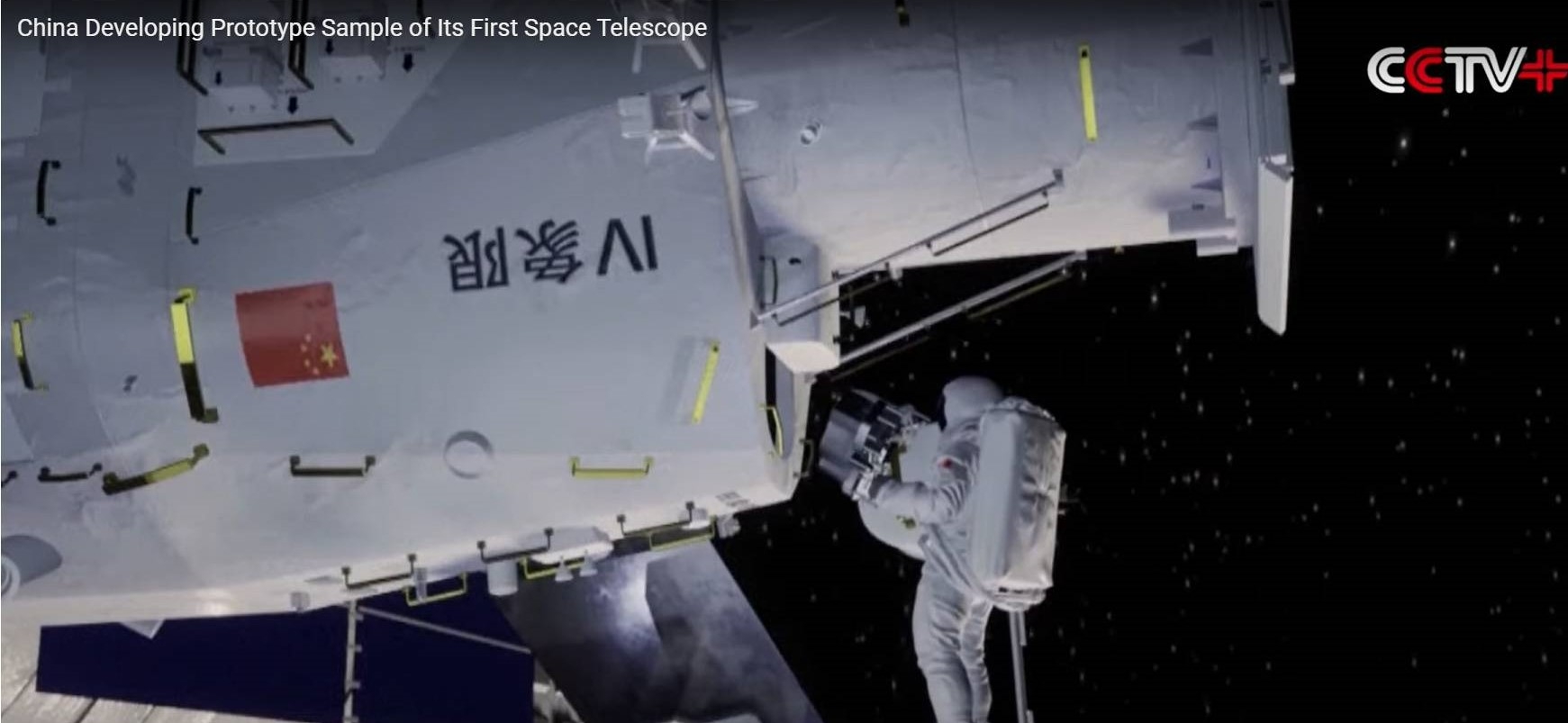
Credit: CCTV/Inside Outer Space screengrab
Independent flight
“We are still developing the prototype sample. Currently, we’ve completed the development of all subsystems, components, and units, and we are preparing for the test after they are assembled,” said Xu Shuyan, chief designer of the Xuntian optical facility and researcher from the National Astronomical Observatories of the Chinese Academy of Sciences.

Credit: CCTV/Inside Outer Space screengrab
“After this, we will start the development of the telescope sample, and start the research of the flying parts. Then we will conduct the joint test with the Xuntian platform and the test at the launch base, before it is launched,” Xu told CCTV.
During its normal observations, the space telescope will fly independently in the same orbit as China’s space station – but at a faraway distance.
The space telescope will be launched after the construction of the space station is completed and will be put into operation around 2024.
For an informative video about China’s space telescope effort, go to:
Credit: Scientific Coalition for UAP Studies (SCU)
In early June, NASA announced it is calling into action an independent study on Unidentified Aerial Phenomena – UAP in nameless, shape-shifting short form.
NASA is commissioning a UAP study team to start early in the fall to look into events in the sky that cannot be identified as aircraft or known natural phenomena.
The intent is to move the scientific understanding of UAPs forward.

Credit: Via Change.org petitions
I reached out to a number of UAP and Unidentified Flying Object (UFO) groups, leading experts in the field, as well as those skeptical of NASA’s endeavor. Clearly, lots of advice and some concerns flagged.
For more information on NASA and its study of UAPs, go to my new Space.com story – “Will new NASA study move the needle on UFO research? – Experts weigh in” at:

The Tianzhou-3 cargo spacecraft was undocked from the Tianhe Core Module on July 17, 2022.
Credit: China National Space Administration (CNSA)/China Central Television (CCTV)/Inside Outer Space screengrab
China’s space station construction site entered a new stage with the undocking of the Tianzhou-3 cargo craft in preparation for the launch of the Wentian lab module.
Video released by the China Manned Space Agency (CMSA) showed the freighter slowly detaching from the front docking port of the core module Tianhe and flying away.

Credit: Lee Brandon-Cremer (CC BY-SA 4.0)
“Before undocking, Tianzhou-3 was docked with the core module’s front port, which will be the one lab module Wentian docks with following its launch. So, before Wentian arrives, Tianzhou-3 needed to detach from the combination to prepare for the launch of the lab module,” said Jiang Ping, deputy chief designer with the cargo spacecraft team at the Beijing Aerospace Control Center.
“The entire undocking process went on without a hitch, with the craft completing the separation safe and sound and switching to normal in-orbit flight mode,” Jiang said in a China Central Television (CCTV) video.
Solo flight mode
“Tianzhou-3 is now in solo flight mode. Next, after the successful launch of lab module Wentian and its subsequent docking with the space station combination, Tianzhou-3 will be deorbited. By then we will lower the cargo craft’s flight altitude through two orbit adjustments,” said Luo Chengdong, assistant to the cargo spacecraft program at the China Aerospace Science and Technology Corporation.

Shenzhou-14 crew.
Credit: CNSA/CCTV/Inside Outer Space
Tianzhou-3 was lofted on September 20, 2021 from the Wenchang Spacecraft Launch Site in the southern province of Hainan. It delivered six tons of goods to the country’s under-construction space station.
Now onboard the station’s core module, the Shenzhou-14 crew — Chen Dong, Liu Yang, and Cai Xuzhe – are the third batch of astronauts to work within the Chinese space station.
Busiest-ever mission
During the busiest-ever spaceflight mission of six months, the trio will carry out an array of sophisticated tasks in space and complete the construction of the Tiangong space station, with a basic three-module structure consisting of the core module Tianhe and the lab modules Wentian and Mengtian.

Mengtian Lab Module undergoes ground testing.
Credit: CAST
In the six months, the trio will conduct rendezvous and docking for five times, three separation missions, and two transposition tasks [with the core module]. They will enter the two lab modules for the first time.
The astronauts will also carry out relevant function tests on the two-module space station complex, three-module space station complex and large and small mechanical arms with the assistance of the ground team, according to CCTV.
China is set to launch the lab module Wentian later this month (likely July 24) and another lab module Mengtian in October. The intent is to fully outfit the orbiting outpost by year’s end.
For a video of the supply craft undocking, go to:

Credit: NASA
“New and unexpected” findings from the Alpha Magnetic Spectrometer (AMS) on the International Space Station, says Samuel Ting of MIT at the Committee on Space Research (COSPAR) being held July 16-24, 2022 in Athens, Greece.
The Alpha Magnetic Spectrometer is a precision particle physics magnetic spectrometer, normally used in accelerators, installed on the International Space Station.
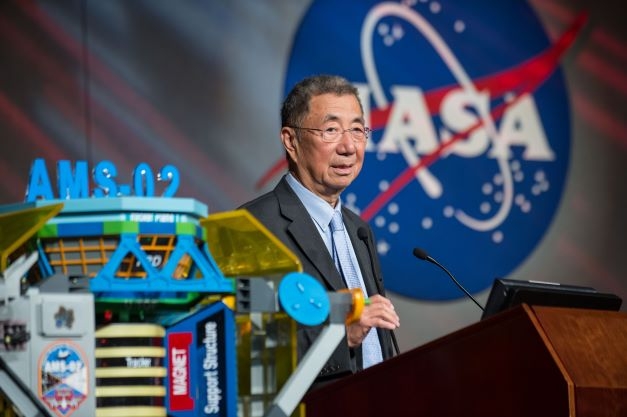
Nobel Laureate Samuel Ting, principal investigator for the Alpha Magnetic Spectrometer, speaks about the first published results of AMS-02 during a 2013 press conference at NASA’s Johnson Space Center in Houston.
Credit: NASA/James Blair
Nobel Laureate Samuel Ting, principal investigator for the AMS, reports that in ten years the space-based equipment has collected more than 200 billion cosmic rays of elementary particles and nuclei with a large acceptance and per cent level accuracy.

Credit: NASA
New physics
“The results on positrons, electrons, and antiprotons show the existence of new physics,” Ting explains.
“The results on nuclei, from hydrogen to iron, show that the current understanding of cosmic rays cannot explain the data,” Ting notes in a COSPAR abstract. “The ten-year AMS results require the development of a new and comprehensive theory of the cosmos.”
AMS was launched on Space Shuttle Endeavour on May 16, 2011, then attached to the International Space Station’s Starboard Truss-3 structure.

Credit: NASA
Earth’s Moon is far from being a “been there, done that” world notwithstanding a dozen Apollo short-stay visitors between 1969 and 1972.
The space agency is eying an Artemis Base Camp, calling it “our first foothold on the lunar frontier.”
The ingredients for that encampment are a Lunar Terrain Vehicle – an unpressurized rover – to transport suited astronauts around the site; a habitable mobility platform – a pressurized rover – to enable long-duration treks away from Artemis Base Camp. Lastly there would be the surface habitat itself, capable of housing four humans at a lunar south pole locale.

Illustration of NASA astronauts on the lunar south pole carrying out early work to establish an Artemis Base Camp. Will placing Artemis astronauts on the Moon become a stepping stone to a sustained presence on Earth’s celestial next door neighbor? Credit: NASA
Digging in deep
To tackle key challenges that need addressing, a Lunar Surface Innovation Consortium is being hosted by the Johns Hopkins Applied Physics Laboratory (APL) in Laurel, Maryland. It is work in progress and an ongoing endeavor that functions in collaboration with the NASA Space Technology Mission Directorate.
This APL-led consortium is digging in deep into road-mapping ways to move humans outward, back to the Moon, re-planting crews there, but in a sustained way.
To learn more, go to my new Space.com article — “Rebooting” the moon: NASA’s Artemis program aims for lunar sustainability – Innovative technologies are needed to forge the first long-term presence on the moon” – at:
https://www.space.com/rebooting-moon-nasa-artemis-sustainability

Nearby, young, star-forming region called NGC 3324 in the Carina Nebula. Captured in infrared light by NASA’s new James Webb Space Telescope, this image reveals for the first time previously invisible areas of star birth.
Credits: NASA, ESA, CSA, STScI
Scene spoiler alert!
The U.S. Government Accountability Office (GAO) has put its own magnifying glass on the James Webb Space Telescope.
Lesson one: manage large project costs to limit cascading effects on others, the GAO’s WatchBlog explains.
Early images
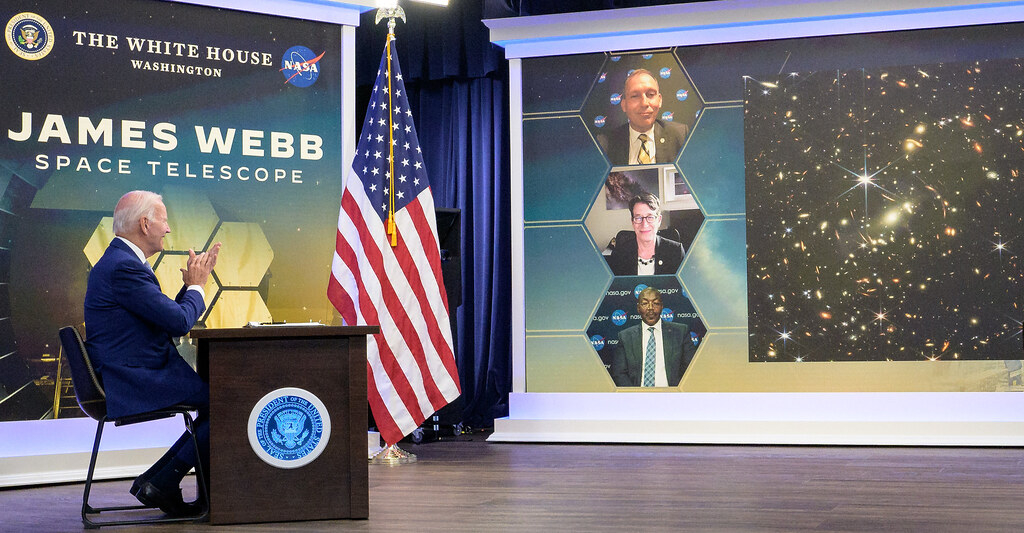
Credit: NASA/Bill Ingalls
While NASA released the first public images from the James Webb Space Telescope (JWST), which launched on December 25, 2021, the early images spotlight the different phases in the history of the Universe—ranging from early galaxy formation after the Big Bang to the evolution of our solar system.
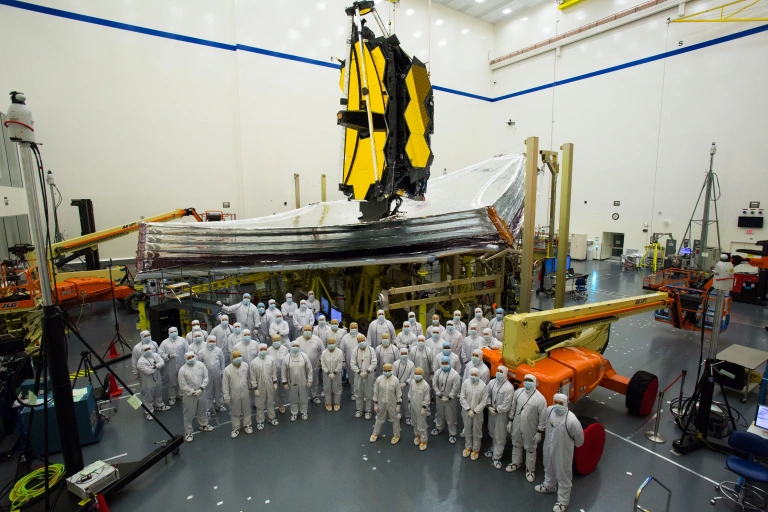
Credit: Northrop Grumman
Costly delays
“But there are other lessons to gain from the James Webb Space Telescope (JWST), which took 20 years to develop and faced more than 7 years of delays,” the GAO adds. They took in some of the early images from the JWST and explore some of the lessons learned that could help NASA in its development of future projects.
Go to this GAO look at JWST’s financial spherical (circular) aberration – “James Webb Space Telescope Delivers Fascinating First Images and Lessons for Future NASA Projects” at:
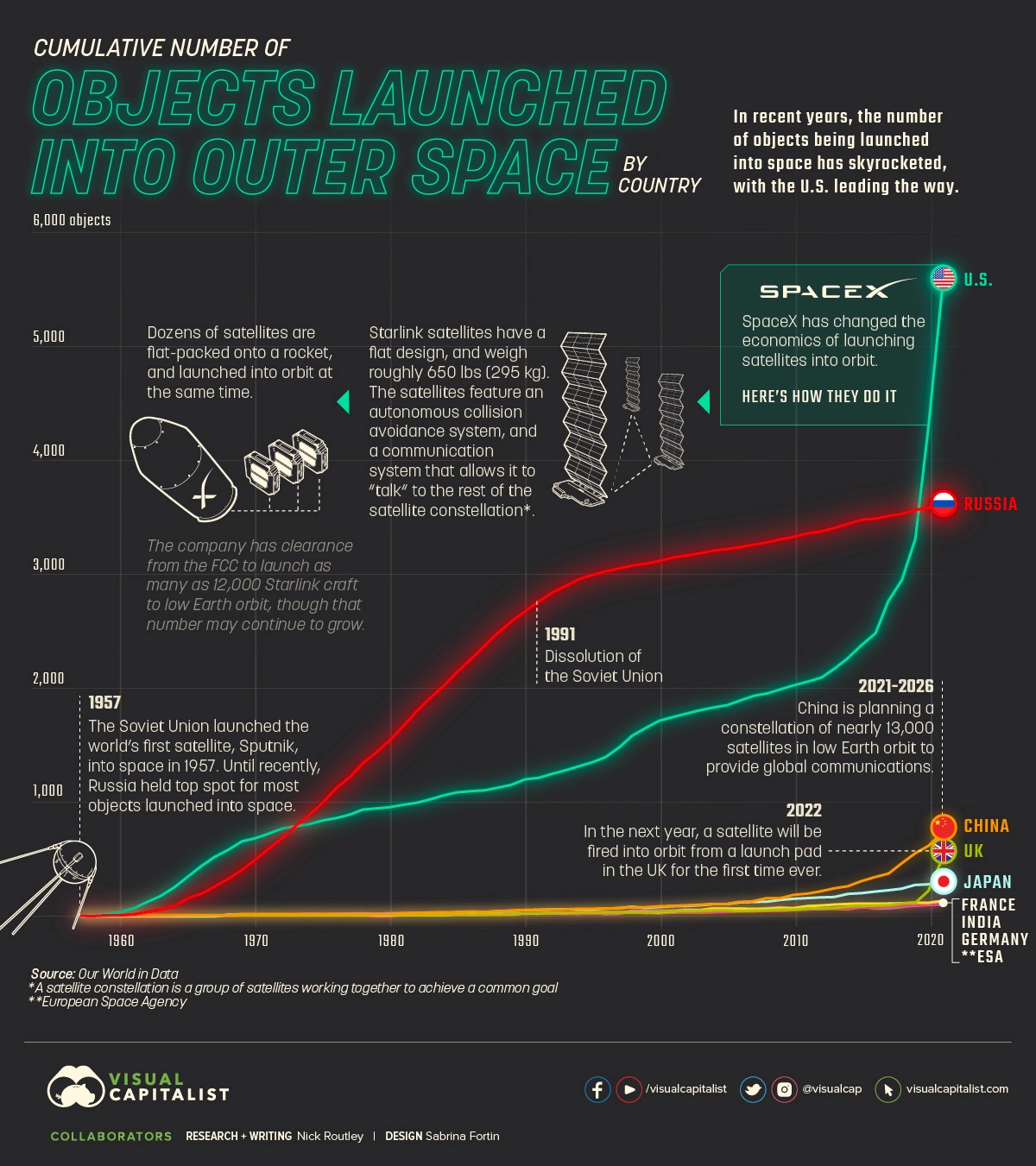
Credit: Visual Capitalist
Every day a staggering 2.5 exabytes of data is generated making our world increasingly difficult to understand.
Headquartered in Vancouver, British Columbia, Visual Capitalist is one of the fastest growing online publishers globally, focused on topics including markets, technology, energy and the global economy.
Check out their website to view all the data gathered on which countries are dominating space at:
https://www.visualcapitalist.com/visualized-which-countries-are-dominating-space/

Credit: Visual Capitalist
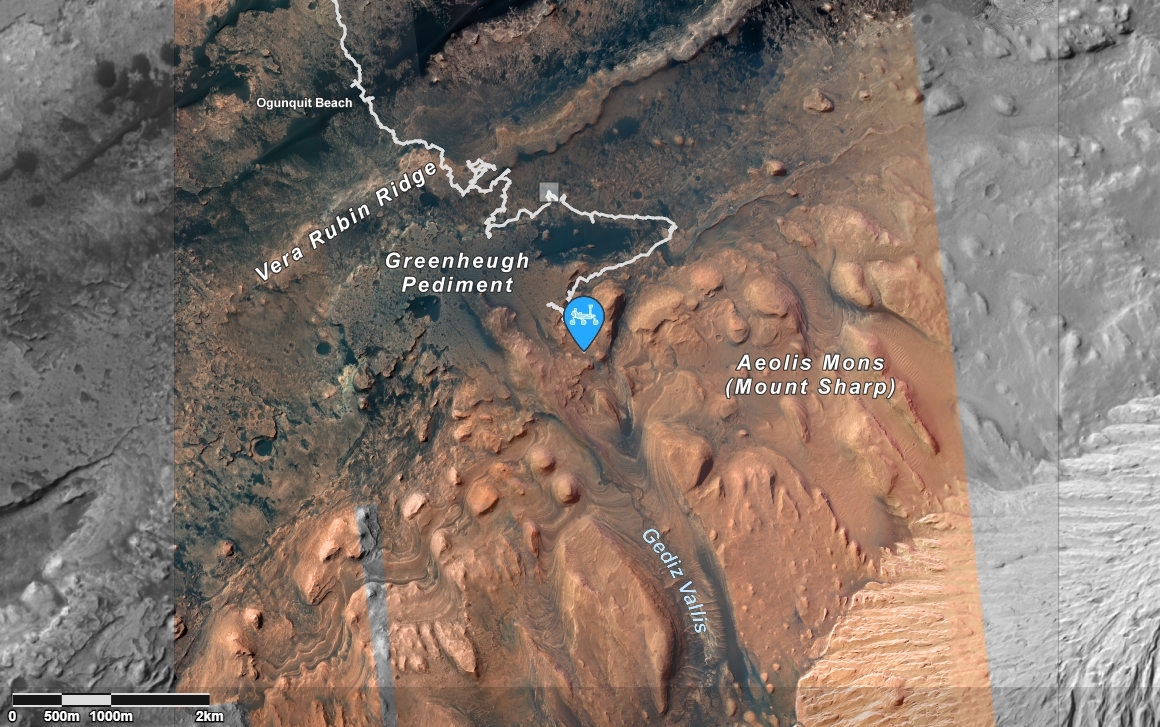
Curiosity’s location as of Sol 3531. Total distance driven by that sol is 17.54 miles/28.23 kilometers.
Credit: NASA/JPL-Caltech/Univ. of Arizona
NASA’s Curiosity Mars rover at Gale Crater is now performing Sol 3532 duties.
The robot has finished up “Avanavero” drill activities and is “officially back on the Martian road to the layered sulfate-bearing unit,” reports Abigail Fraeman, a planetary geologist at NASA’s Jet Propulsion Laboratory.
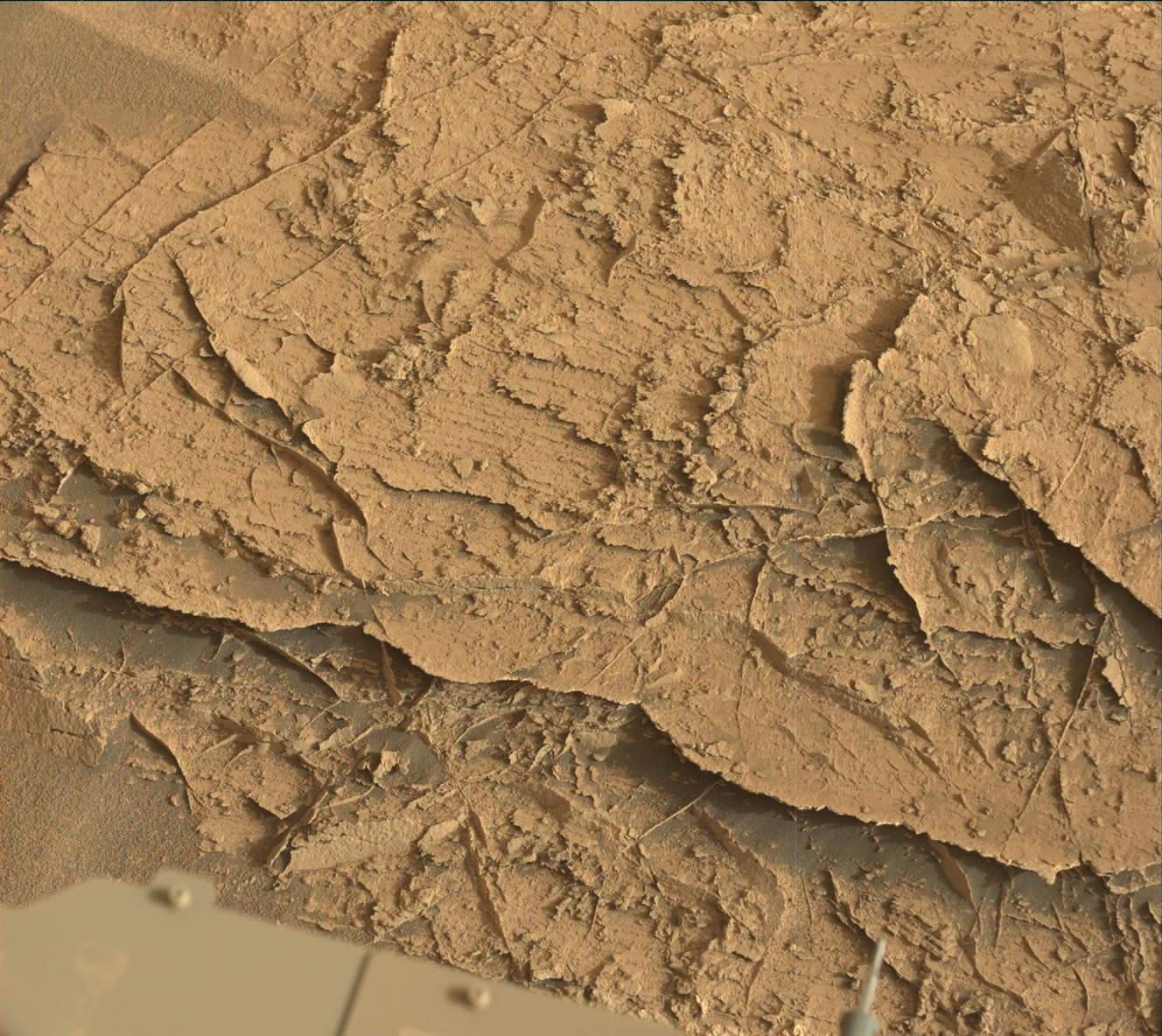
Curiosity Mast Camera (Mastcam) Left image taken on Sol 3531, July 13, 2022.
Credit: NASA/JPL-Caltech/MSSS
The rover recently filled the day with contact science, remote sensing, and a drive of over 164 feet (50 meters-plus).
The remote sensing and contact science activities include use of the Mars Hand Lens Imager (MAHLI) and Chemistry & Camera (ChemCam).
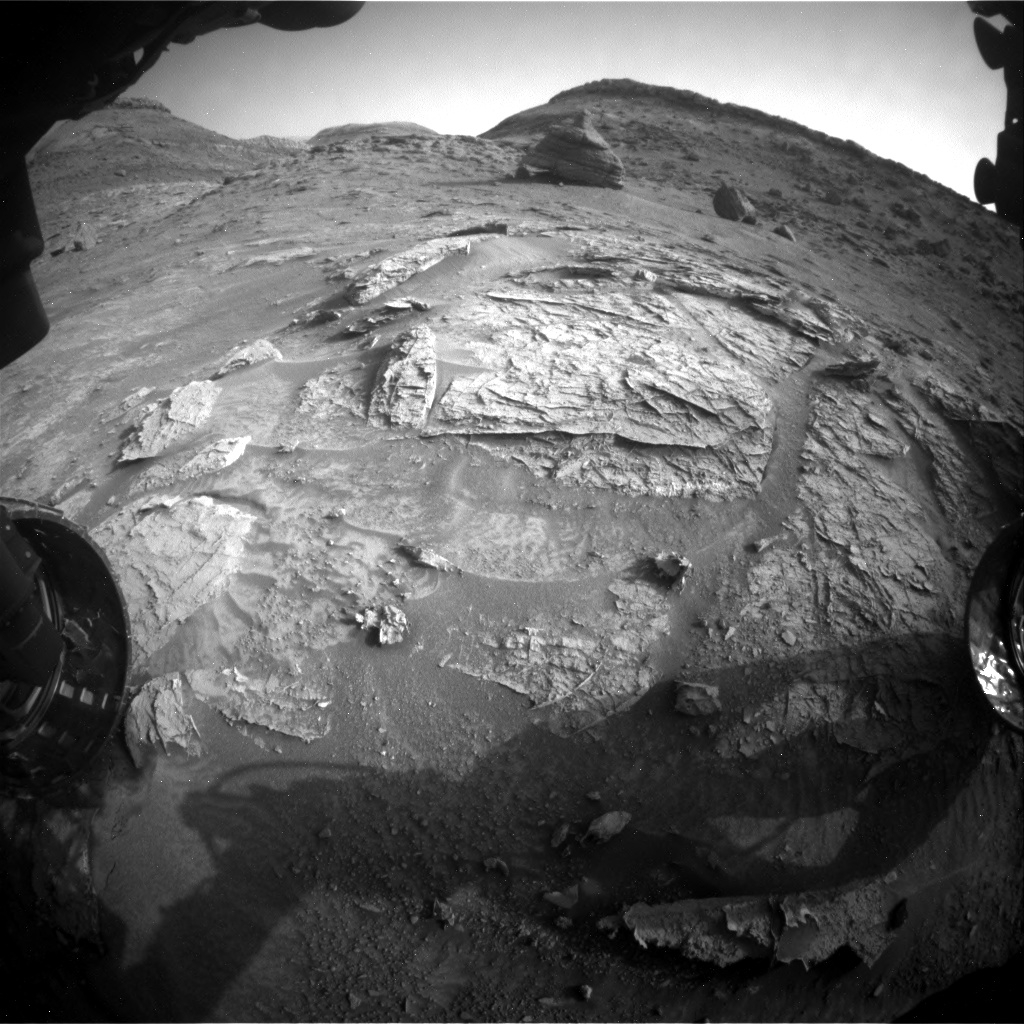
Curiosity Front Hazard Avoidance Camera Left B photo acquired on Sol 3531, July 13, 2022.
Credit: NASA/JPL-Caltech
Vein-rich rock
MAHLI and ChemCam Laser Induced Breakdown Spectroscopy (LIBS) observation of a bedrock target named “Uai Uai,” as well as Mastcam regular and multispectral images of a vein-rich rock target named “Las Nieves” and a layered rock named “Luepa.”
Also on tap was using both Mastcam and Navcam to monitor the atmosphere.
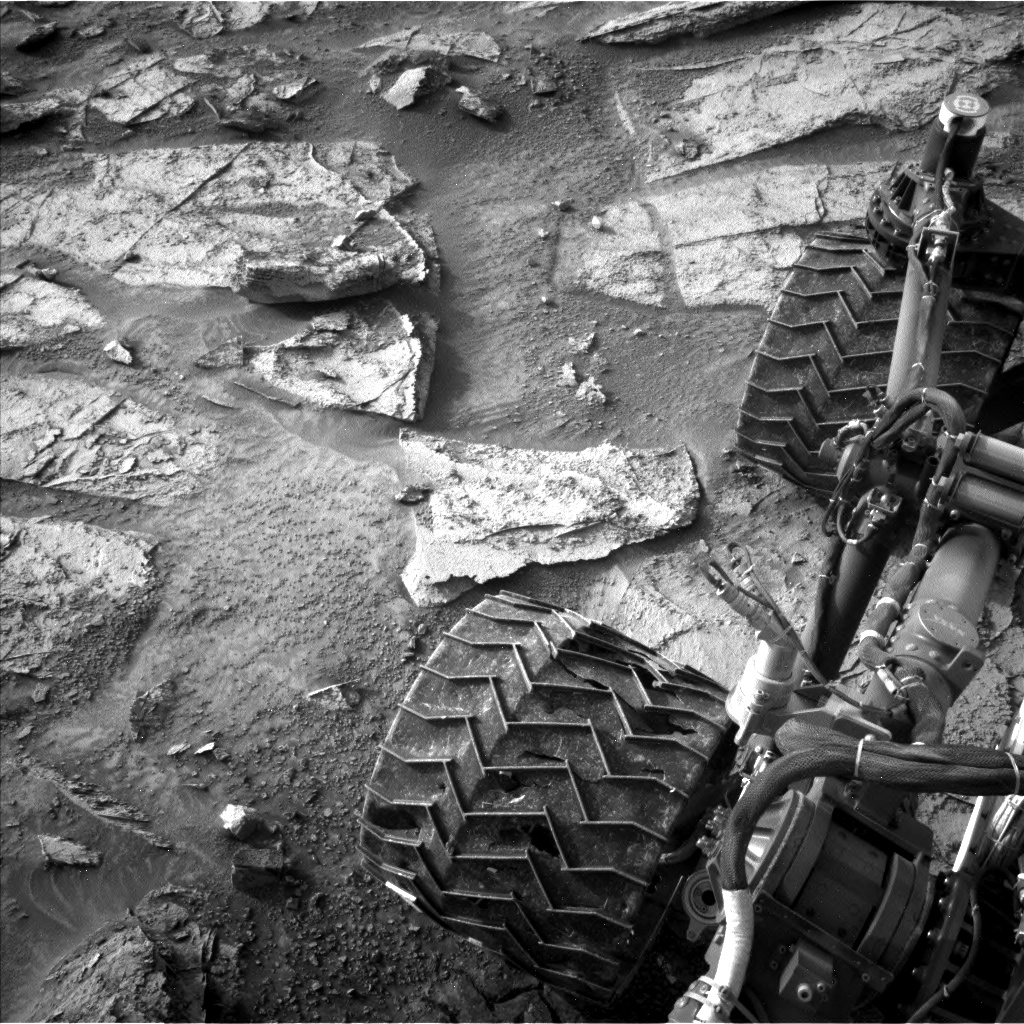
Curiosity Left B Navigation Camera image taken on Sol 3531, July 13, 2022.
Credit: NASA/JPL-Caltech
Fraeman served a tactical role as Surface Properties Scientist. “I helped the rover drivers assess whether Curiosity’s parking spot was stable enough to retract the arm for the MAHLI observations, and any terrain hazards that might affect the drive.”
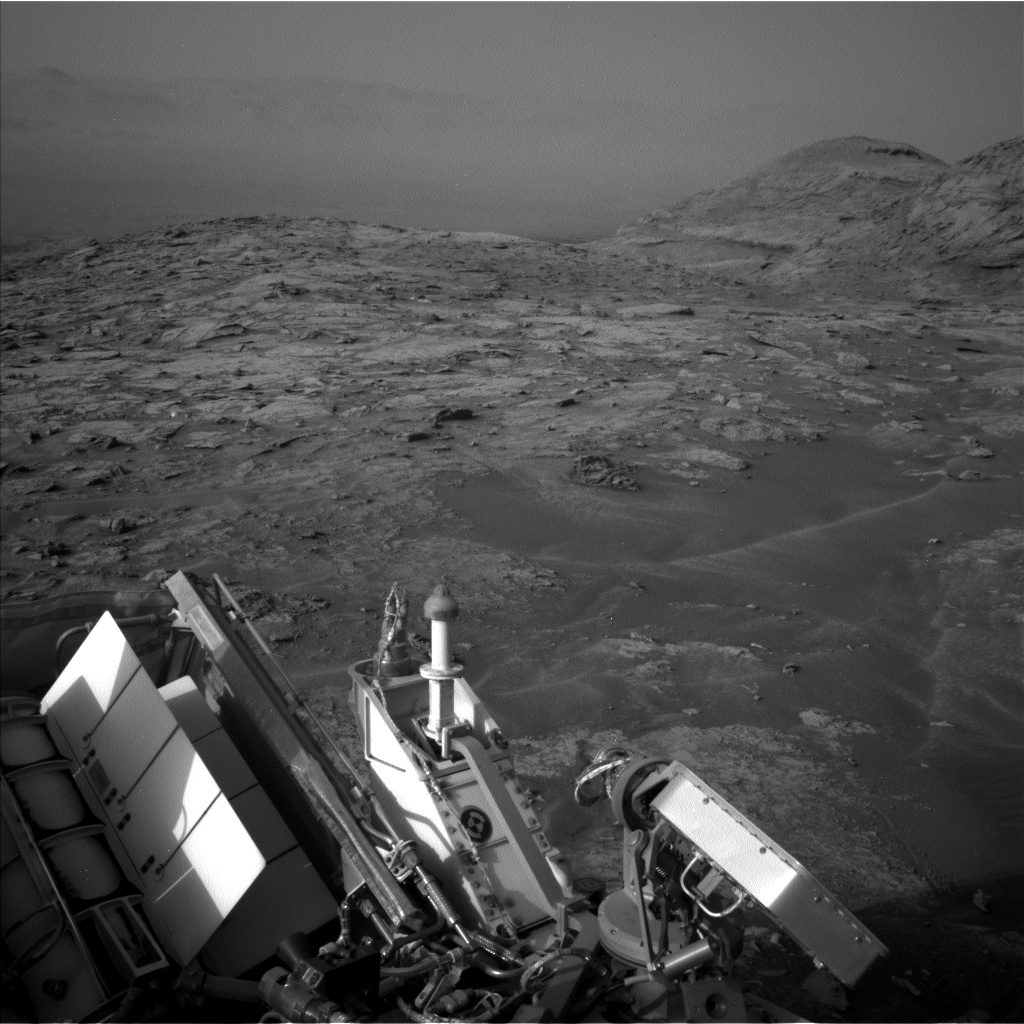
Curiosity Left B Navigation Camera image taken on Sol 3531, July 13, 2022.
Credit: NASA/JPL-Caltech
Several of Curiosity’s wheels were perched on rocks recently which made the stability assessment particularly interesting, Fraeman adds, “but after a lot of discussion with the rover drivers, we all agreed there was minimal risk of the rover shifting when we unstowed the arm.”
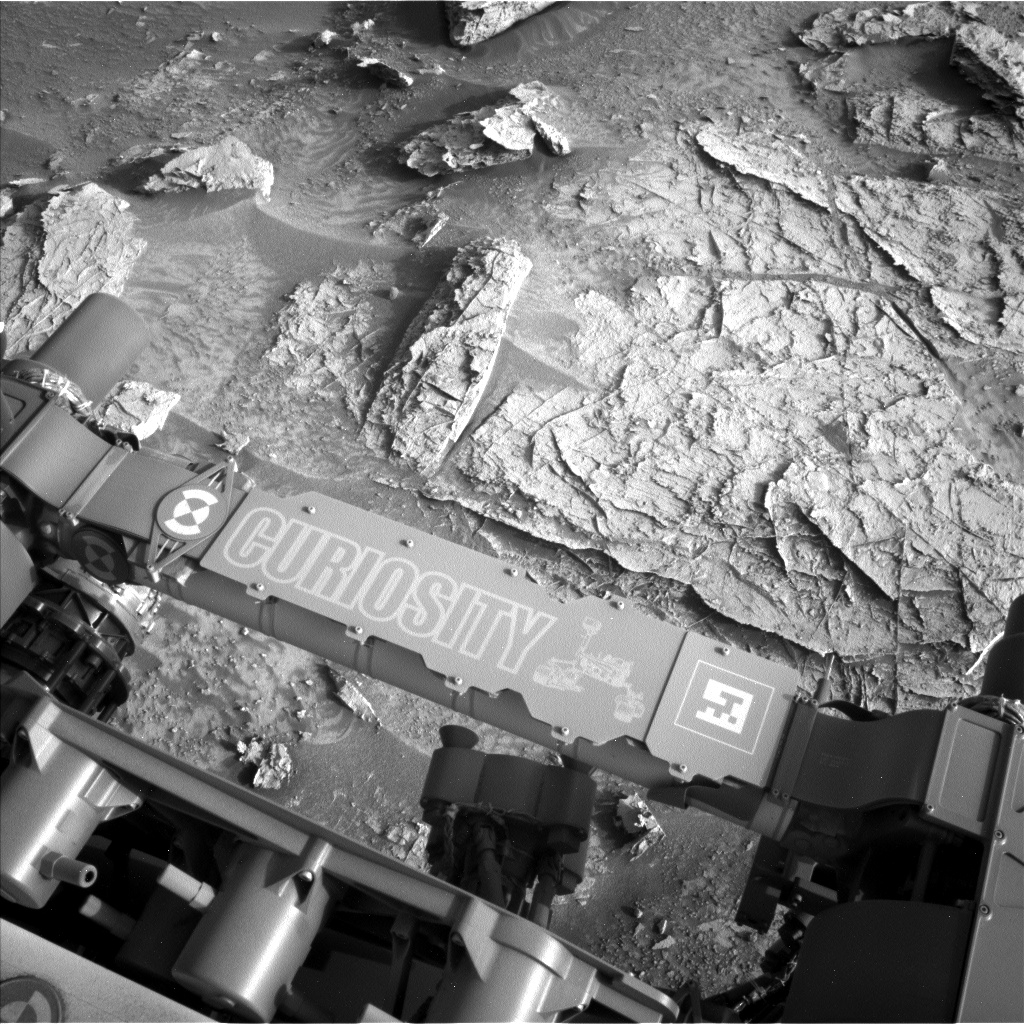
Curiosity Left B Navigation Camera image taken on Sol 3531, July 13, 2022.
Credit: NASA/JPL-Caltech
APXS data
In an earlier report, Ken Herkenhoff, a planetary geologist at USGS Astrogeology Science Center in Flagstaff, Arizona said MAHLI images acquired on Sol 3528 confirm that the rover’s Alpha Particle X-Ray Spectrometer (APXS) was well placed over the Avanavero drill tailings, “and the APXS data look good so we are ready to drive away from this location. But first, we are planning a few more MAHLI and remote sensing observations.”
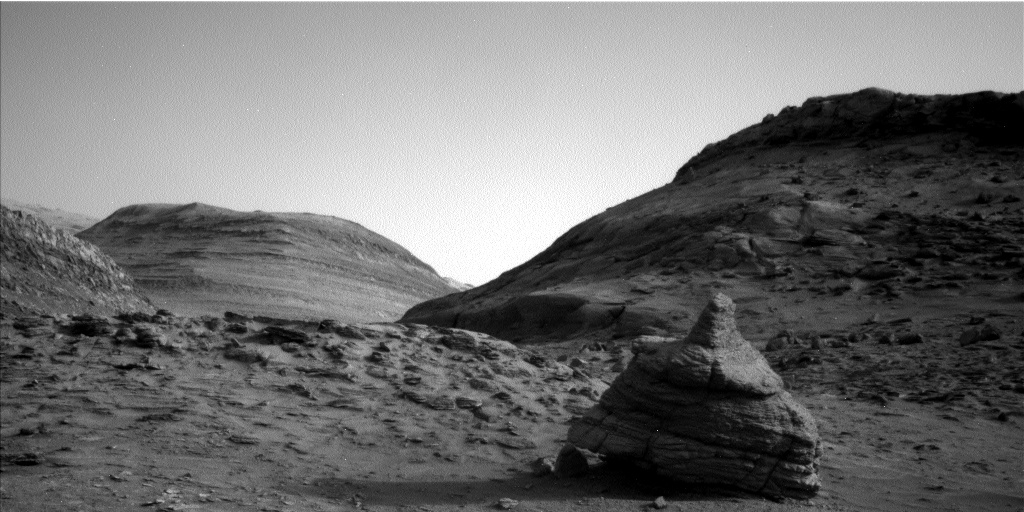
Curiosity Left B Navigation Camera image taken on Sol 3531, July 13, 2022.
Credit: NASA/JPL-Caltech
ChemCam as slated to shoot its laser at a vein target named “Chiung” on the right side of the rover, then will acquire another Remote Micro-Imager (RMI) mosaic to extend the coverage of a bright mound with numerous veins.
Outcrop coverage
Mastcam was scheduled to also extend stereo coverage of the “Amacuro” outcrop, document ChemCam’s Chiung target, and monitor changes in the distribution of material on the rover deck.
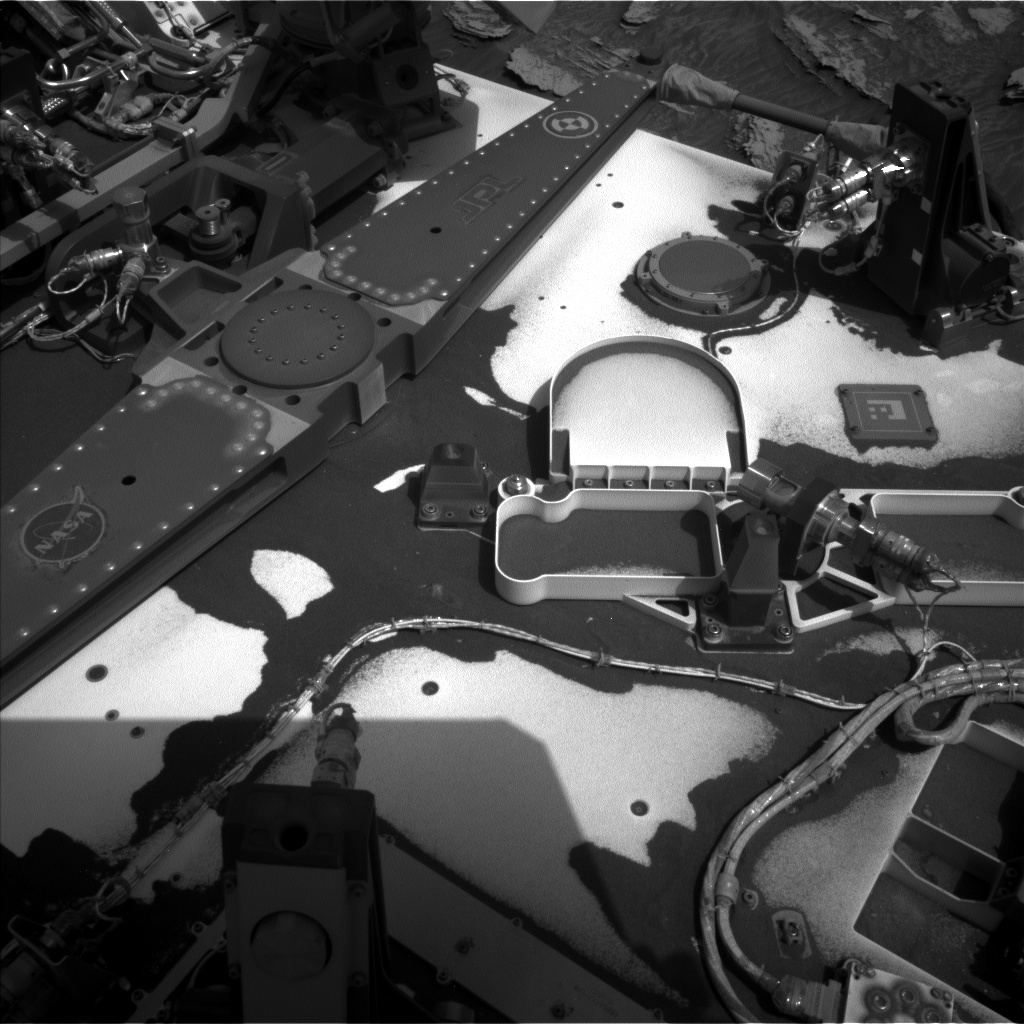
Curiosity Left B Navigation Camera image taken on Sol 3531, July 13, 2022.
Credit: NASA/JPL-Caltech
“After Navcam searches for dust devils, Mastcam will look for changes in nearby rover tracks at Kamana,” Herkenhoff adds. “The arm will then be deployed to acquire another MAHLI image of the drill tailings to determine whether the APXS touched the tailings during the overnight integration planned on Sol 3528.”

Curiosity Right B Navigation Camera image acquired on Sol 3531, July 13, 2022.
Credit: NASA/JPL-Caltech
Also in the plan, MAHLI was set to take images from 25 and 5 centimeters of a vein named “La Laja.” Then the arm will be stowed for the drive.
“We are not expecting to receive as much data as usual for future planning, so downlink priorities were carefully reviewed, especially for the post-drive images,” Herkenhoff reports.
As always, dates of planned rover activities are subject to change due to a variety of factors related to the Martian environment, communication relays and rover status.

