Author Archive
 Author:
  July 27th, 2022
Docking of Tianzhou-3 cargo spacecraft with core module.
Credit: CNSA/China Media Group/CCTV/Inside Outer Space screengrab
China’s Tianzhou-3 cargo craft re-entered the atmosphere “in a controlled manner” Wednesday, reports the China Manned Space Agency (CMSA).
Meanwhile, all eyes are on the “uncontrolled” re-entry of the hefty Long March-5 rocket body, now predicted to fall to Earth July 31 ± 22 hours, according to re-entry experts at The Aerospace Corporation. This Long March-5 leftover hurled the Wentian, the first lab module of China’s space station.

Credit: The Aerospace Corporation
As for the Tianzhou-3 cargo craft, it was launched on September 20, 2021, delivering roughly 6 tons of supplies to the in-construction station site. While in orbit, the cargo craft conducted two rendezvous and docking operations with the combination of the Tianhe core module, and carried out a test flight circling the space station.
Space technology tests
After its separation from the Tianhe combination on July 17, Tianzhou-3 carried out space technology tests, accumulating important experience for the in-orbit construction as well as the operation and management of the space station, according to a China Central Television (CCTV) report.

Credit: China National Space Administration (CNSA)/China Media Group(CMG)/China Central Television (CCTV)/Inside Outer Space screengrab
The Tianzhou-3 cargo craft flew independently during the rendezvous and docking between the Wentian lab module and the Tianhe core module. If any failure occurred during the docking process, Tianzhou-3 would have re-docked with the space station to provide living space for the astronauts, CCTV noted.
The CMSA explained that, as for the demise of the cargo vehicle, most of the spacecraft’s components burned up during re-entry, and a small amount of its debris fell into the scheduled safe waters.

Credit: The Aerospace Corporation
 Posted in

The Interstellar Probe, a mission to provide a unified view of our heliosphere, out into nearby interstellar space.
Credit: Johns Hopkins/APL
There is promising new work underway to pursue a deep space robotic interstellar mission. An Interstellar Probe venture can capture a unified view of our heliosphere, out into nearby interstellar space.
All of that sounds exceedingly lofty, ambitious, and tough-to-do.
But there’s no need to wait for new technology say advocates – it’s here, and one booster of choice for the mission could be NASA’s Space Launch System (SLS).
“It isn’t about where we are going. It’s about the journey out there. And it is a journey now long overdue,” says one leading advocate.
Go to my new Space.com story – “Interstellar probe: Has its time finally come?” – at:
https://www.space.com/interstellar-probe-johns-hopkins-apl-nasa-sls

The Korea Pathfinder Lunar Orbiter, KPLO, is set for a one-year agenda of research.
Credit: Korean Aerospace Research Institute (KARI)
The first lunar mission of the Korean Aerospace Research Institute is slated for an upcoming SpaceX Falcon 9 boost.
The Korea Pathfinder Lunar Orbiter, KPLO for short, is viewed as the first step of the country’s deep space agenda that includes a future first robotic landing onto the moon by 2030, as well as a sample collecting asteroid mission.
In May of this year, the KPLO was officially named “Danuri” – a blend of two Korean words for moon and “nurida” that means enjoy.
Go to my new Space.com story – “South Korea is ready to launch its 1st moon mission – The Korea Pathfinder Lunar Orbiter will lift off on Aug. 2” – at:
https://www.space.com/south-korea-first-moon-mission-launch-one-week
Credit: China National Space Administration (CNSA)/China Media Group(CMG)/China Central Television (CCTV)/Inside Outer Space screengrab
China’s Wentian lab module of China’s space station successfully docked with the combination of the Tianhe core module.
The Shenzhou-14 crew opened the door of Wentian and then entered the lab from the core module Tianhe.

Shenzhou-14 crew watches launch of the new lab module.
Credit: China National Space Administration (CNSA)/China Media Group(CMG)/China Central Television (CCTV)/Inside Outer Space screengrab
Launched on Sunday, the lab module flew to the station construction site, a process that took roughly 13 hours, according to the China Manned Space Agency (CMSA).
It was the first time that China’s two 20-ton-level spacecrafts conducted rendezvous and docking in orbit, and also the first time that a space rendezvous and docking were carried out during the astronauts’ in-orbit stay in the space station, the CMSA said.

Shenzhou-14 crew enters new lab module. Credit: China National Space Administration (CNSA)/China Media Group(CMG)/China Central Television (CCTV)/Inside Outer Space screengrab
Experiment racks
Like the Tianhe, the Wentian lab module is also equipped with living facilities for the astronauts, including three sleeping areas, a toilet and a kitchen. It has an airlock cabin which will become the main exit-entry point for extravehicular activities (EVAs) once active, replacing the role now played by the Tianhe docking hub.
The astronauts are slated to conduct in-orbit work such as the attitude control of the combination of the space station, small mechanical arm crawling and the test of the complex of big and small arms.
They will also use the airlock cabin and the small mechanical arm of Wentian to carry out extravehicular activities.

Station complete is set for year’s end.
Credit: CNAS/CCTV Video News Agency/Inside Outer Space screengrab
Wentian’s main role is hosting experiment racks for science experiments, while also providing backups to the life support and control functions of the core module that was launched in April 2021.
Mengtian, the final component of the space station, is scheduled to arrive in October.
Crew handover
The new crew facilities will allow China to perform a first crew handover. This will take place when the current Shenzhou-14 crew — commander Chen Dong and co-astronauts Liu Yang and Cai Xuzhe — greet three new astronauts aboard Shenzhou-15 in December.
The fully-built Tiangong (Heavenly Palace) station will then host six astronauts for a period of days.
For video views of the docking and the Shenzhou-14 crew boarding the new module, go to:

Credit: CCTV/Inside Outer Space screengrab
China’s Wentian lab module lifted off from the Wenchang Spacecraft Launch Site in south China’s Hainan Province on July 24 – a milestone mission to enlarge the country’s space station.
The lab will function both as a backup of the station’s core module and serve as a scientific experiment platform.

Credit: CCTV/Inside Outer Space screengrab
The construction of China’s Tiangong space station is expected to be completed by year’s end. It will then evolve from a single-module structure into a national space laboratory with three modules — the core module, Tianhe, and two lab modules, Wentian and Mengtian.
The Tianhe core module was launched in April 2021, and the Mengtian module is set to be launched in October this year.

Credit: China Manned Space Engineering Office
The Wentian module is now set to rendezvous and dock to the front docking port of the core module that now houses the Shenzhou-14 crew: Chen Dong and co-astronauts Liu Yang and Cai Xuzhe.
Video of the launch can be viewed at:

Credit: Im-a-puzzle.com
The team at online jigsaw site Im-a-puzzle.com analyzed data from the National UFO Reporting Centre (NUFORC) to find the total number of UFO sightings in each state as a proportion of 100,000 of its residents.
They also looked at the number of sightings that were reported each month worldwide since the year 2000, to find the best month to spot a UFO for yourself.
The methodology used: The National UFO Reporting Center database was used and sightings as a proportion of each state’s population were calculated. The number of sightings per month was calculated from worldwide reports between January 2000 to December 2021.
Here’s what they found:
- Washington is the most likely state to spot a UFO with 88.03 sightings per 100,000 residents.
- Vermont and Montana have the second and third most sightings per 100,000 people respectively.
- California has the highest total number of UFO sightings at 15,280.
- July ranks as the best month to spot a UFO, with 603 reports filed during this month on average.

Up close and personal! Scene from Earth vs. the Flying Saucers circa 1956.
Credit: Columbia Pictures
Top 10
- Washington – 88.03 sightings per 100,000 residents
Washington is the most likely state to spot a UFO, with 88.03 sightings per 100,000 residents or 6,812 sightings in total. Washington is home to what is often regarded as the first UFO sighting of the modern age, which marked its 75th anniversary in June this year. On 24th June 1947, pilot Kenneth Arnold claimed to have seen a string of nine shiny objects flying past Mount Rainier at impossibly high speeds during his flight from Chehalis to Yakima, Washington.
- Vermont – 87.98 sightings per 100,000 residents
Vermont ranks a very close second place, with 87.98 sightings per 100,000 residents. The first of three New England States to make the top ten, Vermonters have reported 568 sightings in total, making it a top contender for unexplained aerial phenomena despite its smaller population. One of the state’s first recorded sightings occurred in 1961 above East Mountain, in which personnel at North Concord Air Force Station reported a strange object that remained stationary in the sky for 18 minutes. Some believe this was related to the Barney and Betty Hill purported alien abduction that took place in New Hampshire on the same evening.
- Montana – 86.21 sightings per 100,000 residents
Montana ranks third with 86.21 sightings per 100,000 residents for a total of 952 reported UFO sightings. One of the Treasure State’s most publicized alleged sightings is the Mariana UFO incident, which occurred on 15th August 1950. Nick Mariana, a general manager for a minor league baseball team, and his secretary spotted two rotating silver discs travelling at speed through the sky in Great Falls, Montana. Capturing the phenomena on 16mm film, the Air Force wrote off Mariana’s footage as reflections from two F-94 jet fighters, however, later studies have questioned the validity of this explanation.
- Alaska – 83.94 sightings per 100,000 residents
Alaska ranks fourth with 83.94 sightings per 100,000 residents or 615 sightings in total. On 17th November 1986, a Japanese Boeing 747 aircraft was completing a portion of its journey from Reykjavík to Anchorage, when its crew claimed to observe three UFOs as they flew over eastern Alaska. The first two were reportedly two square shaped crafts that appeared to have glowing nozzles, the heat from which could be felt by the onboard crew, and the third object was only seen by the captain but was described as a gigantic spaceship twice the size of an aircraft carrier.
- Maine – 81.55 sightings per 100,000 residents
Maine comes in fifth with 81.55 reports per 100,000 residents or 1,119 reports in total. Maine’s most well-known encounter with extraterrestrial life is the case of the Allagash Abductions which allegedly took place on 20th August 1976. A group of four men had taken a fishing boat out on to the water one evening while on a camping trip in Northern Maine. They noticed a bright object in the sky which shone out a beam that followed the men as they scrambled to shore. Once at the campsite, they all felt that they had skipped a substantial amount of time and were extremely fatigued. All four men underwent hypnosis several years later and gave identical recounts of being abducted and experimented on by aliens.
- New Hampshire – 80.13 sightings per 100,000 residents
New Hampshire ranks sixth with 80.13 sightings per 100,000 residents or 1,113 sightings in total. The aforementioned case of Barney and Betty Hill in 1961 is perhaps New Hampshire’s most compelling and publicized account of extra-terrestrial encounters. The couple claim to have spotted and followed a 40-foot rotating craft in the sky while driving home from their vacation. The craft later descended on their parked vehicle with Barney claiming to have seen several humanoid figures on board. The couple stated that as they tried to drive away, they experienced a state of altered consciousness that placed them and their vehicle 35 miles south with no recollection of how they had got there.
- Oregon – 79.04 sightings per 100,000 residents
Oregon ranks seventh with 79.04 sightings per 100,000 residents or 3,356 sightings in total. Oregon is famed for the McMinnville UFO photographs taken on 11th May 1950, which are some of the most famous images ever captured of a UFO. The photos, which were captured by farming couple Paul and Evelyn Trent, show a three-dimensional metallic disc shaped object suspended in the sky above their house, before it then flew away in a western direction.
- New Mexico – 73.96 sightings per 100,000 residents
New Mexico ranks eight with 73.96 sightings per 100,000 residents or 1,565 reports in total. Many will be aware of the Roswell incident, a series of events so significant in UFO history that it sparked World UFO Day which is celebrated across the US every year. In 1947 a rancher helped Roswell Army Air Field officers to recover unusual debris he had found near his ranch near to Corona, New Mexico. The RAAF released a statement that they had recovered a flying disc, however this statement was later altered to state the debris had been from a weather balloon, which many felt formed part of a government alien coverup.
- Idaho – 67.13 sightings per 100,000 residents
Idaho ranks ninth place with 67.13 sightings per 100,000 residents or 1,276 sightings in total. Idaho has become something of a tourist destination for UFO enthusiasts, with countless accounts of bright lights over the sky of Twin Falls following the UFO buzz of 1947. The most well-known was the uncovering of a crashed 30-inch disc which was found by teenagers on 11th July 1947 and was handed over to the FBI for investigation. The story was however later uncovered as a hoax.
- Wyoming – 66.86 sightings per 100,000 residents
Wyoming completes the top ten with 66.86 sightings per 100,000 residents or 387 sightings in total. Looking at declassified reports of UFOs, Wyoming has had its fair share of sightings some of which have reasonable explanations and others leave room for speculation. One such occurrence was reported on 3rd December 1953, in which Captain David Porter spotted two objects moving in formation while piloting a C-47 aircraft. Watching them for seven minutes, they apparently changed color from red to white and were travelling up to speeds of 2,000 mph.
Information credit and link: https://www.im-a-puzzle.com
Sources: National UFO Reporting Center, United States Census Bureau

Credit: Blue Origin
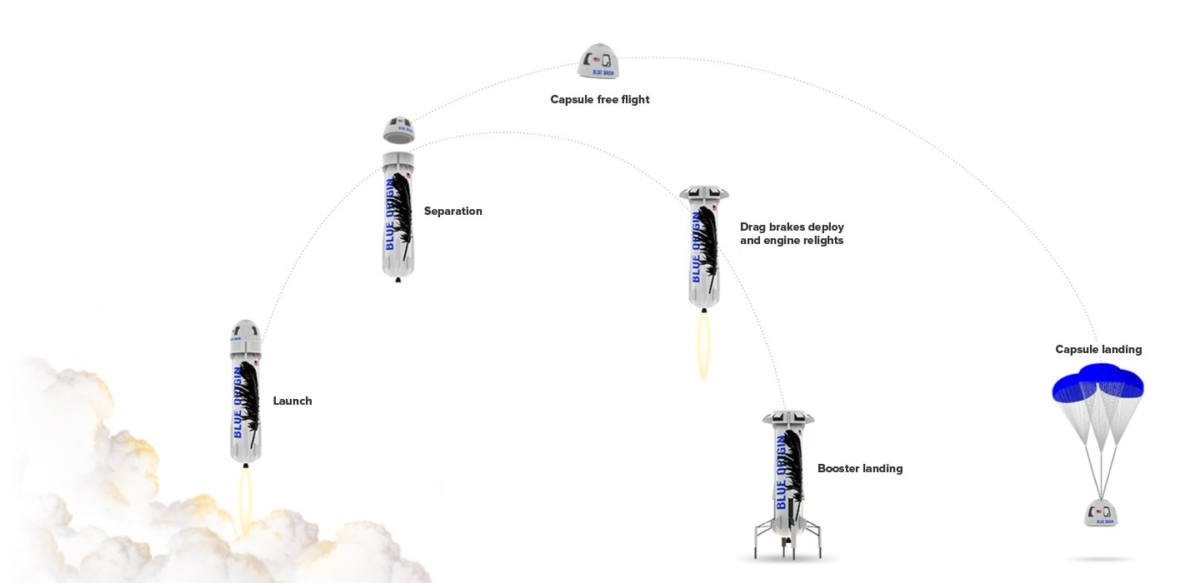
Blue Origin has announced the crew flying on its suborbital NS-22 mission will include Dude Perfect cofounder Coby Cotton, Portuguese entrepreneur Mário Ferreira, British-American mountaineer Vanessa O’Brien, technology leader Clint Kelly III, Egyptian engineer Sara Sabry, and telecommunications executive Steve Young.
Sara will become the first person from Egypt to fly to space; Mário will become the first from Portugal. Vanessa will become the first woman to reach extremes on land, sea, and air, completing the Explorers’ Extreme Trifecta, a Guinness World Record.
Credit: Blue Origin
This mission will be the sixth human flight for the New Shepard program, the third flight this year, and the 22nd in its history.
The flight date will be announced soon.

Mosaic of the Valles Marineris hemisphere of Mars composed of 102 Viking Orbiter images of this huge feature on the Red Planet.
Credit: NASA, USGS, Viking Project
There is movement in Mars exploration circles that see Valles Marineris as a “tell all” place, ripe for human exploration that can uncover the planet’s history and its capacity to sustain microbial life.

Noctis Landing on Mars is an ostensibly flat transitional region between Noctis Labyrinthus and Valles Marineris proper.
Credit: Pascal Lee
That said, how best to investigate the multifaceted geology in evidence at this site? Can future crews on the Red Planet dive safely into this huge canyon system? And what awaits those probing a vast region that’s been branded as the Grand Canyon of Mars?
For a deep dive into this amazing feature, go to my new Space.com story – “How can astronauts explore Mars’ Grand Canyon, Valles Marineris” – at:
https://www.space.com/mars-grand-canyon-valles-marineris-exploration

In the tool kit: Astronauts working on the surface of Mars could employ a helicopter (airborne at left) similar to the Ingenuity Mars Helicopter.
Credit: NASA

Shown at recent Congressional hearing, Video 1 2021 flyby movie showing a purported UAP.
Credit: Counterterrorism, Counterintelligence, and Counterproliferation Subcommittee/Inside Outer Space screengrab
The U.S. Department of Defense has established the All-domain Anomaly Resolution Office – a progressive step to synchronize efforts between the DoD and other U.S. federal departments and agencies.
While not using the term Unidentified Aerial Phenomenon (UAP) or Unidentified Flying Objects (UFOs), the All-domain Anomaly Resolution Office (AARO) duties are clear: “to detect, identify and attribute objects of interest in, on or near military installations, operating areas, training areas, special use airspace and other areas of interest, and, as necessary, to mitigate any associated threats to safety of operations and national security. This includes anomalous, unidentified space, airborne, submerged and transmedium objects,” the DoD statement explains.

Sean M. Kirkpatrick
Credit: USSPACECOM
Director named
The AARO is being stood up within the Office of the Under Secretary of Defense for Intelligence and Security. Also the AARO director has been named – Dr. Sean M. Kirkpatrick, most recently the chief scientist at the Defense Intelligence Agency’s Missile and Space Intelligence Center.
The AARO Executive Council (AAROEXEC), led by Under Secretary of Defense for Intelligence & Security (USD(I&S)) Ronald Moultrie, will provide oversight and direction to the AARO along these primary lines of effort:
- Surveillance, Collection and Reporting
- System Capabilities and Design
- Intelligence Operations and Analysis
- Mitigation and Defeat
- Governance
- Science and Technology
Transfer of data

Credit: Via Change.org petitions
In addition, the Secretary of the Navy was directed to disestablish the Unidentified Aerial Phenomena Task Force (UAPTF) no later than the date the AARO is established, and to support the orderly transition of the UAPTF, including the transfer of any data, analysis, or other relevant material, to the newly created All-domain Anomaly Resolution Office.
For more information on this office, along with AARO establishment memos and Kirkpatrick’s biography, go to:

To support the campaign to return samples from Mars, multiple robots were to team up to ferry to Earth select samples that are now being gathered by NASA’s Mars Perseverance rover.
Credit: NASA/ESA/JPL-Caltech
There appears to be a Mars Sample Return strategy change underway.
At the crux of the discussion is perhaps dropping the European Space Agency Fetch Rover. Toss in for good measure, lots of politics.
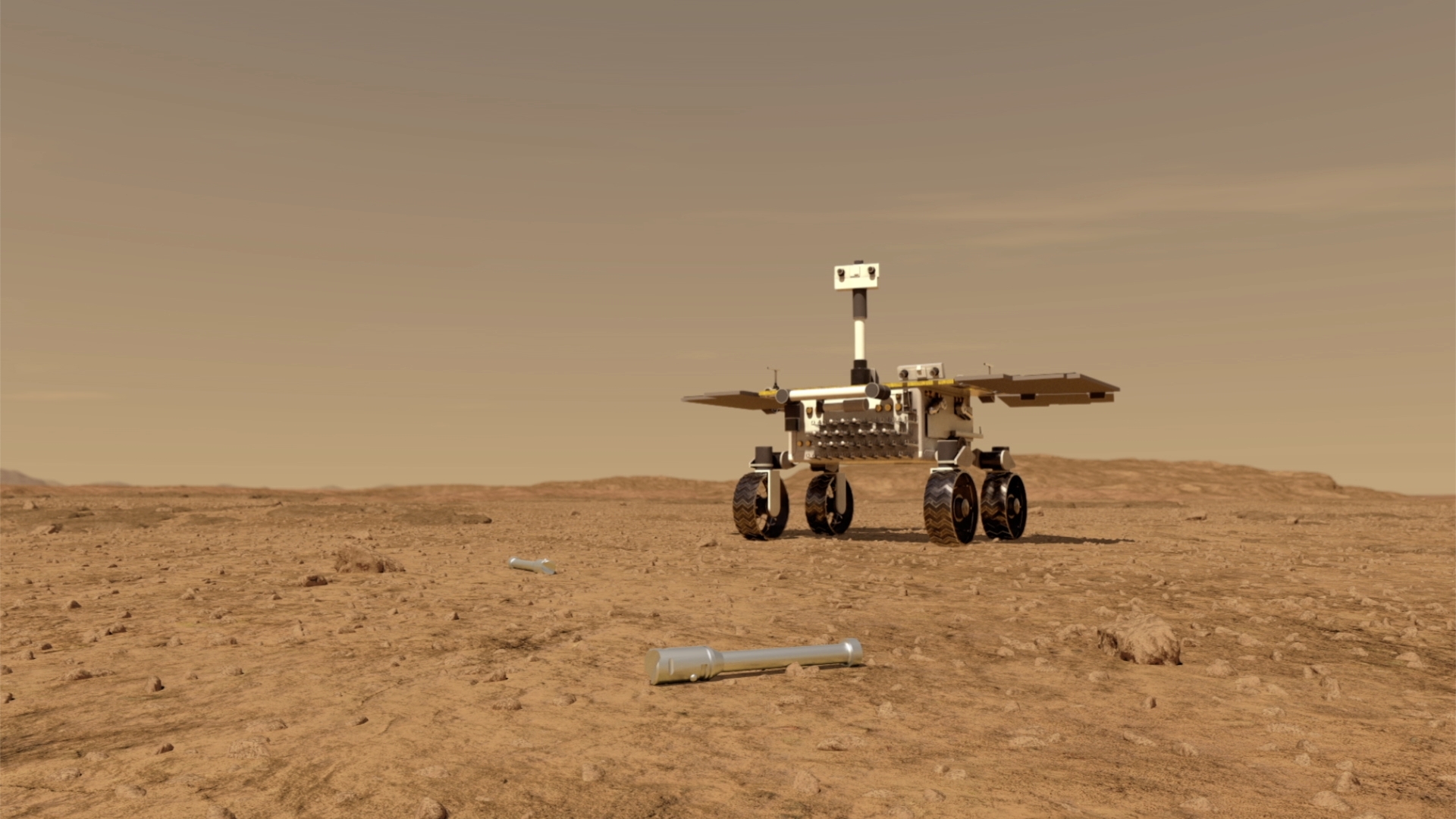
Artist’s concept of the ESA Sample Fetch Rover approaching sample tubes
Credit: NASA/JPL-Caltech
While the decision about the Fetch Rover apparently has not been made, ace reporter, Jonathan Amos, a BBC science correspondent, caught up with European Space Agency (ESA) human and robotic exploration director, David Parker.
Parker advised that due to the overall health of NASA’s Perseverance rover, its status would allow the joint NASA/ESA Mars Sample Return project to “streamline the program and remove the fetch rover,” Amos reports.

Departure of Mars Ascent Vehicle carrying Mars samples.
Credit: NASA
Lower-risk strategy
Indeed, it has been recognized that given the way Perseverance has held up, a lower-risk strategy is probably to have the samples be held inside its sample rack, never put them on the ground, and have Perseverance personally deliver them to the Mars Ascent Vehicle (MAV).
If that path is followed, then the Fetch Rover might be considered a contingency vehicle. It could be used only if there is a problem with the other rover, which means that under the current planning that Mars machinery could be flown to the Red Planet and not used.

Signs of ancient life on Mars could be preserved in layered rocks like those shown in this illustration of NASA’s Perseverance rover in Jezero crater.
Credit: NASA/JPL-Caltech
Contingency mode
All in all, both NASA and ESA planners are in contingency mode, appraising pathways to minimize risk to the Mars Sample Return undertaking. How the space agencies will sort this out is to be determined.
Inside Outer Space has reached out to the Fetch Rover team, an Airbus UK-assembled endeavor. No word as yet.
Meanwhile, work on the MAV continues. It would be packaged within NASA’s Sample Retrieval Lander, another central part of the campaign, with the all-in-one spacecraft (lander and MAV) touching down near or in Jezero Crater. That’s the spot where the Perseverance rover is already busily gathering Mars specimens, some of which are destined to be shot back to Earth in the early 2030’s.

Perseverance rover photo of Ingenuity micro-helicopter taken by Left Mastcam-Z Camera. Image acquired on April 18, 2021 (Sol 57).
Credit: NASA/JPL-Caltech/ASU
Helicopters to fetch samples?
Recent language from the House Commerce, Justice, and Science Appropriations Bill called for investigation of using two “Ingenuity-class helicopters” to fetch samples.
“The Committee is aware that the Mars Sample Return mission is expected to reach Key Decision Point-B later this year and directs NASA to brief the Committee on expected changes to cost, schedule and management challenges revealed during that decisional process, including NASA’s efforts to address such challenges,” the bill notes.
“As NASA conducts Mars Sample Return formulation studies to determine mission architecture and science requirements, the Committee directs NASA to provide a report not later than 180 days after enactment of this Act assessing the feasibility and cost of using more than one Ingenuity-class Mars Helicopter. The report should examine whether using more than one Ingenuity-class Mars Helicopter could increase redundancy and ensure NASA has a capability to return samples by augmenting the Ingenuity helicopter design to add a sample retrieval capability.”

Next up on Mars? One idea is this Mars aerial craft – the Hexacopter.
Credit: Theodore Tzanetos/NASA/JPL-Caltech
Refined and solidified
Once again, what decisions have been made are surely to be discussed in a NASA-hosted media teleconference at 11 a.m. EDT on Wednesday, July 27, to discuss the architecture for its Mars Sample Return campaign.
NASA and ESA recently held a systems requirement review as part of the Mars Sample Return campaign’s conceptual design phase — a phase when the architecture is refined and solidified.
Next week’s briefing will present the architecture proposal that is expected to be finalized in September 2022.

