Author Archive
 Author:
  September 26th, 2022
Credit: APL
NASA’s Double Asteroid Redirection Test (DART) is to test and validate today a method to protect Earth in case of an asteroid impact threat.
DART is NASA’s first mission to demonstrate asteroid deflection by a kinetic impactor, one that aims to shift an asteroid’s orbit by smashing a spacecraft into the smaller member of the binary asteroid system Didymos.

Credit: APL
The countdown to DART’s Impact is underway, set for 7:14 p.m. Eastern Daylight Time. Earth will receive news of DART’s impact roughly 38 seconds after it occurs.
DART’s development was led by the Johns Hopkins University Applied Physics Laboratory (APL) in Laurel, Maryland. APL is the builder and manager of the DART spacecraft for NASA.
Robert Braun is APL head of the Space Exploration Sector, a division that involves both civilian space exploration as well as national security related space programs.
“Basically, the DART spacecraft is a bullet hitting another bullet. And in this case, a number of air and missile defense experts here at APL joined forces with our space folks to create this mission – the first test of planetary defense mission ever, for the benefit of humanity,” Braun told Inside Outer Space. “This is a huge deal. It’s going to be quite the occasion. One day this could be a game-saver for all of humanity,” he said.

LICACube deployment.
Credit Argotec via Xavier Bellanca
Ringside seat
To monitor DART’s impact, Agenzia Spaziale Italiana (ASI)-supplied LICIACube was deployed from the DART spacecraft on September 11. This Light Italian CubeSat for Imaging of Asteroids is to capture images of the event and its effects, such as the resulting ejecta cloud. LICIACube will potentially a catch a glimpse of the impact crater on the surface of Dimorphos.

LISACube’s mission control in Italy.
Credit: Argotec via Xavier Bellanca
The design of the LICIACube spacecraft is based on a 6U CubeSat platform developed by the aerospace company Argotec in Turin, Italy. LICIACube will be the first Italian object to go so far in the space, 14 million kilometers from the Earth.
“We do believe that the DART mission represents a turning point for the history of humanity, and we can’t wait to share unique insights with the rest of the world,” said Raffaella Rossi, an Argotec communications officer.
Confidence builder
Looking forward to the test is planetary defense expert, Bill Ailor of The Aerospace Corporation.
“It is a good test. It’s something that we can demonstrate that we can actually hit one of these objects…and also measure the effect on the object that we hit,” Ailor told Inside Outer Space.
Ailor sees DART as a confidence builder by showcasing this ability.

Credit: IAA
However, as a kinetic impact approach, it is limited in its utility, Ailor said. “You are going to use it for smaller objects, generally speaking. We also have nuclear explosives. People generally think that, if you’re going after something of any size, you are going to have to use those. A recommendation to test some of those [nuclear devices] against an asteroid…that’s going to be harder row to hoe,” he added.
Ailor is a key leader in organizing the 8th IAA Planetary Defense Conference to be held in Vienna April 3-7, 2023. The meeting is hosted by the United Nations Office for Outer Space Affairs (UNOOSA), in cooperation with the European Space Agency (ESA) and the host country, Austria.
While DART will go out with a bang, the need to maintain an international dialogue on planetary defense continues.
For more information and to watch the action, go to:
 Posted in

Credit: Andreas Treuer via ESA
The European Space Agency is proposing a research and development program to further explore the concept and critical technologies to make feasible Space-Based Solar Power.
The effort is called SOLARIS – a step in pursuit of detailing the potential of Space-Based Solar Power – providing Earth with clean energy from space.

Credit: ESA
The SOLARIS initiative would tackle the needed technical advancements in areas such as in-space manufacturing and robotic assembly, high-efficiency photovoltaics, high power electronics and radio frequency beam forming.
Further research to confirm benign effects of low-power microwaves on human and animal health and compatibility with aircraft and satellites would also be undertaken, according to an ESA statement.

Credit: ESA
Global interest
As a program proposal, SOLARIS comes at a point when global interest in Space-Based Solar Power is at its highest for decades, with in-orbit demonstrations being prepared in the US, China and Japan.

Naval Research Laboratory (NRL) has pioneered “sandwich” modules that are far more efficient for space solar power.
Credit: NRL/Jamie Hartman
To this point, an experiment is already flying aboard the U.S. Space Force X-37B robotic space plane. That investigation — the Photovoltaic Radio-frequency Antenna Module Flight Experiment (PRAM-FX) – is a Naval Research Laboratory (NRL) investigation into transforming solar power into radio frequency microwave energy.
Meanwhile, SOLARIS is being proposed for approval at ESA’s Council Meeting at Ministerial Level in November.
For more details on SOLARIS, go to:
https://www.esa.int/Enabling_Support/Space_Engineering_Technology/SOLARIS

Credit: Mars Guy
The NASA Perseverance rover crushed another rock on Mars and exposed a mystery.
Explains Mars Guy (Steve Ruff of Arizona State University), after returning to a location dubbed Enchanted Lake, NASA’s Perseverance Mars rover attempted an abrasion operation on a rock too weak to handle it. The rock shattered into pieces, revealing a paint-like purple coating that defies easy explanation.
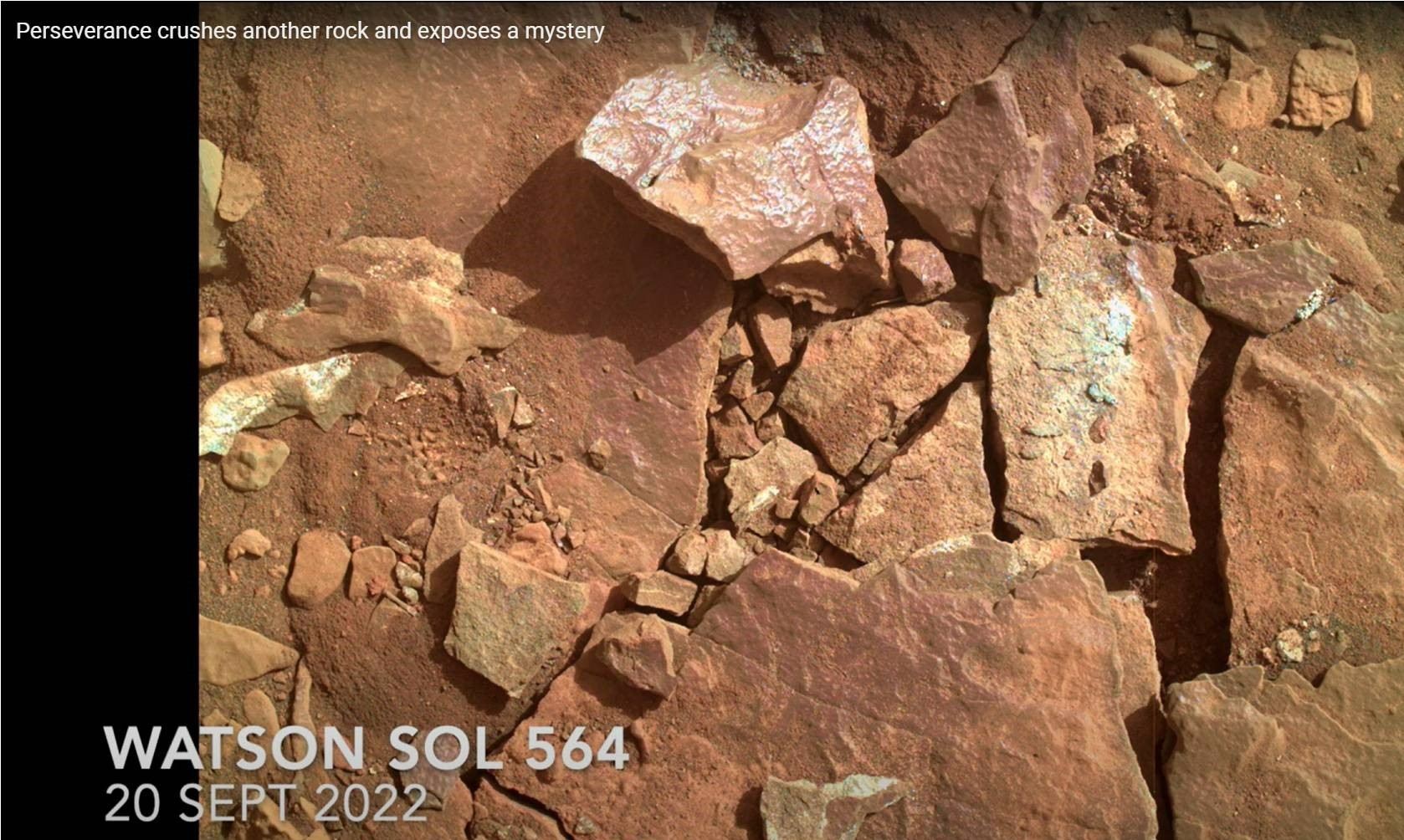
Credit: Mars Guy
Go to this Mars Guy video for details at: https://youtu.be/00P7ZgrBfLc

Image acquired on Sept. 24, 2022 (Sol 567 of the Perseverance rover mission) using its navigation camera mounted in the helicopter’s fuselage and pointed directly downward to track the ground during flight.
Image Credit: NASA/JPL-Caltech
NASA Ingenuity Mars Helicopter looks to have carried out flight number 33.
According to JPL, the craft was targeted to head West; reach a maximum altitude of 33 feet (10 meters); the expected distance was to be roughly 365 feet (111.238 meters) flying at 10.6 mph (4.75 m/s); and an expected time aloft was slated for 55.61 seconds.
The goal of flight 33 was to reposition the helicopter.

Curiosity’s location as of Sol 3601. Distance driven on that sol: 17.83 miles/28.69 kilometers.
Credit: NASA/JPL-Caltech/Univ. of Arizona
NASA’s Curiosity Mars rover at Gale Crater is now performing Sol 3602 duties.
Some fresh new imagery spotlights the surrounding terrain:

Curiosity Right B Navigation Camera photo acquired on Sol 3600, September 22, 2022.
Credit: NASA/JPL-Caltech

Curiosity Mast Camera Right image taken on Sol 3600, September 22, 2022.
Credit: NASA/JPL-Caltech/MSSS

Curiosity Front Hazard Avoidance Camera Right B image taken on Sol 3601 September 23, 2022.
Credit: NASA/JPL-Caltech

Curiosity Left B Navigation Camera image taken on Sol 3601, September 23, 2022.
Credit: NASA/JPL-Caltech

Curiosity Left B Navigation Camera image taken on Sol 3601, September 23, 2022.
Credit: NASA/JPL-Caltech

Air Force Band members and guests sing the new U.S. Space Force service song during the 2022 Air, Space and Cyber Conference in National Harbor, Md., Sept. 20, 2022. (U.S. Air Force photo by Eric Dietrich)
The U.S. Space Force, the newest military branch established in 2019, has officially adopted its own song titled “Semper Supra.” It was unveiled during the 2022 Air & Space Forces Association Air, Space and Cyber Conference in National Harbor, Maryland, Sept. 20.
To listen to the song, go to:
https://www.dvidshub.net/video/857934/us-space-force-reveals-official-song

Map view with base dataset, clickable viewpoints are marked as droplets. (Image: HiRISE/CTX/HRSC)/Europlanet Society
Prospective Mars explorers can now take a walk around the landing site of NASA’s Perseverance rover.
An interactive map that can be accessed through a normal web browser is loaded with orbital imagery, terrain data as well as synthetic and real 3D panoramic views of Jezero crater and its surrounding area.
“The map is the perfect tool for planning a future visit to Mars, with an interactive interface where you can choose from different available base datasets,” explains Sebastian Walter of the Freie Universität Berlin. “Some of the slopes are pretty steep, so watch out for those if you want to avoid too much oxygen consumption!”

Virtual view from top of the western delta into the crater. Credit: HiRISE/CTX/HRSC/Europlanet Society
“To get a real feeling of what to expect on your future Mars trip, you can click on one of the waypoint marker symbols to enter either a full-screen 3D view or, if you have a Virtual Reality setup, to enter a fully immersive environment. You can even listen to the sounds of the rover if you stand close by, but please don’t touch it – otherwise you would contaminate the probes.”
The base layer of the map is a merged dataset derived from three different instruments currently orbiting Mars, carried by Europe’s Mars Express, and NASA’s Mars Reconnaissance Orbiter.
Go to this direct link to the interactive map (wait for map to fully unfold):
https://maps.planet.fu-berlin.de/jezero
Also, for more details, go to this Europlanet Society news release – “Virtual hiking Map for Jezero Crater, the Mars 2020 Perseverance Rover Landing Site” – at:
https://www.europlanet-society.org/virtual-hiking-map-for-jezero-crater/

Russia’s Igor Mitrofanov
Credit: ESA–Stephane Corvaja
Russia’s lunar exploration program faces delay, according to Igor Mitrofanov, head of the Department of Nuclear Planetology of the Space Research Institute (IKI) of the Russian Academy of Sciences.
The first robotic Moon mission, Luna-25 had been previously postponed to 2023. Now the launches of Luna-26, Luna-27 and Luna-28 may be postponed for up to two years, Mitrofanov told Russia’s TASS news agency.

Luna-25
Credit: NPO Lavochkin
The Luna-26 mission was to be launched in 2024, Luna-27 in 2025, Luna-28 in 2027-2028.
Supply chain issue
“Our main problem today, which has a fundamental impact, is import substitution. Because of this, the dates will be postponed, maybe each mission will be postponed for a year, maybe even for two,” Mitrofanov said.
According to Mitrofanov, supply chain issues of certain components have forced the delay of a string of Luna probes.

Luna-26
Credit: NPO Lavochkin
The suite of Moon probes are part of the Luna-Glob program by Roscosmos.
The Luna-25 spacecraft is a small-sized demonstration landing station for testing basic soft landing technologies in the circumpolar region and conducting contact studies of the south pole of the Moon.

Luna-27
Credit: NPO Lavochkin
Luna-26 is a lunar orbiter designed to carry out remote sensing of the lunar surface.
Luna-27 is intended to be a lander for testing the technology of high-precision and safe touchdown landing in the Moon’s south pole region, including drilling to a depth of 2 meters using a cryogenic deep drilling rig.

Luna-28
Credit: NPO Lavochkin
Luna-28 is designed for delivery back to Earth of lunar soil from the region of the south pole of the Moon.

European Space Agency astronaut Samantha Cristoforetti gives the Vulcan salute aboard the International Space Station.
(Image credit: NASA/ESA)
Space life scientists are pushing for the development of an international database on long-term health effects of spaceflight. They feel it is essential for protecting the health and performance of current and future crew members of all nationalities, as well as defining the long-term health consequences for retired crew members across the globe.
That said there are thorny legal and privacy challenges ahead.

NASA astronaut Christina Koch pauses as she helps replace equipment on the International Space Station. She and her fellow astronauts faced a suite of health effects while in space. (Image credit: NASA)
(opens in new tab)
Given that there are now roughly 120 international retired space crew members still alive, collecting medical/health data on these crew members has the potential to expand the total “n” for health outcomes in space explorers by 40 percent.
Understanding the long-term human health impact of space exploration missions is exceptionally challenging.
Why so?
For more information, go to my new Space.com story – “Can we live long and prosper in space? The astronaut health dilemma – Relatively few humans have ever been exposed to the space environment” – at:
https://www.space.com/live-long-prosper-long-term-spaceflight-health-risks

Credit: CMSA/CCTV/Inside Outer Space screengrab
On September 17, during the second extravehicular activity of the Shenzhou-14 mission, astronauts verified an extravehicular rescue capability, the first spacewalk rescue exercise during the construction period of China’s space station.
With the aid of the small mechanical arm, two astronauts conducted a series of extravehicular tasks, including the installation of extravehicular assistance handles.
The astronauts also installed additional pumps, the core equipment of the space station’s thermal control system, and carry out the challenging task of extravehicular rescue for the first time, according to China Central Television (CCTV).

Credit: CCTV/Inside Outer Space screengrab
Assist handle
Chen Dong and Cai Xuzhe performed the tasks, with Liu Yang providing support inside the cabin. The Shenzhou-14 twosome completed their tasks during a roughly five hour period.
The taikonauts opened the airlock cabin of the Wentian lab module making their exit into space. The extravehicular activities included installing foot-stop b, which will facilitate work on the bulkhead, and an assist handle that can help astronauts open the hatch door from outside in emergency.
For videos detailing the rescue exercise, go to:

