Author Archive
 Author:
  October 13th, 2022
Credit: UCF
Back in December 2020, the iconic instrument platform of the 305-meter telescope at Arecibo Observatory in Puerto Rico collapsed.
The unique observatory contributed to scientific discoveries including the demonstration of gravitational waves from a binary pulsar and the first discovery of an extrasolar planet, as well as radar scanning of asteroids. Loosing Arecibo was a loss for the scientific community.
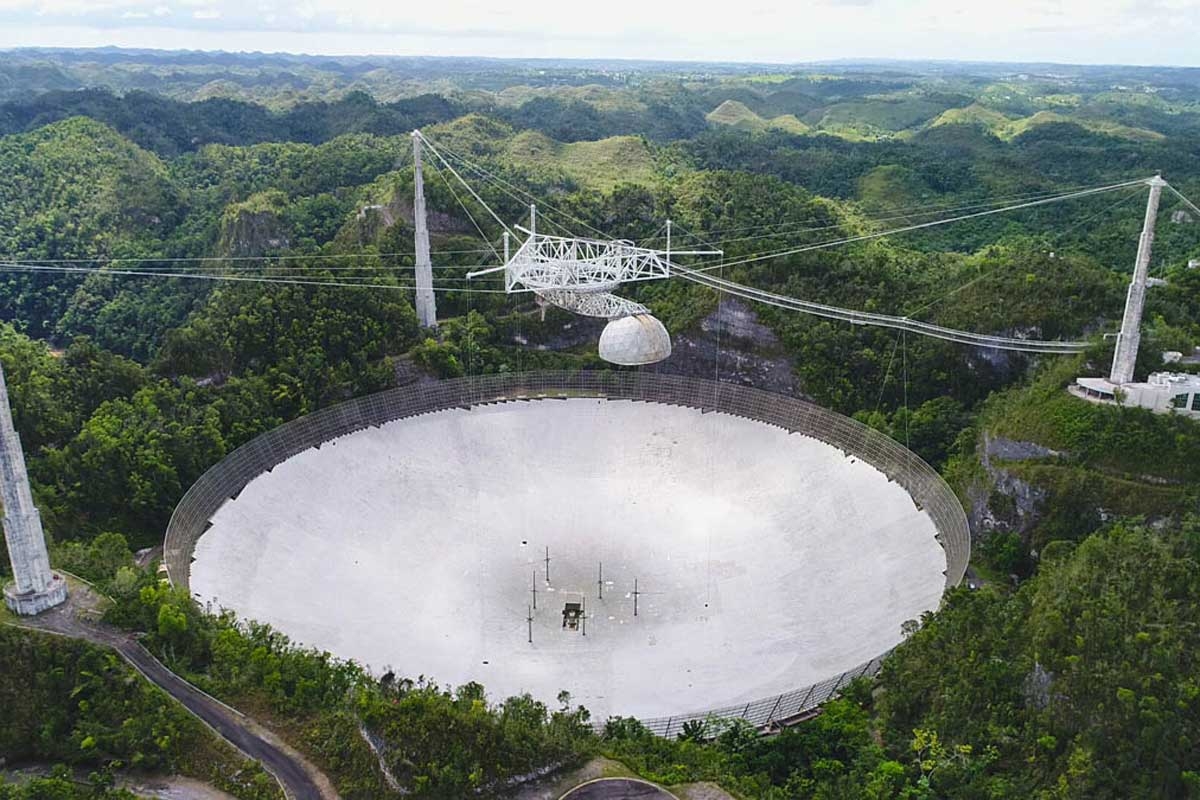
Arecibo radio telescope, pictured here in the spring of 2019.
Credit: UCF

Credit: Michelle Negron, National Science Foundation
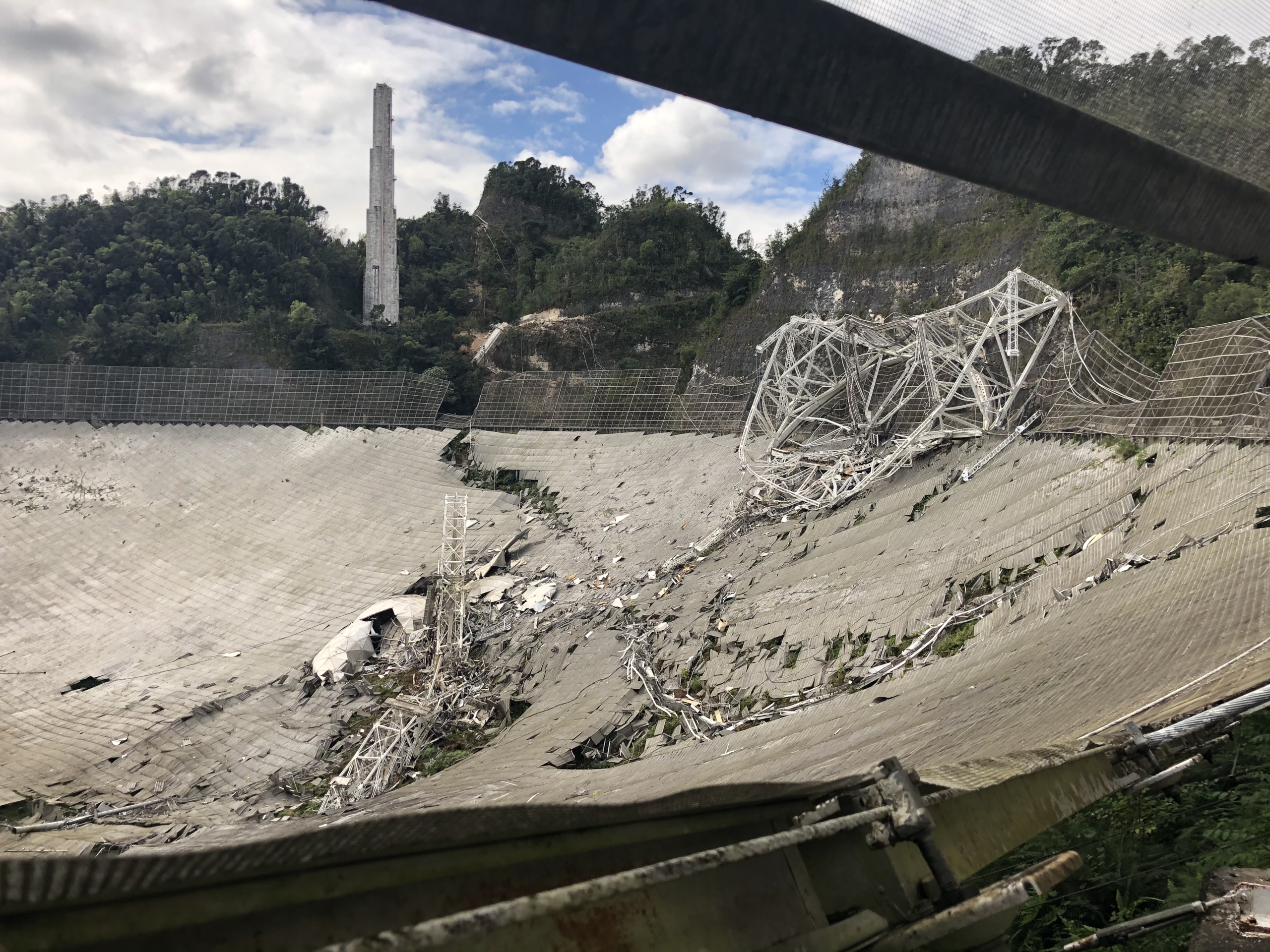
Damage to the 305-meter telescope at Arecibo Observatory, after its collapse on Dec. 1, 2020. The remains of the instrument platform are visible on the telescope’s dish.
Credit: Michelle Negron, National Science Foundation
But now a new multidisciplinary, world-class educational center at the Arecibo Observatory in Puerto Rico is on tap, aiming to serve as a hub for science, technology, engineering, and math (STEM) education and outreach.
Science Act of 2022
The U.S. National Science Foundation (NSF) issued a solicitation October 13 for the center, expected to open in 2023. This new educational center is consistent with guidance provided in the CHIPS and Science Act of 2022.
That act “encourages the National Science Foundation, in consultation with other Federal agencies, to explore opportunities for strengthening and expanding the role of the Arecibo Observatory in Puerto Rico through education, outreach, and diversity programs, and future research capabilities and technology at the site.”

Asteroid 2014 HQ124 appears to be an elongated, irregular object that is at least 1,200 feet (370 meters) wide on its long axis.
Image credits:
NASA/JPL-Caltech
Arecibo Observatory
USRA/NSF
Stewarded by NSF since the 1970s, the Arecibo Observatory is operated under cooperative agreement by the University of Central Florida.
Outreach
The new center would expand upon existing education and outreach opportunities currently in place at the Arecibo Observatory site, while also implementing new STEM programs and initiatives.
The NSF solicitation calls for proposals to manage the education, STEM research, and outreach aspects of the center. Resources available on site include: a learning center, the Ángel Ramos Science and Visitor’s center, exhibition space, laboratory space, auditorium, cafeteria, office space, and dormitories.
The solicitation does not include rebuilding the 305-meter telescope or operational support for current scientific infrastructure, such as the 12-meter radio telescope or Lidar facility at the site.
Further information and a link to the solicitation is available at:
 Posted in

Credit: Roscosmos
Russian scientists see an agreement signed soon between Russia and China on the creation of an International Lunar Scientific Station (ILRS).
According to Russia’s TASS news agency, the forthcoming inking of a formal agreement on the ILRS was detailed by Anatoly Petrukovich, head of Russia’s group of ILRS experts. He is also director of the Space Research Institute of the Russian Academy of Sciences (IKI RAS).
Petrukovich discussed details at the now underway XIII Moscow Symposium on the Study of the Solar System, as also noted by the informative Novosti-Kosmonavtiki news site.

Artist’s view of China/Russia International Lunar Research Station to be completed by 2035. Credit: CNSA/Roscosmos
Full-fledged agreement
“Even last year, a memorandum was signed between Russia and China on cooperation in the development of plans for the creation of the International Scientific Lunar Station,” Petrukovich said. “Cooperation is developing systematically…our joint scientific groups are working, and a full-fledged agreement on the implementation of this program will be signed in the near future.”
Petrukovich said that Chinese and Russian experts have identified nine priority scientific topics for cooperation, such as: lunar topography and geology, internal structure, chemistry, circumlunar space, as well as the possible construction of lunar telescopes and scientific instruments for observing the Earth and outer space, as well as searching for particles of light dark matter.

Russia’s Luna-25 spacecraft.
Credit: Lavochkin/Roscosmos
Russia’s Luna program
Identified as a first phase of the ILRS project, China’s Chang’e and Russia’s Luna spacecraft will carry out reconnaissance and collect data necessary for the implementation of the cooperation program.
In particular, as Petrukovich noted, the next three missions under the Luna program will help scientists choose the most optimal place for building a base in terms of resource availability and scientific feasibility.
That said, Russian space specialists in the Luna program have announced significant slips in rekindling the country’s Moon exploration program, with the first in the series, Luna-25, now delayed for launch until next year. Similarly, follow-on probes in the Luna series are likely slipping too.

Anatoly Petrukovich, head of Russia’s group of ILRS experts. He is also director of the Space Research Institute of the Russian Academy of Sciences (IKI RAS).
Via Novosti-Kosmonavtiki
Joint research
Petrukovich reportedly said that experts have not yet reached a consensus on whether the base will be built at one point or spaced apart, which is optimal from the point of view of astrophysical research.
To scope out answers, Russian and Chinese scientists have prepared 14 proposals for joint research within the framework of the Chang’e and Luna missions, including those related to the search for water reserves on the Moon and the study of the properties of regolith and lunar soil.
A second phase of the ILRS initiative, which is targeted to start in 2026, scientists will work on testing life support systems, as well as developing systems for delivering heavy payloads to the Moon. The construction of the base will be completed in 2035.

Credit: JAXA/NHK
Earth-looking work
The ILRS is also to have an Earth-looking component.
Liu Guang, professor at the Institute of Aerospace Information Research of the Academy of Sciences in Beijing, said the scientific outpost on the Moon will be used to conduct unique studies of the Earth.
As part of this scientific package, observations of the state of glaciers, the level of greenhouse gas emissions, the movement of the global “conveyor of currents” in the world ocean and other global processes affecting the entire planet as a whole, would be addressed, according to Novosti-Kosmonavtiki.

Credit: JPL/Caltech
Starting in May 2022, a new director took the reins of the Jet Propulsion Laboratory (JPL) in Pasadena, California. The lab is home to milestone making spacecraft that have plumbed the inner and outer worlds of our solar system, but has also suffered missteps too.
Laurie Leshin is the first woman to serve as JPL director, a role that also includes serving as Vice President at Caltech, which manages JPL for NASA.

Credit: JPL/Caltech
Now the helmswoman at JPL, Leshin sees opportunities to leverage JPL’s leadership in robotic space exploration and a diversity of other areas. But doing so could be like herding cats. She advocates having the lab branch out beyond traditional collaborators, partners, and colleagues to also embrace today’s non-traditional ecosystem of space players and providers.
Go to my SpaceNews interview with Leshin – “Finding balance within the space ecosystem: Q&A with JPL Director Laurie Leshin” – at:
https://spacenews.com/finding-balance-within-the-space-ecosystem-qa-with-jpl-director-laurie-leshin/

Credit: Amazon Prime Video
As you read this, there are a trio of robots alive and well and purging Mars of its secrets: NASA’s Curiosity and Perseverance rovers, as well as China’s wheeled Zhurong machinery.
All this get-up-and-go on the Red Planet owes a major thank you to two earlier robotic explorers: NASA’s Spirit and Opportunity that landed on the planet in 2004.
Both had expected lifetimes of about 90 days, a warranty that was greatly surpassed.
Of the two, Spirit was first to expire. After March 22, 2010, mission controllers at NASA’s Jet Propulsion Laboratory (JPL) were not able to regain contact with Spirit. NASA officially concluded its recovery efforts May 25, 2011.
The Opportunity Mars rover was declared dead to that world on February 13, 2019 more than eight months after the robot fell mute during an intense dust storm. Final calls to awaken the rover yielded no response.
Good Night Oppy is a film that primarily focuses on the story of Opportunity, a live-long-and-prosper robot that survived for 15 years trekking about on Mars. But the film is far more than a travelogue of technology clunking its way on that distant world.
What has been captured is an emotional link between humans and automatons, the thrill of exploration, and even heartbreak given Opportunity’s last picture show. The robot was a product of years of teamwork, tenacity, and determined will to open up Mars to a new set of scouting eyes. Following its airbag-bouncing landing, Opportunity delivered on every expectation and delivered so much more.
Good Night Oppy premiered at the recent Telluride Film Festival, now moving to theatrical release from Amazon on November 4, followed by its availability on Amazon Prime Video starting November 23.
Ryan White is the film’s director, and co-writer. White and colleagues have produced a truly moving account of the unexpected fifteen-year sojourn of Opportunity and the surprising bond that formed between the robot and the team of scientists and engineers operating the probe, wheeling and dealing with what Mars threw at them.
Featuring photo-real special visual effects and animation by Industrial Light & Magic and the voice of Angela Bassett, Good Night Oppy charts Oppy’s unforgettable journey – and delivers on the promise that Mars still has much to tell us.
Go to this Good Night Oppy Official Trailer at:

Image credit: ILC Dover
Having face time with the Earth from space puts you squarely in the zone of the “Overview Effect” – a cognitive shift that has been experienced by some space travelers.
There are multiple efforts under way to share the experience of the Overview Effect through virtual reality, explains Frank White, President & Board Chair of the Human Space Program. He coined the term for the phenomenon.

Credit: Human Space Program
Meditative journey
Now, Ryan Holmes is “bringing the Overview Effect down to Earth.” His company, Space/VR, has just listed their Overview app on App Lab and they are looking for Oculus Quest users who want to experience this mind-opening occurrence.

Credit: Ryan Holmes/Space/VR
“We have successfully recreated the profound experience of orbiting the Earth using real space footage from NASA for everyone to enjoy in the comfort of your home,” the VR firm explains.
“This is a deeply relaxing, meditative journey through space to a new level of awareness best experienced lying down in a peaceful setting.”
For more information on Space/VR go to:
Also, go to my recent SPACE.com story – “Interview: Frank White on the Iconic ‘Overview Effect’” – at:
https://www.leonarddavid.com/interview-frank-white-on-the-iconic-overview-effect/

Fast paced series of missions will complete China’s space station by year’s end.
Credit: CMSA/CCTV/Inside Outer Space screengrab
China is entering the final stage of completing the country’s space station.
A Long March 7 carrier rocket that will be used to send the Tianzhou-5 cargo spaceship into orbit to dock with the Tiangong space station arrived at the Wenchang Space Launch Center in Hainan province on October 11, according to the China Manned Space Agency (CMSA).

Credit: CNSA/CCTV/CGTN/Inside Outer Space screengrab
The rocket was carried by ships from Tianjin, a northern coastal municipality and home to the rocket’s manufacturing facility, reports China Central Television (CCTV). It will be assembled and then undergo ground tests with the Tianzhou-5 at the launch complex.

Credit: CCTV/Inside Outer Space screengrab
Rapid pace
China space program officials note that, as scheduled, four missions are set to rapidly occur – the Mengtian lab mission launch, the Tianzhou-5 resupply mission liftoff, the Shenzhou-15 crewed flight, and the return of the three-person Shenzhou-14 team — will be done before the end of this year to realize the full construction of the space station.

Station complete is set for year’s end.
Credit: CNSA/CCTV Video News Agency/Inside Outer Space screengrab
At the same time, preparations for the Shenzhou-15 crewed mission at the Jiuquan Satellite Launch Center in northwest China are underway, as is readiness training to handle the return of the now-orbiting Shenzhou-14 crew.
For videos showcasing China’s final staging of missions to complete the country’s space station, go to:

Next up! China’s Mengtian lab for the country’s space station.
Credit: CCTV/Inside Outer Space screengrab
China’s next step in building out the country’s space station is nearing launch.
The Mengtian space lab has been fueled up for upcoming launch stated the China Manned Space Agency (CMSA) on Monday.
Scientific equipment carried in the Mengtian lab will be utilized for studying microgravity and carrying out experiments in fluid physics, materials science, combustion science and fundamental physics.

In-construction: China’s space station.
Credit: CMSA/CCTV/Inside Outer Space screengrab
According to the state-run Xinhua news agency a pre-launch operation was conducted on Sunday.
Launch date
The CMSA added that assembly and tests of the spacecraft were completed after its arrival at the Wenchang Spacecraft Launch Site in the southern province of Hainan.
Prior to launch, a joint check of system functions with the lab’s Long March-5B Y4 carrier rocket will be carried out.

Wrapped up Mengtian Laboratory Module.
Credit: CMS

Credit: The Aerospace Corporation
Reportedly, launch of the Mengtian module is slated for October 31, 2022. As was the case for the Wentian lab module launch, the Long March-5B Y4’s core stage is apparently headed for an uncontrolled re-entry – a fall of hardware that can cause worries to populations below.
At this moment, China’s in-construction Tiangong space station complex is composed of the Tianhe core module, the Wentian lab module, the Tianzhou-4 cargo vessel and the Shenzhou-14 crewed spaceship.
If all goes according to plan, China’s orbital space complex is to be completed by year’s end.
Go to this China Central Television (CCTV) video spotlighting the soon-to-fly lab module at:

Credit: Red Bull Stratos
Ten years ago, Austrian Felix Baumgartner made one small step from the edge of space. That resulting giant leap saw him plunge to Earth faster than the speed of sound.
The Red Bull Stratos effort proved that a human could break the speed of sound in freefall, with Baumgartner setting numerous benchmarks including three official world records: Maximum Vertical Speed (1,357.6kmh, 843.6mph/Mach 1.25), Highest Exit (jump) Altitude (38,969.4m, 127.852.4ft) and Vertical Distance of Freefall (36,402.6m, 119,431.1ft.
A new documentary is being released on October 14 — “SPACE JUMP: How Red Bull Stratos Captured the World’s Attention” – is to premier on Red Bull TV.

Credit: Red Bull Stratos
Years of work
The video documents the enterprising project and the spectacular jump on Friday 14, October 2022. On that date, Baumgartner launched from Roswell, New Mexico and ascended to the stratosphere in a helium balloon and made the jump. The event was the culmination of years of work by a world-leading team of experts.
“For the first time, fans and industry experts give their perspectives, as well as those who made it happen; from the technical project director, to one of the world’s biggest internet giants, whose servers reached near-breaking point to sustain the number of viewers, and from the world record holder himself, Baumgartner,” explains a Red Bull Stratos statement.

Credit: Red Bull Stratos
Life support in space
Given more than 5 years of development, the team took head-on the challenge of dealing with life support in space; space suits now offer better mobility, and new protocols exist to protect the lives of aviators exposed to high altitude.
“The effect that it had globally on education and on the next generation wanting to become aerospace or flight test engineers was huge,” says technical project director Art Thompson. “Additionally, the life support system that we designed on the capsule we used that technology and data to change the configuration for life support for [high altitude jets including] the U-2.”
For more information on Red Bull TV, go to:
https://www.redbull.com/us-en/discover
Get the Red Bull TV app for free at:

Credit: Jinzhu Ji. et al.
China has made available what it terms as “the first 1:2,500,000-scale global geologic map of the Moon.”
Published in the Science Bulletin (August 15, 2022), the map provides a state-of-the-art illustration of impact basins, craters, rocks, and structures of lunar surface, which reveals the geological processes and evolution of the Moon.
“For further investigation and to make the best use of the map, the geodatabases of the map will be publicly accessible,” according to lead author of the paper, Jinzhu Ji, a lecturer at School of Mining, Inner Mongolia University of Technology and visiting scholar at Center for Lunar and Planetary Science, Institute of Geochemistry, Chinese Academy of Sciences.

Credit: Jinzhu Ji. et al.
Unprecedented integrative product
“As unprecedented integrative product of lunar exploration results, the 1:2,500,000-scale lunar geologic map will play important role in the scientific study of the Moon and lunar exploration in the future,” Jinzhu and colleagues explain.
“With 10 years of endeavors, the experience we learned from this lunar mapping project lays the foundation for mapping other planets,” the research team adds.
To access the paper — “The 1:2,500,000-scale geologic map of the global Moon” — go to:
https://www.sciencedirect.com/science/article/pii/S2095927322002316?via%3Dihub

Credit: Visual Capitalist
Visual Capitalist has created an animated map of where here to find water on Mars.
The hunt for water on the Red Planet has always been a point of interest for researchers.
According to a Visual Capitalist posting:
Earth has life almost everywhere water exists. Water is an ideal target for finding lifeforms, like microbes, that may exist on other planets.
And if Mars is to become a future home, knowing where water exists will be necessary for our survival.
Both NASA and the European Space Agency (ESA) have special instruments searching for water on the red planet. After 10 years of in-depth investigation, their latest findings suggest a new “water map” for Mars.

The image is from ‘Hidden Valley’ in Gale Crater on Mars. Very fine-grained sediments, which slowly fell down through the water, were deposited right at the bottom of the crater lake. The sediment plates at the bottom are level, so everything indicates that the entire Gale Crater may have been a large lake.
Credit: NASA/JPL, MSSS
Where Did the Water Go?
Many people know Mars as a dry and dusty planet, but it hasn’t always been that way.
Approximately 4.1 to 3.8 billion years ago, Mars had a massive ocean called Oceanus Borealis. It dominated the northern hemisphere of the planet. Specific planetary conditions at that time let water exist on its surface. Changes in temperature, climate, and geology over the years gradually pushed water out to the atmosphere or into the ground.
Up to 99% of this ocean water is trapped within the planet’s crust, locked within special rocks called hydrous minerals.

Mosaic of the Valles Marineris hemisphere of Mars composed of 102 Viking Orbiter images of this huge feature on the Red Planet.
Credit: NASA, USGS, Viking Project
Hydrous Minerals
Hydrous minerals are essentially rocks that have water (or its two main elements, hydrogen and oxygen), incorporated into their chemical structure.
There are four main classes of hydrous minerals: silicates, sulfates, silicas, and carbonates. While these minerals look pretty similar to the naked eye, their chemical compositions and structural arrangements vary. They are detectable by sophisticated equipment and can tell scientists how water geologically changes over time.
The new water map of Mars actually highlights the location of these hydrous minerals. It is a geological map of the rocks that are holding what remains of Mars’s ancient ocean.
Other Sources of Water on Mars
Despite being a “graveyard” for the bulk of the planet’s ocean, hydrous minerals are not the only source of water on Mars.
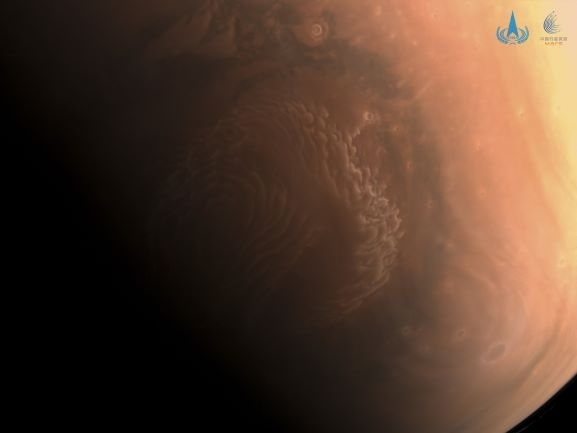
A color image taken by the Tianwen-1 orbiter’s medium-resolution camera is of Mars’ north pole region.
Water ice is present at both of Mars’s poles. The northern polar ice cap contains the only visible water on the planet, while the southern pole covers its water with a frozen carbon-dioxide cap.
In 2020, radar analyses suggested the presence of liquid water, potentially part of a network of underground saltwater lakes, close to the southern pole. In 2022, new evidence for this liquid water suggested that the planet may still be geothermally active.
More frozen water may be locked away in the deep subsurface, far below what current surveying equipment is able to inspect.
Mapping Out the Next Missions
The new water map is highlighting areas of interest for future exploration on Mars.

ESA Exomars robot.
Credit: ESA
There is a small chance that hydrous minerals may be actively forming near water sources. Finding where they co-exist with known areas of buried frozen water provides possible opportunities for extracting water.
ESA’s Rosalind Franklin Rover will land in Oxia Planum, a region rich in hydrous clays, to investigate how water shaped the region and whether life once began on Mars.
Many more investigations and studies are developing, but for now, scientists are just getting their toes wet as they explore what hydrous minerals can tell us of Mars’s watery past.
To access the Visual Capitalist Mars water map, go to:
https://www.visualcapitalist.com/a-new-water-map-of-mars/

