Author Archive
 Author:
  November 5th, 2022
These float rocks appear to have originated in the Marker Band, which can be seen running from lower left to upper right in the accompanying Navcam image. Marker Band is in the upper left of this image. Photo taken by Curiosity’s Left Navigation Camera on Sol 3642, November 4, 2022.
Credit: NASA/JPL-Caltech
NASA’s Curiosity Mars rover at Gale Crater is now performing Sol 3643 duties.
“We are perched just below the ‘Marker Band,’ a thin dark band whose origin is unclear,” reports Catherine O’Connell-Cooper, a planetary geologist at University of New Brunswick; Fredericton, New Brunswick, Canada.

Curiosity Left B Navigation Camera image acquired on Sol 3642, November 4, 2022.
Credit: NASA/JPL-Caltech
Mars researchers have found some amazing textured float rocks in the rover’s workspace but were not in a good position to do contact science here, so Curiosity moved back a little in order to obtain science data, O’Connell-Cooper adds.

Curiosity Mast Camera Left photo taken on Sol 3642, November 4, 2022.
Credit: NASA/JPL-Caltech/MSSS
Float rocks
“These float rocks appear to have originated in the Marker Band…there are several different textures here – the most noticeable are the ropey elongated ridge features, or “sausages” as one of our colleagues Juergen described them,” O’Connell-Cooper explains. “Underlying the sausages features is smoother bedrock. There are also rougher areas on top of the sausages, which look like they might have been altered (by later fluid movement for example). Finally we have the underlying non-Marker Band bedrock, the smooth rock the floats themselves are sitting on.”

Curiosity Left B Navigation Camera image acquired on Sol 3642, November 4, 2022.
Credit: NASA/JPL-Caltech
O’Connell-Cooper notes it was hard to narrow down research choices with so many interesting targets; “we wanted to do a little bit of everything.”
Brushed targets
The rover planners were game to get as much in as possible, so the Alpha Particle X-Ray Spectrometer (APXS) and Mars Hand Lens Imager (MAHLI) were to get a rare triple whammy of targets: unbrushed on the sausages at “Iracema,” brushed underlying smooth float rock at “Mel” and then brushed in-place non-Marker Band bedrock at “Mamupi.”

Curiosity Mast Camera Right photo taken on Sol 3642, November 4, 2022.
Credit: NASA/JPL-Caltech/MSSS
Curiosity’s Mastcam was to obtain multispectral imagery on both brushed targets and the Chemistry and Camera (ChemCam) was slated to use Laser Induced Breakdown Spectroscopy (LIBS) to also analyze the bedrock at Mel.

Curiosity Front Hazard Avoidance Camera Left B image acquired on Sol 3642, November 4, 2022.
Credit: NASA/JPL-Caltech
Ropey textures
ChemCam is then slated to turn its focus onto the in-place Marker Band above the robot, using the Remote Micro-Imager (RMI) to picture the ropey textures at “Pintada” and LIBS to analyze “Soco,” a bright rock where the Marker Band is in contact with the local bedrock.
RMI will also capture images of layering within that in-place Marker Band at “Buena Vista.”

Curiosity Left B Navigation Camera image acquired on Sol 3642, November 4, 2022.
Credit: NASA/JPL-Caltech
Document stratigraphy
The robot’s Mastcam continues to document stratigraphy in this area, taking a very large mosaic (83 images) along the Marker Band itself and a slightly smaller (46 images) mosaic on “Canta,” a butte in the distance but above the Marker Band, O’Connell-Cooper reports.
“Once all of this has been completed, we drive a short distance, scooching closer to the in-place Marker Band,” O’Connell-Cooper adds, as part of the now-in-motion weekend plan.
 Posted in

Credit: Scientific Coalition for UAP Studies (SCU)
I was delighted to take part in This Week In Space podcast: Episode 36 —NASA is finally tackling UFOS.
This topic and others were addressed by space journalists Rod Pyle, Tariq Malik and myself, offering a number of opinions about UFOs and today’s sky-high extraterrestrial expression: Unidentified Aerial Phenomenon (UAP).
NASA study
One subject area tackled: how and why is NASA looking into UFO phenomenon with a new $100,000 study that will run into mid-2023?

GIMBAL/“Tic Tac”
Credit: DOD/U.S. Navy/Inside Outer Space screengrab
With a panel of experts, including scientists, astronauts (and yes, at least one space reporter), NASA has been charged with using its considerable expertise in the quest to understand what exactly UFOs (now called UAPs) might be all about.

Wait a Minute!
Deep dive
Are they extraterrestrial visitors?
Time travelers?
Earthly foreign agents?
Swamp gas (no, we don’t buy that one either)?
Give a listen to the podcast and join us as we deep dive into the possibility of extraterrestrial emissaries.
Go to: https://www.space.com/this-week-in-space-podcast-twit

Photo illustration by Thomas Gaulkin for the Bulletin of the Atomic Scientists’ January 2022 issue (used with permission)
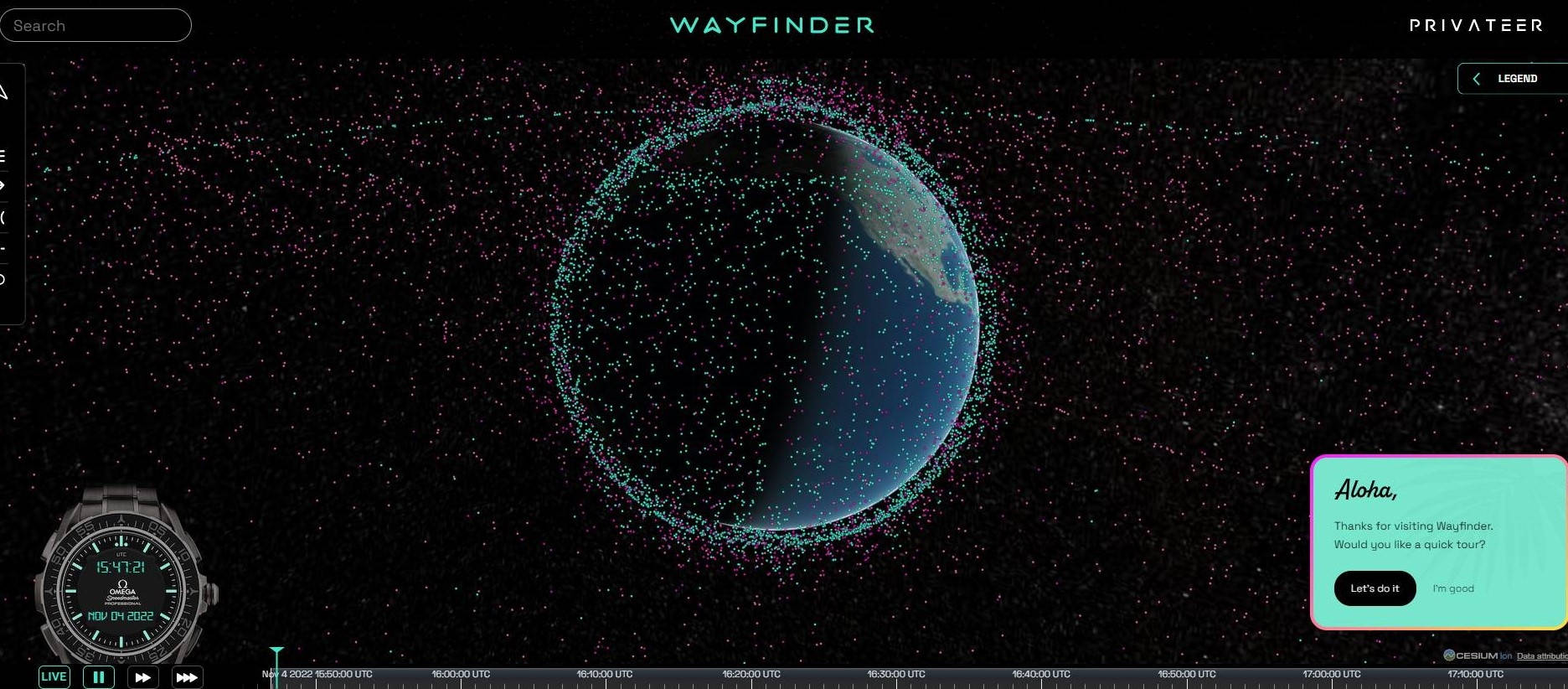
A new partnership is underway, one that calls for amateur astronomers and satellite watchers to create the largest optical space sensor network to accurately track thousands of human-made objects in Earth orbit.
Apple co-founder, Steve Wozniak kick-started Privateer Space, the group now publicizing its partnership with Celestron, a leading telescope maker.
The collaborative venture allows Celestron telescope owners to participate in improving the collective understanding of where objects are located at any given time – in low Earth orbit and beyond.
Credit: Privateer Space
According to a Privateer Space statement, “by crowdsourcing the transparency and predictability of space, Privateer will be able to provide more accurate locations of objects in space and share those critical data through the Wayfinder platform, while Celestron users will be able to participate firsthand in keeping space safe and accessible for all humankind.”
Credit: Privateer Space
Space environmentalism
Moriba Jah, co-founder and chief scientist of Privateer, said that by combining Celestron telescopes with the recently launched Wayfinder 2.0, “anyone can easily become an active steward of the space environment.”
While many radars and telescopes can detect objects in space, Privateer adds that they are often not capable to track those objects long enough to precisely determine their orbits. That leaves much to guess.
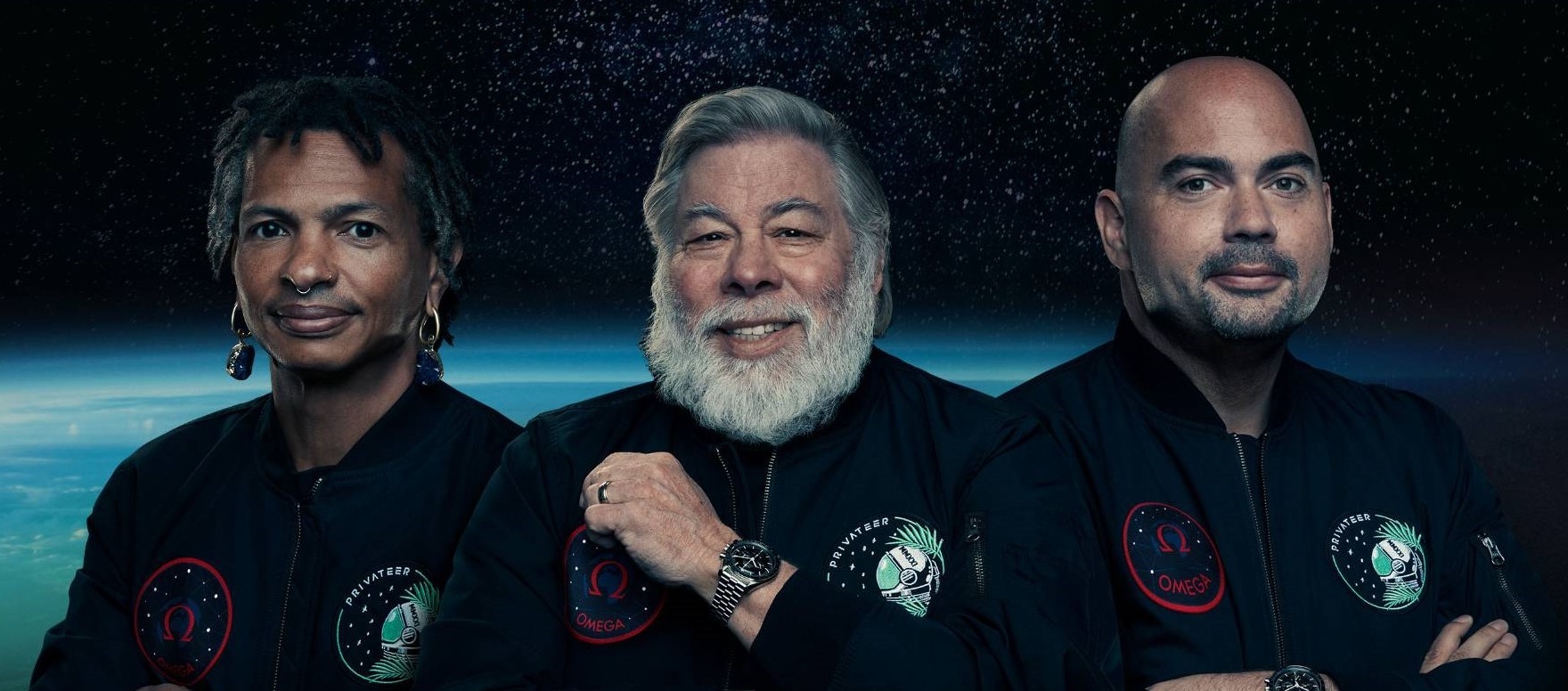
Left to right: Moriba Jah, Chief Scientist; Steve Wozniak, President; Alex Fielding, CEO, Chairman.
Credit: Privateer Space
Celestron CEO, Corey Lee, said in a statement that the partnership with Privateer, will make “space environmentalism accessible to everyone” by participating in the largest optical space sensor network.
More details forthcoming as Privateer and Celestron develop and roll out this capability.
For more information, go to:

Credit: CNSA/CCTV/Inside Outer Space screengrab
The European Union’s Space Surveillance and Tracking (EU SST) Operations Centers are monitoring the uncontrolled reentry into Earth’s atmosphere of China’s large space object CZ-5B (2022-143B). That’s the core stage of the rocket that launched on October 31st Mengtian – the third module of the Chinese large modular space station.
The EU SST network of sensors is observing the object closely, and its radars have narrowed down its re-entry window to November 4th.
Initial measurements from EU SST contributing sensors confirmed that the core stage is tumbling.
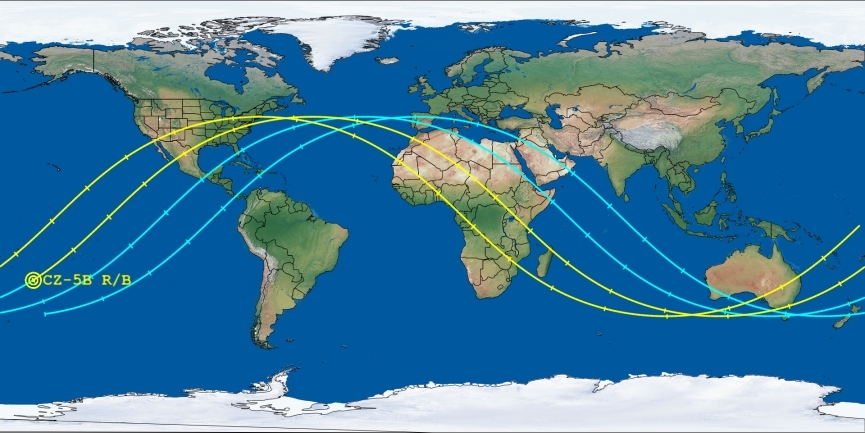
China’s Long March 5 Core Stage – Predicted Reentry Time now November 4, 2022 at 11:20 UTC ± 3 hours – from The Aerospace Corporation.
Yellow Icon – location of object at midpoint of reentry window
Blue Line – ground track uncertainty prior to middle of the reentry window (ticks at 5-minute intervals)
Yellow Line – ground track uncertainty after middle of the reentry window (ticks at 5-minute intervals)
Pink Icon (if applicable) – vicinity of eyewitness sighting or recovered debris
Note: Possible reentry locations lie anywhere along the blue and yellow ground track. Areas not under the line are not exposed to the debris.
Level of risk
“The uncertainty of where the large debris will ultimately land presents a level of risk to human safety and property damage that is well above commonly accepted thresholds,” explains The Aerospace Corporation and its Center for Orbital and Reentry Debris Studies (CORDS).
CORDS — as is the U.S. military and a global network of satellite watchers — are actively tracking the CZ-5B rocket body.
And for good reason.
The core booster weighs an estimated 22.5-metric tons. That’s about the size of a 10-story building.
Notes The Aerospace Corporation, similar uncontrolled reentries of Long March rockets occurred in 2020, 2021 and most recently in July 2022 – of which, two resulted in large debris landing near populated areas.
Precautionary preparation
“Over 88 percent of the world’s population lives under the reentry’s potential debris footprint. Factors such as the rocket core’s uncontrolled manner of descent and its size, which is too large to entirely burn up in the Earth’s atmosphere, collectively present risks high enough that require additional precautionary preparation around the world,” adds The Aerospace Corporation.
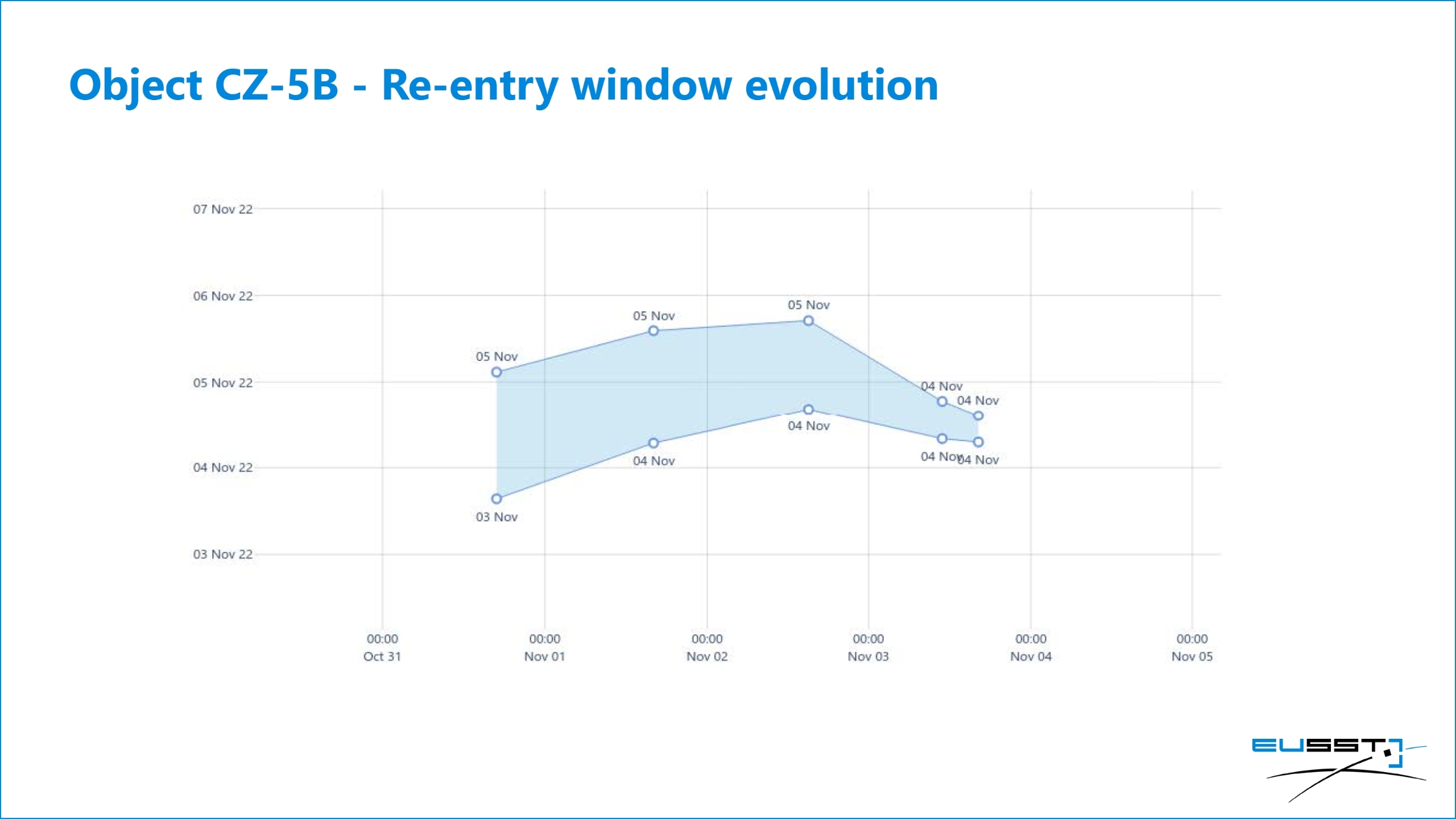
Credit: European Union’s Space Surveillance and Tracking (EU SST)

Air Force X-37B space plane.
Credit: Boeing
The X-37B military space drone has whisked by 900 days in Earth orbit – or two years, five months, seventeen days.
No word on how long this current 6th mission — The U.S. Space Force X-37B Orbital Test Vehicle (OTV-6) – will remain in orbit. It was launched on May 17, 2020 from Cape Canaveral Air Force Station, Florida.
This mission underway is the first X-37B vehicle to use a service module to host experiments. The service module is an attachment to the aft of the vehicle that allows additional experimental payload capability to be carried to orbit.
The mission did deploy the FalconSat-8, a small satellite developed by the U.S. Air Force Academy and sponsored by the Air Force Research Laboratory to conduct several experiments on orbit.

Encapsulated X-37B Orbital Test Vehicle for U.S. Space Force-7 mission, now in Earth orbit.
Credit: Boeing
In addition, two NASA experiments are onboard the space plane to study the results of radiation and other space effects on a materials sample plate and seeds used to grow food.
Technology testing
A U.S. Naval Research Laboratory (NRL) experiment is also onboard the space plane, evaluating technology to transform solar power into radio frequency microwave energy. That experiment continues to crank out data, said Paul Jaffe, electronics engineer and researcher at the Naval Research Laboratory.

Naval Research Laboratory (NRL) has pioneered “sandwich” modules that are far more efficient for space solar power.
Credit: NRL/Jamie Hartman
“It’s still chugging along,” Jaffe told Inside Outer Space. “The longer we’re up there, the more we learn.”
The NRL experiment itself is called the Photovoltaic Radio-frequency Antenna Module, PRAM for short.
Technologies being tested in the X-37B program include advanced guidance, navigation and control, thermal protection systems, avionics, high temperature structures and seals, conformal reusable insulation, lightweight electromechanical flight systems, advanced propulsion systems, advanced materials and autonomous orbital flight, reentry and landing.
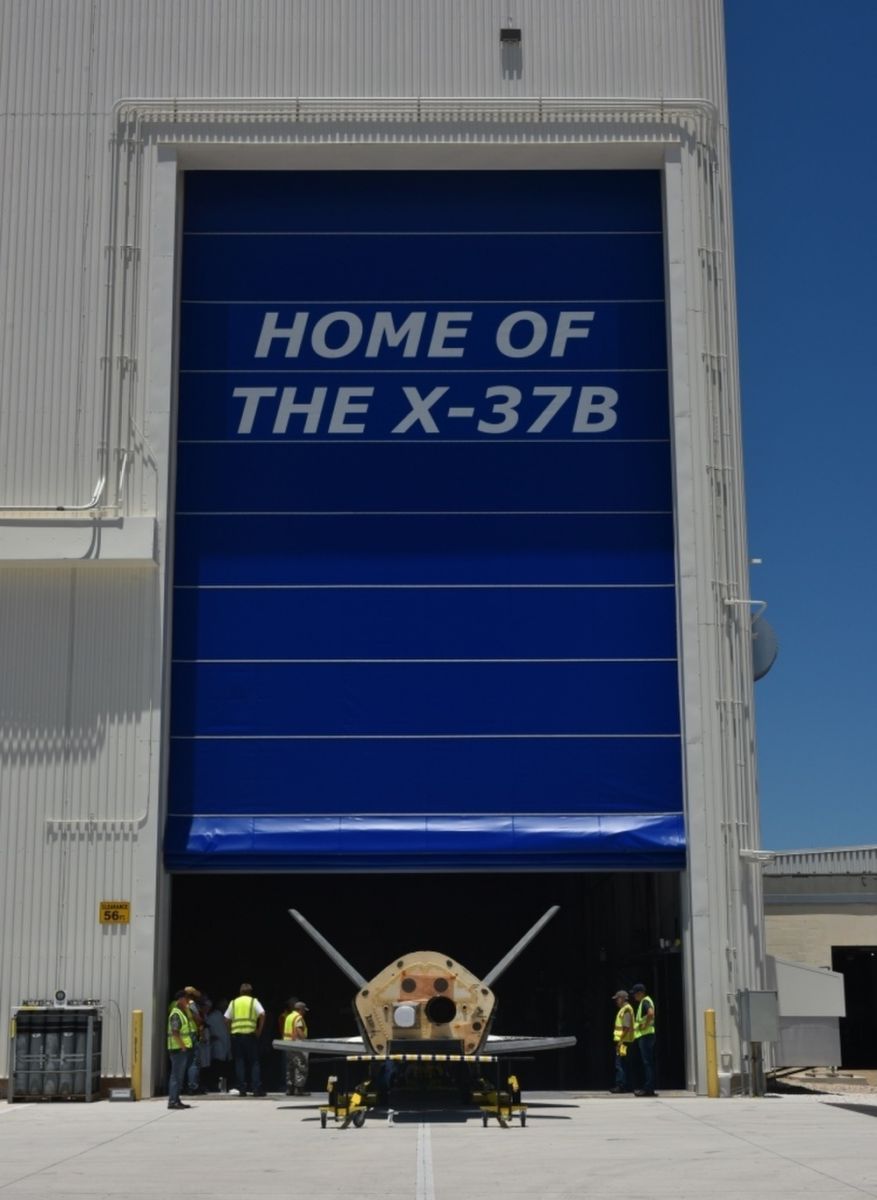
X-37B hangar at Kennedy Space Center.
Credit: Michael Martin/SAF
Flight roster
Here’s a listing of previous flights of the Boeing-built space plane:
OTV-1: launched on April 22, 2010 and landed on December 3, 2010, spending over 224 days on orbit.
OTV-2: launched on March 5, 2011 and landed on June 16, 2012, spending over 468 days on orbit.
OTV-3: launched on December 11, 2012 and landed on October 17, 2014, spending over 674 days on-orbit.
OTV-4: launched on May 20, 2015 and landed on May 7, 2015, spending nearly 718 days on-orbit.
OTV-5: launched on September 7, 2017 and landed on October 27, 2019, spending nearly 780 days on-orbit.
As to when and where OTV-6 will return to a wheels-stopped landing is anybody’s guess.
OTV-1, OTV-2, and OTV-3 missions landed at Vandenberg Air Force Base, California, while the OTV-4 and OTV-5 missions landed at Kennedy Space Center, Florida.
China space plane
Meanwhile, China’s space plane, catalogued as 53357/2022-093A, has also been circuiting the Earth. It was lofted on August 4th. Space tracker Robert Christy of Orbital Focus notes China’s craft recently acquired a companion.
That new object separated from the main vehicle between October 24 and October 30, Christy reported. The two objects are very close to each other, perhaps station keeping, he said.

Curiosity’s location at Sol 3640. Distance driven to that sol: 17.95 miles/28.89 kilometers.
Credit: NASA/JPL-Caltech/Univ. of Arizona
NASA’s Curiosity Mars rover at Gale Crater is now wrapping up Sol 3641 duties.
The rover has arrived at a spectacular workspace, “but what made it spectacular – rocks – is what also made it tricky,” reports Michelle Minitti, a planetary geologist at Framework in Silver Spring, Maryland.
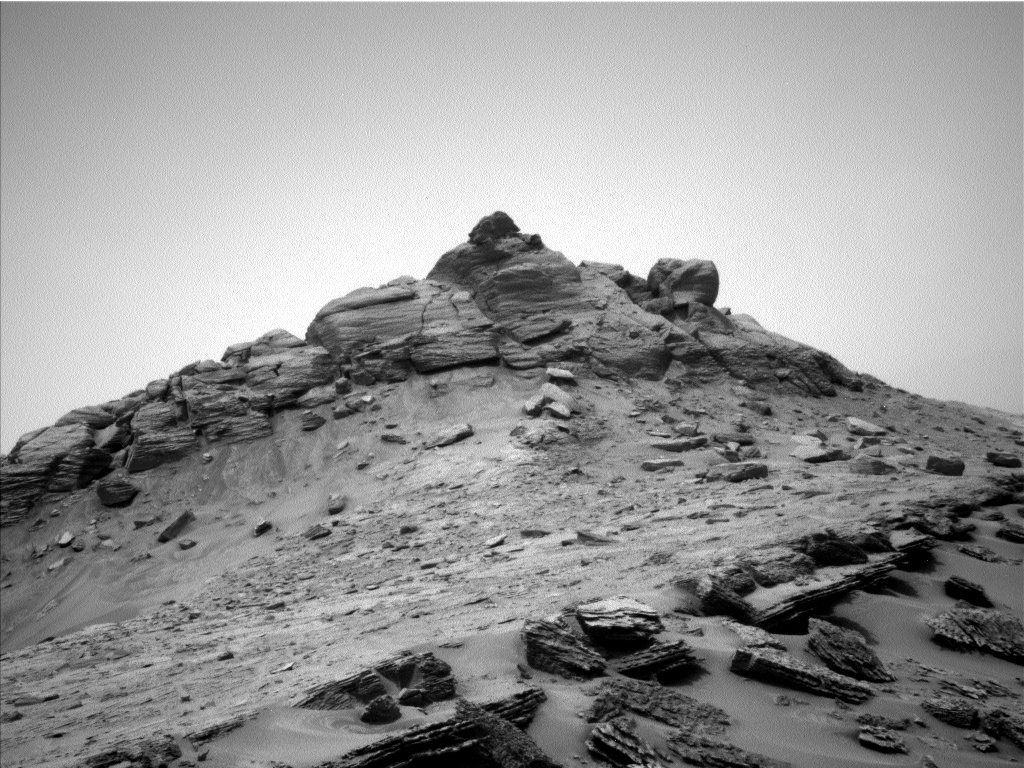
Curiosity Left B Navigation Camera image taken on Sol 3640, November 2, 2022.
Credit: NASA/JPL-Caltech
Stabilize the rover
“Our left front wheel was propped up just enough on one of the lovely and interesting rocks to make it unsafe to unstow the arm,” Minitti adds. “Fortunately, the rover planners were confident in finding a way to reposition the rover to stabilize us enough to get the arm out, so that [a] small maneuever was added to today’s plan [Sol 3639]. Our fingers are crossed we have better luck tomorrow!”
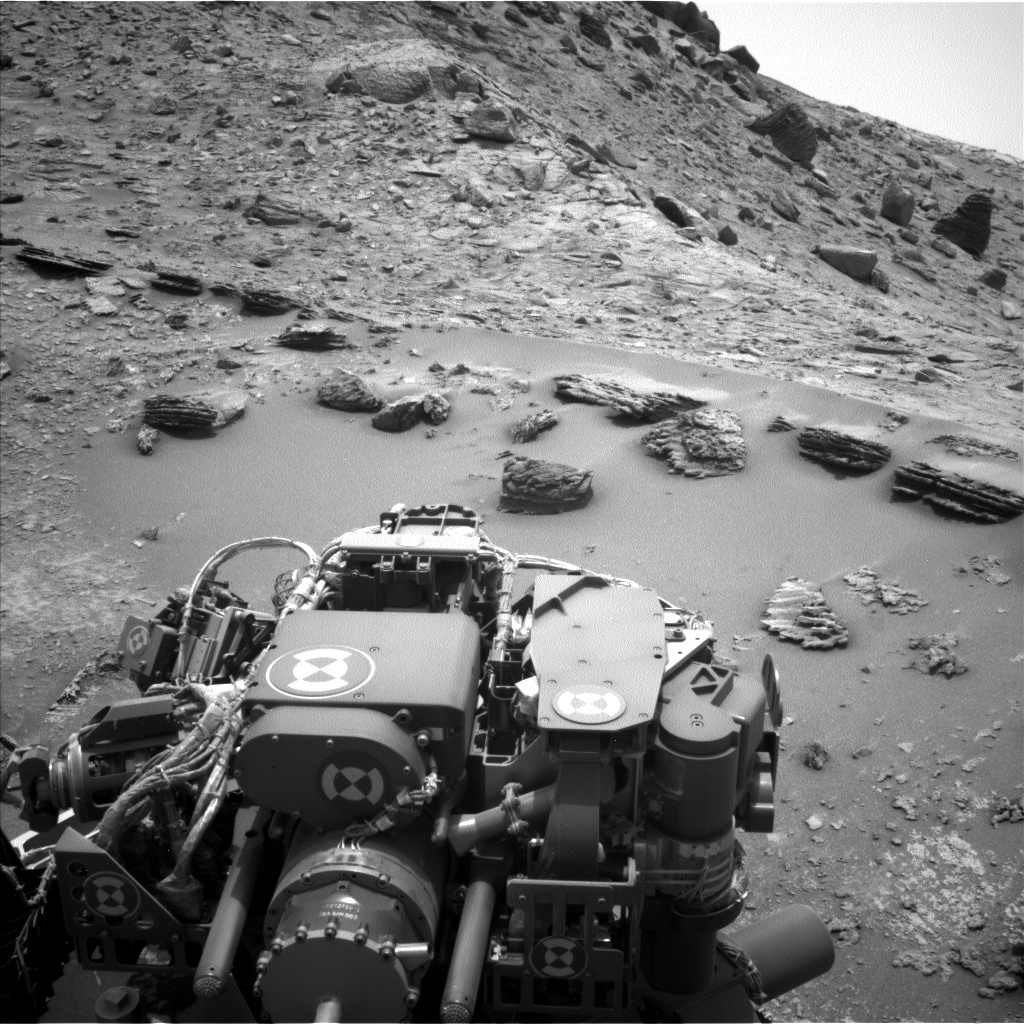
Curiosity Left B Navigation Camera image taken on Sol 3640, November 2, 2022.
Credit: NASA/JPL-Caltech
While the robot could not apply the Mars Hand Lens Imager (MAHLI) or the Alpha Particle X-Ray Spectrometer (APXS) to the rocks ahead of the rover, Minitti said “we had no restrictions, short of overworking uplink teams, on using Mastcam and ChemCam [Chemistry and Camera]. “We took full advantage of our additional time to image our amazing surroundings.”
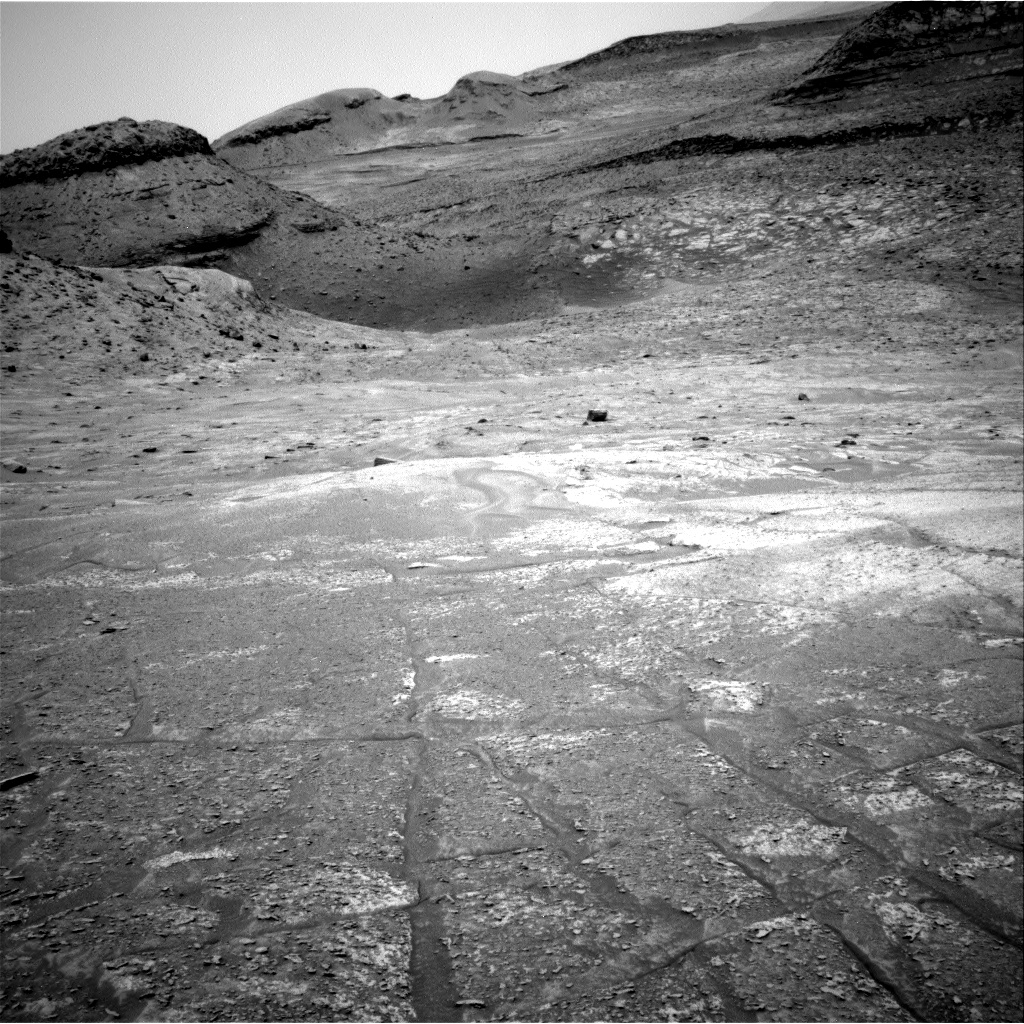
Curiosity Right B Navigation Camera image acquired on Sol 3640, November 2, 2022.
Credit: NASA/JPL-Caltech
Resistant ridges
A ChemCam raster was planned along one of the notable resistant ridges that span the workspace blocks, on target “Saracura.”
The ChemCam Remote Micro-Imager (RMI) was used to image a stack of the layers at the edge of the marker band, at target “Curecurema.”

Curiosity Mast Camera Left image taken on Sol 3640, November 2, 2022.
Credit: NASA/JPL-Caltech/MSSS
“Layer-parallel imaging like this is a terrific way to interrogate the mechanisms that formed those layers. There were so many interesting textures on the workspace rocks that we could not help but wonder if chemistry had anything to do with them,” Minitti points out.

Curiosity Mast Camera Left image taken on Sol 3640, November 2, 2022.
Credit: NASA/JPL-Caltech/MSSS
Multispectral observations
To investigate this, mission operators planned Mastcam multispectral observations of two targets, “Patua” and “Tucano.” Mastcam was to also cover the scene with multiple large stereo mosaics.

Curiosity Mast Camera Left image taken on Sol 3640, November 2, 2022.
Credit: NASA/JPL-Caltech/MSSS
“One will capture the marker band extending away from us to the south, another will cover the workspace blocks, and a third will image blocks similar to those in the workspace,” Minitti continues, “but out of reach, at target ‘Benevenuto.’”
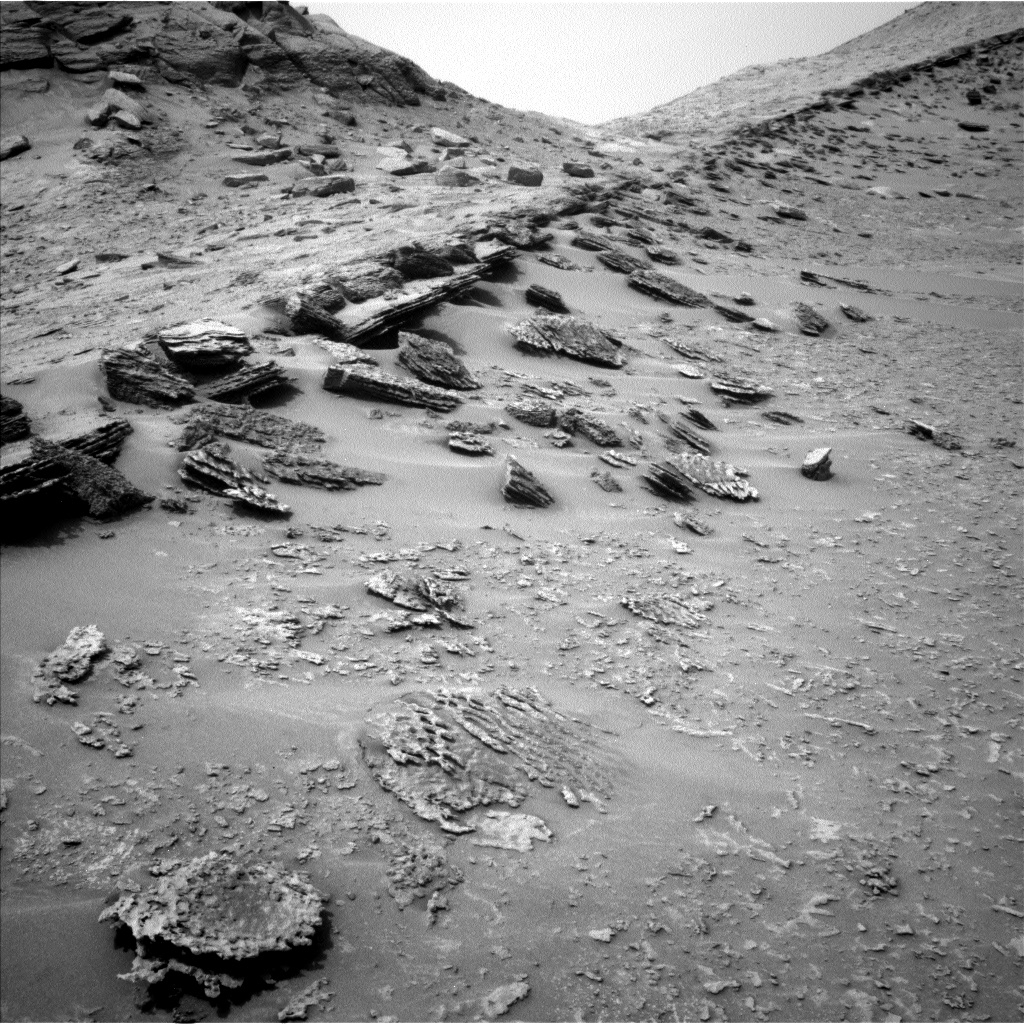
Curiosity Left B Navigation Camera image taken on Sol 3640, November 2, 2022.
Credit: NASA/JPL-Caltech
Curiosity managed time for a Navcam dust devil survey, and Dynamic Albedo of Neutrons (DAN) passive and active measurements before and after the rover was repositioned, respectively. Radiation Assessment Detector (RAD) and use of the Rover Environmental Monitoring Station (REMS) run throughout the plan.
“Over the last few years, companies have launched large constellations of satellites to provide services such as phone and Internet access. This trend is expected to accelerate, with tens of thousands of additional satellites expected to be launched by the end of the decade,” writes the U.S. Government Accountability Office (GAO). “Stakeholders have raised questions about federal consideration of potential environmental and other effects as the number of satellites orbiting the Earth increases.”
As noted by the GAO, the National Environmental Policy Act (NEPA) requires federal agencies to consider the environmental effects of major federal actions prior to making decisions and to involve the public.
Federal agencies consider potential environmental and other effects from large constellations of satellites through licensing and other efforts. GAO reported that these effects could include sunlight reflections, orbital debris, and launch emissions.
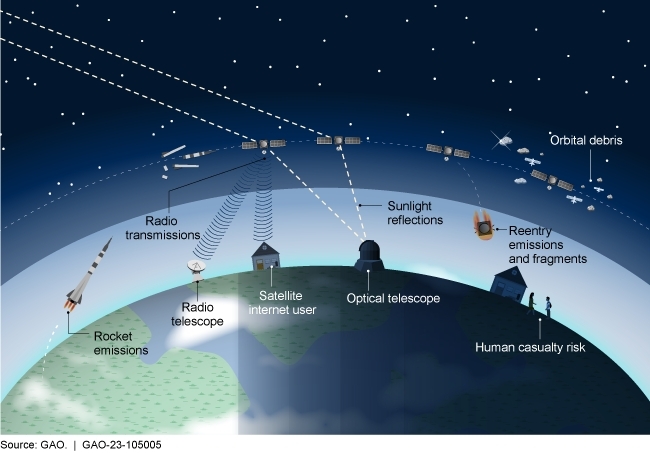
What they found
The Federal Communications Commission (FCC) and the Federal Aviation Administration (FAA) consider these potential effects when licensing satellite transmissions and launch and reentry vehicles, respectively. Other federal agencies fund or lead research on these potential effects.
GAO found that “FCC has not sufficiently documented its decision to apply its categorical exclusion when licensing large constellations of satellites.”
To access the full report — “Satellite Licensing: FCC Should Reexamine Its Environmental Review Process for Large Constellations of Satellites” – go to:
Wait a Minute!
Note: “Wait a Minute!” is the first of a series of stories written to flag issues of concern, consternation, and constant aggravation.
Around and around it goes, where it ends up is anybody’s guess.
China’s “forget me not” Long March 5B core booster weighs an estimated 22.5-metric tons. That’s about the size of a 10-story building.
That core stage is a circling-the-Earth leftover associated with the recent launch of the third and final experiment module of China’s Tiangong Space Station, Mengtian.
Level of risk
“The uncertainty of where the large debris will ultimately land presents a level of risk to human safety and property damage that is well above commonly accepted thresholds,” explains The Aerospace Corporation and its Center for Orbital and Reentry Debris Studies (CORDS).
CORDS as is the U.S. military and a global network of satellite watchers are actively tracking the CZ-5B rocket body. And for good reason.
Notes The Aerospace Corporation, similar uncontrolled reentries of Long March rockets occurred in 2020, 2021 and most recently in July 2022 – of which, two resulted in large debris landing near populated areas.
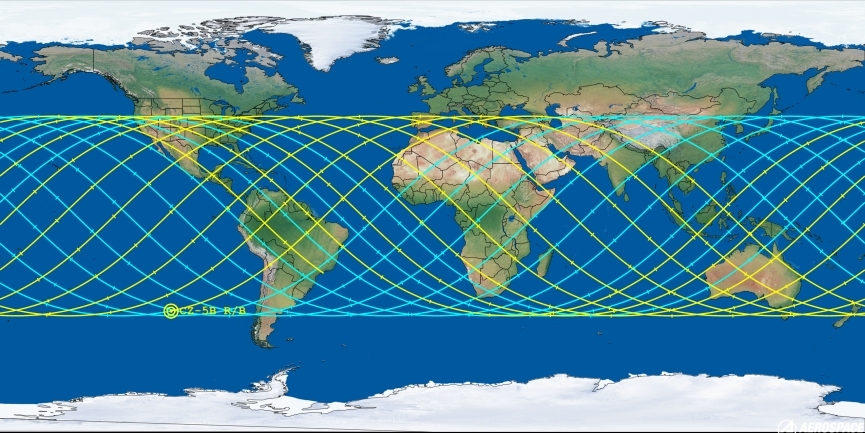
Predicted Reentry Time: November 5, 2022 04:51 UTC ± 14 hours.
Predicted Reentry Time 05 Nov 2022 04:51 UTC ± 14 hours.
Yellow Icon – location of object at midpoint of reentry window
Blue Line – ground track uncertainty prior to middle of the reentry window (ticks at 5-minute intervals)
Yellow Line – ground track uncertainty after middle of the reentry window (ticks at 5-minute intervals)
Pink Icon (if applicable) – vicinity of eyewitness sighting or recovered debris.
Credit: The Aerospace Corporation/CORDS
Precautionary preparation
“Over 88 percent of the world’s population lives under the reentry’s potential debris footprint. Factors such as the rocket core’s uncontrolled manner of descent and its size, which is too large to entirely burn up in the Earth’s atmosphere, collectively present risks high enough that require additional precautionary preparation around the world,” adds The Aerospace Corporation.
China’s Long March 5B core stage is predicted for a November 5th return to Earth: latest predictions at The Aerospace Corporation’s CORDS site are available here at:
https://aerospace.org/reentries/cz-5b-rb-id-54217
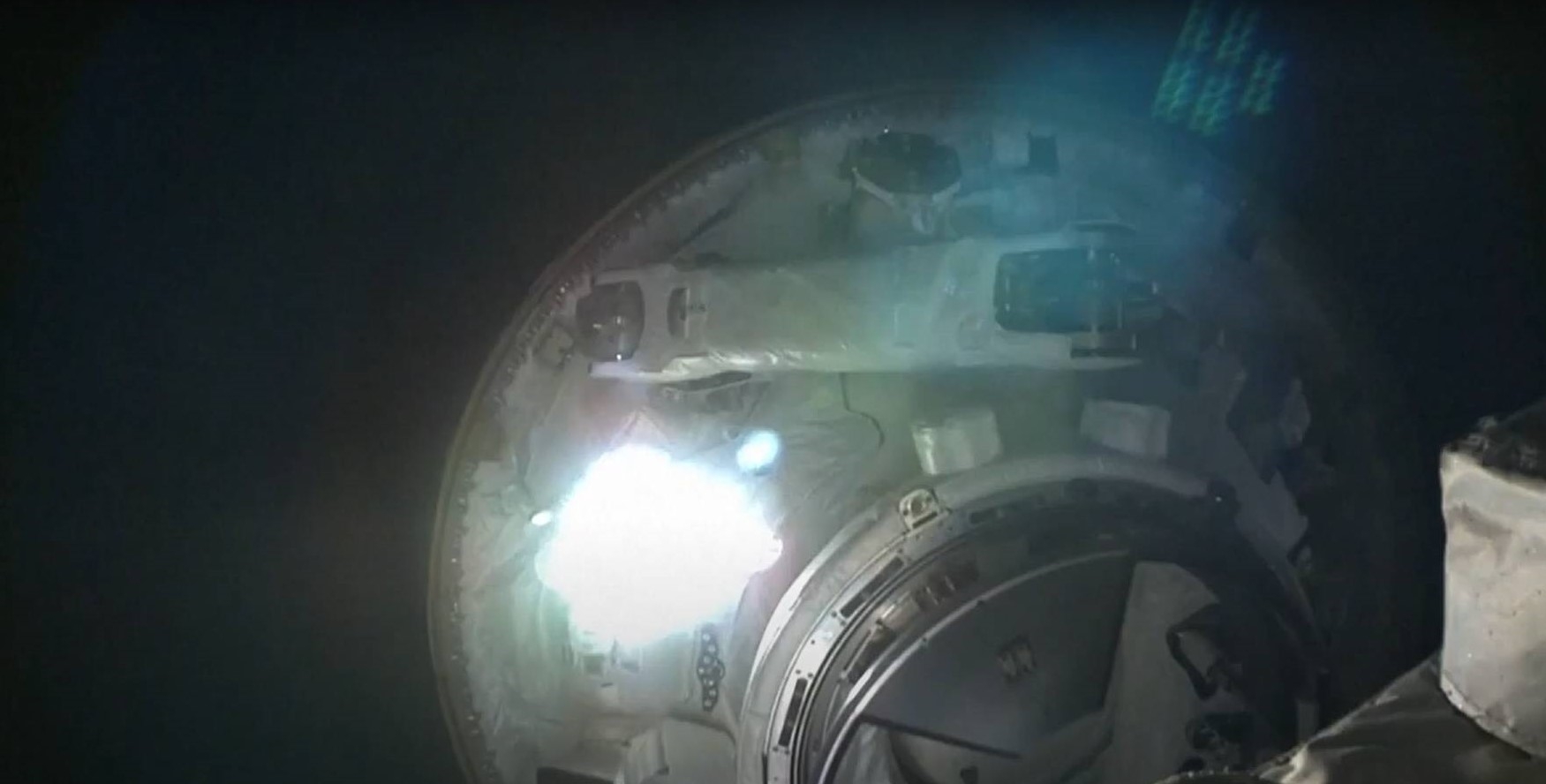
Credit: CNSA/CCTV/Inside Outer Space screengrab
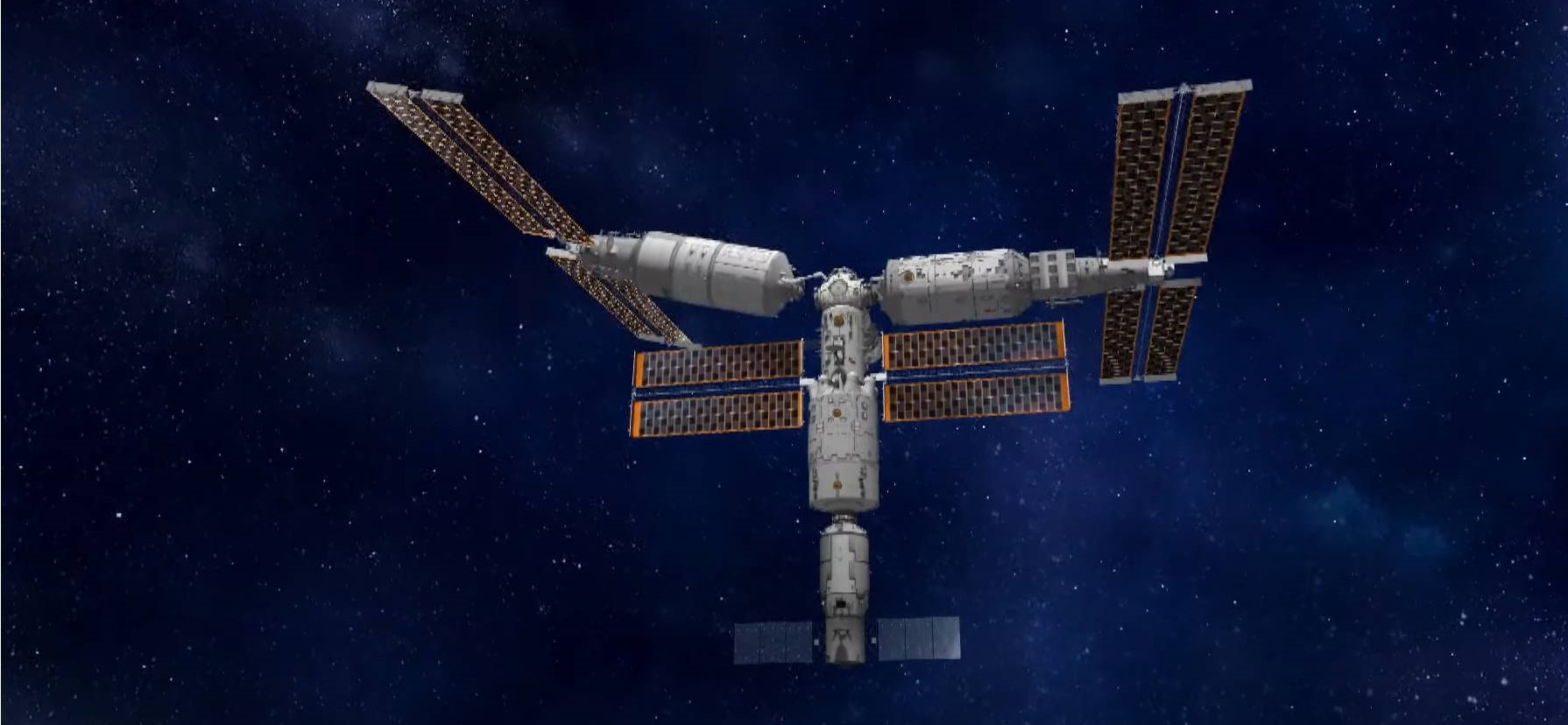
China’s Mengtian lab module has docked with the Tianhe core module’s forward port. This hardware represents the third part of completing China’s Tiangong space station.
Following the lab’s launch, the process of rendezvous and docking took approximately 13 hours.
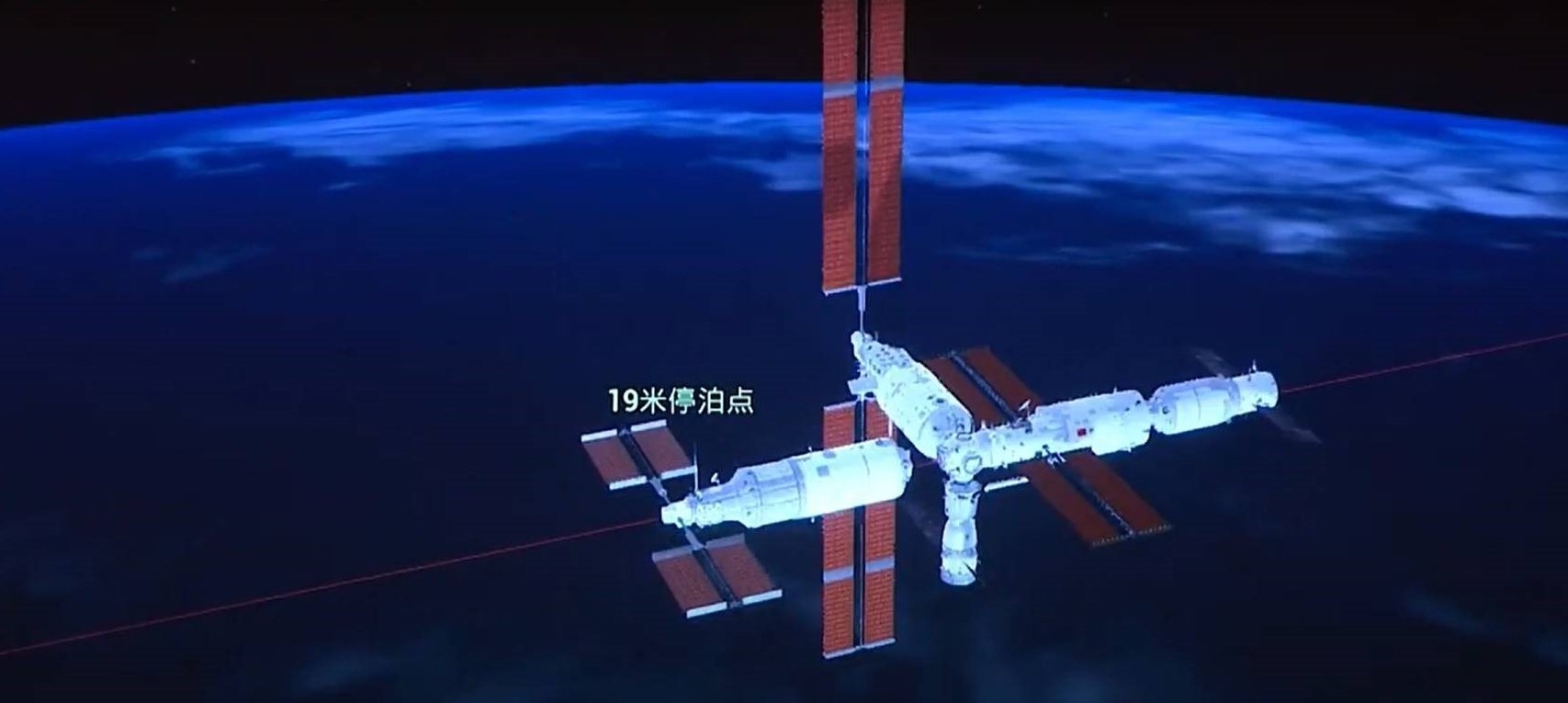
Credit: CNSA/CCTV/Inside Outer Space screengrab
Next step: Transposition of module
“After docking with the space station complex, it will start transposition, which is different from the [earlier launched and docked] Wentian lab module,” said Wang Saijin, deputy chief engineer, Beijing Aerospace Control Center. “Then the Mengtian will connect its system with the complex and create environment for human activities. Our crew members will enter the Mengtian after all these processes,” Wang told China Central Television (CCTV).

Credit: CNSA/CCTV/Inside Outer Space screengrab
The scientific equipment in the Mengtian module will be used for studying microgravity and carrying out experiments in fluid physics, materials science, combustion science and fundamental physics.
T-shape station
During the Mengitan transposition, that module will be moved by an angle of 90 degrees from the front docking port to a side port of the core module’s node cabin, forming a straight line with the Wentian lab module.
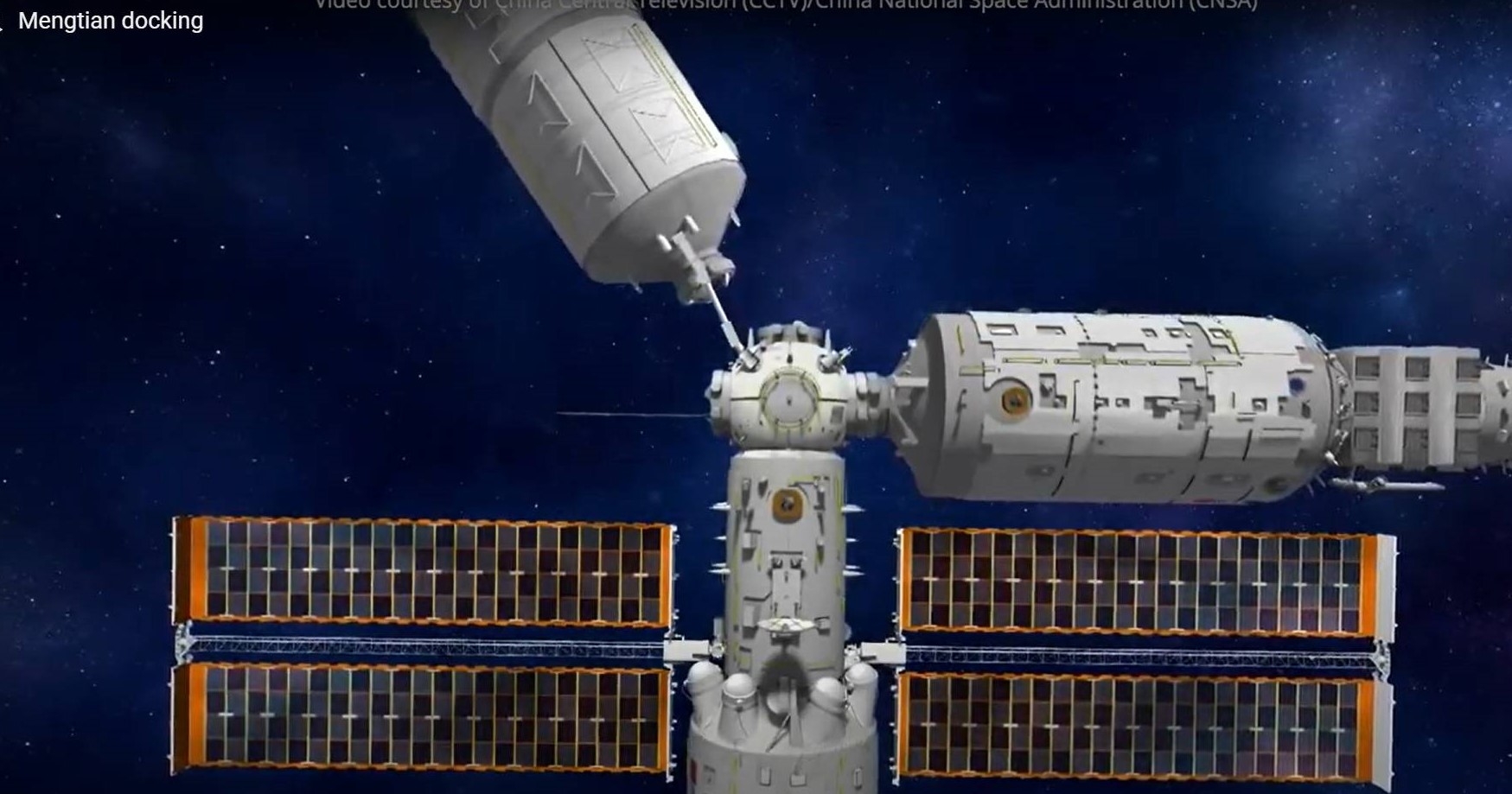
Credit: CNSA/CCTV/Inside Outer Space screengrab
Credit: CNSA/CCTV/Inside Outer Space screengrab
The two lab modules, together with Tianhe core module, will then form a T-shape structure, the planned layout at the space station’s completion.
Malfunction response planning
“The Shenzhou-14 astronauts will cooperate with the ground control teams to adjust the settings of the space station combination. We only need to launch the transposition process at the right time, and then the whole transposition will be implemented automatically without control from the ground,” said Luo Chao, chief system designer for space station with the China Academy of Space Technology.
The transposition equipment weighing only around 220 pounds (100 kilograms) will move the over-20-ton Mengtian lab module during the process.

Station complete is set for year’s end.
Credit: CNSA/CCTV Video News Agency/Inside Outer Space screengrab
Station designers and engineers have arranged many in-orbit tests on the transposition equipment, Luo added. “We have designed plans and done ground tests and in-orbit tests targeting all the links that may give rise to problems. And we have prepared around 100 malfunction response plans to ensure completion of the procedures.”
Airlock serves as cargo port
The airlock cabin on the earlier launched Wentian module is designed for the access of astronauts.
Mengtian’s airlock cabin will enable automatic entry and exit of goods, serving the function of a “cargo port”, according to Liu Huiying, planning manager of the space station project office at the Shanghai Academy of Spaceflight Technology.
“The Wentian lab module also has an airlock cabin, which mainly serves as the exit-entry point for astronauts to conduct extravehicular activities. But the diameter of the cabin is limited, making it difficult to move goods with heavy payload out of the cabin,” Liu told CCTV.

Credit: CCTV/Inside Outer Space screengrab
“The airlock cabin of Mengtian is designed for the free entry and exit of cargoes, with a payload capacity of more than 400 kilograms. The entrance is 1.2 meters in length, width and height, allowing the free entry and exit of cargoes that are difficult for astronauts to carry around,” said Liu.
The three-member crew of the Shenzhou-14 mission now onboard the orbital complex will later be joined by three more astronauts in the coming months to complete the final construction of China’s space station by year’s end.
For newly issued videos regarding the docking and new module, go to:

Boulder-size blocks of water ice can be seen around the rim of an impact crater on Mars. Image taken by the High-Resolution Imaging Science Experiment (HiRISE camera) aboard NASA’s Mars Reconnaissance Orbiter (MRO). The crater was formed Dec. 24, 2021, by a meteoroid strike in the Amazonis Planitia region.
Credits: NASA/JPL-Caltech/University of Arizona
Meteorite impacts on Mars not only toss up dirt and ice, but also produce important data on the structure of the Martian crust.
For example, on December 24, 2021 a meteorite strike on the Red Planet generated surface waves that sped along the planet’s surface. At one point, on the receiving end of those waves was NASA’s InSight Mars lander, recording the hit at a distance of about 2,175 miles (3,500 kilometers) from the lander’s sensitive seismic gear.
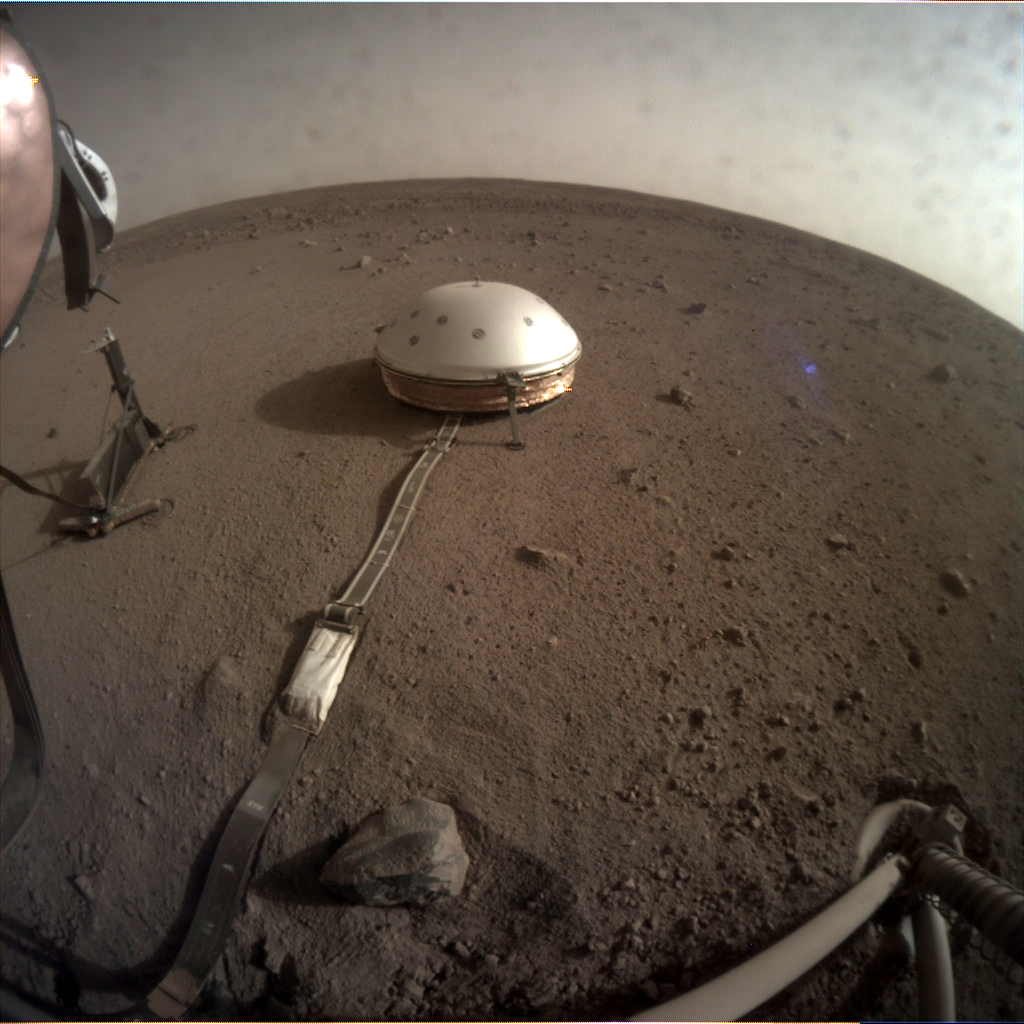
InSight’s Instrument Deployment Camera (IDC) acquired this image showing the HP3 experiment and SEIS seismometer (Seismic Experiment for Interior Structures) on Sol 99, March 8, 2019.
Credit: NASA/JPL-Caltech
Thanks to the Mars-circling NASA Mars Reconnaissance Orbiter, a crater more than 100 meters in diameter was later imaged.
Researchers also identified a meteorite impact at a distance of just under 4,600 (7,500 kilometers) from InSight as the source of a second shock.
Uniform structure
This research has been captured in a new paper published in Science – “Surface waves and crustal structure on Mars” – led by Doyeon Kim of the Institute of Geophysics, ETH Zürich, Zürich, Switzerland.

Cross section of the S1094b surface wave path through Mars.
Credit: Doyeon Kim, et al.
“Until now, our knowledge of the Martian crust was based on only one point measurement under the InSight lander,’ said Kim.
The result of the surface wave analysis: between the impact sites and InSight’s seismometer, the Martian crust has, on average, a very uniform structure and a high density.
“The new findings are so interesting because a planet’s crust provides important clues about the formation and evolution of the celestial body. It is the result of early dynamic processes in the mantle and subsequent magmatic processes,” explained a co-author colleague, Brigitte Knapmeyer-Endrun at the Bensberg Observatory, University of Cologne, Bergisch Gladbach, Germany.

Locations of two large meteorite impacts (yellow circles) identified in MRO images.
Credit: Doyeon Kim, et al.
InSight landing site
According to the Kim, the study lead, the structure of the crust beneath the InSight landing site may have formed in a unique way, like when material was ejected during a large asteroid impact more than three billion years ago.
“If so, the structure beneath the lander is probably not representative of the general crustal structure of Mars.”
For access to the paper — “Surface waves and crustal structure on Mars” – go to:
https://www.science.org/doi/10.1126/science.abq7157

