Author Archive
 Author:
  November 11th, 2022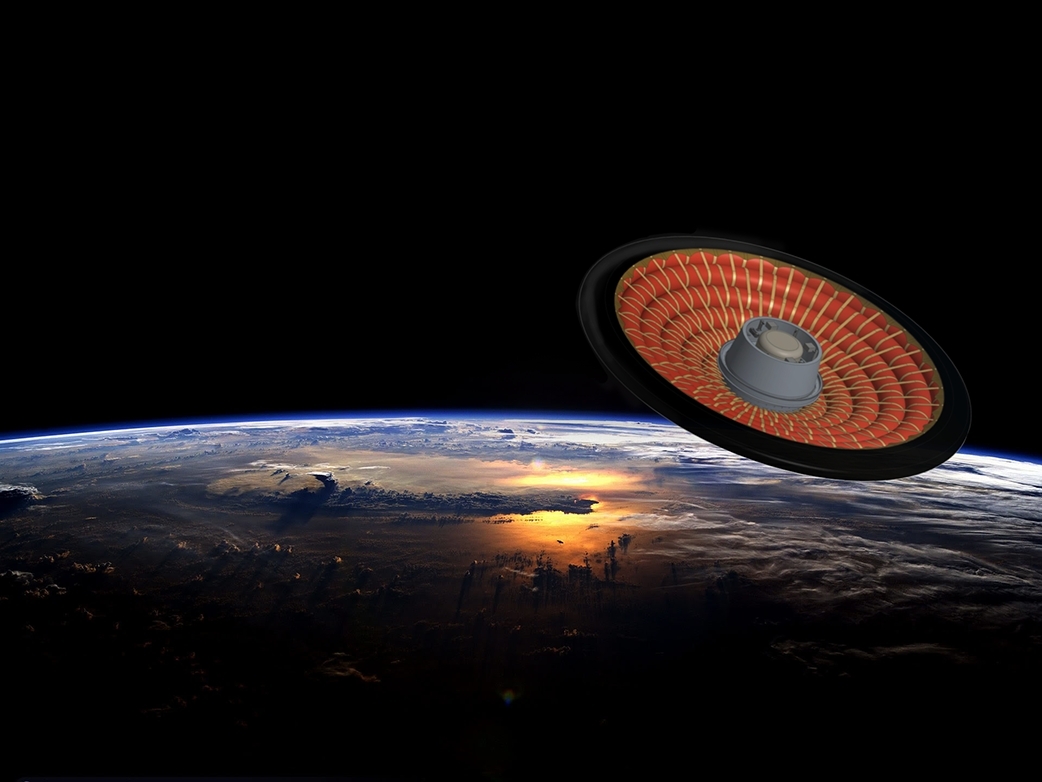
In-coming LOFTID dives toward Earth.
Artwork credit: NASA
NASA test engineers are evaluating how well an inflatable decelerator hurled to Earth from space weathered its high-flying test.
Flown November 10, NASA’s Low-Earth Orbit Flight Test of an Inflatable Decelerator, or LOFTID, is a type of heat shield for atmospheric re-entry.
This technology could be utilized for missions to Mars, Venus, Titan, as well as returning payloads to Earth.

Credit: NASA
Secondary payload
LOFTID got its day in space as a secondary payload, riding along with NOAA’s Joint Polar Satellite System-2 (JPSS-2). That NOAA spacecraft did experience a solar array unfurling issue – but is now fully deployed and the satellite is healthy and operating as expected.
This twosome was hurled spaceward by a United Launch Alliance Atlas V 401 rocket from Vandenberg Air Force Base in California.

Credit: NASA
Plucked from ocean waters
Team members successfully retrieved the LOFTID heat shield from the Pacific Ocean on Thursday morning, plucked from ocean waters and planted on board a recovery vessel. Splashdown was within an ellipse east of Honolulu.
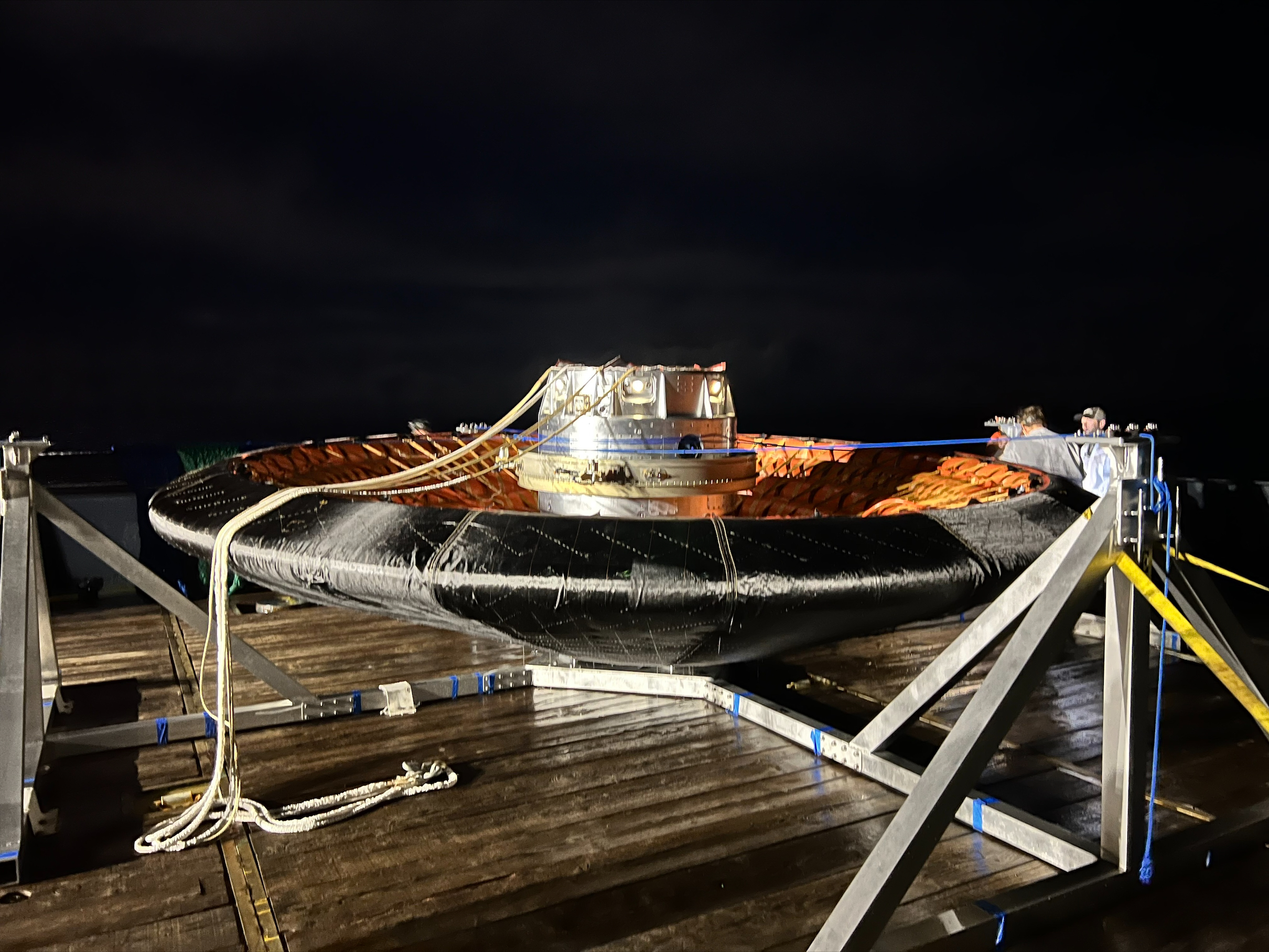
Onboard recovery vessel.
Credit: NASA
Also retrieved from the Pacific Ocean, LOFTID’s ejectable data that holds a backup copy of the data recorded during the heat shield’s plunge through Earth’s atmosphere. Another copy of the data is stored aboard the heat shield itself.

Technicians tend LOFTID in pre-launch photo.
Credit: NASA
The LOFTID project is managed and funded through NASA’s Technology Demonstration Missions program, part of the agency’s Space Technology Mission Directorate. The project is led by NASA Langley Research Center in Hampton, Virginia.
Novel technology
High above the Earth, LOFTID’s heat shield inflated, then re-entered Earth’s atmosphere, showcasing how this novel technology can assist payloads in slowing down and surviving the intense heat of re-entry.

Credit: NASA
For informative, pre-launch videos focused on LOFTID, go to:
 Posted in
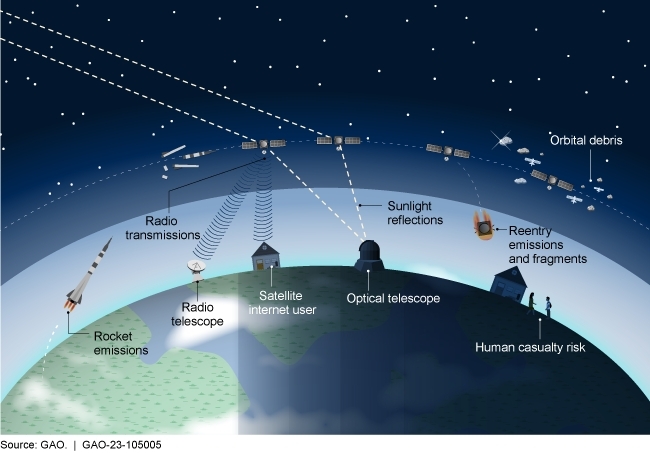
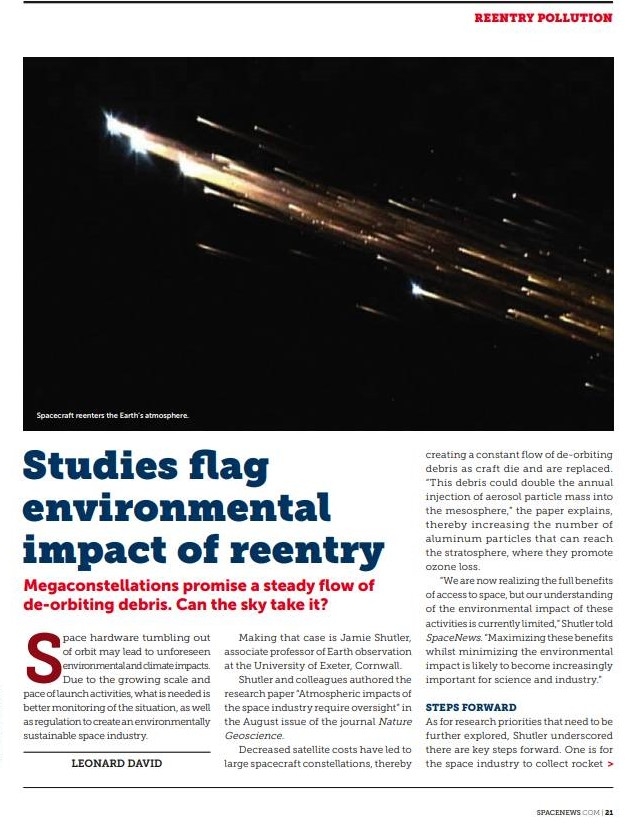
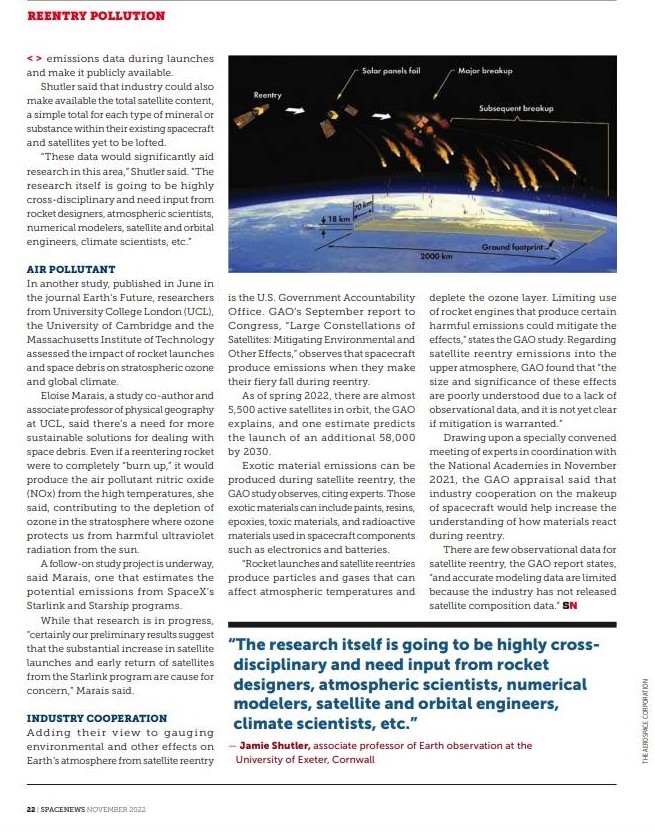
Space hardware tumbling out of orbit may lead to new unforeseen impacts on the environment and climate.
Due to the growing scale and pace of launch activities what is needed is better monitoring of the situation, as well as regulation to create an environmentally sustainable space industry.
For more information on this issue, here’s my new SpaceNews story:

Long March 5B liftoff.
Credit: CNSA/GLOBALink/Inside Outer Space screengrab
The Philippine Space Agency announced that rocket debris found in Busuanga was part of the rocket fairing of China’s Long March 5B booster. In addition, it is “highly likely” that pieces of debris reportedly found off the waters of Calintaan, Occidental Mindoro on November 7 and 8th were also part of China booster.
In a November 9th statement on rocket debris found in Palawan and Mindoro, the Philippine Space Agency also reiterated its “sustained efforts to promote and encourage accountability among nations for objects launched into space.”

Credit: Calintaan MDRRMO
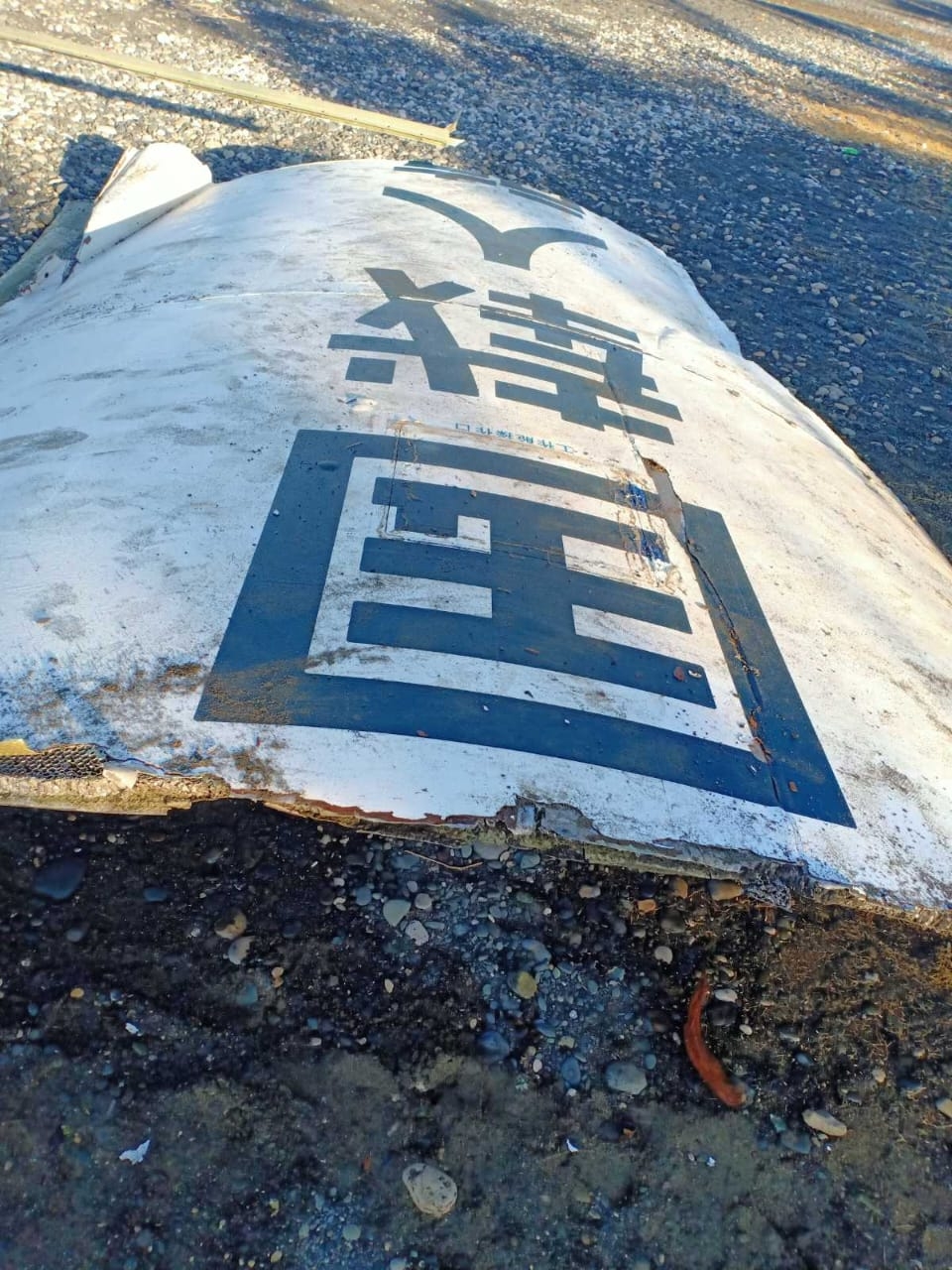
Credit: Calintaan MDRRMO
China’s Long March 5B launcher lofted on October 31st the third and final experiment module, Mengtian, of China’s Tiangong space station. The core stage of that booster later made an uncontrolled re-entry over the south-central Pacific Ocean on November 4th.

Credit: The Aerospace Corporation
Top priority
“Ratifying the Liability Convention would provide the legal basis and means to claim compensation in case of damage or injury to any property and/or people within the Philippine territory that is caused by a space object of another State,” the space agency added.
“On the other hand, while obligations under the Registration Convention are administrative and procedural, they are necessary for the implementation of the Liability Convention.” The space agency is currently working on additional documentary requirements for the preparation of treaty packages. “This remains a top priority for the Agency.”
The Philippine Space Agency said it would continue to coordinate with other space agencies and local government agencies to reduce the risks of space debris in the country.
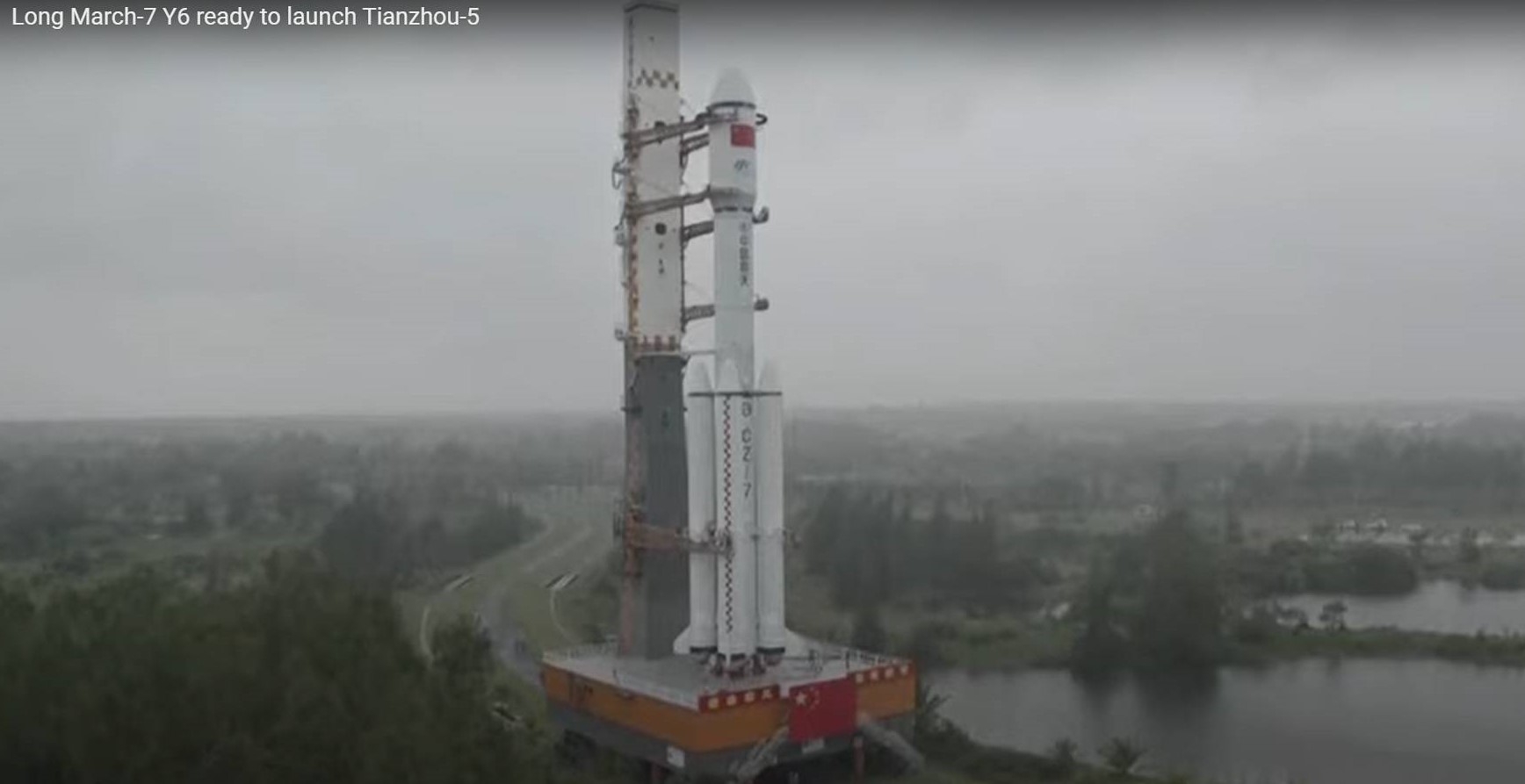
Credit: China Central Television/Inside Outer Space screengrab
China is set to launch the Tianzhou-5 cargo spacecraft from the Wenchang Spacecraft Launch Site in the southern province of Hainan.
The uncrewed supply ship will deliver multiple tons of provisions for China’s space station, now home to a three-person crew.
To prepare for Tianzhou-5’s upcoming docking to the station, the Tianzhou-4 supply ship has backed off from the orbital complex and will re-enter Earth’s atmosphere. The discarded ship departed from the rear docking port of the Tianhe Core Module.

Departure of Tianzhou-4 supply ship. Credit: China National Space Administration (CNSA)/China Central Television (CCTV)/Inside Outer Space screengrab
China launched the Tianzhou-4 on May 10, 2022.
Controlled re-entry
“After the Tianzhou-4 separated from the orbiting station combination, we will independently monitor and control the Tianzhou-4 cargo spacecraft. Some related experiments will be carried out in the next step,” Wang Saijin, deputy chief engineer of the Beijing Aerospace Control Center, told China Central Television (CCTV).
Adds Zou Xuemei, chief engineer of cargo spacecraft mission of the Beijing Aerospace Control Center: “The separation and evacuation of Tianzhou-4 were smooth in general. Then it will fly independently before finally leaving the orbit under control.”

Current occupants of China’s station – the Shenzhou-14 crew. Credit: China National Space Administration (CNSA)/China Central Television (CCTV)
On the pad
On November 9, 2022, the Long March-7 Y6 topped by the Tianzhou-5 was vertically moved to the launching area. Tianzhou-5 is the fourth cargo mission to the China Space Station, scheduled to autonomously dock to the Tianhe Core Module, the first and main component of the China Space Station.
Launch of the new cargo ship is reportedly Friday, November 11th at 9 PM Eastern Time.
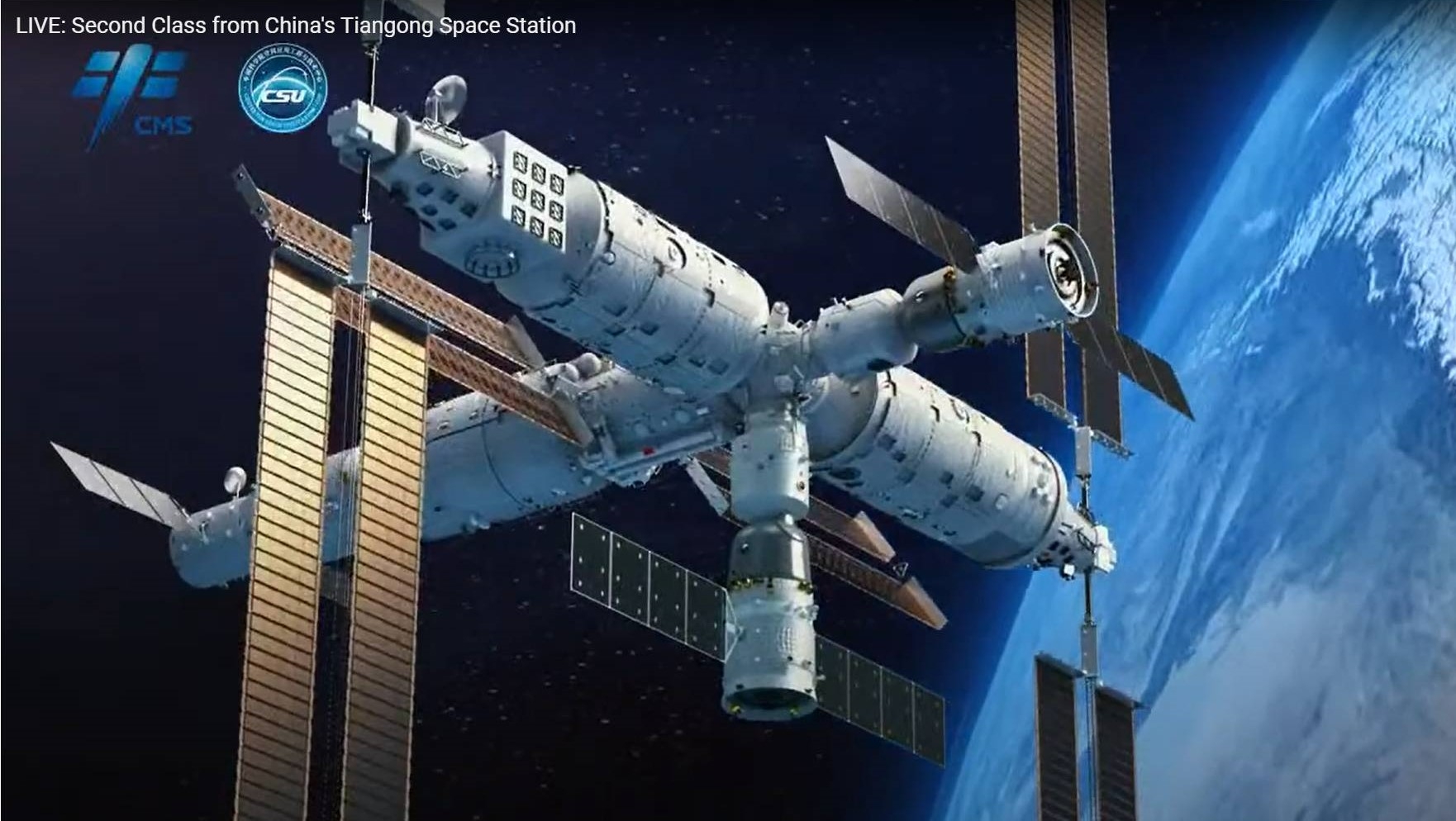
CCTV Video News Agency/Inside Outer Space screengrab
If all continues to go as planned, China is to see a fully-equipped and staffed station by year’s end.
“In the past two years, we have successfully completed the launch of the Tianhe core module, the Wentian lab module, the Mengtian lab module and three Tianzhou cargo spaceships with a 100 percent success rate,” said Mao Wanbiao, deputy director of the Xichang Satellite Launch Center.
Go to these new videos focused on the upcoming liftoff of the Tianzhou-5 supply ship and space station operations at:

Credit: China ‘N Asia Spaceflight
China’s projected booster to support crewed flights to the Moon is expected to make its maiden voyage around 2027.
China Daily reports that Zhao Xinguo, a senior rocket designer and head of the China Academy of Launch Vehicle Technology’s rocket development department, said the new launcher, yet to be named, is a key backbone in China’s future plan to plant Taikonauts on the lunar landscape.
Booster specifics
Speaking Monday in Zhuhai, Guangdong province, the site of the 14th China International Aviation and Aerospace Exhibition, Zhao said that the new rocket will be about 295 feet (90 meters) tall, with a diameter of nearly 17 feet (5 meters) – nearly twice as tall as the Long March 5 that is presently the largest booster in China’s rocket family.
With a core booster and two side boosters, the rocket’s liftoff weight will be 2,187 metric tons, twice as heavy as the Long March 5, according to China Daily.

Credit: CGTN/Inside Outer Space screengrab
Moon base
The next-generation booster can hurl spacecraft weighing about 27 tons into an Earth-Moon transfer trajectory, a gateway for lunar landing, or a 70-ton spacecraft into a low-Earth orbit.
Additionally, China’s Long March 9, also under development, will join the ranks of the new rocket to transport construction materials to the Moon to build a permanent base there, said Hu Xiaojun, a rocket researcher also at the academy.

Credit: AMS
Sky watchers in Northern California on Friday reported seeing a bright light in the sky tumbling down. Video taken from El Dorado County showed a bright ball descending from a dark night sky.
Meanwhile, a family’s house in Nevada County, California caught fire after several witnesses described a ball of light descending from the sky.
The preliminary trajectory, however, does not fit the location of the inflamed home — which is located in Nevada County, about 240 km (150 miles) SSE.
Not related to incident
According to a Vincent Perlerin posting at the American Meteor Society: “There are reports in the news that this fireball reached the ground and destroyed a structure near Harry L. Englebright Lake, which is approximately 50 miles north of Sacramento, CA.”
Perlerin adds that, as you can see from the map, “this fireball passed well north of this area and could not possibly be related to this incident. Confirmation from NASA also discounts this story as this fireball totally disintegrated while still well up in the atmosphere.”
Also, go to this video spotlighting the incident at:

Credit: SETI Post-detection Hub
A new international research hub is established to coordinate global expertise to prepare humanity for an ET “we’re not alone” scenario and how we should respond.
The new SETI Post-Detection Hub is an initiative of the UK SETI Research Network (UKSRN), and is jointly hosted by the Scotland-based St Andrews Centre for Exoplanet Science and the Centre for Global Law and Governance.
The new SETI Post-Detection Hub is hosted by the Center for Exoplanet Science and the Centre for Global Law and Governance of the University of St Andrews in Scotland.
SETI is the Search for Extra-Terrestrial Intelligence, a collective term for scientific searches for intelligent extra-terrestrial life.
Responsible response
The new hub “will act as a coordinating center for an international effort bringing together diverse expertise across both the sciences and the humanities for setting out impact assessments, protocols, procedures, and treaties designed to enable a responsible response,” according to a university statement.

John Elliott, Coordinator of SETI Post-Detection Hub
Credit: SETI Post-detection Hub
“Scanning signals of assumed extra-terrestrial origin for structures of language and attaching meaning is an elaborate and time-consuming process during which our knowledge will be advanced in many steps as we learn ‘Extra-Terrestrial,’” said John Elliott, Honorary Research Fellow in the School of Computer Science of the University of St Andrews and coordinator of the Hub
Societal impact
While there are now procedures and entities established with the United Nations for dealing with the threat posed by impacts of asteroids on Earth, the hub notes, there is nothing similar in place for picking up a radio signal from E.T.

Credit: ESA/Hubble & NASA
According to the university statement, the SETI Post-Detection Hub, for the first time, provides a permanent ‘home’ for coordinating the development of a fully comprehensive framework, “drawing together interested members of the SETI and wider academic communities as well as policy experts to work on topics ranging from message decipherment and data analytics to the development of regulatory protocols, space law, and societal impact strategies.”
Another source of ideas
“The St Andrews group is essentially a parallel to the International Academy of Astronautics SETI committee. They have one advantage, sharing the same physical location instead of meeting once a year and communicating by email the rest of the time,” said Michael Michaud, author of the influential book: Contact with Alien Civilizations: Our Hopes and Fears About Encountering Extraterrestrials, New York, Copernicus (Springer), 2007.
“It may be useful to have another source of ideas about post-detection, but we don’t yet know what those ideas will be,” Michaud told Inside Outer Space.
For more information on this initiative, please go to:

Possible design of China’s space plane?
Source: Homem do Espaco/Twitter
China’s puzzling space plane, catalogued as 53357/2022-093A, has been circuiting the Earth after being lofted into orbit on August 4th.
Space tracker Robert Christy of the informative website, Orbital Focus at https://www.orbitalfocus.uk, notes that China’s in-orbit craft recently acquired a companion.
On October 23 at about 07:30 UTC, the space plane raised its orbit from 351 x 591 kilometers to 597 x 608 kilometers. A new object separated from the main vehicle between October 24 and October 30, Christy reported. The two objects are very close to each other, perhaps station keeping, he said.
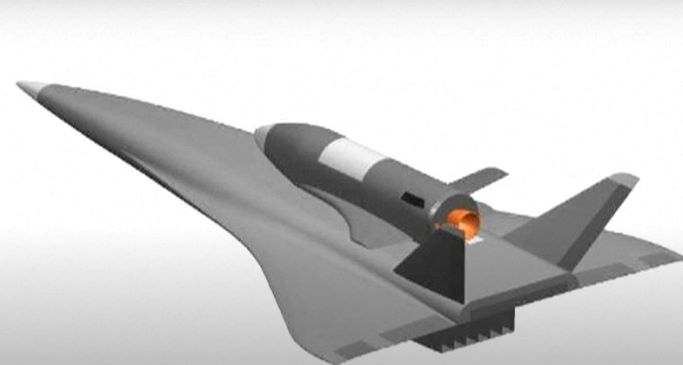
Tengfei-1 reusable aerospace vehicle.
Credit: Credit: China Central Television (CCTV)/Inside Outer Space screengrab
On October 31, U.S. military space trackers released orbital data about the new space plane-released object in a near-identical orbit, showing them less than 656 feet (200 meters) apart.
Separation distance
“They could have separated from each other any time in the week since the orbit change, but the new satellite would not have been detected until it moved far enough away to be resolved as a separate item by U.S. tracking sensors,” Christy tells Inside Outer Space.
November 2, the separation between the two began to increase steadily at about two kilometers per day. Around midnight UTC November 5/6 they were 6.5 kilometers apart.
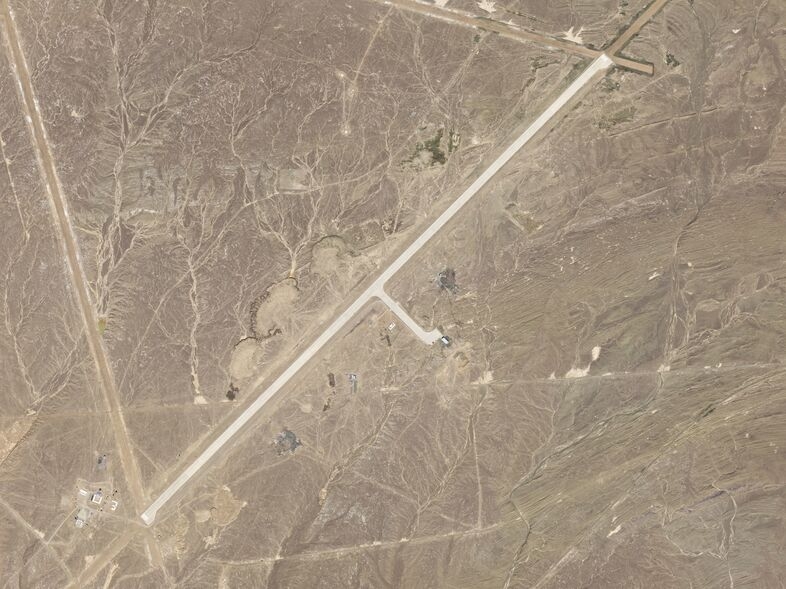
Runway ready for space plane arrival on the edge of China’s former nuclear weapons test range at Lop Nur?
Credit: Planet
Continued monitoring
“For them to stay so close,” Christy adds, “they must either both be experiencing the same degree of drag from the Earth’s atmosphere, or one of them is using thrusters to control the separation distance. Alternatively, they may be connected by a long tether that is being reeled out slowly,” he explains.
Christy speculates that that the new object is carrying a still/video imaging system to return images of the space plane, or it is a space technology experiment of some kind? “Continued monitoring of the pair may provide more answers,” he said.
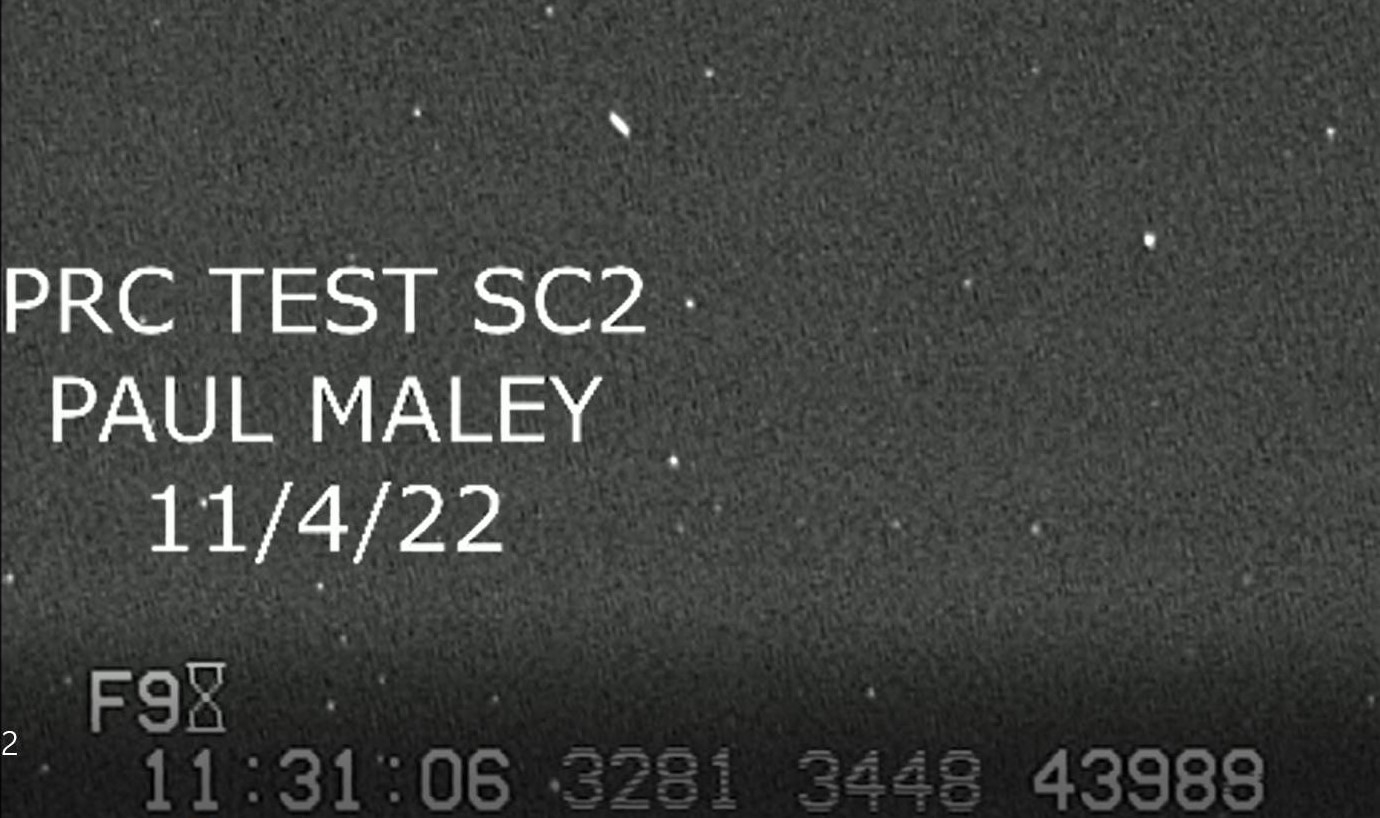
Credit: Paul Maley
Caught on video
“Whatever the object is, its nearness to the space plane is acceptable to mission controllers. An un-wanted piece of equipment would likely have been pushed away at higher velocity or the space plane would have changed orbit slightly to avoid the danger of an inadvertent collision,” said Christy.
As for an end-of-mission, return to Earth of the Chinese space plane, Christy said that in the low orbit, repeat ground tracks for landing opportunities on the Lop Nur runway were coming round every 12 days. In the high orbit, the repeat time is three days, he concluded.
Meanwhile, Arizona-based sky sleuth, Paul Maley, captured a video of the craft slipping by overhead.
Go to Maley’s video at:
Credit: CCTV/Inside Outer Space screengrab
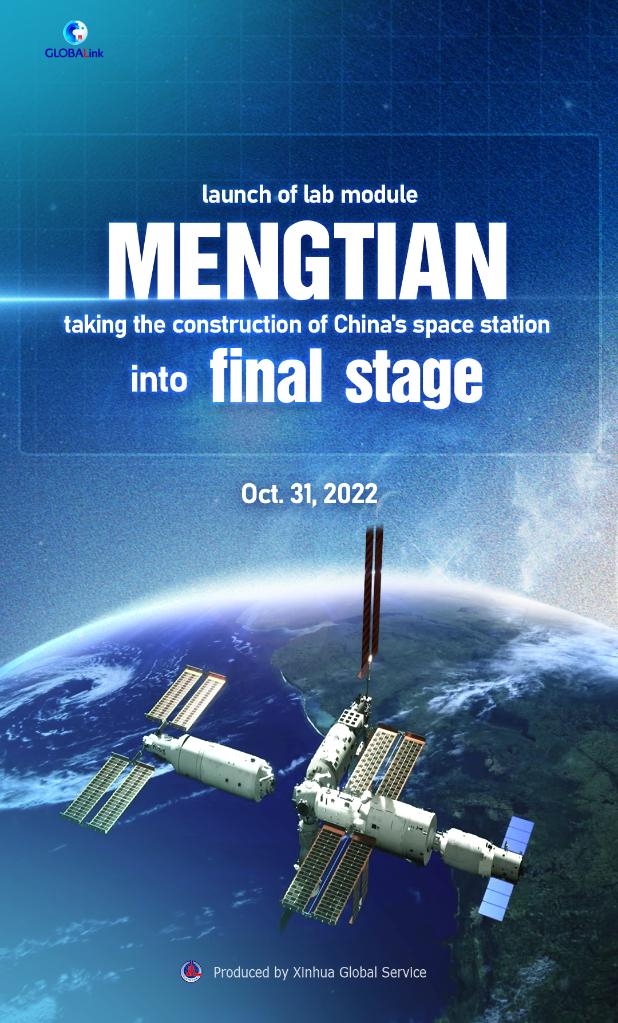
China’s freshly-docked and transitioned Mengtian lab module has kick-started the country’s Tiangong space station into a final stage of completion.
However, China’s space station could further expand and upgrade from inside to outside, said Tang Yi, head designer of the China Space Station System of China Academy of Space Technology.

Credit: CCTV/Inside Outer Space screengrab
Mengtian, Tiangong’s second lab that docked with China’s Tiangong space station complex is the last “building block.” Tiangong now forms a T-shape structure, the planned layout of the space station.

Station complete is set for year’s end.
Credit: CNAS/CCTV Video News Agency/Inside Outer Space screengrab
Extend and upgrade
“For astronauts, the three-module space station means ample room to roam for three, even six astronauts on board without feeling cramped,” Tang told China Central Television (CCTV). “We’ve also anticipated the space station’s future on the outset: we’ve designed so it can extend and upgrade, including what’s inside the modules. The space station’s equipment can change and upgrade,” Tang said.
With the upcoming launch and arrival of the Shenzhou-15 three-person crew, the Tiangong will increase to six for a short period.
Credit: CCTV/Inside Outer Space screengrab
Ins and outs of airlock cabin
To facilitate the ins and outs of larger cargo and payloads, the airlock cabin of Mengtian is equipped with two square hatches, an internal one and an external one. In addition, the external hatch is electrically driven. This auto door reduces the astronaut’s labor and increases efficiency when transporting cargo out of the cabin, said Bai Hemin, a designer for the space station system at the Shanghai Academy of Spaceflight Technology.
With a larger door, Mengtian is capable of releasing miniaturized satellites into space. Astronauts can install small satellites on a payload transfer device, depressurize the airlock cabin, and then take them out of the cabin, said Meng Yao, a designer of Mengtian.
Credit: CCTV/Inside Outer Space screengrab
Pre-launch testing
When the space station is completed, it’s expected to run for at least a decade, or possibly even longer, according to CCTV.
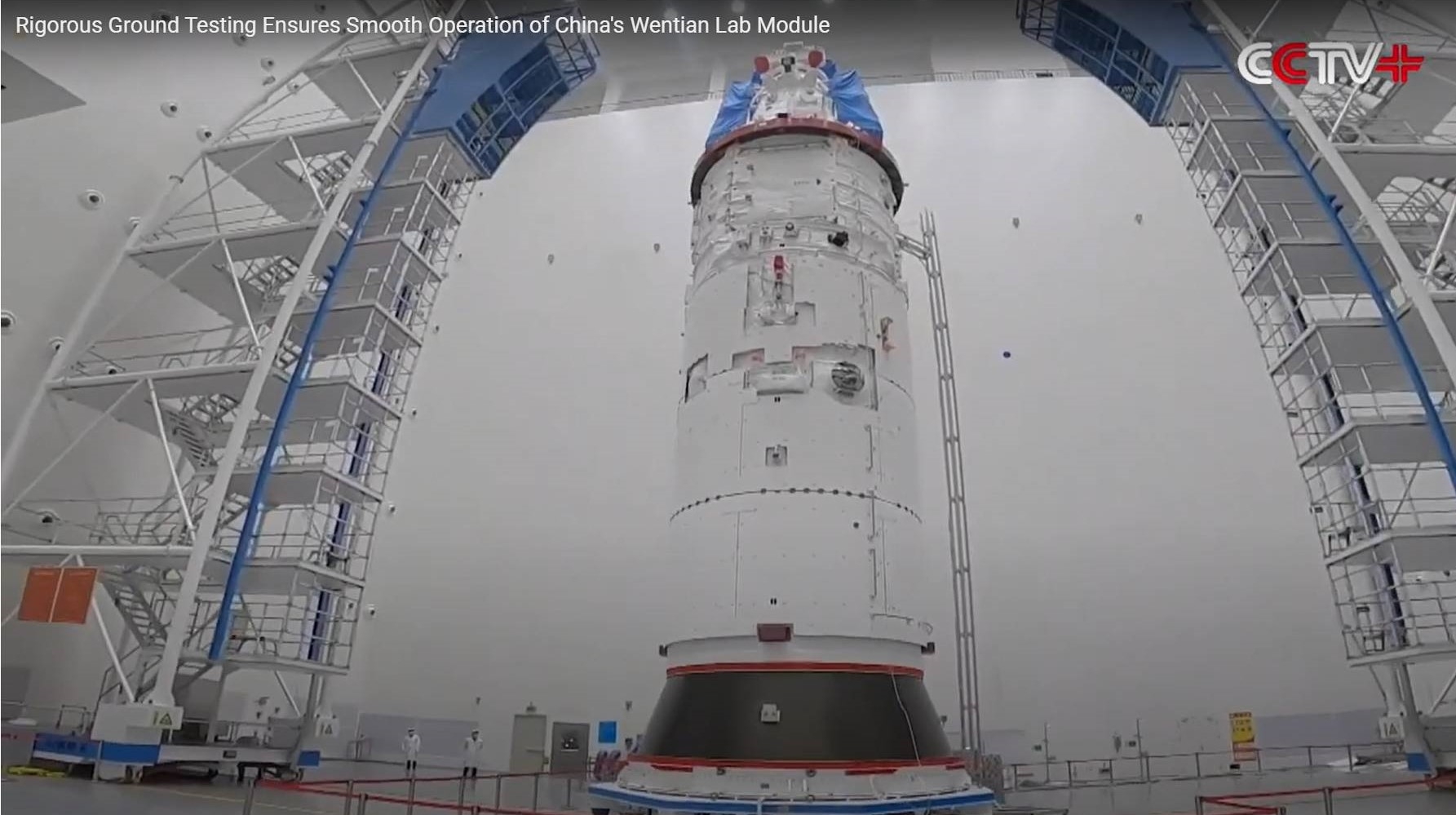
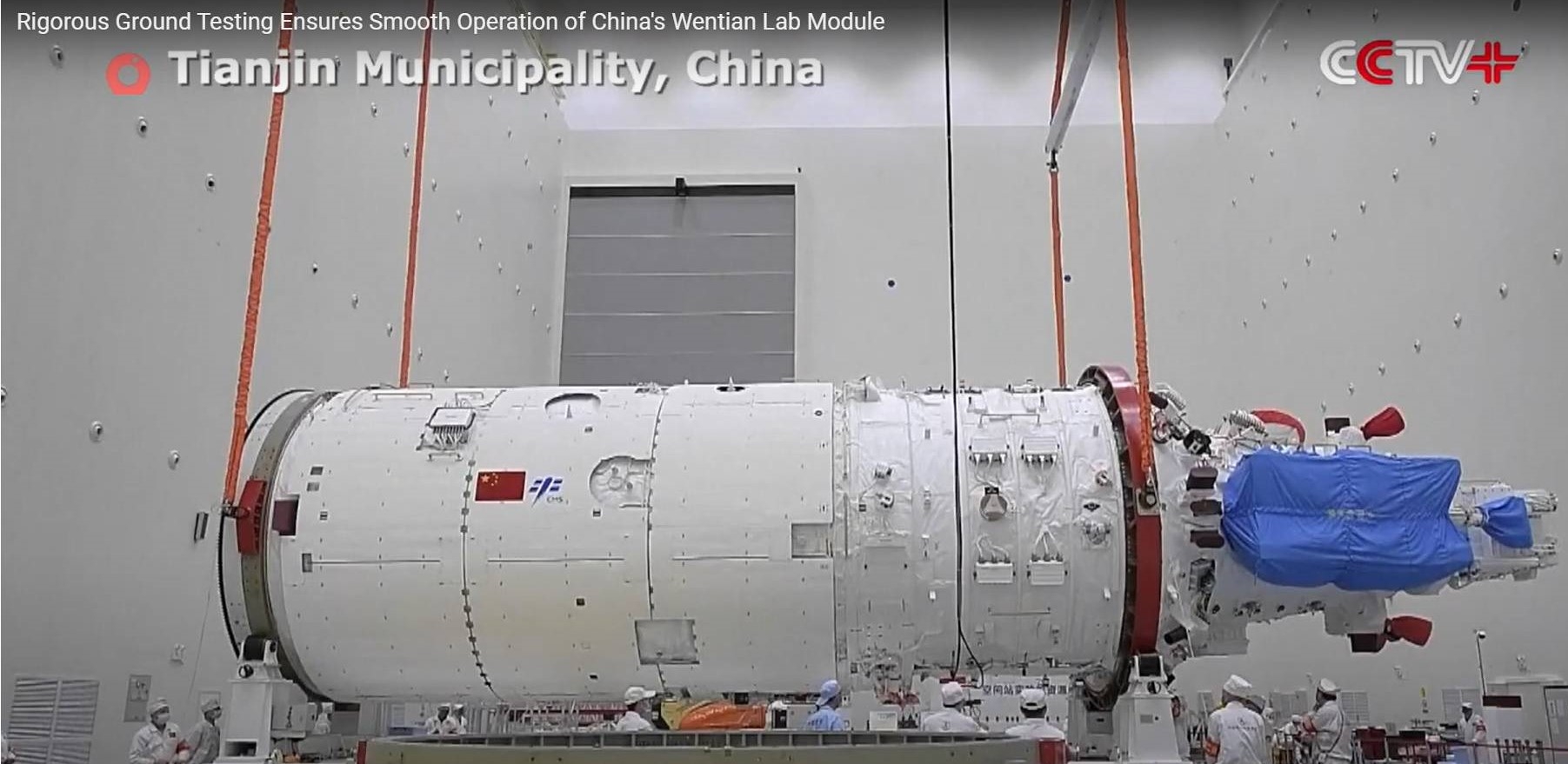
Pre-launch, the Mengtian lab module completed ground tests in the Tianjin base of the China Academy of Space Technology, a subordinate of the China Aerospace Science and Technology Corporation.
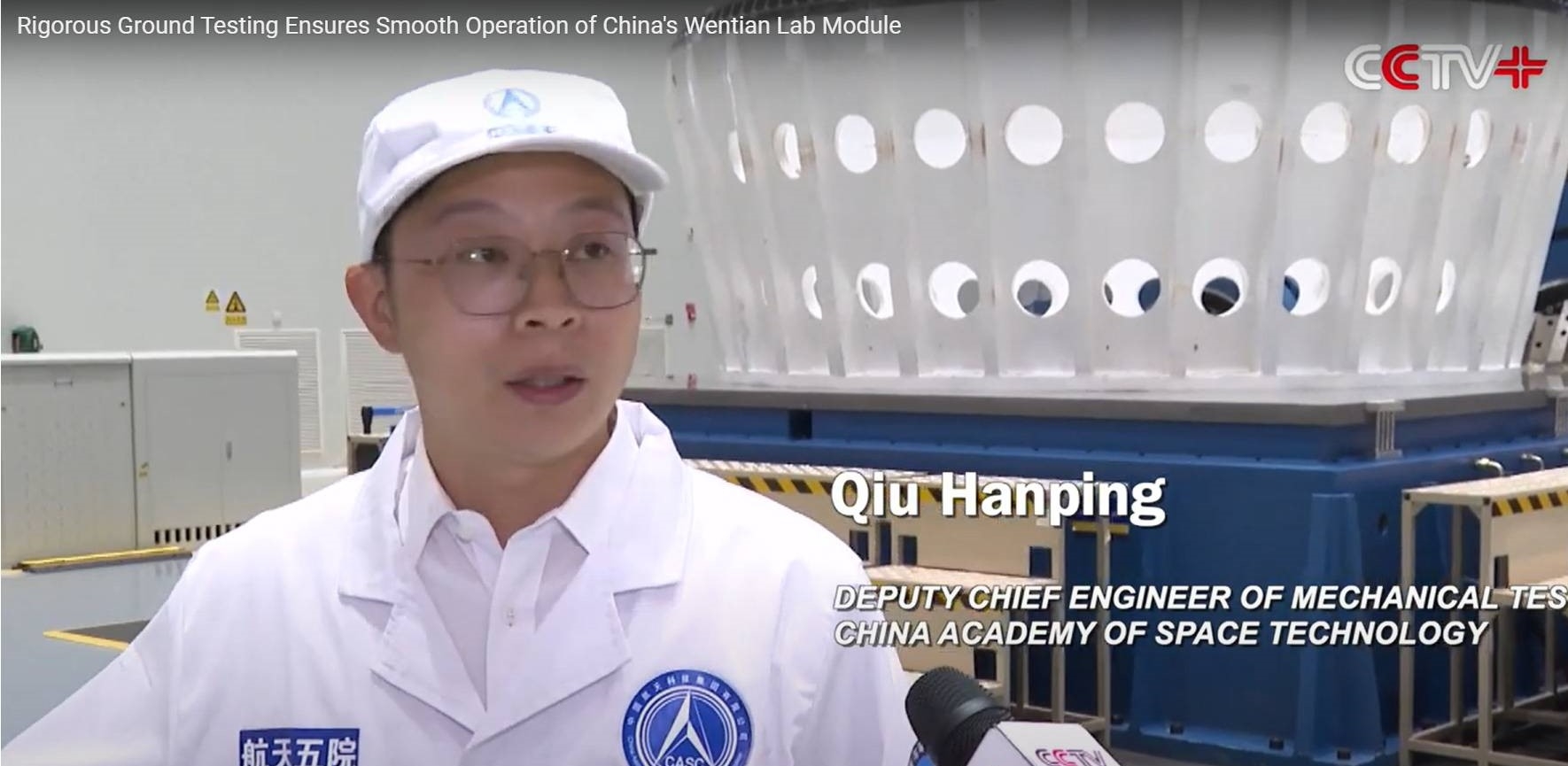
The testing base includes the world’s largest thrust electromagnetic vibration testing system. The Mengtian lab module had previously completed vibration tests in two directions with the help of two electromagnetic shaking tables, “primarily used to simulate the vibration environment generated during the rocket launch and to assess the integrity of module structure and equipment function,” said Qiu Hanping, deputy chief engineer of mechanical test in the General Assembly and Environmental Engineering Department under CAST.
Credit: CCTV/Inside Outer Space screengrab
Thermal testing
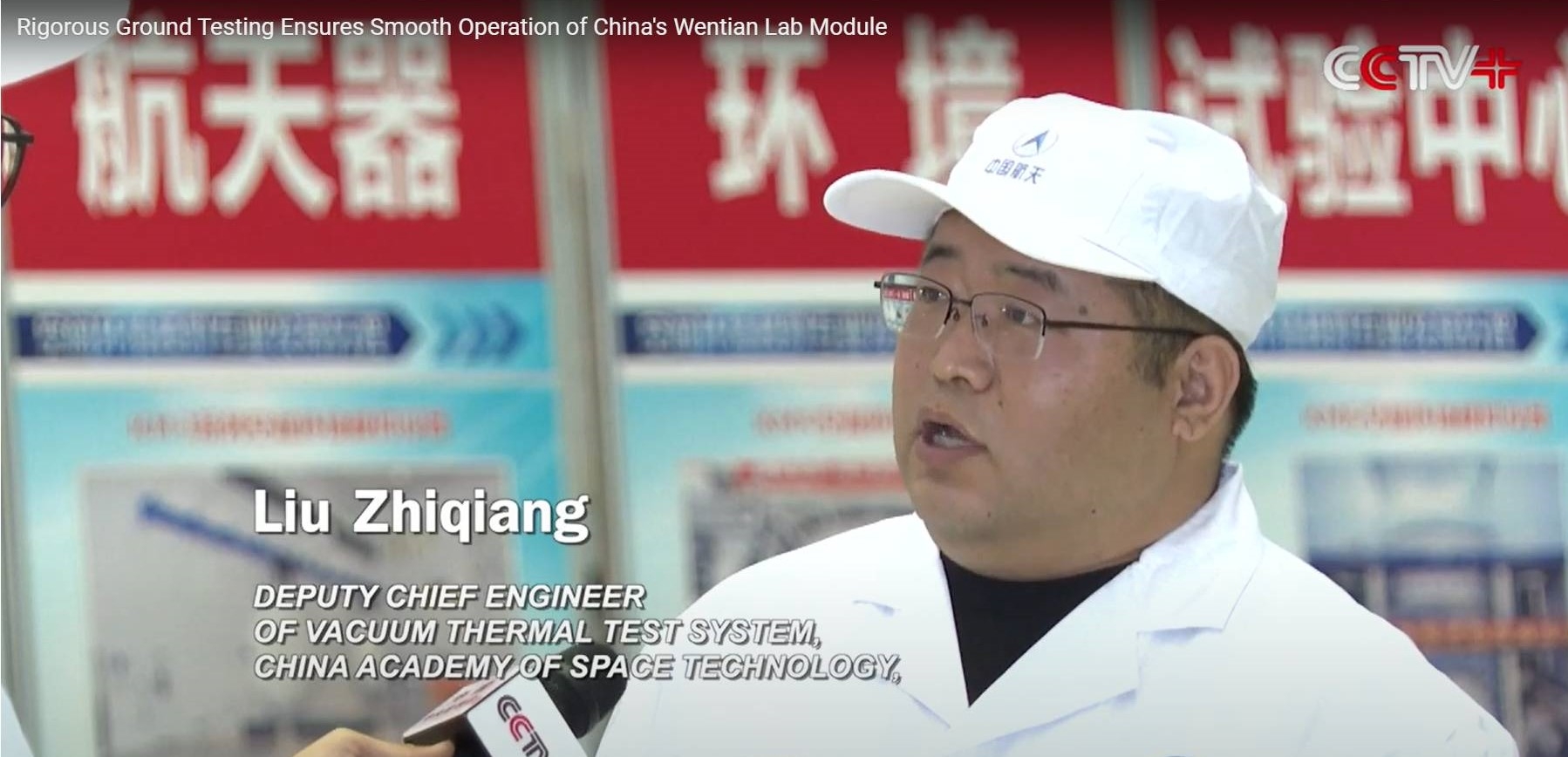
“The temperature of the spacecraft in orbit is always changing as the orbit varies,” reports Liu Zhiqiang, deputy chief engineer of vacuum thermal test system of the General Assembly and Environmental Engineering Department.
Credit: GLOBALink/Xinhua Global Service
“The KM8 Large Space Environment Simulator needs to simulate environmental tests in which the ambient temperature varies from negative 180 degrees Celsius to positive 100 degrees Celsius for checking whether each system works normally or not and ensuring the normal operation of the spacecraft in orbit and the safety of astronauts,” said Liu.
Go to these newly-issued videos at:

The threat of Near Earth Objects (NEOs).
Credit: NASA
The International Asteroid Warning Network is organizing a second “timing campaign,” one that makes use of space rock 2005 LW3.
That object of their affection is an easily observable object from most of our planet as a bright fast-moving source on the nights of November 23-24, 2022.
2005 LW3, the target of the campaign, will reach magnitude 13 during its upcoming fly-by.
Accuracy of observations
The goal of the International Asteroid Warning Network (IAWN) campaign is to provide an incentive to near Earth Object (NEO) observers to check the accuracy of the timing of the astrometric observations they report to the Minor Planet Center. That international organization is responsible for collecting observations of asteroids, comets, and other small bodies in the Solar System.
“The fast angular motion on the plane of the sky, together with the excellent knowledge we already have of this object’s trajectory, will allow the campaign team to carefully assess the accuracy of the timetags reported by each station,” explains the European Space Agency’s NEO Coordination Center – the operational center of ESA’s Planetary Defense Office.
“These checks are extremely important to detect possible subtle time biases that are often present even at telescopes that synchronize their system time with extreme accuracy,” the ESA NEO center adds.
The IAWN was established with the goal of assessing, strengthening, and coordinating the international response to a possible near-Earth object (NEO) impact threat.
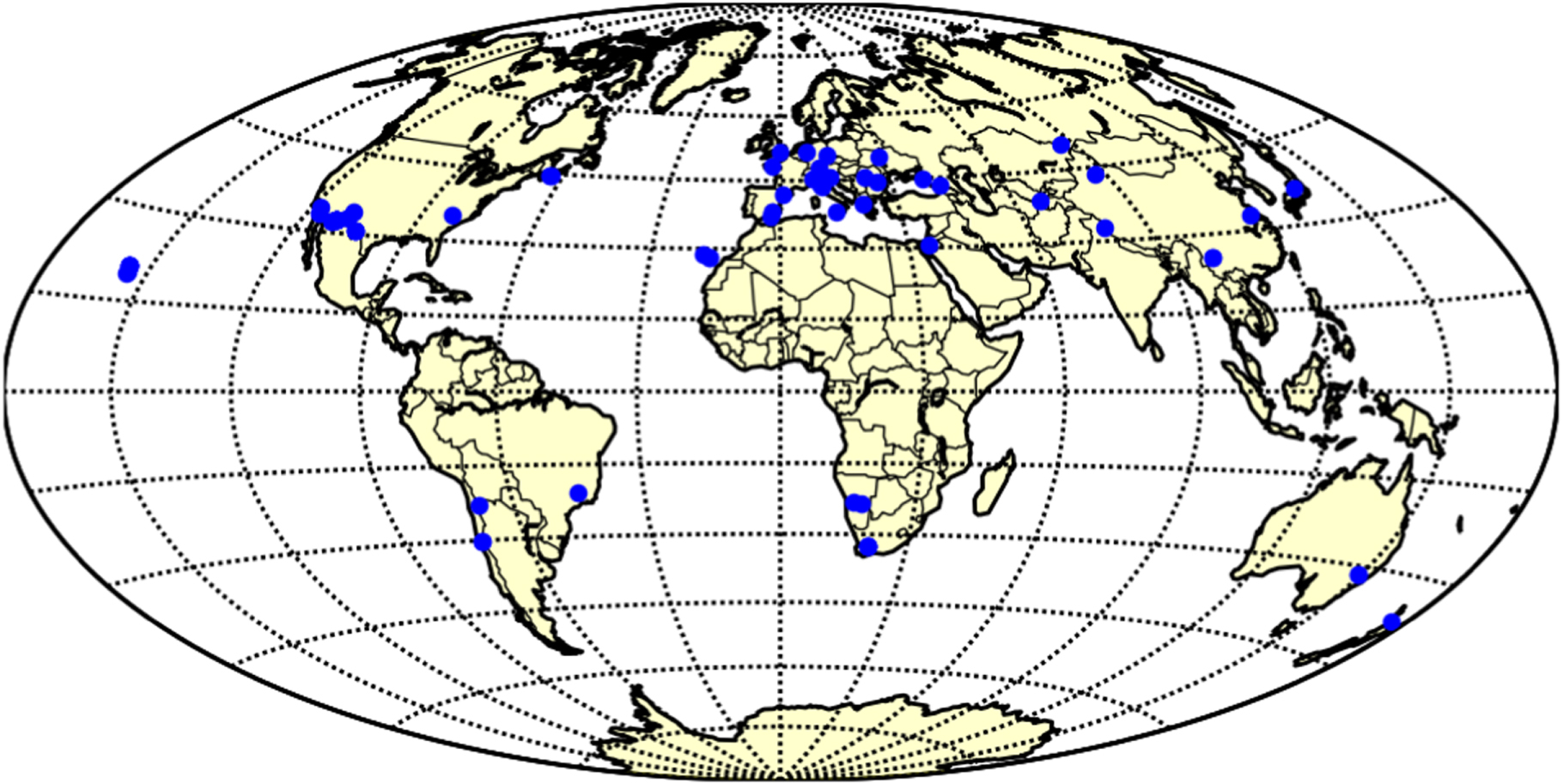
Locations of the 70 ground-based observation sites that participated in the 2019 XS campaign.
Credit: Davide Farnocchia, et al.
Previous campaign
IAWN campaign coordinator Vishnu Reddy at Arizona State University in Tucson is the point of contact for this campaign.
“We have two flavors of the campaign,” said Reddy. “The first is a full-blown planetary defense exercise where we test every component of the system. The most recent Apophis campaign is a good example of that. We have also started doing shorter more focused timing campaign to improve the timing accuracy of observatories collecting asteroid observations,” he told Inside Outer Space.
Reddy said that a previous campaign was performed in November 2021 using 2019 XS, a small Apollo near-Earth asteroid. What was found was a systematic -0.5 second bias across the board, he said.

Chelyabinsk sky rendering is a reconstruction of the asteroid that exploded over Chelyabinsk, Russia on Feb. 15, 2013. Scientific study of the airburst has provided information about the origin, trajectory and power of the explosion. This simulation of the Chelyabinsk meteor explosion by Mark Boslough was rendered by Brad Carvey using the CTH code on Sandia National Laboratories’ Red Sky supercomputer. Andrea Carvey composited the wireframe tail. Photo by Olga Kruglova.
Credit: Sandia National Laboratories.
Good test
“So, the upcoming 2005 LW3 campaign is a follow-on to that to see how we are doing with keeping our clocks accurate. We gave suggestions to improve the clock timing and the campaign this month is a good test of that,” Reddy said.
Observers that are interested or routinely involved in NEO observations can join the exercise, reporting their intention to participate on a webpage dedicated to the campaign at:
https://iawn.net/obscamp/2005LW3/
Also, for detailed information about the earlier 2019 XS campaign, go to “International Asteroid Warning Network Timing Campaign: 2019 XS” in the Planetary Science Journal at:

