Author Archive
 Author:
  December 9th, 2022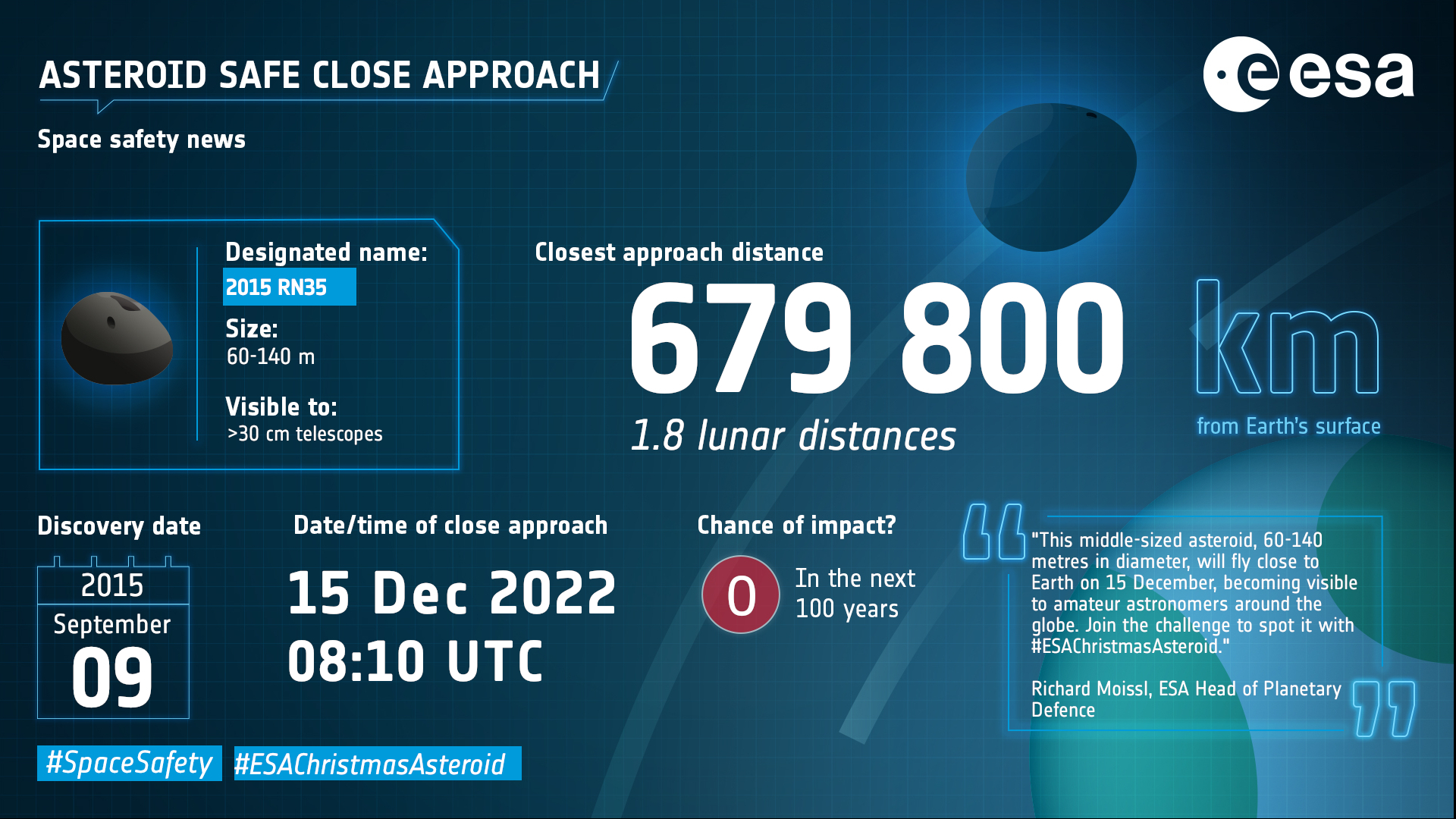
Image credit: ESA
The European Space Agency is looking for an observational assist.
An asteroid is approaching Earth, and to celebrate the release of ESA’s new asteroid toolkit they are calling on amateur astronomers to find the space rock.
No worries here. This Christmas asteroid, 2015 RN35, poses no threat, but like many middle-sized space rocks out there, trackers just don’t know that much about it.
According to an ESA statement, 2015 RN35 will make a safe close approach of Earth at 08:12 UTC (09:12 CET) on December 15, zooming past our planet at 679,800 kilometers – that’s just 1.8 lunar distances measured from Earth.
Observers in the Southern hemisphere will get the best view during close approach, but Europe will get a chance over the following days until about December 19.
Telescopes 30 centimeters and larger should be able to detect this Christmas asteroid and ESA is looking forward to seeing any observations from well-equipped skywatchers.
Use the hashtag #ESAChristmasAsteroid on social media to share your results, which will be shared at @esaoperations channel.
 Posted in
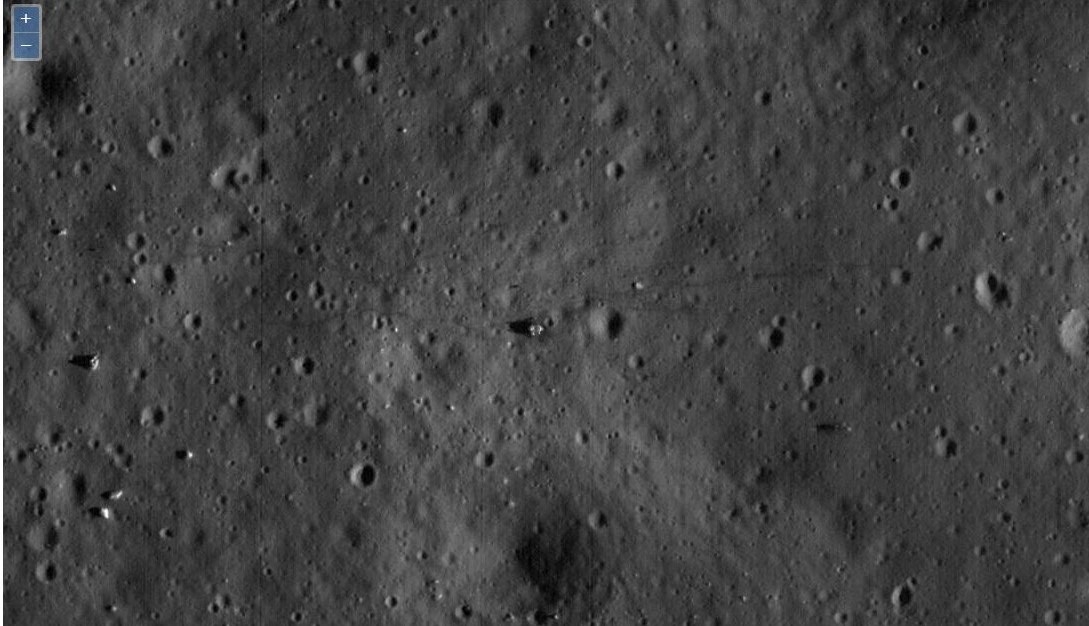
Apollo 17 landing site.
Image credit: NASA/GSFC/Arizona State
A fascinating collection of featured Moon sites is available, based on some of the most requested images snagged by the NASA Lunar Reconnaissance Orbiter’s LROC super-powerful imaging system.
Available for viewing are newly discovered lunar features to the closest images of the Apollo landing sites since astronauts departed the scene in 1972.
The impressive website features:
— 21st Century Spacecraft Impacts
— 21st Century Landing Sites
— New Impacts
— Apollo Landing Sites
— Apollo S-IVB Impact Sites
— Surveyor Landing Sites
— Ranger Impact Sites
— Luna Landing Sites
— Lunokhod Rover Sites

NASA’s Lunar Reconnaissance Orbiter (LRO).
Credit: NASA’s Goddard Space Flight Center Conceptual Image Lab
Special thanks to Mark Robinson and colleagues at Arizona State University ‘s School of Earth and Space Exploration. Robinson is the principal investigator for the LROC imaging system.
Take a look at:
http://lroc.sese.asu.edu/featured_sites

Artist’s view of two Artemis astronauts at work on the lunar surface. What new tools are necessary to maximize exploration output?
Image credit: NASA
When it comes to the NASA Artemis “rebooting” of the Moon plans, it’s not simply a 20th century rekindling of lunar remembrances. Work is in progress to develop a new tool kit for investigating Earth’s companion in gravitational lock.
While the tried-and-true geologist’s hammer remains on tap, fresh capabilities are being appraised to sharpen our next lunar look-see with first-time equipment.

Apollo moonwalker unfurls the American flag. In returning to the moon, this time to stay, what is the Artemis flag strategy?
Image credit: NASA
Experts are digging into gear that surmount challenges seen during Apollo, yet are user-friendly to future moonwalkers.
For more information, go to my new Space.com story – “NASA drawing on Apollo to design Artemis moonwalkers’ tools – Apollo’s considerable legacy is coming in handy” – at:
https://www.space.com/nasa-artemis-moon-tools-apollo-lessons
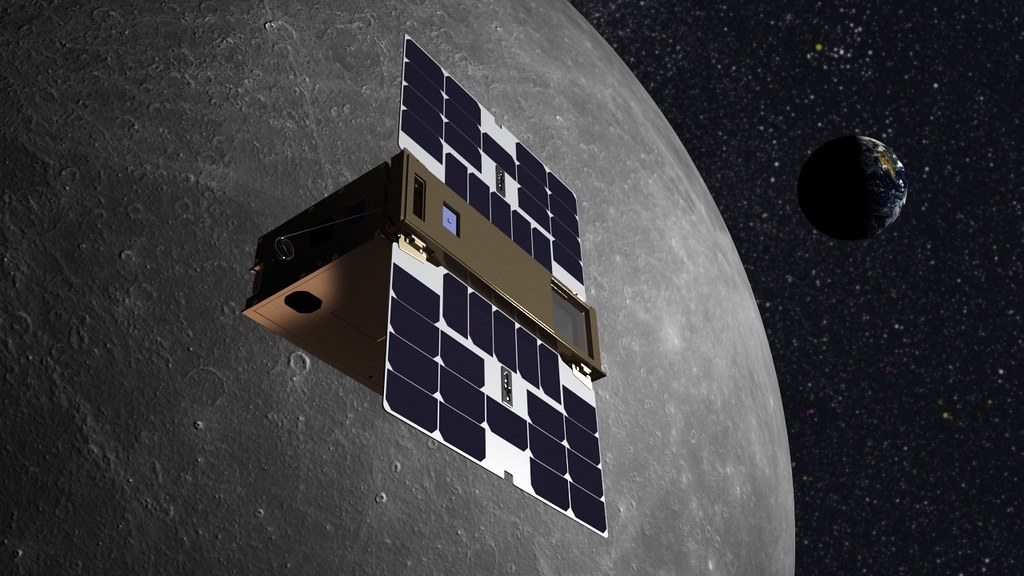
Image credit: Lockheed Martin
That LunIR CubeSat deployed by NASA’s Space Launch System is lost to space. The radio signal received from the hitchhiking LunIR spacecraft was weaker than expected.
Ground control teams were able to downlink some data to help analyze the CubeSat’s issues.
However, as time passed, the ability to accurately predict the spacecraft’s location grew more challenging. Furthermore, there’s limited bandwidth available from deep space communications and networking resources – and the many missions that depend on those assets.
“So while we remain hopeful that a station will catch a signal from LunIR again one day, we are no longer conducting an active, dedicated search for the spacecraft,” said Lauren Duda, a spokesperson for Lockheed Martin.
Novel infrared camera
LunIR stands for Lunar InfraRed Imaging. It was a technology demonstration mission with a goal to prove out a novel type of infrared camera. The shoebox-sized spacecraft was built and integrated by Terran Orbital of Irvine, California. The CubeSat’s first-of-its-kind infrared sensor and unique micro-cryocooler were both developed by Lockheed Martin.
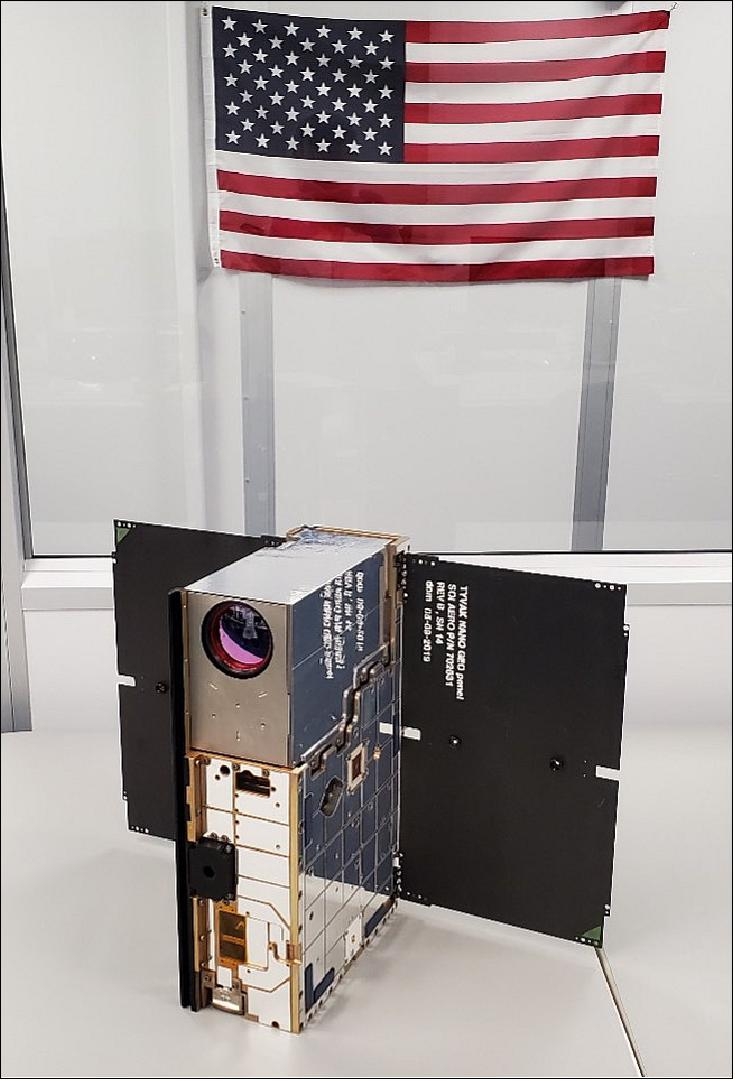
Image credit: Lockheed Martin
Once deployed, the small satellite, LunIR was to perform a lunar flyby taking images of the Moon’s surface and its environment. It would have performed observations to help address Strategic Knowledge Gaps about the Moon, related to surface characterization, remote sensing, and site selection observations.
Learning experience
“While we are disappointed LunIR was unable to complete its mission, we’ve learned so much through its unique design and development. Lockheed Martin will continue to build on lessons in sensors and cryocooler technology and their applications for our exploration of the Moon, and we look forward to future opportunities to continue supporting NASA on tech demonstrations,” Duda said.
Lockheed Martin has posted this Twitter thread about what was learned in developing the CubeSat mission.
Go to:
https://twitter.com/LMSpace/status/1600926003232182280?s=20&t=6Ad9eZ0kzCtpj5yBCivmFw

Completion of Avcoat block bonding on Artemis II heat shield. Image credit: NASA/Isaac Watson
NASA’s Artemis I/Orion capsule re-entry and splashdown are slated for the weekend – and it’s going to be a hot and telling time contrasted to old Apollo town technology.
Re-entering the atmosphere for its final descent into the Pacific Ocean near San Diego on December 11, the craft faces nearly 5,000 degrees Fahrenheit temperatures, about half as hot at the Sun, as it plunges to Earth.

Courtesy: Lockheed Martin
Building process
To be sure, 20th century Apollo heat shield technology was the basis for the 21st century Orion’s heat shield, but the building process was altered.
Instead of having technicians fill 300,000 honeycomb cells individually with ablative material, then heat-cure the material and machine it to the proper shape, now Avcoat blocks are used. There are fewer than 200 of them that are pre-machined to fit into their positions and bonded in place on the heat shield’s carbon fiber skin.
Measuring 16.5 feet in diameter, Orion’s new heat shield is the largest of its kind developed for missions that will carry astronauts.
The heat shield was designed by the Lockheed Martin and NASA Orion team and built at the Lockheed Martin manufacturing facility near Denver.

Credit: Lockheed Martin
Skipping stone approach
For the Artemis 1 mission, toss in for good measure, the Orion capsule is using a re-entry maneuver that no human-rated spacecraft steaming back from the Moon has yet attempted – a skip entry.
Orion will streak into the upper Earth atmosphere, then “skip” back out, influenced by atmospheric friction and the lift properties of the capsule. This technique slows the craft for its re-entry and final descent into the Pacific Ocean near San Diego.
Use of skip-type re-entry is not new, but today’s guidance and navigation technology, coupled with computing power, has blossomed far beyond the Apollo age.
This technique was applied in the past, both by several of the former Soviet Union’s non-crewed Zond circumlunar spacecraft missions. China has also made use of this technique within its Chang’e robotic lunar exploration series.

NASA’s Landing and Recovery Team practices bringing a mock Orion capsule into the well deck of the USS Portland ahead of the Artemis I/Orion splashdown slated for Dec. 11.
Image credit: NASA/Kenneth Allen
Recovery teams
What are the pluses of skip entry?
- A more accurate and consistent landing site that does not depend on the date or departure point from the Moon.
- It decreases the g-forces that crew are subjected to during re-entry.
- It also divides the heat of re-entry into two events, thereby enhancing astronaut safety and setting up Orion for a precise entry and water landing.
Teams responsible for recovering Orion after its splashdown are continuing preparations ahead of Orion’s December 11 splashdown off the coast of California.
A mission management team will focus in on the landing site location on December 8.
For an informative Lockheed Martin video on Orion’s re-entry, go to:

Image credit: NASA
Those deep dives by astronauts into the permanently shaded regions at the Moon’s south pole means working in areas that are among the coldest places in our solar system.
The super-cold regions on the Moon represent a novel operational environment for spacesuits. What’s more, the thermal interactions between the lunar surface and a comparatively warm spacesuit in a permanently shadowed crater may be a problem.

Shown here is a rendering of 13 candidate landing regions for NASA’s Artemis III mission. Each region is approximately 9.3 by 9.3 miles (15 by 15 kilometers). A landing site is a location within those regions with an approximate 328-foot (100-meter) radius.
Image credit: NASA
New research suggests that the temperature change of the regolith due to the presence of a warm spacesuit is large enough to influence the entrapment of volatiles present within sunlight-shy craters. There is substantial scientific curiosity about the nature of volatiles that are cold trapped in permanently shaded regions, also known as PSRs in lunar lingo.
Protect science objectives
“The absolute temperature increase can be large enough to release volatiles from their entrapment, which in turn may necessitate a spacesuit design that radiates less heat to protect science objectives,” explains life support specialist Claas Olthoff at Airbus Defense and Space in Germany. He was also a NASA Postdoctoral Fellow embedded in the Advanced Portable Life Support System Development project located at the NASA Johnson Space Center in Houston, Texas.

Artistic depiction of NASA astronauts at the lunar south pole carrying out early work to establish an Artemis Base Camp.
Image credit: NASA
Olthoff is lead author of “Dynamic thermal interactions between spacesuits and lunar regolith in permanently shaded regions on the moon,” appearing in the journal, Acta Astronautica.
Thermal impact
Suited astronauts moving about on the Moon’s landscape will witness a changing environment from sunlight to shadow – within a few bootsteps.
“Extremely cold environmental temperatures create additional requirements in several areas of spacesuit and spacecraft design,” the paper explains. “For example, materials for the spacesuit soft goods must be selected that do not become stiff or brittle. If temperatures within the spacesuit cross the established thermal comfort or touch temperature limits, heaters may be required at strategic points within the pressure garment or the life support system.”

Astronauts explore lunar south pole crater. A water ice-rich resource ready for processing awaits?
Credit: NASA
Furthermore, as for the thermal impact of a warm object on the cold lunar regolith, small changes in surface temperature can cause volatile substances — like frozen water — to be released into the vacuum of space before they can be captured by a sample collection device, the research paper points out.
Thermal interaction
The research paper includes thermal analysis results from simulations using Virtual Spacesuit (V-SUIT), a MATLAB-based, dynamic thermal simulation tool that includes the Thermal Moon Simulator (TherMoS).
V-SUIT was created at the Technical University of Munich and consists of two major building blocks: A thermal simulation of the lunar environment and a simulation of the spacesuit itself and the human inside.

Spacesuit geometric model in V-SUIT.
Image courtesy of Claas Olthoff
From their results, it was concluded that there is significant thermal interaction between the spacesuit and the lunar surface. “The temperature change of the regolith due to the presence of the spacesuit is large enough to cause a noticeable change in effective sink temperature. However, the temperature change is not large enough to drive any design decisions on the spacesuit,” the research team concludes.
Further research
Olthoff and colleagues note there’s need for further research and experimentation to find out which lunar volatiles are most susceptible in specific surface compositions and at which temperatures.
By better appreciation of the thermal environment in these regions, that knowledge can inform the design process, the researchers observe, not only for spacesuits and rovers, but also help gauge the blueprinting of future moonwalking activities at the lunar south pole.
For more information on this research, go to – “Dynamic thermal interactions between spacesuits and lunar regolith in permanently shaded regions on the moon” at:
https://www.sciencedirect.com/science/article/abs/pii/S0094576522006737?via%3Dihub
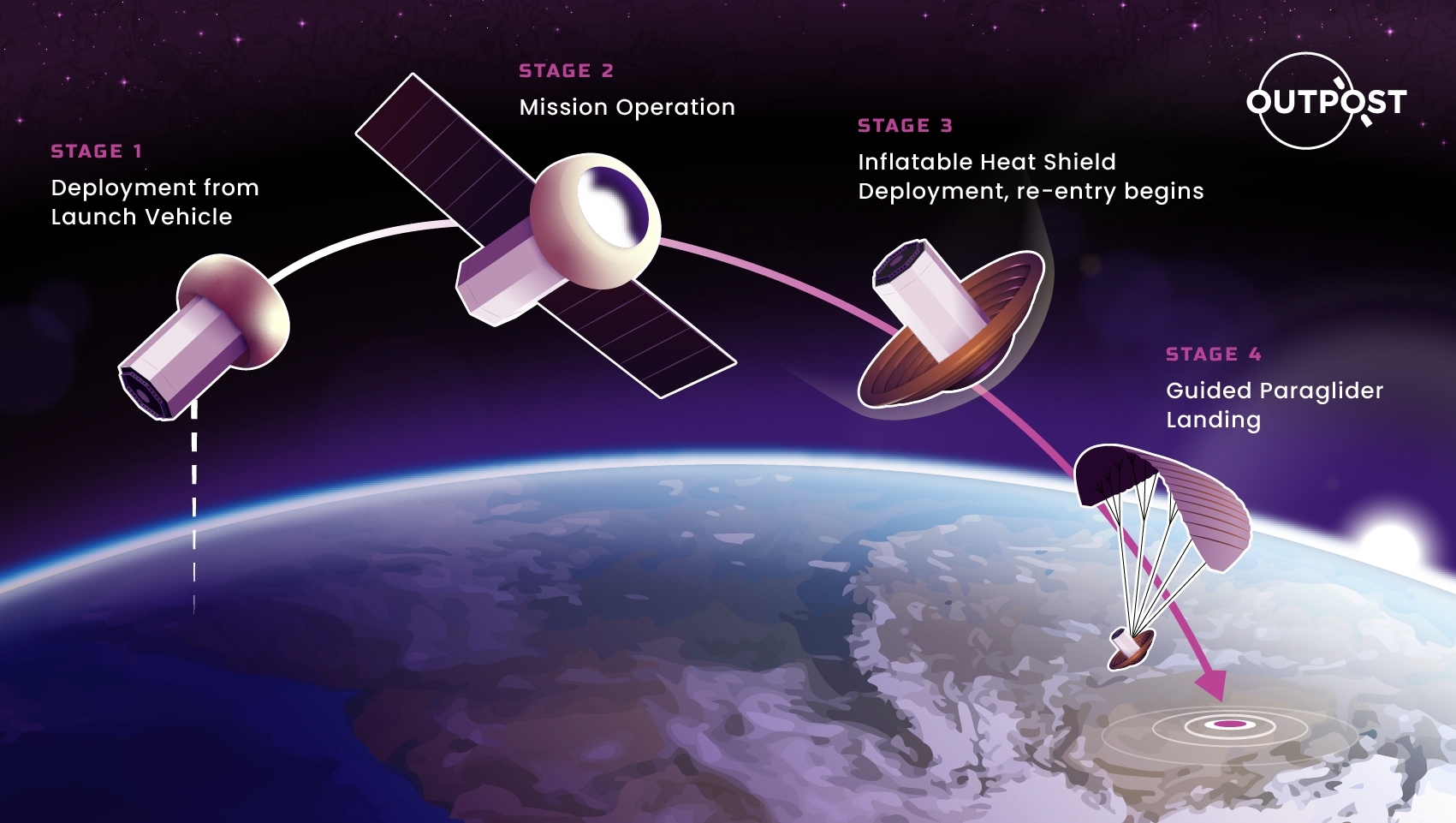
Image credit: Outpost
A space startup group has been selected by NASA to develop the Cargo Ferry to deliver freight from space stations back to Earth.
Outpost Technologies has been selected by NASA for a Small Business Innovation Research (SBIR) “Ignite” program contract to appraise returning to Earth scientific samples, small payloads, and other types of research.
The development of Outpost’s Ferry and Cargo Ferry also utilizes a NASA partnership through a Reimbursable Space Act Agreement (SAA). This partnership enables collaboration on developing NASA’s Hypersonic Inflatable Aerodynamic Decelerator (HIAD) to provide industry-leading payload Earth return capabilities from orbit, an Outpost statement explains.
As Outpost develops the Cargo Ferry, the group is also setting its sights on a future human-rated version that may one day provide a solution for emergency evacuations from commercial space stations.
Additionally, according to the Outpost website: “Our low mass, high efficiency, two-stage re-entry system is fully deployable, making it possible to return and reuse satellites.”

Image credit: Outpost
Driving down the cost
Outpost Founder and CEO Jason Dunn said in a company statement: “Driving down the cost of Earth return could open the door to more throughput on the ISS National Lab while also enabling the broader low-Earth orbit economy to flourish.”
Dedicated payload and cargo return is one of the few remaining items left unsolved for commercial business models to close, those that forecast low Earth orbit destinations as a booming business in years to come.
For more information on this innovative company, go to:

Image credit: CCTV/Inside Outer Space screengrab
Fresh from achieving another milestone in China’s space station program, a future agenda item includes building upon the orbiting complex and perhaps evaluating technologies needed for projected human space exploration of the Moon.
China is in position to further promote space station construction in the future, explains Wang Xiang, Space Station System Commander at the China Academy of Space Technology.
“As a space station, we are at the beginning of our application and development,” Wang told China Central Television (CCTV).

Credit: GLOBALink/Inside Outer Space screengrab
Extension module
Following the current station design, Wang said that an “extension module” can be launched to dock with the forepart of the in-orbit facility. That module, plugged into a new node, would leave more space for docking with subsequent space vehicles and offer a larger and more comfortable environment for crew members.
This evolving station design would also provide an environment, or a site, for better application of scientific payloads, Wang said, both inside the module and outside in free-space.

Shenzhou-14, Shenzhou-15 crew members in handover ceremony.
Credit: CMS/CCTV/Inside Outer Space screengrab
“For example, if we’re going to carry out manned lunar exploration in the future, then we have some of the spacecraft technologies — even some of the new generation of spaceship technologies — that can be verified in the outer space,” said Wang. Using the space station in this way, it becomes a very good platform, he added.
Following the plan
China’s future station ambitions have been bolstered by the recent return to Earth of the Shenzhou-14 crew, a space outing of six months duration.
The Shenzhou-14’s return capsule, carrying astronauts Chen Dong, Liu Yang and Cai Xuzhe, parachuted into the Dongfeng landing site in north China’s Inner Mongolia on Sunday.

Image credit: CCTV/Inside Outer Space screengrab
“We completed the in-orbit missions following the plan. The astronauts all went out of the cabin in good health and everything was implemented as planned. The entire manned flight was perfect, without any abnormality,” said Shao Limin, deputy technological manager of manned spacecraft system with China Academy of Space Technology.

Image credit: CCTV/Inside Outer Space screengrab
Solid foundation
Xu Chong, director of the China Astronaut Research and Training Center, said that the Shenzhou-14 crew stayed in space for 183 days and are all in good shape, both mentally and physically.
“Their return and landing were smooth too. So it has laid a solid foundation for the follow-up work on medical guarantee, medical and heath monitoring and the whole technological system throughout the space station operational period,” Xu told CCTV.

Shenzhou-14 crew.
Credit: CNSA/CCTV/Inside Outer Space screengrab
The Shenzhou-14 crew flew to the space station on June 5. During their stint in space, they completed multiple tasks, such as overseeing five rendezvous and dockings, performing three extravehicular activities, and conducted several science/technology experiments. They landed on December 4.
Many “firsts”
While in Earth orbit, the Shenzhou-14 trio chalked up many “firsts” in China’s space history: the first rendezvous and docking between two 20-ton-level spacecraft and the first in-orbit transposition of a space station module. They also set a record of making three spacewalks on a single flight mission.
Before departing for Earth, the Shenzhou-14 crew performed an in-orbit rotation of responsibility with the newly arrived, three Shenzhou-15 crew members – commander Fei Junlong, along with two newcomers, Deng Qingming and Zhang Lu. That crew made a 6.5 hours long “fast automated rendezvous and docking” with the country’s orbital complex on November 30.

Image credit: CCTV/Inside Outer Space screengrab
Station status
“According to the standards of the mission outline, the Shenzhou-14 manned mission was a complete success,” said Lin Xiqiang, deputy director of the China Manned Space Agency (CMSA).
“With the Shenzhou-14 and Shenzhou-15 finishing the in-orbit rotation and Shenzhou-14 returning to the Earth safely, our planned mission of building the space station has completed,” Lin concluded.
For videos of the Shenzhou-14 mission highlights and projected growth of China’s space station, go to:

Curiosity Left B Navigation Camera image taken on Sol 3672, December 5, 2022.
Image credit: NASA/JPL-Caltech
NASA’s Curiosity Mars rover at Gale Crater is now performing Sol 3673 duties.
Elena Amador-French, a science operations coordinator at NASA’s Jet Propulsion Laboratory reports that, as happens occasionally, a previous plan did not execute quite as expected.
There was an issue with the rover’s avionics in last Wednesday’s plan just before the Mars Hand Lens Imager (MAHLI) was to take images of our contact science target “Roxinho.”
“This precluded that imaging, the subsequent drive and observations taken from our remote sensing mast. Thankfully our engineering team here at JPL assessed the fault and felt comfortable clearing us for nominally planning this morning,” Amador-French notes.

Curiosity Left B Navigation Camera image taken on Sol 3672, December 5, 2022.
Image credit: NASA/JPL-Caltech
Previous plan recovery
The science observations job on a morning like this, Amador-French says, “is to take stock of what activities we need to recover from the previous plan with the fault, make sure they make it into today’s plan and then consider what additional activities we have the resources to bring in.”
As is typical for a 3-sol Friday plan (Sols 3671-3673), Mars researchers were able to bring in contact science as well as a drive.
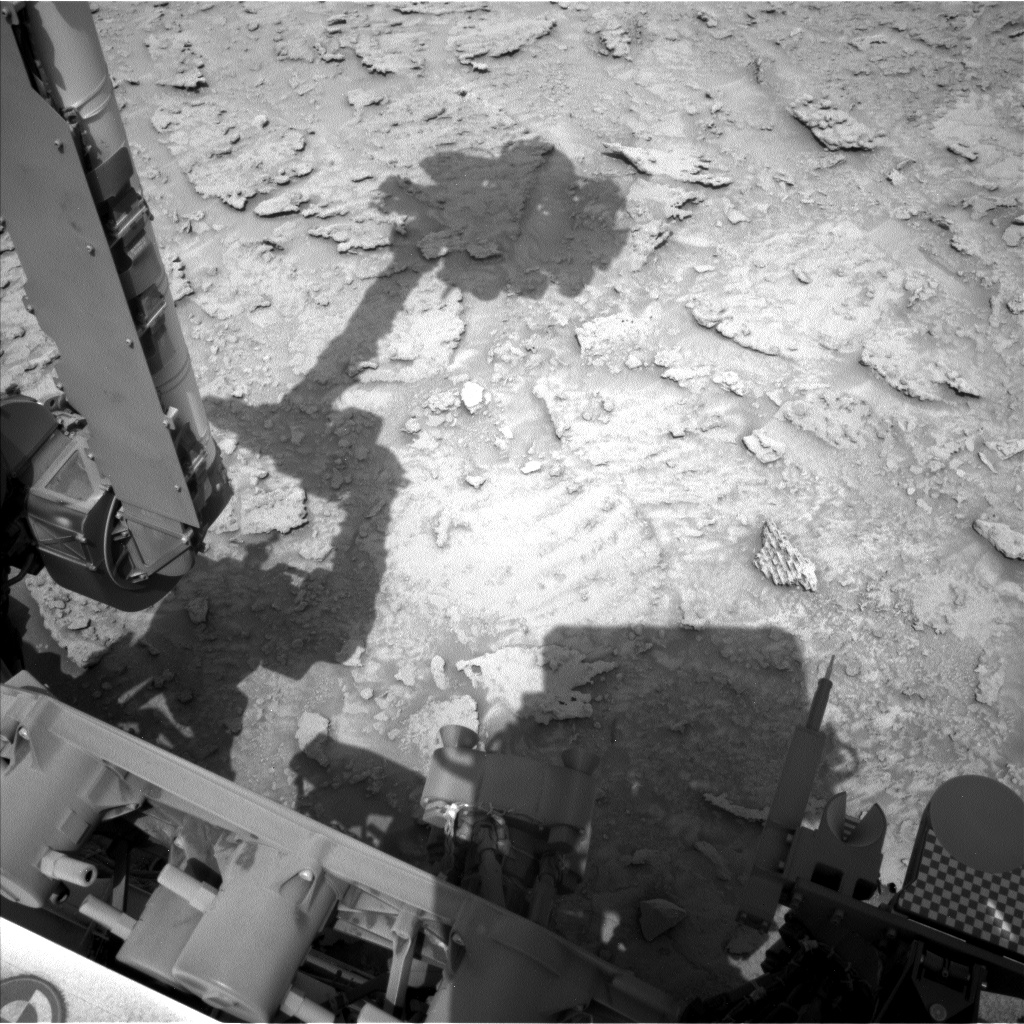
Curiosity Left B Navigation Camera image taken on Sol 3672, December 5, 2022.
Image credit: NASA/JPL-Caltech
“We worked to recover the “Roxinho” MAHLI target, but also brought in a new target “Shabono” which we will brush to remove any pesky dust and will inspect,” Amador-French adds, with both MAHLI and the Alpha Particle X-Ray Spectrometer (APXS).

Curiosity Left B Navigation Camera image taken on Sol 3672, December 5, 2022.
Image credit: NASA/JPL-Caltech
Rhythmically layered bedrock
“Shabono is another example of the lovely rhythmically layered bedrock,” Amador-French explains. Robot operators are also using the MAHLI camera to image the Chemistry & Mineralogy X-Ray Diffraction/X-Ray Fluorescence Instrument (CheMin) inlet funnel for any remaining debris after the rover’s “Canaima” drill campaign back in October – a requirement before any new sample is delivered to CheMin.

Curiosity Left B Navigation Camera image taken on Sol 3672, December 5, 2022.
Image credit: NASA/JPL-Caltech
Curiosity controllers will recover the same drive previously planned on last Wednesday. This drive will be about 50 feet (15 meters) and will set the robot up to perform contact science on an interesting slab of bedrock that the science team is considering for its next sampling campaign.
Untargeted observations
The third sol of the plan (Sol 3673) includes typical untargeted observations – using the Chemistry and Camera (ChemCam) Autonomous Exploration for Gathering Increased Science – a software suite that permits the rover to autonomously detect and prioritize targets.
As for the AEGIS capabilities to autonomously select a Laser Induced Breakdown Spectroscopy (LIBS) target: “It’s so nice” Amador-French concludes “when the rover does the thinking for us, as well as our regular environmental monitoring observations.”

Curiosity Left B Navigation Camera image taken on Sol 3672, December 5, 2022.
Image credit: NASA/JPL-Caltech

Jezero Crater – home base for Perseverance rover.
Credit: NASA/JPL-Caltech/MSSS/JHU-APL
NASA’s Mars 2020 Perseverance rover has snapped over 200,000 images since it landed on Mars within the Jezero Crater in February 2021 – and there have been surprises.
Arizona State University’s Jim Bell is NASA’s principal investigator for Mastcam-Z – two cameras that are inside the box that looks like a rectangular crow’s nest atop the rover’s pivoting mast.

ASU’s Jim Bell.
Credit: ASU/Stephen Filmer/Inside Outer Space screengrab
Perseverance is busily gathering specimens for the anticipated fetch and fly of pre-plucked collectibles by the Mars Sample Return project NASA/European Space Agency undertaking in the 2030s.
Contingency sample site
To assist in that effort, the robot’s Mastcam-Z’s next role will be helping locate and create a contingency sample site.
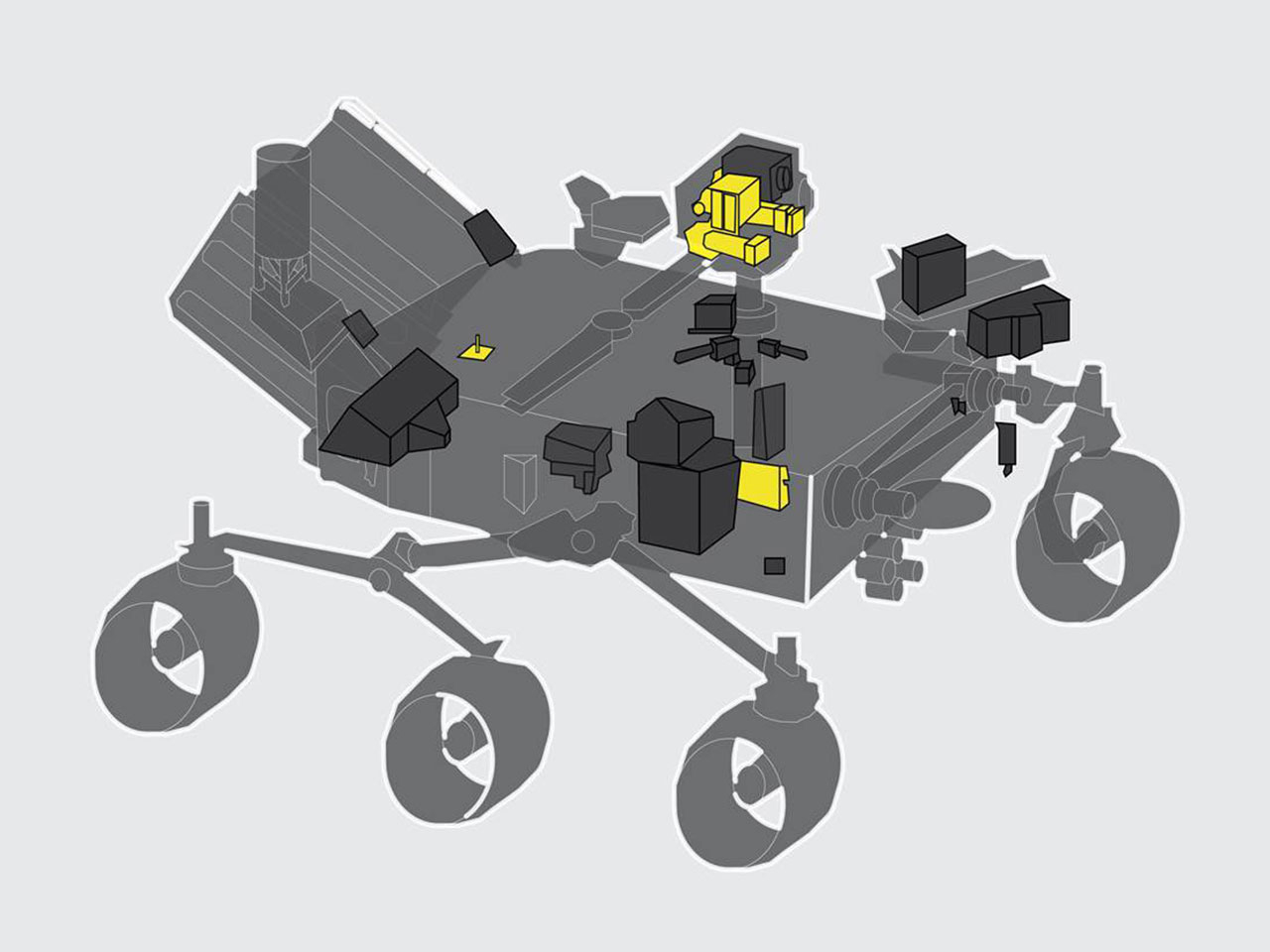
Mastcam-Z is mounted on the rover mast at the eye level of a 6 ½-foot-tall person (2 meters tall). The cameras are separated by 9.5 inches (24.2 centimeters) to provide stereo vision.
Credit: NASA
“Sometime in the next month or so, we will take roughly half of the samples that we’ve collected so far and place them in a pretty boring flat area right in front of the [large] delta” – a geological feature of the Jezero Crater, Bell says in an ASU statement.
This site is a “just-in-case” backup plan by NASA, in the event the rover doesn’t operate as long as predicted.
Go to this ASU-provided video by Stephen Filmer that details what’s been observed to date by the Perseverance rover at Jezero Crater…with unexpected results at:
Go to: https://vimeo.com/776783614

