Author Archive
 Author:
  December 25th, 2022
Wait a Minute!
Space hardware tumbling out of orbit may lead to new unforeseen impacts on the environment and climate.
Due to the growing scale and pace of launch activities what is needed is better monitoring of the situation, as well as regulation to create an environmentally sustainable space industry.

Space debris plunges to Earth, burning its way through the atmosphere.
Image credit: The Aerospace Corporation
For more details, go to my SpaceNews story – “Studies flag environmental impact of reentry” – at:
https://spacenews.com/studies-flag-environmental-impact-of-reentry/
 Posted in

Image credit: NOAA
Spritacular is a citizen science project led by NASA’s Goddard Space Flight Center that aims to collect observations of sprites and other optical phenomena occurring above the thunderstorms – collectively known as Transient Luminous Events (TLEs).
The database generated from these observations will lay the groundwork for first-ever event catalog of TLEs that will greatly contribute to advancement of scientific studies.

Image credit: Nicolas Escurat, Dordogne,Nouvelle-Aquitaine,France
Atmospheric events
Over the last two decades, good quality cameras have become increasingly affordable which allowed more people than ever before to have access to the tools capable of documenting these powerful atmospheric events.
Spritacular project strives to establish a collaborative bridge among communities that are actively engaged in chasing these elusive phenomena, newcomers looking to learn more, and the researchers of atmospheric and space electricity.
Want to take part?
Go to this website at:

Credit: The Aerospace Corporation/Center for Space Policy and Strategy
An international open letter is calling upon leading space agencies to reduce risks from uncontrolled reentries of rocket bodies and other space objects.
The Outer Space Institute (OSI) published the December 19th call to action for “multilateral negotiations on a controlled reentry agreement.”
OSI is based at the University of British Columbia in Vancouver.
The Institute is a global network of space experts that addresses grand challenges facing the continued use and exploration of space.

One object that survived reentry of an Iridium satellite discovered on the ground – space junk that survived reentry of Iridium satellite on October 11, 2018.
(Photo courtesy Kings County Sheriff’s Office)
Reentry regime
“The uncontrolled reentry of space objects presents a significant, cumulative, fast-growing risk to human beings around the world. Uncontrolled rocket bodies are of particular concern,” states the letter to space agency leaders.
“We call on your agencies, working with your states’ foreign ministries, to initiate multilateral negotiations on a controlled reentry agreement, starting with rocket bodies. Recognizing that such negotiations take time, we further call on each of your states to unilaterally commit to a national controlled reentry regime,” the letter states.
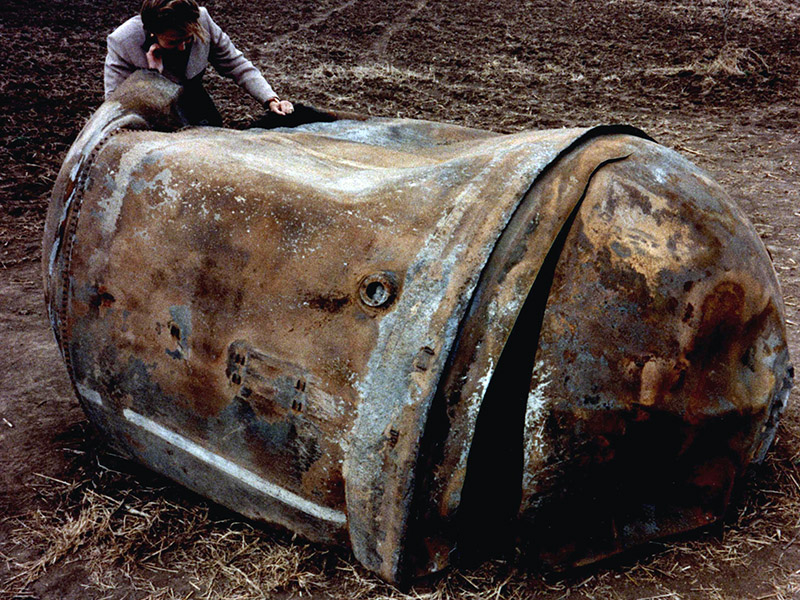
Main propellant tank of the second stage of a Delta 2 launch vehicle which landed near Georgetown, TX, on January 22, 1997. This approximately 250 kg tank is primarily a stainless steel structure and survived reentry relatively intact. Credit: NASA ODPO.
Casualty risks
While the letter focuses on the casualty risks from uncontrolled rocket body reentries, it also flags uncontrolled satellite reentries as a concern, “and may eventually dominate the casualty risk should tens of thousands of medium-sized to large satellites be placed into orbit.”
The OSI open letter suggests a reentry regime that first starts with rocket bodies, then expanded to satellites to reduce all uncontrolled reentry risks.
“Simply hoping that uncontrolled reentries will not cause harm is an unsustainable strategy. With leadership, cooperation and global goodwill, these preventable and therefore unnecessary dangers can be greatly reduced,” the letter concludes.

China’s Long March 5B’s core stage.
Credit: The Aerospace Corporation
Space fallout
Cited in the letter are accounts of uncontrolled space junk reaching land. For example, pieces of a Chinese Long March 5B rocket damaged buildings in the Ivory Coast in 2020.
In July 2022, the breakup of another Long March 5B was visible from the ground in Borneo, and sizable pieces were later found.
On November 4, 2022, another Long March 5B reentered over the Pacific Ocean southwest of Guatemala.
Fuel tanks, pressure vessels
China is not the only actor allowing rocket bodies to reenter in uncontrolled ways, the letter explains.
In 2016, a U.S. SpaceX Falcon 9 second stage was abandoned in orbit, reentering over Indonesia with two refrigerator-sized fuel tanks reaching the ground intact.

Hefty piece of SpaceX space junk found in Australia last July.
Image courtesy: Brad Tucker
In 2018, a number of smaller titanium pressure vessels from a Russian Zenit upper stage reached the ground in Peru.
You can read the full, open letter here – as well as add your name to the list of signatories at:
For more information on the Outer Space Institute, go to:

Image credit: HPS
A drag sail has been successfully deployed in a test meant to showcase the ability to hasten a spacecraft’s reentry and help curb the continuing and uncontrolled pollution of space.
The Drag Augmentation Deorbiting Subsystem (ADEO), carried by D-Orbit’s ION spacecraft, was launched by a SpaceX Falcon 9 booster on June 30, 2021.
This autonomous braking sail comes from the Munich-based space company High Performance Space Structure Systems.

ADEO successfully deployed from D-Orbit’s ION satellite carrier.
Image credit: HPS
The promise of ADEO is to complete deorbit of a spacecraft many years faster than current “unbraked” satellites.

Image credit: ESA/UNOOSA
For an informative video on the ADEO, go to:
http://www.hps-gmbh.com/wp-content/uploads/2020/11/ADEO-L_All-Scenes_Text_HQ-k.mp4
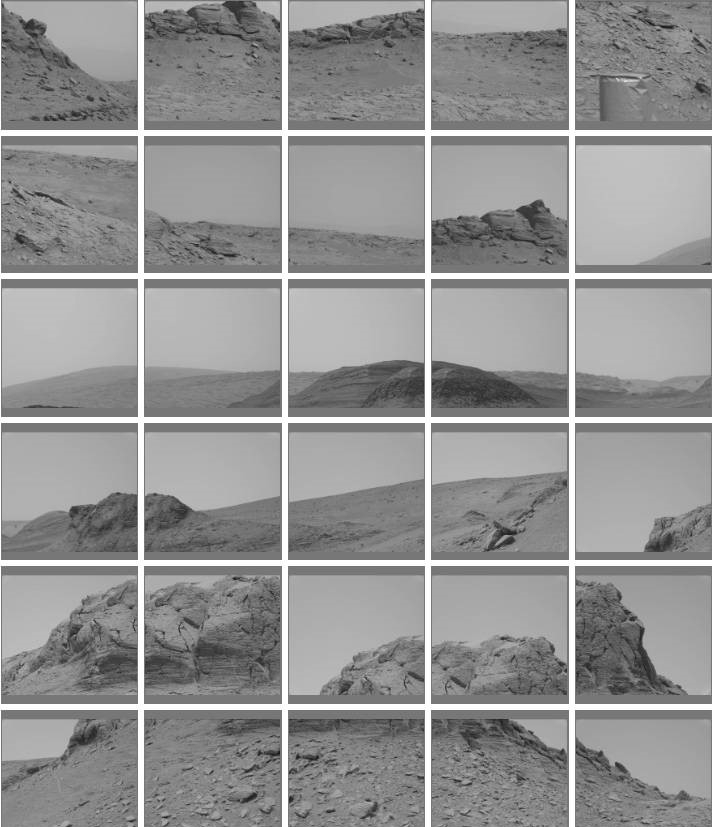
NASA’s Curiosity Mars rover at the Gale Crater landing area is now performing Sol 3687 tasks.
Here’s a sampling of new imagery from the robot:

Curiosity image (above) of the “Amapari” drill hole, but not the desired depth as the Mars research team had hoped. There was insufficient sample in the drill stem for analysis by the robot’s instruments. Image produced by the rover’s Mars Hand Lens Imager on Sol 3685, December 18, 2022. Image credit: NASA/JPL-Caltech/MSSS
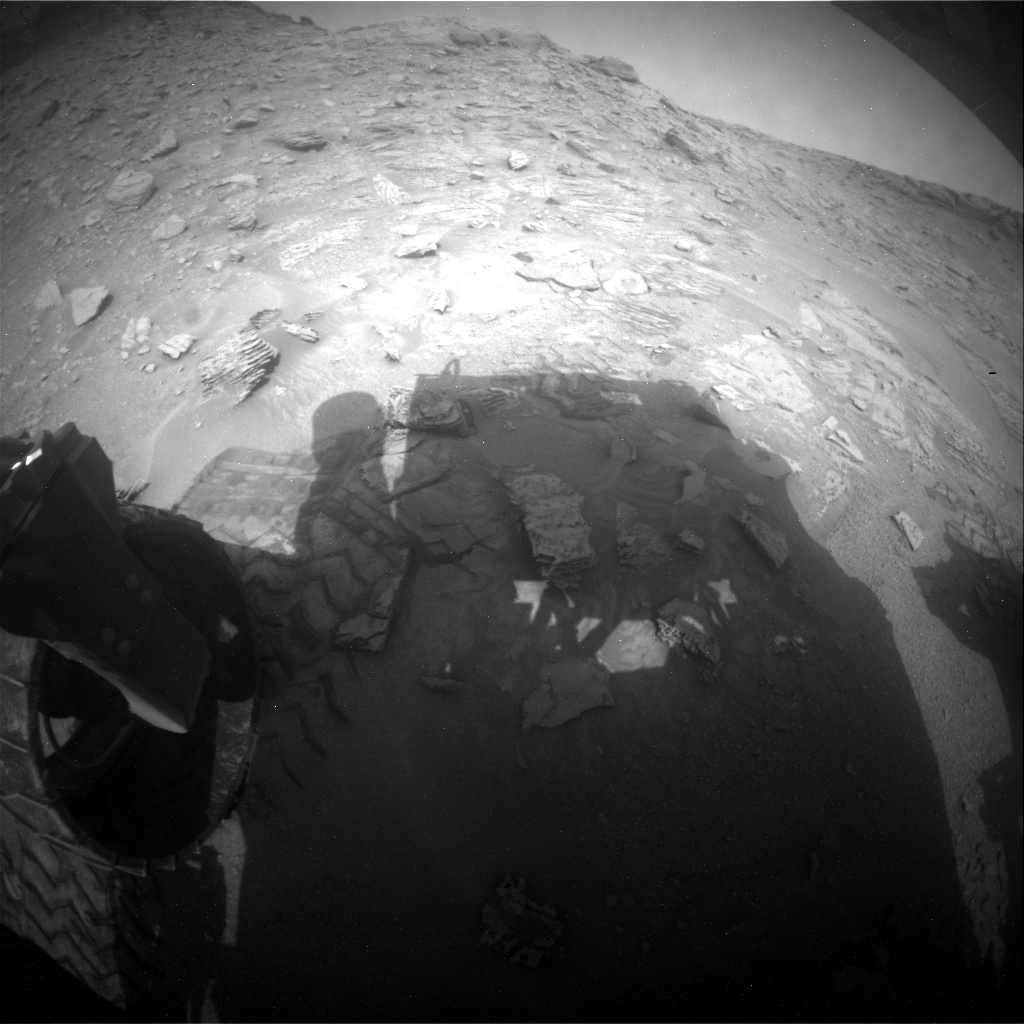
Curiosity Rear Right B Hazard Avoidance Camera image taken on Sol 3685, December 18, 2022.
Credit: NASA/JPL-Caltech
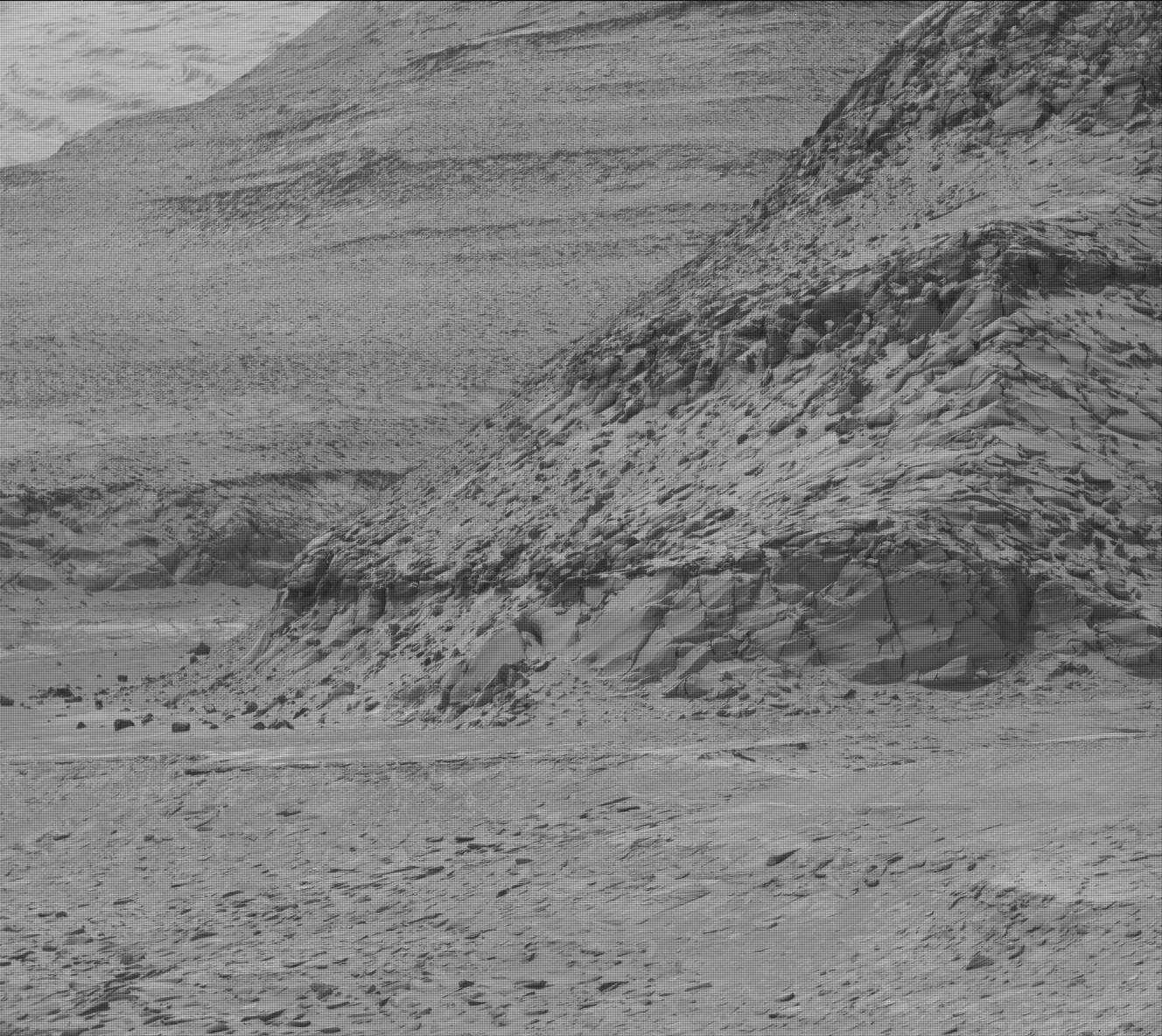
Curiosity Mast Camera image acquired on Sol 3684, December 17, 2022.
Credit: NASA/JPL-Caltech/MSSS
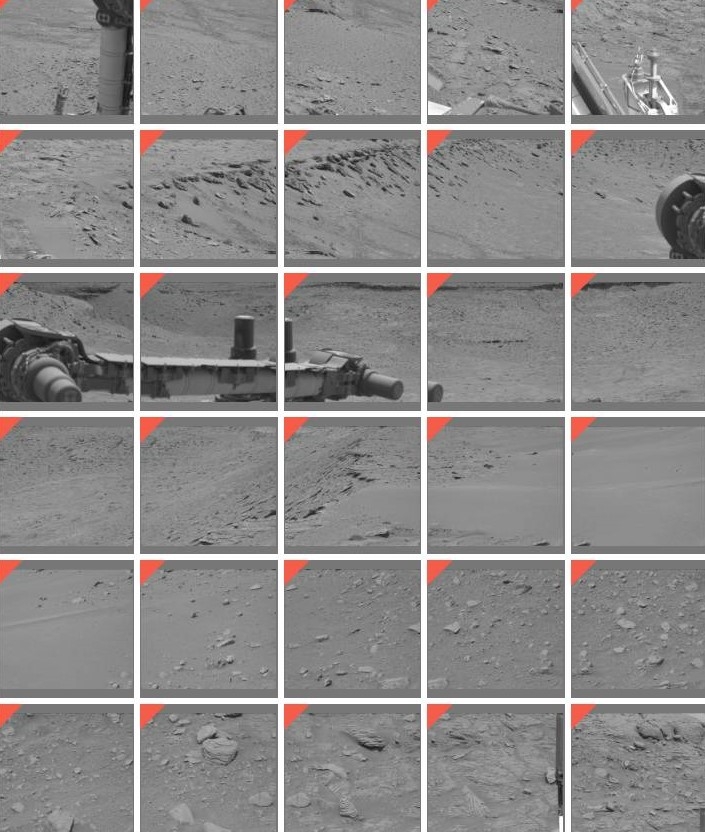
Curiosity Mast Camera imagery acquired on Sol 3684, December 17, 2022.
Credit: NASA/JPL-Caltech/MSSS
Curiosity Mast Camera imagery acquired on Sol 3684, December 17, 2022.
Credit: NASA/JPL-Caltech/MSSS
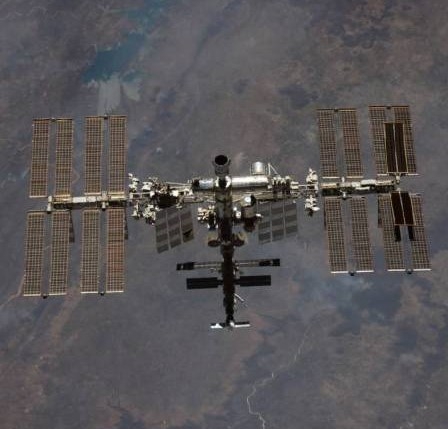
International Space Station.
Image credit: Roscosmos
That coolant problem with Russia’s Soyuz MS-22 spacecraft docked to the International Space Station — perhaps caused by a micrometeoroid or space debris getting into the spacecraft’s external cooler-radiator – is receiving top-level attention.
In a series of postings from Roscosmos via their Telegram channel they report that two working groups have been established “to determine the causes of the emergency situation, analyze the technical condition of the spacecraft and develop recommendations for further actions by ground specialists and the crew of the Russian segment of the station.”
That special commission must decide on the possibility or impossibility of further use of the Soyuz MS-22 spacecraft to return astronauts to Earth, which is planned for March 2023, Roscosmos explains.
“There is no need for emergency evacuation at this time,” states Roscosmos in one Telegram channel posting.
Decision tree
On December 18, a robotic arm toting cameras examined the outer surface of the troubled Soyuz.
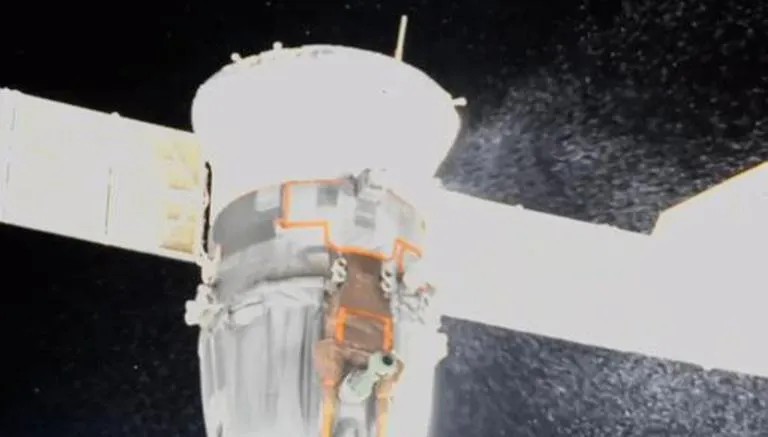
Coolant spraying instrument-assembly compartment of the Soyuz spacecraft.
Image credit: NASA
“The analysis of the data made it possible to find a possible place of damage to the instrument-assembly compartment of the ship. At the end of December, the conclusions of the working groups will be heard and plans for the future will be outlined,” noted a Roscosmos Telegram channel posting.
On one hand, a decision could be in March 2023 to carry out a regular crew change of the ISS Russian segment.
Soyuz replacement
Alternatively, a decision could be made to quickly prepare for launch of an uncrewed Soyuz MS-23 to replace the compromised Soyuz MS-22.
That Soyuz MS-23 has already passed part of the tests before the scheduled launch in March. Another commission task is to make a decision on the further flight program of the Russian segment.
Roscosmos chief, Yury Borisov, told Russia’s Izvestia newspaper: “The situation is really not very pleasant. Of course, nothing threatens the crew now. They are on the ISS.”
Borisov added that at the end of December, “I think the experts will decide how we will get out of this situation.”

Allen Telescope Array dedicated to astronomical observations and a simultaneous search for extraterrestrial intelligence (SETI).
Image credit: Seth Shostak/SETI Institute
The well-known Fermi Paradox, “Where are they?” proposes that Earth may be the only civilization, since there is no evidence for extraterrestrial visits.
A research paper offers a new solution to the Fermi Paradox, authored by Amri Wandel of the Racah Institute of Physics, The Hebrew University of Jerusalem.
“Probes or visits from putative alien civilizations have a very low probability until a civilization reaches a certain age (called the Contact Era) after the onset of radio communications,” Wandel explains in the paper: “The Fermi Paradox revisited: Technosignatures and the Contact Era.”

“Where is everybody?” asked physicist Enrico Fermi during a discussion with colleagues in 1950.
Image credit: National Archives
Physical probes
The Contact Era, Wandel adds, is the time since the onset of radio transmissions at which the contact probability becomes of order unity.
“At that time alien probes (or messages) become more likely. Unless civilizations are highly abundant, the Contact Era is shown to be of the order of a few hundred to a few thousand years and may be applied not only to physical probes but also to transmissions (i.e. SETI),” the research paper explains.
“Consequently, it is shown that civilizations are unlikely to be able to inter-communicate unless their communicative lifetime is at least a few thousand years,” Wandel’s research paper observes.
Lack of detection
Wandel notes that, of course, there are many caveats, such as:
- the civilization may not be communicative, or directed signals may have been sent when we were not listening.
- if a civilization sufficiently nearby has sent probes to the Solar System, its eventual communication with the probes would be directed at Earth and may be detected by SETI.
- the probes may be autonomous or communications may be seldom.

The Atacama Large Millimeter/submillimeter Array (ALMA) in northern Chile’s Atacama desert.
Credit: ESO/B. Tafreshi (twanight.org)
The paper, accepted for publication in the Astrophysical Journal, concludes that for directed signals, “the Contact Era may apply not only to physical probes and alien visits but also to alien intended transmissions, and eventually explain the lack of detections by SETI.”
To access the paper — “The Fermi Paradox revisited: Technosignatures and the Contact Era” – go to:

Shown at Congressional hearing, Video 1 2021 flyby movie showing a purported UAP.
Credit: Counterterrorism, Counterintelligence, and Counterproliferation Subcommittee/Inside Outer Space screengrab

Credit: Breakthrough Listen
The results are in from the first radio technosignature search involving pre-planned observations to synchronize with exoplanets during their transits.
A survey of a dozen exoplanets in the Kepler field has been performed using a Breakthrough Listen search code called “turboSETI” – an analysis tool.
The facility used in the search was the Robert C. Byrd Green Bank Telescope (GBT), based in West Virginia.

Credit: SETI Post-detection Hub
Thirteen citizen scientists volunteered their time to assist the science team with the further filtering of the turboSETI events.
A large list of “signals-of-interest” was reduced to two. However, these signals do not rise to the level of even “candidate” technosignature signals, the research team reports.
New ground
In the process, the research team hopes that the “new ground” that has been broken in radio technosignature parameter space “will be extended by more synchronized SETI searches in the future, across many more instruments and teams.”
For more information, go to: “Signals of Interest” Turn Up in SETI Search Aided by Citizen Scientists by Micah Hanks in The Intelligence Brief
https://thedebrief.org/signals-of-interest-turn-up-in-seti-search-aided-by-citizen-scientists/
For a detailed look at this search and its results, go to the research paper — “A Green Bank Telescope search for narrowband technosignatures between 1.1 – 1.9 GHz during 12 Kepler planetary transits” — at:
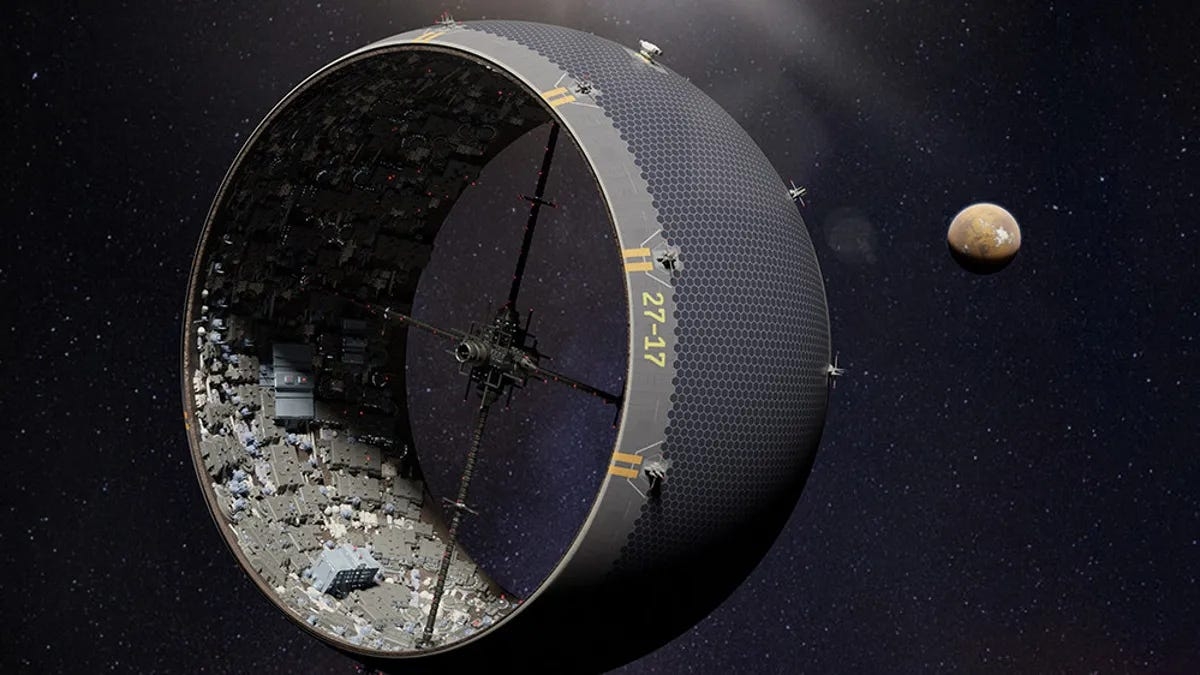
Rochester researchers imagine covering an asteroid in a flexible, mesh bag made of ultralight and high-strength carbon nanofibers as the key to creating human cities in space.
Image credit: University of Rochester illustration/Michael Osadciw)
Researchers have proposed using near-Earth asteroids (NEAs) as a platform for humanity’s expansion into space.
Due to NEA trajectories, a habitat built on an asteroid has implications for interplanetary transport. Manipulating an asteroid’s extensive mass could create shielding from the hazards of space, such as solar radiation.
In recent research paper, what’s being suggested is carefully spinning such a NEA habitat so artificial gravity can be generated for human occupants, ideal for long-term space travel.
For detailed information, go to “Habitat Bennu: Design Concepts for Spinning Habitats Constructed From Rubble Pile Near-Earth Asteroids” at:
https://www.frontiersin.org/articles/10.3389/fspas.2021.645363/full

